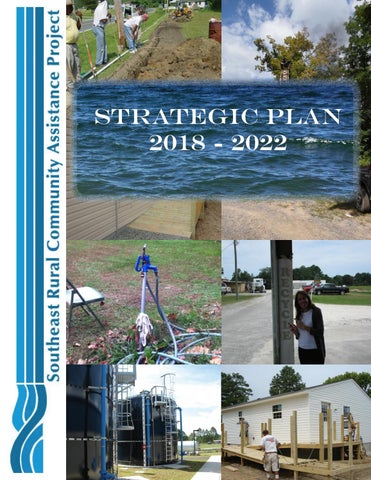
Strategic Plan 2018 - 2022
1
Southeast Rural Community Assistance Project, Inc. Strategic Plan 2018 - 2022 347 Campbell Ave. Roanoke, VA 24016 www.sercap.org
“SERCAP’s mission is to improve the quality of life of low-income individuals by promoting affordable water and wastewater facilities, community development, environmental health, and economic self-sufficiency.”
Table of Contents
Introduction 5 History, Mission, Vision, and Core Values 6 5-Year Strategic Goals & Objectives
7
Methodology 8 Board of Directors & Staff
10
Conclusion 11
4
Introduction Southeast Rural Community Assistance Project, Inc. (SERCAP) is a 501(C)3 Nonprofit Organization that provides training, technical, and financial assistance to both low-income individuals and rural communities in order to address water, wastewater, housing, and community development challenges. SERCAP strives to improve the quality of life of its clients and the residents of rural communities by: 1. 2. 3. 4.
Providing reliable access to clean, safe drinking water Implementing environmentally sound wastewater solutions Improving the Environmental Health of both residents and communities-at-large Improving the Economic Self-sufficiency for both residents and communities
SERCAP is headquartered in Roanoke, VA, but serves seven southeastern states, including: Delaware, Maryland, Virginia, North Carolina, South Carolina, Georgia, and Florida. SERCAP has five satellite offices throughout its seven state service region, including: Frankford, DE; Powhattan, VA; Raleigh, NC; Winnsboro, SC; and Gainesville, FL. Additionally, SERCAP works with contractors in western Maryland and Georgia. SERCAP’s offices and staff are located throughout the agency’s service region, in close proximity to clients and the rural communities in the agency’s target market. This makes it easy for SERCAP to provide personal service and excellent technical assistance to its clients. SERCAP assists rural communities to: develop quality water and wastewater systems, access funding for facilities development purposes, and plan for the future. SERCAP also works with communities to maintain and improve its affordable housing stock by providing housing rehabilitation services and holding part ownership in several multi-family housing projects. SERCAP’s primary strengths are the agency’s skilled staff, and the willingness of the agency to listen and identify the true needs of both the individual clients and the communities that SERCAP assists. In order to make progress toward accomplishing the agency’s mission of improving the quality of life for low-income individuals, SERCAP engaged in a strategic planning process to set goals, objectives, and action steps that will move the agency forward over the next five years. Several Members of SERCAP’s Board of Directors and Staff participated in the development of the 2018-2022 5 Year Strategic Plan, (with the assistance of an outside consultant, SERCAP’s Board and Staff evaluated the agency’s existing Mission Statement, developed a Vision Statement and a set of Core Values, established four key goals, and outlined Objectives and Action Steps to achieve the goals). The strategic planning process focused on where does SERCAP wants to go in the future and how to get there successfully. SERCAP’s 2018-2022 5 Year Strategic Plan document lays the groundwork for the agency for the next five (5) years. The plan outlines SERCAP’s goals and the specific action steps that the Board of Directors and Staff will need to take in order to achieve them.
5
SERCAP’s History, Mission, Vision, and Core Values History SERCAP was founded in 1969 as the Demonstration Water Project (DWP), and was later incorporated as the Virginia Water Project. The organization began following the completion of a needs assessment of low-income communities in Virginia’s Roanoke Valley which revealed that access to safe, affordable water and wastewater systems was the most pressing need at that time. Lack of access to safe drinking water and environmentally sound wastewater facilities had been largely unacknowledged by both government and the general public as a problem in 20th Century America. SERCAP is one of six (6) regional training and technical resource centers across the United States. Over the past 48+ years, SERCAP has earned the well-deserved reputation as experts in the field of water and wastewater service delivery. Through the work of SERCAP’s dedicated staff, agency partners, and community based organizations across the region, SERCAP is able to offer training, technical, and financial assistance for water, wastewater, housing, and community development projects, at little cost to both individuals and rural communities.
Mission SERCAP’s Mission is to improve the quality of life for low-income individuals by promoting affordable water and wastewater facilities, community development, environmental health, and economic self-sufficiency.
Vision SERCAP’s Vision is to provide communities with the resources and opportunities for a safe and healthy environment.
Core Values
SERCAP’s Core Values are: • • • • •
Compassion Integrity Delivering Excellent Service Respect Commitment
6
5-Year Strategic Goals and Objectives Goal 1 Secure and Diversify Sustainable Funding Objective 1: Maintain and Grow Public Funding Action Step 1: Seek Continual Congressional Support for SERCAP Action Step 2: Continue Grant Writing for Each State Objective 2: Increase Amount of Private Funding Action Step 1: Build Rapport with Corporate and Private Donors Action Step 2: Increase Corporate and Individual Donations Action Step 3: Foundational Support: Grants and Relationship Building Action Step 4: Fee-for-Service (State Contracts, Partnership Opportunities, etc.)
Goal 3 Expand Organizational Profile Objective 1:
Action Step 1: Develop List of Influential People (Staff and Board) Action Step 2: Increase the Number of Events, in all 7 States, where SERCAP Exhibits or Distributes Handouts Action Step 3: Develop/Establish Board Assisted Fund-raisers Objective 2:
Action Step 1: Conduct Community Needs Assessment Evaluate Existing Programs Action Step 2: Utilize VFC Program and Other Programs to Meet Identified Needs Objective 2: Partner & Network w/ Other Agencies to Identify Resources
Action Step 1: Action Step 2: Action Step 3:
Objective 3:
Pursue Networking Opportunities Build Rapport with Partner Agencies Include Partner Agencies in Focus Groups
Develop New Programs & Services to Meet Identified Needs
Action Step 1: Explore Potential New Programs and Services Action Step 2: Develop Pilot Programs where Needed and Realistic Action Step 3: Develop Strong Referral Networks with other Community Organizations to Meet Needs Not Met by SERCAP
Host Community Forums and Focus Groups
Action Step 1: Action Step 2: Action Step 3: Action Step 4: Objective 3:
Goal 2 Provide Sustainability for Communities Objective 1: Identify Community Needs in All Seven States
Create an Awareness Among Influential People and the Public
Hold at least one Focus Group in Each State Hold Town Hall Meetings Speak at City/Town Council Meetings Support Community Events
Expand Branding Initiatives
Action Step 1: Explore Social Media and Other Outlets Action Step 2: Update SERCAP’s Website and Create a VFC Website Action Step 3: Commit Financial Resources to Branding and Marketing Efforts Action Step 4: Establish a Consistent Agency Message – coming from Board, Staff, Contractors, and any other Partner Organizations
Goal 4 Strengthen Agency Leadership Objective 1:
Provide Additional Board Development
Action Step 1: Action Step 2: Objective 2:
Board Training on Policy and Governance Create Board Skill Matrix
Provide Staff Training
Action Step 1: Establish On-Boarding for New Staff Members Action Step 2: Establish Department driven Training to Improve Skills and Job Readiness Action Step 3: Assessment-Maximizing Skills of Staff (Develop a Skills Matrix per Department) Action Step 4: Hold Bi-Annual (Every other Year) Staff Retreat Objective 3:
Collaboration
Action Step 1: Cultivate and Maintain Current Partners & Relationships Action Step 2: Share Resources for Community Development and Training
7
Methodology To develop the 2018-2022 Strategic Plan SERCAP used a combination of tools and resources in order to define goals, objectives, and action steps that will move the agency forward. The tools and resources used included: SERCAP’s Annual Community Needs Assessment, an analysis of SERCAP’s Outcomes and Impacts from the past 18 months, a twoday Strategic Planning session with select Staff members and members of the Board of Directors, and the input of an outside consultant who facilitated the Strategic Planning session and offered an outside perspective to the process. One of the key resources used as a part of the Strategic Planning process was SERCAP’s 2016/2017 Community Needs Assessment. Each program year SERCAP conducts a comprehensive needs assessment including input from community stakeholders and leaders, community members, partners, outside data resources such as the American Communities Survey, and SERCAP field staff. As part of the annual needs assessment SERCAP distributes and collects community needs surveys to both community leaders and community members, distributes and collects client satisfactions surveys, collects information from community meetings, reviews outside data sources, and reviews internal data such as the waiting lists for services. During the 2016/2017 Community Needs Assessment, SERCAP also conducted five (5) community focus groups in communities across the Commonwealth of Virginia, including: Pulaski County, Wythe County, Northumberland County, the Eastern Shore, and Buckingham County. The data collected during the needs assessment showed that the top community needs that SERCAP can address, included: 1. Facilities Development - Grant Funding for Large Scale Community Projects 2. Technical Assistance to Support Community Water/Wastewater Infrastructure and Facilities 3. Grant/Loan Funding for Individuals for Individual Household Rehabilitation Projects 4. Housing Rehabilitation 5. Advocacy, Education, and Resources
8
Methodology, Cont’d During the development of SERCAP’s goals, objectives, and action steps for the 2018-2022 Strategic Plan, SERCAP focused especially on increasing the available funding for Facilities Development Grants, Grant/Loan Funding for Individuals, and unrestricted funds for Housing Rehabilitation Projects. Additionally, SERCAP focused on the need for Advocacy, Education, and Resources to expand recognition of SERCAP by the general public, allowing the agency to grow its financial support from individuals, companies, and private foundations. During the Strategic Planning Session with select members of SERCAP’s Staff and members of the Board of Directors, SERCAP examined the agency’s mission statement and determined that is was still relevant and in-line with the direction that the agency wants to go in the future. The staff and Board members also defined the agency’s Vision and developed a set of Core Values using a consensus matrix tool. Once the Vision and Core Values were established, the Staff and Board moved into defining specific goals, objectives, and action steps. The goals, objectives, and action steps will guide the staff in their day-to-day work and help SERCAP to achieve its Mission by keeping the agency focused on long-term outcomes and overall impact, rather than solely focusing on service delivery. SERCAP’s 2018-2022 Strategic Plan is a Living Document. While the four primary Strategic Goals spelled out in this document are long-term and on-going, many of the action steps are short-term or medium-term. As such, each year SERCAP’s management team will review the plan and action steps and make adjustments to the Annual Work Plan, accordingly. By keeping the Strategic Plan in the forefront of its work, SERCAP will be able to better serve clients and communities by focusing on long-term outcomes. SERCAP’s Board of Directors and staff will work together to maintain focus on the Strategic Plan, and the Board will receive quarterly updates at each Board Meeting.
9
SERCAP’s Board of Directors & Staff SERCAP’s Board of Directors Terry Lewis - Chairman Walter Fleming, Vice Chairman ✳ Swynice Hawkins, Secretary ✳ Shawn Utt, Treasurer Bertha Armstrong ✳ Keith Ashby ✳ Kevin Belcher ✳ James A. Brunswick, Jr. John Edwards ✳ George M. Fitz-Hugh, Jr. ✳ Rev. James Johnson Clarence Martin ✳ Freddy Mitchell ✳ Carmela Moore-Orr ✳ Winfred Owens Dr. Alfred Roberts ✳ Claude Thomas ✳ E. Marie Watson
SERCAP’s Staff Hope F. Cupit, CPA - President & CEO Bob Cole ✳ Amanda Howe ✳ Beth Pusha ✳ Russ Rice Lisa Banks ✳ Katherine Bradford ✳ Rick Crews ✳ Andy Crocker ✳ John Crowder ✳ Joan Douglas Valerie Falconieri ✳ Joe Fields ✳ Val Green ✳ Michael Haas ✳ Jean Holloway Lauren Mason ✳ Allen McEntire ✳ Kim Overton ✳ Hayden Peterson ✳ Kenny Rodgers ✳ Kim Rutledge Sam Sarmadi ✳ Andre Saunders ✳ Ellen Smith ✳ LaJuan Thomas ✳ LaFonia Thornton Leslie Tramuel ✳ Pat Walker ✳ Randy Welch ✳ Angela Whitfield ✳ Cherry Wilson
10
Conclusion Following the conclusion of the 2018-2022 strategic planning process, SERCAP is, now more than ever, committed to providing reliable access to clean, safe drinking water, environmentally sound wastewater solutions, and community development services to low-income individuals and rural communities. SERCAP’s Board of Directors and Staff are dedicated to SERCAP’s Mission: to improve the quality of life for low-income individuals by promoting affordable water and wastewater facilities, community development, environmental health, and economic self-sufficiency. In order to accomplish this Mission, SERCAP’s Board and Staff members identified four key Goals: 1. 2. 3. 4.
Secure and Diversify Sustainable Funding Provide Sustainability for Communities Expand Organizational Profile Strengthen Agency Leadership
Actively engaging in the Objectives and Action Steps, as outlined in this Strategic Plan, to successfully accomplish these Goals will help SERCAP to pursue its Mission by: 1. Bringing in additional unrestricted funding that will allow SERCAP to complete more projects that promote Affordable Water and Wastewater Facilities and Community Development Projects 2. Providing Communities with Resources and Tools that will allow them to improve and/or maintain their Water and Wastewater Facilities, support Community Development Projects, improve their own Economic Self-sufficiency, and improve the Quality of Life for their residents. 3. Expanding SERCAP’s visibility to the general public, enabling the potential for new funding sources and new clients, allowing the agency to reach more people and provide more services 4. Strengthening SERCAP’s Board and Staff Leadership will help the agency to be overall more successful in the accomplishment of its Mission Overall, SERCAP is working to become less dependent on government funding and to increase its footprint throughout its service region, especially in the states outside of Virginia. SERCAP has already begun to make strides in some of these areas, but as the agency moves forward, establishing new and consistent funding sources and partnerships will be the most key element in the organization’s overall success to improve the quality of life for low-income individuals, and provide reliable access to clean, safe drinking water and environmentally sound wastewater solutions.
11
SERCAP
347 Campbell Avenue Roanoke, VA 24016 540-345-1184 vwp@sercap.org
www.sercap.org