Vol. 64 No. 2 | March 2026
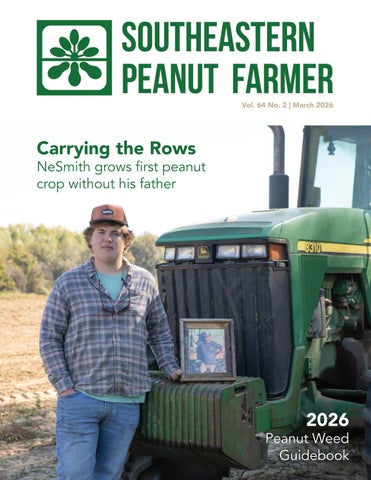
Carrying the Rows
NeSmith grows first peanut crop without his father
2026
Peanut Weed Guidebook
March 2026 | Southeastern Peanut Farmer
1
2 Southeastern Peanut Farmer | March 2026
A Look Inside
March 2026 | Peanut Weed Guidebook
IN THIS ISSUE 6 | CARRYING THE ROWS Sixteen-year-old Waylon NeSmith, Sycamore, Ga., farms his first crop of peanuts following his father's passing in 2025.
18 | PEANUT LEADERSHIP ACADEMY CLASS XIV Class XIV of the Peanut Leadership Academy kicks off in Auburn, Ala. for their first session of the two-year program.
22 | PEANUT EFFICIENCY AWARD NOMINATIONS OPEN The Peanut Efficiency Awards is seeking nominations for 2026. Applications are due by April 15, 2026.
DEPARTMENTS 8 | CHECKOFF REPORT
Alabama Peanut Producers Association Florida Peanut Producers Association Georgia Peanut Commission Mississippi Peanut Growers Association
23 | MENTAL HEALTH 24 | WASHINGTON OUTLOOK 26 | SOUTHERN PEANUT GROWERS UPDATE
10 2026 PEANUT WEED GUIDEBOOK
The Peanut Weed Guidebook provides weed control recommendations as well as weed management tips for 2026 based on observations from the 2025 growing season regarding mistakes or issues farmers faced. On The Cover Sixteen-year-old Waylon NeSmith, Sycamore, Ga., farms his first crop of peanuts without his father, Isaac, in 2025. Photo by Joy Crosby.
SEPF TEAM Editor Joy Carter Crosby joycrosby@gapeanuts.com 229.386.3690
Director of Jessie Bland Advertising jessie@gapeanuts.com 229.386.3472
Contributing Peyton Woods Writing peyton@alpeanuts.com 334.792.6482
Southeastern Peanut Farmer is published six times a year (Jan./Feb., March, April, May/June, July/Aug., and Oct./Nov.) by the Southern Peanut Farmers Federation. The publisher is not responsible for copy omission, typographical errors, or any unintentional errors that may occur, other than to correct it in the following issue. Any erroneous reflection which may occur in the columns of Southeastern Peanut Farmer will be corrected upon brought to the attention of the editor. (Phone 229-386-3690.) Postmaster: Send address changes (Form 3579) to Southeastern Peanut Farmer, P.O. Box 706, Tifton, Georgia, 31793. Circulation is free to qualified peanut growers and others allied to the industry. Periodical postage paid at Tifton, Georgia and additional mailing office. Editorial Content: Editorial copy from sources outside of the Southern Peanut Farmers Federation is sometimes presented for the information and interest of our members. Such material may, or may not, coincide with official Southern Peanut Farmers Federation policies. Publication of material does not necessarily imply its endorsement by the Southern Peanut Farmers Federation. For editorial concerns call 229-386-3690. No portion of this or past issues of the Southeastern Peanut Farmer may be reproduced in any form whatsoever without the written consent of the editor. By-lined articles appearing in this publication represent views of the authors and not necessarily those of the publisher. Advertising: The Publisher reserves the right to refuse any advertisement. Corrections to advertisements must be made after the first run. All billing offers subject to credit review. Advertisements contained in this publication do not represent an endorsement by the Southeastern Peanut Farmer or the Southern Peanut Farmers Federation. Use of trade names in this publication is for the purpose of providing specific information and is not a guarantee nor warranty of products named. For advertising concerns call 229-386-3472.
March 2026 | Southeastern Peanut Farmer
3
Editor’s thoughts March Means Peanuts and Agriculture
M
arch is a special time for those of us connected to agriculture. It's the month when we celebrate both National Peanut Month and National Agriculture Month, and it offers a perfect opportunity to recognize the people and partnerships that make our industry so strong.
For peanut farmers across the Southeast, peanuts are more than just a crop, they’re a way of life and a cornerstone of our rural economies. From planting to harvest, peanut producers demonstrate resilience, innovation and dedication year after year. Their work feeds families, supports communities and contributes significantly to the agricultural strength of our region. National Peanut Month shines a spotlight on one of the most versatile and nutritious foods grown in America. Whether it's peanut butter in a lunchbox, roasted peanuts at a ballgame or peanuts used in countless recipes, this humble legume plays an important role in kitchens across the country. But behind every peanut product is a farmer who has invested months of hard work and careful management to produce a safe, high-quality crop. At the same time, National Agriculture Month reminds us that peanuts are part of a much bigger story. Agriculture is the backbone of the Southeast's economy and culture. Our farmers grow the food, fiber and fuel that sustain our nation, while stewarding the land for future generations. This month also gives us a chance to share our story. Many consumers are generations removed from the farm, and they often don't realize the commitment, technology and stewardship involved in modern agriculture. By celebrating agriculture and peanuts in March, we help bridge that gap and remind people of the vital role farmers play every single day. As we recognize National Peanut Month and National Agriculture Month, I encourage everyone in our industry to take pride in the work we do. Share a peanut product with a neighbor, thank a farmer and take a moment to appreciate the impact agriculture has on our communities. The peanut industry has a long tradition of resilience, and that spirit continues today. With dedicated growers, strong research programs and industry partners working together, the future of peanuts in the Southeast remains bright. So this March, let's celebrate the crop, the people and the industry that make it all possible.
Events Peanut Proud Festival March 28, 2026, Blakely, Ga. For more info visit peanutproudfestival.com. USA Peanut Congress June 8-11, 2026, Amelia Island, Fla. For more info call 229-888-2508 or visit peanut-shellers.org. American Peanut Research and Educational Society July 14-16, 2026, San Juan, Puerto Rico. For more info visit apresinc.com. Southern Peanut Growers Conference July 21-23, 2026, Edgewater Beach Resort, Panama City Beach, Fla. For more info visit southernpeanutfarmers.org. American Peanut Shellers Association and National Peanut Buying Points Association Pre-Harvest Meeting Aug. 18-19, 2026, Albany, Ga. For more info call 229-888-2508 or visit peanut-shellers.org. Brooklet Peanut Festival Sept. 19, 2026, Brooklet, Ga. For more info visit the festival's website at brookletpeanutfestival.com. Plains Peanut Festival Sept. 26, 2026, Plains, Ga. For more info visit the festival's website at jimmycarterfriends.org. Georgia National Fair Oct. 8-18, 2026, Perry, Ga. For more info visit georgianationalfair.com. Sunbelt Ag Expo Oct. 20-22, 2026, Moultrie, Ga. For more info visit sunbeltexpo.com. Florida Farm Bureau Annual Meeting Oct. 28-30, 2026, Hilton Daytona Beach Oceanfront Resort, Daytona Beach, Fla. For more info visit floridafarmbureau.org.
Here’s to peanuts — and to agriculture!
National Peanut Festival Nov. 6-14, 2026, Dothan, Ala. For more info visit the festival's website at nationalpeanutfestival.com.
Joy Carter Crosby SEPF Editor
4 Southeastern Peanut Farmer | March 2026
Let us know about your event. Please send details to the editor at joycrosby@gapeanuts.com.
March 2026 | Southeastern Peanut Farmer
5
Sixteen-year-old Waylon NeSmith, Sycamore, Ga., farms his first crop of peanuts without his father, Isaac, in 2025.
Carrying the Rows
A 16-Year-Old's First Peanut Crop without his Father By Joy Crosby
F
arming has been part of the NeSmith family's story in Turner County, Georgia, for generations. But in 2025, that legacy faced one of its greatest tests.
At just 16 years old, Waylon NeSmith stepped into the cab of a tractor and planted his first peanut crop only weeks after losing his father, Isaac. It wasn't the season he had planned. But it became one that shaped his future. A Family Tradition The NeSmith family has farmed in Turner County since the late 1800s. Through the decades, the farm evolved alongside the peanut industry itself.
Waylon's great-grandfather, Jimmy NeSmith, began planting peanuts in 1954 and still lives on the farm today at 90 years old.
wheat and melons. Today the operation is known as NeSmith Farms.
Farming looked very different when Jimmy started. Earlier generations shelled peanut seed by hand on the porch before planting, and harvested peanuts in sacks loaded onto wagons and trucks.
A Sudden Loss
Over time, the farm adapted to new technology including peanut combines and the use of crop protectant products. Like many South Georgia farms, the operation diversified over the years with crops including peanuts, cotton, grain sorghum, soybeans,
6 Southeastern Peanut Farmer | March 2026
In 2025, the next generation unexpectedly stepped forward. On March 28, 2025, Isaac NeSmith passed away at the age of 41. The loss was devastating for the family and especially for Waylon, who was home when his father suffered a seizure. Waylon attempted CPR to save him. In the weeks that followed, the family worked together to keep the farm moving forward. Isaac had already planted 150 to 200 acres of watermelons before his passing, and Waylon helped relatives finish harvesting the crop.
At first, Waylon had not planned to farm in 2025. "I wasn't initially planning to farm this year," Waylon says. "But my uncle encouraged me to do it, so now I'm here." Planting His First Peanut Crop For his first season farming on his own, Waylon planted peanuts on family land he rented. He grew 45 acres of Georgia-12Y peanuts under irrigation and another 25 to 30 acres of Georgia-16HO dryland. Like many farmers, he quickly learned the challenges that come with raising a crop. Soon after planting, heavy rains crusted the soil and made it difficult for the peanuts to emerge. "They had a hard time coming up out the dirt," Waylon says. "It had rained just after I planted them, and I had to run a rotary hoe across them to get them to come up." Weed pressure and unpredictable weather created more challenges throughout the season. "It was affecting me both ways," he says. "The rain was holding me up, and so was the dry weather." Learning Without His Dad One of the hardest parts of the season had nothing to do with weather. Waylon had spent years helping his father on the farm, but he realized quickly how much knowledge
Family members help support Waylon during his first year of farming. Pictured left to right are Waylon's great grandparents, Jimmy and LaRue NeSmith; grandfather, Ken NeSmith, Waylon and his mom, Amanda Smith.
his dad carried about equipment and fieldwork. "I really wish I could have asked my dad about fine-tuning a bunch of equipment," he says. "He had it all memorized." Before, those details didn't seem important to remember since he could ask his dad. Instead, Waylon had to learn by asking others for help — something that didn't always come easily. "Don't be afraid to ask questions," he says. "That was one of my biggest problems." But he soon discovered that farmers in the community were willing to help. "Nobody out here wants you to fail," he says. "Most of them know you anyway, and they'll help if you ask." A Full Schedule Farming is only part of Waylon's daily routine. He is an 11th-grade student at Tiftarea Academy, where he attends school full time before leaving at 1 p.m. each day for work study and farm work.
Waylon NeSmith and his father, Isaac NeSmith, harvest peanuts together in 2020.
Twice a week he attends welding classes at Southern Regional Technical College. Until recently, he also worked
at South Georgia Oil Distributors in the afternoons before coming home to farm in the evenings. "He works more than some grown people do," his mother Amanda says. "And he still has good grades." Lessons From His Father Throughout the season, one lesson from Isaac stayed with him. "If you're going to do something, give it 110 percent," Waylon says. That advice pushed him through long nights in the field and the challenges of his first crop. "You can't do it halfway," he says. "You've got to give it everything you've got." Waylon plans to keep farming while finishing high school and hopes agriculture will remain part of his future. His family is proud of the way he stepped forward during a difficult year. "I'm very proud of him," Amanda says. "And I know his daddy would be so proud of him too." For Waylon, the 2025 peanut crop was about more than raising a crop. It was about honoring his father — and carrying the family's farming legacy into the next generation.
March 2026 | Southeastern Peanut Farmer
7
Checkoff Report
Investments Made by Growers for the Future of the Peanut Industry FPPA exhibits at Florida State Fair in Tampa The Florida Peanut Producers Association was proud to be featured in the Ag Hall of Fame at the Florida State Fair in Tampa, Feb. 5-16, 2026. The FPPA booth provided visitors with educational information highlighting peanut health and nutrition, and the important role peanuts play in a balanced diet. FPPA FPPA exhibit during the was joined by the National Peanut Board's Little Florida State Fair in Tampa. Peanut, who helped facilitate conversations about early peanut introduction and allergy awareness in a fun, engaging way for families. In partnership with UF/IFAS North Florida Research and Education Center, live peanut plants were grown and displayed at the booth, sparking curiosity and conversation about how peanuts are grown and produced in Florida. The hands-on display allowed fairgoers of all ages to see firsthand how peanut production works from the ground up. Through education, interaction and outreach, the Florida Peanut Producers Association enjoyed connecting with fair visitors and sharing the story of Florida peanuts.
Fresh from Florida Breakfast features Grilled PB&Js The Florida Peanut Producers Association was once again a supporting partner for the Fresh from Florida Breakfast on the opening day of the Florida State Fair in Tampa. The annual event celebrated Florida agriculture while showcasing the high-quality, Florida-grown products. Held at the start of the fair, the Fresh from Florida Breakfast welcomed fair officials, agricultural leaders, producers, and guests for a morning focused on Brittany Peacock, FPPA connection and appreciation. The event highlighted executive director, serves grilled PB&Js to attendees at the vital role agriculture plays in Florida's economy and the 2026 Fresh from Florida daily life and reinforced the importance of supporting breakfast. Florida farmers. The Florida Peanut Producers Association was proud to participate by grilling and serving more than 500 peanut butter and jelly sandwiches to attendees. The crowd favorite offered a delicious way to spotlight the peanut industry's role in providing nutritious, affordable food.
Agriscience Education Leadership Program Visit The Florida Peanut Producers Association hosted a group from the Agriscience Education Leadership Program (AELP) for a hands-on look at Florida agriculture. This program, organized by the Florida Department of Agriculture and Consumer Services, helps agricultural educators and leaders expand their knowledge of Florida's diverse ag industry through The Agriscience Education real-world experiences and on-site learning. During Leadership Program (AELP) the tour, participants explored the world of peanuts group gathers at Malone Peanut for a portion of their and cotton while touring Malone peanut mill, and Cloverleaf Gin Inc., and visiting the Florida Peanut Florida agriculture tour. Producers Association. Programs like AELP are helping shape the future of ag education by equipping teachers and advocates with the tools to share the story of agriculture.
8 Southeastern Peanut Farmer | March 2026
APPA hosts peanut grower production meetings The Alabama Peanut Producers Association hosted seven production meetings throughout February and early March 2026. More than 250 peanut growers attended to receive timely, researchbased updates from Auburn University peanut researchers and the Alabama Farmers receive timely, Cooperative updates Extension System research-based for the 2026 growing in preparation season at production for the upcoming meetings in Alabama. growing season. Topics and speakers were: Peanut Disease Management – Amanda Strayer-Scherer; Herbicide Control in Peanuts – Steve Li; Insect Control in Peanuts – Scott Graham; Peanut Market Outlook – Marshall Lamb; Varieties and Agronomic Management – Kris Balkcom. Sponsors for the production guide and production meetings were: Alabama Ag Credit, BASF, First South Farm Credit, Sanbuck Insurance, Syngenta, Southern Ag Services, Valent, Vantage South and Vision Biologics.
Celebrate during March for National Peanut Month! Follow your state's promotional efforts all month long on social media and post a photo promoting peanuts on your social media page and tag your state. #ALPeanuts #FLPeanuts #GAPeanuts #MissPeanuts #SCPeanuts
Reports by
Chase elected chairman of Georgia Peanut Commission Donald Chase, peanut farmer from Oglethorpe, Georgia, was elected chairman of the Georgia Peanut Commission during the January monthly board meeting. This is Chase's first term serving as chairman. He previously served as vice chairman and succeeds Joe Boddiford of Sylvania, Georgia. "2026 is a year of change at the Georgia Peanut Commission. I am honored and humbled to serve as the board chairman this year. While the commission organization is changing, rest assured that the mission Donald Chase, Oglethorpe, remains the same," Chase says. "We must deliver Ga., was elected chairman value to every one of the peanut farmers of Georgia. of the Georgia Peanut This board, senior management and this staff are all Commission. committed to that goal. As fellow farmers we understand the challenges all too well, and pledge to you our commitment to making your investment in the Georgia Peanut Commission pay dividends." Other officers elected during the board meeting include Joe Boddiford, Sylvania, Georgia, as vice chairman, and Rodney Dawson, Hawkinsville, Georgia, as treasurer. Additional board members include Tim Burch, Newton, Georgia, representing district 1 and Ross Kendrick, Sycamore, Georgia, representing district 2.
Georgia Peanut Commission holds Research Report Day The Georgia Peanut Commission held its annual Research Report Day, Feb. 4, 2026, in Tifton, Georgia. The event provides growers and industry representatives an opportunity to hear the latest reports and newest information available on peanut research projects funded by GPC in 2025. "The commission works to wisely invest peanut farmers' dollars into research projects across Georgia in an effort to reduce production input costs and improve agronomic techniques," says Donald Chase, GPC chairman. "Although some of the findings are preliminary, the projects are exciting, and many times new recommendations or observations are announced."
Georgia Peanut Commission promotes peanuts as poultry feed ingredient at the IPPE The Georgia Peanut Commission promoted peanuts as a poultry feed ingredient at the International Production and Processing Expo hosted at the Georgia World Congress Center in Atlanta, Georgia, Jan. 27-29, 2026. Georgia is the No. 1 producing state for broilers and peanuts and ranks 6th in egg production. In Taylor Arnold, GPC recent years, GPC has funded research conducted by executive director, and Ondulla Toomer, USDA Ondulla Toomer with the United States Department of ARS, visit with attendees Agriculture’s Agricultural Research Service examining during the International the use of unblanched high-oleic peanuts as a preferred Production and Processing alternate feed ingredient in layer and broiler diets. Expo in Atlanta, Ga. The feeding trials have resulted in a premium quality, nutritionally enriched end product. IPPE is the world's largest annual display of technology, equipment, supplies and services used in the production of processing eggs, meat and poultry and those involved in feed manufacturing. Representatives from GPC and the research team were available to answer questions and provide additional information during the event.
Georgia Peanut Commission exhibits at Farm Bureau annual meetings and Georgia Young Farmers Association
The Georgia Peanut Commission exhibited at the Georgia Farm Bureau annual convention held in December and the American Farm Bureau Convention held in January. The events provided GPC an opportunity to visit with farmers from across the state and nation. The GPC provided educational information and roasted peanuts. Additionally, in January, GPC exhibited at the Georgia Young Farmer state convention at Jekyll Island, Georgia.
Scott Monfort, University of Georgia Extension peanut agronomist, provides an update on his agronomic research and extension programs during the annual Research Report Day held Feb. 4, 2026.
GPC awarded $769,129 to peanut research facilities in the state during 2025. This effort funds 40 research projects from the University of Georgia, Abraham Baldwin Agricultural College, Kennesaw State University, North Carolina State University and the USDA Agricultural Research Service. The research programs primarily focus on peanut breeding, conservation methods, irrigation and water management, as well as pests, weed and disease management. The 2025 research reports are available online at the GPC website, www.gapeanuts.com.
March 2026 | Southeastern Peanut Farmer
9
2026
Peanut WEED Guidebook
Weed Management Tips for 2026 By Joy Crosby
E
ffective weed management remains one of the most important components of profitable peanut production across the Southeast. University of Georgia Extension weed specialist Eric Prostko witnessed his share of mistakes and issues farmers faced in 2025 regarding weed control. Some of those issues were preventable and he hopes growers can learn from the mistakes to prepare for weed management in 2026. "In the Southeast, weeds continue to challenge growers and threaten yield potential," Prostko says. "Yet, many of the problems seen in peanut fields each year are preventable with sound management decisions and careful attention to detail."
Prostko shares reminders and lessons learned from field observations and research that can help growers avoid costly mistakes and maintain clean peanut fields throughout the 2026 season. Start Clean and Stay Clean The foundation of a successful weed management program begins before the planter enters the field. Starting clean is critical and can be
done using a combination of deep tillage, cover crops and pre-plant burndown herbicides. Planting peanuts in twin rows can also provide a measurable advantage in weed control. Research has shown that twin-row planting can improve weed suppression by 5–10 percent, depending on the weed species. The quicker canopy closure helps shade the soil surface and reduce weed emergence. According to Prostko, another key principle is the use of multiple residual herbicides in a program. Products such as such as Anthem Flex (pyroxasulfone + carfentrazone), Brake (fluridone), Dual Magnum (s-metolachlor), Outlook (dimethenamid-P), Prowl (pendimethalin), Sonalan (ethalfluralin), Strongarm (diclosulam), Valor (flumioxazin), Warrant (acetochlor) and Zidua (pyroxasulfone) provide soil residual activity that helps prevent weeds from emerging during the early weeks of the growing season. When fields start clean and residual herbicides are properly activated with rainfall or irrigation, early postemergence "cracking" applications of Gramoxone (paraquat)
10 Southeastern Peanut Farmer | March 2026
may not always be necessary. However, if conditions prevent residual activation or if weeds begin to emerge, timely intervention becomes critical, Prostko adds. Timely Applications Are Critical One of the most common mistakes Prostko notices in weed control is simply waiting too long to spray. Postemergence herbicide applications should be made when weeds are 3 inches tall or less—not the average height in the field. This distinction is important. With Palmer amaranth populations, 50 percent of the plants can be taller than the average height, meaning a portion of the population may already be beyond the optimal control window. Delays in application often reduce herbicide effectiveness and can allow weeds to compete with peanuts during critical growth stages. Finally, if weeds escape herbicide programs, they should be handremoved before seed becomes viable. Preventing seed production today helps reduce weed pressure in future seasons.
when relying on internet-generated recommendations, Prostko says.
label violations often stem from simple oversights during busy periods.
Across much of the Southeast, Palmer amaranth populations have evolved resistance to ALS-inhibiting herbicides (WSSA/HRAC Group 2). This includes products such as Cadre.
During the 2025 growing season, Extension specialists received inquiries about herbicide recommendations generated by Google’s AI search results. In one case, the recommendation suggested using Sonalan in field corn and in another, Aatrex (atrazine) in peanuts.
"Planting and spraying seasons are hectic, and equipment, weather, and time pressures can lead to rushed decisions," Prostko says. "However, taking a few extra moments to doublecheck products, confirm tank mixes and verify labels can prevent significant yield losses and financial setbacks."
Both recommendations were incorrect. These uses are not registered by the EPA and could result in severe crop injury as well as regulatory violations.
The goal for every grower should be simple: prevent problems before they occur, Prostko adds.
Because of this widespread resistance, University of Georgia recommendations advise growers to tank-mix either Cobra (lactofen) or Ultra Blazer (acifluorfen) with Cadre when making postemergence applications targeting Palmer amaranth. Including a contact herbicide improves control and helps reduce the risk of resistant plants surviving the application. Ignoring resistance issues or relying on a single mode of action can quickly lead to poor control and escalating weed problems. Beware of Google and AI Recommendations Technology continues to play a larger role in agriculture, but growers should exercise caution
When questions arise about herbicide selection or application timing, the best source of information remains local Extension agents, university recommendations and labeled pesticide uses. A quick phone call can prevent a costly mistake, Prostko adds. Preventing Costly Mistakes Many field problems observed each season such as herbicide misapplications, tank contamination or
Weed control in peanuts requires planning, timely action, and attention to detail. By starting clean, using residual herbicides, addressing herbicide resistance, and relying on trusted information sources, growers can greatly reduce weed pressure and protect yield potential. "Sometimes the most valuable advice is also the simplest: slow down, double-check decisions and ask questions when in doubt," Prostko says. "Those small steps can make the difference between a costly mistake and a successful peanut crop."
March 2026 | Southeastern Peanut Farmer
11
WEED GUIDEBOOK
ALS-Resistant Palmer Amaranth Reminder
WEED GUIDEBOOK
2026 Peanut Weed Control Recommendations for Georgia by Eric Prostko Professor and Extension Weed Specialist, University of Georgia
Five Important Things to Consider: 1. Start clean using a combination of tillage (deep-turning), cover crops, and/or herbicides. 2. Planting in twin rows will improve weed control by ~5-10 percent, depending upon the weed. 3. Use multiple residual herbicides in the system. 4. Cracking or early-postermergence applicaitons of Gramoxone may not always be needed in peanut fields that started off weedfree and where at-planting residual herbicides (i.e. Brake, Dual Magnum, Prowl, Outlook, Sonalan, Strongarm, Valor and Warrant) were moisture activated with timely rainfall or irrigation. 5. Make timely postemergence applications (tallest weeds < 3” tall, not the average). As much as 50 percent of a Palmer amaranth population can be taller than the average! 6. Hand-remove weed escapes before seed is viable.
Table 1: Herbicide Programs for Peanuts. Timing System
Tillage Method
Preplant Burndown1
Preplant Incorporated
Preemergence
No Rain in 7-10 DAP Paraquat + Prowl + Valor (2 oz/A)
Strip-till3
Glyphosate or Paraquat + 2,4-D amine + Valor (2 oz/A)
Rain in 7-10 DAP Paraquat + Prowl + Valor (2 oz/A) + Strongarm4 or Paraquat + Brake + Strongarm4 or Paraquat + Valor (2 oz/A) + Brake5
Non-Irrigated (Dryland)
No rain expected in 7-10 DAP Conventional
Prowl or Sonalan + Strongarm4
Valor Rain expected in 7-10 DAP Either Valor or Brake5 or Valor + Brake5
Strip-till3
Gyphosate or Paraquat + 2,4-D amine + Valor (2 oz/A)
Irrigated
Conventional
Paraquat + Prowl + Valor (2 oz/A) + Strongarm4 or Paraquat + Brake5 + Strongarm4 or Paraquat + Valor (2 oz/A) + Brake5
EarlyPostemergence (~10-20 DAP2)
Postemergence (~30-45 DAP)
Late-Postemergence (~60 DAP)
(for the extended residual control of Palmer amaranth, Benghal dayflower, and annual grasses)
Paraquat + either Storm or Basagran + either Anthem Flex or Dual Magnum or Enversa or Outlook or Warrant or Zidua6 ALS Resistance: Cobra or Ultra Blazer + (either Anthem Flex or Dual Magnum or Enversa or Outlook or Warrant or Zidua6) + 2,4-DB No ALS Resistance: Paraquat + either Storm or Basagran Cadre4 + (either + either Anthem Flex Anthem Flex or or Dual Magnum or Dual Magnum or Enversa or Outlook Enversa or Outlook or or Warrant or Zidua6 Warrant or Zidua6) + 2,4-DB ** A 4-way tank-mixture can be used if required (Cadre4 + Cobra or Ultra Blazer + 2,4-DB + either Dual Magnum or Enversa or Outlook or Warrant or Zidua6)
Dual Magnum or Outlook PHI (days) Dual Magnum = 90 Outlook = 80 Max Total Rate/A/ Season (oz) Dual Magnum = 44 Outlook = 21 * Use of other Group 15 herbicides is limited by peanut stage of growth and should not be applied latepostemergence: Anthem Flex = R3 (beginning pod) Enversa/ Warrant = R1 (beginning bloom) Zidua = R3 (beginning pod)
Prowl or Sonalan + either Valor + Strongarm4 or Brake5 + Strongarm4 or Valor + Brake5
1 Apply at least 7 days before planting. 2 DAP = days after planting. 3 Annual grass control in strip-tillage systems is often more difficult thus additional applications of a postemergence grass herbicide (i.e. Fusilade, Poast and Select) will be needed. 4 Before using Cadre and/or Strongarm, rotational crop restrictions must be considered. 5 Do not apply Brake to the same field more than 2 years in a row. 6 Dual Magnum/Enversa/Warrant/Outlook are in the same herbicide family (chloroacetamide) and have the same mode of action (inhibit very long chain fatty acids). Zidua/Anthem Flex are not in the same herbicide family (isoxazoline) but have the same mode of action. Multiple applications (> 2) of these herbicides in a single year should be avoided when possible to prevent or delay the evolution of resistance. These residual herbicides have no postemergence activity.
12 Southeastern Peanut Farmer | March 2026
March 2026 | Southeastern Peanut Farmer
13
Inside the Alabama–Florida Peanut Trade Show A day of learning, connection and collaboration for peanut producers across Alabama and Florida By Peyton Woods
M
ore than 400 peanut producers and industry partners from Alabama and Florida gathered in Dothan for the annual Alabama–Florida Peanut Trade Show.The one-day event help on Jan. 29, 2026, at the National Peanut Festival Fairgrounds focused on education, innovation, and strengthening on-farm operations by providing timely information. The event was hosted by the Alabama Peanut Producers Association, Florida Peanut Producers Association, and with the help of sponsors like American Peanut Council, American Shellers Association and the National Peanut Board, with the National Peanut Festival serving as venue sponsor. Throughout the day, attendees explored more than 70 exhibitor booths featuring products, services and technologies supporting peanut production and the broader industry. Research played a key role in the program, with researchers from Auburn University and University of Florida on site to highlight current peanut research projects funded through grower check-off dollars. Producers had the opportunity to visit one-on-one with researchers, discussing ongoing studies and how the findings translate into practical, on-farm applications. Another component of the farmers' success is following recommendations from the Extension service and asking questions. The luncheon program featured updates on key issues impacting the peanut industry. Ashton Pellom shared an update from the National Peanut Board, while Bob Redding of The Redding Firm provided a legislative overview. Marshall Lamb of the National Peanut Research Laboratory offered insight into the 2026 peanut market outlook, and attendees were introduced to
Trade show attendees had the opportunity to meet one-on-one with industry professionals and researchers, allowing them to fine-tune their knowledge, explore new ideas and technologies, and gain practical insights to help prepare for the upcoming growing season.
Luke Blaustein, the new president and CEO of the American Peanut Council. Exhibitors also contributed to the day’s excitement by donating numerous door prizes, announced during lunch and at the conclusion of the event. The Grand Door Prize, donated by Kelley Manufacturing Co., was awarded to Jesse Scott of Geneva County, who received a $5,000 voucher toward the purchase of KMC equipment or parts. Additional prize winners included Adam Temple of Houston County, who won a trip to the 2026 Southern Peanut Growers Conference, and Evan Wilson of Houston County, who received a $600 gift certificate to Crosshairs in Marianna, Florida.
to connect, share knowledge and work together to advance peanut production across the region. Photos and additional information from the event can be found at www.alpeanuts.com.
Roy Moore (right) of Kelley Manufacturing Co., presents Jesse Scott of Geneva County, Ala., with the 2026 KMC $5,000 voucher.
"The show was great, as always," says Libbie Johnson, executive director of the Alabama Peanut Producers Association. "It's such a valuable opportunity to bring farmers, researchers and industry professionals together under one roof." The Alabama–Florida Peanut Trade Show continues to serve as a valuable opportunity for producers, researchers and industry leaders
14 Southeastern Peanut Farmer | March 2026
Carl Sanders (right), Alabama Peanut Producers Association president, presents Evan Wilson of Houston County, Ala., with a $600 gift certificate to Crosshairs of Marianna, Fla., toward a firearm of his choosing.
Saving Seed: What Peanut growers need to know
S
aving seed is one way farmers may reduce costs on the farm. However, before making that decision, growers need to understand the laws surrounding seed protection. During the Georgia Peanut Farm Show Industry Seed Seminar in January, Billy Skaggs, executive director of the Georgia Crop Improvement Association, provided growers with an update of varieties available for 2026 and explained the intellectual property protections associated with peanut seed.
According to Skaggs, a significant amount of work goes into developing, selecting, breeding and ultimately bringing a peanut variety to market. "There is a tremendous amount of investment and time into bringing
new varieties to farmers," he says. "All of these varieties have some level of protection." Skaggs explained that varieties with Plant Variety Protection (PvP), allow farmers to save enough seed to plant their own holdings, but they cannot save seed for resale. In addition to PvP protection, some varieties also carry patents or have patents pending. Current varieties with a patent or patent pending include Georgia-18RU, Georgia-21GR, Georgia-22MPR, Georgia-SP/RKN, Georgia-Val/HO and IPG 913.
"A patent supersedes a PvP," Skaggs says. "If it is a patented variety, you cannot save it for your own use."
Skaggs noted that even during the Georgia Peanut Farm Show, he heard farmers discussing seed saving and expressing confusion about which varieties could legally be saved. "These varieties are patented for a reason," Skaggs says. "A tremendous investment went into producing them, and the goal is to ensure that royalty dollars from seed production return to breeding programs and help support the development of future varieties."
Notice of Intellectual Property Protection of novel Peanut Varieties
T
his is to provide notice that the following novel peanut varieties developed at the University of Georgia (“UGA”) are protected by one or more forms of intellectual property protection.
It is a violation of federal patent law to save seed for purposes of replanting any patented varieties. In addition, it is a violation of patent rights to use any patented varieties in research or breeding without a written license to do so from the University of Georgia Research Foundation (“UGARF”). UGARF intends to prosecute those that have violated UGARF's intellectual property rights and appreciates your cooperation in that enforcement effort. Unauthorized propagation, offers for sale, sale, export, and/or use of these varieties compromises the purity of these varieties, which in turn damages their reputation as well as the reputation of the University of Georgia, other land-grant breeding programs, and authorized licensees. Contact University of Georgia Innovation Gateway at igplantlicensing@uga.edu if you have any questions.
Variety Name
Plant Variety Protection
Utility Patent
Georgia-06G
200700208
-
Georgia-09B
201000075
-
Georgia-11J
201200100
-
Georgia-12Y
201300095
-
Georgia-14N
201500262
-
Georgia-16HO
201700283
-
Georgia-18RU
202000125
11,197,449
Georgia-20VHO
202200153
-
Georgia-21GR
202300386
Pending
Georgia-22MPR
202400267
Pending
Georgia-23RKN
To Be Applied For
To Be Applied For
TifJumbo
202200341
-
TifNV-HG
202300143
-
TifNV-High O/L
201800112
-
Georgia-24NHO
To Be Applied For
To Be Applied For
Georgia-SP/RKN
202200512
Pending
Georgia-Val/HO
202200152
Pending
March 2026 | Southeastern Peanut Farmer
15
Mississippi holds 2026 annual meeting By Joy Crosby
T
he Mississippi Peanut Growers Association held its 21st annual meeting Feb. 11, 2026, at the Lake Terrace Convention Center in Hattiesburg, Mississippi. During the meeting, Mississippi peanut growers had the opportunity to hear from peanut industry representatives and specialists, as well as visit with agricultural companies during the trade show. Growers attending visited with approximately 20 exhibitors to see the latest on peanut combines, inverters, GPS systems, herbicides, cotton pickers, crop insurance and more. Mississippi Commissioner of Agriculture Andy Gipson kicked off the MPGA annual meeting with information on the current status of agriculture across the state.
Farmers elected a new board of directors during the 2026 Mississippi Peanut Growers Association annual meeting, Feb. 11, 2026, in Hattiesburg, Miss. Pictured left to right are Van Hensarling, Gibson, Miss.; Joe Morgan, Hattiesburg, Miss.; Alan Atkins, Hamilton, Miss.; Drew Parrish, Lexington, Miss.; Pallas Fair, Caladonia, Miss.; Steve Seward, Lucedale, Miss.; Lonnie Fortner, Port Gibson, Miss.; and Malcolm Broome, MPGA executive director.
"I would like to see peanuts not only grown in Mississippi but also processed in Mississippi," Gipson says. "When we do that, we are going to add value for the farmers, expand the markets and help consumers who often want to know where their peanuts are coming from." During the annual meeting, Mississippi peanut growers received information on peanut management strategies to improve yield from Mississippi State University’s peanut agronomist, Brendan Zurweller, cotton production updates from Brian Pieralisi, MSU Extension cotton specialist, and insect pest management for peanuts and cotton from Whitney Crow, MSU entomologist. Marshall Lamb, research director at the National Peanut Research Lab, provided an update on USDA ARS research and an economic update for 2026. Following lunch, growers held a nomination meeting for seats to the National Peanut Board and the MPGA annual meeting. Mississippi peanut growers also received promotional updates from Ryan Lepicier, president and CEO of
Roy Moore (left) present the Grand Door Prize from Kelley Manufacturing Co. to Mark Platt, Fruitdale, Ala., during the Mississippi Peanut Growers Association annual meeting, Feb. 11, 2026, in Hattiesburg, Miss.
Jason Knox (left) and Chris Beaty (right) present the Grower Door Prize from Amadas Industries to Alan Atkins, Hamilton, Miss., during the Mississippi Peanut Growers Association annual meeting, Feb. 11, 2026, in Hattiesburg, Miss.
the National Peanut Board. Lonnie Fortner, chairman of the Mississippi Peanut Promotion Board, and Malcolm Broome, MPGA executive director presented an overview of some of the promotional activities throughout the past year.
Hattiesburg, Mississippi, for District 1; Alan Atkins, Hamilton, Mississippi for District 3 and Van Hensarling, Richton, Mississippi, for the At-Large Position A.
During the annual meeting, MPGA members elected members to the board of directors. The officers elected include Lonnie Fortner, Port Gibson, Mississippi, president from District 2 and Alan Atkins, Hamilton, Mississippi, vice president from District 3. Additional board members elected include Joe Morgan,
16 Southeastern Peanut Farmer | March 2026
At the close of the annual meeting the Grand Door Prize was presented to Mark Platt, Fruitdale, Alabama. He received a $5,000 voucher for a discount on KMC equipment or for parts. The Grower Door Prize was presented by Amadas Industries to Alan Atkins, Hamilton, Mississippi. Atkins received a certificate for the purchase of new Amadas peanut equipment.
March 2026 | Southeastern Peanut Farmer
17
Peanut Leadership Academy Class XIV Kicks off in auburn By Jessie Bland
S
ixteeen peanut growers and sheller representatives from across the Southeast, Texas and the Virginia-Carolina area began Class XIV of the Peanut Leadership Academy Jan. 5-8, 2026, in Auburn, Alabama. The Peanut Leadership Academy is hosted by the Southern Peanut Farmers Federation and is a cooperative effort between Syngenta Crop Protection, the American Peanut Shellers Association and grower organizations. The program began in 1998 with the first class of 14 peanut growers from Alabama, Florida and Georgia. Since then, the academy has grown to include farmers from Arkansas, Mississippi, North Carolina, South Carolina, Texas, Virginia and sheller representatives.
Activities in the leadership program are structured to give participants a thorough understanding of the U.S. peanut industry. Throughout the course of 18 months and five sessions, program attendees participate in sessions ranging from field trips, meetings with industry leaders and professional development training, as well as one session in Washington, D.C., where class members have an opportunity to visit with members of Congress about issues affecting the peanut industry. During this time, class members build on leadership skills, discuss and debate key industry issues and build relationships. During the first session, class members participated in leadership team building skills, etiquette training and learned more about the peanut industry while joining the Southern Peanut Farmers Federation annual meeting. The SPFF meeting gave the class members an opportunity to network and meet fellow farmers and industry representatives. States reported
The Peanut Leadership Academy Class XIV participants gathered for their first leadership session in Auburn, Alabama. Standing (left to right): Ethan Jordan, Mary Katherine Harrington, Breyon Pierce, Nathan Dunagan, Wes Gaston, Benji Goodrich, Bo Minor, Jacob Scott, Ryan Ireland, Chadwick Armstrong, Andrew Gamble, Adam Curles, Jonathan Upton, Jerod Jones, Jeffery Pittman and Madelyn Infinger.
on activities, the National Peanut Board gave an update and overview and Bob Redding gave a legislative update. Stanley Fletcher also gave an economic update, which garnered great discussion amongst attendees. The class also toured highlights of Auburn's campus, which included
Jordan-Hare stadium, E.W. Shelling Fisheries Center and the Historic Old Rotation. The class was also hosted for lunch and visit at Lazenby Farms Session two of Class XIV is scheduled for March 9-11, 2026, in Tifton, Georgia.
CLASS XIV PARTICIPANTS Alabama Chadwick Armstrong, Dothan Andrew Gamble, Headland Jacob Scott, Brewton Florida Jerod Jones, Jay Jeffery Pittman, Bascom Georgia Adam Curles, Meigs Wes Gaston, Americus Ryan Ireland, Ashburn Bo Minor, Americus North Carolina Ethan Jordan, Clarkton
18 Southeastern Peanut Farmer | March 2026
South Carolina Mary Katherine Harrington, Bamberg Texas Jonathan Upton, Seminole Virginia Benji Goodrich, Wakefield Breyon Pierce, Dendron Sheller Representatives Nathan Dunagan, Sandyland Peanut Madelyn Infinger, Premium Peanut
Peanut Leadership Academy www.southernpeanutfarmers.org
March 2026 | Southeastern Peanut Farmer
19
2026 Georgia Peanut Farm Show Provides a Day of Education By Joy Crosby
M
ore than 1,800 attendees were able to fine-tune their farming operations with information gained at the 49th annual Georgia Peanut Farm Show and Conference held Jan. 15, 2026, at the University of Georgia Tifton Campus Conference Center in Tifton, Georgia. The show is sponsored by the Georgia Peanut Commission. The one-day show offered farmers a chance to view the products and services of nearly 100 exhibitors and education opportunities. The University of Georgia Peanut Team presented an educational peanut production seminar focusing on remaining profitable in 2026, disease and weed management. An industry seed seminar was held, which highlighted peanut varieties available for 2026. The Georgia Peanut Commission inducted its eighth recipient into the Georgia Peanut Hall of Fame by honoring Don Koehler, senior executive director of the Georgia Peanut Commission. A portrait of Koehler, unveiled at the Georgia Peanut Farm Show, will be displayed at GPC headquarters in Tifton. Koehler has served as executive director of GPC since 1986, and throughout his 40 years of service to Georgia’s peanut farmers, he has represented their interests on initiatives ranging from farm bills and disaster assistance to appropriations requests and more. Additionally, the Georgia Peanut Commission presented awards to individuals and businesses for their service to the peanut industry and promotion of peanuts across the United States. The award recipients include Distinguished Service Award – Scott Monfort, Extension peanut
Pictured from left, Georgia Peanut Commission Chairman Donald Chase congratulates the 2026 award recipients who are: Distinguished Service Award – Scott Monfort, Extension peanut agronomist at the University of Georgia; Research & Education Award – Steve Brown, retired executive director of The Peanut Research Foundation; Media Award – Amanda Huber, former editor of Peanut Grower and Tommy Rountree, retired editor of The Dawson News; Special Award – Andy Bell, former chairman of the National Peanut Board; Innovator Award – Frank Nolin, owner and operator of Nolin Steel; Outstanding Georgia Young Peanut Farmer Award – Will Anderson of Bulloch County and Hall of Fame – Don Koehler, senior executive director of the Georgia Peanut Commission . Not pictured: Special Award: Ken Barton, retired executive director of the Florida Peanut Producers Association.
agronomist with the University of Georgia; Research and Education Award – Steve Brown, retired executive director of The Peanut Research Foundation; Innovator Award – Frank Nolin, owner and operator of Nolin Steel; Media Award – Amanda Huber, former editor of The Peanut Grower and Tommy Rountree, retired editor and publisher of The Dawon News; and the Special Award – Ken Barton, retired executive director of the Florida Peanut Producers Association, and Andy Bell, former chairman of the National Peanut Board.
20 Southeastern Peanut Farmer | March 2026
The Outstanding Georgia Young
Peanut Farmer Award, sponsored by the Georgia Peanut Commission and BASF, was presented to Will Anderson, Register, Georgia. The award is presented to one Georgia peanut farmer based upon the applicant’s overall farm operation; environmental and stewardship practices; and leadership and community service activities. Anderson grows peanuts, cotton and corn, as well as 8 broiler houses. Anderson strives to incorporate new and innovative ways to increase yields and be a natural steward of the land while also hosting on-farm research trials for the Bulloch County Extension Service.
In addition to the Outstanding Georgia Young Peanut Farmer Award, the Georgia Peanut Commission and Agri Supply presented the Outstanding Georgia Peanut Farmers of the Year Award to individuals representing each of the commission’s five districts. The GPC board members started this award to honor farmers who have the passion, diligence, leadership and desire to see the peanut industry in the state of Georgia continue to be the highest quality. Winners include District 1 – Willard Mims, Donalsonville; District 2 – Jones Brothers Farms, Chula; District 3 – Carl Hood, Midville; District 4 – Keith Moore, Cordele; and District 5 – Rodney Locke, Dawson. These farmers received a sign to display at their farm and gift cards from Agri Supply and the Georgia Peanut Commission. At the close of the day, the presentation of the Grand Door Prize donated by Kelley Manufacturing Co. was presented to Shelton Pickle, Colquitt, Georgia. Pickle received one season’s use of a new KMC peanut combine and the option of purchasing the combine from a KMC dealer with $15,000 off the list price at the end of the 2026 season, as well as a cash prize. Amadas Industries also provided the Grower Door Prize to Frankie Sapp of Quitman, Georgia, and Mac Paulk, Ocilla, Georgia. Sapp received a customized Grizzly cooler and a certificate towards the purchase of a new Amadas self-propelled peanut combine, pull-type peanut combine, peanut digger or peanut dump cart. Paulk received a customized Grizzly cooler and a certificate for Amadas parts.
The Georgia Peanut Commission presents the 2026 Outstanding Georgia Peanut Farmers of the Year award during the Georgia Peanut Farm Show, Jan. 15, 2026. Pictured left to right: Donald Chase, GPC chairman; District 1 - Willard Mims, Donalsonville; District 2 - Derrick, Dalton and Larry Jones of Jones Brothers Farms, Chula; District 3 - Clint Hood accepting on behalf of his father, Carl Hood, Midville; District 4 - Keith Moore, Cordele, and his son, Jacob; and District 5 - Rodney Locke, Dawson.
Taylor Arnold, Georgia Peanut Commission executive director, addresses the crowd of 1,800 farmers and industry representatives during the awards luncheon at the 49th annual Georgia Peanut Farm Show and Conference. Arnold started working with the Georgia Peanut Commission Jan. 1, 2026.
Donald Chase, Georgia Peanut Commission chairman, presents the Hall of Fame portrait to Don Koehler, senior executive director of the Georgia Peanut Commission. Koehler was inducted into the Georgia Peanut Hall of Fame for his 40 years of service to the Georgia peanut industry. The portrait of Koehler will be displayed in the Georgia Peanut Commission's headquarters in Tifton, Ga.
Bennie Branch (left) and Kasey Luke (right) of Kelley Manufacturing Co. present the Grand Door Prize to Shelton Pickle, Colquitt, Ga., during the Georgia Peanut Farm Show. Pickle received one season’s use of a new KMC peanut combine and the option of purchasing the combine from a KMC dealer with a $15,000 off the list price at the end of the 2026 season, as well as a cash prize.
Chris Beaty (left) and Keith Weeks (right) of Amadas Industries present the Grower Door Prize to Mac Paulk, Ocilla, Ga., and Frankie Sapp, Quitman, Ga., during the Georgia Peanut Farm Show. Paulk received a customized Grizzly cooler and a certificate towards the purchase of Amadas equipment while Sapp received a customized Grizzly cooler and a certificate for Amadas parts.
For photos and additional information on the Georgia Peanut Farm Show and Conference, visit the Georgia Peanut Commission website at GaPeanuts.com.
Presentations from the UGA Peanut Team Seminar and Seed Seminar are available online at www.GaPeanuts.com.
March 2026 | Southeastern Peanut Farmer
21
Peanut Efficiency Awards seeking nominees Nominations due by April 15, 2026
A
chieving high yields and grades are only part of the equation for efficient, longterm sustainable peanut production.
The Farm Press Peanut Efficiency Award is based on production efficiency, honoring growers who produce the highest yields by using inputs wisely. The award is based on a producer’s entire peanut operation and not on individual farms or small plots. A second major component of the Peanut Efficiency Award is education. Southeast Farm Press, Delta Farm Press and Southwest Farm Press support the education element by publishing articles throughout the year focusing on peanut production efficiency. Awards are presented to growers from the Lower Southeast, including Alabama, Georgia, Florida; the Upper Southeast, including Virginia, North Carolina and South Carolina; the Southwest, including Texas, Oklahoma and New Mexico; and the Delta, including Mississippi, Arkansas and Missouri. "The elements of production cost and price are equally important
The 2025 Farm Press Peanut Efficiency Award winners are (left to right) Brad Haire, Farm Press; Lower Southeast: Riley Davis, Dawson, Ga.; Delta: Jamie Dean Atkins and Alan Atkins of Atkins Farm, Hamilton, Miss.; Southwest: Brent Hendon, Welch, Texas. Not pictured: Upper Southeast: Brian and Adam Darden, Newsoms, Va.
factors in our evaluation of nominees. Marketing expertise definitely has given an edge to recent winners of the award," says Marshall Lamb, research director for the National Peanut Research Laboratory and primary advisor of the PEA program. Please submit nomination forms directly to the National Peanut Research Laboratory. The deadline for all nominations is April 15, 2026. The nomination form is online at www.farmprogress.com/peanuts. To receive a hard copy of the form or if a grower has questions, call Brad Haire at 229-809-0974. The awards program has honored
26 classes of winners from the U.S. peanut belt. Since the program's beginning in 2000, the Peanut Efficiency Awards have honored over 78 deserving growers and farms. The awards program began with the Southern Peanut Growers Conference in conjunction with the Southern Peanut Farmers Federation and the two have grown together over the years. Winners of the 2026 awards will receive an expense-paid trip for two to the Southern Peanut Growers Conference, July 21-23, at the Edgewater Beach Resort in Panama City Beach, Florida.
Sustainable U.S. Peanuts enrollment open through April
T
he American Peanut Council is currently taking grower enrollments for the Sustainable U.S. Peanuts' (SUSP) 2025 crop. Growers can enroll now through April 2026 at SustainableUSPeanuts.org.
demand for U.S.-grown peanuts and ensure the long-term economic viability of peanut farming, SUSP provides growers with tools and insights to measure and improve the efficiency of their operations.
During the 2024 crop year, SUSP achieved its highest levels of grower participation to date with 326 peanut growers enrolled, representing 166,338 acres across 12 states. That accounts for 9.2 percent of total U.S. peanut acreage, marking the strongest engagement since the program's inception.
Now entering its fifth year, SUSP is moving into its next phase with an ambitious goal: to reach 13 percent of total U.S. peanut acreage by 2026.
Sustainable U.S. Peanuts is an industry-wide effort to support America's peanut growers in implementing and documenting sustainable farming practices. Designed to help meet rising marketplace expectations, increase
22 Southeastern Peanut Farmer | March 2026
Growers can enroll now through the end of April at sustainableuspeanuts.org.
Mental Health & Wellness Sunlight
Finding the Balance Between Benefit and Risk By Lisa M. Renzi Hammond Institute of Gerontology | College of Public Health University of Georgia
A
s our days get longer, it's time to talk about light. After a winter of snow, ice and burst pipes, I crave warmth and light. But sunlight is a double-edged sword. So how do we balance the good and the bad of sun exposure?
Let's start with the good. Have you ever sat in the sun on an early spring day and felt as if your batteries recharged? That sensation has a biological basis. Sunlight alters our biology, often in beneficial ways. For example, research shows that longer-wavelength red light from the sun can support wound healing, reduce inflammation, and positively influence the nervous system. Shorterwavelength violet light helps convert cholesterol in our skin into Vitamin D, a nutrient essential for many body systems. The takeaway is simple: some sun is good for you. But too much sun can be a serious problem, and one of the clearest examples of this risk lies in our eyes. Unprotected eyes exposed to sunlight face an increased risk of agerelated macular degeneration (AMD), the leading cause of blindness in the Southeast. In AMD, sunlight energizes oxygen molecules in the eye, making them unstable. The retina is always active and requires a constant supply of oxygen to function. When unstable oxygen reaches the retina's photoreceptors—the rods and cones that convert light into signals the brain can interpret—those cells become damaged and may die, leading to permanent vision loss. Farmers are at a particularly high
risk for AMD. Many Southeastern growers are older, have higher than average smoked tobacco use, spend long hours in sunlight, and are often exposed to pesticides, herbicides and fungicides that increase risk. Sun exposure also increases the likelihood of cataracts, another common eye condition that can only be treated surgically. Finding the balance between enough and too much sun isn't easy. During the growing season, farm workers often err on the side of overexposure to sun, yet sun protection is frequently overlooked. A recent study of more than 2,000 agricultural workers found that only about 25 percent seek shade when the UV index is high, and just 14 percent wear wide-brimmed hats that help protect the eyes. Nearly 40 percent
of farmers do not consistently wear sunglasses. The most common reason for not using sun protection was simply forgetting. We know too much sun is harmful, but when sunscreen, sunglasses and a hat slip our minds, we often go without protection altogether. Sun exposure is like a see saw – there is a middle ground where the benefits come without the problems. To find that middle ground as we move from a season of too little sunlight into too much, it's worth remembering that small, consistent protective steps can make a meaningful difference.
Steps to Safe Sun Exposure
1. Timing is everything. Remember that it only takes about 20 minutes to get enough direct sun on your skin to benefit your body. Exposing even one small patch of skin affects the whole body. 2. Put sun protection everywhere – your truck, your house, your farm. That way, if you forget your sunglasses or your hat at home, you’ll find them in your truck. 3. Pay attention to the UV index. When the UV index is highest, work in the shadiest parts of your farm, or prioritize tasks that allow you to seek shade. 4. Now is a wonderful time to quit smoking. Smoking is a major risk factor for eye disease, cancer, and other health problems. Too much sun + smoking causes maximal damage. 5.
Balance in all things. Sun exposure is like a see saw. Balance your exposures with other health behaviors, and good sun protection. March 2026 | Southeastern Peanut Farmer
23
Washington Outlook By Robert L. Redding Jr.
U.S. House Agriculture Committee Releases Farm Bill 2.0 Text On February 13, U.S. House Agriculture Committee Chairman GT Thompson released bill text for the Farm, Food, and National Security Act of 2026, or commonly referred to as “Farm Bill 2.0.” Many traditional Farm Bill provisions were included in the final passage of H.R. 1, the One Big Beautiful Bill Act (OBBBA) in 2025, which provided historic wins for American agriculture, including the U.S. peanut industry. The draft version of the Farm, Food, and National Security Act of 2026 that was introduced on February 13 includes the following provisions relative to the peanut industry: • Provides a minimum of $200 million annually to carry out emergency food assistance programs specifically for the procurement and distribution of ready-to-use therapeutic foods for fiscal years 2027 through 2031, in addition to amounts otherwise made available. • Permanently transfers the authorities of the Food for Peace Act from the U.S. Agency for International Development (USAID) to the U.S. Department of Agriculture (USDA). The bill also reserves 50 percent of Food for Peace resources for U.S. grown commodities. The Farm, Food, and National Security Act of 2026 bill text and amendments are expected to be considered by the U.S. House Agriculture Committee in March. Additional details and updated information will follow this event.
USPF Partners in Hosting Annual Aflatoxin Research Update In January, the United States Peanut Federation, American Peanut Shellers Association, National Peanut Buying Points Association and Southern Peanut Farmers Federation hosted the fourth annual Aflatoxin Research Update at the University of Georgia Conference Center in Tifton, Georgia. Throughout the day, 21 presentations were given by research leaders from the U.S. Department of Agriculture's National Peanut Research Lab, research and extension professionals from land grant universities such as Fort Valley State University, University of Georgia, University of Florida and Mississippi State University. U.S. Congress recently approved the Fiscal Year 2026 Agriculture, Rural Development, Food and Drug Administration, and Related Agencies legislation, which would continue the peanut aflatoxin research funding for FY 2026 at $4 million.
USPF Signs Letter Supporting Ready-to-eat Therapeutic Foods Language in Farm Bill 2.0 On Feb. 19, the U.S. Peanut Federation joined the American Soybean Association, National Milk Producers Federation and U.S. Dairy Export Council in sending a letter to U.S. House Agriculture Committee Chairman Glenn “GT” Thompson and Ranking Member Angie Craig, supporting the inclusion of funding for Ready-to-Use Therapeutic Foods (RUTF) in the draft Farm, Food and National Security Act of 2026 bill text. The letter stated: "On behalf of America's peanut, dairy, and soy producers, we write to express our strong support for the inclusion of language in the Farm, Food, and National Security Act of 2026 base text that advances the use and procurement of American-made Ready-to-Use Therapeutic Foods
(RUTF) to address global malnutrition. American farmers play a critical role in producing the high-quality commodities – such as peanuts, milk, soy, and sugar – that form the backbone of RUTF. Today, ingredients used in American-made RUTF are sourced from producers across 27 states and the finished products are manufactured in two U.S. facilities, underscoring the broad geographic and economic footprint this supply chain provides for rural communities. This farm bill language reaffirms the role of American-grown commodities in foreign assistance programs, ensuring U.S. agriculture remains a central partner in efforts to combat severe acute malnutrition worldwide while supporting rural economies here at home.
24 Southeastern Peanut Farmer | March 2026
RUTF is the world's most effective tool for treating children suffering from severe acute malnutrition. At less than $1 per day, these products can restore a child to health in just a matter of weeks. Strengthening support for these products through the Farm Bill provides greater certainty for producers, processors, and manufacturers who rely on consistent policy direction to maintain and expand production capacity. We appreciate your leadership in including this provision and look forward to working with you and the Committee to advance this language through the farm bill process so that American agriculture can continue contributing to effective, life-saving nutrition assistance worldwide."
USPF Joins Agricultural Coalition for United States-Mexico-Canada Agreement On Feb. 5, the Agricultural Coalition for the United-States-MexicoCanda Agreement (USMCA) launched its campaign with over 40 farm and agricultural groups as members, including the U.S. Peanut Federation. The Agricultural Coalition for USMCA is a broad-based alliance representing the full landscape of U.S. food and agricultural trade associations, state agriculture leadership and related
interests committed to the renewal of the United States-Mexico-Canada Agreement. The coalition brings together organizations spanning farmers, ranchers, producers, processors, exporters and the agricultural supply chain, reflecting the deeply integrated nature of North American agricultural trade. Formed as USMCA enters its formal review period, the coalition is focused
on ensuring the agreement remains in place with targeted improvements that preserve market access, provide long-term certainty and keep American agriculture competitive. Together, coalition members advocate for policies that protect the stability of cross-border trade with Canada and Mexico, which supports millions of U.S. jobs and nearly one-third of all American agricultural exports.
U.S. Senate Finance Committee Holds Hearings on United States-Mexico-Canada Agreement On Feb. 12, the U.S. Senate Finance Committee held a hearing titled, "U.S.-Mexico-Canada Agreement: Evaluating North American Competitiveness."
from pre-USMCA. USMCA propelled the United States to export $60 billion in agricultural goods to Canada and Mexico, which represents nearly onethird of all U.S. agriculture exports."
U.S. Senate Finance Committee Chairman Mike Crapo included the following during his remarks at the hearing: "Overall, USMCA protects American jobs, strengthens domestic manufacturing and continues to grow the U.S. economy. For example, trade with Canada and Mexico supports 13 million American jobs. That is roughly the population of the entire Pacific Northwest. Moreover, since the enactment of USMCA, $775 billion were invested in the U.S. from Canada and Mexico, which is a 55 percent increase
"...Mexico and Canada are two of our most important trading partners. That strong partnership will continue to drive forward America's economic competitiveness. This trilateral relationship should not be taken for granted. This message is generally reflected in the 1,500 comments submitted to the U.S. Trade Representative in December. As Ambassador Greer recently acknowledged during a Finance briefing on USMCA, "many stakeholders expressed support for
USPF Signs Letter Supporting Crop Insurance Inclusion in President's FY27 Budget The U.S. Peanut Federation recently joined over 50 agriculture industry groups in sending a letter to U.S. Department of Agriculture Secretary Brooke Rollins and U.S. Office of Management and Budget Director Russell Vought, urging the protection of crop insurance initiatives during discussions of the Administration's Proposed Budget for Fiscal Year 2027. The letter included: "As the Administration develops its budget proposal for FY 2027, we respectfully urge you to protect crop insurance from harmful cuts that would undermine American farmers and ranchers and rural economies. Crop insurance is a farmer's first line of defense against natural disasters. As the challenges for America's farmers and ranchers
continue to grow, we believe crop insurance as a safety net is only becoming more important to stability in rural America and to a secure domestic food supply." "...Given the challenges faced by rural America with elevated input prices and decreased farmgate prices, cuts to a program as critical as crop insurance should be avoided. Farmers, agribusinesses, lenders and lawmakers agree that crop insurance is a linchpin of the farm safety net and is crucial to the economic, food, and fiber security of both urban and rural America. We urge you to continue to support America's farmers and ranchers and oppose cuts to crop insurance during this year's budget process."
the USMCA and many explicitly called for the Agreement to be extended" in those comments. Many of those public comments and testimony conveyed the singular importance of business certainty, which is best achieved by a timely conclusion to the review and extension of the Agreement."
2025-2030 Dietary Guidelines for Americans Released On Jan. 7, 2026, the Trump Administration released the 2025-2030 Dietary Guidelines for Americans, following collaborative efforts from U.S. Department of Agriculture Secretary Brooke Rollins and U.S. Health and Human Services Secretary Robert F. Kennedy, Jr. Updated every five years, this edition emphasizes eating "real," nutrient-dense foods, prioritizing high-quality proteins, fiber-rich grains, fruits and vegetables, while reducing highly processed foods, refined carbohydrates and added sugars. Specifically, the guidelines state, "Every meal must prioritize high-quality, nutrient-dense protein from both animal and plant sources, paired with healthy fats from whole foods such as eggs, seafood, meats, full-fat dairy, nuts, seeds, olives and avocados." Additionally, the guidelines recommend Americans practice early introduction of potentially allergenic foods, including peanuts and peanut butter, for infancy and early childhood nutrition.
March 2026 | Southeastern Peanut Farmer
25
1025 Sugar Pike Way · Canton, Georgia 30115 |(770) 751-6615 | lpwagner@comcast.net
Chef filming at MANA for training videos Southern Peanut Growers and Chef Karl Gorline visited MANA Nutrition for filming of the third in a series of Chef videos about peanuts. Chef Karl's new restaurant, Avize, on Atlanta's Westside received a coveted Michelin Recommendation at the Michelin Awards ceremony on Nov. 3, 2025. Mark Moore, MANA's co-founder and CEO, and Jon McDowell were on hand to lead Chef Karl through the manufacturing facility and explain MANA's life-saving mission. MANA's mission is to treat malnutrition—the world's oldest and most persistent crisis—with peanut-based Ready-toUse Therapeutic Food (RUTF) and Ready-to-Use Supplemental Food (RUSF). RUTF is made from peanut paste, milk powder, sugar and a multi-vitamin mix, and is designed to treat children six months and older with Severe Acute Malnutrition and return them to health. The individual packets of shelf-
Mark Moore, (left) co-founder and CEO of MANA, discusses MANA's mission treat malnutrition to Chef Karl Gorline, during the filming for A Fork in the Road.
stable RUTF do not require water, refrigeration, or cooking and are easily used at home instead of a feeding center. The video footage will be turned into training videos for educational purposes along with the footage of Chef Karl learning about peanut planting and harvesting on Jess McNeil's peanut farm. The videos are also used on episodes of the television show, "A Fork in the Road."
Georgia Association for Teachers of Family and Consumer Sciences Conference Southern Peanut Growers provided peanuts and educational materials at the Georgia Association of Family & Consumer Sciences annual conference, Jan. 29-30, 2026, at Lake Lanier, Georgia. There were more than 300 middle and high school teachers in attendance who teach career tech classes like food and nutrition sciences, culinary and early childhood development. SPG distributed samples of the 1 ounce packages of Georgia Peanuts. Since the conference, one teacher has already Attendees at the Georgia Association requested a speaker on food for Teachers of Family and Consumer Sciences allergies for Conference enjoy her food and samples of Georgia nutrition classes. Peanuts during the annual conference.
No Bake Peanut Butter Cafeteria Bars Peanut Butter Bars Ingredients
1 cup graham cracker crumbs (grind or crush about 8 or 9 graham crackers) 1/2 tsp. cinnamon 2 cups powdered sugar 1/2 cup unsalted butter, melted 1/4 tsp. kosher salt 1 cup peanut butter, smooth or chunky, your choice nonstick cooking spray
Frosting Ingredients
1 cup dark chocolate chips 2 tbsp peanut butter, smooth or chunky, your choice 1/4 cup dry roasted peanuts, coarsely chopped sprinkles
Directions Spray an 8x8 square baking dish with nonstick cooking spray. Set aside. In a medium mixing bowl, stir together graham cracker crumbs, cinnamon, powdered sugar, melted butter, salt, and peanut butter until well combined. Press into prepared pan. Add chocolate chips and 2 tbsp. peanut butter to a small, microwave safe bowl. Microwave 30 seconds, stir. If not fully melted, microwave another 10 seconds, and stir until smooth. Microwaves vary, so cook cautiously so as to not scorch your frosting. Pour frosting over the peanut butter bars, and use an offset spatula or butter knife to gently spread evenly over the top. Top with chopped peanuts and sprinkles. Refrigerate until firm, about 2 hours. When ready to cut, let pan sit out 10 minutes or so at room temperature to make them easier to cut. Serve immediately, or store refrigerated in a covered container.
26 Southeastern Peanut Farmer | March 2026
March 2026 | Southeastern Peanut Farmer
27
28 Southeastern Peanut Farmer | March 2026