
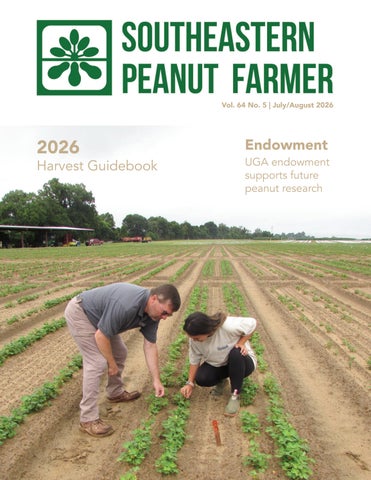
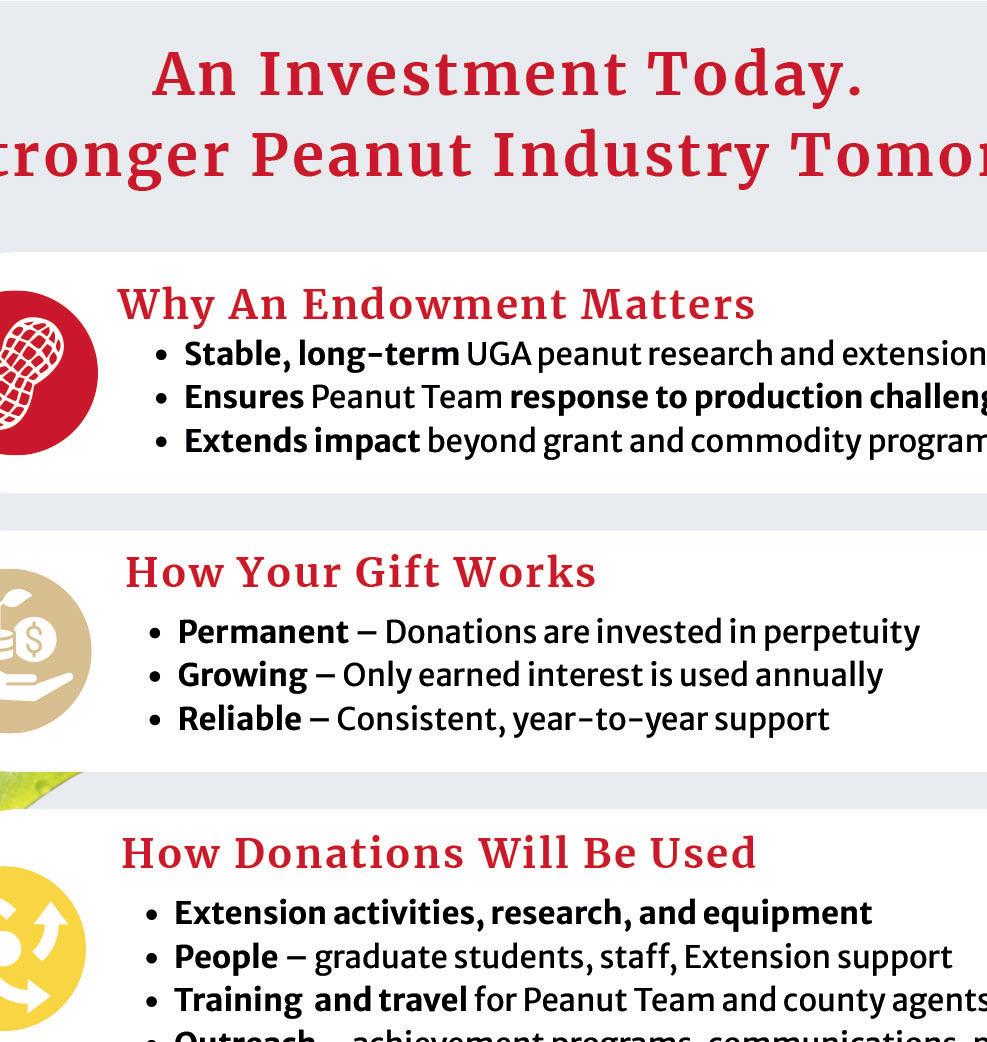
The University of Georgia's Peanut Team Research and Extension Endowment provides support to help grow the future of peanut research.
20
The American Peanut Council presented awards to five peanut industry leaders at the annual USA Peanut Congress in June.
The Southeastern Peanut Farmer has compiled a list of upcoming field days offered throughout the Southeast relating to peanuts or general crop field days.
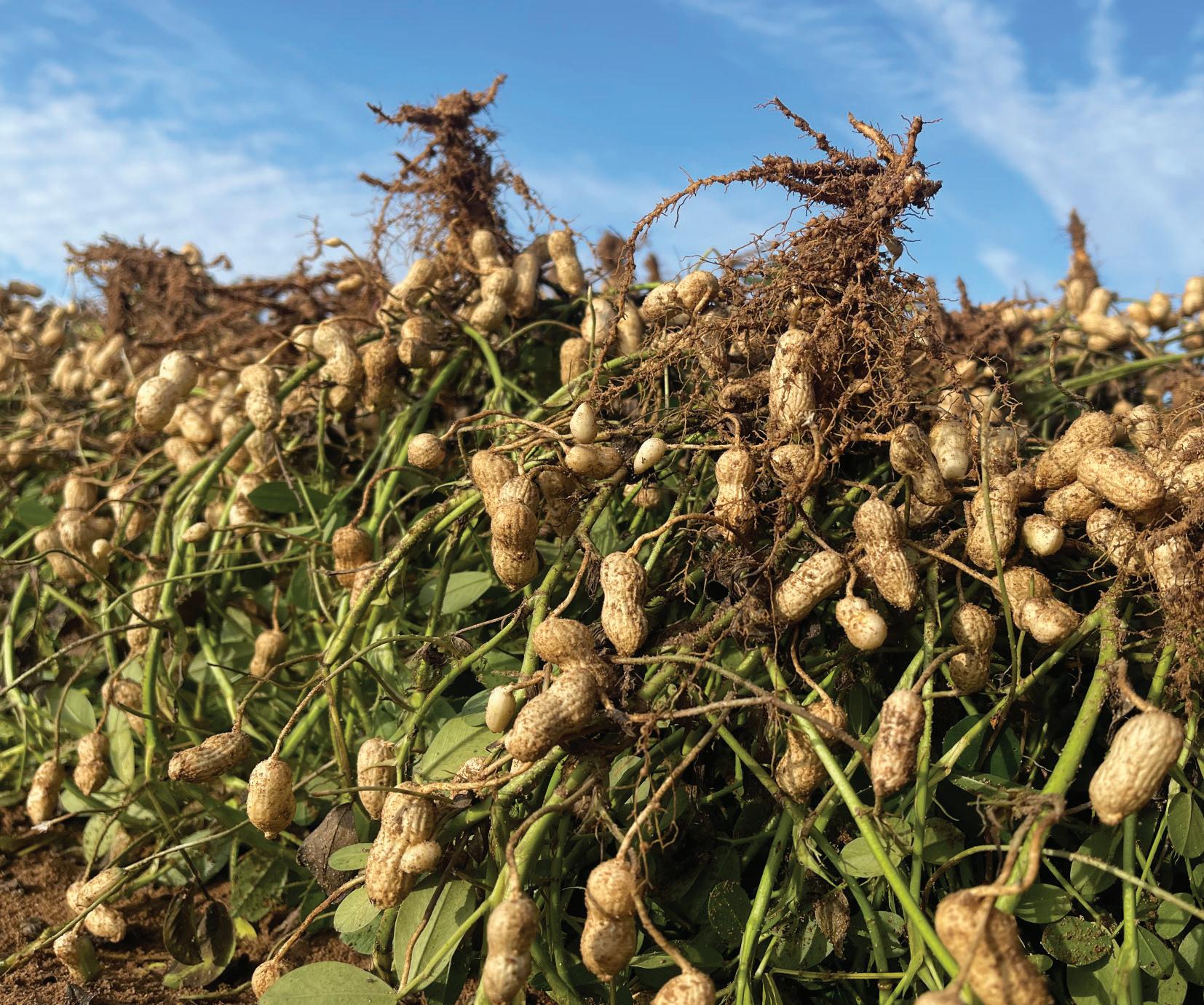
The Peanut Harvest Guidebook provides tips for proper setup and operation of the peanut inverter, the future of peanut sorting, how to use official variety trial data to track peanut maturity and information on new harvest equipment for the 2026 season from Amadas and Kelley Manufacturing Co.

By July, the excitement of planting has settled into the reality of the growing season.
The planters have been parked for weeks, and now comes the part of farming that requires perhaps the greatest amount of patience. The crop is in the field, but there are still countless decisions to make. Irrigation schedules, fungicide applications, insect scouting, weed control and weather forecasts all compete for attention. Every field seems to tell a different story.
July has a way of reminding us that farming is rarely about having complete control. It is about making the best decisions possible with the information available and trusting the process.
Peanut growers know that every season brings its own challenges. Some years it's too dry. Others, too wet. Heat, insects, disease pressure and market uncertainty can all change the outlook in a matter of days. Yet farmers continue doing what they have always done by adapting, solving problems and preparing for whatever comes next.
One thing that never changes is the importance of paying attention to the details. The small decisions made throughout July often have a tremendous impact on the crop that will eventually be dug in the fall. Consistent scouting, timely management and resisting the urge to cut corners can make all the difference when harvest arrives. University research continues to show that careful, in-season management is critical to protecting both yield and quality.
As you read this issue of Southeastern Peanut Farmer, be sure to spend some time with the 2026 Peanut Harvest Guidebook. While harvest may still seem a few months away, the work of a successful harvest begins long before the first peanuts are dug. The guidebook offers practical information to help growers prepare equipment, improve harvest efficiency and maximize yield and quality. From preseason maintenance tips for diggers and combines to using the Official Variety Trials to better estimate optimum maturity, the guidebook is designed to help you head into harvest with confidence. You'll also find coverage of new equipment from KMC and AMADAS, highlighting the latest technology and innovations available for the 2026 peanut harvest season.
To every peanut farmer across the Southeast, thank you for the work you do. Long before harvest begins, you've invested countless hours, resources and faith into this year's crop. We know the work isn't easy, but it's important. Here's hoping July brings timely rains and the promise of a successful harvest ahead.

Joy Carter Crosby SEPF Editor
Dates of upcoming field days are on page 22.
American Peanut Shellers Association and National Peanut Buying Points Association Pre-Harvest Meeting
Aug. 18-19, 2026, Albany, Ga. For more info call 229-888-2508 or visit peanut-shellers.org.
Brooklet Peanut Festival
Sept. 19, 2026, Brooklet, Ga. For more info visit the festival's website at brookletpeanutfestival.com.
Plains Peanut Festival
Sept. 26, 2026, Plains, Ga. For more info visit the festival's website at jimmycarterfriends.org.
Georgia National Fair
Oct. 8-18, 2026, Perry, Ga. For more info visit georgianationalfair.com.
Georgia Peanut Festival
Oct. 17, 2026, Sylvester, Ga. For more information visit the festival's website at gapeanutfestival.org.
Sunbelt Ag Expo
Oct. 20-22, 2026, Moultrie, Ga. For more info visit sunbeltexpo.com.
Florida Farm Bureau Annual Meeting
Oct. 28-30, 2026, Hilton Daytona Beach Oceanfront Resort, Daytona Beach, Fla. For more info visit floridafarmbureau.org.
National Peanut Festival
Nov. 6-14, 2026, Dothan, Ala. For more info visit nationalpeanutfestival.com.
Alabama Farmers Federation Annual Meeting
Dec. 6-7, 2026, Montgomery, Ala. For more information visit alfafarmers.org.
Georgia Farm Bureau Annual Meeting
Dec. 6-8, 2026, Jekyll Island, Ga. For more information visit gfb.org.
American Peanut Council's Winter Trade Conference
Dec. 9-10, 2026, Atlanta, Ga. For more info visit peanutsusa.com.
Let us know about your event. Please send details to the editor at joycrosby@gapeanuts.com.
UGA's Peanut Team Research and Extension Endowment provides lasting support for research, graduate education and the discovery of solutions to emerging challenges facing Georgia peanut growers.
By Ashlyn Thompson
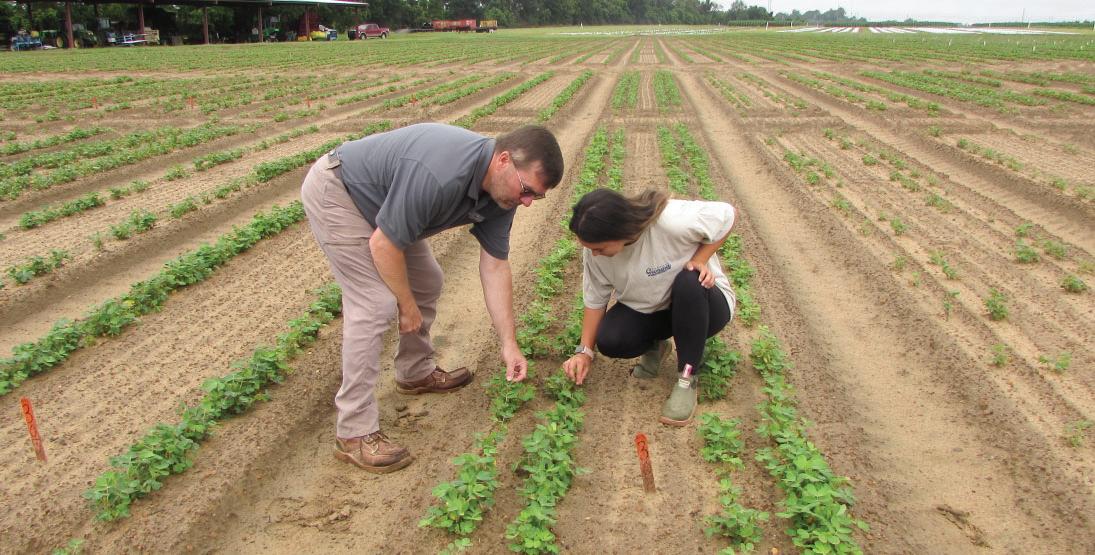
The University of Georgia's Peanut Team Research and Extension Endowment continues to provide support for research, education and extension outreach that directly benefits Georgia Peanut Growers.
Established in 2013 with an initial $100,000 contribution from the Georgia Federal-State Inspection Service, the endowment was created to provide a permanent source of funding for the UGA Peanut Team. Since then, the endowment has grown thanks to the additional contributions from the Georgia Peanut Commission
and other private donors.
The endowment allows donors to support UGA peanut research while preserving the original principal gift. Only the interest earned is used to fund needed research, education and Extension activities for the Peanut Team.
Unlike traditional types of research grants, which are often tied to specific projects and timelines, this endowment provides flexible funding that can be used when new challenges face the peanut industry.
"In peanut production, there are things that come up all the time," says UGA Extension Peanut Agronomist and Peanut Team Leader Scott Monfort. "This endowment provides those consistent funds that the team knows are there so it can solve these everyday problems that come up at the spur of the moment."
Research is crucial to Georgia's peanut industry and this endowment allows the peanut team to address issues that may not fall under traditional funding opportunities.
"Applied research is something one can't get funding for unless one goes through the commodity commissions," Monfort says. "Although these granting agencies fund a majority of the research and extension efforts of the peanut team, there are still additional resources needed to ensure the peanut team can continue to serve the peanut industry effectively in the future."
One issue that currently needs attention is research on peanut seed quality. However, this type of research requires additional resources that the Peanut Team cannot afford at this time.
"Right now, the team doesn’t have the resources or equipment available to do research on seed quality, which is one of the most important things that needs to be worked on right now," Monfort says.
In addition to supporting peanut research projects, the endowment also helps fund graduate student assistantships. Master's and doctoral students are waiting for opportunities
in agricultural research and Extension to gain hands-on experience, and this endowment would offer excellent chance for those students to learn and become active participants in peanut research.
Monfort believes that investing in students today will ensure the future success of agricultural research in Georgia.
"The graduate student side of this is big for the team and even the industry," Monfort says. "It would help the peanut team train the next people to do these jobs."
Funds from the endowment have supported graduate research projects, field day equipment, educational programs and Extension initiatives. Recently, this funding has helped support graduate student Kaelyn Morgan's research on agronomic practices while also improving communication efforts.
"The peanut team needs to be finding those people that are going into their undergraduate and getting
closer to making that dedicated leap into the graduate program," Monfort says. "Georgia is, by far, one of the most effective Extension groups in the country."
Although the endowment currently provides some annual support for the peanut team, Monfort hopes to see the funds rise in the coming years. His long-term vision is to create a lasting source of funding that supports and expands research, graduate education, communication efforts and programs that will directly benefit Georgia peanut growers.
"The goal is to make sure that the team has consistent funding that's coming in and that it can depend on," Monfort says.
Individuals and organizations interested in learning more about the Peanut Team Research and Extension Endowment or supporting its mission can contact Scott Monfort for additional information via email at smonfort@uga.edu or by phone at 229-392-5457.


The Florida Peanut Producers Association awards scholarships annually to deserving high school graduates and college students. The scholarships were presented to five students in 2026. The winners include Reagan Hudson from Chiefland, Megan Fulford from Monticello, Kason Amerson from Bonifay, Emily Cason from Lakeland and Maddox Scanlan from Pinetta, Florida.





Hudson graduated from the University of Florida with a dual degree in Nutritional Sciences and Preprofessional Biology with a minor in Environmental Science. She is currently continuing her education with the University of Florida as a Nutritional Science graduate research student. Her focus is on the connection between agriculture, nutrition and public health.
Fulford is the daughter of Ernest and Sarah Fulford. She attended Community Leadership Academy from K-3 through 11th grade and continued her education as a dual enrollment student at Tallahassee State College. She spent her senior year completing all of her nursing prerequisites and plans to start the nursing program this fall.
Amerson is a junior at Florida State University pursuing a bachelor's degree with plans to attend dental school after graduation. He hopes to use his education to serve rural communities through dentistry while also returning home to help continue his family's agricultural legacy.
Cason is currently pursuing her associates degree at Hillsborough College and aiming to major in business with a minor in agricultural policy. Her leadership extends statewide as an officer with the Florida Junior Angus Association and Junior Florida Cattlemen's Association, along with internship experience with the National Women in Agriculture Association.
Scanlan is a graduate of Madison County High School with a passion for agriculture, welding, and the outdoors. Growing up around his family’s farm, Maddox developed a strong work ethic and gained hands-on experience with crop production, farm equipment and agricultural operations. He plans to pursue a career in welding, where he hopes to use his skills to support the agricultural industry and rural communities.

The Georgia Peanut Commission is partnering with Taste of the South this summer to promote Georgia Peanuts to a highly-engaged Southern food audience. The campaign includes a full-page magazine advertisement, a custom recipe featuring Georgia Peanuts and a short-form video, two e-newsletter features and a dedicated social media post. The partnership also includes a branded giveaway to drive additional consumer engagement. This campaign is designed to encourage peanut purchases during the summer season.
FPPA exhibits at Florida School Nutrition Conference
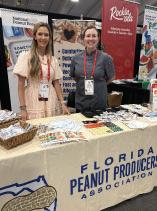
The Florida Peanut Producers Association exhibited at the Florida School Nutrition Association Annual Conference, in Ocala, Florida. FPPA was proud to showcase the importance of keeping peanut butter in Florida school systems, network with school nutrition leaders, and share the nutritional benefits of peanut butter for students across the state. Providing educational materials, peanut butter and roasted peanuts, FPPA helped equip attendees with the resources they needed to make informed decisions about offering peanut butter in the cafeteria.
The Georgia Peanut Commission exhibited at the Georgia Association of Extension 4-H Youth Development Professionals' annual professional development conference, held May 6–8, 2026, at the Rock Eagle 4-H Center in Eatonton, Georgia. More than 125 4-H and youth development professionals from across Georgia attended. Participants learned about the commission's mission, including its efforts to educate youth about the importance of peanuts to Georgia's agricultural sector. They also received information on using Georgia Peanuts for fundraising projects. The conference gave agents valuable information to support their educational activities.




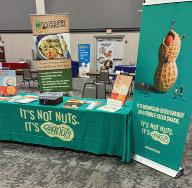
The Mississippi Peanut Growers Association exhibited at the 30th annual convention of the Mississippi School Nurses Assocation, June 9-11, 2026, at the Natchez Convention Center in Natchez, Mississippi. During the event, Malcolm Broome, executive director of MPGA, provided educational literature on allergen awareness and best practices for brining peanut butter back to schools. The nurses also received complimentary roasted peanuts, peanut butter spreaders and USA Peanut tote bags. Nurses were in attendance from nearly all 182 school districts in Mississippi.
Alabama, Florida and South Carolina peanuts featured at the ballpark
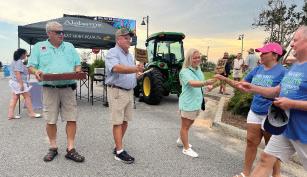
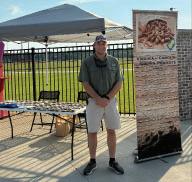
Peanuts are the perfect pairing with baseball and fans of the Blue Wahoos, Montgomery Biscuits or Florence Flamingos are learning more about peanuts this season.
The Alabama Peanut Producers Association and Florida Peanut Producers Association partnered in July for the Blue Wahoos vs. Montgomery Biscuits baseball game in Pensacola, Florida. Throughout the evening, staff distributed peanuts and peanutthemed promotional items to fans while helping raise awareness about the peanut industry and the farmers who grow this important crop. Producers and industry representatives also enjoyed the game from a dedicated party deck, providing an opportunity to connect, network, and celebrate agriculture in a fun, family-friendly environment. The event allowed both organizations to engage with consumers, promote peanuts as a nutritious snack, and strengthen relationships within the peanut industry.
The South Carolina Peanut Board is sponsoring the Florence Flamingos baseball team in Florence, South Carolina. During the game broadcasts air promoting South Carolina peanuts. The SCPB also connected with fans during the tabling nights where samples of peanuts were handed out.
The APPA Communications and Marketing Director Morgan Flowers recently attended the Alabama Agriculture in the Classroom Summer Institute in Prattville, where she connected with more than 90 teachers and Extension specialists. Flowers shared information about Alabama's peanut industry and provided resources to help educators incorporate peanut production, nutrition, economics and agriculture into classroom learning, helping connect students with agriculture through engaging, hands-on educational opportunities.
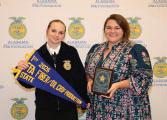
The Alabama Peanut Producers Association sponsored the Fiber and Oil Crop Production Proficiency Award during the 98th Annual Alabama FFA Convention, recognizing students for excellence in crop production and agricultural leadership. First-place honors were awarded to Caitlyn Heard of Benjamin Russell FFA, while Titis Thornton of Lauderdale County FFA earned second place. APPA Communications and Marketing Director Morgan Flowers attended the convention, meeting with FFA members from across Alabama and sharing the peanut industry's story. Through its support of FFA programs, APPA continues to invest in the next generation of agricultural leaders and promote opportunities within Alabama’s peanut industry.
In early May, Morgan Flowers and Peyton Woods traveled across West Alabama for the Alabama Peanut Producers Association's first-ever Planting Tour, visiting 12 peanut farmers in Mobile, Baldwin and Escambia counties over three days. The team captured photos, videos and drone footage documenting the start of the 2026 planting season for use on APPA's social media platforms, website, newsletters and industry publications. The tour also provided an opportunity to meet directly with growers, learn about their operations and conduct on-camera interviews highlighting the dedication and innovation behind Alabama peanut production. Follow Alabama Peanuts on social media to see photos and videos from the tour.
By Simerjeet Virk and Kris Balkcom Auburn University
Peanut harvest will soon be underway. With high input prices and low commodity prices continuing to challenge profitability, one of the most important recommendations for growers is to devote time and effort to ensuring that every piece of harvest equipment is properly maintained, correctly adjusted and operating at peak performance.
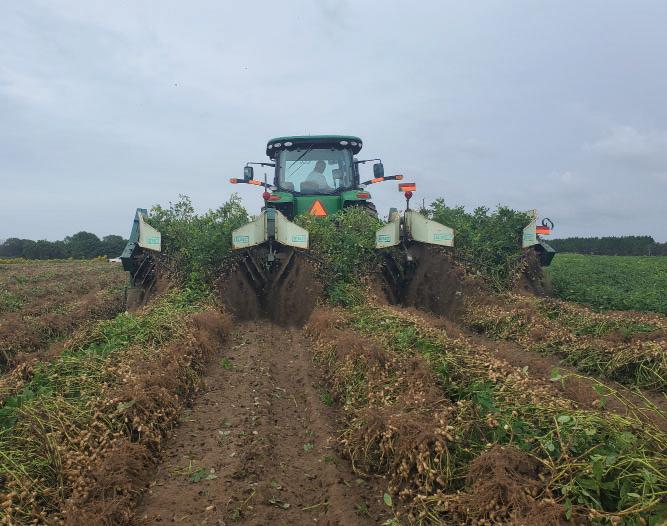
When it comes to the peanut harvest, most losses occur during digging and can result in significant yield reductions if not addressed appropriately. Hence, the proper setup and operation of the peanutdigger-shaker are important for minimizing losses and ensuring optimal equipment performance and efficiency during harvest.
There are many mechanical parts, and hence the adjustments required on the peanut digger-shakerinverter are critical, as even a small misalignment or improper adjustment can result in poor equipment performance and increased digging losses.
Growers should consider the following recommendations to ensure proper digger setup and operation, and minimize mechanically induced yield losses during peanut digging.
• Prior to harvest, inspect the digger carefully for any broken, bent or missing parts as well as the sharpness of the blades. Make adjustments during harvest as needed
based on harvest conditions. Dull blades fail to cut the tap root resulting in dragging roots or dislodging pods from the plant.
• Check that the tractor tires and the digger's rear gauge wheels are inflated to the recommended pressure and that the pressure is equal on both sides. It is also important to ensure that the tires on both the tractor and the digger are the same size.
• Use the top link to adjust the digging angle, which sets the digging
depth. Digger blades should be set at a slight forward pitch and at the depth where they cut the tap root just below the pod zone. Both excessively shallow and deeper depths can result in significant digging losses.
• Blade angle (digging depth) is also dependent on soil type and texture. Any significant change in soil type within or among the fields will require an adjustment to the digging angle, as clay soils usually require a more aggressive angle, whereas sandy soils require a less aggressive angle.
• Tractor speed also affects digging losses and therefore should be optimized based on the prevalent in-field conditions at harvest. Generally, the optimal ground speed for digging peanuts is between 2.5 and 3.5 mph. Speeds above 3.5 mph can increase digging losses and should therefore be avoided.
• The rattler conveyor speed also needs to be adjusted so it matches or is just slightly above the forward travel speed of the tractor while digging peanuts. Conveyor speeds slower or faster than the tractor speed can increase pod losses.
• The conveyor depth should also be adjusted where it picks up vines with its teeth, just clearing the soil. Additionally, as needed, the knocker wheels need to be adjusted up or down to regulate the amount of shaking that is enough to remove the soil from the vines.
• While there is not much technology involved in peanut harvest, the most important one is the RTK-enabled GPS guidance system
(auto-steer) on the tractor. Previous research has shown that using an auto-guidance system while digging peanuts can reduce yield losses by up to 10 percent compared with digging without it. Thus, peanut growers should definitely consider using or investing in an auto-steer system if they haven't already.
Most of the points listed above can be addressed during a preinspection of the digger before heading out into the field. This also helps reduce downtime during harvest and enables growers to make any necessary repairs before major breakdowns or issues in the field.
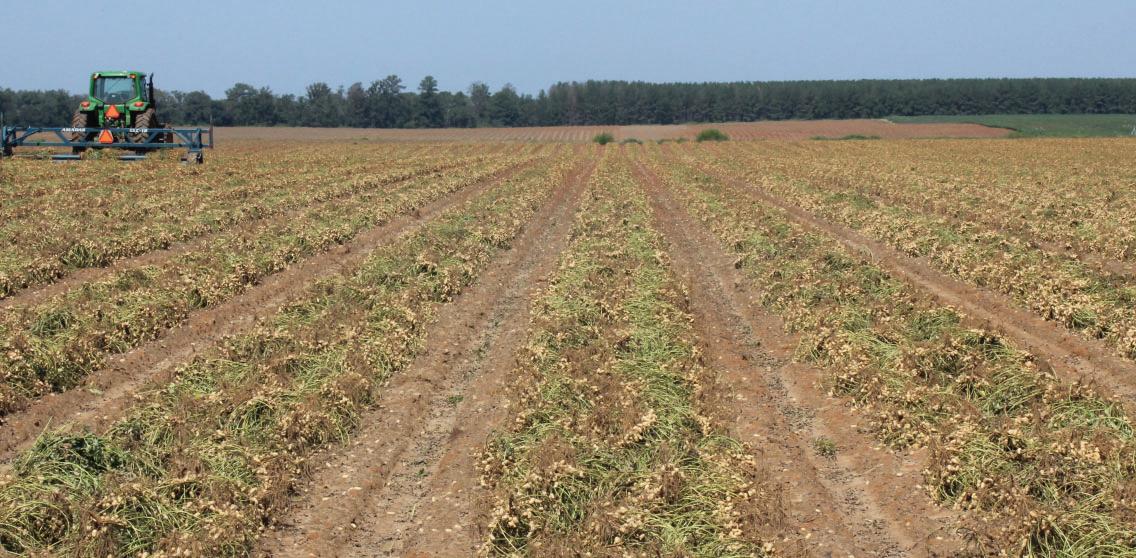
Properly dug and inverted peanut plants should form a uniform, fluffy and well-aerated windrow with few pods touching the soil. Because field and harvest conditions can change throughout the day, growers should continuously monitor digger performance and make adjustments to mechanical and operational settings as needed. Growers should also consult their digger's operator's manual for
additional settings that may seem minor but can play an important role in minimizing harvest losses.
Listed below are several key areas to monitor when evaluating digger performance or troubleshooting issues in the field:
• Blade depth too shallow.
• Dull blades. Blades are dull when they do not cut cleanly through the taproot and start dragging the plants.
• Vine cutter springs too loose or coulters too dull.
• Conveyor pickup running too high above the lifter rods.
• Tractor RPM or hydraulic flow is too fast.
• Vine flow not synchronized with ground speed and conveyor speed.
• Inverter not precisely aligned with the row (indicated by tap roots leaning left or right).
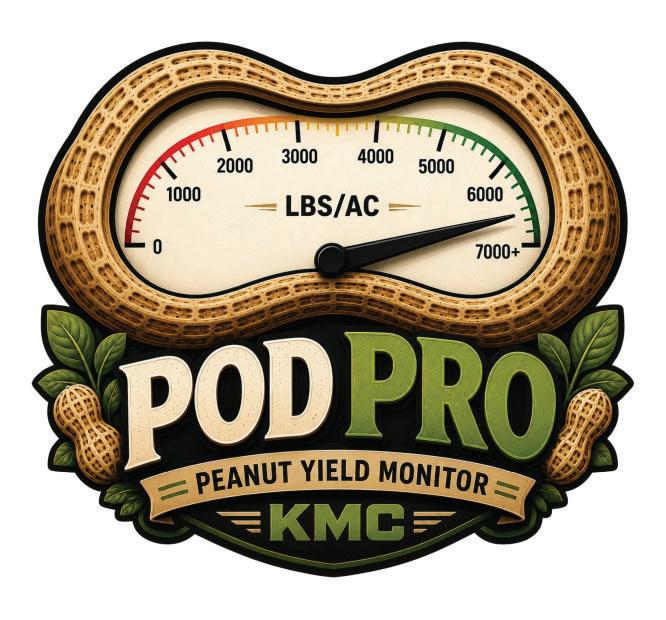
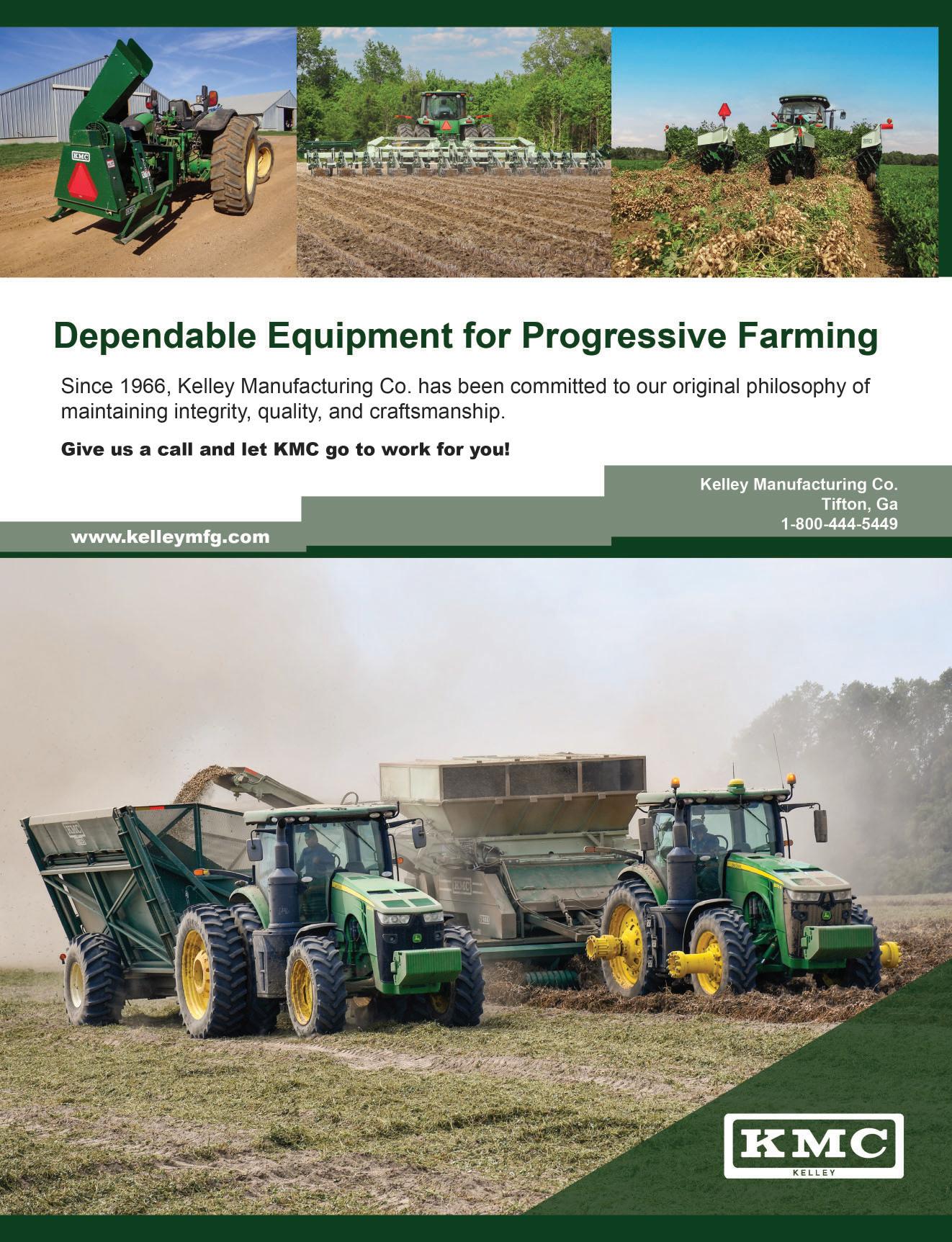
Kelley Manufacturing Co. is expanding its peanut harvest technology lineup for the 2026 season with the commercial release of two new products: PodPro, the peanut industry's first commercially available yield monitoring system, and the Stack-Fold Flex Peanut Digger, designed to improve harvest efficiency and productivity.
Developed specifically for peanut production, PodPro provides operators with continuous, real-time yield information during harvest while collecting detailed field data for post-harvest analysis and future management decisions. The system also creates high-resolution yield maps, giving growers a clearer picture of field variability and crop performance.
In addition to monitoring yield, PodPro features a closed-loop harvest optimization system that automatically adjusts the combine's air damper based on the flow of peanuts through
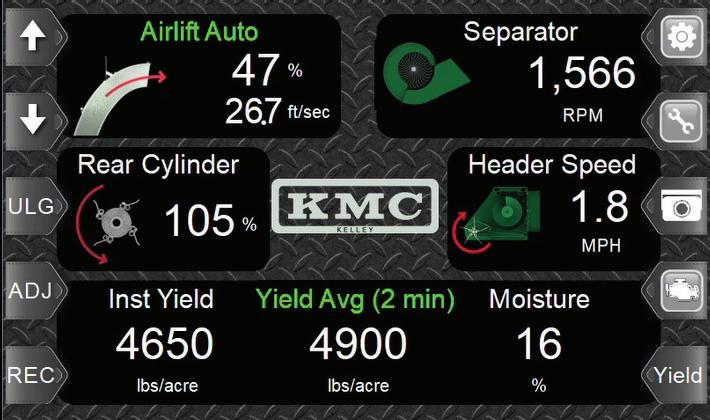
the machine. By maintaining the proper airflow, the system helps prevent duct clogging while reducing pod damage and loose shelled kernels, protecting crop quality and maximizing market value.
Jordan Ledford of Stubbs Farm in Rochelle, Georgia, tested the system during the 2025 harvest season and said the monitor was easy to set up and quickly became part of the harvest routine.
"It didn't take long to get comfortable with the system, and one of the biggest benefits was being able to monitor what the peanuts were doing in real time, giving us immediate insight into yield instead of having to wait until the end of the season," Ledford says.
PodPro is designed for integration with the KMC 7406 Peanut Combine and the patent is currently pending.
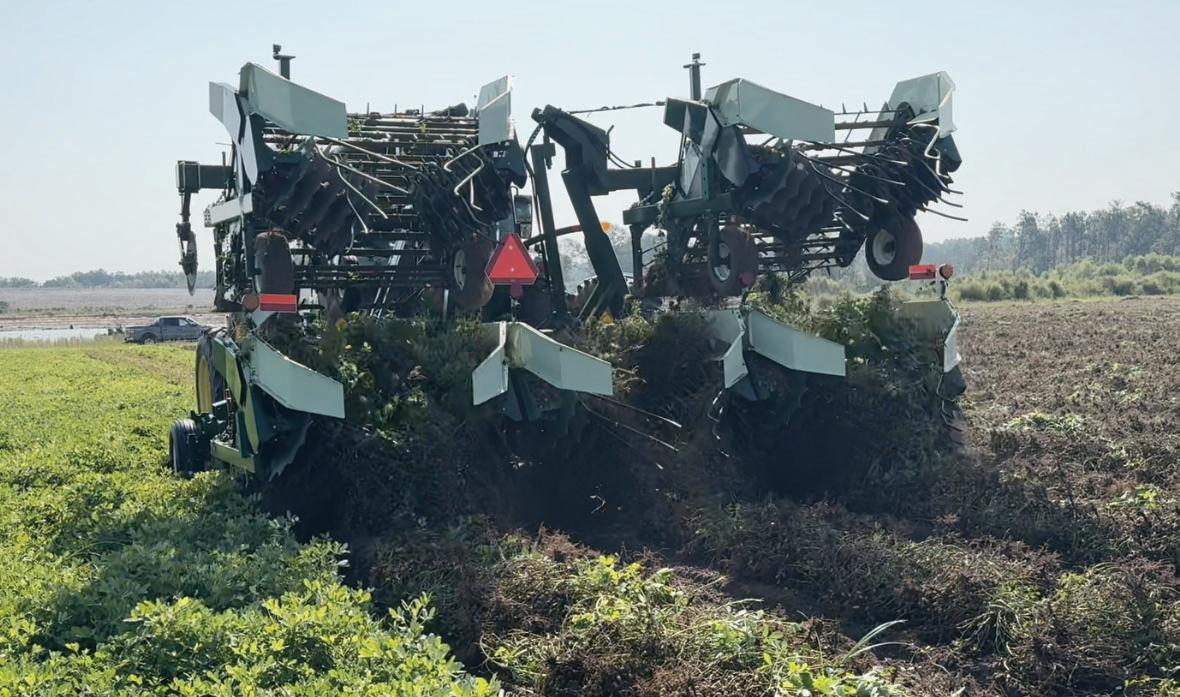
KMC is also introducing the new KMC Stack-Fold Flex Peanut Digger, available in both 8-row and 10-row models, for the 2026 harvest season. The digger combines the company's flex digging technology with a stack-
fold frame that allows larger-capacity machines to maintain a practical transport width for moving between fields.
Independent digging sections help maintain consistent digging depth across varying terrain, reducing losses while creating uniform windrows for improved drying conditions. For larger operations, the 10-row model can increase daily digging capacity by as much as 67 percent compared to a traditional 6-row digger, allowing more acres to be harvested with a single tractor and operator while potentially reducing labor and equipment needs.
The 10-row model also offers the flexibility to operate using only the center six rows when field conditions require it.
Both products are designed to help growers improve harvest efficiency while providing new tools to maximize yield, preserve crop quality and support more informed management decisions.
For more information, contact KMC at 800-444-5449, or visit the KMC website at www.kelleymfg.com.
New artificial intelligence technology aims to improve speed, consistency and accuracy at peanut buying points.
By Peyton Woods
As peanut harvest season approaches across the Southeast, a new technology developed in the Wiregrass region is preparing to make its debut in one of the most labor-intensive parts of the peanut industry: sorting farmer stock peanuts.
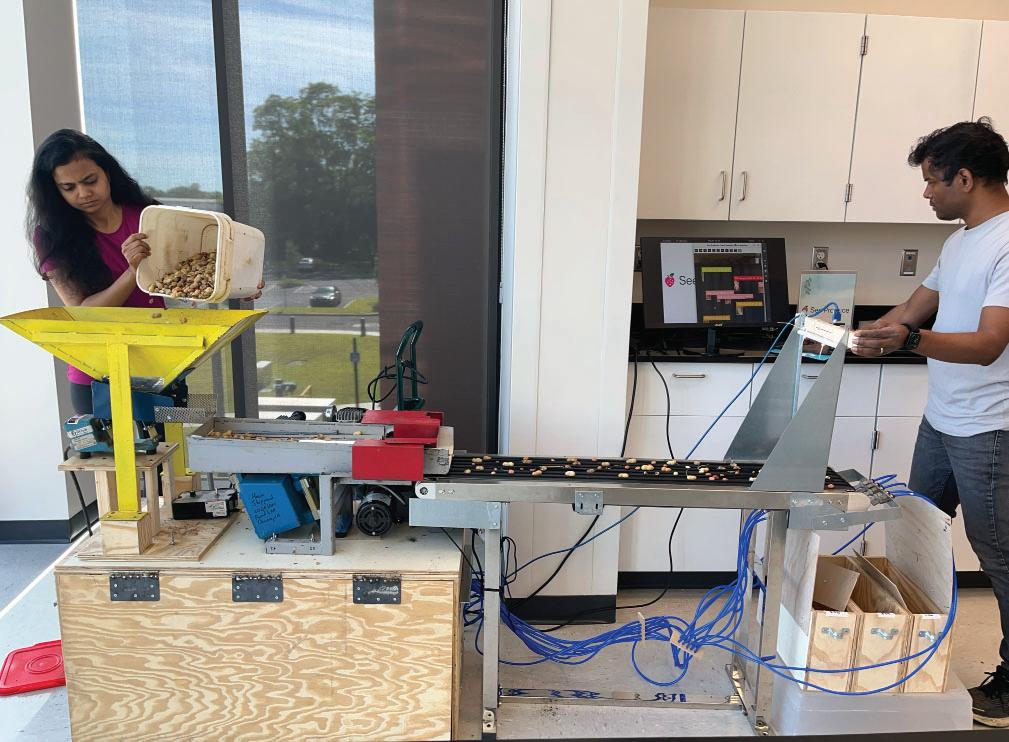
The Wiregrass AI Peanut Sorter, developed by See Produce, is designed to help streamline the
sorting process by using artificial intelligence and machine vision technology to identify and separate peanut samples quickly and consistently. While peanut grading remains a regulated process that follows established industry standards, this new system seeks to improve one of the critical steps that occurs before grading, helping buying points increase efficiency, consistency and
accuracy during the busy harvest season.
What began as a mission to reduce food waste has evolved into one of Alabama's most promising agricultural technology startups. Founded by Pandian Rajaram and Priyanka Kumari, See Produce combines artificial intelligence with practical agricultural applications, developing tools that can evaluate
produce quality, predict shelf life and now assist with peanut sorting. The company's latest innovation, the Wiregrass AI Peanut Sorter, reflects its broader goal of using technology to create greater efficiency and consistency throughout the agricultural supply chain.
The upcoming harvest season will mark a major milestone for the project as the technology moves from development and testing into realworld use.
"The upcoming harvest season is a very important milestone for the Wiregrass AI Peanut Sorter and Grader. For the first time, we're putting industry-grade machines into the field to sort real farmer stock peanuts at buying points. Our goal this season is to test, evaluate and improve. Then bring it to all ~1,100 grading and regrading stations, so every buying point can grade faster, more accurately and more consistently, with shorter lines, and every farmer gets fair pay for every load," Kumari says.
Unlike traditional sorting methods, which require two to four workers sorting by hand for 10 to 12 hours a day across roughly 100 consecutive days each season with no breaks or holidays, the Wiregrass AI Peanut Sorter tackles what has long been one of the most physically demanding jobs at buying points. That sustained workload leads to fatigue, and fatigue directly impacts sorting accuracy, consistency and speed as the season progresses.
Using advanced cameras and artificial intelligence, the system identifies and separates farmer stock peanuts into three primary categories: pods, loose shelled kernels (including kernels and split kernels) and foreign materials such as sticks, stones, empty shells, raisins and dirt. By automating this critical process, the system provides a level of consistency that is difficult to maintain through manual sorting alone. The goal is to bring greater speed, accuracy and repeatability to this essential step, helping ensure every load is handled with the same precision on day one as on day one hundred.
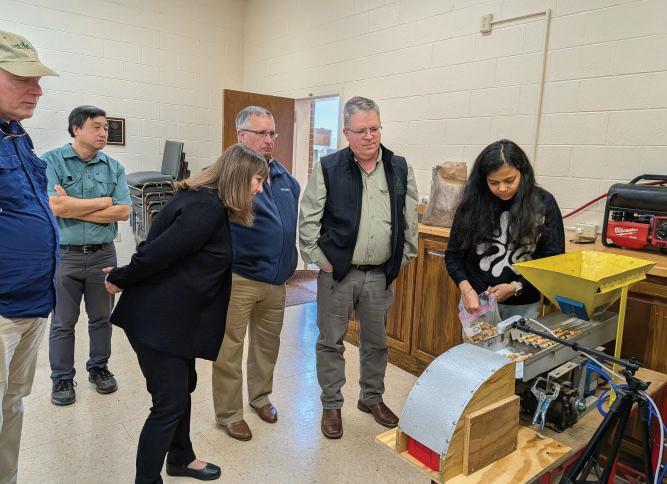
The technology's potential benefits extend throughout the peanut supply chain. For growers, improved sorting consistency can help increase confidence that every load is being handled fairly and uniformly. For buying points and warehouses, the system could help improve workflow efficiency during one of the busiest times of the year while reducing the physical demands associated with manual sorting.
"By training our models on thousands of data points from farmer stock peanut samples right here in the Wiregrass, we've built our See Produce AI that truly understands the crop," Rajaram says. "It can detect everything from pods, kernels and split kernels to foreign materials, including hard-to-catch 'raisins,' at around 95 percent accuracy. That brings an unprecedented level of precision to peanut sorting, and it automatically sorts the farmer stock into three specific bins for pods, loose shelled kernels, and foreign material faster than any traditional method. The best part is, as we keep optimizing, it only gets more accurate and sorts even faster with every load."
Development of the sorter has been driven by a vision to modernize peanut handling while maintaining
the integrity and standards that producers depend on. Rather than replacing existing expertise, the goal is to provide an additional tool that supports the industry through advanced imaging, artificial intelligence and consistent data-driven decision-making.
As harvest begins, researchers and developers will gather valuable information from real-world conditions to continue refining the technology. The data collected this season will help identify future improvements and guide broader implementation opportunities across the peanut industry.
If successful, the Wiregrass AI Peanut Sorter could represent a significant step forward in how farmer stock peanuts are processed, creating a system that is faster, more consistent, and better equipped to serve both growers and buying points.
For an industry that continually balances tradition with innovation, this harvest season may offer a glimpse into the future of peanut handling, one where artificial intelligence helps improve efficiency, consistency, and accuracy while reducing one of the most physically demanding jobs in the industry.
AMADAS Industries has introduced two new pieces of equipment for the 2026 peanut harvest season: the AMADAS Bulldog Digger and the AMADAS 2130 Pull-Type Peanut Combine. Both machines were unveiled to dealers in December 2025 and feature significant design updates aimed at improving harvesting efficiency, reducing crop loss and simplifying operation.
The Bulldog Digger is a completely redesigned digger/ inverter featuring a new chassis that improves structural integrity, weight distribution and overall balance for enhanced digging performance. Engineers also focused on protecting yield by redesigning the shank and blade mounting system, improving crop flow through the machine and refining the inversion system. New bent inverting rods and updated fender geometry are designed to produce a more consistent inversion and tighter, more uniform windrow while minimizing crop damage.
The new digger also incorporates several changes intended to improve day-to-day operation and maintenance. Conveyor visibility has been enhanced, belt tensioning has been simplified, shielding provides quicker service access, and greaseless bearings help reduce routine maintenance. A distributed multi-motor drive system is designed to provide reliable performance across a range of field conditions, while the redesigned frame allows the machine to operate efficiently with smaller-frame tractors. Growers also have several configuration options, including a chain-and-bar conveyor and firming roller, allowing the machine to be tailored to individual harvesting preferences.
In addition to the Bulldog Digger,
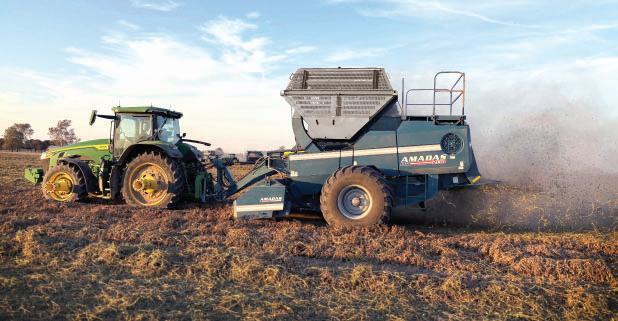
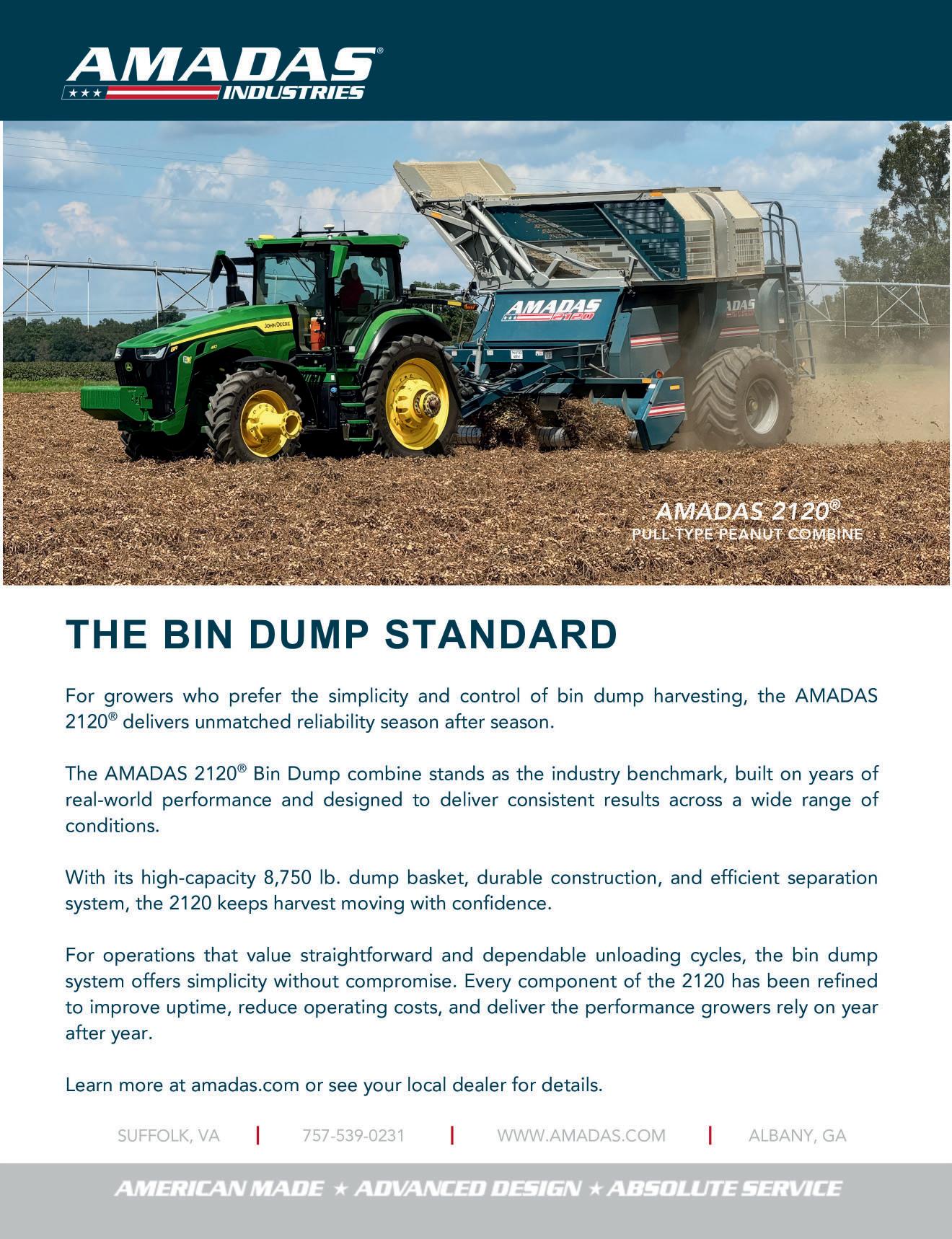
The AMADAS 2130 pull-type peanut combine features an integrated 10,000-pound peanut tank that allows for longer harvesting intervals between unloading. AMADAS 2130 is also equipped with a redesigned header system featuring feeder house-style height control, level operation, quick-detach capability and compatibility with both 6-36 and 6-38 row configurations.
AMADAS introduced the Model 2130 pull-type peanut combine, which includes several updates designed to improve harvesting capacity and operator convenience. The combine features an integrated 10,000-pound peanut tank that allows for longer harvesting intervals between unloading. A redesigned sliding tank also improves access to the picking cylinders for service and maintenance.
The Model 2130 also includes a high-capacity unloading system that increases unloading speed, along with a double-swivel tongue gearbox to improve maneuverability and simplify hitching. A next-generation technology package provides in-cab harvesting adjustments and intelligent machine sensing, while a highdefinition camera system offers rearfacing and in-tank views to improve operator visibility.
Additional design changes include heavy-duty construction with CNC-punched panels, a stainless-steel peanut duct and larger service access panels. The combine is also equipped with a redesigned header system
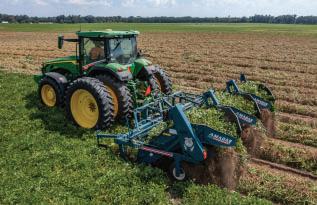
The AMADAS Bulldog Digger is a completly redesigned digger/inverter which features a new chassis that improves structural integrity, weight distribution and overall balance for enhanced digging performance.
featuring feeder house-style height control, level operation, quick-detach capability and compatibility with both 6-36 and 6-38 row configurations. Poly header bands and a larger auger with a deeper trough are intended to improve peanut capture and feeding efficiency during harvest.
The Bulldog Digger and Model 2130 Pull-Type Peanut Combine will be available for the 2026 peanut harvest season through AMADAS dealers
by Henry Jordan Auburn University
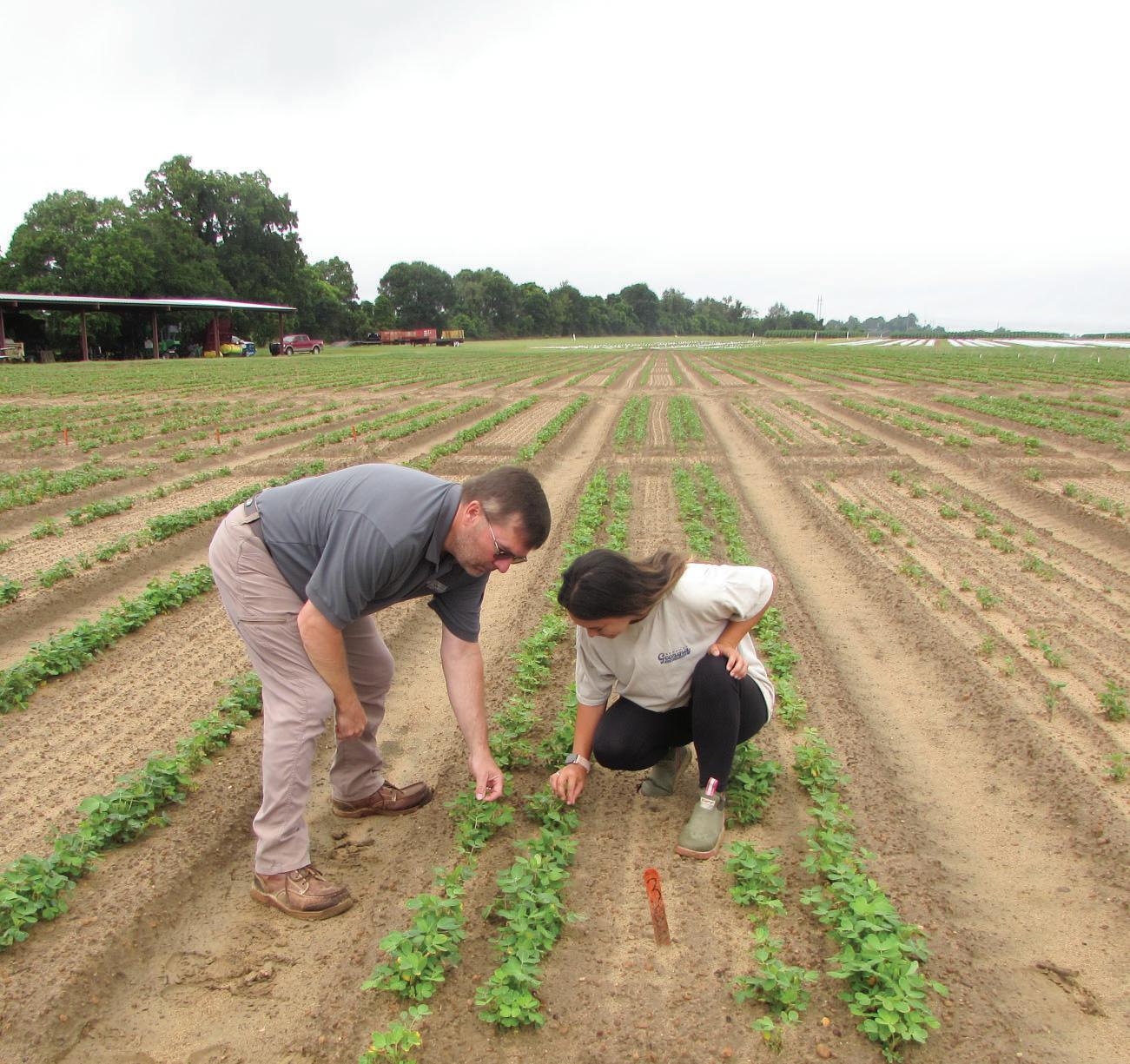
At this point in the season, the crop is in the ground. The most important decision of the season was made when peanut varieties were selected. Growers should continue routinely scouting for pests and taking appropriate management actions. Harvest season will arrive soon, and the next major consideration is determining maturity and identifying the optimal time to begin digging. How can variety trial results help determine the optimal digging date? The answer may be surprising.
First, it is important to understand how the peanut Official Variety Trials (OVTs) are harvested. Within each trial, varieties are harvested according to maturity group to avoid biasing the results. For the past several years, varieties have been divided into three maturity groupings: 140, 145 and 150 days. Using days after planting alone to determine maturity is not accurate because temperature and precipitation are the primary drivers of crop development, and no two seasons are alike.
The OVT results can be used to evaluate the number of calendar days, total rainfall accumulation and accumulated growing degree days (GDDs) at digging across multiple locations and years for each variety. Auburn University has partnered with Medius Ag to create an online tool to assist farmers with gathering variety specific data.
Online results show that, using the GDD calculation in the OVT Variety Selection Tool with a GDD threshold of 56 degrees, digging began at approximately 3,400 accumulated GDDs for the earliestmaturing varieties and concluded around 3,600 accumulated GDDs for the latest-maturing varieties. With
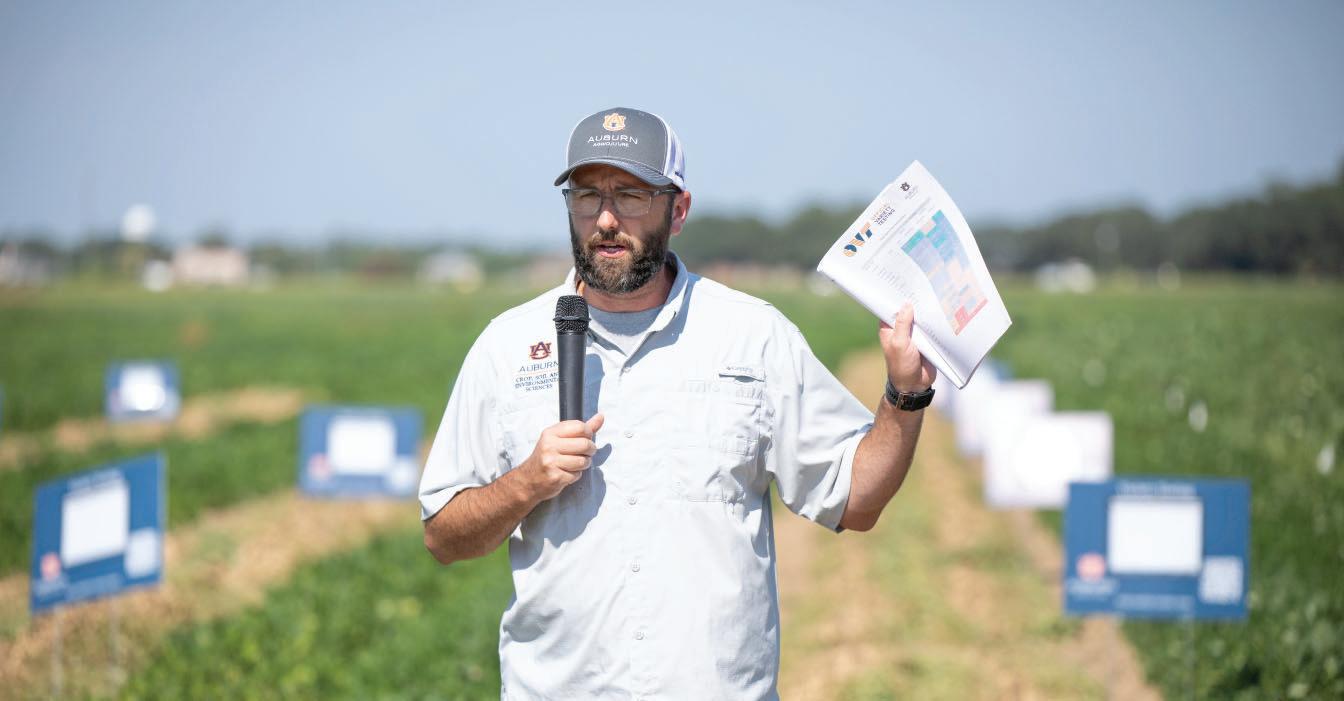
that information, weather data from the nearest Alabama Agricultural Experiment Station (AAES) can be used to determine where the 2026 crop stands in its development.
There are two methods for accessing this information. The first is through the OVT Variety Selection Tool by selecting the trial location nearest the farm, clicking the weather icon, adjusting the dates and reviewing the summary data. The second option is to visit the AAES Weather Exchange at wx.medius.re, create a free account and access the same information directly.
Once this information is available, growers should not begin digging based solely on a specific GDD value. Instead, the data should be used to determine when to begin pod blasting, which remains the most accurate indicator of peanut maturity. Growers may bring peanut samples to the Wiregrass Research and Extension Center, where Extension personnel typically offer pod blasting services twice each week during harvest season.
The variety selection tool, supported by the Alabama Peanut Producers Association, provides more than yield data alone. Weather information can also be leveraged to support management decisions throughout the growing season. For more information on the Auburn University Official Variety Testing Program and to view results, visit aub. ie/variety-tests.
Auburn University Official Variety Trial Online Tool

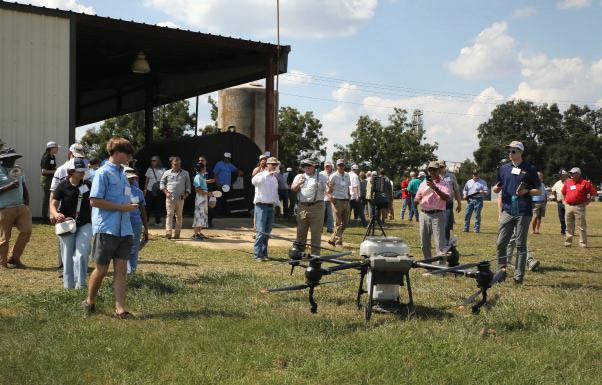
The thirty-eighth annual Georgia Peanut Tour will be held Sept. 22-24, 2026, in Savannah, Georgia, and the surrounding area. The tour brings the latest information on peanuts while giving a firsthand view of industry infrastructure from production and handling to processing and utilization. Tour stops will be made in several peanut producing counties in South Georgia.
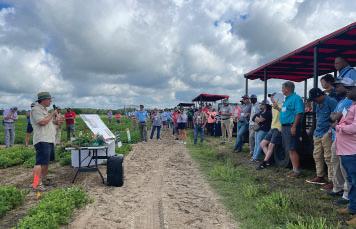
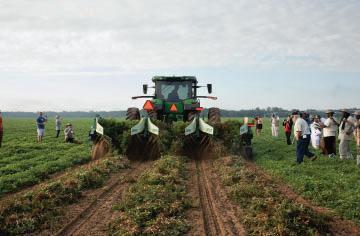
Attendees can expect to see first-hand nearly every aspect of peanut production in the state. This year’s tour hosts many exciting stops including on-farm harvest demonstrations and clinics, research at the University of Georgia Southeast Research and Education Center, Georgia Ports Authority and MANA Nutrition.
The tour kicks off this year with the Hot Topics Seminar on Sept. 22 at 2:30 p.m. at The Clyde Venue in Savannah, Georgia. The seminar topics include an update on the 2026 Georgia peanut crop and a special focus on production challenges, enhancing production and climate issues with emphasis on irrigation, fertilizer and other inputs.
The Georgia Peanut Commission, University of Georgia-Tifton Campus and Griffin Campus, and the USDA Agricultural Research Service National Peanut Research Lab coordinate the tour.
Hotel accommodations can be made at the host hotels, Embassy Suites Savannah Historic District or the Hampton Inn & Suites Savannah
Historic District in Savannah, Georgia, by calling 800-548-8690 and mention the code 90P for Embassy Suites and 90W for Hampton Inn. The room block's deadline is Aug. 7, 2026.
Visit georgiapeanuttour.com or contact David West at 229-386-3470 or via email at david@gapeanuts.com for more information.
The Georgia Peanut Commission is hosting a photo contest through Oct. 1, 2026, featuring peanut farms from across the state to fill the pages of the 2027 Georgia Peanut Calendar. Photos will also be selected to be used in various promotional projects by GPC throughout the year. Georgia farmers are encouraged to submit their best high-resolution photo from throughout the growing season. Winning entries will be selected for each month of the calendar, as well as the cover page. Below are tips to consider when selecting a photo to enter:
• Make sure the photo is not offensive and avoid photos with large,

easy to read corporate logos.
• Think about the months of the year and select photos that represent them. For example, land prep work in the winter, planting in the spring, irrigation in the summer and harvest in the fall.
• Make sure photos are taken in horizontal format, so they will fill the entire page of the calendar.
• Showcase your family (young and old) and what being a Georgia
peanut farmer means to you.
• Choose a photo you feel helps others understand more about how you care for the crop they love.
Photo entries must be taken during the 2024, 2025 or 2026 peanut crop year and feature peanut production. Entries must also be high resolution (300 dpi), horizontal and not taken with a phone; otherwise, they may be disqualified.
Please submit photos in .jpg format and submit them with the online entry form provided online at gapeanuts.com by Oct. 1, 2026, for consideration. Winning entries will be entered for a chance to win a Visa gift card. Visit GaPeanuts.com for complete details
The 30th annual USA Peanut Congress, co-hosted by the American Peanut Council and the American Peanut Shellers Association, brought together leaders from every sector of the peanut industry June 8-11, 2026, in Amelia Island, Florida. During the four-day conference, attendees discussed export markets, sustainability, research and the upcoming peanut crop.
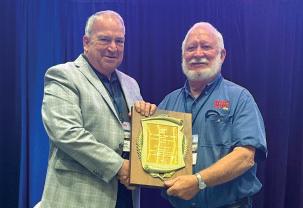
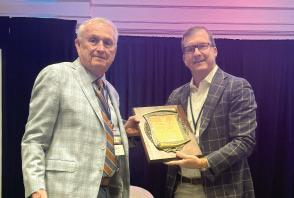
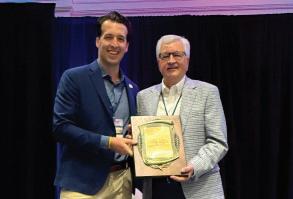
During the event, the American Peanut Council presented awards to five leaders who have demonstrated significant commitment to the peanut industry. The awards honor individuals whose careers have advanced the peanut industry through leadership, innovation, research, service and dedication to growers, processors, manufacturers and consumers.
"This year's honorees represent the very best of our industry," says Luke Blaustein, president and CEO of the American Peanut Council. "Their collective contributions have strengthened peanut production, processing, research, food safety, trade, and humanitarian outreach. We are proud to recognize their achievements and thank them for their decades of service."
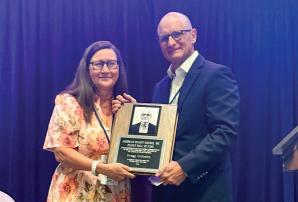
APC's Hall of Fame Award was presented to Gregg Grimsley, vice president of manufacturing for Birdsong Peanuts. The Hall of Fame Award recognizes individuals whose careers have made lasting contributions to both the peanut industry and the American Peanut Council.
Grimsley was honored for his leadership and volunteer service with Peanut Proud, a humanitarian organization established to unite the peanut industry through charitable service and disaster relief efforts. Since Peanut Proud's founding in 2010, Grimsley has helped coordinate the donation of more than 5.2 million jars of peanut butter to individuals and families affected by natural disasters
and other hardships.
Three individuals received the American Peanut Council Lifetime Achievement Award, which recognizes a lifetime of service and meaningful contributions to the U.S. peanut industry. The three honorees are Lewis M. Carter, Jr., chairman Emeritus of Lewis M. Carter Manufacturing; Don Koehler, senior executive director of the Georgia Peanut Commission; and Rusty Smith, founder of R. Smith Nut Company in North Carolina.
The APC Peanut Research and Education Award recognizes individuals for their outstanding contributions to peanut research and education. The honoree is Marshall Lamb of the USDA Agricultural Research Service. For more than 35 years, Lamb has conducted research that has improved the profitability, sustainability and competitiveness of the U.S. peanut industry.
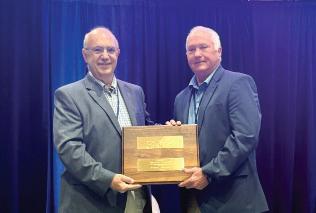
"The accomplishments of these five individuals have strengthened every segment of our industry," Blaustein says. "Their leadership and dedication have left a lasting impact, and we are honored to recognize their extraordinary contributions."

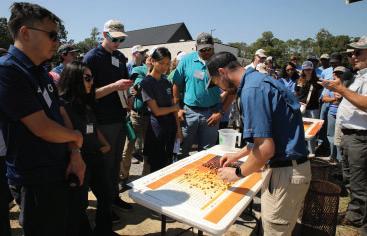
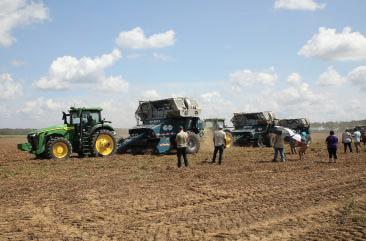
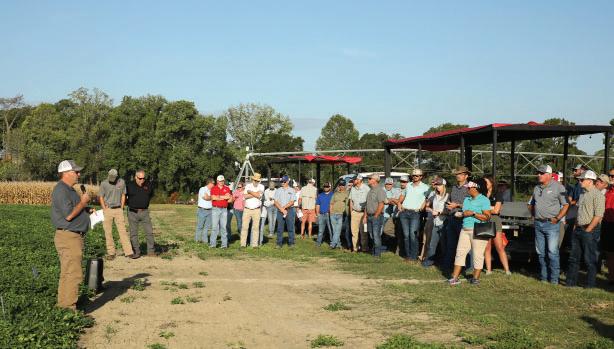
Field days throughout the summer months provide growers with educational information to assist them with production on their farm. Many of the updates include information on a variety of research projects including variety development, weed, disease and insect management, precision agriculture and more.
Many times the results of the research projects are new findings or updates on new products available for farmers. Also, many of the field days offer continuing education pesticide applicators credit so farmers should make sure they register in advance or complete proper paperwork at the field days in order to receive credit.
The Southeastern Peanut Farmer has compiled a list of the upcoming field days offered throughout the Southeast relating to peanuts or general crop field days.
July 29, 2026 - East Alabama Crops Tour, Society Hill, Ala.Participants will visit multiple field locations from 9 a.m. - 1:45 p.m. The starting location is County Road 43 (0.2 miles north of Hwy. 80 intersection), Society Hill, Ala. Register by July 15 online at aces.edu or call Will Yates at 334-870-9361.
July 30, 2026 - Attapulgus Research & Education Center Row
Crop Field Day, Attapulgus, Ga. - The field day will be held at the research center located at 254 North Griffin Ave., Attapulgus, Ga. Field day registration begins at 8:30 a.m. and concludes with lunch. Register by calling 229-522-3623.
Aug. 5, 2026 - Southwest Georgia Research & Education Center Field Day, Plains, Ga. - The field day will be held at the research center located at 108 Experiment Station Road, Plains, Ga. Field day registration begins at
8:30 a.m. and concludes with lunch. Register by calling 229-591-5158.
Aug. 12, 2026 - Southeast Georgia Research & Education Center Field Day, Midville, Ga. - The field day will be held at the research center located at 9638 Highway 56 South, Midville, Ga. The field day registration begins at 8:30 a.m. and concludes with lunch. Register by calling 478-5897472.
August 13, 2026 - Florida Peanut Field Day, Marianna, Fla. - Field day registration begins at 7:30 a.m. Central Time at the North Florida Research and Education Center, 3925 Highway 71, Marianna, Fla. For more information, call 850-526-1611.
Aug. 17, 2026 - Mississippi North Farm Field Day, Starkville, Miss. - The field day will be held at the R.R. Foil Plant Science Research Center, 972 Highway 182, Starkville, Miss. Registration begins at 8:30 a.m. Central Time. For more information call 662-325-7783.
Aug. 20, 2026 - West Florida Row Crop Extension Farm Field Day, Jay, Fla. - Field day will begin at 8:00 a.m. and will conclude around 1:00 p.m. Central Time at the West Florida Research and Education Center, 4253 Experiment Drive, Jay, Fla. For more information call 850-983-7134.
Aug. 21, 2026 - Wiregrass Row Crop Field Day, Headland, Ala. - The field day begins at 9:00 a.m. Central Time at the Wiregrass Research and Extension Center, 167 State Highway 134 East, Headland, Ala. For more information, call 334-693-2010.
Sept. 2, 2026 - Cotton and Peanut Research Field Day, Tifton, Ga.
The field day will be held at the UGA Tifton Campus, Tifton, Ga. For more information, call 229-386-3696 or visit www.gapeanuts.com.
Sept. 10, 2026 - South Carolina Field Day, Blackville, S.C. - The field day will be held at Clemson University's Edisto Research and Education Center, 64 Research Rd., Blackville, S.C. For more info call Dan Anco at 630-207-4926.
By Lisa M. Renzi Hammond Institute of Gerontology | College of Public Health University of Georgia
Last month, we started our multipart series on dementias by defining what dementias are, and what they aren't. We discussed the difference between Alzheimer's disease, Parkinson's disease and vascular dementias from stroke, and we made perhaps the most important point of all, one that I'll repeat often: dementias are not normal aging
In this issue and the next, we'll talk about risk and prevention.
When scientists study dementia risk, we break that risk into two buckets: non-modifiable risk and modifiable risk. Non-modifiable risk includes genetics, age, sex, race and ethnicity – things we can't change. Modifiable risk factors are all the things we can change, even if those things are hard to change, like what we eat, how much sleep we get and how much stress we feel.
Every year, teams of scientists and health care providers come together to report the state of the science on a variety of major diseases, like Alzheimer's disease. These reports are then published in The Lancet, one of the most influential medical journals. In 2024, The Lancet Commission on dementias published a report showing that about 45 percent of dementia cases may be preventable by addressing 14 modifiable risk factors.
Fourteen is a big, daunting number, but 45 percent is a big, hopeful number – big enough that prevention should be taken more seriously by all of us and our doctors.
Prevention begins by remembering that although all 14 risk factors should be addressed,
improving just one behavior can address multiple risk factors. For example, The Lancet Commission report suggests that reducing diabetes, cholesterol, high blood pressure and obesity (four of the 14 modifiable risk factors) can decrease damage to blood vessels serving the brain and protect brain cells from stress and inflammation.
Good nutrition is one of the foundations for reducing all these risk factors. People who eat heart healthy diets are less likely to be obese and less likely to have high blood pressure, high cholesterol and diabetes.
The commodities you grow have a big part to play in preventing dementias, for you and for everyone who eats them. Research shows that peanuts are heart- and brain-healthy foods that are an important part of all four of those prevention goals. In other words, your work makes everyone healthier.

In past issues, I wrote about protecting your senses and eating what you grow. It turns out that vision and hearing loss are another two of the 14 risk factors in The Lancet Commission report. In just a few issues, we've now addressed six modifiable risk factors, with just two behaviors: eat what you grow, and wear your hearing and vision protection. In the next issue, as summer starts to wind down, we'll finish our discussion of prevention by talking about mental health and injury – two additional modifiable risk factors that may affect your brain more strongly than you realize.
risk factors from the 2024 Lancet Commission report
1. Reduce diabetes
2. Manage cholesterol
3. Minimize hypertension
4. Stop smoking
5. Reduce obesity
6. Reduce air pollution
7. Prevent head injury
8. Prevent or treat depression
9. Improve physical activity
10. Minimize alcohol intake
11. Higher education or continue cognitive activity
12. Prevent and address hearing loss
13. Address visual loss
14. Increase social contact
(Livingston G, Huntley J, Liu K et al. Dementia prevention, intervention, and care: 2024 report of the Lancet standing Commission; The Lancet, 2024; 404, 572-628)
By Robert L. Redding Jr.
U.S. Senate Agriculture Committee Chairman John Boozman released his discussion draft version of Farm Bill 2.0 legislation. The Agricultural Act of 2026, or commonly referred to as "Farm Bill 2.0," builds upon the traditional Farm Bill provisions included in last year's final passage of H.R. 1, the One Big Beautiful Bill Act (OBBBA). Additionally, this draft legislation includes many of the provisions recently included in the U.S. Housepassed H.R. 7567, the Farm, Food and National Security Act of 2026.
This Farm Bill 2.0 legislation hosts a variety of provisions to support the peanut industry, which include:
- Updates the Marketing Assistance Loan (MAL) to ensure that the program remains fully operational during any future lapses in federal
government funding.
- Increases funding for the Market Access Program (MAP) and Foreign Market Development Program (FMD)
- Reserves 50 percent of Food for Peace resources for U.S.-grown commodities
- Creates a new high-priority research and extension priority for peanut aflatoxin
- Expands farm ownership and operating loans
- Requires that school food authorities must purchase at least 95 percent of domestic products and commodities in each such category for each school year.
"The U.S. Peanut Federation applauds the release of the U.S. Senate Agriculture Committee's
USPF Signs Letter Supporting RUTF Language in U.S. Senate's Farm Bill 2.0
On June 17, the U.S. Peanut Federation joined the American Soybean Association, National Milk Producers Federation and U.S. Dairy Export Council in sending a letter to U.S. Senate Agriculture Committee Chairman John Boozman and Ranking Member Amy Klobuchar, supporting the inclusion of funding for Ready-toUse Therapeutic Foods (RUTF) in their Farm Bill 2.0 legislation.
The letter stated: "On behalf of America's peanut, dairy and soy producers, we write to express our strong support for the inclusion of language in the 2026 Farm Bill that advances the use and procurement of American-made RUTF to address global malnutrition."
"American farmers play a critical role in producing the high-quality commodities – such as peanuts, milk, soy and sugar – that form the backbone of RUTF. Today, ingredients used in American-made RUTF are sourced from producers across 27 states and the finished products are manufactured in two U.S. facilities, underscoring the broad geographic and economic footprint this supply chain provides for rural communities. This farm bill language reaffirms the role of American-grown commodities in foreign assistance programs, ensuring U.S. agriculture remains a central partner in efforts to combat severe acute malnutrition worldwide while supporting rural economies here at home," the letter continued.

Farm Bill 2.0 discussion draft. This draft legislation includes significant provisions for the U.S. peanut industry, including updates to the Marketing Assistance Loan Program, increases in funding for market access and trade development, updates to farm ownership and operating loans, prioritizing peanut research and more. We appreciate the hard work and leadership from Chairman John Boozman in working to finalize this Farm Bill, which will provide muchneeded certainty for rural America," says Jamie Brown, U.S. Peanut Federation chairman.
The Agricultural Act of 2026 bill text is expected to soon be considered by the full U.S. Senate Agriculture Committee.
Included in Trump’s Recommended Supplemental Package
On June 24, President Donald Trump submitted a policy proposal to Congress for a supplemental funding package to include agricultural economic assistance.
Included in this proposal is $10 billion in temporary economic assistance for row and specialty crops planted in crop year 2026, and $1.1 billion for agricultural producers who faced damages from winter storms that occurred in late 2025 and early 2026
The U.S. House and U.S. Senate Appropriations Committees will now review the proposal and determine a package to be offered for Congressional approval.
On June 30, U.S. House Agriculture Committee Chairman Glenn "GT" Thompson introduced legislation to provide reforms to H-2A agricultural workforce programs. H.R. 9535, the Securing Agriculture's Workforce Act, builds off the suite of bipartisan recommendations of the Agriculture Labor Working Group (ALWG), which was formed among U.S. House Agriculture Committee members in the 118th Congress. The ALWG was comprised of seven Republican members and seven Democrat members who hosted roundtables and hearings among stakeholders to identify the shortcomings of the H-2A program and identify potential policy solutions.
This legislation would make significant reforms to the H-2A agricultural guestworker program aimed at streamlining the application process, providing greater labor cost certainty for growers, modernizing wage calculations, expanding worker portability, and broadening the definition of agricultural labor. The proposal also includes provisions allowing certain unauthorized agricultural workers to obtain legal H-2A status.
The Securing Agriculture's Workforce Act specifically addresses labor challenges in the peanut industry by:
• Broadening eligible H-2A activities to include the following key peanut industry activities:
o the handling, planting, drying, packing, packaging, processing, freezing, or grading of any agricultural or horticultural commodity in its unmanufactured state, without regard to the ownership or location of such facilities or activities
o the transportation and preparation for transportation of any agricultural or horticultural commodity, in its unmanufactured state from the farm to the place of storage, first processing or first marketing
• Eliminating mid-contract wage adjustments
• Placing annual limits on Adverse Effect Wage Rates (AEWR) fluctuations
• Mandating the creation of a single online filing platform for labor certification applications, DHS petitions, communication with agencies, fee payments, appeals and reconsideration requests, housing inspections and approvals, and visa
The U.S. Peanut Federation recently joined as a partner in Ag Investment for America, a multi-industry coalition of domestic growers and manufacturers encouraging policymakers to enact tax policies that boost demand for American made products.
One of the coalition's main projects is the Grown in America Act, legislation which would create a new incentive for American manufacturers to purchase agricultural commodities from U.S. farmers. Recognizing the importance of domestic production and manufacturing, the bipartisan bill would increase demand for American-grown crops, reduce reliance on imported goods, and support our farmers and rural communities. Reps. David Kustoff, R-Tennessee, and Jim Costa, D-California, introduced this legislation in the 119th Congress, and were joined by Reps. David Rouzer, R-North Carolina, Mike Carey, R-Ohio, and Mark Alford, R-Missouri, as original co-sponsors.
"A strong and resilient agriculture and food sector is vital to America's economy and national security," says Congressman Kustoff. "By incentivizing businesses to purchase from American farmers, the Grown in America Act will bolster our agriculture industry and ensure it remains competitive on the world stage. I urge my colleagues to support this commonsense legislation that will help strengthen our supply chains, stimulate domestic investment and job creation and reduce our reliance on foreign markets."
processing
• Replacing current AEWR methodology with a new wage calculation system based on Occupational Employment and Wage Statistics survey data
• Including waiver authority allowing certain unauthorized agricultural workers already in the U.S. to obtain H-2A status, providing a legal workforce pathway for experienced agricultural employees
• Allowing multi-year labor certifications
• Ensuring H-2A processing functions would be classified as essential government services and continue during government funding lapses
• Providing flexibility for employers to stagger worker start and end dates, amend certifications more easily for changes involving housing, transportation, worksites, or dates of employment, and would allow contract termination due to natural disasters, pest outbreaks, drought, or similar events outside employer control.
USPF was proud to be an original endorsing organization for the introduction of this legislation.
USDA Announces Modernization of the Foreign Agricultural Service
The U.S. Department of Agriculture recently announced a reorganization of the Foreign Agricultural Service to streamline operations, consolidate support functions, and bring employees and programs closer to America's agricultural heartland. As part of this effort, FAS will establish an operational support hub in Kansas City, Missouri, and will begin a phased relocation of much of its Washington, D.C.-based workforce to this new duty station and to USDA's George Washington Carver Center in Beltsville, Maryland, while a smaller Washingtonbased contingent will remain in Washington, D.C. This modernization effort does not include any reduction in force and focuses entirely on domestic headquarters functions; no overseas staff or diplomatic posts are affected.

Southern Peanut Growers teamed up with Chef Josh Swinney on June 22 to test five new peanut-based menu items he developed for Brooks County to showcase the versatility of peanuts and peanut butter.
During the event, Chef Josh supervised a part-time culinary student in making the Peanut Butter Energy Balls which turned out to be one of the most popular menu items of the day among students and teachers.
In total, the group made five items for the tasting panel which was comprised of 39 students and 10 adults. The PB&J Parfait and the Peanut Twist Sausage Fried Rice also were very popular. The tasting menu also included Peanut-Glazed Pork Chops with Roast Sweet Potatoes and Indonesian Beef Meatballs with Chili Peanut Sauce.
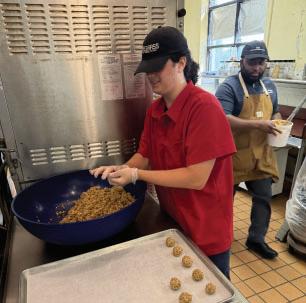
Throughout the event Chef Josh learned from the Brooks County school nutrition team. He thinks it's going to be necessary to tweak recipes for schools based on the type of equipment they have and is doing
Ingredients
1 15 oz. can chickpeas, reserve liquid
3 tablespoons unsweetened peanut butter
2 tablespoons tahini
2 tablespoons peanut oil
2 garlic cloves
2 tablespoons fresh lemon juice
1 teaspoon ground cumin
½ teaspoon smoked paprika
¾ teaspoon kosher salt
¼ teaspoon black pepper
2-4 teaspoons liquid from chickpeas smoked paprika + peanut oil for garnish
Directions
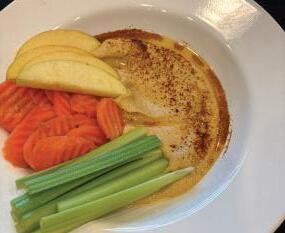
Drain the can and reserve the liquid (aquafaba). For an ultra-smooth hummus, peel the skins off the chickpeas by pinching each one — this step is optional but worth it. Add chickpeas, peanut butter, tahini, garlic, lemon juice, cumin, smoked paprika, salt and pepper to a food processor. Blend for 1 minute. With the processor running, slowly drizzle in peanut oil. Add reserved chickpea liquid 1 tbsp at a time until the hummus reaches a smooth, creamy consistency. Blend 2–3 minutes total for best texture. Taste and adjust salt, lemon or garlic as needed. Add a pinch more cumin or smoked paprika for extra depth. Transfer to a serving bowl. Use the back of a spoon to create a swirl on top. Drizzle with peanut oil and dust with smoked paprika. Serve immediately or refrigerate up to 5 days.
so with a couple of the recipes they tested yesterday.
Chynna Silvernale, the foodservice director in Brooks, also asked if he could create a couple more specific recipes for her which he will be working in the next couple of weeks.
Chef Josh is tweaking a few of the recipes for easier production and creating two additional recipes with the goal of launching the new menu items in the fall.
SPG exhibits at Georgia Chapter of the American Academy of Pediatrics

Southern Peanut Growers exhibited at the annual meeting of the Georgia Chapter of the American Academy of Pediatrics conference June 18 – 20 in Amelia Island, Florida. More than 200 pediatricians and pediatric nurse practitioners were in attendance, mostly from Georgia but with a significant number of attendees from other states.
Leslie Wagner, executive director of SPG, staffed the exhibit with materials focusing on early introduction to prevent peanut allergy and nutrition materials for kids. Wagner also distributed QR codes where doctors can order materials on early introduction and nutrition for kids to give to parents during their well-baby visits.