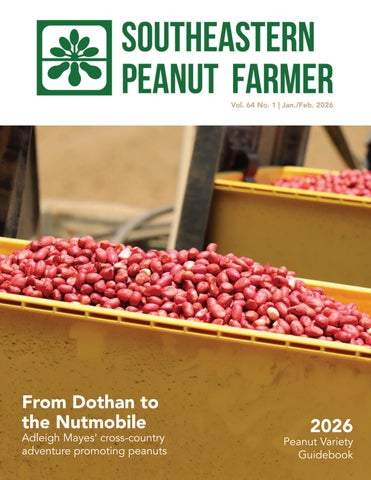
Vol. 64 No. 1 | Jan./Feb. 2026
From Dothan to the Nutmobile
Adleigh Mayes' cross-country adventure promoting peanuts
2026
Peanut Variety Guidebook
Jan./Feb. 2026 | Southeastern Peanut Farmer
1
2 Southeastern Peanut Farmer | Jan./Feb. 2026
A Look Inside
Jan./Feb. 2026 | Peanut Variety Guidebook
IN THIS ISSUE 6 | FROM DOTHAN TO THE NUTMOBILE Adleigh Mayes turned her peanut roots into a cross-country adventure as a Peanutter with the Nutmobile.
18 | HEALTH NUT CLUB TOUR
The National Peanut Board hit the road this past fall visiting six universities to inspire Gen Z to fuel their lives with peanuts.
24 | POWERFUL PEANUT EXPERIENCE LAUNCHES The Georgia Peanut Commission teamed up with Georgia's Rural Center to launch the Powerful Peanut Experience at the Georgia National Fair.
DEPARTMENTS 8 | CHECKOFF REPORT Alabama Peanut Producers Association Florida Peanut Producers Association Georgia Peanut Commission Mississippi Peanut Growers Association
28 | WASHINGTON OUTLOOK 30 | SOUTHERN PEANUT GROWERS UPDATE
10 2026 PEANUT VARIETY GUIDEBOOK
Selecting a variety is a key management step for farmers. SEPF’s 2026 Variety Guidebook highlights varieties available to growers in the Southeast and provides growers with the results of state variety tests. On The Cover Peanut seed in a planter in Turner County, Georgia. Photo by Joy Crosby.
SEPF TEAM Editor Joy Carter Crosby joycrosby@gapeanuts.com 229.386.3690
Director of Jessie Bland Advertising jessie@gapeanuts.com 229.386.3472
Contributing Peyton Woods Writing peyton@alpeanuts.com 334.792.6482
Southeastern Peanut Farmer is published six times a year (Jan./Feb., March, April, May/June, July/Aug., and Oct./Nov.) by the Southern Peanut Farmers Federation. The publisher is not responsible for copy omission, typographical errors, or any unintentional errors that may occur, other than to correct it in the following issue. Any erroneous reflection which may occur in the columns of Southeastern Peanut Farmer will be corrected upon brought to the attention of the editor. (Phone 229-386-3690.) Postmaster: Send address changes (Form 3579) to Southeastern Peanut Farmer, P.O. Box 706, Tifton, Georgia, 31793. Circulation is free to qualified peanut growers and others allied to the industry. Periodical postage paid at Tifton, Georgia and additional mailing office. Editorial Content: Editorial copy from sources outside of the Southern Peanut Farmers Federation is sometimes presented for the information and interest of our members. Such material may, or may not, coincide with official Southern Peanut Farmers Federation policies. Publication of material does not necessarily imply its endorsement by the Southern Peanut Farmers Federation. For editorial concerns call 229-386-3690. No portion of this or past issues of the Southeastern Peanut Farmer may be reproduced in any form whatsoever without the written consent of the editor. By-lined articles appearing in this publication represent views of the authors and not necessarily those of the publisher. Advertising: The Publisher reserves the right to refuse any advertisement. Corrections to advertisements must be made after the first run. All billing offers subject to credit review. Advertisements contained in this publication do not represent an endorsement by the Southeastern Peanut Farmer or the Southern Peanut Farmers Federation. Use of trade names in this publication is for the purpose of providing specific information and is not a guarantee nor warranty of products named. For advertising concerns call 229-386-3472.
Jan./Feb. 2026 | Southeastern Peanut Farmer
3
Editor’s thoughts More than Iron and Paint
S
ome pieces of equipment on the farm are more than iron and paint. They carry memories, seasons and the lessons learned between daylight and dark. The tractor I'm thinking about is my dad's 1953 Farmall Super A. It's the one I raked hay with during my high school years. Back then, I never thought about the age of the tractor or what it meant to my dad. It was simply the tractor that I was given to drive. Like a lot of farm equipment, time eventually caught up with it. Years passed. The tractor sat. Tires went flat. Rust crept in. It reached the point where it hadn't been driven in years, and most folks would have written it off as something better left parked behind the barn. But farm families don't always see things the way "most folks" do. Instead of letting it fade into memory, we made the decision to have it restored, not just to make it run again, but to bring a piece of our family history back to life. That's where John Paulk of Turner County, Georgia, came in. With patience, craftsmanship and respect for what the tractor represented, he took something worn down and tired and gave it new life. When the restoration was finished, it didn't just look good. It felt right. The sound of the engine, the way it handled, even the smell took me straight back to those hay fields decades earlier. The years in between seemed to disappear.
One of the most meaningful moments came when I had the chance to drive it in the antique tractor parade at the Sunbelt Ag Expo. Surrounded by farmers, families and members of the ag community, I eased that old tractor down the parade route. I was proud, grateful and maybe a little emotional as I drove Daddy's tractor. It wasn't about showing off a restored tractor. It was about honoring where we came from. It was about remembering a dad who trusted his kid with a job and a machine that mattered. And it was about recognizing that agriculture isn't just about the next crop or the next season, it's about stewardship, legacy and carrying stories forward. That tractor reminds me that while farming continues to change, the values that built it don’t. Values like hard work and caring for the land were instilled in me, along with knowing when something is worth restoring, not just because it can run again, but because it still has something to teach us. Now, I’m able to pass those lessons on by teaching both of my kids, Eli (12) and Lauren (9), how to drive Grandpa's tractor. Sometimes, the best way to move forward is to climb back onto the seat where it all started.
Joy Carter Crosby SEPF Editor
4 Southeastern Peanut Farmer | Jan./Feb. 2026
Events
Georgia Ag Forecast Seminar Jan. 23, 2026, UGA Tifton Campus Conference Center, Tifton, Ga. For more information call 706-542-3390 or visit agforecast.caes.uga.edu. Georgia Young Farmers Association Annual Convention Jan. 23-24, 2026, Jekyll Island, Ga. For more information visit gyfa.org. Alabama Florida Peanut Trade Show Jan. 29, 2026, National Peanut Festival Fairgrounds, Dothan, Ala. For more information call 334-792-6482 or visit alpeanuts.com or flpeanuts.com. South Carolina Peanut Growers Annuual Meeting Jan. 29, 2026, Santee Conference Center, Santee, S.C. For more information call 803734-5229 or visit aboutpeanuts.com. Mississippi Peanut Growers Association Annual Meeting Feb. 11, 2026, Lake Terrace Convention Center, Hattiesburg, Miss. For more information visit misspeanuts.com. National Peanut Buying Points Association Winter Conference Feb. 12-15, 2026, The Galt House, Louisville, Ky. For more information visit peanutbuyingpoints.org. Florida Peanut Producers Association Annual Meeting Feb. 26, 2026, Jackson County Agricultural Complex and Conference Center, Marianna, Fla. For more info visit flpeanuts.com. Farm Stress Summit March 12, 2026, C.W. Pettigrew Farm and Community Life Center, Fort Valley State University, Fort Valley, Ga. Peanut Proud Festival March 28, 2026, Blakely, Ga. For more info visit peanutproudfestival.com.
Let us know about your event. Please send details to the editor at joycrosby@gapeanuts.com.
Jan./Feb. 2026 | Southeastern Peanut Farmer
5
From Dothan to the Nutmobile
How Adleigh Mayes Turned Her Peanut Roots Into a Cross-Country Adventure By Peyton Woods
F
or Adleigh Mayes, peanuts aren't just a snack, they're part of who she is. Growing up in Dothan, Alabama, the self-proclaimed Peanut Capital of the World, she was surrounded by fields of peanuts, fall festivals and a community that celebrated the crop every fall. Her father, Jeremy Mayes, works in the peanut industry, and through him, Mayes learned the value of agriculture and hard work early on. Those lessons, which may have seemed mundane, would later drive her toward a once-ina-lifetime adventure that quite literally rolled her across the country in a huge legume. After graduating from FreedHardeman University with a degree in public relations, the Houston County native found herself in the same uncertain transition many college seniors face: life after commencement. She loved her years as a collegiate volleyball player and was soaking up her final semester, not yet ready to dive into job searching. Then, in November 2024, a message popped into her family group chat—a link from her dad that would change everything. It was an application for the Planters Peanutter Program, a year-long adventure where a team of recent graduates drives the 26-foot, peanut-shaped Nutmobile across America, spreading smiles and the story of peanuts.
Adleigh Mayes in front of the Love Dothan mural in downtown Dothan, Alabama.
Adleigh Mayes with the Planters Nutmobile during Peanut Prep.
"At first, I thought it had to be a joke," Mayes says with a laugh. "I mean, it was a giant peanut on wheels. But once I actually read about the program, I thought, wait, this actually sounds incredible."
On the final day, the candidates were asked to name two people they'd want to spend the next year traveling with. Unbeknownst to each other, Adleigh, Aria and Hudson all chose one another.
One part of the application required a 60-second video explaining why she'd make a great Peanutter. She leaned into her roots, literally. Filming around Dothan, she posed with the city's iconic peanut statues and even included shots inside the shelling plant her dad works at.
A few days later, an early-morning call from Minnesota, home of Hormel Foods, brought the news Mayes had been hoping for: she got the job. Within weeks, she was packing for "Peanut Prep," a weeklong training where new Peanutters learn everything from PR skills to how to safely drive the Nutmobile.
"I started the video with, 'My name is Adleigh Mayes, and I guess you could say peanuts are in my roots,'" she says. Her humor, creativity, and authenticity helped her stand out among nearly 900 applicants. Months of interviews, written submissions, and group assignments followed. Eventually, Mayes was selected as one of eight finalists flown to Chicago, home of the Planters headquarters, for an in-person evaluation. There she met Aria and Hudson, who would unknowingly become her future teammates, as they worked through creative challenges designed to test communicationand teamwork.
6 Southeastern Peanut Farmer | Jan./Feb. 2026
"It felt like summer camp," she jokes. "Except we were learning everything about the Nutmobile and Mr. Peanut." Since hitting the road, Mayes has traveled over 13,000 miles to cities big and small, sharing her story and representing a crop she's known her whole life. "My dad used to bring home peanuts from work," she says. "Now I'm driving one around the country. It really has come full circle." For Mayes, being a Peanutter is more than a job; it's a celebration of her roots, her community and the peanut that started it all.
Jan./Feb. 2026 | Southeastern Peanut Farmer
7
Checkoff Report
Investments Made by Growers for the Future of the Peanut Industry APPA and FPPA partner up at the National Peanut Festival The Peanut Pavilion, a booth for the Florida Peanut Producers Association and the Alabama Peanut Producers Association, at the National Peanut Festival continues to be one of the busiest spots on the fairgrounds. The festival draws thousands of visitors throughout the 10-day event. This year, festival-goers enjoyed a new interactive activity: guessing how many peanuts were in the jar for a chance to win a gift basket generously donated by Smucker’s. The contest brought plenty of excitement as attendees submitted their best guesses. By the end of the festival, FPPA and APPA awarded four winners with Smucker’s baskets filled with peanut butter favorites. The contest was a fun way to engage visitors and highlight the joy of celebrating peanuts.
Alabama peanuts promoted at Wine on the River The Alabama Peanut Producers Association promoted peanuts at the Wine on the River event held Oct. 18, at Battleship Memorial Park in Mobile. The event drew more than 2,000 attendees and offered a great opportunity to reach a new audience with peanut promotions and education. The APPA booth featured a fun photo op and giveaways, along with local Alabama farmers sharing their story behind the product. The event also served as a fundraiser supporting United Way of Southwest Alabama, making it a meaningful way to connect, give back to the community and showcase the value of the peanut industry in the state.
APPA promotes peanuts across the state From one end of Alabama to the other, the Alabama Peanut Producers Association has been busy sharing peanut knowledge and delicious peanut products. In Mobile County, Amanda Driskell and Dallas Johnson represented APPA at the American Culinary Federation Mobile Chefs and Cooks Association Child Nutrition Day, where they handed Amanda Driskell (left) and out peanut butter and fun activities to 600 students at Dallas Johnson (right) Leinkauf Elementary School. Meanwhile, in Brundidge, handed out peanut butter during the American Culinary Billy and Laura Hixon, Sharon Byrd, and Donna Sanders served warm grilled peanut butter and jelly sandwiches Federation Mobile Chefs and Cooks Association Child to visitors at the Peanut Butter Festival, a crowd favorite Nutrition Day. every year.
Peanuts take the field at Auburn and South Alabama The Alabama Peanut Producers Association promoted peanuts at two major college football events this past fall, reaching fans from both Auburn University and the University of South Alabama. At Auburn's Fan Fest, APPA enjoyed sharing the peanut story alongside grower Joel Sirmon, handing out samples Joel Sirmon, APPA board and answering questions from attendees. Meanwhile member, hands out peanuts in Mobile, a dedicated group of Alabama peanut at Auburn's Fan Fest. farmers represented the industry at the South Alabama Jaguars game, engaging with fans and encouraging everyone to enjoy more homegrown peanuts. These events gave APPA the opportunity to connect with new audiences and encourage consumers to eat more peanuts!
8 Southeastern Peanut Farmer | Jan./Feb. 2026
FPPA exhibits at Florida Farm Bureau Convention The Florida Peanut Producers Association exhibited at the Florida Farm Bureau Federation annual convention held in Daytona Beach, Florida. The 84th Annual Florida Farm Bureau Meeting remains a cherished event for FPPA. Each year, FPPA looks forward to connecting with the hardworking men and women who are the boots on the ground in Florida agriculture. Their dedication, resilience and commitment to feeding consumers are The Florida Peanut what make this Producers Association attends and exhibits at gathering so the Florida Farm Bureau meaningful. Conference in Daytona
FPPA was Beach, Fla. honored to sponsor the reception at this year's meeting, providing an opportunity to show appreciation and extend a heartfelt thank you to the farms and producers who drive the success of Florida agriculture. Throughout the event, the FPPA team enjoyed greeting attendees, handing out roasted peanuts and engaging in conversations at the FPPA table. This year also brought a special highlight: the debut of Florida Ag in the Classroom's new Agriculture Literacy book, "Cotton and Its Boll versus the Peanut at Its Hull." The book offers an engaging educational story that highlights Florida’s vibrant cotton and peanut industries, helping young readers better understand two crops that shape the state's agricultural landscape.
Reports by
Georgia Peanuts featured on VeryVera for Peanut Butter Lovers Month
The VeryVera show, displayed four new recipes using peanut butter in a November episode for Peanut Butter Lovers Month.
Georgia Peanuts were highlighted this past fall on an episode of VeryVera. The VeryVera show, currently in its 14th season, airs in 32 states and reaches 24 million U.S. households. The segment which aired in November 2025, featured four peanut recipes using peanuts and peanut butter. The promotion was coordinated to promote National Peanut Butter Lovers Month. The featured recipes were Southern Chopped Salad with a Peanut Dressing, Sesame Chicken Strips with a Peanut Butter Sauce, Peanut Butter Cake and Energy Bites. To view the episode, visit the VeryVera Youtube channel.
Mississippi promotes peanuts during November for National Peanut Butter Lover's Month The Mississippi Peanut Growers Association sponsored a half page ad in the Mississippi Farm Country Magazine which is distributed to 146,000 households. Included in the promotion was four facts on nutrition, association website and logo, plus November is Peanut Butter Lover's Month, and there's a lot to love!
MPGA exhibits at the 114th Mississippi Nurses Convention
Mississippi Peanut Growers Association Executive Director Malcolm Broome exhibits at the Mississippi Nurses Convention in October.
The Mississippi Peanut Growers Association exhibited at the Mississippi Nurses Association Conference in Biloxi, Mississippi, Oct. 22-24, 2025. MPGA was able to interact with 250 registered nurses and 915 nursing students from across the state. As part of the National Peanut Board's co-promotion project with Mississippi, MPGA was able to sponsor a breakfast for the Advanced Practice Nurses. During the breakfast, MPGA Executive Director Malcolm Broome spoke to the nurses on the nutritional value of peanuts as well as early introduction information to prevent allergies. The exhibit featured materials from the National Peanut Board and The Peanut Institute on early introduction to prevent peanut allergies and nutrition information.
Georgia Peanuts promoted at Georgia School Nutrition Manager's Retreat The Georgia Peanut Commission and Southern Peanut Growers sponsored a session at the Georgia School Nutrition Association Manager's Retreat, Oct. 23, 2025, in LaGrange, Georgia. Chef Josh Swinney of Northside Hospital demonstrated a Gochujang Peanut Noodle Dish with Chicken; and Chef Carlos Granderson of Southern National demonstrated a Peanut Butter and Bacon Burrito for about 100 managers. The noodle dish can be made vegetarian by Chefs Carlos Granderson substituting (left) and Josh Swinney the one(right) demonstrate peanut recipe ideas at a session ounce bag during the Georgia School of Georgia Nutrition Manager's Retreat peanuts for in October 2025. the chicken. School nutrition is hungry for this type of chef-driven training and we are working on another session at the annual conference in April.
Georgia Peanuts promoted at National 4-H Agents Conference
Simbeck selected for Don Self Memorial Scholarship
The Georgia Peanut Commission exhibited at the National 4-H Agents Conference, Oct. 28-30, 2025, in Atlanta, Georgia. GPC was also a gold sponsor of the event. At the exhibit, GPC provided educational materials and peanuts to the 1,000+ agents in attendance.
Patton Simbeck, an ag engineering technology and business major at Mississippi State University, was awarded the the Don Self Memorial Scholarship. Simbeck's focus is on precision agriculture and his home is Loretto, Tennessee. The scholarship was established in October 2015 in memory of Don Self, a life-long farmer in the Hamilton community of Monroe County, Mississippi. Self was one of the pioneer growers of peanuts in northeast Mississippi and served on board for the National Peanut Board and the Mississippi Peanut Growers Association at the time of his death.
GPC is also sponsoring the Georgia 4-H contest, "Powering the Perfect Recipe" for 4th to 8th grade students. Students participate at their county level by creating a peanut recipe. More than 3,000 students are participating from 56 counties in Georgia.
Mississippi peanuts promoted at Hobnob The Mississippi Peanut Growers Association provided 1,200 complimentary bags of roasted peanuts for the Mississippi Economic Council's Hobnob Mississippi event in October. More than 1,000 business executives, community leaders and elected officials attended the event in Jackson, Mississippi.
Jan./Feb. 2026 | Southeastern Peanut Farmer
9
2026
Peanut Variety Guidebook
S
tate, federal and private peanut breeding programs are actively involved in the development of improved varieties with desirable traits for increasing dollar value, yield, grade, disease resistance, insect resistance, virus resistance, nematode resistance, aflatoxin resistance, drought tolerance, better shelling characteristics, longer shelf-life and enhanced flavor and nutritional qualities. In the U.S., there are four peanut market types (runner, virginia, spanish and valencia), and within each market type, there are different varieties. The varieties contained in this guidebook reflect those varieties commonly planted in the Southeast and those varieties recommended by agronomists for this area due to resistance to tomato spotted wilt virus (TSWV). Variety selection is an important process in the overall management of the farm. This guidebook serves as a resource for growers when they select a variety for the 2026 crop year.
Runner Type ACI N104 is a high oleic runner peanut variety with pod and kernel size and shape similar to Georgia06G. It is medium maturity, maturing in about 145 days in South Georgia. It has excellent peg strength and flexibility around harvest timing. It is well adapted to dry land conditions. It has very high levels of resistance to TSWV, white mold and leaf spot. This variety was developed in South Georgia by ACI Seeds, a privately funded peanut research and development company based in South Georgia with ongoing research across all U.S. peanut growing regions. ACI 212 is a high oleic, largeseeded runner variety with multiple disease resistance. It has good resistance to TSWV, white mold and late leaf spot. It has excellent germination and early vigor for quick row closure and dense canopy. This variety matures in about 140 days in South Georgia. ACI 212 was developed at ACI Seeds, a privately funded peanut research and development company based in South Georgia with ongoing research across all U.S. peanut growing regions.
ACI 222 is a high oleic, runner peanut with multiple disease resistance. It is medium maturity, maturing in about 145 days in South Georgia. It has a high level of resistance to TSWV, white mold and late leaf spot. It was developed in South Georgia and is well suited for the disease pressure in the region. However, it is widely adapted across the Southeast and Southwest peanut growing regions. ACI 222 was developed at ACI Seeds, a privately funded peanut research and development company based in South Georgia with ongoing research across all U.S. peanut growing regions. ACI 3321 is a large-seeded, high-oleic runner peanut. ACI 3321 is a top yielding variety for ACI Seeds and in state variety testing in Alabama, Florida and Georgia. ACI 3321 has a high level of TSWV resistance, best in class white mold resistance and very good leaf spot resistance. ACI 3321 has demonstrated stability across diverse U.S. peanut production areas. ACI 3321 is well adapted to irrigated and dry-land production. ACI 3321 was developed by Kim M. Moore of ACI Seeds, a privately funded peanut
10 Southeastern Peanut Farmer | Jan./Feb. 2026
research and development company based in South Georgia with ongoing research and development across all U.S. peanut growing regions. ACI 3321 seed will be commercially available for the planting season. Arnie is a normal oleic runner type peanut with outstanding resistance to TSWV, combined with high yields and grades. Yields and grades of Arnie in irrigated and non-irrigated Florida tests were excellent. Arnie contains a unique resistance to TSWV based on different genetics than other TSWV resistant cultivars. It offers the ability to plant prior to May 1 with lower risk of TSWV compared to most peanut cultivars in the Southeastern United States. The only other commercially available cultivar with this type of TSWV resistance is FloRun™ '725'. Arnie has a medium runner seed size with a high percentage of medium kernels. It was released by the University of Florida, Institute of Food and Agricultural Sciences, North Florida Research and Education Center near Marianna, Florida. Continued on page 12
Jan./Feb. 2026 | Southeastern Peanut Farmer 11
VARIETY GUIDEBOOK
Variety Guidebook Continued from page 10
USDA-ARS National Peanut Research Laboratory in 2017.
AU-NPL 17 is a runner type peanut with high-yielding and very good resistance to TSWV, highly tolerant to leaf spot, strong resistance to white mold and superior shelling characters. AU-NPL 17 has a prostrate growth habit with main stem and with large vines. It has high oleic fatty acid content and excellent flavor. AU-NPL 17 is well adapted to irrigated and non-irrigated lands across diverse U.S. peanut production areas. AU-NPL 17 has a lot of desirable characteristic to mitigate challenging growing conditions from year to year including strong disease package, good stem strength, larger vine and late season drought tolerance et al. The seeds have pink testa and medium large runner seed size, which is a little smaller than Georgia-06G. AU-NPL 17 was released by Auburn University and
FloRun™ '331' is a high-yielding, medium maturity, runner-type variety released from the University of Florida, North Florida Research and Education Center, Marianna, Florida, in 2016. It has medium runner seed size with very good grades. FloRun™ '331' has had excellent pod yield in both irrigated and non-irrigated trials over several seasons of testing across several locations in Florida. FloRun™ '331' has high oleic oil chemistry beneficial for extended shelf-life and marketability of peanuts and peanut products. FloRun™ '52N' is a medium maturity runner type with small vines, high-yield, high grade, and normal oleic oil chemistry that was released from the University of Florida, North Florida Research and Education Center in 2023. The seed size of FloRun™ '52N' is in the medium
range with about 710 seeds per pound from the SMK (sound mature kernels). FloRun™ '52N' has had TSMK grade, in the mid to upper 70's, in on-farm demonstrations and in Foundation and Registered seed production resulting high value returns in production settings. The yield of FloRun™ '52N' was among the highest in Florida irrigated and nonirrigated tests over a three-year period in several locations. FloRun™ '52N' has smaller than average vines making it a good fit for twin-row production and situations where vine production of other varieties is excessive. It has performed well in tests for tolerance to leaf spot, white mold and TSWV and has a sound overall disease package that will respond well to standard disease management recommendations for peanut as outlined in the Peanut Rx. In summary, FloRun™ ‘52N’ combines normal oleic
Alabama State Variety Test Results 2024 Runner Variety
2025
Brewton
Headland
Headland
Fairhope
Tallassee
Brewton
Headland
Headland
Fairhope
Tallassee
Irrigated
Irrigated
Dryland
Dryland
Dryland
Dryland
Irrigated
Dryland
Dryland
Dryland
ACI N 104
4223
5031
3232
5451
4620
4206
5925
5948
4286
4193
ACI 212
4240
4208
2694
4722
4666
4206
6075
5489
4830
5283
ACI 222
4533
4488
2878
4834
4189
4178
6186
5581
4257
4148
ACI 3321
5160
5466
3833
4818
5791
4242
6602
6070
4681
5099
Arnie
4382
5621
3879
4724
5636
4994
6595
6202
5509
4677
AU-NPL 17
4934
5637
3479
4644
5407
4701
6213
5607
4481
4793
DG 913
4800
5807
3463
5726
4487
4756
6324
6122
5877
4948
FloRun™ '52N'
4917
6040
3648
5444
5979
6185
6420
6090
5920
5263
FloRun™ ‘331’
5386
5481
3771
5479
5463
5131
5861
5979
5837
6672
FloRun™ ‘725’
-
-
-
-
-
4737
6842
6122
5175
4936
FloRun™ ‘T61’
4867
5124
3417
5309
5674
6157
6957
6040
4269
5116
Georgia-06G
4399
5388
3633
4890
5376
4829
5749
6287
6038
4704
Georgia-12Y
5700
5606
3817
5066
4997
5470
6854
6134
5466
4693
Georgia-16HO
5160
5947
3910
5373
5402
5617
6643
6345
6741
5053
Georgia-18RU
3805
5280
3894
5322
4512
4774
5749
5693
6012
5560
Georgia-20VHO
5101
6165
4479
4818
5059
5397
6292
6408
5866
5440
Georgia-21GR
4432
4736
3602
4672
4209
4884
6659
6488
5963
5130
Georgia-22MPR
4387
5867
3571
5212
4933
4362
6682
6537
5472
4838
Georgia-23RKN
-
-
-
-
-
4545
8044
6636
5196
4571
TifNV-HG
4407
5776
3802
5390
5072
5104
6947
5842
5641
4997
TifNV-High O/L
4967
5171
3356
5552
5858
5608
5988
6011
4891
5710
TifTB
4516
5683
4223
4784
5736
6377
6228
6472
5390
5274
12 Southeastern Peanut Farmer | Jan./Feb. 2026
FloRun™ 'T61' is a high yielding, TSWV resistant, medium seeded, runner type variety from the University of Florida. It was released in 2020 from the North Florida Research and Education Center in Marianna, Florida. FloRun™ 'T61' has high yield potential demonstrated over multiple locations in Florida as well as in on-farm tests. It has high grades and outstanding resistance to spotted wilt which is the reason for the "T" in T61. During several years of testing, FloRun™ 'T61' has proven to resist TSWV and produce high yields when disease pressure from TSWV reduced yield of other varieties. It has a medium seed size with about 650 seeds per pound and just over 40 percent
Georgia-06G is a high-yielding, TSWV-resistant, large-seeded, runnertype peanut variety that was released in 2006 by the University of Georgia, Coastal Plain Experiment Station,
Tifton, Georgia. Georgia-06G has a high level of resistance to TSWV. In multilocation tests conducted in Georgia during the past several years, Georgia-06G was found to have among the lowest disease incidence, highest pod yield, highest TSMK grade and highest dollar value return per acre compared to other runnertypes tested each year. Georgia-06G combines high TSWV resistance with medium maturity and excellent yield and high TSMK grade which results in greater dollar value return per acre. Georgia-09B is a high-yielding, high-oleic, TSWV-resistant, mediumseeded, runner-type peanut variety that was released in 2009 by the University of Georgia Coastal Plain Experiment Station in Tifton, Georgia. Georgia-09B has a high level of resistance to spotted wilt disease Continued on page 14
Florida State Variety Test Results 2022 Runner Variety
2023
Marianna, Marianna, Gainesville & Live Oak & Jay Live Oak
Marianna, Gainesville & Live Oak
2024
Marianna, Marianna, Gainesville & Live Oak & Jay Live Oak
2025 Marianna
Marianna, Marianna, Gainesville & Live Oak & Jay Live Oak
Irrigated
Dryland
Irrigated
Dryland
Irrigated
Dryland
Irrigated
Dryland
ACI 3321
6765
5134
7792
4431
-
-
-
-
Arnie
8134
4423
8064
5666
7049
7767
9247
5983
AU-NPL 17
7374
5099
7718
4723
7069
7301
8321
6215
FloRun™ '52N'
7362
5591
7992
5471
6390
7644
8696
6386
FloRun™ ‘331’
7909
4689
8334
5911
7781
6728
-
-
FloRun™ ‘725’
7071
5580
7437
4792
7457
7561
7552
5548
FloRun™ ‘T61’
7530
5260
7722
5316
6716
6407
8664
5784
Georgia-06G
6995
5455
7686
4991
7000
7138
8100
6071
Georgia-09B
7812
5293
-
-
-
-
-
-
Georgia-12Y
6503
5888
8498
4769
7373
5644
8387
5230
Georgia-16HO
6993
5404
7395
5203
7524
6647
8646
5935
Georgia-18RU
7750
4004
8178
4894
-
-
-
-
Georgia-20VHO
-
-
7961
5319
6374
7798
-
-
Georgia-21GR
-
-
-
-
7072
7376
-
5694
Georgia-22MPR
-
-
-
-
6740
7060
7435
5562
Georgia-23RKN
-
-
-
-
-
-
7803
5305
TifNV-HG
-
-
7905
5024
7722
8177
8621
6113
TifNV-High O/L
6493
5438
7578
5089
7132
7095
8172
5902
TUFRunner™ ‘297’
7028
6474
7892
5513
7830
7146
-
-
Jan./Feb. 2026 | Southeastern Peanut Farmer 13
VARIETY GUIDEBOOK
medium kernels on an in-shell basis. The vine growth of FloRun™ 'T61' is moderate, allowing good performance in twin rows without excessive vine production. The maturity of FloRun™ 'T61' is in the medium range of 140-145 days after planting under irrigation in Florida. The pod yield of FloRun™ 'T61' has been excellent and better than Georgia-06G in tests across several Florida locations. It also performed very well in on-farm demonstration plots in Florida topping the yield in several locations. FloRun™ 'T61' has high oleic oil and should be an excellent choice for farmers, shellers and manufacturers who need peanuts with the high oleic trait.
oil chemistry with smaller vines, high yield, and high TSMK grade to meet the needs of peanut growers, shellers and manufacturers.
VARIETY GUIDEBOOK
Variety Guidebook Continued from page 13
caused by TSWV. Georgia-09B also has the high-oleic and low-linoleic fatty acid ratio for improved oil quality and longer shelf-life of peanut and peanut products. Georgia-09B originated from the first backcross made with Georgia Green as the recurrent parent. It has an intermediate runner growth habit and medium maturity, similar to Georgia Green. Georgia-09B has a medium runner seed size. Georgia09B combines the excellent roasted flavor of Georgia Green with the high-oleic trait for longer shelf-life and improved oil quality of peanut and peanut products. Georgia-12Y is a high-yielding, TSWV-resistant, white-mold resistant, medium-seeded, runner-type peanut
variety that was released in 2012 by the Georgia Agricultural Experiment Stations. It was developed at the University of Georgia, Coastal Plain Experiment Station in Tifton, Georgia. Georgia-12Y is similar to another runner-type variety Georgia-10T in having low TSWV disease incidence and total disease incidence. However, during several years averaged over multilocation tests in Georgia, Georgia-12Y had significantly higher pod yield and higher dollar value return per acre compared to Georgia10T. Georgia-12Y also has a smaller seed size (greater number of seed per pound) than Georgia-10T. Georgia-12Y should be an excellent variety for an earlier planting (April) option in the Southeast because of its high TSWV and white mold-resistance and later maturity.
Georgia-14N is a high-yielding, high-oleic, TSWV-resistant, and RKNresistant, small-seeded, runner-type peanut variety that was released in 2014 by the Georgia Agricultural Experiment Stations. It was developed at the University of Georgia, Coastal Plain Experiment Station in Tifton. Georgia-14N is similar to other higholeic, runner-type varieties in having high-oleic and low-linoleic fatty acid profiles. However, during threeyears averaged over multilocation tests in Georgia, Georgia-14N had significantly less TSWV and total disease incidence and higher yield, grade and dollar value return per acre compared to Tifguard. Georgia-14N combines high-yield, TSWV resistance and root knot nematode resistance with smaller seed size, and the higholeic trait for longer shelf-life and
Mississippi State Variety Test Results 2023 Runner Variety
2024
2025
Raymond
Stoneville
Verona
Beaumont
Raymond
Stoneville
Stoneville
Verona
-
-
-
5313
4791
6017
2235
2116
3593
4624
2650
AU-NPL 17
3697
4607
2907
5024
4109
5488
1792
3280
4425
5261
3502
DG 913
3704
4971
4009
5532
5269
5911
2156
3614
4765
5367
4103
FloRun™ '52N'
3632
4899
4054
5281
5957
6734
2415
2913
4487
5341
3861
FloRun™ ‘331’
4116
4937
5225
5222
6278
7535
2681
3803
6310
5404
4595
FloRun™ ‘725’
-
-
-
-
-
-
-
3105
4683
5113
2730
FloRun™ ‘T61’
3865
4847
4091
5176
5651
6449
2520
3233
4875
5035
4600
Georgia-06G
4084
5275
3993
4869
5125
6536
2119
3471
4802
5821
4675
Georgia-09B
3194
4710
4128
5098
4651
6146
2092
3249
4831
5540
3959
Georgia-12Y
3631
5024
3474
4737
3910
5629
2422
3732
4945
4850
4096
Georgia-14N
2623
3401
3449
4585
3905
5585
1777
2991
4075
4728
3095
Georgia-16HO
3505
4871
5082
5046
5383
6432
2268
3609
5301
5634
4522
Georgia-18RU
3527
4344
3804
4821
4590
6378
2596
2877
4344
5833
4259
Georgia-20VHO
3703
4949
4444
4833
4745
6484
2195
4405
5684
5745
3653
Georgia-21GR
3338
4720
4178
4241
4160
5765
2322
3464
4962
5206
3869
Georgia-22MPR
-
-
-
5015
3639
5928
1880
3077
4712
5534
3890
Georgia-23RKN
-
-
-
-
-
-
-
3271
4838
5427
4276
TifNV-HG
4090
4937
4648
5666
5733
6586
2312
3159
5218
5427
4104
TifNV-High O/L
3638
3950
4674
4098
4598
6513
2494
-
-
-
-
TUFRunner™ ‘297’
3993
4734
3874
5253
6581
6880
3048
3965
5847
5756
4158
Arnie
14 Southeastern Peanut Farmer | Jan./Feb. 2026
Verona Beaumont Raymond
Georgia-16HO is a high-yielding, high-oleic, TSWV-resistant, largeseeded, runner-type peanut variety that was released in 2016 by the Georgia Agricultural Experiment Stations. It was developed at the University of Georgia, Coastal Plain Experiment Station, Tifton, Georgia. Georgia-16HO is similar to other higholeic, runner-type varieties in having the high-oleic and low-linoleic fatty acid profile. However during several years averaged over multilocation tests in Georgia, Georgia-16HO had less TSWV and total disease incidence and higher yield, grade and dollar value return per acre compared to TUFRunner™ ‘511’. Georgia-16HO was also found to have a large runner seed size similar to TUFRunner™
Georgia-18RU is a high-yielding, normal-oleic, TSWV-resistant and leaf scorch-resistant, medium-large seeded, runner-type peanut variety that was released by the Georgia Agricultural Experiment Station in 2018. It was developed at the University of Georgia, Coastal Plain Experiment Station, Tifton, Georgia. During five-years averaged over multiple location tests in Georgia, Georgia-18RU had the highest percent TSMK grade and the lowest number of seed per pound compared to the Georgia-06G runner-type variety.
Georgia-18RU was also found to have a similar low percent TSWV and total disease incidence, high yield and dollar value return per acre as Georgia-06G. Georgia-18RU combines high yield, high grade, high dollar value and TSWV and leaf scorch resistance with the desirable normal-oleic trait requested by peanut butter manufacturers. It also has similar roasted flavor, blanchability and maturity as Georgia-06G. Georgia-20VHO is a highyielding, high-grading, TSWV-resistant, very high-oleic to linoleic ratio, runner-type peanut variety that was released by the Georgia Agricultural Experiment Station in 2020. It was developed at the University of Georgia, Coastal Plain Experiment Continued on page 16
Georgia State Variety Test Results 2023 Variety
2024
Average of Tifton, Midville and Plains
2025
Tifton
Midville
Tifton
Midville
Attapulgus
Irrigated
Dryland
Irrigated
Dryland
Irrigated
Dryland
-
-
5971
2828
6784
5760
-
-
-
-
-
-
5024
4314
5484
3109
7726
5772
6380
4393
6786
6493
6344
6860
-
-
6180
3158
7875
6221
7028
4585
6786
5152
5808
6655
FloRun™ '52N'
5285
4506
6267
3852
7551
6334
6642
5032
6538
5686
5933
6239
FloRun™ ‘331’
5386
4529
6652
4139
8263
6959
-
-
-
-
-
-
FloRun™ ‘T61’
5059
4565
5931
3663
7936
6381
6352
4721
6486
6068
5447
6251
Georgia-06G
4988
4673
5969
2699
8102
6468
7281
4759
7115
6706
6070
6900
Georgia-09B
5099
4629
6253
3711
6284
6045
6476
4424
6994
6930
5441
6159
Georgia-12Y
5537
5291
5176
2918
6643
5976
7456
5078
6737
6104
6022
6755
Georgia-14N
4886
4883
6539
4016
8140
6557
5915
4677
6274
6100
4784
5797
Georgia-16HO
4954
4599
6339
3932
7120
6784
6871
5229
7104
6617
5258
6267
Georgia-18RU
5105
4882
6100
3553
6513
5999
6273
5102
7020
6821
5561
6210
Georgia-20VHO
5260
4597
5887
3553
6216
5540
7368
5409
7253
6535
5286
6318
Georgia-21GR
5506
5145
5996
2833
6478
5815
7006
5213
7127
6415
5269
5213
Georgia-22MPR
5185
5181
6118
3259
6741
7000
5841
5164
5929
5764
5418
5438
Georgia-23RKN
5098
5305
6559
3101
7830
6093
6741
4690
6426
6147
5151
5593
Georgia-24NHO
-
-
5934
3138
8042
5959
7642
4498
6798
6511
6235
6546
TifNV-HG
5629
4855
6476
3492
8177
6227
6666
4362
7432
6960
5510
6872
TifNV-High O/L
4987
4288
6278
3541
7473
6072
6423
4422
6376
5690
5311
6507
-
-
6093
3474
7887
6708
6150
4765
6965
6594
4745
7088
TUFRunner™ ‘297’
5457
4861
6279
3748
8144
6431
-
-
-
-
-
-
TifJumbo
5406
4896
-
-
-
-
-
-
-
-
-
-
Arnie AU-NPL 17 DG 913
TifTB
Irrigated Dryland
Plains
Irrigated Dryland Irrigated Irrigated
Jan./Feb. 2026 | Southeastern Peanut Farmer 15
VARIETY GUIDEBOOK
‘511’, but not as large of seed size as TUFRunner™ ‘297’. Georgia-16HO combines high-yield, TSWV resistance with large runner seed size, and the high-oleic trait for longer shelf-life and improved oil quality of peanut and peanut products.
improved oil quality of peanut and peanut products.
VARIETY GUIDEBOOK
Variety Guidebook Continued from page 15
Station, Tifton, Georgia. During five-years and three-years averaged over multilocation tests in Georgia, Georgia-20VHO had significantly higher percentage of total sound mature kernel grade compared to Georgia-09B and six other high-oleic runner varieties, respectively. It was also among the lowest in TSWV and total disease incidence and among the highest in pod yield and dollar values compared to the other high-oleic runner varieties in Georgia. Georgia20VHO, as the name implies, has a very high O/L ratio, similar to another VHO virginia-type variety Georgia-11J. Georgia-20VHO combines high yield, grade and dollar values with TSWV resistance and very high O/L ratio for longer shelf-life of peanut and peanut products. Georgia-21GR is a high-yielding, high-grading, TSWV-resistant, normal oleic, runner-type peanut variety that was released by the Georgia Agricultural Experiment Station in 2021. It was developed at the University of Georgia, Coastal Plain Experiment Station, Tifton, Georgia. During six-years averaged over multilocation tests in Georgia, Georgia-21GR had significantly higher percentage of total sound mature kernel (TSMK) grade compared to Georgia-06G, a widely popular runner variety. It also had similar low TSWV and total disease incidence and comparable high pod yield and dollar values as Georgia-06G. Georgia-21GR, as the name implies, has a very high TSMK grade percentage. Georgia21GR combines high yield, grade and dollar values with TSWV resistance and normal oleic in a medium-large seeded, runner-type peanut variety. Georgia-22MPR is a new highyielding, high-oleic, TSWV-resistant, Root-knot nematode resistant and leafhopper-resistant, runner-type peanut variety that was released by the Georgia Agricultural Experiment Station in 2022. It was developed at the University of Georgia Coastal Plain Experiment Station in Tifton, Georgia. During four-years averaged over multilocation tests in Georgia,
Georgia-22MPR had significantly higher yield and dollar value compared to Georgia-14N and TifNV-High O/L runner varieties. Georgia-22MPR as the name implies has multiple pest resistance. Georgia22MPR combines high yield and dollar values with virus, nematode and insect resistance in a high-oleic, mediumlarge seeded, runner-type peanut variety. Georgia-23RKN is a highyielding, normal-oleic, TSWV-resistant and Root-knot nematode resistant, runner-type peanut variety that was released in 2023 by the Georgia Agricultural Experiment Stations. It was developed at the University of Georgia Coastal Plain Experiment Station in Tifton, Georgia. Georgia23RKN has significantly less TSWV and total disease incidence compared to the Tifguard and TifNV High O/L varieties in Georgia. It also has very high-level of RKN resistance similar to Georiga-14N. However, Georgia23RKN has a normal-oleic fatty acid O/L ratio similar to Tifguard. Georgia23RKN combines high yield and dollar values with high TSWV-resistance and RKN-resistance in a normal-oleic, medium-large seeded, runner-type peanut variety. TifNV-HG is a runner-type peanut variety release by the USDAARS and the University of Georgia. Marker assisted selection was used to select for nematode resistance and the high-oleic to linoleic (O/L) characteristic. TifNV-HG has a high level of resistance to both the peanut root-knot nematode and TSWV and has a high ratio of oleic acid to linoleic acid. When tested in fields without nematode pressure TifNV-HG exhibited yields that were at least similar to other currently grown peanut varieties. When tested in fields with nematode pressure, TifNV-HG exhibited yield that was at least equivalent to the nematode resistant varieties, TifNV-High O/L and Georgia 14N, and significantly higher than susceptible varieties. TifNV-HG exhibited higher grade in comparison the TifNV-High O/L. TifNV-High O/L is a high oleic peanut variety developed and
16 Southeastern Peanut Farmer | Jan./Feb. 2026
released by USDA-Agricultural Research Service peanut breeder Corley Holbrook. It's a high oleic version of the nematode resistant Tifguard that Holbrook released several years ago. The variety offers high yields, nematode resistance, a high concentration of oleic acid, resistance to spotted wilt virus, moderate resistance to leaf spot and medium maturity. TifNV-High O/L resulted from a cross between Tifguard and the Florida-07 varieties. Holbrook worked with University of Georgia researchers Peggy OziasAkins and Ye Chu in using molecular markers for nematode resistance and the high O/L trait. Using the molecular markers, they were able to greatly speed up the process of developing the new variety. TUFRunner™ ‘297’ is a high yielding, extra-large seeded, medium maturity runner-type peanut with high oleic oil chemistry developed by the University of Florida, North Florida Research and Education Center, Marianna, Florida. It was released in 2014. TUFRunner™ '297' has demonstrated very good resistance to white mold, good resistance to TSWV and is susceptible to leaf spots. Yield and grade of TUFRunner™ '297' have been excellent. It has a prominent center stem with a semi prostrate growth habit.
Virginia Type TifJumbo is a virginia-type peanut variety release by the USDA-ARS and the University of Georgia. Marker assisted selection was used to select for nematode resistance and the higholeic to linoleic (O/L) characteristic. TifJumbo has a high level of resistance to both the peanut root-knot nematode and TSWV and has a high ratio of oleic acid to linoleic acid. TifJumbo also has a moderate level of resistance to leaf spot. When tested in fields without nematode pressure TifJumbo exhibited yields that were at least similar to other currently grown peanut varieties. When tested in fields with nematode pressure, TifJumbo exhibited significantly higher yields in comparison to other viriginia-type peanut varieties.
here are four new peanut varieties released for growers. However, there will be limited seed available for each variety. The varieties were developed through the breeding programs at the University of Georgia, the University of Florida, the U.S. Department of Agriculture - Agricultural Research Service and the International Peanut Group.
DG 913
FloRun™ '725'
Georgia-24NHO
DG 913 is a medium-maturing, normal-oleic, runner-type variety with excellent yield and grade potential, adapted for the U.S. Southeast, Mid-South, and Virginia-Carolina regions. DG 913 has moderate resistance to TSWV and late leaf spot and reaches optimal harvest maturity in approximately 135-145 days after planting. In small-plot and on-farm evaluations in the Southeastern U.S. in 2020-2025, DG 913 exhibited significantly lower TSWV incidence than Georgia-06G and reached harvest maturity approximately 7-10 days sooner. It was released under utility patent in 2023 by International Peanut Group as 'IPG 913' and is being marketed as 'DG 913' or 'Dyna-Gro 913'. Seed is commercially available. FloRun™ '725' is a high oleic, disease resistant cultivar with medium runner seed size, excellent grades and pod yields. Like Arnie, it has new genetics for resistance to TSWV which significantly minimizes risk of TSWV in early planting and in other high-risk scenarios. FoRun™ '725' can be planted prior to May 1 with minimal risk of TSWV. In addition, FoRun™ '725' has among the best resistance to white mold and late leaf spot which makes it similar to the white mold and leaf spot resistant cultivar Georgia-12Y. However, FoRun™ '725' is medium maturity not late maturity like Georgia-12Y. It was released by the University of Florida, Institute of Food and Agricultural Sciences, North Florida Research and Education Center near Marianna, Florida. Georgia-24NHO is a new high-yielding, verh high-oleic, TSWV-resistant and Root-knot nematode resistant, runner-type peanut variety that was released in 2024 by the Georgia Agricultural Experiment Stations. It was developed at the University of Georgia Coastal Plain Experiment Station in Tifton, Georgia. Georgia-24NHO has a lower total disease incidence and a significantly higher pod yield compared to the Georgia-14N in Georgia. It also has a higher percentage of fancy pods and a higher percentage of jumbo seed size compared to Georgia-14N. Georgia-24NHO combines high yield and dollar values with high TSWV-resistance and RKN-resistance in a large-seeded, very high-oleic, runnertype peanut variety. TifTB is a a high-yielding, high-oleic variety that was jointly released by the USDA-ARS and the University of Georgia. It has excellent resistance to white mold and TSWV. TifTB exhibited very good pod yield in all Tifton, Alabama, and Georgia multilocation variety trials (Tested as experimental line 17-223). Grades were at or near the top for all variety comparisons. TifTB is a runner market-type with seed size slightly smaller than Georgia-06G and slightly larger than Georgia12Y. It is a medium maturity peanut, similar to Georgia-06G.
TifTB
Scan the QR Codes with your phone to view Official State Peanut Variety Data online.
Alabama
Florida
Georgia
Mississippi
Jan./Feb. 2026 | Southeastern Peanut Farmer 17
VARIETY GUIDEBOOK
T
New peanut varieties
Health Nut Club Tour College Tour Highlights Benefits on Eating Peanuts
T
his past fall, the National Peanut Board hit the road to inspire Gen Z to fuel their lives with peanuts—America’s sustainable superfood. Over 4,000 miles traveled across the south and six major universities later, NPB connected with 150K+ students through interactive experiences, peanut-packed Fuel Boxes, and educational fun. At each event, students were able to sample trendy peanut dishes, grab merch, and compete in peanutthemed challenges. The tour visited four college campuses across the Southeast including Auburn University, Clemson University, University of Florida and University of Georgia. • Auburn University (Sept. 23–24): A hundred-student line formed at The Edge dining hall, where NPB board member Thomas Adams and Libbie Johnson from the Alabama Peanut Producers educated students.
Auburn University
University of Florida
by National Peanut Board Auburn officials were so impressed, they invited the team back for spring events, and after two stops, social media was a buzz as other campuses were on the lookout for their tour stop! • University of Georgia (Sept. 30–Oct. 1): Myers Quad, fresh off a College Gameday visit, became peanut central. Don Koehler from the Georgia Peanut Commission and Leslie Wagner from the Southern Peanut Growers encouraged students to make Georgia Peanuts their go-to snack. • Clemson University (Oct. 7–8): Vickery Hall’s courtyard buzzed with activity between seven dorms and campus pathways. Neal Baxley, NPB board member, along with Katherine Helms and Mary Catherine Harrington from the South Carolina Peanut Board joined to share the peanut story. • University of Florida (Oct. 21–22): The final stop at Reitz Union
Clemson University
University of Georgia
18 Southeastern Peanut Farmer | Jan./Feb. 2026
The Health Nut Club van visited six campuses this past fall to encourage wellness and healthy eating while promoting peanuts to Gen Z consumers.
North Lawn featured a full peanut neighborhood of activities. Brittany Green represented Florida Peanut Producers Association with an amazing display, and more than 15 UF Dining leaders and chefs helped wrap the tour with a bang. "The Health Nut Campus Club event provided a great opportunity to educate students and staff about the nutritional benefits of peanuts and connect them with the farmers who grow them," says Brittany Green, executive director of the Florida Peanut Producers Association. In addition to the four state campus visits in the Southeast, the National Peanut Board also visited Texas A&M University in September and North Carolina State University in October. The Planters Peanutter Mobile teamed up at some of the events and Mr. Peanut even took a shot at the Fuel Zone leaderboard! The Fuel Boxes were the social hit of the tour and showcased peanut versatility, filled with 15 peanut products. The National Peanut Board would like to thank the state peanut associations and campus ambassadors who made the tour unforgettable, educating students that peanuts are grown in the USA, harvested from the earth, and celebrated for their sustainability.
Jan./Feb. 2026 | Southeastern Peanut Farmer 19
Georgia Peanut Commission announces hiring of Taylor Arnold as executive director
T
he Georgia Peanut Commission is pleased to announce the hiring of Taylor Arnold as its new executive director, succeeding longtime director Don Koehler, who is retiring after more than four decades of dedicated service to Georgia’s peanut industry. Arnold joins the commission with an extensive background in agricultural leadership, farm program administration, and on-the-ground experience in production agriculture. Since 2017, he has served as County Executive Director for the USDA Farm Service Agency (FSA) in Worth County, where he managed county office operations, supervised staff, and oversaw the implementation of key federal programs supporting farmers. In this role, Arnold directed programs including the Noninsured Crop Disaster Assistance Program, Agriculture Risk Coverage/Price Loss Coverage, Conservation Reserve Program, Livestock Forage Program, and multiple disaster assistance initiatives. He also chaired the District Payment Eligibility and Limitation Review team, ensuring compliance and accuracy across the region. Arnold holds a Bachelor of
By Joy Crosby
Business Administration in Accounting from Mercer University, where he served as president and vice president of his fraternity, director of judicial affairs for the Interfraternity Council, and volunteered extensively with IRS VITA and Relay for Life. “We are excited to welcome Taylor Arnold as the next executive director of the Georgia Peanut Commission,” says Joe Boddiford, chairman of the Georgia Peanut Commission Board. “Taylor’s passion for agriculture, strategic vision, and proven leadership make him the ideal person to guide the commission into its next chapter. We are confident he will continue building on the strong foundation established under Don Koehler’s leadership.” Arnold expressed enthusiasm for the opportunity to serve Georgia’s peanut farmers. “I am honored to join the Georgia Peanut Commission and work on behalf of the growers who make Georgia the nation’s leading peanut-producing state,” Arnold says. “I look forward to continuing the commission’s commitment to research, innovation, and industry collaboration. Don Koehler’s impact on this industry
Taylor Arnold
is immeasurable, and I am grateful to follow in his footsteps.” Koehler, who has served as executive director since 1986, leaves behind a legacy of advocacy, partnership building and significant growth in Georgia’s peanut sector. His leadership helped position Georgia as a global leader in peanut production, research and quality. Arnold will begin as executive director at the commission on Jan. 1, 2026. Koehler will serve as senior executive director until his retirement on July 31, 2026.
Georgia Research Report Day Set for Feb. 4
T
he Georgia Peanut Commission will hold the annual Research Report Day, Feb. 4, 2026, beginning at 9:00 a.m. at the National Environmentally Sound Production Agriculture Laboratory (NESPAL), located on the University of Georgia Tifton campus at 2360 Rainwater Road, Tifton, Georgia 31793. The event provides growers and industry representatives an opportunity to hear the latest reports and newest information available on peanut research projects funded by GPC in 2025.
"The commission works to wisely invest peanut farmers' dollars into research projects across Georgia in an effort to reduce production input costs and improve agronomic techniques," says Donald Chase, GPC Research Committee chairman. "Although some of the findings are preliminary, the projects are exciting, and many times new recommendations or observations are announced."
during 2025. This effort funds 40 research projects from the University of Georgia, Abraham Baldwin Agricultural College, Kennesaw State University, North Carolina State University and the USDA Agricultural Research Service. The research programs primarily focus on peanut breeding, conservation methods, irrigation and water management, as well as pests, weed and disease management.
GPC awarded $769,129 to peanut research facilities in the state
GPC Research Reports will be available online at gapeanuts.com.
20 Southeastern Peanut Farmer | Jan./Feb. 2026
Mpga annual meeting set for Feb. 11, 2026 The Mississippi Peanut Growers Association plan to hold their 21st annual meeting and trade show Feb. 11, 2026, at the Lake Terrace Convention Center in Hattiesburg, Mississippi. The event provides growers with the latest information on peanut production, research and new products. Growers will have the opportunity to visit with several exhibitors showcasing equipment and services for the peanut industry. Speakers during the annual meeting will provide an update on peanut varieties, agronomic practices, peanut market outlook for 2026, weed and insect research in Mississippi peanuts. Growers will also hear reports on checkoff activities of MPGA and the National Peanut Board. For more information visit www. misspeanuts.com.
Feb. 11, 2026 Lake Terrace Convention Center 1 Convention Center Plaza Hattiesburg, Mississippi 7:30 a.m. to 2:30 p.m. For More Information, contact:
Malcolm Broome, Executive Director Mississippi Peanut Growers Association (601) 606-3547 or malcolm@misspeanuts.com www.misspeanuts.com
Sustainable U.S. Peanuts enrollment open through April
T
U.S. peanuts in global markets where sustainability matters more than ever," says Allie Randell, APC director of sustainability.
Through robust data collection and benchmarking, SUSP offers participants key insights into resource use efficiency—from water and fertilizer to energy and land management. By adopting sustainable practices and sharing performance metrics, growers are positioning the U.S. peanut industry to meet the evolving demands of global food manufacturers, retailers and consumers.
Sustainable U.S. Peanuts is an industry-wide effort to support America's peanut growers in implementing and documenting sustainable farming practices. Designed to help meet rising marketplace expectations, increase demand for U.S.-grown peanuts and ensure the long-term economic viability of peanut farming, SUSP provides growers with tools and insights to measure and improve the efficiency of their operations.
Growers can enroll now through the end of April at sustainableuspeanuts.org.
he American Peanut Council is currently taking grower enrollments for the Sustainable U.S. Peanuts' (SUSP) 2025 crop. Growers can enroll now through April 2026 at SustainableUSPeanuts.org.
Now in its fifth year, SUSP has grown from a bold idea into a robust, grower-driven sustainability platform that continues to elevate the entire peanut industry. During the 2024 crop year, SUSP achieved its highest levels of grower participation to date with 326 peanut growers enrolled, representing 166,338 acres across 12 states. That accounts for 9.2 percent of total U.S. peanut acreage, marking the strongest engagement since the program's inception. "Last year's record participation in Sustainable U.S. Peanuts reflects the incredible dedication of our growers and the strong support from partners across the supply chain to promote
Now entering its fifth year, SUSP is moving into its next phase with an ambitious goal: to reach 13 percent of total U.S. peanut acreage by 2026. Achieving this milestone will allow the initiative to credibly represent the broader peanut industry to buyers and consumers who are increasingly seeking verifiable sustainability commitments.
Jan./Feb. 2026 | Southeastern Peanut Farmer 21
Alabama Peanut Producers Association hires Flowers and Woods
T
he Alabama Peanut Producers Association welcomed two new staff members at the beginning of November. Morgan Flowers and Peyton Woods will help guide the association's marketing and communications efforts. As marketing and communications manager, Flowers will develop and coordinate educational and promotional events throughout the state. She will also work with regional and national partners to advocate for the protein-packed legume. Flowers brings a wealth of agricultural and communications knowledge to the association, says APPA Executive Director Libbie Johnson. "Morgan's passion for agriculture and her strong background in communications make her a perfect fit for this role," Johnson says. "Her experience working directly with farmers and her understanding of Alabama agriculture will help strengthen our outreach and tell the incredible story of our peanut producers across the state." Flowers resides on her family's cattle operation in Pike County, Alabama, where she and husband Shawn are the fourth generation. Since 2018, Flowers has worked with farmers in Alabama and Tennessee telling their stories through magazine publications, social media marketing, and digital marketing. Flowers is a 2018 Auburn University College of Agriculture graduate
with an agricultural communications degree. "I have always known about the association," Flowers says. "Growing up in the Wiregrass, I know the importance of peanuts and agriculture. I am proud to be serving over 900 peanut producers in this new role."
"I'm so excited to work for this organization," Woods says. "I'm thankful I have the opportunity to combine my two passions of agriculture and creativity to better serve the peanut producers of Alabama."
Georgia native, Woods will serve APPA as the part-time social media coordinator where she'll work to connect consumers with the people, places, and stories behind Alabama's peanuts through creative social media content. Woods is a 2025 agricultural communications graduate of Abraham Baldwin Agricultural College in Tifton, Georgia. "Peyton is an energetic leader who brings new tools to the staff," Johnson says. “She brings fresh creativity and energy to our communications team. Peyton's agricultural foundation and enthusiasm for connecting consumers to farmers through social media will be a great asset as we continue to share the value of Alabama peanuts."
Morgan Flowers
Woods and husband, Whit, reside in Headland, Alabama. Woods was a leader while at ABAC. She was an officer in the Agripreneurs Club as well as Young Farmers & Ranchers. She also spent her time as a leader for Tifton Younglife, a Christian-based organization for high schoolers.
22 Southeastern Peanut Farmer | Jan./Feb. 2026
Peyton Woods
Alabama-Florida Peanut Trade Show set for jan. 29 by Morgan Flowers
T
he Alabama Peanut Producers Association and Florida Peanut Producers Association will host the annual Alabama-Florida Peanut Trade Show on Jan. 29, 2026, at the National Peanut Festival Fairgrounds. This grower-focused event brings together trusted manufacturers, research-backed products, and new technologies that can help producers fine-tune efficiency, protect yield, and improve overall profitability.
The trade show floor opens at 8:30 a.m., giving farmers ample time to compare equipment, evaluate input options, and visit with industry partners who understand the real production issues facing Southeastern growers—from disease pressure and digging challenges to rising input
and marketing efforts that directly influence peanut demand, prices, and farm-level decisions.
Farmers can learn more about peanut research from Auburn University and the University of Florida during the Alabama-Florida Peanut Trade Show set for Jan. 29, 2026.
costs. Lunch will be served at noon. During lunch, producers will receive timely updates on federal and state legislative issues from Bob Redding with The Redding Firm, along with a promotions update from the National Peanut Board. These insights help growers track policy matters
To close out the day, attendees will have the chance to win several prizes, including the grand prize—$5,000 toward a piece of KMC equipment or parts, sponsored by Kelley Manufacturing Company. Alabama and Florida peanut farmers are encouraged to attend, connect with fellow producers, and gather information that supports sound, on-farm decision making. For details on attending or exhibiting, visit alpeanuts.com or contact the APPA office at 334-7926482 or the FFPA office at 850-5262277.
January 29, 2026 National Peanut Festival Fairgrounds Dothan, Alabama
Registration/Trade Show 8:30 a.m. Door Prizes Catered Lunch More than 60 exhibitors For more information contact: Alabama Peanut Producers Assn. Ph. 334-792-6482 www.alpeanuts.com
Florida Peanut Producers Assn. Ph. 850-526-2590 www.flpeanuts.com
Jan./Feb. 2026 | Southeastern Peanut Farmer 23
Powerful Peanut experience launches at Georgia National Fair New Peanut Exhibit Dedicated to Don Koehler
I
n 2025, Georgia's Rural Center teamed up with the Georgia Peanut Commission to bring Georgia National Fair attendees another immersive exhibit: the Powerful Peanut Experience. Georgia Grown and the Georgia Department of Agriculture showcased the power and sustainability of peanuts, Georgia's official state crop during the Georgia National Fair, Oct. 2-12, 2025, in Perry, Georgia. Nearly 500,000 visitors explore the reimagined Georgia Grown Building at the Georgia National Fair annually, which feature the Powerful Peanut Experience, Seedlings to Solutions Experience, highlighting forestry and the Seed to Shirt cotton exhibit. During opening day of the Georgia National Fair, the Georgia Peanut Commission and Georgia's Rural Center held a ribbon cutting for the new Powerful Peanut Experience. During the ceremony, Joe Boddiford, chairman of the Georgia Peanut Commission, announced a special dedication of the exhibit to Don Koehler, GPC executive director, for his 40 years of service to the peanut industry. "We are thrilled to recognize Don's 40 years of service to the Georgia peanut industry and dedicate this new exhibit in his honor," Boddiford says. "The impact Don has made on the peanut industry will be felt for generations to come." The Georgia Department of Agriculture and Georgia Grown continue to enhance their signature building by highlighting peanuts at the 36th Georgia National Fair. Peanuts are a $2 billion industry in Georgia, and in 2024, the state produced around 50 percent of the
Don Koehler, Georgia Peanut Commission executive director, cuts the ribbon for the new Powerful Peanut Experience immersive exhibit at opening day of the Georgia National Fair in 2025.
peanuts grown in the U.S. Peanuts have supported rural communities for generations and are grown in 78 out of the 159 counties in Georgia. They are a sustainable crop and a nutrient-rich source of protein, making them an excellent staple for a balanced diet. While peanuts and agriculture do support rural areas, these communities face unique challenges. Georgia's Rural Center was created in 2018 to build healthy, vibrant rural Georgia communities through collaborative partnerships-partnerships that help Georgians in every corner of the state and address these challenges of all types. Additionally, Georgia's Rural Center works to rediscover all that is unique and extraordinary in the state's less populated areas. With the passage of HB 495 during the 2025 Georgia Legislative Session, the Center for Rural Prosperity and Innovation moved to the Georgia Department of Agriculture.
24 Southeastern Peanut Farmer | Jan./Feb. 2026
"Georgia's Rural Center continues its mission to rediscover rural Georgia and support the communities in the state's rural areas through impactful projects like this exhibit as a branch of the Georgia Department of Agriculture," says Charlie Fiveash, director of Georgia's Rural Center. Through its partnership with the Georgia Peanut Commission, The Center showcases the importance of peanuts to Georgia's agribusiness. This encounter takes patrons beneath the soil to learn about the history, the growing and harvesting process, nutrition, sustainability and incorporating peanuts into a healthy diet. Since 1961, the Georgia Peanut Commission has promoted and provided research and education for Georgia's Peanut industry. "We're truly excited about the opportunity to give people a deeper look into the world of peanuts—from start to finish. This exhibit is something
special, and we're grateful for all the hard work that went into making it happen. Our main goal is for visitors to walk away knowing more about peanuts than when they arrived – and to be inspired to share what they've learned with others. We want everyone to see just how incredible this industry really is and its impact in Georgia," says Don Koehler, executive director of the Georgia Peanut Commission. Once inside the exhibit, visitors will step beneath towering 3D peanut plants and experience firsthand how peanuts are grown. The journey begins with the foundation of the peanut industry, exploring why peanuts are such a unique plant and food source, and the role key historical figures played in their rise. Next, visitors can follow the peanut's growing cycle, from ideal climates and farming stages to the different peanut varieties and their sustainability story. The final section celebrates peanuts as a food, highlighting the history of peanut butter and how peanuts fuel a healthy lifestyle. Just outside, visitors can also explore an iconic peanut wagon for an added hands-on experience.
In remembrance of Joan Underwood
J
oan Sutton Underwood, 82, a cherished member of the community, passed away on Dec. 2, 2025, at Legacy Village in Tifton, Georgia. Born on April 1, 1943, in Scooterville, Georgia, Underwood's life journey took her from the fields of Scooterville, where she developed a strong work ethic on her family's farm, to a successful career as the advertising manager for the Georgia Peanut Commission and the Southeastern Peanut Farmer. Joan Underwood In 2012, Underwood was recognized with the Distinguished Service Award from the Georgia Peanut Commission for her 40 years of dedicated service. She dedicated many years promoting peanuts to consumers and helping companies advertise their products and services to farmers through the Southeastern Peanut Farmer publication.
Underwood was not only dedicated to her career, but she was also profoundly devoted to her family. Underwood possessed a remarkable ability to connect with others and she enjoyed providing care to those in need. Known for her beautiful smile, her warmth made everyone feel special. Her philosophy was simple yet profound: "keep laughing and keep moving." An avid fan of rock and roll music, Underwood's spirit of adventure and her love for travel reflected her zest for life. She was known to many affectionately as "JoanMa," a testament to her nurturing nature and the love she imparted to those around her. Underwood was a proud graduate of Worth County High School and Abraham Baldwin Agricultural College. Her contributions to her profession and her loving personality made her a beloved figure in her community.
"We're thrilled to bring another exciting exhibit that features one of our state's most famous crops and helps tell the story of Georgia agriculture – the Powerful Peanut Experience – to the Georgia Grown Building at the 2025 Georgia National Fair. Together with the Seed to Shirt Cotton Exhibit and the Seedlings to Solutions Forestry Exhibit, visiting the Georgia Grown building will be an awesome opportunity for fairgoers to experience our state's #1 industry firsthand," says Georgia Agriculture Commissioner Tyler Harper. Georgia's Rural Center, the Georgia Department of Agriculture, Georgia Grown, the Georgia Peanut Commission, the Georgia Forestry Commission and Magnolia Loom invite consumers to experience Georgia's tasty peanut industry, its working forests and the journey of a seed to a 100% American-made, Georgia-grown cotton t-shirt while visiting the Georgia National Fair annually in October. The exhibit is located inside the Georgia Grown Building at the fairgrounds. Jan./Feb. 2026 | Southeastern Peanut Farmer 25
National Peanut Board Officers elected
T
Board Nomination Meetings Set for Alabama, Florida and Mississippi
he National Peanut Board held its last meeting of 2025, Dec. 9-11, in Washington, D.C. The Board approved a new slate of officers for a one-year term beginning Jan. 1, 2026. Neal Baxley, a peanut farmer from Mullins, South Carolina, was elected chairman of the National Peanut Board during the quarterly meeting. Last year, Baxley served as vice chairman. Casey Cox Kerr of Camilla, Georgia is the immediate past chairman and will continue to serve on the board as Georgia's member through Dec. 31, 2027. Also, the National Peanut Board elected Jeff Roper of Lubbock, Texas, as vice chairman; Thomas Adams of Newville, Alabama, as treasurer; and Westley Drake of Newsoms, Virginia as secretary.
In addition to officer elections, the board approved a new National Peanut Board logo designed to
select two nominees each for member and alternate to the National Peanut Board.
align with the new brand platform launching in 2026. The updated logo reflects a modern, unified visual identity that supports the Board's strategic priorities, including increased relevance with younger consumers, strengthened storytelling and clearer alignment across grower, industry and consumer communications. The next meeting of the National Peanut Board will be held March 2-4, 2026 in Atlanta, Georgia. Alabama, Florida and Mississippi seeks NPB board nominees The Alabama Peanut Producers Association, Florida Peanut Producers Association and Mississippi Peanut Growers Association are seeking eligible peanut producers who are interested in serving on the National Peanut Board. All organizations will
The Alabama Peanut Producers Association will hold a nominations election in the Volunteer Building on Jan. 29, 2026, at 1:00 p.m. during the Alabama-Florida Peanut Trade Show at the National Peanut Festival Fairgrounds, Dothan, Alabama. The Mississippi Peanut Growers Association will hold a nominations election on Feb. 11, 2026, at 2:00 p.m. at the Lake Terrace Convention Center in Hattiesburg, Mississippi. The Florida Peanut Producers Association will hold a nominations election on Feb. 26, 2026, at 6:00 p.m. at the Jackson County Agricultural Complex in Marianna, Florida. USDA requires two nominees from each state for each position of member and alternate. The U.S. Secretary of Agriculture makes the final appointments.
Peanut Buying Points Winter Conference set for February The National Peanut Buying Points Winter Conference is set for Feb. 12-15, 2026, at The Galt House, Louisville, Kentucky. The 2025 conference theme is "From Setback to Comeback: The Power of the Peanut Industry." All buying points, shellers and industry associates are invited to attend. The program will kick off on Thursday night with a President's Welcome Reception. Educational sessions will be held on Friday and Saturday mornings. There will be a Prayer Breakfast on Saturday morning. The Great Cash Giveaway Reception and Auction will be held Saturday evening. Registration is available on the NPBPA website at peanutbuyingpoints.org. For more information or to obtain a registration form, email Angela Elder at spearmanagency@friendlycity.net.
26 Southeastern Peanut Farmer | Jan./Feb. 2026
50th Annual Membership Meeting February 26, 2026 Jackson County Agricultural Complex & Conference Center 2741 Penn. Ave., Marianna, Florida Registration begins at 6:00 p.m. (CST) Dinner at 6:30 p.m. (CST)
For More Information: Phone: 850-526-2590 www.FLpeanuts.com
Mental Health & Wellness Eat What We Grow
A Simple Prescription for Heart Health By Lisa M. Renzi Hammond Institute of Gerontology | College of Public Health University of Georgia
F
ebruary is a month of strong feelings. I watch the ground and underbrush, feeling hopeful that my goats will soon have fresh forage. I start my seeds, anxiously awaiting good garden weather. Yet just as spring arrives, work at home intensifies while my other job—as a University of Georgia public health professor— reaches its most demanding point. Late winter is when my health is often at its worst, precisely when I need to be at my best. "I spend entirely too much time working on my health," said no grower ever. Yet growers, including Southeastern farmers, continue to live with and die prematurely from preventable diseases, like heart disease, which is the leading cause of death in the Southeast. Poor heart health also contributes to cognitive decline. Luckily, one of the simplest ways to support both heart and brain health is also one of the most practical: eating what we grow. A large study spanning 119 countries found that reducing sodium—largely by cutting back on those unhealthier convenience foods —could prevent nearly three million deaths each year, most from heart disease. Lower sodium intake could also restore roughly 70 million disability-adjusted life years: time spent living well rather than sick. Eating more fruits and vegetables could prevent another two million deaths and add back approximately 65 million healthy years. This is where Southern-grown foods shine. For example, peanuts
are rich in healthy fats that support heart and brain health and help regulate blood sugar. Pecans provide B vitamins essential for brain function. Blueberries are packed with antioxidants that protect our cells from damage. Poultry is an excellent protein source, and potassium-rich peaches help regulate blood pressure. The larger point is simple: when we eat what we grow, our hearts and brains benefit. Of course, making big diet changes can feel easier said than done. Dietary change rarely happens overnight. Taste is shaped less by our tongues than by our brains, where flavors mix with memories and emotions. Our food preferences are learned, deeply personal, and therefore difficult to change. That's why small swaps matter. Imagine replacing just one packaged,
high-sodium food each day with one Georgia-grown commodity. On its own, the change may feel modest. Over time, repeated day after day and year after year, research shows that these small substitutions can lower blood pressure and support long-term heart and brain health. So this February, I feel confident that my decision to swap butter for Georgia-grown peanut butter on my morning toast will help make my longer spring days healthier—and more productive. And I call on all of you to do the same. Pick one less healthy food, swap it for your favorite Southeastern-grown commodity, and reap the benefits.
Healthy Tips for 2026 1. Swap one less nutritious food for a locally grown commodity every day. 2. Remember that what affects the heart affects the brain heart health is brain health. 3. A strong heart and a strong brain produce better mental health and less stress. 4. Eating fresh, local commodities is one of the simplest strategies for boosting heart, brain, and mental health. Jan./Feb. 2026 | Southeastern Peanut Farmer 27
Washington Outlook By Robert L. Redding Jr.
President Trump Announces Agricultural Economic Assistance Program On Dec. 8, 2025, President Trump announced the Farmer Bridge Assistance (FBA) Program - a new agricultural economic assistance package, totaling $11 billion for row crop producers, including peanuts. U.S. peanut growers have continued to struggle with high costs of production, low commodity prices, and recent natural disasters. The United States Peanut Federation grateful to President Trump and U.S. Department of Agriculture Secretary Brooke Rollins for their continued attention to the success of rural America's producers. For the peanut industry, this announcement strengthens the farm safety net and provides confidence for producers to continue their farming operations. USDA Secretary Rollins noted that producers will have payment rates by the end of 2025 and will be able to provide this information for lending purposes as growers enter the new crop year.
"Following years of financial strain for peanut farmers, we are grateful for the efforts made by the Trump Administration to identify options for relief. This new economic assistance package will ensure our industry can continue to operate under a struggling farm economy. We are thankful to President Trump and Secretary Rollins for listening to the voices of production agriculture and prioritizing the success and sustainability of our industries," says Jamie Brown, U.S. Peanut Federation chairman. "Peanut growers have remained steadfast in their operations over the past few years, even while facing challenging economic conditions at the farm level. We are grateful to President Trump and Secretary Rollins for their leadership in securing this economic assistance and their continued advocacy for rural America. This announcement provides hope to U.S. peanut growers as they prepare to enter the next crop year,"
says Joe Boddiford, Georgia Peanut Commission chairman. As of Dec. 11, 2025, the following details had been released by USDA: • the payment rate will apply to 2025 planted acres; • a $155,000 payment limit applies; • a $900,000 Adjusted Gross Income (AGI) test applies; • for growers who double crop, both crops will be eligible for payments. To be eligible for this program, growers must have filed their acreage report and ensured that their farm data was up to date with their local county Farm Service Agency (FSA) office by Dec. 19, 2025. Farmers can expect to receive payments as early as February 28, 2026.
U.S. Peanut Federation Submits Comments on the United States-Mexico-Canada Agreement (USMCA) On Nov. 3, the U.S. Peanut Federation submitted comments to U.S. Trade Representative Jamieson Greer regarding the upcoming United States–Mexico–Canada Agreement (USMCA) review process in 2026. The comments highlighted the U.S. peanut industry’s support for the USMCA, and the importance of maintaining strong trade relationships with Mexico and Canada. The comments included: "Canada and Mexico are the largest export markets for U.S. peanuts and peanut products, accounting for 53 percent, or $479 million, of total U.S. peanut and peanut product global exports. When comparing the 2003 marketing year to the 2024 marketing year for peanut trade between the
U.S. and Mexico, the U.S. peanut trade value increased by approximately $241 million which is an annual growth rate of 1.80 percent. Looking at the same time period for peanut trade between the U.S. and Canada, the U.S. peanut value increased by approximately $179 million, or an annual growth rate of 1.78 percent." "Maintaining our trade relationships with Mexico and Canada under the USMCA is an important factor for the U.S. peanut industry's viability when competing with lowercost third country suppliers. Some of the peanut industry's export markets have declined in volume, such as the European Union due to their continued non-tariff trade barrier for U.S. peanuts, therefore the increase and
28 Southeastern Peanut Farmer | Jan./Feb. 2026
sustainability of U.S. peanut exports to Mexico and Canada are vital to our industry." "In addition, USMCA chapters related to sanitary and phytosanitary measures, technical barriers to trade, customs facilitation and other matters provide an important rules-based foundation for U.S. peanut exports in the global marketplace. As a key factor to providing market stability and predictability for the U.S. peanut industry, USPF fully supports the uninterrupted continuation and the term extension of the USMCA. We appreciate your efforts to improve U.S. trade relations with our top export markets like Mexico and Canada."
FY26 Appropriations and Farm Bill Update On Nov. 12, Congress passed and President Trump signed into law a temporary funding bill, known as a continuing resolution (CR), that will fund federal programs and services through Jan. 30, 2026, and provide funding through the remainder of Fiscal Year 2026 (FY26) for programs covered under the Veterans Affairs, Agriculture, and Legislative Branch Appropriations bills. This CR also
extends Farm Bill funding and programs that were not included in H.R. 1, the One Big Beautiful Bill Act (OBBBA) until Sept. 30, 2026. Peanut-specific provisions included in the FY26 Agriculture Appropriations bill are $3 million for peanut nutrition research—an increase of $1 million from FY25—and $4 million for peanut aflatoxin research.
USPF Signs Agricultural Economic Assistance Letter On Oct. 6, the U.S. Peanut Federation joined over 200 agriculture industry organizations in sending a letter to President Trump, expressing the need for assistance to agriculture producers, to bridge the gap between the current crop year and the new provisions from H.R. 1, the One Big Beautiful Bill Act to be implemented.
This letter was also signed by the Georgia Peanut Commission, Alabama Peanut Producers Association, Florida Peanut Producers Association, South Carolina Peanut Board, and Mississippi Peanut Growers Association.
USDA Launches New Regenerative Pilot Program to Lower Farmer Production Costs The U.S. Department of Agriculture Secretary Brooke Rollins recently announced a new $700 million Regenerative Pilot Program to incentivize U.S. farmers to implement practices that strengthen soil health, improve water quality, and enhance long-term productivity. USDA is dedicating $400 million through the Environmental Quality Incentives Program (EQIP) and $300 million through the Conservation
Stewardship Program (CSP) to fund this first year of regenerative agriculture projects. Farmers interested in participating are encouraged to apply through their local Natural Resources Conservation Service (NRCS) Center by their state’s ranking dates for consideration in FY2026 funding. Applications for both EQIP and CSP can now be submitted under the new single regenerative application process.
U.S. Senate Nomination Hearing for USTR Chief Agricultural Negotiator On Oct. 29, the U.S. Senate Finance Committee held a nomination hearing for Dr. Julie Callahan to be Chief Agricultural Negotiator at the Office of the United States Trade Representative (USTR). Dr. Callahan currently serves as the Assistant U.S. Trade Representative for Agricultural Affairs and Commodity Policy. The U.S. Peanut Federation previously signed a letter with other
agricultural organizations to U.S. Senate Finance Committee Chairman Mike Crapo and Ranking Member Ron Wyden, supporting the nomination of Dr. Callahan for the position. On Nov. 19, the U.S. Senate Finance Committee advanced the nomination of Dr. Callahan by a 17-10 vote. The U.S. Senate is expected to vote on final approval of the nomination soon.
U.S. Peanut Federation Responds to the U.S. Trade Representative’s Request for Comments on Trade Barriers On Oct. 30, the U.S. Peanut Federation submitted comments to U.S. Trade Representative Jamieson Greer in response to a request for information relative to significant foreign trade barriers and the effectiveness of trade agreements. The USPF comments highlighted the U.S. peanut industry’s trade relationship with the European Union (EU) and concerns about non-tariff trade barriers and aflatoxin regulations. The comments included: "Despite ... data showing that the percentage of loads rejected at EU ports for failing to meet the aflatoxin requirements has decreased, U.S. peanuts going into the EU are still sampled at the 20 percent rate. The major competitors to U.S. peanuts in the EU are Argentina, Brazil, and China. All of these countries' peanuts are inspected at much lower rates – Brazil and China at 10 percent and Argentina at 5 percent. This disparity puts U.S. peanuts at a significant competitive disadvantage over our export competitors." "Our request is that U.S. peanuts be inspected at a much lower rate, one that is comparable to that of our export competitors, with the goal of re-obtaining Pre-Export Certification in the EU. This would level the playing field for U.S. peanuts exported to the EU. We greatly appreciate USTR investigating this issue on behalf of the U.S. peanut industry. The U.S. peanut industry is resilient and has proven to be innovative throughout its history. We look forward to working with USTR on this issue with the goal of fair-trade practices in the EU market."
Jan./Feb. 2026 | Southeastern Peanut Farmer 29
1025 Sugar Pike Way · Canton, Georgia 30115 |(770) 751-6615 | lpwagner@comcast.net
National Extension Association of Family & Consumer Sciences Georgia Peanut Dinner at Atlanta Botanical Garden Southern Peanut Growers exhibited at the National Extension Association of Family and Consumer Sciences in Grand Rapids, Mich. Oct. 21—22. More than 700 family and consumer science extension agents and teachers were in attendance at the meeting. Middle and high school FACS teachers teach classes like culinary, food & nutrition sciences, and early childhood development. We distributed recipe brochures, nutrition materials, food allergy prevention and management materials, peanuts and peanut butter spreaders. We also provided QR code cards where teachers and agents can download free curriculum and request a customized PB Kit for their programming. Since this meeting, SPG has fulfilled requests for PB Kits for Central State University in Ohio, Coweta County Extension in Georgia, University of Arkansas Extension, LSU
Atlanta Botanical Garden’s final Georgia Grown dinner of the season was all about peanuts! The evening featured Georgia Grown Chef Jamie Keating, EPIC Restaurants in Columbus, Ga., in the Edible Garden Outdoor Kitchen. Leslie Wagner, executive director of Southern Peanut Growers, talked to the group about peanuts and answered questions between courses. Victoria Presnal (left) and Olivia Handley (right) received the Community Partnership award for the Empowering Parenthood Expo.
AgCenter, Leslie County Extension in Kentucky, Anaheim Public Library in California, Dunn County Health Department in Kentucky, Perry County Cooperative Extension in Kentucky, Lee County Extension in Kentucky, Hodgenville Extension in Kentucky, Decatur County Extension in Tennessee, and Letcher County Extension in Kentucky.
Peanut Butter Lover's Month Recipe Contest The Peanut Butter Lovers Month Recipe Contest was a big win for PeanutButterLovers.com! The contest opened on November 1 seeking the best peanut butter recipes in the following categories: Breakfast, Appetizer, Main, Dessert, and Gift Giving. There were 27 recipe submissions that advanced to the fan voting stage from November 11 – 21. And the winners are: Breakfast: PB Crunch Cinnamon Rolls by Lori in Texas Appetizer: Crockpot Peanut Butter Satay Meatballs by Donna-Marie in Massachusetts
PB Crunch Cinnamon Rolls
Main: Peanut Butter Bacon Grilled Chicken Tender Ramen Bowls by Marie in Florida Dessert: No Bake Peanut Butter Cafeteria Bars by Clark in Georgia
Gift Giving: Peanut Butter and Chocolate Pretzel Rods by Suzy in Georgia More than 20,000 people viewed some portion of the contest on Facebook with nearly 5,000 content interactions. More than 1,800 people viewed some portion of the contest in Instagram.
30 Southeastern Peanut Farmer | Jan./Feb. 2026
Georgia Grown Chef Jamie Keating, EPIC Restaurants in Columbus, Ga., presents peanut recipes during a Georgia Grown dinner.
The meal began with a Georgia Peanut Hummus and sweet potato chips. The second course was an Heirloom Pumpkin and Shrimp Carpaccio with a Toasted Peanut Vinaigrette. The entrée was a roasted peanut crusted pork tenderloin. Dessert was a Pumpkin Crème Brule with a Peanut Truffle. The Edible Garden Outdoor Kitchen fosters plant-to-plate connections, provides learning opportunities in seasonal eating and sustainable cultivation, and highlights the important relationships between local chefs and growers.
Jan./Feb. 2026 | Southeastern Peanut Farmer 31
32 Southeastern Peanut Farmer | Jan./Feb. 2026