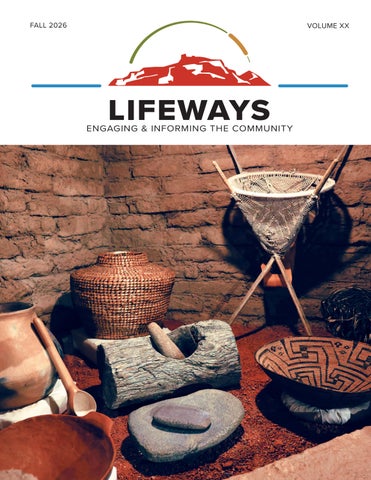
FALL 2026
VOLUME XX
CONTENTS 3 Department Message Alice Manuel
5
Program Spotlight Tai Chi
4 Senior Services
Connecting Waters with Jessica Martinez
8 SRPMIC Fire Department Electrical Safety
10
Better Living Food Bank
26 Recipes
Almost Thanksgiving Dinner
28 Kraft Korner
Window Chime
14
Senior Spotlight Deanna Scabby
30 Mind Teasers Games
34 Community
A Look Back
20
2
FALL 2026
Culture Connections Huhugam Ki: Museum
Department Message Contact us Address 10510 E. Osborn Rd. Scottsdale, AZ 85256 Phone 480.362.6350 Visit us online srpmic-nsn.gov/seniors Follow us on social media
Like us! @SaltRiverSeniorServices Managing Editor Jon Newman Writer Laura Toussaint Graphic Designer Ravenna Curley Photographer Isaac Torres Cover Photo Huhugam Ki: Museum Exhibit
Ske:g tas and Kamduum, As we welcome a new season, we are grateful for the opportunity to reflect, connect, and celebrate the meaningful work happening throughout Senior Services. In this edition, we highlight recent activities and moments that strengthen our connection to one another and our community. Thank you for being part of our journey. We look forward to another season of growth, learning, and connection together. Alice Manuel Senior Services Director
SRPMIC SENIOR SERVICES
3
SENIOR SERVICES
Welcome back to Connecting Waters, or welcome if you are new to this column. My name is Jessica Martinez. I am the Community Liaison for the Senior Services Department. This column is used to answer some FAQ’s I receive from seniors around the community. Some range from really common questions about our services, to wacky questions like: “my dog needs a haircut, can you guys do that for me?” (Yes, I’ve really been asked that question before). I am here to answer them all! Why is Senior Services talking about the Salt River Landfill? Do you guys assist with trash questions? No. Not directly. However, we can help you contact Public Works if you have an issue with your trash pickup or trash can replacement. I am informing seniors about the future of the Salt River Landfill because it will affect everyone living within the SRP-MIC community boundaries. As of now, the landfill is projected to reach capacity by 2032. So that means we may have to look at sending our trash farther out (west valley), which could involve fees for our trash disposal. Or, if we close the landfill to surrounding cities like Scottsdale, Tempe, etc., it will eliminate a source of revenue for the community. This is an important discussion to be had, and I encourage you all to attend your district meetings, and regular council meetings, to be part of the conversation for our community’s future.
More Questions? 480.362.7386 or jessica.martinez2@ sprmic-nsn.gov 4
FALL 2026
In late 2019, the Suquamish tribe of Washington sent an intertribal invitation for other communities to join them in learning tai chi. They had a program that was proving to be beneficial to their elders, and they wanted other tribes to learn and take the program back to their communities. “Erin Manuel oversaw Recreation at the time, and she brought the opportunity to me. I had always had an interest in learning tai chi and thought it could be of benefit to our seniors, so three of us went to the training.” ACM Melvin Deer, who was director of Senior Services at the time said. “We were eager to start the program when we returned from the training in early 2020, but very quickly after, the pandemic closed everything down, and we had to wait.” During the shutdown, a stressful time for most, Melvin practiced what he learned daily and became more convinced of tai chi’s benefits for seniors.
SRPMIC SENIOR SERVICES
5
“As I practiced, I noticed my mind became calmer and less murky, it was easier to relax and I slept better,” said Melvin. “I knew these benefits could help our seniors, especially for balance. It creates an awareness of your body and how it moves, which improves balance and prevents falls.” When the senior center reopened to in-person dining and activities, Melvin knew he wanted to start the program. A regular class had started in the fall 2021 led by a dedicated team of instructors who paved the way for the current team. Celinda Joe became a certified instructor in October 2023. She enjoys teaching tai chi to the seniors. “I like the meditation we do at the beginning of class and the calmness of tai chi for myself and the seniors. I also like seeing the progression of the seniors in their mobility, as well as feeling their energy and positivity,” said Celinda. “It’s amazing to see their commitment to tai chi. Some have been coming since the beginning.” Laura Toussaint was also certified in October 2023. She is happy to see how 6
FALL 2026
tai chi has made a positive impact. “Over the years, some of the seniors have shared how tai chi has helped them—one woman told the class how she stepped off a curb wrong and almost fell but was able to shift her weight and avoid a bad fall,” said Laura. “Another participant shared how doing tai chi in his hospital bed helped him heal faster, and another shared that she was able to return to work after a debilitating injury.” Shaylee Scabby, the team’s newest instructor, who was certified in July 2026, is working with the seniors on a new form, Swan Cools Its Wings. “I like the advanced movements, especially for those who stand—the flow is like water,” said Shaylee. “I also like seeing the regulars in their [tai chi] shirts and the community that we’ve built in class.”
Join us for tai chi! Tuesdays, 9-10 a.m. Ske:g Himdag Ki: Senior Room All fitness levels and abilities are welcome. Questions? Call Celinda Joe, 480.876.7180.
SRPMIC SENIOR SERVICES
7
FIRE DEPARTMENT
This coming fall season we at want to emphasis the importance of electrical safety awareness. I want to start off with 3 tips that will help us be safe this season:
by Captain Robert Scabby
Know your electrical outlet and multiplug capabilities: •
Don’t overload your outlet or multi plug, use ground-fault circuit interrupters (GFCIs) to reduce the risk of shock. GFCI’s shut off an electrical circuit when it becomes a shock hazard. They should be installed inside the home in bathrooms, kitchens, garages and basements. All outdoor receptacles should be GFCI protected.
•
Never “Daisy-Chain”: Do not plug one power strip or extension cord into another. This builds up electrical resistance, traps intense heat, and easily creates a fire hazard.
8
FALL 2026
Avoid Slip trip and fall hazards: •
Use cord covers or ramps when cords must cross walkways—these prevent tripping while protecting cords.
•
Use bright-colored cords or add high-visibility marking tape to increase visibility in dark areas.
•
Coil and secure unused cord length rather than leaving large loops or excess cord on floors.
away from any electrical lines above ground that are coming into the home.
Ladder Safety when decorating with lights: •
Use the most appropriate ladder (e.g., A-frame stepladder, multiposition, or extension ladder).
•
Place ladder on firm, level ground: Never prop a ladder on uneven soil, or loose bricks. Clear mud or debris from the area and ensure the spreader bars on a stepladder are completely locked down.
•
Choose the correct ladder material: If you are hanging any electrical decorations or working near power lines, always use a fiberglass or wooden ladder. Aluminum ladders conduct electricity and pose a severe shock hazard. Stay 10 feet
•
Always maintain three points of contact: Always keep two feet and one hand, or two hands and one foot, securely on the ladder rungs always while ascending, descending, or working.
Practicing proper electrical safety will reduce injury, the possibility of being shocked and falling. We at Salt River Fire – Community Risk Reduction wish you a happy and safe 2026 fall season.
SRPMIC SENIOR SERVICES
9
BETTER LIVING
Salt River Food Bank: Serving Our Elders At the Salt River Food Bank, we are dedicated to supporting the health, independence, and well-being of our community seniors. We understand that having reliable access to food and essential items can make life easier. Whether you need a little extra help or simply want to learn more about
10 FALL 2026
the services we offer, we invite you to come visit us! Community Members can receive one food box each week by visiting the Food Bank or through our home delivery service for those unable to travel.
Receive a Food Box To receive a food box, bring a valid photo ID and stop by during our business hours. If you’re unable to visit due to health, mobility, or transportation concerns, you may qualify for home delivery. When you arrive, you’ll be greeted by our friendly staff. We’ll ask a few short questions, check you in to our database with your ID, and log your visit. Once you’re checked in, our staff will prepare your food box and other requested items. We will assist you in getting it to your vehicle if needed. Each food box is thoughtfully packed with a variety of nutritious foods that may include fresh produce, canned fruits or vegetables, dairy products, meats, and other pantry staples. The boxes vary each week based on availability, giving families a variety of healthy foods throughout the month. The Food Bank also participates in the Commodity Supplemental Food Program (CSFP), which is a federal program that provides an additional monthly food package to eligible seniors. Our staff is happy to answer questions about the program and help determine eligibility. We also proudly partner with the Community Health Representatives and Nutrition Departments Registered Dieticians at River People Health Center to help connect elders with the services and support they need.
Weekly Food Demonstrations Not sure what to make with your box? We can help! Each week, registered dieticians and the Food Bank team provide step-by-step demonstrations using common items and ingredients from your box. Our demos are streamed on facebook.com/SaltRiverDHHS, making it easy to follow along from home and discover new meal ideas for yourself and your families. We keep these recipes on file and are happy to share them.
SRPMIC SENIOR SERVICES 11
Personal Care & Hygiene Items In addition to food boxes, we provide essential personal care/ hygiene items such as adult diapers, disposable absorbent pads (chux), lotion, conditioner, and other basic items. These items are donated to us and may be limited. They are available upon request and while supplies last. Requests are limited to twice per month so that others have a chance to receive them as well.
We’re Here for You We believe that no one should have to face hunger. Whether you’re stopping in for your weekly food box, participating in the CSFP program, watching one of our weekly cooking demonstrations, or receiving a home delivery, the Salt River Food Bank is here to serve our elders. We are committed to supporting the health and well-being of our community—one food box at a time!
If you think you may qualify for home delivery or have any questions, please call us at 480.362.7277 HOURS Monday, 8am – 4pm Closed for lunch 12-1pm Tuesday, 9am-2pm Open through lunch Wednesday, 8am – 4pm Closed for lunch 12-1pm 12 FALL 2026
Thursday, 8am-4pm Closed for lunch 12-1pm Friday, 8am-4pm Closed for lunch 12-1pm ADDRESS 1952 N. Longmore Rd., just north of the Salt River Community Building
Scan the QR code to learn more about about your amazing Food Bank team!
SRPMIC SENIOR SERVICES 13
SENIOR SERVICES
Community Spotlight
Deanna Scabby
My parents are Paul and Beverly Smith (bot). My maternal grandparents were Byron Sebahe from Chinle— he was Navajo—and Ida from Lehi and they met when they attended Phoenix Indian School. When I was small, we moved to Oregon. We lived with my great-grandparents, James Smith of the Warm Springs tribe and Amy Carlos Smith, who was from Lehi. The Warm Springs people embraced my mother and included us in the cultural
14 FALL 2026
feasts. As a child, I loved going to the Long House for the feasts—I remember the smell of smoked salmon and the root feasts where everyone would gather and eat. My mother helped pick strawberries and potatoes and huckleberries and I ate the berries fresh from the pickings. There were rivers and trees, and it was beautiful. To this day I love being around water.
At some point we moved back to Arizona when I was getting ready to enter the first grade. We lived with my Grandpa Bryon and Grandma Ida in Lehi. We all lived in a three-room sandwich house with my aunts and our family. We didn’t have indoor plumbing or running water in the home. I only recall happy fun times growing up there. My grandfather worked in town, and he would always bring home a big block of ice—that was a luxury. I remember chipping at it with the ice pick and I remember how the smell of my grandma’s coffee would wake me up in the morning. Since we didn’t have running water in the home, we had a water bucket that we all drank from and used a dipper for drinking. Sometimes we’d go to the community faucet where the Lehi Community Building is now and fill up our big metal milk cans. There was also The Pump located on McDowell Road and Stapley. The Pump was a place where the water came from the earth. It was designed like a horseshoe, and everyone got their ice cold water from this oasis in the desert. The water was so clear that you could see the sandy bottom of the pump. Before we filled our milk cans up, we would all jump in and swim! After we had our fun swimming, we would fill our milk cans. That was one of my favorite memories. I wish someone had a picture of The Pump. I’ve asked over the years, but no one has one. Our other swimming places were the ditches. We didn’t drink this water, but it was one of our summer swimming places. We also played outside all day, but by evening time my grandpa would call us to be home by sundown. When we got indoors, we would play on the dirt floor and my grandpa would tell us to “quit
raising dust” so we’d get the bucket and sprinkle the floor with water. My parents worked so my Grandma Ida took care of us. Though she spoke mostly English, she tried to teach us simple Piipaash phrases. My great-grandmother Amy and her brother, Leonard Carlos (bot), sang the traditional O’odham songs, so we were exposed to both languages. I wish we had learned more. Grandma Ida loved to plant roses, and we had fruit trees. She also really liked music. Whenever she had extra money, she would go to Milano’s to buy an instrument or a 45 record of her favorite song. Because of my grandmother’s love of music, my mom played piano all her life. My grandmother instilled in us at an early age to be active in school and to enjoy music. I attended the Old Lehi Elementary School, which is now a museum. I loved that school. I loved all my teachers and the food. I remember we had to take iron tablets before we could get our food and sometimes, they take us kids to the old clinic where the Culture Center is now for shots or to the dentist at the old Phoenix Indian Hospital. Today, as I pass my old school, I look at it with fond memories. We would have on-stage assemblies, and I especially liked the spring presentation, where everyone was dressed up in our handmade outfits and sang. I remember the Westwood High Sunshine Band came to perform and being mesmerized by the flute players—how they could play without seeing their fingers. That inspired me to take music, and I played the flute for six years.
SRPMIC SENIOR SERVICES 15
SENIOR SERVICES
“When I was 11, I played on one of the teams with the women even though I was a kid. Because we were always active and my grandma’s emphasis on education, I decided I wanted to be a PE teacher.”
16 FALL 2026
Both my parents were involved in sports—Dad in baseball and Mom in softball and basketball, so we were always at games. Women had their own basketball teams then with big tournaments. When I was 11, I played on one of the teams with the women even though I was a kid. Because we were always active and my grandma’s emphasis on education, I decided I wanted to be a PE teacher. In middle school and high school, I scheduled all my classes towards the goal of going to ASU because they had a really good program back then for physical education. When I got to high school, I wanted to be in the Westwood Marching Band. I never made it—they told me I could either be in the band or play sports and since I wanted to be a PE teacher, I chose sports. I graduated from high school a semester early and went to MCC, but I got to go back to Westwood for the graduation ceremony. Then I went back to MCC. I was on their Women’s basketball team. There were five of us native girls on the team. There was a lot of travel, and I learned a lot. It was demanding—taxing on your body and your grades. I would also referee community basketball games and help with tournaments, even men’s games. I got flak from some men now and then, but I’d give them a warning and if needed, I gave them a technical foul and that would be that. My cousin, Tony Ringlero (bot), was on the LDS placement program, and he eventually went to BYU for college. He’d come home during breaks and encourage me to apply there. I got tired of him bugging me, so I did apply and I was accepted. I was the first grandchild to graduate from high school and to go to college. I traveled by bus one cold
January night and arrived to my new school. It was just me and my big trunk. I didn’t know anyone or what to do. I didn’t even know how to turn the space heater on in my room, so I froze for a week until my roommate got there. I remember a night when I called home from a phone booth on the corner in front of our dorm to let them know that I made it and how I was doing. I didn’t realize it until I hung up the phone that my shoes literally froze to the ground during my conversation. I couldn’t believe it! It was so cold, and I wanted to leave. I met a few other native girls, and they helped me stick it out. It was a good thing that they did because that is where I met my husband, Bob Scabby (bot). When there was a “preference” dance where the girls asked the guys; I asked him. It was our first date—that was in March—and we were married that December 1976. SRPMIC SENIOR SERVICES 17
SENIOR SERVICES
We started our family in Provo while he finished his degree. We eventually had 10 children. We moved to the Salt River community so Bob would have better job opportunities. We were in VA2 for a bit but rent went up a lot and many families could not afford it. There were 10 other families in a similar situation, so we went to the Council and asked if the community could provide us loans to build our own homes. That was the start of the home loan program. We had to put in sweat equity and build on our own land. Since we had such a big family, my grandmother gave us a piece of land she had designated for my mom. The house was almost done before my grandma died, so I was able to show it to her before she passed. I’m still in the house today—almost 40 years. My father was a former council member and president of the community, and my Grandpa Byron was a councilman. From their work, I was always interested in what was going on in the community. I’d go to meetings and people would come to me and say, “BJ—that is my nickname—BJ, ask them this question,” so I would ask for them. Councilman Lance Grey (bot) noticed my interest and people’s trust in me, and he encouraged me to run for council. I didn’t know what that meant but, I did get elected in September 2006 to complete the term of one of our esteemed Council members who had passed. During this time, I returned back to school to attend SCC and completed my associate’s degree in 2007. Now, with only two years left of my current term, and 20 years of service to the community, I look back at the successes of our members who have obtained their goals and I look to 18 FALL 2026
the future where I’d like to see our people be—that we always maintain our identity as O’odham and Piipaash, and that we cherish this land and our community, never taking it for granted. Our Community is truly blessed. My biggest and most important job has been raising my family. I have many cherished experiences and memories, but I owe so much to my family. I was married to the most wonderful person and blessed to raise ten amazing children. Despite life’s ups and downs I wouldn’t change a thing. It’s funny but I didn’t get to become a PE teacher, but I did help my children in their sports endeavors to become accomplished athletes. They all completed high school, and some attained their respective degrees and have been successful in their professional lives. I now get to enjoy the grandchildren, and they complete my total happiness.
“My biggest and most important job has been raising my family. I have many cherished experiences and memories, but I owe so much to my family.”
“...I was always interested in what was going on in the community. I’d go to meetings and people would come to me and say, “BJ—that is my nickname— BJ, ask them this question,” so I would ask for them.”
SRPMIC SENIOR SERVICES 19
SENIOR SERVICES
Museum Director Doreen Duncan and the museum kitchen staff including Sharilyn Belone
20 FALL 2026
Historical photos courtsey of Kavaḍ/ Kushov Cultural Center-CRD
The original museum located northeast of the BIA day school For nearly four decades, the Huhugam Ki: Museum has preserved and shared the history and traditions of the O’odham and Piipaash people. According to Museum Manager Gary Owens, its beginnings were humble, rooted in the dedication of community members who recognized the importance of preserving their culture for future generations. In the mid-1970s, a group of basket weavers, including Hilda Manuel, Vivian Ray, Mrs. Pedro, and others, wanted to preserve the traditions and culture of the Pima and Maricopa. They founded what became the “Pimainum” Museum located northeast of the BIA day school. The museum was named for the man who buried the treaty between the Mexican government and the Pima, in a metal box. His name meant “Without a mat (sleeping)”. The museum began with 30 willow baskets on loan from the grandson of Fred Harvey of the Harvey Houses, and other items from the founding women’s homes. The museum also had a small gift store to encourage community crafts. When the building was no longer available in the late 1970s, the museum closed and the idea for another museum lay dormant until Alfretta Antone was elected Vice President in the mid-1980s. She envisioned a place where visitors to the community and future generations could experience and learn about O’odham and Piipaash culture. The museum was one of the first proposals she brought before the council. “Mrs. Antone pushed for the museum. At the time, the tribal council was dealing with community growth and
infrastructure, so its support for a museum was minimal, but Mrs. Antone took it upon herself to spearhead the project with other women from the community,” said Gary. Once approved, the question became where to locate the museum. The building that now houses the current museum was selected. The building was originally the youth home constructed by community members in the 1960s using traditional adobe brick and rammed-earth methods—the members wanted the youth to live in an environment they were familiar with. After a new youth home was built in the 1980s, the original building became available. Public Works transformed the space by creating offices and opening several rooms into what would become the museum’s main gallery. “The original load-bearing beams were kept. They are said to have come from the White Mountain Apache tribe in reparation for what was done to our community in the past. The beams can still be seen in the main gallery and throughout the space,” said Gary. “Other help came from Salt River Project, which provided consultants who assisted with display cases and some restorations to the space.” As the renovations were underway, a group of community members rallied behind the project by collecting cultural items for the museum’s exhibits. The Huhugam Ki: Museum officially opened on Veterans Day 1987 and was dedicated to the community’s Veterans of Foreign Wars.
SRPMIC SENIOR SERVICES 21
SENIOR SERVICES
“The initial exhibit contained willow baskets, Piipaash pottery, artwork, and a collection of community veteran medals, uniforms and photos,” said Gary. “It was community members who believed in the museum’s mission and donated or loaned items. And it was also the community that told the stories of the men and women who fought in foreign wars.” “In 1990, Doreen Duncan became the museum’s first official director. During that time Geraldine Carlos, with help from ASU, began to establish an inventory system to properly catalog, maintain, and preserve the museum’s growing collection of artifacts.” “Early staff members included Delbert Jackson, Ruth Madar, Veronica Easchief, Cecilia Antone, Alice Manuel, Thomas Jackson, Sharilyn Belone, Marie Kline, Darlene Carlos, and many more. We are grateful to them, for guiding and establishing the mission of the museum,” said Gary. As the museum grew, so did its exhibits. Collections expanded to include culturally significant items related to traditional foods, farming, dance, clothing, storytelling and photographs documenting Salt River history. “The museum started small with exhibits and some demonstrations by community members but soon, a gift store was added to promote the crafts from the community,” said Gary. “Also, a kitchen was added which sold foods like popovers, red chili and breakfast burritos. Many “of the” workers in the tribal government began the day with a breakfast stop at the museum kitchen.” Also added on the museum’s west lawn were half-scale models of
22 FALL 2026
One of the museum’s early exhibits
traditional homes and structures for visitors to explore. Special parking spaces were added to the north parking lot for school and tour-bus groups from senior trailer parks in the surrounding community. “These visitors were exactly what Mrs. Antone envisioned, and it came to be,” said Gary. By its 10th anniversary in 1997, the museum expanded its outreach to include participation in NARD, the Salt River Pageant, and Community parades and other events. In 2004, under new leadership by Kelly Washington as director, the museum was added to the Cultural Resources Department. In 2006, the museum expanded its mission by hiring an education specialist. Traditional cooking and cultural classes soon
Vic An
The youth home was constructed by the community and would eventually become the Huhugam Ki: Museum became a popular way for community members to reconnect with their traditions and culture. The first classes focused on making tortillas with the late Sharilyn Belone, one of the museum’s original cooks. Designed primarily for youth, the classes encouraged participants to bring what they learned home and to continue practicing with their families. As of 2026, the museum has provided tortilla-making instruction to over 400 community members, employees and visitors. These classes are the foundation for the Annual Tortilla festival held every March. Other offerings now include cholla bud picking, roasting wheat and corn, mesquite pod picking, food preservation and storage, and making prickly pear jam.
ce President Alfretta M. Antone and President Gerald nton unveil and open the Huhugam Ki: Museum
SRPMIC SENIOR SERVICES 23
SENIOR SERVICES
As interim director in 2008, Gary oversaw the renovations to the museum’s main gallery, creating a more open floor plan with updated display cases showcasing O’odham and Piipaash arts, crafts and design. The gift shop was expanded and still featured items made by community members. The museum always encouraged community participation in the classes and events, including a yearlong exhibit art from the community members. During the 2010s, it also began encouraging participants from its cooking classes to enter their homemade jams, tortillas and lazy breads in competitions at the Arizona State Fair. Over the years, the museum continued to expand its programming to include annual anniversary celebrations, mesquite pancake breakfasts, tamalemaking parties, arts and crafts shows, and other cultural events that brought the community together while celebrating traditional experiences. In addition to the exhibits on display, the museum cares for a standalone repository that preserves countless pieces of community history. Gary hopes a future museum will make many of these items accessible to the public for viewing. “With community members, we hope to create a new museum on the cultural campus that would allow us to expand exhibit areas and display more ‘way of life’ items and possibly items from other tribes, pre-Colombian items, and contemporary art. We could also include research rooms allowing community members to learn the history and culture of their ancestors,”
24 FALL 2026
said Gary. Gary feels community participation is key to keeping traditions and culture alive. “We now tell people we learn about history by looking at the past, but we become part of history by sharing our past. That’s why we need community members’ help to plan a place where people can share their stories. Those are the stories and knowledge that we need to pass on—about the people who built this community and the teachings of the ancestors who show us who we are,” said Gary. As the Huhugam Ki: Museum looks ahead, it also prepares to celebrate an important milestone. In November 2027, the museum will mark 40 years of preserving, celebrating and sharing the rich history and traditions of the O’odham and Piipaash people. Watch for more to come!
Museum entry is free, though donations are appreciated. HOURS Monday – Friday 9:30 a.m. – 4:30 p.m. Closed Federal and Tribal holidays ADDRESS 10005 E. Osborn Rd. INFORMATION 480.362.6320 huhugamki.com
SRPMIC SENIOR SERVICES 25
FOOD & NUTRITION
Ske:g Kamduum! It’s me, your friendly goth/emo PR & Media Specialist, Ravenna. Yá’át’ééh, my name is Ravenna Curley. I am of the Tsejíkinii (Honeycomb/Cliff Dwellers) Clan and born for the Tó’áhédlíinii (Water Flows Together) Clan. As you may have guessed, I am Diné (Navajo). Last issue, I talked about a mysterious inflammation condition that inspired me to start adding simple anti-inflammatory ingredients to my morning meals. Along the way, I’ve also learned more about cooking, and let me tell you, I despise cooking. I’ve always avoided cooking because things never seem to come out the way I want. When I was about 16, I tried making Rice-A-Roni. Simple, right? Wrong. The rice stayed hard, so I kept adding water. I also didn’t sauté the rice beforehand. After 30 minutes, I gave up. That rice looked like slop in a pot. We threw it out for the rez dogs, and guess what? They didn’t even eat it. From then on, I avoided cooking. But last year, while prepping a turkey for the first time, I decided to make a small whole hen just for me. I called it my “It’s Almost Thanksgiving” meal. Since it’s just me and my dogs, it turned out to be the perfect little dinner.
26 FALL 2026
INGREDIENTS • 1 Cornish hen • ¼ stick of soften butter • ½ cup of jasime rice • 2 cups of green beans Measure with your heart • Dried thyme • Dried rosemary • Dried sage • Dried parsley • Garlic powder • Cajun creole seasoning INSTRUCTIONS 1. Thaw hen completely, which may take 1–2 days if frozen. 2. Preheat oven to 400°F. 3. Combine dry seasonings and divide them in half. 4. Mix softened butter with half the seasoning and melt. 5. Season hen with the remaining dry mixture and coat well. 6. Inject the mixture of melted butter into the hen or spread it under the skin and inside. 7. Add green beans around the hen. 8. Bake for 45–60 minutes, or until fully cooked. 9. Cook jasmine rice while the hen bakes. 10. Serve hen and green beans over rice and enjoy!
SRPMIC SENIOR SERVICES 27
let’s get Crafty in the
Kraft Korner
Here is a fun and simple craft you can do at home with your friends or grandkids!
1
Gather your supplies: Branch, brown bag/ paper, twine, scissors, hot glue gun, white chalk markers and embellishments of choice.
2
Cut leaves from brown paper and use chalk markers to paint patterns on your leaves.
28 FALL 2026
3
Cut twine to varying lengths, glue to your leaves and add your embellishments.
4
Tie the twine strands to the branch. Secure with glue and add a loop to middle of the branch to hang. Voila, your piece is done!
SRPMIC SENIOR SERVICES 29
MIND TEASERS
Word Search
30 FALL 2026
Logic Sudoku
SRPMIC SENIOR SERVICES 31
MIND TEASERS
Find the Pattern Can you find the top view for each paper plane?
32 FALL 2026
Hidden Words Fill in the blanks with the words ACTOR, AND, ANT, CAN, CAR, CARD, KINGS, LAKE, LAND, MIST, NAME, NOW, OBI, RATION, REPLACE, SET , TOE, US, to reveal fourteen holiday related words.
SRPMIC SENIOR SERVICES 33
We Cool!
Doodles!
Rawr!
K O B O A L CK A
Fall is here, and the holidays are just around the corner. From cozy moments to festive traditions, these are the memories made together.
Photogr
Eee! Snakes 34 FALL 2026
Cool Kids
s t f a r C f o r e t s Ma
e d i s t u O e M h c t Ca
Foodies
Smiles
Fun in the Sun :)
raphers!
Let’s dine! We are Family SRPMIC SENIOR SERVICES 35
Roofing
Ramps & Flooring
ADA Bathrooms
Weed Removal
AC & HVAC
What is SHRRP?
Who is eligible?
SHRRP provides day-to-day services that seniors and those with adaptive and medical needs may find challenging such as changing air filters, repairing exterior doors that do not close correctly or windows that are not properly sealed.
Qualified individuals must be members of the community, age 55+ or qualify with medical disability, and have a home condition that detrimentally affects the individual’s health, welfare or safety.
If you think you or someone you know may qualify, call the SHRRP helpline Monday - Friday, 8 a.m. - 5 p.m. at 480.362.7800.