All rights reserved. No part of this publication may be reproduced, duplicated, stored in any retrieval system or transmitted in any form by any means without prior written permission of the Publishers.
The next issue of IBI will be published in Summer 2026.
ISSN No.International Biopharmaceutical Industry ISSN 1755-4578.
The opinions and views expressed by the authors in this journal are not necessarily those of the Editor or the Publisher. Please note that although care is taken in the preparation of this publication, the Editor and the Publisher are not responsible for opinions, views, and inaccuracies in the articles. Great care is taken concerning artwork supplied, but the Publisher cannot be held responsible for any loss or damage incurred. This publication is protected by copyright.
2026 Senglobal ltd.
Volume 9 Issue 2 – Summer 2026
www.international-biopharma.com
04 Foreword
REGULATORY AND COMPLIANCE
06 Upgrading Environmental Monitoring Through Biofluorescent Particle Counting
Environmental monitoring programmes in pharmaceutical cleanrooms were built around intermittent sampling and delayed culture results, yet modern manufacturing demands real-time understanding of microbial risk. Christine Troutman of MicronView evaluates how modern contamination control strategies demand continuous insight, rapid response and data-driven decision making.
12 Biopharma’s New Evidence Era is Holding up a Mirror to Sub-par Commercialisation Strategy
Evidence has never been more central to commercial success. Payers demand it before reimbursement. HTA bodies are raising the bar with sweeping new frameworks. Janice ManLennan of Nmblr examines how Biopharma's new evidence era is not a downstream activity but a vital component of effective commercialisation strategy development.
RESEARCH / INNOVATION / DEVELOPMENT
16 Reviewing the Crystal Structures of Ternary Complexes Formed by Heterobifunctional Degraders
Heterobifunctional degraders rely on the formation of productive ternary complexes to activate cellular degradative machinery, causing the proteolysis of a protein of interest (POI). Ryan Hubball and Lauren Nelson of Cresset display how increasing availability of structural data provides unprecedented opportunities to study these dynamic processes.
22 Antibodies by Design: Cracking the ‘Undruggable’ Code Antiverse
The numbers that have long defined traditional drug discovery are, by any measure, daunting. Bringing a single new medicine to market can take over a decade and costs on average over $1billion. Murat Tunaboylu of Antiverse examines how AI-designed candidates can influence target selection strategies.
TECHNOLOGY
24 Growing Focus on AI Adoption in Biopharma Manufacturing
After decades of relying on established and proven methods, the biopharma manufacturing sector is now changing quickly. Increasing pressures across global supply chains and a heightened need for operational resilience are compelling industry leaders to rethink long-held norms. Steve Oliver of AES Clean Technology explains how partnering organisations can construct the resilient facilities necessary to secure their position as reliable players in the global market.
27 Navigating Scientific Software for Biopharma Success
Scientific software is being purpose-built and adopted across all aspects of biopharma workflows. Kevin Teburi and Arielle Mann of Genedata argue the importance of choosing software and licensing structures that scale with your scientific ambition and adapt to changing teams, workflows and AI tools.
30 De-risking Pipeline Economics and Market Access with Computational Modelling
To combat escalating R&D costs, high clinical attrition and stringent global pricing pressures, the biopharmaceutical industry is on a quest
to find the best uses for AI and computational modelling. Dr. Irina Babina of Concr highlights that by leveraging uncertainty-aware Bayesian algorithms, the biopharmaceutical industry can ensure that only the safest, most effective therapeutics advance to human testing.
LOGISTICS AND SUPPLY CHAIN
34 The Hidden Cost of Siloed Clinical Supply Chain Systems
The need for speed in clinical trials is becoming a strategic imperative for sponsors, with looming patent cliffs, rising R&D investment, increasing innovation competition and patient demand forcing a rethink on how quickly trials can be delivered. Dave Ergott of Almac explains that connected systems are no longer optional. They’re essential for maintaining competitiveness and ensuring reliable patient access.
BIOMANUFACTURING SUBSECTION
38 Mastering ADC Bioconjugation: From DAR Control to Efficient Free Payload Removal
Antibody–Drug Conjugates represent one of the most advanced classes of targeted therapies in oncology, combining the specificity of monoclonal antibodies with the potency of cytotoxic agents. Dr. Matthieu Culié of Olon examines the importance of achieving the right balance between DAR control and residual payload removal.
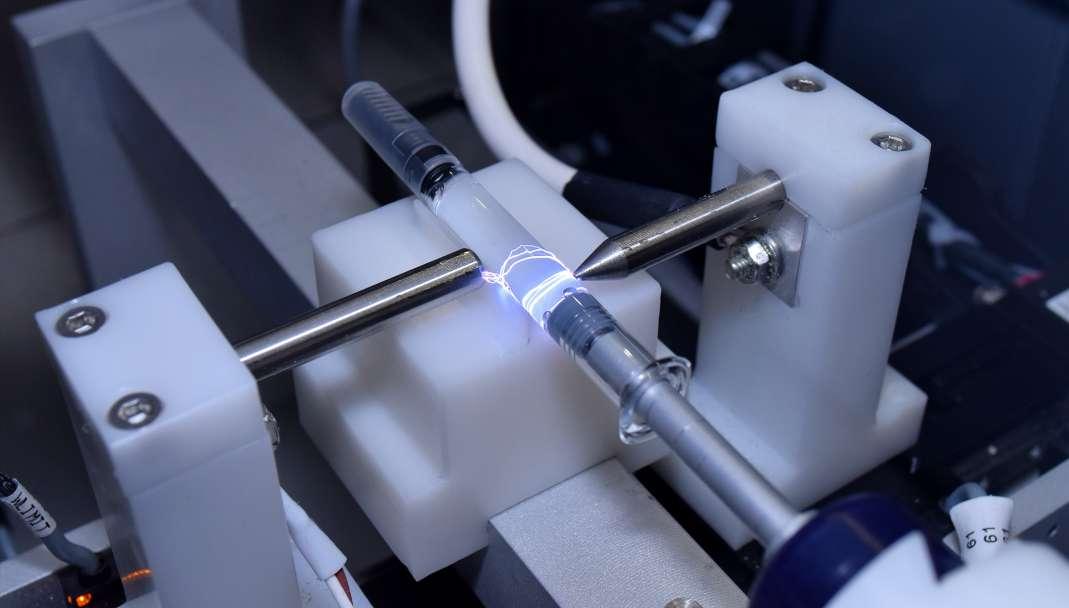
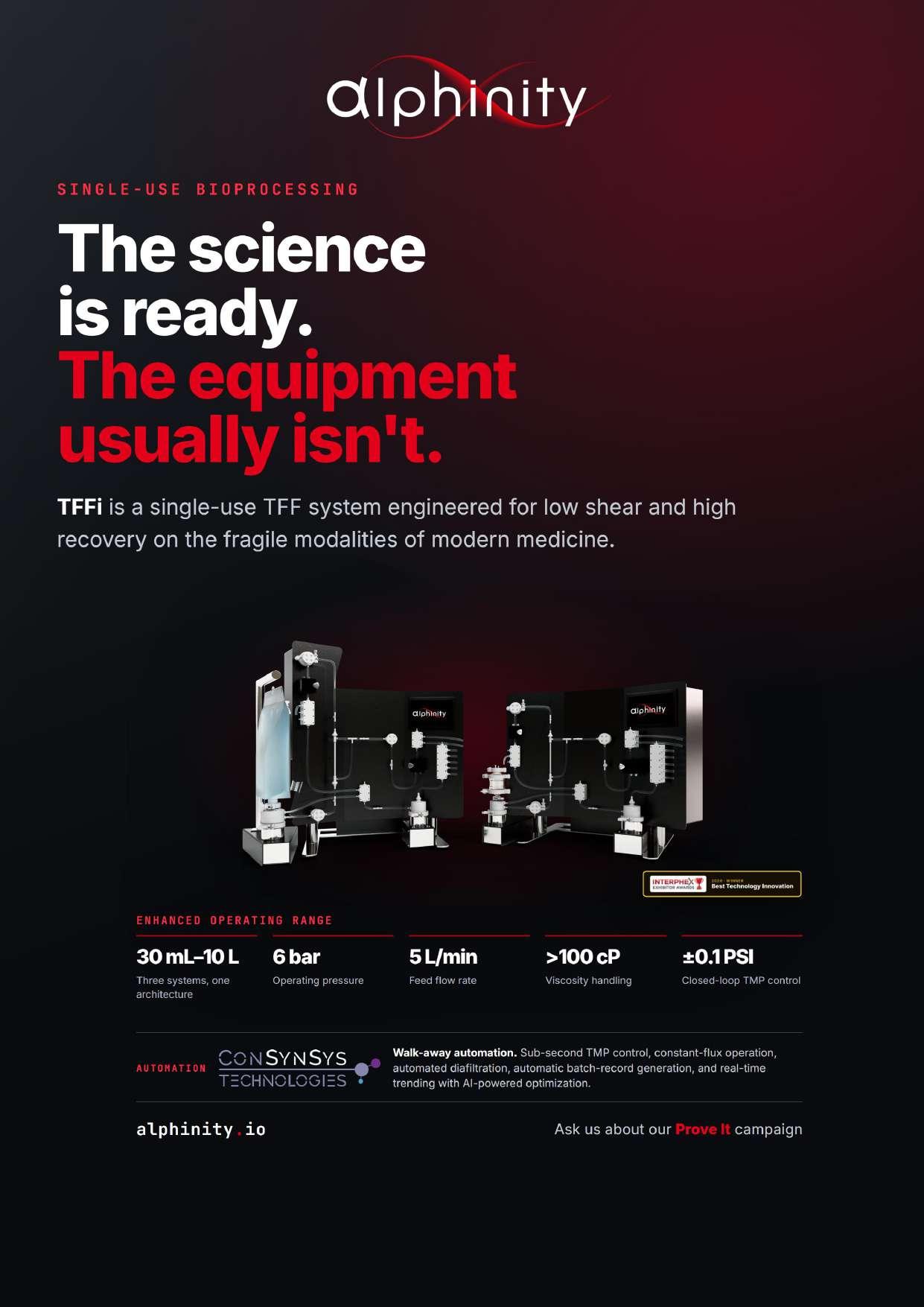
40 Pump Architecture as an Uncharacterised Process Variable in TFF for Fragile Biologics
Tangential flow filtration is a standard unit operation for concentration, buffer exchange and formulation across biopharmaceutical manufacturing. Chris Davies of Alphinity argues that pump
architecture should be evaluated as an independent, characterisable process parameter.
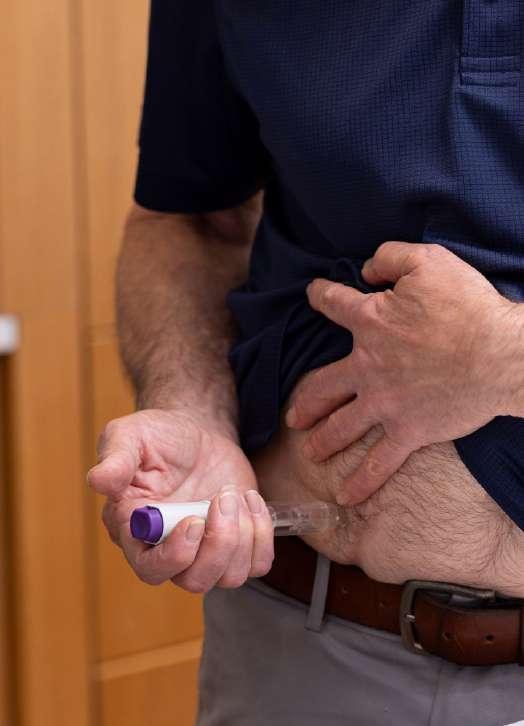
48 Managing Complexity in Combination Product Development and Delivery
Biologic therapies are reshaping the pharmaceutical landscape. Their growing complexity is creating new challenges for combination product development and delivery. Justyna Dudaronek of Becton Dickinson highlights how combination product development is evolving into a broader systems challenge that extends beyond traditional pharmaceutical development models
APPLICATION
NOTE
19 Direct-to-Biology:
Streamlining the DMTA Cycle in PROTAC Discovery
Novel degrader classes like molecular glues and proteolysis targeting chimaeras have emerged as powerful strategies to eliminate disease relevant proteins by targeted protein degradation. Concept Life Sciences evaluates that with the right integrated service partner, the path from the initial concept to the clinic has never been more attainable.
45 Fluid Management as a Strategic Enabler in Biopharmaceutical Manufacturing Avantor
In cell and gene therapy manufacturing, a contamination event during fill-finish doesn’t just cost product; it can cost months of patient wait time. Jerry Keybl of Avantor argues that biopharmaceutical companies who prioritise integration, usability, flexibility and material compatibility will be best positioned to gain a significant advantage.
LABORATORY
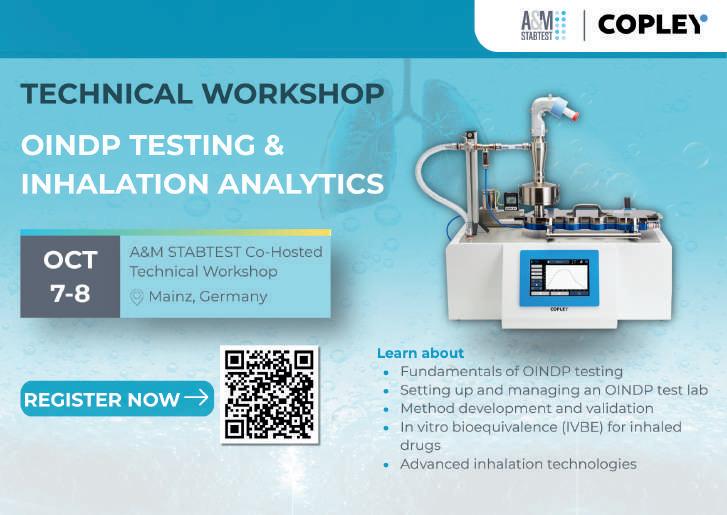
UPCOMING TECHNICAL WORKSHOPS: REGISTRATION NOW OPEN
Our face-to-face workshops bring together experts from industry, academia, and pharma to share the latest analytical techniques, cutting-edge applications, and practical GMP implementation. By combining scientific innovation with practical pharmaceutical applications and regulatory perspectives, they bridge the gap between research and routine quality control.
Best of all, participation in our workshops is completely free of charge.
For further information, please contact: request.mz@am-labor.de/ steven.watt@am-labor.de
Foreword
Antibodies, antibody-drug conjugates (ADCs) and antibody-inspired protein scaffolds continue to drive many of the most transformative therapies in oncology and autoimmune disease. Over the past two decades, biologics have fundamentally changed the treatment landscape, delivering unprecedented specificity and clinical benefit. Yet innovation is no longer confined to the therapeutic molecule itself. Highly efficient production platforms continue to reduce the cost of goods while simultaneously increasing built-in product quality. Novel linker technologies enable precise control of drug-to-antibody ratio (DAR), tailor-made linker stability and compatibility with an expanding range of highly potent payloads, allowing developers to optimise efficacy while improving safety.
It is therefore fitting that this issue of the IBI Journal opens with two excellent examples of how biologics continue to evolve. Antibodies by Design explores how artificial intelligence is beginning to overcome one of drug discovery's greatest challenges, the identification of antibodies against previously "undruggable" targets. AI is no longer simply accelerating discovery; it is expanding the boundaries of what can be discovered. Complementing this, Mastering ADC Bioconjugation examines the equally important challenge of translating these sophisticated therapeutics into robust manufacturing processes, highlighting how advances in DAR control and efficient payload removal are becoming essential for producing the next generation of precision medicines.
These articles also illustrate a broader trend that runs throughout this issue, the convergence of biology, chemistry, engineering and artificial intelligence. Whether reviewing ternary protein degrader complexes, streamlining PROTAC discovery, applying computational modelling to improve portfolio decisions or introducing AI into biopharmaceutical manufacturing, one message becomes increasingly clear. Innovation is no longer taking place in isolated disciplines. Instead, digital technologies are becoming deeply embedded throughout the entire pharmaceutical value chain from target identification and molecular design to manufacturing, commercialisation and supply chain management.
And Finally…
Welcome to the summer edition of IBI. Despite the recent heat wave that we’ve been experiencing, we have been working hard here at Senglobal to bring you a journal packed with interesting and eye-opening editorials. In this issue, we have a subsection on biomanufacturing, which kicks off on page 38 with Dr. Matthieu Culié of Olon’s article titled ‘Mastering ADC Bioconjugation: From DAR Control to Efficient Free Payload Removal.’ We have been lucky to receive some brilliant contributions to fill our subsection, making it packed full of thought-provoking
• Cellia K. Habita, President & CEO, Arianne Corporation
• Deborah A. Komlos, Senior Medical & Regulatory Writer, Clarivate Analytics
• Francis Crawley, Executive Director of the Good Clinical Practice Alliance – Europe (GCPA) and a World Health Organisation (WHO) Expert in Ethics
• Hermann Schulz, MD, Founder, PresseKontext
As biologics become more sophisticated, so too must the manufacturing technologies that support them. This edition explores how process understanding is evolving through improved environmental monitoring, intelligent scientific software, advanced tangential flow filtration, connected clinical supply chains and modern approaches to combination product development. Together, these contributions demonstrate that manufacturing excellence is no longer simply about efficiency; it has become a competitive advantage that directly influences product quality, regulatory success and ultimately patient access.
Artificial intelligence is another recurring theme. Beyond designing therapeutic molecules, AI is increasingly supporting facility design, process optimisation, scientific data management and predictive computational modelling. Rather than replacing scientific expertise, these technologies are augmenting it, allowing researchers and manufacturers to make faster, more informed decisions while reducing risk throughout development.
Finally, this issue reminds us that the future of biopharmaceutical innovation depends on integration. Success will not come from advances in biology alone, nor from engineering or data science in isolation. It will emerge where these disciplines intersect, where computational tools accelerate discovery, manufacturing processes preserve molecular complexity, and innovative therapeutic concepts can be translated into scalable medicines for patients.
The pace of innovation in our industry has never been greater. As antibody engineering, targeted payload delivery, AI-driven drug discovery and advanced manufacturing continue to converge, we are witnessing the emergence of an entirely new generation of precision medicines. I hope the articles in this issue provide fresh perspectives, stimulate new ideas and, above all, demonstrate that the future of biopharma will be shaped not by individual breakthroughs but by the successful integration of multiple scientific disciplines into one coherent vision.
Dr. Steven A. Watt, CBDO (Chief Business Development Officer) at A&M STABTEST GmbH
editorials. Elsewhere, Ryan Hubball and Lauren Nelson of Cresset have provided an editorial titled “Reviewing the Crystal Structures of Ternary Complexes Formed by Heterobifunctional Degraders’, starting on page 16. This is a really good and informative piece, which is definitely worth a read.
I hope you enjoy this edition and have a great summer. Before we know it, we’ll be getting stuck into the production of our autumn issue of IBI ahead of some big conferences later in the year, where we will be distributing!
• Rafael Antunes, Vice President Business Development, Aurisco Pharmaceutical Europe
• Stanley Tam, General Manager, Eurofins MEDINET (Singapore, Shanghai)
• Stefan Astrom, Founder and CEO of Astrom Research International HB
• Steven A. Watt, CBDO (Chief Business Development Officer) at A&M STABTEST GmbH
Regulatory and Compliance
Upgrading Environmental Monitoring Through Biofluorescent Particle Counting
Environmental monitoring programmes in pharmaceutical cleanrooms were built around intermittent sampling and delayed culture results, yet modern manufacturing demands real-time understanding of microbial risk. As contamination control strategies evolve toward prevention rather than retrospective investigation, biofluorescent particle counters have emerged as a powerful upgrade to traditional viable monitoring. By delivering immediate biological insight alongside conventional particle data, technologies such as the BioAerosol Monitoring System (BAMS) are transforming how manufacturers detect, investigate and control contamination in both critical and routine cleanroom environments.
Introduction: Why Traditional Viable Monitoring Is No Longer Enough Environmental monitoring has always served as a foundation of contamination control in pharmaceutical manufacturing. Air sampling, settle plates and surface monitoring have historically provided the primary means of assessing microbial cleanliness in controlled environments. These methods remain essential for regulatory compliance, organism identification and long-term trending. However, they were developed in and for an era that relied on periodic verification rather than the continuous process understanding desired in modern manufacturing.
Culture-based monitoring inherently provides delayed information. Samples must be collected at defined intervals, transported to the laboratory and incubated for several days before interpretation. By the time results are available, the production activity that generated the contamination event has already occurred. Investigations are therefore reactive, relying on historical reconstruction rather than real-time observation.
In addition to the delay, traditional viable monitoring captures only isolated snapshots of cleanroom conditions. Even with robust sampling programmes, the vast majority of manufacturing time remains unmonitored. Transient contamination events, short-duration airflow disruptions or momentary operator interventions may never be detected through scheduled culture sampling alone. Modern pharmaceutical manufacturing has outgrown this approach. The rise of high-value biologics, cell and gene therapies and complex aseptic filling operations has dramatically increased the risk and cost associated with microbial contamination. A single excursion can result in significant product loss, extended downtime, regulatory scrutiny and patient risk.
Regulatory guidance has evolved accordingly. Current expectations emphasise proactive contamination control strategies, continuous process understanding, early detection of risk and data-driven environmental control, particularly in critical Grade A zones. Rather than relying solely on delayed confirmation, manufacturers are now expected to understand and
control contamination pathways in real time. This shift has driven the increasing adoption of rapid and continuous monitoring technologies. Among the most impactful of these advancements is biofluorescent particle counting, which provides real-time insight into biological particle behaviour within cleanroom environments.
Understanding the Science Behind Biofluorescent Particle Counting
Traditional non-viable particle counters rely on light scattering to determine particle size and concentration. While these measurements are critical for assessing overall cleanroom performance, they offer no information about whether particles are biological in nature. A dust particle, fibre, skin fragment or microorganism will all be counted equally based solely on size. Biofluorescent particle counters build upon this foundation by introducing intrinsic fluorescence detection. Using a laser excitation source, typically around 405 nm, BFPC systems illuminate each airborne particle as it passes through the optical sensing region. Two signals are generated simultaneously. The first signal arises from scattered light, which is proportional to particle size and enables classification across standard cleanroom particle channels. The second signal originates from fluorescence emitted by naturally occurring biological compounds within microbial cells.
Many microorganisms contain intrinsic fluorophores such as nicotinamide adenine dinucleotide (NADH), riboflavin and, in some species, dipicolinic acid. When excited by violet or ultraviolet light, these molecules emit characteristic fluorescence that can be detected optically.1
By capturing both scatter and fluorescence signals for each particle, BFPCs can differentiate biologically derived particles from inert environmental debris in real time. This allows real-time enumeration of viable biological particle trends rather than relying solely on indirect culture confirmation.
It is important to note that BFPC systems do not measure microbial growth or colony formation. Instead, they detect intrinsic biological fluorescence, typically reported as autofluorescence units. These values represent biological particle presence rather than culturable organisms. Studies have shown that AFU measurements provide a broader representation of total viable and viable-but-nonculturable microbial burden, offering earlier indication of contamination events compared to culture methods alone.2 This fundamental difference explains why BFPC data should not be interpreted as a 1:1 replacement for CFU counts. Rather, they serve as real-time biological trending tools that complement traditional microbiology.
Why Real-time Biological Trending Changes Contamination Control
The most transformative aspect of BFPC technology is not simply
Regulatory and Compliance
faster results, but the shift from intermittent verification to continuous environmental awareness.
In traditional monitoring programmes, viable samples may be collected a few times per shift or per day. Between those sampling points, the environment remains effectively invisible. Any transient contamination events, short-duration airflow disruptions or momentary lapses in aseptic technique may go completely undetected. BFPC systems can generate real-time data throughout cleanroom operation. Every minute of production becomes a monitored period, producing thousands of data points that reveal how biological particle levels fluctuate in response to real activities.
This real-time visibility allows manufacturers to:
• Observe microbial risk during specific process steps
• Correlate contamination trends with operator interventions
• Identify high-risk activities and zones
• Detect abnormal patterns before excursions occur
• Strengthen contamination control strategies based on real data
Instead of asking “What happened three days ago?”, cleanroom teams can see contamination as it occurs and respond immediately. This capability significantly improves root cause investigations. Rather than reconstructing events from limited historical data, investigators can analyse real-time trends tied directly to specific activities, personnel movements or airflow changes. This type of trending also supports long-term process optimisation. Manufacturers can evaluate procedural changes, training effectiveness, engineering modifications and cleaning strategies based on their real-time impact on biological particle levels.
Regulatory Alignment with Real-Time Monitoring Approaches
Regulatory bodies increasingly support the integration of rapid and alternative microbiological methods as part of modern contamination control strategies.
The revised EU GMP Annex 1 places strong emphasis on proactive contamination prevention, continuous monitoring where appropriate and enhanced process understanding in sterile manufacturing environments.3 The guidance encourages manufacturers to adopt technologies that improve early detection of contamination risk rather than relying solely on retrospective confirmation. Similarly, USP <1223> and European Pharmacopoeia 5.1.6 establish formal frameworks for validating alternative microbiological methods, including real-time technologies such as BFPCs, provided they demonstrate acceptable performance compared to conventional methods.4,5 Industry guidance documents such as PDA Technical Report 33 further support the use of rapid microbiological methods to improve contamination control and process understanding.6 Together, these regulatory developments reflect a broader industry shift toward real-time environmental insight as a critical component of modern pharmaceutical manufacturing.
Practical Deployment of BFPC Technology in Cleanroom
Environments
While the scientific principles of BFPC technology are well established, successful implementation in pharmaceutical
cleanrooms requires instrumentation specifically designed for regulated environments.
The BioAerosol Monitoring System (BAMS) represents a BFPC platform developed to meet cleanroom operational and regulatory needs. The BAMS measures particles across standard cleanroom size channels from 0.5 microns to 25 microns while simultaneously identifying biological particles through fluorescence. Each airborne particle is analysed individually, producing real-time data streams for both total particulate burden and viable biological particle trends. This dual output allows direct correlation between conventional particle cleanliness metrics and microbial risk indicators within the same monitoring system.
To support diverse monitoring objectives, the BAMS is available in both portable and remote configurations.
Portable BAMS for General Environmental Monitoring and Investigations
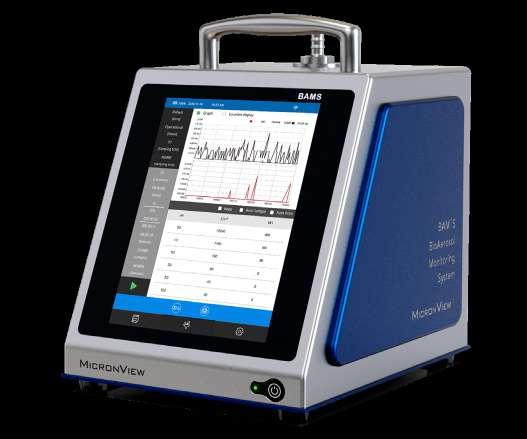
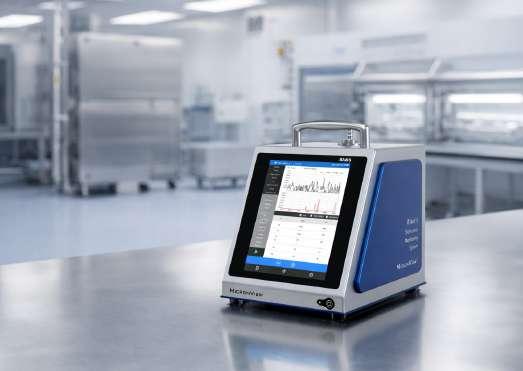
The Portable BAMS (Figure 1) was developed to bring real-time viable particle monitoring directly into cleanroom operations without the constraints of fixed installation. By combining intrinsic fluorescence detection with traditional particle sizing at a controlled pharmaceutical-standard flow rate of 2.83 LPM, the system allows contamination control teams to assess biological particle behaviour wherever insight is needed.
In practice, the Portable BAMS functions as a real-time diagnostic tool for cleanroom environments. Instead of waiting several days for culture-based results, teams can observe how biological particle levels respond immediately to specific activities, environmental conditions and process steps.
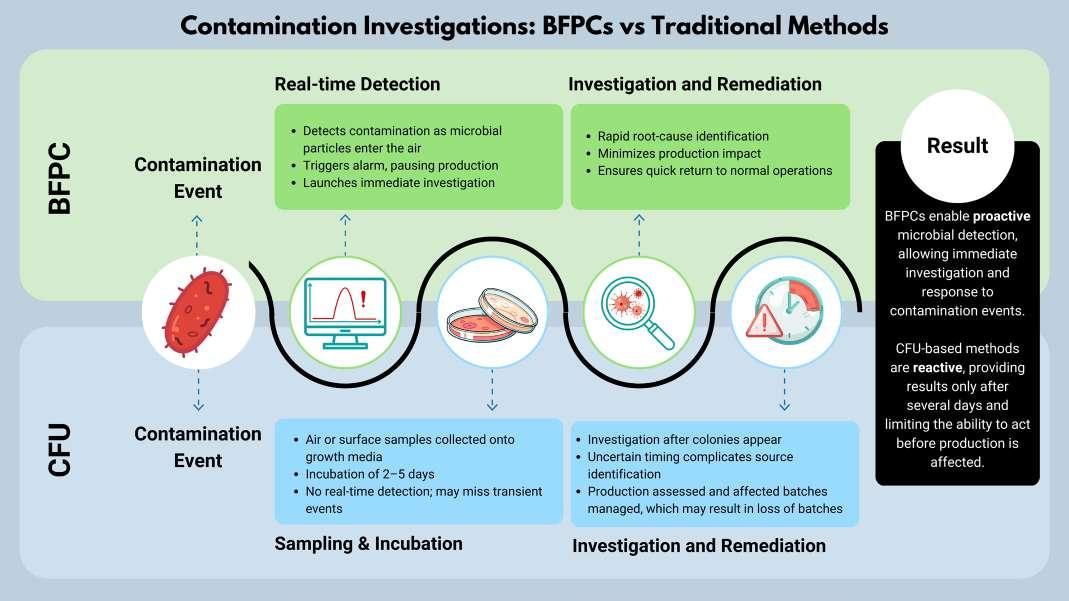
One of the most impactful applications is root cause investigation following microbial excursions (Figure 2). When elevated CFU results are identified through traditional monitoring, the Portable BAMS can be deployed in the affected area to assess microbial risk during routine operations. This often reveals short-duration contamination events associated with operator movement, gowning behaviours, material transfers, equipment interaction or airflow disruption that are rarely captured by intermittent culture sampling alone.
Figure 1: Portable BAMS
Regulatory and Compliance
Additional common applications include:
• General real-time environmental monitoring in replacement of or as a complement to traditional methodology
• Assessing the microbial impact of new equipment and processes
• Evaluating aseptic technique during operator training
• Monitoring manual interventions and line clearances
• Investigating transient contamination events
• Supporting contamination control strategy development
By providing immediate biological insight, the Portable BAMS significantly shortens investigation cycles and enables data-driven process improvements that are difficult to achieve through traditional monitoring alone.
The Remote BAMS for Fixed Monitoring in Critical Grade A Environments
While portable instruments offer flexibility for investigations and process understanding, continuous monitoring within critical zones requires permanent device integration designed for controlled environments.
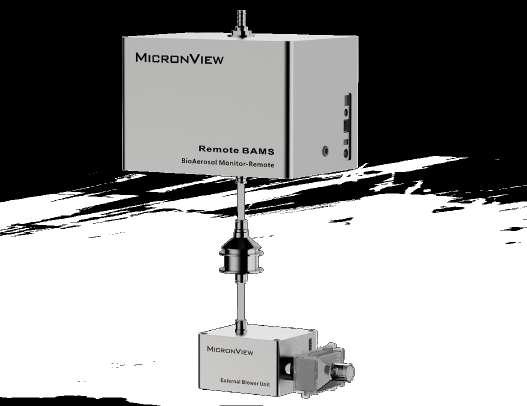
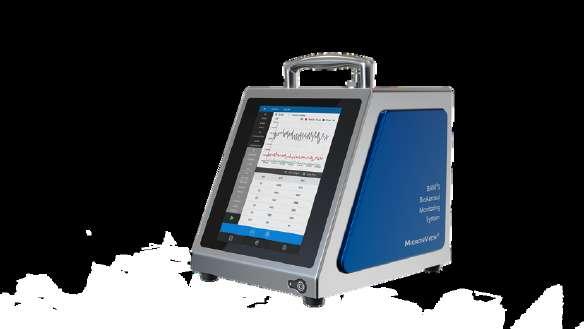
The Remote BAMS (Figure 3) was specifically developed for fixed installation in isolators, RABS and Grade A processing zones where real-time microbial risk awareness is most critical. Its compact footprint allows placement within tight enclosure spaces while preserving airflow integrity and pressure balance. The Remote BAMS offers the same technological basis as the Portable BAMS but also delivers fixed and continuous viable particle trending alongside conventional particle size data. This ensures a consistent monitoring approach across both investigative and critical-zone applications. This device can be connected to existing central vacuum systems or operated using closed-loop external blower control, allowing facilities
to integrate real-time monitoring without disrupting enclosure performance or cleanroom airflow dynamics.
In critical Grade A environments, the Remote BAMS provides continuous visibility into microbial risk throughout every production run. Rather than relying solely on periodic viable air samples, manufacturers gain uninterrupted biological trend data that captures transient contamination events, operator interactions and process-related fluctuations.
Key benefits within critical zones include:
• Immediate detection of biological particle spikes
• Real-time trend analysis during production activities
• Improved understanding of intervention-related risk
• Strong support for contamination control strategies
• Enhanced data for investigations and regulatory review
Figure 2: BFPCs for Investigations
Figure 3: Remote BAMS
Regulatory and Compliance
This level of continuous insight is particularly valuable in isolator systems, where brief glove manipulations, material transfers or airflow disturbances can generate contamination events that may never coincide with scheduled culture sampling. By transforming Grade A monitoring from intermittent confirmation to continuous biological awareness, the Remote BAMS strengthens contamination prevention rather than relying solely on post-event detection.
Integrating Real-Time Monitoring with Culture-Based Confirmation Using Gelatine Filters
While real-time biofluorescent monitoring provides immediate insight into biological particle trends, culture-based methods remain essential for microbial identification, speciation and regulatory documentation.
To support this requirement, the Remote BAMS can be paired with an external gelatine filter sampling system positioned within the same sampled airstream as the biofluorescent measurement. This ensures that both real-time biological trending and culture recovery represent identical environmental exposure.
When abnormal biological trends or alerts are observed, the gelatine filter can be aseptically removed and incubated using standard microbiological methods. Resulting colonies can then be identified to species level and incorporated into routine environmental monitoring investigations. Rather than choosing between rapid monitoring and traditional culture methods, manufacturers gain a comprehensive contamination control strategy that combines early detection with defensible confirmation.
Comprehensive Validation of BAMS in Regulated Pharmaceutical Environments
Successful implementation of real-time viable monitoring requires extensive validation to demonstrate equivalency, reliability and suitability within regulated environments. The BAMS platform has undergone a comprehensive validation programme addressing both optical biofluorescent detection performance and culture-based recovery using gelatine filters.
Validation of Real-Time Biofluorescent Monitoring Performance
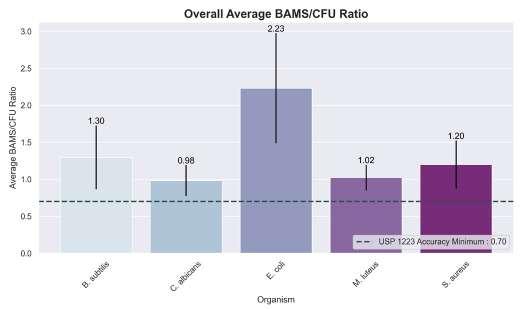
The BAMS was validated following the principles outlined in USP <1223>, European Pharmacopoeia 5.1.6 and industry guidance for alternative microbiological methods. Testing was conducted using the Andersen six-stage impactor as the reference method across multiple representative microorganisms, including Gram-positive bacteria, Gram-negative bacteria, bacterial spores, yeasts and moulds.
• Accuracy relative to traditional CFU-based sampling
• Precision and repeatability
• Linearity across a wide concentration range
• Specificity for biological particles
• Limits of detection and quantification
• Robustness under varying environmental conditions
Results demonstrated strong agreement between BAMS biofluorescent counts and reference culture methods, with
recovery (Figure 4), precision and detection sensitivity exceeding acceptance criteria for quantitative equivalency.
Collectively, these results support the suitability of BAMS as a validated alternative microbiological monitoring technology in regulated pharmaceutical environments.
Validation of Gelatine Filter Integration for Culture Confirmation
Dedicated validation studies were also conducted to evaluate the performance of the external gelatine filter system when used in conjunction with the Remote BAMS during continuous monitoring.
These studies assessed:
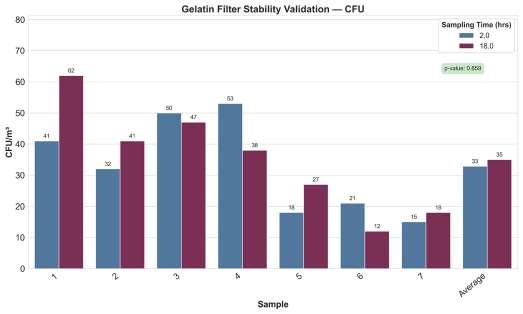
• Gelatine filter stability and microbial viability over extended sampling durations (Figure 5)
• The impact of tubing length, bends and routing geometry on CFU recovery
• Consistency of microbial capture under realistic installation conditions.
Results demonstrated reliable and consistent culture recovery across time-based sampling scenarios and representative installation configurations. Internal particle data confirmed comparable aerosol loading between test conditions, supporting accurate interpretation of CFU results.
This validation confirms that real-time biofluorescent monitoring can be seamlessly integrated with traditional culture-based microbiology without compromising recovery or regulatory expectations.
The Evolving Future of Cleanroom Environmental Monitoring As pharmaceutical manufacturing continues to advance, the limitations of intermittent culture-based monitoring become increasingly apparent. Modern contamination control strategies demand continuous insight, rapid response and data-driven decision making.
Biofluorescent particle counters offer a practical and scientifically robust solution by delivering:
• Real-time biological trend awareness
• Early detection of contamination risk
• Improved root cause investigations
• Stronger contamination control strategies
• Seamless integration with traditional microbiology
Portable BFPC systems support flexible investigations and process understanding, while fixed remote installations provide continuous monitoring within critical Grade A environments. Together, these approaches represent a meaningful evolution of environmental monitoring programmes, shifting cleanroom control from delayed confirmation toward proactive
contamination prevention. By combining real-time biological insight with established microbiological practices, BFPC technology positions pharmaceutical manufacturers to meet modern regulatory expectations while improving product safety, operational efficiency and contamination control in increasingly complex manufacturing environments.
REFERENCES
1. Cabredo S, Parra A, Anzano J. Bacteria spectra obtained by laser induced fluorescence. Journal of Fluorescence, 17(2), 171–180 (2007).
2. Salvas J, Merker P, Dingle M et al. Understanding the non equivalency of biofluorescent particle counts versus the colony forming unit. PDA Journal of Pharmaceutical Science and Technology, 77(6), 514–518 (2023).
3. European Commission. EU GMP Annex 1: Manufacture of sterile medicinal products (2022).
4. United States Pharmacopeia. Validation of Alternative Microbiological Methods <1223>.
5. European Pharmacopoeia. 5.1.6 Alternative methods for control of microbiological quality.
6. Parenteral Drug Association. Technical Report No. 33: Evaluation, validation, and implementation of alternative and rapid microbiological methods.
Christine Troutman
Christine Troutman is the Director of Scientific Operations at MicronView, where she leads product validation, regulatory alignment and scientific strategy for bioaerosol and particle monitoring technologies used in pharmaceutical cleanrooms worldwide. With a background in microbiology, she focuses on advancing real-time contamination control solutions and supporting manufacturers in modernising environmental monitoring programmes.
Email: c.troutman@micronview.com
MicronView BAMS
BioAerosol Monitoring System
Real-time, continuous viable particle monitoring through advanced biofluorescent detection delivers instant alerts for proactive contamination control.
Portable BAMS
Compact lightweight design
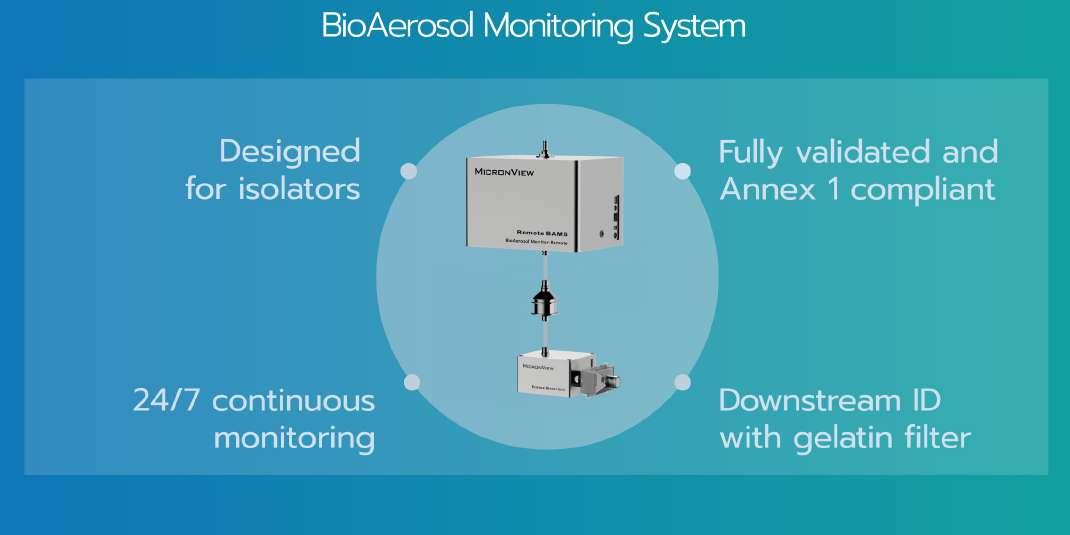
Designed for isolators
24/7 continuous monitoring
www.micronview.com
Battery-powered portability
Instant sample results
Remote BAMS
Downstream ID with gelatin filter
Regulatory and Compliance
Biopharma's New Evidence Era is Holding a Mirror Up to Sub-par Commercialisation Strategy
Evidence has never been more central to commercial success. Payers demand it before reimbursement. HTA bodies are raising the bar with sweeping new frameworks, most significantly the EU's Joint Clinical Assessment process, which launched in January 2025 as a major step toward harmonising clinical evidence requirements across all EU member states.1 Furthermore, regulators are signalling that the era of selective disclosure is over. An FDA study found that sponsors omitted 85% of the agency's safety and efficacy concerns in public announcements, a transparency gap that has since prompted the FDA to begin publishing complete response letters that companies had historically kept confidential.2
Yet, according to McKinsey, only 20% of leading pharmaceutical companies currently develop an integrated evidence generation plan across the full lifecycle of a product, with most leaders still generating evidence in silos rather than for the needs of the wider organisation and its stakeholders.3 Indeed, the vast majority are still building their evidence base reactively. Commissioning studies after payer rejections, scrambling to answer regulatory questions or plugging gaps that should have been identified years earlier.
In biopharma’s new evidence era, this approach to what is a vital element of commercialisation strategy development no longer cuts it. What's needed instead is a fundamental rethink. One in which evidence generation is not a downstream activity delegated to HEOR or medical affairs, but a strategic, cross-functional and proactive discipline. This must be built on the foundations of a clear winning aspiration, confidence in where to play and how to win there, and deliberate prioritisation of the evidence needed to deliver for regulators, patients, payers and providers.
The Case for a Clear Commercial Focus
Ask biopharma companies what problem their asset solves and it’s unlikely each team will answer consistently. This poses a key strategic problem and it's where evidence generation can begin to break down, not at the point of study design, but at the point where no one has agreed on what the evidence is for. Without a unifying goal to align strategic focus around, the risk is that every function defaults to its own interpretation of what winning looks like and builds its evidence plan accordingly.
Many cross-functional teams consistently skip the most important strategic questions: what is the specific problem our product solves, for which patients, versus which alternative and as valued by whom? Instead, they move straight into execution. Clinical designs for regulatory approval. HEOR models for a hypothetical payer. Medical builds a KOL narrative. The brand develops positioning around a differentiator that no one has validated externally. Each workstream generates evidence, but
none of it connects because it was never anchored to a shared North Star, a clear, interrogated definition of the commercial problem the product exists to solve.
That North Star matters for a reason that goes beyond alignment. A winning aspiration sets the context for the problem a team needs to solve and guides strategic focus across the organisation. However, it doesn't directly produce decisions. What it produces is the guard rails for a menu of options, the choices about where to focus for growth, how to win there and what evidence to invest in, that the cross-functional team can then evaluate together. A constraint at the top of that cascade shapes everything downstream. Teams end up with a narrower set of possibilities than they realise. Often, the most valuable strategic alternatives never appear on the menu because the framing has implicitly excluded them before anyone has had the chance to consider their merit.
This is why narrowing focus to achieve the North Star means doing something that most teams resist: identifying and prioritising the key challenges that stand between the current reality and commercial success and letting those challenges drive evidence priorities. As the competitive landscape evolves, label negotiations may narrow the approved population, and emerging data may shift treatment expectations; teams need to revisit this activity regularly. After all, the problem they are trying to solve can look very different at launch than it did in Phase II.
Imbruvica's story helps illustrate what's at stake when a problem definition shifts and the evidence strategy doesn't move with it. Reconstructing the story from what’s available in the public domain, ibrutinib's commercial problem at launch in 2013 appears unambiguous: FCR dominated CLL but was punishing for the elderly majority of patients4 and del(17p) patients had no durable option at all. Ibrutinib was chemo-free, oral and worked where chemo couldn't.5 The evidence strategy was tightly aligned to that problem, and it worked until it didn’t. When Calquence entered decisively in 2021, the problem had moved. With BTKi now the category default, AstraZeneca didn't argue against chemotherapy; it argued against Imbruvica, positioning acalabrutinib's selectivity against ibrutinib's cardiovascular toxicity signal in a population already prone to cardiac comorbidities.6 Ibrutinib's own demographic strength had become its vulnerability. Then in 2022, ALPINE showed that BeiGene’s zanubrutinib/Brukinsa was superior to ibrutinib on both PFS and cardiac safety.7 Imbruvica was no longer the safest or the most effective option and J&J and AbbVie revenue paid the price.8,9
One read of this scenario is that ibrutinib's launch problem framing had been so successful that it built the category in which it was later commoditised. Once chemo-free BTKi became table stakes, the external landscape had fundamentally changed and without clear context to guide decision-making at each competitive inflexion point, the evidence base was stranded in a problem the market had already solved.
Regulatory and Compliance
For development teams, the implication is clear. Evidence generation must be anchored to a clearly defined strategic commercial problem, stress-tested for the competitive dynamics that could redraw it and revisited at every major milestone. Establishing that unifying goal and keeping it honest is the foundation on which everything else is built. But it doesn't yet tell you where the real opportunity lies or what it will take to win there. That's where the work continues.
Exploring Different Routes to Win
Defining the problem that you're solving is necessary. But it doesn't answer the next question: where are you going to focus for growth and how are you going to win there? These are the strategic choices that determine whether an evidence base can do the job it's being built for.
Winning in a given space depends on two things. The behaviour change that you need to compel (from clinicians, payers, patients or all three) and the belief that will drive that behaviour change. Different patient segments, care settings and competitive contexts will each demand a different answer to both questions. That's why exploring different routes to win isn't an optional exercise in creative strategy development, but a mechanism by which teams discover which evidence will actually matter.
Incidentally, most biopharma teams believe that they've made these choices deliberately. In practice, the choices are often made implicitly. They’re embedded in the commercial framing adopted early in development, long before anyone has mapped the full landscape of where real value lies. Indeed, the most consequential strategic decisions are frequently the ones teams didn't realise they were making.
The Imbruvica example illustrates this point. When Calquence reframed the problem from chemo being too toxic to first-generation BTKi being too toxic, ibrutinib's team faced a genuine strategic options question of where to focus for growth and how to win in a market that had shifted under them. From an outsider’s perspective, two routes were visible if the landscape had been explored with fresh eyes. The first was population selectivity, walking away from the frailest and most elderly patients where cardiovascular risk was highest and defending a more defined position in the patients where ibrutinib's benefitrisk profile remained most compelling. The second was clinical partnership, working proactively with cardiologists to develop and evidence cardiovascular side-effect mitigation strategies, turning a perceived liability into a managed and documented risk. Either route represented a genuine path to continued relevance and neither required starting from scratch. Yet both required asking ‘what would have to be true for this option to succeed?’ early enough.
Incidentally, this question is one of the most valuable tools a cross-functional team can apply to a menu of strategic options. It forces assumptions into the open, surfaces the drivers and barriers attached to each route, and reduces a long list of possibilities to the options that deserve serious investment. It also means that when a team does commit to a direction, they've already anticipated the conditions that will determine whether it works.
Getting to that quality of strategic options demands analytical rigour, but it also requires deliberately tapping into the skills
and perspectives of people across the organisation. By this, I mean functions that don't always sit at the strategy table but carry intelligence that can reshape the landscape when surfaced. It requires a framework that enables informed decision-making rather than defaulting to the loudest voice or the most familiar precedent. It requires cultivating the kind of innovative thinking that questions not just where teams have played before, but where the untapped or underserved value lives.
Biogen's Aduhelm is perhaps the most publicly documented example of what's at stake when this exploration is absent. When the FDA approved aducanumab in June 202110 as the first diseasemodifying Alzheimer's therapy in nearly two decades,11 Biogen's apparent winning aspiration was to deliver a category-defining franchise. We can assume the strategic problem, as framed, was how to reach the market before donanemab and lecanemab arrived. That framing made certain choices feel obvious: a broad label across all early Alzheimer's patients, premium pricing consistent with a category-defining asset and patient advocacy as the primary demand-generation mechanism.
However, what this framing suppressed was equally consequential. A narrow biomarker-defined sub-population felt like under-claiming the aspiration. Payer engagement during evidence design felt premature. A third confirmatory trial to resolve the conflicting EMERGE and ENGAGE clinical trial results12 felt like a delay the timeline couldn't absorb. We can conclude that none of these options surfaced naturally because the strategic problem had been defined by timing rather than credibility. This matters because a problem framed around speed produces a very different menu of options than one framed around multi-stakeholder evidence robustness.
The consequences in this case were total. Ten out of eleven FDA advisory committee members voted against recommending approval.13 Major medical institutions, including the Cleveland Clinic and Mount Sinai, announced they would not prescribe it.14 The Institute for Clinical and Economic Review concluded that the drug would only be cost-effective at 85–95% below its list price.15 In January 2022, CMS restricted reimbursement to patients enrolled in qualifying clinical trials,16 effectively closing the commercial market. Biogen discontinued Aduhelm in January 2024,17 an asset framed as franchise-defining, withdrawn within three years of approval, having generated minimal revenue and caused lasting reputational damage that complicated the launch environment for lecanemab, a better-evidenced asset in the same category.
The Aduhelm story is unusual only in its visibility. The pattern it illustrates (a winning aspiration potentially sized to a commercial opportunity the evidence base could not credibly support across regulators, clinicians and payers simultaneously) is not. Most teams don't fail this publicly, but the dynamic exists nonetheless in launches that underperform without ever surfacing the upstream framing that made underperformance almost inevitable.
So then, knowing where to focus for growth and how to win there isn't a market access question settled at launch. It’s a strategic question that must be answered, and with a genuine exploration of the full option space, before evidence priorities are set.
Regulatory and Compliance
Building an Integrated Evidence Base
The third foundation of a proactive evidence strategy is the deliberate identification of gaps and needs to build your strongest evidence base, one designed for every stakeholder who will determine commercial success, at every decision point that matters.
Many teams don't approach evidence this way. They prioritise evidence needs to support regulatory approval, then build outward reactively. For instance, adding payer endpoints after an HTA request, commissioning quality-of-life instruments after a reimbursement rejection and designing real-world evidence programmes after a launch that's underperforming. By the time the gaps become visible, the trials that could have closed them are already complete.
The alternative is to select evidence that strengthens the strategy rather than merely defends it. This means investing in evidence to benefit various stakeholders simultaneously, so that the same data foundation serves clinician, payer and patient narratives without contradiction.
The SGLT2 inhibitor case study provides a clear example of what integrated evidence options that meet customer needs and boost competitiveness look like in practice. When EMPA-REG OUTCOME published in 2015, showing empagliflozin reduced cardiovascular death by 38% and heart failure hospitalisation by 35% in patients with type 2 diabetes and established cardiovascular disease,18 the finding was unexpected. The trial had been mandated by the FDA as a post-marketing safety study, designed to rule out harm rather than demonstrate benefit.19 The cardiovascular signal was, in part, serendipitous.20
What distinguished the outcome from a good luck/happy accident story was what AstraZeneca and Boehringer Ingelheim
did next. Rather than filing for a cardiovascular benefit label update and returning to diabetes-class competition, the sponsors reorganised around a new strategic problem: how to build an evidence base that would earn cross-speciality adoption across diabetology, cardiology and nephrology, in audiences that hadn't been the original target for these molecules. That reframing changed everything about what evidence was needed and where.
DAPA-HF tested dapagliflozin in patients with heart failure with reduced ejection fraction, regardless of diabetes status, and showed that the benefits extended beyond glycaemic control.21 DAPA-CKD later broadened the evidence base into chronic kidney disease,22 while DELIVER and the EMPEROR programme further strengthened the class evidence across both reduced and preserved ejection fraction. 23,24,25 In DAPA-HF, health status was also assessed using the Kansas City Cardiomyopathy Questionnaire as a prespecified endpoint, allowing the trial to capture patient-reported benefit alongside clinical outcomes.26
The result was an evidence spine that held across every scrutiny it faced. NICE recommended empagliflozin and dapagliflozin for heart failure.27 Speciality guidelines across cardiology, nephrology and endocrinology followed.28 The class became standard of care across multiple domains in a way few drug classes ever achieve. Jardiance and Farxiga each generated multi-billion-dollar revenues, with growth trajectories that are continuing long after the typical post-launch peak.
The parallel with Aduhelm is telling, albeit running in the opposite direction. Where Biogen's upstream framing (sized to a commercial opportunity the evidence base could not credibly support) made parallel and ultimately irreconcilable stakeholder narratives structurally inevitable, the SGLT2 sponsors' reframing
Regulatory and Compliance
made an integrated evidence spine structurally natural. The difference wasn't execution at launch. It was the strategic problem each set of sponsors chose to solve, and the evidence gaps and needs that each set of sponsors chose to prioritise as a result.
This is the principle that should govern how teams approach the proof stage of evidence generation. The process should begin by exploring what evidence will serve the full range of stakeholders who need convincing. Teams should also consider how that evidence will be built so that those audiences hear the same coherent story, rather than competing versions of it. This is important because integrated value stories are made possible by the framing decisions and evidence prioritisation choices made months or years before any value narrative is written.
A New Approach for a New Evidence Era
Evidence fails not because teams lack rigour, resource or intent, but because the foundations on which it is built are rarely examined with the same discipline as the evidence itself. Without a clearly defined and shared commercial problem, evidence defaults to functional habit. Without rigorous exploration of where to play and how to win there, the option space closes before the best choices are ever visible. Without deliberate prioritisation of gaps and needs across every stakeholder audience, the integrated evidence base that payers, regulators, patients and clinicians demand cannot be built.
Ultimately, the integrated value story problem can’t be solved at the eleventh hour. By the time launch teams are reconciling payer, clinician and patient narratives, the upstream framing has already determined whether reconciliation is possible. The question that biopharma leaders should be asking is not how to integrate narratives at launch, but is the winning aspiration sized to what the evidence can credibly support? If not, then they must consider whether they are willing to either resize the aspiration or invest in the evidence to support it.
That these questions remain unspoken in many organisations is reflected in a telling data point: confidence in cross-functional readiness was cited as the single biggest launch planning concern by pharma leaders at last year’s Pharma Launch Excellence Summit.29 Cross-functional misalignment at launch is the downstream consequence of foundations that were never shared. It’s the result of teams that never agreed on the problem, never explored the full landscape together and never mapped the evidence gaps that would matter most to the audiences they needed to convince.
Biopharma's new evidence era, with its harmonised HTA requirements, its FDA transparency demands and its payer scrutiny of every efficacy claim, is not creating new strategic problems. The mirror it holds up reflects something that was always true: evidence generation is not a downstream activity but a vital component of effective commercialisation strategy development.
Janice MacLennan is CEO of Nmblr, the Biopharma strategy and collaboration platform. With over 30 years of experience helping Biopharma and Medical Device companies tackle complex commercial challenges and develop winning strategies, she brings deep industry insight and personal passion to her work. Janice has dedicated her career to supporting the delivery of breakthrough therapies through consultancy partnerships with big and mid-sized companies across the globe. At Nmblr, she leads efforts to humanise strategy, empowering teams to align, adapt and move as one to make better decisions and ensure innovations are delivered successfully and to a receptive market.
Research / Innovation / Development
Reviewing the Crystal Structures of Ternary Complexes Formed
by Heterobifunctional Degraders
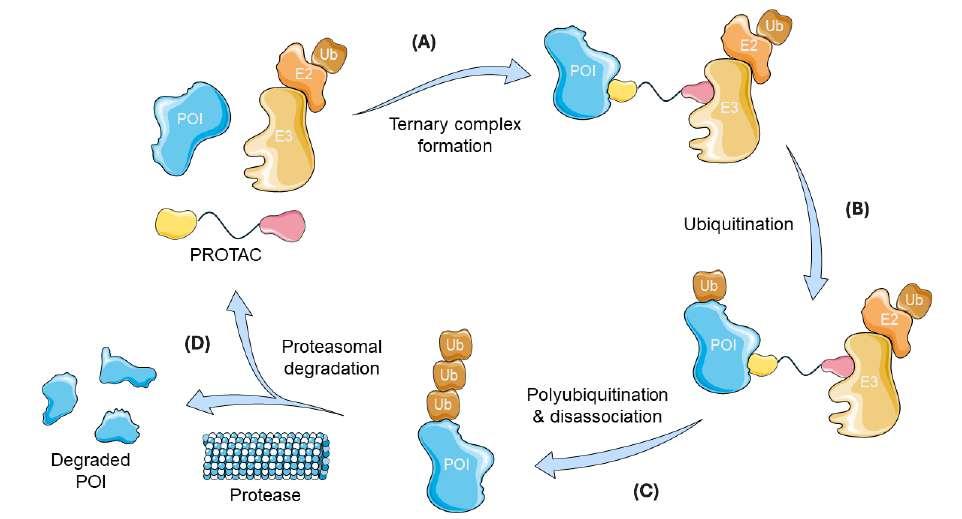
Heterobifunctional degraders rely on the formation of productive ternary complexes to activate cellular degradative machinery, causing the proteolysis of a protein of interest (POI).1 Typically, the POI is tethered to an E3 ubiquitin ligase protein, which, downstream, leads to the degradation of the POI via the ubiquitin degradation pathway (Figure 1). These ternary complexes are dynamic in nature, and various differing protein–protein conformations can lead to a degradation event. This poses a unique challenge for structure-based drug design, as there are multiple correct solutions for the protein–protein conformations.
Whilst crystallographic structures of these complexes were once rare, their availability has steadily increased over the years. Scientists have collated a database of publicly available heterobifunctional degrader-containing ternary complex crystal structures.2 Through careful analysis of these structures, the biological assemblies of these complexes were investigated, with the aim of discovering whether these assemblies provide information on the viability of ternary complex conformations induced by heterobifunctional degrader molecules.
Protein crystallography produces solid-state assemblies of molecules, which can come in different forms. One of the challenges of computational drug design is deducing whether these assemblies are biologically relevant. In particular, crystal packing forces can distort or otherwise alter the configuration of the ternary complex. Examination of the crystallographic
symmetry mates of heterobifunctional molecule-containing ternary complexes can help determine whether this is the case. All modelling and analysis were performed using Flare™.3
For this investigation, the analysis initially focused on the well-known and studied VCB–BRD4(BD2) ternary complexes. VCB consists of the Von Hippel–Lindau E3 ligase (pVHL), along with Elongin B and Elongin C, which are key components of the larger Cullin 2-RING ligase complex (CRL2). The formation of the CRL2 complex and eventual tagging of accessible lysines on the POI is a key mechanism of degradation in this process.4
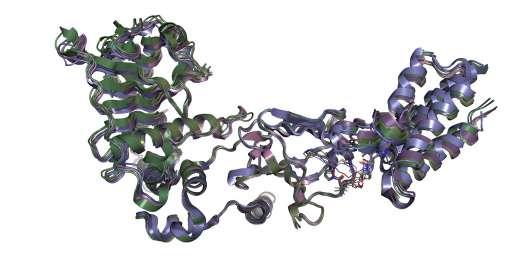
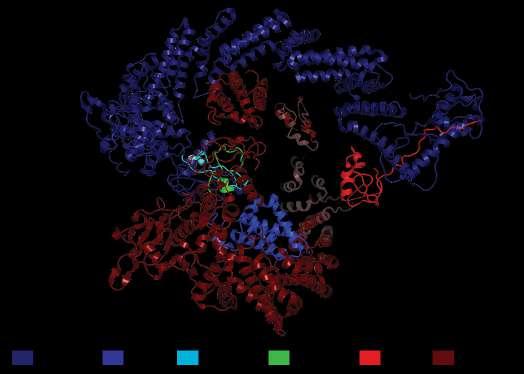
Through searching the literature and the Protein Data Bank (PDB), nine VCB–BRD4(BD2) complexes were identified. Of these, three were extended CRL2 complexes. The six ternary complexes were first compared (Figure 2).
2. PDB
aligned and
5T35,
1. The ubiquitination cycle, showing the recycling of a heterobifunctional degrader and proteolysis of the POI. (A) is the POI binder of the degrader binding to the POI, whilst the E3 binder of the degrader binds to the E3 ligase. (B) The POI–degrader–E3–E2–Ub ternary complex forms. (C) The POI is polyubiquitinated by the intermediate complex, marking it for degradation by the proteosome. (D) The POI is degraded and the heterobifunctional degrader molecule is released, allowing it to act again. This figure was partly generated using Servier Medical Art, provided by Servier, licensed under a CC BY 4.0 license.
Figure
Figure
codes: 8BDT,
8BDX, 7ZNT, 6SIS and 8YMB. These structures were
superposed to pVHL. The BRD4(BD2) protein is depicted in the alpha helices on the right of these structures.
Research / Innovation / Development
By aligning the sequences of pVHL and superposing these complexes, it can be observed that the 3D conformation of the ternary complexes is well conserved. This suggests a strongly preferred protein–protein binding mode between pVHL and BRD4(BD2), regardless of the heterobifunctional degrader structure.
A key focus of this work was the investigation of crystallographic symmetry structures. By generating the crystal mates from the PDB structures, it was found that five of the six ternary structures formed dimers, whilst only one had a monomeric structure. Observing the interacting faces of the dimeric structures revealed a strong interaction between the dimeric face of pVHL opposite to the face of ligand binding (L129–L153). This interaction appears strongly conserved between the five ternary structures showing this dimerisation. Numerous hydrogen bonds and hydrophobic interactions are present when these pVHL faces are oriented to depict dimeric assembly.
In contrast, when the monomeric assembly is examined, this interaction does not occur. This raises the question of why this difference exists and whether it has any biological consequences.
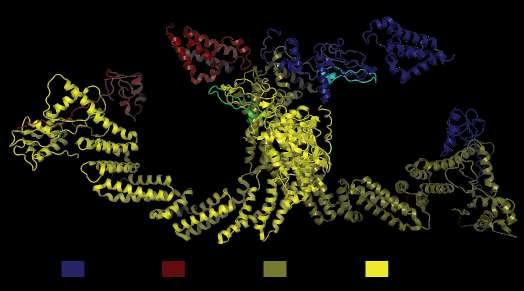
To investigate this, the available extended CRL2 complexes were superimposed with the proteins of a dimeric crystal structure and the monomeric crystal structure, aligning and superposing to the pVHL protein. This provided several observations. First, the open, non-crosslinked extended CRL2 complex showed minimal clashes between the extended complexes. Where minor clashes did occur, these were within the BRD4(BD2) component of the structures, a dynamic part of the system. Notably, it is conceivable that both extended structures feature sufficient flexibility and available space between the BRD4(BD2) and RBX proteins to allow recruitment of the E2 ligase and conjugation of ubiquitin, leading to a degradation event (Figure 3).
Figure 3. Depicting the formation of a supercomplex from dimer complexes, suggesting they may be biologically relevant. Extended CRL2 complex (8RWZ), duplicated, aligned and superposed to the opposite dimeric pVHL protein (7ZNT), where CRL2 complex 1 is dark blue and CRL2 complex 2 is dark red. The dimeric faces of pVHL are shown in cyan (complex 1) and green (complex 2). The BRD4(BD2) protein (blue), the RBX protein (red).
In contrast, when the two cross-linked extended CRL2 complexes were examined, major clashes were observed. These clashes occurred in conformationally dynamic features of the system, namely the E2 ligase and ubiquitin proteins.
The same process was repeated with the monomeric ternary complex. In this case, severe clashes were observed among many of the conformationally inflexible proteins of the extended structure (Figure 4).
Figure 4. Demonstrating a different crystal packing. Extended CRL2 complex (8RWZ), duplicated, aligned and superposed to neighbouring monomeric pVHL proteins (8YMB), where CRL2 complex 1 is dark blue and CRL2 complex 2 is dark red. Clashes are observed between protein complexes 1 (dark yellow) and 2 (light yellow). This indicates that the supercomplex cannot form and is therefore biologically irrelevant.
This presents several challenges. Dimeric extended complexes appear to be conformationally possible. However, these extended complex dimers are not depicted in the electron density maps provided with the structures. A key caveat is that these extended complexes were generated using cryo-EM methods, which differ from the X-ray crystallography methods used for the ternary structures. Crystallographic conditions and methodologies can provide different views of these dynamic structures, and it would be unwise to assume that the extended dimer is impossible based on the limited information currently available, particularly without confirmation via an orthogonal method.
Additionally, the monomeric ternary complex still leads to a degradation event. This indicates that this crystallographic assembly is as relevant as the others, despite being the sole example available. This raises the possibility that both dimeric and monomeric assemblies can lead to degradation events and that one may not necessarily be more productive than the other. This observation warranted further investigation.
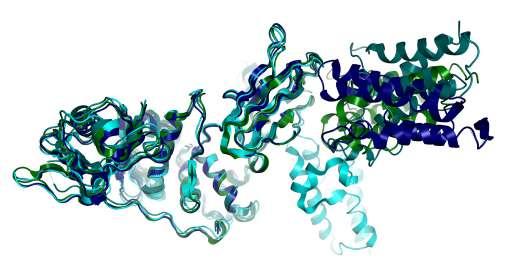
The available crystal structures of VCB–SMARCA2 heterobifunctional degrader complexes were examined next. As before, alignment was performed on the E3 ligase; however, in this instance, Flare’s Match-3D superposition tool was used to improve alignment in three-dimensional space. These systems exhibited a wide range of binding conformations (Figure 5).
Figure 5 shows that whilst the VCB complex (pVHL–Elongin C–Elongin B) is well conserved across all examined PDB structures (the beta-pleated sheets on the left-hand side), the SMARCA2 components adopt a broad range of conformations (the alpha-helices on the right-hand side). Examination of the crystal symmetry mates of a subset of these VCB–SMARCA2 complexes (9HYB, 9HYN, 9HYO and 9HYP), deposited as part of the same publication,5 revealed further complexity. Structures 9HYO and 9HYP exhibited monomeric crystallographic units. In contrast, 9HYB and 9HYN formed dimeric units, with significant interactions occurring between pVHL molecules. This behaviour appeared unrelated to the ternary poses displayed. This observation is particularly notable given that the same crystallographic conditions were reported for the generation of all X-ray crystal structures in this series.
Figure 6. VCB–SMARCA2 complexes, PDB codes 9HYB (green), 9HYN (teal), 9HYO (cyan) and 9HYP (dark blue) aligned on pVHL and superposed with Flare’s Match‑3D.
Figure 6 shows structures 9HYO (cyan) and 9HYN (teal). The pose of 9HYN closely aligns with that of 9HYB (green). Despite this similarity in three-dimensional conformation, the crystal symmetries differ. Confidence in these differing crystal symmetries is supported by examination of the electron density around pVHL in the 2Fo–Fc electron density maps within Flare. Consideration of the electron density and inspection of the pVHL dimeric interaction interface indicate that although the 3D structure differs in this region, these differences do not explain whether crystal mates adopt monomeric or dimeric assemblies. Furthermore, no clear correlation was observed between heterobifunctional degrader poses and monomeric or dimeric crystal structures.
The conclusion of this study was that the biological assemblies observed in deposited crystal structures appear to be unrelated to degradation efficiency and cannot be reliably determined based solely on the conformation of ternary complexes.
However, a potential conformation of dimeric poses for extended CRL complexes was identified that could plausibly lead to degradation events. As additional extended CRL complexes become available, further investigation may extend these findings. This remains an area of active interest in heterobifunctional degrader research. The increasing availability of structural data provides unprecedented opportunities to study these dynamic processes and may ultimately help resolve mechanisms that are currently poorly understood.
REFERENCES
1. Gadd, M. S.; Testa, A.; Lucas, X.; Chan, K.-H.; Chen, W.; Lamont, D. J.; Zengerle, M.; Ciulli, A. Structural Basis of PROTAC Cooperative Recognition for Selective Protein Degradation. Nat. Chem. Biol. 2017,
13 (5), 514–521.
2. Available to download at request from https://cresset-group.com/ about/contact-us/
3. Flare™, Cresset®, Litlington, Cambridgeshire, UK; https://cressetgroup.com/software/flare/; Cheeseright T., Mackey M., Rose S., Vinter, A.; Molecular Field Extrema as Descriptors of Biological Activity: Definition and Validation J. Chem. Inf. Model. 2006, 46 (2), 665-676.
4. Bai, N.; Riching, K. M.; Makaju, A.; Wu, H.; Acker, T. M.; Ou, S.-C.; Zhang, Y.; Shen, X.; Bulloch, D. N.; Rui, H.; Gibson, B. W.; Daniels, D. L.; Urh, M.; Rock, B. M.; Humphreys, S. C. Modeling the CRL4A Ligase Complex to Predict Target Protein Ubiquitination Induced by Cereblon-Recruiting PROTACs. J. Biol. Chem. 2022, 298 (4), 101653.
5. Ma, N.; Bhattacharya, S.; Muk, S.; Jandova, Z.; Schmalhorst, P. S.; Ghosh, S.; Le, K.; Diers, E.; Trainor, N.; Farnaby, W.; Roy, M. J.; Kofink, C.; Greb, P.; Weinstabl, H.; Ciulli, A.; Bader, G.; Sankar, K.; Bergner, A.; Vaidehi, N. Frustration in the Protein–Protein Interface Plays a Central Role in the Cooperativity of PROTAC Ternary Complexes. Nat. Commun. 2025, 16 (1), 8595.
Dr. Ryan Hubball
Ryan Hubball holds a Chemistry BSc, Chemical Biology & Drug Design MSc, and a PhD in Cellular & Molecular Biology from the University of Leeds. He worked as a postdoctoral researcher at the SANKEN Institute, Osaka University, designing and synthesising heterobifunctional degraders before joining Cresset. Ryan has expertise in in silico ligand design, with a focus on structure-based drug design. Following his successful completion of the postdoctoral programme at Cresset, Ryan now works as a Solutions Scientist.
Email: ryan.hubball@cresset-group.com
Dr. Lauren Nelson
Dr. Lauren Nelson holds a PhD in computational chemistry from Newcastle University. Lauren’s research focused on the application of quantum mechanical (QM) and molecular mechanical (MM) methods to Free Energy Perturbation (FEP) calculations. Lauren has worked on projects in collaboration with the Northern Institute of Cancer Research and the University of Edinburgh. Lauren completed the Postdoctoral programme and is now a Senior Solutions Scientist at Cresset, where she continues to work with FEP methods.
Email: lauren.nelson@cresset-group.com
Direct-to-Biology: Streamlining the DMTA Cycle in PROTAC® Discovery
Novel degrader classes like molecular glues and proteolysis targeting chimaeras (PROTACs®) have emerged as powerful strategies to eliminate disease relevant proteins by targeted protein degradation (TPD). Many degraders have shown significant potential in oncology and immunology, including in disease models where conventional small molecule inhibitors have struggled.
However, designing TPD molecules can be challenging due to complex structure-property relationships, extensive reliance on cell-based assays and time-consuming linker optimisation, stretching design-make-test-analyse (DMTA) cycles to months and consuming substantial synthetic and analytical resources. The direct-to-biology (D2B) approach is a practical way to address these bottlenecks and reduce the time and resources to get these promising therapeutics to the clinic.
D2B is an approach that couples sub-micromole scale plate-based synthesis with the screening of crude reaction mixtures, enabling rapid exploration of linker and exit-vector space. This allows delivery of rich cell-based degradation data within days rather than weeks and months, while simultaneously reducing waste and improving sustainability.
Drugging The Undruggable
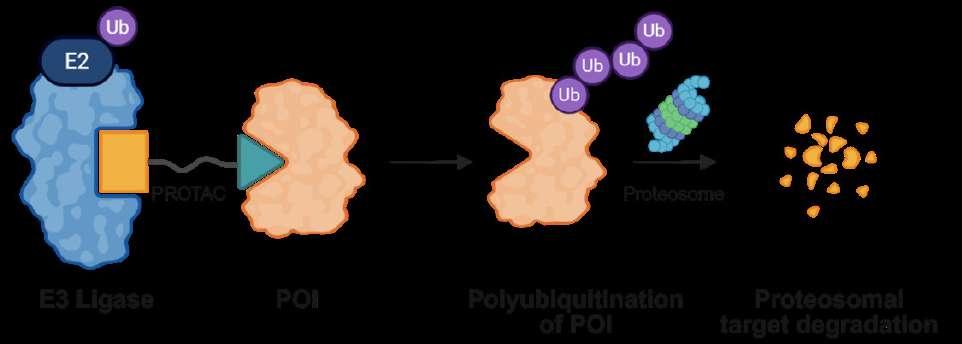
Conventional small molecule inhibitors act via an occupancy driven mechanism, blocking an active site or regulatory pocket in a dose-dependent manner and must remain bound to the protein of interest (POI) to maintain efficacy. Targeted protein degraders act through a catalytic event driven process that relies on induced proximity between the POI and the E3 ligase. Once in proximity, the POI undergoes polyubiquitination and subsequent degradation by the proteosome (Figure 1), leaving the degrader free to bind another POI molecule, allowing for lower dosing and/or less frequent dosing regimens.1,2,3
Many pharmacologically relevant proteins function as scaffolds or as components of extensive protein-protein
interaction networks, often with shallow or featureless binding surfaces rather than classical deep pockets. As a result, they can be difficult to target using conventional small molecule inhibitors due to weak binding affinities.4 Targeted protein degraders can overcome this challenge by eliminating the POI rather than simply inhibiting its activity. This has broadened the range of tractable targets and contributed to the idea of “drugging the undruggable”.1,5 In addition, targeted degraders also enable precision medicine approaches by exploiting E3 ligases with localised tissue expression patterns to deliver improved selectivity.6,7
What Makes PROTAC Discovery Uniquely Challenging?
A classical PROTAC molecule consists of three key components: a ligand that binds the POI (also known as the warhead), a ligand that recruits an E3 ubiquitin ligase (e.g., Cereblon (CRBN), von Hippel-Lindau (VHL)) and a linker connecting the two (Figure 1). The PROTAC induces formation of a ternary complex between itself, the POI and the E3 ligase, triggering polyubiquitination and proteasomal degradation of the POI.8 Despite their advantages, PROTACs present several challenges that distinguish them from traditional small molecules:
• Molecular properties: PROTACs are often larger than 800 Da with high polar surface areas, hindering cell permeability and complicating optimisation under classical Lipinski “rule of five” criteria.9
• “Linkerology”: Even subtle changes in linker length, composition, rigidity, or attachment geometry can dramatically and unpredictably alter degradation efficiency, selectivity and off target profiles.9
• Ternary complex dynamics: Degradation potency depends on cooperative ternary complex formation rather than simple binary binding affinities. As a result, improvements in binary POI:PROTAC or ligase:PROTAC binding affinities are not reliable indicators of greater POI:PROTAC:ligase ternary complex formation and do not necessarily translate into better degradation.10,11
Figure 1: Schematic representation of PROTAC induced target degradation. Created with BioRender.com
Application Note
• Assay burden: Intracellular target degradation, not binding, is the key endpoint for degrader discovery. This means that many TPD projects rely heavily on cell-based assays to confirm degradation and to reveal mechanistic insights.3, 8,9
These factors mean that PROTAC discovery teams are required to synthesise and profile dozens to hundreds of analogues per warhead-ligase combination, whilst being unsure about what constitutes an optimal PROTAC property profile. This creates significant information hungry and resource intensive demands that align well with the high-throughput capabilities of D2B platforms.3,12
Accelerating Progress with Direct-to-Biology
D2B is a discovery approach in which crude reaction mixtures, typically prepared at nanomole to low micromole scale in microtiter plate format, are taken directly into biological assays after minimal purification and rapid quality control. Compounds that meet predefined activity thresholds are then resynthesized, purified and subjected to full analytical characterisation and follow-up mechanistic studies.3,13,14
The D2B workflow builds on established parallel chemistry, but its defining feature is the tight integration of chemistry synthesis, biology, data analysis and automation around plate-based workflows. When implemented effectively, D2B can deliver three major benefits:9,13
1. Reduced timelines: Eliminating the need to purify, weigh and formulate every compound can reduce the cycle from design to biological data from weeks to days (Figure 2).
2. Higher throughput: The use of nano- and microscale reactions and automated liquid handlers allows for tens to hundreds of compounds to be profiled per cycle without a proportional increase in analytical burden.
3. Improved sustainability: Lower reaction scale without the need for preparative chromatography significantly reduces solvent use, reagent consumption and solid waste.
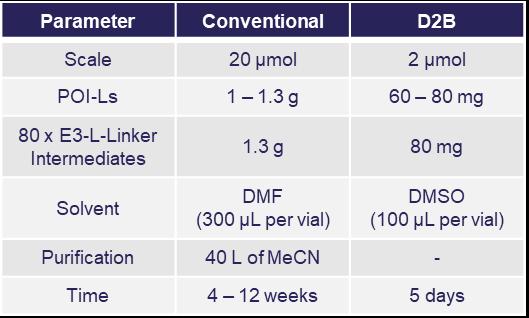
Traditional PROTAC discovery projects can take 4–12 weeks from computational/medicinal chemistry design to the generation of cell-based target degradation data, when including synthesis, purification, analytical characterisation and biology data. The D2B approach compresses this timeline down to days (Table 1), with published case studies against BRD4 and Aurora Kinase A demonstrating success within a week.9,12
D2B analysis cycles also allow for more systematic sampling of linker length, rigidity and exit vector combinations. Multiplexed biology readouts for target engagement, degradation, permeability and toxicity enable early derisking and deselection before time and resources are further invested in resynthesis. These gains in improved efficiency and data quality increase confidence in the potential identification of developable candidates within allocated budget and time constraints.
These advantages make D2B particularly attractive for projects that require a rapid exploration of structure activity relationships (SARs) and significant cell-based screening, as is the case for complex modalities like PROTACs. The modular nature of PROTAC architecture also naturally suits 24-, 96- or 384-well plate-based array chemistry and allows for systematic
sampling of a broad physicochemical space by combining a set of warheads with diverse linkers.3 Importantly, D2B is also applicable to different modalities, including fragments,14 covalent inhibitors15 and molecular glues,16,17 each of which is associated with its own specific challenges.
The advantages that D2B offers in speed also directly translate to compelling benefits in terms of sustainability for PROTAC development,3,13 including reducing solvent use by >90%, reducing consumption of expensive POI warheads and proprietary E3 ligase ligands, and reducing energy footprint from purification workflows.
Table 1: Comparison of conventional synthesis workflow (purified) and D2B (non purified) workflow for a theoretical 80 PROTAC library.
Practical Considerations for Adopting a D2B PROTAC Project Unlike screening with traditional purified compounds, working with crude mixtures in D2B workflows places specific demands on assay design, data interpretation and validation strategies.9,12 For example:
• D2B requires biochemical cell-based assays to tolerate residual solvents, reagents and by-products that may have been carried over from plate-based synthesis.
• Following plate-based synthesis, compound concentration is based on an assumed conversion. Therefore, normalisation using internal standards or LC-MS response factors can improve well-to-well comparisons and help with generating accurate dose response curves in screening assays.
• Hits emerging from crude D2B screens should always be confirmed with purified material in orthogonal assays that separate binding (e.g., FRET, FP), ternary complex formation (e.g., SPR, ITC), and degradation (e.g. HiBiT assays, SimpleWestern blot, quantitative proteomics, high content imaging).
At Concept Life Sciences, we combine deep scientific expertise with integrated capabilities to accelerate your D2B degrader discovery programmes. By leveraging our robust assay cascades, we ensure that the speed of your D2B workflow does not come at the cost of data quality.
We partner with you to deliver the following:
• Computational chemistry & CADD: Predictive molecular modelling and computer-aided drug design to accelerate hit-to-lead optimisation.
• Chemistry & ADME: Integrated medicinal chemistry and ADME support to optimise the PK/PD properties of your lead molecules.
• Protein production: Expert production of high-quality proteins optimised for downstream biochemical and biophysical applications.
• Biophysical characterisation: Advanced insights into binary and ternary complex formation, including affinity, kinetics, stoichiometry and cooperativity.
• Assay development & screening: Comprehensive assay design and orthogonal screening cascades to minimise false hits.
• Structural biology: High-resolution structural insights with Cryo-EM analysis of heterobifunctional and molecular glue degraders.
For scientists focused on the next wave of degrader discovery, Concept Life Sciences offers a practical route to condense DMTA cycles, generate richer SAR data and align your research with modern sustainability goals. This is an exceptionally exciting time for the field, and with the right integrated service partner, the path from the initial concept to the clinic has never been more attainable.
REFERENCES
1. Z. Liu et al., ‘An overview of PROTACs: a promising drug discovery paradigm’, Mol. Biomed., vol. 3, no. 1, p. 46, Dec. 2022
2. K. M. Sakamoto, K. B. Kim, A. Kumagai, F. Mercurio, C. M. Crews, and R. J. Deshaies, ‘Protacs: Chimeric molecules that target proteins to the Skp1–Cullin–F box complex for ubiquitination and degradation’, Proc. Natl. Acad. Sci., vol. 98, no. 15, pp. 8554–8559, Jul. 2001
3. R. Stevens et al., ‘Expanding the reaction toolbox for nanoscale direct-tobiology PROTAC synthesis and biological evaluation’, RSC Med. Chem., vol. 16, no. 3, pp. 1141–1150, 2025
4. A. E. Wakefield, D. Kozakov, and S. Vajda, ‘Mapping the binding sites of challenging drug targets’, Curr. Opin. Struct. Biol., vol. 75, p. 102396, Aug. 2022
5. G. Zhong, X. Chang, W. Xie, and X. Zhou, ‘Targeted protein degradation: advances in drug discovery and clinical practice’, Signal Transduct. Target. Ther., vol. 9, no. 1, p. 308, Nov. 2024
6. D. Lv et al., ‘Development of a BCL-xL and BCL-2 dual degrader with improved anti-leukemic activity’, Nat. Commun., vol. 12, no. 1, p. 6896, Nov. 2021
7. D. A. Nalawansha and C. M. Crews, ‘PROTACs: An Emerging Therapeutic Modality in Precision Medicine’, Cell Chem. Biol., vol. 27, no. 8, pp. 998–1014, Aug. 2020
8. A. Ciulli and N. Trainor, ‘A beginner’s guide to PROTACs and targeted protein degradation’, The Biochemist, vol. 43, no. 5, pp. 74–79, Oct. 2021, doi: 10.1042/bio_2021_148.
9. C. E. Hendrick et al., ‘Direct-to-Biology Accelerates PROTAC Synthesis and the Evaluation of Linker Effects on Permeability and Degradation’, ACS Med. Chem. Lett., vol. 13, no. 7, pp. 1182–1190, Jul. 2022
10. R. Casement, A. Bond, C. Craigon, and A. Ciulli, ‘Mechanistic and Structural Features of PROTAC Ternary Complexes’, Protocol, pp. 79–113, 2021,
11. M. J. Roy et al., ‘SPR-Measured Dissociation Kinetics of PROTAC Ternary Complexes Influence Target Degradation Rate’, ACS Chem. Biol., vol. 14, no. 3, pp. 361–368, Mar. 2019
12. M. Mitrović et al., ‘Click. Screen. Degrade. A Miniaturized D2B Workflow for Rapid PROTAC Discovery’, J. Med. Chem., vol. 69, no. 3, pp. 2599–2624, Feb. 2026
13. A. F. Hübner and F. Barthels, ‘Direct-to-Biology: Streamlining the Path From Chemistry to Biology in Drug Discovery’, ChemMedChem, vol. 21, no. 4, p. e202501080, Feb. 2026
14. R. P. Thomas et al., ‘A direct-to-biology high-throughput chemistry approach to reactive fragment screening’, Chem. Sci., vol. 12, no. 36, pp. 12098–12106, 2021
15. S. M. Rowe et al., ‘“Direct-to-biology” drives optimisation of a cell-active covalent inhibitor of WRN helicase’, Mar. 05, 2025
16. Z. Wang, ‘Direct-to-biology, automated, nano-scale synthesis, and phenotypic screening-enabled E3 ligase modulator discovery’.
17. M. Hu et al., ‘Direct-to-Biology Enabled Molecular Glue Discovery’, J. Am. Chem. Soc., vol. 148, no. 1, pp. 20–27, Jan. 2026
* PROTAC® is a registered trademark of Arvinas.
Concept Life Sciences
Concept Life Sciences is a leading contract research organisation (CRO) serving the global life sciences industry. For over 25 years, the company and its heritage companies have provided consultative and collaborative drug discovery and development services. Our approach, supported by passionate scientists and world-leading capabilities, enables clients to overcome complex scientific challenges across a broad range of therapeutic areas, improving programme success rates. The company has successfully helped 29 candidates advance to the clinic.
Research / Innovation / Development
Antibodies by Design: Cracking the ‘Undruggable’ Code
The numbers that have long defined traditional drug discovery are, by any measure, daunting. Bringing a single new medicine to market can take over a decade and costs on average over $1billion. Despite this investment, only around 10% of drug candidates that enter clinical trials ever receive regulatory approval, and a smaller fraction of drug discovery programmes result in a marketable therapy.
These figures reflect not only economic inefficiency but also the limitations of existing discovery approaches in translating biological insight into effective therapeutics.
Conventional approaches rely heavily on high-throughput screening, which involves testing vast libraries of compounds against a target and hoping something binds. While effective for a subset of well-characterised and structurally accessible targets, this model is poorly suited to proteins that are dynamic, membrane-bound or insufficiently characterised. Up until recently, these have been referred to as “undruggable” targets, not impossible to drug in theory, but resistant to every conventional approach available in practice.
Recent advances in artificial intelligence (AI), particularly generative modelling, are beginning to address these limitations. Rather than screening existing chemical or antibody libraries, AI-enabled approaches allow for the design of novel molecules with properties optimised for specific biological targets.
This article will explore why traditional drug discovery has fallen short, what the emergence of AI-driven drug discovery has done to change the game and what the future holds for this new technology.
GPCRs as the Key
The term ‘undruggable’ has always been provisional, as it describes the limits of the methods available at a given moment. For G-protein coupled receptors (GPCRs), ion channels and other membrane-bound proteins, those limits have been especially pronounced.
GPCRs are among the most therapeutically important protein families, implicated in hundreds of diseases, spanning and accounting for approximately one-third of approved drugs, generating aggregate global sales approaching $1 trillion. Yet that extraordinary footprint covers only around 20% of the GPCR family. Estimates suggest that over two hundred GPCRs remain without targeted therapeutics, highlighting a substantial gap between biological understanding and therapeutic exploitation. The exceptional nature of these receptors has made traditional drug discovery very difficult.
The core challenge lies in membrane topology. GPCRs are embedded within the lipid bilayer, with the majority of their
structure buried deep within the hydrophobic membrane environment. This leaves a limited extracellular surface area available for drug binding, and this surface must be engaged with considerable precision. Off-target binding, and the associated toxicity, is a considerable risk, leading to prolonged empirical screening campaigns with heavy reliance on chance.
Structural biology further complicates this landscape. Determining the crystal structure of a GPCR is technically demanding because extracting these receptors from the membrane causes them to lose their native conformation. Without reliable structural information, rational drug design is constrained, and discovery efforts revert to iterative screening. While antibodies offer increased specificity compared to small molecules, their application to membrane proteins introduces additional challenges, including the need for intact-cell screening systems and interference from co-expressed surface proteins.
Ion channels present similar barriers, including dynamic conformational states and conserved architectures that complicate selective targeting across subtypes. These characteristics collectively limit the effectiveness of traditional discovery approaches and contribute to the persistent gap in therapeutic coverage for these target classes.
Emergence of AI-driven Drug Design
AI-driven approaches are reshaping early-stage discovery by enabling the design of molecules based on learned representations of biological sequence, structure and function. Unlike traditional computational methods, which primarily rely on the analysis of existing libraries, modern generative models can propose entirely novel candidates optimised for defined target characteristics.
In antibody discovery, this shift is particularly significant as traditional antibody libraries are enormous and often largely random. In addition, for targets such as GPCRs, which adopt multiple distinct conformational states, AI models can be trained to design antibodies that preferentially bind specific functional states, thus introducing the possibility of achieving functional selectivity, rather than simply target engagement.
Once optimised candidates have been designed and developed, they are prioritised for experimental validation, creating a closed loop between computational prediction and wet-lab testing. The most effective AI-enabled approaches treat computational design not as a replacement for the wet lab but as a powerful upstream filter, dramatically compressing the hypothesis-to-candidate timeline by focusing experimental resources on molecules that models have already identified as high-probability candidates. The result is not a wholesale replacement of experimental biology, but a fundamental reordering of how discovery programmes are sequenced and resourced.
Research / Innovation / Development
Practical Considerations and Limitations
Despite its potential, AI-enabled discovery introduces new challenges alongside its advantages. Biological complexity does not dissipate in the presence of a generative model, and not all difficult targets become tractable simply because an AI platform has been trained on related structural data. For many membrane proteins, available datasets remain limited, requiring models to extrapolate from related systems with varying degrees of reliability.
This is compounded by broader questions of data quality and accessibility. For rare or undercharacterised targets, public databases are often insufficient to support reliable predictive performance and proprietary datasets held by individual organisations therefore confer a meaningful advantage, but also raise questions about equitable access to both the tools and the resulting medicines.
In addition, regulatory frameworks are still catching up with the science. Both the FDA and EMA are actively developing guidance on the use of AI and machine learning in drug development, but standardised validation frameworks for AI-derived evidence remain a work-in-progress. Novel discovery approaches, however well validated internally, must still navigate established preclinical and clinical pathways, and sponsors will need to demonstrate to regulators not just that their candidates perform but that the process by which they were designed is robust and reproducible.
Taken together, these factors reinforce the theory that AI certainly improves the probability of success but does not guarantee it. The fundamental challenges associated with human biology and disease complexity remain, even as the tools used to interrogate them become more sophisticated.
Future Outlook
The continued evolution of AI in drug discovery, including but not limited to conventional antibody formats, but also other therapeutic modalities, such as nanobodies and cell therapies, is likely to be shaped by improvements in data integration and model fidelity. Multimodal approaches that combine structural, genomic, proteomic and functional data have the potential to better capture biological complexity, particularly for dynamic systems such as membrane proteins.
Within pharmaceutical R&D, AI is increasingly being integrated as a core component of discovery rather than an adjunct capability. Partnerships between specialised AI platforms and established pharmaceutical organisations are accelerating this trend, enabling access to both advanced computational methods and the experimental infrastructure required for validation and development.
As more AI-designed candidates progress through preclinical and clinical pipelines, the evidence base supporting these approaches will strengthen. This is likely to influence target selection strategies, particularly for proteins that have historically been deprioritised due to technical difficulty.
All in all, for the industry, this shift represents a move towards more efficient exploration of complex biology. For patients, it means so much more; it creates the potential for new life-changing therapies targeting mechanisms that have previously remained beyond reach.
REFERENCES
1. Wouters, O. J., McKee, M. & Luyten, J. Estimated research and development investment needed to bring a new medicine to market, 2009–2018. JAMA 323, 844–853 (2020). https://pubmed.ncbi.nlm.nih. gov/32125404/
2. Pammolli, F., Magazzini, L. & Riccaboni, M. The productivity crisis in pharmaceutical R&D. Nature Reviews Drug Discovery 10, 428–438 (2011). https://www.nature.com/articles/nrd3405
3. Hauser, A. S. et al. Trends in GPCR drug discovery: new agents, targets and indications. Nature Reviews Drug Discovery 16, 829–842 (2017). https://www.nature.com/articles/nrd.2017.178
4. Ibid.
Murat Tunaboylu
Murat Tunaboylu, Co-founder of Antiverse, is a business leader with over 15 years of experience in software engineering and bioinformatics across multiple automated life science and drug discovery applications. He previously worked at Thermo Fisher, where he automated DNA synthesis workflows and at Singer Instruments, where he developed cell imaging and lab automation solutions. In 2017, Murat co-founded Antiverse, an AI-driven company specialising in antibody design.
The Predictive Power of AI in Biopharma Cleanrooms Technology
After decades of relying on established and proven methods, the biopharma manufacturing sector is now changing quickly. Increasing pressures across global supply chains and a heightened need for operational resilience are compelling industry leaders to rethink long-held norms. This article explores the accelerating movement toward smart manufacturing and the integration of artificial intelligence (AI) to achieve predictive control, particularly in the critical environment of the biopharma cleanroom, and what it means for cGMP-compliant manufacturing operations.
Global Instability Demands a New Cleanroom Strategy
For many decades, the biopharma industry’s main principle has been consistency. Manufacturing processes, particularly those requiring sterile environments, were managed with meticulous care, prioritising the delivery of safe, high-quality therapeutics above all else. The cleanroom was the physical expression of this philosophy, a highly controlled, static environment engineered to prevent change and guarantee product integrity through steady conditions.
Today, that principle is being challenged by global geopolitical instability. Factors such as shifting geopolitical dynamics, complex international trade barriers and overall supply chain fragility are creating a volatile operational landscape. Sudden events, like the recent acute shortages of certain high-demand therapeutics (notably GLP-1 receptor agonists), can instantly expose weaknesses in established sourcing and distribution networks.1 These supply shocks strain healthcare systems and, more critically, push patients toward potentially dangerous, unverified or counterfeit products. This level of disruption represents a direct threat to public health and the credibility of the entire biopharma supply chain.
This volatility has a direct and profound impact on the cleanroom. Traditional cleanroom designs, which rely on fixed, regional supply chains for everything from filter media and specialised equipment to critical utilities and maintenance parts, may suddenly look vulnerable. When a fixed facility is built around the easy availability of specific, international components, any disruption to that flow can lead to extended downtime, costly redesigns or even complete production halts.
Flexibility and Resilience Requirements
To maintain business continuity and ensure consistent patient access, manufacturers must move beyond minor process adjustments. The traditional buffer of easily accessible global resources is shrinking. The new mandate is a transformation that begins with modular cleanroom design. Instead of static structures optimised for a single, stable scenario, prefabricated modular cleanrooms offer the flexibility and resilience that traditional, stick-built facilities cannot match.
This is where AI-driven cleanroom design comes into play. AI is emerging as the critical technology to inject predictive capability and stability into operations through:
• Mitigating sourcing risk
AI can manage and model processes to accept a broader range of raw materials or components, minimising reliance on a single geographic source.
• Rapid reconfiguration
AI-enabled modular cleanroom construction enables rapid reconfiguration or scaling to pivot to new processes or compensate for a disrupted line, unlike fixed facilities that require months of costly cleanroom construction and reconstruction.
• Predictive control
By integrating AI, the cleanroom moves from reactive monitoring to predictive control. If external instability threatens a utility supply (such as power or HVAC), AI can prioritise power routing, optimise existing resources or intelligently prepare for short-term reliance on backup systems to keep critical processes running, protecting the current batch and guaranteeing delivery.
The goal is to leverage AI and smart infrastructure to build manufacturing systems robust enough to absorb global shocks and ensure therapies reliably reach patients who need them, regardless of external turmoil.
AI Redefining Containment
The integration of AI alters the operational dynamics of the cleanroom, with an AI-enabled manufacturing environment becoming a dynamic, self-optimising ecosystem. This evolution manifests across several critical functions:
1. Predictive environmental optimisation
The legacy model dictates that cleanrooms must maintain energy-intensive, fixed-state conditions around the clock, regardless of current production activity, using a “just-in-case” approach. Intelligent cleanroom systems, by contrast, use AI to anticipate environmental needs. By continuously analysing data streams from production schedules, external ambient weather and even the heat output from active equipment, AI can forecast future requirements.
This predictive modelling allows for real-time adjustments to parameters such as airflow dynamics, utility routing and pressurisation. Conditions are maintained only at the required level rather than at the maximum possible level, leading to reduced energy consumption. This optimisation maintains stringent performance standards while vastly improving resource efficiency and reducing the substantial environmental footprint associated with constant, maximal operation.
2. Continuous quality assurance and real-time monitoring
Conventional quality control methods rely heavily on periodic sampling and testing, an approach that has long defined cGMP manufacturing. This model inherently leaves temporal gaps during which contamination events or subtle environmental breaches could occur undetected, potentially compromising an entire batch before the issue is discovered hours later.
AI-enabled systems leverage extensive networks of advanced sensors to continuously monitor quality. These networks track every critical parameter in real time, including minute fluctuations in temperature, pressure differentials and airborne particulate. Crucially, the AI both collects data and analyses complex correlations across thousands of data points simultaneously, identifying patterns that would be invisible to human operators. For example, a minor drop in pressure correlated with an increase in personnel movement near a critical zone might trigger an alert far sooner than a single out-of-spec reading. When the system detects a subtle anomaly or divergence from the optimal state, it generates an immediate alert. This rapid intervention capability dramatically reduces the risk of costly batch losses and elevates the overall standard of product safety.
3. Operational and workflow streamlining
Beyond environmental control, AI offers granular insights into the complex logistics of manufacturing. By tracking and analysing massive datasets, from the flow of materials to identifying bottlenecks caused by equipment performance or even personnel movement patterns, AI can pinpoint operational inefficiencies.
The system can then suggest and, in some cases, automatically implement optimisations to streamline the entire production process. For example, in a facility with a modular design, an intelligent system could optimise the routing and delivery of materials to a specific process area, minimising transit time within the controlled space and thereby reducing the potential for cross-contamination. This optimisation extends to predictive maintenance, where AI anticipates equipment failure based on performance drift, scheduling service before a catastrophic breakdown halts production.
4. The advantage of adaptive and scalable infrastructure
The future of biopharma production, particularly for novel and complex therapies like immunotherapies and personalised medicine, demands facilities that can adapt quickly to shifting clinical trial phases, regulatory requirements and emerging modalities.
A foundational benefit of modular cleanroom construction is its inherent flexibility and scalability. When coupled with AI, this adaptability is exponentially enhanced. An intelligent cleanroom is designed for physical expansion, but it can also be reconfigured digitally. The AI system can manage the new operational requirements of a process or therapeutic modality without requiring expensive, time-consuming physical reconstruction or significant downtime. This seamless, rapid ability to change and scale production is a game-changer for manufacturers facing dynamic demand and process evolution. This is especially vital for companies dealing with complex, single-use processes that often require rapid, specialised
adjustments as they move from pilot scale to commercial production.
The Business Case for AI Adoption
The move to smart, AI-enhanced sterile manufacturing is more than just a technical upgrade. It represents a powerful strategic and economic imperative. Industry analysis confirms the significant financial benefits awaiting companies that embrace this digital innovation.
Studies suggest that over the coming years, substantial investments in AI could unlock considerable value relative to revenue across various biopharma functions, from research and development efficiency to enhancing commercial operations. For some pharmaceutical and biotechnology manufacturing companies, implementing AI-driven systems promises even more immediate and direct cost reductions, potentially amounting to double-digit percentages of total revenue within a short time frame.2 These financial projections provide a compelling rationale, positioning the embrace of AI as a fiscally responsible and strategically sound decision, moving it beyond a technological curiosity into a core business strategy.
This momentum is sustained by AI’s capacity to transition operations from a reactive, troubleshooting mode to a proactive, predictive management one. Instead of responding to problems after they occur (a costly, time-consuming approach that can jeopardise entire batches), AI enables manufacturers to anticipate and mitigate risks before they materialise. This is a necessary performance leap that minor process optimisations simply cannot achieve. This shift maximises both yield and overall equipment effectiveness (OEE), solidifying the economic justification for the investment.
Navigating the Regulatory and Data Integrity Landscape
For a highly regulated industry like biopharma, the transition to AI-driven control must proceed with absolute clarity regarding cGMP compliance, ISO cleanroom classifications and data integrity. Regulators are increasingly focused on the reliability and traceability of digital systems, and AI-enabled facilities must be designed to satisfy these expectations from the ground up.
The AI system’s ability to continuously log and correlate thousands of operational parameters provides an unprecedented level of data granularity. This comprehensive data capture supports regulatory submission and audit processes by establishing a digital record of the manufacturing environment. However, this demands that the underlying infrastructure, the sensor network and data transfer protocols adhere to stringent standards for data integrity.
The algorithms driving the predictive controls must also be validated, and their logic must be transparently documented. The industry must reach consensus on validating machine learning (ML) models used for critical control, ensuring their decisions are auditable, reproducible and aligned with cGMP requirements and ISO 14644 cleanroom classification standards. By embedding these standards into the design of the cleanroom infrastructure, companies can confidently present their smart manufacturing processes to regulatory bodies, proving that the enhanced flexibility and efficiency have not compromised quality.
Technology
The Infrastructure Reality Check
Realising the long-term impact of AI requires an honest assessment of a facility’s underlying infrastructure and a purpose-built foundation.
Traditional cleanrooms, designed with fixed, static parameters, often prove challenging and prohibitively expensive to fully retrofit with the integrated sensor arrays and seamless data connectivity required for full AI functionality. The sheer effort and cost of cabling, integrating disparate legacy systems and revalidating fixed architecture can erode the business case. The true transformation occurs when a cleanroom is designed for intelligence from its inception.
A facility built with integrated sensors and a robust data backbone transforms a static containment zone into a dynamic, responsive ecosystem. The choice of architecture, specifically modular cleanroom construction, facilitates this integration, providing easily accessible, utility-rich panels and standardised interfaces necessary to manage the continuous data flow. This intelligent modular cleanroom design is the prerequisite for harnessing AI’s full potential for predictive control and constant optimisation.
Confidence Through Intelligent Design and Partnership
The speed and scope of digital transformation, spearheaded by AI, have surpassed many industry expectations. Those biopharma organisations making strategic investments are actively positioning themselves to capture future opportunities through a fundamentally different and more resilient manufacturing model.
This new reality is defined by:
• Facilities that can adapt to new therapeutic needs without massive reconstruction
• Quality control that transitions from periodic sampling to continuous, real-time monitoring
• Automated and predictive resource and energy optimisation
The fundamental question for industry leaders has changed. It is no longer about whether smart manufacturing will become the industry standard, but rather about how quickly individual organisations can adapt their physical infrastructure to support
it. This adaptation demands a clear strategy that moves beyond just adding sensors and instead focuses on creating a unified, data-centric operational environment.
Partnering with a technology provider that possesses a deep, nuanced understanding of both the industry’s conservative, rigorous history and the rapidly emerging possibilities of AI-driven control offers a critical competitive advantage. By leveraging decades of modular cleanroom design and construction expertise (encompassing thousands of facilities, including cutting-edge, complex immunotherapy environments) and combining this with expertise in robust engineering and turnkey cleanroom solutions, organisations can construct the resilient facilities necessary to secure their position as reliable players in the global market. This move beyond purely “clean” containment to predictive control is the defining characteristic of the next generation of biopharma manufacturing excellence. The race to enhance supply chain resilience and meet the surging global demand for novel therapies is on. Is your manufacturing infrastructure ready to support the intelligence of tomorrow?
Steve Oliver is the Director of Marketing at AES Clean Technology. Steve brings experience from previous roles at Physio, J. Reckner Associates, TNS Research International and TNS NFO. Steve holds a 2016 Master of Business Administration in Marketing from Rutgers Business School. With a robust skill set that includes Artificial Intelligence (AI), Intent data, Buyer journey, HubSpot Sales Hub, HubSpot Marketing Hub and more, Steve is a visionary and results-driven executive with over two decades of experience spearheading brand innovation and market disruption across diverse industries.
Navigating Scientific Software for Biopharma Success
Scientific software is being purpose-built and adopted across all aspects of biopharma workflows. Biotech and pharmaceutical organisations of all sizes and modalities, including small molecules, biologics and cell and gene therapies, are rapidly embracing these digital solutions to transform research and development and accelerate therapeutic discovery. While hardware innovations such as liquid-handling workstations, robotic sample movers, shakers and incubators might come to mind, equally critical is the role of software. For example, software helps manage growing sample numbers and data complexity from high-throughput workflows that process thousands of new samples in a single week. These laboratory modernisation efforts have driven major gains in efficiency and throughput, as reported in a recent survey of R&D executives who said 53% have already experienced increased laboratory throughput as a direct result of digital transformation initiatives. This is expected to rise to 85% by the end of 2028.1
Software not only orchestrates laboratory systems, but it is also crucial for managing data workflows. Automated and systematic data capture, parsing and analysis enable faster experimental testing, cross functional collaboration and regulatory ready reports. Well-governed datasets are also foundational for applying AI and advanced analytics in drug discovery. The drug discovery technologies market has grown to $30.58 billion and continues to expand.2 While this growth is accelerating therapeutic discovery, it also creates a complex landscape of software hosting and licensing models. So, choosing how to implement software and store data to deliver the most strategic value to your organisation is a challenge.
Solutions that Meet You Where You Are: SaaS vs On-Prem
With mounting budgetary and time constraints to develop drugs faster, organisations must select a solution that is fit-for-purpose and aligns with their scientific goals, operational maturity and available resources. With a software need identified, the first most important decision is choosing the right hosting model.
• Software as a Service (SaaS): SaaS is a cloud-based delivery model in which a third-party vendor hosts and maintains the application, such as a data analysis or workflow platform, and users access it via the internet.
• On-Premises (On-Prem): On-prem software is installed and operated on an organisation’s own servers and infrastructure. The organisation is responsible for system maintenance, upgrades, security and compliance.
Start-ups, small, medium and large biopharma organisations operate with different levels of in-house expertise and therefore have distinct organisational needs. Budget differences can
further widen the gap. In the current biopharma landscape, start-ups and small biotechnology companies have experienced a nearly 40% decrease in venture capital funding since May 2021.3 At the same time, R&D partnership deals have increasingly shifted toward later-stage clinical assets, leaving early discovery and preclinical research with less access to funding.4 As a result, for start-ups and organisations that lack extensive internal IT capabilities and don’t have the resources for large capital expenditures, SaaS solutions are a strong and supportive partner for research efforts.
The benefits of SaaS include rapid deployment. With an internet connection, users can access the software almost immediately to begin accelerating their R&D workflows. A strong SaaS partner should also provide validated workspaces that are both secure and globally accessible, while assuming responsibility for system maintenance, automatic updates, compliance features and broader IT management. When evaluating SaaS options, it is important to consider whether the platform can scale as the organisation grows. Consider whether the software simply collects all the information in one place or whether it has a built-in data model to support institutional learning and application of AI tools over time.
On premise solutions also have their advantages. While they require greater upfront investment and significant internal IT know-how to implement and maintain, on prem deployments allow for deeper platform customisation and full control over security and compliance in the hands of the host. For some organisations, complete control over the data makes it a preferred option. However, it is worth asking whether your biotech realistically has the resources and personnel to support and operate this type of infrastructure long term.
Ultimately, when choosing software and hosting, make sure it is future-proof. Will it scale? Can it mature alongside your biotech? The right digital solution, be it SaaS or not, should grow with you rather than work against you.
Considering On-Prem
For biopharma organisations with specialised scientific workflows, for example requiring large data volumes to be transferred without compression, on-prem software deployment can be a practical choice. On-prem solutions also provide full ownership and control over sensitive data, which may be important for some organisations. While the need for significant internal IT expertise and upfront investment is higher, it can be a fit for organisations with unique requirements and a commitment to maintaining direct oversight. At the same time, broader industry adoption continues to shift toward cloud based deployment models.
So, You’ve Picked SaaS. What Else Needs to Be Considered? Deciding that a biopharma cloud solution is right for you, whether for flexibility, rapid deployment, IT capabilities or
reasons, is the first of many key decisions in choosing SaaS. The next aspect to consider for your organisation is that biotech and pharmaceutical R&D operate within a highly dynamic landscape. In addition to the shifting financial environment, these organisations face ongoing challenges related to managing laboratory space, scientific expertise, laboratory equipment and automation, and partnerships with contract research organisations (CROs), among others.5 Team structures are also increasingly fluid, with both researchers and leadership experiencing regular turnover.
Given this complexity and the fact that not all SaaS providers are created equal, maximising the value of SaaS solutions for R&D teams requires careful consideration of licensing models:
• User Licensing
• Usage Licensing
• Tiered Feature Licensing
Is this Seat Open?
User licensing is one of the most common SaaS pricing models. Organisations assign seats to individual users, charge per seat and typically reconcile license counts annually. In SaaS environments supporting biopharma R&D, however, this model often breaks down. Knowing that R&D teams have frequent changes in personnel, projects and CROs leads to license churn, unused seats or the need to over provision access to avoid workflow disruptions. This can result in unnecessary costs and administrative complexity.
What may really benefit biotechs is SaaS platforms with controlled identity-based access. Rather than tying access to static paid seats, identity based models allow SaaS solutions to grant permissions based on authenticated identities, roles
and project needs. This way, internal scientists, external collaborators and short term contributors can securely access the platform without constant license renegotiation. Additionally, this provides governed access in real time according to project requirements, preserving the flexibility and scalability that SaaS promises.
No More Surprising Bills
You would think that organisations pay only for what they consume, compute hours, storage, API calls or analyses run. In theory, usage-based licensing offers flexibility and efficiency, especially for cloud native platforms. In practice, however, biotech R&D workflows often involve intense, episodic computational demand. High throughput screening, imaging or multi omics workflows can trigger sudden spikes in compute usage, resulting in unpredictable and sometimes significant cost increases. These cost surges can be difficult to predict and thus challenging to resolve with management and fixed budgets.
Instead, what can benefit biotechs more is a SaaS pricing model that balances usage based elasticity with cost predictability. Platforms that combine a baseline or committed pricing level with the ability to absorb heavy compute loads during short analysis bursts allow teams to complete critical work without constantly worrying about runaway costs. This approach is particularly valuable for organisations with fluctuating batch workloads, such as high throughput screening or biological characterisation groups. By smoothing costs while still enabling on demand scalability, these SaaS models support scientific productivity and operational planning.
Bronze, Silver or Gold? Get What You Need Platforms are packaged into tiers, with key features for scientific
workflows gated behind higher tiers and typically locked into year-long contracts. While this model may simplify purchasing decisions, it assumes that organisations progress through capabilities and needs on predictable timelines. But, knowing research, how often is this the case?
Biopharma pipelines do not advance in neat annual cycles from discovery to development, manufacturing or clinical testing. Scientific priorities shift as data emerges, programmes are paused or accelerated depending on developability testing and new modalities or technologies are introduced. What biotechs really need are modular SaaS platforms designed for enterprise scale deployment but flexible by design. Systems should allow organisations to scale incrementally and plug in new modules, workflows, biological modalities or integrations over time, without being constrained by an initial contract. This flexibility enables R&D teams to adapt their digital infrastructure as their science evolves, rather than forcing scientific progress to conform to licensing tiers.
Conclusion
There is no universal software or licensing model that works for every biopharma and biotech organisation, and some vendors offer all options (user, usage and tiered all combined). The right software solution must reflect how your science is conducted, how your teams collaborate and where your organisation sits on its digital transformation journey.
For some organisations, on-premises deployments can offer greater control over data, infrastructure and compliance. Alternatively, SaaS solutions can also transform dynamic R&D environments instantaneously. However, cloud solutions need to be carefully chosen; while their licensing models may appear simple, they can quickly become misaligned, leading to unnecessary costs and contractual constraints.
Ultimately, fit-for-purpose is more than selecting the right features or deployment model for right now. It requires choosing software and licensing structures that scale with your scientific ambition and adapt to changing teams, workflows and AI tools. Choosing a SaaS platform and licensing approach that reflects
your true R&D needs can turn digital infrastructure into a competitive advantage rather than a constraint on innovation.
REFERENCES
1. https://www.deloitte.com/us/en/insights/industry/ health-care/future-proofing-pharma-rnd-labs. html?id=us:2el:3dp:wsjspon:awa:WSJCIO:2025:WSJFY26, visited on 2 April 2026.
2. https://www.prnewswire.com/news-releases/ drug-discovery-technologies-market-worth-51-51-billion-by-2031-marketsandmarkets-302662239.html, visited on April 2026
3. https://pitchbook.com/news/reports/q4-2025-biopharma-vctrends, visited on 6 April 2026.
4. https://www.mckinsey.com/industries/life-sciences/our-insights/ the-synthesis/pulse-check-key-trends-shaping-biopharmadealmaking-in-2025, visited on 6 April 2026.
5. DeCorte, B. L. Evolving Outsourcing Landscape in Pharma R&D: Different Collaborative Models and Factors To Consider When Choosing a Contract Research Organization. J. Med. Chem. 63, 11362–11367 (2020).
Kevin Teburi
Kevin Teburi is a Managing Director and the Global Head of Operational IT Services at Genedata. He is passionate about guiding life science organisations through digital transformation initiatives. Previously, Kevin spent 18 years at AstraZeneca, where he gained extensive experience spanning from research to data science. Kevin holds a B.Sc. (Hons) in Biochemistry (University of Wales, Bangor), a post-grad diploma in Healthcare Informatics (University of Manchester) and is PMP accredited (PMI).
Arielle Mann
Arielle Mann, PhD, is a Science and Technology Manager at Genedata. Previously, she was a research scientist working in early discovery at Oddity Labs. Arielle completed her PhD in chemistry at New York University.
De-risking Pipeline Economics and Market Access with Computational Modelling Technology
To combat escalating R&D costs, high clinical attrition and stringent global pricing pressures, the biopharmaceutical industry is on a quest to find the best uses for AI and computational modelling. Increasingly, Bayesian digital twins and in silico trials are used to expedite and de-risk drug development. By combining multi-omic and real-world data, these computational models generate next-gen Digital Controls capable of managing biological uncertainty, reducing reliance on human subjects and streamlining trial design, particularly for rare diseases. This paradigm shift not only compresses development timelines to safeguard pipeline economics against policies like the US MFN but also delivers the robust, patient-level evidence necessary to satisfy modern regulatory and HTA mandates, including the FDA Modernization Act 2.0 and the EU Joint Clinical Assessment.
R&D Productivity Crisis
The biopharmaceutical industry is intimately familiar with "Eroom’s Law", the opposite of Moore’s Law, where drug discovery is becoming exponentially slower and more expensive over time, despite remarkable, concurrent improvements in technology and an increase in the volume of research data. The financial reality of bringing a novel therapeutic to market is staggering; costs frequently exceed $2.5 billion, and the development timeline routinely stretches over a decade. This crisis is most acutely felt in complex disease areas like oncology, where the clinical trial failure rate for novel therapeutics routinely hovers above 95%.
With the rise of AI, the drug discovery process has been transformed, with faster timelines and drugs for previously undruggable targets now possible. Increased efficiency of this process, however, hasn’t yet translated into novel targets, with most “AI-generated” drugs developed for existing and previously reported targets. Furthermore, while the progress in drug discovery is commendable and promising, it is relatively cheap to fail in the discovery stages. It is very expensive to fail in late-phase clinical trials. Given the industry’s current attrition rates, translating promising in vitro results into patient benefit remains a challenge, which this new wave of drugs is now facing.
For decades, the standard drug development paradigm has relied heavily on traditional in vitro assays and in vivo animal models to predict human responses. Utilising these models possesses inherent translational limitations, as they frequently fail to capture the immense, multi-scale complexity and heterogeneity of human biology. But, as with every model, it is not the real thing. It captures some elements, but not others. Combining the knowledge across those models together with patient clinical responses and outcomes, however, could break this cycle of late-stage attrition and unsustainable costs.
Closing the Translational Gap with Computational Biology
To bridge the translational gap, often referred to as the “Valley of Death”, the industry is increasingly turning to New Approach Methodologies (NAMs) and computational biology. NAMs represent modern laboratory techniques, such as cell-based assays, organ-on-a-chip platforms and computer-based pharmacological models. They are designed to mimic human tissues and organs directly. The regulatory momentum behind this shift is accelerating. In April 2025, the U.S. Food and Drug Administration (FDA) announced immediate plans to phase out animal testing requirements for monoclonal antibodies and other drugs, signalling a definitive transition toward human-centred evidence generation. This announcement builds upon the FDA Modernization Act 2.0 of 2022, which legally authorised drug sponsors to use non-clinical tests to investigate drug safety and effectiveness prior to human trials.
Among the most promising NAMs are in silico (computerbased) models. By integrating datasets generated by simpler NAMs with human clinical data, computational models can evaluate biological processes with direct human relevance, offering high-throughput screening that predicts drug behaviour, therapeutic effects and toxicities much faster and safer than animal testing. Several technologies like these are now commercially available for research use only.
While individual NAMs and basic computational models excel at predicting drug effects on isolated biological systems, they inherently fragment human biology. They struggle to model the complex, integrated coordination of molecular signalling pathways across interconnected tissues. Many continue to rely on population-level information rather than focusing on individual patients who drive heterogeneity of clinical response and outcome. The ultimate evolution to bridge this gap would be the ability to model an individual patient’s biology via their “digital twin”.
Digital twinning is a concept that has been used for decades in engineering and other complex industries to run multiple simulations and scenarios before committing to real-world implementation. A human digital twin is a dynamic, data-driven computational representation of an individual, but unlike engineering, some of the modelling components are invisible and uncertain. Crucially, they move beyond static precision medicine like baseline biomarker measurements (e.g., HER2 or BRCA mutations) to incorporate dynamic, high-dimensional multi-modal data. By integrating genomics, transcriptomics, proteomics and Real-World Data (RWD) such as electronic health records and patient registries, digital twins allow researchers to simulate dynamic, systems-level cancer adaptations under the selective pressure of multi-agent therapies.
The Bayesian Advantage
Integrating massive volumes of multi-omic data presents a profound dimensionality problem. Human biology is
Key strengths Provides direct human relevance using human cells; allows for mechanistic evaluation of specific biological systems
Throughput
Heterogeneity Moderate
Reflects human tissue, but lacks system-wide diversity
Adaptability Static
New variables require new cultures
Ethical burden
Reduces the reliance on animals for early-stage screening
Limitations Susceptible to phenotypic drift, culture conditions, passage, and biological fragmentation
Provides integrated physiology; capable of evaluating systemic effects and interactions across interconnected tissues simultaneously
Limited Often doesn’t reflect human genetic diversity
New variables require new animals
Dynamically synthesises fragmented multi-omic data to predict systemic human response
High
Simulates vast human genetic diversity and creates heterogeneous virtual populations
Parameters can be updated in real-time
Entails extensive reliance on animals for every variable Low
Drastically reduces the need for both animals and human trial participants for placebo/ standard treatment arms
Prone to severe translational failures due to interspecies differences
Table: Models used to bridge the translation gap in drug development
notoriously stochastic, and biological data is frequently sparse, noisy, highly variable and subject to batch effects. Standard deep learning algorithms often struggle in this environment, unable to scale to more than a few dozen features and prone to overfitting, with a lack of scientific transparency demanded by medical regulators.
Bayesian probabilistic frameworks are explicitly designed to navigate uncertainty. Rather than providing a rigid, unexplainable, binary decision, a Bayesian model calculates the probability of a clinical outcome based on biological first principles and continuously updates its internal beliefs as new real-world clinical evidence is introduced. This continuous updating provides researchers and regulators with scientifically rigorous, biologically interpretable confidence intervals. In complex conditions like oncology, having a model that manages uncertainty with mathematical soundness is a critical advantage, generating the clinical trust necessary for regulatory and commercial success.
REAL-WORLD APPLICATION:
In Silico Trials and n-of-1 Simulations
Examples of Model-Informed Drug Development (MIDD) for clinical stage de-risking are growing, and one of the practical applications of digital twins is computationally simulating how an investigational drug will perform across patient populations through in silico trials. These trials are deployed in two primary mutually inclusive formats to tangibly accelerate clinical research: by simulating hundreds of trial designs and inclusion/ exclusion criteria, and/or augmenting a specific trial with digital (sometimes referred to as ‘synthetic’) controls aggregated into a digital comparator arm.
Accuracy is entirely dependent on the quality of the underlying data, requires validation
Fully In Silico Trials using Virtual Patients Only
Fully in silico trials rely exclusively on patient simulations without concurrent human subjects. These virtual cohorts allow drug developers to evaluate multiple dosing regimens, eligibility criteria, drug combinations and outcome measures in hours to days, identifying optimal therapeutic windows before a single human is exposed. Select Clinical Research Organisations (CROs) provide these services, but increasingly, there are specialised companies dedicated to modelling in silico clinical trials using RWD alone, or in combination with AI to expand digital patient populations.
Furthermore, fully in silico trials possess unique ethical utility; they permit researchers to test scenarios that are practically or ethically impossible to conduct in the real world. For example, modelling foetal drug exposure during pregnancy, evaluating therapies in neonates where controlled trials pose unacceptable risks, or testing extreme dosing limits.
Modelling response to standard-of-care therapy is more robust than predicting how a novel drug will behave, so of course, this approach has limitations. As with any model, it is most applicable to reducing the vast uncertainty of clinical response based on historical data and predictive analytics, not an exact forecaster of future events.
Hybrid In Silico Trials and Digital (Synthetic) Controls
Hybrid trials supplement physical human clinical trials with historical patients or digital twins of real participants, ranging from specific individuals to entire subpopulations. Their most critical application is the generation of Digital Control Arms, which are frequently highlighted for their ability to make rare
disease and orphan drug studies viable. However, their utility extends significantly beyond ultra-rare conditions. Digital controls provide critical comparator information across broader clinical applications by supplementing or partially replacing traditional control arms. In many complex fields like oncology, assigning terminal patients to a placebo or standard-of-care arm is increasingly viewed as ethically fraught.
How does it work? First-generation digital twins enabled researchers to match historical patients to the active treatment cohort based on clinical baseline variables to simulate the control group's outcomes. In other words, they asked the question “how did patients with these characteristics respond to standard therapy in the past?” This provides developers with a robust computational baseline to rapidly evaluate drug efficacy without the time and expense of recruiting a full physical control cohort. Regulatory agencies are already accepting such evidence in drug submissions. The FDA has granted drug approvals based on real-world evidence and external control arms for not only rare conditions, but also more common indications such as non-small-cell lung cancer.
The main limitation of the first generation of digital twins is reliance on historical data and its availability. It also gave a very specific and static snapshot of patients’ disease state. In contrast, Bayesian digital twins unlock the most advanced iteration of the control arm, the highly personalised "n-of-1" trial design. In an n-of-1 approach, a patient’s own virtual counterpart serves as their direct control comparator. Rather than relying on empirical population averages to gauge efficacy, researchers can use Bayesian-powered platforms to generate detailed, patient-level simulated evidence. This allows clinical researchers to precisely model how a specific individual's
unique molecular pathology would evolve under the standardof-care versus any investigational precision therapy.
The potential of this approach has already been recognised and encouraged by the FDA and EMA, with draft guidance issued by both regulators. But the impact extends beyond just scientific evidence. Integration of Bayesian digital twins into the clinical development process represents a profound commercial imperative for biopharmaceutical developers.
Commercial and Market Access Imperative of Digital Twins
The global pharmaceutical industry is facing unprecedented pricing pressures, heavily driven by Most Favoured Nation (MFN) policies and tightening margins in the United States. The ripple effects of these policies are fundamentally altering the viability of European market launches, exemplified by recent UK deals involving heavy net price adjustments in exchange for tariff relief.
To protect launch economics and ensure European market viability in this climate, R&D costs must be drastically reduced. Digital twins transition from scientific novelties to protective commercial tools by heavily compressing R&D timelines. Through in silico trials and virtual control arms, developers can identify risks before costly late-stage trials, streamline development and accelerate time to market. This allows the enormous capital savings to offset pricing pressures and be passed on to patients, ensuring equity of access.
Furthermore, digital twins are becoming essential for satisfying payers and Health Technology Assessment (HTA) bodies. The implementation of the EU-level Joint Clinical Assessment (JCA) has significantly raised evidentiary standards for clinical proof
Figure 1: Clinical trials augmentation with in silico modelling and digital twins
and reimbursement across member states. Pharmaceutical companies must provide deeper justifications for therapeutic value. Bayesian-powered digital twins provide a highly efficient solution, generating robust, patient-level simulated evidence. By bridging the gap between clinical trial data and real-world efficacy at a fraction of the cost, these models generate the high-resolution, predictive evidence required by HTA bodies to confidently justify reimbursement decisions.
Concluding Remarks
Digital twins and in silico trials are not poised to completely replace human clinical trials in the near term. Rather, their strategic purpose is to aggressively de-risk them. By leveraging uncertainty-aware Bayesian algorithms, the biopharmaceutical industry can ensure that only the safest, most effective therapeutics advance to human clinical trials. Realising the full potential of this technological paradigm shift will require robust cross-disciplinary collaboration among biopharma companies, data scientists and global regulatory agencies to standardise multi-omic data and break down fragmented silos. Ultimately, the true beneficiary of this transition is the patient, as the industry becomes equipped to deliver highly personalised,
life-saving precision treatments faster, safer and at a fraction of the historical cost.
Dr. Irina Babina
Dr. Irina Babina is the CEO of Concr, a deeptech company that applies astrophysics computational models to solve translational challenges in cancer treatment and care. Trained as a geneticist, Irina spent over 12 years as a cancer scientist, developing targeted breast and gastric cancer therapies and researching mechanisms of cancer resistance at the Royal College of Surgeons and the Institute of Cancer Research in London. Seeing the lack of translation of promising science, she turned to funding management and investing, helping other researchers with the development of their healthcare innovations, deploying over £120m of public and VC funds into innovation. Irina continues to work with scientific founders to help improve the lives of patients with cancer.
Logistics and Supply Chain
The Hidden Cost of Siloed Clinical Supply Chain Systems
The need for speed in clinical trials is becoming a strategic imperative for sponsors, with looming patent cliffs, rising R&D investment, increasing innovation competition and patient demand forcing a rethink on how quickly trials can be delivered.
While being first to introduce new innovations to market offers a clear advantage, as trial designs evolve and drug compounds advance, crossing the finish line ahead of the competition is becoming more difficult. It is also dependent on a range of factors, a key one being the efficiency and effectiveness of the clinical supply chain tasked with ensuring the right patients receive the right drugs at the right time and in the right condition.
In today’s market, sponsors are turning to technology to optimise processes and mitigate risk, and the clinical supply chain is no exception. Supply chain systems underpin modern clinical trials, helping sponsors assure timely supply to sites and patients. Yet when they operate in silos, when data held in one digital supply chain system isn’t reflected in another or representative of the physical supply chain, cracks appear that compromise visibility and control. This restricts the ability to make fast and informed decisions to limit waste, keep timelines on track, and patient access open.
Sponsors can no longer afford to operate with fragmented supply chain systems. Prioritising connected, automated and intelligent technology is what will fuel the next chapter of drug development.
The Pitfalls of Siloed Systems
The only consistent thing about operating clinical trials is inconsistency. Maintaining control and protecting patients when unexpected challenges arise demands a proactive approach and that requires complete, accessible and real-time data.
From a study execution standpoint, complexity often emerges without warning. A trial may be progressing smoothly when suddenly, priorities shift and a multi-country expansion is announced. That single decision triggers an array of implications. Is there sufficient supply for these new regions? What are the country-specific labelling requirements? Which regulatory and logistics-based considerations must now be addressed?
Similarly, in manufacturing, scenarios can unfold upstream that delay an API batch needed for future resupplies, leaving sponsor teams needing to quickly determine how to optimise the existing inventory to meet current and projected demand. This requires simultaneously accessing multiple sources of information, actual patient data in the IRT, current and planned manufacturing schedules for primary and secondary packaging
and labelling, and distribution requirements across regions. Every piece of data is critical to making informed allocation decisions. The challenge is that the solution to these issues doesn’t exist within a single system.
Typically, sponsors rely on several core systems to manage the lifecycle of clinical supplies. Forecasting and simulation tools inform and optimise production campaigns. ERP systems support manufacturing operations and aspects of drug release, shipments and inventory management. IRTs manage patient randomisation and trial supply processes, like drug ordering assignment. Temperature management solutions help identify and avoid excursions. Multiple systems, each with some unique and some shared data and each with an important role to play during multiple stages of the clinical supply lifecycle.
Navigating this fragmented landscape is inherently difficult. When data resides in siloed systems, often managed by separate vendors, it creates blind spots and makes assessing impact and making proactive, informed decisions cumbersome and time-consuming.
The consequences are tangible and immediate, with misaligned data between systems capable of causing excess inventory to accumulate at depots, sitting idle and tying up resources or overloading sites, creating storage and administrative burdens. Even more critically, shortages can occur, jeopardising the ability to randomise patients or, in worst-case scenarios, to continue treating existing patients.
This fragmentation of data directly constrains the ability to act proactively. Decisions that could prevent disruptions or optimise supply are delayed, not because of a lack of expertise or effort, but simply because gathering and consolidating the necessary information takes too long. This is why, in an environment defined by unpredictability and the need for speed, the ability to access integrated, real-time data is what separates reactive crisis management from strategic, proactive clinical supply chain leadership.
The Argument for Integration
From a clinical supply perspective, planning begins with alignment. Teams start by interpreting the clinical protocol, understanding study requirements, patient pathways and dosing schedules, and mapping these against the realities of drug supply, including manufacturing constraints and presentation limitations. This forms the baseline and an initial supply strategy designed to meet the anticipated needs of the study.
However, no study unfolds exactly as planned. As recruitment progresses, the reality begins to diverge from the forecast. Patient enrolment rates shift, country mix evolves and dosing patterns change. Clinical supply teams must continuously reconcile these dynamics against the original plan, assessing
Logistics and Supply Chain
how real-world activity is trending and what that means for supply continuity.
This is where connected data becomes critical. When patient dosing, resupply activity and enrolment trends are integrated directly with forecasting and supply planning, teams gain access to real-time, actionable insights. Forecasts are no longer static; they are continuously informed by what is actually happening. This enables faster, more confident decision-making and creates the conditions for proactive supply management, reducing waste and improving study outcomes.
Connecting systems across the clinical supply lifecycle creates an end-to-end, real-time data environment where all functions operate from the same accurate, up-to-date information, reducing manual effort, improving data integrity and lowering overall risk.
To contextualise this, we can look to a familiar challenge many sponsors face: visibility into actual site-level drug usage, something that, without integration, can undermine forecasting efforts and require manual reconciliation. However, with integrated systems, forecasts can be continuously updated using real-time consumption data. Integration also transforms the ordering and release process. In disconnected environments, manual data entry into IRT systems introduces errors that can delay shipments, disrupt recruitment and result in misallocated or wasted product. By integrating ERP and IRT systems, a closed-loop process is established, from order trigger
through to fulfilment, reducing order failures and improving speed. Processes that once took days can be executed in hours, with automation ensuring greater accuracy and a ‘right first time’ approach.
With integration, sponsors also spend less time resolving discrepancies and more time acting on insights, accelerating material release and reducing operational friction. Connected systems strengthen compliance and patient safety too. For example, linking temperature monitoring directly to supply systems ensures that any material affected by excursions is automatically quarantined, preventing patient assignment and simplifying audit readiness. In an environment where delays and disruptions are inevitable, system integration is what enables clinical supply teams to move from reactive management to proactive control.
Implementing Change
Beyond operational efficiency, the shift toward integrated clinical supply chains is being driven by broader strategic imperatives, most notably speed to market and the rise of advanced analytics and AI across drug development. For sponsors, accelerating timelines has direct financial and patient impact. Industry analyses consistently show that even modest reductions in development timelines can translate into significant revenue gains and earlier patient access to therapies.1 In this context, the ability to make fast, informed decisions, enabled by accessible, connected data, becomes a critical differentiator.
Logistics and Supply Chain
At the same time, the industry is rapidly embracing AI and advanced analytics to optimise clinical trial design, execution and supply planning. These technologies promise faster insights, improved forecasting accuracy and greater automation across the supply chain. However, their effectiveness is dependent on data quality and completeness. AI models are only as powerful as the data they can access. Fragmented systems limit visibility, constrain analysis and ultimately diminish the value these technologies can deliver. As such, integration is quickly becoming a foundational requirement for sponsors seeking to capitalise on AI and data-driven decision-making.
Despite this, many sponsors face practical barriers to integration. Clinical trials are inherently complex, often involving multiple vendors, each operating their own systems and data structures. Integration can introduce additional cost (financial and in terms of time to set up) and is sometimes perceived as too late to implement once a study is underway. Vendor dependencies, particularly in areas such as IRT, can further complicate efforts, with integration requiring negotiation, alignment and investment across multiple stakeholder groups. Resultingly, integration is often deprioritised in favour of meeting immediate study milestones, reinforcing the very fragmentation that limits long-term efficiency, agility and speed.
Overcoming these barriers requires a more intentional and strategic approach. First, data integrity must be treated as a foundational pillar. Establishing a single source of truth, or as close to one as possible, reduces the risk of discrepancies across systems and ensures that all stakeholders are working from consistent, reliable data. Without this, even minor misalignments can have significant downstream impacts, from failed randomisations to incorrect supply allocation.
Second, interoperability must be designed into the ecosystem. Rather than relying on manual data transfers or isolated platforms, systems should be able to communicate seamlessly, enabling near real-time synchronisation of critical data points. This connectivity is what enables the closed-loop, insight-driven supply chain required for proactive decisionmaking.
Finally, change management can’t be ignored. Integration isn’t just a technical exercise; it requires cross-functional alignment, early planning and prioritisation at the organisational level. Sponsors that consider integration early in study design are better positioned to avoid costly retrofitting and can ensure clinical supply is embedded as a core component of the broader data strategy. Without this alignment, even well-designed systems can fail to deliver their full value.
Getting Drugs to Market: Changing Patients’ Lives
Clinical trial success increasingly depends on speed, but expediting trial timelines is made harder by growing complexity and fragmented clinical supply chain systems. When critical data is spread across disconnected platforms, visibility is compromised, decision making is delayed and risk increases.
Getting drugs to market faster, so patients have access to breakthrough therapies, is made easier by integrating supply chain systems. With a unified, real-time view of data, sponsors
can embrace proactive planning, faster and more accurate decision-making, and improved operational efficiency.
As pressure to accelerate drug development intensifies and as AI and advanced analytics become more central, connected systems are no longer optional. They’re essential for maintaining competitiveness and ensuring reliable patient access.
Dave Ergott is the Decentralised Clinical Trial Supply Chain Solutions Manager at Almac Clinical Services. As Supply Chain Solutions Manager, Dave is responsible for enhancing and supporting the Almac to Patient service. This includes ensuring cohesive delivery of new services and products, maintaining positive and collaborative partnerships among supply chain stakeholders, and leading improvement efforts to ensure optimal service quality and client experience. Dave has 14+ years of supply chain management experience in the healthcare and pharmaceutical industries. He joined Almac in 2019 as a Supply Chain Manager, where he successfully managed forecasting, setup and end-to-end maintenance of clinical trial supply chains before transitioning to the Supply Chain Solutions manager in 2022.
Mastering ADC Bioconjugation: From DAR Control to
Efficient Free Payload Removal
Antibody-Drug Conjugates (ADCs) represent one of the most advanced classes of targeted therapies in oncology, combining the specificity of monoclonal antibodies with the potency of cytotoxic agents. Yet their development remains highly complex, particularly during bioconjugation, where both efficacy and safety are defined. Through two case studies, this article illustrates how a combination of process optimisation and tailored purification strategies enabled precise control of Drug-toAntibody Ratio (DAR) and efficient removal of residual free payload. Despite tight timelines and stringent specifications, robust and scalable solutions were implemented, demonstrating how integrated expertise can accelerate ADC development.
Bioconjugation:
A Critical Step in ADC Development
ADCs are sophisticated constructs built from three components: a monoclonal antibody, a linker and a cytotoxic payload. Each plays a distinct role, but it is the bioconjugation step that ultimately determines how effectively these components work together. By controlling how many payload molecules are attached to each antibody molecule, bioconjugation directly impacts the Drug-to-Antibody Ratio (DAR), a key driver of therapeutic efficacy. At the same time, it must ensure that any unreacted payload, highly cytotoxic by nature, is reduced to trace levels to guarantee patient safety.
Balancing these two dimensions is not straightforward. Increasing payload loading can improve potency but often comes at the cost of higher levels of residual free drug or linker-payload species. Conversely, aggressive purification can affect yield or product quality. In practice, success depends on the ability to align conjugation efficiency with an effective and scalable purification strategy. The following case studies highlight how these challenges were addressed in real development programs.
Reducing Residual Free Drug: A Combined Process Strategy
In the first case, the main obstacle emerged immediately after conjugation. Significant levels of free drug remained in the reaction mixture, and standard purification methods were unable to reduce them sufficiently. Given the inherent toxicity of the payload, this represented a critical safety concern and a potential barrier to clinical progression.
Rather than relying solely on downstream processing, the team adopted a dual strategy. The first step focused on improving the conjugation reaction itself. Using a Design of Experiment approach, key parameters such as buffer composition, reaction time and reagent concentrations were systematically evaluated. This work led to a better-controlled reaction and a noticeable reduction in free drug levels even before purification.
The second step involved the development of a dedicated tangential flow filtration (TFF) process. Different membrane materials and buffer conditions were screened to identify the most effective combination for separating the ADC from the free drug. Beyond empirical testing, diafiltration performance was modelled to determine the optimal volume required to achieve the lowest possible residual levels.
The result was a robust and efficient process in which residual free drug was reduced to levels three times below the required specification. Just as importantly, the solution was implemented within the project timeline, allowing preclinical and clinical activities to proceed without delay. This outcome underscored the importance of addressing upstream and downstream challenges in parallel, rather than treating purification as an isolated step.
Fast-Tracking Bioconjugation Under Tight Constraints
The second case study presented an even broader challenge, combining ambitious technical targets with a highly constrained timeline. The objective was to develop a process capable of delivering a DAR of 8, while ensuring that residual free linkerpayload remained below 0.02% and that the final product was fully monomeric. At the same time, the process needed to remain as simple as possible, ideally avoiding chromatography, and had to be completed within four months.
The work began with optimisation of the reduction step, which is essential for exposing the antibody’s conjugation sites. Selecting the appropriate reducing agent proved critical. While dithiothreitol offered cost advantages, tris(2-carboxyethyl) phosphine (TCEP) was ultimately preferred due to its greater stability, lower interaction with proteins and compatibility with a wider pH range. Rather than implementing a full Design of Experiments, the team relied on a simplified design and prior expertise to rapidly identify robust conditions, including the choice of buffer system.
Attention then shifted to the conjugation reaction itself. Here, the interplay between process parameters became evident. The ratio of linker-payload to antibody and the duration of the reaction both had a strong influence on DAR, while reaction time also affected the proportion of monomeric species. By contrast, factors such as stirring and small variations in temperature showed limited impact under the selected conditions.
After exploring the experimental space, a set of conditions emerged that consistently delivered the desired DAR of 8 while maintaining product quality. These included a reaction time of one and a half hours, an antibody concentration of 15 g/L and a linker-payload/antibodyratio of 11. Interestingly, this ratio not only supported the target DAR but also reduced raw material consumption compared to higher ratios, providing a tangible cost benefit.
Subsection: Biomanufacturing
However, these conditions did not fully minimise residual free linker-payload. Faced with a trade-off, the team made a deliberate decision to prioritise control of DAR and address the remaining impurity through purification. This choice proved to be pivotal in meeting both performance and timeline objectives.
Designing an Efficient Purification Strategy
Following conjugation, approximately 5% of free linker-payload remained in solution, far above the acceptable limit. The challenge was therefore to develop a purification step capable of reducing this level to below 0.02% without introducing unnecessary complexity.
A tangential flow filtration approach was again selected, with a systematic evaluation of key parameters. Membrane material emerged as a critical factor, with clear differences observed between cellulose- and polyethersulfone-based systems. Membrane cut-off also required careful consideration, as a 100 kDa threshold led to unacceptable product losses. Buffer composition, particularly ionic strength, showed a more moderate but still measurable effect on separation performance.
Through iterative testing, a set of conditions was identified that enabled efficient removal of free linker-payload using a single TFF step. Although a chromatographic alternative was explored in parallel as a risk mitigation measure, it ultimately proved unnecessary.
The final process successfully met all quality targets, reducing residual linker-payload to below 0.02% while preserving product integrity. Moreover, it was scaled up to 100 litres without issue, confirming its suitability for clinical manufacturing. Importantly, the entire development was completed within the four-month timeframe, demonstrating the effectiveness of a focused and pragmatic approach.
From Process Optimisation to Integrated Development
Taken together, these case studies highlight several broader lessons for ADC development. First, bioconjugation and purification should not be considered as separate challenges. Decisions made during conjugation, such as targeting DAR or selecting reaction conditions, have a direct impact on downstream processing requirements. Aligning these steps early can significantly improve overall efficiency.
Second, while Design of Experiments remains a powerful tool, it is not always the most appropriate approach under tight timelines. In both cases, a combination of structured experimentation and expert judgment enabled faster progress without compromising robustness.
Finally, these examples illustrate the value of integration across disciplines. Successful ADC development requires not only expertise in biologics, chemistry and analytics, but also the ability to connect these domains within a coherent process strategy. By doing so, it becomes possible to simplify workflows, reduce development risks and accelerate the path to clinical evaluation.
Conclusion
Bioconjugation lies at the core of ADC performance, defining
both therapeutic efficacy and patient safety. As these case studies demonstrate, achieving the right balance between DAR control and residual payload removal requires more than incremental optimisation. It calls for a holistic approach in which conjugation and purification are developed in tandem, guided by both data and experience.
Even under significant time pressure, it is possible to design processes that are robust, scalable and aligned with stringent quality requirements. In this context, the ability to make informed trade-offs and to integrate expertise across scientific domains emerges as a key driver of success in modern ADC development.
An Integrated Approach to ADC Bioconjugation
As the ADC field continues to evolve, the increasing complexity of these molecules calls for stronger integration between biologics, chemistry, analytics and process engineering. The examples presented here illustrate how aligning expertise across these domains can simplify development strategies, reduce risks and accelerate timelines.
In this context, integrated models that combine monoclonal antibody production, linker-payload chemistry and conjugation capabilities offer a clear advantage. By streamlining the transition from early development to clinical manufacturing, such approaches contribute to more efficient process design and more reliable scale-up, ultimately supporting the faster delivery of innovative ADC therapies to patients.
Dr. Matthieu Culié
Dr. Matthieu Culié is Head of Development & GMP Manufacturing at Olon, specialising in bioconjugation and ADC process development. He oversees the clinical-scale GMP production of next-generation ADC therapies, supporting biotech and pharma innovators from early development through to clinical supply. Olon is an Italian pharmaceutical company combining expertise in chemical synthesis and biological processes, serving both CDMO and generic markets.
Pump Architecture as an Uncharacterised Process Variable in TFF for Fragile Biologics
Tangential flow filtration (TFF) is a standard unit operation for concentration, buffer exchange and formulation across biopharmaceutical manufacturing. Process development effort is typically directed at membrane selection, transmembrane pressure (TMP) operating point and crossflow rate. The pump is rarely treated as a variable. For the modalities that increasingly define the gene and cell therapy pipeline, including adeno-associated virus (AAV) vectors, lentiviral vectors, lipid nanoparticles (LNPs) and plasmid DNA (pDNA), this represents a systematic gap. TFF hardware was standardised around peristaltic architectures developed for robust proteins and over the last decade has been partially displaced by even-number positive-displacement diaphragm pumps, most prominently four-chamber configurations. Both architectures introduce mechanical environments (shear at the compression or chamber boundary, transmembrane pressure pulsation, suction-side transients at intensified flow) that are not neutral to structurally fragile products. This editorial argues that pump architecture should be evaluated as an independent, characterisable process parameter, that the literature gaps around it are themselves diagnostic and that the regulatory framework already provides for this treatment under ICH Q8(R2). The aim is not to advocate a specific architecture; it is to argue that the field has stopped asking what the pump is doing.
The Question the Field Does Not Routinely Ask
A few years ago, I worked with a gene therapy development group that could not close a yield gap. They had done everything correctly: multiple membrane formats evaluated, TMP window mapped with standard flux-stepping, crossflow within the cassette manufacturer's recommended range. On paper, the process was optimised. In practice, they were losing 25 to 35 per cent of their AAV titre at every UF/DF step.
When we ran a high-frequency pressure trace on their system, the explanation was in the first few seconds of data. The peristaltic pump was generating TMP excursions of approximately 8 psi at each roller pass, superimposed on its mean operating pressure. That is not a malfunction; that is how peristaltic pumps work. The question the field does not routinely ask is what a 25 nm AAV capsid experiences when it is driven against a membrane surface under those conditions, in the order of tens of thousands of cycles over a process-scale run.
That conversation is not isolated. In standard TFF practice, an operator verifies that the pump achieves its target flow rate and the mean TMP sits inside the target window and then moves on. The variance about those means, the amplitude and frequency of excursions, the upper and lower bounds the membrane actually sees over a real run, is rarely interrogated and almost never specified in the process description. The mean is the deliverable; the distribution is invisible.
Why the Hardware Has Not Kept Up
To understand why the gap exists, it helps to be clear about when TFF systems were standardised and what for. The dominant early architecture, a peristaltic pump recirculating retentate from a feed vessel across a flat-sheet or hollow-fibre module, was developed through the 1980s and 1990s in support of monoclonal antibody manufacturing.1 The proteins being processed at that time were structurally robust, peristaltic pumps handled them without meaningful yield consequence and offered simple single-use fluid paths. The installed base grew quickly, and the architecture became the default.
Over the last decade, single-use viral-vector and LNP processing has largely transitioned from peristaltic to four-chamber positivedisplacement diaphragm pumps for the same recirculation duty. The transition addressed the most visible peristaltic problem (pulsation amplitudes of several psi at the membrane) by replacing the rotating-roller compression cycle with phased diaphragm actuation. Manufacturer characterisation typically reports residual pulsation in the range of 0.5 to 3 psi for current-generation four-chamber pumps. This is a meaningful improvement.
It is also incomplete. Four-chamber even-number configurations reduce pulsation amplitude but do not eliminate it; consecutive chamber contributions, offset 90 degrees, produce a fundamental and second-harmonic content that align rather than cancel.2 At intensified flow rates, where the gene-therapy and LNP economic case actually lives, suction-side transients (acceleration head, cavitation risk, feed-line backpressure pulses) emerge as a secondorder concern that the bioprocess literature has not systematically characterised. The hardware has moved once. The characterisation framework has not moved with it.
The modalities now driving early- and mid-stage development pipelines are not the proteins this hardware lineage was built around. Recombinant AAV. Lentiviral vectors. mRNA-LNP formulations. Plasmid DNA as both a product and an intermediate.3 Each has physical characteristics that put it in a different category from an IgG.
What the Pump Is Actually Doing to the Product
The Integrated Mechanical Environment
The most rigorous recent study of AAV behaviour under downstream processing stress found something the field had not previously distinguished: AAV is resistant to pure shear at rates up to 20,000 s¹ in isolation but is measurably damaged by pumping operations through a combined hydrodynamic, mechanical and interfacial stress mechanism.4 The damage is real, the mechanism is multifactorial. Shear, pulsation, gas-liquid interfacial transients and surface contact at the pump-fluid boundary all contribute, and they do so in combination rather than in isolation.
This nuance matters. Bench-scale shear-loop experiments have suggested AAV is robust, while production-scale TFF
Subsection: Biomanufacturing
reports titre losses of 20–40 per cent per UF/DF step.4 The shear loop captures one variable, and the pump captures the integrated environment. The mechanistic decomposition into wall shear, interfacial generation and surface-contact stress does not, however, map one-to-one onto an architectural category. Architecture modulates the profile of that multifactorial stress; a peristaltic pump produces high wall shear at the compression zone alongside tubing-surface contact and low interfacial generation; a diaphragm pump produces low wall shear at the chamber boundary but introduces interfacial transients at the inlet check valve and on the suction stroke. The product experiences the combination, not the category.
AAV is structurally a 25 nm icosahedral protein shell, assembled from 60 subunits by non-covalent interactions.5 It does not fail like a covalently bonded molecule. It fails through the cumulative effect of repeated mechanical-environment exposure, the integrated condition the pump establishes, over the residence time of a real process.
Lentiviral vectors fail through a related mode, the lipid bilayer envelope is mechanically less resilient than a protein capsid, and the downstream processing literature already treats reduced pump passes, lower crossflow and minimised-shear fractionation as accepted workarounds,6 themselves an implicit accommodation of the integrated pump environment.
LNPs (typically 80–150 nm) are held together by lipid composition and charge, not covalent structure. Mechanical disruption of the bilayer releases the RNA cargo and degrades encapsulation efficiency, which correlates with in vivo transfection performance. Direct peer-reviewed characterisation of encapsulation loss as a function of TFF pumping is thin; recent modelling work on mRNA-LNP TFF7 begins to address it, but is not yet a comprehensive characterisation literature.
pDNA fails through strand shear. The conversion of supercoiled to open-circular or linear forms under mechanical stress is well established as a primary structural mechanism,8 and pump-specific characterisation has been performed using ultra-scale-down models.9 Structural form is itself a regulatory quality attribute for plasmid products; pump-induced conversion is not a cosmetic concern.
Pulsation, Even-Number Harmonics and Critical Flux
Pulsation deserves separate treatment because it affects yield through a different route than direct mechanical damage to the product.
A peristaltic pump generates a pressure wave with every roller pass. Practitioner measurements and engineering estimates place process-scale TMP excursions in the single-digit to low-doubledigit psi range superimposed on the mean operating TMP. Run a process at 10 psi mean TMP and the actual TMP can oscillate considerably above and below that setpoint at the pump frequency. Systematic peer-reviewed measurement of this amplitude range across process-scale TFF, with full instrumentation disclosure and architecture-to-architecture comparison, is sparse. The order of magnitude is widely reported by practitioners, but the literature underdetermines the architecture-resolved values. This is a measurable, addressable gap, not a substitute for evidence.
Three consequences follow. First, at peak TMP, product is driven into the membrane with greater force than at the mean. For pore-size-sensitive separations, this can push material into pores it would not enter under stable conditions, with cumulative impact across many cycles. Second, membranes operating near critical flux are highly sensitive to TMP excursions above the critical value; a system that looks well-controlled at the mean setpoint can be repeatedly breaching the fouling threshold on every pump cycle, with fouling established before it is visible in flux performance.
There is a related observation that deserves attention because it explains why this issue has been invisible to so many operators. On most commercially deployed TFF systems, the evidence of pulsation is effectively absent from the operator's view. Pressure sensor outputs are routinely low-pass filtered, time-averaged or sampled at frequencies well below pump pulsation before display or logging. The sensor itself often integrates over a window that obscures pump-frequency content, and the displayed TMP is a smoothed representation rather than the instantaneous value. The membrane does not filter. It sees the unfiltered pressure environment. Operators who interpret a clean pressure trace as evidence of well-controlled TMP may be looking at the filtering pipeline, not at the process, which is itself part of why the variable has gone uncharacterised.
Third, and most overlooked at the architectural level, pulsation amplitude does not vanish with the transition from peristaltic to even-number diaphragm pumps. It reduces. The Fourier decomposition of multi-piston positive-displacement output is a textbook result in mechanical engineering. N evenly-phased chambers produce a residual pulse at N times the rotation frequency, and the harmonic content depends on whether N is even or odd. Four-chamber configurations produce a fundamental and second harmonic that align rather than cancel. Five-chamber configurations with offset phasing can cancel both and reduce residual pulsation by an order of magnitude or more.2 Figure 1 shows the difference.
Figure 1: Outlet pressure traces over one full pump cycle. Pump A: five diaphragm positive displacement, odd number phased actuation. Pump B: four diaphragm positive displacement, even number configuration. Both pumps operated at equivalent volumetric flow against a representative TFF backpressure. X axis: pump phase (degrees, 0–360). Y axis: relative pressure (bar). Data from author's in house characterisation. Absolute amplitude depends on downstream valve configuration, tubing compliance and membrane resistance. Pump identities anonymised by architecture type.
Suction-Side Mechanics at Intensified Flow
The mechanical environment a pump establishes is not only on the discharge side. Every positive-displacement pump cycle pulls fluid through the suction port. The pressure trace on the upstream side of the pump is the inverse-phase reflection of what happens at the discharge.
Pump architecture Operating principle
Subsection: Biomanufacturing
Typical TMP pulsation
Peristaltic Tube compression by rotating head 5–15 psi (architecturedependent)
Phased diaphragm flex, standard 4-chamber configuration
Phased diaphragm flex with offset designed for harmonic cancellation
0.5–3 psi
Evidence basis for the range
Practitioner reports and engineering estimation, no systematic peer-reviewed primary measurement located
Manufacturer characterisation literature (e.g. Quattroflow QF1200/ QF4400 technical bulletins)
< 0.2 psi
Author's in-house characterisation, see COI disclosure
Primary concern for fragile modalities
High shear at compression zone, high pulsation, tubing wear products
Even-harmonic reinforcement, suctionside transients at intensified flow
Near-zero residual pulsation, higher capital cost
Table 1: Summarises pulsation characteristics by architecture. The range within a class is real. Not all peristaltic pumps perform identically. Engineered low pulsation peristaltics with multiple rollers and tubing compliance management are meaningfully better than the architectural baseline. The point of the table is not to characterise a specific product but to make the case that pulsation amplitude varies meaningfully by architecture and is rarely measured as part of system characterisation.
For peristaltic pumps, the suction stroke is a smooth tube relaxation; suction-side issues are limited to feed-line collapse under vacuum at high speeds. For diaphragm pumps, the suction phase is a transient negative pressure pulled across the inlet check valve at every chamber stroke. General pump engineering treats this through the framework of net positive suction head (NPSH) and acceleration head, the inertial pressure drop in the suction line during the acceleration phase of each stroke.2 At normal operating speeds, the margin is large and the issue is invisible. At intensified-process flow rates, where crossflow ratios are pushed up to maintain mass transfer across smaller membrane areas, the margin compresses and the consequences emerge: feed-line backpressure transients, bag deformation in single-use feed vessels and, at the limit, plunger or diaphragm separation with localised cavitation at the chamber face.
The bioprocess-specific peer-reviewed characterisation of this regime is, as far as I can determine, absent. The engineering principles are well established in general pump and fluid-power literature;2 the bioprocess-scale measurement and reporting are not. For a field that is pushing process intensification as a primary economic lever, this is a gap worth noting.
The Filterability Problem
There is a second-order consequence I think is underappreciated: filterability characterisation is pump-dependent, and most process development teams do not know it.
Filterability, the normalised permeate flux achievable per unit TMP, is typically characterised in early process development as a property of the product-membrane pair. The pump is treated as a neutral conveyor. But it is not neutral. Concentration polarisation and gel-layer formation are TMP-dependent phenomena,1 by extension, they are pulsation-dependent. Repeated high-TMP excursions accelerate polarisation and compress the practical operating window below what the product-membrane pair would sustain under stable conditions. The peer-reviewed head-to-head comparison of normalised water permeability (NWP) recovery as a function of pump architecture, for the same product-membrane pair, does not appear to have been published. The mechanism is established, but the systematic measurement is not.
The practical consequence is that a filterability value characterised on a bench system with one pump architecture may not transfer when a different architecture is used at pilot or manufacturing scale. This is a technology-transfer failure mode that tends to surface as an unexplained drop in process performance. The mean TMP, flux and crossflow are all within the characterised range; what changed is the pump-induced mechanical environment, and that was never part of the characterisation package.
Scale-Up and the Pump Discontinuity
The standard TFF scale-up framework, constant flux and constant crossflow velocity, has served the industry well for robust proteins. The assumption embedded in it is that if the key process parameters are held constant, performance is preserved. For most mAb applications, the assumption holds.
For fragile modalities, there is a confounding variable that the framework was not designed to capture. Moving between scales typically changes the pump as well, and with it the shear, pulsation and suction-side environment, independently of flux and crossflow. The process parameters are held constant, but the integrated mechanical experience of the product is not.
This matters regulatorily, but the regulatory argument is narrower than it first appears. ICH Q8(R2) defines a Critical Process Parameter as a process input that demonstrably affects a Critical Quality Attribute,10 and proper CPP designation requires DoE-supported demonstration of an input-CQA relationship within and beyond the design space. The current literature on pump architecture in TFF does not yet meet that threshold for any modality. The argument here is therefore not that pump architecture is a CPP, but that it is a credible candidate for one. For viral vector and LNP products where infectious titre or encapsulation efficiency are CQAs, recent peer-reviewed evidence that pumping operations damage product through a multifactorial mechanism4 is sufficient to warrant characterisation of pump architecture under the CPP framework rather than treatment of it as a neutral hardware substitution. The data establish candidacy. The field has mostly not treated the variable as either a candidate or a parameter.
Subsection: Biomanufacturing
Implications for Process Development
The argument is not that any particular pump architecture is unsuitable. Peristaltic pumps continue to serve robustprotein TFF effectively at commercial scale, and the installed base across both architectures is enormous. The argument is narrower.
For structurally fragile modalities, pump architecture should be evaluated as an independent process variable, the same way membrane selection, TMP operating point and crossflow are evaluated. In practice, this means three things.
First, characterise TMP pulsation at system qualification. Use a pressure sensor with a bandwidth sufficient to capture pump-frequency oscillations (10 Hz minimum for typical peristaltic operating speeds, higher for diaphragm pumps). Document pulsation amplitude alongside mean TMP in the process description.
Second, when moving between scales, treat a change in pump architecture as a process change requiring characterisation. A peristaltic-to-four-chamber-diaphragm substitution at scale is not a neutral hardware swap. A four-chamber-to-engineeredlow-pulsation substitution is not either.
Third, include the integrated pump environment in failure mode analysis for shear-sensitive products. This is no longer a theoretical risk. Peer-reviewed data establish that the damage exists and that the mechanism is multifactorial.4,6,8,9
The three honest gaps in the supporting literature, no systematic peer-reviewed measurement of process-scale TMP pulsation, no head-to-head NWP comparison across pump architectures and no bioprocess-specific characterisation of suction-side mechanics, are themselves diagnostic. They are not voids that the field has investigated and closed. They are voids that have remained open because the variable has not been treated as one worth measuring. Closing them is the work.
Conclusion
The conversation about TFF optimisation has been sophisticated in many areas (membrane science, automation, scale-up methodology) for the applications around which the field was built. The pump has largely escaped scrutiny because, for those applications, it did not need scrutiny. That is no longer the situation. The modalities at the centre of the current development pipeline are operating on equipment lineages never designed with them in mind, and some of the unexplained yield loss and process-transfer failures at the UF/DF step are a direct consequence of that mismatch.
The fix is not complicated. It is primarily a matter of asking a question that has not been routinely asked: what is the pump doing, and is the product tolerating it? For the gene therapy and advanced-modality space, the answer to that question is increasingly worth knowing before the batch is lost.
REFERENCES
1. van Reis R, Zydney A. Bioprocess membrane technology. J Membr Sci. 2007;297(1-2):16-50. DOI: 10.1016/j.memsci.2007.02.045
2. Karassik IJ, Messina JP, Cooper P, Heald CC. Pump Handbook, 4th edition. McGraw-Hill, 2008. ISBN 978-0071460446. Chapters on positive-displacement pump performance, harmonic content of multi-piston configurations, and acceleration head.
3. Kulkarni JA, Witzigmann D, Thomson SB, et al. The current landscape of nucleic acid therapeutics. Nat Nanotechnol. 2021;16(6):630-643. DOI: 10.1038/s41565-021-00898-0. PMID: 34059811.
4. Picciano A, Wilson K, Joyner K, Wendeler M. Impact of hydrodynamic, mechanical, and interfacial stress during downstream processing on adeno-associated virus serotype 8 and 9. J Pharm Sci. 2025;114(12):104017. DOI: 10.1016/j.xphs.2025.104017. PMID: 41052725.
5. Wang D, Tai PWL, Gao G. Adeno-associated virus vector as a platform for gene therapy delivery. Nat Rev Drug Discov. 2019;18(5):358-378. DOI: 10.1038/s41573-019-0012-9. PMID: 30710128.
7. Panicker RKG, Wu W, Oliveira LT, Jain A, et al. Process development of tangential flow filtration and sterile filtration for manufacturing of mRNA-lipid nanoparticles: A study on membrane performance and filtration modelling. Int J Pharm. 2025 (in press). SSRN: https:// papers.ssrn.com/sol3/papers.cfm?abstract_id=5018450
8. Lengsfeld CS, Anchordoquy TJ. Shear-induced degradation of plasmid DNA. J Pharm Sci. 2002;91(7):1581-1589. DOI: 10.1002/ jps.10140. PMID: 12115820.
9. Zhang H, Kong S, Booth A, Boushaba R, Levy MS, Hoare M. Prediction of shear damage of plasmid DNA in pump and centrifuge operations using an ultra scale-down device. Biotechnol Prog. 2007;23(4):858865. DOI: 10.1021/bp070066z. PMID: 17672520.
10. ICH Q8(R2). Pharmaceutical Development. International Council for Harmonisation. Step 4 version, 2009. Available: https://database. ich.org/sites/default/files/Q8_R2_Guideline.pdf
Chris Davies is Senior Director of Process Development at Alphinity, with two decades of experience in downstream bioprocessing. He has held engineering and project roles at Repligen, Pall Life Sciences and Oxford Biomedica, developing deep expertise in tangential flow filtration, chromatography, equipment validation and tech transfer. At Alphinity, he leads the development of single-use process solutions designed to protect fragile modalities and preserve yield.
Chris Davies
Fluid Management as a Strategic Enabler in Biopharmaceutical Manufacturing
In cell and gene therapy manufacturing, a contamination event during fill-finish doesn’t just cost product; it can cost months of patient wait time. The fluid path that carried the material there is rarely where post-mortems start, but it’s where it should. Fluid management has long been treated as an operational support function, necessary but not strategic. That framing is changing, and for good reason.
This shift to a strategic role is advantageous in the context of aggressive investment in advanced biologics, increasing regulatory scrutiny and a growing emphasis on speed-to-market without compromising control or quality. In this environment, integrated fluid management systems, whether standard, configurable or engineered-to-order, play a pivotal role, helping manufacturers bridge from development and commercialisation while enabling more robust, flexible operations.
The Evolving Demands of Bioprocessing Operations
From monoclonal antibodies (mAbs) and antibody-drug conjugates (ADCs) to cell and gene therapies, each therapeutic modality introduces unique processing requirements. Biologics can have varying sensitivity to shear forces, temperature fluctuations and material interactions, which place new demands on fluid handling systems. At the same time, manufacturers need to scale processes more quickly and efficiently.
The traditional bioproduction model, where fluid management approaches are adapted or re-engineered at each stage of scale-up, is no longer practical or sustainable in such a highly competitive environment. Instead, there is a growing need for systems that speed transition from development to GMP manufacturing, maintaining process integrity at every step and meeting the specific needs of different molecules and workflows.
Integrated fluid management systems are designed to address these challenges by bringing together peristaltic pumps, single-use assemblies, systems, connectors and control elements into cohesive platforms. The result is not only greater operational efficiency and scalability but also improved process understanding and control.
Designing for Integration Across the Workflow
One of the most important considerations in developing integrated fluid management systems is the need to support the full bioprocessing workflow. Upstream, downstream and fill-finish operations each have distinct requirements and historically, fluid handling solutions would be optimised for individual steps rather than the process as a whole.
To address this, modern fluid management systems are being engineered to unify these workflows into a cohesive framework. This means implementing systems that can accommodate a range
of process conditions without requiring extensive customisation at each stage. It also means ensuring that fluid paths remain consistent and controlled as the feedstream advances through the process, reducing variability and enhancing reproducibility. There is a greater need for data to be collected and shared through central orchestration systems.
Flexible, Process-Centric System Design
While technical performance is critical, adoption ultimately depends on usability. Manufacturing environments are fast-paced and highly regulated, leaving little room for overly complex systems that are not user-friendly. Recognising this, a key priority in the development of integrated fluid management solutions must be process-centric design.
This includes a focus on ease of setup and intuitive interfaces. Systems should minimise the number of manual interventions required, reducing the potential for error while also improving efficiency. Standardised connections and simplified assembly processes all contribute to faster changeovers and more consistent execution.
Process-centric design also facilitates scale-up. Systems with consistent user interfaces across scales can significantly reduce training time and help ensure that processes are executed correctly, regardless of operator experience.
In addition to the differences across therapeutic modalities, no two biomanufacturing facilities are exactly alike. Differences in layout, scale and digital maturity can present significant challenges when implementing new technologies. Rigid, one-size-fits-all fluid management solutions can be difficult to integrate and may require costly modifications to existing infrastructure.
Flexibility in the design of an integrated fluid management system is key to overcoming this challenge. Whether the system components are standard, configurable or engineered to order, the final solution must meet specific process requirements and facility constraints. This flexible approach also supports scalability, making it easier to expand capacity or introduce new processes without starting from scratch.
This is not a theoretical concern. Extractables and leachables from poorly validated tubing or connectors have derailed regulatory submissions and, in some cases, required reformulation late in development, an expensive problem to solve under time pressure. In single-use systems, where every material in the fluid path is in direct contact with the product, early and rigorous compatibility assessment is a prerequisite, not an afterthought.
Ensuring Material Compatibility
As biologics become more sophisticated, so too do the challenges associated with material compatibility. Interactions
between process fluids and system components, such as tubing, connectors and seals, can impact product quality, particularly for sensitive or high-value therapies.
To address this, attention to the selection and validation of materials used in fluid management systems is essential. This includes evaluating compatibility across a wide range of formulations, as well as assessing factors such as extractables and leachables.
By ensuring that material selection is a key factor for consideration, drug manufacturers reduce the risk of unintended interactions and ensure that product integrity is maintained throughout the process. This is especially important in single-use systems, where materials are in direct contact with the product.
The Path to Digital Connectivity
While physical integration is a critical first step, truly integrated fluid management requires digital connectivity. New fluid handling solutions incorporate sensors that monitor key parameters such as flow rate, pressure and temperature in real time. When connected to broader digital ecosystems, such as manufacturing execution systems (MES) and supervisory control and data acquisition (SCADA) platforms, this data can provide valuable insights into process performance.
This real-time monitoring enables more proactive decisionmaking, allowing operators to identify and address issues before they impact product quality. It also supports advanced analytics and predictive maintenance, helping manufacturers optimise processes and reduce downtime.
However, achieving true digital connectivity will require continued progress in areas such as data standardisation and interoperability. Systems must be able to communicate seamlessly with one another, avoiding the creation of data silos that limit the value of integration.
Bridging Innovation and Implementation
While the strategic value of integrated fluid management is increasingly clear, successful implementation relies on flawless execution. Even the most advanced systems must operate within the constraints of real-world manufacturing environments, tight timelines, evolving regulatory expectations and the need to maintain uninterrupted production.
One of the most critical success factors is early alignment between development and manufacturing teams. Fluid
Integrated fluid management solutions for bioprocessing production, featuring connected equipment and sterile transfer systems for scalable manufacturing workflows.
Single use assembly designed for closed fluid transfer in bioprocessing production
Peristaltic pump system with tubing setup for precise fluid transfer
Application Note
management decisions made during process design, pump selection, tubing materials and connector standards constrain what is possible at GMP scale. Revisiting those decisions under timeline pressure is costly. Getting them right early is not. That requires a partner who can engage at the process level, not just supply hardware and consumables. Avantor’s approach integrates fluid handling hardware, application engineering, materials validation and digital connectivity support into a single engagement, reducing the coordination burden on manufacturers and enabling faster, lower-risk transitions from development to commercial production.
Fluid Management as a Strategic Priority
The evolution of fluid management reflects a new vision of biopharmaceutical manufacturing. Rather than focusing on individual unit operations, there is growing recognition of the importance of end-to-end process integration. By transforming fluid handling from a fragmented, operational task into an integrated, strategic capability, the industry is better positioned to support the development and delivery of next-generation therapies.
In this context, fluid management is no longer just about moving feedstreams from one point to another. It is about enabling consistent, controlled and scalable processes that can meet the demands of increasingly complex modalities. The cost of poor fluid management is no longer just operational inefficiency; it shows up in programme timelines and product quality data.
To realise this potential, manufacturers must move beyond a tactical approach and proactively design fluid management strategies aligned to their specific molecules, processes and facility constraints. Doing so not only improves process robustness but also strengthens overall control strategies, which is an increasingly critical factor in regulatory submissions and success.
For stakeholders across the value chain, from process engineers and manufacturing leaders to quality and regulatory
teams, the implications are clear. Investment in integrated, flexible and digitally enabled fluid management systems can drive faster scale-up, improved product quality and greater operational efficiency.
As the industry continues to explore new types of therapeutic modalities and grapple with imperatives to increase speed, reduce risk and contain costs, the importance of robust, integrated infrastructure will only grow. Fluid management, once an afterthought, is now a strategic lever.
The opportunity for leveraging integrated fluid management as a strategic solution lies in building systems that meet today’s needs and can adapt to the therapies and technologies of tomorrow. Biopharmaceutical companies that prioritise integration, usability, flexibility and material compatibility will be best positioned to gain a significant advantage.
Jerry Keybl
Jerry Keybl is Senior Vice President and General Manager of Avantor’s Masterflex®
Fluid Management business, where he leads end-to-end strategy, operations and execution across a portfolio serving life sciences, research and industrial applications. Prior to this, he served as Senior Vice President of Biopharma Products and Strategy at Avantor, where he oversaw the bioprocessing portfolio and drove alignment across product innovation, commercialisation and long-term growth initiatives. He previously held product management, marketing, and strategy roles at MilliporeSigma, with a focus on cell and gene therapies, and served as a Project Leader at the Boston Consulting Group.
ISO certified technician assembling a filtration assembly in a controlled cleanroom environment.
Integrated single use bioprocessing solution featuring a peristaltic pump, sterile tubing assembly and 2D bag for controlled fluid transfer
Managing Complexity in Combination Product Development and Delivery
Biologic therapies are reshaping the pharmaceutical landscape. Their growing complexity is creating new challenges for combination product development and delivery. Therapies are becoming more viscous, larger in volume and increasingly designed for self-administration. This means the demands placed on delivery systems, testing strategies, manufacturing infrastructure and regulatory coordination are intensifying.
These dynamics are emerging across oncology, immunology and other high-value biologic categories. Success is no longer defined solely by the efficacy of the drug itself, but by how effectively the integrated drug, device, packaging and supporting ecosystem perform together in the real world, including adherence, delivery reliability and patient usability.
Expanding Complexity Across Biologic Therapies
The rapid growth of biologics has transformed both therapeutic innovation and patient expectations. Across multiple disease areas, therapies are designed for long-term administration outside traditional clinical settings, placing greater emphasis on convenient and reliable self-injection systems. Patients and providers alike are seeking delivery options that reduce treatment burden while maintaining consistency, safety and ease of use.
Much of the current conversation has focused on GLP-1 therapies due to their unprecedented growth and manufacturing demands. However, the same challenges are relevant across other high-growth injectable therapies. Many of these products involve concentrated formulations, larger injection volumes and/ or increased viscosity, which lead to more complex administration requirements than current injectable drugs.
As a result, device selection, injection performance, usability and manufacturability are increasingly important to the viability of the therapy itself. This shift is driving pharmaceutical and biotechnology companies to rethink how combination products are developed, approved and integrated across the product lifecycle.
The evolution toward device-dependent therapeutic systems is also reshaping how development functions operate together. Engineering, analytical testing, manufacturing and supply chain activities can no longer operate as isolated stages without introducing downstream risk; they are interdependent components of a single development pathway. When these functions are not aligned early, risks may remain hidden until later phases, when changes are more complex and costly. This dynamic is driving a broader shift toward development models that prioritise connectivity and cross-functional alignment from the outset.
Technical Constraints and Challenges
The technical challenges associated with modern biologic
therapies have become more difficult to manage as formulations evolve. Higher-viscosity drugs often require increased injection force and time, and larger-volume therapies can extend injection time, influencing patient usability, device engineering requirements and overall treatment experience.
These considerations are especially critical in selfadministration settings. A delivery system that performs well under laboratory conditions may still present usability challenges for patients managing chronic therapies at home. Injection dynamics and administration time can influence adherence, treatment consistency and, ultimately, therapeutic outcomes. Caregivers must also be considered, as their needs and capabilities differ significantly from those of healthcare professionals in clinical environments.
Primary packaging and device compatibility introduce more complexity. Components such as prefillable syringes, auto-injectors, pens and wearable injectors must function reliably with increasingly demanding formulations.
Even small variations in factors such as silicone interactions or container closure performance can affect both product stability and delivery performance. In many cases, these interactions are not fully identified until late-stage testing, creating risk for redesigns, additional validation work and delayed timelines.
At the same time, manufacturers face increasing pressure to scale production capacity for biologics and associated delivery systems. Supporting global demand requires reliable access to device components, testing infrastructure, filling capacity and resilient supply chains. Constraints in any part of the combination product ecosystem can introduce downstream delays that disrupt both development timelines and product availability.
Collectively, these pressures highlight a critical shift within the industry: combination product development is becoming a systems engineering challenge, rather than a series of isolated technical activities.
Where Combination Product Programmes Break Down
Many combination product programmes encounter inefficiencies not because of singular failures, but due to fragmentation across the development process. Functions often operate independently during early stages, with alignment occurring only after key product decisions have already been made.
This fragmentation can emerge across several critical areas, including formulation, device selection, testing strategy, regulatory planning, human factors and manufacturing readiness. When these workstreams evolve in parallel rather than in coordination, inconsistencies may not become apparent until later stages of development, when timelines are less flexible and changes are more costly to implement.
Subsection: Biomanufacturing
Late-stage alignment frequently results in additional testing requirements, redesign activities and expanded regulatory documentation. For example, a device selected early for commercial convenience may require modification after usability testing reveals patient handling challenges. Similarly, a formulation optimised for therapeutic performance may present unforeseen delivery constraints once integrated into a final device platform.
Supply chain readiness can also become a limiting factor. As demand for biologics increases, manufacturers must ensure that filling operations, component sourcing, testing capacity and distribution infrastructure can scale in parallel. This includes managing risks related to single-source components, fill-finish capacity constraints and regional supply variability.
Gaps in any of these areas can introduce operational risk that extends beyond development into commercialisation and long-term supply reliability.
The growing interdependence of these functions means that combination product success is increasingly tied to organisational coordination. Companies that continue to treat engineering, testing, manufacturing and regulatory planning as separate activities may struggle to manage the complexity of modern biologic delivery systems.
Integration as a Risk Reduction Strategy
In response to these challenges, many organisations are adopting more integrated development models designed to improve coordination across the combination product lifecycle.
An integrated approach improves visibility in how decisions in one area influence downstream development requirements. For example, connecting formulation data with device performance testing early in development can help identify injection force
limitations, usability concerns or container compatibility risks before commercial scale-up begins.
Combination product development increasingly depends on end-to-end visibility, the ability to connect product data, performance testing, manufacturing readiness, regulatory strategy and supply chain planning within a unified framework.
This integration also supports more efficient decision-making. Development teams that share performance data and technical insights earlier in the process can reduce the likelihood of late-stage redesigns or duplicative testing activities. In highly competitive therapeutic areas, even modest reductions in development delays can translate into meaningful commercial advantage.
Integration is not solely a technical objective. It reflects a broader operational shift toward closer collaboration between pharmaceutical companies, device manufacturers, testing providers and specialised development partners.
In addition to improving coordination, integrated models enable more structured use of data across the product lifecycle. Organisations are increasingly working to connect analytical testing results, device performance metrics and human factors insights into a unified understanding of product behaviour. This approach supports earlier identification of potential failure modes and provides a stronger foundation for regulatory submissions. Rather than relying on sequential validation, development is gradually shifting toward more iterative, data-driven processes that allow for continuous refinement.
Evolving Development Models and Industry Partnerships
To address growing complexity, the industry is increasingly adopting collaborative development models that bring together specialised expertise across the combination product lifecycle.
Subsection: Biomanufacturing
These approaches aim to reduce fragmentation while improving coordination between formulation development, device engineering, analytical testing and manufacturing.
Recent partnerships across the industry illustrate this trend. By combining consulting capabilities, device expertise, testing support and regulatory guidance, such partnerships aim to help organisations navigate increasingly complex development requirements more effectively.
Device-focused collaborations are also expanding as companies seek delivery systems capable of supporting high-viscosity biologics and evolving patient needs. Combination products are composed of a variety of sub-assembly components, devices and the drug to enable safe and effective delivery of therapeutics. Pharmaceutical companies are accountable for demonstrating the quality, safety and robustness of the assembled end combination product. Independent development and siloes across the supplier ecosystem can create challenges.
Infrastructure investment is evolving alongside these partnership models. As demand continues to grow, manufacturers require reliable access to high-quality primary packaging systems, scalable production infrastructure and compatible delivery solutions.
These developments reflect a broader industry reality: no single organisation can independently manage every aspect of modern combination product development at the level of specialisation now required. As a result, partnerships are becoming less transactional and more strategically integrated across the product lifecycle.
Toward a More Integrated Combination Product Model
As biologic therapies continue to evolve, the future of combination product development will depend on how effectively organisations manage integration across increasingly interconnected systems. The challenge is no longer limited to designing a drug or selecting a device independently. Success depends on aligning formulation science, delivery performance, usability, manufacturing infrastructure, testing strategy and supply chain readiness within a coordinated development framework.
This shift is driving greater emphasis on integrated development models that connect stakeholders earlier and enable more effective use of product and performance data throughout the lifecycle. Organisations that achieve stronger alignment across technical, operational and regulatory functions are better positioned to reduce development risk, accelerate commercialisation timelines and improve long-term scalability.
At the same time, the growing complexity of biologic delivery systems reinforces the importance of data-driven decisionmaking. Product performance data, human factors insights, device compatibility findings and manufacturing readiness indicators are most valuable when evaluated collectively rather than in isolation.
Combination product development is evolving into a broader systems challenge that extends beyond traditional pharmaceutical
development models. Execution, coordination and integration are becoming defining differentiators as the industry adapts to increasingly demanding therapies and delivery requirements.
Organisations that succeed in this environment will be those capable of building connected development ecosystems that align technical expertise, operational infrastructure and strategic collaboration around a shared objective, delivering increasingly complex therapies safely, reliably and efficiently to patients.
REFERENCES
1. U.S. Food and Drug Administration. Combination Products Guidance Documents.
2. International Organization for Standardization. ISO 11608 NeedleBased Injection Systems Standards.
Justyna Dudaronek
Justyna Dudaronek, PhD, is Director of Combination Product Services at BD Pharmaceutical Systems, where she leads global combination product testing services and focuses on integrated development strategies for combination products and drug delivery systems. With nearly 20 years of experience, she brings expertise in drug–device integration, technical services and strategic innovation. She also holds a PhD in Molecular Biology and Biochemistry from the Johns Hopkins University School of Medicine.
Pharma’s biggest event is back.
Bigger, bolder, and more fun.
62,000+ Attendees
J o i n t h e e x p e r i e n c e
2,900+ Exhibitors
170+ Countries
Cell 2025 Review
Two days at the forefront of advanced therapy development. Cell 2025 brought together over 800 attendees at Novotel London West for two days of content spanning cell culture, bioprocessing and cell & gene therapy, and it delivered.
Day One: Setting the Agenda
Bobby Gaspar (Orchard Therapeutics) opened the event with a compelling account of bringing HSC gene therapies from lab to market, addressing the regulatory, manufacturing and reimbursement challenges that come with potentially curative, once-only treatments. It set exactly the right tone; ambitious science grounded in real-world complexity.
Christof von Kalle followed with a clear-eyed diagnosis of Europe's fragmented CGT landscape and a persuasive case for the kind of unified, multi-stakeholder framework that Germany's National GCT Strategy is beginning to model. The message that collaboration isn't optional, it's structural, resonated across the room.
From there, the parallel tracks gave delegates depth across the value chain. François Gianelli (TreeFrog Therapeutics) showed how encapsulated iPSC platforms are reshaping what's possible in cell therapy manufacturing, while Rhiannon David (AstraZeneca) made a strong case for advanced human cell models as the future of preclinical safety assessment. Jon Beaman (MHRA) rounded out the regulatory picture with an update on licensing, new guidance and the agency's rare disease initiative, practical and well-timed given where much of the field is heading.
The fireside chats were a highlight format-wise. Rachel Haines (Rinri Therapeutics) brought genuine texture to the patient engagement conversation, and Terri Gaskell's session on CGT development and manufacturing had the kind of candour you don't always get in a formal presentation slot.
Day One closed with a drinks reception that doubled as a fundraiser for Great Ormond Street Hospital, a tin knockdown challenge that turned out to be more competitive than expected. A letter of thanks from GOSH speaks for itself.
Day Two: Bigger Questions
Dame Molly Stevens (University of Oxford) opened Day Two with a keynote that pulled back to the horizon, how AI and bioengineering breakthroughs are enabling more sensitive diagnostics, advancing personalised nanomedicine and building in vitro models that reflect human physiology. It was the kind of talk that reframes everything you hear afterwards.
The day's tracks carried the momentum forward, with strong sessions on cell therapy manufacturing at scale, regulatory navigation and clinical translation, reflecting just how much ground the field is covering simultaneously.
Join us for Cell 2026
Cell 2025 made clear that the conversations happening in this space are only getting more urgent. Cell 2026 is already taking shape. Register your interest now to be part of it.
Anthony Mire-Sluis, PhD Senior Vice President, Global Quality, Gilead Sciences
Melissa J. Moore, PhD Chair, Board of Directors, Waterfall Scientific; Board Member, Tessera Therapeutics
DIGITALIZATION AND AI
Susan Hynes Global Head, Quality, GSK
Jennitte L. Stevens, PhD Chief Technical Operations Officer, insitro
Lynn Bottone Senior Vice President, Quality Operations, Environment Health & Safety, Pfizer Inc.
Weichang Zhou, PhD CTO, MediLink Therapeutics
2026 PROGRAMS
UPSTREAM PROCESS
DOWNSTREAM & FORMULATION
INTENSIFICATION & DIGITALIZATION
MODERNIZING ANALYTICS
GENE THERAPY, RNA, AND LNPs
CELL THERAPY
EMERGING MODALITIES
Subscribe today at www.international-biopharma.com or email info@senglobalcoms.com
I hope this journal guides you progressively, through the maze of activities and changes taking place in the biopharmaceutical industry IBI is also now active on social media. Follow us on:
Mastering RNA Complexity with the GXP BioInfonomics Suite
In the race for the next breakthrough, data noise is your greatest enemy. Extract the biological truth with GenXPro’s definitive analytical engine for mRNA, small RNA, and epigenetic data.
THE BIOINFORMATICS CORE
• Interactive Discovery: Move beyond static PDFs. Use our Suite for real-time Pathway Mapping (GSEA, GO), Volcano Plots, and Heatmaps.
• Minimized Bias – High Accuracy: Our patented TrueQuant (TQ) technology eliminates PCR artifacts, providing the high-fidelity input required for AI-driven Drug Discovery.
• TQ pan RNA-Seq Integration: Simultaneously resolve the coding and non-coding landscape (mRNA, lncRNA, small RNA) in one unified pipeline.
• Cross-Domain Mastery: Expertly engineered pipelines for Human Oncology, Plant Science, and Non-Model Organisms – handling complexity where others fail.
THE PROFESSIONAL EDGE
• Scientific Partnership: Direct, PhD-level bioinformatics support – no automated “Black Box” reports.
• Data Sovereignty: 100% GDPR-compliant, Germanbased infrastructure for sensitive R&D assets.
• De Novo Excellence: Specialized tools for assembly and annotation of non-model species.
EXPLORE THE SUITE
Scan to Test-Drive our Engine: Experience the BioInfonomics Suite instantly.