SEMCORP TECHNICAL WHITEPAPER SERIES
SEMCORP
PROCESS & VACUUM SYSTEMS PVT LTD
https://semcogroups.com
ISO 9001:2015
ISO 45001:2018
ASME SECTION VIII
TEMA STANDARDS
ENGINEERING SPECIFICATION & TECHNICAL WHITEPAPER
Calculating Residence Time and Kinetics for CSTR Chemical Reactors
Continuous Stirred Tank Reaction Engineering, Hydrodynamics, and Exothermic Heat Dissipation DOCUMENT ID SEMCORP-WP-2026-09
DISCIPLINE AUTHOR Chemical Reaction Engineering SEMCORP Technical Cell & Kinetics
CLASSIFICATION Public Whitepaper
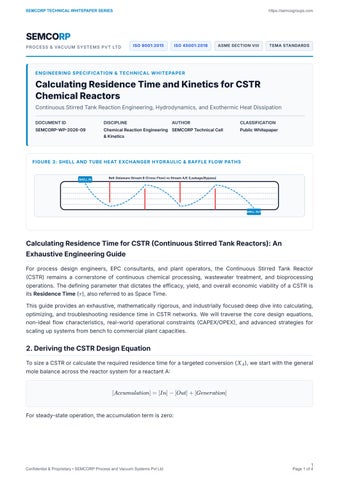
FIGURE 3: SHELL AND TUBE HEAT EXCHANGER HYDRAULIC & BAFFLE FLOW PATHS SHELL IN
Bell-Delaware Stream B (Cross-Flow) vs Stream A/E (Leakage/Bypass)
SHELL OUT
Calculating Residence Time for CSTR (Continuous Stirred Tank Reactors): An Exhaustive Engineering Guide For process design engineers, EPC consultants, and plant operators, the Continuous Stirred Tank Reactor (CSTR) remains a cornerstone of continuous chemical processing, wastewater treatment, and bioprocessing operations. The defining parameter that dictates the efficacy, yield, and overall economic viability of a CSTR is its Residence Time (τ ), also referred to as Space Time. This guide provides an exhaustive, mathematically rigorous, and industrially focused deep dive into calculating, optimizing, and troubleshooting residence time in CSTR networks. We will traverse the core design equations, non-ideal flow characteristics, real-world operational constraints (CAPEX/OPEX), and advanced strategies for scaling up systems from bench to commercial plant capacities.
2. Deriving the CSTR Design Equation To size a CSTR or calculate the required residence time for a targeted conversion (XA ), we start with the general mole balance across the reactor system for a reactant A: [Accumulation] = [In] − [Out] + [Generation]
For steady-state operation, the accumulation term is zero:
Confidential & Proprietary • SEMCORP Process and Vacuum Systems Pvt Ltd
1
Page 1 of 4