SEMCORP TECHNICAL WHITEPAPER SERIES
SEMCORP
PROCESS & VACUUM SYSTEMS PVT LTD
https://semcogroups.com
ISO 9001:2015
ISO 45001:2018
ASME SECTION VIII
TEMA STANDARDS
ENGINEERING SPECIFICATION & TECHNICAL WHITEPAPER
Industrial Crystallizer Selection: Forced Circulation vs DTB vs OSLO Systems Supersaturation Mechanisms, Crystal Size Distribution (CSD), and Scaling Mitigation in ZLD DOCUMENT ID SEMCORP-WP-2026-10
DISCIPLINE Crystallization & Solid-Liquid Equilibrium
AUTHOR SEMCORP Technical Cell
CLASSIFICATION Public Whitepaper
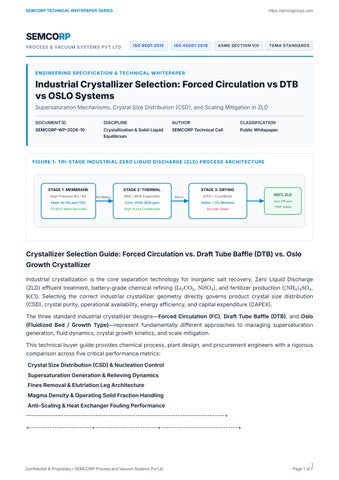
FIGURE 1: TRI-STAGE INDUSTRIAL ZERO LIQUID DISCHARGE (ZLD) PROCESS ARCHITECTURE
STAGE 1: MEMBRANE
STAGE 2: THERMAL
High-Pressure RO / NF
MEE / MVR Evaporator
RO Reject
STAGE 3: DRYING ATFD / Crystallizer
Slurry
Feed: 5k-15k ppm TDS
Conc: 250k-350k ppm
Solids: < 5% Moisture
70-80% Water Recycled
High-Purity Condensate
Dry Salt Cakes
100% ZLD Zero Effluent TSDF Solids
Crystallizer Selection Guide: Forced Circulation vs. Draft Tube Baffle (DTB) vs. Oslo Growth Crystallizer Industrial crystallization is the core separation technology for inorganic salt recovery, Zero Liquid Discharge (ZLD) effluent treatment, battery-grade chemical refining (Li2 CO3 , NiSO4 ), and fertilizer production ((NH4 )2 SO4 , KCl). Selecting the correct industrial crystallizer geometry directly governs product crystal size distribution (CSD), crystal purity, operational availability, energy efficiency, and capital expenditure (CAPEX).
The three standard industrial crystallizer designs—Forced Circulation (FC), Draft Tube Baffle (DTB), and Oslo (Fluidized Bed / Growth Type)—represent fundamentally different approaches to managing supersaturation generation, fluid dynamics, crystal growth kinetics, and scale mitigation. This technical buyer guide provides chemical process, plant design, and procurement engineers with a rigorous comparison across five critical performance metrics: Crystal Size Distribution (CSD) & Nucleation Control Supersaturation Generation & Relieving Dynamics Fines Removal & Elutriation Leg Architecture Magma Density & Operating Solid Fraction Handling Anti-Scaling & Heat Exchanger Fouling Performance --------------------------------------------------------------------------------+ +-------------------------+-------------------------+-------------------------------+
Confidential & Proprietary • SEMCORP Process and Vacuum Systems Pvt Ltd
1
Page 1 of 7
SEMCORP TECHNICAL WHITEPAPER SERIES
FORCED CIRCULATION
https://semcogroups.com
DRAFT TUBE BAFFLE
OSLO GROWTH TYPE
+-------------------------+-------------------------+-------------------------------+ BULK FLASHING SEPARATOR
CENTRAL DRAFT TUBE
DECOUPLED FLASH CHAMBER &
External Calandria
Internal/External Fines
Clear Liquor Circulation
Small Crystals (<0.5mm)
Medium Crystals (1-2mm)
Extra Large Crystals (>2.5mm)
+-------------------------+-------------------------+-------------------------------+
Confidential & Proprietary • SEMCORP Process and Vacuum Systems Pvt Ltd
2
Page 2 of 7
SEMCORP TECHNICAL WHITEPAPER SERIES
https://semcogroups.com
### 1.1 Forced Circulation (FC) Crystallizer The Forced Circulation (FC) crystallizer is a Mixed Suspension, Mixed Product Removal (MSMPR) vessel designed for *
**Operating Mechanism:** The axial flow pump circulates magma at velocities between **2.0 and 4.5 m/s** throu
*
**Primary Application:** Sodium sulfate ($\text{Na}_2\text{SO}_4$), sodium chloride ($\text{NaCl}$), high-sal
### 1.2 Draft Tube Baffle (DTB) Crystallizer The Draft Tube Baffle (DTB) crystallizer is a low-shear, classified-suspension MSMPR vessel designed to produce l *
**Operating Mechanism:** The internal propeller pumps the dense crystal slurry upward through the draft tube
*
**Primary Application:** Ammonium sulfate ($(\text{NH}_4)_2\text{SO}_4$), potassium chloride ($\text{KCl}$),
### 1.3 Oslo (Growth / Fluidized Bed) Crystallizer The Oslo crystallizer (invented by Jeremiassen) completely decouples the supersaturation generation zone from the *
**Operating Mechanism:** Clear mother liquor (virtually free of crystals, $< 2-5\ \text{wt}\%$ solids) is dra
*
**Primary Application:** Large-grain fertilizer crystals, ammonium sulfate, lithium carbonate ($\text{Li}_2\t
| :--- | :--- | | **Non-Corrosive Salts / Organic Slurries** | **SS304L / SS316L** | Low carbon content prevents sensitization du | **High Chloride ZLD Brines / $(\text{NH}_4)_2\text{SO}_4$** | **Duplex 2205 (UNS S31803)** | Austenite-ferrite | **Concentrated Chlorides / High-Temp Acids** | **Super Duplex 2507 / Hastelloy C-276** | Hastelloy C-276 ($\tex | **Acidic Chloride / Reactive Metals** | **Titanium Grade 2 / Grade 7** | Titanium Grade 2 provides immunity to | **High-Concentration Caustics ($\text{NaOH}$)** | **Monel 400 (UNS N04400)** | Nickel-copper alloy immune to ca ----------------------------------------------------+ |
Flash Separator
|
+---------------------------+---------------------------+ │ Annular Baffle / Settling Zone │ (Clear Mother Liquor + Fines) │ ▼ External Fines Dissolver (Steam / Condensate Heating) │ ▼ Recycled Back to Main Vessel │ ▼ Bottom Elutriation Leg (Hydraulic Classification) │ ▼ Coarse Product Slurry
Forced Circulation: Has no internal fines removal or elutriation mechanisms. All particle sizes (nuclei, fines, and product crystals) are homogeneously mixed and continuously discharged together. External hydrocyclones can be added, but provide limited particle size sharpening compared to integrated systems. Draft Tube Baffle: Features an integrated internal annular baffle skirt. The upward velocity of mother liquor in this annular zone is designed to be lower than the settling velocity of product crystals (> 150 μm), but higher than the settling velocity of fine crystals (< 75 μm). Fines are captured in the overflow, pumped through a shell-
Confidential & Proprietary • SEMCORP Process and Vacuum Systems Pvt Ltd
3
Page 3 of 7
SEMCORP TECHNICAL WHITEPAPER SERIES
https://semcogroups.com
and-tube fines dissolver where temperature is increased by 2 − 5∘ C to dissolve the fine solids, and recycled to the main body. An optional bottom elutriation leg injects clear mother liquor upward to wash back small crystals, permitting only heavy, fully grown crystals to settle into the discharge manifold. Oslo Growth Type: Inherently acts as a self-classifying fluidized bed. Hydraulic classification occurs naturally based on particle mass and superficial fluid velocity (ue ). Fine crystals remain suspended at the top of the growth bed, while coarse crystals settle to the vessel bottom. An elutriation leg at the bottom of the Oslo growth chamber further cleanses product crystals of any residual fine particles prior to slurry extraction.
3.4 Magma Density & Operating Solid Fraction Handling Magma density refers to the dry mass percentage of suspended solid crystals in the slurry (wt% solids or g/L). Forced Circulation: Handles the highest magma densities (30 – 50 wt% solids) without operational instability. High-velocity axial flow pumps and large-bore calandria tubes (38 − 50.8 mm OD) prevent crystal settling, slurry stagnation, or line plugging even with highly non-Newtonian slurries. Draft Tube Baffle: Operates efficiently at 20 – 40 wt% solids. Higher magma densities provide larger total crystal surface area (Ac ), accelerating supersaturation depletion. However, if magma density exceeds 45 wt%, internal draft tube circulation friction increases sharply, causing impeller cavitation, localized settling, and motor overload. Oslo Growth Type: Operates with a growth bed magma density of 15 – 35 wt% solids. However, the recirculating fluid drawn from the top of the bed to the external heat exchanger is crystal-free clear liquor (< 2 wt%). This allows the heating circuit to operate at extremely low fluid friction and prevents tube plugging, while maintaining a dense, active growth zone in the lower chamber.
3.5 Anti-Scaling & Heat Exchanger Fouling Performance Fouling and wall scaling are caused by boiling inside heat exchanger tubes, localized high thermal flux (ΔTwall ), or wall friction in supersaturated zones.
Forced Circulation: Exceptional anti-scaling performance inside the heat exchanger. By maintaining tube fluid velocities of 2.0 – 4.0 m/s and imposing static liquid head above the top tubesheet, boiling inside the tubes is completely suppressed. Heat transfer occurs purely by sensible heating (ΔTtubes ≈ 1.5 − 3.0∘ C). Vapor release is restricted to the flash vessel bulk liquid volume. However, scale can accumulate on the flash vessel internal walls at the liquid-gas interface line. Draft Tube Baffle: Good scaling resistance when operated with low thermal flux external heat exchangers or direct vacuum cooling. Because boiling occurs at the upper liquid surface of the draft tube, scaling can form over prolonged operating campaigns on the upper vessel walls and draft tube internal rim. Oslo Growth Type: Superior anti-scaling performance throughout the heating loop. Because the recirculating liquid passing through the heat exchanger is unseeded clear liquor and heating is strictly controlled to maintain ΔC < ΔCcrit , scaling inside calandria tubes is virtually non-existent. Scaling risks are concentrated in the central downcomer pipe if the supersaturated liquid flash relief is uncontrolled.
Confidential & Proprietary • SEMCORP Process and Vacuum Systems Pvt Ltd
4
Page 4 of 7
SEMCORP TECHNICAL WHITEPAPER SERIES
https://semcogroups.com
5. Comprehensive Comparative Analysis & Selection Matrix ENGINEERING PARAMETER
FORCED CIRCULATION (FC)
DRAFT TUBE BAFFLE (DTB)
OSLO GROWTH CRYSTALLIZER
**Primary Separation Principle**
Bulk Flashing MSMPR
Internal Draft Circulation + Baffle
Fluidized Bed Decoupled Growth
**Mean Crystal Size (d50 )**
**0.15 − 0.50 mm** (Small)
**0.80 − 2.00 mm** (Medium-Large)
**1.50 − 4.50 mm** (Coarse/Extra Large)
**Coefficient of Variation (CV)**
40 − 60% (Wide)
20 − 30% (Uniform)
< 20% (Extremely Tight)
**Crystal Habit & Purity**
Irregular, fractured, low purity
Uniform, rounded, medium purity
Spherical, high purity, low inclusion
**Supersaturation Location**
Bulk liquid vapor interface
Boiling surface at top draft tube
Decoupled vapor chamber (crystal-free)
**Max Allowable ΔT (Calandria)**
2.0 − 4.0∘ C
1.5 − 3.0∘ C
1.0 − 2.0∘ C
**Fines Removal System**
None (Homogeneous discharge)
Integrated annular baffle + dissolver
Self-classifying bed + elutriation leg
**Elutriation Leg Integration**
Rare / External only
Optional / Standard bottom leg
Standard integral bottom leg
**Operating Magma Density**
**25 − 50 wt%** (Very High)
**20 − 40 wt%** (High)
**15 − 35 wt%** (Growth Bed)
**Recirculation Fluid State**
Dense slurry (25 − 50 wt% )
Dense slurry (20 − 40 wt%)
Clear liquor (< 2 wt% solids)
**Mechanical Agitation Shear**
High (Axial pump tip speed > 8 m/s)
Low (Propeller tip speed 2 − 4 m/s)
Zero in growth bed (External pump only)
**Anti-Scaling Performance**
Excellent (Boiling suppressed)
Moderate (Surface boiling scaling)
Superior (Clear liquor heating)
**Turndown Capacity**
50 − 110%
70 − 105%
60 − 100%
**Relative CAPEX**
**1.0 (Baseline)**
**1.35 - 1.50**
**1.60 - 1.90**
**Relative OPEX (Pumping/Steam)**
**High** (High circulation power)
**Medium** (Low head draft flow)
**Medium-Low** (Clear liquor pumping)
**Footprint & Height**
Compact height, medium footprint
Moderate height, medium footprint
Tall vertical column, compact footprint
Confidential & Proprietary • SEMCORP Process and Vacuum Systems Pvt Ltd
5
Page 5 of 7
SEMCORP TECHNICAL WHITEPAPER SERIES
https://semcogroups.com
7. Engineering Best Practices & Buyer Decision Logic BUYER DECISION FLOWCHART Is crystal size > 1.5 mm OR ultra-high purity mandated? │ YES ◄───┘
│ └───► NO
│
│
▼
▼
Select OSLO Growth
Is the fluid highly scaling,
Crystallizer
viscous, or > 40 wt% solids? │ YES ◄───┘ │ ▼
│ └───► NO │ ▼
Select FORCED
Select DRAFT TUBE
CIRCULATION (FC)
BAFFLE (DTB)
To optimize capital expenditure, operational stability, and product specifications, process design engineers should apply the following decision framework: Specify Product Particle Size First: If market requirements specify small, fine salt particles (< 0.5 mm) or if the product undergoes downstream wet milling, select Forced Circulation (FC) to minimize vessel footprint and CAPEX. If the target market demands premium, dust-free granular fertilizer (1.0 − 2.0 mm), select a Draft Tube Baffle (DTB) crystallizer. If coarse, spherical, high-purity crystals (> 2.5 mm) with near-zero mother liquor occlusion are required, select an Oslo Growth crystallizer. Evaluate Rheology and Fouling Index: For wastewater streams containing organic contaminants, silicates, or inverted solubility salts (CaSO4 , Na2 SO4 ), Forced Circulation is mandatory. The high liquid velocity (> 2.5 m/s) scours tube walls, preventing boundary layer scaling. Avoid Oslo crystallizers on streams with unpredictable solid precipitation or high primary nucleation rates, as unseeded nucleation in the vaporization vessel can foul the central downcomer. Optimize Energy Consumption & Recirculation Power: FC crystallizers require high-power axial pumps to overcome static head and tube friction at high slurry flow rates. DTB crystallizers consume significantly less electrical power per ton of product due to low-head, low-speed internal draft tube circulation. Oslo crystallizers reduce heat exchanger pumping power by pumping clear mother liquor rather than dense slurries, but require taller structural steel frameworks to house the vertical fluidized bed column. Incorporate Metallurgical Corrosion Allowances: Always specify minimum 2.0 mm corrosion/erosion allowances on vessel shells subjected to high-velocity slurry impingement. Utilize Duplex 2205 or Super Duplex 2507 for calandria tubesheets and impellers when processing chloride brines exceeding 15, 000 ppm Cl− at temperatures above 70∘ C. -------------------------------------------------------------------------------+
Confidential & Proprietary • SEMCORP Process and Vacuum Systems Pvt Ltd
6
Page 6 of 7
SEMCORP TECHNICAL WHITEPAPER SERIES
https://semcogroups.com
+-----------------------+----------------------------------------------------------+ +-----------------------+----------------------------------------------------------+ OPERATING PRESSURE
FULL VACUUM (0.1 BAR A) TO ATMOSPHERIC (ASME SEC VIII)
Metastable Margin
Delta T across heater < 2.5 deg C
Fines Dissolution
Fines loop sizing >= 15-25% of total recirculation flow
Agitator Tip Speed
< 3.5 m/s for DTB Internal Propeller
Minimum Tube OD
>= 38.1 mm (1.5 in) to prevent slurry plugging
+-----------------------+----------------------------------------------------------+
SEMCORP PROCESS & ENGINEERING EXECUTION HUB SEMCORP is an ISO 9001:2015 and ISO 45001:2018 certified turnkey engineering contractor and process equipment fabricator based in Pune, India. We deliver complete Concept-to-Commissioning solutions with guaranteed performance metrics. 🧮 Interactive Sizing Suite Model MEE steam economy, heat transfer area, and agitator power in real time at semcogroups.com/tools
📋 Technical Specification & Catalog Explore complete equipment data sheets and metallurgy options at SEMCORP Industrial Crystallization Systems
📞 Commercial & Engineering Inquiries Direct RFQ line: +91-9684011611 | Official Email: enquiry@semcogroups.com
🏭 Head Office & Fabrication Facilities Head Office: Ravet, Pune – 412101 | Heavy Fabrication: Solapur MIDC Chincholi & Pune, Maharashtra, India.
Confidential & Proprietary • SEMCORP Process and Vacuum Systems Pvt Ltd
7
Page 7 of 7