SEMCORP TECHNICAL WHITEPAPER SERIES
SEMCORP
PROCESS & VACUUM SYSTEMS PVT LTD
https://semcogroups.com
ISO 9001:2015
ISO 45001:2018
ASME SECTION VIII
TEMA STANDARDS
ENGINEERING SPECIFICATION & TECHNICAL WHITEPAPER
ATFD vs. Spray Dryer for Industrial Salt Recovery in ZLD Plants Mechanical Thin-Film Agitation vs. High-Pressure Atomization for Concentrated Saline Slurries DOCUMENT ID SEMCORP-WP-2026-05
DISCIPLINE Solids Recovery & Industrial Drying
AUTHOR SEMCORP Technical Cell
CLASSIFICATION Public Whitepaper
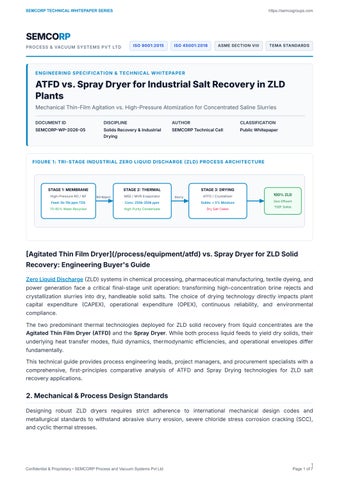
FIGURE 1: TRI-STAGE INDUSTRIAL ZERO LIQUID DISCHARGE (ZLD) PROCESS ARCHITECTURE
STAGE 1: MEMBRANE
STAGE 2: THERMAL
High-Pressure RO / NF
MEE / MVR Evaporator
RO Reject
STAGE 3: DRYING Slurry
ATFD / Crystallizer
Feed: 5k-15k ppm TDS
Conc: 250k-350k ppm
Solids: < 5% Moisture
70-80% Water Recycled
High-Purity Condensate
Dry Salt Cakes
100% ZLD Zero Effluent TSDF Solids
[Agitated Thin Film Dryer](/process/equipment/atfd) vs. Spray Dryer for ZLD Solid Recovery: Engineering Buyer's Guide Zero Liquid Discharge (ZLD) systems in chemical processing, pharmaceutical manufacturing, textile dyeing, and power generation face a critical final-stage unit operation: transforming high-concentration brine rejects and crystallization slurries into dry, handleable solid salts. The choice of drying technology directly impacts plant capital expenditure (CAPEX), operational expenditure (OPEX), continuous reliability, and environmental compliance. The two predominant thermal technologies deployed for ZLD solid recovery from liquid concentrates are the Agitated Thin Film Dryer (ATFD) and the Spray Dryer. While both process liquid feeds to yield dry solids, their underlying heat transfer modes, fluid dynamics, thermodynamic efficiencies, and operational envelopes differ fundamentally. This technical guide provides process engineering leads, project managers, and procurement specialists with a comprehensive, first-principles comparative analysis of ATFD and Spray Drying technologies for ZLD salt recovery applications.
2. Mechanical & Process Design Standards Designing robust ZLD dryers requires strict adherence to international mechanical design codes and metallurgical standards to withstand abrasive slurry erosion, severe chloride stress corrosion cracking (SCC), and cyclic thermal stresses.
Confidential & Proprietary • SEMCORP Process and Vacuum Systems Pvt Ltd
1
Page 1 of 7
SEMCORP TECHNICAL WHITEPAPER SERIES
https://semcogroups.com
DESIGN PARAMETER / CODE
AGITATED THIN FILM DRYER (ATFD)
SPRAY DRYER
**Vessel Design Code**
ASME Section VIII Div 1 / EN 13445 (Jacketed [Pressure Vessel](/process/equipment/pressure-vessel))
ASME Section VIII Div 1 (Nonpressure / low-draft structural design)
**Heat Exchanger Code**
TEMA C/B (for integrated vapor condensers)
NFPA 86 (Standard for Ovens and Furnaces for air heaters)
**Venting & Vacuum Code**
API 2000 / ISO 28300 (Overpressure and vacuum relief)
Explosive Dust Venting: NFPA 68 / NFPA 69
**Rotor & Dynamic Balancing**
ISO 1940-1 Grade G2.5 / G1.0 dynamic balancing
ISO 1940-1 Grade G1.0 for highspeed rotary atomizers
**Shaft Sealing Standards**
API 682 Plan 53B / Plan 54 double mechanical seal systems
Air-purged labyrinth seals / sanitary lip seals
Metallurgical Selection for ZLD Salt Environments − Brines in ZLD evaporators contain high concentrations of Chloride (Cl− ), Sulfate (SO2− 4 ), Nitrate (NO3 ), and trace organic compounds. Metallurgical selection must account for temperature, pH, and localized pitting/crevice corrosion risks.
Corrosion Resistance & Metallurgy Hierarchy: SS304L
<
SS316L
<
Duplex 2205
<
Super Duplex 2507
<
Hastelloy C-276
<
Titanium Gr. 2
SS304L: Limited to non-chloride, low-salinity industrial wastewater streams (< 500 ppm Cl− ). SS316L: Suitable for neutral pH brines with low chloride levels (< 3, 000 ppm Cl− ) at temperatures below 80∘ C. Duplex 2205 (UNS S31803 / S32205): Standard workhorse material for ATFD shell, blades, and Spray Dryer chambers handling high-salinity mixed sodium/calcium chloride brines (< 30, 000 ppm Cl− ). Superior resistance to SCC compared to austenitic stainless steels. Super Duplex 2507 (UNS S32750): Applied in aggressive high-temperature chloride/sulfate environments (< 60, 000 ppm Cl− ). Hastelloy C-276 (UNS N10276): Mandatory for acidic brines (pH < 3), highly concentrated calcium chloride ( CaCl2 ), magnesium chloride (MgCl2 ), or organic-laden hazardous chemical ZLD rejects. Titanium Grade 2: Preferred for high-temperature chlor-alkali brine crystallization and marine/seawater ZLD reject drying.
3.2 ATFD Thermal Sizing & Heat Transfer Logic In an ATFD, thermal energy is supplied indirectly across the vessel wall: Qtotal, ATFD = Qsensible + Qlatent + Qsolids + Qloss
Qsensible = ṁfeed ⋅ Cp,feed ⋅ (Tboil − Tfeed )
Confidential & Proprietary • SEMCORP Process and Vacuum Systems Pvt Ltd
2
Page 2 of 7
SEMCORP TECHNICAL WHITEPAPER SERIES
https://semcogroups.com
Qlatent = ṁwater, evap ⋅ ΔHvap (Tboil )
Qsolids = ṁsolids, out ⋅ Cp,solids ⋅ (Tdischarge − Tboil )
The required heat transfer wall area AATFD (m2 ) is calculated via Fourier's Law of Conduction combined with overall heat transfer coefficients:
Qtotal, ATFD Uoverall ⋅ ΔTlm
AATFD =
The Logarithmic Mean Temperature Difference (ΔTlm ) for steam-heated ATFD:
ΔTlm =
(Tsteam − Tfeed ) − (Tsteam − Tboil )
−Tfeed ) ln ( TTsteam steam −Tboil
≈ Tsteam − Tboil
(for isothermal condensation)
Typical Overall Heat Transfer Coefficients (Uoverall ) in ATFD for ZLD applications:
Viscous slurry to paste regime (30% − 45% TDS): 1, 000 − 1, 400 W/m2 K Paste to dry cake regime (45% − 98% solids): 600 − 900 W/m2 K Mean design envelope value: 850 − 1, 100 W/m2 K
4. Key Performance Metric Comparisons 4.1 Feed Solids Concentration Limits & Rheological Tolerance ATFD: Specifically engineered to process high-viscosity pastes, non-Newtonian crystallizing slurries, and heavy sludge feeds. It can readily accept concentrate directly from Multi-Effect Evaporators (MEE) or Mechanical Vapor Recompression (MVR) systems at 30% to 55% Total Dissolved Solids (TDS). The mechanical rotor blades continuously clear the boundary layer, preventing clogging regardless of slurry viscosity. Spray Dryer: Constrained by atomizer capabilities. Feed brines must remain pumpable and atomizable without clogging nozzles or causing severe wear on rotary discs. Max feed TDS is capped at 15% to 35% TDS (viscosity < 150 − 200 cP). High-concentration feeds form premature salt skins on droplets, resulting in incomplete core drying or severe chamber wall buildup. Feed Solids Concentration Range Comparison: ATFD:
[============================= 30% to 60% TDS =============================]
Spray Dryer:
[=========== 15% to 35% TDS ===========] +-----------+-----------+-----------+-----------+-----------+-----------+ 0%
10%
20%
30%
Confidential & Proprietary • SEMCORP Process and Vacuum Systems Pvt Ltd
40%
50%
60%
3
Page 3 of 7
SEMCORP TECHNICAL WHITEPAPER SERIES
https://semcogroups.com
4.2 Energy Consumption & Thermal Efficiency ATFD (Indirect Steam Economy): Operates at high thermal efficiency (85% − 92%) because latent heat is transferred directly through a thin metallic wall. Steam consumption ranges from 1.1 to 1.25 kg steam per kg water evaporated (approximately 650 − 750 kcal/kg water). Electricity consumption is limited to the main rotor drive motor (15 − 30 kWh/ton evaporated). Spray Dryer (Direct Hot Air Losses): Operates at lower overall thermal efficiency (45% − 65%) due to latent heat escaping in the high-volume exhaust air stream (Texhaust ≈ 90∘ C − 120∘ C). Thermal energy requirements range from 1,100 to 1,500 kcal/kg water evaporated (1.6 − 2.2 kg steam equivalent). High electrical energy is consumed by air blowers, hot air fans, atomizers, and pulse-jet bag filters (45 − 80 kWh/ton evaporated).
Thermal Energy Required per kg Water Evaporated: ATFD:
[====== 650 - 750 kcal/kg ======]
Spray Dryer: [================= 1,100 - 1,500 kcal/kg =================] +--------+--------+--------+--------+--------+--------+ 0
300
600
900
1200
1500 kcal/kg
4.3 Powder Quality & Morphological Characteristics ATFD Product: Yields a granular, dense, crystalline salt cake or flake. Bulk density is high (0.8 − 1.25 g/cm3 ), which reduces storage volume, bagging footprint, and disposal freight costs. Low dust generation minimizes operator exposure and health risks. Spray Dryer Product: Produces spherical, hollow micro-particles or amorphous powders with fine particle size distributions (20 − 100 μm). Bulk density is low (0.35 − 0.55 g/cm3 ). The fine powder is highly dusty, highly hygroscopic, and prone to rapid moisture re-absorption during bagging. ATFD Product
Spray Dryer Product
┌──────────────────────────┐
┌──────────────────────────┐
│ Dense Crystalline Flakes │
│ Fine Amorphous Spheres
│
│ Bulk Density: 0.8-1.2 g/cc│
│ Bulk Density: 0.3-0.5g/cc│
│ Moisture: < 1-2%
│
│ Moisture: < 2-4%
│
│ Low Dusting Potential
│
│ High Dusting Potential
│
└──────────────────────────┘
└──────────────────────────┘
4.4 Plant Footprint & Spatial Requirements ATFD: Features a compact, self-contained layout. Vertical ATFD units require a footprint of 4 m × 4 m with head-room of 6 − 10 m. Horizontal configurations are available for restricted overhead clearance buildings. Spray Dryer: Demands extensive vertical and horizontal real estate. A typical industrial spray drying system requires a tower height of 15 to 30 meters and a floor footprint exceeding 12 m × 15 m to accommodate the drying chamber, hot air generator, primary cyclones, baghouse filters, induced draft fans, and exhaust ducting.
4.5 Maintenance Complexity & Operational Reliability ATFD: Mechanical maintenance focuses on the dynamic rotor drive, gearbox, mechanical seal assembly, and hinged scraper blades. Scraper blades require periodic inspection for wear (replacement interval: 8, 000 − 16, 000 operating hours). Wall scaling is actively prevented by scraper mechanical action. CIP (Clean-In-Place) wash cycles are short (1 − 2 hours). Spray Dryer: Contains high-speed rotating elements (10, 000 − 25, 000 RPM) operating under thermal stress. Rotary atomizer spindle/bearing failures can cause unplanned outages. Spray nozzles require frequent declogging. Internal chamber wall deposition (crusting) demands manual cleaning or prolonged automated washing. Baghouse filter bags require regular pulse-jet replacements due to salt chemical blinding. Confidential & Proprietary • SEMCORP Process and Vacuum Systems Pvt Ltd
4
Page 4 of 7
SEMCORP TECHNICAL WHITEPAPER SERIES
https://semcogroups.com
:---
:---
:---
**Specific Thermal Energy**
650 − 750 kcal / kg H2 O
1, 100 − 1, 500 kcal / kg H2 O
**ATFD** (∼ 40 − 50% energy reduction)
**Specific Electrical Energy**
15 − 30 kWh / ton H2 O
45 − 80 kWh / ton H2 O
**ATFD** (Lower auxiliary power demand)
45% − 65% (Direct Convective)
**ATFD**
0.35 − 0.55 g/cm (Fine
Powder)
**ATFD** (2× reduction in bag volume)
**Thermal Efficiency ( η )**
85% − 92% (Indirect
**Product Bulk Density**
0.80 − 1.25 g/cm
Contact)
3
(Granular/Flake)
3
**Product Moisture Content**
0.5% − 2.0%
1.5% − 4.0%
**ATFD**
**System Footprint**
Compact (4m × 4m, Height 6 − 8m)
Large (12m × 15m, Height 18 − 25m)
**ATFD** (Saves structural civil cost)
**Atomizer / Rotor Speed**
Low Speed (100 − 350 RPM)
Ultra High Speed (10, 000 − 25, 000 RPM)
**ATFD** (Lower mechanical fatigue)
**Dust Explosion Risk**
Low / Negligible
Moderate to High (Requires NFPA Vents)
**ATFD**
**Cleaning & CIP Frequency**
Fast CIP (1 − 2 h), Selfscraping
Frequent manual wash down ( 4 − 8 h)
**ATFD**
**CAPEX (System Scope)**
Moderate
High (Includes tower, heaters, baghouse)
**ATFD**
**OPEX (Energy + Spares)**
Low to Moderate
High
**ATFD**
Confidential & Proprietary • SEMCORP Process and Vacuum Systems Pvt Ltd
5
Page 5 of 7
SEMCORP TECHNICAL WHITEPAPER SERIES
https://semcogroups.com
7. Engineering Decision Tree & Best Practices [ ZLD Feed Concentrate ] │ ▼ /───────────────────────────────\ < Is Feed Concentration > 30% TDS? > \───────────────────────────────/ YES
│
│
│
│ NO
▼
▼
┌────────────────┐ │ Select
ATFD
/──────────────────────────\
│ < Is Product Powder Spherical >
└────────────────┘ <
Requirement Mandatory?
>
\──────────────────────────/ YES
│
│
│
│ NO
▼
▼
┌────────────┐ ┌────────────┐ │Select Spray│ │Select ATFD │ │
Dryer
│ │
(Pre-conc)│
└────────────┘ └────────────┘
Key Engineering Recommendations for ZLD Specification: Prioritize Thermal Economy: Select ATFD for standard ZLD crystallizer reject streams. The indirect steam transfer offers up to 50% lower OPEX per ton of salt produced compared to convective spray drying. Evaluate Material of Construction (MOC): Specify Duplex 2205 as the baseline MOC for ATFD shell and rotor components when handling chloride concentrations > 5, 000 ppm. Upgrade to Hastelloy C-276 for acidic brines or high concentrations of CaCl2 /MgCl2 . Verify Rotor Mechanical Design: Ensure the ATFD rotor is balanced to ISO 1940-1 Grade G2.5 and equipped with a double mechanical seal with pressurized barrier fluid (API Plan 53B or 54) to protect bearings from abrasive salt dust ingress. Avoid Dilution Traps: Avoid spray dryer designs that require diluting high-density MEE/MVR concentrates down to pumpable ranges. Liquid dilution invalidates upstream evaporator energy savings. Safety Compliance: If selecting Spray Drying for organic-contaminated salts, perform Dust Explosion Testing (Kst and Pmax values) in accordance with ASTM E1226 and install explosion vent panels in compliance with NFPA 68. --
Conclusion While Spray Dryers excel in producing uniform, fine, spherical powders for food, pharmaceutical, and specialty chemical applications, the Agitated Thin Film Dryer (ATFD) is the superior, highly economical choice for industrial Zero Liquid Discharge (ZLD) salt recovery. ATFD's ability to handle high-viscosity pastes (30% − 60% TDS), operate with low specific steam consumption ( 1.1 − 1.25 kg/kg water), deliver high bulk-density salt cake (0.8 − 1.2 g/cm3 ), and fit within compact plant footprints makes it the industry standard for robust, cost-effective ZLD plant design. *For detailed ATFD equipment sizing, custom metallurgy evaluation, or integrated ZLD system engineering support, contact the SEMCO Process Engineering Team.*
Confidential & Proprietary • SEMCORP Process and Vacuum Systems Pvt Ltd
6
Page 6 of 7
SEMCORP TECHNICAL WHITEPAPER SERIES
https://semcogroups.com
SEMCORP PROCESS & ENGINEERING EXECUTION HUB SEMCORP is an ISO 9001:2015 and ISO 45001:2018 certified turnkey engineering contractor and process equipment fabricator based in Pune, India. We deliver complete Concept-to-Commissioning solutions with guaranteed performance metrics. 🧮 Interactive Sizing Suite Model MEE steam economy, heat transfer area, and agitator power in real time at semcogroups.com/tools
📋 Technical Specification & Catalog Explore complete equipment data sheets and metallurgy options at SEMCORP Agitated Thin Film Dryers & Evaporators
📞 Commercial & Engineering Inquiries Direct RFQ line: +91-9684011611 | Official Email: enquiry@semcogroups.com
🏭 Head Office & Fabrication Facilities Head Office: Ravet, Pune – 412101 | Heavy Fabrication: Solapur MIDC Chincholi & Pune, Maharashtra, India.
Confidential & Proprietary • SEMCORP Process and Vacuum Systems Pvt Ltd
7
Page 7 of 7