Discovering Diverse Content Through Random Scribd Documents
warn the doomed mouse. It is a much more probable view that the rattlesnake uses its rattle, the cobra expands its frill, and the puffadder swells whilst hissing so loudly and harshly, in order to alarm the many birds and beasts which are known to attack even the most venomous species. Snakes act on the same principle which makes a hen ruffle her feathers and expand her wings when a dog approaches her chickens.’ This profound thinker, then, is one of those who include the rattle among ‘the many ways by which animals endeavour to frighten away their enemies.’
We may reasonably conclude that the Crotalus, in common with other snakes, also with dogs and cats, expresses a variety of feelings with its sounding tail, fear being the most predominant one. The Indians recognise its utility as a warning by gratefully abstaining from killing one that rattles. They superstitiously regard it as protective to themselves if not to the snake, and they in turn carefully protect the reptile. Backwoodsmen display little or no fear when they hear the Crotalus, and though they do not spare it, regard it with less bitter animosity than they display towards its cousin the Copper-head; because, as a facetious writer has testified of it, ‘it never bites without provocation, living up to the laws of honour, and by his rattles giving challenge in an honourable way.’
That the sound has a language of its own is known by the fact that when disturbed and one rattle is sprung, all other rattlesnakes within hearing take up the chorus. That the sexes also understand each other through crotaline eloquence is generally believed. In fact, to each other and to themselves they have, no doubt, as many variations in the use of their rattles, as any other animal in the expression of its tail; and probably all the above enumerated examples are at one time or another its legitimate uses. Those who have most closely observed them have detected a variety of cadences in one and the same rattle.
Those also who have carefully watched rattlesnakes under various circumstances, must perceive that timidity is one of the strongest features in this reptile. In chap. xxx. I will give examples of this. Already convinced by observation, I attributed to excessive
timidity the chief agitation of the rattle, when writing on the Ophidia in the Dublin University Magazine, December 1875, and again in Aunt Judy’s Magazine, July 1877. Fear causes some snakes to puff themselves; others to expand or flatten the body; fear excites the cobra to erect its anterior ribs and display its ‘hood;’ and, above all, fear causes most snakes to hiss. Fear is coupled with anger, in these attempts to do their best towards repelling the offender. Dr. E. Coues, in speaking of the rattle, supposes it to have possibly ‘resulted in the course of time from the continual agitation of the caudal extremity of these highlynervous and irritablecreatures.’ Dr. Weir Mitchell has known captive snakes to vibrate the rattle for hours at a time; and probably, if there were opportunities of becoming more intimately acquainted with crotaline idiosyncrasies, we should discover some snakes to be more or less afflicted with temper, nervousness, terror, or other emotions which induce an animal to express its feelings in its own way.
But the most remarkable peculiarity in this snake is that no other way is in its power: a rattlesnake never hisses. Throughout the numerous arguments, theories, explanations, and suggestions, there is such an absence of allusion to this fact that we must suppose it to be very little known. Says Dumeril in describing les petits étuis cornés,comparé à celuique feraientplusieursgrelotspeu sonorés: ‘Les Crotales diffèrent de tous les autres serpents connus par la facultéqu’ils ont deproduire des sons sourds et rapides, cu plutôt des bruits continus et prolongés à l’aide d’un organe spécial, qui supléerait—pourainsidire—àlavoix,dontcesserpentssonttoujours privés.’[89] But the sibilations of the rattle are often so like hissing that they have been compared to the whistling of wind among the leaves, to the escape of water through a pipe, to the whizzing of insects, the rattling of seed pods, and many similar sounds, showing at the same time the character of the noise and its variability.
Concisely recapitulating what this rattle does, we understand that in the first place it is a substitute for the voice—so far as hissing can be called voice; and that what would cause other excessively nervous, timid, terrified snakes to hiss, causes the rattle to vibrate. It
may attract insectivorous birds; it may alarm other timid creatures; it may summon its mate; and, as is well known, it has sympathy with its mate; for a second rattle is almost sure to be sounded, and they have been observed to sound in pairs or numbers responsively—it may be to express anger, fear, and for aught we know pleasure, in a state of liberty and enjoyment, feelings expressed by the tail of other creatures.
Why it is formed as it is, so wholly different from all other tails; from what it has been evolved; and how long in evolving,—all these are problems to be solved by future Darwins and future Evolutionists.
This chapter, therefore, closes with only feeble speculations after feeble attempts to explain an inexplicable phenomenon. The simplest and truest solution seems to be found in those few words, ‘qui supléeraitàlavoix,dontcesserpentssonttoujoursprivés.’
Again, we wonder whether in the non-hissing serpents any peculiarity of trachea may be observed.
CHAPTER XVIII.
THEINTEGUMENT—‘HORNS,’ANDOTHER EPIDERMALAPPENDAGES.
HAVING decided that in animal organization nothing exists without its especial use; assuming also that the peculiar development of cuticle forming the rattle is to supply the deficiency of voice, we are next induced to examine those other appendages in serpents which are also modifications of the integument, such as the ‘horns’ of the Cerastes, the tentacles, snoutprotuberances, and developments occasionally seen about the head of snakes, and which have all, no doubt, their uses.
‘Serpents are naked,’ says Günther—that is, they have no separate epidermal productions in the way of fur, feathers, hair, or wool, and all the variations of form in scales are but the folds of the epidermis.[90] The ‘variations of form’ include, therefore, the appendages above mentioned.
The heads of most snakes are covered with non-imbricated plates or shields. The form and position of these shields are in a great measure used in classification; ‘are of the greatest value for distinction of species and genera.’[91] For this reason each and all of the head shields are specially named.
Ophiologists differ slightly in distinguishing them as regards assigning the exact position of some of the shields, which, like all other ophidian features, vary in closely allied species. As, for example, while one naturalist may decide that a certain shield is exactly over the eye, another may consider it somewhat to the right or the left.
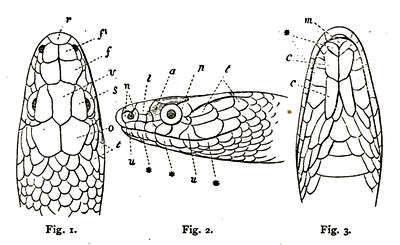
Günther’s classification being the one now generally adopted, I copy the names assigned by him, and the diagrams given in his work.
Fig.1.Top of the head of a Colubrine snake. r, rostral; f’, anterior frontal; f, posterior frontal; v, vertical; s, supraciliary; o, occipital; t, temporal.
Fig.2.Profile of the same. t, temporal; p, posterior ocular or orbital; a, anterior ocular or præorbital; l, loreal; n, nasals; uu, upper labials; **, lower labials.
Fig.3.Under side of the same. **, lower labials; cc, chinshields; m, mental or median lower labial.
It will be observed that some of these shields can be seen both in the profile and the others as well; as, for instance, the temporal and the labial or lip shields. The study of them is simplified by the initial letter of each name being used in reference to them. The names
used also speak for themselves; as mental, the chin shield; nasals, near the nostril; rostral, the beak shields.
Ophiologists in deciding species, etc., enumerate those which are more than a pair as ‘upper labials’ so many, ‘lower labials’ so many. In some snakes these shields are so large as to cover nearly the entire head; in others, they are almost inconspicuously small, or absent altogether, and much varied, as we shall see.
In the vipers the head is generally covered with small, rigid, imbricated, or overlapping scales instead of plates, and in some the scales are so extremely fine and closely arranged as almost to represent short bristles. This is noticeable in the African ‘nose-horned viper’ (Vipera nasicornis), p. 322, where they present a curiously complicated structure.
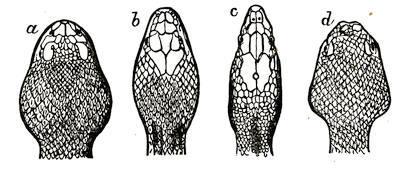
Too minute to examine except under the magnifying-glass, or to attempt to illustrate, we can convey only a general idea of these curious viper scales, which to the touch are spinous, and rough as a coarse brush. They must form an unpleasant perch for a bird, if it be true that the latter is enticed by the horns of some vipers to come and peck at them, as at a worm. These rigid head-scales become gradually larger and more simple on the body, but are still comparatively small for so large a serpent. In some few of the viperine snakes, plates are present as well as the fine scales, though chiefly about the nose and mouth, exceptions which are now and then found in non-venomous ones also. The preceding three illustrations are the head shields of a Colubrine snake, in which a greater uniformity prevails. Below are given four other types, though even here variations are constantly occurring.
Magnified carinated scale. Magnified head-scale of Vipera nasicornis, of the coloured illustration.
Fig. a. One of the Indian Crotalidæ. It has two conspicuous supraciliary shields, two equally conspicuous anterior frontals over the nostril. The rest are small, and those on the top are absent altogether. The scales are all finely carinated.
Fig. b. The head of a Colubrine snake in which the same scales appear as those in Fig. 1 of the preceding page, viz. two orbitals, etc., but are all much smaller, and do not therefore more than half cover the head.
Fig. c. The head of a sea snake, which as to design is really pretty, and, as Günther affirms, so different from land snakes in respect to head shields, that without any further investigation an ophiologist can at once distinguish the hydrophidæ.
Fig. d. The head of a viper in which only very small supraciliary and nasal (or anterior frontal) shields are seen. The angular form of the viperine head is here noteworthy. In some of the Tropical American viperine species (the Crotalidæ) the angular head is so marked as to be separated into a genus—the Trigonocephali, threecornered heads. One head is sagittate or arrow-shaped to such an extent that the serpent is known as the Fer de lance, the dreaded Trigonocephaluslanceolatusof the Antilles. There are Trigonocephali among the Indian Thanatophidia also.
One other very remarkable exception must not be omitted— namely, that in pythons may be seen an angular head, which makes the neck thin and conspicuous, only in a less degree; and also the absence of large head shields. In addition to this, many of the pythons have particularly short and very pointed tails—three singular
viperine features in non-venomous snakes, which can only be inherited from a common ancestry.
Another caprice is seen in the carinated or keel-shaped body scales, which are found in venomous and non-venomous, land and water, ground and tree snakes indifferently; though I think one may be safe in affirming that none of the true vipers have unkeeled and polished scales. Nicholson has observed that in several allied species, some have and some have not the keel, and that those without do as well as those with. ‘The history of the keel is not known,’ says this author. In appearance it reminds one of the mid-rib of a leaf or of a feather, and may probably be an inherited feature in common with birds whose reptilian ancestry in process of ages had fluttered their scales into feathers. In fact, in many snakes where no keel is found, there is some slight indication of a centre line, even if it take the form of a groove or depression. In the Tropidonotithe keel is so developed as to distinguish the group; yet many with keels have comparatively smooth skins. The carinated scales of vipers (from carina, a keel) are sharply defined, like the keel at the prow of a ship, or like the breastbone of the swift-flying birds which Mr. Sclater, in one of his zoological lectures, described as the carinate birds. It is these sharply-defined, stiff; and dull scales belonging to the vipers which produce the rustling noise when the snake is agitated, as described in the little Indian Echis carinata in the chapter on hissing. In the Cerastes I have witnessed the same agitated convolutions accompanied by the audible rustling produced by the rough scales. See illus. p. 317.
What are called ‘horns’ in some of the African vipers are curiouslymodified scales, which, under close examination, present the appearance of half-curled leaves, sometimes of ears, like those of a rabbit or a mouse. Being only cuticle, and liable to injury, these ‘horns’ vary in size and colour as well as form.
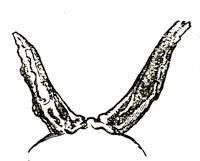
The accompanying figure is from the slough of the Vipera nasicornis of the coloured illustration. They were not reversed in desquamation, but came off with a portion of the fine spiny head scales. They were so dry and shrivelled at the time, that it is hard to
The sloughed horns of Vipera nasicornis (exact size).
conceive how they could possibly be reversed, the rest of the bristly headscales peeling off in pieces. Yet we cannot conclude from this that the horns are never reversedin sloughing; the individual in question having undergone long captivity in a close box during her journey from West Africa, and arriving at the Zoological Gardens in such a miserable plight that it was difficult to distinguish species or colouring for many days. In this condition she remained for five weeks, when one fine Sunday afternoon she presented the Society with forty-six viperlings.
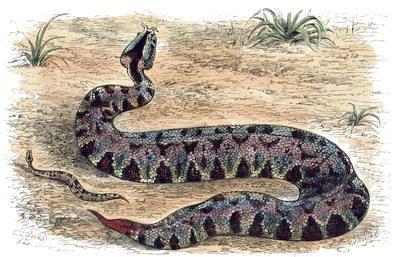
VIPERA NASICORNIS AND YOUNG ONE. AFRICA.
Mother over five feet long, Viperling 9 inches.
Soon after this event she discarded her way-worn and bedraggled garment, and shone resplendent in gorgeous colouring, as presented to the reader in the coloured illustration.
Her portrait was not taken until some weeks afterwards, when the horns were therefore a little dry and shrivelled again. With the new
dress they presented a well-defined and perfect curve, tapering to a point, and without any break in their outline. By degrees they became curled in the manner here represented. Her colours were of a rich prismatic hue on the sides, where the brilliant tints are so blended that to paint them is impossible. Only on the back and in the darker markings can the pattern be fairly represented. Her children all resembled her in their rich tints, and were so handsome that one almost forgot their evil propensities.
Forty of them died within a week. I begged hard for one of the deceased. The keeper of course had no power in his hands. All were wanted for scientific experimentalists. Alas, I was no scientist, but only a woman! The following Sunday, when I was at the Gardens, the forty-first baby viper had just died. The Superintendent ‘happened along,’ and was greeted with another appeal from me. He would ‘consider of it’ and let me know ‘to-morrow.’ ‘Oh, why not now?’ pleaded the reader’s devoted servant. ‘You can’t want forty-one little dead vipers!’
Suddenly to the rescue appeared on the scene no less a personage than Dr. Günther, and to him I urged my request. ‘Well,’ said he in response to my eagerness, ‘one of Our Council is here, and’—Yes, the F.Z.S. referred to had, with the Superintendent, just passed the iron barrier to view the interesting little survivors, and Dr. Günther followed, while I discreetly remained outside. My suspense was not of long duration, for soon reappeared the amiable Superintendent daintily carrying a little paper bag which might have contained bon-bons. ‘Fortunately,’ said he, ‘two of Our Council happen to be here, and so,’ etc., and I became the happy possessor of the scarcely cold viperling, here faithfully represented by the side of its mother. Exultantly I carried it off to a sequestered spot,— thinking chiefly of you, dear readers,—and examined its ‘horns,’ which wore the appearance of an ornamental top-knot rather than horns. They were like a bow, or two little ears, or half-unfolded leaves. Its colouring was gorgeous, but the pattern is too fine and complicated to represent on so small a scale. The black triangular mark on the head of both mother and child was like velvet in its density. Nor was this appearance lessened under the lens; for quickly
I ran off with my treasure, and spent a delightful ‘evening at home’ in studying its ‘points,’ not even excepting those of tongue and fangs. The former is represented on p. 120, and the latter on p. 360. The other results of my investigations come under their separate heads in this book.
Another of the horned serpents, Vipera cornuta, has a cluster of leaf-like scales in three distinct pairs decorating its nose. These in the individual at the Zoological Gardens were particularly ear-like, and there was a remarkable peculiarity about them which was not found in either of the other horned specimens when dead. It was, that when one horn was moved divergently with the finger, its fellow moved withoutbeing touched to correspond, and when let go both sprang back to their original position. I at first was merely feeling and examining them when this singularly sympathetic movement arrested my attention. Then I tried it with each of the six scales or ‘horns’ several times, and always with the same result. Whichever one of them was held back, the opposite one diverged at a corresponding angle.
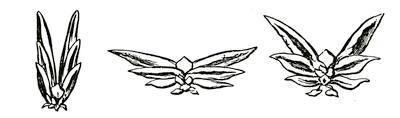
Their natural position is nearly erect, and when one horn—say the longest to the right in Fig. 1—was pressed or pulled outwards, we might suppose that in a dead specimen it would drag its fellow that way also, should any movement at all take place; instead of which, it flew off in the opposite direction, like two negative or two positive poles repelling each other. If I pressed the three to the right as much as in the centre figure, the other three receded similarly to the left.
1. Natural position.
2. Three held back to their utmost.
3. Three held back partly.
Each pair acted in concert in this remarkable manner, or each two pairs, or all three pairs.
The three sketches are given merely in illustration of a phenomenon which I cannot attempt to explain or even to comprehend. They were drawn from memory, and are not therefore offered as exact representations, though near enough to serve our purpose. The movement seems to argue some peculiar muscular or nervous connection between each pair. The serpent had not been long dead; and as no others of this species have since been at the Gardens, I cannot tell whether the same sympathetic movement would be seen in the living viper. I have attentively watched the horns of the other vipers, but never detected the slightest voluntary action in them. Nor do the horns of V . nasicornis respond to the touch in the same way. A third of the horned vipers is the Cerastesof classic times. Illustrators of books from descriptions only have presented us with this serpent adorned with horns like a young heifer. They are simply scaly appendages like the rest, but when perfect do certainly curve backwards and upwards in a rather bovine fashion. It happened that a Cerasteswas brought to the Gardens just after the six-horned viper had died, affording me a happy opportunity of examining it. It was of this viper that Pliny wrote: ‘It moves its little horns, often 4 in number, to attract birds, the rest of its body lying concealed.’ It is the habit of all those inhabiting sandy deserts thus to hide themselves, probably to escape the scorching, drying sunshine, and with perhaps the nose and upper part of the head exposed for breathing. I have carefully watched several of the horned vipers for a long while together, but have never detected the slightest volitional movement in their horns. A bird might come and peck at them, nevertheless. Another belonging to South Africa (Lophophrys) has a bunch of irregular and much shorter horns standing erect and apparently unpaired. Incipient horny scales often accompany the regular pairs, making it difficult to decide exactly which was Pliny’s of the ‘four horns,’ and which is the Hexacornisof Shaw. Varieties exist and add to the perplexity; probably also hybrids occur among these as among non-viperine snakes.
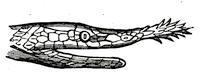
A curious variety of the nasal appendages appears in the Langaha with the crêtedecoq; only the crest is on the snout instead of on the head.
These spurs are merely modifications of the epidermis like the rest; but are, no doubt, endowed with peculiar sensitiveness, so that possibly they act as a sort of herald in the dark, like a cat’s whiskers.
There are the pointed-nosed Dryophidians also, with scaly protuberances, and others with variously-elongated snouts terminating in long, scaly, horn-like appendages, all, no doubt, more or less sensitive, to enable the owners to feel their way, or ascertain the nature of their surroundings, especially if they are of nocturnal habits.
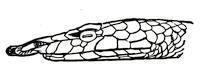
In some of the tree snakes, notably Passerita, there is no appendage, but the long snout is itself endowed with mobility. This is a nocturnal snake; a harmless and exceedingly slender, graceful creature.
But of these curious developments or prolongations, one of the Indian fresh-water snakes presents a remarkable example, almost allying it to some of the fishes with long tentacular appendages. Herpeton tentaculum is its name, its pair of tentacles being scaly and flexible, and in appearance somewhat like the African viper’s horns, sticking out horizontally from its snout. They are employed under water as organs of touch, and probably to discern food.
These are some of the most striking head-appendages; though in the way of pug-nosed ophidians and curious profiles we might give a whole page of illustrations.
In the acrobatic chapter, mention was made of a pair of rudimentary hind limbs in some of the boas. Externally the derm is condensed into ‘claws’ or ‘hooks.’ In form they are merely long, simple appendages, which in the largest boas are about as big as a
Profile of Langaha.
Profile of Passerita.
finger. Claws and hooks they are in the matter of use, being a pair, and they no doubt assist the climbing snakes in grasping.
As a condensed form of the tegument, they are included in this chapter; but as they are truly vestiges of limbs, I will digress a moment to add a word.
Says Darwin on rudimentary and atrophied limbs: ‘The disuse of parts leads to their reduced size: and the result is inherited.’ Some tame little lizards in my possession—our native species—when crawling about their cages scratching the sand or pushing their way among the moss and rubbish, frequently made use of their fore legs only, allowing the hind legs to drag after them, not because the latter were in any way injured, but simply because the lizards could do well enough without them. They were folded back or permitted to lie passively prone against the tail, while the arms and exquisite little hands were sufficient for the work required. They reminded one of Darwin’s words, and though my style of talking to my pets was such as to suit lizard comprehension solely, I did sometimes warn them in plain English. ‘If you don’t give your legs sufficient exercise, they will dwindle away by and by, and your descendants will have no hind legs at all!’
After thus moralizing to the unheeding lacertines, it was with secret gratification that one heard Professor Huxley, in his Lecture on ‘Snakes’ at the London Institution, Dec. 1, 1879, say—as nearly as I can remember—‘In evolution or a gradual change, the lizard found it profitable to lose its legs and become a snake; all modifications are an improvement to the creature, putting it in a better condition.’ In this ‘better condition,’ therefore, does the slow-worm find itself, when it glides noiselessly, and almost without stirring a blade of grass, into its burrow. In other lizards one may sometimes observe that the hind legs are most used in scratching and pushing the earth away. Thus, in the constricting snakes—these descendants of some pre-ophidian lizards—the unused limbs have become obsolete; and the spine, gaining strength with increased action, has at length become to the constrictors their hands, feet, arms, and legs, and endowed with those wondrous capabilities which were described in chap. xii.
To return to the integument. As one of its developments, the hood of the cobra may be included in this chapter, the skin here exhibiting its extensile or expansive construction. It is the longer ribs, about twenty pairs nearest the head (see p. 33), which really do form the hood. These anterior ribs, gradually increasing in length and decreasing again, are not connected with the ventral scales in the same way as those on which the snake progresses, but can be elevated or expanded in the manner familiar to the reader; they then support the extended skin exactly in the way that the ribs of a lined parasol support the fabric; only while the ribs of the parasol spring from a common centre, the ribs of the cobra are attached to its vertebræ, requiring no other agency than the will of the owner. The action of the ribs as expressive of emotion, in several species of snakes, was mentioned page 150. In the ‘hooded’ snakes (naja), it is seen in an extreme degree. Facing you, the angry cobra displays these umbra-like expanded ribs, while the form of the ‘neck’ or vertebral column in the centre is prominently perceptible. When at rest, they all lie flat one over the other, like the ribs of a closed parasol.
In the way of external peculiarities the ‘gular fissure’ may be mentioned. It is merely a slight groove or crease extending from the chin longitudinally under the throat for a few inches or more, according to the size of the snake; a sort of wrinkle (fosse) to admit of expansion during the swallowing of prey.
Externally snakes have no indication of ears; therefore, in the way of integument, there is nothing to describe in their organ of hearing. But the eye covering is a beautiful and wonderful arrangement.
Snakes have no eyelids, and can therefore never close their eyes, a fact which has given rise to a vulgar belief that they never sleep. Their eyes are, however, well developed, particularly in those snakes which live above ground, and are covered with a transparent layer of the epidermis, forming a capsule which is moulted with the cuticle. Physiologists tell us that it is moistened with the lachrymal fluid. Bright and glistening is the serpent’s eye, except previous to desquamation, when, from the new skin forming beneath, it becomes
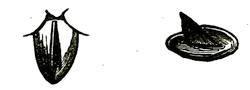
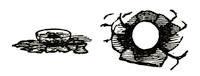
opaque and dull, and the snake is blind for a few days more or less, according to its health at the time. Rymer Jones considers the transparent membrane cast with the slough a real eyelid in a framework of regular scales; Huxley (in the lecture already alluded to) said snakes’ eyelids are as if our two eyelids were joined. In form and appearance this moulted cuticle is singularly clear and shapely: on the outer side, like a miniature watchglass; but within it is a perfect cup, standing up and out from the surrounding scales like a cup in a saucer, the rounded base of which is the transparent skin, as here seen.
For the process of sloughing or casting the skin, the term desquamation —literally, an unscaling—is often used; but this word seems rather to imply an unhealthy action, as if the cuticle peels off in pieces, than the normal operation, which is to shed it entire.
Illustration of eye covering.
It is a matter of surprise—if we are to believe what we read—that few naturalists seem to have witnessed this process, so as to be able to describe it from their own observations; but this must be due more to lack of interest than of opportunity, since the occurrence is very frequent. Those in the vicinity of Zoological Gardens have no excuse for not observing it; yet so lately as Oct. 1879, we find a writer in Nature, vol. xx. p. 530, attempting to describe the ‘skin-shedding,’ with the admission that he has never witnessed the process, nor, he believes, ‘has any observer’! He thinks snakes shed the skin ‘as if you turned a narrow hem, or a glove-finger by a knotted thread fastened at the tip,’ and which of course would draw the tip insidethe finger. The glove tip is to represent the tail of the snake, which, as he supposes, adhering at thetip, is drawn along inwards as the snake proceeds to crawl out of its own mouth, or its cuticle’s mouth—which has already become loosened round the lips. This, in the mind of that writer, satisfactorily accounts for the skin being usually found reversed! Can he have never seen a silkworm change its skin; or found the slough of a common caterpillar adhering to its tail; or observed the appearance of its mouth previous to the moulting?
True, a slow-worm sometimes leaves its slough in a crumpled-up condition, exactly like the silk-worm’s. This I have seen. On the other hand, the same little reptile, on another occasion, crawled out of its coat, leaving it perfect and unreversed through its entire length. Both sloughs have been preserved. As a more general rule the slough is reversed; but in the process it folds back and over the body, outside of it, in the manner of a stocking drawn off from knee-wards, and turning back till entirely reversed it leaves the foot. This common and apt illustration is easily understood if we suppose the top of the stocking to be the mouth of the slough, and the toe its tail. But as the toes might sometimes slip out of a stocking when nearly off, so does the tail of a snake sometimes slip out; this portion therefore is often found unreversed. More than a hundred years ago the sloughing of snakes was understood and described in the Phil.Trans. for 1747, vol. xl.; as also of lizards ‘slipping off their skins as vipers do.’ Some young vipers changed at six weeks old, and again in two months after that. ‘They always began at the mouth,’ said the writer. The process has been witnessed and described by many since that, though more by foreign than by English naturalists.
Some of the older writers have told us that ‘a snake frequents the spot where it has cast its skin,’ or, in other words, that it selects that locality for its nest—a fact as curiously stated as if you related of a person that he chose for his home the house in which he performed his toilet. Snakes have a strong affection for locality; and where their nest is, there, or near it, their garments are naturally renewed.
Another mooted question has been the precise period of sloughing; formerly the accepted opinion was that once a year, viz. in the spring, was the usual habit. This was probably from so many coils of skins being found at this season. That they do change in the spring may be established as an almost invariable rule; but not then only. No precise periods can be given with certainty, because it depends on the individual, its health and surroundings. The ophidian is a fastidious creature, and when his garment becomes soiled or uncomfortable he discards it. Thus after hibernation, when for some months numbers of snakes have been coiled in masses in a cave or under stones and rubbish, and they emerge into daylight, aroused by
the sun’s revivifying rays, what more natural than to cast off the old winter garb for a more comfortable suit?
Almost invariably, soon after a long journey, and on being established in a new home, a snake re-attires. We have seen what their travelling cages are! Closely nailed up, and often in air-tight boxes in which the poor things are tumbled over and over with as little mercy as ceremony during removal from one conveyance to another, they arrive—as in the case of the African viper (coloured illustration)—in such a pitiable plight that it is next to impossible to identify them. Another almost invariable rule is sloughing soon after birth—that is, in from a week to a fortnight; also, during early and rapid growth, the young snake will change frequently. Most ophiologists fix upon two months as an average time, taking one snake with another; for while one may desquamate every few weeks, another may keep his coat unsoiled for six months.
Sir Joseph Fayrer made careful notes on this subject. He had one cobra which changed in rather less than a month—viz. first on Oct. 17th, next on Nov. 10th, and again on Dec. 7th. A Liophis at the London Gardens changed every few weeks, and a Ptyas—he of the lecture exhibition (p. 214)—changed almost once a month on an average.
A curiously beautiful object is the cast-off coat, and well worth an examination. You discern the exact form of the reptile’s head, mouth, and nostrils, the exquisitely transparent eye-covering, the various forms of the overlapping or imbricated folds or ‘scales,’ and how admirably the broad ventral plates are adapted for locomotion; particularly noteworthy too is the perfect reversion of this coat of some feet or some yards in length, turned inside out as you may turn a sleeve.
The first time I watched the process was with the celebrated Hamadryad soon after it was installed as a distinguished inmate at the Zoological Gardens. The interest attached to this Ophiophagusor snake-eater had caused me to observe it on all possible occasions; and as the whole front of its cage was clear glass at that time, the spectator could easily see all that occurred within.
Will the reader once more accompany me in imagination to the Gardens, and see how a snake performs its toilet? I have watched many since then, and have observed the same proceeding in them all, those in good health and able to assist themselves; in others it is a literal desquamation or peeling off of scales or fragments in a dry state. Encouraged by the very recent statement in a highly scientific journal, that no one is supposed ever to have witnessed the sloughing of snakes, I venture to again describe what I saw, having already done so in the DublinUniversityMagazinein Dec. 1875, and in AuntJudy’sMagazine(Sept. 1874), and elsewhere.
We stand before the cage of the interesting Hamadryad (Ophiophagus elaps). His name at once tells us that he is fond of trees as well as of snakes; but, alas! there is no tree in his cage, not even an old bough on which to exercise his climbing propensities. He is wonderfully restless to-day, crawling ceaselessly about as if in search of something. This, however, cannot be his object; for his head is not raised in observation, but is close to the shingle, as if too heavy to lift. He seems to be pushing it before him in a very strange manner, and is evidently suffering discomfort of some sort. All round his cage he goes, against the edge of the tank, still pushing and rubbing his head, now under his blanket, or against any projecting surface, under again, close to the floor, restlessly on and on in these untiring perambulations; what can be the cause? After a tedious while ‘Ophio’—as his admirers call him—varies his movements, but only to turn the chin upwards and push his head sideways over the shingle. Now the other side he pushes along: the action is like that of a cat rubbing her head against your chair. Now he turns his head completely over, so that the top of it may come in for its share of rubbing; and such for a considerable time are his persistent movements, while we watch him wonderingly, and at length point him out to the keeper inquiringly.
‘Going to change,’ said Holland. ‘That’s the way they always do.’
To you and me, dear reader, the sight is novel and interesting; so let us continue to watch, glad that nothing more serious is the matter with this rare and valuable snake than doffing an old coat.
And soon we see the skin separating at the lips, where, no doubt, it has caused irritation and induced that incessant rubbing. Now the entire upper lip is free, and the loose portion laps back as Ophio pursues his course. Next we see the skin of the under lip detaching itself; and that is also reversed, the two portions above and below the jaw increasing every moment and folding farther and farther back with the ceaseless friction until they look like a cape or hood round Ophio’s neck, from which his clean bright head emerges. Hitherto the process has been tedious, but now the ribs are reached, and they take part in the work and facilitate matters greatly. The snake has no longer to rub himself so vigorously, but simply to keep moving; and at every step, so to speak—that is, with every pair of ribs in succession beginning at the neck—the large ventral scale belonging to that pair is shoved off, carrying with it the complete circle of scales. With an almost imperceptible nudge each pair of ribs eases off a portion, which continually lengthening as it is vacated, and reversed of course, folds back more and more, till Ophio looks as if he were crawling out of a silken tube. As he thus proceeds, now very rapidly, he emerges bright and beautiful—six inches, a foot, two feet; and all the while each pair of ribs successively performs its part with that nudging sort of action, like elbowing off a coat sleeve. If we had begun to count from the very first pair, and if he had not gone under his blanket during the process, we could have told the precise number of pairs of ribs which he has to assist his toilet. He had two yards and a half of old coat to walk out of, but this he achieves in far less time than it took him to get his head clear. In his native tree or jungle he would have found leaves and underbrush to aid the operation; and it would be a great kindness to snakes in captivity to provide them with wisps of straw, when sloughing, or some rough rubbish in their cages. Soft blankets and smooth wood-work do not offer sufficient resistance for them.
The constricting snakes are less at a loss. From their pliancy of motion, and their habits of coiling—from the fact of their ‘whole body being a hand,’ as we have already seen, they can assist themselves by their own coils passing through them, and so helping to drag off the slough.
Those who have kept snakes tell us that the tame ones will even leave the slough in the hand, if you hold them during the process, and permit them to pass gently through the closed fingers. Owen, in his AnatomyoftheVertebrates, mentions as a not unfrequent action, that when the head is free from the slough the snake brings forward the tail, and coils it transversely round the head, then pushes itself through the coil, threading its body through this caudal ring.
But we have left our captive with still about a foot and a half of garment to get rid of and this is not much less difficult to accomplish than the head-gear. He has arrived at the last pair of ribs, and now, without such agency to free the tail cuticle, he more than ever needs some opposing obstacle. He has only his blanket, however, to pass under; and at last, by dragging himself along, the process is completed, the extreme few inches sliding off unreversed.
On several subsequent occasions the Hamadryad has left the entire tail, often nearly all of it, unreversed, as do many other snakes. Sometimes by a succession of jerks they manage to get rid of this portion; sometimes a comrade happens to pass over the slough—a great assistance, as affording resistance. I observed this particularly in a small constrictor, one of the three that entrapped two or three sparrows in as many coils at the same moment. In this case the whole process occupied less than ten minutes. After rubbing its head against the gravel, and turning it completely over to free itself from the upper shields, its ribs took chief part as usual, and I noted particularly that each pair moved in concert, and not alternately. This little snake went round close under the slanting edge of his bath-pan, which afforded him some assistance, and by the time he reappeared in front the whole slough was discarded, excepting a few inches of tail. These few inches caused some trouble, until his friend the python happened to pass over it, when with one final jerk the slough was free and entire from lip to tip. It was the quickest and most complete sloughing I have ever watched.
When all was over, the large, beautiful black eyes of this fourstriped or ‘four-rayed’ snake were particularly brilliant, as the little constrictor looked about and watched observantly, rejoicing in his
newly-found faculty, after the blindness of the preceding days. Often the snakes are shy, and change at night; the tamer ones, however, undress when it suits them, affording frequent opportunities for observation.
The slough when first discarded is moist and flabby; but it soon dries, and then in substance is as much like what is called ‘goldbeater’s skin’ as anything else, though a stronger texture is observable in the head-shields and the ventral scales.
The size of the scales does not appear to bear any very regular correspondence with the size of their owner; for you will notice that some snakes only three feet in length, have larger scales than others three yards in length. Some of the immense pythons have smaller scales than a rattlesnake; and again, snakes of similar dimensions have scales different both in size and form. As great a variety is seen in the form and arrangement of scales as of shields.
Snakes are to a certain extent invalids previous to the shedding of their skin, temporarily blind, courting retirement, and declining food; but they recover triumphantly the moment the slough is discarded. They then appear to rejoice in a new existence, their functions are in fullest activity, their appetite keen. At this time the poisonous kinds are most to be dreaded, probably from the venom having accumulated during the quiescent condition.
At this time, too, their colours show to the greatest advantage, their eyes are brightest, and their personal comfort no doubt is enhanced in every way.
Before taking leave of the integument, a few words about the markings or patterns and colouring of serpents may not come amiss. Mr. Ruskin, in his celebrated lecture on Snakes, exhibited to his delighted audience a fine anaconda skin, and drew attention to the ‘disorderly spots, without system,’ with which this snake is marked. Taches à tortue, as it was at first described; and by Dumeril as marked ‘avecdegrandestachesseméessansordre.’ Notwithstanding the irregularity the skin is handsome. The oval spots of various sizes and at unequal distances have still a character of their own, as much as the spots of the leopard or the stripes of the zebra, no two of
which are placed with mathematical precision. Mr. Ruskin had but few kind words to bestow on ophidian reptiles, but the disorderly patterns of their coats he greatly disapproved. Moreover, the great artist was inclined to pronounce a sweeping verdict on the conspicuous ‘ugliness of the whole poisonousfamilies’ without exception.
Now unfortunately we have had occasion to lament the good looks of many venomous kinds which are easily mistaken for harmless snakes. Some of the American elapidæ are amongst the most beautiful, with their black, white, and crimson rings. The African viper and her young one baffle the artist’s palette in their prismatic hues, as do several other of the horned snakes. Indeed, for rich colourings the venomous kinds rather carry the day. The form, it is true, is often clumsy and ungraceful in the vipers, but as an exception we have ‘vipera elegans,’ and others of less ugly and slighter forms.
Since the subject was thus presented to us, I have, however, observed the markings more closely; and it really is curious as well as interesting to note how very nearly the various patterns approach to a perfectly geometrical design, yet failing in the same manner that a bad workman would fail in imitating the pattern given him to copy.
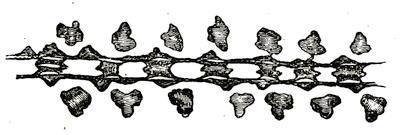
Plan of design.
To Dr. Stradling I am indebted for a very handsome boa skin from Brazil. Spread upon the carpet it is like a piece of oilcloth, and at the first glance I exclaimed, ‘Even Mr. Ruskin could not disapprove of this.’ But on closer inspection one was obliged to admit ‘disorder’ throughout. The skin is about ten feet long, and the whole way down the centre of the back runs a pattern which an accomplished artificer would thus represent. There is evident intention of two straight lines with points at equal distances, a very pretty centre of rich brown,
picked out with darker shades and spots of white. Throughout the entire ten feet of skin most of the points and intermediate centres had a splash or spot of white, and most of the points were opposite, but no two feet consecutively could I find with better finished markings than this.
Exact pattern with the lateral spots.
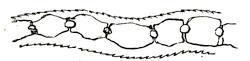
The outer spots also were evidently of triangular intentions, and for the most part occupying the spaces midway between the points. These, of lighter tints, also run the whole length of the snake, the pattern of course diminishing with the size tailwards, but varying in no other way. The question is not whether the strictly geometrical or the less perfect design would be the handsomer, or we might give the preference to the pattern as we find it; but looking closely at any elaborately-marked snake, it certainly is curious to perceive that in every case there is this same attempt at something too difficult to accomplish, as when a novice in fancy-work does her stitches wrong. The same thing is seen in the snakes of the frontispiece, and the same is seen again even in this simple pattern, a chain running down the back of little Echis carinata. The spaces are unequal, the black cross bands imperfect, and the centre spots some round, some oval, some almost absent.
May we conclude that this incompleteness is a sign that the design is not fixed by long inheritance? But if it were so, and presented to us
Pattern of a snake.
with geometrical precision, it is doubtful whether we could admire it equally!