

The Digital Difference
Employers navigating their way through latest health apps
At the heart of expecting the unexpected
Get the peace of mind and support it takes to self-fund your healthcare.
Self-insuring your healthcare benefits can open up new possibilities for your business — affording greater flexibility in how you manage your healthcare spend. Trust the expert team at QBE to tailor a solution that meets your unique needs.
Rated “AA-” by S&P, we offer a range of products for protecting your assets, your employees and their dependents:
• Medical Stop Loss
• Captive Medical Stop Loss
• Organ Transplant
We’ll find the right answers together so no matter what happens, your business is prepared.


Written By Bruce Shutan
Written
Laura Carabello
Written By Scott Bennett and Alex Houle Written

(ISSN 10913815) is
The Digital Difference
Employers navigating their way through latest health apps
AsAWritten By Bruce Shutan
the digital health space expands, new apps are flooding the self-insured marketplace to help employees better understand and use their health benefits. The number of point solutions can be overwhelming, with Solera Health reporting more than 40% of employers now managing eight or more digital health vendors at $2.5 million or more a year. Some of the latest benefits navigation companies to sell their wares include HealthJoy, Healthee and Transcarent.
There are even hyper-focused tools being offered, with some public-sector employers adopting condition-specific digital health benefits. One such example is the Self-Insured Schools of California, a large public employee benefits pool that recently expanded its partnership with an autoimmune care platform called WellTheory.

These tools are so prevalent that they’re also being used independent of one’s employer-sponsored benefits package, which can be empowering but also a cause for concern. More than 230 million weekly users of ChatGPT, for instance, are asking health and wellness questions, according to OpenAI’s deidentified analysis of user conversations. Search engines are another source for their lines of inquiry. In addition, a Castlight Health survey noted that most employees are actually building their own ecosystem of digital tools, oftentimes at their own expense.
REMOVING FRICTION
Just keeping up with all these advances in technology can be a dizzying proposition, but the promise of their deployment is significant. Digital navigation becomes materially more effective when it is paired with consumer incentives, not just guidance, explains Pamela Klein, SVP and General Manager, Member Engagement and Transparency for Zelis.
“That matters because employers are no longer looking only for a better member experience,” she says. “They need solutions that can actually change behavior, steer people to high-value care and produce measurable savings.”
Forward-thinking, self-insured employers are using these platforms to solve a problem that plan design alone has never been able to fix: the gap between having good benefits and actually being able to use them. So says Caroline Jessen, Chief People Officer at Collective Health, noting that the role of these platforms is evolving.
“Employers started using them primarily as a communication tool or smarter benefits guide,” she explains. “Increasingly, they’re treating them as core infrastructure, expecting them to connect across the plan ecosystem, personalize guidance based on member context and influence care decisions rather than just inform them. That shift from benefits communication to benefits integration is where the real value starts to emerge.”

For Jim O’Gorman, Chief People Officer for Included Health, the focus is on looking for ways to remove friction and prevent high-cost claims. He says most medical plans are unintentionally difficult to use, and when employees or their dependents encounter a pain point, they delay care. “In the selfinsured world, delayed care is the fastest way to drive up long-term costs,” he adds.

Therefore, the mission at hand is to seek out platforms that act as a seamless entry point to care that is high-quality, timely and affordable. “If it isn’t all three, it’s a problem,” he suggests. That’s why it’s important to find partners that ensure health plan members are connected with the right specialist or primary care provider the first time. The goal isn’t to hand employees a map of their benefits; he says it’s to provide a clear, efficient path to a healthy outcome.
‘STRANGLED BY COMPLEXITY’
A siloed approach to using scores of digital tools to navigate one’s way through today’s healthcare maze serves as an enormous obstacle. “The truth is that effectiveness is being strangled by complexity,” O’Gorman laments. “We’ve reached a breaking point with point solutions. We’re asking employees to visit one app for mental health, another for primary care and a third for MSK – and none of them talk to each other. It isn’t whole-person care
Jim O'Gorman
Pamela Klein
Caroline Jessen
when the primary care doctor has no idea what the therapist is doing; it’s the opposite.”
“It has become so confusing,” he continues, “that employees are actually turning to open, unsecure AI platforms just to try and navigate their own healthcare. That should be a big concern for any benefits leader.
To bend the cost curve and improve health, O’Gorman recommends moving away from this collection of disconnected vendors and toward a single, integrated entry point. Employees need a trusted and objective platform that stores the patient’s history and plan details in one place.
“That is the only way to guide someone to the right care –virtual or in-person – at the right time,” he says. The thinking is that only when the integration problem is solved will better clinical outcomes and cost controls follow.
It’s reflected in his company’s data, which has seen a 4% yearone reduction in healthcare trend and an average of two more “healthy days” per month for Included Health members.
“If a platform isn’t simplifying the system, it isn’t effective,” he explains.
THE POWER OF INTEGRATION
The platforms delivering the most meaningful results are the ones integrated with plan administration, where the navigation experience and third-party administration (TPA) function are part of the same system, according to Jessen. When that’s the case, she says employers can move from reactive support to proactive guidance.
A member trying to understand what’s covered before scheduling a procedure gets a clear answer through the digital experience. “And if their situation is more complex,” she explains, “a member advocate or care navigator can step in and proactively reach out based on a priorauthorization request we received or that initial consultation visit to help coordinate the right next step.”
With all of the TPA data inputs in one place, Jessen says it’s possible to act before care happens. At Collective Health, that integrated approach delivers an average of $8,400 in annual savings per engaged care navigation member – reflecting what’s possible when navigation and administration aren’t two separate systems.
“That’s when navigation stops being a nice-to-have and starts driving real outcomes for the member and the plan,” she says. “And it’s what I think the industry should be holding these platforms accountable to.”

While digital health platforms can be highly effective, their impact depends on how far they go beyond information and how well they are integrated into the member decision journey, according to Klein.
At a baseline level, they can reduce confusion. “Healthcare benefits are notoriously difficult for employees to navigate, especially when they are under stress, facing a new diagnosis or trying to make a quick scheduling decision,” she notes.
Her sense is that a strong digital navigation experience gives clarity to the next step: where members should go, what the service is likely to cost, what alternatives exist and how they can get support. “That alone can improve the member experience because it replaces ambiguity with direction,” she adds.
UTILIZATION AND OUTCOMES
Where effectiveness becomes more variable is in changing utilization and cost outcomes. Many platforms do a good job surfacing information, but Klein says information by itself does not always result in action. Members are busy, while healthcare is emotional and overwhelming. The most effective models are the ones that combine navigation, transparency and incentives, she notes. “When you pair guidance with a financial reward, the member has both clarity and motivation,” she explains. “That combination is much more likely to redirect care to high-value settings.”


The Digital Difference
Self-insured employers are increasingly looking to these kinds of platforms as a way to simplify what has become an extremely fragmented benefits experience. In practice, employers are using these platforms in a few important ways, according to Klein. First, they are giving employees a digital front door for benefits questions and next steps. That may include plan education, provider search, guidance on where to go for care, appointment support and help understanding what services are covered.
They are also using them to reduce friction when making decisions, which is often where confusion and unnecessary cost enter the picture. If an employee needs an MRI, lab work, physical therapy or a specialist, she says the platform can help narrow choices and present more relevant options instead of leaving the person to figure it out alone.
Finally, employers are increasingly expecting these solutions to do more than inform. They want them to influence behavior in measurable ways. That’s where the role of incentives becomes crucial to success.
“It is no longer enough for a navigation platform to point someone to information,” she observes. “Employers want to know whether the platform can change utilization patterns, guide members toward high-value care and lower spend without making the experience feel punitive or confusing. In other words, they are moving from member engagement as a soft concept to behavior change as a hard business outcome.”

PASSAGE Safe

We deliver best-in-class solutions that cover your clients and support you with experts in data analytics, underwriting, claim reimbursements, dedicated account management and CompanionCARE SM
With CompanionCARE, you have access to experts in large case management and emerging therapies.
Our stop loss contracts are backed with the strength reflected in our A+ AM Best company rating.
In addition to specific and aggregate stop loss insurance, Companion Life offers an array of innovative products:
or
A health plan member may appreciate being told that one site of care is more affordable than another, but the likelihood of action increases when there is a meaningful financial reward tied to making the highervalue choice.
That is the logic behind Zelis ’ SmartShopper, which combines navigation and transparency with a direct member incentive, so the guidance is not passive. She says it’s designed to motivate action. A third-party actuarial analysis shows that it saved an average of $552 per use in 2024. That research drew on medical claims from more than 92,000 participants across 32 payer populations using a HIPAA-compliant claims database representing more than 19 million commercially insured lives.
“When I look at how employers are using platforms in this space, I would say they are trying to solve two problems at once: reduce the cognitive burden on employees and create a practical mechanism for navigating toward better-value decisions,” Klein says. “The best solutions are the ones that do both.”
Klein says SmartShopper’s broad average savings and significant savings in common, high-cost, shoppable categories are a good illustration of that. Zelis found savings of more than $1,200 for CT scans, over $600 for MRIs and $300 to $550 for lab visits at independent labs.
“That matters because employers are not just asking whether a platform is engaging,” she explains. “They are asking whether it changes where care happens and whether those changes hold up financially.”
In terms of member experience, Klein says health plan members do not experience navigation and affordability as separate things. If they can quickly identify a high-quality, lower-cost option, understand what they will pay and receive a reward for making that choice, then it will prove to be a better experience.
“It feels more transparent, supportive and aligned with how consumers make decisions in other parts of their lives,” she observes. “In that sense, streamlining access and improving experience are not side benefits. They are part of the mechanism that drives savings.”
FROM CLARITY TO CONFIDENCE
The effectiveness of these platforms ultimately depends on how they’re built and connected to the rest of the health plan. Jessen describes the centrality of transparency in benefits as the right lens for evaluating navigation platforms.
“Transparency isn’t just about disclosure; it’s about giving people the clarity they need to make confident decisions,” she says. “Employees need clear,
concise information to act on their benefits, and the platforms that deliver that well are the ones that have access to the full picture: what a member’s plan actually covers, what it costs and what’s happened in their care journey.”
Navigation tools that sit outside the claims stream can reduce confusion and improve the employee experience, “and that’s genuinely valuable,” she adds. But her sense is that their ability to consistently direct employees to cost-effective, high-quality care is limited when they can’t see that full picture.
One of the earliest lessons Jessen took from her experience in an HR service center, where her career began, is that while tools and systems are crucial, genuine connection and understanding of employees’ needs are irreplaceable.
“Employees face a maze of networks, deductibles, point solutions and prior-authorization requirements, often at moments when they’re already stressed,” she observes. “Digital navigation platforms are stepping into that gap, helping people understand what’s covered, where to go and what it’s going to cost before they make a care decision.”

Do you aspire to be a published author?
We would like to invite you to share your insight and submit an article to The Self-Insurer! SIIA’s official magazine is distributed in a digital and print format to reach 10,000 readers all over the world.
The Self-Insurer has been delivering information to top-level executives in the self-insurance industry since 1984.
Bruce Shutan is a Portland, Oregon-based freelance writer who has closely covered the employee benefits industry for nearly 40 years.
Articles or guideline inquires can be submitted to Editor at Editor@sipconline.net.
The Self-Insurer also has advertising opportunities available. Please contact Shane Byars at sbyars@ sipconline.net for advertising information.
Workers
Optimize Affordability, Ensure Regulatory Compliance
S Retirement Benefits Reset for Employers and

Social
science pundits often advise that the best time to start thinking about your retirement is before the boss does.
But when you’re the boss – a self-insured company leader or the plan sponsor – this topic merits attention and engagement with employees sooner than later. It is projected that 15 million workers will prepare to retire over the next five years.
Retirement significantly alters employee benefits by transitioning individuals from active employersponsored perks to personal income management, often involving the loss of health insurance, life insurance and paid leave. These challenges are compelling organizations to better prepare employees for retirement, and the urgency is greater than most employers realize – particularly with new regulatory requirements under the SECURE 2.0 Act.
Kari Niblack, President, Boon Chapman, attests, “Retirement is a benefits cliff, not just a financial transition. Employees who've relied on employer-sponsored health coverage, life insurance, and paid leave suddenly face a landscape they're often completely unprepared to navigate. As an ERISA attorney, I've seen firsthand how that gap creates real hardship.”
She maintains that organizations have both a practical and ethical responsibility to close that gap, adding, “That means proactive education well before retirement age, clear communication about coverage transitions, and benefits counseling that treats retirement planning as a continuum, not a finish line.”
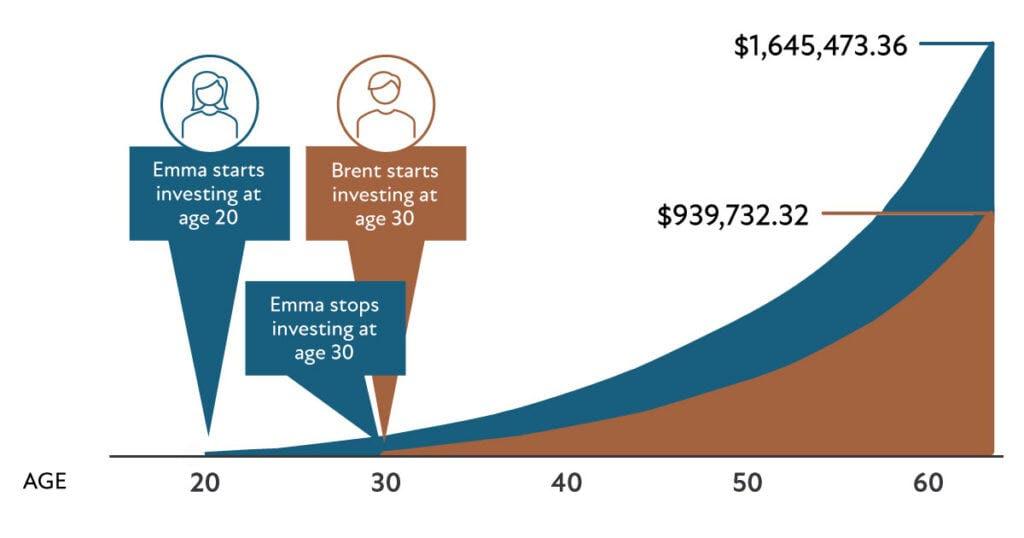
Habits of Successful Retirement Savers
Source: CreativePlanning.com
Retirement represents a major shift from employer-supported benefits to individual, financial responsibility, as Patrick Williams, Co-Founder, Fiduciary in a Box, shares, “Many employees underestimate longevity risk, healthcare costs and the loss of employer-sponsored protections such as life insurance and disability coverage.”
He suggests organizations that provide retirement readiness education, income planning tools and transition guidance help employees make better decisions and reduce workforce disruption caused by delayed retirement.
“Preparing employees also strengthens workforce planning and productivity,” he continues. “Employers that treat retirement readiness as part of total rewards help employees move from accumulation to sustainable income planning while maintaining financial stability and confidence during the transition into retirement.”
Kari Niblack
Speaking from decades of experience as an ERISA/Employee Benefits compliance and planning attorney, Jack M. Towarnicky, CEBS, Of Counsel, Koehler Fitzgerald, LLC, and Member, aequum LLC, shares, “Retirement preparation is not a top priority for the majority of today's workers. So, a more holistic response is more likely to succeed.”
Towarnicky insists that a holistic response would meet workers where they are, recognizing that many workers live paycheck to paycheck and understanding that current financial needs – such as everyday medical expenses, car repairs, food – are not necessarily more important, but are more urgent.
“In fact, for the majority of retirees, about one of every four dollars spent in retirement will be on health expenses,” he notes. “Recognize that for almost all American workers, medical costs will increase in the future, including in retirement. The best option for preparing for those expenses in retirement would include strategic allocations of savings between your 4301k/403b plan and a Health Savings Account (HSA).”
He says too many workers think Medicare coverage is provided without premiums for Part B and Part D, and without point-of-purchase cost sharing, such as deductibles, copayments or coinsurance.

Jack Towarnicky
A Strategic Advantage for Benefits Consultants and TPAs
Mayo Clinic Complex Care Program

Mayo Clinic’s Complex Care Program is a customizable center of excellence solution designed to integrate seamlessly with your existing offerings. Whether you’re advising self-funded employers or evaluating their COE networks, our program helps you deliver measurable value. We’ll work through your preferred pathways or build new ones together. Let’s make complex care simple, strategic, and impactful. All without added fees.
Learn more: mayoclinic.org/complex-care-program
55% of patients experience a change in diagnosis
82% see a change in treatment plan
Retirement Benefits Reset
“The best strategy for preparation for retirement is: HSA & 401k, Better Together,” he continues. “Beyond the 401k and HSA-capable coverage, incorporating automatic enrollment, escalation and investment features, a savvy plan sponsor will also introduce postemployment medical coverage for its retirees.”
He says the best alternative is to define "retiree" in a limited fashion, such as separating after reaching age 62 and completing 25 years of service, while limiting the coverage offer to a retiree – pay all, fully insured, Medicare Supplement or Medicare Advantage coverage (or both).
“This will position the coverage to take full advantage of HSA tax preferences in ways that will avoid impacting the corporate balance sheet,” he concludes.
Retirement is often framed as a financial milestone, but for employees it is a deeply personal transition that affects identity, routines, relationships, and health.

Dani Kimlinger, PhD, MHA, SPHR, SHRM-SCP, CEO, MINES and Associates, Inc., shares, “Many people enter retirement unprepared for the emotional and practical shifts that come with changes in income, healthcare access and daily structure. Organizations can make a meaningful difference by supporting employees earlier, offering clear guidance, trusted navigation and access to behavioral health, financial and Medicare resources that reduce stress and uncertainty.”
She says the most effective retiree benefit programs recognize the whole person, not just the plan, adding, “Protecting retirees’ personal and financial information is also essential, as trust and security are foundational to long-term wellbeing.”
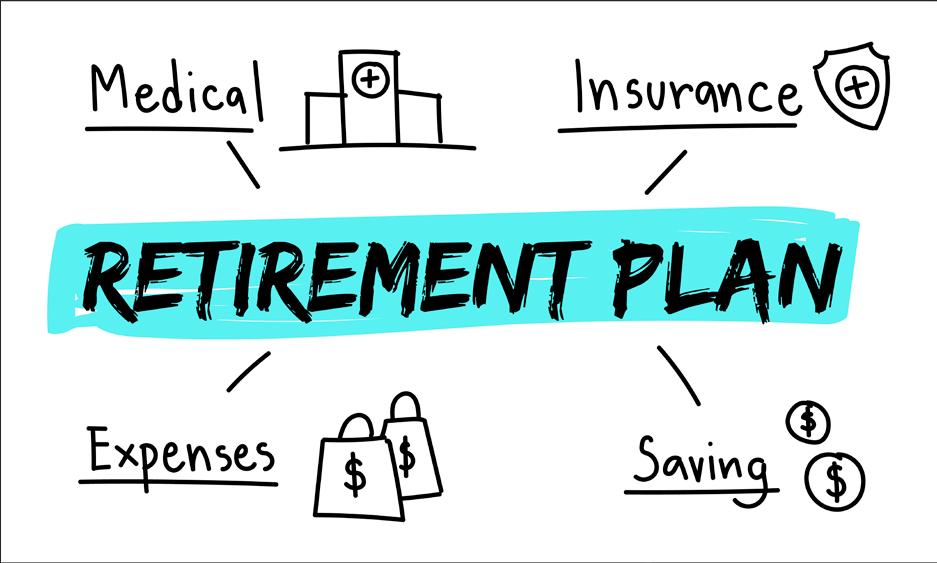
MULTIPLE FACTORS IMPACT RETIREMENT SPENDING
How Much $ is Needed to Retire
People often ask how much they will need to save for retirement. With so many factors and uncertainties, financial counselors will offer more generalized advice along with personalized suggestions.
Experts at Fidelity Investment answer these queries, responding that its savings factors are based on the assumption that a person saves 15% of their income annually beginning at age 25 (which includes any employer match), invests more than 50% on average of their savings in stocks over their lifetime, retires at age 67, and plans to maintain their preretirement lifestyle in retirement.
Based on those assumptions, they estimate that saving 10x (times) your preretirement income by age 67, together with other steps, should help ensure enough income to maintain your current lifestyle in retirement. To stay on track, they suggest these agebased milestones: Aim to save at least 1x your income by age 30, 3x by 40, 6x by 50, and 8x by 60.
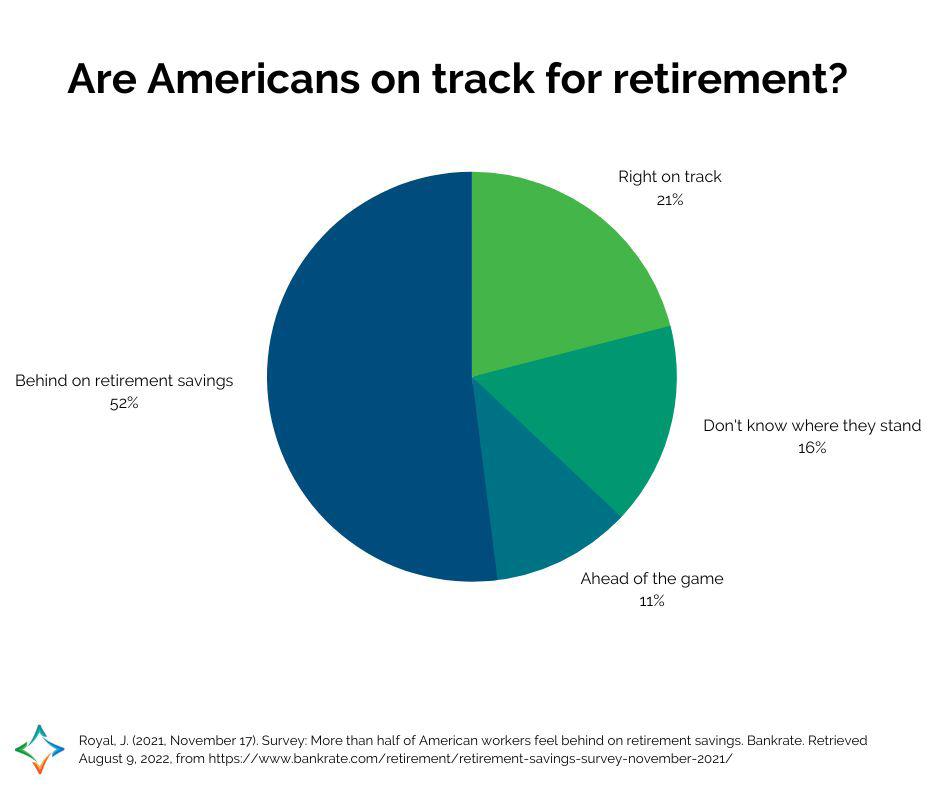
Financial planners have portfolios of recommendations for boosting retirement savings. J.P. Morgan Asset Management suggests making small changes consistently -- but saving just 1% more each year can significantly boost retirement savings over time. In its recently released 2026 Guide to Retirement, analysts attest that 56% of people haven't calculated how much they'll need in retirement — a step they warn that is critical to avoid setbacks. By factoring in age and household income, individuals can quickly see whether they're on track to meet their retirement goals or if they need to adjust their strategy.
Dani Kimlinger
Accelerating Progress



We study risk, research it, speak on it, share insights on it and pioneer new ways to manage it. With underwriters who have many years of experience as well as deep specialty and technical expertise, we’re proud to be known as experts in understanding risk. We continually search for fresh approaches, respond proactively to market changes, and bring new flexibility to our products. Our clients have been benefiting from our expertise for over 50 years. To be prepared for what tomorrow brings, contact us for all your medical stop loss and organ transplant insurance needs.
Tokio Marine HCC – A&H
HCC Life Insurance Company operating as Tokio Marine HCC – A&H Group
They also debunk Social Security myths, amid dire projections that the fund will be depleted around 2033–34. Advisers point out that roughly three-quarters of benefits will still be funded by ongoing payroll taxes through the end of the century and caution people about claiming their benefits early at 62 when they will only receive about 70% of what they would otherwise get at full retirement age, which is 67 for anyone born in 1960 or later.
Additionally, they cite another factor that can impact retirement readiness: lack of emergency savings. According to the report, nine in 10 employees experience significant spending spikes, defined as 25% more than their baseline spending over the previous 12 months. But one in three who experience these spending shocks is unable to fund them out of savings and instead turn to credit cards or 401(k) loans.
Employees can get overwhelmed by all of these different factors since two out of three workers say they should be saving more for retirement, but they're just not sure what to do, according to the report. When planning for retirement, they need their employers to provide targeted communications.
Rajiv Sood, general manager, Insurance & Risk, Evidium, Inc. provides this perspective, “When we think of retirement, we often think of Social Security and whether we might be able to take it, or if it is even going to be around at that time. We also wonder, of course, when we should take it and how much our payout will be. More sophisticated individuals also tend to calculate the payout’s ROI. All this, in turn, begs the question of longevity.”
He identifies key issues impacting longevity and retirement, including healthcare as well as what medical care one might need as we live longer and more productive lives, adding, “Conceivably, one may live ‘in retirement’ for a period of 30-ish years or more. So, naturally, the question of medical needs and individual medical trajectories should also be (or become) a vital part of the discussion and calculation. That is where a computational AI platform comes in.”
He points to the value of this approach that allows healthcare experts to understand where patients are today, how their conditions are changing, and which actions might matter -- in order to support, not replace, expert judgment.
“With the Evidium platform, every insight is traced to clinical evidence and real-world evidence,” explains Sood. “These insights can help drive improved individual health, more proactive health cost forecasting and more informed clinical choices. This can help lead to targeted interventions that better improve clinical and financial outcomes – which are critical to optimizing well-being during retirement years.”
On this backdrop, new research from Dayforce, a human capital management technology provider, documents that for the first time in three years, the total retirement savings rate for full-time workers decreased in 2025, to 8.9% from 9.2% the year before. Declines in savings rates, participation and employee contributions last year were greatest among workers who earn between $50,000 and $150,000 annually. The study encompasses the entire full-time U.S. workforce over the past four years, including workers who do and who do not participate in an employer-sponsored plan.
Rajiv Sood
AGE OF RETIREMENT
For individuals, retirement age has a significant impact on the amount of savings needed, and the longer retirement is postponed, the lower the savings factor. Delayed retirement allows for greater saving growth and fewer years of retirement.
However, for employers this is projected to create a dual workforce challenge, balancing the retention of experienced talent against increased operational costs, stalling career progression for younger staff and higher benefits expenses.
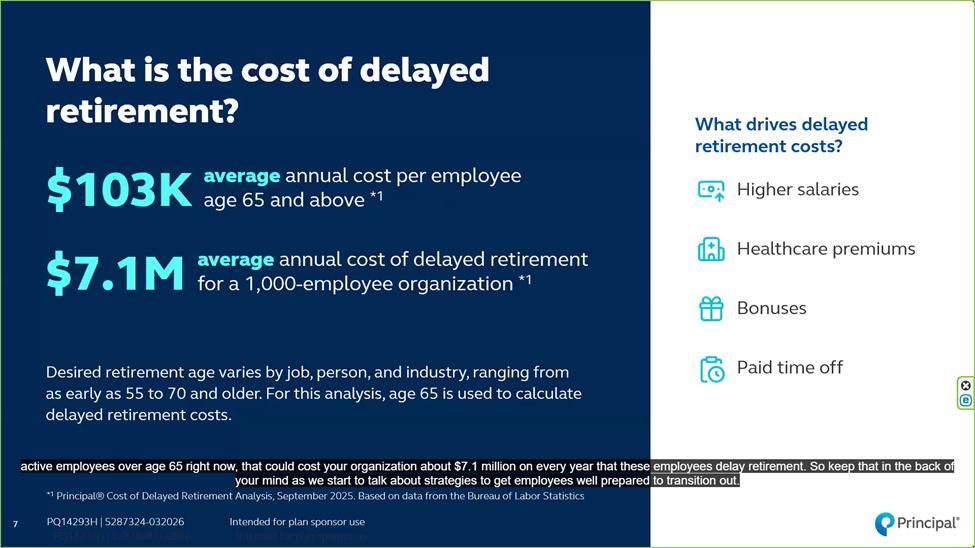
The Principal® says this shift affects both employees and employers in significant ways. For workers, extending employment beyond their desired retirement age can lead to decreased job satisfaction, physical and emotional strain and delayed pursuit of retirement dreams. For employers, there are real financial consequences.
A detailed Principal® analysis found it costs an average of $103,000 each year in added compensation and benefits when an employee works past age 65. For employers with a sizeable population over that age, the impact can reach millions annually.
It appears that a growing number of older Americans are hitting pause on their retirement plans as economic instability continues to upset their retirement timelines. According to the annual Protected Retirement Income and Planning (PRIP) Study, sponsored by CANNEX in partnership with The Alliance for Lifetime Income, 30% of workers ages 61 to 65 are now considering postponing retirement.
This demographic is known as "Peak 65," due to the unprecedented number reaching retirement age this year. Their top concerns include persistent inflation, market volatility and deepening uncertainty about the future of Social Security. The survey findings paint a picture of growing anxiety around retirement readiness and income security, particularly among Gen X and Baby Boomers, who increasingly fear outliving their savings.
In this environment, employers must adapt by offering phased, flexible roles and personalized, holistic financial planning. Key benefit shifts include increased pension actuarial adjustments, longer participation in defined contribution plans and a need for retirement-transition support.
Human Relationships > Corporate Processes

Welcome to long-term relationships built on trust, continuity, and results.
At Pinnacle, we put a face to a name and nurture long-term relationships you can depend on today, tomorrow, next week and next year. That’s why self-funded employers like you can rely on an account team with an average tenure of at least a decade. That’s 10+ years of providing proactive service that identifies challenges before they become problems. And that’s why your employees typically never have to wait more than 12 seconds before a friendly, human voice answers their call. To find out why we’ve earned a 98% client retention rate, talk to us today.
Are you ready for benefits planning time? Let’s talk. pinnacletpa.com/excellence
Retirement Benefits Reset
Many advisers recommend that employers pivot to support decumulation – the strategic spending of savings, offer employees part-time opportunities or remote work to phase in the transition to retirement and continued access to employer-sponsored health insurance (better than Medicare) and continued contributions to 401(k)/IRA accounts, increasing their overall nest egg.
RETIREMENT AGE AND LIFESTYLE
It was rare when somebody in America turned 100 years old. However, new data suggest that this will become the norm in the not-too-distant future. According to the World Economic Forum (WEF), today’s 20-yearolds can expect to live to 100 and 10-year-olds can expect to live to 103.
How long people will live takes on new meaning for both employers and employees. Although older Americans could work a few years longer, perhaps into their 70s, the reality is longer lifespans mean many more years in retirement, putting pressure on individuals
who will need to plan and save accordingly.
According to the World Health Organization (WHO), average healthy life expectancy in the U.S. is in the low-to-mid 60s. This means many people live several years with some health limitations. WHO simply puts it this way: if you retire at 65, you’re already past your peak physical years.
Here’s the reality of retired life from Yahoo Finance: It’s less magic and more mundane. Spending in retirement is rarely a smooth glide path. Instead, expenses could shift based on age, health and lifestyle changes. If you’re taking fewer flights, cruises and hikes in your 80s, you’re also spending far less money.
The bottom line: living longer increases financial fragility and many more Americans are simply not saving enough.
THE VALUE OF DEFINED CONTRIBUTION PLANS
Bureau of Labor Statistics data shows that nearly two-thirds of American workers had access to a defined contribution plan in 2024, the highest amount in at least a decade. New research finds that nearly half of all Americans who have retirement savings in a 401(k) or similar plan say they probably would not save for retirement otherwise, highlighting the key role Defined Contribution plans play in getting Americans to save.
This finding comes via the Investment Company Institute’s (ICI) 18th annual survey, “American Views on Defined Contribution Plan Saving, 2025,” which reported that 47% of defined contribution-owning individuals agreed with the statement “I probably wouldn’t save for retirement if I didn’t have a retirement plan at work.” Moreover, 77% are confident that DC plans can help people meet their financial goals and voice strong support for preserving the key features of DC plan retirement savings.

ICI found that agreement was higher among individuals with lower household incomes, including 58% of those making less than $50,000 and 55% of those making from $50,000 to $99,000. But individuals with higher household incomes were among those likely to agree (93%) with the statement, “My employersponsored retirement account helps me think about the long term, not just my current needs.”
In a concluding observation, ICI noted that the findings are generally consistent with prior years’ survey results showing that Americans “value the discipline and opportunity” that DC plans represent and want
Retirees increasingly depend on defined contribution accounts for income, but tend to underspend from those accounts, according to a report recently released by Morningstar. Researchers found that retirees can find it difficult to figure out how much money to withdraw each year to use as income and concluded that retirees tend to pick simple, hands-off strategies — withdrawing based upon required minimum distributions, expected expenses, dividend/interest income or advisor consultation — and to stick with



LIFE EXPECTANCY & RETIREMENT
As a nation, we are getting older and a higher percentage of the population will be entering retirement years.
Based on trends reported by the Census Bureau, the median age in the United States reached 39.1 by July 2024 and is projected to rise.
While official 2026 data is not yet finalized, estimates suggest the median age is on track to increase to approximately 40 years as the population continues to age.
The number of Americans age 65 and older is expected to grow to 74 million by 2030, up from 49.2 million in 2016, according to an analysis of U.S. Census data by the Urban Institute.
The baby boomer generation began turning 65 in 2011 and 10,000 of them are turning 65 every day between now and 2030.
Average life expectancy is also increasing. 2026 U.S. reports show:
Average Age: 79.0 years
Female Life Expectancy: Increased to just over 81 years (approx. 81.4)
Male Life Expectancy: Increased to 76.5 years
Source: US Census Bureau
COST OF RETIREMENT HEALTHCARE
Healthcare costs are rapidly rising for all Americans, with average annual out-of-pocket costs increasing from $763 to $1,425 over the past two decades, reports WalletHub, which recently analyzed the prices of five key healthcare components in each state, totaled these costs and compared them to the median household income. Although everyone is paying more, where a person lives can have an impact on how much they pay. Even in states with lower-than-average healthcare prices, residents’ incomes may not be enough to keep up with the cost.
Wherever you live in the US, healthcare affordability remains a significant challenge, with a third of respondents to a recent Gallup poll saying they had to cut back on daily living expenses to afford care. The most commonly cited trade-offs were prolonging a prescription or borrowing money to cover medical costs. The newest Gallup poll affirms that Americans are more concerned about the availability and cost of healthcare than any other domestic issue, with it reclaiming the top spot for the first time since 2020.
So, it’s not surprising that healthcare expenses consistently rank among the top retirement concerns for Americans across all generations, as described in the 2026 Retirement Healthcare Costs Data Report, published by HealthView.
The impact of longevity is a key factor. People without chronic health issues – even those in excellent health – aren’t guaranteed low expenses. In fact, the healthier someone is, the more they may ultimately spend lifetime on healthcare in retirement. While their annual costs may be lower, total cumulative spending can be greater because they tend to live longer, resulting in more years paying for care and greater cost inflation.

Group health solutions from a carrier you can trust
Why work with Nationwide?
• More than 20 years of trusted stop-loss solutions
• Comprehensive and innovative Self-Funded Program and stand-alone stop-loss solutions
• Flexible plan designs to meet employer and agent needs
• Access to national networks or reference-based pricing
• Supporting employer groups from 2 to 5,000+ members
Nationwide® is a strong and stable FORTUNE 100 company with resources to help employers manage their self-insured plans. Our specialists are ready to help your customers stay ahead of rising health care costs. Visit nationwide.com/grouphealth to learn more.
Retirement Benefits Reset
Analysts say this worry is compounded by ongoing medical cost inflation, which continues to rise at approximately twice the rate of the Consumer Price Index (CPI). A key challenge in addressing this issue is developing personalized projections for retirement healthcare expenses based upon the many factors that influence costs. They advise that generic averages are insufficient for crafting a plan to accurately project (and ultimately fund) future healthcare needs.
According to Fidelity Investments' annual retiree healthcare cost estimate, the projected cost of healthcare expenses in retirement continues to grow, yet a significant portion of Americans are unaware of the need to save for health expenses. They advise that a 65-year-old retiring today can expect to spend $172,500 on healthcare and medical expenses during retirement. This represents a more than 4% increase yearover-year and continues an upward trajectory of projected health-related expenses since 2002, when the estimate was $80,000.
The largest share of medical expenses during retirement includes co-payments, coinsurance and deductibles for doctor and hospital visits. Close behind are Medicare Part B and Part D premiums. Out-ofpocket prescription drug costs account for about 9% of healthcare costs in retirement.
The report decries that many Americans underestimate how much they’ll need to save to cover healthcare costs. More than 1 in 5 Americans said they have never considered healthcare needs during retirement, and 17% have taken no action at all to prepare for these expenses.
The study confirms what was pointed out earlier: HSAs are one tool that pre-retirees can start now to prepare for the future. Unfortunately, the report also revealed an HSA knowledge gap, with only 15% of people between the ages of 55 and 64 having an HSA. More than half of those were not aware that an HSA can be used as a retirement savings vehicle.
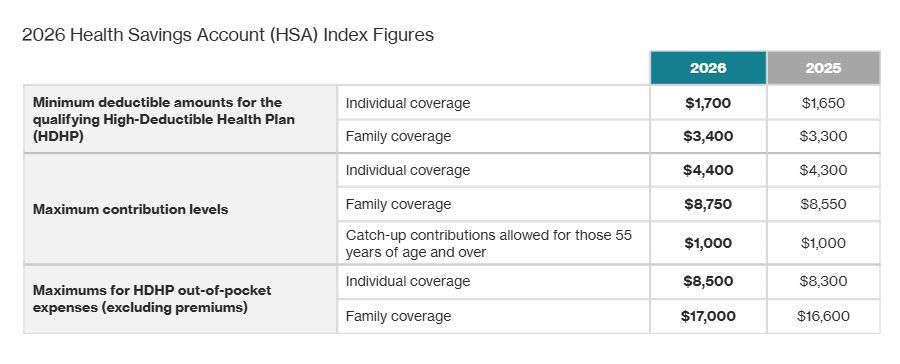
IRS RAISES 2026 HSA CONTRIBUTION LIMITS
Source: Health Equity
Despite this lack of understanding, the study verifies that HSA adoption rates continue to increase. Fidelity HSAs saw 43% growth in total assets and a 23% increase in accounts last year as average 401(k) and 403(b) account balances continue to trend upward. This marks the third straight year of doubledigit annual balance increases — thanks in part to continued market gains and strong 401(k) savings


levels, which Fidelity says demonstrates the consistency that so many Americans show in maintaining responsible savings behaviors and keeping a long-term perspective will serve them well in retirement.
Fidelity explains that contributions to HSAs are pre-tax, and funds withdrawn to pay for qualified medical expenses are tax-free. In addition, any growth in invested HSA funds is considered tax-free. These tax advantages can help reduce the burden of healthcare costs that retirees encounter. However, less than one-quarter of Americans are contributing to an HSA to prepare for healthcare costs in retirement, and only 30% are investing their HSA funds.
They question is why so many Americans may be overestimating how much Medicare will help with expenses. Thirty-seven percent of Americans said they plan to rely on Medicare to cover healthcare costs in retirement, but many are unaware that they will still be responsible for premiums, over-the-counter medications, dental and vision care and long-term care.
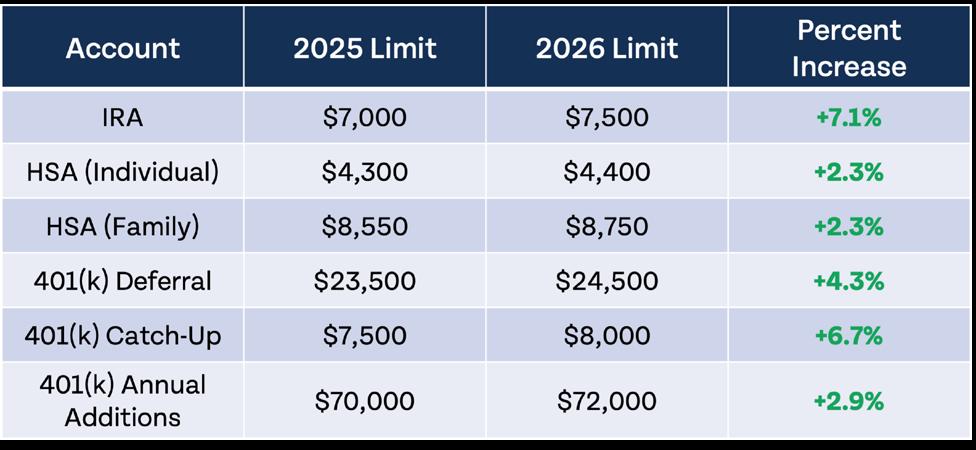
IRS 2026 TAX CHANGES
Source: Money Guy
“Fortunately, actuarial data allows individuals to tailor projections within the broad range of potential cost outcomes. By accounting for factors such as health status, coverage, and state of residence, individuals can prepare for retirement healthcare expenses with greater confidence.”
For reference, a 65-year-old couple retiring in 2026, with average health and national average costs, are projected to see an average annual increase of 5.8% throughout their retirement.
A 70-year-old diabetic Ohio man on Medicare Parts B and D will spend $3,121 more out-of-pocket in 2026 on hospitalization, doctor visits, tests, and prescription drugs than his healthy counterpart.
Notably, 93% of Americans age 65 and older have at least one condition, and 79% live with multiple.
Source: 2026 HealthView, a leading producer of healthcare cost-projection and related retirement planning data, software and APIs.
Furthermore, typical retirement savings just can't keep pace with long-term care (LTC) costs. In 2026, Americans should expect the cost of long-term services and supports (LTSS) to be high and rising, with national median costs for nursing homes surpassing $127,000 to $135,000 annually for a private room. A typical 65-year-old should prepare to set aside approximately $135,000 for future high-intensity care needs, although those requiring more than five years of care may need to cover expenses exceeding $665,000.
Roberts Wealth Management contends that LTC costs — for ongoing help when someone needs assistance with daily activities (like bathing, dressing, eating) or supervision due to cognitive decline -- can “quietly undo even a strong plan” if it’s ignored.
That point out that LTC is often misunderstood as “nursing home care.” In reality, it’s a spectrum that can include:
In-home help (home health aide, homemaker services)
Adult day care
Assisted living
Skilled nursing/nursing home care
Memory care (often part of assisted living or skilled nursing)
trusted advisor
Tatum RE is an insurance and reinsurance intermediary that works with clients, producers, insurers, and reinsurers to design, structure and place insurance and reinsurance programs in the self-funded and broader Accident and Health market.

Risk has nowhere to hide.

If you can’t see risk, you can’t price it. The most consequential stop-loss risks rarely announce themselves. Only Curv blends clincial insight with actuarial rigor to expose the catastrophic claims lurking behind group health data—so you can underwrite with confidence.
Milliman Curv
WHERE TO START
Employers can begin the discussion by asking employees these questions, as suggested by The Georgetown University Center for Retirement:
At what age would you like to retire?
Have you taken all the possible costs into consideration, such as health and long-term care, if you do live 20 or 30 years after you stop working?
Does it make sense to work longer?
Should you be saving more?
What are the best types of investments for you to accomplish your retirement goals?
How should you withdraw money from your retirement plan so it can last if you live to 100?
Williams advises programs that address healthcare risk and income stability tend to be the most compelling approach, noting, ‘Retiree medical support, access to Medicare transition guidance, and HSA strategies help address one of the largest retirement expenses. Financial wellness programs that provide retirement income modeling and Social Security claiming guidance are also valuable.”
Furthermore, lifetime income solutions within defined contribution plans are gaining traction because they help convert savings into predictable retirement income.
Williams clarifies, “In addition, phased retirement programs allow employees to gradually transition out of the workforce while maintaining partial benefits and institutional knowledge, creating a smoother transition for both employees and employers.”

As a follow-on to this perspective comes the current efforts of sellers of HSAs who see an opening for expanding their market and are ramping up lobbying efforts to seize the opportunity. A group of companies and organizations tied to the HSA industry this year formed a nonprofit called the Great American Health Alliance, or GAHA, a 501(c)(4). Members of GAHA include HealthEquity, one of the largest administrators of HSAs, and the American Bankers Association, which represents institutions holding about 90% of HSAs.
Patrick Williams
OLDER AMERICANS ARE WORKING LONGER AND OFTEN PART-TIME
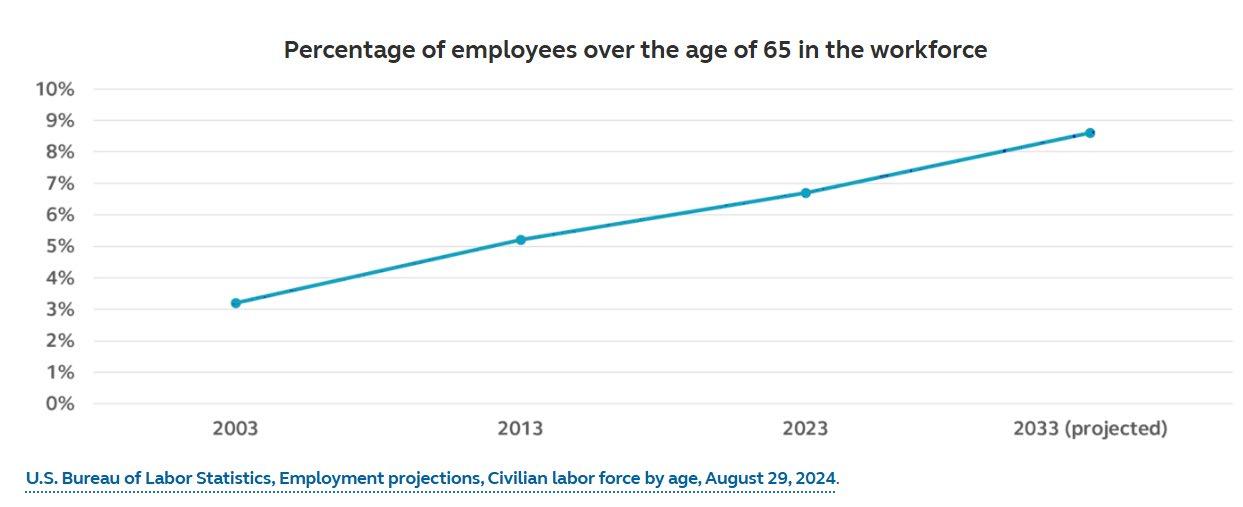
More people age 65 and older are remaining in the workforce: sixty-two million people in the U.S. are age 65 and over and close to 12 million still are working, reports VOYA. They say the numbers are increasing as the U.S. Bureau of Labor Statistics (BLS) projections show that the role of older workers will continue to grow over the next decade:
Adults ages 65 and older are projected to be 8.6% of the labor force (those working and looking for work) in 2032, up from 6.6% in 2022. Women represent 46% of all workers ages 65 and older.
Older adults are projected to account for 57% of labor force growth over the next ten years.
Data from late 2025 indicates that over 38% of employed Americans 65+ work part-time (1–34 hours/ week), with many seniors planning to work part-time as they rejoin the workforce.
Between 2016 and 2026, the BLS projects the labor force growth rate of those age 65 to 74 years of age to be more than 50 percent and the growth rate for those 75 years of age and older to be more than 91 percent. This is compared to a 6.6 percent projected growth rate in the labor force as a whole.
Transamerica Institute's “25 Facts About Women's Retirement Outlook” also shows that women have about 39% less saved by the time they retire than men do. With a median life expectancy of 90, 44% fear outliving savings, yet only 25% have a written plan. Women make up 47% of the U.S. workforce, according to the National Association of Home Builders.
DON’T IGNORE THE MILLENNIALS
Millennials, better known as Generation Y, may not seem to be anywhere near retirement. Born between 1981 and 1996, this working-age demographic is now roughly between 30-45 years old, making them a major part of the workforce.
Unfortunately, a new study conducted by the National Institute on Retirement Security finds a deeply troubling retirement outlook for this age group. Researchers suggest we may already be missing an opportunity with millennials, concluding that two-thirds of working millennials have nothing saved for retirement and only 5 percent are saving 15 percent of their salaries as recommended by financial experts. This is creating serious shortfalls in savings that may prove very costly decades from now.
The report indicates that many factors are contributing to this generation’s retirement savings challenges –from depressed wages to the lack of eligibility to participate in employer retirement plans.
More specifically, the analysis finds the situation is far worse for working Millennial Latinos. Some 83 percent of Latinos in this generation have nothing saved for retirement.
Exclusive Insights to Navigate an Evolving Market
Drawing from our $11.7B+ in premium placements and a $2.8B+ stop-loss portfolio — combined with leading carrier data and industry surveys — the Amwins Benefits State of the Market Report delivers market intelligence you won’t find anywhere else.
As the wholesale market leader, Amwins Benefits brings unmatched depth, scale, and perspective to every conversation.
10.7+ M Lives Covered 7,400+




ENSURE REGULATORY COMPLIANCE: SECURE 2.0 ACT
One of the biggest regulatory changes that is already reshaping employer-sponsored retirement plans is the SECURE 2.0 Act (Setting Every Community Up for Retirement Enhancement Act of 2022).
Sweeping payroll changes already landed on employer doorsteps on January 1, 2026 as this federal legislation includes over 90 provisions. It covers auto-enrollment, catch-up contributions, Roth requirements, part-time eligibility, student loan matching, and emergency savings — rolling out between 2023 and 2027. For employers that sponsor a 401(k), 403(b), or SIMPLE IRA, multiple provisions are already in effect.
Kari Niblack asserts that SECURE 2.0 represents one of the most significant shifts in retirement plan administration in years, and compliance timelines are tighter than many plan sponsors appreciate.
“The mandatory Roth catch-up contribution requirement for high earners, increased 401(k) limits, and enhanced participant communication standards all demand meaningful updates to payroll systems and plan documents. We're seeing delayed retirement trends complicate workforce planning simultaneously.”
Her strong advice to plan sponsors: “Don't wait for penalties to drive action. Work with your advisors now to audit current systems, confirm vendor readiness, and ensure participant communications reflect the new rules accurately and accessibly.”


Blue Wave HR provides this briefing on several aspects of the regulation:
Does the auto-enrollment mandate apply to my existing 401(k)?
No. The mandate only applies to new 401(k) and 403(b) plans established after December 29, 2022. If your plan existed before that date, you’re grandfathered. However, businesses with 10 or fewer employees, businesses less than 3 years old, and church/government plans are also exempt even if they start a new plan.
What is the super catch-up contribution?
Starting in 2025, plan participants aged 60, 61, 62, or 63 can make enhanced catch-up contributions — the greater of $10,000 (indexed for inflation) or 150% of the regular catch-up limit. For 2025, that’s $11,250 compared to the standard $7,500 catch-up for those 50 and older. This gives near-retirees a window to accelerate their savings. Employers must opt into offering this.
What changes for high earners’ catch-up contributions in 2026?
Starting January 1, 2026, employees who earned more than $145,000 in FICA wages (Box 3 of their W-2) from the plan sponsor in the prior year must make all catch-up contributions as Roth (after-tax) only. If your plan doesn’t currently offer a Roth contribution option, those high-earning employees won’t be able to make catch-ups at all. Most employers need to amend their plan documents by the end of the 2026 plan year.
How does SECURE 2.0 affect part-time employees?
SECURE 2.0 reduced the eligibility waiting period for long-term part-time workers from three consecutive years to two. Employees who work at least 500 hours in two consecutive 12-month periods must be allowed to make elective deferrals to the 401(k) plan. Employers are not required to match these contributions. This is especially relevant for restaurants, retail, healthcare, and franchise businesses with large part-time workforces.
Does SECURE 2.0 affect my payroll system?
Yes, significantly. Your payroll system needs to handle automatic enrollment deductions with annual escalation, age-based contribution limit calculations (different maximums for 50+, 60–63, and 64+), Roth catch-up routing based on prior-year W-2 wages, and part-time employee hour tracking across years.
Beyond SECURE 2.0 is a new development announced in early 2026: the inclusion of alternative investments—private equity, venture capital, private credit, real estate, and cryptocurrency—in qualified retirement plans (such as 401(k)s). This has moved from a niche topic to a regulatory priority as the DOL released a Proposed Rule on March 30, 2026 designed to make it easier for 401(k) plans to include alternative assets.
The proposal offers safe harbors for plan fiduciaries. If they follow a prudent process—evaluating performance, fees, liquidity, valuation, and complexity—they are less likely to face litigation for including these higher-risk assets. The DOL proposal is intentionally neutral, aiming to remove prior prohibitions or restrictions on specific asset classes (like crypto or private equity) while emphasizing a "process-based" approach. Overall, the initiative is driven by the goal of allowing ordinary workers to access high-growth opportunities previously reserved for high-net-worth investors and institutional pension funds.
Smaller employers may also consider a pooled employer plan (PEP), a type of defined contribution retirement plan made possible by the SECURE Act, allowing unrelated employers of any size to participate in a single plan, rather than each company sponsoring its own 401(k) plan.
Willis Towers Watson (WTW) explains that PEPs are designed for a wide range of employers, including forprofit/not for profit and small- to mid-sized businesses, to help them offer retirement plans with reduced administrative burdens and fiduciary liability. Participating employers shift nearly all oversight and governance to the pooled plan provider (PPP), including fiduciary responsibility for investments and plan administration.
Setting the stage for plan sponsors, Patrick Williams explains that SECURE 2.0 introduces several operational and compliance responsibilities, adding, “Mandatory Roth catch up contributions for employees earning more than $150,000 require payroll systems and recordkeeping platforms to be updated to ensure correct tax treatment. Increased contribution limits and expanded participant communication requirements also require coordination between payroll providers, recordkeepers, and advisors.”
He says many plan sponsors are still working through implementation timelines and system changes. In addition, delayed retirement trends are creating workforce management challenges, requiring sponsors to focus more on retirement readiness education and plan design strategies that encourage appropriate retirement timing.


Brad Hansen VP of Provider Relations
2026 AMOUNTS RELATING TO RETIREMENT PLANS AND IRAS, AS ADJUSTED FOR CHANGES IN COST-OF-LIVING
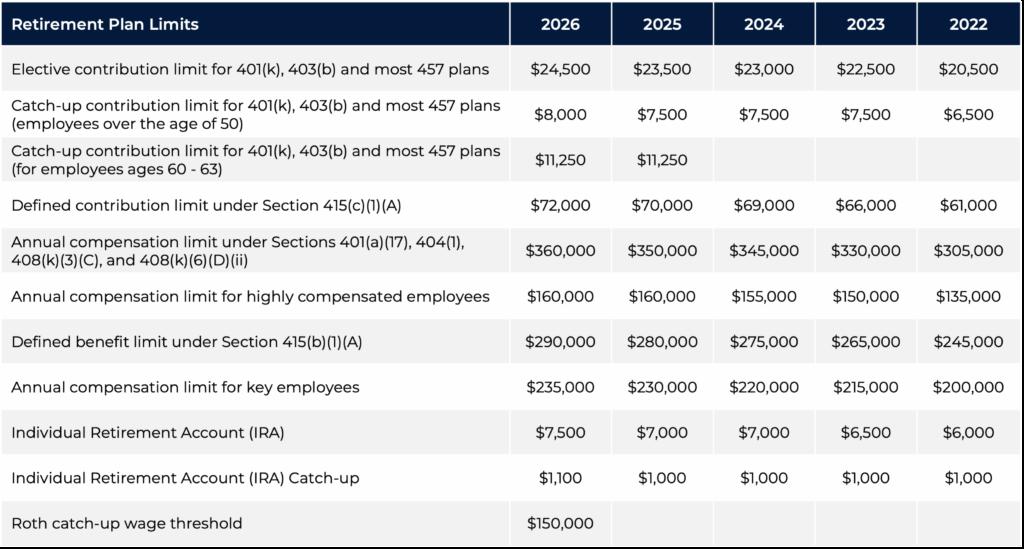
Source: Internal Revenue Service; https://www.irs.gov/pub/irs-drop/n-25-67.pdf
Notably, a federal program known as the Saver’s Match will provide a government match on retirement savings for millions of Americans. While it was enacted as part of the SECURE 2.0 Act of 2022, it applies to tax years beginning on or after January 1, 2027.
Currently, lower and moderate-income workers who contribute to a retirement plan may claim the Saver’s Credit, a non-refundable tax credit that only reduces tax owed. Beginning in 2027, the Saver’s Match replaces the Saver’s Credit with a direct federal matching contribution deposited into the individual’s retirement account (such as a 401(k), 403(b), governmental 457(b), or IRA). The government will match 50% of contributions up to $2,000 per year, meaning a qualifying worker could receive up to $1,000 directly in their retirement account. Eligibility is based on modified adjusted gross income (MAGI) and filing status.
BE AWARE OF CYBERSECURITY ISSUES
Cybersecurity emerges as an important issue since retirement plans hold over $45 trillion in assets and maintain participants’ personal data. Recognizing this threat, many plan sponsors are implementing programs to protect the plan.






Kari Niblack succinctly captures the challenge: “With over $45 trillion in retirement plan assets and deeply sensitive participant data at stake, cybersecurity is a fiduciary responsibility.”
She says that while the Department of Labor's (DOL) cybersecurity guidance has helped elevate awareness, “Guidance alone doesn't equal protection. Plan sponsors need to actively vet their recordkeepers and service providers, implement multi-factor authentication, and establish clear incident response protocols.”
Participant education matters, too, as she makes clear, “Social engineering remains one of the most common attack vectors. At every level of the retirement ecosystem, the only question worth asking is whether you're prepared. Every plan is a target. The organizations that recognize that are the ones building meaningful defenses.”
Patrick Williams echoes this position, stating, “Cybersecurity is now a central fiduciary responsibility for plan sponsors. Retirement plans hold significant assets and maintain sensitive personal and financial data, making them attractive targets for cybercrime. Plan committees should evaluate cybersecurity practices of recordkeepers, payroll providers, and other vendors, including data encryption, access controls, breach response protocols, and ongoing monitoring.”
He also points out that the DOL has issued cybersecurity guidance that encourages fiduciaries to document vendor oversight and security procedures.
“Strong cybersecurity governance helps protect participant assets, maintain trust in the plan, and demonstrate that fiduciaries are exercising prudent oversight in protecting plan information and operations,” says Williams.

Sourced exclusively from licensed Canadian pharmacies — DIN-matched, pharmacist-verified, cold-chain certified. 30–70% below domestic cost. Same therapies. Zero disruption.
COST-CONTAINMENT PROGRAMS
Your fastest-growing cost has a proven answer. PBMS &
Zero disruption. Instant overlay. No rip-andreplace.
BROKERS & CONSULTANTS
The specialty tool your clients haven't seen yet.

RETIREMENT IN 2026: KEY CONSIDERATIONS FOR EMPLOYERS
In 2026, employers should expect that many people, particularly baby boomers -- with the oldest turning 80 -- are looking to retire due to career fatigue and a desire to focus on personal interests. There will likely be greater demands for more than traditional coverage along with personalized experiences, smarter tools and benefits that support the whole life experience.
For employers, that means rethinking how benefits are designed, delivered and experienced amid a complex landscape of new regulatory requirements, evolving compliance standards and heightened scrutiny from the Department of Labor. Regardless of workforce size, it is important to understand the changes that are underway and implement strong operational practices in order to better serve plan participants and avoid costly corrections.
This discussion of retirement is aptly captured in The Harvard Business Review:
“The problem is not retirement per se. It is the way we have elevated it into the central purpose of financial life. Retirement has become a destination in and of itself, an abstract ideal rather than a conduit to achieve greater meaning and broader relationships.”
Laura Carabello holds a degree in Journalism from the Newhouse School of Communications at Syracuse University, is a recognized expert in medical travel and is a widely published writer on healthcare issues. She is a Principal at CPR Strategic Marketing Communications. www.cpronline.com


CAPTIVATING TALENT
How the captive insurance industry is plugging labor shortages
WWritten By Bruce Shutan
With the captive insurance market having grown exponentially in recent years, concern is mounting that the industry’s labor supply isn’t keeping pace with high demand for this specialty insurance.
“The challenge is finding people who can actually work in the business,” says Mark S. Gaunya, Founding Principal and CEO of Captivated Health, a Principal at Borislow Insurance and author of a book on captive insurance.
Between a hard-to-find industry resources and the older generation not necessarily teaching younger people about self-funding and captive insurance, he worries about a brain drain. Any such effort must start with helping the next generation of benefit advisers develop an understanding of how a self-funded plan works, noting that a captive is just another form of self-insurance that mitigates the impact of large medical claims through group purchasing.
A 2025 industry panel described a “growing shortage of qualified talent” as one of the most pressing challenges in the captive space, while as many as 72% of captive executives surveyed online by the Captive International website as far back as 10 years ago believed there was already a talent shortage in place. One industry insider estimates that the U.S. insurance industry overall could face 400,000 unfilled jobs through 2034.


Rethink what’s possible with your stop-loss partner
For over 40 years, Sun Life has been a trusted partner in risk management for self-funded employers. Now, we’re taking it further—combining proven cost savings with innovative health solutions that give your employees access to expert care when and where they need it most.
Clinical 360+: Optimizing care, maximizing value
Our enhanced program builds on the industry-leading Clinical 360 foundation, which achieved over $68 million in savings in 2025. Available for select clients, this advancement adds personalized care pathways and expert navigation with the goal to deliver even greater value. Through proactive outreach and dedicated support, your employees gain seamless access to specialized programs, digital health tools, and clinical guidance—all designed to improve health outcomes while managing costs effectively.
It’s time to reconsider what you expect from your stop-loss partner. Let Sun Life support your business with innovative health solutions that prioritize access to quality care.*
Ask your Sun Life Stop-Loss Specialist about Clinical 360+ today.
*Hinge Health will be provided to eligible members at Sun Life’s expense through the first policy year.
Sun Life is not responsible or liable for the care, services, or advice provided by Somatus, OptiMed Health Partners, or Hinge Health, and reserves the right to discontinue this service at any time.
Sun Life will collaborate with your TPA on eligibility and applicability of programs. Health Navigator is provided by PinnacleCare. PinnacleCare is a member of the Sun Life Financial Inc. (“Sun Life”) family of companies. PinnacleCare and its employees do not diagnose medical conditions, recommend treatment options or provide medical care, and any information or services provided should not be considered medical advice. Any medical decisions should be made only after consultation with and at the direction of the member’s medical provider. Any person or entity who provides health care services following a referral or other service provided does so independently and not as an agent or representative of PinnacleCare.
Group stop-loss insurance policies are underwritten by Sun Life Assurance Company of Canada (Wellesley Hills, MA) in all states, except New York, under Policy Form Series 07-SL REV 7-12 and 22-SL. In New York, Group stop-loss insurance policies are underwritten by Sun Life and Health Insurance Company (U.S.) (Lansing, MI) under Policy Form Series 07-NYSL REV 7-12 and 22-NYSL. Policy offerings may not be available in all states and may vary due to state laws and regulations. Not approved for use in New Mexico.
© 2026 Sun Life Assurance Company of Canada, Wellesley Hills, MA 02481. All rights reserved. The Sun Life name and logo are registered trademarks of Sun Life Assurance Company of Canada. Visit us at www.sunlife.com/us. BRAD-6503-ad

The trouble with this line of work is that it lacks sex appeal and brow-raising paydays relative to the investment trading or brokerage spaces for finance majors or those with an accounting degree, notes Alex Murray, a partner with Johnson Lambert, LLP and President of the South Carolina Captive Insurance Association (SCCIA).
SCHOLARSHIPS AND FELLOWSHIPS
Mindful of this challenge, SCCIA gifted the University of South Carolina’s Darla Moore School of Business $100,000 in 2024 to establish a captive insurance endowed fund for students studying risk management, accounting and actuarial services. The fund, which will be managed by the university in perpetuity, will support undergraduate scholarships and graduate fellowships for students interested in pursuing a career in captive insurance in South Carolina.
“I think there’s just a lack of people wanting to get into the accounting field, and toss
insurance on top of that, it’s certainly not the most appetizing field,” he remarks. “But once you get into it and really see the opportunities, why would you not want to get into a market that’s growing faster than it can serve?”
A driving force behind the popularity of this specialty insurance is the application of medical stop-loss captives to help contain group health benefit costs, according to Murray. “It’s something we see growing significantly,” he says.
While lauding scholarships such as the one the SCCIA is offering at the University of South Carolina, as well as others at Temple University and industry mentorship programs, Captive Planning Associates, LLC CEO John Capasso believes it’s also important to help diversify the skillset of professionals who are already working in the insurance, underwriting and TPA fields through mentorships.
He references several organizations that are not only educating the next generation of captive insurance industry leaders but also helping industry professionals transition to the captive space. They include SIIA’s Future Leaders group of professionals younger than age 40, the Captive Insurance Companies Association (CICA) NEXTGen program aimed at developing the next generation of captive insurance professionals and International Center for Captive Insurance Education (ICCIE).
Captive practitioners have long been aware of impending mass retirements across industry, “so there have been efforts on multiple levels to increase recruiting and training efforts,” reports ICCIE Executive Director Mitch Cantor.
His organization has noticed that many employers assume that new employees will pursue one of the group’s designations to get them up and running. “The need to get new entrants up to speed immediately, along with the experiences of so many supervisors who have been through the ICCIE designations, have made it an easy decision to use ICCIE to get new employees to be more productive quickly,” he says.
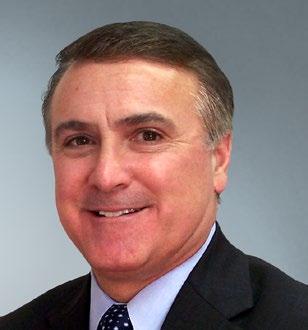
Alex Murray
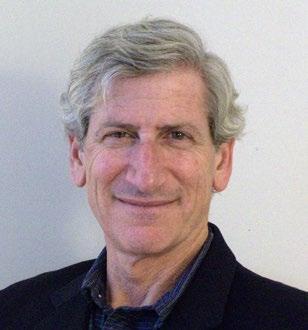
John Capasso
Mark Gaunya

LEARNING TO MANAGE RISK
“The initiative plays a meaningful role in strengthening the industry’s talent pipeline by creating early exposure, access to mentorship and clear pathways for professional development,” she says. “It helps build awareness of career opportunities in captive insurance and fosters engagement and learning among emerging professionals.”
Believing that the interest is there for younger people to enter the selffunded captive insurance space, Gaunya says it’s incumbent upon organizations like SIIA to teach them the industry’s inner workings. “If you don’t,” he cautions, “then it’s like being dropped in a foreign country and not knowing how to speak the language, and it’s nearly impossible trying to have a conversation.”
Once new recruits learn a baseline knowledge, he says the next step would be to understand the components inside a self-funded captive structure that make it work the way it does – the technical expertise – and determine how effective they are at managing risk “because that’s what the self-funded captive structure is all about.”
Gaunya’s agency hires 10 interns each summer in hopes of cultivating the next generation of self-funded captive industry talent. These opportunities allow young people to be deployed in risk management, client services, vendor contracting, compliance or anywhere else within the space that they express an interest in pursuing based on their particular unique abilities.

We have a team of Clinicians and risk managers working to simplify your most complex claims
Mitch Cantor
“When I was growing up in the business, there was this thing known as Group School where you could actually go and learn the language of health insurance, healthcare and alternate forms of financing,” he recalls.
However, he believes there aren’t currently many places where the younger generation can cut its teeth in the industry, noting that most brokerage and consulting firms don’t have the budget or bandwidth to invest in professional development.
The larger problem or concern is that there’s not enough education on what it takes to be a captive manager, Capasso explains, adding that while some professionals may be schooled in auto and general liability, they lack the knowledge and skills to be creative with a captive, know how they’re structured or how to handle contracts.
Noting that the role of captive program manager is becoming increasingly critical in the self-insurance community, Murray likens these professionals to a point guard in basketball. In a nutshell, they provide valuable insights into how alternative risk transfer agreements work, the regulatory requirements and tax implications involved, and meaningful knowledge about what types of service providers to use.
Organizations need to develop from the ground up, and while it’s always easier to recruit someone with experience from another firm, he says “if we’re going to support the industry, I think it’s finding those people right out of college.”
There’s definitely an opportunity to earn good money in the captive space, especially with private-equity firms entering the market and in terms of how it has evolved, according to Murray. “There’s a lot of cash inflow into the industry,” he reports.
Given the tight supply of captive labor and growing demand for this product, he believes “there’s plenty of opportunity for professional growth early and often, and we see that in our own firm as we have a lot more audits and tax work coming in when people get thrust into opportunities that you might not get at another firm.”
ALTRUISTIC CAPITALISM
In order to get younger people interested in pursuing a career in self-funded captives, Gaunya suggests that the messaging provides a larger strategic context to explain the importance of this type of work.
“I have kids who are in their late 20s, and they tell me what a rip off they think health insurance is, and they know I do this for a living,” he reveals. “I say to them, ‘well, let me tell you about some of the things I’m doing with middle-market companies – that they’re actually banking money on their balance sheet and reinvesting that surplus back into the benefits to help people get better care at a lower price,’ and they’re just wowed by it.”
When extoling the virtue of this mission and societal value, he’s also quick to point out that it’s a profitable business. “You can make money by delivering great results to your clients who are more than happy to pay you for those great results that you're delivering for them. So, it is altruistic capitalism in some sense,” he adds.
Bruce Shutan is a Portland, Oregon-based freelance writer who has closely covered the employee benefits industry for nearly 40 years.
FROM SURPRISE BILLS TO SURPRISE COSTS: HOW THE NSA IS RESHAPING EMPLOYER RISK

Written By Scott Bennett and Alex Houle
ForFyears, surprise medical billing represented one of the most visible and emotionally charged failures of the U.S. healthcare payment system. Employees did everything "right" because they went to an innetwork hospital, followed plan rules, and trusted the system; however, they received staggering bills weeks or months later from out-of-network providers they never chose. In some cases, those balances reached into the tens or hundreds of thousands of dollars, triggering financial distress, public outrage, and, eventually, legislative action.
Stories like the Texas public school teacher who received an astronomical emergency room bill after a routine medical event were not anomalies. They were emblematic of a system that allowed patients to be caught in the middle of provider payer disputes with no meaningful protections. By the time Congress passed the No Surprises Act, there was broad bipartisan agreement on one core point: patients should never again be the leverage point in these payment fights.
In that respect, the No Surprises Act largely succeeded. Balance billing for covered emergency services and certain non-emergency services is now prohibited. Patients are protected from surprise bills, and payment disputes are formally redirected away from individuals and into a structured process between providers and health plans. For employees and their families, that change has been both real and meaningful.
But solving one problem does not mean the system stops evolving. It means the pressure moves.
What the No Surprises Act did was shift the locus of financial conflict. Instead of patients absorbing unpredictable and often devastating charges, those disputes now play out behind the scenes through open negotiation and Independent Dispute Resolution. And increasingly, the financial consequences of those disputes land squarely on employer-sponsored health plans.
That is the context in which The Phia Group undertook its National NSA Report on aggressive provider billing and arbitration behavior. The purpose of the report was not to argue that the NSA was a mistake, nor to accuse providers of wrongdoing. Rather, it was to ask a practical, data-driven question: how is the dispute resolution system actually being used in practice, and what does that usage mean for employers who fund health benefits?
The analysis reviewed more than one million federal arbitration disputes across all fifty states and examined billing and offer behavior for tens of thousands of providers where sufficient data existed. What emerged was not a picture of uniform behavior across markets or specialties. Instead, the data revealed patterns that suggest strategy, concentration, and incentivedriven decision-making rather than random variation.
One of the most striking findings is that elevated arbitration activity and high offers are often driven by a relatively small subset of
providers. In several states, a modest number of entities account for a disproportionate share of disputes and aggressive offers relative to typical billing benchmarks. This matters because it challenges the assumption that NSA cost pressure is simply the result of broad market forces. In many cases, the exposure appears to be clustered.
Geographic variation reinforces that conclusion. Some states show a high proportion of providers making elevated offers, while others show lower proportions but still meaningful dispute volume. Large states with complex healthcare markets are not immune; even where overall percentages are lower, the sheer volume of disputes creates material exposure for employer plans. In other words, risk does not disappear just because a market is large or mature.
The report also underscores an important nuance: it is not only about how many providers are involved, but how aggressively a subset behaves. When the same providers repeatedly file disputes and anchor offers at the high end of the spectrum, arbitration can begin to function less as a neutral dispute resolution mechanism and more as a payment maximization tool. That dynamic does not benefit patients, but it does affect plan costs, contribution levels, and long-term affordability.
At the same time, the report is careful to acknowledge what the data cannot prove. Public arbitration data does not capture clinical complexity, patient acuity, or the full context of individual negotiations. A high offer is not inherently improper. The analysis does not assert intent, legality, or bad faith. Instead, it highlights signals that warrant attention and further scrutiny, particularly from fiduciaries responsible for managing plan assets.
For employers, brokers, and advisors, this distinction is critical. The takeaway is not that every dispute is suspect or that arbitration should be avoided. The takeaway is that the NSA environment now requires active management. Passive approaches that rely solely on network discounts, automated pricing, or after-the-fact appeals are increasingly misaligned with how the system actually operates.
One of the clearest lessons from the data is that not all markets behave the same way. Employers with geographically diverse workforces may face very different NSA exposure depending on where care is delivered. Understanding that exposure requires visibility into provider-level behavior, not just aggregate claim counts or average outcomes.
The report also points to emerging best practices for managing NSA risk. Plans that consistently validate eligibility, engage meaningfully during open negotiation, and submit disciplined, well-supported IDR positions are better positioned to contain costs over time. Equally
important is tracking repeat provider behavior. When the same facilities or groups appear repeatedly in disputes, a tailored strategy is often more effective than a one-size-fits-all approach.
Another important implication is expectation setting. The No Surprises Act was never designed to guarantee savings on every claim. Arbitration outcomes will vary, and some disputes will result in higher payments. The real measure of success is whether a plan is managing the process intentionally, understanding where risk is concentrated, and avoiding systematic overpayment driven by unchecked arbitration dynamics.
Looking forward, it is unlikely that NSA disputes will become simpler or less frequent. Providers are becoming more sophisticated, data is becoming more accessible, and strategies will continue to evolve. At the same time, employers are under increasing pressure to justify benefit costs, demonstrate fiduciary prudence, and explain premium and contribution increases to employees who no longer see surprise bills but still feel the downstream impact.
In that environment, the value of the National NSA Report is not that it offers definitive answers. Its value lies in reframing the conversation. It shifts the focus from anecdote to pattern, from individual disputes to systemic behavior, and from reactive problem solving to proactive governance.
The No Surprises Act succeeded in protecting patients. The next challenge is ensuring that the system designed to resolve payment disputes does not quietly undermine the affordability of employer-sponsored coverage: Data, transparency, and disciplined strategy are essential to meeting that challenge. It is up to plans and their administrators to make sure the NSA fulfills its promise without simply shifting the burden to a different, less visible set of stakeholders.
Scott Bennett is Chief Provider Relations Officer at The Phia Group. Alex Houle is Vice President of Provider Relations at The Phia Group.


A NEW ERA FOR DOL EBSA ENFORCEMENT
TWritten By Alston & Bird Health Benefits Practice
The Department of Labor’s Employee Benefits Security Administration (EBSA) recently issued Field Assistance Bulletin 202601 (“FAB 2026-01”), titled Guiding Principles for EBSA Enforcement Priorities. Signed by newly confirmed Assistant Secretary Daniel Aronowitz, FAB 2026-01 reflects a marked change in how EBSA will select cases, frame theories, and conduct investigations.
Although FAB 202601 is an internal policy memorandum directed to EBSA personnel, its direction as to how investigations are to be selected, reviewed, and conducted is relevant to entities that are subject to EBSA investigations, including plans, fiduciaries, and their advisers. FAB 2026-01 provides guidance to EBSA investigators on when to pursue cases, when not to, and how to avoid regulating through enforcement. These updated approaches should be taken into account by plan service providers and fiduciaries alike.
Also of importance is that FAB 2026-01, by its own terms, creates no enforceable rights. As an internal EBSA policy, the FAB “is not intended to, does not, and may not be relied upon to create any rights, substantive or procedural, enforceable by law by any party in any matter, civil or criminal.”
BACKGROUND: FABS AS ENFORCEMENT SIGNALS
FABs function as a window into EBSA’s enforcement posture. Earlier FABs frequently provided transitional relief (e.g., fiduciary rule implementation and fee disclosure regimes); temporary enforcement safe harbors; and targeted guidance. Historically, FABs addressing enforcement issues often appeared in response to invalidated regulations (e.g., FAB 201802 following the Fifth Circuit’s investment fiduciary rule decision); new statutory regimes (e.g., Consolidated Appropriations Act 2021 disclosure requirements); and operational enforcement challenges (e.g., missing participants, MEWA failures).
FAB 202601 is substantively different. Rather than addressing a discrete legal development, it sets out an agencywide enforcement philosophy—and does so in explicit (but not enforceable) terms.
GUIDING PRINCIPLES OUTLINED IN FAB 202601
FAB 2026-01 identifies four guiding principles that now govern EBSA enforcement decisions. Each could have direct implications for service providers supporting group health plans.
1. Enforcement Should Target the Most Egregious Conduct and Significant Harm
EBSA instructs its staff to focus investigations on cases involving serious harm to participants or beneficiaries, with particular emphasis on criminal cases. In civil enforcement, the emphasis will be on breaches of the duty of loyalty or situations involving direct evidence of non-exempt prohibited transactions intertwined with impermissible conflicts of interest. EBSA believes that it should be targeting cases “where the Department can make the most significant difference in addressing harm to plan participants and beneficiaries.” To that end, FAB 202601 states:
“[…] our highest priority will be to target individuals and entities who, acting in bad faith, improperly administer plan benefits or misappropriate (or aid in the misappropriation of) assets set aside for the benefit of the American worker. This includes conduct designed to enrich themselves or other goals unrelated to participants’ best interests, such as the promotion of environmental, social, or governance objectives.”


To the extent any enforcement activity is “solely based on a prudence breach,” EBSA will take a more measured approach. For service providers and plan sponsors, this direction is notable for two reasons. First, the FAB explicitly distinguishes loyalty breaches from mere process-based prudence claims, recognizing that ERISA is “a law of process and not results.” Second, EBSA cautions investigators to avoid second-guessing fiduciary judgment where enforcement is based solely on alleged prudence failures without evidence of disloyalty or conflicted conduct.
This exercise of restraint tracks longstanding judicial reluctance to impose hindsight-based fiduciary liability and could signal increased restraint toward investigations premised only on, for example, fee levels, vendor selection outcomes, or plan design disagreements—absent conflicts of interest.
2. No Regulation Through Enforcement
Perhaps the most consequential provision for service providers is EBSA’s explicit rejection of policymaking through enforcement actions. FAB 202601 states plainly:
“Consistent with the principles of fairness … EBSA will not regulate through enforcement whenever possible.”
FAB 2026-01 further provides that novel legal theories or interpretations of ERISA “should not be first articulated during enforcement actions” and instead should proceed through “notice-and-comment rulemaking or sub-regulatory guidance.”
Unless senior leadership provides written approval, EBSA enforcement activity must have a close nexus to one of three sources:
The plain language of ERISA;
Clearly established regulations or prominently published guidance, or;
Clearly established case law.
More generally, this principle reflects an effort to ensure that enforcement theories are anchored to existing statutory text, established guidance, or settled case law, rather than being used as a vehicle to announce new interpretive positions. This should help curtail “regulation by surprise.”
3. Senior-Level Review of Significant Enforcement Actions
FAB 202601 requires centralized oversight of major enforcement decisions. The following must be reviewed by EBSA leadership, including the Director of Enforcement and the Assistant Secretary:
Novel legal positions;
Issues likely to generate circuit splits;
Departures from prior EBSA positions;
Any other issues identified as being of interest or importance to the Assistant Secretary.
Investigators must, for significant actions, provide leadership with:
A clear description of the matter’s significance;
The rationale for the proposed enforcement approach, and;
All material correspondence with the investigated party or counsel.
For service providers, this could elevate the importance of early engagement and advocacy, as records and communications are expressly contemplated as part of leadership review.
4. Timeliness and Responsiveness in Investigations
FAB 2026-01 directly acknowledges longstanding complaints—by Congress and regulated entities—about open-ended investigations. Some investigations have carried over across 5 or more years. Now, absent exceptional circumstances, EBSA commits to completing:
Routine investigations within 18 months; and
Complex investigations within 30 months.
Investigations exceeding these timeframes require quarterly leadership review, with reporting obligations up the chain. This is a significant operational commitment, particularly for service providers who have experienced multiyear audits involving expansive document requests and evolving theories.
Independence from Private Litigation
FAB 202601 also states that EBSA investigators and enforcement personnel “will not do anything that compromises the Department’s independence, integrity and credibility,” including avoiding any appearance that enforcement priorities or activities are being coordinated with plaintiff lawyers pursuing private actions. FAB 2026-01 specifically references an ongoing Office of Inspector General investigation into the use of certain common-interest agreements, and notes that the guiding principles in the FAB may be updated following that inquiry.
Implications under FAB 2026-01 for Health Plan Service Providers
Although FAB 202601 applies across all ERISA-covered plans, its framing has particular relevance for health plan service provider enforcement.
Historically, EBSA’s national projects have increasingly scrutinized:
Service provider compensation arrangements;
Conflicts of interest;
PBM and TPA fee structures;
MEWA-related activity.
FAB 202601 does not abandon these priorities. Instead, it re-anchors them:
Loyalty breaches and conflicts remain central;
Process-focused fiduciary claims may receive more restraint;
Enforcement is tied explicitly to harm and bad faith.
For service providers that can demonstrate, for example, transparent compensation, documented conflict mitigation and reasoned fiduciary processes supporting their roles, FAB 202601 offers language that may be helpful to frame interactions with EBSA investigators.
Key Takeaways
FAB 202601 is not an enforceable document but does signal a new enforcement identity for EBSA. For service providers to self-insured ERISA health and welfare plans, FAB 202601:
Clarifies where EBSA intends to concentrate its enforcement energy;
Narrows the circumstances in which aggressive theories could emerge;
Reinforces the value of documented process, transparency, and loyalty.
While FAB 202601 does not eliminate enforcement risk or offer any guarantees, it has the potential to reshape the rules of engagement—and provide a framework for both compliance planning and enforcement response.
Attorneys John Hickman, Ashley Gillihan, Amy Heppner, and Laurie Kirkwood provide the answers in this column. John is partner in charge of the Health Benefits Practice with Alston & Bird, LLP, an Atlanta, New York, Los Angeles, Charlotte, Dallas and Washington, D.C. law firm. Ashley is a partner in the practice, and Amy and Laurie are senior members in the Health Benefits Practice. Answers are provided as general guidance on the subjects covered in the question and are not provided as legal advice to the questioner’s situation. Any legal issues should be reviewed by your legal counsel to apply the law to the particular facts of your situation. Readers are encouraged to send questions by email to John at john.hickman@alston.com.
NEWS FROM SIIA MEMBERS

JUNE 2026 MEMBER NEWS
SIIA boasts a very active and dynamic membership. Here are some of the latest developments from member companies and individuals powering the self-insurance industry.
Coastal Administrative Services Teams up With Point C
Point C, a national independent third-party administrator (TPA), announced a strategic expansion with Coastal Administrative Services (CAS), one of the Pacific Northwest’s fastest-growing TPAs. These two deeply aligned organizations are united by a shared commitment to high-touch customer service and customized health plan solutions that help clients and their members navigate the complexities of healthcare with confidence and compassion.
This partnership expands Point C’s presence on the West Coast, establishing operations in the Pacific Northwest while simultaneously providing Coastal with greater resources and access to Point C’s full suite of in-house product offerings, accelerating the value for employers and the members they serve.
“From our first conversations, it was clear that Point C and Coastal share the same philosophy in how we serve our members,” said Jason Barth, President and Owner of CAS. “We both have a memberfirst approach, investing in the right people, processes, products, and technology to deliver genuinely effective, cost-conscious health plan solutions. This partnership allows us to continue growing without compromising what makes Coastal unique.”
“The culture and core values that Coastal have built mirrors what we’ve worked hard to create at Point C,” said Ben Frisch, CEO of Point C. “That alignment, plus the shared importance of supporting our plan sponsors and their members, made this decision cohesive and seamless, and it’s what excites me most about this next chapter of growth for both organizations.”
“CAS has been on a tremendous growth trajectory, and a key driver of that has been our ability to bring tailored, high-quality solutions to our clients,” said Kasha Ozog, CEO of CAS. “It is an exciting and pivotal time for CAS, and by combining forces with Point C, we can now deliver these solutions at an even broader scale and scope. We will also remain an independent TPA which allows us to continue providing the same high level of quality and service that clients have come to rely on.”
“Point C has been growing rapidly and expanding its reach across the country, and CAS brings a wellstablished presence with strong relationships, allowing us to extend our distribution in a meaningful and intentional way,” said Bob Wolfkiel, Chief Growth Officer of Point C. “The growth opportunity here is substantial, and we're excited to pursue it together.”
The acquisition of Coastal further solidifies Point C’s commitment to growth and innovation within the TPA and cost-containment spaces, with both companies well-positioned to meet the current and future demands of the market.


MORE THAN JUST “OFF-THE-SHELF” OPTIONS
When it comes to Excess of Loss, one size doesn’t fit all. That’s why our team of experts is dedicated to delivering customized solutions that are as unique as your business. At StarLine, we pride ourselves on being concierge underwriters, offering tailored, flexible coverage options to meet your specific needs. Visit starlinegroup.com or call (508) 495-0882 to discuss how we can get started for you.
ANGLE HEALTH NAMES TEXAS-BASED SALES EXECUTIVE
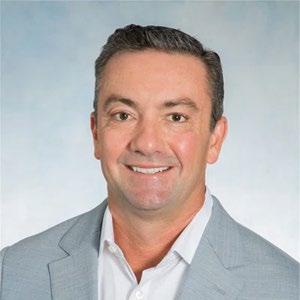
Scott Ferguson is a seasoned healthcare and benefits sales executive with over 30 years of experience driving growth in a variety of markets has been appointed as Vice President of Sales for Texas at Angle Health.
Previously, Scott was Executive Vice President of Sales at Marsh McLennan Agency, where he led multiple teams across Central Texas and drove strong revenue growth. He has also held senior leadership roles at Blue Cross and Blue Shield of Texas and BCBSNC, managing large and national group sales organizations and implementing strategic benefit solutions for complex clients.
Scott spent a decade at UnitedHealthcare, rising to Vice President of Sales and Account Management. He began his career at Aetna Health Plans, consistently recognized as a top sales leader.
ZENITH EXPANDS PROGRAM MANAGEMENT CAPABILITIES
Zenith Risk Strategies, a Texas-based managing general underwriter focused on medical stop-loss, is positioning itself as a program manager built around underwriting discipline, clinical oversight, and captive integration.
Founded in 2024 and led by CEO Thomas Wagner, the Austin-based firm targets the self-funded employer market. In particular, it works with brokers, captives, and advisors to structure stop-loss programs with an emphasis on long-term stability rather than short-term pricing cycles.
More broadly, the company frames its model as a departure from traditional stop-loss. Specifically, it aims to align incentives across underwriting, claims management, and employer outcomes. To support this, its approach combines data-driven pricing, clinical-led claims review, and cost containment strategies designed to reduce volatility at renewal.
At the core of the model, Zenith’s offering centers on five components:
Strategic pricing
Advanced underwriting using clinical and analytics data
Physician-led review of high-cost claims
Cost containment programs
Surplus retention strategies tied to long-term performance
In addition, the platform integrates with captive structures. As a result, employers and groups can retain underwriting gains while maintaining transparency into program performance.
Scott Ferguson Angle Health
BHSI Announces Three New Vice Presidents
Berkshire Hathaway Specialty Insurance (BHSI) announced that it has named Ford Coacher as Vice President, Taft Hartley; Chris Slezak, as Vice President, Employer Stop-Loss Sales, U.S. West; and Bill Bixler as Vice President, Employer Stop-Loss Sales, U.S. East.
“BHSI’s financial strength, long-term view and CLAIMS IS OUR PRODUCT philosophy has really resonated in the employer stop-loss (ESL) marketplace,” said Phil Gardham, President, NA Accident & Health, BHSI. “These well-deserved promotions are designed to recognize the work of our talented professionals and provide strong support for our continued growth in ESL—including the Taft Hartley space.”
Ford Coacher joined BHSI in 2024 as Assistant Vice President, bringing more than a decade of insurance industry experience with a focus on the Taft-Hartley and multiemployer health plan market. In his new role he will oversee the ongoing expansion of BHSI’s Taft Hartley ESL business for self-funded multi-employer union health plans.
Chris Slezak joined BHSI in 2022 and was previously Regional Vice President, for the South-Central Region. He has more than two decades of insurance industry experience. In Chris’s new role, he will oversee sales of BHSI’s ESL solutions for U.S. West which will include the Southwest, Northwest Regions, in addition to the South Central.
Bill Bixler joined BHSI in 2017 and was previously Regional Vice President for the Northeast & Mid Atlantic. He has more than three decades of insurance industry experience. In Bill’s new role, he will oversee sales of BHSI’s ESL solutions for U.S. East which will include the Midwest and Southeast Regions, in addition to the Eastern and Midwest.
AMY MATTINGLY TO LEAD GROUP BENEFITS DISTRIBUTION AS NATIONWIDE
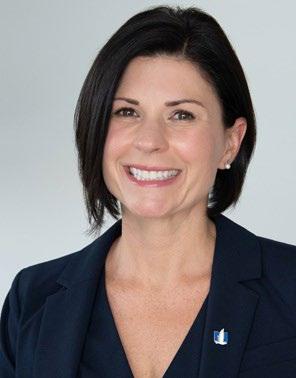
Lindsey Murray, president of Nationwide Group Benefits, shared that Amy Mattingly will lead the Group Benefits Distribution team to focus on stop-loss.
In her new role, Mattingly is responsible for developing, implementing and leading the sales and distribution strategy for Nationwide Group Benefits, with a focus on stop-loss and program managed solutions for small and mid-sized businesses.
“Amy has consistently shown courageous leadership in navigating the financial industry’s evolving landscape while delivering growth,” said Murray. “Her proven leadership skills along with her ability to develop strong relationships with sales partners will allow Nationwide’s stoploss distribution to grow and thrive.”
Amy Mattingly Nationwide
Executive Sales Team Grows at Vālenz
Vālenz Health® announced that five experienced business leaders have joined its executive sales team to support the advancement of smarter, better, faster healthcare for clients and partners.
Joe Calabretti, Lou Fiscella, Kenny Fritz, and Jeff Wunderlich will each serve as Vice President of Broker Sales, while Adam Drake steps into the role of Vice President of Digital Solution Sales. Together, they bring unparalleled experience in the healthcare industry to the Vālenz team and will play a pivotal role in driving growth for clients through strategic partnerships and plan design innovation.
“As we enter a new phase of growth at Vālenz, we are thrilled to add such a wealth of experience and knowledge to our sales team,” said Kevin O’Donnell, Executive Vice President of Solution Strategy and Expansion at Vālenz. “The addition of these five leaders strengthens our ability to provide the highest level of service and guidance to employers and members beyond the traditional renewal season, ensuring yearlong support for our most valued partners.”
As part of the sales team, these five leaders will also leverage their experience in the industry and bold strategic thinking to help clients and partners harness the full potential of the entire Vālenz platform to optimize the cost, quality, and utilization of healthcare for everyone.

Zelis Announces New CSO and CRO Appointments
Zelis, a leading provider of healthcare technology solutions, announces the appointment of Peter Durlach as Chief Strategy Officer and the promotion of Matthew Krawse to Chief Revenue Officer. Together, they will help advance Zelis’ mission to modernize the healthcare financial experience for payers, providers, and members.
“Peter and Matthew bring deep experience and complementary perspectives that will help us move faster, stay focused on where we can lead, and deliver even greater value for our clients,” says Amanda Eisel, CEO of Zelis. “In an evolving healthcare landscape, these leaders will play a key role in how we support clients today while sharpening our vision for the future.”
As Chief Strategy Officer, Durlach will lead the creation of an enterprise-wide function focused on accelerating long-term growth, strengthening Zelis’ market position, and expanding the value the company delivers to clients.
He will build and lead a coordinated team spanning enterprise, product, and development capabilities. This group will help shape company strategy, advance AI-driven capabilities, strengthen cross-functional alignment, and turn business priorities into actionable outcomes across the organization.
Durlach brings more than three decades of experience building and scaling healthcare technology businesses. Most recently, he served as Corporate Vice President and Chief Strategy Officer for Health & Life Sciences at Microsoft, where he helped guide the company’s strategic direction and portfolio across the healthcare industry.
Krawse has spent the last 10 years at Zelis, most recently as Senior Vice President of Growth, focusing on the Zelis Payments Optimization business. As Chief Revenue Officer, he will lead the company’s Sales and Client Management organization. He brings to this role a deep understanding of the complex healthcare market, client needs and Zelis’ differentiated solutions.
Acrisure Restructures Key Division
Acrisure Re, the reinsurance division of global fintech Acrisure, integrates its capital and captives division into a single platform.
The integration brings together more than 275 captive specialists across North America and Bermuda. It combines the firm’s established captive business with its specialist reinsurance brokerage capabilities.
The new division, Acrisure Re Capital and Captives, is led by Seth Denson, head of captives, who reports to Simon Hedley, global CEO of Acrisure Re.
The move is a strategic step to unlock the next phase of growth. Currently, almost 70 per cent of the business focuses on the US life and health (L&H) segment, where alternative and self-insured medical plans are among the fastest-growing areas of the US medical insurance market.
The remaining 30 per cent operates across property and casualty (P&C), an area targeted for expansion within the Acrisure Re platform. In the P&C space, the division intends to pursue growth across group and single-parent captives, focusing on sourcing opportunities, executing reinsurance placements, and generating new business for trading partners.
Beyond Risk Launches Beyond Health Partners
Beyond Risk announced the official launch of Beyond Health Partners, a unified health benefits funding specialist that brings together stop-loss, captive, and cost containment businesses under one integrated platform. The name “Beyond Health Partners” reflects the organization’s commitment to collaboration and its belief that working as an extension of each partner across brokers, employers, TPAs, and vendors is key to delivering better outcomes.
By unifying industry-leading organizations SL Management Partners, LLC (SLMP), Captive Solutions & Options, and the Beyond Health captive team (a BevCap Management program) into a single platform, Beyond Health Partners supports both traditional and alternative health benefits funding strategies while managing more than $175 million in gross written stop-loss premium for brokers and mid-market employers nationwide.
The integrated platform supports the full lifecycle of health benefits funding, including stop-loss underwriting and program management, captive strategy and participation, claims monitoring and costcontainment coordination, and renewal planning and long-term risk management.
“This launch marks an important step in bringing our capabilities together in a more intentional way,” said Steve Solomon, President of Beyond Health Partners. “With stronger alignment across our organizations, we are better positioned to support carrier and client needs through a more connected and effective operating model.”
Boon-Chapman President Recognized as Innovation Leader
Boon-Chapman announced that its president, Kari L. Niblack, has been named to the HIPN GTM 100, April 2026 Edition, a distinguished list recognizing the go-to-market leaders driving innovation and growth across the healthcare payer and services ecosystem. The recognition was announced by Healthcare BizDev, publisher of Health Insurance Plan News (HIPN).
"Self-funded healthcare is no longer a niche strategy reserved for large corporations. It is becoming the smarter choice for employers of all sizes who want transparency, control, and better outcomes for their people," said Niblack. "Being recognized alongside so many exceptional leaders in this space is an honor, and it reinforces what we work toward every day at BoonChapman: building smarter health plans that actually serve the members they are designed for."
Karl Fry to Head Producer Relations at Skyward A&H
Skyward Accident and Health is pleased to announce the appointment of Karl Fry as Vice President of National Producer Relations. In this strategic role, Fry will spearhead the development and management of key national producer partnerships, working in close alignment with Skyward’s Regional Sales offices to drive nationwide growth.
Fry brings over 30 years of experience across the healthcare insurance and reinsurance sectors. He possesses a deep technical mastery of employer stop-loss, provider excess of loss, medical excess,
Kari Niblack
Boon-Chapman

and HMO reinsurance. Throughout his career, he has earned a reputation for engineering creative, results-oriented programs that empower clients and brokerage partners to navigate intricate risk landscapes while meeting critical financial and strategic milestones.
Before joining Skyward, Fry held several executive leadership roles, including Vice President of Business Development at RGA and Vice President at Guy Carpenter.
“Karl’s extensive tenure and specialized background in the Employer Stop-Loss market provide him with an acute perspective on the sophisticated and evershifting insurance ecosystem,” said Mike Remeika, Divisional President of Skyward A&H. “By bringing an industry veteran of Karl's caliber into the fold, Skyward reinforces its commitment to delivering elite expertise and high-touch service to our national partners. We are thrilled to have him leading our producer relations.”
Leading Edge Names Technology Executive
Leading Edge Administrators (LEA), a family-owned independent ThirdParty Administrator, announced a strategic investment in its technology leadership, platform, and infrastructure to support the next generation of self-funded benefits administration. As part of this initiative, the company has appointed Doug Stewart, an industry veteran, as Chief Technology Officer.
This move reflects LEA’s long-term commitment to building a more agile, scalable, and future-ready operating model, one that combines advanced technology with the high-touch service its clients rely on.

Stewart brings more than 20 years of healthcare technology experience, including leadership roles at one of the nation’s largest health insurers, where he led large-scale digital transformation initiatives. Throughout his career, he has worked at the intersection of technology, operations, and business strategy, driving improvements in system performance, data accessibility, and user experience. At LEA, he will play a central role in shaping the company’s technology roadmap and advancing its platform capabilities.
“LEA holds a distinct advantage because we aren’t burdened by the technical debt that often comes with acquisition-based growth,” Stewart said. “Our size and structure allow us to be flexible and intentional in how we build. That means we can focus on solving real business problems and delivering outcomes that matter to our clients.”
According to a company statement, A key focus of LEA’s technology strategy is the use of smarter automation to enhance, not replace, human service. By streamlining repetitive, manual administrative processes, the company enables its teams to operate more efficiently while maintaining the high level of responsiveness and personalization that clients expect. This approach ensures that automation supports faster turnaround times and improved accuracy, while freeing up internal teams to focus on complex, highvalue interactions with brokers, employers, and members.
Karl Fry
Skyward Accident and Health
Doug Stewart Leading Edge

Steve Stucky
September 25, 1936 - May 9, 2026
SELF-FUNDING PIONEER, STEVE STUCKY, PASSES
Steven P. Stucky, CLU, founder of S. P. Stucky Company, Inc., a stop loss MGU based in Lafayette, IN, died on May 9, 2026. His wife and business partner, Pat Stucky, had passed years earlier.
"Steve was an early supporter of SIIA during its founding in 1981 and subsequently served the association with membership on several committees, and later as an SIIA board member and officer. Steve rose to the position of president and it’s chairman of the board. Steve also led the charge to create the Self-Insurance Educational Foundation, Inc. (SIEF) a 501(c)(3) non-profit that developed industry scholarship programs and publisher of a variety of research documents, best practices, etc. He served as Chairman for several years," said Jim Kinder, co-founder/Executive Director/CEO of SIIA (1981-2008).
"Steve was known to many industry leaders as the inventor of the stop-loss insurance product to cap losses for employer sponsored self-insured benefit plans," added Kinder. "This new product (developed back in the 70’s along with federal legislation passed in 1974 known as ERISA fueled the growth of self-insurance and remains the cornerstone of legislative authority today. Steve’s innovations in product design within the excess & reinsurance market was and throughout his career a great service to the industry" Kinder added. "Steve will be truly missed both as an industry legend and a close personal friend. Steve never really retired from the industry and remained active in his normal quiet way. Steve and I remained friends to this day, some 45 years, and I will certainly miss our frequent visits and telephone calls. RIP Steve."
“Steve provided a wonderful model for me to serve the self-funded industry,” said Ernie Clevenger, publisher of this Newsletter. “When I was a young stop loss underwriter, Steve taught me valuable techniques how best to analyze risks. Later when I followed him as president of SIIA, Steve provided valuable guidance where the organization needed to focus.”
Steve received a B.S. Degree in Economics from Butler University in 1959 and a Chartered Life Underwriter (CLU) Degree from The American College of Life Underwriters, Bryn Mawr, PA in 1966. He began his insurance career in 1957 and served as an underwriter, officer and member of the board of directors of a number of outstanding U.S. insurance companies. In 1981, he formed a Managing General Underwriting firm called the S. P. Stucky Company, Inc. in West Lafayette and operated it successfully until he sold it and retired in June of 2000.
Services for Steve were held in his hometown of Lafayette, Indiana at Soller-Baker Funeral Home on May 23, 2026. You may leave messages/condolences to family, share memories, and view Steve’s full obituary at: https://soller-baker.com/obituary/steven-p-stucky-clu/
2026 SELF-INSURANCE
INSTITUTE OF AMERICA
BOARD OF DIRECTORS
CHAIRWOMAN OF THE BOARD*
Amy Gasbarro President
ELMCRx Solutions
CHAIRPERSON ELECT, TREASURER AND CORPORATE SECRETARY*
Mark Lawrence President
HM Insurance Group
BOARD MEMBER
Blake Allison Chief Executive Officer
Employers Health Network
BOARD MEMBER
Christine Cooper CEO
aequum, LLC
BOARD MEMBER
Orlo “Spike” Dietrich Operating Partner
Ansley Capital Group
BOARD MEMBER
Jeffrey Fitzgerald
Managing Director, SRS Benefit Partners
Strategic Risk Solutions, Inc.
BOARD MEMBER
John Fries
Head Accident & Health NA
Swiss Re Corporate Solutions
BOARD MEMBER
Matthew Smith
Managing Director Risk Strategies
BOARD MEMBER
Beth Turbitt
Managing Director
Aon Re, Inc.
VOLUNTEER COMMITTEE CHAIRS
Captive Insurance Committee
George M. Belokas, FCAS, MAAA President
Beyond Risk
Future Leaders Committee
Morgan Sandell
Operations Lead, Underwriting Operations
QBE North America
Price Transparency Committee
Christine Cooper CEO
aequum LLC
Cell and Gene Task Force
Ashley Hume President
Emerging Therapy Solutions®
* Also serves as Director
SIIA NEW MEMBERS
GOLD MEMBERS
Kathy Haase President, Employee Benefits Marshall+Sterling Poughkeepsie, NY
CORPORATE MEMBERS
Stephen Adams Director of Market Access ROMTech Clearwater, FL
Curtis S. Bloch Director of Sales & Marketing Elite Corporate Medical Services Visalia, CA
Rachel Graham Healing Springs Ranch Tioga, TX
Linnette Knox Human Resources 4C Digital Health Midlothian, VA
Lauren Pickard VP, Business Development Health 180 Chanhassen, MN
Tia Sawhney Owner & Managing Director Teus Health, LLC Newark, NJ

2026 BOARD OF DIRECTORS
Dani Kimlinger CEO & Partner
MINES & Associates
Les Boughner Chairman Advantage Insurance
Paul Tankard Regional Director, Managed Care CSI Pharmacy Springfield, NJ
EMPLOYER MEMBERS
Michelle Johnson EVP & Chief Human Resource Officer
Independent Pharmacy Cooperative Sun Prairie, WI
Liz Midtlien Head of Large Claims Solutions BCS Financial Corporation
Matt Hayward Office President Ryan Specialty
Jonathan Socko President East Coast Underwriters, LLC
Nigel Wallbank SIEF Chairman Emeritus
Give your TPA a digital edge

Zelis Mobile Member Connect™ empowers TPAs to deliver clarity, convenience and real value — helping you strengthen employer relationships and drive member satisfaction. See what seamless feels like.


Managing claims uncertainty through reliable, precise payment execution.
When it comes to paying high-dollar Stop Loss claims, predictability is everything. It’s confidence, security, and peace of mind. At HM Insurance Group, we’ve transformed a source of uncertainty into dependable performance. The result: payments made quickly with more than 99% technical and financial accuracy.
Experience predictable claims management. Visit hmig.com/predictability.