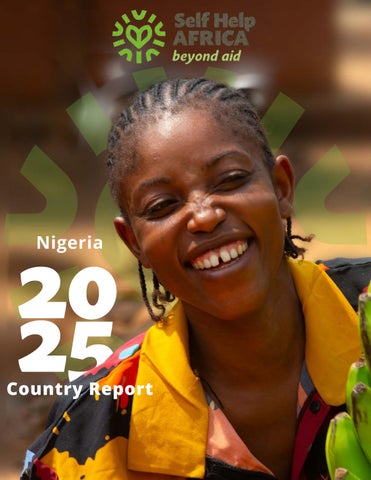
20 25 Nigeria
Country Report
2
Table of Contents Executive Summary
3
Who We Are
4
The Change We Are Working Towards
5
Our Approach
6
Programme Impact Areas - Strengthening Water, Sanitation & Hygiene Systems
7
Programme Impact Areas - Empowering Women and Building Inclusive Livelihoods
8
Promoting Climate-Smart Agriculture and Environmental Sustainability
9
Empowering Youth Through Inclusive Agricultural Livelihoods
10
Evidence of Impact
11
Stories of Change
12
Key Learnings, Conclusion
13
3
Executive
Summary In 2025, Self Help Africa (SHA) Nigeria demonstrated that sustainable development is achieved by strengthening systems, empowering communities and creating opportunities that endure beyond individual projects. Through an integrated portfolio, the organisation addressed critical challenges in Water Sanitation and Hygiene (WASH), climate resilience, food security, youth employment and gender equality.
BUILDING RESILIENT COMMUNITIES. CREATING LASTING OPPORTUNITIES. Our integrated approach strengthens systems, empowers people and drives sustainable change across Nigeria.
OUR INTEGRATED PORTFOLIO
WASH
CLIMATE RESILIENCE
FOOD SECURITY
STRONG WASH SERVICE DELIVERY
YOUTH EMPLOYMENT
GENDER EQUALITY
SYSTEMS FOR HEALTHIER FUTURES
SURWIN achieved a 94% functionality rate across rehabilitated rural water points.
WASH System for Healthadvanced technologies, strengthened domestic financing and philanthropic 10% accountability across the WASH sector.
EMPOWERING WOMEN. STRENGTHENING COMMUNITIES.
CLIMATESMART SOLUTIONS
We advanced women's economic empowerment through enterprise education and training, increasing incomes and expanding opportunities.
We promoted climate-smart agriculture and adaptive sanitation solutions in fragile settings, built resilience and safeguard livelihoods.
INVESTING IN YOUTH. BUILDING FUTURES. Youth in Work supported
50,000 young people
particularly women with skills training, enterprise support and productive resources to help them build better futures and drive local economic growth.
Through integrated action and local partnerships, SHA Nigeria is strengthening systems, empowering people and creating lasting impact for a more resilient and inclusive Nigeria.
4
Who We Are Self Help Africa (SHA) is an international development organisation dedicated to ending hunger and poverty by enabling communities to achieve sustainable livelihoods and healthy lives in a changing climate. In Nigeria, SHA has partnered with government, communities, civil society, the private sector and development partners for over two decades, delivering integrated solutions across more than 5,000 communities in Akwa Ibom, Benue, Cross River, Ebonyi, Lagos, Kano and Sokoto States. Guided by its vision of sustainable livelihoods and healthy lives for all, SHA addresses interconnected challenges through systems strengthening, community-led development, market-based approaches and enterprise development. Its work focuses on improving food systems, expanding economic opportunities, strengthening climate resilience and increasing access to sustainable WASHservices, while placing women, young people and vulnerable communities at the centre of development. In 2025, SHA implemented a diverse portfolio of programmes, including the Sustainable Rural Drinking Water Initiative in Nigeria (SURWIN), Improving Equitable Access to Basic Sanitation and Hygiene for People Living in Fragile Contexts (FragileSAN), Rural Women Enterprise (RWE) Accelerator Project Phase II, the Abatement of Short-Lived Climate Pollutants Project, WASH Systems for Health (WS4H), and the Youth in Work (YiW) Project. Together, these interventions strengthened institutions, improved livelihoods, promoted inclusive economic growth and enhanced community resilience, reflecting SHA's commitment to delivering evidence-based, locally led and sustainable development across Nigeria.
5
THE CHANGE WE ARE WORKING TOWARDS BUILDING RESILIENT COMMUNITIES. STRENGTHENING SYSTEMS. SHAPING FUTURES.
At Self Help Africa, we believe sustainable development is achieved when communities have the knowledge, resources and opportunities to shape their own future. Our integrated approach tackles interconnected challenges and creates lasting change.
1. LIVELIHOODS
We promote climate-smart agriculture, expand economic opportunities and support inclusive enterprise development.
5. PARTNERSHIPS FOR SYSTEMS CHANGE We work with government, civil society, development partners, the private sector and communities to build local capacity and strengthen policies and accountability.
2. WASH
We improve access to adequate water and sanitation services for healthier, more dignified communities.
OUR INTEGRATED APPROACH Stronger systems. Stronger institutions. Stronger communities. Better futures.
4. STRONG INSTITUTIONS AND GOVERNANCE
3. INCLUSION We invest in women's entrepreneurship, promote youth employment and support inclusive decisionmaking to ensure no one is left behind.
We strengthen governance, financing and service delivery to ensure reliable, inclusive and sustainable water and sanitation services.
OUR IMPACT By addressing root causes and linking programmes across livelihoods, WASH, inclusion, governance and partnerships, we create resilient communities, stronger institutions and inclusive economies ready to respond to future challenges and opportunities.
RESILIENT COMMUNITIES
STRONGER INSTITUTIONS
INCLUSIVE ECONOMIES
SUSTAINABLE SERVICES
LASTING CHANGE
Better equipped with withstand shocks and thrive over the long term.
More accountable, responsive and capable of delivering services.
More opportunities for women, youth and marginalised groups.
Reliable and inclusive water and sanitation for all.
Systems change that extends beyond individual projects.
TOGETHER, WE ARE DRIVING SYSTEMS CHANGE THAT PUTS PEOPLE, PLANET AND PROSPERITY FIRST.
6
Our Approach SHA advances sustainable development through an integrated, inclusive and collaborative approach that strengthens systems, builds livelihoods and empowers communities to thrive.
OUR APPROACH IS BUILT ON FIVE PILLARS
1 SYSTEMS STRENGTHENING THROUGH COLLABORATION
We strengthen the systems, capacities and opportunities that enable individuals and communities to thrive.
We work hand-in-hand with government institutions, communities, civil society and the private sector to improve governance, accountability, resource mobility and institutional capacity.
2
3
COMMUNITY-LED PARTICIPATION & OWNERSHIP
MARKET-BASED & ENTERPRISE DEVELOPMENT
We place communities at the centre of change.
We drive inclusive economic growth and resilient livelihoods.
Communities actively identify priorities, co-design solutions and lead implementation—ensuring trust, local ownership and sustainable outcomes that respond to real needs and realities.
We support access to skills, finance, productive assets and markets, and promote small and growing enterprises and smallholder farmers to enhance productivity and build sustainable businesses.
4
5
INCLUSION & EMPOWERMENT
STRONG MEAL SYSTEMS FOR EVIDENCE & LEARNING
We leave no one behind.
We use evidence to learn, adapt and improve.
We deliverate address barriers affecting women, youth and vulnerable groups, and promote meaningful participation and empowerment to drive social and economic transformation.
Our Monitoring, Evaluation, Accountability and Learning (MEAL) systems track results, promote accountability and inform decision-making for greater impact and continuous learning.
Stronger, more accountable systems and institutions
OUR IMPACT
Empowered communities leading their own development Resilient livelihoods and thriving local economies Inclusive opportunities for women, youth and vulnerable groups Evidence-based decisions for greater results and sustainability
Collaborating for Systems. Empowering Communities. Building Resilient Livelihoods.
7
Programme Impact Areas
Strengthening Water, Sanitation & Hygiene Systems In 2025, Self Help Africa advanced resilient, inclusive and sustainable WASH systems that improve services, strengthen institutions and empower communities across rural and underserved Nigeria. 2025 IMPACT HIGHLIGHTS
94%
POLICY WIN
FUNCTIONAL WATER POINTS Maintained a 94% functionality rate across rehabilitated rural water points through improved maintenance systems and accountability mechanisms.
100+
CROSS RIVER STATE WATER SUPPLY AND SANITATION LAW
COMMUNITY CHAMPIONS TRAINED
STRONGER SYSTEMS
ADAPTIVE SANITATION
Supported the development and passage of the Cross River State Water Supply and Sanitation Law, a milestone for sustainable WASH governance.
Strengthened citizen accountability and service oversight through training of over 100 community champions.
Worked with government, communities and sector partners to improve governance, infrastructure planning and sustainable financing by 169% in Kano and 211% in Cross Ricer for WASH services.
Through FragileSan, tested adaptive sanitation approaches that improved community participation and delivered sustainable service delivery in challenging environments.
OUR IMPACT
Stronger institutions. Effective governance. Sustainable financing. Engaged communities. Resilient WASH systems that deliver lasting benefits for rural Nigeria.
TOGETHER, WE DELIVER LASTING CHANGE
Self Help Africa continues to partner with government, communities and development partners to build resilient WASH systems that leave no one behind.
8
Programme Impact Areas
Empowering Women and Building Inclusive Livelihoods Women are key contributors to household and community development, yet barriers such as limited access to finance, markets, productive resources and decision-making opportunities continue to restrain their economic participation. In 2025, Self Help Africa advanced women's economic empowerment through the Rural Women Enterprise Accelerator Project (RWE Phase II) in Benue and Cross River States. Through Women Business Centres, rural women accessed business development support, digital skills, financial literacy, mentorship and market opportunities to strengthen their enterprises. The project demonstrated that combining enterprise support with efforts to address social and economic barriers can drive lasting change. Women reported improved incomes, savings practices, business growth, confidence and greater control over financial resources, enabling them to reinvest in their businesses and strengthen household resilience.
Digital literacy further expanded opportunities by helping women connect with wider markets and adopt improved business practices. Overall, RWE Phase II highlights that sustainable empowerment requires more than economic support, it requires strengthening women's agency, confidence and inclusion so they can lead businesses, influence decisions and contribute to resilient local economies.
Key Achievements
50
34
Accredited Women Business Mentors trained to support rural entrepreneurs.
Village Savings and Loans Associations (VOS) supported to strengthen small and credit access.
10
200
Enriched rural businesses provided with tailored support to improve education and profitability.
Women reached in mentorship and coaching sessions to build leadership and leadership capacity.
OUR IMPACT
200 Facilitators trained on business development, marketing, VSLA management and M&E.
16 market exhibitions organized to link rural women entrepreneurs with wider markets.
Stronger women. Thriving enterprises. Resilient households. Together, we build systems that leave lasting benefits for rural Nigeria.
TOGETHER, WE CREATE LASTING CHANGE
Story of Change - Empowering Women and Building Inclusive Livelihoods Lydia Ikebe: From Local Sales to New Market Opportunities For Lydia Ikebe, President of the Neborifem Women's Group in Busi 3, Obanliku Local Government Area of Cross River State, farming has always been more than a source of income; it is the foundation of her family's livelihood and a means of supporting other women in her community. For years, however, the group's efforts were constrained by poor market access. Bananas, one of the community's principal crops, frequently spoiled before reaching buyers because of unreliable transport links. Despite producing highquality harvests, women were often forced to sell at a loss or watch their produce perish before it reached the market. The Rural Women Enterprise Accelerator (RWE) Project transformed these circumstances by introducing digital literacy and practical marketing skills through the Women Business Centre. Equipped with tablets and trained to photograph and market their produce online, Lydia and her fellow entrepreneurs were able to connect directly with buyers beyond their local communities. Orders soon began arriving from Makurdi, Abuja and Kano, with some customers paying in advance and purchasing in bulk. The ability to reach wider markets increased confidence, reduced dependence on local traders and opened new opportunities for income generation. Reflecting on the experience, Lydia said:
“We now know so many things. We are better than before.” For Lydia, the project represented more than improved market access. It strengthened her confidence as a business leader, enhanced the economic resilience of the Neborifem Women’s Group and demonstrated how digital innovation can create new opportunities for rural women entrepreneurs. While transport challenges remain, the women of Busi 3 are now better equipped with the knowledge, skills and market connections needed to build more sustainable livelihoods.
9
10
Promoting Climate-Smart Agriculture and Environmental Sustainability Climate change, environmental degradation and unsustainable farming practices continue to threaten agricultural productivity and rural livelihoods in Nigeria, highlighting the need for sustainable agricultural practices that strengthen resilience while reducing environmental impacts. In 2025, Self Help Africa advanced climate-smart agriculture through the Abatement of Short-Lived Climate Pollutants (SLCPs) in the Nigerian Agricultural Sector by Reducing Open Field Burning project in Benue State. The project supported 550 farmers across 100 communities and strengthened the capacity of 45 agricultural extension offices to promote no-burn farming, climate-smart agriculture and integrated pest management.
Through farmer training, stakeholder engagement and extension system strengthening, the project increased the adoption of sustainable practices such as mulching, crop residue management and alternative improving soil health, conserving moisture and reducing harmful Irmavvovas, including low-cost briquette product from agricultural residues, demoral solutions to environmental challenges. By strengthening extension services and promoting sustainable farming practices, the project laid the more resilient and environmentally sustainable food systems. It also reinforced that scaling climate-smart agriculture required only knowledge and behaviour change, but also improved access to finance, agricultural inputs and markets to enable wider adoption and long-term impact.
Key Achievements 550
farmers uptake farming practices that are geared towards reducing open burning.
5
Farmer Field School sections conducted on no-burn alternative practices.
45
Local government Extension Officers improve their capacity on no-burn alternatives and Climate Smart Agriculture
Contribute towards Nigeria’s goals of Low Carbon Development and emissions reduction as set out in Nigeria’s National Implementation (NDC) document
23 demonstration farms established
Improve air quality in Benue State by significantly reducing emissions and particulate position from open field burning.
Empowering Youth Through Inclusive Agricultural Livelihoods Nigeria’s growing youth population presents both an opportunity and a challenge, as many young people face barriers to accessing skills, finance, productive resources, markets and decent employment opportunities, particularly within agriculture. In 2025, Self Help Africa strengthened 50,000 youth participation in agricultural value chains through the Youth in Work (YiW) Project in Kano and Sokoto States, in partnership with the Mastercard Foundation and World Food Programme. The project supported young women and men with technical, entrepreneurial and financial skills, alongside access to productive resources, markets and employment pathways.
50,000
OUR GOAL
KANO AND SOKOTO STATES
YOUTH
to participate in agricultural value chains through the Youth in Work (YIW) Project in 2025.
Stronger skills, better opportunities, and resilient, inclusive agricultural value chains.
Project implementation focused in Kano and Sokoto States, Nigeria.
OUR PATHWAY TO PRODUCTIVE AND INCLUSIVE LIVELIHOODS YiW equips young women and men with the tools, support and opportunities they need to succeed.
1
2
SKILLS DEVELOPMENT
MENTORSHIP AND ENTERPRISE SUPPORT
Practical training builds technical, entrepreneurial and financial skills for agriculture and agribusiness.
11
Ongoing mentorship and business support help youth start, strengthen and grow enterprises.
44
3
ACCESS TO PRODUCTIVE RESOURCES AND MARKETS Linkages to quality inputs, finance, technologies and markets open doors to productive opportunities.
EMPLOYMENT AND ENTREPRENEURSHIP Stronger businesses and jobs drive income, dignity and long-term prosperity for youth and communities.
PUTTING WOMEN AT THE CENTRE
SUSTAINABLE YOUTH LIVELIHOODS. RESILIENT AGRICULTURAL SYSTEMS.
The project prioritizes women’s economic inclusion by strengthening their skills, business capacity and participation in agricultural value chains, ensuring no one is left behind.
By working together with government, private sector actors and development partners, YiW strengthens the systems needed to expand youth employment and entrepreneurship opportunities and build inclusive, resilient agricultural value chains.
Story of Change - Empowering Youth Through Inclusive Agricultural Livelihoods Amina Mai Akwai: Building a Stronger Business Through Financial Literacy At 33 years old, Amina Mai Akwai manages five small businesses, including grinding services, the production of bean cakes and groundnut cakes, cooked rice vending, and the sale of fresh vegetables. Like many young entrepreneurs, she worked tirelessly to support her family, yet despite her hard work, she struggled to understand which of her businesses were generating profit and which were holding her back. Without separating her business finances or tracking income and expenditure, making informed business decisions was difficult. Although she remained determined to grow her enterprises, limited financial management skills restricted her ability to maximise their potential. This changed when Amina joined the Youth in Work (YiW) Project. Through training in financial management, budgeting, business planning, savings and investment, she gained practical skills that enabled her to manage each enterprise as a separate business. For the first time, she was able to monitor performance, identify profitable activities and make informed decisions based on evidence rather than instinct. The impact was immediate. Within a month of completing the training, Amina realised that while her bean cake business generated consistent profits, her vegetable business was operating at a loss. Armed with this knowledge, she adjusted her pricing strategy to better reflect market conditions and improve profitability. Reflecting on her experience, she explained:
I am repricing my vegetables to match market demand so I can make profit from the business as well. For Amina, the greatest transformation was not simply increased income, but greater confidence in her ability to manage and grow her businesses. The knowledge and skills gained through the project enabled her to move from uncertainty to informed decision-making, strengthening both her resilience and her long-term economic prospects. Amina's story illustrates how investing in young entrepreneurs with practical business skills, financial literacy and enterprise support can unlock sustainable employment opportunities, strengthen local economies and empower young people, particularly women, to build resilient livelihoods.
12
13
Working Towards Long-Lasting Impact
The results achieved in 2025 demonstrate the value of Self Help Africa integrated and system-based approach to development. Across its portfolio, the organisation generated evidence of change at individual, community and institutional levels, demonstrating that sustainable impact is achieved by strengthening systems, expanding economic opportunities and building resilience.
1. Stronger and More Sustainable WASH Systems Significant progress was made in improving the governance, financing and sustainability of water and sanitation services. The Sustainable Rural Water Initiative (SURWIN) maintained an average functionality rate of 94% across water points under its management, with long-term servicing arrangements that reduced breakdowns and improved service reliability. Through the WASH Systems for Health (WS4H) Programme, SHA supported the passage of the Cross River State Water Supply and Sanitation Law, strengthened evidence-based planning through comprehensive WASH assessments and water point mapping, mobilised domestic financing and enhanced citizenled accountability. In addition, the rehabilitation of 35 water facilities in Yala Local Government Area restored access to reliable water supply, while the promotion of non-potable reuse and market-based sanitation approaches in Makurdi Local Government Area stimulated more than 250 household sanitation improvements, demonstrating increased community investment in sanitation.
2. Increased Economic Opportunities for Women Women's economic empowerment remained a defining feature of SHA's work. Through the Rural Women's Enterprise Development (RWED) project, women strengthened their enterprises, improved savings behaviour and gained greater control over productive and financial resources. Increased confidence, stronger participation in household decision-making and growing social acceptance of women's economic roles demonstrated that meaningful empowerment extends beyond income generation to greater agency and inclusion.
3. Climate-Smart Agriculture and Environmental Sustainability SHA strengthened climate resilience by promoting environmentally sustainable farming practices that reduced reliance on open field burning and improved natural resource management. Through the Abatement of ShortLived Climate Pollutants Project, 550 farmers across 100 communities adopted climate-smart agricultural practices, while 45 extension officers were trained in no-burn alternatives and climate-smart agriculture.
4. Expanded Opportunities for Young People Through the Youth in Work Project, 50,000 young women and men strengthened their participation in agricultural value chains by developing technical, entrepreneurial and financial management skills. Improved access to productive resources, enterprise support and market opportunities enabled participants to build more sustainable livelihoods, while targeted support for young women strengthened their economic participation and leadership within local farming.
5. Strengthened Institutions and Local Capacity Beyond programme-specific achievements, SHA continued to strengthen the institutions that underpin sustainable development. Government agencies, community structures, sanitation entrepreneurs, agricultural extension officers and local authorities improved their coordination and capacity to deliver services more effectively. These investments in local leadership, institutional systems and partnerships are helping to ensure that programme benefits are sustained beyond the life of individual projects.
94% of water points under SURWIN maintained with long-term servicing.
45 extension officers trained in climate-smart agriculture, promoting sustainable practices.
23 demonstration farms established.
5 key institutions built capacity to deliver more effective services.
6
evidence from completed projects confirms stronger systems, resilience and improved practices.
7 greater adoption of climate-smart practices reducing emissions and improving farming.
14
Key Learnings
01
02
03
Strengthening Systems Ensures Sustainability:
Economic Empowerment Must Address Structural Barriers:
Climate-Smart Agriculture Needs Enabling Systems:
Sustainable outcomes require strong governance, maintenance and accountability systems alongside service delivery.
Combining enterprise support with digital inclusion, financial literacy and social norm change delivers stronger and more lasting outcomes for women.
Scaling climate-smart practices depends on improving access to finance, inputs, markets and supportive incentives.
04
05
Fragile Contexts Demand Adaptive Programming:
Effective interventions in fragile settings require flexibility, sustained engagement and stronger humanitarian-development coordination.
06
Strong MEAL Systems Improve Programme Effectiveness:
Partnerships and Local Ownership Sustain Impact:
Real-time data, community feedback and continuous learning enable adaptive management, accountability and better results.
Collaboration with government, communities and partners strengthens ownership, coordination and long-term sustainability.
07 Integrated Approaches Deliver Lasting Change: Sustainable development is achieved by strengthening systems, addressing structural barriers, empowering communities and adapting programmes based on evidence.
CONCLUSION The achievements of 2025 demonstrate that sustainable development is built on strong partnerships, resilient systems and empowered communities. Working with government, development partners, the private sector and local communities, Self Help Africa Nigeria delivered integrated, evidence-based programmes that strengthened institutions, improved livelihoods, advanced climate resilience, expanded economic opportunities and enhanced WASH systems. Our experience reaffirmed that lasting impact is achieved by placing local ownership, inclusion and systems strengthening at the centre of development. These successes were made possible through the commitment of our partners and the leadership of the communities we are. As we look ahead, Self Help Africa Nigeria remains committed to strengthening systems, expanding partnerships and scaling proven solutions that build resilience, improve livelihoods and drive inclusive, locally led sustainable development.
Sustainable livelihoods and healthy lives for all in a changing climate 48, Anthony Enahoro Street, Utako, Abuja, FCT. Nigeria. + 234 (0) 807-887-2798 info.nigeria@selfhelpafrica.org www.selfhelpAfrica.org/nigeria
Connect with us