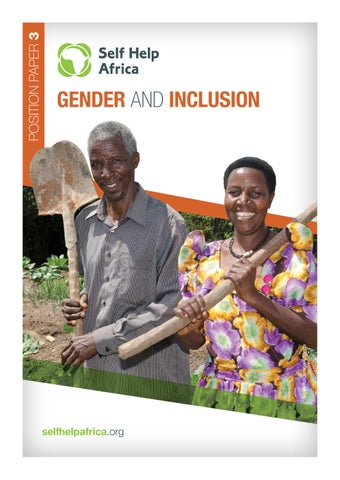
Agnes Katushabe, Uganda
Position Paper 3
Gender and Inclusion
selfhelpafrica.org
Position Paper 3
Lonasi Sikwese,Lubeni Village, Malawi
The Challenge
Gender Equality
T
he Food and Agriculture Organisation (FAO) recognizes that rural women and men together hold the keys to ending hunger and extreme poverty. Rural women and girls, in particular, are recognized as major agents of change. Across the developing world, women make up 50 percent of the agricultural labour force. As farmers and farm workers, horticulturists and market sellers, businesswomen, entrepreneurs and community leaders, they fulfil important roles throughout agrifood value chains, as well as in the management of natural resources, such as land and water. Yet the gender gap in food and agriculture is extensive. As consumers, women are more likely to be food-insecure than men in every region of the world. And as producers, rural women face even greater constraints than their male counterparts
2
in accessing essential productive resources and services, technology, market information and financial assets. They are under-represented in local institutions and governance mechanisms, and tend to have less decision-making power. In addition to these constraints, prevailing gender norms and discrimination often mean that women face an excessive work burden, and that much of their labour remains unpaid and unrecognized. Experience shows that enhancing gender equality in rural areas is indeed a key instrument to fight poverty and hunger. Empowering women also empowers and benefits men; the key to improved agriculture, food security and nutrition lies in the involvement of men, women, boys and girls.1 1 See FAO, http://www.fao.org/gender/background/en/
What are we committed to? In SHA
In Ireland
In Embracing Change - SHA’s Strategic Plan 2017– 2021 SHA recognised the missed potential in agricultural productivity resulting from failing to invest in women. Given the prominence of women among Africa’s smallholders, gender equality is essential to achieving our goals and will, therefore, remain a constant feature of our work.
A Better World – Ireland’s Policy for International Development, , recognises that “in many poor countries, women are an untapped resource that can bring about transformative change with the right support.” The document defines gender equality as a key policy priority for Ireland and qualifies it as fundamental for transformation and reaching the furthest behind first. The policy commits to having an overarching focus on women and girls in all partnerships and interventions.
All activities undertaken by SHA currently promote discussion and mutual understanding of issues between women and men with regard to gender roles, unequal workloads and decision making to raise awareness, inform programming and address gender inequality. Ultimately, across all of our work, we seek to increase women’s voice, choice and control; their voice in collective spaces (producer associations, cooperatives, family home etc.), their decision-making power (choice) and their control over economic resources produced as a result of their labour.
INTERNATIONALlY SHA’s support for gender equality and inclusion is part of our response to the UN call for Leaving No-one Behind, an underlying principle running across all 17 Sustainable Development Goals. Our gender-related work will contribute in particular to SDG 5: Gender Equality
5.2 Eliminate all forms of violence against all women and girls in the public and private spheres, including trafficking and sexual and other types of exploitation 5.3 Eliminate all harmful practices, such as child, early and forced marriage and female genital mutilation 5.4 Recognize and value unpaid care and domestic work through the provision of public services, infrastructure and social protection policies and the promotion of shared responsibility within the household and the family as nationally appropriate 5.5 Ensure women’s full and effective participation and equal opportunities for leadership at all levels of decision-making in political, economic and public life
5.6 Ensure universal access to sexual and reproductive health and reproductive rights as agreed in accordance with the Programme of Action of the International Conference on Population and Development and the Beijing Platform for Action, and the outcome documents of their review conferences 5.a Undertake reforms to give women equal rights to economic resources, as well as access to ownership and control over land and other forms of property, financial services, inheritance and natural resources, in accordance with national laws 5.b Enhance the use of enabling technology, in particular information and communications technology, to promote the empowerment of women 5.c Adopt and strengthen sound policies and enforceable legislation for the promotion of gender equality and the empowerment of all women and girls at all levels
Gender and inclusion
5.1 End all forms of discrimination against all women and girls everywhere
3
Equality According to UNICEF “equality means that women and men, and girls and boys, enjoy the same rights, resources, opportunities and protections. It does not require that girls and boys, or women and men, be the same, or that they be treated exactly alike.”2 Inequality between women and men is a relational issue and so inequalities are not going to be resolved through a focus on women only. Much more attention needs to be brought to the relations between women and men, particularly with regard to the division of labour, access to and control over resources, and potential for decision-making. There must be increased understanding of the importance of seeking out male allies and working with men to jointly redefine gender roles and relations. Thus we need to move away from women as a target group, to gender equality as a development goal.
Julia Gitari, Kenya
Position Paper 3
What do Equality and Inclusion mean to us?
Equity, which is the process of being fair to women and men, is key in the pursuit of gender equality. Empowerment Women’s empowerment is also essential in addressing gender inequality. The concept of empowerment is related to gender equality but distinct from it. The core of empowerment lies in the ability of a woman to control her own destiny. It involves awarenessraising, building self-confidence, expansion of choices, increased access to and control over resources and actions to transform the structures, which reinforce and perpetuate gender discrimination and inequality. This implies that in order to be empowered, women must not only have equal capabilities (such as education and health) and equal access to resources and opportunities (such as land and employment), they must also have the agency to use those rights, capabilities, resources and opportunities to make strategic choices and decisions (such as provided through leadership opportunities and participation in institutions). Empowerment comes from within; women empowering themselves. Our inputs to promote the empowerment of women should facilitate women’s articulation of their own needs and priorities and we need to be pro-active in promoting these interests and needs. Inclusion As mandated by the new Sustainable Development Goals agenda, we are called to “leave no-one behind”. This requires both urgency and responsibility on the 2 UNICEF, Gender Action Plan 2018-2021.
4
part of us all to ensure that women, men, boys and girls enjoy equal opportunities and benefits arising from all our interventions. This is very much part of our vision of change, which is based on transformed gender relations and enhanced human dignity. Self Help Africa is committed to identifying and removing barriers that prevent the inclusion of more vulnerable groups, and ensuring that neither age, disability, health status, tenure of land, nor gender should be a barrier to participating and benefitting from our programmes.
OUR VALUE PROPOSITION In SHA, we work towards ensuring that all our programmes are gender transformative and drive changing power dynamics within our beneficiaries, households and communities. Our focus: •
Increasing decision-making power (voice, choice and control)
•
Increasing economic independence
Our key differentiator is the Family Life Model, explained on the following page.
Mainstreaming Gender into Programming
How to Start As part of our programme cycle management, a gender analysis is undertaken together with baseline studies. A gender analysis is the systematic gathering and examination of information on gender differences and relationships between women and men, girls and boys, in terms of their relative distribution of resources, opportunities, constraints and power, in a given context. A gender analysis is the starting point to identify, understand and redress gender inequalities and look at the different impacts of development interventions on women, men, girls and boys. Once we have that picture of the differences, programmes are designed to overcome barriers and ensure that women and men can participate equally. Our approach in the programme design focuses on: • Increasing decision making power and agency • Increasing economic independence Throughout the programme cycle we intervene in the stages indicated in the graph below3, always ensuring the use of a gender lens.
The Family Life Model (FLM) Our gender approach has a distinct methodology which we have adopted as our overarching framework in SHA – the Family Life Model. The FLM is a family-led, pro-poor gender transformative methodology which uses inclusive and participatory processes to address issues of gender inequality and social exclusion in development interventions. The approach is centred around the family as an agent of change and transformation in the community and aims at challenging traditional notions of gender roles and responsibilities in order to achieve greater equality between men and women, boys and girls. In particular, the approach focuses on changes in areas of voice, choice and control as key determinants / qualifiers of real empowerment. The methodology consists of: • A set of principles related to equality and inclusion • A series of tools used for analysis and assessments, training and capacity building, planning and monitoring • Mentoring and peer learning mechanisms and processes (structures) for knowledge and attitude change, and for scaling up • Mechanisms to integrate FLM into areas of climate and agriculture, food and nutrition security, and agrienterprise development • Mechanisms to integrate FLM into advocacy and policy efforts to challenge structural challenges Distinctive features include: • SHA Gender Assessment Tool based on voice, choice and control • Family action planning tool The FLM covers the full life cycle of a project from assessment to evaluation.
3 See Anne e Marie Golla, Anju Malhotra, Priya Nanda and Rekha Mehra, Measuring Women’s Economic Empowerment, International Centre for Research on Women, 2018. Page 4, Figure 3: A Framework to Measure Women’s Economic Empowerment.
Gender and inclusion
F
or us, gender integration refers to taking into account both the differences and the inequalities between women and men, girls and boys in development programme/ project planning, implementation and evaluation. The roles of women and men and their relative power affect ‘who does what’ in carrying out an activity, and who benefits. Taking into account the inequalities, and designing programmes to reduce them, should contribute not only to more effective development programmes but also to greater social equity/equality.
5
Mango Processing in Malawi
Position Paper 3 What can research contribute? SHA works with research institutions and other agencies to assess the impact of existing and emerging approaches to gender transformative initiatives. Furthermore, we undertake research to understand, document and overcome the constraints to the systematic integration of gender equality dimensions into value chain development programmes and projects.
Mwata Sakala and Jacob Banda, Zambia
How do we advocate for equality and inclusion? SHA supports advocacy efforts to promote and integrate the ‘Leave No One Behind’ agenda with emphasis on women and girls, youth, the elderly, and persons living with disability. We do so in all of our target countries through donor support and partnerships with civil society, academia and businesses. We work through our national and international networks, including the Irish Forum for International Agricultural Development (IFIAD), Dóchas and its Working Groups, the Irish Consortium on Gender Based Violence, the Gender and Development Network (UK), and Coalition 2030. In-country SHA advocates for greater inclusion of gender consideration in relevant legal, policy and institutional frameworks and engagement in sector reforms.
6
In Practice The list below provides examples of gender and inclusion initiatives promoted by SHA over the years.
1
Knowledge: increasing knowledge and information with regard to agriculture, nutrition and enterprise
2
Labour: promoting an understanding of the triple role of women (caring, productive, community management) with a view to enhancing a more shared workload within the family and community
3
Decision-making power: sensitizing family members and communities with regard to unequal power relations and encouraging women to use their voice in decision making
4
Income: increasing discretionary income, with particular attention given to crops/livestock produced by women
5
Access to services: improving women’s access to extension services, financial services, technology (emphasis on labour and time saving ones), inputs, markets
6
Assets: improving access to assets (including seeds, crops, livestock)
Gender and inclusion
In particular, our focus is on:
7
Position Paper 3
Some useful resources • Guide for Gender and Inclusion • Guide to Integrating Gender into SHA Programming • The Family Life Model (FLM) – Guide to Implementation • Gender Training Manual (to be used in conjunction with FLM Guide) • Guide to Disability and Inclusion • Guidelines for Conducting Community Dialogue for Gender Champions • Guide on Integrating Gender in Business and Enterprise Development
ethiopia PO Box 1204 Addis Ababa Tel. +251 116 620 659
kenya
dublin
PO Box 25503-00100 Nairobi Tel. +254 703 946477
Kingsbridge House, 17-22 Parkgate Street, Dublin 8, Co. Dublin Tel. +353 (0)1 6778880
malawi
belfast
PO Box B-495 Lilongwe, Tel. +265 175 0568
uganda P.O. Box 34429, Plot 44 Ministers’ Village, Ntinda, Kampala Tel: +256 414 286 305
41 University Street Belfast, NI, BT7 1FY Tel: +44 (0)28 90232064
shrewsbury Westgate House, Dickens Court Hills Lane, Shrewsbury, SY1 1QU Tel. +44 (0) 174 327 7170
west africa
London
12 PO Box 418, Ougadougou 12, Burkina Faso Tel. +226 503 68960
14 Dufferin Street, London, EC1Y 8PD Tel. +44 (0) 20 7251 6466
zambia
USA
87 Provident Street, Fairview, Lusaka tel +260 211 236 595
41 Union Square West, Suite 1027 New York, NY 10003, USA Tel. +1 212 206 0847
www.selfhelpafrica.org