POSITION PAPER 7
COMMUNITY-LED PROGRAMMING
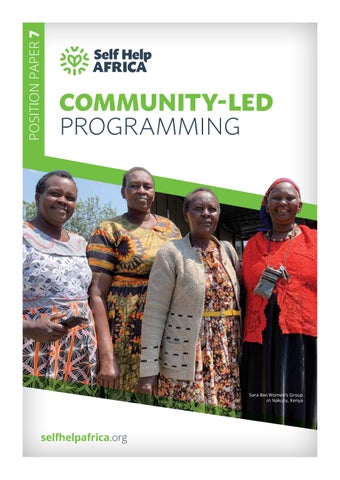
Sara Bwi Women’s Group in Nakuru, Kenya
selfhelpafrica.org
POSITION PAPER 7
Uwezo Women’s Group, Nyandarua Kenya
Introduction to Community-led Programming
T
he discussion around community-led programming dates back to the early seventies when the proliferation of NGOs as direct service providers in underserved communities began to raise questions about how decisions were being made in development programming.
As far back as the late nineties, organisations like the Organization for Economic Cooperation and Development (OECD), the World Bank and the United Nations, have articulated the need to transform the common development approach whereby actors in the global north dictate policy and development objectives for chronically under resourced and underserved communities in the global south.1 In its early iterations, the localisation conversation has centred around promoting participatory methods, capacity training to bring civil society up to international standards, and closer cooperation with government programming.
While progress has been made in this area with increased accountability, reduced duplication, and more equitable representation, it is increasingly recognised that the international development community is falling short in achieving truly locallyowned development programming and systemic change.2 It is also recognised that actual practical use of community-led programming has never fully been realised in the international development sector, largely because funding structures are designed to be top-down and accountability mechanisms follow this power dynamic. Currently, many multilateral donors and international non-governmental organisations are grappling with the ways in which they have not achieved the grassroots mobilisation that would truly allow community-led programming to emerge and drive the development agenda. This presents a unique opportunity for those most impacted by development programming to claim a position of leadership in its design and for INGOs to accompany these voices as an advocate and enabler.
2 h ttps://oecd-development-matters.org/2020/10/14/ implementing-the-sdgs-why-are-some-civil-society-organisations1 https://cooperation.ca/localize-or-perish/
2
being-left-behind/
What are we committed to? IN SELF HELP AFRICA Self Help Africa’s (SHA) core values of Impact, Innovation, and Community are inherently aligned with our commitment to community-led programming. As an organisation, We are accountable, ambitious and committed to systemic change; We are agile, creative, and enterprising in an ever changing world; and we are inclusive, honest, and have integrity in our relationships. To us, “community-led” means practising these behaviours as a facilitator, a supporter, and an advocate for the members of the communities we serve. We are inclusive in terms of who we define as a community partner in this context, taking on this role for local civil society, member-based organisations, private sector entities, local government, and individuals. A complete articulation of these values and behaviours can be found in our 2023-2027 Global Strategy. SHA recognises that while these values and behaviours are aspirational and enshrined in our strategy, they are also not a given. Each day we must work as an organisation to practise these behaviours and uphold these values. We are inclusive in terms of who we define as a community partner, recognising the contributions of local civil society, member-based organisations, private sector entities, local government, and individuals. SHA is committed to the implementation of community-led programming which has the potential to strengthen the impact of development programming by ensuring sustainability through ownership, increase the efficiency of programming by reducing duplication and ensuring that it is demand-driven, and create a more ethical and egalitarian framework for development that tackles the imbalances of power inherent in the system.
The Irish Development Sector has identified locally-led programming as an essential piece of its efforts to support the sustainable development goals and the development agenda of the Irish government. Rather than implementing a top-down approach to localisation, which would be antithetical to the concept itself, the Irish Government, including Irish Aid, is drawing from the perspectives of INGOs through the Dochas INGO alliance to craft its response to localisation. Self Help Africa is committed to this process and to advocating for an adaptive, grassroots approach at all levels of policy creation.
INTERNATIONALY While the Sustainable Development Goals highlight localisation as a necessary ‘whole society approach’, many donors and development actors are well short of their mark for locally disbursed funds and many still have not developed metrics to measure meaningful transformation in this area.3 Globally, International Non-Governmental Organisations (INGOs) are seriously grappling with the need to develop robust and impactful localisation and locally led programming policies and are critically reviewing efforts in the humanitarian sector with the Grand Bargain and Charter for Change. This is necessitated by the recognition that “business as usual” is failing to create the grassroots mobilisation and systemic change necessary to address growing inequality, the climate crisis, and the myriad knock-on effects created by these crises. This is occurring alongside shifting donor priorities and the reduction in funds available for development programming which are necessitating important conversations about the roles of INGOs in international development. Simultaneously, many Global South governments are increasingly discussing the need for localisation policies that support the development of local actors including public sector agencies, civil society, etc. Many countries where Self Help Africa operate now have policies in place or will have them shortly. 3 h ttps://unstats.un.org/sdgs/report/2019/?_gl=1*17lmdvk*_ga*MTcyMTgyNDI1Ny4xNjc0NzQ5NjQ5*_ga_ TK9BQL5X7Z*MTY5ODM0NjA0Mi4xLjEuMTY5ODM0NjA1Ni4wLjAuMA..#
COMMUNITY-LED PROGRAMMING
IN IRELAND
3
POSITION PAPER 7
Uwezo Women’s Group, Nyandarua Kenya
What does Community-led Programming mean to us?
CLIMATE CHANGE
ES
FO COMMUN ITY -
WA
ND
IN C
RKET-B ASED
OME
UR NAT
SO
MA
RE
TA
URC
POVERTY
EN
4
HUNGER
SOCIAL INEQUALITY
OYM
In order to achieve these positions, SHA identifies several areas of structural and relational change that are required. At the structural level, we set out specific steps for a locally-driven approach to programme design and implementation, equitable and accountable financial processes, localised procurement policies, and an inclusive and locallyrooted human resource approach.
ENT ER
D LE
E MPL
For Self Help Africa, “community-led” refers to a transformational approach to partnership based on the organisations positions of mutual support, leadership by those most affected, and collective purpose. Often referred to as reciprocity, subsidiarity, and solidarity, respectively, these positions inform a role of accompaniment for SHA OU S whereby we recognise our mutual R C O Lstake O U R and role in addressing hunger, climate change, poverty, and social inequality at all levels.
OD
R TE -FOCUSED ISE PR
S
elf Help Africa’s (SHA) newly updated Global Strategy positions community-led programming alongside a market-based approach and a focus on enterprise as central themes of its approach to addressing hunger, climate change, poverty, and social inequality. COLOU RS OUR
AL
At the relational level, we chart a path for capacity strengthening based on mutual learning; investment and financing of local entities to develop contextually relevant and appropriate administrative capacity; and direct engagement with all forms of local partners including civil society, private sector, member based organisations, government, and individuals. Spanning all of our departments, teams, and policies, communityled is a practical representation of the values and behaviours defined in our global strategy.
Where We Begin
T
his position paper sets out a process by which SHA begins with the structural transformation of existing policies, practices, and resource flows, builds new relational frameworks for engagement with our partners, and progresses towards transformative change which enables community-led development to flourish. The ultimate goal is a process which enables ours and our partners shared ambition to alleviate hunger, poverty, social inequality, and the impact of the climate crisis through a community-led, marketbased, and enterprise-focused approach. This effort is present across our work to ensure that people have access to nutritious food, clean water, decent employment and incomes, all while sustaining natural resources.
To achieve this systemic change, a human centred design approach is encouraged. The steps for localisation closely follow the process of mutual learning with all involved parties, jointly visioning objectives, cocreating a prototypical methodology to achieve them, and then testing it iteratively until it works. Importantly, community-led programming should include a place for failure and adaptation, as well as disagreement and negotiation. Drawing from this position paper, each country will develop a grassroots communityled approach strategy that is harmonised with their 5-year strategy, the Global Strategy, and our evolving understanding of “community-led”. In turn, SHA will further draw from these various teams to evolve the Global Community-led Policy document which will guide SHA’s ongoing efforts.
PROTOTYPING
HUMAN CENTRED DESIGN EN
UNDERSTAN
DI
N
REATE
REFINE
PROTOTYPING
SCALING
CO-C G
MUTUAL LEARNING
TE
ENVISION
ST
& MONITO
R
ADAPT
This human centred design approach informs the use of the below systems change framework4 which aims to address the explicit structural change required of SHA as an organisation so that our programming is community-led, engages the semi-explicit relational changes required for new forms of external partnership, and ultimately achieves transformative change in how we look at partnership altogether. It’s important to note that no one area of focus is more important than the other and that many are interlinked. Below, we discuss these thematic areas of change in more detail. 4 https://collectiveimpactforum.org/resource/the-six-conditions-of-systems-change-virtual-coffee/
COMPLIANCE & RISK
FINANCIAL ACCOUNTABILITY
DIRECT ENGAGEMENT
HUMAN RESOURCES
INVESTMENT & FINANCING
ACCOMPANIMENT
PROCUREMENT
CAPACITY STRENGTHENING
STRUCTURAL CHANGE
RELATIONAL CHANGE
TRANSFORMATIVE CHANGE
COMMUNITY-LED PROGRAMMING
D
P EE
5
POSITION PAPER 7
COMPLIANCE & RISK In creating a framework for mutual accountability and the sharing of risk, SHA recognises the importance of gathering and incorporating feedback from our partners on the types of risks present in our work and the methods, like our compliance and due diligence processes, which mitigate them. However, we also recognise the importance of risk to the work we do and the opportunity and risk reward that comes from innovation and mutual trust. Defining these parameters and designing compliance and risk management processes that are based on shared trust, shared responsibility, and shared benefit is essential to this process. As such, we begin with feedback and listening sessions with partners at the country office and international level. This builds on the use of our existing Partnership Guide & Organisational Capacity Assessment (OCA) tool, using participatory methods like visioning sessions to address the positive aspects of risk in partnership and goals for improving our mechanisms. From there we prototype and test new approaches to managing risk and share the learnings across the organisation. As we develop this approach as an organisation, we will look to expand this process from formal civil society, public, and private sector
partners to include community-level partners and individuals that we work with. This includes engaging with community & member based organisations and representatives which have been put forward by these groups to interact with SHA in partnership. Where necessary, we should continue to support the formation of these entities and groups to enable this long-term coordination. At the staff level, integrating the Power Dynamic Analysis tool into programme initiation is another avenue to developing this, as is strengthening our capacity for risk analysis and response amongst our facilitators. Based on our findings from this review, there is significant opportunity to coordinate with other INGOs at the regional, national, and international levels to ensure alignment on minimum standards as part of reducing the burden on local partners to complete varied and inconsistent compliance & due diligence processes. Exploration of the use of Due Diligence Passports is part of this process, however SHA sees greater potential in advocating for standardised compliance requirements from donors first before trying to create piecemeal passports between individual organisations.
COMPLIANCE & RISK MANAGEMENT
COMPLIANCE & RISK MANAGEMENT
Q1 & Q2 2024
PARTNER FEEDBACK SESSIONS ON COMPLIANCE & RISK FRAMEWORKS
Q3 & Q4 2024
ALIGNMENT WITH OTHER INGOS ON MINIMUM REQUIREMENTS & INFO SHARING REVIEW OF PARTNERSHIP AGREEMENT & SELF-ASSESSMENT PROCESS
6
2025 ONWARD
ADVOCACY TO MULTI-LATERAL DONORS FOR STANDARDIZED COMPLIANCE & DD REQUIREMENTS UPDATING GLOBAL COMPLIANCE PROCESSES
FINANCIAL ACCOUNTABILITY In building mechanisms for this horizontal accountability with our partners, SHA is reviewing our indirect cost recovery policy at the global level to ensure equitable distribution of administrative resources. This policy is to be considered in alignment with this position paper and forthcoming communityled policy. We are also developing a SHA Carbon Revenue Policy which ensures equitable and ethical frameworks for revenue generation and reinvestment. At the core of this is a model for “free, prior, & informed consent” (FPIC) which is present at each stage of the partnership development process and ensures FINANCIAL AC C O U Nequitable T A B I L Iand T Y fair distribution of resources, time, and risk.
As we explore new modalities of financing which are situationally adaptive and based on equitable partnership, SHA is adamant that community-led programming cannot come at the cost of financial accountability. Our rigorous financial accountability mechanisms will be maintained and further strengthened over the course of our current 5-year strategy and beyond. We also recognise that we are not just accountable “vertically” to donors but also accountable “horizontally” to the partners we work with.
Q3 & Q4 2024
2025 ONWARD
PARTNER FEEDBACK SESSIONS ON COST RECOVERY POLICY & ON-GRANTING CAPACITY
REVIEW AND UPDATE COST RECOVERY & LOCAL PARTNER ON-GRANTING MINIMUM REQUIREMENTS
ADVOCACY TO MULTI-LATERAL DONORS FOR EQUITABLE & REALISTIC COST RECOVERY POLICIES
REVIEW OF PARTNER INTEGRATION INTO FINANCIAL REPORTING TOOLS
ALIGNMENT WITH CLIMATE FINANCE POLICY
STANDARDIZATION OF PARTNER FINANCIAL MANAGEMENT
HUMAN RESOURCES and listening sessions at the country level, and SHA’s commitment to locally-managed country practical alignment of our values and behaviours programmes is part of our efforts to ensure the local within the hiring and performance review process. relevance and appropriateness of our programming. Coherent balance between centralisation and Explicit articulation of this model will be a strong decentralisation is key to localised management, element of our community-led approach, as will the recognising both the need to make locally relevant way we position our global expertise and capacity for hiring decisions while also countering nepotism and innovation. This should also include articulation of unequal resource capture. In the coming year, our local working conditions, pay scales, and incentive efforts to address this will draw from the findings of structures H U M A N R E S O U R C E that S are ethical. the ARISE social audit of the organisation, consultation
Q1 & Q2 2024
LISTENING SESSIONS WITH STAFF AND REVIEW OF HR POLICY DIFFERENCES ACROSS THE ORGANISATION REVIEW AND INTERPRETATION OF ARISE FINDINGS
Q3 & Q4 2024
STAFF TRAININGS ON SELECTED AREAS (POWER ANALYSIS, FACILITATION, GENDER MAINSTREAMING, SAFEGUARDING, ETC)
2025 ONWARD
ITERATIVE TESTING AND REVIEW OF HR POLICY & HIRING PRACTICES CROSS-LEARNING BETWEEN COS AND REVIEW OF GLOBAL POLICY
COMMUNITY-LED PROGRAMMING
Q1 & Q2 2024
7
POSITION PAPER 7
PROCUREMENT SHA is an enterprise-focused organisation and as such we are committed to moving away from the centralised procurement of inputs and service providers and instead adopt approaches that support local enterprise and business and develop strong local markets that are self-sustaining. Our efforts towards localising procurement processes include prioritising goods and services from local entities, increasing the autonomy of local civil society and government to work with the private sector, and investing in private sector partners through the same methods used with civil society and government partners.
merchants for agricultural input procurement. This will enable us to be more flexible to external factors like rapidly changing climatic conditions and ensure we’re supporting local business as part of our communityled efforts. Simultaneously, SHA will review its policy for local partner procurement thresholds, seeking to expand their autonomy for making decisions on procurement and develop service-based partnerships that extend across projects and activities. Through this process, SHA will inform its advocacy strategy to donors to ensure that this approach is backed by consistent policy and demonstrable impact.
Centralised procurement provides little benefit to local communities, often undermines local businesses and invariably results in delays in getting services and supplies into the hands of the intended users. This is particularly important for our work in agricultural value chains where our default mode must be to use seed fairs, vouchers (electronic or paper) or cash transfers or prequalified seed and other input
These efforts will complement SHA’s broader effort to expand its strong organisational assessment and partnership development processes to non-civil society entities as part of our recognition of the important role that private sector and enterprisefocused organisations play in community-led development.
PROCUREMENT PROCUREMENT
Q1 & Q2 2024
REVIEW OF PROCUREMENT POLICY & LISTENING SESSIONS WITH COUNTRY OFFICES ON DECENTRALISED PROCUREMENT
8
Q3 & Q4 2024
REVIEW & UPDATE PROCUREMENT POLICY TO REFLECT PROPOSED SELECTION MODALITIES
2025 ONWARD
ITERATIVE TESTING AND REVIEW OF PROCUREMENT PROCESSES AND REPRESENTATION OF LOCAL BUSINESS AS METRIC
CAPACITY STRENGTHENING SHA recognises that our development partners have a wide range of capacities for community organising, mobilisation, and development in a wide range of contexts where we work. We also recognise that many are not able to match this implementation capacity with the administrative, financial, governance, accountability, and other requirements of submitting competitive proposals to multilateral donors or managing a multi-region project at scale. Through mutual capacity strengthening, SHA aims to learn from our local partners while also sharing our expertise and capacity. Rather than trying to turn local NGOs into international NGOs, our capacity strengthening approach is built on mutual support and benefits.
In identifying these areas of mutual capacity strengthening, SHA draws from the “5 Capabilities” (5C) framework which tensions an organisation’s ability to create value for others against its ability to act, relate to and attract support, adapt and selfrenew in the context of a changing environment, and balance diversity and coherence of its strategy and decision making processes. Through this framework, our mutual learning and capacity strengthening efforts expand beyond simple administrative support and technical expertise to include a holistic approach to organisational strengthening based on partnership and symbiotic support. This is particularly important in the context of the climate crisis and complex emergencies which threaten the long-term sustainability of our agenda-based partnerships and their sustainable impact.
RELATE & ATTRACT
CREATE RESULTS OF VALUE TO OTHERS
BALANCE DIVERSITY & COHERENCE
SHA’s approach to mutual learning is based on the bi-directional exchange of information and support, as well as agenda-driven partnerships which go beyond individual projects. This is required to affect transformative change towards the SDGs at the global scale. In practical terms this means pre-project coordination with local partners to identify complementary strengths and weaknesses in implementation and administrative capacity that align towards strategic objectives rather than project-specific requirements from donors. It also
ADAPT & SELF-RENEW
means coordination with international actors, including other INGOs to eliminate duplication and align our value propositions to maximise our benefit to local partners. Towards this end, SHA will use and evolve our existing OCA tools and update our Partnership Guide using a human centred design process in the first half of 2024. This updated guide will include refined selfassessment processes that support equitable and honest reflections on strengths and weaknesses for all partnered organisations and set out contextualised frameworks for progress against strengthening these five capabilities.
COMMUNITY-LED PROGRAMMING
COMMIT & ACT
9
POSITION PAPER 7
PARTNER INVESTMENT One of the most common measures of localisation to date is the percentage of programme and project funding that is directly on-granted to local partners. While SHA views our community-led approach as much broader than this, on-granting of both implementation and administrative funds remains an essential component of community-led development at this stage. Currently, many national governments are setting their own standards for on-granting requirements in development programming, as are multi-lateral donors. In this context, SHA is committed to ensuring the equitable distribution of development funds which support organisational autonomy and unique methods and approaches to grassroots development. Beginning with our Cost Recovery Policy, which is finalised at the end of 2023, SHA will review and update its policy for on-granting percentages through review of national and sector policies towards our commitment of a minimum 25% of programme funding on-granted by 2027. This minimum rate will be formalised in our updated partnership guidelines and forthcoming community-led policy and will inform country-specific fixed rates, which may vary. Importantly, review of these policies on a case-by-case basis with partners will be part of our human centred design approach to programme co-creation. In addition to on-granting, SHA’s approach to partner investment includes leveraging new funding
sources that expand their autonomy over financing decisions and improve their ability to invest in their organisational development and capacity strengthening. Climate and carbon financing present unique opportunities in this space where SHA is developing its capacity to facilitate community access to carbon credits through sequestration and mitigation programming. SHA’s carbon policy, including its frameworks for community receipt and use of funds, will be finalised in Q2 of 2024. The leveraging of Loss & Damages Funds as championed by the Irish Government at COP28 also present unique opportunities to transform the way that funds move to community-led responses to the climate crisis. Additionally, when investment in partnered social enterprise organisations targets green economic development and climate resilient business practices, the potential to leverage their own investment of profit into business growth becomes part of our climate finance strategy. SHA’s work with private sector and community-based organisations including micro, small, and medium enterprise, is essential to this process. Drawing lessons from our business investment programming in Kenya and Zambia, as well as our efforts to create enterprise-driven funding for women-led development through the women’s business centre model, SHA will develop strategic aims for linking local markets and impact investment into our development strategy.
CLIMATE FINANCING & LOCAL INVESTMENT
ON-GRANTING
INVESTMENT & FINANCING
CARBON CREDITS & IMPACT INVESTING
10
COST RECOVERY
DIRECT ENGAGEMENT Continuing our direct engagement with partners at all levels is a key element of SHA’s community-led approach. Our capacity to reach remote areas with direct implementation and support for new and emerging community level structures is integral to our objective of creating independent, enterprise-focused solutions to development challenges. Our direct engagement approach is informed by our values of accountability, ambition, and commitment and achieved through synergistic programming cocreation towards systemic change and an enabling environment for our partners at all levels. Critically, as an organisation, our work is to not just support the development of local civil society, but also member-based organisations (like cooperatives) and community leadership structures to design and implement programming that directly addresses their
needs on their own terms. This applies at all levels, from investing in individual micro-enterprise activities to capacity building businesses with numerous employees. In order to expand our direct engagement with partners at all levels and create enabling environments for them to cement themselves in positions of leadership, SHA is committed to embedding the principles of localization at all levels of our programming. This includes strengthening our facilitator training process to include power dynamic analysis & human centred design methodologies; systemic use of the sustainable livelihoods approach; deployment of action research through our community partners; and integrating co-creation into all phases of programme design, implementation, and evaluation.
DIRECT ENGAGEMENT
Q1 & Q2 2024
Q3 & Q4 2024
CROSS-SHARING SESSIONS ON CO-CREATION PROCESS
ACTION RESEARCH FRAMEWORK REVIEW & UPDATE
REVIEW OF POWER DYNAMIC ANALYSIS & SOCIAL ACCOUNTABILITY
REVIEW OF CO-CREATION IMPLEMENTATION FIELD FACILITATOR STEP-DOWN TRAINING
2025 ONWARD
UPDATING OF POSITION PAPERS INTEGRATED WITH COMMUNITY-LED APPROACH FORMAL INTEGRATION OF CO-CREATION PROCESS IN PROGRAMME DEVELOPMENT
COMMUNITY-LED PROGRAMMING
DIRECT ENGAGEMENT
11
POSITION PAPER 7
ACCOMPANIMENT connectivity with national and regional level structures towards the inclusion of local level perspectives and needs in policy planning and service delivery. SHA’s approach to social accountability & advocacy includes documenting and representing the interests of our partners in national and international forums where we are present while also increasing the accountability of these forums to relevant partners at the local level.
Through the structural and relational changes described here, SHA aims to achieve transformational change in its partnerships based on its values of inclusion, honesty, and integrity. Our position is best encapsulated by the term “accompaniment”, which means to go along with mutual support, leadership by those most affected, and collective purpose. This aligns with progression towards agenda-based partnership which is defined by the below partnership maturity index as a relationship based on mutual trust and space for diversity in addressing shared objectives. This is underpinned by our organisational behaviours of meaningful connectivity between our team members and community partners, fair treatment and opportunity, and the inclusion of diverse voices and perspectives. It is also informed by our recognition that the hunger, poverty, climate change, and social inequality, are something we all as a global community have a stake in. As an organisation and individuals, we are collectively bound to address these existential challenges and to put ourselves forward as stakeholders and equitable partners in meeting them. As part of our value add for our partners, SHA has the opportunity to further leverage its reputation and
Engagement with a diverse array of ‘ways of being’ and knowledge types will enable us to work towards equitable partnership and sensitivity to the power dynamics of knowledge creation, language, and resource distribution. This includes review and updating of the terminology used in communications to ensure accessibility and relevance to partners at all levels of our programming. Examples of this include alignment with feminist development around the recognition of women’s roles and responsibilities in formal and informal economic systems and the reallocation of service delivery to support those who have been discriminated against, disenfranchised, or unincluded from development support. This would build on our internal social accountability frameworks which themselves provide pathways to deliver this linkage.
PARTNERSHIP MATURITY INDEX PARTNERSHIP MATURITY INDEX FEAR BASED
FEEL-GOOD BASED
REASON BASED
Partnership is driven by financial survival and organisational security. Mutual Distrust between partners
Partnership is based on making each other feel good. no space for critique or honest feedback
Relationship is based on logical problem solving through fixed approaches, playing it safe, and avoiding mistakes
TRANSACTIONAL PARTNERSHIP
12
AGENDA BASED Relationship is based on shared values & Trust towards supporting overall shared objectives. Space for different perspectives and methods
TRANSFORMATIONAL PARTNERSHIP
Junumachara Women’s Business Centre, Rangamati, Bangladesh
S
HA’s timeline for iterative development and review of our community-led approach is based on a dynamic and continuous process of testing our methods through practical action research. Through this process, practices are envisioned, tested, refined, changed entirely, or discarded. Using a mix of quantitative and qualitative measures that are identified through mutual exchange and consultation with partners at all levels, SHA will evaluate the impact, efficiency, and relevance of its community-led approach. One of the main rationales behind the communityled approach is the potential for increased impact of our programming. Evaluating the ways in which the approach improves the local ownership of development processes enables us to take a more adaptive posture to the demands and changes of local markets. It also supports the sustainability of efforts which are owned at the implementation level. In practical terms this means co-defining impact measures with our partners prior to programme implementation which augment our existing resultsbased framework. Another rationale is the improved efficiency of development programming that is community-led. By ensuring our programming is driven by local demand, leverages existing skills and capacities using assetbased development frameworks, and generates income that incentivises local management in the
long-term, SHA minimises the amount of groundwork needed when starting from scratch, connects supply chains that retain incentive structures, and eliminates the wasting of resources on duplicated or repeated efforts. In practical terms this means ensuring our OCA is contextualised and deployed iteratively throughout the partnership period to identify these opportunities and measure our collective progress against them. Our third area of self-evaluation is around the improved relevance of our development programming. By integrating local knowledge, best practices, scientific expertise, and traditional practices, SHA is able to identify and deploy the most relevant and appropriate programming while minimising paternalistic and didactic technical methods. Key to this is addressing the imbalances of power between SHA and our partners which are underpinned by social norms and economic disparity. These norms can often lead development actors to make assumptions about suitable programming that harms its local relevance in the short and long term. Understanding this relevance and co-identifying metrics with our local partners will take SHA far beyond simple feedback mechanisms and enable transformative change that is actionable, achievable, and locally derived. In practical terms this means significantly expanding our community response & feedback mechanisms to include open dialogues and joint knowledge frameworks that are both diverse and inclusive.
COMMUNITY-LED PROGRAMMING
The Role of Action Research in Community-led Development
13
POSITION PAPER 7
Advocacy for Community-led Programming
S
HA is not explicitly a social justice organisation, yet the roots of poverty, social inequality, hunger, and climate change are social justice issues with long histories linked to the patriarchy, colonisation, resource extraction, and systemic racism. Addressing these enduring power imbalances, in alignment with our organisational values and behaviours, allows us to chart an ambitious and solution-oriented pathway forward through our multi-sectoral strategy. It also requires us to advocate on behalf of our partners who are underrepresented, underserved, or at greater risk by advocating for their own rights. In developing an approach to advocacy in this delicate space, SHA once again draws on its human centred design process of listening, testing, and scaling. In doing so we apply a range of different power lenses, including gender, race, socioeconomic status, and cultural beliefs and ‘ways of being’, among others. Addressing gender inequality has long been at the core of our work as an organisation. Yet we also have opportunities to make significant improvements in how we mainstream gender as a lens for power dynamics within partnerships, within programming, and with external stakeholders. Coherent gender mainstreaming is required and each country office
will be supported in 2024 to review its local gender advisory services and its utilisation of global gender & social inclusion resources. As an organisation, SHA is grappling with systemic racism in all forms. Our ARISE social audit has been an important first step towards our internal understanding of racial dynamics within the organisation. In 2024, we will draw from these findings to take actionable and proactive steps based on our strengths as an organisation and our tireless commitment to self improvement. Additionally, we are adapting frameworks for decolonisation as a lens to address current power imbalances within the international development approach. It’s important to note that the process of decolonisation within the development sector is not about rectifying historical colonisation, but is rather a process of addressing the colonial practices present in contemporary development relationships. This means addressing top-down cultural, political, and economic norms within our work, and engaging with non-western beliefs and knowledge in equitable ways that makes way for diverse and inclusive perspectives and approaches to development. This is directly linked to our commitment to creativity and inclusion which make space for open and honest dialogues internally and externally.
POWER & ADVOCACY
POWER & ADVOCACY
ANALYSIS OF SYSTEMIC FACTORS INCLUDING: GENDER RACE SOCIOECONOMIC STATUS NORMS
TRAINING FOR ALL STAFF INCLUDING COMMUNITYFACING FACILITATORS ON POWERY DYNAMIC ANALYSIS
ADVOCACY WITHIN AND EXTERNAL TO SHA ON ADDRESSING POWER IMBALANCE AND INCLUDING DIVERSE VOICES AND PERSPECTIVES
These internal efforts are essential to informing an advocacy approach that is based on self-reflection and commitment to the values and behaviours we are advocating for. As we learn as an organisation, we will ensure that we share these learnings with others and open dialogue for those we work with to contribute to - and in some cases guide - this process. In this way, we will be able to evolve as an organisation and adapt as our community partners take on greater leadership in the development process. Importantly, SHA does not view the localisation of development as a zero-sum game. While our role may evolve, there will always be a place for us to work together in solidarity towards our shared goals.
14
Partnership with government institutions
Partnership with Community and Member-Based Organisations
SHA works closely with government institutions from national to village level to ensure alignment and support of existing government programming. We endeavour to minimise duplication while strengthening existing systems through robust incentive structures based on demanddriven programming and mutual support. Our coordination with technical working groups at local levels is one key avenue of this process.
As an organisation with capacity for direct implementation, SHA reaches into remote locations for multi-sectoral development programming where others may not be able to operate. Our partnerships with community-level structures and businesses in these areas enable our community-led approach to reach beyond civil society partners and elevate the voices, interests, and capacities of the most under-resourced groups into local development.
Local Administration
Action Research Partnerships
In many cases, SHA endeavours to manage programme implementation at the country level under the leadership of local development experts who live in the contexts where they work. Our network of local advisors spanning numerous projects is also growing and supports the development of institutional knowledge at the implementation level and agenda-based partnerships which continue beyond individual project periods. This is key to ensuring contextual relevance for our programming and building lasting relationships with local stakeholders.
SHA’s work with national research institutions and extension services on new technologies helps us leverage the most up to date and contextually appropriate methods in our programming. This follows the “capacity first” model towards building localised evidence-bases for locally led action.
Social Accountability
Risk Sharing for Local Partners
SHA’s approach to social accountability seeks to build grassroots advocacy efforts that hold duty bearers to account and support the equitable and inclusive provision of services across all sectors where SHA operates. Our efforts to advocate for the interests and needs of women, persons with disabilities, and landless producers, are just a few areas where SHA is leveraging its voice for our community partners.
SHA’s strong local partner accountability mechanisms support interface between implementers and complex granting frameworks. In many contexts, SHA has an established capacity as an intermediary and has capacity to shoulder risk for local partner-led implementation. At the same time, we need to update our financial risk assessment frameworks to ensure we don’t over-leverage, particularly given shrinking cash flows.
Multi-Stakeholder Capacity Strengthening SHA has longstanding experience working with existing multistakeholder platforms to support strong coordination at local level. This also positions us as strong advocates for the interests of community level groups (like cooperatives) in policy decisions, much of which already occurs in our programming.
COMMUNITY-LED PROGRAMMING
Examples from the field
15
Ihugh Tailors Association, Vandeikya Nigeria
Some useful resources Please scan this QR code with your phone to access the most recent resources online
Partner Africa Self Help Africa is the trading name of Gorta HEAD OFFICE Kingsbridge House, 17–22 Parkgate Street, Dublin 8, Ireland Tel: +353 (0)1 677 8880 | Email: info@selfhelpafrica.org
selfhelpafrica.org