Annual Report 2025
Our Vision Sustainable livelihoods and healthy lives for all in a changing climate
2
Self Help Africa Annual Report 2025
Contents Chair’s introduction
6
CEO’s introduction
8
Case Studies
11
REPORT OF THE BOARD
Independent auditors’ report 47
CONSOLIDATED FINANCIAL STATEMENTS
1. Objectives and activities
17
Consolidated statement of financial activities 50
2. Strategic report 2025
20
Consolidated balance sheet 51
3. Localisation
29
Company balance sheet 52
4. Global Citizenship Education programmes
30
Consolidated statement of cash flows 53
5. Fundraising and retail
32
Notes to the financial statements 54
6. Our people
34
Appendix 1 76
7. Legal and administrative information
35
8. Financial review
36
9. Structure, governance and management
38
10. Risk management and internal controls
43
11. Future plans
45
12. Other matters
45
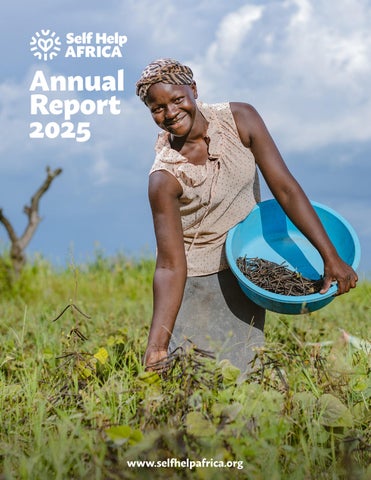
Front cover: Ritah, from a village in Uganda’s Napak District, proudly harvests green grams from her field. Inside cover: Aerial view of Zeddy Chelanga, lead farmer Kimiren women group harvesting sweet potato in Baringo North, Kenya
Self Help Africa is a signatory to the Dochas NGO code of conduct on the responsible use of images and messages.
Self Help Africa Annual Report 2025
3
What We Do Agriculture & Nutrition
Cooperatives
Over 70% of Africa’s poorest people live on small farms. We help these farming families achieve their potential to grow much more and earn more from their land.
We bring communities together working as a cooperative means farmers can access new markets and earn a better income from their produce.
Gender
Climate-Smart
Enterprise
We’re working to level the gender field in sub-Saharan Africa. When women receive the same support as men, yields increase 20–30%.
Those least responsible for climate change are the most affected by global warming. We support vulnerable communities to adapt to changing climate, through climate-smart agricultural techniques.
We nurture small businesses and encourage enterprise, enabling households to earn a vital alternative source of income.
Microfinance We invest in people. Providing access to small loans through microfinance gives impoverished rural families the means to improve their farms, so they can grow, eat and sell more.
4
Water, sanitation and hygiene (WASH) We believe everyone should be able to access resilient water, sanitation and hygiene services that help support sustainable livelihoods and healthy lives.
Self Help Africa Annual Report 2025
Where We Work BANGLADESH
SENEGAL
ETHIOPIA BURKINA FASO State of Paribe
UGANDA
THE GAMBIA
KENYA
BRAZIL
MALAWI
NIGERIA
ZAMBIA
MOZAMBIQUE
97 PROJECTS IN 2025
Self Help Africa Annual Report 2025
5
An introduction from our Chair Geoff Meagher The international development sector has experienced many challenges through the years, but few periods have been as difficult for our sector as 2025.
I
t was a year marked by significant funding cuts, with the new United States administration closing USAID and cancelling approximately 80 per cent of its foreign aid budget by March. Elsewhere, there were deep cuts made to aid budgets by the governments of the UK, Germany, France, Sweden, The Netherlands and Norway, among others. Yet, even amid extraordinary pressure that changed funding landscape brought for Self Help Africa, our teams and partners demonstrated remarkable resilience and commitment to the communities we serve. This sudden loss of funding created a seismic shift in the global aid landscape and left multilateral institutions, including UN agencies we work with in several countries, severely underfunded. These reductions created serious challenges, but the work we were able to sustain continued to make a difference on the ground. Self Help Africa was forced to make difficult decisions. By the end of the year, we had closed operations in The Gambia, Uganda and Senegal. In addition to this, we continued a process that was already underway to transition our operations in both Brazil and Bangladesh to local ownership. Self Help Africa worked closely with donors and local partners to ensure,
6
where possible, that programmes could continue, but as Chair, I recognise the weight of these decisions and the impact they have had on communities, colleagues and partners. We are grateful for the foundations that these programmes leave behind, which will continue to make a difference even after our direct presence has ended. As a result of these country closures and cuts to our income, we regrettably lost valued staff and colleagues in several programme countries and also reduced our workforce at headquarters in Dublin by close to 30 per cent. I would like to place on record my personal thanks to all for their dedication and the lasting contribution they have made to our work. In response to the economic uncertainty that 2025 brought, the organisation acted with agility, reassessing its priorities at speed, redesigning programmes and reducing costs across all areas. While these changes were difficult, they prompted important reflection on how we deliver impact in an increasingly uncertain environment. What has not changed is the scale or urgency of the needs facing rural smallholder farmers in sub-Saharan Africa. Communities still face a convergence of pressures: conflict and displacement, rising costs of food and fuel, and the growing impact of climate change. Prolonged droughts and devastating floods
Self Help Africa Annual Report 2025
Ritah from Napak District in Uganda
have disrupted harvests, damaged livelihoods, and reduced families’ access to nutritious food, contributing to rising poverty and vulnerability. It is my deepest wish that we will shortly see an end to the spiralling conflicts that are consuming so much of the world’s resources, adding to the hardships being endured by so many people who are innocent victims, and a reinstatement of the funding cuts implemented by countries and agencies over the past year. Internally, the Board also oversaw a period of leadership transition. We said farewell to our Chief Executive Officer, Feargal O’Connell, whose significant contribution ensured the organisation remained agile during turbulent times. We were delighted to end the year with the appointment of a new CEO, Niamh de Loughry, and we look forward to working with her to guide the organisation through its next phase.
Self Help Africa Annual Report 2025
While 2025 was defined by difficult decisions, it also demonstrated the resilience and commitment of our people. I would like to acknowledge the professionalism, dedication, and perseverance that was demonstrated across the organisation, and the roles so many of our team played in keeping the organisation steady through turbulent times. We are deeply grateful to our institutional donors too, including Irish Aid and the European Union, alongside the many partners who continue to recognise the value of our work. We also extend our sincere thanks to our loyal supporters and fundraisers, who donated time, energy and resources, took on personal challenges, and showed up at events during the year to help sustain our mission. Finally, I would like to thank my fellow Board members for their guidance and steadfast support during what
was another complex and challenging period. Martin Ryan and Catherine Fitzgibbon have retired from the Board after long years of service, I thank them for their commitment and dedication. We are currently renewing the Board membership. As we move into 2026, we do so with clarity about the challenges ahead but also with confidence in our ability to adapt, remain true to our purpose, and continue supporting communities to build more secure and sustainable livelihoods.
Geoff Meagher, Chair, Self Help Africa
7
An introduction from our CEO Niamh de Loughry Confronted by a combination of conflict, extreme weather events, funding cuts and rising food and fuel prices, it can become difficult to frame an annual report positively.
H
owever, in 2025, the brutal reality is that hunger levels across sub-Saharan Africa are rising, and notwithstanding the progress that has been made in recent years, one in five people in the region continue to live in extreme poverty. While agricultural productivity and regional trade have improved in some areas, millions continue to experience chronic food insecurity due to climate shocks, conflict and economic instability. For many of the communities we work with, these overlapping crises are dramatically reshaping rural life for too many smallholder farmers. Erratic rainfall and prolonged droughts are damaging harvests, insecurity is disrupting local markets, and rising costs are placing growing strain on already fragile household incomes – all of which is having a devastating knock-on effect on families’ health, education and future. Climate experts consistently rank Africa as the continent most vulnerable to the effects of global warming, with eight of the 10 most at-risk countries located on the continent. This vulnerability is stark when you consider that close to 65 per cent of Africa’s population relies on smallholder farming for survival, and most of the continent’s 33 million small farms depend
8
almost entirely on rainfall. And yet, in the face of these immense pressures, throughout 2025 we saw communities continue to demonstrate extraordinary resilience. With the right support, farmers – many of them women – adapted the way they work, strengthened local markets, learned new skills and diversified their livelihoods, building foundations for a more secure future. In Zambia, hundreds of thousands of families who lost almost everything, including their maize harvests, to drought two years ago re-trained in climate-smart farming methods and pest control. Many are now beekeeping and growing more resilient crops, such as sorghum, alongside vegetables and fruit, including cabbages, onions, mangoes and orange-fleshed sweet potatoes, preserving and drying food so that they can maintain nutrition levels during drought season. And in Kenya’s drought-prone Baringo County, where seasonal hunger has contributed to high levels of child malnutrition, a 2025 study of our work with 60,000 farming households found diets and livelihoods had been transformed. Over five years, childhood stunting fell by half, as families diversified their crops, established kitchen gardens and
Self Help Africa Annual Report 2025
Tololo Marie Ouedeogo from Wougea in Burkina Faso
improved how they fed their children. These examples prove there are life changing solutions. Across our programmes in sub-Saharan Africa, we are working every day with communities to help farming families adapt to changing conditions, diversify their livelihoods, and access the markets where they can sell the food they produce. When this is done as a collective, we see communities invest in their village savings schemes and use that money to invest in equipment that further supports meaningful long-term development. As 2025 drew to a close, however, the failure of the traditional rainy season in Kenya, southern Ethiopia and neighbouring countries provided worrying signs that another wave of widespread crop failure and food shortages may be looming. This is all happening at a time when the global development landscape is becoming increasingly uncertain. Significant reductions in international aid budgets during 2025 – including major cuts by some long-standing donors – have placed additional pressure on organisations like ours. In this context, the commitment of our supporters, donors and partners who believe in long-term, locally led
Self Help Africa Annual Report 2025
development is more important and appreciated than ever. We are particularly grateful for the steadfast support of the Government and the people of Ireland through Irish Aid. Their partnership enables us to invest in programmes that help farming families build resilience, improve nutrition and create sustainable livelihoods. I would like to close by saying thank you to our Board for their guidance and leadership during a challenging year, to my colleagues for the warm welcome, to our partners and to the many friends and supporters whose generosity and deep commitment to meaningful impact and the work of Self Help Africa makes this work possible. At a time of complex geopolitics, an ever-challenging funding landscape and climate change impacts, your support enables communities not only to withstand the shocks they face, but to ensure the vision of ‘sustainable livelihoods and healthy lives for all’ can be realised. Never has that vision been more urgent and relevant.
Niamh de Loughry Niamh de Loughry, Chief Executive, Self Help Africa
9
Phiona from Kafue, Zambia
Our Mission
We aim to alleviate hunger, poverty, social inequality and the impact of climate change through community-led, market-based and enterprise-focused approaches, so that people have access to nutritious food, clean water, decent employment and incomes while sustaining natural resources.
10
Self Help Africa Annual Report 2025
Case Study Zambia
Harvesting hope: A new future for the Mangombo family
C
ommunity-based seed producers like Milimo Mangombo play a vital role in ensuring that farmers in remote areas of Africa can have access to good quality seed to plant, at the time that they need it. A mother of seven from Zambia’s southern province, Milimo and her husband Rabby have provided hundreds of farming families with good quality cowpea (black-eyed pea) seed that she had produced under controlled conditions on her farm. In a region where many farmers had lost their traditional maize (corn) to drought, cowpea provided a more drought resilient alternative. Working as a seed multiplier as part of a project being supported by Self Help Africa, Milimo says that from an initial 20kg bag of Msandile cowpea, she
Self Help Africa Annual Report 2025
produced a massive 31 bags of certified seed, which she sold to an agricultural seed supplier for the equivalent of €1,500. This new income has enabled Milimo and Rabby to invest in their farm and their family. They have bought six new improved breed Boer goats, have extending the land that they are using to grow maize, and have increased their cowpea cultivation from two acres to 10 acres. They’re also able to buy books and uniforms, and they can afford to send their children to school, she says. Milimo is thinking of the future too. She plans to use her future income to finish the construction of a new family home, and drill a borehole that will provide them with water, and allow them to irrigate and farm their land year around.
11
Case Study Nigeria
How Hajara took her tofu business to the next level
S
ince she improved her business and budgeting skills, Hajara has taken her micro-enterprise - making and selling tofu - to a new level. She is earning more and is trading with confidence, thanks to the support she received from Self Help Africa’s Youth in Work, a project that aims to improve on-farm and off-farm opportunities for 50,000 young people in Nigeria’s Kano State. It is seeking to create jobs and businesses focused on five food crops – sorghum, millet, soya bean, groundnut and vegetables. Living in a small home in close proximity to animals, Hajara felt held back. She was concerned about hygiene
12
because accessing clean water was a problem, and she was unsure about her finances. Through Youth in Work she gained vital business and financial skills, learned how to keep proper records, manage her budgets and handle her savings and her loans. She is properly managing her cash flow and feels confident that she can make informed financial decisions. Hajara has adopted better hygiene practices around food preparation, although some challenges remain. She says that she’s now able to contribute more to meet her family’s needs. “I can now support myself,” she says.
Self Help Africa Annual Report 2025
Case Study Ethiopia
The business of growth: From seeds to services Jemberua, left, with her daughter Ayeleche
J
emberua is a community-based seed producer in Burajera, Ethiopia. Jemberua and her husband Mulugeta, who have six children, are members of a local seed producer cooperative that sells cereal seed commercially to farmers across this region of central Ethiopia. Jemberua says that the work provides them with a living, and has enabled them to buy cows and rear poultry. Seed multiplication has also helped Mulugeta to purchase an ox-drawn cart with which he operates a part-time local taxi and transport service.
Self Help Africa Annual Report 2025
The enterprising couple have also invested in a shelling machine, which they use to remove corn kernels from the cob. It saves a lot of labour and they make it available to others in the locality. In a country where less than 20 per cent of farmers have access to certified seed from the formal seed sector, community-based producers like Jemburua and Mulugeta are part of a vital network, providing small-holder producers with affordable, good quality crop seed at the time that the need it each year. Self Help Africa has been supporting seed multiplier cooperatives in Ethiopia for more than 20 years.
13
Case Study Uganda
Sprouting success: Juliet’s mushroom venture
J
14
uliet has set up a small business growing mushrooms that she sells at the local market.
Juliet received a small start-up loan, equipment and training in mushroom production.
A young mum from Rubanda district in Uganda’s far south-west, she’s among a group of budding businesswomen who have received business training from Self Help Africa’s GREEN Project.
The project, supported by Community Foundation Ireland, has enabled hundreds of young people like Juliet to have established their own new income generating small agri-businesses.
Self Help Africa Annual Report 2025
Women made up
52%
of the people we worked with
Annet from Kabale District, Uganda
Self Help Africa Annual Report 2025
15
Report of the Board The members of the Board hereby present their annual report and the financial statements for the year ended 31 December 2025.
Agnes from Poron Subcounty, Napak District, Uganda
16
Self Help Africa Annual Report 2025
1. Objectives and activities i. Who we are
ii. Where we work
Our purpose
In 2025, Self Help Africa worked in the following 12 countries: • Bangladesh • Brazil • Burkina faso • Ethiopia • The Gambia • Kenya • Malawi • Mozambique • Nigeria • Uganda • Senegal • Zambia
We are an international development charity working with vulnerable communities in sub-Saharan Africa, as well as in Bangladesh and Brazil. The majority of our work is with smallholder farmers, ensuring they have the knowledge and resources to grow and sell more nutritious food, can diversify their income and diets, have sustainable livelihoods and are better equipped to handle external shocks, particularly extreme weather events linked to climate change.
Our mission We aim to alleviate hunger, poverty, social inequality and the impact of climate change through community-led, market-based and enterprise-focused approaches. This will help ensure people have access to nutritious food, clean water, decent employment and incomes, while sustaining natural resources.
Our vision
iii. What we do Self Help Africa fulfils its charitable duties through a focus on the following core activities:
Agriculture
Sustainable livelihoods and healthy lives for all in a changing climate.
Agriculture is at the core of Self Help Africa’s work. From crop and livestock production to horticulture and agroforestry, we work at all levels of farming value chains to ensure vulnerable communities can access safe, nutritious and affordable food.
Our values are: • Impact - We are accountable, ambitious and committed to systemic change. • Innovation - We are agile, creative and enterprising in an ever-changing world. • Community - We are inclusive, honest and have integrity in our relationships.
In response to previous droughts, many of our activities in 2025 focused on strengthening resilience to future droughts through multiple-use irrigation systems in Burkina Faso, Ethiopia, Malawi, Uganda, and Zambia. These systems reduce dependence on rainfed agriculture while providing communities with access to safe drinking water and promoting the production of drought-tolerant crops. In 2025, Self Help Africa supported innovation and value addition in agricultural systems. It expanded its work, including in the Ethiopian dairy system, where a simple hydroponic fodder production system is improving the feed quality for dairy cows, and new milk processing units have been introduced. We also developed advanced tissue culture techniques for the commercial multiplication of new cassava varieties in Kenya. The Irish Embassy-funded Dairy Development project in Kenya, which aims to develop climate-resilient fodder crops, completed the testing of dairy breeds for climate resilience and developed an economic breeding index – working with
Self Help Africa Annual Report 2025
17
Teagasc, the Agriculture and Food Authority in Ireland, and the Kenya Agricultural and Livestock Research Organization in Kenya.
Natural resource management
nutritious meals. To ensure the sustainability and effectiveness of our nutrition work, we ensure households have access to clean and safe water, as well as decent toilets, and have access to information on how to maintain good hygiene practices. Self Help Africa also works with enterprises to help them meet food safety standards.
The natural environment provides the ecosystem services that we all depend on. Self Help Africa promotes the ‘Functional Landscape Approach’ to restore and maintain healthy ecosystems. This approach is based on the principle that communities need to generate an income from their natural resources, if they are to conserve them.
Our activities in 2025 included biofortification and food fortification; improving the nutritional value of food through the production of crops with enhanced levels of key nutrients and the addition of critical nutrients to processed food. Our work ensured 70 per cent of households in 2025 reached acceptable levels of dietary diversity, a proxy indicator of good nutrition.
In 2025, much of the organisation’s work was focused on helping communities implement their own community natural resource management plans. This included restoring degraded forests, such as mangroves on the coast of West Africa, and controlling invasive species in the rangelands of East Africa. Providing clean, safe water is a critical ecosystem service, so in 2025 Self Help Africa also began to integrate catchment management with water, sanitation and hygiene (WASH) projects.
Emergency preparedness and response Self Help Africa works with local governments to help prepare village- and district-level committees and line ministries to respond to emergencies and provide extra resources when emergencies occur. In 2025, the organisation helped local authorities and communities to prepare for and take anticipatory action to the impact of high rainfall at the start of the 2025-26 growing season in Southern Africa as a result of La Niña. We also supported communities to recover from the 2023-24 El Niño drought in Southern Africa through the development of multiple-use irrigation systems. In Burkina Faso, Ethiopia and Kenya we responded to emergencies caused by landslides and insecurity that undermined affected communities’ livelihoods.
Nutrition Self Help Africa works to address long-term, chronic nutrition problems through the food system by ensuring universal access to a diverse, nutritious, affordable and safe diet. We focus on nutrition-sensitive agriculture, which involves growing a diverse range of crops and vegetables, improving the nutritional value of crops, ensuring harvests are safe from microbial contamination and that the people we work with have the knowledge, skills and resources they need to prepare
18
Water, sanitation and hygiene (WASH) Self Help Africa works with local governments and the private sector to build the ecosystem of services and skills required to sustainably run water and sanitation systems, using social accountability to track government investment in WASH infrastructure. In 2025, we undertook WASH activities in Burkina Faso, Bangladesh, Ethiopia, The Gambia, Kenya, Malawi, Mozambique, Nigeria, Uganda, and Zambia. Activities included drilling boreholes and promoting hygiene and sanitation practices. Self Help Africa also advocated a market-based approach to sanitation. We trained and equipped local masons and hardware retailers to promote, sell and install low-cost toilet products. We supported the local commercial production of improved WASH products, such as soap in Burkina Faso and reusable sanitary pads in Zambia, to create new business opportunities.
Enterprise development Self Help Africa takes an enterprise-based approach to development, designing projects that can be commercialised to ensure sustainability. In 2025, we supported access to finance, business development support services and access to markets across all of the countries we work in. The organisation supported a range of financial service providers, from traditional village savings and loan associations (VSLAs) to large savings and credit cooperatives (SACCOs). The EU’s flagship circular economy or green economy waste recycling project in Zambia, GREENTech4CE, allocated €3.4 million to 10 companies with the potential to create around 954 jobs. The EU-funded, five-year Enterprise Zambia
Self Help Africa Annual Report 2025
Challenge Fund project was completed, having disbursed €15.1 million to 27 companies and reached more than 200,000 smallholder farmers
Energy Self Help Africa has long promoted the use of energy-efficient and smoke-free stoves that reduce firewood requirements and indoor air pollution. The organisation’s current focus is on developing sustainable business models for the production of these energy-efficient stoves and generating voluntary carbon credits from stove sales. Free stoves are provided to certain households on the government’s social protection registers. In 2025, Self Help Africa started piloting the use of carbon and smoke-free electric induction stoves. Diesel water pumps were replaced with solar photovoltaic pumps. All new drinking water and irrigation systems are fitted with solar power, with some water committees selling surplus electricity at solar kiosks. Self Help Africa’s subsidiary, Kuyatsa, operates PV micro grids in Malawi, selling electricity to households and local businesses. In Ethiopia and Uganda, biogas digesters were installed to convert gas for cooking. This provides a clean energy source and reduces methane emissions, with the installed systems reducing emissions by an estimated 36 to 52 tonnes CO₂ eq per year. Governments are increasingly promoting the transition from petrol and diesel vehicles to electric alternatives. CUMO in Malawi has replaced its fleet of petrol motorcycles with electric models.
Development education Self Help Africa works with schools in Ireland to raise students’ awareness of development and global issues. In 2025, we continued our development education programme by running sessions for primary schools and working with early school leavers being supported by the Youthreach programme. Our development education programme also runs the ‘Science for Development Award’, sponsored by Irish Aid, at the Young Scientist and Technology Exhibition, now sponsored by Stripe. Our development education team also coordinates Self Help Africa’s programme of public engagement activities, which saw us engage with people in 2025 at events including Electric Picnic music festival and the National Ploughing Championships.
Self Help Africa Annual Report 2025
Worldwise Global Schools WorldWise Global Schools (WWGS) supports post-primary schools across Ireland to embed Global Citizenship Education through a wholeschool approach. The programme is delivered through a consortium comprising Self Help Africa as the lead partners, National Association of Principals and Deputy Principals, Concern Worldwide, Ubuntu Network, City of Dublin Education and Training Board, the Association of Secondary Teachers Ireland and Teachers’ Union of Ireland. WWGS provides professional learning, curriculum resources and direct support to educators and school leaders. Its main engagement mechanism is the WWGS Global Passport, which combines recognition and grant funding to help schools plan, implement and sustain Global Citizenship Education initiatives.
Partner Africa
Partner Africa
In 2025, Partner Africa maintained its commitment to responsible business practices across the continent, expanding its operational reach and securing ISO certification. During the year, Partner Africa conducted 908 social audits with 794 firms across 21 industries and 21 countries. Its responsible business advisory department also engaged in 24 projects across seven industries.
On 10 February 2026, an agreement was signed for the sale of the business and assets of Partner Africa to LRQA. Partner Africa will continue to operate as a distinct brand while being fully integrated within LRQA’s wider service offering. The purchase agreement does not include the Partner Africa legal entity, which will be renamed Coulthard Continental.
Other CUMO is a microfinance institution in Malawi. Its staff provide financial services and entrepreneurship mentoring to approximately 90,000 clients.
19
2. Strategic report 2025 Overview In 2025, Self Help Africa worked in 12 countries and implemented 97 projects reaching nearly 1.5 million households. Additionally, we supported nearly 20,000 school children and teachers.
D
uring 2025, Self Help Africa continued to operate in a highly volatile environment shaped by overlapping humanitarian, economic and climate-related pressures. Protracted conflicts and insecurity, particularly in the Sahel and the Horn of Africa, continued to disrupt livelihoods, constrain market access and drive displacement. While global commodity markets showed some stabilisation compared to previous years, many African economies remained exposed to high food and agricultural input costs due to currency depreciation, debt pressures and structural import dependencies. Inflation persisted in several countries, eroding household purchasing power and limiting smallholder investment in productive assets. Climatic shocks remained a defining feature of 2025. The lingering impacts of the 2023–2024 El Niño event contributed to continued drought conditions in parts of Southern Africa, while some areas in Eastern Africa experienced irregular rainfall patterns, including localised flooding. In parallel, an emerging shift towards La Niña conditions introduced further uncertainty, complicating seasonal planning and recovery efforts. These dynamics left millions of people across programme areas facing heightened food insecurity. However, improved early warning systems and greater investment in anticipatory action, building on lessons from previous years, enabled the organisation and its partners in several countries to respond more proactively, helping to mitigate the most severe impacts on vulnerable communities. In spite of the challenges communities endured, Self Help Africa made significant and impactful achievements in 2025, supporting nearly 1.5 million households through its projects. Political and macroeconomic conditions in 2025 were challenging in many of our countries. Ethiopia and Malawi experienced high inflation levels and shortages of forex. Self Help Africa’s enterprise-focused model, supporting the
20
development of commercial supply and value chains, has struggled in countries reliant on imports. Supply chains for agriculture, livestock and water, sanitation and health (WASH) were unable to secure sufficient forex to meet the demands for seeds, fertilisers, fuel and WASH spares and equipment. While microfinance institutions and savings groups supported by Self Help Africa performed well in terms of local currency, high inflation rates and the declining value of the local currency undermined their balance sheets in real terms. After two years of El Niño, which caused droughts in Southern Africa, the region’s 2024-25 growing season experienced good rains and excellent harvests in many areas, helping communities to recover and restock national food reserves after the drought. Burkina Faso also experienced unusually good rains, contributing to harvests and economic growth. Fertiliser costs remained high as the El Niño-Southern Oscillation (ENSO) cycle shifted in mid-2025. The transition from El Niño to La Niña at the start of the 2025-26 growing season brought heavy rains to Southern Africa. The operating environment for civil society, including NGOs, continued to contract in several countries, as governments introduced stricter regulations and restricted activities, such as surveys and advocacy. At year-end, Self Help Africa had complied with these new requirements without significant disruption to its operations or social accountability programmes. Security remained a concern in Burkina Faso, Ethiopia, northern Mozambique and Nigeria. There were also wide-spread demonstrations in Kenya, and the economic and political situation in Bangladesh remained fragile.
Self Help Africa Annual Report 2025
Achievements and Performance in 2025 In 2023, the Board of Self Help Africa approved the organisation’s global five-year strategy and its four key objectives. Outlined below is our progress, in 2025, towards delivering on them.
Strategic objective 1: Sustainable landscapes, resilient food systems and healthy communities Contribute to the equitable stewardship of ecosystems for well-functioning food and water systems, ecosystem services, human well-being and quality of life.
Progress in 2025 In 2025, Self Help Africa delivered 58 projects under Strategic Objective 1. Of those, 28 projects across 11 countries focused on agriculture; 20 projects across four countries focused on water, sanitation and hygiene (WASH); eight projects across five countries focused on natural resource management; and two projects in two countries focused on nutrition. Key achievements in each of these thematic areas are outlined below.
Sustainable landscapes and natural resource management The Gambia: In 2025, an Irish Aid-funded project advanced sustainable landscape management through mangrove restoration, promotion of energy-efficient cookstoves, and the planting of fast-growing fruit and fuelwood trees in schools and communities. Approximately 46 hectares of degraded mangrove areas were identified and restored, contributing to early signs of biodiversity recovery and improved ecosystem health. Energy-saving cookstoves and briquette production initiatives reduced pressure on mangrove resources by lowering firewood consumption among oyster processors. These interventions benefited from strong community participation and the use of locally adapted mangrove propagules. Overall, the activities strengthened community awareness and stewardship of natural resources while supporting more sustainable livelihood practices. Uganda: With funding from the Community Foundation Ireland, Self Help Africa delivered the Growing Resilience and Eco-Enterprises (GREEN) project around Lake Bunyonyi sub-catchment. The project established six village natural resource management committees, engaging 1,107 households and 40 farmer groups, with 101 members elected based on integrity, gender balance and community commitment. Committees developed and implemented resource management plans, identifying 16 high-risk sites and driving conservation actions, including 968 water trenches and 56 check dams, restoring 218 acres of land. Governance and bylaw
Self Help Africa Annual Report 2025
Marie Demba secures oysters on the shores of Kartong mangroves in The Gambia
21
enforcement improved, alongside the adoption of sustainable practices. Additionally, 566 farmers received agroforestry training and seedlings, restoring 135.7 hectares. Farmer field schools promoted integrated land management, enhancing soil fertility, productivity and food security while strengthening community stewardship of fragile ecosystems in the Lake Bunyonyi catchment.
Agriculture and climate adaptation Ethiopia: In partnership with the World Food Programme, the Development Livelihoods for Desert Locust Affected Smallholders project strengthened the capacity of 376 trainers (including 71 women). These trainers cascaded knowledge about regenerative agriculture, soil moisture conservation and integrated pest management to 3,120 farmers, including 1,455 women. These farmers then proceeded to conduct demonstrations that reached a further 7,091 farmers, including 3,395 women. The project also distributed improved wheat, teff and sorghum seeds – varieties specifically selected for high yield and resistance to regional pests. This reached 3,304 households and brought 1,048 hectares under improved cultivation. Seeds were provided through an innovative revolving credit scheme. This model ensures kebele-level cooperatives maintain a seed bank for the 2026 season, fostering a self-sustaining local input market. Senegal: Self Help Africa implemented the Waitrose Foundation Worker Voice activities across supplier farms in The Gambia and Senegal, delivering community infrastructure, safety improvements, and agricultural training in 2025. Education facilities were expanded through new classrooms and an administration block, improving learning conditions for more than 300 students from farming communities. Worker safety was enhanced through the installation of 50 solar lamps along key access roads. In addition, 60 apprentices were trained in climate-smart agriculture using local languages, who then cascaded knowledge to their communities, reaching 3,667 people. These combined efforts strengthened community wellbeing, improved local infrastructure, and promoted sustainable agricultural practices across farm-linked communities.
build a more reliable, market-oriented income base. To boost on-farm performance and value chain services, Self Help Africa also provided 270 kits to support bio-based agricultural practices, nursery establishment and grafting, strengthening local capacity to improve cashew productivity and orchard management. The project trained 30 women in commercial negotiation and supported seven farmers’ organisations in Sindou, Péni, Toussiana and Karangasso Sambla to formalise as cooperatives, improving their ability to engage buyers, organise collectively and access services.
Nutrition Malawi: Self Help Africa’s European Union-funded Fortifying for our Communities Under-Nutrition Status (FOCUS) biofortification project strengthened nutrition outcomes in Malawi by expanding access to biofortified crops and reinforcing delivery systems for nutrient-dense foods. The project established 40 biofortified crop demonstration plots featuring provitamin A maize, high-iron beans, orange-fleshed sweet potato and intercropping systems, achieving approximately 95 per cent germination rates. It also distributed 600 sweet potato vine bundles, 828 kg of vitamin A maize seed, and 740 kg of highiron bean seeds to schools, community-based childcare centres, demonstration sites and selected farmers, the increasing availability of micronutriet-rich foods for vulnerable households. In addition, assessments engaged 90 agro-dealers (63 male-owned, 15 female-owned, 12 company-owned), with 40 Eliza in Dedza, Malawi
Livelihoods (farm-based) Burkina Faso: In 2025, the Austrian Development Agency-funded Cashew project advanced livelihoods by strengthening the cashew value chain and supporting producers with practical skills and productive assets. The project supported the development and sustainable management of 128 hectares of cashew orchards, helping participating households to
22
Self Help Africa Annual Report 2025
Rasmala pumps water from a new well in Noungou in Burkina Faso.
high-performing agro-dealers selected for targeted engagement to strengthen the supply and promotion of biofortified inputs. Ethiopia: The Build a Regenerative, Inclusive, and Sustainable Food System for Transforming Rural Livelihoods in Ethiopia project strengthened household nutrition through targeted dietary diversity training, cooking demonstrations, and the promotion of nutrient-dense crops and livestock products. In total, 355 households (193 of which were female-headed) gained practical skills in balanced meal preparation using locally available foods, while 177 farmers participated in hands-on cooking demonstrations. Complementary interventions, including the distribution of orange-fleshed sweet potato to vulnerable households and poultry support to 300 women, improved access to vitamin A-rich foods and eggs, contributing to enhanced dietary diversity. Monitoring data indicated that 51 per cent of households achieved ‘acceptable+’ food consumption scores and 72 per cent adopted better hygiene and nutrition practices, demonstrating positive behaviour change and improved nutrition outcomes.
Water, sanitation and hygiene and access to safe drinking water Malawi. Through its Charity: Water- and FCDO-funded projects in Malawi, Self Help Africa is strengthening a network of local area mechanics and investing in remote monitoring of water infrastructure. This improved the management of operations and maintenance by district water offices and
Self Help Africa Annual Report 2025
supported verification requirements for carbon credit sales. The payment of performance-based bonuses to mechanics from the carbon revenues resulted in at least 95 per cent water point functionality, less than 48-hour repair response times and the consistent reporting of faults. The private sector continued to play a significant role in Self Help Africa’s systems strengthening model, providing equipment, spares and maintenance. Almost all the equipment and spares required by the water sector were imported into Malawi. The shortage of forex has affected the viability of businesses that are dependent on imports, challenging WASH supply chains previously developed by Self Help Africa. Nigeria: Self Help Africa expanded its handpump preventative maintenance service contract model in Cross River and Kano states, while increasing support to piped water schemes. It also supported the Federal Government to establish a national technical working group on rural water sustainability, providing a platform for learning and the development of policies and guidelines. Mozambique: The MEDICOR Foundation-funded Strengthening WASH Services in Schools project saw 12 schools gain access to safe drinking water in 2024, benefiting 9,844 schoolaged children and 144 teachers. Another five schools gained access to improved and inclusive sanitation, benefiting 4,049 children and 60 teachers, while 12 schools took part in hygiene behaviour change communication activities, which involved a customised approach combining Hygiene Heroes, which uses interactive activities, games or characters to make learning about hygiene fun and engaging for children.
23
Strategic objective 2: Sustainable businesses, decent employment and thriving economies
Support the growth of inclusive, profitable and sustainable businesses that provide services and decent employment for communities.
Progress in 2025 In 2025, Self Help Africa ran 35 projects with an enterprise, SME or finance access component. Of them, seven were primarily enterprise focused. This work supported the growth of inclusive, profitable and sustainable businesses that provided services and decent employment for communities. Key achievements in 2025 are outlined below.
Access to finance, rural finance
SMEs, enterprise and access to markets
Malawi: The Self Help Africa-owned microfinance bank CUMO strengthened access to finance for farmers and village savings and loan groups by providing business, agricultural and equipment loans to 23 groups, following awareness sessions and credit assessments within 27 groups. In total, MK145,660,000 (approximately €72,830) was disbursed to 437 people (302 women, 135 men). The same group also received training to build their business and financial management skills, using an interactive approach focused on practical enterprise development and improved financial practices to support more sustainable businesses.
Brazil: With support from Electric Aid, Self Help Africa implemented a project in Paraíba, Brazil to address menstrual poverty by improving access to sanitary products, increasing income and strengthening knowledge of women’s health and rights. The project reached 4,140 people, including 387 women and girls who received reusable sanitary pads and 1,385 who gained health and dignity awareness. Additionally, 65 women were supported through training, materials and funding to strengthen livelihoods. Participants reported greater income, improved health and more confidence. The initiative also supported women-led enterprises to engage with government, creating opportunities for business growth and sustained access to menstrual products.
Zambia: The EU-funded, 5.5-year ENTERPRISE Zambia Challenge Fund (EZCF) project concluded in 2025. Over the course of the programme, 34 projects were contracted with 27 companies and €15.1 million was disbursed to companies. The companies contributed an additional €22.4 million. These agri-enterprises supported more than 200,000 smallholder farmers, including 99,332 women, of whom more than 160,000 had contracts with companies (63,201 women and 97,248 men). The project ran for four agricultural seasons, during which companies created more than 3,113 jobs and purchased agricultural products with a value of more than €40 million from smallholder farmers. EZCF also significantly strengthened agribusiness capacity through targeted initiatives, enhancing skills in financial management, agricultural production, business development, regulatory compliance, sustainability practices, social and gender inclusion, technology adoption, procurement efficiency and grant writing.
24
Uganda: The World Food Programme-funded Agriculture and Market Support project strengthened small- and medium-sized enterprises and smallholder market participation by improving links between farmers, input suppliers, financial institutions and private off-takers. In total, 1,055 farmers, including 665 women, accessed improved sesame seed under a cost-sharing model, enabling them to increase production for commercial markets. Complementary post-harvest training for 822 farmers improved product quality, storage and readiness for market, while village savings and loan association strengthening for 1,173 farmers enhanced working capital and investment capacity for enterprise growth. As a result, farmers reported improved access to both financial services (100 per cent) and quality agro-inputs (74 per cent), positioning smallholder producers and emerging rural enterprises to engage more effectively in structured markets and value chains.
Self Help Africa Annual Report 2025
Green economy, green enterprises In response to the accelerating climate crisis, Self Help Africa’s commitment to fostering a green economy and green enterprises remained central to its mitigation strategy. In 2025, Self Help Africa continued to help small enterprises invest in the green economy as an economic and environmental imperative that drives job creation and innovation. Zambia: In 2025, the EU-funded GreenTech4CE project advanced Zambia’s circular economy by contracting 20 enterprises across four calls, including 12 medium-sized enterprises, six business development service providers, and two financial service providers. The supported medium-sized businesses were implementing green and circular innovations, such as copper component recycling and reprocessing, producing eucalyptus poles encased in recycled plastic, microbial-based plastic bio-recycling and avocado waste processing. The six business development providers were mandated to onboard and provide technical assistance to more than 800 start-ups and micro-, small- and medium-sized enterprises in the green, circular, digital and artisanal mining sectors, strengthening enterprise capacity to adopt resource-efficient and low-carbon business models. Two financial service providers were contracted to develop tailored financial products addressing the specific needs of green and circular enterprises, including barriers related to collateral, tenor and capital investment structures. The Gambia: In 2025, the EU-funded Scaling-up Organic Fertilisers Advancing Nutrition, Innovation and the Circular Economy
Self Help Africa Annual Report 2025
(S-ORGANIC) project supported on-farm and commercial organic compost production. The project constructed six compost chambers for commercial compost production at demonstration sites in 2025. Through the re-establishment of the ‘buy it local’ movement, 180 members (30 per region) of Marketing Federation farmer groups developed marketing plans for organic soil amendment products. Two live radio programmes were conducted in local languages to promote sustainable consumption and strengthen demand for locally produced compost. Project site visits across all six regions reached 118 people (101 women and 17 men) and demonstrated an uptake of compost production and sales, while women in Kuwonkuba generated income through compost sales to schools, supporting nutritious school gardens. An exhibition of organic fertilisers was held to showcase circular economy innovations and climate-smart agricultural practices.
Carbon Kenya: The Restoring Trees and Livelihoods project, funded by the Global Evergreening Alliance, trained 2,124 people on land ownership to secure user rights and support long-term tree planting. Agreements enabled women and young people to manage trees despite most land being owned by men, with land attestation letters introduced to reduce disputes before carbon payments. In 2025, 1,024 farmers mapped 263,207 trees across community groups in Baringo. Carbon credits will be shared between communities, investor GenZero, and the Alliance. The project strengthened land governance, reduced conflict risks, and supported sustainable livelihoods through climate finance mechanisms.
25
Strategic objective 3: Crisis response and resilience Support communities to prepare effectively for and respond to chronic and acute humanitarian shocks.
Progress in 2025 In 2025, Self Help Africa delivered 13 projects across seven countries that comprised crisis response and resilience building activities.
Anticipatory action and disaster risk management Zambia: The Irish Aid-funded PRESERVE-Kafue project strengthened anticipatory action by enhancing community early warning and preparedness systems. In collaboration with the provincial meteorological department, 50 village natural resource management committees were trained to provide weather updates to their communities and develop climate adaptation plans, which would be integrated into the district disaster management and mitigation unit’s plans. Weekly weather updates were shared via SMS and WhatsApp and cascaded to 180 community groups, helping farmers make informed decisions on planting and risk management. Bangladesh: Under the Strengthening Forecast-based Early Actions in Cyclone Prone Coastal Regions in Bangladesh project, which is ECHO-funded, Self Help Africa strengthened the region’s disaster preparedness. Twenty-two disaster management committees developed early warning systems, risk reduction plans, and community awareness initiatives aligned with Government frameworks. More than 7,000 vulnerable households received anticipatory cash support before cyclones, reducing losses and protecting livelihoods. Shelter management committees ensured gender-responsive services during emergencies, while community organisations supported alert dissemination and volunteer mobilisation. Government departments integrated anticipatory action into planning. Overall, the project enhanced local capacity, improved early response systems, and strengthened longterm community resilience to climate-related disasters.
Resilience and crisis response Zambia: The Drought Resilience to Overcome Poverty project distributed drought-tolerant crops to more than 1,400 households and established 36 demonstration plots to promote conservation agriculture and water-efficiency. Post-harvest
26
Phales uses climate-smart agriculture in her vegetable garden, Kafue, Zambia
management training reached more than 2,700 farmers through lead farmer cascading, reducing storage losses and improving household food security. In response to financial and climatic risks, 46 savings groups (830 members) received financial literacy training, with three groups successfully securing Constituency Development Fund grants to invest in irrigation, agro-dealing and piggery businesses. Together, these measures improved household resilience to climate variability and economic shocks. Burkina Faso: Self Help Africa responded to the humanitarian crisis in Burkina Faso with funding from Irish Aid and Enabel (Belgium development agency). Two projects – namely, the Strengthen the Resilience of Vulnerable Households Affected by Climate Change and the Security Crisis in Burkina Faso project and the Support the Creation of Sustainable Livelihoods through Training and Socio-professional Integration of Youth and Women, including IDPs, in the Centre-North Region project – are supporting internally displaced people. In 2025, these projects provided training and start-up support to participants rebuilding livelihoods and seeking economic recovery. In total, 1,185 people participated in training, monitoring and equipment activities, with 324 people being IDPs. This reflected the programme’s strong inclusion of displaced populations. The projects also reached 56 people living with disabilities, who received training on harvesting and processing of non-timber forest products, legumes and cereals, ensuring the most marginalised groups could benefit from these economic recovery initiatives.
Self Help Africa Annual Report 2025
Strategic objective 4: System strengthening and an enabling policy environment
Embed our approach in policy influencing, system strengthening, social accountability and the localisation agenda.
Progress in 2025 In 2025, Self Help Africa supported system strengthening and fostered an enabling policy environment across all country programmes.
Legal, policy and institutional engagement Burkina Faso: In partnership with local authorities, Self Help Africa trained administrative authorities and technical services in the Koulsé region on national biodiversity priorities. This included the conservation and sustainable use of biological resources, as well as Burkina Faso’s National Strategy and Action Plan for Biological Diversity (2025-2030) and its contribution to the Kunming-Montreal Global Biodiversity Framework. The training also covered how to integrate biodiversity protection into local development policies, plans and programmes. Following the training, stakeholders expressed a willingness to systematically integrate biodiversity conservation into any local development policies and plans. Kenya: As part of the Teagasc-led Kenya Dairy Production Systems project, the multi-institutional engagement led by Self Help Africa and the Kenya Agricultural and Livestock Research Organization directly addressed long-standing fragmentation in dairy data systems, aligning government agencies, research institutions and breeding bodies around common standards. The cooperative-led service delivery supported by the project was a viable institutional model, informing policy discourse on farmer aggregation, extension delivery and climate-resilient livestock development. Nigeria: Through the FCDO-funded WASH Systems 4 Health programme, Self Help Africa strengthened policy, governance and accountability in Nigeria’s WASH sector at national and subnational levels. Nationally, it supported the Clean Nigeria Campaign strategy, Compact 2.0, and the establishment of a rural water sustainability technical working group. WASH policies in Kano and Cross River States were updated to reflect sustainability, climate resilience and inclusive service delivery. The organisation also supported sanitation legislation, including an Open Defecation Prohibition Bill. These efforts enhanced regulatory frameworks, institutional
Self Help Africa Annual Report 2025
coordination, and sector financing – positioning both states to improve service delivery, enforce standards and progress toward universal access to sustainable WASH services. Mozambique: Five projects promoted the capacity strengthening of decentralised governance bodies and central government agencies, with a focus on promoting inclusive, equitable and sustainable social development in subnational governance. The projects – namely SDG Localisation, Provincial Decentralization in Niassa and Nampula, Gotas, Social Accountability in Niassa and WASH in Schools in Lichinga – have, among others, supported the implementation of provincial development observatories (236 participants) and organised a workshop for the socialisation and consolidation of the Territorial Strategy of the Province of Maputo.
Social accountability Mozambique: Across social accountability initiatives in Niassa Province, two projects – the UN Capital Development Fund sponsored Boosting Equitable Development through Citizens Participation and Social Accountability in Niassa and the GOTAS project, funded by the Swiss Agency for Development and Cooperation – worked to strengthen citizen participation and transparency in local governance. Under the UN Capital Development Fund project, four public hearings were held in Lichinga and Lago districts, as well as in the municipalities of Mandimba and Lichinga, engaging 390 citizens (244 men and 146 women). The project also supported the sharing of information on local issues with government institutions to help inform and improve municipal administrative policies and procedures, reaching 360 people. Complementing this work, the GOTAS project supported district development observatories to share information with communities about district development plans and community WASH plans, enabling communities to actively participate in
27
prices and support healthier margins for fledgling businesses. These were complemented by interface meetings between citizens and duty bearers, which discussed poor leadership in livestock groups and the mismanagement of grain banks. Concrete improvements followed. Makankhula Grain Bank recovered MK1,500,000 (approximately €735) of the MK2,550,000 (approximately €1,250) loaned out, Chiothera community successfully facilitated the passing on of three goats, and grain bank structures were strengthened and revitalised.
Community-led programming, partnerships and capacity building In 2025, Self Help Africa transformed its partnerships processes in line with its localisation commitments and the principles outlined in its Community-led Programming Position Paper. This has included an overhaul of the organisation’s partnership guide and all associated components – including partner mapping, risk assessments, due diligence and capacity strengthening – to enable more accessible and inclusive evidence generation, co-creation and collaboration. It has also significantly streamlined the partnership development process to reduce administrative duplication and enabled long-term, agenda-based partnerships with civil society as well as local government, community organisations and private sector entities.
Ladifatou from Kongoussi in Burkina Faso
water and sanitation decision-making processes and contribute to national-level dialogue and policy influence. A supervisory committee meeting was also held to support the oversight and accountability of project implementation. Malawi: The Irish Aid-funded Sustainable Production, Economic Growth, Accountability and Resilience project in Malawi systematically strengthened citizens’ capacity to engage with duty bearers and demand improved service delivery through structured social accountability tools. Building on this progress, in 2025, 35 citizen forum members from Chongoni, Diamphwi and Nkundi were trained in public expenditure tracking, community scorecards, and social audits. These tools enhanced community capacity to track public resource allocation, monitor project implementation and hold service providers accountable for performance and transparency. Additionally, assessments on clean cookstove profitability informed advocacy efforts with the National Cook Stove Steering Committee to revise recommended
28
Burkina Faso: The project to sustainably improve the performance of small farms in the cashew sector of the Hauts-Bassins region of Burkina Faso was officially launched in 2025 with key stakeholders in the cashew sector and served as a showcase for Self Help Africa’s strategic positioning and partnership strengthening. The organisation contributed to the functioning of several consultation frameworks in the Koulsé region, including meetings of the WASH Cluster, the Regional Task Force, the Koulsé Regional Committee for the Coordination of Agricultural Sector Policies, and the General Assembly of the Regional Food Security Council. Nigeria: In the Rural Women’s Empowerment project, rural women shaped value-chain selection, enterprise models and implementation strategies, strengthening local leadership, confidence and collective agency. Similarly, the Fragile SAN project worked through trusted traditional institutions and internally displaced artisans, embedding ownership while applying conflict-sensitive approaches that prioritised dignity, safety and sustainability in fragile contexts. In addition, structured partnerships under the Youth in Work project expanded access to markets, finance, innovation challenges and post-harvest technologies for young people across Kano State.
Self Help Africa Annual Report 2025
3. Localisation
In 2025, Self Help Africa continued to integrate locally-led development into all phases of its programming. The Self Help Africa Localisation Policy was published in early 2025. The organisation then expanded its on-granting to local partners and enacted reviews of its programme management process, partnerships approach and accountability mechanisms to ensure they supported its localisation commitments. Locally-led implementation
Enabling systems
Self Help Africa remained committed to increasing project delivery by local partners. By strengthening their systems and accountability, the organisation sought to ensure development support was led by those closest to the challenges. To support this, in 2025, Self Help Africa provided €9m in funding to local partners.
Self Help Africa’s programme management guide was revised in 2025, informed by an organisation-wide consultation process on localisation objectives and country-specific value propositions. The guide was designed to systematically achieve Self Help Africa’s localisation commitments and encourage the organisation to remain agile, adaptive and efficient in a rapidly changing sector.
Agenda-based partnerships To better enable long-term and objective driven partnerships, Self Help Africa developed, tested and rolled out a new partnership guide in 2025. This stakeholder driven tool included new resources for partner mapping and classification, which broadened the scope of partnership to better accommodate private sector entities and support long-term development of savings groups, cooperatives, and other enterprise-focused structures across individual projects. It also introduced a new approach to capacity strengthening centred on complementarity, long-term growth and independence for Self Help Africa’s diverse partners.
Grassroots accountability In 2025, Self Help Africa introduced a new community feedback response mechanism, significantly broadening the accessibility of feedback structures for communities Self Help Africa works with. The mechanism creates rigorous documentation and accountability frameworks that seek to improve programme quality and encourage co-creation. The mechanism is part of the organisation’s system strengthening approach, enabling local structures to own feedback processes and reinforce the organisation’s accountability.
Self Help Africa Annual Report 2025
Owen Agabe, beekeeper in Kabale District, Uganda
29
4. G lobal Citizenship Education programmes WorldWise Global Schools (WWGS) programme The WorldWise Global Schools (WWGS) programme, funded by Irish Aid, is delivered by a consortium led by Self Help Africa, in partnership with Concern Worldwide, the National Association of Principals and Deputy Principals, the Association of Secondary Teachers in Ireland, the Teachers Union of Ireland, the Ubuntu Network, and the City of Dublin ETB. The programme aims to increase the number of post-primary educators engaging in global citizenship education (GCE), adopt a whole-school approach to its implementation, and strengthen coordination and policy influence across the formal education and GCE sectors. During the 2024/25 academic year, 394 post-primary settings – including schools, Youthreach Centres and alternative provision – engaged directly with GCE through WWGS, representing approximately 47 per cent of such institutions in Ireland. In total, 394 schools participated in WWGS-related activity, including those engaging indirectly through NGO and education network projects. This figure includes some overlap between direct and indirect participation, 128 schools involved in WWGS-funded NGO and education network projects. Schools engaged with the WWGS programme in a variety of ways. In 2025, WWGS launched a new Global Passport tool, which is now the primary framework through which schools participate. Hosted on the Salesforce platform, the online system enables all post-primary settings to apply for both Global Passport awards and grant funding. A total of 181 applications were received in 2025. Continuous professional development remained a core strand of activity. During 2025, 1,327 educators took part in training and events delivered directly by the programme. These opportunities were central to strengthening educators’ knowledge and understanding of the GCE principles and supporting the adoption of a whole-school approach. Resource development also remained key, supporting post-primary educators through accessible materials, such as lesson plans, activities and case studies. One key resource developed in 2025 included the WWGS Junior Cycle Wood Technology subject guide, launched at Blackstairs Eco Trails in County Carlow.
30
In May 2025, formal feedback from the Irish Development Education Association (IDEA) on WWGS’ sixth submission to the Code of Good Practice highlighted the programme’s continued commitment to build evidence-based practice, noting in particular the strength of whole-team reflection. In 2025, WWGS on-granted €401,700 to support GCE initiatives across schools, school clusters, education networks and NGOs. This included second instalments of multi-annual funding to partner organisations, such as education networks and NGOs. This included second instalments of multi-annual funding to partner organisations with allocations made on an all-island basis, including support for NGOs based in Northern Ireland. The programme also strengthened educator participation through centralised peer learning events hosted for the first time via the Education Support Centres Ireland (ESCI) network. These were complemented by flagship events, including the annual teacher conference and the School Leadership Symposium held at Iveagh House in the Department of Foreign Affairs.
Development Education Self Help Africa’s Development Education team delivered 186 workshops to students and student teachers in Irish post-primary schools and teacher training colleges in 2025. The department also developed a number of schools’ workshop resources, ran workshops for students involved in Youthreach Centres and piloted a schools programme with eight primary schools in Ireland. The Development Education team was also engaged with the delivery of a programme of public and private engagement activities. These included participation in the Electric Picnic music festival, at the National Ploughing Championships agricultural fair and the Airfield Youth Food Forum, in the autumn. The organisation’s photographic exhibition ‘Africa Adapting’ was shared at Iveagh House during the Science for Development Showcase following a successful Young Scientist and Technology Exhibition, now sponsored by Stripe, in January. The Adapting Africa Exhibition was subsequently displayed at Queen’s University Belfast, to coincide with World Food Day in October, and at St. Mary’s Teacher Training College in Belfast, the same month.
Self Help Africa Annual Report 2025
Anaus, winner of the Science for Development Award at the 2025 Young Scientist and Technology Exhibition, receives his prize from Minister of State, Seán Fleming TD
Students from Ursuline College, Sligo present their project ‘Sheep Strength’ at the Science for Development Showcase at Iveagh House
Activities at the Self Help Africa stall, Electric Picnic At Electric Picnic, our elephant reminds visitors about the importance of international aid
The ‘Africa Adapting’ exhibition at Queen’s University Belfast
Self Help Africa Annual Report 2025
Neale Richmond, Minister of State for International Development and Diaspora, visits the Self Help Africa stall at the Ploughing Championships
31
5. Fundraising and retail The generosity of our donors and supporters enabled us to raise €5.7 million in Ireland and the United Kingdom (UK) as well as $900,000 in the United States (US), through our fundraising and activities in 2025. This funding was generated from an extensive programme of key donations, fundraising events, regular gifts, campaign donations, legacy gifts and through other mechanisms, from our network of supporters in Ireland, the UK and the US.
Jaimie Alexander and Neil deGrasse Tyson at the New York Ball
Fundraising activities In 2025, our supporters continued to play a vital role in sustaining our fundraising efforts through individual giving. This included major gift donations, regular monthly contributions and gifts in wills, all of which provided crucial, flexible funding for our work. Across the year, we hosted several fundraising events, including the Dublin, Boston and New York Change-Makers Balls. It was the first Boston Ball in six years, emceed by Hollywood actor and Self Help Africa ambassador Jaimie Alexander, who visited our Malawi programme in March 2025 and posted about the trip to her 1.2 million followers on Instagram. With the support of our community, these events were highly successful and raised significant funds to support our work. Our 2025 Plant the Planet trip brought Irish inter-county GAA stars to Uganda, where they planted trees and raised awareness of the devastating impact of climate change in
32
Africa through sport. Their fundraising directly supported Self Help Africa’s reforestation and livelihood programmes. Alongside these events, our supporters took part in a variety of community-led initiatives and challenges, including but not limited to the Offaly Camino Canal WayWalk, which saw 300 people walk 22km to raise awareness and funds; the New York Marathon; and a Camino trip to Spain. We are grateful to our supporters for their generosity.
Retail Self Help Africa’s retail shops achieved revenues of €710k in the Republic of Ireland and €141k in Northern Ireland. This success reflects the tireless efforts of our staff and volunteers for their ongoing commitment and hard work.
Self Help Africa Annual Report 2025
Dr. Winifred Patricia Johansen speaks at the Dublin Ball
Peter Okoth Aluoch, Keynote speaker at the New York Ball
From Left: R Sharon Smith, Dr. Winifred Patricia Johansen and Martha Hourican at the Dublin Ball
Plant the Planet Games Uganda
Plant the Planet Games Uganda
Plant the Planet Games Uganda
Self Help Africa Annual Report 2025
Plant the Planet Games Uganda
33
6. Our people
Our employees are the cornerstone of everything we do. We recognise that our progress is driven by the commitment and perseverance of our staff, whose ability to manage challenging and changing international and local contexts is instrumental to our collective impact. We extend our profound gratitude to our staff for their unwavering commitment, resilience and vital contributions they have made throughout 2025. Staff wellbeing Staff wellbeing is a core priority for Self Help Africa, supported by our employee assistance programme and flexible work policies. We adapted our 2025 wellness strategy to better support our employees through a challenging period. Our wellbeing seminars focused on building resilience, mastering active listening and embracing the power of kindness. There was also a renewed emphasis on the importance of regular rest and switching off, fostering a supportive and sustainable work environment.
Gender pay gap reporting This year, Self Help Africa conducted a Gender Pay Gap report for the first time. The data in this report reflects a specific fixed point during our organisational restructure. While recognising that our present gender pay gap figures fall short of our parity goals, we are committed to closing this gap by continuously strengthening our approach to Equality, Diversity, and Inclusion.
34
Dedicated colleagues Mona Jouni, Mary Sweeney and Sarah Carroll
Volunteers Our volunteers are essential partners in enabling us to achieve our goals. We wish to express our sincere gratitude to our Group Board, our sub-committees, and the dedicated network of volunteers within our retail and fundraising operations. Your unwavering support throughout 2025 was instrumental to our achievements. Thank you for your tireless efforts.
Self Help Africa Annual Report 2025
7. L egal and administrative information Board of Directors
Geoff Meagher (Chair) Martin Ryan (resigned 26/02/2026) Jim Galvin Catherine Fitzgibbon (resigned 26/02/2026) Jim Kinsella (resigned 12/09/2026) Kalongo Chitengi (resigned 21/11/2025) Hadi Husani Chinyere Almona Mary Robinson Sinead Kilkelly Ray Coyne Karl Wall (appointed 26/02/2026) Paul O’Shea (appointed 26/02/2026)
Company Secretary
Sinead Kilkelly (appointed 26/09/2024 - 27/02/2025) Wezi Gibson (appointed 27/02/2025)
Chief Executive Officer
Feargal O’Connell (CEO Resigned 21/07/2025) Eoin Wrenn (interim CEO appointed 21/07/2025) Martha Hourican (interim CEO appointed 24/10/2025) Niamh De Loughry (substantive CEO Appointed 05/01/2026)
Registered Office
4th Floor, Joyce’s Court, 38 Talbot Street, Dublin 1, D01 C861
Company Number
28228
Charities Regulatory Authority Number
20008895
Revenue Number
CHY 5678
Solicitors
Mason Hayes and Curran South Bank House, Barrow St, Dublin 4, D04 TR29
Principal Bankers
Bank of Ireland Lower Baggot Street, Dublin 2
Withers LLP. 16 Old Bailey London EC4M 7EG England
Permanent TSB 2-4 Upper Baggot Street, Dublin 4 AIB 1-4 Lower Baggot Street, Dublin 2 Auditors
Self Help Africa Annual Report 2025
RBK Business Advisers Chartered Accountants & Statutory Audit Firm RBK House, Irishtown Athlone, Co. Westmeath N37 XP52 Ireland
35
8. Financial review In 2025, income increased by 10.9% and expenditure decreased by 12.9%, which resulted in a net increase in reserves (before other recognised gains and losses) of €3.3m at the 31st of December 2025 (2024: decrease in reserves of €7.2m). Income
Expenditure
The organisation’s income in 2025 amounted to €44.5m (2024: €40.1m) – see note 2 to the financial statements for a detailed breakdown by source. This is an increase of 10.9% on 2024.
Overall expenditure across the Group decreased to €41.2m (2024: €47.2m) in 2025 – see note 3 to the financial statements for a detailed breakdown by source. This is a decrease of 12.9% on 2024.
The main movements in the Group’s income streams, during 2025, are explained below: Donations and legacies: Income from donations and legacies is comprised of donations from individual and corporate donors, legacies and events. In 2025, we received €5.5m (2024: €4.3m) from this income stream, an increase of 28.3% on 2024 – see note 2(a) to the financial statements. This increase is mainly due to an increase in unrestricted income in 2025 of €1.6m, which has been offset by a decrease of €0.4m in the restricted income received during the year. Charitable activities: The Group received a total of €34m (2024: €31.6m) in grants from institutional and other donors in 2025 – see note 2(b) to the financial statements for an analysis by donor. This represents a 7.7% increase from our 2024 levels. This increase is due in part to the addition of several funded projects in 2025. The EU remained our largest donor in 2025. Other trading activities: Income from other trading activities includes income earned by Partner Africa and retail income from the sale of donated goods through shops. In 2025, we received €3.7m (2024: €3.5m) from this income stream, an increase of 5.5% on 2024. Income from our retail operations and ethical audits decreased during the year.
Charitable activities: Expenditure on charitable activities in 2025 totalled €39.2m (2024: €44.8m) - see note 3(a) to the financial statements. This is a decrease of 12.6% when compared to 2024. The top three areas of expenditure, within charitable activities in 2025, were Enterprise development (€9.6m), Agriculture (€9.2m), and Emergency Preparedness and Response (€4.6m). Our largest country programme in 2025 was Malawi (2024: Zambia). Raising funds: The cost of raising funds totalled €2m in 2025 (2024: €2.4m) which 18.6% lower than 2024. Expenditure from our retail operations and fundraising decreased during the year. Support costs: The total costs set out above in relation to charitable activities and raising funds include attributable support costs. These support costs include the key services of Finance, HR, IT, governance, management and other administration costs. These services play a crucial role in providing support to the delivery of our programmes globally. Our total support costs for the year (including the exchange gain) amounted to €4.6m (2024: €3.9m) – see note 3(d) to the financial statements.
Other income: This income line includes income earned by carbon sales, deposit interest earned and any ad hoc income that does not fall under the other income headings. The increase of 77.3% on this income line is primarily due to increased level of other residual income during 2025 – see note 2(d) to the financial statements for a detailed breakdown by source.
36
Self Help Africa Annual Report 2025
Nuezia from Mozambique
Reserves a. Reserves policy The purpose of the reserves policy for Self Help Africa is to ensure the stability of the mission, programmes, employment and ongoing operations of the organisation. Our reserves are intended to provide an internal source of funds for situations such as a sudden increase in expenses, onetime unbudgeted expenses, unanticipated loss in funding, or uninsured losses. The reserves policy outlines that the organisation should only retain sufficient reserves to safeguard the continuity of its country programme operations, thereby committing the maximum possible resources to its programmes. In line with this requirement the policy outlines that the organisation needs to manage its finances so as to ensure that the level of year end unrestricted reserves is adequate to meet between four to six months’ budgeted, unrestricted expenditure. b. Year end position At the 31st of December 2025, total reserves were €13 million (2024: €10.4m). These reserves fall into two categories: • Restricted funds €11.3m (2024: €9.2m): these funds are tied to particular purposes, which arise because of restrictions on their use imposed by the donor at the time of receipt or because the funds were collected in a public appeal to raise money for a particular purpose. It is the organisation’s policy to fully apply such funds for the purposes for which they were donated as quickly as possible.
Self Help Africa Annual Report 2025
• Unrestricted funds €1.8m (2024: €1.2m): these are funds that are available for expenditure at the discretion of the Board in furtherance of any of the Groups’ objectives. It is the Board’s view that the level of unrestricted reserves needs to be enhanced.
Investment Policy All cash balances for planned development work are held in demand deposit accounts or short-term investment accounts at the highest interest rates available at the time of investment. Long term investments acquired by donation or through merger will not be held in the long term and will be disposed of within a reasonable time frame.
Going concern The Group’s forecasts and projections, taking account of reasonable possible changes in performance, show that the Group will be able to operate within the level of its current cash and investment resources. The Board has a reasonable expectation that the organisation has adequate resources to continue in operational existence for a period of at least 12 months from the date of approval of these consolidated financial statements. Thus, they continue to adopt the going concern basis of accounting in preparing the annual consolidated financial statements.
37
9. S tructure, governance and management Structure Self Help Africa is an international development organisation headquartered in Ireland. The organisation came about as a result of a merger in 2008 between two like-minded organisations, Self Help Development International from Ireland and the UK’s Harvest Help. Both organisations were initially founded in the mid-1980s in response to food security crises in sub-Saharan Africa. In July 2014, Self Help Africa merged with Gorta, Ireland’s oldest established NGO, and in 2021 it merged with United Purpose, a UK-based international development charity. All entities operate under the umbrella of the Gorta Group, which trades as Self Help Africa.
Gorta (trading as Self Help Africa) is the parent company of the organisation. Gorta (trading as Self Help Africa) is a company limited by guarantee, incorporated in Ireland in 1969 under company number 28228. Gorta (trading as Self Help Africa) is also registered with the Charities Regulator in Ireland under registration number 20008895, and its governing document is the Constitution (most recently amended in June 2019). Self Help Africa is a public benefit entity. The benefit it provides arises from its development and relief work. The table below outlines the different subsidiaries within the Gorta Group.
Entity
Description
Activities/Purpose
Status & registrations
CUMO Microfinance Limited
A microfinance company in Malawi.
Engaged in micro finance business providing a wide range of financial services to low income earners in rural parts of Malawi.
A registered company, limited by guarantee and incorporated in Malawi, under company registration number 8330.
Provides sustainable and professional off-grid energy services primarily through mini grids.
A registered company limited by guarantee in Malawi.
Provides a range of ethical business services including ethical audits & assessments; small producer assessments; training and consultancy services.
A registered company, limited by guarantee. Registered with the Charity Commission for England and Wales under registration number 1144815.
Kuyatsa Sustainable Energy
A not-for-profit social enterprise.
Partner Africa
A not-for-profit social enterprise.
This entity forms part of the Self Help Africa Malawi Branch.
The main guarantor of this entity changed to Self Help Africa in November 2024 (prior to this it was United Purpose). The Gorta Group is the main guarantor of this entity.
Registered with the Companies House under company number 07770647. Partner Africa also has registered branches in Kenya and South Africa. Its ethical audit hub is based in Cape Town, its responsible business advisory hub is based in London, England and its operational hub in Nairobi, Kenya. This entity is a wholly owned subsidiary of the Gorta Group.
Self Help Africa
38
Since the company’s merger with Gorta in July 2014, all activities of Self Help Africa are channelled through Gorta, which now operates (trades) as Self Help Africa. This entity is now a dormant company and is currently undergoing a voluntary strike off process, which is expected to be completed in 2026..
Established to help communities to become self-sufficient by means of long-term development projects.
Registered with the Charity Regulator in the Republic of Ireland under registration number 20012786. Registered with the Companies Registration Office in Ireland under company number 105601. This entity is a wholly owned subsidiary of the Gorta Group.
Self Help Africa Annual Report 2025
Entity
Description
Activities/Purpose
Status & registrations
Self Help Africa UK
Initially known as Harvest Help, founded in the mid1980s in respond to food security crises in sub-Saharan Africa. In 2008 Harvest Help merged with Self Help Development International and became known as Self Help Africa.
Established to provide services to prevent or relieve poverty.
Registered with the Charity Commission for England and Wales under registration number 298830.
A not-for-profit social enterprise.
Established to transform the way smallholder farmers’ access markets in Kenya and Uganda.
A company limited by shares, registered in Kenya under number CPR/2012/74219.
Established to provide services to alleviate hunger, poverty, social inequality and the impact of climate change through community led, marketbased and enterprisefocused approaches.
Registered with the Charity Commission for England and Wales under registration number 272465.
A charitable company and subsidiary of Self Help Africa UK.
Providing income from fundraising activities to relieve the impact of poverty among persons in African rural communities
Registered with the Charity Commission for England and Wales under registration number 1067322.
A charitable company and subsidiary of the Gorta Group
The operation of charity shops as well as engaging in several other fundraising activities to raise funds to relieve poverty, distress and suffering in any part of the world.
Registered with the Charity Commission for England and Wales under registration number 1067322.
TruTrade Africa Limited
United Purpose
Village Aid
War on Want (N.I.) Limited t/a Self Help Africa N.I.
An international nongovernmental organisation.
Registered with the Companies House under company number 02226352. This entity is a wholly owned subsidiary of the Gorta Group.
TruTrade ceased trading during 2024.
Registered with the Companies House under company number 01278887. This entity is a wholly owned subsidiary of the Gorta Group.
Registered with the Companies House under company number 03446625. United Purpose is the majority member of this entity.
Registered with the Companies House under company number 03446625. SHA UK is the majority member of this entity as approved by the Board on 31st March 2025.
Self Help Africa, Inc is an affiliated charity based in the United States of America. In 2024, it shared one Board Member with Self Help Africa and is governed separately and independently of Self Help Africa. Country programmes in Burkina Faso. DRC, Ethiopia, Burundi, Uganda, Malawi, Zambia, Nigeria, Kenya and Rwanda operated as branches of Self Help Africa. (Our programme in Eritrea was run out of our office in Ethiopia)
Self Help Africa Annual Report 2025
Country programmes in Bangladesh, Brazil , Senegal, The Gambia and Mozambique operated as branches of United Purpose. During 2024, United Purpose Malawi and United Purpose Nigeria ceased to exist, and all current projects were transferred to Self Help Africa Malawi and Nigeria respectively. Country programmes in Eritrea, Burundi, Rwanda and DRC were closed and plans progressed for the localisation of our country programmes offices in Bangladesh and Brazil.
39
Governance The Board The Board of Directors is the governing body and has the ultimate decision-making authority in Self Help Africa. Members of the Board of Directors, all of whom are non-executive Directors, are drawn from a diverse range of backgrounds and bring a wealth of experience and skills to the organisation. The senior leadership team which includes the CEO are the key management personnel of Self Help Africa. None of the senior leadership team are members of the Board. The role of company secretary has been delegated to a member of the senior leadership team, by the Board, in a non-voting capacity. There is a clear distinction between the roles of the Board and the management team, to which day-to-day management is delegated. The senior leadership team prepares matters for consideration and approval by the Board e.g. annual budgets and policy papers. The Board then monitors their implementation. In areas such as strategic planning, there is Board involvement at all stages. Ultimate approval of the strategic plan is the responsibility of the Board. All Board members give their time freely and receive no fees or remuneration for serving as a Director. The organisation reimburses reasonable expenses incurred while acting as a Director. This includes travel and accommodation expenses required to attend meetings, training and orientation. Every effort is made to ensure costs are modest. The Board met 6 times in 2025 (5 in 2024). Details of attendance at the Board meetings are set out below: Name
Attendance at meetings
Appointment date to the Board
Geoff Meagher (Chair)
5/6
16/09/2021
Catherine Fitzgibbon
6/6
28/06/2019
Jim Galvin
4/6
28/06/2019
Martin Ryan
4/6
28/06/2019
26/02/2026
Jim Kinsella
5/6
07/10/2020
12/09/2026
Kalongo Chitengi
0/5
18/11/2020
21/11/2025
Hadi Husaini
6/6
16/09/2021
Chinyere Almona
6/6
29/09/2022
Mary Robinson 6/6
28/03/2023
Ray Coyne
5/6
28/09/2023
Sinead Kilkelly
6/6
28/09/2023
40
Resignation date
26/02/2026
Board recruitment Directors are elected from the membership of the organisation, with interested members putting themselves forward for election at the Annual General Meeting. In addition, the Board itself is empowered to appoint any person to be a Director either to fill a casual vacancy or as an addition to the existing Directors. Once appointed, Directors may serve a maximum of three continuous terms of three years each. As the Board is required to have a broad range of skills and experience, the Governance and Nominations Committee monitors succession planning for Board membership. It makes recommendations to the Board and membership regarding the recruitment of new Directors who join the Board either via co-option or by being elected at the AGM. Directors co-opted between AGMs are required to put themselves forward for election at the following AGM. Board training and induction New Directors receive background and explanatory materials covering the nature and purpose of Self Help Africa to enable them to familiarise themselves with their duties and responsibilities, the Self Help Africa governance framework and its work overseas. Any relevant training requirements of Directors are facilitated by the organisation. Governance and other standards The Board of Directors is committed to maintaining high standards of corporate governance. It has taken action to ensure the organisation is fully compliant with the principles outlined in the Charities Governance Code. A review of the organisation’s compliance with the principles of the Code is conducted annually. Self Help Africa has been awarded ‘Triple-Lock’ membership from Charities Institute Ireland, which demonstrates our commitment to best practice in all aspects of good governance, transparency and fundraising and is committed to upholding the principles outlined in the Dóchas Guide to Ethical Communications. As a recognised development and humanitarian organisation, Self Help Africa works with other non-governmental organisations (NGOs), donors, governments and stakeholders across the countries we work in, as well as globally. We are an active member of the UN cluster system as well as other global groups, including the ECHO Humanitarian Watch Group, the Dóchas Humanitarian Working Group, the Irish Emergency Alliance and the Core Humanitarian Standard Alliance.
Self Help Africa Annual Report 2025
Conflicts of interest A comprehensive conflict of interest policy is in place that requires Board and sub-committee members to disclose and manage actual or potential conflicts of interest and/or activities or relationships that may give rise to a perception of a conflict of interest.
2. Programme Review Committee This Committee monitors the effectiveness of Self Help Africa’s programmes and advises the Board and Management on programme policies and programme approaches, ensuring the effective delivery of programming against organisational strategy and standards. The Committee met five times in 2025.
Annual declarations of conflicts of interest are made by Board and sub-committee members and the Senior Leadership Team. All Board and sub-committee members are asked to declare any conflicts of interest at the start of each Board and/or Committee meeting.
Name
Attendance at Meetings
Catherine Fitzgibbon (Chair)
4/5
Jim Kinsella (resigned 12/09/2026)
5/5
Jim Campbell (retired 12/02/2025)
1/1
Nicholas Holden
1/5
Hadi Husaini
2/5
Kalango Chitengi (resigned 21/11/2025)
0/4
Omotayo Alabi
5/5
All new employees sign the Conflict of Interest Policy as part of their onboarding. Board sub-committees The Board has five standing committees. 1. Audit, Finance and Risk Committee The function of the Audit, Finance and Risk Committee is to review internal financial controls, financial planning and risk management processes. It liaises with external auditors and reports directly to the Board. It meets on a regular basis to monitor and review the financial performance of the organisation, internal and external audit findings, management information systems and internal control systems. It provides independent oversight of the annual budgets, management and statutory accounts and makes recommendations to the Board where relevant.
3. People and Culture Committee This Committee focuses on fostering a motivating work environment, promoting company values, and ensuring succession planning for various roles. It oversees staff retention, performance, and engagement while facilitating effective communication. Additionally, it ensures key HR policies and remuneration structures are in place on behalf of the Board.
The committee met eight times in 2025.
Name
Attendance at Meetings
Mary Robinson (Chair)
5/5
Sinead Kilkelly
4/5
Peter Atfield
5/5
Margaret Pedder
4/5
Name
Attendance at Meetings
Chinyere Almona (Chair)
3/8
Theresa Morrissey
3/8
Chris McDonald
3/8
Dervla Owens
7/8
Martin Ryan (resigned 25/09/2025)
5/7
Martin Freyne
7/8
Self Help Africa Annual Report 2025
The committee met five times in 2025.
41
Participant in the Youth in Work project, Nigeria
4. Governance and Nominations Committee The role of this Committee is to provide general oversight of the governance of the organisation. The committee ensures an independent governance review is undertaken (at least every five years) and that agreed recommendations are implemented. They also undertake the review of the annual performance of the CEO in conjunction with the Chair of the Board. They conduct an annual review of the Board’s composition (including the skills, knowledge, experience, and diversity) and make recommendations to the Board with regard to any proposed changes. The Committee met three times in 2025. Name
Attendance at Meetings
Jim Kinsella (Chair) (resigned 12/09/2026)
3/3
John Carroll
3/3
Carmel Fox
1/3
Geoff Meagher
3/3
5. The Fundraising, institutional funding, income and Communications and Advocacy Committee This Committee has oversight of fundraising strategy – monitoring trends and performance. The Committee met three times during 2025. Name
Attendance at Meetings
Hadi Husani (Chair)
3/3
Pat O’Keefe
0/3
Jason O’Brien
3/3
Hugh Chaloner
3/3
Ray Coyne
2/3
42
Management Senior Leadership Team As previously noted, the Board of Directors delegates authority as appropriate to the Chief Executive Officer (CEO), who manages the day-to-day running of the organisation, in conjunction with the Senior Leadership Team. The senior leadership team (who are the key management personnel of Self Help Africa) as of 31/12/2025 were as follows. • Interim CEO: Martha Hourican • Head of Global Finance and ICT: Patrycja Jurkowska • Director of International Programmes: Kathrin Hall • Director of Public Engagement: Martha Hourican • Head of Governance, Risk and Compliance: Wezi Gibson • Head of People & Culture: Claire O’Regan
Self Help Africa Annual Report 2025
10. Risk management and internal controls a. Risk management The Directors have responsibility for, and are aware of the risks associated with, the operating activities of the Group. Risks are regularly discussed and reviewed at different levels of the Group ensuring they are identified managed and mitigated in line with the Group’s policies and risk framework. The Board are satisfied that adequate systems of internal control are in place and that these controls provide reasonable assurance against such risks. Management prepares a risk register, which is a consolidation of head office and country-level risk reviews. The top six principal risks and uncertainties for 2024 are: 1 Sustainable finance: This is the risk of reduced income due to challenges in securing diverse institutional and public funding, shifts in donor trends, economic pressures, and a difficult fundraising environment. Failure to manage these financial pressures could lead to reduced programme delivery, organisational contraction, and an inability to deliver on our mission and strategic plan. The main controls include robust financial systems, qualified finance staff across HQ and country offices, finance involvement in donor proposals, and a diversified fundraising portfolio supported by teams in Ireland, the US, and the UK, alongside structured proposal development processes. Governance measures—such as the Reserves Policy, management accounts, Board-level budget approval, the cost recovery policy, and AFRC oversight – provide additional financial stability and assurance. 2 Fraud and corruption: This is the risk of material fraud by employees, partners, or contractors, which could divert critical funds from programme activities, harm participants, and damage SHA’s reputation and stakeholder relationships. This risk is heightened by fragile operating environments, weaknesses in partner systems, nonadherence to policies, gaps in monitoring and internal controls, delayed reporting of suspected fraud, and inadequate supervision due to staffing or capacity constraints. The main controls in place to manage this risk include a comprehensive suite of antifraud policies and procedures, Anti-Terrorist and Sanctions Checking Policy,
Self Help Africa Annual Report 2025
Whistleblowing Policy, Code of Conduct, Procurement and Logistics Policy, Complaints Policy, and Conflict of Interest Policy. These are supported by a formal investigation process, an investigation committee for all complaints, and an Internal Audit function. Oversight by the AFRC provides an additional layer of governance and assurance. 3 Programme Quality and Impact: This is a risk that SHA faces a risk of programme management failures or an inability to demonstrate impact, which could reduce institutional funding and ultimately limit programme delivery, participant reach, and organisational credibility. This risk is driven by unmet community needs, weak or inconsistent monitoring systems, staffing gaps, economic and environmental pressures, partner underperformance, and poorly designed or rushed projects. The main controls in place to manage this risk strong programme design processes—such as the Go/No Go procedure, alignment with Country Strategic Plans, and support from the Programme Funding team – alongside technical guidance, templates, and oversight from advisors, coordinators, and Regional Directors to ensure quality implementation. Ongoing programme reviews, monitoring and evaluation systems, Complaints and Response Mechanisms, and the use of forecasting and early warning systems further strengthen programme quality and risk management. 4 Security & Staff Safety: This is the risk that external events or internal weaknesses could lead to serious harm to SHA staff such as injury, illness, kidnap, or trauma and disrupt programme delivery during periods of political unrest or security incidents. This risk is driven by unstable operating environments, increasing government hostility, inadequate or outdated security procedures, staff noncompliance with guidance, and natural disasters including pandemics. The main controls include comprehensive safety and security policies, SOPs, guidelines, welcome packs, fleet and driving rules, incident reporting (including near misses), and mandatory security training and briefings for staff. These are reinforced by a crisis management team and plan, ensuring structured oversight and preparedness across all country offices.
43
5 Safeguarding: This is the risk that Self Help Africa fails to protect programme participants, staff, partners, contractors, and others from harm caused through contact with the organisation, including misconduct, weak safeguarding systems, or delayed reporting. This risk is heightened by power imbalances, increased vulnerability due to displacement, and the possibility that partner safeguarding structures may be less robust, particularly in localisation contexts. The main controls in place to manage this risk include a comprehensive Safeguarding Policy and Code of Conduct, supported by global and local safeguarding structures, safe hiring practices, mandatory training, multiple reporting channels (including anonymous options), and committees that respond to concerns. These are reinforced by senior leadership oversight, Board-level focal points, CFRM working groups, and established investigation and disciplinary procedures with survivor support pathways in place. In 2025, Self Help Africa demonstrated a steadfast commitment to safeguarding by embedding rigorous safeguarding standards across its global operations and partnerships. A significant milestone was achieved as its country offices in Bangladesh, Ethiopia, Malawi and Mozambique were all externally validated as ‘low risk’ following comprehensive UN capacity assessments for protection from sexual exploitation, abuse and harassment. A ‘Safeguarding in the Employment Cycle’ pack was launched and new safeguarding response procedures were rolled out. To support community-led accountability, a comprehensive community feedback and response mechanism toolkit was developed, alongside visual-led awareness-raising posters tailored for diverse linguistic contexts. Additionally, specialised safeguarding training was offered to more than 30 partner agencies, ensuring the safety and dignity of the people Self Help Africa serves remains at the heart of its mission. 6 Information Security & Data Protection: This is the risk that SHA faces a risk of data protection or information security breaches that could result in loss of data or system access, financial or legal consequences, reputational damage, operational disruption, and reduced stakeholder trust, especially as cyberattacks become more sophisticated and INGOs are increasingly targeted. This risk is driven by human error, technical vulnerabilities such as weak or outdated systems, and deliberate cyberattacks, including phishing, malware, ransomware, and denial of service attempts.
44
Joyce leading a female-led poultry enterprise, Zambia
The main controls in place to manage this risk include the use of secure cloud-based systems, strict role-based access controls, multifactor authentication, disaster recovery planning, and centrally monitored security software across all devices. These are reinforced by monthly user awareness campaigns, regular phishing simulations, and policies governing email and internet use to strengthen staff vigilance and reduce vulnerability to cyber threats.
b. Internal audit function The internal audit function in Self Help Africa has developed an Internal Audit Framework with a standardised approach to audit, along with standard reporting tools and programmes. The internal audits focus on Self Help Africa’s internal control environment and incorporate a risk-based approach to internal audit planning.
Self Help Africa Annual Report 2025
11. Future plans As Self Help Africa moves forward, our priority is to consolidate our strengths and continue adapting our operations to meet the new realities of the landscape we work in.
distance between offices to revitalise our shared values and foster a unified global identity. Identifying strengths across our teams and working laterally.
In 2025 we embarked on a major restructuring that included the closure of several of our African programme countries and the transition of our projects in Bangladesh and Brazil to local leadership.
• Delivering quality, impactful programmes: We remain steadfast in our mission. We are sharpening our focus on excellence, ensuring that every initiative we lead results in measurable, positive change for the communities we serve and that we continue to foster a culture of continuous learning internally and externally.
Reductions made during the year to our global workforce have required us to streamline our operating model to ensure that we continue to deliver impactful work across a smaller, seven country programme portfolio. As we navigate a volatile and shifting global landscape, agility has to be at the core of our approach. To move us forward, we have established five key organisational priorities that will define our work in the coming year and provides stability and focus to our teams across the Global Office and our seven Country Programme Offices: • Financial stability: A critical step toward long-term impact is fortifying our foundation. We are committed to rigorous fiscal management and diversifying our funding streams to ensure we remain resilient against external economic pressures. • Rebuilding our culture and identity: Our people are our greatest asset. We will leverage technology to bridging the
• Strengthening our systems: Our systems are good, but there is always room for further enhancement and application. By investing time and training on our infrastructure we can better support each other. Leverage systems to the best of their capacity means we empower our staff with the tools they need to succeed in a digital-first world. • Developing our next five-year strategy: While we stabilize in the present, we are also looking to the horizon. This year, we will begin the collaborative process of designing our next strategic cycle, setting a bold vision for the years to come. Through these priorities, we are not just adapting to a changed environment, we are actively shaping a more sustainable and effective future for Self Help Africa.
12. Other matters Carbon footprint Self Help Africa is committed to a carbon neutral future for our organisation. While our carbon consumption reduced in the last number of years, we recognise that there are still areas for improvement. In our country programmes we are transitioning from fossil fuel-based energy sources to energy sources that are either carbon-free, such as photo voltaic cells, or ones that use carbon-based fuels from renewable sources. We are also moving to recycling waste and using waste and residues as raw materials for commercial products. We will continue to plant trees and take other steps to mitigate the effects of the carbon that we are responsible for generating.
Self Help Africa Annual Report 2025
Tene Sawadogo with an energy efficient cookstove, Bigui in Burkina Faso.
45
Subsequent events As approved by the Board in March 2025, country programmes in Senegal, The Gambia and Uganda were closed at the end of 2025. The winding up activities are expected to commence in 2026 after filling the 2025 audited accounts. At the balance sheet date, the Group was in discussions regarding the potential divestment in Partner Africa. On 10 February 2026, an agreement was signed for the sale of the business and assets of Partner Africa to LRQA. Partner Africa will continue to operate as a distinct brand while being fully integrated within LRQA’s wider service offering. The purchase agreement does not include the Partner Africa legal entity, which has been renamed Coulthard Continental and the Trustees of the Group intend to commence a process for the orderly wind down of the company. In addition, United Purpose Mozambique has not yet moved under the direct control of Self Help Africa, as one provincial registration remains outstanding. The localisation of United Purpose in Bangladesh is also in progress. Both processes are expected to be completed by the end of 2026.
Political contributions and lobbying The Group did not make any political contributions in the financial year (2024 - €nil) and as a result made no disclosures as required under the Electoral Act, 1997. The Group is required under the Regulation of Lobbying (Amendment) Act, 2023 to record any lobbying activity or communications with Designated Public Officials (DPOs). It has made any returns and submissions as required under the Act.
i So far as the Director is aware, there is no relevant audit information of which the Company and the Group’s auditors are unaware; and ii The Director has taken all the steps that they ought to have taken as a Director in order to make themselves aware of any relevant audit information and to establish that the Company and the Group’s auditors are aware of that information. This confirmation is given and should be interpreted, in accordance with the provisions of Section 330 of the Companies Act 2014.
Directors compliance statement It is the policy of Self Help Africa to a comply with its relevant obligations as defined in section 225 of the Companies Act 2014; b put in place arrangements and structures that provide a reasonable assurance of compliance in all material respects by Self Help Africa with its relevant obligations, which arrangements and structures may, if the Directors so decide, include reliance on the advice of one or more than one person employed by Self Help Africa or retained by it under a contract for services, being a person who appears to the Directors to have the requisite knowledge and experience to advise Self Help Africa on compliance with its relevant obligations; and c review, on an annual basis, the arrangements or structures in place. The arrangements and structures referred to above were reviewed for the financial year ended 31.12.2025.
Accounting records
Auditors
The measures that the Directors have taken to secure compliance with the requirements of sections 281 to 285 of the Companies Act 2014 with regard to the keeping of accounting records, are the employment of appropriately qualified accounting personnel and the maintenance of computerised accounting systems. The company’s accounting records are maintained at the company’s registered office at 4th Floor, Joyce’s Court, 38 Talbot Street, Dublin 1, D01 C861.
The auditors, RBK Business Advisers, have expressed their willingness to continue in office.
Statement of disclosure of information to auditors The Directors at the date of approval of this report confirm that:
46
Approved by the Board and signed on its behalf by:
Director: Geoff Meagher
Director: Chinyere Almona Date: 17th September 2026
Self Help Africa Annual Report 2025
Independent Auditors’ Report to the Members of Gorta t/a Self Help Africa For the year ended 31 December 2025 Report on the audit of the financial statements Opinion on the financial statements of Gorta (trading as Self Help Africa) (“the company”) We have audited the consolidated financial statements of Gorta t/a Self Help Africa (the ‘parent charitable company’) and its subsidiaries (‘the Group’) for the year ended 31 December 2025 which comprise the Consolidated Statement of Financial Activities, the Group and parent charitable company Balance Sheets, the Consolidated Statement of Cash Flows and the related notes, including a summary of significant accounting policies. The financial reporting framework that has been applied in their preparation is applicable Irish law and accounting Standards, including Financial Reporting Standard 102 ‘The Financial Reporting Standard applicable in the UK and Republic of Ireland’, as modified by the Statement of Recommended Practice “Accounting and Reporting by Charities” issued on 1 January 2019. In our opinion the financial statements: • give a true and fair view of the state of the Group’s and of the parent charitable company’s affairs as at 31 December 2025 and the Group’s incoming resources and application of resources, including its income and expenditure for the financial year then ended; • have been properly prepared in accordance with Financial Reporting Standard 102 The Financial Reporting Standard applicable in the UK and Republic of Ireland; and • have been prepared in accordance with the requirements of the Companies Act 2014. Basis for opinion We conducted our audit in accordance with International Standards on Auditing (Ireland) (ISAs (Ireland)) and applicable law. Our responsibilities under those standards are further described in the Auditor’s responsibilities for the audit of the financial statements section of our report. We are independent of the Group and parent charitable company in accordance with the ethical requirements that are relevant to our audit of the financial statements in Ireland, including the Ethical Standard as issued by the Irish Auditing and Accounting Service Authority (“IAASA”), and
Self Help Africa Annual Report 2025
we have fulfilled our other ethical responsibilities in accordance with these requirements. We believe that the audit evidence we have obtained is sufficient and appropriate to provide a basis for our opinion. Conclusions relating to going concern In auditing the financial statements, we have concluded that the Directors’ use of the going concern basis of accounting in the preparation of the financial statements is appropriate. Based on the work we have performed, we have not identified any material uncertainties relating to events or conditions that, individually or collectively, may cast significant doubt on the Group’s and parent charitable company’s ability to continue as a going concern for a period of at least twelve months from when the financial statements are authorised for issue. Our responsibilities and the responsibilities of the Directors with respect to going concern are described in the relevant sections of this report. Other information The other information comprises the information included in the Annual Report other than the financial statements and our Auditor’s Report thereon. The Directors are responsible for the other information contained within the Annual Report. Our opinion on the financial statements does not cover the other information and, except to the extent otherwise explicitly stated in our report, we do not express any form of assurance conclusion thereon. In connection with our audit of the financial statements, our responsibility is to read the other information and, in doing so, consider whether the other information is materially inconsistent with the financial statements or our knowledge obtained in the course of the audit, or otherwise appears to be materially misstated. If we identify such material inconsistencies or apparent material misstatements, we are required to determine whether this gives rise to a material misstatement in the financial statements themselves. If, based on the work we have performed, we conclude that there is a material misstatement of this other information, we are required to report that fact. We have nothing to report in this regard.
47
Independent Auditors’ Report to the Members of Gorta t/a Self Help Africa For the year ended 31 December 2025 Opinion on other matters prescribed by the Companies Act 2014 In our opinion, based on the work undertaken in the course of the audit: • we have obtained all the information and explanations which we consider necessary for the purpose of our audit; • the accounting records of the Group and parent charitable company were sufficient to permit the financial statements to be readily and properly audited; • the financial statements are in agreement with accounting records; • the information given in the Directors’ report is consistent with the financial statements; and • the Directors’ report has been prepared in accordance with the Companies Act 2014. Matters on which we are required to report by exception In the light of our knowledge and understanding of the Group and parent charitable company and its environment obtained in the course of the audit, we have not identified material misstatements in the Directors’ Report. Section 305 to 312 of the Companies Act 2014 requires us to report to you, if in our opinion: • adequate accounting records have not been kept, or returns adequate for our audit have not been received; or • the financial statements are not in agreement with the accounting records and returns; or • we have not received all the information and explanations we require for our audit; or • certain disclosures of Directors’ remuneration specified by law is not made. We have nothing to report in this regard. Responsibilities of Directors As explained more fully in the Directors’ Responsibilities Statement, the Directors are responsible for the preparation of the financial statements and for being satisfied that they give a true and fair view, and for such internal control as the Directors determine is necessary to enable the preparation
48
of financial statements that are free from material misstatement, whether due to fraud or error. In preparing the financial statements, the Directors are responsible for assessing the Group’s and parent charitable company’s ability to continue as a going concern, disclosing, as applicable, matters related to going concern and using the going concern basis of accounting unless the Directors either intend to liquidate the Group and parent charitable company or to cease operations, or have no realistic alternative but to do so. Auditors’ responsibilities for the audit of the financial statements Our objectives are to obtain reasonable assurance about whether the financial statements as a whole are free from material misstatement, whether due to fraud or error, and to issue an Auditor’s report that includes our opinion. Reasonable assurance is a high level of assurance, but is not a guarantee that an audit conducted in accordance with ISAs (Ireland) will always detect a material misstatement when it exists. Misstatements can arise from fraud or error and are considered material if, individually or in aggregate, they could reasonably be expected to influence the economic decisions of users taken on the basis of these financial statements. As part of an audit in accordance with ISAs (Ireland), we exercise professional judgement and maintain professional scepticism throughout the audit. We also: • Identify and assess the risks of material misstatement of the financial statements, whether due to fraud or error, design and perform audit procedures responsive to those risks, and obtain audit Evidence that is sufficient and appropriate to provide a basis for our opinion. The risk of not detecting a material misstatement resulting from fraud is higher than for one resulting from error, as fraud may involve collusion, forgery, intentional omissions, misrepresentations, or the override of internal control. • Obtain an understanding of internal control relevant to the audit in order to design audit procedures that are appropriate in the circumstances, but not for the purpose of expressing an opinion of the effectiveness of the Group’s and parent charitable company’s internal control. • Evaluate the appropriateness of accounting policies used and the reasonableness of accounting estimates and related disclosures made by the Directors.
Self Help Africa Annual Report 2025
Independent Auditors’ Report to the Members of Gorta t/a Self Help Africa For the year ended 31 December 2025 • Conclude on the appropriateness of the Directors’ use of the going concern basis of accounting and, based on the audit evidence obtained, whether a material uncertainty exists related to events or conditions that may cast significant doubt on the Group’s and parent charitable company’s ability to continue as a going concern. If we conclude that a material uncertainty exists, we are required to draw attention in our Auditors’ report to the related disclosures in the financial statements or, if such disclosures are inadequate, to modify our opinion. Our conclusions are based on the audit evidence obtained up to the date of our Auditors’ report. However, future events or conditions may cause the Group and parent charitable company to cease to continue as a going concern. • Evaluate the overall presentation, structure and content of the financial statements, including the disclosures, and whether the financial statements represent the underlying transactions and events in a manner that achieves fair presentation. We communicate with those charged with governance regarding, among other matters, the planned scope and timing of the audit and significant audit findings, including any significant deficiencies in internal control that we identify during our audit.
The purpose of our audit work and to whom we owe our responsibilities This report is made solely to the Group’s and parent charitable company’s members, as a body, in accordance with Section 391 of the Companies Act 2014. Our audit work has been undertaken so that we might state to the Group’s and parent charitable company’s members those matters we are required to state to them in an Auditors’ Report and for no other purpose. To the fullest extent permitted by law, we do not accept or assume responsibility to anyone other than the Group and parent charitable company and its members, as a body, for our audit work, for this report, or for the opinions we have formed.
Michelle O’Donoghue for and on behalf of RBK Business Advisers Chartered Accountants and Statutory Audit Firm Irishtown Athlone Westmeath N37XP52 Date: 17/09/2026
Self Help Africa Annual Report 2025
49
Consolidated Statement Of Financial Activities for the financial year ended 31 December 2025 Continuing Operations
Continuing Operations
Discontinued Operations
Notes
2025 Restricted Funds €’000
2025 Unrestricted Funds €’000
2025 Unrestricted Funds €’000
Donations and legacies
2(a)
76
5,456
Charitable activities
2(b)
29,220
Other trading activities
2(c)
Other income
2(d)
Continuing Operations
Continuing Operations
Discontinued Operations
2025 Total €’000
2024 Restricted Funds €’000
2024 Unrestricted Funds €’000
2024 Unrestricted Funds
2024 Total €’000
-
5,532
480
3,830
-
4,310
4,793
-
34,013
27,160
4,412
-
31,572
-
851
2,847
3,698
-
1,180
2,326
3,506
778
455
-
1,233
524
172
-
696
30,074
11,555
2,847
44,476
28,164
9,594
2,326
40,084
INCOME FROM
Total EXPENDITURE ON Charitable activities
3(a)
27,810
9,152
2,266
39,228
32,802
9,636
2,403
44,841
Raising funds
3(b)
-
1,957
-
1,957
-
2,405
-
2,405
27,810
11,109
2,266
41,185
32,802
12,041
2,403
47,246
Total Net (expenditure)/ Income
4
2,264
446
581
3,291
(4,638)
(2,447)
(77)
(7,162)
Other recognised gains/ (losses)
5
(45)
73
(19)
9
(61)
(10)
4
(67)
2,219
519
562
3,300
(4,699)
(2,457)
(73)
(7,229)
-
-
(10)
(10)
-
-
(5)
(5)
2,219
519
552
3,290
(4,699)
(2,457)
(78)
(7,234)
(169)
169
-
-
2,228
(2,228)
-
-
Net (expenditure)/ Income Taxation
12 6
Net movement in funds Transfer between funds
7
RECONCILIATION OF FUNDS Total funds brought forward
19
9,208
1,121
66
10,395
11,679
5,806
144
17,629
Total funds carried forward
19
11,258
1,809
618
13,685
9,208
1,121
66
10,395
There are no other recognised gains or losses other than those listed above. There are no other recognised gains or losses other than those listed above. Other than the discontinued operations disclosed above and as detailed in Note 3 and 26, all other income and expenditure derive from continuing activities. The financial statements were approved and authorised for issue by the Board of Directors on the 17th of September 2026 and signed on its behalf by:
Chinyere Almona, Director Geoff Meagher, Director
50
Self Help Africa Annual Report 2025
Consolidated Balance Sheet as at 31 December 2025 Notes
2025 €’000
2025 €’000
2024 €’000
2024 €’000
FIXED ASSETS Tangible assets
868
9
1,098
CURRENT ASSETS Short term investments
12
17
283
Cash at bank and in hand
13
14,422
11,280
Debtors and prepayments
14
6,397
5,378
20,836
16,941
(7,074)
(6,279)
Total current assets Creditors: Amounts falling due within one year
15
Net current assets
13,762
10,662
Total assets less current liabilities
14,630
11,760
(945)
(1,365)
13,685
10,395
Creditors: Amounts falling due after one financial year
16
Net assets FUNDS OF THE CHARITY Restricted fund
19
11,258
9,208
Unrestricted fund
19
2,427
1,187
13,685
10,395
Charity funds
The financial statements were approved and authorised for issue by the Board of Directors on 17th September 2026, and signed on its behalf by:
Chinyere Almona, Director
Self Help Africa Annual Report 2025
Geoff Meagher, Director
51
Company Balance Sheet as at 31 December 2025 Notes
2025 €’000
2025 €’000
2024 €’000
2024 €’000
FIXED ASSETS Tangible assets
638
9
668
CURRENT ASSETS Short term investments
12
17
283
Cash in bank and at hand
13
11,780
9,122
Debtors and prepayments
14
7,981
8,125
19,778
17,530
(6,264)
(5,182)
Total current assets Creditors: Amounts falling due within one financial year
15
Net current assets
13,514
12,348
Total assets less current liabilities
14,152
13,016
(945)
(1,365)
13,207
11,651
Creditors: Amounts falling due within one financial year
16
Net assets
FUNDS OF THE CHARITY Restricted fund
19
10,805
9,036
Unrestricted fund
19
2,402
2,615
13,207
11,651
Charity funds
The financial statements were approved and authorised for issue by the Board of Directors on 17th September 2026, and signed on its behalf by:
Chinyere Almona Director
52
Geoff Meagher Director
Self Help Africa Annual Report 2025
Consolidated Statement of Cash Flows for the financial year ended 31 December 2025 Notes
2025 €’000
2025 €’000
2024 €’000
2024 €’000
Cash flows from charitable activities Net cash generated (used) by charitable activities
3,393
20
(3,620)
Cash flows from investing activities Interest received Purchase of tangible assets - group
9
20
10
(271)
(332)
Net cash used in investing activities
(251)
(322)
Increase/(decrease) in cash and cash equivalents in the reporting year
3,142
(3,942)
Cash and cash equivalents at the beginning of the reporting year
11,280
15,222
Cash and cash equivalents at the end of the reporting year
14,422
11,280
14,422
11,280
Reconciliation to cash at bank and in hand: Cash and cash equivalents at end of the financial year
Self Help Africa Annual Report 2025
53
Notes to the consolidated financial statements for the financial year ended 31 December 2025 1. A CCOUNTING POLICIES The principal accounting policies are summarised below. They have all been applied consistently throughout the current and preceding financial year.
General Information and Basis of Preparation
Directors’ report under section 325 (1) (c), Companies Act 2014 but does so in compliance with the Charities SORP. There is nothing to disclose in respect of Directors’ interests in shares or debentures of the Company under section 329, Companies Act 2014.
Gorta (t/a Self Help Africa) is a Company Limited by Guarantee (CLG) (registered number 28228) and is a registered charity (charity number CHY 5678). The address of the registered office of the Group and Company is Fourth Floor Joyce’s Court, 38 Talbot Street, Dublin 1. The nature of the Group and Company’s operations and its principal activities are set out in the Report of the Directors. In accordance with section 1180(8) of the companies Act, 2014, the company is exempt from including the word “Limited” in its name.
The Company has taken advantage of the exemption available to it under paragraph 1.12(b) of FRS 102 not to present its own cash flow statement.
The financial statements have been prepared under the historical cost convention as modified by the revaluation of investments and in accordance with FRS 102 The Financial Reporting Standard applicable in the UK and Republic of Ireland issued by the Financial Reporting Council, as applied in accordance with the provisions of the Companies Act 2014, and with the Accounting and Reporting by Charities Statement of Recommended Practice applicable to charities preparing their financial statements in accordance with FRS102 (“the Charities SORP”) (“relevant financial reporting framework”).
• Group companies The consolidated financial statements include the financial statements of the Company and its subsidiaries, drawn up to December 31 each year.
The functional currency of the Group and Company is Euro because that is the currency of the primary economic environment in which the Company and Group operates. As permitted by section 291(3)(4) of the Companies Act 2014, the Group has varied the standard formats specified in that Act for the Statement of Financial Activities, the Balance Sheets and the Statement of Cash Flows. Departures from the standard formats, as outlined in the Companies Act 2014, are to comply with the requirements of the Charities SORP and are in compliance with sections 4.7, 10.6 and 15.2 of the Charities SORP. The Company has taken advantage of the exemption available to it under section 304 of the Companies Act 2014, which permits a company that publishes its company and group financial statements together not to present its own statement of financial activities and related notes. The Company meets the definition of a Public Benefit Entity under FRS102. As a registered charity, the Company is exempt from the reporting and disclosure requirements to prepare a
54
All amounts in the financial statements have been rounded to the nearest €1,000.
a. Basis of consolidation
• Subsidiaries The subsidiary undertakings of the Group are, Self Help Africa (UK), Coulthard Continental (formerly Partner Africa), United Purpose and War on Want (N.I.) Ltd. Village Aid is a subsidiary of Self Help Africa UK. CUMO Microfinance was a subsidiary of United Purpose until the 31st of October 2024, it moved under the control of the Company after this date. The activities of all companies are mutually interdependent. Subsidiaries are entities controlled by the Group. The Group controls an entity when it is exposed to, or has rights to, variable returns from its involvement with the entity and has the ability to affect those returns through its power over the entity. The financial statements of subsidiaries are included in these consolidated financial statements from the date on which control commences until the date on which control ceases. • Branches The work of the Group in Africa and across the globe, which is not carried out by one of the subsidiary undertakings noted above, is carried out through branches located in the Group’s countries of operation. The branches are the local representatives of the Group. They do not have a separate legal personality and have been set up specifically to carry out the work of the Group.
Self Help Africa Annual Report 2025
Notes to the consolidated financial statements for the financial year ended 31 December 2025 1. ACCOUNTING POLICIES (continued) • Affiliates Self Help Africa (US) Inc. is a related, though independently governed, company based in New York, USA, which supports the mission of the Group. Self Help Africa (US) Inc. is governed by an independent Board of Directors which retains full control over the financial and operating policies of that company. Self Help Africa (US) Inc. is not controlled by the Group and therefore is not consolidated in the results of the Group. Grants received from Self Help Africa (US) Inc. to fund projects are recognised as grants from institutional and other donors.
b. Significant accounting estimates and judgements
In the application of the Group’s accounting policies, the Directors are required to make judgements, estimates and assumptions about the carrying amounts of assets and liabilities that are not readily apparent from other sources. The estimates and associated assumptions are based on historical experience and other factors that are considered to be relevant. Actual results may differ from these estimates. The estimates and underlying assumptions are reviewed on an ongoing basis. Revisions to accounting estimates are recognised in the period in which the estimate is revised if the revision affects only that period or in the period of the revision and future periods if the revision affects both current and future periods. Information about critical judgements in applying accounting policies that have the most significant effect on the amounts recognised in the financial statements is included in the accounting policies and notes to the financial statements. The Directors do not consider there are any critical judgements or sources of estimation requiring disclosure. Foreign currencies Transactions in foreign currency are recorded at the rate ruling at the date of the transaction. Monetary assets and liabilities denominated in foreign currencies are translated at the rate of exchange ruling at the balance sheet date. All differences are taken to the consolidated statement of financial activities. The balance sheets for the subsidiaries are translated at the prevailing year end rates and included in the consolidated balance sheet. The consolidated statement of financial activities for the subsidiaries are translated at an average rate for the year and included in the consolidated statement of financial activities.
Self Help Africa Annual Report 2025
Any exchange gains or losses arising on consolidation are recognised in the consolidated statement of financial activities.
c. Going concern
The Group’s forecasts and projections, taking account of reasonable possible changes in performance show that the Group will be able to operate within the level of its current cash and investment resources. The Board have a reasonable expectation that the Group has adequate resources to continue in operational existence for a period of at least 12 months from the date of approval of these consolidated financial statements. Thus, they continue to adopt the going concern basis of accounting in preparing the annual consolidated financial statements.
d. Income
Income is recognised by inclusion in the consolidated statement of financial activities only when the Group is legally entitled to the income, the amounts involved can be measured with sufficient reliability and it is probable that the income will be received by the Group. • Donations and legacies Income derived from donations and legacies is recognised when the Group becomes entitled to the resource, when receipt of funds is probable and when the amount can be measured with sufficient reliability. Monetary donations (including donations from the public) are recognised when the donations are received. As with many similar charitable organisations, independent groups from time to time organise fundraising activities and may operate bank accounts in the name of Gorta or Self Help Africa. However, as amounts collected in this way are outside the control of the Group and Company, they are not included in the financial statements until received by the Group. Income arising from legacies is recognised when it becomes probable that funds will be received (i.e. where there is a grant of probate, the executors have established that there are sufficient assets in the estate and any conditions attached are within the control of the Group). Income arising from tax refunds is recognised upon filing the necessary returns, when the relevant
55
Notes to the consolidated financial statements for the financial year ended 31 December 2025 1. A CCOUNTING POLICIES (continued) legislative requirements have been met and when receipt of funds is probable. • Charitable activities Grants from institutional and other donors have been included as income from charitable activities in furtherance of the charity’s objects and accounted for on a receivable basis. • Other trading activities Income from other trading activities includes income earned by Coulthard Continental (formerly Partner Africa) and retail income from the sale of donated goods through shops. Income earned by Coulthard Continental (formerly Partner Africa) is in respect of ethical trade related assignments and is recognised on a receivable basis. Such income is deferred until such time as the assignment occurs and the related expenditure is incurred. Donated commodities for resale (in the Group’s charity shops), are recognised within other trading activities when they are sold. Volunteer time is not included in the financial statements. • Other income Other income includes income earned by carbon sales, deposit interest earned and any ad hoc income that does not fall under the other income headings. The sale of carbon credits contributes to the ongoing costs of the carbon projects. If excess funds are available, they are reinvested into the projects and the general funds of the Group. Carbon sales are recorded on a receivable basis. Interest income is recognised on a receivable basis.
e. Expenditure
Expenditure is analysed between charitable activities and raising funds. The costs of each activity are separately accumulated, separately disclosed and analysed according to their major components. Expenditure is recognised when a legal or constructive obligation exists as a result of a past event, a transfer of economic benefits is required in settlement and the amount of the obligation can be reliably measured.
56
• Charitable activities Charitable activities comprise expenditure incurred by programme countries as well as costs incurred at headquarters that are directly related to the implementation of programmes. All costs of charitable activities are recognised on an accrual basis. Expenditure incurred but unpaid at the balance sheet date is included in accruals and other creditors. • Raising funds Costs of raising funds comprise expenditure incurred on retail and fundraising, including the costs of advertising, producing publications, printing and mailing fundraising material, staff costs and an appropriate allocation of support costs. All costs of raising funds are recognised on an accrual basis. • Gifts in kind Items donated for resale are included in shop income when sold and no value is placed on stock at the year end. Any other gifts in kind which are deemed non-material are not included in the financial statements. Gifts in kind that can be valued with reasonable confidence will be included in the consolidated financial statements. • Support costs Support costs, which cannot be attributed directly to one activity, are allocated to activities in proportion to the estimated support received. Support costs include finance, HR, IT, governance, management and other administration costs. The basis of allocation of the support costs is a mixture of the percentage of time spent on each activity and the pro rata cost of each direct cost when compared to the support cost. • Employment costs Employee benefits include all costs incurred by the Group in exchange for the services of its employees. Expenditure is recognised for all employee benefits resulting from employee services to the Group during the reporting period. A liability is recognised for the cost of all benefits to which employees are entitled at the reporting date that have yet to be paid. Termination costs include redundancy and other termination costs. These costs are payable when employment
Self Help Africa Annual Report 2025
Notes to the consolidated financial statements for the financial year ended 31 December 2025 1. ACCOUNTING POLICIES (continued) is terminated by the Group before the normal retirement date or end of employment contract. Termination costs are recognised at the earlier of when the offer of the benefits becomes irrevocable or when the Group recognises any related restructuring costs.
Tangible fixed assets are stated at cost less accumulated depreciation. Depreciation is provided for on a straight line basis at rates estimated to write off the cost over the years of their expected useful lives (taking account of residual value). The annual rates of depreciation are as follows:
f. Fund accounting
Land & Buildings 2%-5% Straight line
• Restricted funds are funds which are to be used in accordance with specific restrictions imposed by donors or funds which have been raised by the Group for particular purposes. Such purposes are within the overall aims of the Group.
Motor vehicles 25%-33.3% Straight line
• Unrestricted Funds are funds that are available for expenditure at the discretion of the Board in furtherance of any of the Groups’ objectives. Unrestricted funds are further categorised between general funds and designated funds. Designated funds are funds that have been set aside for particular purposes by the Group itself and general funds are funds that are available for use within the Group.
Furniture and computer equipment: 20%-33.3% Straight line
The Group maintains various types of funds as follows:
g. Taxation
No charge to tax arises due to the exempt status of the Company and its subsidiaries. Irrecoverable value added tax is expensed as incurred in these companies. Coulthard Continental (formerly Partner Africa) is registered as a charity and benefits from corporation tax exemptions available to charitable bodies. It is however registered for VAT in the UK and Kenya and Partner Africa Kenya is subject to Kenyan corporation tax. Any taxes arising in, or as a result of international operations, are included in the cost of charitable activities in the consolidated statement of financial activities.
h. Tangible fixed assets
Tangible fixed assets are recognised when a resource is controlled by the Group as a result of a past event or transaction, it is probable that the expected future economic benefits associated with the asset will flow to the Group and the cost can be reliably measured. Items procured under restricted project funding are expensed in the consolidated statement of financial activities in the year of purchase.
Self Help Africa Annual Report 2025
Shop fittings 20% Straight line
The range in rates reflects different rates in use across the Group.
i. Intangible fixed assets
Intangible fixed assets represent computer software applications and are capitalised when there is a clearly defined project, the related expenditure is separately identifiable and the outcome of the project has been assessed with reasonable certainty as to its technical, surplus generating and financial feasibility. In the absence of such criteria, these costs are expensed. Intangible fixed assets are amortised over their expected useful lives of 4 years.
j. Basic financial instruments
Financial assets and financial liabilities are recognised when the Group and Company become a party to the contractual provisions of the instrument. Financial liabilities are classified according to the substance of the contractual arrangements entered into. All financial assets and liabilities are initially measured at transaction price (including transaction costs), unless the arrangement constitutes a financing transaction. If an arrangement constitutes a financing transaction, the financial asset or financial liability is measured at the present value of the future payments discounted at a market rate of interest for a similar debt instrument.
57
Notes to the consolidated financial statements for the financial year ended 31 December 2025 1. A CCOUNTING POLICIES (continued) Financial assets are derecognised when and only when a) the contractual rights to the cash flows from the financial asset expire or are settled, b) the Group and Company transfers to another party substantially all of the risks and rewards of ownership of the financial asset, or c) the Group and company, despite having retained some significant risks and rewards of ownership, has transferred control of the asset to another party and the other party has the practical ability to sell the asset in its entirety to an unrelated third party and is able to exercise that ability unilaterally and without needing to impose additional restrictions on the transfer. Financial assets include: • Debtors which are recognised at the settlement amount due after any discount offered. Debtors in countries of operation primarily comprise of balances arising from programme activities. • Cash at bank and in hand which is comprised of cash on deposit at banks generally requiring less than three months notice of withdrawal. These are carried at amortised cost. • Short term investments which are recognised at fair value with gains and losses recognised through the consolidated statement of financial activities. Financial liabilities are derecognised only when the obligation specified in the contract is discharged, cancelled or expires. Balances that are classified as payable or receivable within one year on initial recognition are measured at the undiscounted amount of the cash or other consideration expected to be paid or received, net of impairment. Financial liabilities include: • Creditors which are recognised where the Group and Company has a present obligation resulting from a past event and the amount due to settle the obligation can be reliably measured. Creditors are normally recognised at their settlement amount after allowing for any trade discounts due and at their present value where the time value of money is deemed significant. Creditors in countries of operation primarily comprise of balances arising from programme activities.
58
k. Provisions
Provisions are recognised where the Group has a present obligation resulting from a past event that will probably result in the transfer of funds to a third party and the amount due to settle the obligation can be reliably measured or estimated. Provisions are normally recognised at their estimated settlement amount and at their present value where the time value of money is deemed significant.
l. Pension scheme
The Group operates defined contribution pension schemes for employees in Ireland and the UK. The assets of the schemes are held and managed separately from those of the Group by independently administered funds. The annual contributions are charged to the consolidated statement of financial activities.
m. Operating leases
Income and expenditure from operating lease rentals are credited/charged to the Group and Company consolidated statement of financial activities on a straight-line basis over the lease terms.
n. Contingent assets
Carbon units, known as Verified Emission Reduction Units (VERs), represent an asset of value to the Group and are tradeable. The value of these units is subject to market volatility which is outside of the organisation’s control. The Group recognises the value of verified but unsold carbon units as a contingent asset. Sale of VERs which are contracted, are recorded as assets directly in the balance sheet. Income received from the sale of carbon units is used to contribute to the Group’s work.
o. Investment Policy
All cash balances for planned development work are held in demand deposit accounts or short-term investment accounts at the highest interest rates available at the time of investment. Long term investments acquired by donation or through merger are not held in the long term and are disposed of within a reasonable time frame.
Self Help Africa Annual Report 2025
Notes to the consolidated financial statements for the financial year ended 31 December 2025 2. INCOME (a) Donations and legacies 2025 €’000
2024 €’000
3,449
3,624
99
110
Legacies
1,297
110
Campaigns, events and treks
687
466
TOTAL
5,532
4,310
Committed giving (regular giving) General donations
In 2025, €76k (2024: €480k) of income from donations and legacies was restricted.
(b) Charitable activities Income received from institutional and other funders European Commission Irish Aid FCDO - Foreign, Commonwealth and Development Office World Food Programme CUMO Microfinance Deutsche Gesellschaft für Internationale Zusammenarbeit (GIZ) United Nations (UN) Charity Water Food and Agriculture Organisation Give Well World Vision The One foundation Global Affairs Canada (GAC) Catholic Relief Services TMA-USAID Embassy of Sweden Climate Seed Austrian Development Agency (ADA) The Community Foundation Others
2025 €’000 7,593 5,541 4,785 3,234 2,807 1,622 1,224 1,066 609 573 560 547 505 441 302 2,604
2024 €’000 9,049 6,100 853 2,431 1,949 2,446 817 1,142 325 605 481 596 515 506 358 3,399
TOTAL
34,013
31,572
In 2025, €29,220k (2024: €27,160k) of incoming resources from charitable activities was restricted.
Self Help Africa Annual Report 2025
59
Notes to the consolidated financial statements for the financial year ended 31 December 2025 2. INCOME (continued) (c) Other trading activities Continuing Operations
Discontinued Operations
UNR 2025 €’000
UNR 2025 €’000
Retail income
851
Ethical audits TOTAL
Continuing Operations
Discontinued Operations
Total 2025 €’000
UNR 2024 €’000
UNR 2024 €’000
Total 2024 €’000
-
851
1,180
-
1,180
-
2,847
2,847
-
2,326
2,326
851
2,847
3,698
1,180
2,326
3,506
In 2025 (and 2024), all income from other trading activities was unrestricted.
(d) Other income 2025 €’000
2024 €’000
Investment income
29
32
Carbon credits
777
592
Other income
427
72
TOTAL
1,233
696
In 2025, €779k (2024: €524k) of incoming resources from other income was restricted.
60
Self Help Africa Annual Report 2025
Notes to the consolidated financial statements for the financial year ended 31 December 2025 3. EXPENDITURE (a) Charitable activities
Programme expenditure has been incurred in the following thematic areas: Our Work Agriculture
€’000 7,884
Grants to Partners €’000 442
Total Direct Costs €’000 8,326
Support Costs €’000 1,058
2025 Total Costs €’000 9,384
2024 Total Costs Reclassified €’000 8,845
Emergency preparedness and response
1,744
2,357
4,101
521
4,622
5,232
Enterprise development
3,357
5,073
8,430
1,071
9,501
14,643
Natural resource management
2,374
168
2,542
323
2,865
2,455
Nutrition
723
159
882
112
994
1,986
Water, sanitation & health (WASH)
2,895
797
3,692
469
4,161
3,581
Development education (including WWGS and IFIAD) CUMO
1,553 2,194
-
1,553 2,194
197 279
1,750 2,473
1,270 1,615
Coulthard Continental
2,266
-
2,266
288
2,554
2,616
Other
820
-
820
104
924
2,598
TOTAL
25,810
8,996
34,806
4,422
39,228
44,841
In 2025, €27,810k (2024: €32,802k) of expenditure on charitable activities was restricted.
The unrestricted expenditure for Coulthard Continental (formerly Partner Africa), €2,554k relates to discontinued operations (2024: €2,616k)
Self Help Africa Annual Report 2025
61
Notes to the consolidated financial statements for the financial year ended 31 December 2025 3. EXPENDITURE (continued) (a) Charitable activities (continued)
Programme expenditure has been incurred in the following geographic and thematic areas: Total Direct Costs €’000
Total Support Costs €’000
2025 Total Costs €’000
2024 Total Costs €’000
Bangladesh
663
84
747
1,604
Brazil
59
7
66
61
Burkina Faso
1,271
161
1,432
1,255
Ethiopia
1,827
232
2,059
4,716
Gambia & Senegal
1,344
171
1,515
1,684
Kenya
1,784
227
2,011
7,097
Malawi
10,561
1,342
11,903
6,767
Mozambique
2,202
280
2,482
2,602
Nigeria
2,307
293
2,600
1,355
Uganda
1,464
186
1,650
2,046
Zambia
4,684
595
5,279
9,337
Subtotal
28,166
3,578
31,744
38,524
Development Education (including WWGS and IFIAD) CUMO Microfinance
1,553 2,194
197 279
1,750 2,473
1,270 1,615
Partner Africa
2,266
Other*
627
TOTAL
34,806
288
2,554
80
707
4,422
39,228
2,616 816 44,841
The unrestricted expenditure for Coulthard Continental (formerly Partner Africa) €2,554k relates to discontinued operations (2024: €2,616k)
62
Self Help Africa Annual Report 2025
Notes to the consolidated financial statements for the financial year ended 31 December 2025 3. EXPENDITURE (continued) (b) Raising funds
Expenditure on raising funds represents fundraising and retail costs to raise both restricted and unrestricted income. This is analysed as follows: Direct €’000
Staff €’000
Total Direct €’000
Support €’000
Total 2025 €’000
Total 2024 €’000
Fundraising and promotional expenses
161
742
903
115
1,018
1,339
Retail – see Note 3(c)
390
493
883
56
939
1,066
TOTAL
551
1,235
1,786
171
1,957
2,405
In 2025, none (2024: Nil) of expenditure on raising funds was restricted.
(c) Retail income and expenditure 2025 €’000
2024 €’000
851
1,180
Direct operating expenses
(390)
(459)
Staffing costs
(493)
(514)
Support costs
(56)
(93)
Total costs
(939)
(1,066)
Trading Surplus
(88)
114
Turnover from donated goods Less costs:
Self Help Africa Annual Report 2025
63
Notes to the consolidated financial statements for the financial year ended 31 December 2025 3. EXPENDITURE (continued) (d) Support costs
The basis of allocation of the support costs is a mixture of the percentage of time spent on each activity and the pro-rata cost of each direct cost when compared to the support cost. 2025 2025 Charitable Fundraising Activities €’000 €’000
2025 Retail €’000
1,789
2024 Charitable Activities €’000
2024 Fundraising
2024 Retail
€’000
€’000
2024 Total Costs €’000
1,418
70
53
1,541
1,712
45
Foreign exchange
171
5
-
176
142
7
-
149
Human resources
152
5
2
159
126
7
3
136
ICT
120
3
3
126
99
5
6
110
Communications
75
2
2
79
62
2
3
67
Direct salaries
32
2025 Total Costs €’000
Premises
545
9
1
555
452
14
2
468
Governance costs
725
22
4
751
600
33
7
640
Research/advocacy costs
363
10
5
378
301
15
8
324
Other support costs
558
14
7
579
463
24
11
498
TOTAL
4,421
115
56
4,592
3,663
177
93
3,933
4. NET INCOME/(EXPENDITURE) 2025 €’000
2024 €’000
Depreciation of tangible fixed assets (Note 9)
268
231
Amortisation of intangible fixed assets (Note 10)
-
-
146
165
235
103
20
19
The net income/(expenditure) for the financial year is stated after charging: (a) Group
Auditors’ remuneration, including expenses - Audit of the Group financial statements for 2025 (a) (b) Company Depreciation of tangible fixed assets (Note 9) Auditors’ remuneration, including expenses - Audit of Company only financial statements for 2025 (a)
(a) This includes VAT. No amounts were paid to the group auditors in relation to advisory, tax advisory or other assurance services.
5. OTHER RECOGNISED (LOSSES)/GAINS Exchange gain/(loss) on consolidation
2025 €’000
2024 €’000
9
(67)
(i) Continuing operations – Included in the exchange gains and losses figure are restricted exchange losses of €45k (2024; €61k) and unrestricted gains of €73k (2024; losses of €10k) (ii) Discontinued Operations – Included in the exchange gains and losses figure are unrestricted losses of €19k (2024; gains of €4k)
64
Self Help Africa Annual Report 2025
Notes to the consolidated financial statements for the financial year ended 31 December 2025 6. TAXATION
Deferred tax charge - Kenyan branch of Coulthard Continental
2025 €’000
2024 €’000
10
5
No charge to tax arises due to the exempt status of the Company and its subsidiaries, Self Help Africa, United Purpose (and its subsidiaries), Self Help Africa (UK), War on Want NI and TruTrade. Irrecoverable value added tax is expensed as incurred in these companies. Coulthard Continental (formerly Partner Africa) is registered as a charity and benefits from corporation tax exemptions available to charitable bodies. It is however registered for VAT in the UK and Kenya and Partner Africa Kenya is subject to Kenyan corporation tax.
7. TRANSFER BETWEEN FUNDS Transfers between funds represent movements of funds between projects. In 2025, a transfer of funds of €169k (2024: €2.2m) from restricted to unrestricted took place to align restricted funds to the amounts due to/from donors.
8. STAFF COSTS (a) Staff costs and numbers 2025 €’000
2024 €’000
Wages and salaries (i)
5,844
6,364
Social welfare costs
528
568
Pension costs (ii)
326
339
6,698
7,271
Wages and salaries
7,422
7,370
Social welfare costs
67
84
Pension costs
380
336
Sub-total
7,869
7,790
Total staff costs
14,567
15,061
Staff costs are comprised as follows: Ireland and United Kingdom
Sub-total Program Staff in Countries of Operation
(i) Termination costs, included in wages and salaries, amounted to €135k (2024: €31k) (ii) Pension costs - Ireland and the UK: - The Group operates defined contribution pension schemes which are available to all staff in Ireland and the UK. During the year, contributions were made in respect of employees who elected to contribute. The assets of the scheme are held separately from those of the Group, in externally managed funds. The pension expense for the financial year amounted to €326k (2024: €339k). Balance outstanding at the financial year end €0.5k (2024: €9.6k). (iii) Discontinued Operations - Included in the Ireland and United Kingdom staff costs are unrestricted amounts related to discontinued operations as follows: Wages and Salaries €574k, Social welfare costs €18k and Pension costs €54k. (2024 ; Wages and Salaries €660k, Social Welfare costs €17k and Pension costs €65k).
Self Help Africa Annual Report 2025
65
Notes to the consolidated financial statements for the financial year ended 31 December 2025 8. STAFF COSTS (continued) The average number of employees during the financial year was as follows: 2025 Number
2024 Number
Ireland and United Kingdom
116
153
Programme Staff in Countries of Operation
468
740
Total
584
893
No employee of the Group acts as Director of the Board. The number of employees whose salaries (excluding employer pension contributions and employer PRSI) were greater than €60,000 were as follows: €60,001 - €70,000 €70,001 - €80,000 €80,001 - €90,000 €90,001 - €100,000 €100,001 - €110,000 €110,001 - €120,000
2025 Number
2024 Number
5 8
9 7
4
3
2
1
1
-
-
1
(b) Director remuneration and expenses
Directors are not remunerated for their services but are entitled to be reimbursed for out-of-pocket expenses incurred in the course of carrying out their duties. Travel and accommodation expenses relating to meetings of the Board and subsidiary Boards that were either borne by the Group or reimbursed to the relevant Board members amounted to €187 in 2025 (2024: €618). In addition, Board members may periodically visit one of the Group’s countries of operation in order to ensure that they are familiar with Self Help Africa’s work or attend events overseas on behalf of the Group. The cost of these visits (which comprise medicals, visas, flights and accommodation) are generally borne by the Group.
(c) Key management compensation
The total remuneration for the Group’s key management personnel (which includes gross pay, employer insurance contributions, employer pension contributions and any other remuneration including benefits in kind) for the financial year amounted to €650k (2024: €623k) and this relates to nine personnel (2024: eight personnel). Benefits in kind primarily consist of medical insurance contributions by the employer which totalled €7.1k in 2025 (2024: €4.3k). The remuneration of each individual subsidiary entity’s key management team is disclosed in the respective subsidiary entity individual financial statements.
66
Self Help Africa Annual Report 2025
Notes to the consolidated financial statements for the financial year ended 31 December 2025 9. FIXED ASSETS Fixed Assets - Group
Land & Buildings
Shop Fittings
Motor vehicles
€’000
€’000
648
Additions
Total
€’000
Furniture, fittings and equipment €’000
€’000
146
1,458
928
3,180
-
-
212
59
271
Disposals
(183)
(19)
(191)
(153)
(546)
Exchange loss on consolidation
(36)
-
(110)
(55)
(201)
At 31 December 2025
429
127
1,369
779
2,704
At 1 January 2025
190
146
1,096
650
2,082
Charge for the year
16
-
162
90
268
Disposals
(45)
(19)
(171)
(145)
(380)
Exchange gain/(loss) on consolidation
(10)
-
(81)
(43)
(134)
At 31 December 2025
151
127
1,006
552
1,836
Net Book Value at 31 December 2025
278
-
363
227
868
At 31 December 2024
458
-
362
278
1,098
Cost At 1 January 2025
Accumulated Depreciation
Self Help Africa Annual Report 2025
67
Notes to the consolidated financial statements for the financial year ended 31 December 2025 9. FIXED ASSETS (continued) Fixed Assets - Company
Total
Land and Buildings €’000
Shop Fittings €’000
Motor Vehicles €’000
Office Furniture and Equipment €’000
€’000
106 -
146 -
998 212
365 57
1,615 269
-
(19)
(157)
(33)
(209)
Exchange gain/(loss) on consolidation
(9)
-
(76)
(21)
(106)
At 31 December 2025
97
127
977
368
1,569
At 1 January 2025
6
146
594
201
947
Charge for the year
2
-
154
79
235
Disposals
-
(19)
(139)
(32)
Exchange gain/(loss) consolidation
-
-
(50)
(11)
(190)
At 31 December 2025
8
127
559
237
931
Net Book Value at 31 December 2025
89
-
418
131
638
At 31 December 2024
100
-
404
164
668
Cost At 1 January 2025 Additions Disposals
Accumulated Depreciation
(61)
10. INTANGIBLE ASSETS - GROUP Intangible assets are fully amortised as at the end of 2025 and 2024.
11. FINANCIAL ASSETS OF THE COMPANY 2025 €’000
2024 €’000
Investment in United Purpose
-
2,591
Write-off of Investment in United Purpose
-
(2,591)
Value of Investment 31 December 2025
-
-
On 4 August 2021, Self Help Africa entered into a legal and binding merger agreement with United Purpose. At the date of the merger, a fair value assessment was carried out on the assets and liabilities of United Purpose and a Gift in Kind valuation was calculated and included in the consolidated financial statements. This Gift in Kind valuation has been written off over a number of years and the remaining balance was written off in 2024 due in part to the ongoing restructure of United Purpose. The writeoff was included in the Company’s financial statements.
68
Self Help Africa Annual Report 2025
Notes to the consolidated financial statements for the financial year ended 31 December 2025 12. SHORT TERM INVESTMENTS GROUP and COMPANY: Investments relate to a bequest of shares, the market value of which at 31 December 2025 is shown below: 2025 €’000
2024 €’000
283
249
(266)
-
Portfolio gain
-
34
Closing valuation
17
283
Opening valuation Disposal
13. CASH AT BANK AND IN HAND Group
Company
2025 €’000
2024 €’000
2025 €’000
Cash held in parent and subsidiary companies
11,095
9,948
9,406
7,126
Countries of operation
3,327
1,332
2,374
1,996
TOTAL
14,422
11,280
11,780
9,122
Self Help Africa Annual Report 2025
2024 €’000
69
Notes to the consolidated financial statements for the financial year ended 31 December 2025 14. DEBTORS & PREPAYMENTS Group
Company
2025 €’000
2024 €’000
2025 €’000
2024 €’000
-
29
-
-
317
135
240
Deferred tax
195
Prepayments
401
Accrued income
52
Due from Self Help Inc.
-
Amounts due from subsidiaries
294 104 -
315
180
2,743
3,137
52
104
Other debtors
5,749
4,634
4,736
4,464
TOTAL
6,397
5,378
7,981
8,125
15. CREDITORS
(Amounts falling due within one financial year) Group
Trade creditors Accruals
Company
2025 €’000
2024 €’000
2025 €’000
2024 €’000
5,250
4,384
5,172
4,105
552
950
150
355
Other amounts payable
1,272
945
942
722
TOTAL
7,074
6,279
6,264
5,182
16. CREDITORS
(Amounts falling due after more than one financial year) Group
Company
2025 €’000
2024 €’000
2025 €’000
2024 €’000
Other amounts payable
945
1,365
945
1,365
TOTAL
945
1,365
945
1,365
The figure for 2025 (and 2024) represents amounts due by CUMO to external funders.
70
Self Help Africa Annual Report 2025
Notes to the consolidated financial statements for the financial year ended 31 December 2025 17. FINANCIAL INSTRUMENTS The carrying value of the Group and Company’s financial assets and liabilities, fair value gains and losses are summarised by category below: Financial Assets Measured at undiscounted amount receivable
2025 €’000
2024 €’000
17 14,422 52 5,749
283 11,280 104 4,634
Short-term investments (Note 12) Cash in bank and at hand (Note 13) Amount due from subsidiaries (Note 14) Due from Self Help Africa Inc. (Note 14)
17 11,780 2,743 52
283 9,122 3,137 104
Other debtors (Note 14)
4,736
4,464
5,250
4,384
-
2,591
942
722
(A) GROUP Short-term investments (Note 12) Cash in bank and at hand (Note 13) Due from Self Help Africa Inc. (Note 14) Other debtors (Note 14) (b) COMPANY
Financial Liabilities Measured at undiscounted amount payable (a) GROUP
Trade creditors (Note 15)
Other amounts payable (Note 15) (b) COMPANY Write-off of investment in United Purpose (Note 11) Trade creditors (Note 15)
Other amounts payable (Note 15)
1,272
5,171
945
4,105
Fair Value Gains and Losses on Financial Assets Measured at fair value (a) GROUP AND COMPANY
Gains and losses on financial assets (Note 12)
(266)
34
18. COMMITMENTS
At 31 December 2025, the Group had total future minimum commitments under non cancellable operating leases as follows: Expiring on: Within 1 year
2025 €’000 253
2024 €’000 375
Between 1 and 5 years
305
272
Over 5 years
234
354
Total
792
1,001
Self Help Africa Annual Report 2025
71
Notes to the consolidated financial statements for the financial year ended 31 December 2025 19. FUNDS OF THE CHARITY (a) Reconciliation of funds GROUP:
Restricted Funds Unrestricted Funds €’000 €’000
Total Funds €’000
Funds at 1 January 2025
9,208
1,187
10,395
Net movement in funds
2,219
1,071
3,290
Transfer between funds
(169)
169
-
Fund balances at 31 December 2025
11,258
2,427
13,685
(i) Continuing Operations – Restricted funds at the beginning of the year were €9,208k, Unrestricted funds were €1,121k. The net movement on restricted funds for the year was €2,219k. The unrestricted movement for the year was €519k. The transfer between funds, €169k, relates to continued operations. (ii) Discontinued Operations – Unrestricted funds at the beginning of the year were €66k. The unrestricted movement for the year was €552k.
COMPANY:
Restricted Funds Unrestricted Funds €’000 €’000
Total Funds €’000
Fund balance at 1 January 2025
9,036
2,615
11,651
Net movement in funds
1,375
181
1,556
Transfer between funds
394
(394)
-
10,805
2,402
13,207
Restricted Funds Unrestricted Funds €’000 €’000
Total Funds €’000
Fund balances at 31 December 2025
(b) Analysis of net assets between funds GROUP:
Fixed Assets Current Assets Liabilities Total Funds
868
-
868
11,258
9,578
20,836
-
(8,019)
(8,019)
11,258
2,427
13,685
(i) Continuing Operations: Unrestricted Tangible Fixed Assets were €864k. Restricted Current Assets were €11,258k. Unrestricted Current Assets were €8,356k. Unrestricted current liabilities were €7,411k. (ii) Discontinued Operations: Unrestricted Tangible Fixed Assets were €4k. Unrestricted Current Assets were €1,222k. Unrestricted current liabilities were €608k. COMPANY: Fixed Assets Current Assets Liabilities Total Funds
72
Restricted Funds Unrestricted Funds €’000 €’000
Total Funds €’000
-
638
638
10,805
8,973
19,778
-
(7,209)
(7,209)
10,805
2,402
13,207
Self Help Africa Annual Report 2025
Notes to the consolidated financial statements for the financial year ended 31 December 2025 19. FUNDS OF THE CHARITY (continued) (c) Movements in funds Group and Company
At 1 January 2025 €’000
Income Expenditure Other gains/ €’000 €’000 losses/taxes
Transfers €’000
At 31 December 2025 €’000
At 31 December 2024 €’000
Restricted funds: 9,208
30,074
(27,810)
(45)
(169)
11,258
9,208
Continuing Operations
1,121
11,555
(11,109)
73
169
1,809
1,187
Discontinued Operations
66
2,847
(2,276)
(19)
-
618
-
Total Unrestricted funds
1,187
14,402
(13,385)
54
169
2,427
-
Total Funds
10,395
44,476
(41,195)
9
-
13,685
10,395
Total restricted funds Unrestricted funds:
The funds carried forward at 31st of December 2025 are: a. Restricted funds These are funds which are to be used in accordance with specific restrictions imposed by donors or funds which have been raised by the Group for particular purposes. Such purposes are within the overall aims of the Group. b. Unrestricted Funds These general funds represent amounts which are expendable at the discretion of the Board in furtherance of the overall objectives of the Group. In 2025, a transfer of funds of €169k (2024: €2.2m) from unrestricted to restricted took place to align restricted funds to the amounts due to/ from donors
20. RECONCILIATION OF NET EXPENDITURE TO NET CASH USED BY CHARITABLE ACTIVITIES Group
2025 €’000
2024 €’000
3,290
(7,234)
Depreciation and amortisation
269
231
Loss on fixed asset disposal
165
3
Net expenditure for the reporting year (as per the Consolidated Statement of Financial Activities) Adjustments for:
Exchange loss on consolidated fixed assets
67
77
(Increase)/decrease in short term investments
266
(34)
(1,019)
4,218
(Decrease)/Increase in creditors - amounts due within one year
795
(1,178)
(Decrease)/Increase in creditors- amounts due over one year
(420)
307
Interest received
(20)
(10)
Net cash generated (used) by charitable activities
3,393
(3,620)
(Increase) in debtors
Self Help Africa Annual Report 2025
73
Notes to the consolidated financial statements for the financial year ended 31 December 2025 21. SUBSIDIARIES The parent company, Gorta t/a Self Help Africa, has a beneficial and controlling interest in the following subsidiaries: Name
Registered Address
Shareholding Activity
Self Help Africa (UK)
Suite 1 Old Grammar School House School Gardens Shrewsbury, SY1 2AJ United Kingdom 61 Duncairn Gardens, Belfast, BT15 2GB, Northern Ireland Suite 1 Old Grammar School House School Gardens Shrewsbury, SY1 2AJ United Kingdom Suite 1 Old Grammar School House School Gardens Shrewsbury, SY1 2AJ United Kingdom Denby House Business Centre, Taylor Lane, Loscoe, Derbyshire, DE75 7AB, UK Plot No. 278/6, Area 6, P.O Box X99, Lilongwe, Malawi 4th Floor Joyce’s Court, 38 Talbot Street, Dublin 1, D01 C861, Ireland
100%
Improve food, nutrition, and income security for smallholder farmers in Africa.
100%
Operates charity shops across Northern Ireland.
100%
Delivers high quality and innovative ethical audits and responsible business advisory services to clients.
100%
Established to provide services to alleviate hunger, poverty, social inequality and the impact of climate change through communityled, market-based and enterprise-focused approaches. The relief of poverty among persons in African rural communities.
War on Want (N.I.) Ltd t/a Self Help Africa N.I Coulthard Continental (formerly Partner Africa)
United Purpose
Village Aid (subsidiary of SHA UK)
CUMO (subsidiary of United Purpose to 31st October 2024. Subsidiary of Self Help Africa from 1st November 2024) Self Help Africa
SHA UK
100%
Engaged in micro finance business providing a wide range of financial services to low income earners in rural parts of Malawi.
100%
Dormant entity and will be struck off in 2025.
The net income/(expenditure) for the year, and the funds of the charity of each of the group companies at the financial year-end are detailed below: Net income (expenditure) 31/12/2025 €’000
Funds of the charity at the year end 31/12/2025 €’000
1,557
13,207
Self Help Africa (UK)
742
896
Coulthard Continental (formerly Partner Africa)
552
619
War On Want (N.I.) Ltd
(103)
33
1
-
United Purpose
541
(1,070)
Group total
3,290
13,685
Gorta (Company)
TruTrade
74
Self Help Africa Annual Report 2025
Notes to the consolidated financial statements for the financial year ended 31 December 2025 22. CAPITAL COMMITMENTS
At 31 December 2025, there were no capital commitments (31 December 2024: Nil).
23. CONTINGENT ASSETS
The unsold carbon credit units held at 31 December 2025 are 160,584 (31 December 2024: 112,187 units). The sale of carbon credits continues to contribute to the ongoing costs of the carbon projects and to the general funds of the Group where there are excess funds available.
24. CONTINGENT LIABILITIES
The Group is involved in a number of ongoing legal proceedings in the jurisdictions in which it operates. The outcome of these matters remains uncertain and, at this stage, any potential liabilities cannot be measured with sufficient reliability. Accordingly, no provision has been recognised in these financial statements.
25. RELATED PARTY DISCLOSURES
The Company is availing of the exemption under FRS102 (33.1A) Related Party Disclosures not to disclose details of transactions with companies within the Group. Self Help Africa Inc. is a not-for-profit organisation registered in the United States of America. Self Help Africa Inc. (SHA Inc.) is governed by an independent Board of Directors which retains full control over the financial and operating policies of the company and is not controlled by the Gorta Group. The results and operations of SHA Inc. are not consolidated in these financial statements. During the financial year SHA Inc. on-granted €181k (2024: €178k) of restricted income received to the Group - these amounts have been included in income and expenditure from charitable activities. At the 31st of December 2025, SHA Inc. owed the Group €52k (2024: €104k) represented by amounts repayable by SHA Inc. to Gorta t/a Self Help Africa. During the year, the Company received a donation of €1m (2024: €0.02m) from a Director.
26. LEGAL STATUS OF THE COMPANY
In accordance with section 1180 of the Companies Act 2014, the Company is exempt from including the word limited in its name. The Company is limited by guarantee and has no share capital. At 31 December 2025, there were 145 active members (2024: 151) whose guarantee is limited to €1.27. As permitted by section 304 of the Companies Act 2014, the Company has not presented its own statement of financial activities as indicated in Note 21 the surplus of the Company after other recognised gains and losses for the financial year was €1.6m (2024: deficit €1.7m).
27. SUBSEQUENT EVENTS
As approved by the Board in March 2025, country programmes in Senegal, The Gambia and Uganda were closed at the end of 2025. The winding up activities are expected to commence in 2026 after filling the 2025 audited accounts. At the balance sheet date, the Group was in discussions regarding the potential divestment in Partner Africa. On 10 February 2026, an agreement was signed for the sale of the business and assets of Partner Africa to LRQA. Partner Africa will continue to operate as a distinct brand while being fully integrated within LRQA’s wider service offering. The purchase agreement does not include the Partner Africa legal entity, which has been renamed Coulthard Continental and the Trustees of the Group intend to commence a process for the orderly wind down of the company. In addition, United Purpose Mozambique has not yet moved under the direct control of Self Help Africa, as one provincial registration remains outstanding. The localisation of United Purpose in Bangladesh is also in progress. Both processes are expected to be completed by the end of 2026.
28. COMPARATIVES
Comparatives have been regrouped for the year ended 31 December 2024 on a basis consistent with the current year presentation.
29. APPROVAL OF THE FINANCIAL STATEMENTS
These financial statements were approved by the Board on the 17th September 2026.
Self Help Africa Annual Report 2025
75
Appendix 1 (Not forming part of the financial statements) Grants funded by Irish Aid, Department of Foreign Affairs (i) Grant utilisation in 2025
ICSP €000
WWGS €000
IFIAD €000
Total €000
Direct programme activities
4,693
1,086
96
5,875
Programme quality
294
69
-
363
Management support costs
294
-
-
294
Total 2025
5,281
1,155
96
6,532
Total 2024
4,812
1,042
81
5,935
(ii) Details of the direct programme expenditure by country
ICSP €000
WWGS €000
IFIAD €000
Total €000
Ethiopia
780
-
-
780
Burkina Faso
496
-
-
496
Kenya
687
-
-
687
Malawi
671
-
-
671
The Gambia
339
-
-
339
Uganda
691
-
-
691
Zambia
753
-
-
753
Ireland
276
1,086
96
1,458
Total 2025
4,693
1,086
96
5,875
Total 2024
4,224
1,007
81
5,312
(iii) Analysis of the movement in funds from Irish Aid
ICSP €000
WWGS €000
IFIAD €000
Total €000
Opening balance
474
632
95
1,201
Income received
4,900
647
-
5,547
Expenditure incurred
(5,281)
(1,155)
(96)
(6,532)
Balance at 2025 (restricted reserves)
93
124
(1)
216
Balance at 2024 (restricted reserves)
474
632
95
1,201
(i) Ireland’s Civil Society Partnership (ICSP) for A Better World 2023 - 2027 (ii) Worldwise Global Schools (WWGS) - the programme cycle aligns with the school year (iii) Irish Forum for International Agricultural Development (IFIAD)
76
Self Help Africa Annual Report 2025
Eliza in Dedza, Malawi
Self Help Africa Annual Report 2025
77
HEAD OFFICE 4th Floor, Joyce’s Court, 38 Talbot Street, Dublin 1, Ireland Tel. +353 (0)1 677 8880