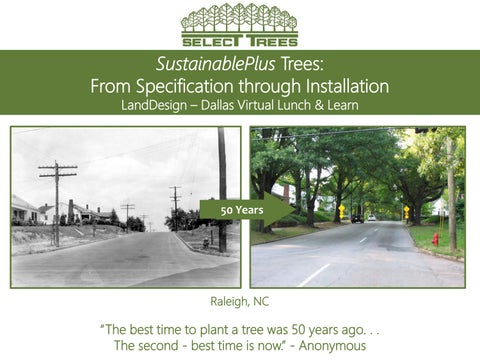
SustainablePlus Trees: From Specification through Installation LandDesign – Dallas Virtual Lunch & Learn
50 Years
Raleigh, NC
“The best time to plant a tree was 50 years ago. . . The second - best time is now.” - Anonymous
SustainablePlus Trees SustainablePlus Trees Environmental Return on Investment Over the course of 50 YEARS, a single large shade tree can generate over $160,000 in environmental benefits. - Arbor Day Foundation
$31,250 worth of generated oxygen $62,000 worth of air pollution control $37,500 worth of recycled water $31,500 worth of soil erosion control
$162,250 TOTAL ENVIRONMENTAL BENEFITS
SustainablePlus trees are trees that significantly appreciate in value from environmental benefits that they provide.
What are SustainablePlus trees?
The biggest, oldest, and healthiest trees.
Characteristics of SustainablePlus Shade Trees • Potential for optimum bio-mass • Long life expectancy in tough urban environment • Tolerant of poor growing conditions typical of urban
environments
• Minimal inputs compared to environmental benefits to maintain tree health in the landscape – pruning, water, nutrition, and pests “The average length of survival of a new street tree in New York City is seven years. The short life span means that trees do not grow large enough to provide climate control through shade, not to reduce and slow rain run-off, not to clean the air. - Henry Arnold, FASLA
SustainablePlus Shade Tree
This Willow Oak has survived the test of time in Rocky Mount, NC
What is NOT a SustainablePlus shade tree?
Rocky Mount, NC Crape Myrtles require fairly minimal resource inputs but will never yield the environmental benefits of large, long-lived, healthy, shade trees.
Because Willow Oaks were performing very well in the Rocky Mount area, the landscape architect chose them for this street planting.
Why SustainablePlus Trees?
“Considering the economics, wouldn’t it be more effective to trade fewer trees that grow large for a larger quantity of trees that last less than ten years?” – Henry Arnold, FASLA
Why SustainablePlus Trees?
Center for Urban Forest Research, Pacific Southwest Research Station, USDA Forest Service, Davis, California and the Southern Center for Urban Forestry Research & Information, Southern Research Station, USDA Forest Service, Athens, Georgia. 2004
SustainablePlus Trees Positively Affect Retail Sales
Wolf, Kathleen L. “The Environmental Psychology of Shopping”. Research Review, Vol. 14, No. 3, 2007.
SustainablePlus Trees Have Both Environmental and Economic Value
Rocky Mount, NC
Fayetteville Street - Raleigh, NC
“To walk rows of Highbeam® Overcup Oaks, all uniformly brimming with superior characteristics, is to appreciate this milestone in propagation - trueness-to-type from top to bottom ...an oak for the ages.” - Dr. Michael Dirr
SustainablePlus Trees Have Both Environmental and Economic Value
Raleigh, NC
Alexandria, VA
Seedling Oaks vs. Clonal Oaks
Impact From SustainblePlus Trees White Oak Village – Richmond, VA Select Sustainable Hightower® Willow Oaks
August 26, 2008
October 13, 2008
•1000+ Select Sustainable® Trees, 4 -6” in caliper •Summer-harvested and installed during a significant drought with no permanent irrigation •Select Trees Group Consultation on tree selection, installation, & maintenance •99.7% Success rate with Select Sustainable® Trees
Impact From SustainablePlus Trees White Oak Village – Richmond, VA Select Sustainable Hightower® Willow Oaks
August 26, 2008
August 1, 2024
•1000+ Select Sustainable® Trees, 4-6” in caliper •Summer-harvested and installed during a significant drought with no permanent irrigation •Select Trees Group Consultation on tree selection, installation, and maintenance •99.7% Success rate with Select Sustainable® Trees
How often are your intentions in design realized at installation?
What can be done to solve this problem?
What can be done to solve this problem?
Seedling Overcup vs Highbeam® Overcup Oak Seedling Overcup Oaks Highbeam® Overcup Oak is an own root clonal selection of overcup oak first planted by Select Trees in 1997. Highbeam® leafs out and drops all leaves at the same time each year, resulting on consistent and predictable performance, appearance, and growth.
Highbeam® Overcup Oaks Seedling overcups can leaf out any time between April 1st & June 1st ,resulting in inconsistent appearance and performance. Many years ago, Select Trees grew seedling overcup oaks and each spring received Several phone calls about dead overcup oaks on various projects. These seedling overcups that appeared dead were actually healthy trees with later leaf out dates.
Seedling Overcup Inconsistency
Choosing the Right Tree for the Right Place Crape myrtles do not provide optimum shade in the parking lot.
Choosing the Right Tree for the Right Place Oak optimizes biomass opportunity while the maple is declining
Durable American Linden – Parent Tree
Cultivars of Own-Root Clones Selected for Strengths and Attributes •Tolerant of various soil conditions (moisture, ph, etc.) •Drought / heat tolerance •Vigorous growth •Sustainable in urban environments •Unique aesthetic qualities
Tolerant of Various Soil Conditions (moisture, pH, etc.)
Similar Tough Conditions
Select Sustainable Highbeam® Overcup Oaks
Landscapes with Seedling Trees
2 Years
Seedlings pruned to match in nursery
2 years after installation
Why are own-root clones more dependable and predictable? “Since genetics vary widely, every tree will vary. This can lead to different growth rates, branch structure, time of leaf-out, and fall color. Trees that look matched in the nursery might not look matched a few years after planting.” – Jim Urban, Up By Roots
Seedlings Can Be Undependable and Unpredictable
1 Year
Cox Communications Atlanta, GA Hightower® Willow Oaks
2 Years
Stonecrest Mall
Atlanta, GA Seedling Willow Oaks
Seedlings Can Be Undependable and Unpredictable
5 Years
Cox Communications Atlanta, GA Hightower® Willow Oaks
6 Years
Stonecrest Mall
Atlanta, GA Seedling Willow Oaks
Grafted Trees
Same size planted at the same time
Fastigiate Carpinus
Seedling understock
Grafted trees typically have clonal tops and seedling root stock.
Clone with desirable genetics
Seedling with unknown genetics
Grafted trees mature unpredictably in the landscape
Graft Incompatibility Can Lead to Tree Failure
Commonly Grafted Trees: Shade Trees
Cultivar Examples
Japanese Zelkova
Green Vase, Village Green
Ginkgo
Princeton Sentry®, Shangri-La®, Autumn Gold
White Ash / Green Ash
Urbanite®, Summit, Patmore, Autumn Purple®, Georgia Gem
London Planetree
Bloodgood, Yarwood, Columbia
Honeylocust
Shademaster, Moraine, Skyline, Sunburst
Sugar Maple
Legacy, Green Mountain®, Steeple
Linden
Greenspire, Redmond, Legend®, Chancellor
English Oak (some hybrids)
Rosehill , Regal Prince , Skyrocket
European Hornbeam
Fastigiata, Franz Fontaine
American Sweetgum
Rotundiloba, Slender Silhouette
Tulip Poplar / Tulip Tree
Arnold, Ardis
Bald Cypress
Shawnee Brave
Blackgum / Tupelo
Wildfire, Forum
Flowering Trees
Cultivar Examples
Flowering Pear
Bradford, Aristocrat, Chanticleer®
Japanese Pagodatree
Regent
Flowering Dogwood
Cherokee Princess, Cloud 9, Cherokee Chief
Kousa Dogwood
Constellation, Stellar Pink, Milky Way
Flowering Crabapple
Snowdrift, Firebird, Prairifire, Sargent
Autumn Gold® Bald Cypress
Autumn Gold® Bald Cypress
Durable
American Linden
Palisade® American Hornbeam
Palisade® American Hornbeam
Cultivars of Own-Root Clones Selected for Strengths and Attributes •Tolerant of various soil conditions (moisture, ph, etc.) •Drought / heat tolerance •Vigorous growth •Sustainable in urban environments •Unique aesthetic qualities
Drought / Heat Tolerance
Dura-Heat® River Birch was selected as a more heat tolerant River Birch.
Drought / Heat Tolerance
Creole Queen® American Elm was selected as a more heat tolerant American elm.
Drought / Heat Tolerance
Built to Last® Red Maple was selected as a more heat tolerant Red Maple.
Vigorous Growth
Raleigh, NC
Select Sustainable® Hightower® Willow Oaks grow approximately 30% more vigorously than typical seedling Willow Oaks
Sustainable in Urban Environments
Fayetteville Street
Raleigh, NC Highbeam® Overcup Oaks
Cox Communications Atlanta, GA Hightower® Willow Oaks
Unique Aesthetic Attributes
We have over 50 patented and/or trademarked introductions with licensed growers across the country.
Allee Lacebark Elm
Height: 40-70’ Spread: 30-50’ Shape: Upright arching Foliage: Rich green Fall Color: Yellow to rosy pink
Hardiness: Zone 5 to 9 Summer Dig: Yes Native: No Own Root Clone: Yes
“Allee® Elm withstands the harshest growing conditions and will bring green civility to our cities and towns and cool to our streets and our homes .” - Dr. Michael Dirr
Proper Nursery Culture Canopy & Structure Development
Root Enhancement
Harvest Techniques
Proper Nursery Culture Canopy & Structure Development
Root Enhancement
Harvest Techniques
Trees that do not have a central leader developed in the nursery will not be as structurally sound.
Allee® Lacebark Elm WITHOUT central leader
Allee® Lacebark Elm with central leader
Central leaders must be maintained throughout the trees’ development.
Trees that do not have a central leader developed in the nursery will not be as structurally sound.
Raleigh, NC October Glory® Red Maple
Central leaders must be maintained throughout the trees’ development Maintaining the leader as the tree matures
Central leaders allow trees to be limbed up above store signs and away from pedestrians and vehicles
Highbeam ® Overcup Oak Alexandria, Virginia
Proper Nursery Culture Canopy & Structure Development
Root Enhancement
Harvest Techniques
Select Trees’ Root Enhancement Process
I. Rooting genetically superior trees
II. Hand planting for proper root orientation
III. 100% Root Pruning and transplanting to create dense, fibrous root systems
IV. Harvesting with Optimal spade to capture more roots
Select Trees’ Root Enhancement Process • Each tree from a particular own-root clonal cultivar at Select Trees is genetically identical including root systems. This means that trees are genetically predictable in the nursery and in the landscape. The only significant remaining variables are growing conditions in the nursery and in the landscape. • The Select Trees Root enhancement process includes a strict ongoing culling procedure which eliminates inferior trees. Any time during the growth of a tree from propagation to final harvest, if a tree has a problem or is suspected of having a problem with the root system or planting depth, the problem is corrected or the tree is culled.
Select Trees’ Root Enhancement Process • At Select Trees all trees are field grown in heavy red clay soils and irrigated with drip irrigation. All trees are grown in no container larger than one gallon.
Select Trees’ Root Enhancement Process
Year One
Year Three and Four
• Root softwood cutting in 4 in. Rootmaker propagation cup. This is a specialized cup with multiple baffles, steps, and holes designed to minimize circling roots and encourage root branching. • Grow rooted trees in the propagation cup until they have a strong flush of new growth and multiple roots have emerged from the Rootmaker cup.
• Plant the young trees from the Rootmaker 1 gallon container into field soil, spaced 3 ft. apart. • This planting is done by hand to assure soil does not cover the first roots by more than ½ in. • The young trees are staked with a 5 ft. fiberglass stake to develop a straight central leader. • All trees receive water from a drip irrigation system. • Grow the young trees into large starter trees in field soil. • The fiberglass stake is removed and a bamboo splint is used to maintain the growth of the straight central leader.
Year Two • Transplant young trees from the Rootmaker propagation cup directly to field on 3 ft spacing or into a Rootmaker 1 gallon container. This is a specialized container with multiple vertical ribs, steps and holes designed to minimize circling roots and encourage root branching. Timing varies with variety and original cutting date. • Transplanting is done by hand to assure that soil above the first root is removed to establish the root flair at the correct depth. • Growing shoot is staked with 3 ft. bamboo to establish the central leader. • Grow in Rootmaker 1 gallon until multiple roots have emerged from the holes in the sides of the container.
Year Five and Six • Transplant the starter trees from 3 ft. spacing to average of 7 ft. spacing to grow into finished size landscape trees. • The harvesting of the starter trees is done using a specialized machine that root prunes 100 % of the roots with a vibrating cut blade to assure root branching in the soil at the new field location. • Planting is done by hand with special attention paid to the planting depth to assure that the first roots are not covered by more than 1 in. of soil. • The young trees are staked only long enough for the new roots to establish in the soil, typically 6 months or less.
Year Seven to Eight and Beyond
Harvest
• The trees grow on field spacing into landscape size and are harvested with a mechanical tree spade beginning on average in the seventh to eighth year.
• Landscape size trees are harvested with a specialized mechanical tree spade designed to capture the most roots in a broad root ball.
• Central leader is continually developed using bamboo splints moved higher up the leader as the tree grows taller. • Pruning is done to develop a full, structurally sound canopy.
• The clear trunk is raised according to the size development of the tree.
• Based on this root enhancement process, the cut roots at the edge of the root ball will branch with new growth to establish rapidly into the soil of the landscape site.
Improper Root Development
Stem girdling roots are often the result of planting too deep and pot bound root systems.
Which root system is better?
Poor Root Development
Proper Root Development
Poor root systems will lead to dead trees. •Hazard •Damage to People & Property •Liability
Poor root systems will lead to tree problems. •Hazard •Damage to People & Property •Liability
Tree Grown at The Proper Depth
Poor Root Development Will Lead to Poor Trees
Girdling roots are killing this tree. Girfling roots are the result of trees being planted too deeply.
Proper Nursery Culture Canopy & Structure Development
Root Enhancement
Harvest Techniques
Harvesting with an Optimal Spade captures more of the root system.
Proper Installation
Proper care during planting
Proper handling and staging
Proper Handling & Planting Instructions Are Provided Prior to Installation and with Every Shipment of Trees
Proper care after planting
1000+ Clonal Trees Harvested in The Summer
White Oak Village – Richmond, VA
Select SustainablePlus Hightower® Willow Oaks
Select Trees Leads Team to Successfully Plant Trees
White Oak Village – Richmond, VA
Select SustainablePlus Hightower® Willow Oaks
Planted in Summer Though a Drought
White Oak Village – Richmond, VA
Select Sustainable® Panache® Shumard Oaks
Only 15 Trees Replaced Out of 1000+ (98.5% Success Rate)
White Oak Village – Richmond, VA
Select Sustainable® Hightower® Willow Oaks
Recipe Impact
Recipe Impact
Recipe Impact
Prior to Construction Update Specifications Based on Previous Experience Based on our experience, we suggest setting a meeting prior to delivery of plant material with the on-site supervisor for the landscape contractor. Monitor moisture in the root ball by probing the soil with a soil probe and manage with supplemental irrigation accordingly. Be careful not to over or under irrigate.
Proper specifications should assign responsibility to one company for landscape and irrigation installation and maintenance (for at least one year after substantial completion.)
Specifications should be consistent to cover proper handling & planting and maintenance with guarantee from grower
Prior to Construction Evaluation of Landscape Contractors
Evaluate landscape contractors including visits to previous projects
Prior to Construction Poor Scheduling Leads to Tree Problems
During & After Tree Installation Site Visits to Analyze and Report Tree Health I. Checklist
II. Site Plans
III. Figures
For any additional information or questions feel free to contact us at (706) 743–5124 or jlee@selecttrees.com
Hightower Willow Oak – UGA – Athens, GA