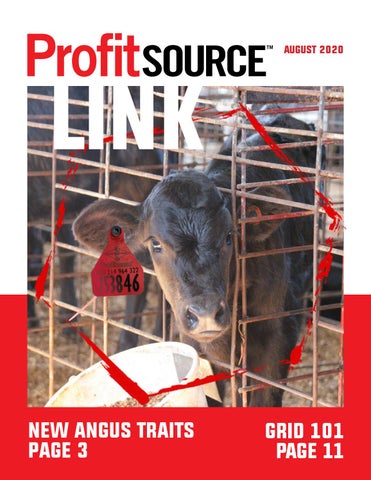
AUGUST 2020
LINK
NEW ANGUS TRAITS page 3
GRID 101 PAGE 11
GROWING PROGRAMS Welcome to the August issue of The LINK. In this issue we review some new information just released and an entertaining way to explain the various roles many play in the development of ProfitSOURCE. The usual pieces offer greater insight into our calf care lineup, sire listing with designation into various programs and education through the Meat Corner.
The ProfitSOURCE LINK is an internal publication created to keep our team connected with the most up-to-date information regarding our beef x dairy programs. Our mission at Select Sires: To enhance the productivity and profitability of dairy and beef producers, Select Sires is committed to be the premier provider of highly fertile, superior genetics accompanied by effective reproductive- and herd-management products and services. For more information, visit www.selectsires.com or www.selectsiresbeef.com. You can also call (614) 873-4683 for more details.
You will find timely information about the recent BxD indexes added to the American Angus Evaluation. The Select Sires acquisition team has done a great job finding the right Angus sires to mate with dairy cows to create the desirable cross. With these new indexes, we’ve been working on graphs and spreadsheets to tell the story of our lineup versus the competition. We will share those with you in the next LINK and put them out on mySelect for distribution. They tell a great story about what we will have to offer our ProfitSOURCE partners going forward in terms of hitting the targets offered on various grids. Our herd management products help give calves a healthy start and can provide solutions for environmental issues that may arise. Immunity is critical to the success of these calves along the chain. There have been several team members added to the roster in the last year. We thought an explanation of the roles each individual plays in the development of ProfitSOURCE would help those in the field understand who to contact with questions. You can read more on page 6. The flowchart will expand in the next couple issues with updates and will be a regular piece that is modified as new opportunities arise. As always, we encourage you to bring any potential opportunities to our attention. You all play a significant role in the development of ProfitSOURCE opportunities. The listing of ProfitSOURCE sires will continue to expand as we gather Composite Fertility Index (CFI) data and make sure those sires are meeting the needs of our dairy customers. The sire spreadsheet provides the most up-to-date listing of bulls and the various marketing programs to which their progeny qualify. We had requests from the field for an educational piece to explain grid marketing. Dr. Corah put together a great article to walk you through the various components that are involved in grid marketing of the finished animal at the end of the feeding period. Read the full article on page 11.
Sandra Utter
Beef Business Development and Supply Chain Specialist sutter@selectsires.com
2
New Angus Traits
brian house Vice President, Beef Program and Product Manager
In mid-July, the American Angus Association released two indexes designed as specific crossbreeding tools for Angus bulls being mated to dairy cows. Angus-On-Dairy $Value indexes are an estimate of how future beef x dairy (BxD) progeny of each Angus sire are expected to perform, on average. This is compared to BxD progeny of other Angus sires, if the sires were randomly mated and calves were exposed to the same environment. Two indexes have been developed for dairy producers: Angus-On-Holstein ($AxH) index and Angus-On-Jersey ($AxJ) index to help identify the most profitable Angus sires for each breed for future end marketing. Each index comprises several genetic traits weighted by the appropriated economics to serve this terminal BxD sector including: calving ease, growth from birth through the feeding phase, feed intake, dressing percent, yield grade, quality grade, muscling and height (only included in $AxH). I recently shared some insight about the new Angus-On-Dairy indexes in a brief audio update. You can listen to that by following the url below. The access password is ssbeefxdairy. https://vimeo.com/442101895 To sort Angus bulls for these indexes, you can visit the American Angus Assocation here: http://www.angus.org/DairyIndex/DairyIndexSearchCriteria.aspx For more information about how these indexes were developed, follow the link below to view a presentation by Dr. Stephen Miller at the 2020 Beef Improvement Federation meeting. https://www.youtube.com/watch?v=THLNVHsdvPM&feature=youtu.be
INTERNAL LAUNCH UPDATE
Sandra Utter
We have been talking about an internal launch this spring and the steady stream of information has been deemed to be a more effective way to disseminate the information to the field for a couple reasons. First, there are so many developments occurring within a month, it seems counterproductive to develop material that seems to change weekly. Second, a trickle of information gives those in the field a chance to “digest� the information in a reasonable fashion. We are trying to accomplish this through The Link, podcasts and other documents. The information that has been sent out can be found on mySelect. In addition, there are several sets of cattle that will be harvested in the next month that provides data to validate the genetics we currently offer as ProfitSOURCE sires. Our team is excited to get this data out there and this will add to our story with a public launch later this fall. The last reason is the current travel issues we are experiencing is making training or a launch a little more challenging. We are looking at a public launch later this fall and will make sure you are all trained and up to speed with the details related to ProfitSOURCE.
3
HYDRATION THERAPY
Understanding Calf Electrolytes
jILL STRANGSTALIEN Director of Herd Management Products and Solutions
“It’s an electrolyte. They all have to be the same.” A common thought many may have when choosing an electrolyte for calves. Unfortunately, it’s a misconception. One that can be very costly when taking into consideration how important hydration therapy is in the recovery process of an ailing calf. Research indicates that scours accounts for up to 75 percent of deaths in calves less than three weeks of age. Early identification and aggressive fluid therapy are critical in correcting the metabolic complications associated with diarrhea. Fluid imbalance can occur as a result of numerous instances in addition to scours, such as environmental changes, transport, crowding, temperature extremes, reduced feed intake, exposure to new animals, and management procedures like dehorning, castrating or vaccination. Start by looking at the ingredient list on the label. The ingredients listed from highest to lowest inclusion rate are key in deciding which calf electrolyte product is best for your calves. Some electrolytes on the market are formulated with ingredient inclusion rates outside of the recommended levels by industry and university experts. Knowing expert parameters and benchmarks is a wise standard practice. Five factors to consider when selecting an electrolyte for calves include:
1. RELIABLE ENERGY SOURCE When a calf is sick, its bodily response is to naturally pull any energy available to help combat the challenge. This can add stress to normal body functions resulting in a struggle to recover and lower average daily gain. A dehydrated calf needs an energy source to correct hypoglycemia and negative energy balance. Dextrose provides high energy; aiding in maintaining body condition and transporting sodium to the cells.
A common and effective energy source is dextrose. Again, the inclusion rate is vitally important as an electrolyte with high levels of dextrose can bring harm to calves by slowing down gut movement; thus, resulting in a bloated calf. If a calf already has scours, too much dextrose can also cause its symptoms to worsen.
2. STRONG ION DIFFERENCE (SID) Calf scours can cause a large loss of sodium and potassium which can result in metabolic acidosis — a drop in blood pH. A calf is not able to correct acidosis without intervention. For moderate acidosis, calf electrolyte products with a high SID inclusion can help balance the loss. If the metabolic acidosis is too severe, oral therapy will likely not correct it alone, and intravenous therapy may be necessary.
4
3. ALKALIZING AGENTS Alkalizing agents, often referred to as buffering agents, are used to achieve optimal blood pH levels. One of the most common alkalizing agent ingredients in calf electrolyte products is sodium bicarbonate, mostly because it helps to counteract acidosis. Other ingredients you may see on an electrolyte label include acetate and propionate, both alkalizing agents with several benefits. These agents help facilitate sodium and water absorption, produce energy when metabolized and they don’t alkalize or interfere with milk clotting in the
abomasum. Acetate and propionate can also improve sodium absorption. The process of absorbing sodium helps rehydrate the calf by replenishing total body fluids. In summary, a most effective choice is a combination of these ingredients.
4. OSMOLALITY AND CALF HEALTH SUPPORT Osmolality is a term used to measure the level of solids in a solution. Look for a calf electrolyte product ranging from 400-600 Osm/L. If there is an osmolality greater than 700 Osm/L, the calf scours could get worse or the calf could experience abomasal bloat due to the delayed emptying of the stomach.
5. DIRECT-FED MICROBIALS (DFMs) DFMs provide large amounts of beneficial “bugs” or microbes that help to combat the negative effects of stress by preventing pathogens (bad bugs) from taking over the gut. They assist in stimulating the calf’s own natural immune system. DFMs also recolonize the gut with “good bugs” following depletion by antibiotics or disease.
Along with all of the above, it is important to understand that a calf cannot meet its energy needs with only an electrolyte, which is why it is recommended to keep a calf on a pasteurized milk or milk replacer diet in addition to electrolyte therapy during health issues. In addition, it is recommended to feed an electrolyte recovery solution separate from the milk or milk replacer offering as mixing the electrolyte powder into the milk will change the solids level and can be harmful to the calf. We’ve done the homework for you and your customers! Accel RS is formulated as a more complete recovery solution than a regular electrolyte! Accel RS can be fed as a recovery solution when calves are troubled by illness or when calves simply show decreased appetite. Decreased appetite symbolizes that a calf is about to get sick, and Accel RS can assist to avoid illness or lessen the severity. Accel RS can also be fed as a proactive tool when fed prior to days when calves typically have a high incidence of scours.
BENCHMARKS
Accel rs
Sodium = 90-130 mmol/L Chloride = 40-80 mEq/L Potassium = 10-30 mmol/L Osmolality = 400-600 mOsm/L
Sodium = 128 mmol/L Chloride = 70 mEq/L Potassium = 27 mmol/L Osmolality = 472 mOsm/L
Alkalizing Agents = 50-80 mmol/L
Alkalizing Agents = 56.37 mmol/L
Source: Treatment of Calf Diarrhea: Oral Electrolyte Therapy Geof Smith, 2009
a TEAM of SPECIALISTS
SANDRA UTTER
To help explain the role each team member plays in the development and operation of ProfitSOURCE, I thought a football analogy would give you some insight since many people have an understanding of the game. Lorna Marshall – General Manager General managers are the eyes and ears of the owner, and they oversee the day-to-day operation of the team. They make the player trades and free agent acquisitions and ultimately determine which players to select in the ProfitSOURCE draft. Lorna has pulled together a team of specialists in the beef department that have set up our program for success. With long term vision and goals, she continues to push our team to grow and think beyond today’s market. Dr. Larry Corah – Head Coach The team member who knows the big picture game, the players, the coaches and the opposition. The head coach is also well versed in the positions and the most successful plays. Dr. Corah has a finger on the pulse of the beef industry. He has connections with programs and organizations that lead to valuable insight. Lyle Kruse – Offensive Coordinator The coach in charge of the offensive players usually calls the plays and works directly with the quarterbacks. He’s responsible for developing the offensive game plan (the plays he believes will be successful against the upcoming opponent). Lyle has experience with launching successful programs at Select Sires and has worked directly with commerical operations for years. Sandra Utter – Defensive Coordinator The coach in charge of the defensive players usually decides what defensive schemes to run. A master of flexibility and drive, our “defensive coordinator” Sandra, strives to set us up for the best possible situation for the ProfitSOURCE program to succeed. She is constantly in contact with key players to establish the next route that will benefit our beef x dairy (BxD) business. Todd Kranz – Scout Football scouts discover, evaluate, and recruit promising new players. Todd has been a talent scout for ProfitSOURCE investigating a variety of sources to identify promising players, meeting with potential partners and arranging incentives to encourage new key partners to join. Dr. Matt Utt and King Smith – Play Analysts Analysts gather data and information to help the team develop and become stronger and perform consistently against the competition, helping team owners and partners be more profitable. Crunching numbers and basing decisions on data helps us grow in the right direction and hit intended targets. 6
Brian House – Director of Personnel Having the right players on your team is only effective if those skills are managed and correct rosters are maintained. Brian is an expert when it comes to our beef inventory and eligibilty and has continued to help rotate our superior genetics into the correct positions. Mike DeGroot – Offensive Line Coach Works with the offensive linemen and generally has a solid understanding of the team’s running game. He and the offensive coordinator spend time discussing what plays may work. Mike points us toward opportunities for developing the supply chain potential. He helps recruit and identify calf ranches to help move the game forward. Sire Acquisition Team – Agents An agent’s core responsibilities include: negotiating contracts to achieve the best possible outcome for their clients. Our acquisitions team members spend hours analyzing which sires are the right fit for our program. Once a bull is identified, they secure the right contract to best serve our needs. Jill Strangstalien – Equipment Manager/Nutritionist For a team to be effective, they need to have the right nutrition and equipment to operate at maximum performance. Jill manages the diet requirements and makes sure each player has the right contracts in hand and access to equipment to meet the expectations set forth. These components are critical to player success on the field as they work to meet expectations of coaches, ticketholders and team owners. Morgan Cook and Jackie Rausch – Offensive Guards Members of the offensive line; there are two guards on every play. Cook and Rausch collect photos and video for our promotional material. They enhance our work by adding flash and bling to attract customers and help create sales material for advertising use in the field. Communications Team – Kicker The player responsible for kicking field goals and extra points, as well as for the opening kickoff. We have an elite group in the Select Sires communications department. These individuals pull together details and are able to create marketing materials to help kick off the conversations between representatives and customers. Each member cooperative has it’s own offensive line, starting with the Trusted Advisors as Quarterbacks. As you fill roles, you may fill several positions through the development of ProfitSOURCE in your Co-op: • Fullback: Lines up in the offensive backfield and generally is responsible for run blocking for the halfback and pass blocking for the quarterback. • Wide receiver: Lines up on or near the line of scrimmage, but splits to the outside. His primary job is to catch passes from the quarterback. • Center: Hikes (or snaps) the ball to the quarterback at the start of each play. The center lines up in the middle of the offensive line and relays play calls and assignments to others. You can think of these other members of the program in the analogy too; ProfitSOURCE Partners might be Box Seat Ticket Holders, Consumers are Ticket Holders, and our Select Sires Dairy Customer-Owners are really our Team Owners. It takes us all working together in order for this program to operate like a professional team. As you develop your ProftSOURCE team think of ways the roles fit together.
7
7
$20 $20 $20 $20 $20 $20
Advantage
Stronghold
Augustus
First Light
Brushfire
High Rank
Top Cut
7SM84 Madison %Rank 7SM98 Architect %Rank 7SM100 Country Boy %Rank 714SM107 Mainstream %Rank Inventory as of 7-27-20
Code
NO
5784
NO
NO
NO
NO
Royalty
NO
1236
Inventory
$2.00
$2.00
NO
NO
NO
NO
NO
NO
NO
NO
NO
NO
NO
NO
Royalty
2583
9916
8899
7351
4018
6874
3476
$20
Fortune
8314
$20
$20
Prime Effect
4412
2572
$20
Check It
3906
$18
$20
All Profit
12160
17321
$20
Rocket
15568
$20
$20
Ice Cap
1359
8298
$20
Omaha
5566
14522
Inventory
Retail Price $18
$20
Konza
Name
$20
Horizon
7AN363 %Rank 7AN408 %Rank 7AN444 %Rank 7AN449 %Rank 7AN453 %Rank 7AN476 %Rank 7AN526 %Rank 7AN556 %Rank 14AN557 %Rank 7AN573 %Rank 7AN575 %Rank 9AN578 %Rank 7AN582 %Rank 7AN583 %Rank 7AN588 %Rank 714AN604 %Rank
SIMMENTAL
Retail Price $20
Name
Code
ANGUS
-
4.2
3.4
3.8
CFI
-
-
-
-
3.4
2.9
3.5
4.0
3.4
3.4
4.1
3.1
3.6
3.6
CFI
CE %Rank 11.1 60 13.6 30 16.2 10 12.8 40
CE %Rank 11 15 13 10 6 55 14 4 15 3 13 10 13 10 6 55 6 55 10 20 5 60 10 20 6 55 14 4 4 70 11 15
BW %Rank 2 85 -1.1 20 -2.3 10 0.2 45
BW %Rank -1.1 10 -0.8 15 2 70 -2.8 2 -3.6 1 0.3 30 -1.5 10 1.3 50 2.1 70 1.1 45 1.9 65 -0.4 20 2.4 75 1.5 55 1.3 50 1.5 55
YW %Rank 119.3 10 87.7 75 111 25 134.9 2
YW %Rank 114 25 117 25 110 35 95 60 104 45 121 20 118 20 148 1 155 1 124 15 152 1 109 35 132 10 118 20 148 1 139 3
RADG %Rank .29 10 .21 55 .27 15 .30 4
RADG %Rank .28 15 .28 15 .24 45 .24 45 .25 35 .29 15 .32 3 .28 15 .31 4 .27 25 .31 4 .23 55 .30 10 .21 75 .35 1 .27 25
CW %Rank 29.4 55 19.1 90 31.6 45 40.3 15
YH %Rank 0.7 25 0.2 80 0.3 70 0.2 80 -0.1 95 0.4 60 0.6 35 0.5 50 0.6 40 0.7 30 0.9 15 0.3 75 1.0 10 0.7 30 0.5 50 0.4 65
Marb %Rank .79 1 .51 15 .31 45 .41 30
CW %Rank 48 30 56 15 43 40 43 40 32 70 52 20 50 25 60 10 60 10 60 10 66 4 44 45 59 10 54 20 60 10 54 20
Select Sires Beef on Dairy
RE %Rank .94 10 .41 90 .86 15 .91 10
Marb %Rank .90 15 .32 70 .60 35 -.26 95 1.00 10 1.01 10 .99 10 1.28 2 .93 15 1.21 3 1.00 10 1.05 10 1.28 2 1.04 10 1.01 10 1.55 1
TI %Rank 87 2 73 35 78 15 88 1
RE %Rank .62 35 .90 10 .64 35 .78 15 .70 25 .88 10 .88 10 .79 20 .68 30 1.00 5 .75 25 .72 25 .86 15 .95 10 1.08 3 .88 10
Select Sires and Accelerated Genetics Beef x Dairy
133 20 150 15 118 30 65 65 142 20 166 10 177 4 167 10 125 25 183 3 158 10 136 20 143 15 153 15 188 3 205 1
%Rank
Y
Y
Y
Y
ProfitSOURCE
$AxH
Y
Y
TD Beef
$AxJ %Rank 118 25 142 15 97 35 49 65 109 30 160 10 179 4 134 20 99 35 185 3 151 10 117 25 128 20 153 10 180 4 183 3
Y
Y
Top Dollar
Y
Y
Y
Y
Y
Y
Y
Y
Y
Y
Y
Y
Y
ProfitSOURCE
Y
Y
Power Genetics
Y
Y
Y
Y
Y
TD Beef
Y
Y
Y
Y
Y
Y
Y
Y
Y
Y
Y
Y
Y
Y
Top Dollar
9
$20 $20 $20 $20
Cascade
Free Ride
Lead Time
Foreman
Honcho
7CH95 %Rank 9CH99 %Rank 9CH103 %Rank 9CH106 %Rank 9CH107 %Rank
6795 16191 26069 10938
$20 $20 $20 $20
Argus Lim-Flex
Davy Crocket Lim-Flex
Farmer Joe Lim-Flex
Filmer
Fidelo %LM
7KB1 Seigi 7KB2 Emori 14KB3 Haru Inventory as of 7-27-20
Code
Retail Price $30 $30 $30
18589
$20
Africa %LM
Name
28780
$20
Accel
WAGYU
18050
$20
Warbonnet
7LM12 %Rank 7LM14 %Rank 7LM15 %Rank 7LM16 %Rank 7LM18 %Rank 7LM19 %Rank 7LM20 %Rank 14LM4514 %Rank
4803 5093 7619
Inventory
26204
Retail Price $20
Name Inventory
1917
2044
18283
8079
11848
Inventory
Code
LIMOUSIN
Retail Price $20
Name
Code
CHAROLAIS
NO NO NO
Royalty
NO
NO
NO
NO
NO
NO
NO
NO
Royalty
NO
NO
NO
NO
NO
Royalty
4.3 4.0 -
CFI
4.2
4.0
3.8
3.8
3.1
3.7
3.7
3.5
CFI
-
-
-
4.5
3.1
CFI
VA AA AA
SCD
CE %Rank 14 15 11 35 12 30 15 10 16 3 17 2 14 20 12 35
CE %Rank 5.4 55 8.5 25 11.5 7 7.2 35 10.5 15
YW %Rank 90 50 98 35 94 50 102 45 95 70 107 35 120 3 101 40
YW %Rank 71 25 67 30 64 35 71 20 77 10
3 4 7
Tenderness
BW %Rank 1.7 55 1.3 45 -1.3 10 -2.3 3 -0.6 15 0.1 30 1.4 60 1.1 55
BW %Rank 0 40 -2.1 15 -4.0 3 -0.6 30 -3.1 6
CW %Rank 17 40 18 35 6 90 32 30 37 20 13 95 23 25 6 95
CW %Rank 26 20 15 75 24 35 27 20 29 15
REA %Rank 1.26 35 1.42 10 1.25 20 .72 60 .94 25 1.16 3 1.17 45 .90 65
REA %Rank .74 30 .70 50 .72 40 .85 15 .73 40
Marb %Rank -.75 95 -.52 75 -.08 30 .17 30 .38 5 .08 45 -.04 1 -.18 50
Marb %Rank .20 20 .17 20 .46 1 .28 3 .14 30
Select Sires Beef on Dairy
$MTI %Rank 27.10 95 37.12 60 52.00 25 57.17 35 64.60 10 58.30 30 57.43 1 48.28 45
TSI %Rank 216 25 217 20 222 15 222 10 226 7
Y
Y
Y
Y
Y
Y
ProfitSOURCE
Y
Y
Y
Y
Y
ProfitSOURCE
Y
Top Dollar
Y
Y
TD Beef
Top Dollar
10
FLOW CHARTS for EXISTING BXD PROGRAMS
THE MEAT CORNER
Larry Corah ph.d.
Supply Chain Consultant
Grid 101 Today, nearly 75 percent of the fed cattle are sold on some type of formula or grid; to the point many people are concerned the cash market is not large enough to establish a base price. How did we get to the point of pricing cattle on their carcass merit? When the cattle feeding industry started in the 1950s, and up until the ‘80s, cattle were sold based on price per pound of live weight. In the 1990s two key events occurred. With the formation of U.S. Premium Beef, quality cattle could now be sold on a grid contract to National Beef. Another packer, Beef America (now defunct), also started offering grids. Then in 1998, Dr. Ken Conway formed GeneNet to sell cattle to ConAgra (now JBS) on a grid. Soon all other packers followed suit. What is a grid? Grid prices refer to pricing cattle on an individual animal basis. Before we get into the specifics, the biggest advantage of a grid is that it allows the feedlot to sell cattle when they are at their optimum compositional end point. Remember, selling as a carcass versus live marketing allows for considerable added weight since about 70 percent or more of the added pounds are carcass pounds. This is another reason why carcass weights have increased over the years. Now to the specifics of a grid. Keep in mind that most grids are negotiated between the buyer and seller so there really is no such thing as a “typical” grid but nearly all grids have common pricing points. Also, understand that packers generally prefer to buy cattle live so often grids are not available to many cattle feeders, especially the smaller lots. What are the typical premiums and discounts? Let’s start with quality grade. There generally is a premium for Prime and Premium Choice (Certified Angus Beef or CAB) and a discount for Select and No Roll carcasses. How much? Usually, each Prime carcass receives a $10-14/cwt premium, which for a 900 pound carcass can be over $100/head. This is one reason why many feedlots target the Prime grade today. For a Premium Choice grade, such as CAB, the premium will vary from $3-6/cwt and since 35 percent of the black-hided cattle hit this threshold today, this becomes another important grid target. Most packers use the plant average (or a targeted predetermined threshold) for percent Choice to determine Select discounts. If you hit the plant average, or threshold, each carcass receives the current Choice–Select (CH-S) spread dollar value (as of July 25, CattleFax reports a $11.47/cwt CH-S spread) for each carcass above the target or conversely the same discount for each carcass below the target. Yield grades generally carry a premium or discount. For a Yield Grade (YG) 1 carcass the premium varies from $3-7/cwt; YG 2 carcasses receive $2-5/cwt for each carcass qualifying. Yield Grade 4 cattle are discounted $1014/cwt, although some grids or packers may offer a YG 4 allowance. Yield Grade 5 cattle generally are discounted $20/cwt or more. Extremes in carcass weight also have discounts. For carcasses below 575 (or in some cases 600) pounds there will be $12-15/cwt discount and for those above 1,050 pounds a $15-20/cwt discount, but again, sometimes packers will have some allowance agreements in place. Some packers even discount carcasses over 1,100 pounds as much as $30/cwt. One important factor to remember when selling on grid is dressing percentage. It is not unusual to see as much as a 1-1.5 percent variation in dressing percentage between feedlot pens of cattle. Factors like muscling and proper fat cover become important considerations. Another key to effective grid marketing is the ability of a feedlot to sort cattle to avoid discounts for overweight or over fat cattle.
11
How much added value is there to selling on a grid? As many feeders have learned with their first couple pens of gridded cattle, sometimes there is no premium and maybe even a discount. Today I’d say the typical pen of cattle sold on a grid receives about a $20-30 premium. Yet, programs like U.S. Premium Beef will tell you that the top 25 percent of cattle sold on their grid average $88/head premium. I would also argue, because of the emphasis Select Sires places on marbling and muscling, that A.I.- sired calves should be sold on a grid to capture the value created by genetics. I’d also argue that selling BxD calves on a grid will be very important.
MVP AWARD
SANDRA UTTER
The MVP award is something that we implemented to acknowledge the hard work our BxD team members are doing to make the ProfitSOURCE program successful. Some of these individuals are part of our core team and sometimes they are members of the extended Select Sires BxD family. That is the case for our August MVP. This month we want to recognize Karen Wheatley, manager of employee development, training and management with Premier Select Sires, for her dedication in helping to grow aspects of ProfitSOURCE. Karen has played a key role in the development of a Penn State relationship and research endeavor that will give us data this fall as we do a public launch of ProfitSOURCE.
I’ve been impressed with Karen’s attitude and willingness to pitch in and help in any form or with any part of the ProfitSOURCE program. She has helped put together this initial Penn State study and find calves (similar to finding a needle in a haystack, literally). She has also worked to get semen out into the field in a timely fashion to create the next crop for analysis. Karen recently helped gather feedback to get the proper ProfitSOURCE tag combination to an important Select Sires customer. She continually volunteers to go beyond her designated role to help build the program and enhance the experience for not only customers, but our Select Sires team as a whole. Her ability to assist on any play on the field and create new plays make her an easy selection for this month’s MVP!
Sandra Utter (left), Jerome Meyer, CEO CentralStar (back to camera), Brent Beeker, CentralStar area sales manager (center), and Ed Nichols, CentralStar director of integrated services (far right), meet with calf ranch partners through the Power Genetics program to discuss opportunities with the ProfitSOURCE supply chain. ProfifitSOURCE is a trademark of Select Sires Inc. ®Accel RS and Your Success Our Passion. are registered trademarks of Select Sires Inc. Buyer assumes all responsibility for use, storage and handling of this product. All claims, representations, and warranties, expressed or implied, are made only by the company responsible for manufacturing and not by Select Sires Inc., its member cooperatives, its agents or employees. First Day Formula is manufactured for Select Sires Inc., 11740 US 42N, Plain City, OH 43064.
TM
Market Access Through Numbers SANDRA UTTER Most of us have customers with varying sizes of herds or matings related to beef-on-dairy (BxD), and lower numbers create greater challenges in finding opportunities. I wanted to take some space and explain the reasons we need to put together numbers when we talk about calf pickups, transportation and groups of calves. I want to start by saying, I am so impressed with the lengths everyone in the field goes to in helping
facilitate or create calf pickup or market access for your customers. You all are great at customer service and this is another part of that puzzle. You not only deliver semen, but often provide genetics and technical support, you are also becoming great assets at finding or creating marketing opportunities for the BxD calves produced by your dairies. It’s easier when there are larger groups of calves born daily, but many of you are creating routes with significant enough numbers to help calf runners be efficient in picking up customer calves.
Let’s examine why this is important not only for the calf ranch, but for everyone else within the production chain. First, transportation needs to be efficient from the dairy to the calf ranch. Picking up one calf at various locations isn’t the most efficient. We can find ways to group calves at one location or pick up twice a week to allow time for a greater number of calves to accumulate. The efficiency needs to be transmitted throughout the production chain as these calves move from the calf ranch to a grow lot or feedlot. Most calves will be transported by semi truck loads, which allow for a gross weight of 45,000-50,000, depending on the type of semi-trailer utilized. The other part of the number equation is feedlot pen space. Most commercial feedlots have a pen size from 100-200 head. For that reason, numbers need to be in that 100 head minimum. There are exceptions, but not often and larger numbers equate to greater market access. Feedlots prefer to feed all steers or all heifers in a pen and not mix sexes. Consistency of sires, breed and gender all play into market access, but making transportation more efficient from a head count standpoint also plays into the formula value. Please try to keep that in mind as we build this system. You all have been very good at helping develop or create opportunities for customers. Keep up the great work!
13