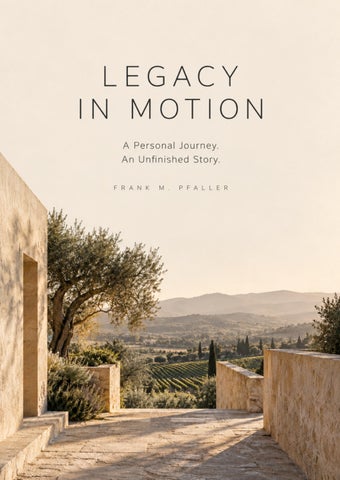
LEGACY
IN
MOTION A
Personal
Journey.
An Unfinished Story. FRANK
M.
PFALLER
CHO WE DESIGN DESIRE. NATURE COMPLETES IT.
CH ALLIANCEPARTNERS| COUTUREHOSPITALITYCONCEPT
The privilege of an unfinished journey A personal reflection on hospitality, creativity, trust — and what comes next. Frank M. Pfaller
There comes a moment in a long professional life when one might reasonably assume that the defining chapters have already been written. I have recently begun to suspect otherwise. Looking back over more than 25 five-star hotels in some 18 countries, I remember the people more readily than the addresses. Owners with formidable imaginations. Colleagues who could rescue an impossible evening without attracting attention. Guests whose needs were sometimes touching, sometimes extravagant, and occasionally beyond the capacity of the local electricity supply. I went into hospitality to create places in which people would feel well looked after. Over the years, that apparently simple ambition has taken me into architecture, design, brand philosophy, destination development and the delicate business of telling an owner something he or she would rather not hear. It has also provided a useful education in the limits of certainty. Some people taught me what to do; others offered equally valuable instruction in what to avoid. I remain grateful to both, although I may have expressed that gratitude differently at the time. What follows is less a record of appointments than a reflection on what those experiences have left with me: curiosity, respect for the character of a place, and the conviction that hospitality succeeds when it makes people feel something. Those convictions now inform my work with Alejandro Bulgheroni and his family’s estates. The journey feels unexpectedly current.
I went into hospitality to create places in which people would feel well looked after. Over the years, that apparently simple ambition has taken me into architecture, design, brand philosophy, destination development and the delicate business of telling an owner something he or she would rather not hear. It has also provided a useful education in the limits of certainty. Some people taught me what to do; others offered equally valuable instruction in what to avoid. I remain grateful to both, although I may have expressed that gratitude differently at the time. What follows is less a record of appointments than a reflection on what those experiences have left with me: curiosity, respect for the character of a place, and the conviction that hospitality succeeds when it makes people feel something. Those convictions now inform my work with Alejandro Bulgheroni and his family’s estates. The journey feels unexpectedly current.
Where character mattered Spain gave me some of my most formative years. At La Bobadilla, near Granada, the landscape and the architecture belonged to the same conversation. The appeal lay in a distinctly Andalusian sense of place. Luxury could be quietly confident; it did not need to explain itself at every turn. Puente Romano in Marbella offered a different education: Mediterranean sophistication, international society and the daily theatre of a hotel whose guests brought quite enough personality of their own. Some were famous; others were convinced that recognition was merely overdue. Discretion served us well in either case. At Las Dunas Beach Hotel & Spa in Estepona, the ambition was to create something exceptional through accommodation, wellbeing and the quality of the table. I remember the culinary achievement with particular affection. Behind any distinction lies a great deal of work that never reaches the dining room: repetition, discipline and people willing to notice the smallest thing before a guest has to mention it. Of course, standards occasionally encountered more charming forms of resistance. Las Dunas had a clear policy: no dogs. Maite, whom I remember
from her time as Prince’s wife, was staying in a suite for an extended period. Being a gentleman, I helped with her luggage. Among its contents, less conventionally packed, were two small dogs. The staff knew. In retrospect, almost everyone appeared to know except the policy. We became friends, and my owner eventually joined in the amusement. I have no wish to turn an amiable conspiracy into a management principle, but it remains a fond memory of the distance between a printed rule and the life of a hotel. Quinta do Lago in Portugal broadened the picture. Here, landscape, residential life, sport and an international community formed part of the same destination. A hotel could contribute to a much larger way of living. It was a lesson I would return to years later, among vineyards rather than fairways. The Mediterranean years left me with a lasting respect for character. Buildings and facilities can be copied with sufficient money. The relationship between a place and the people who give it life is much harder to reproduce.
One Christmas party One of my sharpest lessons in the consequences of a decision came at the Maharani in Durban. I was 31, a young general manager in Sol Kerzner’s orbit, and probably rather less knowledgeable than I imagined. South Africa was still under apartheid. As Christmas approached, my personal assistant asked how and when we should arrange the separate staff parties expected for the different racial groups. My answer was immediate: we would have one party for everyone. Advice to the contrary did not improve my receptiveness.
I remember the celebration, and I remember the consequences. What seemed to me a straightforward decision about colleagues sharing a Christmas party became a matter of press attention and serious personal jeopardy. As I recall it, imprisonment was a possibility and deportation a real threat. Sol Kerzner intervened, and the outcome could have been very different without him. Saved by the bell, one might say, although in my case the bell answered to SK. The lesson that followed was unforgettable. I would not turn that memory into a heroic episode. Apartheid was a system of profound injustice, not a dramatic backdrop to a young hotelier’s career. My part was small, and my understanding incomplete. What stayed with me was the conviction behind the decision, together with a much soberer appreciation of the circumstances in which other people had to live and work. Leadership requires more than confidence in one’s intentions. It requires an understanding of who may bear the consequences. At 31, I had considerably more of the first than the second.
Islands and the practical limits of paradise The Caribbean offered another rhythm and its own exacting education. St. James’s Club in Antigua, Le Guanahani in St. Barthélemy and Krizia’s K-Club in Barbuda belonged to an era in which celebrated guests sought informality and privacy while retaining exceptionally high expectations. Bare feet did not necessarily imply modest requirements. At K-Club, Mariuccia Mandelli, the formidable creative force behind Krizia, told me that Giorgio Armani found the swimming pool too cold. It should be heated. There was a small practical difficulty. Our gas arrived by a special weekly boat from Antigua, and the available supply had other duties: the kitchen and the showers among them. I explained that the choice was essentially between hot soup and hot water for our guests, or a warmer pool for Giorgio. Even in fashion, some combinations
are impossible. Her husband’s request for water for a practice golf course met a related obstacle. On Barbuda, our desalinated water was precious. The demands of a fairway could not take precedence over those of the people staying with us. Neither conversation was conducted entirely in whispers. We held our ground on behalf of the majority of our guests. I remember those exchanges with affection, and with undiminished respect for the imagination behind the place. Yet imagination could not enlarge a gas delivery or produce water on command. The island’s resources set the terms. It was an early, very practical lesson in responsibilities that our industry would later discuss in more polished language. Opening Le Guanahani as managing director provided a different test. Almost everything that could go astray appeared determined to do so. Containers carrying furniture and plants went missing or took unexpected routes. Electricity and telephone lines failed during the year-end high season, when an impressive crosssection of New York society and the financial world had already arrived. The landscape was not quite ready for its audience. We sprayed a green mixture where lawns were supposed to be. Palm trees travelled from villa to villa between guest arrivals; curtains displayed a similar willingness to relocate. The team became exceptionally accomplished at making a limited inventory appear to be in several places at once. I would gladly have exchanged some of that ingenuity for a functioning telephone. Still, there was something remarkable in the way people kept going: improvising, helping one another and trying to protect the holiday our guests had come to enjoy. Some departures were accompanied by complaints we had certainly earned. Others came with a response I remember in this spirit: what an adventure; we
would be back, and that was a promise, not a threat. It was generous of them. We had given them rather more story than they had booked. Those islands taught me how much privacy, warmth and a thoughtful gesture can matter. They also taught me to respect the unglamorous machinery beneath a beautiful experience. Paradise is considerably more convincing when the lights stay on.
Making room and learning to listen At Le Touessrok in Mauritius, the landscape seemed capable of doing much of the work itself. The Indian Ocean, the island’s cultural richness and the ease of resort life created an extraordinary setting. Occasionally, however, even that was insufficient compensation for the size of a suite. A celebrity guest felt hers was too small. We invited her to a long lunch at our tree restaurant on Île aux Cerfs. While she was away, a wall was removed. She returned to more generous accommodation; lunch had proved unexpectedly constructive. I shall preserve her anonymity. The memory belongs as much to the team who made the transformation possible as to the guest who prompted it. There are occasions when hospitality demands imagination, and others when it appears to require alterations to the floor plan. Further east, the delMango chapter in Bali deepened my interest in lifestyle hospitality and the relationship between design and local culture. Craftsmanship, spirituality and the island’s intimacy with nature offered a richness that conventional displays of opulence could easily miss. The important question was what a contemporary project might learn from its surroundings. At the Ruijin in Shanghai, I encountered another set of relationships between heritage, international expectations and local institutions. My memories include government connections and
a suite on a scale I recall as some 2,000 square metres. After Mauritius, one could hardly complain that I had failed to encounter the other end of the accommodation spectrum. Scale was only part of the lesson. Shanghai required me to understand the context before presuming to interpret it. An approach that felt entirely natural in Marbella could be quite wrong elsewhere. The longer I worked across cultures, the more useful it became to listen before offering an opinion. For someone increasingly invited to advise, that was a necessary discipline. Experience is helpful; assuming that it has already supplied every answer is less so.
What experience is for Over time, my work expanded beyond hotel operations into creative concepts, positioning, architecture, communications and strategic advice. Through CoutureHospitalityConcept and the partners with whom I have worked, I found myself bringing different disciplines into the same conversation. The most rewarding collaborations were those in which nobody needed to have the only good idea. HoteliersGuild gave another dimension to that work. Its nonprofit purpose matters to me because an industry so dependent on people has a responsibility to widen opportunity. Experience ought to circulate, rather than remain the private property of those fortunate enough to acquire it. The SIRIUSACADEMYCAMPAIGN curated and initially generously funded by Lindsey Ueberroth of the PREFERRED HOTEL GROUP and our educational collaborators, has made that responsibility more tangible. The figure I return to with particular pride is 70 scholarships for women. Behind a number like that are individual ambitions and the possibility of careers that might otherwise have been harder to pursue. I hope that what we share is useful without becoming prescriptive. The next generation deserves access to what we have learned, together with enough
freedom to question it. They will find original mistakes of their own; we need not insist that they inherit all of ours. My understanding of luxury has changed alongside this work. Abundance alone is an inadequate measure. A place can offer more facilities, more space and more expensive materials while giving very little of itself. Equally, a beautifully judged experience can feel generous without exhausting the landscape or overwhelming the culture that makes it possible.
Emotion is today’s true luxury. I use those words as a personal conviction, with practical consequences. They ask whether people feel welcomed, whether a place has retained its integrity, and whether what we create deserves the resources it consumes.
The gas boat and desalination plant in Barbuda had already made part of that argument, rather effectively. It has taken the industry longer to find the vocabulary.
The privilege of trust My first encounter with Bodega Garzón came shortly after its 2016 opening, while I was in Uruguay on another project. I was struck by the beauty of the place and the breadth of the owner’s vision. I contacted Alejandro Pedro Bulgheroni with what seemed to me an obvious observation: this place called for a hotel. His answer, as I remember it, was that the wines must earn their standing first: the equivalent of five stars, or ratings above 90 points. Only then would he consider adding a luxury hotel. I admired the order of priorities, even if it did little to advance my immediate proposal. After what I like to describe as ten years sitting beside the telephone, it rang. We began to plan. The telephone vigil is, I should confess, an editorial approximation; the patience behind the story is real. I have since had the privilege of earning Alejandro’s trust and being invited to help lead the transformation of the family’s vineyard portfolio towards a broader hospitality vision. What began as a brand mandate has opened a much wider dialogue about heritage, architecture, cultural identity, environmental responsibility and the experience of the estates themselves. Alejandro Bulgheroni Family Estates — ABFE — gives that dialogue a shared identity. A World of Living Estates expresses the ambition: places with their
own histories and productive lives, connected without being made interchangeable. Dievole in Tuscany is a cultural anchor, with a history traced to 1090. Elsewhere, the landscapes, traditions and possibilities are quite different. The task is to understand what belongs in each setting, and what should be left alone. Trust makes such a conversation possible. It also creates an obligation to offer an independent view. An adviser who merely confirms an owner’s wishes is unlikely to be much use when the difficult decisions arrive. Sometimes the most valuable contribution is an inconvenient question asked early enough to prevent an expensive answer. I am conscious, too, of how many people a project of this ambition requires. Owners, executive teams, architects, specialists and creative collaborators bring knowledge I do not possess. My contribution is to connect experience and judgment with their work, and help the whole retain a coherent purpose.
A world taking shape Universo Garzón brings many of these questions into one landscape. The opportunity reaches beyond a vineyard hotel towards a relationship between wine, gastronomy, residential life, wellbeing, sport, nature and culture. I find that possibility compelling precisely because it demands more thought than assembling a collection of facilities. The concepts under discussion give the ambition a tangible form: an all-suite B-LODGE as an initial hospitality component; Villa Bulgheroni as a flagship hotel; and BSPA as a proposed centre for wellbeing and longevity. At José Ignacio, BSHORE envisages an Atlantic connection through a villa, beach club and the Quinco restaurant concept associated with Francis Mallmann. B-inResidence envisages around 190 private villas, with a polo club proposed alongside the existing golf offer. These remain elements of an evolving vision, with their scope, sequence and final form to be worked through. A concept becomes meaningful through the decisions that make it appropriate to its place. The questions I keep returning to are simple to ask and difficult to answer. How much development can a landscape welcome while retaining its openness? What will make a resident’s life richer without diminishing a visitor’s
experience? Where does a new building belong, and where is the greater contribution to leave the view undisturbed? The wider ABFE world gives those questions different accents. At Dievole, agricultural heritage and contemporary hospitality need to remain in a respectful relationship. Meraviglia Bolgheri offers another conversation between vineyards, geology and the proximity of the sea. In Patagonia, Otronia’s remoteness suggests a very different understanding of comfort and access. Alkina in the Barossa Valley brings its own relationship with land, viticulture and craftsmanship. I would be disappointed if the eventual answers looked the same. A shared philosophy should give these places confidence in their individuality. It should help a guest recognise a quality of care while continuing to discover where he or she actually is.
That is what legacy in motion means to me: inherited character kept alive through thoughtful choices. Heritage carries obligations as well as possibilities. I find myself increasingly interested in the quality of the decisions we leave behind.
Still curious There is a particular freedom in reaching a stage of life when the work matters more than the need to prove oneself. I am drawn to projects because of their purpose, the people behind them and the possibility that what we do might still feel worthwhile many years from now. The ABFE undertaking brings together much of what has occupied and delighted me: hospitality, design, cultural interpretation, environmental responsibility and the art of bringing people into a productive conversation. There is a great deal still to resolve. Some ideas will change; some will never be built. Restraint deserves its place at the table. My hope is to contribute places that respect their surroundings and make people feel welcome, while leaving something of value for those who follow. The most enduring memories of my own journey are rarely of physical
grandeur. They are of how people behaved, how they cared, and occasionally how they found a way through an entirely unreasonable afternoon. Asked for my motto, I begin with responsibility: take great care over the social and environmental consequences of what we do, and how we do it. In hospitality, I come back to the same conviction: emotion is today’s true luxury.
In private life, I have a fondness for the muchcirculated image of arriving at the end sideways, chocolate in one hand and a martini in the other, thoroughly worn out and exclaiming, “Wow! What a ride!” I claim affection for the sentiment, rather than authorship of the line.
The companion thought is equally dear to me: what matters is the life we add to our years. I have been fortunate in the people, places and adventures that have filled mine. I remain curious about what may come next.
And if anyone expected me to retire quietly, I fear there has been a slight misunderstanding.
The most meaningful chapter may still be unfolding. Frank M. Pfaller November, 2026
A SHARED
A LASTING CO
G
HOTELIERS GUILD EST. 2000
Connecting hospitality leaders
through shared knowledge, creative exchange and a commitment to responsible hospitality.
EXPERIENCE SHARED. O
› PASSION.
ONTRIBUTION. HOTELIERS GUILD
ACADEMYOFHOSPITALITY ARTS EST. 2020
Opening pathways for emerging
talent through education, mentorship and scholarships in the hospitality arts.
PPORTUNITY CREATED.
BULCI FAMI
LEGACY I Honouring heritage. Sh