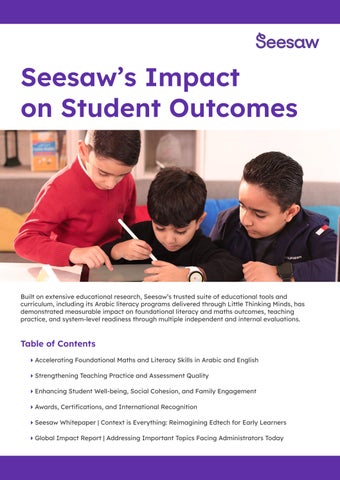
Seesaw’s Impact on Student Outcomes
Built on extensive educational research, Seesaw’s trusted suite of educational tools and curriculum, including its Arabic literacy programs delivered through Little Thinking Minds, has demonstrated measurable impact on foundational literacy and maths outcomes, teaching practice, and system-level readiness through multiple independent and internal evaluations.
Table of Contents Accelerating Foundational Maths and Literacy Skills in Arabic and English Strengthening Teaching Practice and Assessment Quality Enhancing Student Well-being, Social Cohesion, and Family Engagement Awards, Certifications, and International Recognition Seesaw Whitepaper | Context is Everything: Reimagining Edtech for Early Learners Global Impact Report | Addressing Important Topics Facing Administrators Today
Accelerating Foundational Maths and Literacy Skills in Arabic and English •
In an independent, third-party ESSA Tier III study conducted by LearnPlatform during the 2022–23 school year, Seesaw usage among 8,133 K–5 students across 25 elementary schools was examined in relation to end-of-year academic outcomes. •
Greater use of video or voice posts was associated with statistically significantly higher end-of-year NWEA MAP® reading and mathematics scores.
•
30.4% improvement in words read correctly; 106% improvement in the lowest-performing region; strong RCT gains in Arabic reading (decoding, fluency, comprehension); adaptive learning effect size up to 0.41 for engaged learners. (Let’s Live in Harmony – Final Internal Evaluation Findings)
•
Seesaw’s English Early Literacy curriculum has been independently validated by a third party as an ESSA Level IV intervention, confirming a research-aligned logic model grounded in the Science of Reading and designed to improve foundational literacy outcomes. 2024 ESSA Tier IV Report and Logic Model
Seesaw Early Literacy Logic Model
2. Citation: Foorma n, B.R., Chen, D. T., Carlson, C., Moats, (2003). Necessity L., Francis, D.J., & of the alphabetic Fletcher, J.M. principle to phonem Writing, 16, 289–32 ic awareness instruct 4. ion. Reading and a. Citation Type: b. Population: c. Design Decision (s) Driven by the Researc h: Scope and sequenc awareness and phonics e design; phonemic lessons/activities d. How did the team leverage the citation to come to this design research highlights decision? The the importance and impact of incorpo awareness alongsid rating phonemic e alphabetic instruct ion in kindergarten e. If the sample varies curricula. significantly from your population of why this research interest, please explain is still relevant to your product: N/a f. Evidence of the feature (screen shot, video, or URL): g. The first 10 weeks of the K Scope and Prepared for: Sequence feature alongside the K alphabe Fun Phonemes lessons tic principle/alphab Seesaw et recognition collectio Treasures. The order n, Alphabet of activities in Alphabe t Treasures is scaffold a : phonem ic awaren by Instructure orm ed to begin with ess activity immedi Prepared by LearnPlatf“Listen” ately following the activity.r “Introduction” in the Researche Meetal Shah, Ph.D., Senior Researcher Alexandra Lee, Ph.D., Senior r Christina Davis, M.P.A., Researche
ce Level IV
Study Type: ESSA Eviden
Revised
for Seesaw, 2024 November 2024 November 12,
6
LearnPlatform by Instructure
© 2024
Strengthening Teaching Practice and Assessment Quality •
Seesaw Instruction & Insights was named a 2025 CODiE Award Winner for Best Education Platform, recognizing excellence in product quality, innovation, and impact within the global education technology industry.
•
According to an ISTE expert review, Seesaw enables multimodal demonstration of learning, fosters digital citizenship, and supports creative student expression through original work and remixing. ISTE Seal Review Findings Report
BEST EDUCATION PLATFORM
•
98% of teachers agree that Seesaw helps them deliver engaging instructional experiences in a 2023 survey of active teachers.
•
94% of teachers reported positive changes in students’ engagement, participation, confidence, and classroom behavior after using Little Thinking Minds tools. (Let’s Live in Harmony – Final Internal Evaluation Findings)
•
Seesaw holds multiple Digital Promise product certifications, including Learner Variability, Responsibly Designed AI, and CAST UDL, validating its commitment to equitable, inclusive, and research-based design. About Digital Promise Product Certifications
Enhance Student Well-being, Social Cohesion, and Family Engagement •
Independent ESSA Tier III research found that greater use of Seesaw,particularly family engagement and student audio/video expression,was significantly associated with higher end-of-year reading outcomes
•
Students demonstrated social-emotional learning gains, including a 3.8–4.8% increase across empathy, relationships with family and peers, and conflict resolution, alongside an 8.4% improvement in social cohesion comprehension. Behavioral assessments also showed increased pro-social behaviors, including generosity and grit toward peers. (Let’s Live in Harmony – Final Internal Evaluation Findings)
Methodology
Let’s Live in Harmony
o Sampling
o Assessed 1610 secon d and third grade (27% of total population); and o 100 public schools in Jordan (North, Cente r and South). o Internal evaluation complemented by The WZB Berlin Social Science Cente team measuring social cohesion behavior; and r research o Qualitative research with teachers and studen ts. o Dosage o 45 minutes once a by d Powere week for one semester.
ings Final Internal Evaluation Find o Additional Research
Awards, Certifications, and International Recognition Seesaw’s impact and product design are recognized through:
25M+
users worldwide (educators, students, and families)
100K+
Seesaw Pioneers and Ambassadors forming a large professional community
10+
awards and certifications
Finalist positions in Bett Awards for AI in teaching and primary learning, and GESS finalist for Primary Supplier of the Year.
Little Thinking Minds has earned: •
Selection in the HundrED Global Collection 2025, identifying it as one of the world’s most impactful and scalable education innovations.
•
Certification from Education Alliance Finland, validating pedagogical quality and learning design.
•
ICEIE Bronze Effectiveness award for real-world educational impact.
•
Recognition as an AWS Qualified Software Partner, signaling high technical quality and cloud-readiness.
•
Finalist in GESS Awards, The EdTech Awards (Cool Tool), and other competitive global recognitions.
Impact metrics including
10M+
books read
Context Is Everything: Reimagining Edtech for Early Learners Global Edition By Evo Popoff and Daimen Sagastume Joseph South, Chief Innovation Officer, of ISTE
Produced by
Commissioned by
Foreword By Joseph South, Chief Innovation Officer, ISTE One of the most important conversations we
in Education (ISTE) and the Association for
can have, regardless of where we live, revolves
Supervision and Curriculum Development (ASCD) to
around how young children should interact with
help educators and families around the world make
technology. These formative years are critical,
sense of edtech for early learners.
as young children are particularly susceptible to our influence, and we bear the responsibility for
For example, ISTE recently released its Hands
shaping their early experiences with technology.
On AI Projects For the Classroom: A Guide for
While some advocate for complete abstinence
Elementary Educators to help educators bring
from technology for young children, this stance is
core AI concepts into the classroom in relevant
often impractical and can deprive them of valuable
and safe ways for young learners. As noted in the
and meaningful experiences. For example, for
report, given how seamlessly AI blends into the
children who don’t live near their extended family,
world of children between the ages of 4 and 10, it is
story time with grandparents may happen on a
all the more important they learn how to identify AI
screen. For young students, computers or tablets
and use it effectively and responsibly.
are a useful part of their learning experience that expands their access to quality resources and
ISTE is also developing—with support of General
sparks their curiosity.
Motors—a STEM Early Learning Guide outlining both technology-free and technology-rich
Legitimate concerns about the impact of
STEM activities in early childhood and primary
technology on the development of young
classrooms. This guide will present a version of the
children have made parents and educators
ISTE Standards for early learners, along with lesson
apprehensive about the use of new and emerging
ideas for children as young as ages 3-9.
technologies with early learners, even as they acknowledge potential benefits of these new
This guidance has never been so urgent. The ever-
tools. This inherent tension has been a consistent
growing digitization of our world, the increasing
theme of conversations that have taken place in
acceptance of edtech usage coming out of the
communities around the world over the past two
pandemic, and a new explosion of edtech tools
decades about the role of technology in primary
developed with and by powerful AI engines, means
and elementary classrooms. This tension led the
that more edtech will be finding its way into the
United States Department of Education’s Office
hands of young learners.
of Educational Technology (OET) to issue guiding principles for edtech and early learning when I
In introducing this report featuring advice from
was leading the Office, and it’s at the heart of
global experts in early learning and edtech, I’d like
this report. It is also what motivates my current
to highlight four foundational concepts that drive
work at the International Society for Technology
our work at ISTE.
1. Early learners (and their teachers)
4. We need to make sure we unplug! It is
deserve educational technology designed
also important that children have time away
specifically for their needs. Young children
from technology, time with peers and adults
are developmentally very different from adults
that is not mediated by a machine, and time
or even adolescents. In many cases, tools that
to explore the world around them first-hand.
have been designed for older learners simply
None of us should be in an “always on” mode,
aren’t effective for them, and in fact may open
and children, in particular, need time for play
the potential for harm. Edtech developers need
unencumbered by digital tools.
to apply all that we know from the science of learning and development to create better
The through line in our work and the findings of
technology that supports young learners.
this report is this: when designed well, edtech can be a powerful tool for learning, providing all
2. Early learners need relationship-centered
young children opportunities to explore, play,
technologies. There is no rule that says that
and communicate. This will only occur if we are
edtech must require a child to stare at a
intentional about our choices and base them on
screen in isolation for hours on end. Learners’
the science of learning and development.
experiences are actively shaped by the design choices made by developers. We can make
In ISTE’s work with education systems across
different design choices. For example, we can
the globe, I have witnessed the potential power
design apps to support co-learning with other
of edtech for young learners. While there is still
children and adults in the room. We can design
much work to be done, edtech can help connect
apps for brief engagements that seed deeper
young learners in remote or under-resourced
human conversations or that help us reflect on
communities with learning opportunities they
those conversations. As educators, parents,
otherwise would not have been able to access.
and caregivers, we can choose to seek out
But, to benefit from those learning opportunities,
technology that enhances human connection.
the technologies young learners are using must be designed for them.
3. We need technology that draws ALL learners into the learning community.
As noted in this report, that hasn’t always been
Technology can help break down language,
the case. It can be challenging to develop edtech
physical and geographical barriers, to help
that addresses the dynamics of a primary or
us bridge and celebrate cultural differences.
elementary classroom. But it is possible. This
If we aren’t thoughtful, we will create a world
report, along with the guidance we are publishing
where some children reap the benefits of
at ISTE, will hopefully help drive the development
technology while others are increasingly left
of a new generation of edtech solutions that
out of the advantages of a connected world.
offer playful, inclusive and connected learning
We need to prioritize technology that reaches
experiences to early learners worldwide.
all of us, reflects our shared values, and draws us together.
Contents About the Authors Acknowledgments Introduction How We Got Here: Edtech in K-12 and Early Learning Learning Science and Early Learners The Affordances of New and Emerging Technology Reimagining Edtech for Early Learners Principle 1: The Importance of Joyful Learning Principle 2: Connected Learning: The parent, student, family partnership in early learning Principle 3: Inclusivity and Divergent Learning Looking ahead: Hold Fast to the Means — Not Just the Ends Additional Resources
About the Authors Evo Popoff is a senior vice president at
Daimen Sagastume is a senior director at
Whiteboard Advisors. Named State Policy Maker
Whiteboard Advisors where he specializes in
of the Year by the State Education Technology
advocacy and growth enablement across the
Directors Association, he previously served as chief
K-12 education space. He comes to Whiteboard
innovation and intervention officer and assistant
Advisors after five years at Emerson Collective,
commissioner for the New Jersey Department of
where he managed the education philanthropy
Education, where he oversaw the state’s education
investment portfolio, in addition to incubating a
technology and school and district improvement
seed stage ed-tech company, Uppercase, which
efforts. Prior to joining the department, he led the
aims to democratize access to the best teaching
development of education technology products
knowledge in the world. Daimen is a graduate of
and school improvement solutions in collaboration
Stanford University, where he earned a Bachelor
with district and state leaders and educators.
of Science in Biology — an ode to his pre-med
Before beginning his career in education, Evo
aspirations before discovering his deep passion
practiced law at McDermott, Will & Emery, where
for educational equity.
he worked on labor and employment, antitrust and general corporate issues. He holds a Bachelor of Arts in political science from the University of Chicago and a Juris Doctor from The George Washington University Law School.
For more than 20 years, Whiteboard Advisors has
Seesaw is trusted and loved by 25 million
collaborated with the most transformative
educators, students, and families worldwide and
organizations, individuals and investors in
is the only early Learning Experience Platform
education. Our diverse team of educators, wonks
that offers a suite of award-winning tools,
and storytellers brings in-depth understanding of
resources, and curriculum for teachers to deliver
policy, technology and practice to bear on cutting
joyful, inclusive instruction. Through interactive
edge research, powerful writing, and the design of
lessons, digital portfolios, and two-way
communications and advocacy campaigns
communication features, Seesaw keeps everyone
that challenge the status quo. Whether we’re
in the learning loop by providing continuous
working with startups or the most established
visibility into the students’ learning experience to
organizations in education, we’re passionate about
support and celebrate their learning.
taking breakthrough ideas to scale.
Acknowledgments We’re grateful to the education leaders who helped inform our perspective and contributed their insights to this paper: Alissa Mwenelupembe, Managing Director, Early Learning, National Association for the Education of Young Children (NAEYC) Bo Stjerne Thomsen, Chair of Learning through Play, Vice President at the LEGO Foundation Dyane Smokorowski, Coordinator of Digital Literacy, Wichita Public Schools James Radburn, Computing and Digital Innovation Lead, The Rivers C. of E. Academy Trust Joseph South, Chief Innovation Officer, International Society for Technology in Education Kyla Haimovitz, Director of Education Technology, Digital Promise Lisa Guernsey, Director, Learning Sciences Exchange, and Senior Fellow & Strategic Advisor, Education Policy Program, New America Maggie Picket, Senior Technical Assistance Specialist, CAST Margery Mayer, Former President of Education at Scholastic, Board Member, Cambium Learning, Metametrics and Teachers Pay Teachers Matthew Ferrinda, Team Leader Digital Learning, Catholic Education Western Australia Michael Horn, Co-Founder and Distinguished Fellow, Clayton Christensen Institute for Disruptive Innovation Michael Preston, Executive Director, Joan Ganz Cooney Center at Sesame Workshop Michelle Kang, Chief Executive Officer, National Association for the Education of Young Children (NAEYC) Pana Asavavatana, KA-1 Technology and Design Coach, Taipei American School Sara Trettin, Senior Policy Advisor, U.S. Department of Education Sharon Shewbridge, Director of Instructional Technology, Virginia Beach City Public Schools Susan Ward, Quality Improvement Officer (Digital Inclusion and Learning), Midlothian Council Tara E. Courchaine Fox, Chief Research and Development Officer, CAST Thomas C. Murray, Director of Innovation, Future Ready Schools Ximena Dominguez, Executive Director of Learning Sciences and Early Learning Research, Digital Promise
Introduction Walking into a primary school classroom can be
in higher grades or the adult workplace. While
a unique experience for adults who aren’t early
the pandemic may have solidified some role for
childhood educators — or educators in general.
technology for primary students, as a society
Typically, there is a lot of activity: children engaging
we have been largely hesitant to accept the
with books, blocks, learning materials, and each
idea of wide-scale use in classrooms for good
other as they explore and create representations
reason — mostly that it’s still fairly new and
of their world. A primary classroom can also
remains untested on any kind of long term scope.
be noisy. Conversations are enthusiastic and
Looking past the bright colors and simplified
animated as students engage with one another
user interface of most edtech tools in primary
or the teacher, and there isn’t an inch of wall that
classrooms, there are stark similarities with
remains uncovered by a lively bulletin board or rich
the tools used for adolescent or adult learning.
examples of student work. Amidst the bustle, there
Most learning applications and platforms are
is culture and community being built and nurtured
largely focused on task completion, response to
with deep and meaningful relationships on full
questions, and delivery of content to students. Too
display. In many primary school environments,
often, the primary objective is measuring student
students spend their whole day engaging with the
performance on tasks (correct answers) and
same teacher and with a consistent group of their
reporting those outcomes to teachers, parents
peers or classmates. In the best case scenario,
and administrators (and sometimes students).
the classroom becomes like a second home for them; offering a safe community and the feeling of
When considering the many differences between
belonging we know is necessary for learning.
adult learners and primary students, the fact that the technology they use isn’t equally varied
This experience is in stark contrast to most
— to reflect their unique experiences — is worth
adults’ ordinary day. Although most adults may
exploring. Notably, in a recent Seesaw survey of
remember certain aspects of being in school, their
primary educators, over 70% of teachers reported
most recent memories of learning are likely from
that the edtech tools they use in the classroom
secondary school or university experiences, or
don’t adequately meet early learners’ needs.
through an employer, and are typically focused on task accomplishment and deliverables. In addition,
By unpacking the trajectory of edtech adoption
their social interactions tend to be more structured
over the past few decades, this paper will
with agendas, course syllabi, or management tools.
explore a vision for edtech for early learners
And then there is technology — a lot of technology
grounded in the types of learning experiences
— from email and office tools to online courses that
that all stakeholders — families, educators,
adults commonly use in their professional lives.
administrators, researchers and students — want to have. To accomplish this, the paper posits a
While technology can be found in primary classrooms, most often, it’s not as common as
number of questions:
•
How well do you believe the majority of current educational technology is tailored for early learners? 757 responses
What do the developmental and learning sciences tell us about the types of learning experiences we want students between the ages of 4 and 10 to have?
•
What are the affordances of technology — and emerging technologies like artificial intelligence (AI) — that can support (and not create barriers to) these learning experiences?
9.4% 25.2% 17.2%
•
What are the key attributes and design principles that should inform the ways edtech tools for primary students are developed, purchased and used?
This paper does not intend to imply that the
48.2%
tools being used in primary classrooms are not serving a purpose; to the contrary, there are many beloved edtech tools for primary students that drive positive student outcomes for which they were designed. Instead, through interviews with
Very well, it is tailored for their needs
educators around the world, thought leaders, and
Somewhat well, but more could be done
researchers, this paper will attempt to answer
Not so well, it is often just a modified version of tools for older grades Not well at all, early learners require a very different approach
these questions and, in the process, present a new way for educators, decision-makers and parents to think and talk about the core tenets in reimagining edtech for early learners. Additionally this paper explores the potential for existing and new tools to better support early learners by creating a vision for edtech in primary education — one that is unique and separate from the ways older learners and adults use edtech.
How We Got Here: Edtech in K-12 and Early Learning The last decade has witnessed an explosion in the
where the end user — the student or teacher — is
development of edtech tools for K-12 classrooms.
only one participant in a community of peers,
Given the number of tools created — and the
parents and administrators,” noted Michael Horn,
investment in those tools — it seems reasonable
Co-Founder and Distinguished Fellow at the Clayton
to ask: why do most primary teachers believe the
Christensen Institute for Disruptive Innovation.
tools they use don’t meet the needs of students in
“Human-centered design can work well for tools
their classrooms?
that focus on a single end-user, but developers need to adopt different approaches that incorporate
First, as noted by Michelle Kang, Chief Executive
human-relationships and communities for dynamic
Officer for the National Association for the
use cases like primary classrooms.”
Education of Young Children (NAEYC), and Kyla Haimovitz, Director of Education Technology,
Second, historically, there has been a reluctance,
of Digital Promise: it’s difficult to develop good
particularly among parents and educators, to use
software tools for young learners. Collecting
technology with young learners. For the better part
feedback from end users is a critical step in
of the past decade, parents and educators have
successful product design, a task that can
voiced concerns about too much screen time and
be very challenging when your end user is an
that technology interferes with social interactions;
unpredictable 6 year old. Edtech developers often
while researchers worry about its developmental
build assumptions about their end users — their
impact on children.
prior knowledge, facility with technology, or literacy levels — into their solutions. But, making
These attitudes shifted somewhat during the
assumptions about young learners can be
pandemic as parents and teachers, in particular,
problematic: while some children may have had
began to appreciate the potential value of edtech
extensive experience with technology, others have
when used appropriately for all children— including
never touched a device. Similarly, a developer can’t
those in early grades. As noted by the National
assume that every child is literate, as many are in
Institutes of Health (NIH) and the National
fact still learning how to read.
Library of Medicine (NLM), “increased exposure to digital technologies [by parents] during lockdown
Moreover, developing tools that take into account
facilitated new or different ways of engaging with
not only the end user — the 6 year old using the app
digital resources that were perceived to support
— but their families and educators, who are critical
children’s learning and development.”
to their successful early learning experiences, adds further complexity to an already difficult process.
Along with the challenges in developing tools for
“The challenge in developing effective tools for
this age, the reluctant acceptance of edtech for
young learners is common for dynamic systems
early learners may explain, in part, why, to date,
with multiple key stakeholders, like early education,
educators haven’t developed an effective way to
think or talk about edtech for primary students—
Over the last decade learning management
and why they feel the tools they do have don’t fully
systems (in particular) have evolved to claim a
meet their needs.
larger market share in K-12 education and have become nearly ubiquitous. “There is a strong
One final possible explanation rests in the role that
desire among K-12 administrators to simplify
tools— initially designed for adult learners— have
and streamline — to find a single platform to
played in K-12 education. Education technology
meet the needs of every learner at every grade
is not new. From the advent of the chalk board
level,” Murray continued. “Learning management
and mass production of the modern pencil in the
systems have adapted from their adult education
late 1800s and early 1900’s, to the emergence
roots to attempt to become all things for all
of the World Wide Web in the 1990s, the tools
learners in K-12 education, but it isn’t clear
we use in classrooms continue to evolve. While
that you can do that while still meeting the
the technologies may change, most tools follow
very different instructional needs of learners at
a relatively consistent trajectory: originating as
different grade levels.”
resources for adults before eventually finding use in the classroom. As Horn noted, “there is a track
Susan Ward, is a Quality Improvement Officer
record of higher education imposing its technology
(Digital Inclusion and Learning) for Midlothian
on K-12 systems that don’t apply to all students,
Council, one of 32 council areas in Scotland. She
particularly younger learners.”
weighed in on the common practice of early learners using tech that lack’s age appropriate
In the early days of software development,
features. “The cookie-cutter approach of
a number of applications such as PLATO and
bringing down tech platforms and workflows
Logo were developed, largely by researchers
designed for adults into the early years simply
at universities, to support instruction in K-12
doesn’t work. The technology has to fit and
classrooms. However, device upgrades and the
enhance the learning experiences appropriate for
development of the internet introduced wider-scale
each age group.”
adoption of new tools that were initially developed for use in higher education and adult learning.
With the challenges of — and reluctance to — developing edtech for young learners, it is not
“When we were launching our district’s online
surprising that many primary teachers find the
programming in 2009 and 2010, we looked at
tools they use are insufficient for their needs.
learning management platforms — at that time Blackboard was the main option — that were initially
With these ideas in mind, there is no better place
developed for higher education,” noted Thomas
to begin than with the central question for any
Murray, Director of Innovation at Future Ready
educator, administrator or family member: what
Schools. “While we decided the [learning management
are the learning experiences that are vital for
system] platform could work for our secondary
children to have in the early years? This question
students, the tools simply weren’t appropriate for kids
must be addressed in order to begin to explore
in our elementary schools and weren’t designed for
the ways in which technologies—both existing and
the types of active, engaged learning we wanted to
emerging—can support and enhance these critical
see in those classrooms,” he continued.
learning experiences.
Learning Science and Early Learners Learning Science is a research practice or body of knowledge that supports or influences certain instructional approaches as best practices. As with most things, the idea of best practices looks different depending on what developmental stage students are in. Consider the hypothetical primary classroom from the introduction. It’s loud, boisterous and bustling with activity. While most adults might look at this scene and see chaos, a developmental scientist will see a robust and rich learning environment. Learning at any age is a social activity —relationships matter — and adults and children alike learn better through active, handson experiences. But, as noted by Joseph South, Chief Innovation Officer at ISTE, “while we can pretend relationships and active learning are not important for older learners, we can’t get away with that with younger children — they will reject it and just won’t learn.” When we look at the science of early learning, there are a few things that stand out in comparison to the way older students learn. Indeed, the findings from learning and developmental science provide clear guidance that can inform the types of learning experiences that enable learners to thrive in primary school and beyond:
Joy and Playful Learning The research on the importance of joy in early learning and its impact on student academics is clear: “School enjoyment as young as age 6 is positively associated with later academic achievement.” Equally important, research also demonstrates that play is critical for supporting overall student well-being. And, as explained in research compiled by the LEGO Foundation, exposing children to joyful experiences is critical to unlocking the benefits of playful learning. So, play and active learning should be key components of students’ primary school experience as a way to promote “self-regulation and language competence’’ while also supporting learning in general. In order to reimagine what playful learning can be, it’s helpful to think about “play” on a spectrum, as shown in Figure 1” At the heart of this idea, unsurprisingly, is context: who is involved? Who is directing the play? What (if any) learning objective is present? All of these questions help guide knowledgeable educators to think more strategically about leveraging how children naturally learn.
Figure 1: Play Spectrum Showing Three Types of Playful Learning Situations (NAEYC) Adapted from Zosh et al. 2018 Free Play
Guided Play
Games
(Self-Directed Play) Initiated by:
Child
Adult
Adult
Directed by:
Child
Child
Child
Explicit learning goal:
No
Yes
Yes*
*Here, we refer to “serious games” as outlined in Hassinger-Das et al. 2017, in which the game has a learning goal.
Playful learning is not only about engaging kids
relationships and learning communities for young
or having fun; playful learning provides students
learners. Ward expanded on this with her thoughts
with active, hands-on opportunities to learn,
about the ways in which children are accustomed
whether the outcome is an intentional, explicit
to using tech. “Many young learners come to
learning objective or one students discover on their
school with significant technical proficiency due
own. These experiences should also be fun and
to increased screen time during the pandemic.
engaging, and when done right, should foster a
However, their associations with screens often
student’s lifelong joy of learning.
revolve around one-on-one use for entertainment,
Self Directed vs. Isolated Learning
like watching videos or playing games. Educators need to provide different associations and explicitly
Developing a child’s independence and
guide children towards using technology for
empowering them to become self-directed learners
learning, collaboration, and communication.”
is a critical goal of early education. Students in primary classrooms should be encouraged to
At this age, children learn with and from
explore the world around them and engage in
everyone: their teachers, their peers in their
productive struggle to develop independence and
classroom and their families at home. This also
their own self-conception as learners.
speaks to the importance of the home-school connection, particularly in the primary grades.
However, encouraging self-directed learning at this
The Center for Educational Policy Studies Journal
age does not mean parking a child in front of a
offers this insight as well: “it’s well established
computer for them to navigate an online course or
that parental involvement is correlated with
playlist, which is often how self-direction can look
school achievement of both children and
for older learners. For one, younger learners need
adolescents. In particular, primary school children
more scaffolding by a teacher or guardian than
gain greater academic, language, and social skills
older students — underscoring the importance of
when parents are involved.”
Creativity and Divergent Thinking Learning at any age should aspire to include the “four C’s”: critical thinking, collaboration, creativity and communication. More specifically, primary classrooms should help foster the divergent thinking that is critical for creativity and that children typically begin to lose as they age. This isn’t surprising given the urgency placed on grades and test scores, and on getting the “right
While these pillars of early learning are important at all levels, they look quite different for what most older learners need in their environment to optimize learning. These differences also translate to the instructional materials and educational technology deployed at different grade levels. Teachers wouldn’t hand a high school science textbook to a primary student even if reading levels were adjusted for a 6 year old. Likewise, high
answer” in many traditional school settings.
school teachers don’t need to give detailed daily
As noted in several interviews for this paper, for
are learning.
primary students, it’s far less important to get the “right answer” than it is for them to explore and engage in productive struggle. Moreover, skills like creativity and curiosity are among the most coveted skills in today’s job market and are likely to remain as employers seek employees who are able to adapt to a rapidly changing world of work. The ability to think about a problem with creativity, and from multiple perspectives, begins with having the space to develop these skills. Asking early learners to focus on task completion or on providing the right answer — whether using technology or not — can stifle divergent thinking, as well as the four C’s described above.
explanations to parents about what their students
Pana Asavavatana, KA-1 Technology and Design Coach at the Taipei American School works with primary teachers and students, and offers a perspective on the importance of expanding beyond a one-size-fits-all solution with early learners, focusing instead on instilling transferable digital skills. “In the early grades, it really is about building digital fluency across platforms and spaces, understanding what’s the same, what’s different, and developing skills and strategies to be able to figure it out on their own. Are we teaching students those transferable strategies so that they can be fluent, regardless of the platform? Or are we just teaching them about the app?”
The Affordances of New and Emerging Technology If early learning experiences should be connected,
the technology itself, but in how edtech tools have
joyous, inclusive, and focused on establishing
been designed and developed.
meaningful relationships, it is reasonable to ask what role technology technology has — or should
In discussing the evolution of technology and
have — in primary classrooms.
learning over the past 20 years, Sara Dewitt, Senior Vice President of PBS Kids Digital noted
Over the last three decades, technological
that “technology—when used properly—holds the
advances including the internet, mobile technology,
potential to remove barriers between kids and
big data and analytics, and most recently, artificial
their learning experiences. There is an incredible
intelligence, have completely transformed the
opportunity presented by emerging speech
world. While these technologies have inevitably
technologies, based on artificial intelligence,
impacted K-12 education, educators and families
to support early learners by empowering
have not always embraced their presence in the
them and putting them in control of their own
classroom. According to Bo Stjerne Thomsen, Chair
learning.” Just as the mouse and touch screens
of Learning through Play and Vice President at the
removed barriers between young children and
LEGO Foundation, “there is a growing divide that
learning opportunities through technology,
exists in K-12 education. We see this with current
new technologies may open up new learning
discussions around artificial intelligence, between
experiences that further empower young learners.
those who believe that new technologies are problematic and should not be used or have limited
As controversial as some of the newer AI tools have
use in classrooms, and those who believe these
been in the context of a school setting, and as many
technologies will revolutionize education.”
educators are concerned about the way these tools will damage learning processes, there are an equal
One reason for this, at best, begrudging
number of educators pointing out the opposite: that
acceptance of technology in education, may
there is a place for AI as a tool among other tools
come from attitudes about screen time;
in the classroom. Thomsen, who is working with Sal
particularly when it comes to young learners. But
Khan (of Khan Academies) on principals to address
another possible reason may be that edtech has
AI in education, similarly confirms that early work
not fully delivered on its potential. As Michael
they have done with generative artificial intelligence
Preston, Executive Director of the Joan Ganz
systems — such as ChatGPT — indicates that it can
Cooney Center at Sesame Workshop, noted
actually support creativity in students and teachers.
“for years, proponents of edtech have made
According to Thomsen, “AI has the potential to
claims about the transformational potential of
support divergent thinking and problem-based
technology in K-12 education, but for the most
learning, making difficult [teacher] prep easier. It
part, that promise has yet to be realized.” As
could provide adaptive scaffolds for open-ended
Preston and others note, the fault does not lie with
student exploration.”
Yet despite its potential, many school
case scenario could offer while recognizing
administrators are being thoughtful in how they
the scaffolding needed to help it remain well
integrate these technologies into schools —
intentioned and human-first. “AI has the
especially in the early years. Matthew Ferrinda,
potential to support creativity and problem-
Team Leader Digital Learning at Catholic
based learning,” she added. “But we also stress
Education Western Australia, offers his perspective
the importance of developing students’ skills in
on the way they are currently engaging with
using AI effectively and critically. We need to
AI. “We are taking a cautious approach to
educate young people about the human role
implementing AI in education, focusing on
in AI and ensure they remain in control of the
assessing its impact on students. Currently,
technology, rather than simply accepting its
our emphasis is on exploring how teachers can
outputs at face value.”
leverage generative AI to assist with tasks such as productivity, workload management, lesson
Ultimately, the question isn’t whether technology
design, and assessment feedback.”
should be a part of primary classrooms, but rather, how we design learning experiences
Both Ferrinda and Ward share the cautious
and tools that make the best (and most
but hopeful outlook on using AI in education.
developmentally appropriate use) of technology
Ward understands the possibilities that a best
to support teachers and student learning.
Reimagining Edtech for Early Learners
“
We need a shift in mindset when developing tools for young children. It’s essential to consider the actual use case and how technology supports it. This perspective results in a different approach to tech design, focusing on active learning experiences rather than sheer engagement metrics. Ximena Dominguez Executive Director of Learning Sciences and Early Learning Research, Digital Promise
The idea that early learners are different in their
interfaces. As Dyane Smokorowski, Coordinator
needs isn’t groundbreaking. We know it inherently
of Digital Literacy for Wichita Public Schools
when it comes to traditional learning content
suggests, “when most people talk about edtech for
— publishers create specific content, curricula
early learners, it’s all about the bells and whistles —
and textbooks for early learners, middle school
but they always forget that there’s a philosophical
students and high school students. But edtech
shift required in the ways edtech is deployed and
often takes a one-size-fits-all approach, frequently
used for younger children.” With this context in
offering watered down tools that fail to meet the
mind, the following three key principles provide a
distinct learning needs of primary students, and
starting point to guide the development of edtech
the unique teaching needs of primary educators.
tools and their evaluation and selection by primary
As Joseph South, the Chief Innovation Officer at
educators and district leaders.
ISTE, notes, “this is perhaps one of the greatest crimes we commit with edtech in K-12 education: repurposing technologies for uses and, perhaps
But edtech often takes a one-
more importantly, for end users they were not
size-fits-all approach, offering
initially designed for or intended to support.”
watered down tools that fail to
Selecting edtech tools for early learners — and developing those tools in the first place — is about much more than semantics, pictographic passwords and simplified and/or more colorful user
meet elementary students’ distinct learning needs and elementary educators’ teaching needs.
Principle 1: The Importance of Joyful Learning Play promotes joyful learning that fosters self-regulation, language, cognitive and social competencies as well as content knowledge across disciplines. Play is essential for all children, birth through age 8 — NAEYC Over the past two decades with the urgency and
have to be a dichotomy. It doesn’t have to be
legislation surrounding test scores and school
either playful or educational. It can be both.
funding, many school programs have gone in the
But designing edtech that is both engaging
opposite direction of play. Children are sitting for
and consequential for learning requires a
longer, and having less movement and outdoor
coordinated effort to bring together various
activity. In many places — often where students
perspectives and areas of expertise into the
are more at risk of experiencing learning gaps —
design process, including the expertise of
teacher and student expectations are sky high,
practitioners,” underscoring the critical role of
with little margin for error.
educators in facilitating those experiences for young learners.
Asavavatana agrees with this notion, lamenting the idea that early learners need time for play and
But the idea behind playful learning can
to try things repeatedly to gain problem-solving
be off putting for some. When we speak
skills on their own. “In an ideal world, I would like
about joyful learning, it’s not meant to only
to see students have more space for independent
highlight whether or not a learning experience
problem solving. It takes so much time for young
is engaging or “fun.” On this topic, Margery
learners to develop that skill set. They need to be
Mayer, Education Consultant and pioneer in the
able to face a problem and fail a couple times, but
development of research-based educational
that takes a lot of time with little ones. Our school
technology, provided an insightful point. “Joyful
day doesn’t naturally allow for that kind of open-
learning is about more than just fun and
ended learning opportunity, as we are driven by
games. While edtech can provide engaging
the structure of a schedule, which determines how
experiences for kids, real learning happens
time is utilized and how long we spend on various
when they’re able to take concepts from the
subject areas or concepts.”
digital world and apply them through handson, tangible activities. Simply piecing together
So how can we reimagine edtech tools to support
a puzzle on a device does not necessarily
learning through play while ensuring students’
equate to retained knowledge.
balance their time learning online with how they learn offline?
But if that digital experience is thoughtfully connected to real-world, creative play and
+
Playful Pedagogy: When considering early
exploration, it becomes a launchpad for deeper
childhood pedagogy, Ximena Dominguez,
understanding and skills.”
Executive Director of Learning Sciences and Early Learning Research at Digital Promise,
Asavavatana also spoke on this, adding that
offers an important perspective: “It doesn’t
part of year end learning assessment should
include noting whether children can decide how
Development (OECD) report titled, Future of
to best express or demonstrate their learning.
Education and Skills 2030, student agency
“A well rounded experience for students is
is discussed as being, “rooted in the principle
created when they can assess various tools
that students have the ability and the will
and make choices around what might work to
to positively influence their own lives and
accomplish documentation or show learning in
the world around them. [Student agency} is
a way that they want to — and to understand
thus defined as the capacity to set a goal,
there are many ways to do it. We need to
reflect and act responsibly to effect change.”
expose them to various ways to express
Supporting this concept, though not recognized
their learning, to problem solve, and make
in every language globally, can and should be
connections, so their thinking is fluid.”
at the heart of the design and use of an early learning edtech platform. Although there are
Ferrinda expanded on the importance of
different types of student agency, one that
looking for real-world learning as well, and not
stands out as important for early learning
just what primary learners can do inside of an
is creative agency: which “allows students
app. “We look for edtech tools that have real
to add new value to the world by using their
fundamentals, such as the ability to use camera
imagination and ability to innovate, whether
and audio to capture evidence of student
for artistic, practical or scientific purposes”
learning outside of the device. The focus should
(Leadbeater, 2017).
be on complementing what students have done in the real world, rather than forcing them to
So in reimagining these tools to be built with
recreate something digitally.”
intention for primary elementary students, it’s critical to strike the balance between learning
+
Playful pedagogy requires balancing digital
offline and learning online. James Radburn,
and analog experiences thoughtfully. As
Computing and Digital Innovation Lead at
Dominguez noted, joy and learning are not
The Rivers CofE Multi Academy Trust, had this
mutually exclusive — with intentional design,
to say about this delicate balance: “There is
edtech can promote both. Mayer provides a
a concern that technology might replace or
good example of how to thoughtfully connect
limit talk and interaction in the classroom.
digital play to hands-on learning. The key
We can mitigate this by using technology to
is coordination between stakeholders to
instigate conversations, such as using AR to
create playful learning experiences that are
explore Roman shields or mosques, or apps
developmentally appropriate and lead to
that encourage children to draw and talk about
meaningful educational outcomes.
their creations.”
Online and off-line learning: Primary school
Instead of seeing digital tools for primary
students typically aren’t developmentally ready
students as solely a one-to-one student
to spend a lot of time learning on screens.
experience or a means of communication
Digital tools in the primary grades can and
with parents, they can instead be used in
should be designed and used differently
myriad other ways to help build and foster
than they might be for older students. In the
both creative agency in early learning as well
Organisation for Economic Co-operation and
as interaction within a wider community that
supports each student. In fact, the OECD also
Using tech tools in early learning environments
uses the term “co-agency” to describe the
doesn’t necessarily mean student use —
power of this concept. “In education systems
teachers can also use tools to help streamline
that encourage student agency, learning
their own processes (documentation,
involves not only instruction and evaluation
communication etc.). And when students are
but also co-construction. Co-agency is when
online using these tools, we work to ensure
teachers and students become co-creators
that the purpose of the tools aligns with the
in the teaching-and-learning process.” This
learning experiences we want them to have.
research highlights the importance of the investment of all stakeholders—students, teachers, parents and the whole community— in helping the student realize their full potential. According to this research, early
Key Questions for Decision Makers •
play, creativity, and student-
learning environments are most effective when
directed learning?
they are built on the principles of this idea. As such, early learning edtech platforms need
Does the tool allow for open-ended
•
Does the online learning connect
to not only provide parents with information,
meaningfully to physical classroom
but actively engage and include them in the
activities?
learning process.
•
curiosity and questioning that leads
This holistic approach to early learning, which emphasizes co-agency and community involvement, also necessitates a thoughtful consideration of how digital tools are implemented in the classroom. How will the tool be used? By the student? By the teacher? To practice a skill? Or for recording to document and communicate progress? The balance of on-line to off-line learning is different for early learners than it is for older students—so much so that at the earlier grades the online tools must serve to complement offline learning. This often means a greater role for an educator with the workflow and the use of tools whose structure truly informs this functionality. An example of this might be the classroom teacher using technology to capture artifacts of learning in order to document strengths and challenges as students are more self-directed.
Does the online component inspire to offline inquiry?
•
Do the offline activities allow for experimentation, tinkering, and hands-on application of online concepts?
Principle 2: Connected Learning: The Parent, Student, Family Partnership in Early Learning “The tech use, the learning management system, should be about the student demonstrating, communicating, collaborating; so they can share what they are doing.” Dr. Sharon Shewsbridge Director of Instructional Technology | Virginia Beach City Public Schools To understand early learning experiences is to
edtech — families and educators — are a critical
understand the crucial partnership between
part of the children’s ecosystem. Powerful edtech
school and families. Recognizing the unique
tools are those that provide children with unique
role of parents as partners in early childhood
learning opportunities and serve as catalysts for
education, where they are considered the
rich dialog with peers and adults.” Digital tools
child’s first and best teachers, aids in all
can also offer a window into what students are
stakeholders working together towards one goal.
learning and working on each day — whether
In fact, there is detailed research confirming
that’s by student curated portfolios, private
that a strong school-home connection can
teacher messages with links or videos to show
have a significant impact on learning and
work, or whole class announcements.
academic success. Additionally, we know that responsible and positive family engagement
Connected learning is about more than parents
with schools improves student achievement,
receiving information about what happened
reduces absenteeism and strengthens parents’
with their student in class. “Parents want to be
confidence in their child’s education.
part of the conversations about their child’s learning,” explained Maggie Picket, Senior
Early learners need to be engaged in the type
Technical Assistance Specialist, at the Center for
of playful, joyful learning we know helps them
Applied Special Technology (CAST), “they have
to thrive. It’s also true that primary grades
known their child since birth and understand
teachers want to be able to share that joyful
the barriers that may cause a breakdown in
learning with families in order to help them
their learning experience as well as the things
understand their children’s progress. Here is a
that excite them.” Given the importance of the
place where edtech tools are evolving to be an
family connection at this age, Picket stresses
authentic connection between school and home.
the importance of streamlining communications
Platforms that are built for primary students
between schools and parents by “providing one
should inherently be built for this connected
location or system where these conversations
dynamic. As Dominguez confirms, when we
can take place, rather than multiple apps or
think about what edtech tools should look like
platforms where things can get lost.”
for early learners, context is everything. “When co-designing edtech for young learners, we must
“Technology plays a crucial role in facilitating
consider more than just the students themselves.
communication and engagement between
The adults supporting children’s interactions with
school and home,” Radburn added. “Parents
often struggle to get information about their child’s day at school, and edtech tools can help bridge this gap by allowing students to share their learning experiences. It’s also important
Key Questions for Decision Makers •
and collaboration between students,
to educate parents about the positive uses of technology in learning and involve them in
Does the tool facilitate communication teachers, and families?
developing their child’s digital skills.”
•
Ward also weighed in on this idea. “We like
•
Can parents easily view student work samples and provide feedback? Are there options for teachers to
to use edtech to share learning, celebrate
share announcements, updates, and
achievements, and provide parents with insights
resources with families?
into their child’s day. The goal is to create meaningful connections between home and school, allowing parents to engage with their child’s learning experiences.”
“
•
Can the tool generate student portfolios or progress reports for parent-teacher conferences?
A partnership really makes sense in those early years when there are usually fewer teachers. And if we can create tools to help facilitate that part of the partnership, it makes it even better for both the educator, who’s doing the work during the day, and for the parent who goes home; it’s carrying it over. If something new was learned, then they can take the learning home and help build on it. In the end, most parents want to do whatever they can to help their children learn.” Michelle Kang, CEO of National Association for the Education of Young Children (NAEYC)
Principle 3: Inclusivity and Divergent Learning “An inclusive learning experience also has to take into account parents, home environment and what is meaningful and interesting to children; the full spectrum of their learning experience.” Bo Stjerne Thomsen, Chair of Learning through Play, Vice President |
learning experiences are inclusive and truly meeting
LEGO Foundation
students where they are.
Children in early grades (like most grades) do
According to the Universal Design for Learning (UDL)
not necessarily develop at the same rate, and
framework developed by CAST, inclusive learning
also have a wide range of developmental needs
environments proactively build in flexibility to
and backgrounds. They are working toward the
accommodate learner variability. For young students,
same set of goals but will not achieve mastery or
this could involve presenting information through
proficiency at the same rate as the children around
visual, auditory and tactile modalities, or by using
them. As Picket describes “inclusivity in education
hands-on games, manipulatives and experiential
goes beyond just considering IEPs or special needs.
learning to empower children to engage with content
Especially at a young age, we can’t assume what
through their preferred channels. “The ideal edtech
children bring into the classroom. We often see
tool for primary students,” Ferrinda suggests, “would
decisions made for district-wide systems, but a
seamlessly assist them in enhancing their learning.
one-size-fits-all approach doesn’t work. Each child’s
Technology to scaffold, communicate and enable
background and needs are different.” As such, the
creativity. It should integrate smoothly into the
edtech used for early learning must ensure that
learning experience without causing disruptions,
acting as an accompaniment that works well and does what the learner needs it to do.” Edtech can provide equitable opportunities for students to participate in learning. In the primary grades, early support of students with special needs can ensure they are set up for
Key Questions for Decision Makers •
for learning principles? •
Are there multiple ways for students to engage with content and
future success. Tools that can accommodate
demonstrate knowledge?
English language learners, learners with an individualized educational plan, learners with
Does the tool follow universal design
•
Can support features like text-to-
dyslexia, learners who are sensory impaired, and
speech, translations, and visual aids
autistic learners empower teachers to effectively
be toggled on/off as needed?
support all students without experiencing tech fatigue. Because assumptions cannot be made about learners’ abilities, tools must be designed to remove barriers that may get in the way of a student and their learning. “I look at how visually busy an edtech tool is,” Asavavatana notes, “ as that impacts how quickly students can process the stimuli. Less visual clutter and animation is better, as it can distract from the learning goals.” She continued. “I also value icon consistency across platforms, such as using a plus sign to mean ‘add,’ which helps students navigate using prior knowledge. Flexibility in how a tool can be used is important, rather than just progressing through game-like levels.” As Picket concludes, “[in early learning] the concept of inclusivity is foundational. It’s crucial for creating a joyful and connected learning environment. Inclusivity isn’t just about adapting to different abilities — it’s about meeting each child where they are in their educational journey.”
•
Does the tool provide options for support and accessibility based on individual needs?
Looking Ahead: Hold Fast to the Means — Not Just the Ends Edtech, as we know it, is a relatively new industry. The importance of the first part of this term “ed,” representing the word education, cannot be understated. Especially when it comes to early education. Dominguez reminds us of this: “inclusivity should be a crucial goal for edtech, extending beyond early childhood. To be more inclusive, technology should leverage children’s and families’ experiences, context, and stories. This requires centering families in the design process and creating clear roadmaps for tech development.” Put differently, tool development must take into account the end user — students, teachers, and families — and what’s relevant and meaningful to them. Learning at this early stage of life is inherently joyful. It’s when we interfere with the natural way that children learn that it can become stale and stagnant. When the question of reimagining edtech for early learners is raised, the loudest voices should be insisting that teachers don’t need tools to replace what they are doing; they need tools to make what they are doing more meaningful, more connected and more inclusive for the children that already infuse joy and play into everything they do. The edtech industry at large must lean more on the “ed” and less on the “tech,” measuring success by the connection, joy, and inclusivity their tools provide, rather than the number of downloads an app has. True learning at this stage can be harder to measure, but is worth far more than a download represents.
Additional Resources “Guiding Principles for Use of Technology with Early
“Field Guide to Learning Management Systems” |
Learners” | U.S. Department of Education
American Society for Training & Development
Technology and Young Children: Preschoolers and
“Twenty Years of Edtech” | EDUCAUSE Review
Kindergartners | NAEYC “The Evolution of Edtech—Will Your Company Make Technology and Young Children: School-Age
the Grade?” | Forbes
Children | NAEYC “Applying the science of learning to EdTech evidence “Using Technology to Enhance Early Childhood
evaluations using the EdTech Evidence Evaluation
Education” | Edutopia
Routine (EVER)” | NPJ Science of Learning
“Incorporating Technology into Instruction in Early
Student Agency for 2030 | OECD Future of
Childhood Classrooms: a Systematic Review” |
Education and Skills 2030
Advances in Neurodevelopmental Disorders “The Evolution of Technology in K-12 Classrooms: 1659 to Today” | EdTech
Endnotes Kucirkova, Natalia, Garvin Brod and Nadine Gaab. “Applying the science of learning to EdTech evidence evaluations using the EdTech Evidence Evaluation Routine (EVER).” NPJ Science of Learning, 2023. https:// www.nature.com/articles/s41539-023-00186-7
1
Đurišić, Maša and Mila Bunijevac. “Parental Involvement as a Important Factor for Successful Education.” CEPS Journal, 2017. https://files.eric.ed.gov/ fulltext/EJ1156936.pdf
11
Zimmerman, Eli. “The 4 C’s of Learning in a Connected Classroom.” EdTech, July 17, 2018. https:// edtechmagazine.com/k12/article/2018/07/4-cslearning-connected-classroom
12
Lewis, Kate L, Steven J Howard, Irina Verenikina and Lisa K Kervin. “Parent perspectives on young children’s changing digital practices: Insights from Covid-19.” Journal of Early Childhood Research, March 2023. https://www.ncbi.nlm.nih.gov/pmc/articles/PMC9813658
2
“The Science of Learning.” Deans for Impact. https:// www.deansforimpact.org/tools-and-resources/thescience-of-learning
3
“The Science of Early Learning: How Young Children Develop Agency, Numeracy, and Literacy.” Deans of Learning, 2019. https://www.deansforimpact.org/files/ assets/thescienceofearlylearning.pdf
4
Morris, Tim T., Danny Dorling, Neil M. Davies & George Davey Smith. “Associations between school enjoyment at age 6 and later educational achievement: evidence from a UK cohort study.” NPJ Science of Learning, 2021. https://www.nature.com/articles/s41539-021-00092-w
5
6 “Responsible Innovation in Technology for Children.” UNICEF, 2022. https://www.unicef-irc.org/ritec
“RSA ANIMATE: Changing Education Paradigms.” RSA, Oct. 14, 2010. https://www.youtube.com/ watch?v=zDZFcDGpL4U
13
“Future of Jobs Report 2023.” World Economic Forum, 2023. https://www3.weforum.org/docs/WEF_Future_of_ Jobs_2023.pdf
14
Popoff, Evo. “Can Speech Recognition Help Children Learn to Read?” SoapBox, 2022. https:// www.soapboxlabs.com/blog/announcing-our-newwhitepaper-can-speech-recognition-help-children-learnto-read/
15
“Principles of Child Development and Learning and Implications That Inform Practice.” NAEYC, https:// www.naeyc.org/resources/position-statements/dap/ principles 16
“Student Agency for 2030.” OECD. https://www.oecd. org/education/2030-project/teaching-and-learning/ learning/student-agency/Student_Agency_for_2030_ concept_note.pdf
17
“Learning Through Play: What the Science Says.” Learning Through Play. https://learningthroughplay. com/explore-the-research/the-scientific-case-forlearning-through-play 7
Maxwell, Kelly, Sharon Ritchie, Sue Bredekamp, and Tracy Zimmerman. “Using Developmental Science to Transform Children’s Early School Experiences.” Issues in PreK–3rd Education, 2009. https://firstschool. fpg.unc.edu/sites/firstschool.fpg.unc.edu/files/ UsingDevelopmentalScience.pdf
8
18 Topor, David R., Susan P. Keane, Terri L. Shelton and Susan D. Calkins. “Parent Involvement and Student Academic Performance: A Multiple Mediational Analysis.” Journal of Prevention & Intervention in the Community, 2010. https://www.ncbi.nlm.nih.gov/pmc/articles/ PMC3020099/
“The Influence of Parent Education and Family Income on Child Achievement: The Indirect Role of Parental Expectations and the Home Environment.” APA PsycArticles. https://psycnet.apa.org/ record/2005-06518-016
19
Zosh, Jennifer M., Caroline Gaudreau, Roberta Michnick Golinkoff, Kathy Hirsh-Pasek. “The Power of Playful Learning in the Early Childhood Setting.” NAEYC, 2022. https://www.naeyc.org/resources/pubs/yc/ summer2022/power-playful-learning 9
“Why Act Early if You’re Concerned about Development.” Centers for Disease Control and Prevention, June 6, 2023. https://www.cdc.gov/ncbddd/ actearly/whyActEarly.html
20
“The Science of Early Learning: How Young Children Develop Agency, Numeracy, and Literacy.” Deans of Learning, 2019. https://www.deansforimpact.org/files/ assets/thescienceofearlylearning.pdf
10
Global Impact Report Addressing Important Topics Facing Administrators Today
The Power of the Learning Loop Seesaw, a Learning Experience Platform trusted and loved by 25 million educators, students, and families worldwide, is making a profound impact on some of the most important topics school administrators are facing today. Tailored for PreK-6th grade students, Seesaw enables schools to actively involve parents, guardians, and family members in what we call “the learning loop”, fostering a collaborative partnership in their child’s educational journey. Engaging students in these crucial developmental years can yield positive and enduring effects academically, socially, and emotionally, instilling a lifelong love of learning. This impact report includes testimonials from educators and school leaders from around the world, highlighting successful strategies they are employing to implement Seesaw and the positive impact it’s having on their school community and student achievement. Seesaw’s Learning Experience Platform supports OECD Future of Education and Skills 2030 Conceptual Learning Framework from the Student Agency for 2030. Reference #1: “Students with involved parents or caregivers earn higher grades and test scores, have better social skills and behave better at school.” Reference #2: “Research shows that responsible and positive family engagement with schools improves student achievement, reduces absenteeism and strengthens parents’ confidence in their child’s education.” Reference #3: “An effective learning environment is built on ‘co-agency,’ i.e. where students, teachers, parents, and the community work together. Teachers play a key role in designing a learning environment that values agency.” Reference #4: “When students play an active role in shaping their lessons, they are more likely to participate, ask questions, have open and candid discussions, express opposing opinions and make challenging statements.” *Source: https://www.oecd.org/education/2030-project/teaching-and-learning/learning/student-agency/Student_ Agency_for_2030_concept_note.pdf
Table of Contents 02
|
Family Engagement & Communication
04
|
School Participation & Attendance
05
|
Student Achievement
07 |
Teacher Support, Retention, & Positive School Culture
08
|
Student Engagement
10
|
Equity & Access
Family Engagement & Communication Seesaw helps schools develop strong family relationships as partners in their child’s learning. This is particularly critical for supporting families of all types including: immigrant families, divorced families, families overseas, and those with non-English speaking family members. This helps foster a sense of belonging, provides support, bridges geographical gaps, and ensures inclusive participation in their child’s education. Parent-teacher conferences, translation assistance, and involving extended family members all contribute to building a strong foundation that lays the foundation for a child’s success in life.
“ Our families consistently affirm that Seesaw gives them a window to their child’s learning and helps them feel connected to the school, despite leading busy lives that sometimes prevent them from physically being here. Our students LOVE sharing their learning progress with their families and the fact that their work is being ‘published’ and shared with their families, motivates them to show their best selves and aligns perfectly with our high expectations culture. Seesaw is a wonderful platform that supports us in celebrating learning and working in partnership with our families and community.” - Karen Morris, Assistant Principal Curriculum and Instruction, Australia
“ Parents have commented on how they can be a ‘fly on the wall’ to their children’s classroom and how they feel more involved in their child’s education in a way that was never possible in their own educational journey.” - Conall Mac Loingsigh, Assistant Head of Prep School, United Arab Emirates
“ I send all my parent communications through Seesaw. I love that every single one of my families is connected (especially important for parents who do not live together) and can see their child’s work and hear about the great things that are happening in our class and at our school. This has helped me tremendously in fostering positive home/school connections.” - Allison Sirdar, Grade 3/4 Classroom Teacher, Canada
“ Working at a school where parents often are required to travel for work and many students have grandparents and other family members overseas, Seesaw has been an amazing tool for sharing students’ learning. My favourite memory is a boy whose family moved to Perth, Western Austrailia (WA) for his dad’s work. He shared the family code with grandparents in New South Wales, Autrailia (NSW) and grandparents in England. It was amazing that families in different parts of the country and world were part of our classroom.” - Glenda Harnett, Project Coordinator Teaching and Learning, Australia
“ We want all our students to have equity and we want all our families to be in the loop of what’s happening at school. We want school to be a transparent place where a family member knows what’s happening. We can do that with Seesaw.” - Joni Quintavelle, Technology Integrationist, United States
“ Pupils enjoy sharing work that they are proud of with their families. It helps parents engage and see what their child is learning throughout the year rather than receiving everything at the end. Pupils are encouraged when family members comment on their work.” - Fiona Batista, P4 Teacher, Scotland
“ The family of a student in my class struggled to communicate with us due to a language barrier. We were able to share his learning through Seesaw and the family was excited about what they were seeing. They came to parent conference nights because they knew they would be able to show us what they were seeing on Seesaw and find ways to express how proud they were.” - Michelle Read, Year 5 and 6 Teacher, New Zealand
“ Being employed in the United Arab Emeriates (UAE) exposes me to diverse nationalities. Seesaw’s messaging and translation features facilitate effective communication, strengthening parent-child and educational connections overcoming language barriers.”
by
- Ingy Fahmy, 7th Grade Teacher, United Arab Emirates
“ I am a pre-kindergarten teacher, and my little friends are often unable to share what they have done throughout the day. Seesaw provides a window into the classroom, allowing parents to see all the wonderful experiences and learning what is happening in the classroom. At the beginning of the school year, when new children may be experiencing some separation anxiety and be a little teary at drop off, it is comforting for parents to see a picture of their child smiling and happily engaged five minutes after drop off. It allows parents the opportunity to carry on with their day knowing that their child is happy and in good hands. Seesaw allows me to do this!” - Mary Almeida, PreK Teacher, Canada
“ Our students get a thrill when they see their parents respond to their posts in Seesaw. Many of our parents are in the Defence Force and Seesaw allows them to track posts no matter where in the world they are serving at the time. It helps the children feel connected to their parents even though they are away on deployment.” - Nigel Tongs, Deputy Principal, New Zealand
“ Children love to share their learning. During the day, they will ask, “Will you take a photo of me with my picture/writing/model to show my mummy?” They then want to see the picture to check that they’re happy with it! Sometimes, they will ask if they can take a photo of their friend to send it to their parents too. It is so lovely for them and their adults at home to experience their learning journey wherever they are.” - Suzanne Gratton, Reception Teacher, England
“ Our school no longer has walls because of Seesaw. Our parents enjoy the transparency Seesaw creates. Families are part of their child’s learning journey and can see and discuss everyday learning experiences.” - Natalie See, Principal, Australia
School Participation & Attendance Students are much more likely to participate in school when they feel supported by their family and school staff. Seesaw helps increase school participation by creating joyful and inclusive experiences that engage all types of students to have a positive learning experience. This helps teachers effectively reach new students, shy or reserved students, and facilitate remote learning for sick or injured students. These factors help foster improved attendance rates and continuous learning experiences for all students, regardless of their situation.
“ As a school with largely disadvantaged pupils, where parents have had negative personal educational experiences, family engagement has historically been a struggle. Seesaw has allowed parents to view their children’s learning on their devices when it suits them. As work can be presented in audio and video format, it supports parents who may have literacy difficulties. After implementing Seesaw across the school, 95% of parents are commenting and engaging with their child’s learning, and attendance at Parents Evenings has increased significantly.” - Charlotte Branney, Deputy Head Teacher, United Kingdom
“ Teaching multilingual students, and developing oracy skills is HUGE. Seesaw provides a safe space for my introverted students to record their voices. So often I have students who do not participate in class discussions but shine in their recorded assignments. Seesaw allows them to practice using new vocabulary as well as share their understanding of the material. As a result, it builds their confidence!” - Maria Spentzos, 6th Grade Teacher, United States
“ Recently at our teacher-parent learning conferences, I received some amazing feedback from a parent of a new student in my class. Their child has recently started at our school, leaving their previous school due to not having the best experience, and this is their first time using Seesaw. They shared how they love spending time each evening to look over at their child’s Seesaw journal at the new posts. They were impressed with how excited their child was sharing about each item and how Seesaw is allowing them to have a more positive outlook on school.” - Kylie Stutt, Primary School Teacher, New Zealand
“ I once had a new, shy learner join our class. Transitioning to a new school was already a scary experience, compounded by the reality that they had very little productive English language expression. Seesaw allowed us to scaffold their introduction by assigning “Getting to know me” type activities for them to share, providing sentence starters to help with peer responses, and even posting pictures of important people and items in their homes. By the time their first day arrived, they were already familiar with their classmates and felt a bit more comfortable stepping into a new learning space.” - Andrea Lillis, Fourth Grade Teacher, Mongolia
“My lightbulb moment was when one of my students who was shy and hated sharing was able to make videos to record their thoughts and make connections. Seeing their confidence blossom was amazing. Being able to participate and receive feedback on Seesaw helped them with so many different areas at school and home.” - Katy Hunnicutt, Year Five Teacher, China
“ We have been using Seesaw for now for seven years. We moved to Seesaw to help with our continuous reporting throughout the year. I have been working with staff to build the capacity of reporting through technology and Seesaw. This helped us move into the pandemic as we were able to move quickly and efficiently into an online realm. From then I have continued my Seesaw journey through the assessment functions now available and making all staff comfortable with building their online resource libraries to better engage our pupils in their learning.” - Sinead Mcgourty, Year 1 Teacher, Ireland “ Having digital portfolios of pupil work is invaluable. Pupils, parents, and teachers alike enjoy viewing work and giving meaningful feedback which is cherished by learners. The range of media that is supported makes Seesaw very inclusive and gives every pupil an opportunity to showcase their understanding and achievement. The digital portfolio provides a vital link for families. Using Seesaw’s digital portfolios has enhanced the school experience for our whole community.” - Michael Johnston, Acting Principal Teacher, Scotland “ During the pandemic, we used Seesaw to ensure the continuity of learning among our students. With Seesaw tools and features, I felt that my students were able to learn the essential skills even in a remote learning setup. Now that we are back to the new normal, Seesaw is still a staple in my classroom because it keeps my students engaged and the parents involved. We feel like Seesaw enables us to make learning alive and interesting.” - Shane N. Daquiz, Year 4, Philippines
“ Seesaw creates an opportunity to deliver instruction that covers a multitude of learning styles and preferences while delivering high-quality content.” - Teagan Belitski, Vice Principal, Canada
Student Achievement Seesaw’s Learning Experience Platform correlates with improved end-of-year assessment outcomes by focusing on elementary learners’ unique needs. Unlike other products, Seesaw enhances the elementary student, teacher, and classroom experience with age-appropriate solutions. It equips teachers with tools and curriculum to maximize students’ potential during their crucial foundational years. Seesaw fosters critical thinking, comprehension, and fluency assessment, facilitating tailored interventions. It promotes collaboration between families and teachers, aligning strategies with classroom curriculum and empowering both educators and families alike to drive academic growth and student success through joyful and dynamic learning environments.
“ Some children were scrolling through their Seesaw portfolio, looking at past learning experiences from when they were in a lower grade. While scrolling, they were discussing amongst themselves what they can now do that they couldn’t when they were ‘younger.’ They kept saying, ‘Now I can write this word,’ or ‘I couldn’t count to 20, and now I can even write the numbers.’ This is an amazing opportunity for them to self-assess their own learning and feel motivated about the milestones they’ve reached.” - Beatrice Moccia, Assistant Principal for Curriculum, Germany
“Incorporating Seesaw into my classroom has been pivotal in achieving high-quality instruction, and I’ve been passionate about helping other educators do the same. The immediacy of voice note feedback is unmatched, and I’ve been mentoring colleagues on using this feature to create a deeper connection with pupils. Introducing them to Seesaw’s multimedia features, I’ve seen how it can elevate our collective approach to high-quality instruction, as pupils become more engaged and responsible for their learning. I often recommend resources from Seesaw’s activity library, optimising our instructional time. By demonstrating how to craft custom activities, I’ve supported fellow teachers in ensuring instruction is tailored to each pupils’s unique needs.” - Richard Poth, Technology Consultant, United Kingdom
“Throughout the school year, my students complete personal goal-setting in a variety of subject areas. Because my students view Seesaw as a safe and familiar space, they are so honest and vulnerable regarding both their goal-setting efforts and their self-reflections that happen along the way. I am continually surprised and impressed by the raw and real quality of this goal-setting and reflecting process, and I am often touched by the growth that I have seen my students make. Most importantly though, the way that my students can see their progress and be proud of themselves for their successes is the most impactful and rewarding part of all.” - Stefani Oakes, 1st Grade Teacher, Canada
“ I love that I can set high-quality lessons for most key learning areas for my students. I can differentiate the content to best suit the individual student’s needs. It encourages students to explain their thinking. Students can work at their own pace and submit their work. I can give them quality feedback instantly.” - Meredith Moody, Senior Teacher, Australia
“ Seesaw was able to help my students look at their learning and self-reflect to understand what they need to improve on. One of my students noticed their reading fluency was something they could work on and through recording and listening to themselves back, they worked on it and it eventually led to better outcomes.” - Lauren O’Connor, Year 4 Teacher, Australia
“ I utilise Seesaw extensively in my STEAM classroom due to its exceptional capacity for building comprehensive digital portfolios of students’ achievements. What truly sets it apart is its versatility, empowering students to express themselves through various mediums. This diverse toolkit not only fosters individuality but also supports differentiated learning, ensuring that every student has equitable access to the educational experience.” - Tam Scharf, STEAM Teacher, Australia
“ Seesaw creates an opportunity to deliver instruction that covers a multitude of learning styles and preferences while delivering high-quality content.” - Teagan Belitski, Vice Principal, Canada
“ A pupil explained the process of adding and subtracting fractions with different denominators using the record feature. The pupil then used this to help with the following homework. The pupils did not need any teacher intervention after they had been taught it. They also could refer back to this whenever they needed it.” - Lee Farrington, Year 5 Teacher, England
“ I love that when teachers use Seesaw to its fullest capability, then failure isn’t an option for students. They can try again until they’ve mastered the skill. It changes the culture of the classroom and brings joy back in when kids know failure isn’t an option. All kids can succeed.” - Tiffany Wood, Instructional Technology Specialist, United States
Teacher Support, Retention, & Positive School Culture Schools across the world are facing teacher shortages. In light of this reality, keeping existing staff happy and engaged while developing teachers who are new to the profession are critical drivers of positive school culture and academic achievement. For experienced teachers, Seesaw helps to alleviate their workload and enhance their productivity with easy-to-administer assessments, ready-to-teach lessons aligned to their standards, multiple ways to differentiate, and parent communication tools that are seamlessly connected to student learning. For teachers new to the profession, Seesaw provides tools that align with effective teaching practices like promoting student voice and choice, providing scaffolds and opportunities for differentiation, and lessons based on effective teaching methods (gradual release of responsibility, for example).
“ In times of teacher shortages, the Seesaw voice recording tool is a blessing for students with special needs like dyslexia. Students with ADHD love the games menu which I was able to link using Seesaw templates and motivate participation and engagement. I could not have imagined the ease with which I can give flipped learning experiences to different ability groups and differentiate the content. The multimodal presentation facilities provided by Seesaw are the best way to facilitate multiple means of representation. Seesaw has even helped me understand the interests of my students through their choices.” - Manju Senan, 5th Grade Teacher, Australia
“ Seesaw has completely transformed my teaching. One of my favorite ways to use Seesaw is for STEM Fridays. Students work in collaborative groups to create a design plan. After hands-on time to create, students are able to upload pictures and/or videos of what they have created. They are able to reflect on what worked well and areas they can improve. Students are able to edit the people to reflect their STEM team and all students have access to the cooperative activity.” - Erin Buening, 1st Grade Teacher, United States
“ Seesaw has been the most amazing tool for connecting with our families and creating a community. As many speak English as an additional language, Seesaw’s translation tool has been amazing for us. It is fabulous to be able to share notices with families that also include photos, videos, and links to important websites. Families shared photos/videos with us on our recent school holiday break, and it has really helped to be able to share student work via Seesaw with our families so they know what is happening at our new school!” - Rachael Lehr, Associate Principal, Australia
“ As a teacher, Seesaw cuts down the workload of printing photos and sticking them into books. The recording of work is instant and the feedback is instantly recorded too.” - Klansee Reynolds Bulmer, 2nd Grade Teacher, New York
“ I appreciate having access to materials and ideas for all grade levels. I teach grade five, but my students’ abilities are wide-ranging. Having early phonics instructional materials alongside reading response activities to novels makes my life a lot easier!” - Reagan Elysia Niedan, Year 5 Teacher, Canada
“Seesaw has been a tremendous help to myself and my classroom assistants in that we can assess and bring our results together in one place, making future planning so much easier for us all.” - Janet Edgar, Year 1 Teacher, Northern Ireland “ Catering to a range of learning needs in my class has never been easier. I use math rotations almost daily and can easily differentiate between a student’s needs. At times, I have had students working several years below their peers, and others working well above. Seesaw allows me to create really specific activities based on their needs.” - Jessica Thorburn, Year 4 Teacher, Australia
“ When working as a digital technology specialist and teaching 20 classes across the school, Seesaw was an incredibly useful tool to track student learning through their digital portfolios. After a lesson, I was able to quickly go through student responses to Seesaw tasks that I had created and mark against my criteria, making assessing and reporting so much easier.” - Eilis Smart, Digital Technology Specialist, Australia
“ The parents at our school were feeling quite disengaged with their children’s learning and felt they wanted to see more. Seesaw has helped with this and now the parent engagement is much better.” - Sophie Perez, Year 6 Teacher, United Kingdom
“ Once a year, we have student-led conferences in which the students get to showcase their learning. Having digital portfolios helps the students collect and build their portfolios throughout the year which makes my work seamless. They also can share with their parents at home in case they are not able to attend the conferences in school.” - Lillian Mwendwa, 3rd Grade Teacher, Kenya
“ It is wonderful having student’s work in one place and sorted according to subject. The digital portfolio is a wonderful tool for walking parents through their child’s academic progress during student-led conferences. It also helps me with organization and I love how it eliminates the use of paper! Environmental stewardship is a big theme in our school and this compliments our efforts seamlessly.” - Adam Reid, 5th Grade Teacher, Canada
“ As computing lead and deputy head of our school, I am always looking for ways to help our staff with workload, but also engage our children. Seesaw enabled us to do both. It has totally changed the way we do things and has cut our workload massively. Our use of Seesaw also enabled us to apply and be awarded part of the EdTech 50 schools in the UK where we were invited to the House of Lords in London and given an award.” - Miss J Pattison, Deputy Head Teacher and Computing Lead, England
Student Engagement Seesaw is instrumental in promoting student engagement through its versatile features tailored to support diverse learning needs and preferences. Seesaw’s “Daily Check-Ins” enable educators to gain insights into students’ interests, well-being, challenges, and situations, fostering a supportive and empathetic learning environment. Seesaw also enhances learning experiences by animating diagrams, incorporating audio elements, and allowing for annotations, making complex concepts more accessible and engaging for students. Whether documenting a science experiment or a STEM project, Seesaw facilitates hands-on learning experiences, promoting active participation and deeper understanding. Seesaw supports joy and celebration in the classroom, reinforcing positive behavior and creating memorable learning moments that inspire students to thrive academically and emotionally.
“ When I am looking for a way for my students to fully engage with a topic and to show me that they have a good understanding of it, my first stop is always Seesaw! My students can experience a lesson richly and interact with it at their own pace. They develop ownership of their learning in a way that was not possible before we began using Seesaw.” - Sheila Dunwoodie, Pedagogical Consultant, Canada
“ My favourite Seesaw story was a moment with a wee boy I was struggling to engage with. He had high learning needs and lots of behavioural issues, and I hadn’t managed to find something that hooked him and showcased his talents. Through Seesaw, I discovered an amazing artistic talent, creativity, and humour in this student. I assigned an open-ended ‘complete the image’ art task after being inspired by the Community Library, and his response was so clever, funny, and intricate. It led to lots of art expressions and a bonding moment between him and me.” - Sophie Lennon, Year 1/2 Teacher, New Zealand
“ Seesaw provides my students with accountability, creativity, and engagement. Seesaw meets students where they are at. The user-friendly digital platform gives my students the power to engage in their own rights as digital citizens. Students learn to receive and give positive feedback.” - Tonya Kelly M.Ed, 4th Grade Teacher, United States
“ I just love the fact that children who don’t usually engage in homework or tasks respond so well to Seesaw. One child last year rarely completed tasks at home or engaged, but completed all of the tasks and loved the oral feedback she got. She even made videos and recordings after school! It was great to develop parental engagement and she got praise for something she never did before. It was amazing to see the transformation and eagerness to complete everything we did on Seesaw.” - Emma Chichester, Primary Teacher, United Kingdom
“ Each time we publish work to our digital portfolio, we spend five minutes at the end of the lesson showcasing each student’s work. They love seeing their work up on the screen. We use the Tell Ask Give (TAG) peer feedback strategy, where students think, pair, share, and then tell us something they liked, ask a question, and give a suggestion. The students absolutely love this time and often end up using the suggestions from their peers in future lessons.” - Brittany Warton, Year 2 Teacher, Australia
“ The Seesaw digital portfolio allows the youngest learners to actively see their growth. Seesaw empowers the children to share their thinking and ideas. It is a powerful tool to demonstrate how they have improved since the beginning of the year.” - Wendy Brandse, Kindergarten Teacher, United Kingdom
“ Students’ faces light up when they are assigned a Seesaw activity because they know they are in for a fun time. Even students who do not follow up on worksheets and homework love completing Seesaw activities. Motivation is key in learning, and with Seesaw that is a given.” - Valeria Villarreal, Year 5 Headteacher, Mexico Emirates
“ Watching the joy of the students, that for the first time can articulate their learning in a style that suits them, is the most magical moment.” - Laura Lang, Year 3/4 Primary School Teacher, Australia
Equity & Access Seesaw serves as a powerful tool for promoting equity and access in education by addressing the diverse needs of all students, regardless of their backgrounds or abilities. Seesaw is designed to meet Web Content Accessibility Guidelines (WCAG) content accessibility guidelines and equip teachers with the resources and tools they need to implement Universal Design for Learning (UDL), multiply their reach, and personalize learning to ensure that every learner receives the assistance they need to succeed. Seesaw also serves as a source of motivation for populations with ASD and ADHD, and facilitates the documentation of learning for students with special needs, supporting educators in implementing individualized education plans (IEPs) and 504 accommodations effectively. Moreover, Seesaw breaks down barriers related to poverty, educational challenges, and language barriers by providing equitable and accessible access to educational resources to students and their families. For example, Seesaw supports multilingual students and their families by providing resources in multiple languages to foster inclusive learning environments. By ensuring equitable support and attention to all students, Seesaw promotes inclusivity in education, ultimately empowering every learner to achieve at their fullest potential.
“ With all the different tools within Seesaw, students have a voice and choice as to how they want to showcase their learning. It engages all students and gives teachers important assessment data that can be used for reporting. Seesaw is a one-stop shop!” - Mai Lu, Relieving Deputy Principal, Australia
“ I teach in a special needs classroom where all the students have diverse and different abilities. Seesaw has allowed me to diversify my classroom instruction. It has allowed me to assist those who cannot read by providing audio instructions.” - Caryn Marnewick, Special Education Teacher, New Zealand
“ There are so many tools in Seesaw that allow teachers to meet the needs of their students. Visuals and recorded directions help make the content accessible!”
- Martha Thomas, TK-8 Technology Curriculum Specialist , United States
“ I teach a composite class of children from seven to 11 years old. This makes differentiation particularly important. Using Seesaw means that I can record instruction videos and allocate them to specific students. This allows me to work with one group of children, while others are listening to my instructions for their activity using their Seesaw journal.” - Kevin Beattie, Year 3-6 Teacher, Northern Ireland
“ As a Special Needs teacher, Seesaw has been invaluable in allowing children with additional needs to engage with learning in a fun and active way. The children are taking ownership of their learning and seeing progress on their digital profile.” - Laura Shaw, Special Needs Teacher, Ireland
“ Seesaw has enabled me to customize learning experiences and cater to individual student requirements. Through the platform’s interactive features, students can engage with a variety of multimedia resources, such as videos, images, and audio recordings, which accommodate different learning styles and preferences. Additionally, Seesaw’s built-in assessment tools allow teachers to assess student understanding in real time, providing immediate feedback and the opportunity for targeted interventions. The platform’s accessibility features further enhance inclusivity, as it supports various assistive technologies and provides language support for multilingual learners.” - Edith Mbalaga, Year 2 Teacher, China
“ Seesaw creates an opportunity for students who arrive in our classrooms with many different needs and abilities to express knowledge, understanding, and reflection in the best way they know how. Students who may have been marginalized or not included in the lesson, activity, or reflection, now have an opportunity to express themselves!” - Kati Devlin, Pre-K-6 Inclusive Education/Resource and EAL Teacher, Canada
“ Seesaw provides so many other ways for children to express themselves outside traditional reading and writing. It allows educators to see a broader spectrum of personalities and skills in your classroom. For children with different needs (e.g. dyslexia), they can respond orally to questions and activities where a written response might be too much for them. This means they can be fully engaged with an inclusive task, not just put up with an amended version which may make them feel othered. It also gives the child the choice of how best to respond, allowing for more meaningful interactions with the content.” - Roisin Martin, Special Education Teacher, Ireland
“ Giving children the voice they so desperately need is one thing as a teacher I am so thankful to to Seesaw for. It is so much more than just posting pictures or work of the children’s academic studies. It allows children to express their abilities without having a cap on it.” - Hannah Maybury, Year 6 Teacher, England
Keeps everyone in
the learning loop
To learn more about our award-winning instructional platform grounded in research and designed by experts, please visit: https://seesaw.com/awards-press/
www.seesaw.com
seesaw.com