CONFIDENTIAL
A M E S S A G E F R O M D E T E C T I V E S TA C H E
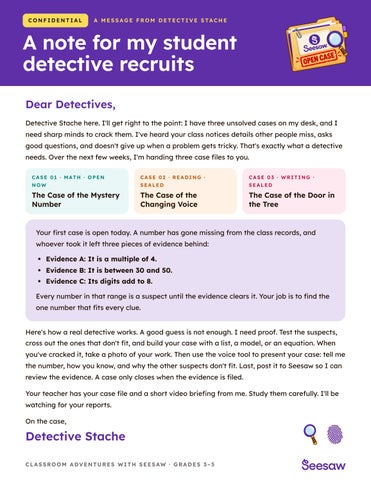
A note for my student detective recruits Dear Detectives, Detective Stache here. I'll get right to the point: I have three unsolved cases on my desk, and I need sharp minds to crack them. I've heard your class notices details other people miss, asks good questions, and doesn't give up when a problem gets tricky. That's exactly what a detective needs. Over the next few weeks, I'm handing three case files to you. C A S E 0 1 · M AT H · O P E N NOW
CASE 02 · READING · SEALED
CASE 03 · WRITING · SEALED
The Case of the Mystery Number
The Case of the Changing Voice
The Case of the Door in the Tree
Your first case is open today. A number has gone missing from the class records, and whoever took it left three pieces of evidence behind: Evidence A: It is a multiple of 4. Evidence B: It is between 30 and 50. Evidence C: Its digits add to 8. Every number in that range is a suspect until the evidence clears it. Your job is to find the one number that fits every clue. Here's how a real detective works. A good guess is not enough. I need proof. Test the suspects, cross out the ones that don't fit, and build your case with a list, a model, or an equation. When you've cracked it, take a photo of your work. Then use the voice tool to present your case: tell me the number, how you know, and why the other suspects don't fit. Last, post it to Seesaw so I can review the evidence. A case only closes when the evidence is filed. Your teacher has your case file and a short video briefing from me. Study them carefully. I'll be watching for your reports. On the case,
Detective Stache C L A S S R O O M A DV E N T U R E S W I T H S E E S AW · G R A D E S 3 – 5
CASE FILE 01
M AT H · G R A D E S 3 – 5
The Case of the Mystery Number CASE DETECTIVE(S)
D AT E O P E N E D
CASE BRIEFING
A number has gone missing from the class records. Three pieces of evidence were left behind. Identify the number and build a case strong enough that nobody can argue with it. Missing number: EVIDENCE RECOVERED EVIDENCE A
EVIDENCE B
EVIDENCE C
It is a multiple of 4.
It is between 30 and 50.
Its digits add to 8.
Y O U R I N V E S T I G AT I O N
01
02
03
Investigate
Build the case
Present it
Test every number the evidence allows. Cross out the ones that fail.
Show your proof with a list, a model, or an equation.
Name your number and explain why the other suspects don't fit.
File your evidence in Seesaw. Photograph your work, then record yourself presenting your case.
The case closes when your evidence is posted.
Scan to watch Detective Stache's video seesaw.academy/adventure01
CASE FILE 01
M AT H · T E A C H E R G U I D E · G R A D E S 3 – 5
The Case of the Mystery Number
Three pieces of evidence, one missing number. Students investigate, build a case, and present it. 10–15 minutes
Grades 3–5
Camera + Voice
Works with one device
LEARNING GOAL
Students use multi-step clues to identify a number, rule out alternatives, and defend the answer with a list, model, or equation. TEACHER DIRECTIONS
1. Open the case: read the three pieces of evidence aloud and post them where everyone can see. 2. Students work alone or in pairs to list every possible suspect. 3. Ask them to test each suspect against the evidence and cross out the ones that fail. 4. Students present the case: the answer, and why no other number fits. 5. Capture the reasoning in Seesaw before the work is put away.
M AT E R I A L S
Case card or whiteboard Hundreds chart or number line Paper and pencils At least one device
S E E S AW TO O L S
Photo of the written proof, plus a voice recording of the case.
THE EVIDENCE
A It is a multiple of 4. · B It is between 30 and 50. · C Its digits add to 8. Answer key: 44. The multiples of 4 between 30 and 50 are 32, 36, 40, 44, and 48. Only 44 has digits that add to 8.
→
Case 01 Closed One challenge = one prizedrawing entry. Submit your entry at seesaw.com/adventures
STUDENT DIRECTIONS
Investigate
BADGE EARNED
Build the case
→
Present it
TEACHER CAPTURE
STUDENT CAPTURE
Walk the room with one device. Photograph three or four proofs and have each student present their case into the mic.
Students photograph their own proof, record their case, and post to the journal for your approval.
Suggested reflection: “What evidence ruled out the other suspects?”
PROCEDURE
STUDENT CAPTURE · GRADES 3–5
Filing evidence in Seesaw
AL O F F I C IU R E D PROCE
Five steps for every case. Work on your own or during centers.
01
02
03
04
05
Open Seesaw
Sign in and open your class.
Add
Tap the green + Add button to start a new post.
+
Capture
Photograph your work from directly above. Fill the frame so every part is readable.
Add voice or video
Present your case: what you did, what you found, and how you know it's right.
Post to the journal
Tap the green check. Your teacher reviews it, then your family can see it.
BEFORE YOU FILE, CHECK
Every part of the work is readable in the photo. I explained how I know, not just what I got. Someone outside our class could follow my explanation.
Classroom Adventures with Seesaw · Grades 3–5
✓
PROCEDURE
TEACHER CAPTURE · GRADES 3–5
Capture the learning
One device, one pass around the room. The same five steps, done by you on behalf of the class.
01
Open Seesaw
02
Add
03
Capture
04
Add voice or video
05
Post to the journal
Sign in on the shared device and open your class before the case starts, so capture never interrupts the investigation.
Start a post. Tag the students whose work is in the frame — one post can be assigned to several journals at once.
Photograph the work, not the student. Written proofs, models, and drafts all photograph well from directly above.
Hold the device toward the student and let them present their case. Their reasoning is the evidence — yours is not needed.
Post as you go rather than saving a batch for later. Families see it the same day, which is when it means the most.
I F YO U H AV E O N E D E V I C E
Rotate a station. Four or five students file evidence per day. The whole class is documented by Friday.
Make one class post. Photograph several cases in a row and post them as one gallery.
Assign an evidence clerk. A student passes the device and presses record. It is a real classroom job.
Classroom Adventures with Seesaw · Grades 3–5 · One case = one badge = one prize entry