Table
2: Back-end Price Impact Summary of Alleged Corrective Disclosures Claimed Against U.S. Issuers
During 4Q’21, SAR analyzed 49 “stock-drop” SCAs filed against U.S. issuers that allege violations of Rule 10b-5 via 104 claimed corrective or truth-revealing disclosures or events.vi After consolidating cases with seemingly related allegations against individual U.S. issuers, SAR accounted for 31 filed SCAs.vii A total of 55 corrective disclosures have been alleged in the 31 first-filed SCAs. Of the 55 corrective disclosures alleged during 4Q’21, 18 (33%) may not translate to classwide shareholder damages since they do not warrant inclusion in a certified class of proposed shareholders (Goldman) as they do not surpass statistical thresholds of back-end price impact (Halliburton II). These alleged stock drops also run afoul of the heightened pleading standards of loss causation (Dura) because they lack statistical significance after excluding non-company specific factors.viii
The number of alleged stock drops increased from 32 in 3Q’21 to 55 in 4Q’21, an increase of 71.9%. There was a three-fold increase in the number of alleged stock drops that do not exhibit price impact, from 6 in 3Q’21 up to 18 in 4Q’21. That means that 33% of alleged corrective disclosures included in first-filed complaints analyzed in 4Q’21 do not exhibit price impact. The shareholder value of those drops - as calculated by the alleged market capitalization losses stemming from econometrically deficient alleged stock drops - doubled from $1.75 billion in 3Q’21 to $3.5 billion in 4Q’21.ix
[1] Identified and analyzed first-filed SCA complaints that allege violations of Rule 10b-5. Excludes non-U.S. issuers that trade through ADRs.
[2] The number of alleged corrective disclosures identified in the sample of SCA complaints.
[3] The number of alleged corrective disclosures that do not exhibit a statistically significant one-day residual stock price return at the 95% confidence standard.
[4] The ratio of the number of
SCA RULE 10b-5 EXPOSURE BY INDUSTRY SECTOR
Over Half of U.S. Rule 10b-5 Exposure Estimated in 4Q’21 Was Driven by Claims Against Software Companies.
Out of the 31 SCAs filed in 4Q’21, 9 (or 29.0%) were filed against Pharma/Biotech companies, 7 (or 22.6%) against Software companies, 4 (or 12.9%) against Media companies, and 3 (or 9.7%) against Manufacturing, Farm, and Industrial companies. The sector with the greatest SCA Rule 10b-5 Exposure was the Software sector, which accounted for 57.4% of the U.S. SCA Rule 10b-5 Exposure and amounts to $55.4 billion.
Data and analyses indicate that the industry sectors that were impacted most by alleged corrective disclosures that may not surpass statistical thresholds of back-end price impact are Auto; Pharma/Biotech; Media; and Energy. 100% ($119.6 million) of shareholder losses alleged in the single SCA against an Auto company did not exhibit stock price impact. 20.0% ($2.8 billion) of shareholder losses alleged in the 9 SCAs filed against Pharma/Biotech companies did not exhibit stock price impact. 4.2% ($378.9 million) of shareholder losses alleged the 4 SCAs against Media companies did not exhibit stock price impact. 4.0% ($6.7 million) of shareholder losses alleged in a single SCA against an Energy company did not exhibit stock price impact.
$169,309
$7,482,932
SCA RULE 10b-5 EXPOSURE OF U.S. LARGE CAP CORPORATIONSx
Large Cap SCA Rule 10b-5 Exposure Nearly Tripled, Increasing from $33.3 Billion 3Q’21 to $89.0 Billion in 4Q’21.
15 large cap corporations were sued for alleged violations of Rule 10b-5 during 4Q’21. Large Cap Rule 10b-5 Exposure during 4Q’21 increased by 167.1% relative to 3Q’21, amounting to $89.0 billion. The average aggregate market capitalization of U.S. large cap corporations, based on the market capitalization range of the S&P500 Index during 4Q’21, was $48.89 trillion.xi This is an increase in aggregate market cap of $1.9 trillion, or 4.0%, relative to 3Q’21.
Large Cap SCA Rule 10b-5 Exposure Rate increased by 11 basis points to 0.18% in 4Q’21. The Large Cap SCA Rule 10b-5 Litigation Rate increased from 0.51% in 3Q’21 to 1.30% in 4Q’21; an increase of 79 basis points.
The return of the S&P500 Index between October 1, 2021 and December 31, 2021 was 11.0%.
$55.7B 167.1%
4Q’21 U.S. Large Cap Analysis: The frequency of SCAs filed against large cap corporations increased by 150% relative 3Q’21. As a result, 4Q’21 exhibited the highest Large Cap SCA Rule 10b-5 Litigation Rate since 4Q’20. This also resulted in a material increase of 167.1% in Large Cap Rule 10b-5 Exposure relative to 3Q’21. The Large Cap SCA Rule 10b-5 Exposure Rate increased by 11 basis points to 0.18% in 4Q’21.
In 2021, the Large Cap U.S. SCA Rule 10b-5 Litigation Rate equates to 3.5% — 1 in 28 large cap companies were the target of Rule 10b-5 Exchange Act claims.
Table 4: Large Cap SCA Rule 10b-5 Exposure of U.S. Issuers
SCA RULE 10b-5 EXPOSURE OF U.S. MID CAP CORPORATIONS
xii
Mid Cap SCA Rule 10b-5 Exposure Decreased by 28.5% in 4Q’21, Amounting to $1.8 Billion.
4 mid cap corporations were sued for alleged violations of Rule 10b-5 during 4Q’21 – an increase of 1 — relative to 3Q’21. The average aggregate market capitalization of U.S. mid cap corporations, based on the market capitalization range of the S&P MidCap 400 Market Index during 4Q’21, was $1.66 trillion, a slight increase of 0.1% relative to 3Q’21.xiii Although one additional mid cap company was sued in 4Q’21 relative to 3Q’21, the Mid Cap SCA Rule 10b-5 Exposure decreased to $1.8 billion.
Mid Cap SCA Rule 10b-5 Exposure Rate decreased by 4 basis points relative to 3Q’21, amounting 0.11%. The Mid Cap Rule 10b-5 Litigation Rate increased quarterover-quarter to 0.54%; an increase of 11 basis points relative to 3Q’21.
The return of the S&P MidCap 400 between October 1, 2021 and December 31, 2021 was 8.0%.
4Q’21 U.S. Mid Cap Analysis: Mid Cap SCA filing frequency and Mid Cap SCA Rule 10b-5 Exposure Rate both decreased this quarter. The 4Q’21 Mid Cap SCA Rule 10b-5 Exposure amounted to $1.8 billion, a decrease of 28.5% relative to 3Q’21.
In 2021, the Mid Cap U.S. SCA Rule 10b-5 Litigation Rate equates 2.4% — 1 in 41 mid cap companies were the target of Rule 10b-5 Exchange Act claims.
Table 5: Mid Cap SCA Rule 10b-5 Exposure of U.S. Issuers $0.72B 28.5% $1.8B 4Q’21
SCA RULE 10b-5 EXPOSURE OF U.S. SMALL CAP CORPORATIONS
xiv
Small Cap SCA Rule 10b-5 Exposure nearly doubled relative to 3Q’21, Amounting to $5.6 Billion in 4Q’21.
12 small cap corporations were sued for alleged violations of Rule 10b-5 during 4Q’21, which is 1 fewer than in 3Q’21. The Small Cap SCA Rule 10b-5 Exposure in 4Q’21 amounted to $5.6 billion, which is nearly double the exposure of 3Q’21. The average aggregate market capitalization of U.S. small cap corporations, based on the market capitalization range of the S&P SmallCap 600 Market Index during 4Q’21, was $859.5 billion, an increase of 2.0% relative to 3Q’21.xv
In 4Q’21, the Small Cap SCA Rule 10b-5 Exposure Rate was 0.65%, which is 31 basis points higher relative to 3Q’21. The Small Cap Rule 10b-5 Litigation Rate decreased by 8 basis points to 0.54.
The return of the S&P SmallCap 600 Index between October 1, 2021 and December 31, 2021 was 5.6%.
4Q’21 U.S. Small Cap Analysis: Small Cap SCA Rule 10b-5 Exposure nearly doubled relative to 3Q’21, while Small Cap SCA Rule 10b-5 filing frequency decreased by 1. The decrease in frequency resulted in the lowest Small Cap Rule 10b-5 Litigation Rate of the past year even as the Small Cap Rule 10b-5 Exposure Rate increased by a substantial amount.
In 2021, the Small Cap U.S. SCA Rule 10b-5 Litigation Rate equates to 3.0% — 1 in 33 small cap companies were the target of Rule 10b-5 Exchange Act claims.
6: Small Cap SCA Rule 10b-5 Exposure of U.S. Issuers
Table
The ADR SCA Rule 10b-5 Exposure of nonU.S. issuers in 4Q’21 amounts to $3.7 billion, a Decrease of 7.1% Relative to 3Q’21.xvi
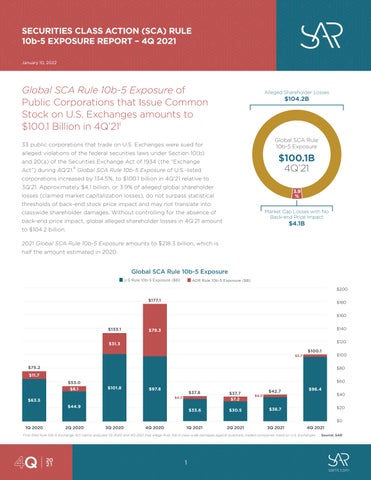
2 non-U.S. issuers that trade on U.S. exchanges through ADRs (“non-U.S. issuers”) were sued for alleged violations Exchange Act during 4Q’21.xvii ADR SCA Rule 10b-5 Exposure of directors and officers of non-U.S. issuers to claims that allege violations of Rule 10b-5 under the Exchange Act amounts to $3.7 billion.xviii Approximately $588.4 million of market capitalization declines that have been claimed as investor losses by a proposed class of common stock shareholders may not surpass statistical thresholds of back-end price impact and may not translate into classwide shareholder damages. Without controlling for the absence of back-end stock price impact, claimed shareholder losses against directors and officers of non-U.S. issuers amounts to $4.3 billion in 4Q’21.
In 4Q’21, the ADR SCA Rule 10b-5 Exposure Rate remained steady relative to 3Q’21 at 0.01%. The ADR SCA Rule 10b-5 Litigation Rate decreased by 10 basis points relative to 3Q’21 to 0.10% based on the number of non-U.S. issuers that trade in the NYSE, NASDAQ, and over-the-counter in the U.S.
ADR SCA Rule 10b-5 Exposure
ADR SCA Rule 10b-5 Exposure Rate Relative to 3Q’21
$3.7B 4Q’21
ADR SCA Rule 10b-5 Litigation Rate
Table 7: ADR SCA Rule 10b-5 Exposure of Non-U.S. Issuers
4Q’21 ADR Analysis: While the frequency of filings decreased by 2 in 4Q’21, ADR SCA Rule 10b-5 Exposure of nonU.S. issuers also decreased by 7.08% relative to 3Q’21. However, 5 out of the 6, or 83.3%, of the alleged corrective disclosures in the 2 SCAs filed against non-U.S. issuers do not surpass statistical thresholds of back-end price impact. That amounts to $588.4 million, or 13.6% of the claimed market capitalization losses that do not surpass statistical thresholds of stock price impact.
Table 8: Back-end Price Impact Summary of Alleged Corrective Disclosures Claimed Against Non-U.S. Issuers
[1] First-filed and analyzed SCA complaints that allege violations of Rule 10b-5 against non-U.S. issuers that trade on U.S. exchanges through ADRs. Excludes U.S. issuers. [2] The total number of alleged corrective disclosures identified in the sample of SCA complaints.
[3] The total number of alleged corrective disclosures that do not exhibit a statistically significant one-day residual stock price return at the 95% confidence standard. [4] The ratio of the number of alleged corrective disclosures that do not meet statistical thresholds of back-end price impact to the
Sources: S&P Global Market Intelligence, S&P Dow Jones Indices, Thomson Reuters, SAR SCA Platform as of December 31st, 2021.
Any reprint of the information or figures presented in this quarterly report should reference SAR. Please direct any technical inquiries to Stephen Sigrist, VP of Data Science, at 202.891.3652 or stephen@sarlit.com. SAR is a software and data analytics company that actively tracks, monitors, and analyzes private securities fraud actions that allege violations of the Exchange Act of 1934.
iGlobal SCA Rule 10b-5 Exposure is the sum of U.S. Rule 10b-5 Exposure and ADR Rule 10b-5 Exposure
iiThis tally accounts for U.S. issuers of common stock and non-U.S. issuers that trade on U.S. exchanges through ADRs that are listed as defendants in first-filed SCA complaints filed during the fourth quarter of 2021 and allege shareholder damages. A corporation that was sued a second or third time during the current quarter is not accounted for in the current quarter’s tally. The tally excludes SCA complaints that were identified but not analyzed per Appendix-1
iiiFigures of Securities Class Action (SCA) Rule 10b-5 litigation exposure are based on identified and analyzed first-filed complaints for each claim filed during the corresponding quarter. All federal securities class action complaints are read and screened for allegations that specifically include alleged violations of Rule 10b-5 and define a specific Class Period. Only the claimed stock price declines presented in the first-filed complaint against each defendant company are accounted for to estimate U.S. SCA Rule 10b-5 Exposure. Measures of SCA exposure for each claim may increase or decrease as the case progresses through the class action life cycle. SCA Exposure is not amended retroactively for cases that have been dismissed by the Court or voluntarily dismissed by plaintiffs.
ivThis tally accounts for U.S. issuers of common stock that are listed as defendants in first-filed SCA complaints filed during the fourth quarter of 2021. A U.S. issuer of common stock that was sued a second or third time during the current quarter is not accounted for in the current quarter’s tally. The tally excludes SCA complaints against U.S. issuers of common stock that were sued for alleged violations of the federal securities laws in previous quarters. The tally also excludes cases that have been filed against international corporations that are listed on U.S. exchanges through American Depositary Receipts (ADRs). The tally excludes SCA complaints that were identified but not analyzed per Appendix-1.
vA public corporation’s exposure to alleged violations of Rule 10b-5 is estimated by tracking the cumulative decline in market capitalization during single market trading sessions that correspond with the timing of the claimed alleged corrective disclosures that surpass statistical thresholds of indirect price impact at the 95% confidence standard and are presented in a first–filed SCA complaint. This figure excludes market capitalization declines of non-U.S. issuers that have been sued for violations of the U.S. federal securities laws and trade on U.S. exchanges through American Depositary Receipts (ADRs).
viSAR relies on Docket Alert and Court Wire notifications attained from Thomson Reuters Westlaw. SAR professionals actively monitor and track case dockets to attain newly filed and amended class action complaints.
viiThis tally of alleged corrective disclosures includes only those from first-filed SCA complaints identified and analyzed during 4Q 2021 against U.S. issuers of common stock. The tally excludes securities class action complaints against companies for which there are first-filed complaints in prior quarters.
viiiSee Goldman Sachs Group Inc. v. Arkansas Teacher Retirement System, No. 20-222 (2021), Halliburton Co. v. Erica P. John Fund, Inc., 134 S. Ct. 2398 (2014), and Dura Pharmaceuticals, Inc. v. Broudo, No. 03-932, 2005 WL 885109 (2005).
ixA single-firm multivariate regression analysis with a minimum of 100 observations (if a full 252 observations is unattainable) for a Control Period is applied to evaluate the statistical significance of the logarithmic residual stock price decline on the trading day(s) affected by an alleged corrective disclosure(s) (or the alleged adverse event). Statistical significance is measured by computing the t-statistic of the residual stock price decline during the single trading session that is affected by the alleged corrective and/or truth-revealing information. The Control Period ends one trading day prior to the start of the Class Period presented in the corresponding securities class action complaint. Due to the proliferation of Rule 10b-5 claims made against companies involved in recent SPAC transactions, beginning in 2Q’21, a single-firm multivariate regression analysis is performed when sufficient pricing observations are available to support an adequate Control Period. If there are between 50 and 100 closing stock price observations before the first alleged corrective disclosure, the VP of Data Science determines whether the raw data sample is sufficiently robust to perform a multivariate regression analysis that surpasses econometric quality controls standard of SAR.
xLarge cap corporations are the sub-set of defendant corporations that have market capitalizations within the range of the greatest and least market capitalization value of the constituent members of the S&P 500 Market Index at the time of the start of the Class Period alleged in the first-filed complaint.
xiThis is the average total market capitalization of U.S. issuers of common stock that are listed on the NYSE or Nasdaq exchanges with market capitalizations greater than $3.7 billion between October 1st, 2021 and December 31st, 2021.
xiiMid cap corporations are the sub-set of defendant corporations that have market capitalizations within the range of the greatest and least market capitalization value of the constituent members of the S&P MidCap 400 Market Index at the time of the start of the Class Period alleged in the first-filed complaint.
xiiiThis is the average total market capitalization of U.S. issuers of common stock that are listed on the NYSE or Nasdaq exchanges with market capitalizations between $1.26 and $3.7 billion between October 1st, 2021 and December 31st, 2021.
xivSmall cap corporations are the sub-set of defendant corporations that have market capitalizations within the range of the greatest and least market capitalization value of the constituent members of the S&P SmallCap 600 Market Index at the time of the start of the Class Period alleged in the first-filed complaint.
xvThis is the average total market capitalization of U.S. issuers of common stock in that are listed on the NYSE or Nasdaq exchanges with market capitalizations less than $1.26 billion October 1st, 2021 and December 31st, 2021.
xviFigures of ADR Securities Class Action (SCA) Rule 10b-5 Exposure are based on the first-filed and analyzed complaint for each claim filed during the corresponding quarter. All federal securities class action complaints that comprise the data and analyses presented herein are read and screened for allegations that specifically include alleged violations of Rule 10b-5 and define a specific Class Period. Only the claimed stock price declines presented in the first filed complaint against each defendant company are accounted for to estimate ADR SCA Rule 10b-5 Exposure. Measures of SCA exposure for each claim may increase or decrease as the case progresses through the class action life cycle.
xviiThis tally only includes securities class action complaints against non-U.S. issuers that trade on U.S. exchanges through ADRs that were sued for alleged violations of the federal securities laws for the first time in the current quarter. A non-U.S. issuer of ADRs that was sued a second or third time during the current quarter is not accounted for in the current quarter’s tally. The tally excludes SCA complaints that were identified but not analyzed per Appendix-1
xviiiA non-U.S. issuer’s exposure to alleged violations of Rule 10b-5 is estimated by tracking the cumulative decline in market capitalization during open market trading sessions that correspond with the timing of the claimed alleged corrective disclosures that surpass statistical thresholds of indirect price impact and are presented in a first-filed SCA complaint.
To learn more about how SAR data analytics services and data packages can enhance the complex claim resolution capabilities of your organization, please contact:
Carolina M. Doherty
Vice President – Business Development
Direct: 202-926-4434
Email: carolina@sarlit.com
Act Claims Identified But Not Analyzed in 2021
The following list comprises Rule 10b-5 Exchange Act SCAs filed during 2021 but not analyzed by SAR due to two primary factors. Either there is insufficient pricing data to conduct a multivariate regression in accordance with SAR’s data analytics standards of quality control, and/or cases of first impression that allege novel theories of Rule 10b-5 liability are not analyzed according to SAR’s standard operating procedures and quality control standards.
Ginkgo Bioworks Holdings, Inc.
Goldman Sachs & Morgan Stanley (Gaotu Techedu Inc.)
Goldman Sachs & Morgan Stanley (Baidu, Inc.)
Goldman Sachs & Morgan Stanley (iQIYI, Inc.)
Goldman Sachs & Morgan Stanley (Tencent Music Entertainment Group)
Goldman Sachs & Morgan Stanley (ViacomCBS Inc.)
Goldman Sachs & Morgan Stanley (Vipshop Holdings Limited) 10/12/2021 21-cv-08413
GoodRx Holdings, Inc. 1/8/2021 21-cv-00175
Hyzon Motors Inc. 9/30/2021 21-cv-06612
Immunovant, Inc. 2/19/2021 21-cv-00918
Infinity Q Diversified Alpha Fund Investor Class 2/26/2021 21-cv-01047
Kanzhun Limited 7/12/2021 21-cv-13543
Katapult Holdings, Inc. 8/27/2021 21-cv-07251
Meta Materials Inc. 1/3/2021 21-CV-07203
MultiPlan Corp. 2/24/2021 21-cv-01640
Oatly Group AB 7/26/2021 21-cv-06360
Paysafe Limited 12/10/2021 21-cv-10611
Piedmont Lithium Inc. 7/23/2021 21-cv-04161
PureCycle Technologies, Inc. 5/11/2021 21-cv-00809
QuantumScape Corporation 1/5/2021 21-cv-00058
Reconnaissance Energy Africa Ltd. 10/25/2021 21-cv-05910
Romeo Power Inc. 4/16/2021 21-cv-03362
Root, Inc. 3/19/2021 21-cv-01197
TMC The Metals Company Inc. 10/28/2021 21-cv-05991
View, Inc. 8/18/2021 21-cv-06374
Volkswagen AG 4/30/2021 21-cv-03678
XL Fleet Corp. 3/8/2021 21-cv-02002