SAR SECURITIES EXCHANGE ACT CLASS ACTION LITIGATION EXPOSURE REPORT – 4Q 2019
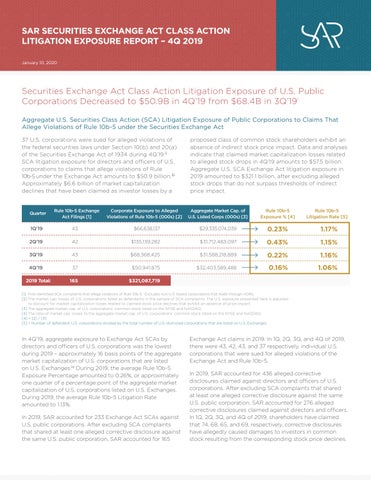
Securities Exchange Act Class Action Litigation Exposure of U.S. Public Corporations Decreased to $50.9B in 4Q’19 from $68.4B in 3Q’19i
Aggregate U.S. Securities Class Action (SCA) Litigation Exposure of Public Corporations to Claims That Allege Violations of Rule 10b-5 under the Securities Exchange Act
37 U.S. corporations were sued for alleged violations of the federal securities laws under Section 10(b) and 20(a) of the Securities Exchange Act of 1934 during 4Q’19.ii SCA litigation exposure for directors and officers of U.S. corporations to claims that allege violations of Rule 10b-5 under the Exchange Act amounts to $50.9 billion.iii Approximately $6.6 billion of market capitalization declines that have been claimed as investor losses by a
proposed class of common stock shareholders exhibit an absence of indirect stock price impact. Data and analyses indicate that claimed market capitalization losses related to alleged stock drops in 4Q’19 amounts to $57.5 billion.
Aggregate U.S. SCA Exchange Act litigation exposure in 2019 amounted to $321.1 billion, after excluding alleged stock drops that do not surpass thresholds of indirect price impact.
Rule 10b-5 Exchange Act Filings [1] Aggregate Market Cap. of U.S. Listed Corps (000s) [3]
Total:
= Number of defendant U.S. corporations divided by the total number of U.S.-domicled corporations that are listed on U.S. Exchanges. Corporate Exposure to Alleged Violations of Rule 10b-5 (000s) [2]
10b-5
[4]
10b-5
$29,335,074,039
$31,712,483,097
$31,588,218,889
$32,403,589,488 $66,638,137
The market cap. losses of U.S. corporations listed as defendants in the sample of SCA complaints. The U.S. exposure presented here is adjusted to discount for market capitalization losses related to claimed stock price declines that exhibit an absence of price impact.
/ [3]
In 4Q’19, aggregate exposure to Exchange Act SCAs by directors and officers of U.S. corporations was the lowest during 2019 – approximately 16 basis points of the aggregate market capitalization of U.S. corporations that are listed on U.S. Exchanges.iv During 2019, the average Rule 10b-5 Exposure Percentage amounted to 0.26%, or approximately one quarter of a percentage point of the aggregate market capitalization of U.S. corporations listed on U.S. Exchanges. During 2019, the average Rule 10b-5 Litigation Rate amounted to 1.13%.
In 2019, SAR accounted for 233 Exchange Act SCAs against U.S. public corporations. After excluding SCA complaints that shared at least one alleged corrective disclosure against the same U.S. public corporation, SAR accounted for 165
Exchange Act claims in 2019. In 1Q, 2Q, 3Q, and 4Q of 2019, there were 43, 42, 43, and 37 respectively, individual U.S. corporations that were sued for alleged violations of the Exchange Act and Rule 10b-5.
In 2019, SAR accounted for 436 alleged corrective disclosures claimed against directors and officers of U.S. corporations. After excluding SCA complaints that shared at least one alleged corrective disclosure against the same U.S. public corporation, SAR accounted for 276 alleged corrective disclosures claimed against directors and officers. In 1Q, 2Q, 3Q, and 4Q of 2019, shareholders have claimed that 74, 68, 65, and 69, respectively, corrective disclosures have allegedly caused damages to investors in common stock resulting from the corresponding stock price declines.
[4] The ratio of the number of alleged corrective disclosures that exhibit an absence of indirect price impact to the total number of alleged corrective disclosures claimed in first filed SCA complaints. [4] = ( [3] / [2] ) - 1
During 4Q’19, SAR accounted for 44 SCAs that allege violations of Rule 10b-5 via 97 claimed corrective disclosures.v After consolidating the filed SCAs against individual U.S. corporations, SAR accounted for 37 filed claims. A total of 69 claimed corrective disclosures were alleged against 37 U.S. corporate defendants based on the first filed SCA complaints.vi, vii Of the 69 corrective indirect price impact (Halliburton II) in the corresponding stock price declines and do not meet the thresholds related with the heightened pleading standards of loss causation (Dura) viii 23% of alleged stock price declines claimed in 37 SCAs
SCA Exposure of U.S. Large Cap Corporationsx
The SCA Exchange Act litigation exposure of large cap corporations was $41.1 billion during 4Q’19. This is a decrease of 27%, or $15 billion relative to 3Q’19. 16 large cap corporations were sued for alleged violations of Rule 10b-5 during 4Q’19 – an increase of 3. The average aggregate market capitalization of U.S. large cap corporations, based on the market capitalization range of the S&P500 Index during 4Q’19, was $30.4 trillion.xi In 4Q’19, exposure to alleged violations of the Exchange Act by large cap corporations decreased to 14 basis points of the aggregate market capitalization of all publicly traded large cap corporations.
against directors and officers of U.S. public corporations exhibit an absence of indirect price impact.ix This is indicative of a further decrease in the quality of the filed Exchange Act SCAs against U.S. public corporations in 2019. In 2Q’19, 12% of alleged corrective disclosures did not surpass thresholds of indirect price impact. In 3Q’19, that figure increased to 20%. In 4Q’19, that figure increased to 23%. Approximately one quarter of alleged corrective disclosures claimed by shareholders in 4Q’19 exhibit an absence of indirect price impact and do not warrant attribution of potential aggregate damages.
4Q’19 U.S. Large Cap Analysis: 4Q’19 shows an increase in the number of large cap corporations that have been sued, however it is also the second consecutive quarterly decrease in the amount of claimed shareholder losses relative to 3Q’19 and to 2Q’19. 4Q’19 exhibited the lowest amount of claimed shareholder losses during 2019 with $41.1 billion. The Rule 10b-5 Litigation Rate for U.S. large cap corporations during 4Q’19 was 1.87%.
2019 U.S. Large Cap Analysis: In 2019, U.S. large cap corporations suffered a total of $280 billion in claimed shareholder losses for alleged violations of Rule 10b-5. During 2019, the average Rule 10b-5 Exposure Percentage amounted to 0.24%.
SCA Exposure of U.S. Mid Cap Corporationsxii
The SCA Exchange Act litigation exposure of mid cap corporations was $8 billion during 4Q’19. This is an increase of 15%, or $1 billion relative to 3Q’19. 7 mid cap corporations were sued for alleged violations of Rule 10b-5 during 4Q’19. The average aggregate market capitalization of U.S. mid cap corporations, based on the market capitalization range of the S&P MidCap 400 Market Index during 4Q’19, was $1.35 trillion.xiii In 4Q’19, exposure to alleged violations of the Exchange Act by U.S. mid cap corporations increased to 59 basis points of the aggregate market capitalization of all U.S. mid cap corporations listed on U.S. Exchanges. This is an increase of 9 basis points relative to 3Q’19.
4Q’19
U.S. Mid Cap Analysis: 4Q’19 was the quarter with the greatest amount of claimed shareholder losses against U.S. mid cap corporations in 2019. The Rule 10b-5 Litigation Rate for U.S. mid cap corporations during 4Q’19 was 1.17%.
2019 U.S. Mid Cap Analysis: In 2019, U.S. mid cap corporations suffered a total of $26.8 billion in claimed shareholder losses for alleged violations of Rule 10b-5. During 2019, the average Rule 10b-5 Exposure Percentage amounted to 0.48%.
SCA Exposure of U.S. Small Cap Corporationsxiv
The SCA Exchange Act litigation exposure of small cap corporations decreased substantially to $1.9 billion in 4Q’19 from $5.4 billion in 3Q’19. That is a material decrease of 66%, or close to $3.5 billion relative to 3Q’19. The average aggregate market capitalization of U.S. small cap corporations, based on the market capitalization range of the S&P SmallCap 600 Market Index during 4Q’19, was $677 billion.xv In 4Q’19, exposure to alleged violations of the Exchange Act by U.S. small cap corporations listed on U.S. Exchanges was 27 basis points of the aggregate market capitalization of all publicly traded small cap corporations. This is a material decrease of 48 basis points relative to 3Q’19.
4Q’19 U.S. Small Cap Analysis: 4Q’19 exhibited the lowest amount of claimed shareholder losses against U.S. small cap corporations listed on U.S. Exchanges in 2019. The Rule 10b-5 Litigation Rate for U.S. small cap corporations during 4Q’19 was .69%.
2019 U.S. Small Cap Analysis: In 2019, U.S. small cap corporations suffered a total of $14.2 billion in claimed shareholder losses for alleged violations of Rule 10b-5. During 2019, the average Rule 10b-5 Exposure percentage amounted to 0.50%.
SCA Exposure by Industry Segment
Out of the 37 SCA Exchange Act claims filed in 4Q’19, 9 (or 24%) were filed against Pharma/Biotech, 6 (or 16%) against Retail and Consumer Products, and 6 (or 16%) against Software companies. The three sectors with the greatest exposure to SCA Exchange Act litigation according to alleged market capitalization losses, are Retail and Consumer Products, Pharma/Biotech, and Software. Claimed shareholder losses against U.S. corporations in these three sectors amounted to $41.8 billion (73% of total alleged market capitalization losses).
Exchange Act SCA claims filed against Pharma/Biotech, Hardware and Semiconductor, Health Care, and Telecom companies indicate that all of the claimed shareholder losses in 4Q’19 surpass thresholds of indirect stock price impact. SCA Exchange Act litigation exposure against these companies amounts to $17.3 billion, or 34%, of U.S. aggregate SCA Exchange Act exposure.
Any reprint of the information or figures presented in this quarterly report should reference SAR. Please direct any direct inquiries to Stephen Sigrist, SAR at 202.891.3652 or stephen@sarlit.com. SAR is a software and data analytics company that actively tracks, monitors, and analyzes private securities fraud actions that alleged violations of the Exchange Act of 1934.
i Figures of Securities Class Action (SCA) Exchange Act litigation exposure are based on the first filed complaint for each claim filed during the corresponding quarter. Exposure may increase or decrease throughout the life cycle of each securities class action.
ii This tally accounts for U.S. publicly traded corporations that are listed as defendants in first filed securities class action complaints identified during the fourth quarter of 2019. The tally excludes securities class action complaints against U.S. corporations that were sued for alleged violations of the federal securities laws in previous quarters. A U.S. corporation that was sued a second or third time during the current quarter is not accounted for in the current quarter’s tally. This tally also excludes cases that have been filed against international corporations that are listed on U.S. exchanges through American Depositary Receipts (ADRs). All federal securities class action complaints are read and screened for allegations that specifically include alleged violations of Rule 10b-5 and define a specific alleged inflationary period (the Class Period) of the corresponding company’s price of common stock. Only the claimed stock price declines presented in the first filed complaint against each defendant company are accounted for to estimate aggregate SCA Exchange Act litigation exposure. SCA Exchange Act litigation exposure for each claim may increase or decrease as the case progresses through the class action process.
iii A public corporation’s exposure to alleged violations of Rule 10b-5 is estimated by tracking the cumulative decline in market capitalization during open market trading sessions that correspond with the timing of the claimed alleged corrective disclosures that surpass thresholds of indirect price impact and are presented in a first filed SCA complaint. Aggregate measures of exposure exclude market capitalization declines of international companies that have been sued for violations of the U.S. federal securities laws and trade on U.S. exchanges through American Depositary Receipts (ADRs).
iv Fourth quarter aggregate market capitalization is defined as the average of total market capitalization on October 1st, 2019 and December 31st, 2019 for all U.S.-domiciled equities that trade on the NYSE or Nasdaq. There was 1 Exchange Act claim filed against a U.S. corporation that traded Over-the-Counter in 4Q’19.
v SAR relies on Docket Alert and Court Wire notifications attained from Thomson Reuters. SAR professionals actively monitor and track case dockets to attain newly filed and amended claims.
vi SAR accounted for a total 97 corrective disclosures alleged in 44 filed claims for alleged violations of Rule 10b-5 against U.S. corporations during 4Q’19.
vii This tally of corrective disclosures includes only those from first filed SCA complaints identified during 2019 against U.S.-based companies that have publicly traded shares of common stock in the NYSE or NASDAQ. The tally excludes securities class action complaints against companies for which there are first filed complaints in prior quarters. viii See Dura Pharmaceuticals, Inc. v. Broudo, No. 03-932, 2005 WL 885109 (2005), and Halliburton Co. v. Erica P. John Fund, Inc., 134 S. Ct. 2398 (2014).
ix A single-firm multivariate regression analysis with a minimum of 100 observations (if a full 252 observations is unattainable) for a Control Period is applied to evaluate the statistical significance of the logarithmic residual stock price decline on the trading day(s) affected by an alleged corrective disclosure(s) (or the alleged adverse event). Statistical significance is measured by computing the t-statistic of the residual stock price decline during the trading session that is affected by the alleged corrective information. (If the t-statistic is greater than plus or minus 1.96, the likelihood that the daily residual return of the defendant company’s common stock could have been caused by random volatility is less than 5%.)
The Control Period ends one trading day prior to the start of the Class Period presented in the corresponding securities class action complaint.
x Large cap corporations are the sub-set of defendant corporations that have market capitalizations within the range of the greatest and least market capitalization value of the constituent members of the S&P 500 Market Index at the time when the first filed complaint was identified.
xi This is the average total market capitalization of U.S. corporations that are listed on the NYSE or Nasdaq exchanges with market capitalizations greater than $3.7 billion between October 1st, 2019 and December 31st, 2019.
xii Mid cap corporations are the sub-set of defendant corporations that have market capitalizations within the range of the greatest and least market capitalization value of the constituent members of the S&P MidCap 400 Market Index at the time when the first filed complaint was identified.
xiii This is the average total market capitalization of U.S. corporations that are listed on the NYSE or Nasdaq exchanges with market capitalizations between $1.26 and $3.7 billion between October 1st, 2019 and December 31st, 2019.
xiv Small cap corporations are the sub-set of defendant corporations that have market capitalizations within the range of the greatest and least market capitalization value of the constituent members of the S&P SmallCap 600 Market Index at the time when the first filed complaint was identified.
xv This is the average total market capitalization of U.S. corporations that are listed on the NYSE or Nasdaq exchanges with market capitalizations less than $1.26 billion between October 1st, 2019 and December 31st, 2019.
Sources: S&P Global Market Intelligence, S&P Dow Jones Indices, Thomson Reuters, SAR SCA Claims Database as of December 31st, 2019.