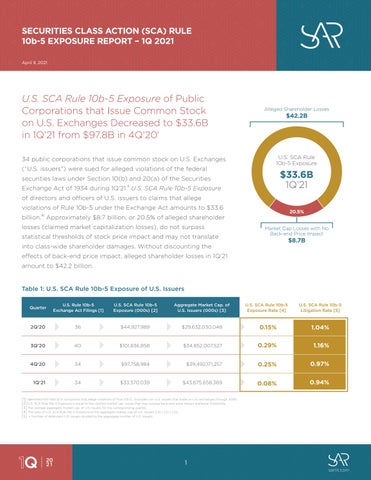
U.S. SCA Rule 10b-5 Exposure of Public Corporations that Issue Common Stock
on U.S. Exchanges Decreased to $33.6B in 1Q’21 from $97.8B in 4Q’20i
34 public corporations that issue common stock on U.S. Exchanges (“U.S. issuers”) were sued for alleged violations of the federal securities laws under Section 10(b) and 20(a) of the Securities Exchange Act of 1934 during 1Q’21.ii U.S. SCA Rule 10b-5 Exposure of directors and officers of U.S. issuers to claims that allege violations of Rule 10b-5 under the Exchange Act amounts to $33.6 billion.iii Approximately $8.7 billion, or 20.5% of alleged shareholder losses (claimed market capitalization losses), do not surpass statistical thresholds of stock price impact and may not translate into class-wide shareholder damages. Without discounting the effects of back-end price impact, alleged shareholder losses in 1Q’21 amount to $42.2 billion.
Table 1: U.S. SCA Rule 10b-5 Exposure of U.S. Issuers
Unlike 4Q’20 data where lower frequency did not result in lower severity, 1Q’21 data indicates that frequency of filings remained steady but resulted in a material decline in U.S.
SCA Rule 10b-5 Exposure U.S. SCA Rule 10b-5 Exposure of $33.6 billion was the lowest quarterly exposure recorded since we began tracking this data and fell by nearly two thirds relative to 4Q’20. U.S. SCA Rule 10b-5 Exposure Rate also decreased materially by 17 basis points from 0.25% in 4Q’20 to 0.08% in 1Q’21. The U.S. SCA Rule 10b-5 Litigation Rate declined slightly by 3 basis points in 1Q’21 to 0.94%.
COVID-19 U.S. SCA Rule 10b-5 Litigation Exposure: The SCA Rule 10b-5 Exposure of private securities class actions related to COVID-19 amounts to $2.2 billion in 1Q’21 stemming from 5 SCAs filed against U.S. issuers.iv COVID-19 related allegations account for 6.4% of the $33.7 billion in aggregate U.S. SCA Rule 10b-5 Exposure. The total SCA Rule 10b-5 Exposure related to COVID-19 since March 2020 amounts to $25.0 billion, of which 8.6% was alleged by shareholders during 1Q’21.
Table 2: Back-end Price Impact Summary of Alleged Corrective Disclosures of U.S. Issuers
During 1Q’21, SAR accounted for 59 “stock-drop” SCAs filed against U.S. issuers that allege violations of Rule 10b-5 via 114 claimed corrective disclosures.v After consolidating cases with seemingly related allegations against individual U.S. issuers, SAR accounted for 34 filed SCAs. A total of 67 corrective disclosures have been alleged in the 34 firstfiled SCAs.vi Of the 67 corrective disclosures alleged during 1Q’21, 21 (31%) do not exhibit price impact (Halliburton II) As such, they may not warrant inclusion in a certified class of proposed shareholders and may not translate into classwide shareholder damages. These alleged stock drops
also run afoul of the heightened pleading standards of loss causation (Dura) because they lack statistical significance after excluding non-company specific effects.vii
The number of alleged stock drops decreased from 73 in 4Q’20 to 67 in 1Q’21. The number of alleged stock drops that did not exhibit price impact decreased by 3 relative to 4Q’20. As a result, the alleged market capitalization losses stemming from econometrically deficient alleged stock drops decreased from $14.4 billion in 4Q’20 to $8.7 billion in 1Q’21.viii
SCA RULE 10b-5 EXPOSURE BY INDUSTRY SECTOR
A Single Claim Filed Against a Retail and Consumer Products Company Contributed to the 57.7% of Alleged Market Cap. Losses that May Not Translate into Shareholder Damages.
Out of the 34 SCAs filed in 1Q’21, 8 (or 23.5%) were filed against Pharma/Biotech companies, 5 (or 14.7%) against Electronics, Hardware and Semiconductor companies, 5 (or 14.7%) against Software companies, 3 (or 8.8%) against Energy Companies, and 3 (or 8.8%) against Media companies. The sector with the greatest SCA Rule 10b-5 Exposure was the Energy sector which accounted for 35% of the U.S. SCA Rule 10b-5 Exposure and amounts to $11.7 billion.
Data and analyses indicate that the industry sectors that were impacted most by alleged corrective disclosures that may not surpass statistical thresholds of back-end rice impact are Retail and Consumer Products, Electronics, Hardware and Semiconductor, and Auto. 100% ($5.0 billion) of shareholder losses alleged in the single SCA filed against a Retail and Consumer Products company did not exhibit stock price impact. 49% ($2.5 billion) of shareholder losses alleged in the 5 SCAs against Electronics, Hardware and Semiconductor companies do not exhibit stock price impact. 18% ($510 million) of shareholder losses alleged in the 2 SCAs against Auto companies do not exhibit stock price impact.
$11,746,442
$0
$6,290,367
$756,816
$321,348
$3,961,471
$3,917,488
$5,007,836 $2,358,193
$2,276,172
$2,578,172
$11,653,234
SCA RULE 10b-5 EXPOSURE OF U.S. LARGE CAP CORPORATIONS
ix
Large Cap SCA Rule 10b-5 Exposure Decreased Materially in 1Q’21, Amounting to $22.8 Billion.
11 large cap corporations were sued for alleged violations of Rule 10b-5 during 1Q’21 – a decrease of 6 – relative to 4Q’20. The average aggregate market capitalization of U.S. large cap corporations, based on the market capitalization range of the S&P500 Index during 1Q’21, was $41.39 trillion.x This is an increase in aggregate market cap of $4.01 trillion, or 10.7%, relative to 4Q’20. The decrease in Large Cap Rule 10b-5 Exposure combined with the increase in the aggregate market cap led to a material decrease of the Large Cap SCA Rule 10b-5 Exposure Rate by 19 basis points to 0.06% in 1Q’21. The Large Cap SCA Rule 10b-5 Litigation Rate decreased from 1.96% in 4Q’20 to 1.06% in 1Q’21.
The return of the S&P500 Index between January 1, 2021 and March 31, 2021 was 6.17%. $22.8B 1Q’21
$70.4B 75.6%
1Q’21 U.S. Large Cap Analysis: The Large Cap SCA Rule 10b-5 Exposure of $22.8 billion during 1Q’21 is the lowest exposure exhibited since SAR began tracking this data in 2018. 6 fewer large cap corporations faced Rule 10b-5 allegations in 1Q’21 relative to 4Q’20, resulting in a Large Cap SCA Rule 10b-5 Litigation Rate of 1.06%.
$37,641,718
15 17 11
$93,702,669 $93,171,021 $22,769,816
$37,375,514,160
$41,385,863,786
* 9 large cap defendants were sued in 2Q’20, but SAR is using the 10 Rule 10b-5 Exchange Act Filings to calculate the Large Cap SCA Rule 10b-5 Litigation Rate because the 2 SCAs filed against Wells Fargo & Co. in that quarter present non-overlapping allegations.
SCA RULE 10b-5 EXPOSURE OF U.S. MID CAP CORPORATIONS
xi
Mid Cap SCA Rule 10b-5 Exposure
Mid Cap SCA Rule 10b-5 Exposure Increased by 10.6% in 1Q’21, Amounting to $2.4 Billion.
Filing frequency against mid cap corporations remained steady at 4 during 1Q’21. The average aggregate market capitalization of U.S. mid cap corporations, based on the market capitalization range of the S&P MidCap 400 Market Index during 1Q’21, was $1.56 trillion.xii In 1Q’21, the Mid Cap SCA Rule 10b-5 Exposure Rate remained steady at 0.15%. The Mid Cap Rule 10b-5 Litigation Rate decreased quarter-over-quarter to 0.62%.
The return of the S&P MidCap 400 between January 1, 2021 and March 31, 2021 was 13.47%.
Relative to 4Q’20
Mid Cap SCA Rule 10b-5 Exposure Rate
Mid Cap SCA Rule 10b-5 Litigation Rate
Table 5: Mid Cap SCA Rule 10b-5 Exposure of U.S. Issuers $0.23B 10.6% $2.4B 1Q’21
1Q’21
1Q’21
1Q’21 U.S. Mid Cap Analysis: While Mid Cap SCA filing frequency and Mid Cap SCA Rule 10b-5 Exposure Rate remained steady, Mid Cap SCA Rule 10b-5 Exposure increased by 10.6% in 1Q’21 relative to 4Q’20. Mid Cap Rule 10b-5 Litigation Rate decreased 3 basis points relative to 4Q’20, which is the lowest rate exhibited during the proceeding four quarters.
SCA RULE 10b-5 EXPOSURE OF U.S. SMALL CAP CORPORATIONS
xiii
Small Cap SCA Rule 10b-5 Exposure Increased Significantly in 1Q’21, Amounting to $8.4 Billion.
19 small cap corporations were sued for alleged violations of Rule 10b-5 during 1Q’20, which is 6 more than in 4Q’20. The Small Cap SCA Rule 10b-5 Exposure in 1Q’21 increased nearly two and half times relative to 4Q’20. The average aggregate market capitalization of U.S. small cap corporations, based on the market capitalization range of the S&P SmallCap 600 Market Index during 1Q’21, was $733.5 billion.xiv In 1Q’21, the Small Cap SCA Rule 10b-5 Exposure Rate was 1.15%, which is almost 80 basis points higher relative to 4Q’20. The Small Cap Rule 10b5 Litigation Rate also increased by 33 basis points to 0.97.
The return of the S&P SmallCap 600 Index between January 1, 2021 and March 31, 2021 was 18.24%.
1Q’21 U.S. Small Cap Analysis: Small Cap SCA Rule 10b-5 Exposure increased materially despite the overall decrease in U.S. SCA Rule 10b-5 Exposure during the quarter. The aggregate market cap of small cap corporations also increased throughout the year to $733 billion in 1Q’21. Combined, this resulted in the highest Small Cap SCA Rule 10b-5 Exposure Rate and Small Cap Rule 10b-5 Litigation Rate during the proceeding four quarters.
6: Small Cap SCA Rule 10b-5 Exposure of U.S. Issuers
The ADR SCA Rule 10b-5 Exposure of non-U.S. issuers in 1Q’21 amounts to $4.3 billion, a material decrease of 94.6% relative to 4Q’20.xv
4 non-U.S. issuers that trade on U.S. exchanges through ADRs (“non-U.S. issuers”) were sued for alleged violations of the federal securities laws under Section 10(b) and 20(a) of the Securities Exchange Act of 1934 during 1Q’21.xvi ADR SCA Rule 10b-5 Exposure of directors and officers of non-U.S. issuers to claims that allege violations of Rule 10b-5 under the Exchange Act amounts to $4.3 billion.xvii
Approximately $1.7 billion, or 28.3% of alleged shareholder losses do not surpass statistical thresholds of stock price impact and may not translate into shareholder class-wide damages. Without discounting the effects of back-end stock price impact, claimed shareholder losses against directors and officers of non-U.S. issuers amounts to $6.0 billion in 1Q’21.
In 1Q’21, the ADR SCA Rule 10b-5 Exposure Rate decreased by 26 basis points to 0.01% relative to 4Q’20. That is the lowest ADR SCA Rule 10b-5 Exposure Rate recorded since we began tracking this data. The ADR SCA Rule 10b-5 Litigation Rate is 0.20% based on the number of non-U.S. issuers that trade in the NYSE, NASDAQ, and over-the-counter in the U.S, which is a decrease of 15 basis points relative to 4Q’20
1Q’21 ADR Analysis: 1Q’21 had the fewest number of ADR Rule 10b-5 Exchange Act Filings at 4, which is 3 fewer relative to 4Q’20. ADR SCA Rule 10b-5 Exposure of non-U.S. issuers also decreased materially by 94.6% relative to 4Q’20 and is the lowest amount recorded since we began tracking this data. Of the 4 alleged corrective disclosures included in the 4 SCAs filed against non-U.S. issuers, 2 alleged corrective disclosures do not surpass statistical thresholds of back-end price impact. That amounts to $1.7 billion of market capitalization declines that may not translate into potential shareholder damages.