Securities ClassActions May Spur IPO Investigations In 2023
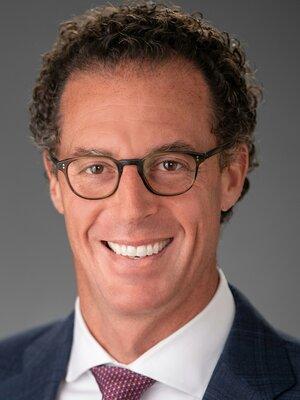
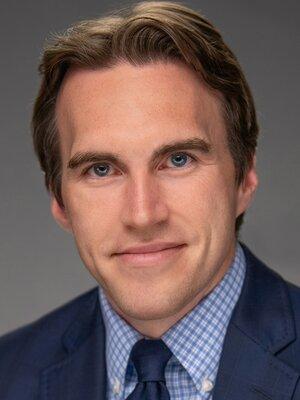
By Nessim Mezrahi and Stephen Sigrist (January 10, 2023, 5:13 PM EST)
In 2023, as the Federal Reserve's strict anti-inflationary regime continues to shape America's capital markets, a high likelihood of an increase in frequency of securities class actions exists as global economic contraction punishes unsustainable business models that have failed to meet optimistic investor expectations.
Companies that went public between 2020 and 2021 have a higher probability of facing securities class actions that allege violations of Section 11 of the Securities Act in 2023 because a majority of that common stock is now trading well below issuance prices.[1]
As a result, counsel for investors are more likely to expend resources and investigate overvalued initial public offerings whose registration statements may have misrepresented the issuers real ability to grow profitably.
According to James J. Park, Professor of Law at UCLA School of Law in his book "The Valuation Treadmill: How Securities Fraud Threatens the Integrity of Public Companies":
As it becomes clear that the prospects of some public companies were overstated, there will likely be cries of securities fraud. Regulators and courts will have to carefully assess whether public companies manipulated the valuation process to deceive investors or whether stock declines reflect the bursting of a bubble.[2]
The equity market selloff in 2022, which contributed to the worst year since 2008 for the Dow Jones, S&P 500 and the NASDAQ, has exposed U.S.-listed companies to a notable increase in the number of high-risk adverse events.
That increase may very likely spur litigation frequency of securities class actions that allege violations of the federal securities laws under Section 10(b) and 20(a) of the Securities Exchange Act and U.S Securities and Exchange Commission Rule 10b-5 promulgated thereunder.
High-risk adverse events have proliferated under these market conditions: For example, when a company's stock price exhibits a material decline in response to a press release or a filing made with the SEC that informs shareholders that it failed to meet previously issued expectations of top line growth or earnings.[3]
Portfolio monitoring systems maintained by sophisticated securities plaintiff law firms are more likely to initiate investigatory actions when three conditions that prompt a high-risk adverse event are met:
1. The company issues a press release or makes a presentation with press in attendance;
2. A regulatory filing is made with the SEC; and
3. Stock price exhibits a negative statistically significant residual return at the 95% confidence standard after controlling for general market and industry-specific factors.[4]
Nessim Mezrahi
Stephen Sigrist
According to a Reuters article by Alison Frankel:
A drooping stock market may inspire more securities fraud class actions. Stock price drops aren't an automatic trigger for shareholder suits, of course. But you can't win a securities class action without showing a decline in share price. And economic downturns have a way of exposing — or prompting — corporate misconduct.[5]
Data and analysis from our SCA Risk Tool on 201 companies that comprise 19 subindustry sectors of the U.S. health care industry, for example, confirms this dynamic.
The companies we ranked in the highest decile for securities litigation risk had, on average, eight high-risk adverse events and a 53% probability of facing a securities class action lawsuit.
Companies in the second-riskiest decile exhibited, on average, six high-risk adverse events, and a 26% probability of facing a securities class action lawsuit.[6]
Issuers are also facing adverse events triggered by activist short sellers who publish biased research with the intent of driving down their target company's stock price.
Consequently, aggressive plaintiff attorneys continue to file securities fraud lawsuits following the publication of short-seller reports.
According to securities claims against U.S. issuers in 2021 and 2022 that we analyzed, investor plaintiffs filed 22 and 11 securities class actions, respectively, following the publication of short-seller reports. The related market capitalization losses for these two cohorts of short-seller driven securities suits amount to $12.3 and $4.3 billion, respectively.[7]
With loaded dockets of private securities fraud suits in the barrel, aching equity markets, and soaking expectations of an increase in frequency of both Securities Act and Exchange Act claims in 2023, mediators will play a vital role of carefully orchestrating a greater volume of high-stakes negotiations.
Having a greater understanding of how investor plaintiffs and corporate defendants estimate aggregate damages in private Rule 10b-5 securities suits will cultivate a more efficient and datadriven claim resolution process to compensate allegedly defrauded investors in an equitable manner.
Empirical Validity of Potential Aggregate Damages Estimates in Private Rule 10b-5 Securities Suits
The results of our exhaustive empirical analyses on 1,371 individual securities class action filings, which includes 137 recently settled cases, indicates that stale methodologies that rely on proxies for plaintiff-style damages, yield understated settlement rates due to overstated estimates of potential Rule 10b-5 aggregate damages.
A proxy for damages claimed by plaintiffs may not be an accurate determinant in predicting settlement outcomes because it does not apply the court-accepted event study methodology to effectively compute potential damages per share.
According to the solicitor general of the U.S. in Goldman Sachs Group Inc. v. Arkansas Teacher Retirement System in 2021:
When event studies reveal no statistically significant movement in a company's stock price at either the time that an alleged misstatement was made or the time when it was corrected, it is relatively straightforward to conclude that the alleged misstatement has no price impact.[8]
With no price impact on the alleged stock drop — there is no damage.
Proxies for plaintiff-style damages also do not take into consideration other critical factors, such as the impact of short-selling activity in investors' trading behavior, or the limitation on damages stipulated by Section 21D(e) of the Private Securities Litigation Reform Act.
According to our data and analysis presented in the SAR Rule 10b-5 Exposure Report for 4Q 2022,
there were 27 first-filed securities class action complaints filed in 2022 that exhibited a complete absence of indirect stock price impact.[9] The related market capitalization losses for this cohort of initially deficient securities claims amount to $79.3 billion.[10]
With proven innovation in cloud native data analytics using lambda functions, in conjunction with more efficient application programming interfaces with suppliers of high-quality raw data, we correctly apply the event study methodology, along with an industry-accepted trading model, to estimate maximum potentially available Rule 10b-5 aggregate damages on the great majority of filed claims.
Our data science process for securities class action data analytics relies primarily on two proven determinants of settlement amounts in Rule 10b-5 private securities-fraud litigation: "(1) the pershare price inflation that results from the fraud, and (2) the volume and timing of shares traded."[11]
In accordance with long-standing academic literature in the fields of law and economics, our securities class action data analytics framework applies the following standard operating procedures to derive our claim-specific estimates of maximum potentially available Rule 10b-5 aggregate damages:
1. Reliance on the allegations presented in the operative securities class action complaint;
2. Application of a firm-specific event study analysis to estimate the dissipation of maximum potential artificial inflation per share on alleged stock drops that do not exhibit an absence of indirect price impact at the 95% confidence standard; and
3. Application of an industry-accepted two-trader model that is used to estimate the number of potentially damaged shares for two distinct cohorts of investors in common stock, with reductions to reported trading volume, adjustment to daily fluctuations in float that account for changes to insider holdings and short-selling activity, and the limitation of damages through the application of section 21D(e)(1) of the Private Securities Litigation Reform Act on the final alleged corrective disclosure. [12]
Our empirical results of our analysis of recently settled claims, demonstrates that our estimates of maximum potentially available Rule 10b-5 aggregate damages, calculated at the time when the corresponding securities class action complaints are filed, alone explains 48% of the variation in settlement amounts in simple univariate regressions.
Our results exhibit highly significant coefficient estimates indicating that a 10% increase in potential aggregate damages predicts a 4.9% increase in the settlement amount. These results are robust and exclude settled securities suits that allege violations of both the Exchange Act and Securities Act.
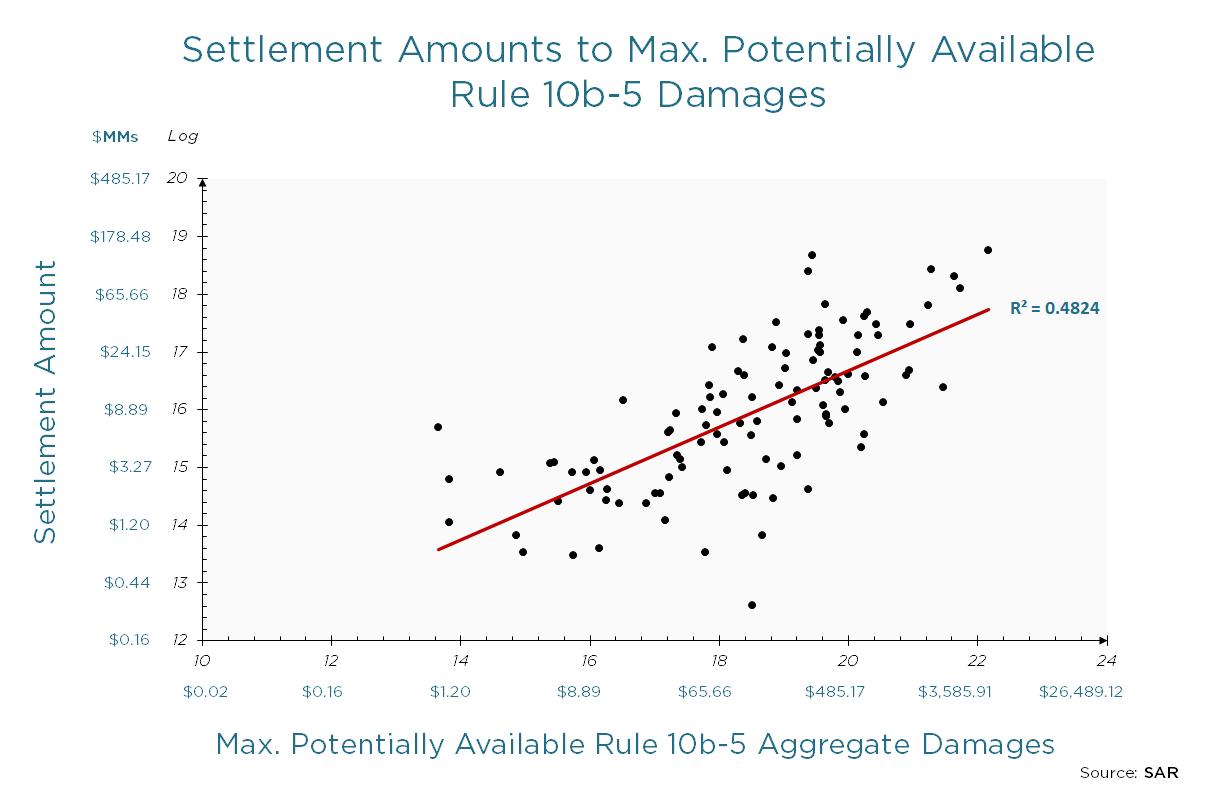
When we add additional controls for the U.S. exchange, circuit court and the plaintiff firm that represents the lead plaintiff, our estimates of maximum potentially available Rule 10b-5 aggregate damages can explain 80% of settlement variation as reported by the R-squared measure, and 64% by the adjusted R-squared measure, with the damage's coefficient indicating that a 10% increase in estimated damages predicts a 3.7% increase in the settlement amount.
These specific performance metrics are based on log-log regressions that exclude the few settled cases for which we estimated maximum potentially available Rule 10b-5 aggregate damages of zero, due to all the alleged stock drops exhibiting a complete absence of indirect stock price impact, in accordance with the Supreme Court ruling in Arkansas Teachers Retirement System v. Goldman Sachs, made effective June 21, 2021.[13]
Non-log-log regressions that include these fully deficient cases that settled for a monetary sum perform similarly in terms of their explanatory power.
Rule 10b-5 Private Securities-Fraud Litigation Settlement Rates
Based on our robust empirical results on 117 settled securities class actions filed since June 2018, we computed the median settlement rates by taking the median quotient of claim-specific settlement amounts as reported by Institutional Shareholder Services Securities Class Action Services and our proprietary estimates of maximum potentially available Rule 10b-5 aggregate damages.[14]
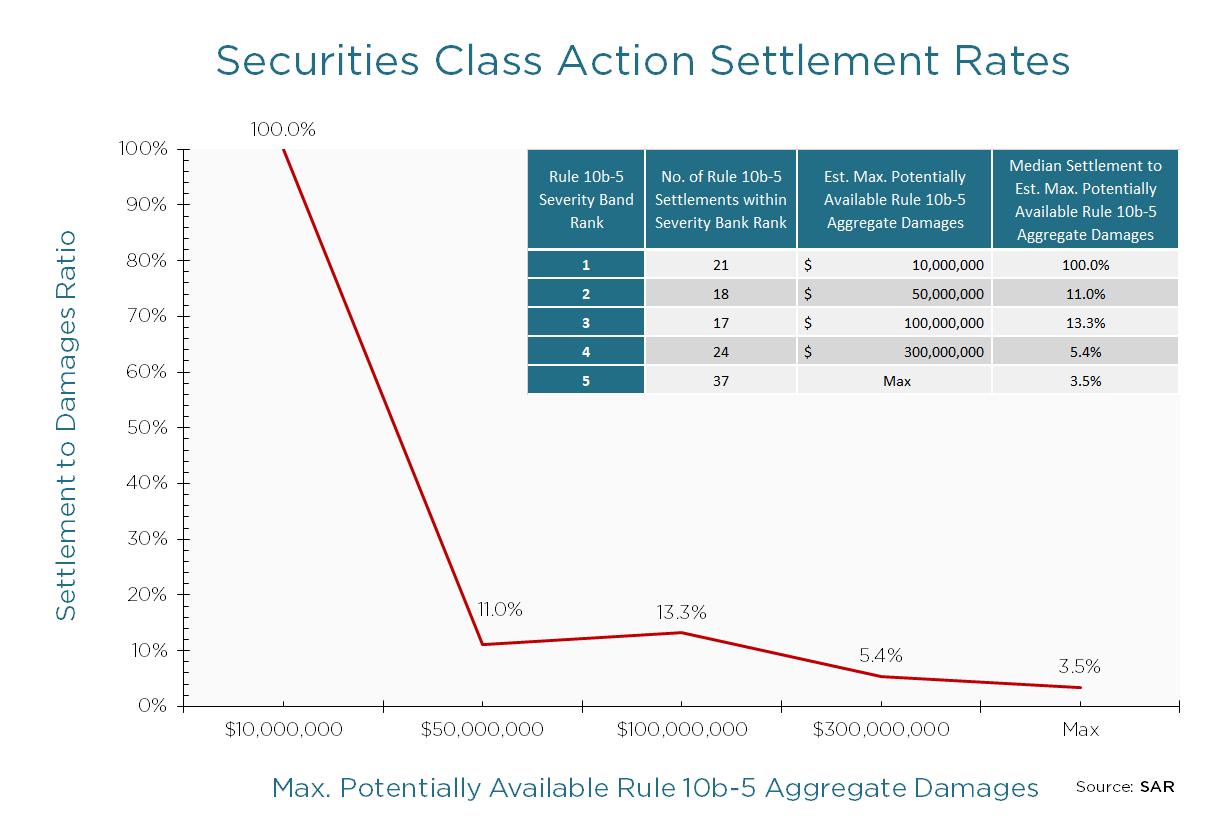
We classify our results into five distinct categories according to the magnitude of potential severity. Results of statistical clustering analyses based on settled claims data indicate that the settlement ranges of the five severity bands are statistically distinct according to the median population for each set.[15]
We expect to further refine and add severity band ranges as our ratio population of settlement dollars to our Rule 10b-5 damages estimates expands and our statistical clustering analysis indicates meaningful distinction.
A greater understanding of aggregate damages in securities class actions, and the empirical relationship with the proposed range of settlement amounts, is pivotal to ensure maximum objectivity is obeyed during mediated settlement negotiations.
Well-established industry practices, combined with innovation in cloud native computing, fosters trusted adoption of proven data-driven initiatives to strengthen the empirical guard rails in the securities class action mechanism and limit potential settlement value inflation that may proliferate during a period of heightened litigation activity.
Nessim Mezrahi is co-founder and CEO, and Stephen Sigrist is senior vice president of data science, at SAR LLC.
The opinions expressed are those of the author(s) and do not necessarily reflect the views of their employer, its clients, or Portfolio Media Inc., or any of its or their respective affiliates. This article is for general information purposes and is not intended to be and should not be taken as legal advice.
[1] "Oatly, Other Deflated IPO Stocks Haunt New-Issue Market," Corrie Driebusch, The Wall Street Journal, December 19, 2022. https://www.wsj.com/articles/oatly-other-deflated-ipo-stocks-haunt-new-issue-market11671417781?mod=Searchresults_pos1&page=1
[2] Park, J. (2022). The Valuation Treadmill: How Securities Fraud Threatens the Integrity of Public Companies. Cambridge University Press, Pg. 147.
[3] "Tesla Stock Falls 12%, Posting Worst Drop in Over Two Years," Meghan Bobrowsky, The Wall Street Journal, January 3, 2023. https://www.wsj.com/articles/tesla-stock-falls-more-than-12posting-worst-drop-in-over-two-years-11672783776?mod=hp_lead_pos12
[4] "Assessing Securities Class Action Risk with Event Analysis," Nessim Mezrahi, Law360, January 22, 2020. https://www.law360.com/articles/1236335/assessing-securities-class-action-risk-withevent-analysis.
[5] "Big firm litigators are amped for 2023," Alison Frankel, Reuters, December 30, 2022, https://www.reuters.com/legal/government/big-firm-litigators-are-amped-up-2023-2022-1230/
[6] SAR SCA Risk Tool output for constituent companies of the U.S. Health Care industry during a 2year evaluative period.
[7] SAR Rule 10b-5 Exposure Report 4Q 2022.
[8] Brief for the United States as Amicus Curiae Supporting Neither Party in Re: Goldman Sachs Group Inc. v. Arkansas Teacher Retirement System, No. 20-222 (2021).
[9] SAR Rule 10b-5 Exposure Report 4Q 2022.
[10] Id.
[11] John D. Finnerty and Gautam Goswami, Determinants of the Settlement Amount in Securities Fraud Class Action Litigation, 2 Hastings Bus. L.J. 453 (2006).
[12] Id., see Pg. 459, footnote 24: "We also believe that of three types of models, only the TTM is capable of meeting the Daubert standard for the admissibility of scientific evidence."
[13] Opinion of the Court, Goldman Sachs Group Inc. v. Arkansas Teacher Retirement System, No 20-222 (2021).
[14] "SAR Launches Quarterly Rule 10b-5 Settlement Rates in Collaboration with ISS Securities Class Action Services (ISS SCAS)," PR Newswire, May 7, 2021. https://www.prnewswire.com/newsreleases/sar-launches-quarterly-rule-10b-5-settlement-rates-in-collaboration-with-iss-securitiesclass-action-services-iss-scas-301286807.html
[15] SAR Rule 10b-5 Exposure Report 4Q 2022.
All Content © 2003-2025, Portfolio Media, Inc