Conflicts Abound When Activist ShortSellers Publish Reports
By Nessim Mezrahi and Stephen Sigrist
January 10th, 2024
By Nessim Mezrahi and Stephen Sigrist
January 10th, 2024
Law360 (January 10, 2024, 5:50 PM EST) -Activist short-sellers often impugn targeted issuers for their own pecuniary gain. They are remarkably proactive and solely responsible for deciding when to publish and what to disseminate to drive down a target company's stock price.
Their intent is clear: to maximize trading profits by publishing negative information to trigger a sell-off in the targeted issuers' common stock.
When these "dark knights of Wall Street," as a recent Law360 Expert Analysis article called them, succeed in driving down a stock price, aggressive securities plaintiff attorneys heed the bat signal and litigate against the affected issuer when they may not have done so otherwise.[1] After all, the defendant company may not have publicly disclosed anything at the time when the activist short-seller decided to launch a fauxfraud campaign to profit from their short position.
But this self-serving relationship between activist short-sellers and entrepreneurial plaintiff officers of the court is conflict-ridden and hinders the fact finder's impartiality when a short report forms the basis for lead plaintiffs' alleged violations of the federal securities laws under Section 10(b) and 20(a) of the Securities Exchange Act and U.S. Securities and Exchange Commission Rule 10b-5 promulgated thereunder.
First , an activist short-seller's work product is an unreliable source of new information about an issuer because the short-seller has an economic interest in driving down the stock price. During the 180, 90 and 30 days leading up to a short report, defendant issuers in 57 short-seller-driven securities class actions exhibited formidable mean stock price returns of 121.6%, 84.8% and 12.4%, respectively.[2]
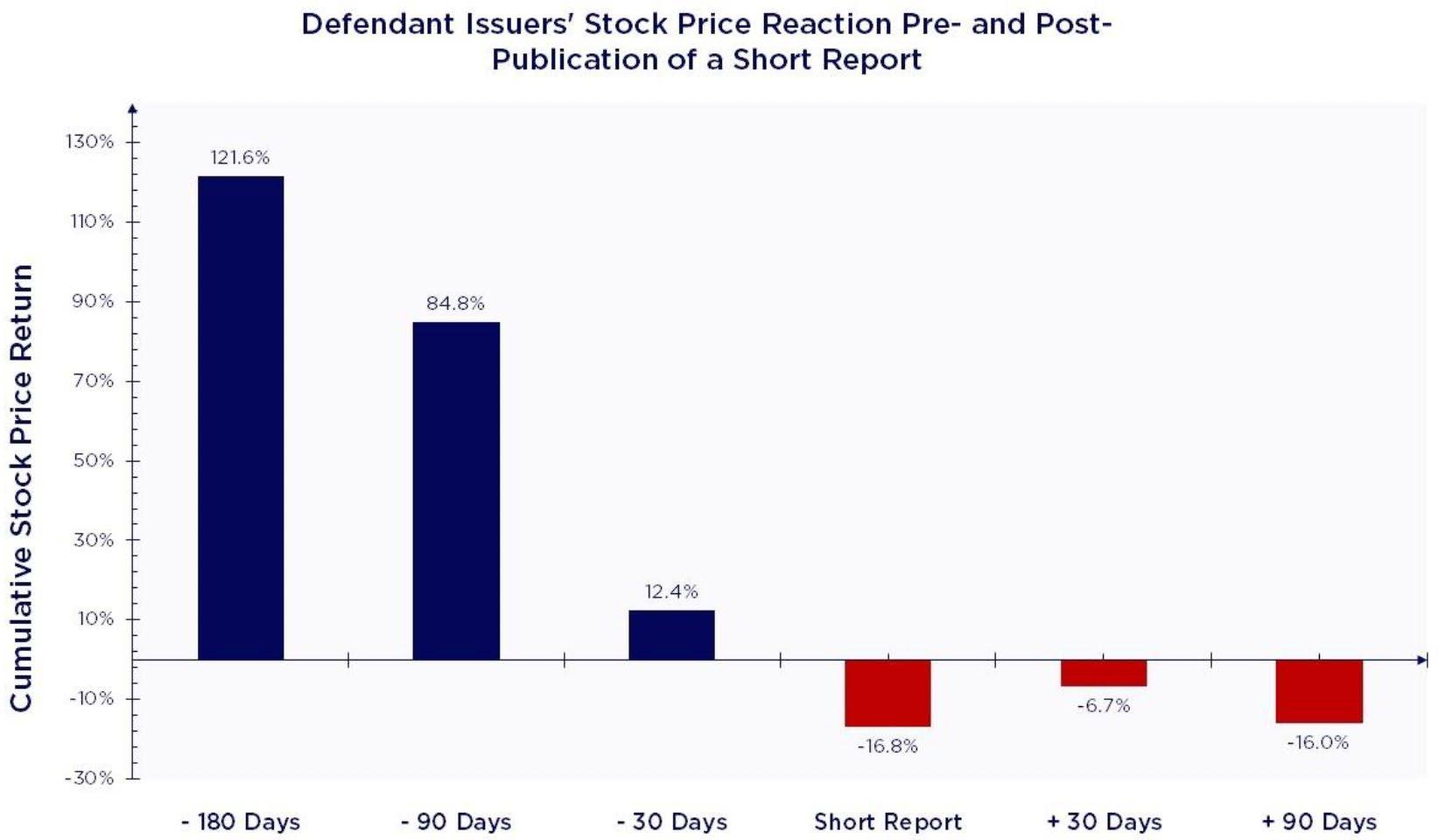
Second, short reports have an immediate and substantial impact on an issuer's stock price, coupled with other dispositive lingering effects post-publication. During the close-to-close trading sessions affected by a short report, defendant issuers' stock price declined by 16.8%, on average, and incurred additional declines of 16.0% during the 90-day look-back period of Section 21D(e)(1) of the Private Securities and Litigation Reform Act.[3][4]
Third, Rule 10b-5 private securities fraud lawsuits based primarily on activist short-seller research may not be indicative of actual fraud-on-the-market since the work product does not necessarily reveal
information of material fact the issuer is obligated to disclose publicly.
According to the January 2023 opinion and order issued by U.S. District Judge Paul A. Engelmayer in In re: Draftkings Inc. Securities Litigation in the U.S. District Court for the Southern District of New York, "[a]s the assembled case law reflects, to the extent that open-market securities fraud complaints use as the source for adverse factual allegations about a public issuer a report by a short seller — an entity with an economic interest in driving down the company's stock price — these allegations must be considered with caution."[5]
A short-seller's intent hinders an objective evidentiary assessment of securities fraud allegations.
Short reports are ill-suited to support allegations of open-market securities fraud because they are published only when the short-seller decides to pull the trigger on a short attack to ignite a sales frenzy, thereby catalyzing an immediate decline in a targeted issuer's stock price.
According to a story by Shaud G. Tavakoli of Skadden Arps Slate Meagher & Flom LLP in Westlaw, shortsellers "take matters into their own hands, preparing and publishing purported 'research' reports detailing their rationales for expecting a stock price decline in the hopes of triggering or accelerating a market reaction."[6]
During the last three years, our organization SAR LLC has identified 79 short-seller-driven securities class actions.[7] Our independent event study results on 57 of these lawsuits indicate that activist short-sellers act to drive down the stock price of issuers that are exhibiting notable stock price appreciation prior to the publication of a short report.[8]
Our data and analyses indicate that cumulative stock price returns during the 30, 90 and 180 days prior to the publication date of the corresponding short reports relied on by investor plaintiffs were, on average, 12.4%, 84.8% and 121.6%, respectively.[9]
The graph below illustrates the mean, 25th and 75th percentile returns of defendant issuers during the 90 days prior to and after the publication of the first-referenced short report in the corresponding class action complaint.
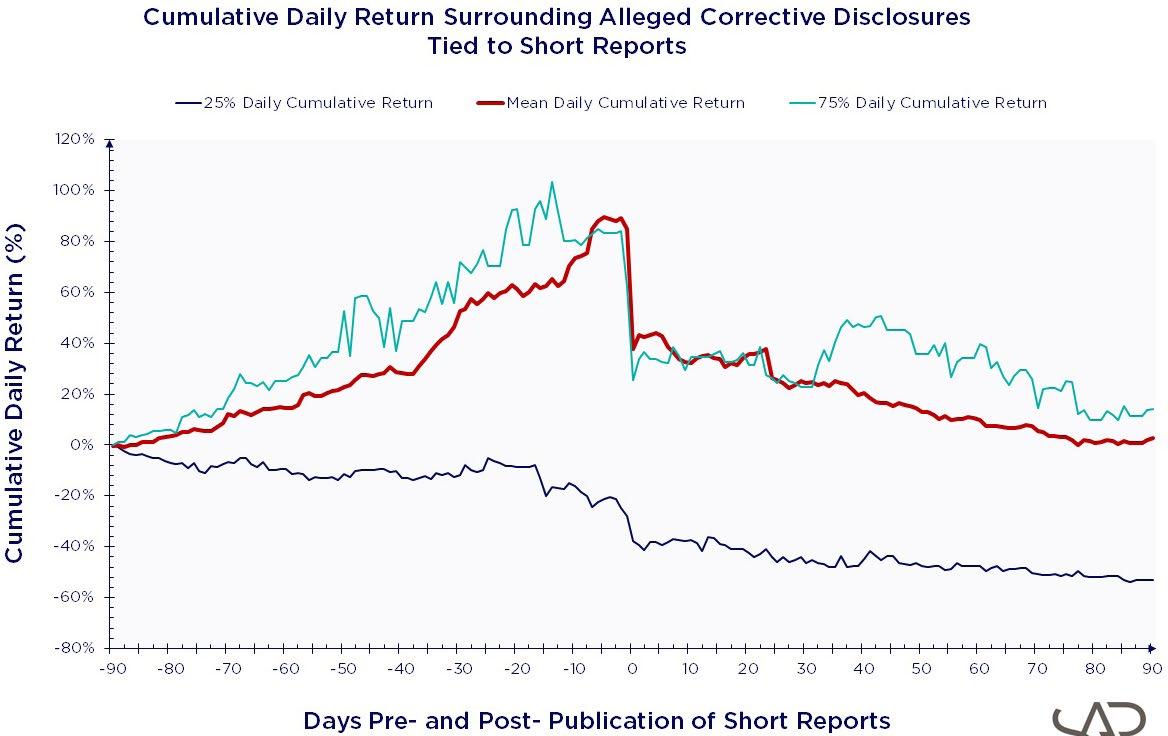
Our independent event study results provide objective indicia that potential aggregate damages stemming from short-seller-driven securities class actions are magnified based on the publication time chosen by the activist short-seller.
According to the SEC's Rule 34-98738, which went into effect on Jan. 2, "[w]hile short selling can serve useful market purposes, such as facilitating price discovery, there are concerns that it could be used to drive down the price of a security, to accelerate a declining market in a security, or to manipulate stock prices."[10]
Activist short-sellers do not operate as "independent detectives," as described by plaintiff-side class action litigators in their recent Law360 Expert Analysis article.[11]
Their work product is instead conflict-ridden and unsuitable for evidentiary purposes in Rule 10b-5 private securities fraud litigation. It falls short relative to the independent discoveries made by truth-seeking investigative journalists who do not pursue trading profits, and is subpar to the valiant breakthroughs achieved by whistleblowers who seek to rectify deep-rooted corporate malfeasance.
The economic harm facing issuers from short attacks and follow-on shareholder litigation is growing and becoming increasingly impactful for other investors as well.
Short reports have a substantial immediate impact on
Our data and analyses indicate that short-sellers are directly responsible for $34 billion in alleged market capitalization losses claimed by investor plaintiffs in 57 private Rule 10b-5 securities fraud lawsuits during the last three years.[12]
Approximately 68% of the alleged corrective disclosures tied directly to short reports exhibited a statistically significant return at the 95% confidence standard after controlling for the effects of the U.S. equity markets and corresponding industry-specific indices.[13]
On average, the stock price decline over the singleday event window affected by a short report for the cohort of defendant issuers is 16.8%.[14]
Our data and analyses also indicate that issuers defending both a short attack and follow-on litigation saw their stock price decline an additional
16% during the 90-day look-back period of the PSLRA.[15] In other words, the stock price of issuers facing short-seller-driven litigation remains depressed during the PSLRA period, effectively mooting the utility of the damages cap, because the issuers' common stock did not exhibit a bounce back in price.
Out of the 57 short-seller-driven securities class actions analyzed independently by SAR since January 2021, 16 have been dismissed, five have settled and 36 remain open. That yields a 28% dismissal rate over the last three years, with mean and median settlements of $2.83 million and $2.5 million, respectively.[16]
The market capitalization losses attributable to the cohort of open short-seller-driven securities class actions we have analyzed amount to approximately $22 billion.[17]
Short-sellers disseminate information that may not be materially factual.
The consequences of well-timed short attacks against issuers experiencing an increasing stock price are notably impactful, particularly when short-sellers disseminate negative information that may not necessarily be of material fact and required to be made public in accordance with the federal securities laws.
In a recent webinar, Susan Muck of WilmerHale said, "The short-seller is writing about something that the company has never addressed publicly. It is a short-seller's analysis of what she or he finds troubling about the company, but isn't the subject of any affirmative disclosure, nor is it the subject of something a company has to disclose."[18]
Given the zero cost to procure short reports, plaintiff class action litigators are incentivized to rely on them as evidence "to recover the losses investors suffer due to [alleged] corporate misconduct," according to the "Activist Short-Sellers Are The Dark Knights Of Wall Street" authors, even if such work product is curated to inflict maximum impact on the stock price.[19]
According to a Bloomberg reporter, "[a]ctivist short sellers such as Nathan Anderson of Hindenburg Research and Carson Block of Muddy Waters Capital are getting more attention, as they increasingly use social media to push well-timed claims of weak fundamentals, improper accounting or outright fraud at publicly traded companies."[20]
The entrenchment among plaintiff-side litigators and activist short-sellers is strengthening. Our data and analyses indicate that 37 plaintiff law firms heeded the bat signal of 25 activist short-sellers to aggressively litigate alleged open-market securities fraud.[21][22]
The top five plaintiff law firms that have participated during the pleading stages of the sample of short-sellerdriven securities class actions we analyzed are Pomerantz LLP (15), Glancy Prongay & Murray LLP (15), Rosen Law Firm PA (9), Block & Leviton LLP (5) and Hozer & Holzer LLP (5). The top three activist short-sellers that were relied upon by investors' counsel are Hindenburg Research (10), Culper Research (6) and Blue Orca (4).[23]
More recently, leading plaintiff-side firms were also willing to go to bat for a short-seller at the U.S. Court of Appeals for the Tenth Circuit when a scheme to profit from a short attack went awry against Overstock.com.[24]
In 2021, in In re: Overstock Securities Litigation, now before the Tenth Circuit, the U.S. District Court for the District of Utah held that the plaintiff "contends that Defendants engaged in a scheme to issue a locked-up dividend they knew would cause a short squeeze, artificially spike Overstock's stock price, and force short sellers of Overstock stock to cover their positions at inflated prices."[25]
According to the memorandum decision and order issued by U.S. District Judge Dale A. Kimball granting the defendant's motion to dismiss, the "[d]efendants could not manipulate the market via truthful statements or via a dividend that everyone immediately knew would impact short sellers."[26]
Evidently, the securities litigation landscape now displays a growing number plaintiff-side firms following, acting with and defending these "dark knights of Wall Street" in a biased pursuit of justice that relies on illsuited evidentiary support that does not necessarily reveal anything the company was obligated to disclose.
On Jan. 16, the U.S. Supreme Court will hear arguments in Macquarie Infrastructure Corp. v. Moab Partners LP, to evaluate "[w]hether the U.S. Court of Appeals for the 2nd Circuit erred in holding that a failure to make a disclosure required under Item 303 of SEC Regulation S-K can support a private claim under Section 10(b) of the Securities Exchange Act of 1934, even in the absence of an otherwise misleading statement."[27]
As we previously noted, "focused review of plaintiffs' scienter allegations by federal judges has helped U.S.listed corporations ward off a litigation wave of purported irregularities related to Regulation S-K, specifically pertaining to alleged violations of Item 303, or management's discussion and analysis of financial condition and results of operations."[28]
Now, on the heels of the Supreme Court's 2021 landmark ruling in Goldman Sachs Group Inc. v. Arkansas Teacher Retirement System, the justices face another complex disclosure issue related to whether an issuer's "optional disclosure [is] a required one — expanding the bounds of Section 10(b) liability for Item 303 violations even further."[29]
The Supreme Court's Goldman framework is effective to nullify short-seller-driven litigation.
With over $21 billion in market capitalization losses alleged by investor plaintiffs in the cohort of active short-seller-driven securities class actions that we analyzed, the Supreme Court's ruling in Goldman Sachs provides the trier of fact an essential datadriven framework to disqualify ill-suited evidentiary support in fraud-on-the-market lawsuits.[30]
As Muck stated, "I think Goldman can also give us tools to try to argue forcefully at the motion to dismiss stage, as well as at class cert, that there's a complete and utter mismatch and the Courts should not allow plaintiffs to take advantage of the
fact that a short-seller, a self-interested investor, was able to get into the market and throw around a lot of allegations — but, completely untied to anything the company has said publicly."[31]
The timing chosen by activist short-sellers to publish short reports to not only limit a targeted issuer's appreciating stock price, but to also drive it down and maximize trading profits, impairs the independence of the work product and hinders its evidentiary utility to validate investor plaintiffs' alleged falsity and loss causation in open-market securities fraud litigation.
Nessim Mezrahi is co-founder and CEO, and Stephen Sigrist is a senior vice president at SAR LLC
The opinions expressed are those of the author(s) and do not necessarily reflect the views of SAR LLC, its clients, or Portfolio Media Inc., or any of its or their respective affiliates. This article is for general information purposes and is not intended to be and should not be taken as legal advice.
Endnotes:
[1] "Activist Short-Sellers Are The Dark Knights of Wall Street," Francis McConville, William Schervish, and Connor Boehme, Law360, December 4, 2023.
[2] SAR Securities Class Action ("SCA") Database, as of December 31, 2023.
[3] Id.
[4] For this analysis, the 90-day look-back period of Section 21D(e)(1) of the PSLRA is applied beginning on the date of the alleged corrective disclosure tied to a short report.
[5] Opinion & Order, In re: DraftKings Inc. Securities Litigation, No. 21-cv-5739 (PAE), (S.D.N.Y. Jan. 10, 2023).
[6] "Securities fraud plaintiffs rely on short seller reports at their peril," Shaud G. Tavakoli, Esq., Westlaw Today, Thomson Reuters, February 8, 2023.
[7] SAR SCA Database, as of December 31, 2023. The 3-year tally excludes 1 short-seller SCA claim that only alleges violations of Section 11, not Rule 10b-5.
[8] 21 defendant issuers exhibited insufficient trading history for SAR to derive robust statistical results of stock price reaction.
[9] SAR SCA Database, as of December 31, 2023.
[10] SEC 17 CFR Parts 240 and 249; Final Rule: Short Position and Short Activity Reporting by Institutional Investment Managers, Effective Date, January 2, 2024.
[11] "Activist Short-Sellers Are The Dark Knights of Wall Street," Francis McConville, William Schervish, and Connor Boehme, Law360, December 4, 2023. [12] SAR SCA Database, as of December 31, 2023.
[12] SAR SCA Database, as of December 31, 2023.
[13] Id.
[14] Id.
[15] Id.
[16] Id.
[17] Id.
[18] Professional Liability Underwriting Society (PLUS) Webinar: "Goldman Sachs: Common Sense Prevailed in the 2nd Circuit," Gregory Larsson, Nessim Mezrahi, Susan Muck, Walker Newell, November 8, 2023.
[19] "Activist Short-Sellers Are The Dark Knights of Wall Street," Francis McConville, William Schervish, and Connor Boehme, Law360, December 4, 2023.
[20] "Why Activist Short Sellers Get Everyone So Worked Up," Lisa Pham, Bloomberg, May 19, 2023.
[21] "Activist Short-Sellers Are The Dark Knights of Wall Street," Francis McConville, William Schervish, and Connor Boehme, Law360, December 4, 2023.
[22] SAR SCA Database, as of December 31, 2023.
[23] Id.
[24] In re: Overstock Securities Litigation, Case No.: 21-4126.
[25] In re: Overstock Securities Litigation, Case No.: 2:19-cv-709-DAK-DAO.
[26] Id., Memorandum Decision and Order.
[27] SCOTUSblog.com: Macquarie Infrastructure Corp. et al., v. Moab Partners, L.P. et al., Case No. 21-2524.
[28] "3 Reasons Securities Fraud Litigation Exposure Fell in Q1," Nessim Mezrahi and Stephen Sigrist, Law360, April 9, 2021.
[29] Petition for a Writ of Certiorari in Macquarie Infrastructure Corp. et al., v. Moab Partners, L.P. et al., Pg. 27, Case No. 21-2524, May 30, 2023.
[30] "Q2 Stock Drop Stats Buoy High Court's Goldman Ruling," Nessim Mezrahi and Stephen Sigrist, Law360, July 9, 2021.
[31] Professional Liability Underwriting Society (PLUS) Webinar: "Goldman Sachs: Common Sense Prevailed in the 2nd Circuit," Gregory Larsson, Nessim Mezrahi, Susan Muck, Walker Newell, November 8, 2023.
SAR is a pioneer in public company D&O data analytics solutions. Our organization was founded in 2018 and relies on specialized data science that implements U.S. Federal Court-approved methodologies to identify and track adverse corporate events that impact stock price performance of U.S. and non-U.S. issuers that trade on the NYSE and NASDAQ. Through a cloud-native platform, SAR dispenses comprehensive data-driven insights for leading global insurance companies and their distribution partners. Highly specialized expertise, decades of independent empirical research, and tried and true technologies, have established SAR as an innovation leader in public company D&O data analytics solutions anchored by human accountability.
www.sarlit.com


Nessim Mezrahi
Co-Founder and CEO
Tel.: 202-436-9994
E-mail: nessim@sarlit.com
Stephen Sigrist
Senior Vice President, Data Science
Tel.: 202-891-3652
E-mail: stephen@sarlit.com
E-mail: info@sarlit.com