UNREAL
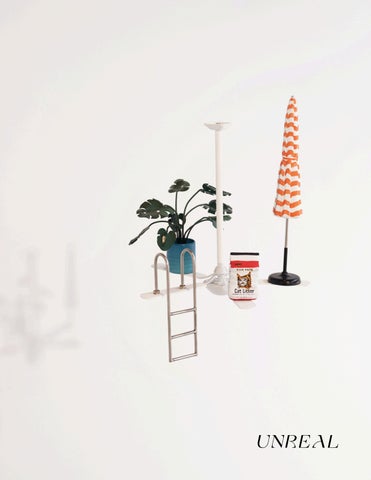
Cover image: Chris Bradley, Ceiling Fan (Superior Absorbing and Deodorizing), 2026
UNREAL April 10, 2026 - June 13, 2026
Esa´i Alfredo Dan Attoe Ever Baldwin Omar Barquet Chris Bradley Ginny Casey Josh Dihle Al Freeman Nereida Garcia-Ferraz Lola Gil Naomi Hawksley Rodrigo Imaz Jared McGriff Enrique Gomez De Molina Kitty Rauth Nina Surel
Introduction by Britton Bertran
Introduction by Britton Bertran
image credit
SECRIST | BEACH presents UNREAL, an invitational survey exhibition featuring fourteen artists exploring these strange and anxious times through guise of surrealism. This exhibition is presented concurrently with a solo presentation by New York-based gallery artist Liliana Porter titled The Strange Task. From the multitude of definitions, surrealism readily encapsulates the rejection of rationalism and the embrace of imagination, creating an intriguing baseline. UNREAL draws upon a variety of the machinations that evoke the multiplicities of the original 1920s cultural movement conceived by artist André Breton with his Surrealist Manifesto in 1924 and “officially” ending with Jean Schuster’s provocative manifesto The Fourth Song in 1969. Unofficially, however, the power of imagination has never been for naught; creative freedom has expanded the concept of surrealism beyond a singular artistic movement, instead realizing it as a persistent state of mind. One hundred years later, the core principles of surrealism still revolve around dreamlike narratives, symbolic iconography, distorted or abstract humor, illusionistic play of materials and mediums, and the stretching of rationality in pursuit of liberation. UNREAL takes a flexible, contemporaneous interpretation of these ideologies while keeping a wary eye on the complexities of current socio-political, conceptual, and philosophical concerns. While the origins of the movement evolved from a combination of the horrors of war alongside the burgeoning field of Sigmund Freud’s analysis of the subconscious, its influence continues to adapt and resonate within contemporary artistic practice today. The diverse approaches to reality presented in UNREAL foreground a synchronous mode of artmaking characteristic of contemporary practices. The works explore themes of fantasy, mystery, history, family, spirituality, identity, and sexuality, situating them within frameworks that initially presume coherence and legibility. However, with varying degrees of opacity and inexplicability, these artworks can destabilize these assumptions, complicating the viewer’s capacity to distinguish between the real and the constructed. This tension produces a critical space in which reality is not approached as a fixed or stable condition, but as a mediated construct. The exhibition reflects broader ideological shifts in society in which truth claims - understood as assertions upheld by individuals, belief systems, or authoritative texts - are increasingly coming under scrutiny. Instead, we find ourselves in a place where multiple narratives can exist and subjective experiences are validated. By extolling the concept of ambiguity, UNREAL resists singular interpretation and instead foregrounds the instability of meaning itself. In this sense, the exhibition may be understood as an inquiry into the clarity of the image itself as it relates to the limits of representation. Here, reality is not merely depicted but is instead produced, refracted, and reconfigured through aesthetic and discursive practices.
Josh Dihle Josh Dihle’s relief sculptures and paintings are bodily topographies where features like eyelashes and lips protrude alongside trees and pockets with animals peering out and embedded objects. The surface becomes a concept to probe in Dihle’s work: traditionally, one perceives the surface of art as the image, form, or material consideration, not as the edge of a world to peer into its depths. In UNREAL, Josh Dihle’s wood sculpture and drawings explore the surreal dimensions of his take on figuration. In Tasters, the wood surface is layered where each outline of a face seems to be afforded its own plane. In line with Dihle’s practice in other materials, the depths of the material is where the work is to be found. In Dihle’s drawings, outlines of faces meld into one another as if they are not solid – something we tend to consider bodies to be. In other pieces, the body engages with drawn landscapes and forms, a task in layering and fragmenting realities.
Josh Dihle Tasters, 2019 Carved walnut 66 x 50 x 3 inches
Auraes
All works: Josh Dihle, Graphite on paper, 12 x 9 inches; 15 x 12 inches, framed.
Drawing 11, 2022
Drawing 87, 2025
Drawing 67, 2025
Drawing 77, 2025
Drawing 18, 2025
Drawing 13, 2022
Drawing 80, 2025
Drawing 198, 2025
Drawing 04, 2022
Auraes
Dan Attoe In Dan Attoe’s compositions, the natural world is at once serene and commanding. Painted to appear smooth, clear, and refined, Attoe scales trees, mountains, sunrises and sunsets, and the human form irrationally. As if weighing the influence of the human spirit and the enormity of nature, Attoe places the relative egos of both in relationship: the artist proposes that neither nature or humanity is absolute, but rather in a dialogue that encourages pause, reflection, and reconciliation. Attoe’s work orbits the contemporary fixation on the lived and digital world, where we fail to recognize and revel in the world around us – a world that sees our inner state and reverberates back. In Fingertip Mountain, a manicured, composed hand reaches as if to touch the volcano, sitting at once at rest and of danger. The mountain is a landform characterized by the ominous dichotomy of stillness and unrest, where Attoe has familiarized the form with a gentle, human touch. In Dual Falls with Painted Arches, painterly strokes superimpose a dynamic image, rendering the scene, with cascading water, frozen and atemporal. Both paintings soften the forces of nature, disarming fear and welcoming reflection.
Dan Attoe Fingertip Mountain, 2020 Oil on canvas on panel 24 x 24 inches
Dan Attoe Dual Falls with Painted Arches, 2021 Oil on canvas on panel 36 x 24 inches
Chris Bradley Chris Bradley’s sculptures assemble found materials in structural and symbolic juxtapositions that open up, rather than prescribe, associations. At times, the assemblages take on anthropomorphic status, engaging a surrealist trompe l’oeil in space. Household objects take a human form, often their material makeup juxtaposed with their adopted character, while inanimate objects are imbued with their own comical personas. In Always Night, Bradley creates a window and ledge that looks into a black void. Soft white strips allude to curtains while an unnervingly consistent black surface does not relent. Bradley includes objects so easily related to the windowsill – plants, tables, a cat – but somehow, against that ominous backdrop, all is uncomfortable. Fireplace (The Great Northern) is embedded in the gallery wall, with a serious suggestion of a real chimney hidden in the drywall. Believable, along with all the fire-tending accoutrements, a prized fish is planted squarely in the mantle. In Ceiling Fan (Superior Absorbing and Deodorizing), a seemingly floating miniature ceiling fan becomes the ground for multiple imagined spaces. The sculpture epitomizes surrealism, the object distorted almost to the point of illegibility. Bradley’s version, however, achieves not revulsion or horror, but wit. Bradley’s pumpkins-turned-gear-shifts fuse the organic with the mechanical, existing in a realm of the absurd. One cannot help but be entertained by the notion of driving with a pumpkin, and soften to Bradley’s unique syntax.
Chris Bradley Fireplace (The Great Northern), 2026 Wood, steel, 3-D printed PLA, epoxy putty, rope, paint, and hardware 12.5 x 12.5 x 5 inches
Chris Bradley Ceiling Fan (Superior Absorbing and Deodorizing), 2026 Steel, stainless steel, wood, 3D printed PLA, paint, and hardware 10 x 8 x 8 inches
Chris Bradley Always Night, 2015 Steel, stainless steel, cast bronze, wood, polystyrene, 3D printed PLA, acrylic paint, magnets, and adhesive 8.5 x 27.5 x 1.25 inches
Chris Bradley 1967 Austin-Healey 3000 MK III BJ8 Phase II in British Racing Green (GN-25) (2.9-liter (2,912cc) BMC C-Series inline-six engine, 148–150 bhp at 5,250 rpm, Twin SU HD8 2-inch carburetors, 4-speed manual transmission with a synchronized top three, top speed over 120 mph with a 0-60 mph time of approximately 9.8 seconds, Semimonocoque steel body with an aluminum hood and rear deck panels, 72-spoke chrome wire wheels with "knock-off" spinners, walnut veneer dashboard housing Smiths gauges, Ambla vinyl seating, roll-up side windows, a center console with a padded armrest and radio, and a fold-down rear luggage platform), 2026 Glass reinforced polymer infused gypsum, polyurethane foam, stainless steel, brass, and wood 22 x 28 x 13 inches
Chris Bradley 1999 Mitsubishi 3000GT VR-4 in Glacial White Pearl (W75) (3.0L DOHC 24-valve V6 engine with Twin Turbochargers and Dual Intercoolers, 320 hp @ 6,000 rpm and 315 lb-ft of torque @ 2,500 rpm, 0-60 in 4.8 seconds, top speed of 159mph, Getrag 6-speed manual transmission, 3737 lb curb weight, Full-time All-Wheel Drive (AWD) with a viscous coupling center differential and a limited-slip rear differential, Four-Wheel Steering (4WS) system that turns rear wheels in phase with front wheels at high speeds. Fixed high-profile "Combat Wing" spoiler, 18inch chrome-finished five-spoke alloy wheels, driver-centric cockpit with tan leathering seating, 210-watt Infinity sound system with an AM/FM/Cassette head unit and a trunk-mounted CD changer, full automatic digital climate control system, and dual front SRS airbags), 2026 Glass reinforced polymer infused gypsum and stainless steel 22 x 15 x 10.5 inches
Chris Bradley 1971 Volkswagen Super Beetle (VW 1302) in Lemon Yellow (L11E) (1.6L (1584cc) air-cooled, rear-mounted, horizontally opposed "boxer" flat-four engine, 60 hp at 4,400 rpm, 82 lb-ft of torque at 3,000 rpm, standard 4-speed manual transaxle, 0 to 60 mph in approximately 16 seconds, top speed of 87 mph, curb weight of 1,984 lbs, "bulbulous" front end with slotted grill, flat windshield, “tombstone” taillights, traditional flat dashboard with a single circular instrument pod, leatherette bucket seats with built-in headrests and "bouncy" cushioning, door-to-door carpeting, and a “big” trunk), 2026 Glass reinforced polymer infused gypsum, stainless steel, and wood 20 x 16 x 13 inches
Chris Bradley 1991 Ford F-150 XLT Lariat in Midnight Regatta Blue (MG/M5979) (5.0L V8 (302ci) engine, 185 hp and 270 lbft of torque, 0-60 in 9.5 seconds, 5-speed manual transmission with overdrive, towing capacity of 7,500 lbs, twin traction beam suspension, 4x4, curb weight of 3874lbs, payload of 4252lbs, "Bricknose" front end, chromed bumpers and grille, brushed stainless steel tailgate insert, 15-inch aluminum "bullet hole" wheels, cloth bench seat with a folddown center armrest, manual roll up windows with wind-wings, push locks, brushed woodgrain accents, sliding rear window, AM/FM/cassette stereo, short range CB radio, police radar scanner, ashtray with cigarette lighter), 2026 Glass reinforced polymer infused gypsum, polyurethane foam, stainless steel, aluminum, and wood 21.5 x 26 x 18 inches
Lola Gil Lola Gil employs layering to manufacture unreal spaces, where residuals of the artist’s play with perspective, reflection, and distortion convey an eerie presence – of which the viewer is unsure. Warped images and strange objects are conflated, irrationally, on separate planes. Their dysfunction refines the viewer’s eye in ways that lay bare tropes of the suburban and idealized American symbolic imagery. The artist’s “Narrative Escapism” strives to describe, through alienation, something central to human connection. In Living Room Curtain, nothing is properly seen, nor with any sense of objectivity. The figure painted the most realistically is hidden by the titled curtain (which is out of place in the interior scene), sitting on an abnormally long – almost never-ending – couch. One can sense the hidden figure is expressing something, but to which the figure with a ballooned, glazed head cannot hear or digest – a conversation, broken. Decapitated, the figure in Go Outside dresses in draping, illuminated attire while their ‘head’ floats, enlarged, in an amorphous space. Two conversations – or realities – exist in the painting: the Americana of the white picket fence is broken by the nightmarish head and layered plane of the glass shoe; the latter is at once distorting and at another aligned with the language of the suburban scene.
Lola Gil Living Room Curtain, 2024 Oil and acrylic on linen 47.25 x 70.75 inches
Lola Gil Going Outside, 2024 Oil and acrylic on linen 51 x 38.5 inches
Kitty Rauth Kitty Rauth creates flaccid objects, glasses that appear to be melting, and inoperative tables – where utility becomes irrational. The dinner table is a place of unspoken and spoken etiquette, a contradictory message of indulgence and restraint, and a place of gathering and exclusion. For Rauth, in these contradictions, the table is a site to explore social expectations around health and wellness. This environment catalyzes the concept of how things are to be done; Rauth decides to explain the crisis through disrupting the scene’s logic. Using a kiln, Kitty Rauth’s glass objects appear to slump. Two drinking glasses bend at the stem, as if unable to support the weight of the vessel. Untitled (Wilted Series #2) falls entirely limp, while Untitled (Wilted Series #4) retains much of its shape, transforming into a different form entirely – with a different, yet related, utility. The candlesticks in Untitled (Wilted Series #6) retort the rituals of the dinner party and ideas of etiquette around gatherings, rejecting their depended-upon function. In this discrepancy, the dimensions and weight of the glass prior to melting become central, provocative questions, as well as the artist’s own process.
Kitty Rauth Untitled (Wilted Series #6), 2023 Kiln slumped found glass 15 x 6 x 3 inches
Kitty Rauth Untitled (Wilted Series #2), 2023 Kiln-slumped found glass 8 x 3 x 1.5 inches
Kitty Rauth Untitled (Wilted Series #4), 2023 Kiln-slumped found glass 11 x 9 x 4 inches
Auraes
Mcgriff + Imaz + Squirtle install
Enrique Gomez de Molina In Enrique Gomez de Molina’s surreal geno-sculptures – taxidermied hybrid creatures – attention is drawn to universality. The artist works from the notion that elements of all living beings can be shared, and these beautiful, tactile—real—objects evoke wonder and reckoning, for the current and future relationships in the natural world. Molina’s Squirrdle fuses the sharp beak of a Reeves Pheasant, its feathers embracing a contrasting tough Box Turtle’s shell, leading to a furry Red Squirrel’s tail perked to attention. The artist’s care for each animal his works is built using is clear in the work, where he preserves the natural beauty and curiosities of each species through the meticulous grooming and handpainting of fine details.
Enrique Gomez De Molina Squirrdle, 2010 Box Turtle, Red Squirrel, Reeves Pheasant, Geno-Sculpture / Taxidermy 13.5 x 12 x 6.5 inches
Jared McGriff Jared McGriff paints figures in reductive spaces, where bodies, furniture, and objects seem to sit, pensive and attuned, in an oneiric mood. McGriff draws on memories from his family’s history, but imbued with new stories. McGriff connects his reflective beings with elusive landscapes, felt and recognized but difficult to define. In A Trade for a Bird’s Song, the figure’s face is hidden behind dynamic, layered brushstrokes, edges fading into the background. The held birdcage is faint, but the bird has a vivid blue that jumps out from the hazy light. McGriff’s deep hues offer voids within the composition, if one desires to feel. In Gathering Before Embarking, a boat veers toward a bright horizon. Trees frame the landscape — quite a familiar vision — as the depths of the scene are painted in beautifully illegible strokes. The two figures, as the title suggests, are preparing, as they commune before the story truly starts. It is these quiet moments that McGriff chooses to portray, when we are called to look inward.
Jared McGriff Gathering Before Embarking, 2023 Oil on canvas 54 x 68 inches
Photos by Zachary Balber Courtesy of Spinello Projects
Jared McGriff A Trade for a Bird’s Song, 2023 Oil on canvas 76 x 53 inches
Photos by Zachary Balber Courtesy of Spinello Projects
Rodrigo Imaz Rodrigo Imaz, across mediums, examines the increasingly porous divide between nature and culture, and the ways in which the man-made world disrupts and reframes that relationship. Working primarily through sculpture and installation, he transforms familiar, everyday objects through unexpected material interventions, pulling them into metaphorical studies. His work draws on the recognizable forms of bodies, animals, and mass-cultural objects, subtly altering them so that in their oscillation between familiarity and estrangement, the viewer reflects on systems surrounding the social and political realms. Talachas aqui, translates to “repairs done here,” is a car tire made of marble. The trompe l'oeil here is subliminal, forcing a reckoning when one looks at the piece for a bit longer than a quick glance. In line with Imaz’s broader practice, this sculpture, upon second look, is loaded with allusion: to the world of technological innovation, the detriment caused by emissions and oil extraction, and the everyday engagement we have with labor and human connection.
Rodrigo Imaz Talachas aqui, 2025 Marble 39 inches, diameter
Omar Barquet From sculpture to collage and printmaking, Omar Barquet examines memory, personal biography, and object histories. Artifacts of personal significance and cultural symbols emerge from found graphic materials, converging into a lexicon centered around confluence: of the permanent and the ephemeral, of the specific and the universal, and of the material and the symbolic. Barquet’s work asserts itself into space, both physically and emotionally, with the organic, the tonal, and the active balancing and softening one another. Barquet’s Anagram 10 assimilates textural and weighty elements into curving movement. Pulling into the center of the piece, the graphic and physical pieces meld into unity. The assemblage, mounted in a vitrine, reads immediately as a type of cultural inquiry — one that is particular to the artist. With animal remnants included alongside postcards and polaroids, Barquet creates a type of cultural repository and produces a singular vision. In WAISENPSALMEN VII and WAISENPSALMEN VIII, patterns seem to recede into the depth of each component, but are met with flat, layered planes. Barquet plays with borders in these collages, each layer nested in the next. In both pieces, there is a central point, from which curving lines emanate, breaking the framed-within-aframe structure to suggest divergence from order and manifesting the artist’s subjectivity. The patterned collaged pieces almost resemble land formations, fire, and the sky, but escape capture, melting into a dreamscape or a state of horror, perhaps both at once.
Omar Barquet 10th Anagram (for G. Moreau), 2026 Solarized postcards and Polaroid photographs intervened with lacquer, fragments of wooden chair, oysters, snails and butterfly wings, feather, marble, nails, pins and synthetic hair on painted MDF and glass box with brass 20 x 201 x 5.5 inches
Omar Barquet WAISENPSALMEN VIII, 2026 Collage, digital print on paper, wood fragments, lacquer, color pencil, synthetic hair, seashell, oyster, nails, pins, and peacock feather on book covers mounted on a painted wood board with a custom artist’s frame 14 x 17 x 2 inches
Auraes
Auraes
Omar Barquet WAISENPSALMEN VII, 2026 Collage, digital print on paper, wood fragments, lacquer, color pencil, synthetic hair, seashell, oyster, nails, pins, and peacock feather on book covers mounted on a painted wood board with a custom artist’s frame 14 x 17 x 2 inches
Ever Baldwin Often with bilateral symmetry, Ever Baldwin’s canvases fuse the bodily with landscape. Hand-carved frames expand the painting into the physical space, allowing the artist’s emotive forms to emanate while maintaining the canvas as an interior space. Visceral spiritual forms and colors that appear in liminal tones convey a vulnerability, where the shaped frames serve as armor and protection. Intimacy runs paramount, where there is a concerted contrast between the inner and outer of Baldwin’s work. Two women pull draped fabric out of the painting in Attendants. The figures, composed a wooded frame around the painting, are rendered minimally, with a material shift between the canvas, full of luminosity and dimension, to the wood, amplified by form and texture. Baldwin dances with boundary, where the canvas extends into space with its wooden appendage, while at the same time remaining encased, as if holding something fragile in the paint.
Ever Baldwin Attendants, 2025 Pigmented wax (oil paint) on charred wood frame 40 x 60 x 6 inches
Nereida Garcia-Ferraz Through painting, photography, video, and sculpture, Nereida Garcia-Ferraz traces her Cuban identity in tandem with spirituality. Figures float, glide, and hover, opening up the possibilities of narrative in an abstracted space. Her paintings have busy compositions, dense with bodies and symbols, sometimes overlapping. Reaching limbs and curving torsos fill every inch of the canvas, allowing color and line to flow. The artist explores identity and feminist themes, nature, beauty, and the physical world, with a transportive logic. Garcia-Ferraz’s three paintings engage with the plane in vertical sweeps, figures long and fluid. As La Lección (The Lesson)’s title suggests—as does the visual cadence of color and form—interaction between figures, providing care, conversing, dancing, and imagining. In Su Piel (Your Skin), the figures almost seem in relation to each other in a subconscious state, while physically separate. Candles rest on bodies, ledges, and blocks of text while horned creatures frame the bottom of the composition. In La Mujer Que Habla Sola (The Woman Who Talks To Herself), the composition frames a smaller woman in an arch, while enigmatic faces, bodies, objects, and animals float around.
Nereida Garcia-Ferraz La Lección (The Lesson), 2022 Oil on canvas 63 x 64.5 inches
Courtesy of Spinello Projects Photo by Elliot Jiménez
Nereida Garcia-Ferraz Su Piel (Your Skin), 2023 Oil on canvas 63 x 63 inches
Courtesy of Spinello Projects Photo by Elliot Jiménez
Auraes
Nereida Garcia-Ferraz La Mujer Que Habla Sola (The Woman Who Talks To Herself), 2022 Oil on canvas 48 x 36 inches
Courtesy of Spinello Projects Photo by Elliot Jiménez
Naomi Hawksley Surreal and apparitional, Naomi Hawksley’s drawings call upon tropes of female depiction and image structures with a careful and evocative handling of graphite. Concerned with how women are seen and who does the seeing, the stroke is respectful and protective, encasing her figures in intimacy. Opacity is critical in Hawskley’s formal lexicon, offering that soft barrier between her vulnerable figures and the viewer’s eye. In little detail, the artist communicates from line and shape. In the work, the figures are caught between violence and peace, presence and absence, exposure and invisibility. Hawskley’s two graphite drawings are housed in dolls beds. Untitled (Assured) is an eerie scene of dogs and two figures calling upwards, out of the frame. The image is irrational against its frame: the planes don’t follow a dimensional logic, rather alluding to another entity in the void – perhaps the recipient of the howling. In Untitled (Projector), a woman’s face is layered with metal brackets, a sinister proxy for eyes. While unsettling, these two drawings tell stories of anonymity, and, in a strange way, protect the image from trespass.
Naomi Hawksley Untitled (Assured), 2025 Graphite on vellum, acrylic, silicone, assorted metal and doll’s bed frame 20 x 9.75 x 11.5 inches
Naomi Hawksley Untitled (Projector), 2025 Graphite on paper, vellum, acrylic, silicone and doll’s bed frame 11 x 5.5 x 8.75 inches
Al Freeman Comical and provocative, Al Freeman’s puffy wall sculptures critique brazen confidence. Icons of consumerism, machismo, status, and signifiers of social currency are partially-deflated, critiquing mass culture and the ‘puffing up’ of one’s chest and ego, say. At a scale that cannot be considered anything but ridiculous, the artist’s indictment is palpable. Soft Einstein takes the dialectic of the artist degrading her subjects to a critical register above simple humor. Science is fallible and variable, as the search for absolute truth is impossible. Freeman understands this, and in the artist’s textbook on relativity – as it is written by ‘Al Einstein’ – the physical qualities of the sculpture make it more real and tangible over prized and untouchable. Soft Glow Lava Lamp, with colors nothing more than drab: the legitimacy of the lava lamp as ‘cool’ or ‘interesting’ will never be the same in Freeman’s hands.
Al Freeman Soft Einstein, 2025 Vinyl and polyfil 54 x 42 x 10 inches
Al Freeman Soft Glow Lava Lamp, 2025 Vinyl and polyfil 50 x 15 x 4 inches
Ginny Casey Ginny Casey paints imagined objects – some stranger and more metaphorical than others – in an abstracted space. Often vessels, these entities still follow a painting’s pictorial order, somewhat engaging with scale, dimension, and shadow. The artist allows the paintings to adopt the setting of a ceramic studio, where these vases, cups, and bowls hold the spiritual, the unknown, the hoped-for, and the lost. The forms develop and take on biomorphic shape – at times, personas – where Casey draws on the unconscious, psychoanalysis, free-association, and dreams to create environments of exploration and discovery. Casey’s Preparations depicts a swan digging into a vase of floating eggs. A few vulnerable eggs are laid beside, while another swan appears stuck in a second vase. As with other paintings, Casey toes the line of rational and irrational space: the vessels cast shadows, hold water, and are placed in relation to one another, but the environment is abstract and dislocated from the wildlife scene. While the first swan is free to spread its wings, a philosophical or emotional call is heard when the other feels lodged, captive, inert.
Ginny Casey Preparations, 2026 Oil on canvas 36 x 36 inches
NSUREL INSTALL
Nina Surel Aligning the malleability and transformative properties of clay with the human body, Nina Surel’s ceramic sculptures and wall installations trace cycles of creation, transformation, and renewal. Working with a material that is at once fragile and enduring, she treats clay as both vessel and extension of bodily experience. Surel’s two ceramic wall sculptures appear in conversation with one another, each figure sitting in a slightly differentiated environment. Perhaps the pieces are two sides of the entity of a woman, as one is different in unique contexts. Surel’s three cermic vessels depict figures embracing, melting into, and dancing around a central column. In one, a deity-like figure stands strongly, with a palm leaf fanning out above her. In another, a mermaid figure is coupled with vibrant blue forms, perhaps symbols of water.
Nina Surel The Queen Conch, 2024 Underglaze on stoneware over wood 53.5 x 32.5 inches
Photos by Zachary Balber Courtesy of Spinello Projects
Nina Surel Beauty Berry, 2024 Underglaze on stoneware over wood 57 x 33 inches
Photos by Zachary Balber Courtesy of Spinello Projects
Auraes
Auraes
Photos by Zachary Balber Courtesy of Spinello Projects
Nina Surel Her Tears Were Drops of Living Blue, 2025 Underglaze on stoneware 13 x 6.5 x 6.5 inches
Nina Surel She Came From the Inland Winds, Wraped in Light and Clothed in Silence, 2025 Underglaze on stoneware 20.5 x 13 x 8 inches
Photos by Zachary Balber Courtesy of Spinello Projects
Photos by Zachary Balber Courtesy of Spinello Projects
Nina Surel She Held a Shell to Carry Her Story, 2025 Underglaze on stoneware 14.5 x 6 x 9 inches
Esaí Alfredo Esaí Alfredo fuses a cinematographic sensibility with magical realism in paintings of queer youth rendered in dim, dramatized nocturnal light. His compositions read as stills from an unseen film, where atmosphere and lighting carry narrative weight as much as figure and setting. Drawing on his experiences navigating queer identity at night in Puerto Rico, Alfredo constructs scenes that move between memory and invention. In the distance in The Theme Park, a pink light emanates from behind the horizon. A lone man faces the scene. With a hand on the telescope, the figure chooses to see through his own eyes as he sits in awe of the scene in front of him. There is no need for visual aid; the imagination expands the story.
Esaí Alfredo The Theme Park, 2025 Oil on canvas 72 x 96 inches Courtesy of Spinello Projects Photo by Zachary Balber
We would like to thank the participating artists as well as their galleries; Ackerman Clarke, Andrew Rafacz, Marinaro, Nino Mier, Spinello Projects, Western Exhibitions, and 56 Henry.
SECRIST | BEACH 1801 West Hubbard Street | Chicago | 60622 www.secristbeach.com
|
312.212.8888
SECRIST | BEACH