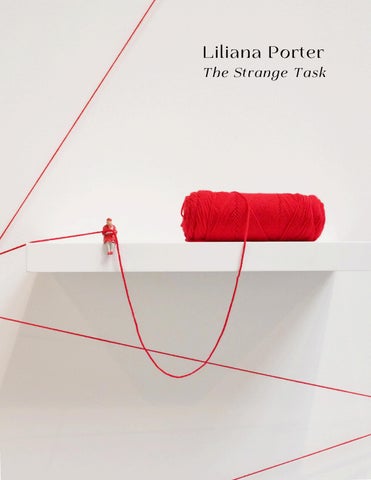
Liliana Porter The Strange Task
Cover image: Liliana Porter, The anarchist (WOMAN IN RED), 2025
Liliana Porter The Strange Task April 10 - June 13, 2026
Introduction by Britton Bertran
“In Conversation with Liliana Porter” Introduction by Lori Waxman
Introduction by Britton Bertran
I would have to say that what art gives me is awareness. Awareness of this short period of time that we have, on one hand, and on the other hand, a way of understanding reality. It may sound corny or dramatic, but for me art is a form of salvation. Liliana Porter in Conversation with Inés Katzenstein, (Fundación Cisneros, 2013), 91.
The solo presentation of New York-based gallery artist Liliana Porter, titled The Strange Task, features a variety of media including painting, works on paper, sculpture and video all featuring Porter’s coterie of endearing inanimate found objects, toys and figurines. The exhibition is presented concurrently with UNREAL, an invitational survey featuring a group of artists exploring contemporary anxieties and the surreal dimensions of everyday life. Born in Argentina in 1941 and based in New York since 1964, Liliana Porter has developed a enigmatic multidisciplinary practice spanning more than six decades. Working across video, photography, painting, printmaking, drawing, collage, small-scale installations, and theatre, her work incorporates everyday found objects to investigate themes of identity, labor, and time, with an idiosyncratic blend of poetic metaphor and humor. Porter constructs situations in which ordinary objects are transformed into agents of reflection on the human condition. Porter is widely recognized as an important figure in conceptual, Latin American and feminist art. Her uniquely personal visual language is rooted the theory of surrealism highlighting not only our relation to objects, but the very nature of objecthood itself. By placing these toys and figurines in a specific context where they are either connected to each other or, conversely, directly connected to the viewer, the fidelity of emotional connection is enhanced. Works included in the exhibition - such as To Get There, To Hold the String, and To Do It Again - stage moments of quiet action and contemplation. Objects and protagonists develop a narrative that is as approachable as it is meaningful, creating a reconsideration of our own everyday actions. As co-founder of the influential New York Graphic Workshop (1964), Porter also produced prints for the Spanish Surrealist artist Salvador Dalí. Although their artistic practices differ in both method and context. significantly, both artists share a commitment to distorting reality as a method of inquiry. This conceptual affinity situates Porter within a broader lineage of Surrealist experimentation, where altered perception functions as a means of probing psychological, cultural, and symbolic structures. Highlighting Porter’s connection to this artistic movement, The Strange Task is presented alongside UNREAL, an exhibition featuring a group of artists whose work engages with contemporary manifestations of surrealism. The simultaneous presentation of these two exhibitions establishes a dialogue of contemporary approaches to the surreal, highlighting the relevance of imaginative distortion as a strategy for interrogating collective consciousness.
In Conversation with Liliana Porter Introduction by Lori Waxman
I first chanced upon Liliana Porter’s artwork in an exhibition at Carrie Secrist Gallery about 15 or 20 years ago. For me, it was love at first sight. Ever since, I rejoice when I encounter her mischievously profound arrangements of small vintage toys and figurines,sometimes in dialogue with each other, sometimes in tableaux that might include a broken clock, pencil scribbles, an enormous tangle of red yarn. Presented via still photographs and short videos, affixed to pieces of paper or canvas, positioned on shelves and plinths, they contain great contradictions. Liliana’s “situations,” as she calls them, at first seem funny and light, maybe even cute; soon after, they reveal themselves to be sad and cosmic, not cute at all. This coexistence of opposites reveals a canniness on the part of the artist, who thereby entices viewers of all ages and dispositions to engage with something far more complex than expected. More crucially, it enacts a philosophical conundrum penetratingly true of human existence. The following conversation took place at Secrist|Beach Gallery in Chicago on May 29, 2026, on the occasion of Liliana’s solo exhibition, The Strange Task. The title comes from a featured assemblage, a tiny figure of a woman who stands at one end of a narrow shelf, mopping up a blue spill that, by the time it gets to the other end of the shelf, morphs into a stormy sea about to wreck a tall ship. No one could ever hope to successfully clean up that mess, but the woman proceeds determinedly. Vignettes of this nature fill the show, tiny figures wielding paint brushes, wheelbarrows, brooms, and pickaxes as they stolidly engage in enormous, impossible jobs. Liliana calls this “forced labor.” I consider it metaphysical, as if the two men toiling on a broken clock were trying to fix time itself, as if the woman sweeping gold glitter into a spiral was maintaining a constellation in the sky. The exhibition includes two photographs Liliana staged in the 1970s, completely unlike her later work materially, absolutely in keeping with its impishly analytical bent. In one, a drawing of a rectangle extends magically from the background across young Liliana’s face; in the other, she giggles into the ear of René Magritte, the Surrealist painter dead some 10 years by then. Both photographs trick delightfully, achieving optical illusions by playing with spatial juxtaposition. (The rectangle is skewed to appear continuous, Magritte a print blown up to just the right scale.) Their subjects, the laws of time and space, are as grand as ever. For the talk, Liliana’s sagacious and eloquent partner Ana Tiscornia joined us. They sometimes collaborate, as on Cuentos Inconclusos/Unfinished Tales, a collection of short videos also on view. In it, various tragicomic scenarios play out between dozens of ceramic, plastic, and metal tchotchkes. So minimal are the characters, scenery, and action, yet so enormous the magnitude of pathos generated, it is as if Liliana has invented an implausible new form of mathematics, in which 1 + 1 + 1 = 4,792. Meeting an artist whose work one adores entails considerable risk, but Liliana turns out to be as irresistible as her art. We hope you will enjoy reading our discussion, edited for clarity, length, and flow. – Lori Waxman
(left to right) Ana Tiscornia, Liliana Porter, and Lori Waxman in conversation at Secrist | Beach, May 29, 2026.
In Conversation with Liliana Porter Lori Waxman
I thought we could start by talking about the toys. Because there's a lot of toys here. Where do they come from? Could you maybe tell us a little bit about how you find them?
Liliana Porter
The objects I find in flea markets, which is a great place. The very small ones are from Germany. Incredible characters. So different in scale.
LW
And how do you know them when you find them?
LP
Because I always feel like they were mine to begin with.
LW
So you recognize them, and you rescue them. What are you rescuing them from?
LP
From life. [laughs]
LW
So this is how you find them, and then you bring them home. How many are there?
LP
Well, many, many many. I have these boxes with characters waiting to be somebody.
LW
I like this idea that they're waiting, it's like they're waiting for you to help them...
LP
Act.
LW
Act. It's acting?
LP
Well... Yeah. [laughs] Acting. Being!
LW
We talked a bit earlier about how you don't have a scenario. You're not forcing them to do things like you would with a human. But the toys or the characters, they know almost what they need to be...
LP
They come all ready, because I don't paint them or change them or dress them. They are just like that, no? They come with a past. So let's say I make a dialog with another figure. There is always one that is perfect, that connects with the first one. So they find the role naturally, I would say.
Liliana Porter, Two Candles (detail), 1997. Cibachrome print, 36 x 28 inches
LW
How do you figure out what to do with them?
LP
Well, I think what happens is not that I think of a narrative and then I illustrate it. It's more that I do things, and then after a while I realize there is a pattern. I realize what I am doing, and at that moment you can manipulate the situations. For instance, that series that I call ‘Forced Labor,’ there is a small person doing something bigger, like this one [Forced Labor: Black Sand II]. I think it's a metaphor for ourselves in front of our task to understand who we are and what we are doing. And it's always something that is beyond our possibility.
LW
I think there’s a lot of work in the show that is expressing those kinds of Liliana Porter, Forced labor: Black Sand II, 2018 Black sand and figurine on pedestal, dimensions variable situations. These huge tasks, like the cosmic golden one. Or the ocean that needs to be swept up. There are all these very small tasks that are put into a __ situation of being enormous. Sweeping here is more than a challenge, it’s a cosmic challenge.
LP
The main thing is that they are confronted with something either that they don't understand, or they won't be able to accomplish. At the same time, we have the feeling that they believe they could. She is really sweeping and is not saying, ‘ah, I can't’ and sitting down. They try to do it. So I feel there is some kind of hopeful inclination in the works. I am an optimist, but at the same time I'm very aware that reality is not great. So, that's why humor also helps.
LW
Your work is funny, but it's never just funny.
LP
Right … I am attracted to when opposites are simultaneous, something that's super tragic and funny at the same time. The two things together is something that always attracts me. To do something that looks stupid, but maybe it's not. Or, the opposite, it looks super intelligent and it's really idiot. I think we are always in that situation because we are not able to solve the most important questions.
LW
There's a real simplicity to the situations that you construct. Do you think simplicity is important in these situations?
LP
My goal would be to be very clear and the least mysterious in the sense of not being able to communicate… And I think there is nothing simple, really. It is impossible to make something simple, or something meaningless. But at the same time, I think if I could say something with minimal milieu, I think it's better. I like it, myself. I like empty space. The space around, you can see that there is no context in anything. Everything is in this abstract space. I like that space because I think it represents time, all the time; the possibility of past, future, present. It makes the work more accessible, I think. Also, it becomes more a metaphor than a narrative.
LW
I wonder how important accessibility is to you and why… If there are certain strategies you use that allow the works to be really accessible, which it is.
Well, I think that every artist has an abstract relationship with the viewer. And you can tell that some artists really don't like the viewer. The viewer is also one’s self, to begin with, so they might have a problem! [laughs] But I, personally, like the viewer. And I would like the person to connect and to understand. I don’t want to use things that Liliana Porter are inaccessible. Ana Tiscornia
But I think that is a very important point, of the accessibility of the work in Liliana’s case, because I have noticed that people in general sometimes are able to access art in different levels. Let's say that some people can access very superficial or formalities in art, that are more immediate, and then it's more difficult to go deep to the essence of that art, no? People sometimes cannot grasp that. In the case of Liliana, what happens, actually, is the opposite. I notice that the viewer at first, identifies with her work, getting to the basics of what is happening there. This is an important phenomenon in her relationship with the viewer, or the viewer with her.
Carrie Secrist
I think that if you look around at every single piece in the exhibition, everyone has a job. They feel accomplished with their job, from digging a hole by themself and drinking a beer afterwards, somebody else who's fixing a clock, somebody else who's finding a path. They have this job that you gave them, this engagement, this employment, and then they feel really good about it. The other thing I'll say, if you look, everyone has an expression.
LW
I think the figurines all seem really engaged, they're not depressed about the job, they're not overwhelmed with the job, which is amazing because the jobs are really big. They're impossible! But, they're all doing it. They're all dedicated to this ‘forced labor.’ They don’t reject it. They don't feel maybe even burdened by it, amazingly. But, it's hard work. They're serious.
Liliana Porter, Man with Pickaxe Wooden Wall II (detail), 2023. Figurine on distressed wooden panel, 9 × 12 × 0.75 inches
LP
Maybe they have a hope that they will be able to accomplish it.
LW
I don't know, it's impossible! Like they'll never finish these cosmic tasks. But the job is to just keep moving the gold dust around, right? Or to keep filling in the giant forms with red paint.
LP
They are metaphors of ourselves and the script we write for ourselves. What to do with what we have, in this life. It's a challenge.
LW
Do you think that that's a political position?
LP
Everything is political. I think the goal, maybe, is happiness. But happiness and understanding are the biggest challenges ... Like if you accomplish it, you win.
Liliana Porter, Woman Sweeping with Gold, 2025. Installation with figurine and gold glitter
AT
I think that Liliana is an optimist. We should have that in mind. She's an optimist philosopher, from my point of view, because there are a lot of philosophical things in her work, in the sense of those questions that they don't have answers to. Basically, a philosopher is thinking always of the same questions, and they know that they don't have answers, but they keep trying to formulate in a different way. I think that that's what happens in her work–but from a very optimistic point of view. Liliana always tells me, “I don't have the answer, but I believe that there is an answer, and I never want to get to that.” And I think that the work reflects that.
LP
To know there is the answer, even if I don't know which one is there. It's different to think there is no answer. I mean, it's the same actually, because we don’t have the answer, but it's better to think there is one!
LW
There is a middle position. You could just not know what the answer is. Have no idea… just not know if there is an answer, but you think there is one?
LP
I remember once I was in the subway and there was this Chinese guy reading in Chinese and I said “wow.” I look at the book and I don't understand it, but I know he understands. So there is something to learn there. That you have to trust there is something you don't understand, but exists.
LW
That seems really well expressed in a lot of the sculptures. Actually a lot of the situations. The little figures, that's their position. They just trust in the task, the giant task they're involved in, in some small way. Like a faith.
LP
Faith has something to do with it.
LW
If we take the Strange Task… there's the ship and the big blue ocean, and then there's the little figure who's mopping it up. She's up for it.
LP
She’s got all the sea to go!
LW
She has a lot of work to do. It's not possible.
LP
We see that it’s impossible. But still we are trying to do it.
LW
That does feel very optimistic.
Liliana Porter, the Strange Task, 2025. Assemblage and acrylic on canvas, 35 x 76.25 x 3 inches
LP
I think it comes from my mother. My mother is almost like in an Ingrid Bergman movie. Incredible childhood. She had six brothers and sisters. Each year somebody died. She was the youngest. And when all the brothers and sisters died, her house caught fire. And the father and the last sister died. I mean, terrible, terrible. She was all her childhood dressed in black, because at that time, if somebody died you had to wear black for one year. But my mother was the most optimistic person you can imagine, and also taught me that you are responsible to make things better. And it's possible to make things better.
LW
Let's talk a little bit about animism. The idea that objects are imbued with spirit, or selfhood, or something beyond like inanimacy, which seems very important to your work.
LP
I think children have that relationship very easily. They relate to a person, or a tree, or a toy in the same way. And as we grow up, we lose that ability to believe in our things, probably… I still wish on the power of objects.
AT
The power of ourselves animating that situation.
LP
Not the object, but ourselves giving meaning or giving interiority to things.
AT
I think that that is very clear in the videos: if something moves, it is because it's a toy that you can wind. Or it’s a hand that is moving something. They are not animated in the sense of animated drawings. Precisely, they are not. You feel a lot of animation, although there is none there, because what is appealing is they are demanding the capacity of animation that we have. It's not the video itself that is animated. No, it is the viewer who animates.
Still from Liliana Porter & Ana Tiscornia’s Cuentos Inconclusos / Unfinished Tales, 2022. Digital video with sound, 10:57 minutes, color, sound
LW
It's worth thinking about the different types of animism or animation that exist in the different types of work. In the installations, in the almost two dimensional work, or in the videos, because it works quite differently in the different places… the viewer is involved differently, and you are involved differently.
LP
Well, I do call them situations. So they’re situations that make you think of what happened before or after, or the connotation of what it means. For instance, when drawing, I like to make in different ways. It's a person looking at the point, and it looks like forever. Because it doesn't move. Could have many meanings, but it also could represent an idea that we try to solve, and it's a fixed point. Also I think that the situations have this narrative where it doesn't end there. Let’s say somebody is cleaning a mess. It's cleaning the mess but also could mean cleaning up things you did that you wanted to erase, it could mean it's possible to clean up, or politically we should clean up… I try to make the works sort of open to these possibilities of interpretation.
LW
How important do you think scale is?
LP
It's interesting about the scale because it's true that the people I use are getting smaller and smaller. And if I have to think why, maybe it is because I want, or myself as a viewer, to get close to the thing. There is an intimacy that is created when the things are smaller, and then you are giant next to that situation. I think something happens in that relationship.
AT
I think that every object in the world intervenes in some space... So when we walk around it intervenes on other spaces… And I think that figures that small live in one kind of space that gets inside our space. So our space is so big in relation to that, that we include them in our space and that establishes a very intimate relationship. That is different if we have something big, we have a different kind of relationship between the spaces that don’t intersect, or intersect. But in this case, with the small figurines, the figures are included in our space, and that establishes a certain relationship, very close.
LW
A lot of people like little dioramas and miniature rooms, myself included. And I think maybe you've explained some of the mechanics of that. We have to get so close, you force it, because we can't see otherwise. And we can wrap it inside us. Which is a very unusual experience with a made thing in the world.
Liliana Porter, Hole (detail), 2021. Assemblage with figurine and graphite on notebook paper(s), 9.75 x 7.25 inches
CS
The thing that I've always loved about working with your work in the last 20-plus years, is how it never gets old. How you continue to give these little figurines a purpose and it's always fresh. It's always new. Every single piece has a purpose, a unique feeling to it. And it just – never gets old. I mean, do you ever feel like you're repeating yourself?
LP
I think we are automatic, a little bit. But formally they are different. There are so many ways to say the same thing. You know, I work a lot and I love to work. So I think that's something that keeps you alive. Fresh, at least.
AT
I think the repetition became a kind of strategy. Although maybe she’s not 100% conscious about that. But there are a lot of things that reappear in different mediums or in different ways of doing it, but keep reappearing. Maybe this has to do with the fact that most artists have one or two subjects in an entire life. And different ways to formulate that.
CS
Is there a medium that you feel is easier to work with? Between, let's say, drawing or painting or video...
LP
No, what happens is there is always a best solution in a certain medium or certain size. So in that way, I choose to do it on canvas or to do it on paper. To try to find the best solution to the idea. But I like all the mediums.
LW
How do you feel towards some of these characters in their various sad or difficult situations?
LP
I think compassion and empathy. There was one video where there was a storm. It was fantastic, we kept throwing ice and water while the guy was filming with a video camera. It is a pity that we did not have another camera recording the process, because it was super funny. But at the end it’s sort of sad at the same time... I think everything has the two possibilities.
AT
I think that many of the works have this thing of humor and sadness, together. And you speak a little bit about this idea that you like contradictory situations…
LP
I like to put together this array of opposite things, to create a moral, something to learn. You feel that if you learn it, you will be wiser. My work is like looking at the movie with the lights on. You cannot give in to the movie, and at the same time, you are not completely in unreality. It's wishful thinking.
Magritte (from Contact), 1976 Vintage gelatin silver print, Unique 17.25 x 17.25 inches, framed
Untitled- Woman in long dress, 2020 Acrylic, graphite and assemblage on canvas 36 x 76 x 5 inches
To Fix It (2 Man Task), 2024 Installation/Assemblage with figurine and broken clock on white shelf 4 x 9.25 x 9.25 inches
the Strange Task, 2025 Assemblage and acrylic on canvas 35 x 76.25 x 3 inches
To Fix It (3:15), 2024 Broken clock and figurine 5.75 x 3.25 x 3 inches
Girl with Blue Sand, 2016 Fuji-flex c-print Edition 4/5 24 x 36 inches 25 x 37 inches, framed
Woman Sweeping with Gold, 2025 Installation with figurine and gold glitter Dimensions variable
Traveler Holding a Basket, 2022 Acrylic, graphite, and figurine on canvas 10 x 8 x 1.5 inches
To get there, 2023 Assemblage with figurine and graphite on notebook pages 16 x 24 inches (eight 8 x 6 inch papers) 19 x 27 inches, framed
Man with Black Shiny Stuff (Grey Suit), 2023 Figurine on distressed wooden panel 8 × 8 × 0.75 inches
Auraes
The Pickaxe, 2023 Assemblage with figurine 8.25 x 6.25 inches 12 x 9.5 inches, framed
Tennis Player (white socks), 2026 Assemblage with figurine and graphite on notebook paper 8.25 x 6.25 inches 12 x 9.5 inches, framed
False infinite, 2022 Assemblage on notebook paper 8.5 x 6.5 inches 12 x 9.5 inches, framed
The copy, 2021 Assemblage with figurine, acrylic and graphite on notebook paper 8 x 6 inches 12 x 9.5 inches, framed
Hole, 2021 Assemblage with figurine and graphite on notebook paper(s) 9.75 x 7.25 inches 12 x 9.5 inches, framed
The Dancer, 2023 Assemblage with figurine and graphite on notebook paper 8.25 x 6.25 inches 12 x 9.5 inches, framed
Tennis Player (with dark hair), 2026 Assemblage with figurine and graphite on notebook paper 8.25 x 6 inches 12 x 9.5 inches, framed
to untangle, 2025 Assemblage with figurine and string on notebook paper 8 x 6.25 inches 12 x 9.5 inches, framed
to do it again, 2023 Assemblage with figurine and graphite on notebook paper 8 x 6.25 inches 12 x 9.5 inches, framed
Infinite, 2021 Assemblage with figurine, acrylic and graphite on notebook paper 8.5 x 6.5 inches 12 x 9.5 inches, framed
cut, 2023 Assemblage on cut notebook paper 8 x 6 inches 12 x 9.5 inches, framed
To Hold the String (man with black tie), 2023 Assemblage with figurine, string and graphite on paper 8.5 x 6 inches 12 x 9.5 inches, framed
To Run, 2026 Assemblage with figurine and graphite on notebook paper 8.25 x 6.25 inches 12 x 9.5 inches, framed
Red Spill (girl with green sweater), 2022 Assemblage with figurine and acrylic on notebook paper 8.25 x 6.25 inches 12 x 9.5 inches, framed
to wait for it, 2021 Assemblage with figurine and graphite on notebook paper 8.25 x 6.25 inches 12 x 9.5 inches, framed
the triangle (man with green shoes), 2021 Assemblage with figurine and acrylic on notebook paper 8.25 x 6.25 inches 12 x 9.5 inches, framed
Forced labor: Black Sand II, 2018 Black sand and figurine on wooden shelf Pedestal dimensions; 72 x 18 x 24
Untitled, 2026 Installation with wall-mounted figurines and mural scale acrylic and colored pencil on wall 118 x 240 x 1.5 inches
Painter with Red Hair II, 2022 Acrylic and figurine on canvas 12 x 9 x 1 inches
To Clean Up (yellow), 2010 Acrylic and collage on paper 8 x 12.25 inches 11.25 x 15.5 x 1.5 inches, framed
Red with Him, 2013 Figurine and acrylic on paper 15 x 22 inches 16.75 x 26.75 x 2 inches, framed
The Harvest, 2010 Acrylic and collage on paper 11.5 x 13.25 inches 14.5 x 18.5 x 1.5 inches, framed
Man with Pickaxe Wooden Wall II, 2023 Figurine on distressed wooden panel 9 × 12 × 0.75 inches
Two Candles, 1997 Cibachrome print 36 x 28 inches 36.5 x 28.5 inches, framed
Peligro de Muerte (Death Threat), 1995 Cibachrome print 20 x 24 inches
Please Don't Move! (with red background), 2002 Cibachrome print 31.25 x 40.5 inches
The anarchist (WOMAN IN RED), 2025 Installation with figurine on wooden shelf and yarn Variable
Untitled (Self Portrait with Square II), 1973, printed 2014 Modern gelatin silver print made from the original 1973 film negative 28 × 22.75 inches, framed
Still from Cuentos inconclusos / Unfinished tales, 2022
Cuentos Inconclusos / Unfinished Tales Cuentos Inconclusos / Unfinished Tales (2022), co-directed by Porter and collaborator Ana Tiscornia, features a moving score by composer and sound designer Sylvia Meyer alongside an open-ended and undefined series of fragemented stories played out by miniatures. Porter and Tiscornia encourage an extended look at the ensemble of mis-matched figurines – which reveal their surprising similarities and differences in function, scale, and patina. Acquired by the artist from flea markets and vintage shops, close up views of the figurines reveal the quirks of hand-painted miniatures. Against a solid background, a pair of asymmetrically articulated eyes, or the weathered paint of a ceramic bird, create depth and tension that bleeds into each concise sequence. Over nearly eleven minutes, Porter’s tiny found figures and objects inhabit a white space, portraying disparate and unresolved tales. Like a silent movie, vignettes are introduced by fragmented subtitles that suggest they are mid-story or even mid-sentence. Cut from old books or magazines, the lines hint at a narrative—“A happy encounter” and “Though it seemed strange”—and pose metaphysical questions —“Who are you?” and “Where are you going?” Rather than unfolding complex dramatic acts, these modest figures present simple situations in which their blank faces and immobile bodies lead us to reflect on the human condition. Porter’s deceptively simple “situations” question the nature of relationships – to labor, environments, the self, and one another. Video is crucial to understanding Porter’s oeuvre, as a time-based medium where she continues to disrupt expectations and engages a full range of emotion (for the viewer) through a single artwork.
Cuentos Inconclusos / Unfinished Tales, 2022 Digital video with sound 10:57 minutes, color, sound Edition of 5 and 2 APs Conceived and directed by Liliana Porter and Ana Tiscornia Compositions and sound design by Sylvia Meyer Videography by Federico Lo Bianco Editing by Federico Lo Bianco, Liliana Porter, and Ana Tiscornia
Still from Cuentos inconclusos / Unfinished tales, 2022
Liliana Porter Liliana Porter (b. Argentina, 1941, resides in New York) received her arts education at Ibero-American University in Mexico and the National University of the Arts in Argentina. Porter moved to New York City in 1964, continuing her printmaking before becoming widely associated with installation, photography, and conceptual art. Her early formation in Buenos Aires and Mexico City was grounded in traditional graphic arts training, establishing a foundation of technical discipline that allowed her to push against the limits of traditional printmaking. Porter’s early career foregrounded conceptual questions of material, transmission, and context as entry points into investigating truth. In 1964, Liliana Porter co-founded the New York Graphic Workshop, which approached printmaking as a method of circulation and exchange rather than a fixed object. Beginning in the late 1960s, Liliana Porter became closely associated with the rise of conceptual and mail art, cofounding the New York Graphic Workshop, which approached printmaking as a system of circulation and exchange rather than a fixed object. These collaborative works question authorship, reproduction, and the boundaries between artwork and everyday communication. In 1973, Liliana exhibited with the Museum of Modern Art in Projects: Chuck Close/Liliana Porter. Porter’s portion of the exhibition focused on the pared-down conceptual language she was developing in the early 1970s with photographs, drawn lines, shadows, strings, and subtle interventions blurring illusion and physical space. While the conceptual concerns of her early career remain present, Porter has increasingly turned toward narrative. Beginning in the 1980s, the miniature figurines that have become synonymous with her practice emerged as protagonists in improbable scenarios—sweeping away mountains, confronting disasters, or undertaking futile tasks with quiet resolve. Through "situations" with these modest actors across media, Porter transforms questions of scale, labor, memory, and mortality into scenes that are at once absurd and deeply human. Creating site-specific interventions, installations, drawings, photographs, videos, and paintings, Porter’s ideas of the enduring human spirit come through in her vignettes in poignantly nuanced ways. Porter was included in the “Viva Arte Viva" exhibition of the 57th La Biennale di Venezia in 2017. Curated around ideas of humanism, the artist offered a site-specific installation of a laboring figure. In THEM, a performance at The Kitchen in 2018, Liliana Porter and Ana Tiscornia translate the logic of Porter’s installations into a theatrical format. The conundrums and arrangements static in other mediums become dynamic, complicated, explained, and nuanced — all at the same time — when animated. Porter’s ability to move fluidly between conceptual rigor and emotional resonance has established her as as one of the most influential Latin American artists of her generation, with works now held in the __ collections of Museum of Modern Art, Whitney Museum of American Art, Tate Modern, and Museo de Arte Latinoamericano de Buenos Aires. Porter’s recent solo exhibitions include The Task at Dia Bridgehampton and Other Situations at El Museo del Barrio. Porter was recognized with a Guggenheim Fellowship (1980); New York Foundation for the Arts Fellowships (1985, 1996, 1999); the Mid Atlantic/NEA Regional Fellowship (1994). She was a professor at Queens College, CUNY until 2007.
Liliana Porter with Untitled (Self Portrait with Square II), 1973
Still from Cuentos inconclusos / Unfinished tales, 2022
Ana Tiscornia Ana Tiscornia was born in Uruguay, now lives and works in New York. In Uruguay, Ana studied architecture, visual arts, and printmaking. Tiscornia uses architectural tools to expose the difficult constructions of memory, working across installation, collage, assemblage, painting, and photography. Tiscornia has exhibited internationally, including at OMI Architecture in New York, the Contemporary Art Museum of Buenos Aires, the National Museum of Visual Arts in Uruguay, and Columbia University in New York. She also represented Uruguay at the 2nd and 9th Biennial of Havana, Cuba. Tiscornia is a longtime collaborator and partner of Liliana Porter. Their co-authored works include Cuentos Inconclusos/Unfinished Tales, 2022 and theatrical debut THEM, performed at The Kitchen, in 2018. Tiscornia and Porter’s collaborative works are in the collections of the Museum of Modern Art, New York; Hirshorn Museum, Washington, DC; MALBA, Buenos Aires, and the Museum of Fine Arts, Boston.
Lori Waxman Lori Waxman has been the primary art critic of the Chicago Tribune newspaper since 2009; since 2022, she has also had a monthly column in Hyperallergic. She is the author of Keep Walking Intently (2017); the coeditor and co-author of Girls! Girls! Girls! in Contemporary Art (2011); and a contributor to Talking with Your Mouth Full: New Language for Socially Engaged Art (2008). Her performance, "60 wrd/min art critic," has been exhibited around the country since 2005 and was included in dOCUMENTA (13). Waxman has been awarded a Warhol Foundation Arts Writers Grant, a Rabkin Foundation Award, and the Jean Goldman Book Prize. She has a B.A. from McGill University, an M.A. from SAIC, and a Ph.D. from the Institute of Fine Arts, New York University. Waxman teaches in the department of Art History, Theory, and Criticism at the School of the Art Institute of Chicago.
Introduction by Britton Bertran
1801 West Hubbard Street | Chicago | 60622 www.secristbeach.com
|
312.212.8888
SECRIST | BEACH