WARRIOR LUNCH MEET 2016
IACH AGM and Reunion Lunch Sunday November 19th at 12.00 hrs.
Tickets £50.00 can now be bought see flyer enclosed with this Journal
Internet contacts for our events are to be found at; http://www.capehorners.org/events-future-iach.html
On line booking by pay-pal can be made at http://www.4clubs.biz/ticketbooking/iach/bookingform.html
Do not forget that our memorabilia of all sorts can be had at the lunch or by mail order from the Peter Waring via our web site www.capehorners.org
Three
Ships: Peking, returns to Hamburg
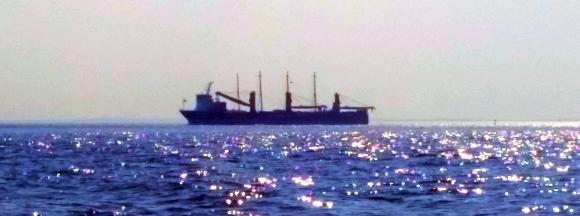
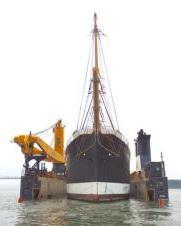
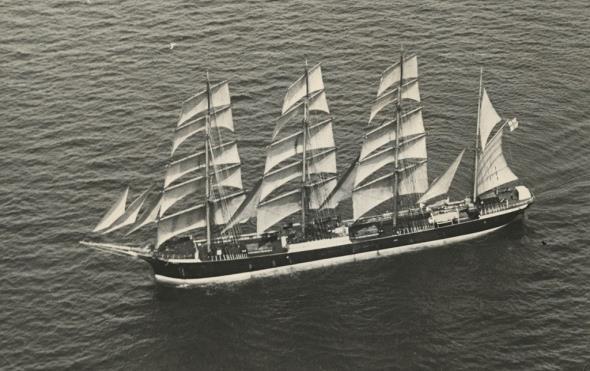
The ship was just a silhouette in the haze as we sailed into New York harbour. We were on the last leg of the delivery of my sailboat Arcturus from southern Virginia to Oyster Bay, Long Island. The ship in the distance looked odd. The ship’s deck-house was forward with three pedestal cranes aft. What was strange was the other rigging, which at first looked like four king posts, rising from the deck. Why would a ship with pedestal cranes also have king posts? I then realized what I was seeing. The ship was the heavy-lift ship Combi Dock III and what looked like king posts were the masts of the windjammer Peking sitting in the well deck, leaving New York for one last Atlantic crossing, on her way to restoration and a new life as queen of the new port museum at Hamburg. Rick Spillman.
Peking has been ripe for sympathetic restoration ever since she left the mooring that Shaftsbury Homes had her on in the Medway, when she arrived in the USA her shiny new yards were as a matter of expediency welded to masts before being lifted in by cranes. Further progress information can be found at. www.oldsaltblog.com
Mike Lee wrote; I used, a very long time ago, (nearly 70 years, I hate to say) to sail up the Medway river in Kent. (UK) and was always deeply impressed by the towering rig and wellkept hull of this great ship. She was used then as a cadet training ship, so the masts were largely intact and the cadets would scurry about in the tops, as they would once have done when the ship was in service. Moored almost opposite were truly old ships, hulks from the Napoleonic wars of the late 18th century. They had been used as prisons for French prisoners who spent their time carving wonderfully detailed ship
© Peter Van Dorp
models from mutton bones. Later they became coal bunkers for the Navy during the first Great War. The smell of coal still hung about them. This sail was a real voyage through history, and always a joy. Now all long gone of course, but wonderful to think of Peking/Arethusa with a whole new life head.
Great Britain, returned to Bristol
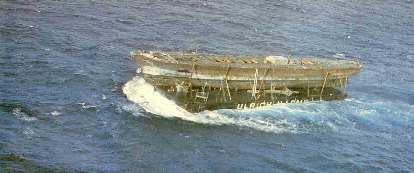
As Mike so rightly says, a truly surreally sight: Liverpudlian Mike Stanley had the same feeling when he was in an ore carrier back in 1970 and came on deck to hear the mate utter some shouted expletives about the ship that appeared to be floating above the surface haze on the horizon. What they were at this time seeing in May of 1970 was Brunel’s great iron ship, Great Britain whose last incarnation was as a Cape Horn sailing ship not the steam ship albeit sail assisted that she was launched as. It was that great supporter of all things British the man who became known as known as `Union Jack Hayward’ who paid most all of the cost of her recovery from Sparrow Cove. On our run in, to the Falklands, we had sailed past Sparrow Cove in Søren Larsen 11th December 1991. Mike had seen the submersible pontoon Mulus lll being towed by the German tug Varius ll on which Great Britain had sat tight since leaving Stanley on 14th April 1970 for Montevideo and the home. I saw that same ship the day after she was put back in the graving dock in which she had been built in 1845 and marvelled as I looked in through the hole in her stern through the uninterrupted length of the ship, “boy was she holed badly”.
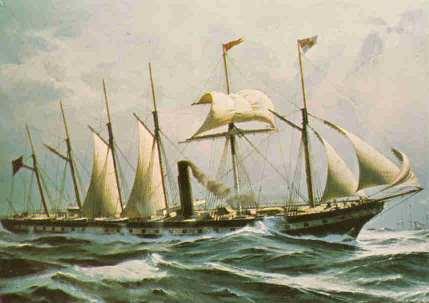
Great Britain on Mulas lll courtesy of www.redduster.com MNA site
Painting by Keith Griffin noted artist and son of Cape Horner Bob Griffin AICH
Falls of Clyde, maybe returning to the Clyde?
Now for the four mast ship Falls of Clyde. The trust formed by David O`Neill to make a last ditch attempt to save her is franticly trying to find the funds to pay for a Norwegian heavy lift ship that has been offered by O.H.T. for September/October conditional on funding becoming available. The trust has been offered use of the former Ailsa shipyard dry dock at Troon if they can get the old ship built in 1878 home. Let us hope so and donate to the cause. In July the Trust was in discussion with former Hawaiian and American owners Matson and UK Shipping and Shipbuilding groups seeking help. http://www.savefallsofclyde@gmail.com
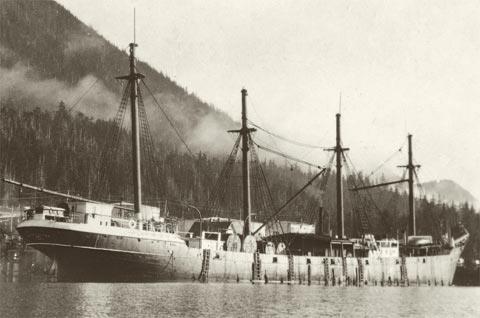
The old ship survived much neglected and unnoticed by the wider world servicing fishing boats with fuel in this far off Alaskan outpost for decades awaiting a saviour. The late Harold D Huycke who was an associate member of the Cape Horners, was one of those who helped inspire the group that came together and somehow got the aid of the US navy who provided the tow vessel that got her to her new berth, towed on her own bottom. I am afraid that this venerable old lady the last sailing oil tanker in the world has one last chance and that is, to be returned to the Clyde where she was born 139 years ago. CR
Falls of Clyde at Ketchican Alaska.
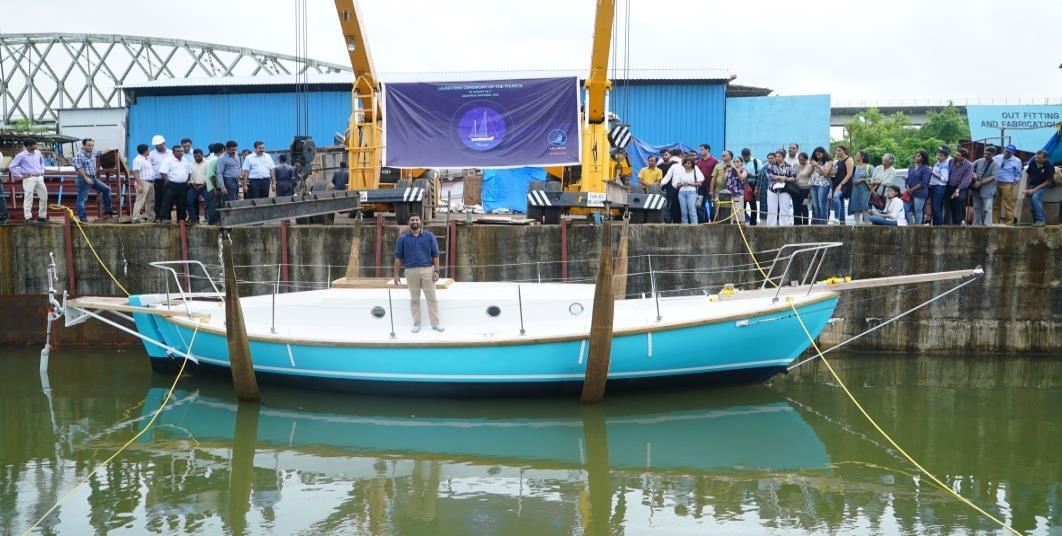
Thuriya was launched at the Aquarius shipyard at Goa on 7th August 2017 and is currently fitting out there, she is a Suhaili replica to the same 32 feet dimension and plans, she is not built as Sir Robins 1963 was built, by adze, hand saw, spindle drill and eye but designed by modern day CAD design methods so will be of lighter build to the heavier original. CNC cutting machinery too produces a much lighter wood epoxy composite. When fitted out she will be sailed to Cape Town by Cdr Tomy some 4500 miles on her proving voyage and then shipped to England for the race start on 30th of June 2018 all being well.
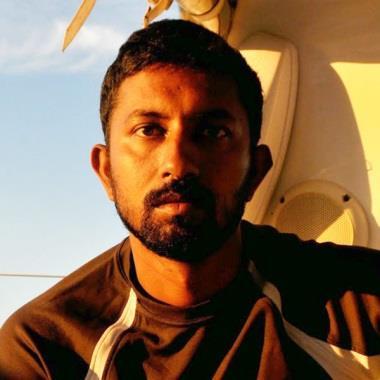
Cdr Abhilash Tomy, KC (Keerthi Chakra) from Mumbai, (a coincidence as that is where Suhaili was built) he was born in Chettipuzha in Chengannacherry, Kerala, his father is a retired naval officer. Both his grandparents came from farming communities on the paternal side from the paddy fields and the maternal side came from the rubber and coffee plantations. He is one of our Cape Horners and wrote to me that he is “proud to be IACH”. He is one of India’s most prominent sailors and has been given one of five Special Invitations to join the GGR which is the shortened title of this 50th anniversary re-enactment. As a serving officer in the Indian Navy, he has had all the advantages his talent and determination deserves at 38 years of age he has spent a great deal of his naval service sailing for his country. In 2013 he became the first Indian from the sub-continent to complete a solo no stop circumnavigation sailing from Mumbai on November 1st 2012 in INSV Mhadei and completing on 6th April 2013.
He says of the challenge ahead:
“This event recreates in the closest way possible, the magic of the original race. The emphasis is not on technology and its management, but on seamanship and a direct experience of sea. This Spartan philosophy is in keeping with my own view that a lot can be achieved with very little.”
Abhilash Says our own Sir Robin Knox Johnson has been a huge inspiration and friend and that they have shared meals and more than a few drinks together in both England and India. He even sent a personal message for the launch of the boat.
Competitors in this race will sail simple boats with only basic equipment. The challenge is pure and raw. It is for ‘those who dare’, just as it was for the then merchant navy officer Robin Knox Johnston. Navigation is to be with sextant, pencils, and wind up chronometers, no GPS, digital cameras, satellite phones, or other electronic instruments or autopilots, no pocket calculators, digital watches, laptops, iPads or mobile phones. Participants will hand-write their logs and determine the weather for themselves. Only occasionally will they talk to the outside world, if they meet a passing ship and can hail her crew or when 12 Meg VHF allows. In fact nothing can be used aboard that was not invented after 1968 and that extends to rigging and sails, while the boats must be long keel boats with rudder hung off the trailing edge. There are 20 designs that may be chosen from by competitors, there is much more on the GGR rules web page. www.goldengloberace.com
YES: Boats will carry sealed trackers to allow organisers to keep tabs on the vessels these and the sealed box with Sat Phone and GPS for emergency use (giving up) will be secured with an alarm attached.
With no money in his kitty when he started off last year, Cdr Abhilash got help from the passionate boat-maker Ratnakar Dandekar at the Aquarius Shipyard where INSV Mhadei was built, he stepped up and agreed to build the boat that has become Thuriya from his own resources until a funder or sponsor came along. One year later, a sponsor has yet to come forward to back the dream of Cdr Abhilash, whose manager for the GGR-18 race will be his mentor, Capt Dilip Donde.
Presently Cdr Abhilash Tomy is crowd funding the site for a donation is: https://www.ketto.org/fundraiser/abhilashtomyGGR
It Is Not That Easy On the Cape Horn Road
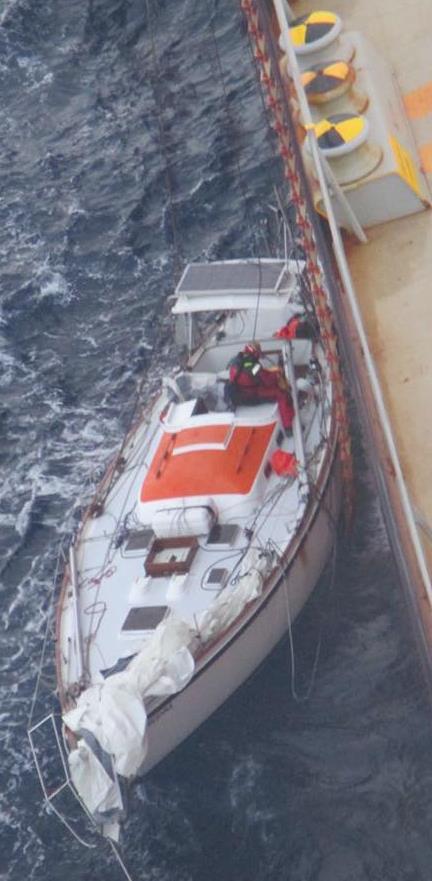
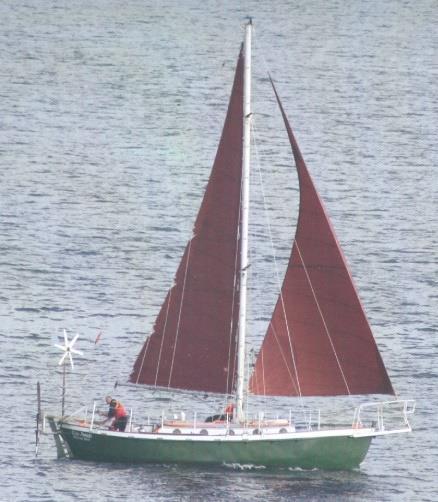
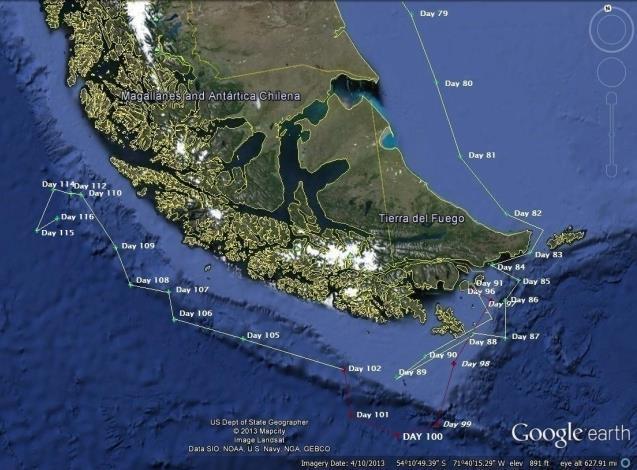
Shane Freeman was plucked from his sinking yacht Mushka by the 180,000+ ton Chinese bulker Frontier Ambition 28th February 2017. He had been at sea 70 days on his 12,000 mile delivery voyage from Melbourne for Plymouth and the start of the Golden Globe Race. The yacht he lost was a 35 foot Tradewind long keel cutter-rigged production cruiser built in the UK in 1984 to a John Rock design and was one four of the class entered in the GGR.
Shane had suffered a Knee injury a few days before the Knockdown which was painful all black and purple. On the day of the knockdown winds were 25-45kts. LOG: Feb 18, 0340 UTC; Lat 51° 45s Long 85° 04w Shane was knocked down. It was blowing 35-40kts WSW…not huge seas just typical Southern Ocean. He said he had been hand steering all day. Two weeks before the wind-vane steering failed as the mounting frame was bent up 40 degrees and as a result of the Drogue bridle streaming astern fouled the Mountings and causing irreparable damage that could not be fixed at sea. Before going below that day he had set the boat up to sail herself slowly with just a storm jib, sailing about 150-160° true, heading down to round Cape Horn, the cockpit had filled at least twice that day.
He went below and had cooked a meal…About two hours later he was stowing a few things in the locker above his berth when he heard the unmistakable sound of an approaching wave `a big one’ he braced himself taking two hand holds and his feet against the base of the opposite sea berth. Mushka rose and lurched to port the breaking wave hit the stb`d side like a truck and suddenly the sole became the deck-head. She had rolled and he had rolled 360°, very little water had got below.
On deck the mast had gone snapped about 3 feet above the deck, and with the boom still attached was bobbing up and down in the sea, grinding against the hull, all the chain-plates and rigging was intact with no breakages of wire or fitting failures. It took 5 hours to clear everything away to stop damage to the hull, saving the boom for a possible jury rig. The mast took out all stanchions and wires and he had to separate the boom from the mast as a possible support for a jury rig. The life-raft had broken free from its mount and had to be re-secured before it involuntary inflated. Contact was made by sat phone with Taupo Marine Radio in New Zealand to advise of his condition,
Shane then continued to assess his options, no wind vane, not enough power for effective use of his electric wheel pilot, wind generator damaged, he decided risks were mounting and after about six hours deliberation, concluded the sensible thing to do was accept help from the ship some 12 hours away. When the ship was close he cut the engine inlet pipe to sink his boat. He was at this point 600 miles off the Chilean coast.
Report edited courtesy of Yachting Monthly and www.goldengloberace.com
Anniversary Reunion Søren Larsen and Eye of the Wind 25 years on:
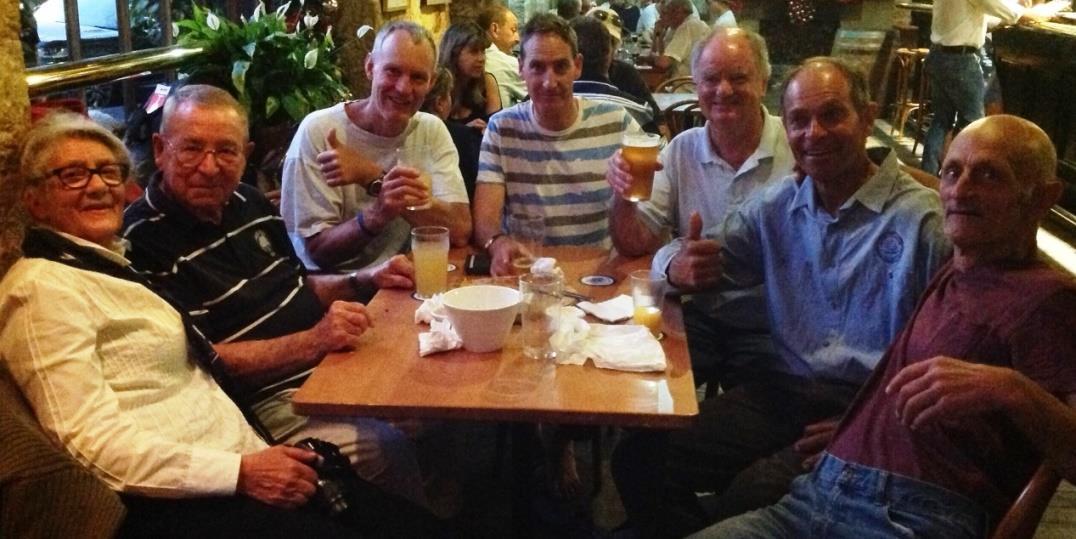
After attempts to find shipmates that had over the period scattered to the four proverbial winds those in the photo gathered and those who could not by virtue of distance that had been found raised a glass where ever they maybe. Daryl in Dubai, and Chris in England, Tish and Andy in NZ under the Southern Cross at which they were peering with glass in hand and Nigel Snell were but a few absent friends.
From Sydney:
Hello Shipmates,
Seven stout Shellbacks gathered at the Lord Nelson Brewery in The Rocks on the 10th December 2016 to remember when twenty-five years ago Søren Larsen and Eye of the Wind wetted their keels off the watery wastes of Cape Horn.
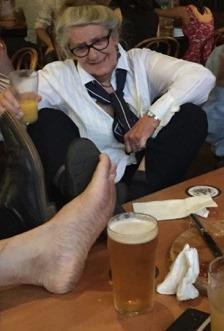
Capt Ken Edwards, Capt. Marty Woods, Russ Rimmington, Gabrielle Stewart, Hugh Cross, Johnny Anderson, Capt. James Parbery alias Jimmy Parbuckle. At eight bells raised their glasses to absent shipmates (on both sides of *the bar*) and put their feet on the table (those who could get a leg up at any rate). However, the security guard with total lack of understanding and a sense of humour failure stormed in and ordered the assembled to take them off the tables. The din of chattering landlubbers was such that prevented this
Gabrielle Stewart, Ken Edwards, Hugh Cross, James Parbery, Russ Rimmington, Marty Woods, John Anderson
group of Cape Horners from explaining their ancient right, sometime later, outside the hotel the same guard gave an admiring nod of approval after a friendly nod, wink and enlightening conversation.
Gabrielle Stewart, representing the females on that voyage and was sporting a fetching IACH scarf she had brought some beautiful photos of departed shipmates to help remember them.
Russ Rimmington had brought a handsome brown parcel with him from New Zealand, beautifully scribed and containing four precious books by Captain Jim Cottier - Søren Larsen`Homeward round the Horn', published in 1997. The last four volumes of the second edition; which Jim very kindly donated to those who had not yet read the book.
Capt. Marty Woods was miraculously free of his sailing duties this night and despite the heavy weight on his shoulders of keeping Søren Larsen, Southern Swan, Wangi Queen and Coral Trekker afloat was still smiling from ear to ear as always.
Senior member, Capt. Ken Edwards Eye of the Wind and James Craig at 88 years of age, roaring with laughter, is still fit as a fiddle, and is never scared of a drop or two of rum.
Hugh Cross still involved with Cape Horn ship James Craig reminisced of the time he nearly lost his job when insisting he gets leave to go on the Cape Horn voyage in '91.
Having tired of screaming at each other in the Cape Horn gale of a racket in the Pub, Parbery suggested they head down to Millers Point (Barrangaroo) with a bottle of rum and a song, but the balmy night had turned to a cold southerly. Being dressed for the tropics (and having turned a little soft these days) they found themselves in Windmill Street, minus two members lost along the way, now in the lee of a row of dilapidated terraces they sang a commemorative song and drank the rum to keep warm.
http://www.youtube.com/watch?v=BdL_BoULWBg
Capt. Edwards was looking a little nervous, especially when sirens were heard further down the street. He later recounted to James the time when as a young midshipman, circa 1947, when he was arrested for drinking rum and singing shanties in the streets of Sydney. He was ordered back to his ship, his rum confiscated.
Since Parbery had tortured his shipmates with his pwifel stick* during the actual voyage, he was delighted to present the hard won result of that experiment - the painting was hung on a wrought iron fence for all to puzzle over and scratch their heads once more...
Then sheltering in James' vintage (but well preserved) Subaru all listened to a song which Parbuckle wrote about the voyage around Cape Stiff in surround sound - 'Ocean of Darkness' Hear a sample of the dirge 'Ocean of Darkness' at. http://www.cdbaby.com/cd/jimmyparbucklebehold
After further reminiscence of days of yore all went home to their cosy, dry beds and dreamt of rolling about the Horn.
Wish you were there!
John Anderson who had sailed with Søren down to Auckland is an honorary member of the group we carried his songs with us around the Horn, especially 'The Shellback Song'.
Had I been there I would have been reminding Hugh of our visit in the Falklands to Garland and how we swam out to the wreck and then had to shelter from a sudden hail storm while dressed only in our undies and wet shirts, as we went out to the wreck some 100 yards off shore Lindsey stood on the shore shouting to us you`re mad` you’re mad, and this from a man who had gone over the side of Eye of the Wind in a survival suit in the southern ocean armed with a spanner to tighten up loose rudder bolts. I would dearly love to know who took the photo on my camera as I streaked round the deck totally starkers down below 50° south; I only found the photo after arriving home in March of 1992. Chris Roche
Daryl Parker wrote:
Hey All,
Sorry I can’t attend would’ve love to be there, to catch up, share a yarn or two over a few quiet ones, but I'm stuck here in the big Sandpit of Dubai. However at six bells, I will be on the water yacht racing off Dubai, I will make sure I raise a glass of rum in the yacht club after to
Cape Horner Journal CHJ71 15
remember our departed shipmates, John Gryska, Anne von Bertouch, Margaret Holt, Scottie Bell, Dudley Lane, Robert Coombe (Rangi) from Søren and Alan Roper, Phil and Cdr Bill from the Eye.
Daryl
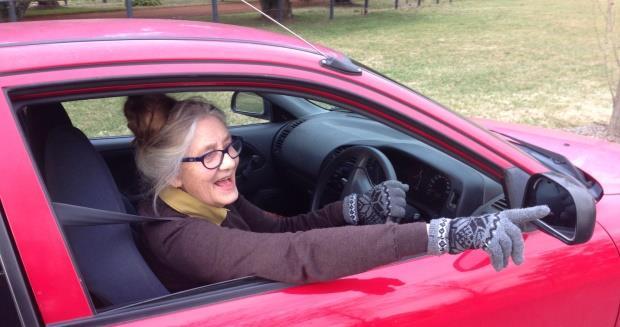
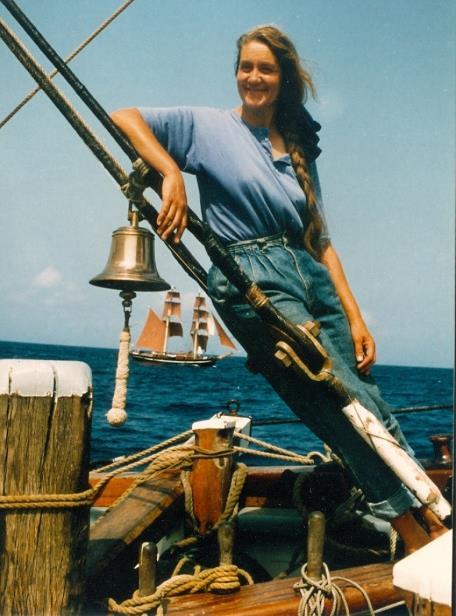
Obituary: Gabrielle Stewart
20th September 1939 – 19th July 2017:
Shipmate James Parbery wrote that within a year we had lost another of our Søren Larsen crew to a road accident, he wrote; it is with great sadness that I must inform you that we have lost another dear shipmate; Gabrielle Stewart was killed in a car crash on Wednesday 19th July. I was informed this afternoon by one of her daughters, Hermione, Gabrielle had four daughters and two sons; Hermione, Ray, Sonja, Solveig and Bronwyn, her son Walter died young at 2 days old.
Of Gabrielle her daughter says; “Mum talked so often of her sea chapter. I think she loved the idea of running away to sea. To throw herself into the unpredictable wind and fly”.
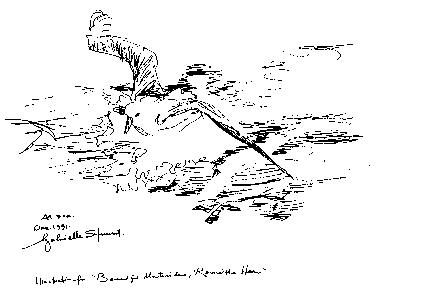
She had joined Anna Kristina during the First Fleet Re-enactment and then Søren Larsen in Sydney for the Cape Horn passage to the Falklands and Montevideo afterwards onward to Lisbon, where she then joined Anna Kristina for the Christopher Columbus Quincentennial celebration voyage to USA. In life she was a talented artist and draughtswoman, fine black and white drawings from Gabrielle`s pen have at times featured in this Journal.
Gabrielle was an art teacher and in her retirement she focused on her own art and writing, as well as travelling. She attended the 25th Anniversary of her 1991 Cape Horn voyage last December and then the 30th Anniversary of the First Fleet Re-enactment's departure from Portsmouth in Sydney in May of this year.
When I opened the mail from James I sat in disbelief at what I was seeing looking at the screen for the next twenty minutes. My last message from Gabby as we called her was an email on the 18th July.
I remember well when we stayed with this vital lady at her home in Bundanoon, NSW, when we were last in Australia Gabrielle was involved in a protest movement dead set against Coca Cola who wanted to bottle water from a bore hole in her village. Bundanoon became the first place in the world to ban bottled water. We two Pat and me were marched along to the latest protest the morning after our arrival and duly sat down in the road with Gabrielle all waving placards while waiting to be removed from the road. What more can I say, she was a wonderfully infectious lady always up for a laugh.
Gabrielle recently wrote me:
Gabrielle`s last message to me was to remind me to do the write up for the 25th anniversary gathering in Sydney 10th December last.
For they marry and go, as the world rolls back, They marry and vanish and die; But their spirit shall live on the outside track, As long as the years go by.
From the poem, The Outside Track
Harry
Lawson
It is sense we all have that binds us as a conglomerate of people, it is an urge that cannot be denied, of a need not just to want, within that crowd. With each sailor’s hug flow memories of shared days, away on the great, unending expanse of the oceans with views into nowhere. Clean, fresh and always beautiful. Away from our lives on the edge of the slippery slopes of pettiness that so often takes over modern living where the need to trust is so often absent from many Landlubbers. I felt again that stirring, a longing of being part of another adventure, another stage of my varied life, in this insecure world. Now in my sitting room with Boronia flowering at the window and Kangaroos in the yard, I am safe because obscure, hopefully even in this new world of Trumpites! I remain a romantic. CR
Gabrielle`s story was written as `How was it for you No.9 CHJ60 p18’
Cape Horner Journal CHJ71 17
Photo taken by Chris Roche on the Tasman out of Sydney for Auckland 1991
Captain Bill Damerell
10 May 1925 – 17 July 2017
After graduating from the General Botha Training Ship, moored in Simon's Town, William Joseph Damerell was offered a berth as 'cadet' aboard s.v. Lawhill in 1943. During the war years Lawhill was one of a handful, if not the only ship, to continue trading on behalf of Gustav Erickson in the southern Hemisphere. So 'Bothie Boys' as they were nicknamed were keen to join to experience working aboard a real windjammer before they vanished from the seas forever.
In his retirement, Bill recalled life aboard as 'harsh but humane.' The crew was a mixture of Finns, British, Australians and South Africans but the orders from the mates and Captain were issued in either Finnish or Swedish. When South African Jimmy Barrett, who joined in 1942, was made 3rd Mate, things became easier for English speakers but even he was expected to use Swedish or Finnish for deck orders. Apart from the minor language difficulties Lawhill was a happy ship and a most unusual ship in that Captain Soderlund had his wife and teenage daughter on board as well as two dogs. Bill's first impression was that she was a floating menagerie. Lawhill carried pigs, sheep; chickens as live provisions and at one stage even had a 'pet' kangaroo aboard. Bill and other cadets were given the lowliest tasks such as mucking out the animal stalls and scrubbing the lavatories (heads).
On her last call in Melbourne (June 1941), Lawhill was armed with two 20mm Oerlikon anti-aircraft guns and a dozen .303 rifles. The guns were mounted just forward and on either side of the wheel on the poop deck, their ammunition stored in lockers outside the charthouse. Cadets were trained to man the guns. Bill recalls the guns as troublesome, the rounds had to be greased to prevent jamming and their traverse was limited by the rigging so they could only be fired in an arc astern. Apart from a few practice sessions in mid ocean the guns were never used. If the unique 'armed merchantman' Lawhill was spared action in the war, the southern ocean represented a merciless foe, especially during a mid-winter Cape Horn rounding. Bill and his fellow cadets went aloft to hand canvas in all conditions, fair or foul and the boy swiftly became a man. He was proud of a photo taken of him in Sydney in 1944 as a fit youngster, knife on his belt, (or between his teeth) gazing aloft
with new found confidence. The caption read 'Afeared of no man, and very few women!' This was typical of Bill's impish humour.
Worked hard, the cadets were always ravenously hungry. Bill and his fellow cadets developed elaborate and ingenious pranks to distract the Finnish cook or lure him away from the galley so that foodstuff could be made to disappear. A tacit agreement evolved that cadets could eat what they pilfered as long as they were not caught. But if caught the offenders could expect punishment with extra duties and a ferocious telling-off from the Captain, 'old soda-water.' Besides the brutally hard work, miserable living conditions (crew quarters were un-heated and often awash in heavy weather) the 'Bothie Boys' loved every minute of it and many signed up again and again when Lawhill touched South African ports, Bill included. But after the war Bill joined the Merchant Navy aboard steamers. He said that in comparison to Lawhill it was a paid holiday –no need to go aloft, heated quarters and excellent and ample food.
However, marriage and a family induced him to seek employment ashore and he found it in the rapidly expanding ports in South Africa. Bill rose to become Port Captain of Cape Town and one of his favourite memories was 'skippering' the Chilean sail training ship Esmerelda under full sail as she left the port after her visit. The arrival of any 'square-rigger' in Cape Town was always a treat for Bill and a chance to relive his experiences aboard Lawhill. When the South African Cape Horners association was founded, consisting of mostly old Lawhill hands, Bill was elected as Chairman and officiated at the annual luncheons and group visits to visiting sailing vessels. The association published a newsletter 'Spindrift' quarterly and extended honorary membership to visiting Captains of Square Riggers or foreign Lawhill crew.
Bill Damerell retired to live in a house named, appropriately, 'Lawhill' above Simon's Town where he had a panoramic view of False Bay and the historic town and docks. There, surrounded by much 'nauticalia' he had collected over
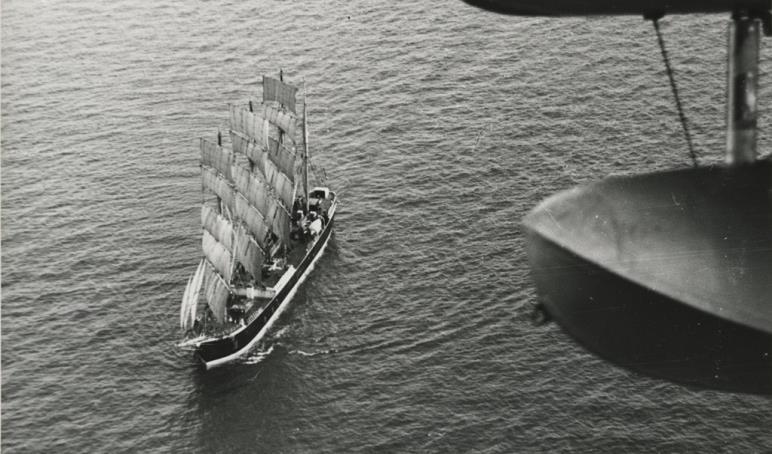
Image LA48.08-1362 of Lawhill March 15 1939 as she sailed out of Port Lincoln taken by Stanley Fowler © CSIRO
the years, he held court to any who expressed interest in a life under working sail. There is no doubt his years 'before the mast' left their stamp on him for life and he was a celebrated member of an exclusive fellowship. Like all sailors his stories were frequently uproarious and sometimes not repeatable in polite company. Sadly, all his Lawhill contemporaries 'crossed the bar' until Bill was the last of his breed.
He is sorely missed.
Josh Spencer, Cape Town 22 July 2017
On a personal note Josh says that he owed Bill a debt of gratitude for his help when he was researching the Lawhill`s history. Josh fondly recalls the many afternoons spent sitting on Bill`s veranda with Simon's Town at their feet, listening to his recollections of life afloat. He had an irrepressible sense of humour and phenomenal memory. Over the years, as the complier of 'Spindrift' Josh grew to know him well and when he moved to Cornwall in 2000, Bill and he corresponded regularly. When Josh last saw him in 2014 he was very frail but mentally undimmed. Josh says he counted Bill Damerell as a great friend and inspiration. On the morning of 22nd July Josh attended the funeral held at a small church in St James, just up the bay from Simon's Town. It was packed with friends and family; a fond farewell to an exemplary man.
The book Josh mentions is the rather excellent and still in print from Josh `A Sailors Scrapbook’ Gordon Belton ISBN 0-620-21333-7 edited by Josh Spencer. CR
Edward Cecil Allcard
October 31st 1914 – July 28th 2017
At age 102 this world renowned yachtsman and author of Temptress then return of Temptress, a Cape Horner who started his solo around the world odyssey in 1961, a leisurely adventure that took him about a dozen years, in a 36-foot ketch he had called Sea Wanderer. During which time he rounded Cape Stiff has passed away peacefully at his home in Andorra.
Alf’s Story and Obit
After 102 years and just short of three months on June 5th Alf Jarvis that redoubtable old man and husband of Audrey has crossed the bar, Alf Jarvis gave up driving as his sight worsened at 100 years of age Audrey said he was terrible as a passenger, he had been cycling into his late nineties and was sailing almost to the end with chums at the yacht club, going out on their sunset sails. As Garry Kerr heard, Alf just plumb wore out although his mind was good his body failed him. Audrey said in a phone call that she cared for him in his last days at home and that he leaves a great big empty space in her life and:-
“Yes my darling Alfie died on the 5th June. We had been together for 27+ years so it leaves a big empty space. We family don't feel like he's died, because he has gone to Uni. So we haven't had a funeral that is what he has always wanted. He said he couldn't go to Uni. when he finished school so he'd go now, he reckoned his body was of no use to him when he was gone, but what would be better than if it could help someone else to learn something. (Always the teacher). We had a remembrance morning at the yacht squadron and it was grey and misty. I thought he was there with us, he was always reciting:-
“A
grey mist on the seas face, and a grey dawn breaking”
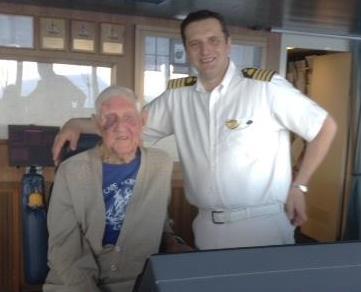
The photo above has Alf seated in the Captain's chair. Two days before leaving on what was to be his 101st birthday cruise he took a nose dive into the concrete, hence the black eye, split eyebrow, possible cracked rib, skinned knees etc. etc. I thought that had put paid to the trip, but after 5 -10 mins he bounced up and said "let's go to dinner" that was my Alf:
Audrey
I was 18 and it was during the depression years when I went to Port Lincoln to look for work. I found a job as a baker and worked at this for about 4 years before I was lucky enough to get taken on, in the crew of the big barque Lawhill, it was 1937 she was a 4 masted barque carrying 4,800 bags of grain to England, by way of Cape Horn. It took approximately 123 days before we reached Falmouth says Alf.
Rounding Cape Horn is always rough, and there were only 31 hands on board, so that meant that often both watches were called out to trim set and take in sails.
“One English chap, who wore very thick glasses, was working on the bow-sprit when it ducked into a big sea which washed him off. The mate on the poop deck heard the call “Man over board” so he threw the life buoy to him. We saw the chap get to it, but we travelled on about a mile before we could bring the ship up into the wind. We lowered a life boat with 8 men and an Officer, whilst a man climbed aloft to point out where he could see the life buoy, but the seas were very rough and we lost sight of him. We were about to give up searching, when eventually we spotted him, still in the life buoy. When we picked him up, all he said was – “I’ve lost my bloody glasses.” He was very lucky that he only lost his glasses, and not his life.”

We were held up in the doldrums for a few days, hot weather and flat calm. On arriving at Falmouth after 123 days, I caught a train to London, and did some sight-seeing and then on to Liverpool where I joined the English steamer Themistocles as a ships baker. We sailed via Cape Town South Africa to Durban, then on to Fremantle and around the Australian coast to Brisbane and back to Adelaide where I left the ship it was still 1938.
In January 1939 I joined the Victorian Police Force, and after 9 years, returned to Adelaide where I joined the South Australian Police for a further 5 years until I was left with 2 small children to look after, so I transferred to the Education Department and took up teaching at primary school until retirement at 65 years of age. I then continued relief teaching until 73 years of age.
In retirement I attended 6 Cape Horner’s Congresses in different cities in Europe. In 1995 the world Congress was held in Chile, where I had the opportunity to “Round Cape Horn” again, this time in a Chilean Naval ship Aquillies and visit Horn Island in the process. Going to sea had given me the opportunity to travel and achieve my desire to see the world.
After my time spent in the sailing ship Lawhill with neither engine nor radio, (just the wind and the sails), I joined the Victoria Police, I had first tried SAPOL `South Australia Police’ but at the time they were only taking cadets, so hence the move to Victoria State. There 300 men had applied, and only 40 were wanted. I was one of the lucky ones who were marched up to Russell Street, where I was accommodated with 2 other chaps above the cells in the watch house. I was sent to Carlton Police Station to learn the ropes, later I served at West Melbourne, St Kilda Road, St Kilda Junction and Punt Road.
Whilst working night duty. I took a job during the day at Spencer Street rail yards loading goods trains @ 2/6 an hour. One night at the police station I was feeling tired so during my meal break at 1 a.m:
“I rested my head on my arms, on hearing a noise; I lifted my head to see a woman sitting at the other side of the table pointing a revolver at me. In shock, I could only say “Point that somewhere else Jean” (She was a local prostitute and only lived in the next street.) She said “I have just shot big Jim because he bashed me up again.” I rang the C.I.B. at H.Q. and they sent 2 detectives down. She laid the revolver down and I lifted it with a pencil in the barrel and put it on my side. I made her a cup of coffee while we waited for the detectives to arrive. She only got 12 months because she was always being viciously attacked by Jim, her pimp”.
I spent 9 years in the Victoria. Police and had many interesting and gruesome incidents.
On hearing from a fellow South Aussie colleague that SAPOL were now taking adults, I resigned and joined SAPOL in 1948, in spite of my 9 years in Victoria I still had to do 6 months training in Adelaide. I was then stationed at Parkside when Peter Malpas (my brother in law) was a cook at the barracks. He had the opportunity of promotion to Assistant Fire Chief to Fred Kerr he wanted someone to take his place, so I offered, and was cook for a year or two. During this time I was playing cricket for the police, and was due to play against the Victorian Police at the Railway Oval. Due to the King’s death, the match was cancelled and an Army team arranged to play there. An Army Sgt’, who was playing my position at mid-off, was shot dead by a mentally deranged gunman who was billeted in accommodation at the railway yards.
I was at the barracks for about a year or two before I left to take up the teaching post.
Note:
The Master was Artur Alexander Söderlund, when Lawhill sailed from Belfast on Tuesday September 29th 1936 for Port Lincoln arriving at anchor on Thursday 7th January 1937. The voyage out was Via Belfast Lough, 7th Oct 1936 arriving Port Victoria for orders, 2nd – 6th Jan 1937. Departing Port Lincoln 18th Feb for London 16th June via Falmouth for Orders in 107 days 5th – 13th June and the downs 15th – 16th June.
Lawhill from the air taken by Stanley Fowler on 15 March 1939 in South Australian waters. © ref CSIRO AU LA48.45-1386
Volvo 2017
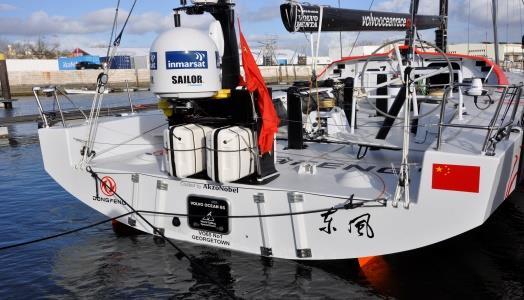
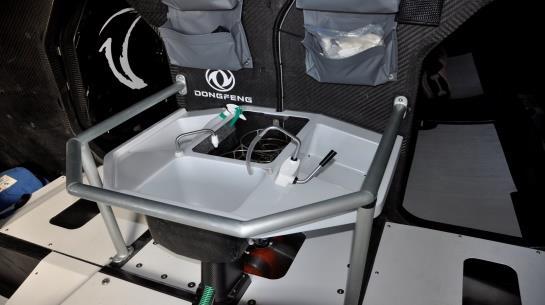
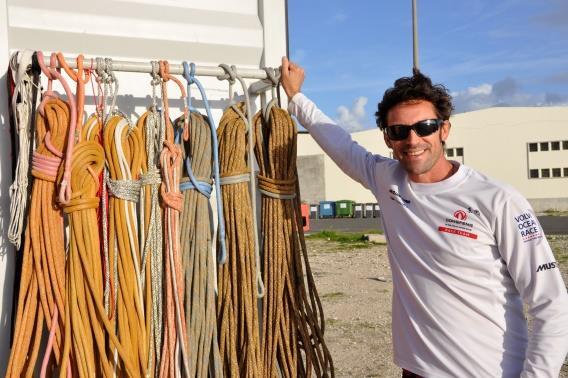
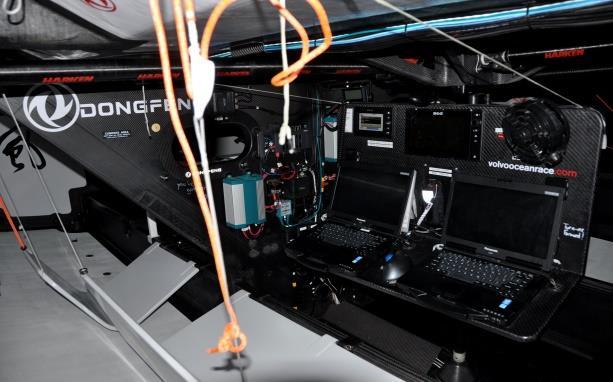
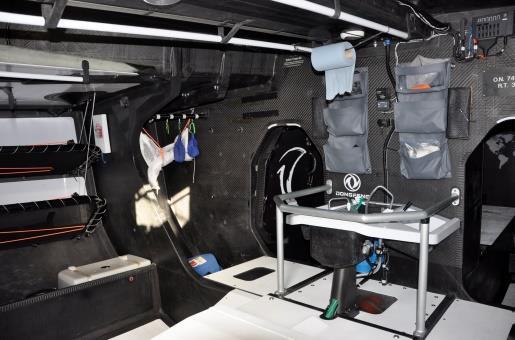
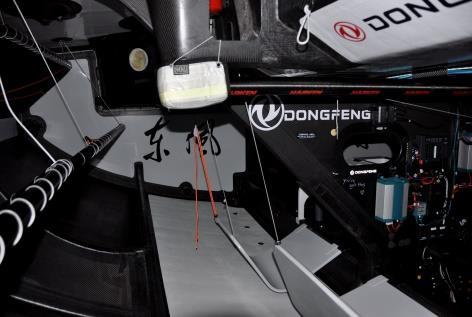
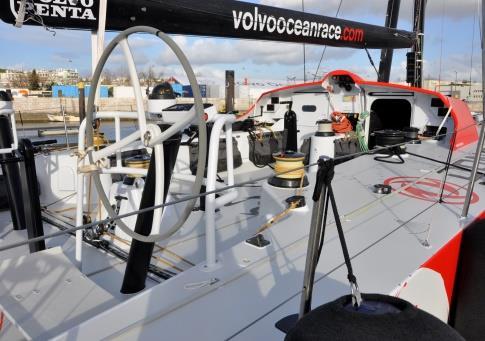
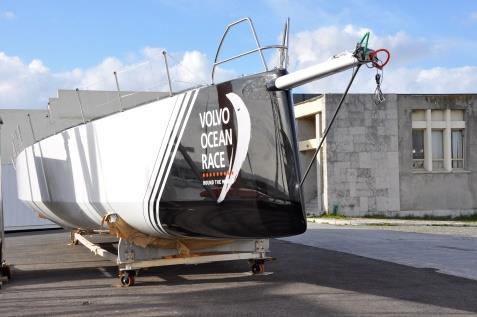
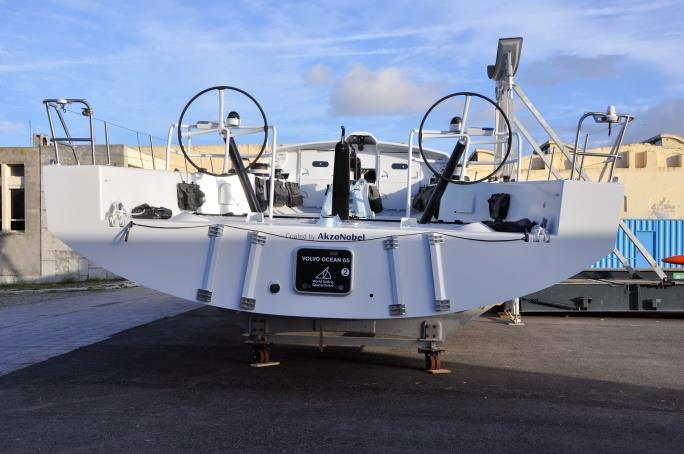
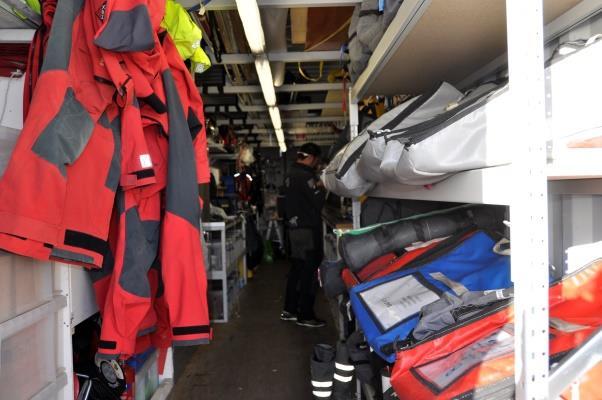
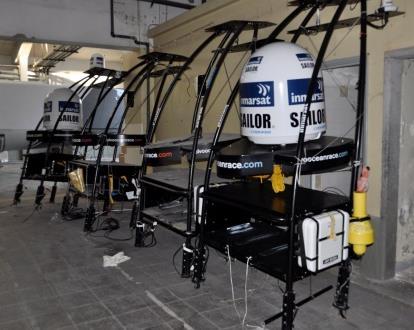
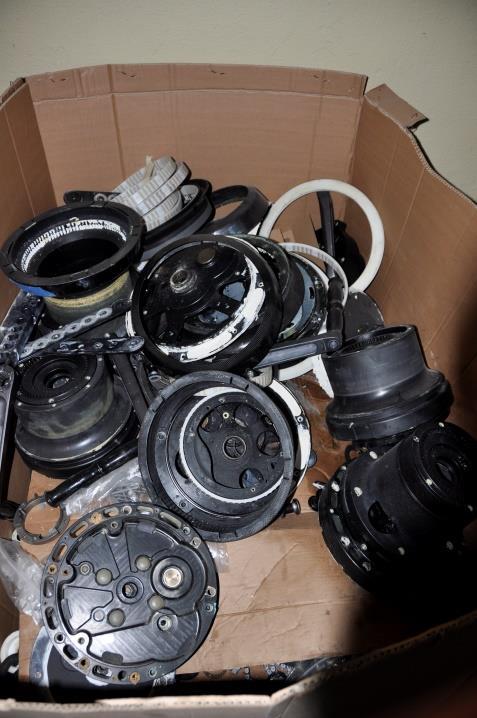
On our winter motor-homing trip we came to Lisbon and while parked up at a dockside saw a distant yacht the markings were Dongfeng, I went to take a look and found the Volvo fleet under preparation for the next race the work up skipper Graham showed me round just how often does one get the opportunity to get a look below decks of a Volvo yacht. CR
Asking for the galley I was shown this area I forgot to ask about heads perhaps it is a bucket and chuck it for I saw none?
Cape Horner Journal
Nav stations includes one for the media guru who does not take part in any sailing operations
Pipe berths six either side of Spartan central area were seen
I felt quite fortunate to have seen this amount of preparation, Graham and Kong told me that theirs was the first of the refurbished boats to be put in the water and was being readied for testing and shipping to Southampton England. It was the quiet end of day when I was there so work was winding down for the weekend all photos © CR
Cape Horner Journal CHJ71
Yachting News by Ashley Manton
Louis Vuitton 35th America’s Cup Series
Following success by Emirates Team New Zealand (ENZA) as the winner of the 35th America Cup in June, the discussion moves to what form the race will take in the future. Discussions include whether to move back to monohull, or retain the foil configuration of the foiling catamaran.
The yacht 'Luna Rossa' of the Italian Yacht Club Circolo della Vela Sicilia has been accepted as the official Challenger of Record for the next America Cup.
Consideration will also be made as to the format of the future series and the frequency of the races, the race locations, including the final.
Vendée Globe
Vendée Globe the singlehanded, non-stop, unassisted race around the world was won this year by the Frenchman Armel Le Cléac'h in his yacht Banque Populaire VIII. He narrowly beat UK’s Alex Thomson who was sailing his yacht Hugo Boss. 11 of the 29 starters abandoned the race.
The format of the future race in 2020 is being reviewed with many contenders expecting to take part.
Volvo Ocean Round the World Yacht Race 2017/2018
As reported in the previous edition, the next Volvo Ocean Round the World Yacht Race (VOR) will start on 22 Oct 2017. All teams will race the same types of yachts as in the previous 2014-2015 race namely the Farr Yacht Design, Volvo Ocean 65 foot monohull.
There are currently seven VOR contestants, with an 8th possible. So far, the yachts have sailed in all four of the races of Leg Zero and now making their way from Lisbon to Alicante for the start. Mapfre was the winner of Leg Zero.
The route will take them to: Cape Town, Hong Kong, Guangzhou, Auckland, Itajai, Newport (R.I.), Cardiff, Gothenburg and The Hague.
The Future of the VOR
The future of the VOR is now being discussed by the CEO Mark Turner and others. The following are some of the areas being discussed:
• 60ft foil assisted monohull for ocean legs, designed by Guillaume Verdier and built in Persico Italy.
• Fully foiling multihull for inshore stages, with increased points available in the port races. Design currently out to tender but to be 3250ft one design.
• Eight monohulls and multihulls to be built.
• Possibility to move to multihull in 2023.
• Race activity in every calendar year.
• New race routes and start ports under consideration, including a nonstop lap around Antarctica.
• Mixed format for stopovers, including 24-48hr pit stops.
• Creation of VOR academies to help younger sailors progress into ocean racing
• Partnership with World Sailing and close involvement in the pitch for a new offshore class at the Tokyo 2020 Olympic Games.
• Improved sustainability in partnership with the United Nations’ Clean Seas campaign and 11hr Hour Racing.
• Corporate leadership and development programme, with an on-water component racing in the VOR 65s
2018 Golden Globe Race
The Golden Globe Race will start in June 2018. This will be the 50th Anniversary of the Sunday Times Golden Globe Race which was won by Sir Robin Knox-Johnson’s in 1968/9 when he was one of only 7 yachts to finish.
The yachts will depart Plymouth, on June 30th 2018 and sail solo, nonassisted, non-stop around the world, via the five Great Capes and return to Plymouth. Entrants are limited to sailing similar yachts and equipment to what was available to Sir Robin in that first race. That means sailing without modern technology or benefit of satellite based navigation aids. Competitors must sail in production boats between 32ft and 36ft overall (9.75 – 10.97m) designed prior to 1988 and have a full-length keel with rudder attached to their trailing edge. These yachts are heavily built, strong and sturdy, similar in concept to Sir Robin’s 32ft vessel Suhaili
30 entries are permissible
This year’s races started on 25 May from Plymouth bound for Newport Rhode Island. However very severe storms caused damage to 4 yachts requiring crews to be rescued by passing ships, a further 10 yachts retired and just 7 yachts finished.
The Clipper Race
The Clipper Race set off from Liverpool on 20th Aug with twelve 70 foot yachts and over 700 international crew taking part. The round the World race will have 8 legs covering a total of 40,000 miles, finally returning to Liverpool in July 2018.
Challenger for the Solo Round the World Speed Record
Gitana 17, a trimaran, was launched in July and was on trials during the summer. She is 100ft long, designed by Guoillaume Verdier (the designer behind the ENZA America’s cup winner). The yacht is expected to sail at speeds of up to 50 Knots on her revolutionary foils.
Sources: Events’Websites and Yachting World magazine.
Cape Horners Club review
Adrian Flanagan
Pub Bloomsbury 2017
ISBN: 978-1-4729-1252-7
ePub: 978-1-4729-1253-4
£18.99 HB
Adrian is a Cape Horner and one of our members making his rounding in Barrabas 20th February 2006 starting with fine endpapers showing in colour the bottom end of South America. Adrian for those who would not know gives a sensible informative introduction to the how, where and why, rather like Mount Everest `because it is there’ being the conclusion. The last few pages give the likes of sailor traditions perpetuating the myth of traditions which can be best said are reborn for modern times but originating in Greek times wearing the fee to pay the
ferryman Charon to get you into Hades several millennia ago. Sandwiched in between the covers is a fairly eclectic set of stories of 20 rounding’s, included are the usual high profile names without which the book may well not succeed, but look amongst them for that is where there are the stories of much daring and refusal to give up are found. There is no index which is so much valued by researchers, but at the end there is a useful appendix of solo rounding’s. The individual stories are set out in a number of chapters each with an introduction and at the head of the story is an illustration and below the technical detail of both sailor and boat then the story of that rounding. I would have liked to see in this block the actual date of rounding but no matter. The persistence in all these chapters is amazing such as Marcel Bardiaux in Les Quatre Vents who managed to take 8 years circumnavigating by way of the Horn. Vito Dumas the Argentine who rounded in Lehg ll in the midst of war when the world was going mad in 1943.
And particularly: Webb Chiles the first American to do the job solo with no sponsor, no shore team, no PR agent, no electrical system, no radio, no engine and no through hull fittings below the water line, he relied on bucket and chuck it, everything was kept simple, so simple there was no pulpit or pushpit or lifelines. Not long after sailing he found the rudder gland had sprung and water was up to the sole of the floors, then water came in through a 5 inch crack developing at the keel where an internal steel stanchion plate had been bonded, making Tahiti for repairs but still he put out again for the south, short of money he had not fitted a bilge pump, this intrepid fellow arrived in Auckland in as he put it his “ beautiful bitch, Egregious floated” he was bailing from his near wreck at this time 600 gallons a day by hand. Egregious is from the Latin for Illustrious, food for thought I would say.
Read the story and others; add it to the book shelf to take down when you think you are having a bad time, well worth the buying and if you use one of those electronic reading pads there is a download version. ED
Editors further note: At what stage the rules were changed I cannot say but, it was the case that when the old French captains founded the AICH or IACH Cape Horners as we now know it today initially the only way in was to have been a master of a square rigger in the Cape Horn trade, only later were crew of such ships admitted and then there were the further changes when yachtsmen and those in modern square riggers could join `1973 which as the book says is correct on that point. I have edited the Journal since January 1983 then `The Journal of the British Section’ in `No 38 January 2001 we showed on our cover we were the IACH Incorporating AICH British Section’ first displaying our new logo, this was shortened in No 43 August 2003 when the old association wound up and we seamlessly continued as `Journal Of The International Association of Cape Horners. IACH which we are today, I know this is a bit of a ramble but since we are supposed to as on - p282 have dropped UK from our title in 1996 UK was never there, it has to be said….. ED
Into the Southern Ocean. The perilous voyages of the Elsi Arrub
By: Andrew Halcrow.
Pub: The Shetland Times Ltd. Lerwick 2016. Card cover @ £15.99
ISBN: 978 -1-910997-07-9.
230 pages, illustrated with colour photographs, charts, glossary, extracts from his wife’s diary, and an extensive appendix with technical details.
Born in the sixties, on the barren coast of Burra Isle, Shetland, the first obstacle for the Atlantic Ocean`s winter storms, Andrew Halcrow was on the best breeding ground for sailors in general and solo sailors in particular:
A perfect place for a youngster to grow dreams of waves and far horizons.
After the daydreaming years, he knew what he wanted: not a small pleasure boat, but something strong, in steel, safe and seaworthy, easy to be sailed singlehanded, basic and easy to build. “A good sea boat”, as they say in Shetland, more a ship than a boat. He built her in two and a half years beside his parental home on Burra, sheltered from the salty spray of breakers, in an old wartime Nissen hut, all by himself. He chose a cutter of 30 feet length with a single mast on which would be two headsails, based on an original ketch rigged Tahitian design. His sister Marilyn christened her Elsi Arrub. Burra Isle spelled backwards. On launching day the older fishermen were surprised by the colour she had been given…
He had prepared himself very thoroughly, he read all the books he could find from the square rigger era and all singlehanded adventures, he mastered the art of celestial navigation and in 1988 went on a five year circumnavigation along the “easy route” with his brother, a good try-out for skipper and boat, a taster for more adventures.
On the 27th of June 2006 the lines were slipped from the same pier as in 1988. He now started on his attempt at a solo circumnavigation along the old sailing route, through the different climates, around the historically famous Capes of Good Hope, Lewin and the Horn. Single handed and non-stop.
Andrew was constantly aware that although alone, that he would be in the good company of all the seamen and explorers who had taken this route before him, in former times many not knowing what was there to be discovered.
Food, his attempts at fishing for a fresh meal, the heat of the tropics, the frustrating doldrums, the navigation by sextant, compass and Walker log, his efforts to scrape the cursed barnacles from the hull and the sheer beauty of the constantly changing sea and sky, it is all written so very well that it takes the reader as if an enthusiastic stowaway on board.
Once in the Roaring Forties, Elsi Arrub performed very well. All the points of importance when Andrew planned and built the yacht now payed off, she was both strong and reliable.
He had taken the advice of the doctor (“at your age, the chance of a heart attack is much bigger than the risk of appendicitis, so you better have your heart taken out”), and so did not have his appendix removed by way of precaution. It nearly costed him his life.
It was 350 miles SW of Albany (Australia), when the Ship Captain’s Medical Guide gave no other opportunity, his appendix was on the verge of bursting, and that was what it did indeed. Cargo ship, helicopter, Albany surgeon already waiting at the table, all came to his rescue in a hair-raising operation. And as it turned out it was the once hated darned barnacles that saved his life in the first place!
Elsi, abandoned, had to take care of herself, she was spotted after many weeks by an airplane, now found she was towed in, trucked to Fremantle and shipped back to Shetland, where a by now recovered Andrew saw her return home on the 24th of May 2007.
Of course this would not be then end of the dream Andrew was not for giving up on his early young man’s dream….
After some alterations Elsi Arrub soon had her seaworthiness restored, and supported by his wife and family, Andrew could not get another try out of his mind. He started again. This time he planned a course the other way around. Westbound around the Horn, up North until the trade-winds kicked in, then by Torres Strait back through the trades to the African coast, south and around Cape of Good Hope, and from there through both Atlantics back home to Shetland.
Rounding the Horn in a westerly direction, against the prevailing winds, is the most difficult route. Many barques in former time battled in that area not always successfully.
The barnacles and accumulated weed growth were scraped when beached at Caleta Lennox. (Almost like the Hoorn in January of 1616, when Van Schouten lost her while careening the hull at Port Desire modern day Puerto Deseado north of the rock he went on to name, she burnt while attempting to burn off weed and barnacle growth).
One cannot overestimate the difficulties here in headwind storm conditions, without an engine on that lee-shore of Patagonia. Elsi and Andrew here showed here remarkable seamanship and perseverance in the 2 weeks after rounding the Horn. Possibly with Smeeton’s words in the back of Andrew’s mind. - “It’s best to keep 30 foot boats out of 30 foot seas”. Elsi Arrub was dismasted in tremendous seas on day 116. No chance or hope of recovery without support from others, and no choice but to abandon ship again and take the help of the Chilean coastguard, and the hated but most welcome lifesaving helicopter. The older fisherman on Shetland were right all along. Green is an unlucky colour for a boat, if for no firmer belief than that of superstition. Again Elsi Arrub was on her own and this time for good.
If you have missed the real spirit of long distance sailing written in books since Moitessier, Knox Johnston, Rose etc., then this book is one I can highly recommend. Written in the best tradition of British seamanship, it is a must for anyone interested in long distance sailing and adventure, and almost obligatory literature for those youngsters who muse the idea of doing something similar with their own dreams. Perfect literature for long winter nights, and not only for under the Christmas-tree. After reading this, you will wish and hope you are young enough to start building and prepare in order to go yourself!
Jan Wit
Note: All photos © as noted or Andrew Halcrow.
In the doldrums
By: Paul Rogers
My Farr 38 eM has taken me from Venezuela, through the Caribbean, into the Atlantic and up to the Azores. This was my swallowing-the-anchor voyage after many, many years as a professional yachtsman.
I was a journalist until I had Pentax and Pentax Cameras sponsored my solo Round the World voyage after I became a singlehanded Cape Horner. The sea won my heart, and instead of returning to Fleet Street, I went to nautical college to become a DOT Commercial Yacht Master.
Much of my professional sailing was alone; my preferred way to cross oceans, but the time had come to retire. Solo wayfaring is wonderfully challenging, but I feared my reactions were slowing, and that is not a help for single-handing.
At this part of the story, I have visited the mid-Atlantic islands of Madeira and Canaries, where romance blossomed but became rather complicated. It seemed wise to give the lady involved a breathing space, and I sailed for Cape Town, down through the Doldrums, the South Atlantic to the Roaring Forties and the Southern Ocean, to achieve that necessary odd angle to reach the Cape by sail.
“I chose this part of `Sailing to Purgatory’ for fellow Cape Horners, because they will recognise much of the passage through the Doldrums and into the Trades”……...
The sky clears. An equatorial sun steams the deck dry in moments. Suddenly it’s too hot for bare feet. The sky overloads with cloud so that within a minute or two the remaining daylight is snuffed. Now it’s almost dark, as if the gloaming has arrived prematurely, very prematurely. Torrential rain drums the deck. The tumult on the sails has the sound, the uproar, of snare drums and yet not as if novices want to destroy their instruments. There is a sort of rhythm and even occasional rolls a percussionist might be proud to play. The downpour passes over. The world brightens a little. Change is on the way, I can feel it, and that brightens me as it lightens the locale and lets in some toleration of the torrents, and these dramatic variations of shade and shadow. At the wheel, I serenade Sal with a famous aria - As steals the morn upon the night, and melts the shades away…. Handel’s inspiration doesn’t quite prompt
the doldrums. Nor, I may report, does my amazing vessel offer encouragement for the vocalising. A little applause wouldn’t go amiss, I hint from the wheel.
The decks and helmsman are soaked again. What would serious painters of old make of the scene, those masters who delighted over Rome’s wonderful light. What would they make of this half-hearted gloom which distorts, disfigures, the appearance of the little we see – the water, the low cloud ceiling, the mast which for a moment resembles a reduced Eiffel. Lightning flashes, great jags one after another, and now a second or two of intense brightness. Then the clouds so low and dense in the heavens return the dark. It’s the middle of the day – a want of light makes it seem more like midnight. Thunder is raging aggressively again. The compass light glows, surprisingly brightly in the remnants of daylight. It allows me to keep exactly on course, to attempt to get us out of the doldrums as quickly as possible. To steer is to daydream: it’s the dearest darling’s wide-eyed visit to the local library. She stares in wonder at so many books. I’m yawning through late night shifts on Fleet Street, praying for some scoop so I can rewrite the splash, even if – sin of sins – reading the current sailing book has to be interrupted.
The sun appears, it’s almost noon, I grab the sextant, measure the angle. Thick cloud floods in possessively, but I have the sum. A little basic maths puts us right over the line. Two days later, in a brief break in the clouds, the Southern Cross appears, low down, just climbing from the horizon now. It shows, proves, that we are progressing. Magnificently, fantastically, it reaches for the zenith each night – each night, that is, that omniscient cloud-cover permits a glimpse.
A sudden loud plop! Beside the wheel introduces a whole school of dolphin fun. There's an oversubscribed classful practising a fish form of yoga around the transom. More surface at the bow, jumping and somersaulting close to the cutwater. For a moment longer, our sea is packed with playful neighbours. Beyond in the background a vague silhouette of a tanker slides silently along the horizon.
Glittery bonito of Brobdingnag proportion, bigger than even Bob might dream of, play follow the leader in our wake: An intense convection storm delays dawn. The wind bends more onto our bow. The steering demands determined concentration to keep southward. Weighty clouds unzip, hammering the waves flat with heavy rain. The oilskin is like a sauna. I’m working through a repertoire of verse. I offer a sonnet to another cloudburst. I hear echoes of ancient conversations. They come mixed with bursts of recent chat. My father speaks angrily. I’m a toddler again. I won’t, I can’t finish the meal, can’t abide
Oxo cubes. Sofie's voice breaks through: the inflection, the smile in her voice, the earnest seriousness is replaying here on the deck. I hear whole paragraphs of her dialogue, our history, happy chapters. Now the ancient bloke is sniffing. It's the moisture in the air, of course, and my old habit of not pulling the hood’s brim forward. The stubble gets saturated and salty. I'm chasing a fluky wind. Sleepy tell-tails dry and point a little to port, then to starboard. The Casio says it’s time for lunch. The wind vane reports for duty.
Another deluge drums the deck. Cloud brushes the sea, and then lifts dramatically. The yacht is weighed over by a gathering head-wind. It strengthens. It puffs strongly. It takes a moment to confirm, to be sure. Dare I hope? And, yes, it's the trades! The South-east trades. Progress ... palpable progress and I set the self-steering to 35˚off the wind. The sun steams the sails dry. Sal is bounding forward in leaps of enthusiasm. The sea spruces up to a dazzling, fierce azure. Fulvous streaks and omnipresent charcoals fall away, as if by magic. The sky transforms to take on the precise shade of the sea. It becomes quite brilliant, too. Suddenly our world has changed dramatically, seems a different place. We beat at speed now in a consistent breeze that’s becoming servile to the influence of the trades. I look back along the wake to the uncomfortable memory of the doldrums; a solid wall of vile weather should block the track, perhaps baring a comics-like shattered hole where we smashed through. I search for it in the horizon aft. Only a mild bruise hints at where dull discomfort ended. Mysteriously, the wake is as unfettered as a footpath striding a field.
A long beat lies ahead, I know from experience, a time for fighting to keep the blustery trades and the wave-jagged sea in the role of servant not master. That's in the future, I prompt myself. Enjoy the now of the voyage, the present, where air feels fresh and wonderfully pure even in the grim tooth-shaking pounding of the trades.
We crash over steep-fronted waves, stumbling when crests collapse suddenly in haphazard angles. I offer no complaint. Almost anything is tolerable after the doldrums. And our first night, clear of that intense ceiling returns, the constellations, the heavens are fantastic, now with star families amazingly close.
And then at almost exactly the same latitude as on earlier voyages, boobies appear as if from nowhere. One minute, there’s not a solitary bird to be seen, and then suddenly a flock is here. The elusive visitors swarm around Sal; they’re here to commute, but not to a specific place as far as I can tell. It seems that they want to be transported to wherever. It’s the ride that counts, the travel, hardly the destination. These large birds have some sort of
hitchhiker gene or perhaps they are scientists at heart, scrutinising occasional human interlopers. When a vessel comes along, they leap on board, make straight for a convenient perch, or anything that will act as one, and settle down to enjoy the passage. The odd epithet, booby, is said to come from boba, Spanish for dunce, dolt, and fool. It was chosen by sailors of old who saw the gorgeous birds as food which volunteered itself for the table.
In the brief gloaming, booby after booby lands on the pushpit. What follows reminds me of Sally’s toddler workshops from long ago. The birds, like the little ones, immediately squeeze close together and begin to chat, all of them, all altogether, all at full volume. The chorus is packed with excitement and seemingly pleasure, and is just as untranslatable as the infant talk.
The moment a bird’s story is told, there’s no waiting for applause or questions or comments. The storyteller immediately tucks its head under a wing to presumably nod off. The birds stay balancing on the rail at the stern through the night, heads very trustingly out of sight. In the morning, refreshed and ready for a full day of fishing, they check out with a quick thank you flight over the mast. On the pushpit rail, they might have been telling each other fisherman-like stories, exaggerated to the heavens. However, observe their approach to filling the larder and you’ll see that it looks neither practised nor precise. They climb very high. Perhaps it makes spotting the prey easier, only they seem to rise far too far. Once a suitable fish is spotted, the boobies dive. It takes several seconds to hit the surface and plunge to chase the meal. They do this many times a day, so you’d imagine that they must soon be masters of the art. However, the dives look clumsy even careless. At a great height, they fold their wings and simply fall. The landing is a massive belly flop, a mighty splash.
Perhaps they trace Sal’s wake, or hazard a good guess, but after a day of Hamish shopping, the mob is back with the sunset. They return straight to the rail, and begin immediately to recount the adventures of the day with
Farr 38 eM in mid Atlantic doldrums©
tremendous enthusiasm, nineteen to the dozen, as they settle in for a similar night of free b and b plus travel.
Boobies belong to the Sulidae family, cousins of gannets. They are constructed in the most perfect and fragile way, with fine bones and the slimmest of features, snow white bodies with black etchings, and a face crammed around a massive pink bill. So flawlessly made and so identical, it seems they must be related to Siamese cats or other fine-boned creatures that share almost identical features. Apparently, Sula dactylatra remain true to their mating partners through life, though how any of them can tell one from the other is puzzling, even more how scientists can be so convinced.
Another very strange though much less attractive aspect to their lives is that murder is their very first act. All booby nests have two eggs. For all the matiness of their congregating ways, their first act in life is to kill the other sibling. It sounds like something to do with faiths or beliefs more than any form of necessity, but scientists see a connection with open ocean survival.
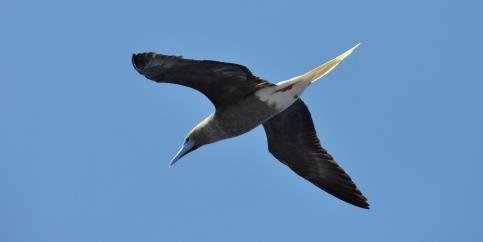
Often on voyages, the birds are so close to me that they seem almost perched on my shoulders as I steer. When their heads are not tucked away, tiny yellow and pink eyes watch me knowingly, not in the least fearfully. I like to think that they can judge character and know they are safe. Their hitchhiker ways, their Siamese feline features, the astonishing sameness, their welcoming at always the same latitude, is another wonder of sailing oceans. You’d think they would be surprised in return: Blimey, missus, a lone non-flying biped, feverless, beakless, steerin’, cooking, typin’, shootin’ the sun, sailing flotsam the wrong way in strong winds. Whatever next … And yet, like the albatrosses of the Southern Ocean, they show no surprise whatsoever. For many, I must have been their first view of a human, perhaps the only one they will ever see, and yet there’s not a raised eyebrow, and not the slightest curiosity, just a friendly and fascinating acceptance.
It adds a real delight to these latitudes. After the agony of the doldrums along come these wonderful hitch-hikers, cadging a ride over several imprecise latitudes. There they are, jammed together, swaying gently to some unheard music, all in time like a dance chorus. They become part of the voyage and part of life, then like ships that pass in the night, they are gone suddenly, as if they had been looking over my shoulder and counting off the latitudes on the South Atlantic chart, or as if they really only belonged to a happy dream.
Gannet ©CR
This excerpt comes from Sailing to Purgatory, published by Olympia. Paul runs a blog www.SailingtoPurgatory.com facebook.com/Sailingtopurgatory
Ever wonder how a vessel gets a name in this case eM was named after Pauls daughter `he says a late lamb’.
Gleanings:
Jan Wit wrote from the Netherlands and asked who among us followed Alec Thomson in Hugo Boss his Kerguelen video he says is terrific and brought back such vivid memories, view at; http://www.vendeeglobe.org/en/news/16697/landmark-footage-of-solo-sailorsin-southern-ocean-released
Tenacious coming home: Andy Spark at JST, announced the planned return to the UK by saying “She is a British flagged square rigger and there is only one way for her to come home and that is by way of Cape Horn” She leaves Auckland for the Falkland Islands 11th January and then has onward passages to Cape Town, Ascension Islands and to Europe. A few berths are still available. www.jst.org http://jst.org.uk/voyages/new-zealand-falklandislands/ any takers?
John Bartlett, Satquote Defender Whitbread 1989-90 writes:
The Reunion – A Maidens tale:
We flew out to Santiago and joined a Holland America cruise ship Zandaam. Down the West coast of Chile, Beagle channel, Cape Horn, Antartica, Falklands and up the east coast and flew back from Buenos Aires. Antartica was out of this world!! Would recommend this trip, no water down the neck, no on deck at 4am, no stress about boat speed have a great Christmas.
John
If any of you missed the first of the new Reunion series I have it recorded from BBC R4 some of the girls were gathered together around a table on radio for a little over 45 minutes of chatter and discourse about how they got together and made the 1989 Whitbread race a success for them, interesting listening.
Ponder this Times 13th June 2017 Busy on Top? A note follows from Kathmandu it states that 450 climbers reached the top of Everest during the previous month and that is only from the Nepalese side.
With an estimated £100 million spent on the recent failed Americas cup attempt led by Ben Ainslie we could have built a whole fleet of Cape Horn ships.
Peking arrived home to Hamburg in the early hours of 2nd August, the veteran Cape Horner arrived in her home town for refit to be the central attraction at the new Port Museum.
Don’t forget the Warrior do 19th November 2017 Why not bring a crew with you.
Horn Again PT4 - Salvador bound south
Diary Entry Sunday 8th November
We roll to the South`ard on our merry way in a light swell wearing ship at noon looking for a better slant, more sail handling practice for the newbies, stay’sl’s up down, up down and even again better than working in any gym. I get an hour`s catnap fully clothed just in case of a call.……
Gijs our mate is master and owner of Tecla the tough little ex-fishing boat and now a ketch that bravely became a Cape Horner in 2013 along with bark Europa and three mast topsail schooner Oosterschelde.
The off coming Mates watch is taking a beer in the deckhouse while Rian patrols the deck wearing a headlamp that does nothing for night vision at all, and although he lip reads well his voice is so very loud as to disturb some aboard. In the third quarter of the watch I saw a bright light flash about 2 points off the starboard bow high to the South`ard, it reminded me of the French airliner that came down in these waters a couple of years ago and how vigilant we lookouts have to be. Bill complains that the air conditioning is too dry, I say and cold and that to get over the dryness, I hang a damp T shirt in the airway on the side of my bunk, does it help he says, I think so is the reply. I am seeing little of my cabin mates Roger and his son Sam as they are on Blue
watch, as they come on as I in White watch go off I get some peace by turning the damned air con they love so much off. At 0300 we are drifting at 2.5kts and 210° so M.E. is run.
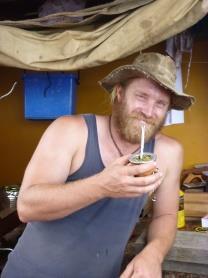
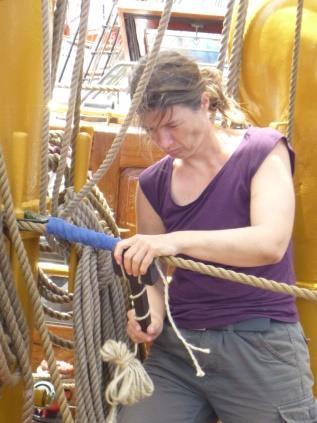
Among the ships permanent crew as they like to be called are Australian Elliot who as the others do under Dutch maritime law spend four month stints aboard, he has been coming back for 7 years now with breaks and when not aboard has spent time in Søren Larsen and otherwise works in wineries and on the land. Arran a South African who would like to settle in Canada is the carpenter and has been with the ship six years he is one of five Cape Horners in the crew along with Captain Klaas Gaastra, his wife and galley supremo Anne Marie, Gijs Sluik, Richard Gibson, Chris Roche and another Dutchman Kees Gerritse who thinks the British lost so many Cape Horn ships because he says they were poor and untrained seamen, there are more than a few who would disagree with his view. Dan the English Bosun has been coming back to the ship these six years now he learnt his trade in the film ships of Robin Davis company’s `Square Sail’, and Finn who was bosun on the run down to Salvador from Tenerife he has been involved with Europa for seven years.
I understood from Kees and Wim Bolk that the Whitbread skipper and yachtsman Conny Van Rietschoten who won line honours in Flyer twice has died at 80 something I understand that he sailed a Dragon to Norway in the pre-war period, the first ketch Flyer 1 was sold by Conny to an American she has been bought back by the Dutch and a sailing trust set up in honour of this well respected sailor……….
True we have no Whitbread sailors here but Chris Payne did go all the way in one of Robin Knox Johnsons `Around the World Races’, Chris says it is amazing just what can be done aboard, unlike in the yachts he is used to sailing just about anything can be repaired and maintained he said it was “a revelation to him”
Tacked before lunch Captain says we go look for wind.
It is going to be the thing to have a status and position briefing on a daily basis says our captain as we now head deep into the south Atlantic
Klaas 1400 daily briefing: 118 miles, at average 4.9 kts, since leaving Salvador we have run 470 miles, we are closer to the coast than might be comfortable, we are looking for more wind, there is rain in the south beyond Cape Rio about 15 miles, and by the way some of you are coiling down to pins the wrong way round!
After the briefing I helped with setting more sail we are now running down wind and talk is of setting stuns’ls as I go down to my bunk for a while:
I must remember to carry more pens with me on another voyage, mine are not lasting as well as expected, I am already on my third the second failed before it ran out, as a rule I fill a notebook a month, I use the Oxford A6 black and red lined ones they fit into the pouch I have carried for thirty years now and are instantly available. I get asked why I write only on the right hand page and then turn the book round and go the other way, being right handed I find it easier with the hard cover fitted in the palm of the hand.
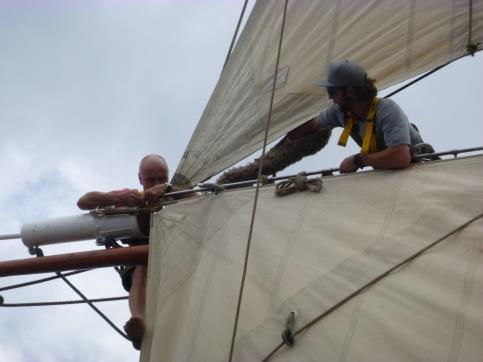
Coming up on deck again there I find a line familiarisation course going on being led by Balca an affable Dutchman and third mate, it is alien to me that the braces are called by number 1-2-3-4-5-6 and not by their traditional names, course, top, upper top, t’gallants, royal and sky’sl, we are after all a traditional sailing ship, on a traditional sailing route, aiming at something rarely done, westabout the Horn under square sail for over 3000 miles without use of an engine. The pain is the Generator rumbling away continuously 24 hours a day and for now the poorly set up air conditioning system which is unpleasantly noisy being individual cabin units, engineer Joss says soon we will be needing the heating system so it will be off. The heating system in Europa is a wet radiator system. Coiling down is explained again to those who need to be corrected, but the way it is done here is alien to those experienced in the most simple of arts, first a loop is made around the pin and then the coiling is done on the deck try to keep to four deck planks width and coil with the lay of the rope/line, in truth coil the other way you only get kinks as you go. I am sailing with my second bosun since leaving Tenerife and Dan is busy rearranging lines that bosun Finn had been happy with, why so many changes is the question. This was mostly done in Salvador so when those of us who were continuing to Punta Arenas we had to start over again as now the Sky`sl is no longer on the pin rail but has been moved to the fife rail, this means that some
stay`sl halyards are now on the pin rail, there is much head scratching going on. Work continues on another change that of stripping down all varnished surfaces which are to be oiled for the future, hoping it will last better and that includes hundreds of blocks.
We pass a freighter going up our starboard side from the south Sir Hubert Wilkins Australia Explorer, what a mouthful that is. Up on lookout after trimming and bracing watched the phosphorescence dancing in our bow wave, in the half-light the odd flying fish skims past. Bill talks about a cargo train he was on Kazakhstan to Moscow, it was a traders train very dirty, passengers came aboard with all sorts to sell but particularly cases of beer, the restaurant waitress a sort of Eskimo Nell character who could throw a beer bottle over her shoulder to fly through an open window always a clean throw. The toilets were so crusty you would not want to sit, “the dirtiest train I have ever seen”. Another bulker passed across our bow a half mile ahead port to stb`d, I could clearly hear the engines rumble as she passed.
Talking with Klaas he says he is not good with languages he has Dutch, English, Friesen, some German and Norwegian, the latter no doubt from his time in Anna Christina; I would say that not bad at all.
Diary Entry Monday 9th November
Today watch duty is 8-12 and 12-4: It`s slowly changing as we make southing, the day opens dull and the winds are not helping overmuch, at breakfast Bill is wearing a CiscoBranco shirt from the Brazilian sail training ship he had it up in the Orkneys when Europa met up with her in Stromness another place where Klaas sailed his ship up onto the anchorage. Kees is reading Phantom Terror 1789-1848 Revolution and Liberty by Adam Zamorski. Kees is well read and has a bunk full of books to last the voyage. Braced up tweaking them all again just to keep us on our toes. On lookout watched Megan and Alehandra reeving and then seizing a recently made grommet onto a block after setting up a Spanish windlass meanwhile Elliot was being taught the Liverpool splice by Dan splicing in a block, how long have you been splicing wire Elliot “first time today” he said. The Stuns`ls are sent up on the stb`d side it takes a couple of hours to get the gear set up before hoisting begins but only now when the halyards are led to pins on the Sheerpole at the shrouds is it found to be loose on its moorings, it slides up the standing rigging and has to be refitted, the two parts needing the bolts tightened up. Roger is out on the yard securing the outer end of the lower stun`sl boom, he finds the block he is reeving out of his reach as the footrope a flying horse he is standing on is too deep for him, I can see his distress as Sam his son makes his way out to assist. One yellow nosed Albatross
seen this morning also a whale of unknown species, it was too far off. We are 16 miles before “Cabo de Rio” making 5kts. Noon position is 22° 38.2s 038° 55.3n. As the day wears on the Port side stuns`ls are sent up with much the same difficulties. It is however great to be under such a cloud of sail, now down wind sailing at 4kts in 7-8kts of wind.
I am certain that in another age the clipper ships crews did not have all the problems we do with stuns`ls, but then they were well practiced professionals and zipped them up aloft in no time at all we are modern day adventurers. Arran our carpenter can be put in that group an adventurer he is South African and although he has family in Canada he says for some reason those from S.A. have problems so he might have to sneak in, South Africans are pretty sneaky. Laura our purser and bar girl a native of Argentina on the other hand when not working aboard Europa is to be found on duty as a barmaid in the Netherlands where she also teaches Spanish.
Captain would appreciate it or more especially the cook if we all ate within a 30 minute period more or less so I go to eat at 07.00 and then relieve lookout for last period up to change of watch. The air has become heavy and sticky. Our stores are giving a problem not unseen in ships I have been in before this and a problem well known to shipmasters of old. Potato is the word, yes they are already going off what looked good ashore are going off so soon into the voyage, they are of the white variety and already being sorted so as to use the worst first, we have 80 kilos to get through, it is likely that we shall get fried, roast, boiled and mash on a more regular basis
On the passage down to Salvador from Tenerife voyage crew were heard saying “it would be nice to have something to use a knife on”, so much of the food although decent did not require cutting, egg and bacon is a strange apparition, the Dutch have found a way to fry the two together so they come as if joined at the hip. Of course being English it is only us who properly understand how to do an egg and bacon breakfast. There is however a good cold continental spread at breakfast, usually there are eggs boiled hard and soft and sometimes in place of them there is scrambled egg and usually porridge, fruit toast and jam.
Diary Entry Tuesday 10th November
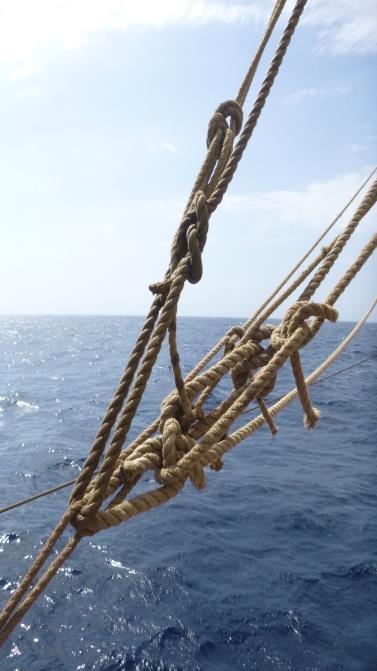
Watch is 4-8 12-4: I could not sleep the air con is so noisy, so up on deck early in fact the first up before midnight, it is dry but there was rain in the off coming watch, it is getting serious now mid watch Megan and Laurence are detailed to set up safety lines on the poop but are having trouble as they have not done so before, I am asked by Elliot to give a hand as he calls it for us. Meg wears a headlight which is ok for her but the white light blinds all around her destroying my and our night vision, such lamps work only for the user. Katelinn called the jibs down, (she has before this voyage only had real experience in Schooners and the American great lakes brig Niagara ) she speaks with an odd condescending falling tone in the voice, (I heard that she was used to working with children not adults like us) Flying, Outer, Inner, all without clear command it is little surprise that Alehandra (Ali) hauled the down hauls in the wrong order and the Flying Jib stuck some 2 meters up the wire stay and needed the horse shackles freeing, no easy matter when with or without a harness health and safety issues prevent instant action, god knows what would happen in dire circumstances, take me back 25 years ago to a different time and place please. Krista comes to help she is American with Swedish roots before joining Europa she had done a costal passage with Søren Larsen, she is of a slight build and has a weak voice which in a breeze makes her difficult to hear when she is calling the set of the sails when at Halyards and braces.
All bowlines
David Starke an Australian who has been with the ship since she left Texel Roads at Hoorn said “watch the P.C. they gather unto themselves rarely mixing there is a them and us separation” easily noticed at Captains briefings which go like this, first at 1400 it is in the deck house for the V.C. and after the P.C. who gather and sit on the poop at the top of one or other companionway with Captain as if holding court all with a beer in hand. They cluster like this a couple of times daily.
Klaas 1400 Briefing: 103 miles 4.3kts SW with current 212° being set in towards Rio de Plata, swell coming from the East, 693 miles done 133 hrs, now making 6.5kts, 2263 miles to Cape Horn, nearest land is 133 miles, if showers come we know we will get 20kts of wind, sea temperature is 29.8° when it drops to around 24° we will be out of the tropics.
Log Entry Wednesday 11th November
Made note on the board remember 11-11-11, 1918 and asked Captain for a minutes silence at the appropriate hour, he refused I have no understanding as to why never before has this been refused. I stood in silence with Rian the only one who would, Klaas sinks in my estimation.
Noon Position 26° 31.5s 041° 43.5w
Diary Entry Wednesday 11th November
New partners in the dance today as the watch is shuffled around I am now on with a Frenchman Jean Pierre as buddy, he worked for Air France at an executive level although not a flyer. We are on lookout when the P.C. turns up on mass and pack away the stuns`ls all with head lights on and not one word to either of us then the deck lights come on in full blaze we two cannot see a thing. Megan, Elliot, Arran and Matt another Australian are the best of the crew they at least talk sensibly to us paying crew. I am having difficulty helming as I do not see the red helm indicator and have difficulty reading the compass card degrees due not having distance glasses with me, I do see the points which are black diamond symbols but that is not what the ship wants. In previous ships there has been, as in old school, a `get the Brasso out polishing opportunity’, and a brass helm indicator on the wheel box which can be felt by placing a hand on it.
I have sailed and helmed in ships with Hydraulic steering before, Sea Cloud was good but mostly used her George auto pilot, Stavros Niarchos was like a hand in a bucket dreadful and very noisy to boot, her crew said try living under the helm as we have to, Søren Larsen was ok as was Jacque Cartier. The Hydraulic steering in Europa is surprisingly quiet and good to handle. The box actually is just like a parallel steering box of old, many sit on the box or stand in front of the wheel with their back to it and are allowed to do so rather than take the helm standing on the weather side as is the regular place to stand when helming. Also on this ship apart from the standard compass there is a box in front of that with an iPad which displays rudder angle when it works but being electronic it often fails and is usually a bit behind where it needs to be added to which when it is raining there is a protective lid in front of it that obscures the view of the iPad and it gives off too much light in the dark. By choice I would always take a good parallel steering gear any day.
Ten Humpbacks seen during the day identified by their blow, we are seeing more whales as they migrate further south mostly distant 3 miles off to port.
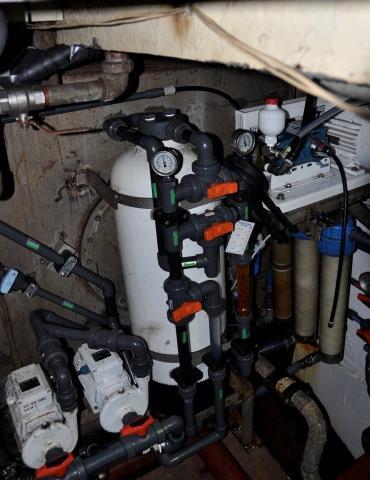
Water is provided by a water maker of the reverse osmosis kind it keeps up well with our needs of 3300 litres a day which translates to 72 litres a person for all uses, 23 gallons, to me that seems to be a goodly amount but with what looks like heavy usage in the galley where a commercial dishwasher is used, no restrictions on showering, there are showers basins and heads in all cabins, many shower twice a day and then there is the washing machine which in good weather is always on the go. In Søren Larsen we were told we could shower in the shared showers every three days if we wished, I once at least went on deck and bathed as Jim had said you can have one any time you wish when the Ginny is running it throws out warm water you know! The water maker she has did not work so well in cold waters; I am guessing that there have been great improvements in the twenty-five intervening years.
Diary Entry Thursday 12th November; wore ship during the first hour of the watch some wind and rain. Stuns`ls up again early afternoon as we face a cold front 60 miles off the coast, humps seen
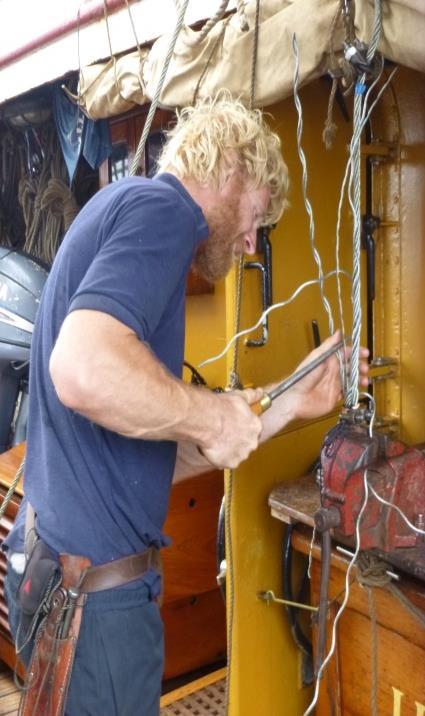
breaching but distant as usual Ali has rewritten our watch rota so I have yet another buddie Wim B a Dutch yachtsman a real nice guy. I tried doing a blog wore ship during the first hour of the watch some wind and rain. Stuns`ls up again early afternoon as we face a cold front 60 miles off the coast, humps seen breaching but distant as usual Ali has rewritten our watch rota so I have yet another buddie Wim B a Dutch yachtsman a real nice guy. I tried doing a blog not realising yet that they are only for internal circulation so not sent to the wider world, after working up a post only to lose the content 4 times, I asked around a half dozen how to! None of whom could say that they knew how to themselves. The ships communal lap top has a mind of its own which I now know Balca and Matt understand it best. There are fewer with mobile devices aboard this voyage than the last which is good. (I can remember being in the schooner Amistad in 2008 a night when I saw the helm being blinded by a Brazilian girl Carla using a laptop on deck at night, I went up to he and closed the lid telling her to go below with it, at times those who should make sensible decisions don’t? perhaps it was not my place to but when the watch leader was there with her I had to act for the sake of the helm and the night vision of all.) I have asked Ali our watch leader to think about my tricks at helm and to put me on in the daylight hours of our watches early evening before dusk and in the morning as dawn breaks when I see the instruments somewhat clearer and the colour red is not an issue. We are short on our night watches as Bill`s wife Janice does not do night watches. Ali who was born Chilean but moved to Holland with her mother as a very young child like some of the Dutch has a problem understanding colloquial English at times.
More knot tying practice was no one aboard in the Scouts? Knots taught are figure of eight, reef, clove hitch, and gasket coiling; the advanced group are trying their hand at the Bowline. A Wilsons storm petrel is blown aboard, it had become disorientated so was put in a bucket by Jordi our zoologist and covered over to be released at dusk when this species is most active.
After dinner Garry Kerr`s excellent Last Cape Horners DVD is shown after dinner and before some retire for bunk time, it is a shame that there never seems to be reshowing of the documentary films that would benefit all to see, there is always a part of crew sleeping or working on watch. After this showing and referring to the sequence where Chris Halls speaks saying it was Pamir. I was out on the yard with Murray (Murray Henderson a New Zealander and president of the NZ Cape Horners) there was a scream just heard! I looked round and Murray had had his shirt ripped off his back by the wind we were over that far we were having trouble getting off the topsail yard it was like walking up hill. Roger as we left the saloon said loudly “time to get the brown trousers out”.
Mechelein our doctor gave a talk during the afternoon period on surf lifesaving. The film Peking Battles Cape Horn by Irving Johnson 1929 is shown, many comment about the amount of water on deck but she was in trade and deep loaded, we sit high in the water sailing light and as such it is only when we roll we get water in the channels on the well deck.
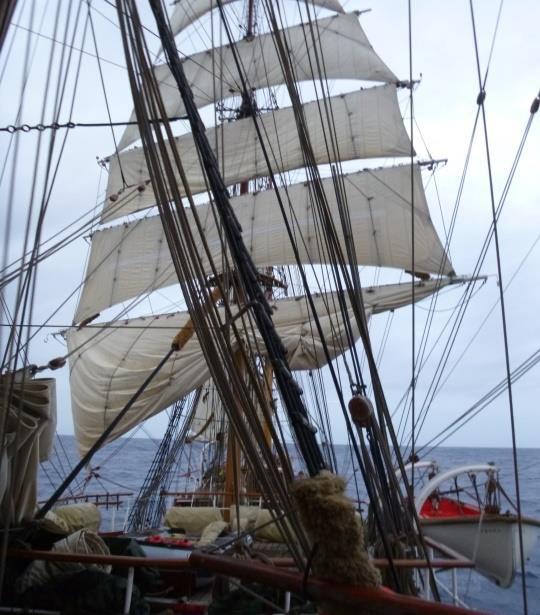
Diary Entry Friday 13th November: Came up on watch at 2A.M. and today I saw the first cold steaks of mistress dawn with an orange glow behind it, grey cloud streaking low across the horizon and just above it. Meanwhile in the deckhouse thoughts are speculation regards our arrival off Cape Horn some sort of sweepstake is proposed, and I get into bother again when I say the ship asked voyagers not to organise flights out of Punta Arenas on the scheduled day of arrival, I say we are not a cruise ship just look aloft at what propels us. The sciatic pain that has bedevilled me for months and prevented me from so far going aloft has eased to a tolerable level, I ponder that it might be the continual movement of the lady Europa that is helping. Mechelein is surprised that I have so much Tramadol with me, my GP was hesitant before he prescribed the quantity I asked for.
To be continued all photos©CR