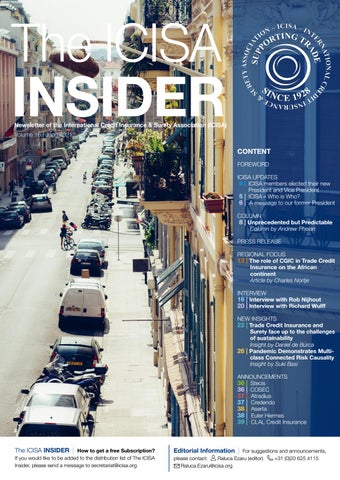
The ICISA INSIDER
The ICISA INSIDER | June 2021
Newsletter of the International Credit Insurance & Surety Association (ICISA) Volume 16 | June 2021
CONTENT FOREWORD ICISA UPDATES 4 | ICISA members elected their new President and Vice President 5 | ICISA ‒ Who is Who? 6 | A message to our former President COLUMN 8 | Unprecedented but Predictable Column by Andrew Phelan PRESS RELEASE REGIONAL FOCUS
13 | The role of CGIC in Trade Credit Insurance on the African continent Article by Charles Nortje
INTERVIEW 16 | Interview with Rob Nijhout 20 | Interview with Richard Wulff NEW INSIGHTS
22 | Trade Credit Insurance and
Surety face up to the challenges of sustainability Insight by Daniel de Búrca 26 | Pandemic Demonstrates Multiclass Connected Risk Causality Insight by Suki Basi ANNOUNCEMENTS Stecis COSEC Atradius Credendo Aserta Euler Hermes CLAL Credit Insurance
36 | 36 | 37 | 37 | 38 | 38 | 39 |
The ICISA INSIDER | How to get a free Subscription? If you would like to be added to the distribution list of The ICISA Insider, please send a message to secretariat@icisa.org
Editorial Information | For suggestions and announcements, please contact: Raluca Ezaru (editor) Raluca.Ezaru@icisa.org
+31 (0)20 625 4115 1
|
June 2021 | The ICISA INSIDER | Foreword
|
2
Foreword | The ICISA INSIDER | June 2021
Foreword Crises are all different but each of them carries new challenges that force shifts and foster learning steps. With challenges on at least three levels – economic, societal and personal – the COVID-19 crisis has brought about several paradigm shifts: the post Covid era is not going to be a simple way back. As credit-risk managers, we have witnessed the first decorrelation in history between risk levels and GDP trends, owing to fast and massive public intervention. Predictive models have suddenly become ineffective, leaving our industry leaders with little data to plan and shape their responses. A new breed of tools should factor in the impact of public support instruments (in on and off phases). As one instrument of this public support, TCI players ran complex negotiations with governments in 2020, handling conflicting parameters such as buyers’ support, risk prevention restraint, excess risk transfer and profit transfer. We have collectively learnt from this exercise and should now build on it. In my view, the objective to stop sharing our profits with States – by exiting the public reinsurance schemes – should not deter ICISA members from working on a reference framework for PPP (publicprivate-partnership) in TCI and Surety for the future. This framework may include objective criteria for when PPP is useful and when it is not. On a different level, like most white-collar industries, we have essentially worked from home for a little more than a year. Some say the period will accelerate the globalization of services, in which employees in lower cost zones may progressively replace local staff. This could go far beyond the shared service centers we have known in the past 15 years, which were limited to a few support functions. In 10 years from now, we might even observe specialisations appearing in key functions of our industries. A Bangalore of risk underwriting? A Madagascar of claim adjustment?
In fact, it would not be entirely new to see insurance concentrate its resources – London, Zürich or Bermuda being previous examples, although driven by other efficiency levers. Enough speculating, but I must say it makes the moment quite thrilling for the new management of ICISA to take over. The association must be fit for a world where meeting in person is not always possible, where the Committees work with shorter milestones and where technology becomes as topical for members as underwriting or regulation. The transformation is already on its way under the leadership of Kay Scholz and Richard Wulff, starting with a full update of working conditions at the Secretariat (IT, office relocation, communication tools, home office arrangements…). I wish them great success in this enterprise to streamline the resources that serve our industry and support our members. I want to thank Rob Nijhout for his long leadership as Executive Director, his relentless eagerness to meet the needs of members and his talent for making ICISA a society where it is pleasant to meet and rewarding to bring one’s work. We have been lucky enough to arrange a significant overlap period between Rob and Richard, so I am very confident that the transition will be solid and complete when Rob steps down. I am truly grateful for the opportunity to have served as President. I can only recommend this enriching experience: working for the entire industry, within ICISA, is worth the extra hours! Happy reading of the Insider. Patrice Luscan
3
|
June 2021 | The ICISA INSIDER | ICISA Updates
ICISA members elected their new President and Vice President The 79th General and Associated Meeting of Members marked the election of the 42nd President and Vice President of International Credit Insurance & Surety Association. Mr. Kay Scholz, Divisional Chief Underwriting Officer at R + V Re, was elected by the members of ICISA as President of the association for the next 12 months. Kay Scholz has been a member of the Management committee and Vice President of ICISA since 2018. His election marks also the first nomination and election of a Reinsurer as President of ICISA. For the position of Vice President, Mr. Benoît des Cressonnières, CEO of Euler Hermes Reinsurance, was elected. Benoît has served on ICISA’s management committee for the last decade and, as such, is intimately familiar with ICISA. In the upcoming months, Kay will work closely with Benoît and with Richard Wulff, the newly confirmed Executive Director of the association. The new team will build on solid foundations to further increase ICISA’s focus on what members expect. At the beginning of their mandate, Richard Wulff notes:
“I am humbled by the confidence placed in me by the members of this great association. The team and I have started initiatives in the fields of IT, PR and advocacy. Most of all, we want to bring the membership together in order to learn from each other. Having seen the cooperation and common learning fills me with pride to be able to contribute to ICISA for the good of our industry.”
*Don’t miss the upcoming edition of the ICISA Insider, where interviews with the new elected President and Vice President will be published! |
4
ICISA Updates | The ICISA INSIDER | June 2021
ICISA ‒ Who is Who? ICISA is led by a Management Committee, which consists of:
• President Kay Scholz, R + V Re
• Vice-President Benoît des Cressonnières, Euler Hermes
• 7 Company Members
Kay Scholz President Company: R + V Re
Atradius
Axis Capital
COFACE
Benoît des Cressonnières Vice-President Company: Euler Hermes
Hannover Re
Liberty Mutual
SGI
Tryg Garanti
The President and Vice-President of ICISA are elected during the Annual General Meeting of Members of ICISA, for a mandate of 12 months. ICISA has 52 company members that are active in six committees, two sub-committees and two working groups, depending on topics of interest: Asia Committee, Single Risk Committee, Credit Insurance Committee, Surety Committee, Committee of Underwriters, LGD Sub-committee, Regulatory Sub-committee, Solvency II working panel and IFRS17 Working group. The Secretariat of ICISA is based in Amsterdam, the Netherlands. Richard Wulff, Executive Director of ICISA, leads the activity of the Secretariat.
5
|
June 2021 | The ICISA INSIDER | ICISA updates June 2021 | The ICISA INSIDER
A message to our former President The 79th General Meeting of Members of ICISA marks the end of the third (and last) annual mandate of Patrice Luscan, Marketing & Innovation Director at COFACE, as President of ICISA. Patrice has represented COFACE in ICISA’s Management Committee since 2015. At our 2018 AGM, held in Stockholm, he was elected President of ICISA. Upon being nominated as President, Patrice shared his first thoughts:
“I felt relatively unprepared for the job (…), I needed to get a better idea of the contribution I could make to ICISA before I signed up.” Looking back three years later, ICISA is impressed by his contribution to the association and to the industry. His tireless efforts on advocacy, especially during the unprecedented lockdowns and ensuing government measures, ensured that members’ interests were taken into account where possible in talks with national and European government counterparts. Thanks to his leadership, members were better prepared and able to respond early and effectively to the pandemic fallout. As Chair of ICISA’s Management Committee he built strong working relationships and gave guidance during a difficult time for an association. During his term, Patrice participated in countless association meeting at all levels, making him directly informed and involved in major and minor issues concerning members. This hands-on involvement was much appreciated by members and helped in addressing these concerns effectively despite a lack of physical meetings. Patrice took the initiative to explore if blockchain technology can solve some the pressing concerns in our sector, resulting in different projects, of which a blockchain solution for surety is now in its proof-of-concept phase. Initiated by ICISA, this blockchain solution now involves the full surety eco-system. On behalf of all members, the Secretariat of ICISA wishes to thank Patrice for his commitment to the association and for his leadership which helped steer us all through uncertain waters. Rob Nijhout, former Executive Director at ICISA:
“I enjoyed working closely with Patrice over the past 3 years. Being aware of the much-increased demands from his day-to-day job during the pandemic, I am even more grateful for his commitment to ICISA and his guidance in these challenging times.”
|
66
ICISA updates | The ICISA INSIDER | June 2021 The ICISA INSIDER | June 2021
7 77
||
June 2021 | The ICISA INSIDER | Column
Unprecedented but Predictable By Andrew Phelan, MS Amlin Things have changed. Recently I have been receiving photos and social media alerts showing friends, acquaintances (and even people I barely know!) in a frenzy of excitement as, for the first time in over a year, they have just ordered their first beer, or glass of wine, in a bar or a restaurant… all misty eyed and almost reverential over something 18 months ago we took for granted. Common place activities of all sorts are now appreciated and valued in a way that perhaps they always should have been… We might even be forgiven for thinking the world is further returning to normal (whatever that might now be) both from a personal and business perspective but for those of us in the Trade Credit, Surety or Political Risk business I can’t help feeling we are probably only half way through the crisis. Loss activity has been at record lows for the last 12 months but the potential for deterioration, creeping defaults, shock bankruptcies and surprises remains high, especially in the traditionally more volatile Surety/Bond and Political Risk & Credit lines. As a reinsurer I can (with a healthy amount of both relief and gratitude) say that MS Amlin’s clients have overall been extraordinary in their handling of the Pandemic. From the tight and prudent underwriting in the lead up to the crisis, the management of risk during its height, the regular communication and the pragmatic approach to business as (it feels like) we emerge from the economic crunch, they have been exceptional. But were we as an industry purely reactive and is that ok?
|
8
It occurred to me as I heard the word “unprecedented” for the 15th time during one client meeting that maybe we as a market used this word a little too liberally and a little too much as an excuse for not having answers or even views. We saw an “unprecedented” pandemic, an “unprecedented” shut down of economic activity, of zero travel, of government support and intervention in markets, companies, people …all apparently “unprecedented,” and while in many instances that is true, it isn’t the same as saying any of this was unpredictable. There have been books, papers, analytical forecasts and even a major movie on the subject of global pandemics! So if this wasn’t unpredictable then should we have been more ready for it? Should we (as a market/product line/ business) have had a clearer view of the costs, consequences and ultimate outcome? Maybe, maybe not. The terrible human tragedy aside, the crisis so far has been a huge disruption for the market but benign in terms of loss
Column | The ICISA INSIDER | June 2021
Even if that remains the case what about the next unprecedented, but predictable, event? A cyber-attack wiping out all financial records? A Science Fiction style Artificial Intelligence disaster? Solar Flare pulse frying all electronics? An asteroid hit… all potential events that, 2 years ago, we may have put in the same category as a Global Pandemic shutting down the world for a year. Can we prepare at all or is our business too complex and too nuanced that when the next unprecedented (but predictable) event comes we can only react, trust in our underwriting and hope? As the great 1980s philosopher and sage, Ferris Bueller once said “Life moves pretty fast. If you don’t stop and look around once in a while, you could miss it.”
“Life moves pretty fast. If you don’t stop and look around once in a while, you could miss it.” ‒ Ferris Bueller
of some of life’s simpler pleasures, like being able to stand at a bar and order a beer. Perhaps we also have new insight to push further into the realms of possibility of new and “unprecedented” events ahead and how we might be impacted. I suspect there already been a lot of work done on these kind of extreme scenarios in the past, maybe we will give them more attention and thought in the future?
Well, I think this last year has been our chance to stop and “look around” and hopefully we all have a new appreciation
9
|
June 2021 | The ICISA INSIDER | Press Release
Trade Credit Insurance and Surety continues to support the economy Despite the economic outlook and uncertainties, insurance coverage for trade reaches new peaks in 2020
Amsterdam, 17 June 2021
Trade credit insurance • Insured exposure was € 2.4 trillion in 2020 despite the COVID-19 pandemic, thereby supporting world trade. • Premium written was € 6.3 billion in 2020 compared to € 6.9 billion in 2019 at constant FX rates, showing the effects of COVID-19 early in 2020. • Claims paid increased by 12% to € 3.8 billion. • Claims ratio 2020: 60% (in 2019: 48%).
Surety • Insured exposure increased by 16% to € 679 billion. • Premium written was € 5.2 billion compared to € 5 billion in 2019 at constant FX rates. • Total claims paid over 2020 was € 1.4 billion. • Claims ratio 2020: 28% (2019: 27%).
Discussions at the 79th Annual General Meeting of ICISA members (June 2021) • Mr. Kay Scholz (R+V Re) and Mr. Benoît des Cressonnières (Euler Hermes) were elected as President and Vice President respectively. • Tryg Garanti was appointed as a member of the Management Committee. • ICISA welcomed one new member: GreenStars BNP Paribas S.A. Given the extraordinary situation caused by the pandemic, the members of the International Credit Insurance & Surety
Association (ICISA) met virtually for their 79th Annual General Meeting (AGM). During the AGM the membership elected Kay Scholz (R+V Re) as President for 2021/22 and Benoît des Cressonnières (Euler Hermes) as Vice President for the same period. Following the retirement of Mr. Rob Nijhout, Richard Wulff was confirmed as the new Executive Director of ICISA. Richard Wulff: “I am humbled by the confidence placed in me by the members of this great association. The team and I have started new business initiatives to be of service to our members. Most of all, we want to bring the membership together in order to learn from each other. Having seen the cooperation and common learning fills me with pride to be able to contribute to ICISA for the good of our industry and the economy at large.” The industry results of 2020 reflect the impact of the significant government intervention in a number of markets to counteract the effect of the COVID-19 pandemic. This has included direct support to the real economy in the form of equity support, direct grants, furlough schemes, as well as deferred tax deadlines. Some markets also introduced deferrals of insolvency declarations. State reinsurance schemes were also introduced in some locations to encourage the continued availability of credit insurance.
>>> |
10
The ICISA INSIDER | June 2021
We are moving!
As a result, claims from insolvencies and non-payments were lower than normal in many markets with high levels of government support. However, on a global level, claims were up in comparison to last year reflecting that government intervention was not universal. Premium and exposure remained at high levels despite some necessary reductions, also reflecting the economic impact of government interventions in support of the real economy. Due to the amount of governmental spending on infrastructure in many countries where our members offer their products, there is a great deal of optimism on Surety in the upcoming years. Raluca Ezaru External Relations & Information Officer Herengracht 473 1017 BS Amsterdam The Netherlands Raluca.Ezaru@icisa.org Tel: +31 (0)20 625 4115
Cl
u!
While these schemes gave early comfort to credit insurance to maintain cover, the reduction in insolvencies stemming from the wider government interventions meant that claims through such schemes were much lower than expected, with related costs from administering schemes also incurred.
o
t o r e yo s
From 1 July 2021 you will find us here: Spaces Schiphol Evert van de Beekstraat 354 1118 CZ Schiphol The Netherlands
In the meantime, we will still be reachable in the usual ways: Email: secretariat@icisa.org Telephone: +31 (0)20 625 4155 Website: www.icisa.org
11
|
June 2021 2021 || The ICISA INSIDER | Regional Focus June
|
12
Regional Focus | The ICISA INSIDER | June 2021
The role of CGIC in Trade Credit Insurance on the African continent By Charles Nortje, CEO, Credit Guarantee Insurance Corporation (CGIC) Credit Guarantee Insurance Corporation of Africa Limited (CGIC) was registered in 1956 and has since then been providing Trade Credit Insurance Solutions in support of its clients, across the globe and as spotlighted in this article, the African continent. A little known fact is that CGIC itself started as an insurer of exports, rather than an insurer of domestic trade. Our current portfolio has evolved to reflect a 75% domestic and 25% export mix. Our Export trade credit policies offer coverage for both Commercial and Political risks. South Africa remains a primary resource commodity exporter, with metals & minerals comprising 60% of all exports. A number of international car manufacturers produce all their right-hand drive vehicles in South Africa. Agricultural products are an important component of the CGIC export portfolio, with agriculture being one of the strongest performing sectors in the economy. (Figure 1) During the prior 12 months ending December 2020 CGIC provided cover on at least 32 African countries with a total declared insurable turnover of more than ZAR 60 Bn (USD 4.1 Bn).
“Only a fool tests the depth of a river with both feet’’ (African Proverb) The business of trade credit insurance in Africa comes with a characteristic set of risks, which although not to unique to Africa, are commonly encountered together in many African markets. • Difficulty in sourcing reliable buyer risk information. This emphasises the importance of buyer visits and risk assessments on the ground • Foreign currency shortages, and associated inconvertibility problems • Currency devaluation • Port delays • Political instability and tenuous democracies, with sometimes capricious government action • Requests for payment extensions are often encountered • Country dependence on donor aid • Many African economies are themselves still primary resource dependent, making them vulnerable to sudden upheaval in international commodity cycles
Figure 1 - South Africa – Export Composition 12 Months Ended March 2021 Precious Metal 26.63%
Mineral Products 24.41%
Vehicles Aircraft Vessels 11.14%
Products Iron Steel 8.78%
Machinery 6.64%
Chemicals 6.33%
Vegetables 5.13%
Plastics Textiles Wood Rubber 1.27% Pulp 1.61% Paper 1.14%
Prepared Foodstuffs 3.31%
0.52% 0.47% Live Animals 0.97%
Values < 324M (0.22%)
0.42%
0.26%
>>> 13
|
June 2021 | The ICISA INSIDER | Regional Focus
>>> Underwriting buyers in Africa can often be difficult, and the ability to adequately price for risk is crucial. CGIC seeks to maintain close relationships with key buyers in order to gain underwriting insights Some of the larger buyers on which we provide cover have international parent companies, which CGIC can look to provide security. In many ways the current “virtual” working environment under COVID-19 greatly facilitates our buyer interactions. Travel
across Africa can be time consuming, expensive, and in some countries even hazardous, given the current pandemic, and kidnap risks. Cuisine can also be unusual, as anyone experiencing Nigerian pepper soup will attest to, once they have fully recovered! Figure 2 reflects the relative importance of Africa in comparison with the rest of world destinations for SA Exports.
Figure 2 - South Africa – Most Important Export Destinations - 12 Months Ended March 2021 [Dark blue bubbles representing African territories]
|
14
June 2021 2021 Regional RegionalFocus Focus | The ICISA INSIDER | June
Our clients continue to look for opportunity within African markets, and we have seen export growth to countries like Kenya, Tanzania, Mauritius, Zambia (which market is currently experiencing its own challenges) and Ghana. The majority of goods supplied into these African regions include steel, building supplies, FMCG and technology products. CGIC continues to experience demand for new cover and increases in existing cover, for these product sets in particular. There remains only a handful of African countries on which CGIC offers no cover at all, for example the Central African Republic (political upheaval) and currently, Zimbabwe (perennial economic woes and currency shortages). The difficulties of a particular country can however often be in inverse proportion to the commercial attractiveness presented to our clients, and thereby to CGIC. Our philosophy remains one of partnering with our clients as they seek out opportunities in Africa, to the extent possible within our risk appetite. Our scope mainly extends to Sub-Saharan Africa (SSA), with a much smaller buyer risk portfolio in North Africa. The African Growth and Opportunity Act (AGOA) is a United States Trade Act which significantly improves market access to the USA for qualifying SSA countries. AGOA has been extended until 2025. Another exciting development is the concept of the Africa Continental Free Trade Area (AfCFTA). Africa accounts for only 2% of global trade, and only 17% of African exports are intra-continental, compared with 68% for Europe. AfCTFA seeks to connect 1.3 billion people across 55 countries with a combined GDP of USD 3.4 trillion, into the largest free trade area in the world. There are some challenges with implementation of AfCTFA to be sure, but the opportunity space for trade growth in Africa is enormous.
In Closing CGIC is a member of the Old Mutual Group, headquartered in Johannesburg and operating across 13 African territories. We are currently partnering with these Group companies to offer “in country” trade credit insurance solutions. Our footprint currently includes Namibia, Botswana, Swaziland, Kenya, Tanzania, and Uganda through Old Mutual, and a further associate in Mauritius. CGIC will look to expand into the other Group territories.
15
|
June 2021 | The ICISA INSIDER | Interview
Two decades of history of ICISA An interview with Rob Nijhout, former Executive Director of ICISA
The end of an era! That’s what I dare to say, after the farewell interview with Rob Nijhout. It was 2001 when Rob was confirmed as Executive Director of ICIA (yes, that’s right – ICIA became ICISA only a year after Rob’s appointment – noted outside the interview – Rob likes to talk about this change with certain pride). Rob served the industry for over 35 years, first from several international management positions at NCM (now Atradius) and later on from his role as Executive Director of ICISA. Now, just before his retirement, I had one more chance to ask Rob about what was before. In the past 20 years a lot changed with the Secretariat of ICISA: moved from London to Amsterdam, changed names, logos, ambitions and plans. But always with the same goal: to serve the members of the organization and the industry it represents. About the changes of the industry of the past 20 years it’s best to hear from Rob, so please enjoy reading the next pages! The Editor
|
16
Interview | The ICISA INSIDER | June 2021
What is, in your opinion, the biggest achievement of ICISA of the past 20 years? Perhaps one of the most remarkable developments over the past decade is the turnaround in how trade credit insurance has been perceived by the outside world and especially by the general media. Trade credit insurance has always been well understood and appreciated by customers, financiers, the specialised media, and those working with the sector. But for others, the product was often either not known or little understood. This became even more obvious when the industry stepped into the spotlights during the 2008/2009 crisis. Suddenly, the media focused on credit insurance, and often not in a favourable way. And while some criticism was justified at the time, many observations were based on incorrect information, a lack of understanding or wrong assumptions. Because they rarely covered the sector before, some of the leading media outlets, including some financial papers, had an incorrect understanding of what credit insurance is, leading to unfounded criticism which tainted the perception of the industry. In response to this, ICISA’s Management Committee approved a new, pro-active engagement with the media. Regular meetings with key media outlets were helpful in “educating” journalists towards a better understanding of what trade credit insurance does, and especially of what it cannot or does not do. At the same time, policyholders’ satisfaction rose as ICISA members applied lessons learned from the crisis. Effective media strategies of members supported this further. These combined efforts were successful and eventually led to a greater awareness and appreciation of trade credit insurance, a better understanding of TCI and, better informed and fairer media coverage. The current crisis is very different from the previous one but concerns about buyers’ ability to pay and the role played by credit insurance in support of that remain the same. The sector is covered extensively again by the media. And there is criticism. Even in the best companies, mistakes will be made. Nor does it mean that uninformed comments are no longer made. However, journalists in need of industry information now turn to ICISA for background. This way we were able to prevent critical articles that were based on wrong assumptions. By and large the media now write about the sector in an informed and constructive manner. And if there is criticism, this is based on factual concerns rather than on misinformation, wrong assumptions or incorrect perceptions.
What are some of the biggest challenges for TCI and Surety Industry of the past 20 years? In Europe the last two decades were dominated by the implementation of new prudential regulations (particularly with Solvency II) and subsequent changes of the regime. In other parts of the world similar rules were, or are being adopted. Solvency II is widely supported by both sectors and seen as an advantage as it assures an objective assessment of the adequate capitalisation of players in the industry. Rules could still be fairer however, and this is still not the case. Efforts have been made to address those parts that could be improved upon. Thanks to the huge input from leading members, talks are ongoing with regulators at the highest E.U. level, with the objective of a better recognition of trade credit and surety in these regulations. Outside of Europe, market growth for TCI in Asia, the Americas and Africa has been tremendous but not without its own challenges. A level playing field for public and private players is not a given in many countries. New Basel rules and how these are applied on a national level are an additional concern that risks making the playing field even more unlevel. Surety has had its own challenges in growing beyond its more traditional markets, hampered by a lack of legislation and regulation in many countries. An open market and a level playing field would benefit customers but is lacking in some countries.
>>> 17
|
June 2021 | The ICISA INSIDER | Interview
>>> We are proud that ICISA, together with our local partner, was able to facilitate surety legislation in Hungary, setting an example for other countries to follow. ICISA, together with others, is working on standardising terminology, as surety is defined differently in countries. There is still a long way to go. One could question whether these differences will ever be resolved, as these are often caused by national regulation and tradition. They remain a challenge for surety companies operating in multiple markets.
How do you see the next years for the industry? The coming years are likely to be dominated by sustainability concerns. Issues such as climate action, green energy, sustainable farming and fair working conditions are affecting trade and are just some of the concerns that will further penetrate the underwriting process and may very well determine the price or availability of insurance cover. This is recognized by most and often urged on by shareholders’ demands and clients’ expectations. But policyholders differ, as do companies, in their views of how these issues should be addressed. How to keep everyone satisfied will require new skills. Policies need to be developed for a practical and achievable application of these objectives. A transition period is necessary but cannot be open-ended as demands for early implementation deadlines are likely. This is more effective if done on a sector level but cannot be done in isolation. Opinions on urgency and on solutions differ. Multiple interests need to be considered. Alignment on these concerns with policyholders will be a new challenge. Further alignment with ECAs, trade financiers, brokers and others working in our ecosystem seems logical and necessary but will not be easy and won’t happen by itself.
Sophisticated fraud structures are harder to detect and require underwriters to be one step ahead. New or disruptive technology make it easier to enter the market or to change the way in which cover is offered. Adapting or adopting is a requirement. And as new entrants grow, a further consolidation in the market is likely.
What was your expectation when joining 20 years ago, and how did your time with ICISA meet that expectation? 20 years ago, we were in the middle of a consolidation drive among trade credit insurance members. This sentiment spilled over into the association as well, with calls for mergers with other associations. This was also my expectation when joining ICISA, as talks were ongoing for the creation of a new much larger global association. As talks progressed, so did the awareness that different associations exist for a reason. In the end, a majority of ICISA members preferred the status quo and merger talks stopped. The pros of merging were recognised, and strategic partnerships were formalised with colleague associations. These efforts continue until this day. On advocacy matters and on a project level ICISA benefits from working together with ITFA, Lloyd’s, SFAA, the Berne Union, PASA, ICC, FCI, Alasece and national insurance associations. The collaboration among surety associations from around the world resulted in the creation of the International Surety Association, of which ICISA is one of the proud founding members.
At the same time, the credit insurance and surety sectors are highly competitive and will likely remain so. This risks a relaxation of objectives, which could have a negative effect on how the industry is perceived or worse.
Are there any stories from previous ICISA events that you like thinking about? Funny moments maybe too? Are there any remarkable characters of the industry that you’ve come along in the past?
Technology is expected to be another dominating factor. When companies fall victim to hackers this is often seen as someone else’s problem. Risks associated with cybercrime become less abstract when it involves a company you know. Guarding against this will require ongoing additional resources, especially as cybercrime becomes more sophisticated.
I have had the good fortune of meeting so many remarkable people during my time at ICISA. All stood out for very different reasons. The biggest impression though has been left by the delegates to our meetings. Thanks to their expert input there was always something to learn. And thanks to their positive outlook, it was fun too. Meetings were always something to look forward to.
From an underwriters’ standpoint, cyber risks are of increasing concern, especially regarding business continuity and fraud.
But there were surprises of course. Unexpected things usually make an event more memorable. Sharing our hotel
|
18
The ICISA INSIDER | June 2021
with Beyoncé or with Demi Lovato, as happened at our AGMs in Barcelona and Milan, was memorable mostly because of unexpected organisational and security challenges, as well as for the adoring crowds in front of the hotel. The cameo appearance of former US Foreign Secretary George Schulz during Beach Blanket Babylon, the drag-show at our 2004 AGM in San Francisco is an impressive highlight for me. A more recent unforgettable experience was our private tour of the Vatican, during our Spring Meetings 2019.
What are your plans for retirement, and do you think you will keep connected to the industry? The pandemic has upended some of the plans that I had but the lockdowns also helped me discover the joys of not having a hectic travel schedule and regular jetlag. I look forward to having more time for music and my other hobbies. But after 40 great years in the industry, the sector has become part of my DNA. I cannot imagine a future without being involved in some way and I am lucky enough to be invited to join some projects.
What advice would you give to young professionals in the industry? My first advice would be: nourish your sense of dynamism and creativity. Dynamism and creativity are not the first terms one associates with the insurance industry. But this is what makes credit insurance and surety stand out.
NOW AVAILABLE
Catalogue of Credit Insurance Terminology The new German edition of the catalogue is available. It can be downloaded from the ICISA website at www.icisa.org To order a hard copy, please send an email to secretariat@icisa.org
There is continuity and standardization of course in underwriting standards and the basics of products offered. But the world changes constantly, and so do policyholders. Contracting parties are creative in the structures they set up, driven by competition, finance, tax, legislation, or commercial considerations. Underwriters must match this creativity to continue serving the policyholder while protecting the insurer’s interests. Time is money and solutions cannot wait. Insurance companies also change. Increasingly FinTech or InsureTech solutions are added to their product offering. This dynamic and creative environment makes every day different with its own challenges. There are few sectors where dayto-day global events can have such an immediate and direct impact on your daily work. In the end the industry is all about serving customers and addressing their needs and concerns. My advice to young professionals in our industry would be to stay close to your customer and be creative in managing their expectations, embrace change, keep an open mind and look beyond the obvious.
19 19
| |
June June 2021 2021 || The ICISA INSIDER | Interview
A sneak peek on what’s to come An interview with Richard Wulff, new Executive Director of ICISA
Richard Wulff joined the ICISA Secretariat in the beginning of the year, working closely with Rob Nijhout, preparing for the time when he will take over as Executive Director, following Rob’s retirement. He has over 30 years of experience in the Trade Credit Insurance, Surety and Reinsurance sectors, and has worked in the past for some of the current ICISA members. We sat down with Richard recently, prior to taking over his new role, and asked him about his motivation, ambitions for the future, and how he sees the role of ICISA in the Trade Credit and Surety industries. Looking back at the moment when ICISA announced the vacancy for a new Executive Director, this was brought to his attention by other colleagues in the industry: “When Patrice sent out a notice to members that ICISA was looking for a successor to Rob, my email inbox suddenly filled up with old friends pointing me to the opportunity. The rest was history: I applied for the position and was over the moon to have been nominated by the selection committee.”, Richard notes.
|
20
Interview | The ICISA INSIDER | June 2021
Ambitions for the future Asked about the ambitions he has for the future, Richard mentioned his primary, long-term ambition of fulfilling ICISA members’ wishes and “spreading the word” about what the Credit Insurance and Surety industry does: “Most of us would recognize the blank stares on people’s faces when we say we’re in trade credit insurance or surety (probably even more so if you add the word reinsurance). That means we need a stronger narrative and to spread it widely”. Bringing the industry together is his second ambition: “This is important as a scattered industry can never talk with a strong unified voice”, noted Richard. On short term ambitions, Richard mentioned his plan to improve online collaboration between ICISA committee members, which means that their interactions will be “more effective and efficient”, while also noting that “…our committees are no longer a twice-a-year event”. Still part of the ambitions for the upcoming months, he mentioned his plan for the acquisition and dissemination of better data, which will help build a greater appreciation and understanding of the sectors and their importance among external stakeholders. He notes: “In 1995, the late Steven Sandberg wrote a piece on financial guarantee after the demise of Svenska Kredit. He identified that “that traditional credit and traditional guarantee insurance will forever be “small fry” business when compared to general non-life or life insurance, or to banking or to other big time industry.” We are not small fry anymore when the directorgeneral of the WTO says “80% of global trade is supported by some form of financing and credit insurance.”
Transition from member to secretariat Looking back at his transition to the Secretariat of ICISA, Richard notes: “The transition has been great due to the welcoming attitude of the secretariat’s staff. Our people are good at what they do and enthusiastic to serve our members”. In the past months, some changes in the Secretariat were done as well, which he proudly mention: “working closely with Rob, we’ve been able to make some meaningful changes already: our office move in July is an example of this”. Finally, Richard notes also the efforts of the Secretariat on the PR and Advocacy: “It has also been great to get stuck into PR and Advocacy activities right away. Recent press interviews and an appearance before the European Systemic Risk Board’s Insurance Expert Group. This kind of activity was not really a surprise, but it has been great way to get my feet wet early.”
When it comes to essential things to be achieved by ICISA, Richard highlighted the role ICISA has in helping our members speak with one, strong voice. He pointed the need “to remain committed to working towards our common goals” and “finding good compromises where interests differ.” The second aspect mentioned by Richard was the attractiveness of ICISA towards our members: “The enthusiasm in our committees are testament to that and creating a positive and friendly atmosphere withing our committees is essential to this.” Finally, he mentioned the need “to be taken seriously by the outside world”. From his new role, he highlights his focus in the upcoming years: “to enable ICISA – both at a secretarial and member level – to meet our ambitions.” Asked about the role that ICISA has in supporting individuals working in the industry or thinking to join it, Richard notes: “One thing I’m passionate about is bringing in fresh blood to the industry. This doesn’t only mean hiring smart young people - this is certainly necessary, but is only half the story. Bringing in people with non-insurance skillsets is also a really good thing for the entire industry, new colleagues as well as existing ones. It keeps us asking the right questions and exploring truly new avenues to grow this industry and to keep it at least as relevant as it is today. As Neil Young sang “Rust never sleeps”. But now I might be showing my age…”
21
|
June 2021 | The ICISA INSIDER | New Insights
Trade Credit Insurance and Surety face up to the challenges of sustainability By Daniel de Búrca, ICISA Major life-changing events, it is hoped, don’t come around very often. Or at least that’s the expectation. Here we are almost 18 months into a global pandemic that has changed (or at least challenged) long-established patterns and practices for how things are done. In historic terms, it comes just after another supposedly “once-in-a-generation-event” – the Global Financial Crisis (GFC) of 2007/08. The GFC brought about a lot of change in life and in business since 2008, particularly in the way financial services operate and are regulated. In many ways, we were still working through the fundamental issues it left us with while now also responding to the challenges of COVID-19. Society is quickly learning that just because two things are 1-in-200 events (or greater), that doesn’t mean they can’t come back-to-back! COVID-19 has given us a sharp lesson in what it looks like when external events force widespread behavioural change. However, throughout this crisis, the longer term question of how we respond to climate change bubbles away under the
|
22
surface. Despite taking a back seat to the immediate concern of the pandemic, climate change will have a much greater effect on our lives than either the GFC or the pandemic. Indeed, our response to the pandemic and eventual recovery must be grounded in sustainable practices. Sustainability as a topic suffers from the broadness of the term. The word itself is often used as short-hand for climate change. Climate change is the biggest issue that needs to be addressed under the umbrella of sustainability. But it’s not the only thing. It includes broader corporate social responsibility elements such as the impact of businesses on society or the environment, as well as more fundamental questions around building operational and economic resilience. But equally it includes addressing the aspects of our world which lead to growing inequality, social unrest, populism, geopolitical tensions and the potential for wars of resource. These things are already happening or are likely to become more prevalent in the near future without major changes today.
New Insights | The ICISA INSIDER | June 2021
From a narrow insurance perspective, these types of events will lead to changes in claims severity and frequency too. The impetus for change is real and obvious. When considering the impact of the GFC and the pandemic as events in their own right, there is a clear difference when compared to the topic of sustainability. Sustainability will lead to significant changes to how we work and live. Some of these changes we know, and many we don’t. The major difference with COVID-19 and the GFC as things that brought about change is that sustainability is not an event itself. In fact, when looking at the climate change aspect, it is about mitigating the likelihood of other major events happening. Models predict such events will be more deadly, more costly and more frequent than before. So without addressing the wider question of sustainability, we may have to get used to “oncein-a-generation” events happening more frequently than once in a generation!
Property and casualty insurance is in a difficult position when it comes to sustainability. Many of the risks insured may be damaging to the environment or have other negative impacts from the broader scope of sustainability. But equally, leaving such risk entirely uninsured and hovering over taxpayers is also not a responsible or sustainable approach. The key for insurers, regardless of the class of business, is to ensure that they are ultimately working towards making things better. Most importantly, they should be part of the transition to a more sustainable economy. To do so requires making a number of changes to how businesses operate today. In the trade credit insurance and surety sector, these changes are already being made rapidly. One of the sources of change is regulation. Looking at the regulatory agenda for sustainability, there are significant developments in a number of markets. Some of these developments are driven by international commitments, such as the UN Sustainable Development Goals or similar
>>>
23
|
June 2021 | The ICISA INSIDER | New Insights
>>> frameworks. Many of these have been in place for some time and are influencing the shape and direction of financials services regulation too. Indeed, these initiatives already influence underwriting and investment strategies of ICISA members. However when considering specific regulatory developments, ongoing changes in the EU are of particular interest. This is in part because many new approaches to financial services regulations emerge there first before being adopted elsewhere. Notable is the ongoing development of the European Green Deal, which includes a range of different initiatives across the economy and society at large. This includes steps to incorporate climate risk within Solvency II. For example, EIOPA recently issued an opinion on the integration of climate risk in the ORSA. EIOPA noted that only a minority of European insurers currently do so and it is likely to work with member state supervisors to increase this. How Solvency II evolves in the face of sustainability will be indicative for what may come in other markets in the near future. This is particularly true for those countries adapting and implementing their own riskbased capital regimes, including in Australia, UK, South Africa, Hong Kong, and elsewhere.
|
24
Greater transparency and reporting is another element for financial services within a sustainability context. The Sustainable Finance Disclosure Regulation (SFDR), the EU taxonomy for sustainable activities, and proposals for a Corporate Sustainability Reporting Directive all form part of the EU’s approach. Some of these developments will impact insurers directly, but many will have indirect impacts as they are targeted at policyholders, clients and other counterparties. For that reason, ICISA members will need to be conscious of how new rules affect users of their services. It is already clear that banks are going to be more vigilant about making sure the companies they work with are meeting high standards of sustainability. This is not just a question of reputation either – the sustainability of business partners could have significant impacts on capital models in the near future. It’s also worth noting what ECAs are doing in this space. Public sector ECAs must plug into the system of intergovernmental commitments that have been drawn up to drive forward economic decarbonisation. One particular example of this was the launch in April 2021 of the Export Finance for Future (E3F) coalition by Denmark, France, Germany, the Netherlands, Spain, Sweden and the United Kingdom. The E3F cites as its aim: “…[harnessing] public export finance as a key driver
New Insights | The ICISA INSIDER | June 2021
in the fight against climate change.” They set out a number of principles which participants will follow from an export finance perspective. This includes strong statements about ending support for coal power and reviewing wider support for fossil fuels. While no time-frame was attached to the initiative, the intent is clear for those involved. Within ICISA, we recently surveyed our members on their priorities and plans when it comes to sustainability. Across the different categories and locations our members fit into, interest and awareness are very high. Members reported having already taken major steps to address sustainability within their own businesses with more work ahead for most. This includes reviewing underwriting and modelling processes, setting targets for the phasing out of support for certain risks, and adopting sustainable investment strategies for the management of assets. When looking at the drivers of change within our membership, one of the key reasons identified was a genuine desire to take action. Pressure to change was seen to come not only from wider society, but also from staff, boards, investors, as well as other interested parties. These all seek to ensure that high
standards are followed and that ICISA members are meeting their obligations as good corporate citizens. As well as the actions being taken by insurers themselves, the products provided by our members also have a role to play. Helping to make the real economy more resilient is a key function performed by ICISA members. Underinsurance has long been an issue of concern within economies and a major source of vulnerability. Boosting insurance penetration rates will be key to adapting to future challenges posed by climate change. This will also help with adaptation to changing demographics, technological change and the many other issues which fall under the heading of sustainability. But our members too are transitioning at the same time. Old strategies, practices and ways of doing business are being transformed for the better. Just as the wider move towards sustainability is not an overnight project, neither is the transformation in our industry. However, it does require continuous action now and in the future. ICISA for its part is working to support our members in sharing best practice and other information to help achieve this. It’s in everyone’s interest that we act now to address these problems together.
25
|
June 2021 | The ICISA INSIDER | New Insights
Pandemic Demonstrates Multiclass Connected Risk Causality By Suki Basi, Russell
The COVID-19 pandemic has created the perfect connected risk 1 in global trade as referenced by the Airline and Travel Industries, with knock-on effects for the underlying manufacturing, entertainment and supporting industries. These sectors might differ but they are all impacted similarly by the pandemic connected risk. Now we see that industries are all connected, and that a connected risk event can deliver an economic shock which cascades across industries on the down-cycle and can also be observed during recovery on the up-cycle. This requires scenario analysis using data at an integrated, multi-sector, global level. We can see the connections and causality, which is now contributing to the formation of a new era of business transformation with new approaches required to manage the risk and opportunities. This article is a summary of an indepth report which shows that: 1. Connected risk exists. The pandemic is a form of connected risk. 2. The dominant effect of pandemic connected risk is the causality across multiple sectors. 3. Multiple sectors can impact one sector while one sector can impact multiple sectors. We took a particularly close look at aviation and travel, and the tightly interwoven supply chain ecosystem that connects them. An integrated approach to data gathering and scenario-level analysis is the solution for strategic risk managers, (re)insurers and investors that need to act fast.
1 Russell defines Connected Risk as the systemic impact on commercial organisations, their partners, suppliers, and clients from cumulative and cascading financial, operational, and reputational fluctuations and uncertainties. We can see the effect of the pandemic, not just on travel and hospitality, but other industries such as aviation, which is interconnected with energy (oil prices), commodities trading e.g., manufacturing aluminium, hotels, restaurants, tourism and travel, and in-flight entertainment.
|
26
New Insights | The ICISA INSIDER | June 2021
Graph 1: COVID-19 - An unprecedented crisis COVID-19: An unprecedented crisis
The number of confirmed cases is lower than the number of actual cases; the main reason for that is limited testing
Source: John Hopkins University
The number of coronavirus cases is overwhelming health systems around the world. Even the richest and most prepared countries have struggled. In the most vulnerable countries, millions of people have not had access to critical life-saving supplies, such as test kits, face masks, and respirators.
In 2019, global GDP amounted to about 87.55 trillion U.S. dollars. Global GDP has experienced growth every year over the past decade with the exception of 2009. [Source: IMF]
Graph 2: Real gross domestic production growth
Source: Source: OECD
>>> 27
|
June 2021 | The ICISA INSIDER | New Insights
>>> The coronavirus pandemic, or COVID-19, has had a significant impact on the global economy. In 2020, the global Gross Domestic Product (GDP) decreased by 3.4 per cent, global goods exports decreased by 15%, against an original forecast for this year of 2.9 per cent GDP growth. According to the forecast for 2021, the global GDP should increase by 5.6 per cent this year. [Source: OECD] The COVID-19 pandemic hit many industries hard. Lots of people lost their jobs or were forced to reduce their employment radically throughout 2020. As a result, 131 million more people
globally were classified as poor, meaning that they lived on two U.S. dollars or less daily. [Source: Pew Research Centre] Share prices have dropped nearly across the board due to the COVID-19 pandemic. [Source: OECD] Oil demand drastically declined following lockdowns and travel restrictions. Initial outlooks and uncertainty surrounding the course of the pandemic led to a disagreement between two of the largest oil producers, Russia, and Saudi Arabia, in early March, which clearly demonstrates connected geopolitical risk.
Graph 3: Closing price of crude oil in U.S. dollars per barrel
Source: Source: OECD
In 2020, oil exports dropped by more than 50%. Industry experts have estimated that global oil demand may take until 2022 to see a full recovery, with demand for 2021 expected to remain below 2019 levels. [Source: Bloomberg] Global PMI for manufacturing plunged from above 50 to around 27 points in April 2020 and new export orders fell from 50 points at the start of the year to 40 points by April. [Source: JP Morgan] For the week starting January 4, 2021, the number of scheduled flights worldwide was down by 43.5 percent compared to the week of January 6, 2020. The impact of COVID-19 on the Chinese aviation reached a peak in the
|
28
week starting February 17, 2020, with flight numbers down by 70.8 percent.
Connected Risk Case Study: Aviation market after COVID-19 shock As a result of persistent COVID-19 shocks, passenger aviation is expected to lose roughly 314 billion U.S. dollars in 2020. Even though some countries started to recover as the coronavirus spread is being contained, the desired level of recovery may take at least several quarters or years. The change of airlines’ capacity will most likely remain at least ten percent below the 2019 levels.
New Insights | The ICISA INSIDER | June 2021
Graph 4
Source: Source OAG
The longer recovery periods are attributed to several factors, including the COVID-19 economic recession, confidence of people to travel, and stringent travel restrictions. Therefore, some institutions forecast the aviation industry to recover at a much slower pace than what was expected. [Source: OAG]
In 2020, due to the coronavirus pandemic, the number of scheduled passengers boarded by the global airline industry dropped to only 1.8 billion people. This represents a 60 per cent loss in global air passenger traffic.
>>> 29
|
June 2021 | The ICISA INSIDER | New Insights
>>> Graph 5: Revenue in billion U.S. dollars
Source: Source: IATA
|
30
New Insights | The ICISA INSIDER | June 2021
The airline passenger revenue loss was estimated at around 314 billion U.S. dollars in 2020. In the absence of government aid, airline groups cannot accommodate a recessionary shock like the magnitude and persistence of the COVID-19. Therefore, numerous airline groups have requested for large government fiscal help package to survive the coronavirus crisis.
As of September 2020, governments around the world intervened in the economy through various types of governmental aids to support airlines and avoid any major bankruptcy filing in the aviation industry. Until the end of September 2020, aid issued directly to airlines amounted to close to 100 billion U.S. dollars in response to the COVID-19 shock. [Source: IATA chief economist]
Graph 6
Source: IATA
>>> 31
|
June 2021 | The ICISA INSIDER | New Insights
>>>
In 2021, European airports estimate to have a 37.5 billion U.S. dollars loss in revenue due to the coronavirus outbreak after losing 44.3 billion U.S. dollars in 2020. The impact of the COVID-19 crisis removed more than 6.1 billion passengers for the whole year 2020 compared to the projected baseline (pre-COVID-19 forecast for 2020), representing a decline of 64.6% of global passenger traffic (see Table 1). The impact of the COVID-19 crisis is forecasted to remove additional 4.7 billion passengers by year-end 2021 compared to the projected baseline (pre-COVID19 forecast for 2021),
representing a decline of 47.5% of global passenger traffic. [Source: Airports Council International] The global revenue for the travel and tourism industry will be an estimated 396.37 billion U.S. dollars in 2020 - a decrease of around 42.1 per cent from the previous year. Additionally, this is significantly lower than the original 2020 forecast of around 712 billion dollars. [Source: Statista Mobility market outlook] In May 2020, the hotel occupancy rate in Europe saw the most dramatic effects of the virus, with occupancy rates of 13.3 per cent - compared to the previous year this figure dropped by 82.3 per cent. [Source: Hotel news]
Graph 7: Monthly hotel revenue per available room worldwide 2018-2020 by region
Source: Hotel news
Graph 8: Leading aircraft sales fall
Source: Boeing, Airbus
|
32
New Insights | The ICISA INSIDER | June 2021
The release by Airbus and Boeing of full-year 2020 order and delivery figures has brought into stark view just how significantly the COVID-19 pandemic has stricken the world’s two largest airframers. Combined, the companies delivered
723 jets during the year, down a staggering 42% from 2019. With these falls in aircraft orders, as might be expected, there has been a knock-on effect in aluminium production.
Graph 9: Price in nominal U.S. dollars per metric ton
Source: World Bank
In 2019, the average price for aluminium stood at 1,794 nominal U.S. dollars per metric ton, falling to 1,660 in 2020. [World Bank Commodities Price Forecast]
producers across the country halted operations in response to government mandates and concerns over the welfare of workers. In the USA, the automotive sector is the largest end user of aluminium.
The US metals market saw the removal of an estimated 33,000 vehicles per day from production as all major auto
Graph 10: Aluminum consumption in the United States by market
Source: S&P Global
>>> 33
|
June 2021 | The ICISA INSIDER | New Insights
Global in-flight connectivity services In 2019, the market for passenger connectivity services generated 1.7 billion U.S. dollars in revenue. By 2029, in a
low-case scenario due to the coronavirus pandemic, this market is expected to generate 6.1 billion U.S. dollars.
Graph 11: Revenue in billion U.S. dollars
Source: Statista
Conclusion The pandemic is a ‘connected risk’ that has paralysed both the services industries and global supply chains. An increased perception of this kind of connected risk exposure has elevated the discussion to the c-suite in companies around what we should now consider remote risks to be, and the volatility associated with such risks. The pandemic heavily disrupted the aviation industry. |
34
There is a need for better business insight and data collection on a more frequent basis, as economies emerge from their enforced paralysis. Overall, underwriters will need to assess exposure outcomes more frequently than they have in the past, moving to a more near-time exposure assessment, built on real-time data collection and analysis.
The ICISA INSIDER The ICISA INSIDER| June | June2021 2021
A Guide to Trade Credit Insurance By the International Credit Insurance & Surety Association A practical and accessible industry-wide reference on Trade Credit Insurance, written by a team of industry experts.
This compact volume is a practical guide for anyone interested in Trade Credit Insurance. The International Credit Insurance & Surety Association (ICISA) presents an approachable but detailed guide written collaboratively by carefully selected industry experts. The guide describes the ‘lifeline’ of the credit insurance product, from the initial application stage to the expiration phase of the policy, including practical use aspects for credit managers. The volume offers compact information on the history of trade, the need for protection against trade credit risks, and solutions offered by credit insurance providers. The focus is on short term credit, including whole turnover policies and single risk policies.
Readership Suitable for anyone interested in Trade Credit Insurance, from credit managers to policymakers.
Key selling points • • • •
Collaboration of a diverse group of experts from top organisations around the world Written in an approachable style, accessible to the non-specialist Includes extended glossary of key terminology Includes a list of relevant resources for further reading
Content Foreword; Introduction; Disclaimer; 1.What is trade?; 2. What is trade credit insurance?; 3. Product types; 4. Risk types; 5. Typical set-up of a trade credit insurance contract; 6. Premium, the price for cover; 7. Day-to-day policy management; 8. Buyer risk underwriting in trade credit insurance; 9. Debt collection; 10. Imminent loss and indemnification; 11. Renewal, expiry, termination of a policy; 12. Single risk business; 13. The single risk insurance market: Private and public players; 14. Reinsurance of Trade Credit Insurance; Trade Credit Insurance resources; Glossary of trade credit terminology
About the Author(s) / Editor(s) The International Credit Insurance & Surety Association (ICISA) brings together the world’s leading companies providing trade credit insurance and surety bonds. ICISA promotes technical excellence, industry innovation and product integrity, as well as addressing business challenges generated by new legislation.
Where to order my copy? The book can be ordered from Barnes&Noble and Bol.com.
35 35
| |
June June 2021 2021 || The ICISA INSIDER | Announcements
ANNOUNCEMENTS Stecis: an update from the Chairman The year 2020 has been for Stecis a year of transition into distance learning as it was not possible to organise classroom training at all. So two webinars were launched: Fundamentals of Trade Credit Insurance and Fundamentals of Surety. During four hours two tutors introduced the world of Trade Credit Insurance and Surety to the participants. The webinars were received well. Also the development of two Masterclasses and three webinars on an Advanced Trade Credit Insurance are currently developed. The topics of the Masterclasses are: “Innovation and Digitalization in Trade Credit Insurance and Trade Finance” and “Nontraditional Trade Credit Insurance (incl. Trade Finance)”. The Modules of the Advanced webinar of TCI are: Policy and Policy, Underwriting and Collections and Claims. Rob Klouth Chairman Company: Stecis
In November Stecis is starting up four class room courses again: two Foundation courses and two Advanced courses on both Trade Credit Insurance and Surety. The classroom courses are held at the Steigenberger Hotel next to Schiphol Airport/Amsterdam. The data and details of all courses you can find on our website: www.stecis.org. Also the group of tutors has been expanded and strengthened : new on Board are Paul Bécue (Surety), Greg Davenport (Surety), Sandrine Sarikey (TCI), René Staalstra (TCI) and Johannes Thanner (TCI). In the meantime Willem-Jan Pepping has retired and we thank him for him contribution to Stecis. The composition of the Board of Stecis also has changed: Michael Kennedy and Peter Evola have left the Board. We thank both Michael and Peter for their support and contribution to the growth and development of Stecis. Currently Stecis is looking for a new Board member to help to join André Düsing and Rob Klouth to expand the activities of Stecis in the future. Further information can be obtained from Rob Klouth, the Chairman of Stecis: rob.klouth@stecis.org.
Vassili Christidis is the new Chairman of the Executive Committee of COSEC Lisbon, May 27 - At the COSEC General Assembly held on 24 March, Vassili Christidis was elected Chairman of the Executive Committee of COSEC to replace Thierry Etheve, who resigned from this position due to having assumed new and important functions in the Euler Hermes Group. Vassili Christidis has had a professional career linked to Euler Hermes since 2013, first as CEO of Euler Hermes Hellas in Greece, and from 2016, as Regional Commercial Director for the Mediterranean, Middle East and Africa.
Vassili Christidis Chairman of the Executive Committee Company: COSEC
|
36
Before starting work at the Euler Hermes Group, he first worked in London at MK International and Piraeus Bank (London Branch) and then at BNP Paribas in Greece and Turkey, within the Corporate & Investment Banking Division. He has a degree in Economics from the University of Macedonia (Salonica, Greece), a Master’s in International Business from the Manchester School of Management and an MBA from the Cass Business School, City University in London.
Announcements | The The ICISA ICISA INSIDER INSIDER || June 2021
Christophe Cherry appointed Head of Atradius France Christophe Cherry has taken over as Head of Atradius France, since 1 April 2021. Christophe is also continuing in his role for Atradius Belgium and Luxembourg. He joined Atradius in 1998 as a Credit Analyst and subsequently became Senior Account Manager and Sales Director for Belgium and Luxembourg. Since May 2009, he has been Head of Belgium and Luxembourg and a member of the Atradius Group Management Team. Since 1 April 2021, he has taken over as Regional Director Atradius France, Belgium and Luxembourg.
Christophe Cherry Head of Atradius France Company: Atradius
As Country Manager, Christophe Cherry guided Atradius Belgium and Luxembourg through the financial and economic crisis of 2008. With the perspective of a hard Brexit and the most severe economic crisis in decades, Christophe Cherry, with more than 20 years of experience in the credit insurance and finance industry, is taking on a new challenge as head of Atradius France. “The challenges facing European businesses today are immense. The coronavirus crisis, a hard Brexit and the polarization of the political world, are creating unprecedented economic uncertainty. As Regional Director Atradius France, Belgium and Luxembourg, my ambition is to strengthen the framework within which our customers can manage their risks and grow safely, with a world leader as their partner.” says Christophe Cherry.
Credendo completes merger of Credendo – Excess & Surety and Credendo – Single Risk Credendo announced the successful completion of the merger of its two subsidiaries under the name Credendo – Guarantees & Speciality Risks. Given the strong complementarity of Credendo – Excess & Surety and Credendo – Single Risk, the merger, announced in September 2020, provides opportunities for significant value creation fostering the emergence of a leading specialised credit insurer in surety bonds, excess-of-loss and single-risk cover. With a combined paid-up capital of €135 million, Credendo – Guarantees & Speciality Risks has been assigned a rating ‘A-‘ with a stable outlook by S&P Global Ratings. Dirk Terweduwe CEO Company: Credendo’s Group
With its headquarters in Brussels, Belgium, Credendo – Guarantees & Speciality Risks will henceforth be active across Europe through its branch offices based in Austria, France, Germany, Ireland, Italy, Luxembourg, the Netherlands, Poland, Spain and Switzerland. By merging the sister companies, Credendo wants to facilitate the access for all companies, involved in local or international business, to a wide range of specialised and innovative insurance cover and surety solutions that meet their complex and evolving needs. “The merger is mutually beneficial, unlocking huge potential to develop Credendo – Guarantees & Speciality Risks’ leadership in this specialised market,” commented Dirk Terweduwe, Credendo’s Group CEO.
37
|
June June 2021 2021 || The ICISA INSIDER | Announcements
Gerardo Lozano de León, Commercial and Underwriting Executive Director of Grupo Financiero Aserta Gerardo Lozano was appointed Commercial and Underwriting Executive Director in February 2021. Previously he was Executive Director of Finance and Administration. In both roles he reported directly to the CEO of Grupo Financiero Aserta, Enrique Murguía Pozzi. As head of growth business strategy and development of new market niches and products, Gerardo will maintain Aserta as a key player in the Surety/Insurance sector.
Gerardo Lozano de León Commercial and Underwriting Executive Director Company: Grupo Financiero Aserta Reinsurance
He has followed a successful career path in the Insurance sector, having worked for the National Insurance and Surety Commission (Comisión Nacional de Seguros y Fianzas) as Vice-president for Institutional Operations, being responsible for overall supervision of the Insurance and Bonding institutions in Mexico. Insurance Advisor for the International Monetary Fund, President of the Association of Insurance Sector Officials in Mexico (Asociación de Funcionarios del Sector Asegurador – FUSA México) and continues as an active professor on the master’s program in Finance at Universidad Nacional Autónoma de México (UNAM) and various courses on Insurance and Finance at the Escuela Libre de Derecho. Gerardo holds a master’s degree in Finance from UNAM and graduated in Administration from the Instituto Tecnológico Autónomo de México (ITAM).
Euler Hermes announces key changes in their Board of Management and Regional Management teams • Michele Pignotti, member of the Group Board of Management in charge of Market Management, Commercial and Distribution, will be leaving the company on June 20, 2021 to pursue new challenges within Solunion[1] in Spain. • Anil Berry is appointed member of the Group Board of Management in charge of Market Management, Commercial and Distribution, effective June 21, 2021. • Frédéric Bizière, member of the Group Board of Management in charge of Credit Intelligence and Reinsurance, will be leaving the company on June 20, 2021 to pursue new challenges within the Allianz Group. • Fabrice Desnos is appointed member of the Group Board of Management in charge of Credit Intelligence, Claims, Collection and Reinsurance, effective June 21, 2021. • Milo Bogaerts will succeed Fabrice Desnos as CEO of the Northern Europe Region, effective June 1st, 2021. • Holger Schäfer will succeed Anil Berry as CEO of Euler Hermes’ World Agency, effective July 1st, 2021. • Paul Flanagan will succeed Holger Schäfer as CEO of the APAC Region, effective July 1st, 2021.
“I warmly thank Frédéric and Michele for their immense contribution to the success of the company throughout the years, and wish them success in their future roles. I am delighted to welcome Anil, Fabrice, Milo, Holger and Paul in our Leadership Team, who all come with strong international and field experience. They will contribute with their vision and energy to bring our company to the next level, shifting the gears of our growth and transformation, and support our clients in the upcoming phase of economic recovery.” ‒ said Clarisse Kopff, CEO and Chairperson of the Board of Management of Euler Hermes Group. |
38
Announcements | The The ICISA ICISA INSIDER INSIDER || June 2021
Mr. Itzik Or appointed as new CEO of CLAL Credit Insurance CLAL Credit Insurance announced the appointment of Mr. Itzik Or as CEO of the company, effective 1st June 2021.
Bridging the gap between high-level geopolitical debate, digital innovation and the day-to-day realities of managing supply chains and logistics, Global Trade Virtual Week will offer a unique opportunity to advance global trade dialogue and trust between key stakeholders. Convening policymakers, government representatives, trade leaders and supply-chain experts, together we will explore how global trade is driving post-pandemic economic recovery, assess the exit strategy for easing Covid-19 export restrictions, and identify solutions to build supply-chain resilience for a post-pandemic world. Join 150+ trade experts and 4000+ global participants for a week of thought-provoking conversation through case studies, interviews and panel discussions.
39
|
June 2021 | The ICISA INSIDER
ICISA Members
ICISA Herengracht 473 1017 BS Amsterdam The Netherlands +31 (0)20 625 4115 secretariat@icisa.org www.icisa.org
Registered Number: 64391736
|
40