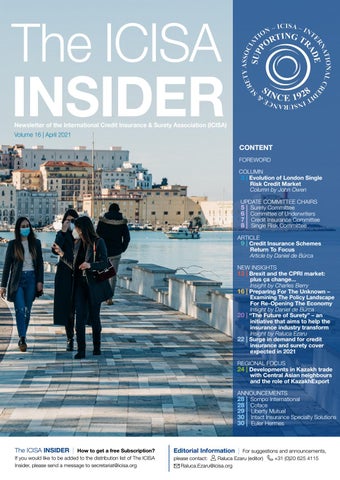
The ICISA INSIDER
The ICISA INSIDER | April 2021
Newsletter of the International Credit Insurance & Surety Association (ICISA) Volume 16 | April 2021
CONTENT FOREWORD COLUMN 3 | Evolution of London Single Risk Credit Market Column by John Owen UPDATE COMMITTEE CHAIRS 5 | Surety Committee 6 | Committee of Underwriters 7 | Credit Insurance Committee 8 | Single Risk Committee ARTICLE 9 | Credit Insurance Schemes Return To Focus Article by Daniel de Búrca NEW INSIGHTS
13 | Brexit and the CPRI market:
plus ça change... Insight by Charles Berry 16 | Preparing For The Unknown – Examining The Policy Landscape For Re-Opening The Economy Insight by Daniel de Búrca 20 | “The Future of Surety” – an initiative that aims to help the insurance industry transform Insight by Raluca Ezaru 22 | Surge in demand for credit insurance and surety cover expected in 2021 REGIONAL FOCUS
24 | Developments in Kazakh trade with Central Asian neighbours and the role of KazakhExport
ANNOUNCEMENTS Sompo International Coface Liberty Mutual Intact Insurance Specialty Solutions Euler Hermes
28 | 28 | 29 | 30 | 30 |
The ICISA INSIDER | How to get a free Subscription? If you would like to be added to the distribution list of The ICISA Insider, please send a message to secretariat@icisa.org
Editorial Information | For suggestions and announcements, please contact: Raluca Ezaru (editor) Raluca.Ezaru@icisa.org
+31 (0)20 625 4115 1
|
April 2021 | The ICISA INSIDER | Foreword
Foreword Richard Wulff Joins ICISA It is my pleasure to welcome Richard Wulff, who joined the secretariat earlier this year as the association’s next Executive Director. Richard will be formally ratified by members of ICISA at this year’s General Meeting of Members. Richard’s 30+ year career in the industry includes previous positions such as Regional Director at NCM (Netherlands), Executive Director at NCM Re (Ireland), Head of Department at Munich Re (Germany/India), Chief Underwriting Officer Ergo General Insurance (India) and Group General Manager at QBE (Australia/Hong Kong). Richard is very familiar with ICISA and knows our members well. As a former member, Committee Chair, Management Committee member and Vice President, Richard’s experience in the association and knowledge of the industries we represent, make him well placed to address the many challenges the industry and its players face in a post-pandemic world. Regulatory changes, a better understanding of the role of trade credit insurance, the growing need for surety in line with higher infrastructure and construction spending and much more increases the role of ICISA as representative of our members’ interests. Members of ICISA will see changes in the way we meet and communicate in line with changing needs and demands. Richard is already much involved in the day-to-day activities of the association in preparation of a smooth transfer this summer. I wish him every success in his new role as Executive Director of ICISA.
Rob Nijhout
|
2
Column | The ICISA INSIDER | April 2021
Evolution of London Single Risk Credit Market By John Owen, Head of Marine and Political Risks, AXIS Capital 2021 marks my 30th anniversary in the Insurance industry, and 25 years since my move into the Lloyd’s credit & political risks sphere. This was just two years after Lloyd’s had authorized its syndicates to underwrite single risk credit business alongside the fledgling political risk & contract frustration accounts that already existed. The anniversaries - along with Covid enforced WFH - have given me the opportunity to pause and reflect on how the London single risk credit market has evolved in that time. It has progressed from underwriters largely operating in their own London centric (but arguably peripheral) bubble to a market that has become a mature global exchange, integrated into the wider credit world. Although the general (whole turnover) credit insurance market has been in existence for around a century, I do feel fortunate that my insurance career has coincided with the era that London and the single risk market has really come into its own. In parallel with the insurance industry more generally, this market has acquired a reputation for professionalism and dependability. The market has survived several crises already in the last 25 years: the dotcom bubble, 9/11, GFC, 2014 Crimean crisis, the Commodity Price crash of 2013 /14. As the market has survived each crisis, the comfort level of the client base and banks in particular has increased. The market has become such an accepted part of banks’ risk distribution strategies that it has, in a very broad sense, improved the financial sustainability of global trade, and aided the growth of the worldwide economy. Improved technological capabilities have aided growth, and the market today - with its instant access to financial, political and economic data - is light years away from my early days. Back then although I had access to as many Economist Intelligence Unit reports as I wanted, I was limited to no more than a couple of dozen articles per month from the very expensive Reuters database!
>>> 3
|
April 2021 | The ICISA INSIDER | Column
>>> The progress made is testimony to the work of everyone involved and as the market has gone from strength to strength it has over time had a positive effect on talent development within the sector. The single credit risk market has become an established and accepted specialty in several territories, but particularly in London, and has over the past 25 years established itself as a viable and long-term career path for (re) insurance brokers, underwriters, credit analysts and those providing ancillary services such as loss adjusters and lawyers. The acquired reputation for professionalism has also helped the market attract new talent. Not many would have thought 25 years ago that we would have a stream of highly qualified bankers willingly moving into the credit insurance field, viewing it a viable long-term alternative to banking. As a result, there is greater diversity and choice when it comes recruitment, met by a higher level of interest from those looking to enter or move within the market. On a personal level it has always been apparent to me that the London single risk credit market should be part of the wider credit world. My team has been an active participant in the ICISA Single Risk Committee since it was established. Werner Jäger, the first Chairman of this committee, had the foresight to see the potential size and importance of the market back in 2009/10, and was instrumental in bringing the London based single risks industry out into the wider credit world where easier collaboration between entities such as the Berne Union, ITFA, IUA and the LMA has further raised the relevance of the market. Finally, I will pass the baton on to Andrew Phelan, a participant in the first Annual Single Risk Forum in London in 2010, even though at the time he was a broker rather than an underwriter. I’m not sure how he was allowed to break into the room back then, but having discussed it with Rob Nijhout (and I can’t write this article without wishing Rob a long and happy retirement and thanking him for all of his patience, persistence and general hard work over the last 20 years) we have decided Andrew’s prize is to write the next article for ICISA Insider…
John Owen Head of Marine and Political Risks AXIS Capital |
4
Committee Updates | The ICISA INSIDER | April 2021 The ICISA INSIDER | April 2021
Update Committee Chairs Surety Committee Marlène Hertel The pandemic continues to influence our lives both personally and professionally, working and living under the same roof, giving up travels, restaurants visits and social life. We held our spring committee meeting virtually, all confined in our countries and felt a great need to meet again in person. Nevertheless, members are motivated to work with ICISA and the surety committee on supporting the economy, our industry, and our clients. If one year ago our concern was the uncertainty about the impact of the sanitary crisis, today we focus on the effects of the termination of the measures taken by the governments to support the economy. We are optimistic that this development could facilitate risk sharing with banks and even the access for sureties to certain products until now issued exclusively by the banks. But we are also aware that risk assessment and mitigation are significant challenges for surety underwriters in the hardening environment. Taking a decision based on information reflecting an extraordinary situation is not easy, the more important is support from experienced underwriters who went through several economic cycles. Education and people development could be part of our next discussions. Another important topic discussed during the virtual spring meeting was the terminology project, with the aim of a common understanding of terms used by insurers and re-insurers around the world. The working group is progressing well and has prepared a product catalogue including bond definitions and particularities. The structure is defined, and products are already described, but, as the range is infinitely wide, it is now time to invite the members to complete the catalogue.
Marlène Hertel Chair of the Surety Committee Company: AXA Switzerland
The product catalogue will also allow to identify where ICISA network for advocacy and lobbying could be used to improve the awareness of sureties. A good example is the energy sector which is in full expansion, especially with the development of the green and renewable energy. Regulations, governmental investments and subsidies constrain companies operating in the energy sector to provide a whole number of bonds, ranging from bid, performance through concession, dismantling bonds, or payment and trading guarantees. This creates excellent opportunities for our industry and an exciting topic for the surety committee considering the variety of bonds needed and their specificities. A relevant subject to be put on the agenda. This is just an overview of the most important matters that we will follow up in the near future, but the list is longer and will grow once members can meet again in person and benefit of the great networking we all know from ICISA.
55
|
April 2021 2021 || The The ICISA ICISA INSIDER INSIDER | Committee Updates April
Committee of Underwriters James Deloz One year after the global outbreak of the Covid-19 pandemic and of the economic crisis which resulted from it, the situation from the Credit Insurers’ perspective remains remarkably calm. If anything, direct and indirect insurers report an even mildly better situation. Business volumes remain resilient and claims continue to be low ; for some direct Insurers claims are currently even very low. As before, members do expect claims levels to increase from mid-2021 onwards, when government support measures are expected to be wound down. However, most members do not, or not anymore, foresee a dramatic increase of claims even then. A lot will depend not so much on when the various forms of government support will be decreased, but on how that decrease will be organised: what will be the advance notice given and, above all, how gradual (or not gradual) will the decrease be. Members have no other choice but to prepare for this post-support phase, but at the same time their actions, if taken abruptly, may cause unwanted effects. Striking the right balance in this will be the Credit Insurers’ major challenge throughout most of 2021 and possibly early 2022, depending on when government support will be decreased or will be stopped altogether. Although the full impact of the pandemic-induced crisis is yet to come to the surface, the question is already being asked as to how government support could be organised differently when the next crisis occurs, as inevitably it will.
|
6
James Deloz Chair of the Committee of Underwriters Company: Credendo
In this crisis of an unseen magnitude, members do value the state support schemes via the trade credit insurers. At the same time, some members would have welcomed a less radical level of premium cession, if not in 2020, then at least in the extension into 2021. Still, the industry tends to continue making maximum use of the state support schemes. Whilst it is unrealistic to hope that government support could be organised at supranational level e.g. at the level of the EU, a minimum of alignment between the member states would be welcomed, if only on practical matters (e.g. in some countries, the state support scheme considers the nationality of the Insured, whereas other countries consider the nationality of the Policyholder). Such alignment would facilitate the Insurers’ management of the state support schemes.
Committee Updates | The ICISA INSIDER | April 2021 The ICISA INSIDER | April 2021
Credit Insurance Committee Niels Enevoldsen COVID-19 Pandemic is still influencing the work of the Credit Insurance Committee. The regular spring meeting was shorter than usually and took place virtually again. Many thanks to ICISA for setting up this meeting. Tour de table clearly demonstrated that the current main concerns are the development of the pandemic and the economic impact it might cause. It was interesting to learn about the different markets and the development of insolvencies – at the moment surprisingly moderate. State aid packages are still available and the visibility in the markets is very limited. Concerns are the number of zombie companies kept alive by state aid packages and if or when we might see a negative impact hereof.
Niels Enevoldsen Chair of the Credit Insurance Committee Company: Tryg Garanti
So the CIC will in the near future follow this trend closely and follow up on development in late payments/ insolvencies along with available state aid solutions. The committee will also closely monitor new demands arising from an unusual market situation. Our committee agreed to put together a working group to go through some essential FAQ’s concerning Credit Insurance. The aim of this project is to make the sector more accessible for anyone interested in understanding better the trade credit insurance industry. Another topic of interest for our committee was Brexit. Of course this will still be observed – there might come some legal/license questions up soon that must be addressed. The economic impact of Brexit is still to be monitored and discussed by the committee. We live strange times and the industry will most likely face new challenges that I believe will become topics of discussions for the Credit Insurance Committee.
77
||
April 2021 | The ICISA INSIDER | Committee Updates April 2021 | The ICISA INSIDER
Single Risk Committee Christian Hendriks “Anne, sister Anne, do you see anybody coming?” Sister Anne said, “I see nothing but a cloud of dust in the sun, and the green grass.” However, Sister Anne finally saw the brothers who eventually killed Bluebeard. We are miles away from having such visibility. There is dust in the air but it remains unclear what it will bring to our business? In this highly disruptive environment, one salient fact is that the CPRI market shows no disruption, while the Coronavirus crisis continues to have a severe impact on our societies for a second consecutive year. During its Open Forum, the Single Risk Committee recognized that the impact on the market remains on the low side. The predominant view is that claim situation will deteriorate over the next six or twelve months, driven by the phasing-out period of the governmental support schemes. Some members anticipate claims start rising already in the first semester, whereas others expect the second semester. The aircraft sector could be a case in point: members of the SR Committee discussed the probability that the sector could face liquidity issues, after the withdrawal of the governmental supports, pushing insolvencies and losses to high level. Anyhow, there is a general agreement that market situation will change by the end of the year. The certainty of the difficulties to come can be read in the hardening of the reinsurance market, also impacted by the natural catastrophes events in 2020. No disruption neither from the game changing after the Brexit: the London market has not been shaken up by major global change in market patterns. This demonstrates that the London market was well prepared for future proofing market in post Brexit era. It is the same report with regard to the Basel IV regulations whose processes have been delayed due to the Covid Crisis. This postponement provides more time to advocate against implications of
|
8
Christian Hendriks Chair of the Single Risk Committee Company: Credendo – Single Risk the new regulatory rules for European banks. The damaging effect will be the same for the banks and the credit insurers, which are doing more and more business with banks. Consequence of the pandemic crisis affecting the world’s commodity markets, the banks are taking a growing lion’s share in most of risk portfolio. Political risk insurers continue to see a rise in demand for cover, but level of demand remains below of pre-crisis levels. Risk appetite continues to improve and indicates a change towards green energy that has support of reinsurers and banks with the further integration of the ESG criteria. More than a trend, we can expect this issue to take the top of the agenda over the next few years. Single risk committee’s participants are looking for further diversification in new sectors while monitoring their exposures on traditional energy sources. Despites real market opportunities, the degree of uncertainty persists, with a large dispersion of potential outcomes. There is a systemic risk with high leverage ratios for corporates and sovereigns, with zombies companies and with the re-emergence of inflation risk. Whilst the market participants are cautiously optimistic, they recognize that the vaccine timing and availability within the countries is probably the most important factor that will define the playing level field for the coming months. Those issues will remain the prominent topics on the agenda during the next Committees, at least until the autumn one. Obviously, if we dare use the little key to open the secret closet, we might take some supply chain financing issues out of it…
Article | The ICISA INSIDER | April 2021
Credit Insurance Schemes Return To Focus By Daniel de Búrca, Head of Public Affairs, ICISA Expected increases in both claims and demand in the year ahead were the key take-aways from the latest ICISA State of the Industry survey. Looking at the wider context, members noted the important role played by state support schemes, including credit insurance schemes in this period. With many of the credit insurance schemes due to expire shortly, we look at this topic in more detail, as well as discuss what ICISA is doing to help members as they develop their thinking and prepare for the future.
Most TCI members responding to our latest State of the Industry survey reported that they participate in one or more of the state-backed credit insurance schemes. These schemes form part of the wider suite of measures used by countries to insulate businesses from the worst impacts of the pandemic. Most credit insurance schemes are located in EU member states, but can also be found in the UK, Canada and a small number of other non-EU countries. In the EU, these fall under the state aid temporary framework, which sets out broadly what member states can do to support their economies at this time. This temporary framework was due to expire in June, but was extended earlier this year until the end of 2021. Credit insurance schemes in the EU also follow this time frame, but with terms of the schemes due to expire in June, discussions with governments will begin shortly.
>>>
9
|
April 2021 | The ICISA INSIDER | Article
>>> With widespread agreement early on in the pandemic, credit insurance schemes were introduced to ensure limits could be maintained at a time when insurers acting prudently may otherwise have to reduce their exposures. As noted in a recent EIOPA staff paper:
“Many governments acted quickly in the COVID-19 crisis and, by means of state protection shields, enabled credit insurers to maintain their limits – for the benefit of their customers and the economy at large.” It was not possible to tell at the time, but other measures have had a significant impact on the functioning of credit insurance schemes. These other measures, which maintained liquidity in the real economy or deferred insolvencies, significantly reduced the occurrence of exactly the kinds of loss events the credit insurance schemes were designed to cover. At the same time, members have reported that schemes come with a significant administrative and reporting burden, as well as cost implications.
|
10
As discussed elsewhere in this edition of the Insider, how governments choose to open economies is a hugely important question. ICISA members will be paying very close attention to the decisions of policymakers in the coming months. If a more permanent recovery takes hold in the summer, governments will need to be ready to pull the levers available to them to restart the economy. Planning on how and in what order measures are lifted is essential to avoid unnecessary shocks at a time when the recovery may be relatively fragile. Which measures are maintained and which are lifted will be key. Those measures that directly support viable but vulnerable businesses will likely be prioritised. Resuming normal functioning of debt resolution mechanisms will be important. As mentioned, members expect claims to rise as some of these support measures are lifted. Getting the order and pacing of these next steps will be crucial to avoid unnecessary shocks on the one hand, and continuing to artificially preserve non-viable businesses on the other. What role the credit insurance schemes have in different markets during this transition and emergence phase of the pandemic remains open.
>>>
Article | The ICISA INSIDER | April 2021
To support ICISA members, we will continue to provide a forum for discussion of the challenges in the market, as well as opportunities to consider different approaches for the future. We have consulted members involved in schemes on the likely discussions ahead and what options and preferences they have. A white paper on possible models for schemes produced by ICISA early in the pandemic was influential and distributed widely. If members would benefit from another white paper setting out options for schemes in the coming months, we will provide this. ICISA has closely engaged with the European Commission during this time to communicate the views of members on a range of topics related to the pandemic. This includes a regular call for closer coordination of member state actions. With coordination of the way out of lockdown required, we will continue to make that case to key stakeholders. Our aim as ever is to support members in the decisions they make in their own markets, as well as inform ongoing debates and represent members views effectively.
11
|
April 2021 | The The ICISA ICISA INSIDER INSIDER | New Insights
|
12
New Insights | The ICISA INSIDER | April 2021
Brexit and the CPRI market: plus ça change... By Charles Berry, Chairman, BPL Global Today, two months after the end of the UK’s transition period, EU 27 clients of the specialist credit and political risk insurance (CPRI) market are dealing with EU regulated brokers and placing their business with EU regulated insurers - very different from the pre-Brexit world of mainly dealing with UK regulated brokers and insurers. Plus ça change. Despite this, the CPRI market’s EU clients, a very important part of the market, are placing very much the same business with the same global insurers. Operational problems over the last two months have been minimal, and longstanding commercial relationships have been maintained seamlessly over the whole Brexit transition. Plus c’est le meme chose. The London CPRI market handles only about 2% of the USD110 billion of annual premiums handled by EC3 based insurance businesses, but like our general insurance colleagues we are used to dealing in a highly regulated global marketplace. Close prudential regulation for (re)insurers and conduct regulation for both (re)insurers and intermediaries is right and proper, and protectionist barriers shielding domestic insurance markets are only to be expected. The gift of passporting into the rest of the EU from the UK, on the back of a single “home state” authorization, was very much the exception to the normal regulatory environment for international business. Even in the post Brexit world, the regulatory burden we face in Europe is far lower than the complex, state by state administered regulatory hurdles the London market has to navigate in the USA. Despite these regulatory differences the wider London market has nearly 50% of its business with North America and only about 15% with the EU 27 (though for the CPRI market those percentages are probably reversed). The Brexit vote in 2016 faced the market with the same challenge for Europe as we face in the rest of the world. In facing that challenge, the market acted on two assumptions: first, that Brexit would happen; and second, any deal with Europe would be the same for the London market as a “no deal” outcome, with no passporting or equivalence. Both assumptions proved right.
>>> 13
|
April 2021 | The ICISA INSIDER | New Insights
These challenges were simplified for many London insurance businesses by them being global businesses with EU 27 operations already in place. However, even for those businesses Brexit, while not a game changer, has certainly been a nuisance. For BPL, for example, it meant transferring many colleagues to the new UK branch of our well-established Paris business, no small change. However, most London market businesses began operating their post-Brexit model well in advance of the deadline, in our case from November 2019. Hence the minimal disruption at the start of 2021. The nuisance of Brexit has been shared by our clients. They had the job of vetting the EU platforms of the insurers previously using their UK regulated carriers. However, this task was set in motion well ahead of the deadline, and was often fairly straightforward. It was less straightforward for Lloyd’s. However, as well as a unique ability to combine entrepreneurial underwriting with massive financial strength, Lloyd’s genius over the years has been its ability to adapt to its everchanging environment. Lloyd’s Brussels became the latest manifestation of this ability. However, for our banking clients in particular, it took time and effort for clients to see the corporate Lloyd’s Brussels as presenting effectively the same security as the Lloyd’s
>>>
|
14
The ICISA INSIDER | April 2021
syndicates that sit behind it and with whom they were used to dealing direct. What are the London insurance market’s expectations over the anticipated EU-UK MOU on financial services? We as brokers expect little, not least as the EU Insurance Distribution Directive (IDD) does not recognise equivalence. Furthermore, even if progress is made for (re)insurers, for example on Solvency II, the CPRI market does not expect its new model for servicing EU based clients with EU regulated brokers placing business with EU regulated insurers to change. Has Brexit effected CPRI market appetite? In our view, not at all. The last 12 months has been all about the pandemic which initially had a material impact on insurers’ appetite, even though today activity has returned to pre-pandemic levels. Of course, the pandemic has also seen a dramatic effect on the London market’s operations. Home working, Teams and Zoom, and electronic trading has mentally untethered the market from EC3. The CPRI market is now more than ever functioning as one global, virtual coffee shop. CPRI market brokers and insurers, including many who use the Lloyd’s platform, see themselves as global businesses serving predominantly global corporations and financial institutions. London, along with New York, Bermuda, Paris, Zurich, Singapore and others, will a key hub for the CPRI market and other specialty (re)insurance business because of its unique insurance ecosystem, its language, its geographical position and its time zone, and (we hope) its continuing competitive regulatory regime.
NOW AVAILABLE
Catalogue of Credit Insurance Terminology The new German edition of the catalogue is available. It can be downloaded from the ICISA website at www.icisa.org To order a hard copy, please send an email to secretariat@icisa.org
However, the CPRI market and the other global specialty insurance markets remain respectful and compliant with the very wide range of different regulatory regimes in the territories where we conduct our business. Brexit has certainly changed the way we operate: the end of passporting means the CPRI market is now more European, not less.
Charles Berry Chairman BPL Global 15 15
| |
April 2021 | The ICISA INSIDER | New Insights
PREPARING FOR THE UNKNOWN – Examining the policy landscape for re-opening the economy By Daniel de Búrca, Head of Public Affairs, ICISA
With equal measures of hope and fear, “What happens next?”, is a question people have been asking themselves and their governments for the best part of a year. While infections continue to fluctuate and vaccine rollout has been less than perfect in many locations, there at least seems to be an emerging path out of lockdown. Returning to normality is everyone’s goal, but how we get there is a complicated question and the implications for different approaches is something we at ICISA are looking at closely.
|
16
New Insights | The ICISA INSIDER | April 2021
>>> Unwinding the complicated web of support measures that have been introduced around the world is a huge challenge facing governments. The question for those in power is not simply, when should this happen or under what circumstances can it begin, but also which measures can and should be lifted first; which ones need to remain in place; and, what additional measures may be needed to mitigate the shock that turning off the tap may cause?
Those pulling the levers of policy will need to be conscious of not only how consumer confidence rebounds, but the extent to which consumer behavior might have changed permanently. The level of support in place also dictates some of the complexity for governments. Economies more widely protected may have been better insulated from the impact of lockdown, but unraveling measures may be a more delicate prospect and the potential for shocks greater.
It was understandable that support structures put in place early in the pandemic were relatively blunt tools intended to insulate the entire economy quickly. Governments intended to protect otherwise healthy businesses, which under normal circumstances, would have remained viable. A side-effect of the broad approach taken has been that not only are viable companies protected, but potentially non-viable ones too.
In November 2020, the OECD highlighted two of the key medium-to-long term challenges governments would have to respond to: increased insolvencies, and the prospect of debt overhang on investment. The authors noted that, ‘…policy makers need to strike a balance between the risk of phasing out support too early (thereby leading to liquidation of viable firms) and providing across-the-board support for too long (favoring the persistence of inviable firms)’. They suggest that a flexible approach which couples equity boosting measures for viable firms, as well as debt re-structuring and ultimately resolution mechanisms for non-viable firms.
To complicate matters further, the impact of the pandemic has been highly asymmetrical. Some industries have not only maintained their standing, but improved their position, while others have seen their entire business model questioned.
>>> 17
|
April 2021 | The ICISA INSIDER | New Insights
>>> Similarly, a paper published via the IMF in May 2021 by Yan Liu, José Garrido, and Chanda DeLong called Private Debt Resolution Measures in the Wake of the Pandemic identifies three key phases in the policy response of governments to the pandemic: the freeze phase (for early in the pandemic to respond to the immediate shock); the transition phase (interim measures as the economy emerges from lockdown); and, the final phase, combatting debt overhang. An interesting idea proposed by the authors is a triage system, which would help to identify businesses and sectors requiring targeted support going forward, while also creating a path to restructure debt or resolve non-viable entities. The authors note, ‘During this phase, insolvency and debt enforcement activity needs to be maintained, as it is crucial to uphold payment discipline and to incentivize debt restructuring’. However, as the situation stabilises, they recommend an eventual return to normal resolution and insolvency mechanisms. They also recommend governments consider reforms that could be introduced now to make these systems more efficient for when they will be needed. Understanding how and when governments will open economies will give businesses the time (and potentially the tools) needed to prepare themselves for the end of certain measures and the introduction of others. For the EU in particular, close coordination between member states is essential and can make up for the lack of coordinated action early in the crisis.
|
18
New Insights | The ICISA INSIDER | April 2021
>>> Governments need to consider carefully which support measures remain in different phases of recovery. They should carefully weigh whether the steps they take will enable the economy to resume normal functioning in an orderly fashion. Amongst other things, this could include ensuring that any stimulus is directed towards viable businesses, while providing an efficient path to resolution for non-viable firms. For ICISA members, what governments do next is also a complicated question. As noted in our recent annual survey of members, members expect claims to rise in both TCI and Surety, but demand for products and services is also expected to grow due to the increased perception of risk. New economic stimulus packages, such as the recent USD 1.9 trillion relief bill in the US, plus expected further investment in infrastructure around the world are also likely to have an impact on our industry. At the same time, state-backed credit insurance schemes also remain in place in a number of EU markets as well as a smaller
number of non-EU markets. In the EU context, the temporary framework, which allows member states to introduce support measures, was extended in January to apply from 1 July until the end of 2021. Discussions in member states with credit insurance schemes are likely to resume shortly on whether, or in what form, those arrangements are prolonged. Whether these schemes are considered necessary for the transition to normal economic functioning remains an open question. We discuss some of the intricacies of this debate from the perspective of ICISA members elsewhere in the Insider. Blanket support from governments have been very successful in limiting the damage of the pandemic on economies. Given that some sectors are likely to remain impacted and recover slower than others, a more targeted approach may be needed going forward. “What happens next?” remains as unclear as ever, but governments have a number of tools at their disposal to prepare and respond. Transparency and early planning can give businesses - and society - the opportunity to plan ahead effectively.
19
|
April 2021 | The ICISA INSIDER | | New NewInsights Insights
“The Future of Surety” – an initiative that aims to help the insurance industry transform By Raluca Ezaru, External Relations & Information Officer, ICISA In a press release published in December 2021, we announced our collaboration with The Institutes RiskStream Labs on a blockchain initiative that looks at the current process of registering, maintaining and verifying powers of attorney with the goal of making these processes less expensive and more efficient. Our intention was to bring together professionals to cooperate on solving some of the pain points in surety sector, in a collaborative approach that enables everyone to get in the game.
|
20 20
Not a big surprise that two months later, four more International Surety Associations welcomed our initiative, showing interest and support. Currently, along with Surety & Fidelity Association of America (SFAA), the National Association of Surety Bond Producers (NASBP), the Surety Association of Canada, and the Pan American Surety Association (PASA) we took some steps supporting a global approach to solve the business challenges of transforming power of attorney processes in this digital age.
>>>
New Insights | The ICISA INSIDER | April 2021
>>> As a first step, with support from The Institutes Riskstream Labs, we give everybody a four month innovative network opportunity with goal to build and gain global awareness and build a network for the surety community. Our first two workshops were a real success, reaching out more than 130 participating organisations. The third workshop of the first phase is scheduled for 28 April 2021, with the fourth workshop tentatively planned for May 19th. We would like to thank everyone participating in this working group for their input and hope this will lead to a successful initiative that will shape the future of Surety business. If interested in taking part on this project, please contact Hampel Sandy at hampel@theinstitutes.org.
Who is The Institutes RiskStream Collaborative? The Institutes RiskStream Collaborative was created by The Institutes, a non-profit, 100+ yearold organisation that provides educational support, resources and leading research to help those in risk management and insurance better serve the public. The Institutes RiskStream™ Collaborative aims to create an ecosystem within the risk management and insurance industry that leverages a scalable, enterprise-level blockchain/digital ledger technology framework to streamline the flow and verification of data in order to lower operating costs, drive efficiency from improved processes, and enhance the customer experience.
21
|
April 2021 | The ICISA INSIDER | Press Release
Surge in demand for credit insurance and surety cover expected in 2021 Amsterdam, 3 March 2021
After unexpectedly benign claims in 2020, credit insurers and sureties also expect a rise in claims in 2021. In the latest annual state of the industry survey, members of the International Credit Insurance and Surety Association (ICISA) anticipate increased demand for credit insurance and surety. As government support measures are wound down, ICISA members expect a resulting rise in claims in the course of this year.
Trade credit insurance 95% of ICISA trade credit insurance respondents anticipate an increase in global demand for credit insurance cover in 2021, due to greater risk awareness and increased likelihood of defaults. Members also expect increased demand for cover in countries heavily affected by the pandemic, such as Spain and Portugal, due to greater risk perception stemming from the effects of the pandemic in those economies. For single- and political risk underwriters, growth is anticipated in OECD countries and Brazil, in particular. Underwriters also expect growth in countries that have recovered more quickly from the pandemic, such as China, as well for countries in Europe, Africa and Asia with a high GDP growth potential. Almost all members expect an increase in claims in 2021 as the economy recovers and economic support measures are wound down, in particular in Europe, Latin-America and the U.S. An orderly and coordinated wind-down of
|
22
support measures may ease this concern. A small number of respondents (40%) expect claims to rise further in 2022. Pricing is expected to harden further, continuing a trend that began prior to the Covid-19 pandemic. In countries without government support schemes or where these are limited, respondents expect a harder market to match the increased risk in these markets. When it comes to new products and new policies launched, insurers focused on developing new digital products, improving automation and introducing policies in support of sustainable development.
Government support Most ICISA Trade Credit Insurance members participate in one or more of the credit support schemes set up by governments in various countries. This support is not aimed at insurers themselves, who are and remain solvent, but rather at the companies that are insured, in protection of those companies, the jobs they represent, their supply chains and buyers. There was wide agreement that it was important that risks continued to be insured allowing vulnerable, but otherwise healthy companies to stay in business. In retrospect the effect of these schemes is mixed. The credit support schemes are costly for insurers and carry an administrative burden, while the effect of these schemes on risk appetite is limited. In general exposures were reduced selectively or not at all and this applies to countries with and without a credit risk support scheme.
>>>
New Insights | The ICISA INSIDER | April 2021
The schemes are important for the traders they aim to protect. A sudden or disorderly cancellation of economic support measures risks creating an unintended shock and exacerbating a situation that these measures aimed to avoid. An orderly and coordinated wind-down will determine their ultimate success. ICISA members will continue to support their policyholders during these changes.
Surety A majority of surety members expect an increase in demand for cover in the coming year, driven largely by expected growth in infrastructure spending. Sureties foresee growth in Latin-America, Europe, South Africa, China and the US. Almost all of ICISA surety members (85%) expect a sharp increase in claims paid in 2021, and some 40% expect this to continue in 2022. Respondents perceive an increased risk in countries where government support measures are available, as well as in tourism-dependent countries.
Top tutors share highest quality knowledge JOIN! STECIS ‒ the Credit Insurance and Surety Academy
Given long-term healthy prospects of surety markets, this market is expected to remain competitive with ample capacity to meet demand. One of the benign consequences of the pandemic is the launch by sureties in the past 12 months of new initiatives that aim at providing a complete digital experience and further integrating new technologies into their business models.
Learn more at www.stecis.org
23
|
April 2021 | The ICISA INSIDER | Regional Focus
Developments in Kazakh trade with Central Asian neighbours and the role of KazakhExport Expanding the geographical spread of sales markets for Kazakhstan’s products and improving their competitiveness are among the priority tasks of Kazakhstan’s economy. In particular, Kazakhstan pays much attention to the development of cross-border trade, elimination of trade barriers, provision of free movement for goods and services within the implementation of its National Export Strategy Program.
first on major infrastructural projects and promotion of international production cooperation, which will boost mutual trade turnover. Experts forecast that in the mid-term, trade will be actively transformed from supplies of raw materials to joint cooperation in the manufacture of end products.
For Kazakhstan - Kyrgyzstan and Uzbekistan are in the category of high export interest and although they lag behind Russia and China in terms of transportation availability of freight traffic, and forecast of growth of export and import volumes, they are still promising sales markets.
Kazakhstan borders Kyrgyzstan to the south where the most densely populated areas of the country. Both are full members of the Eurasian Economic Union. Trade and economic cooperation between Kazakhstan and Kyrgyzstan in recent years is marked by positive dynamics, however there are significant reserves for further development in such areas as investment cooperation, diversification of mutual trade structure, and increasing trade volumes.
Kazakhstan is gradually deepening and expanding its trade and economic cooperation with these countries, focusing
|
24
Kyrgyzstan
>>>
Regional Focus | The ICISA INSIDER | April 2021 The Kazakhstan Institute of Strategic Studies under the President of the Republic of Kazakhstan reports that in 2020, Kyrgyzstan ranked number 18 by volume of trade turnover among key foreign trade partners of Kazakhstan. Kyrgyzstan accounts for 0.9% of trade turnover, including 1.2% export and 0.6% import. In 2020, the trade volume between both countries was almost USD 800 million, including USD 564 million of exports from Kazakhstan and USD 235 million of imports. Thus, Kazakhstan has a positive balance of USD 329 million in its trade with Kyrgyzstan. Agricultural products and raw materials were the major components of trade between the countries in 2020. The bulk of Kazakhstan’s export to Kyrgyzstan was generated by four groups of commodities: foodstuffs (30%), mineral products (28%), products of chemical industry (13%) and engineering products (12%). In 2020, trade with Kyrgyzstan shrank by 15.3% due to the ongoing global crisis, including a decrease in exports by 9.9% and imports by 26%. This dynamics is not solely a feature of Kazakh-Kyrgyz trade as similar trends have been seen in foreign trade of the country overall. Indeed, trade with Kyrgyzstan decreased to a lesser extent than the aggregate foreign trade turnover of Kazakhstan. Moreover, mutual investments have gained special focus where Kazakhstan captures their bulk. In recent years, Kazakh investment activities in Kyrgyzstan have increased – 2019 performance was more than twice the average volume of
gross inflow of foreign direct investments into the country from Kazakhstan for the past 15 years (USD 57 million). KazakhExport is the only dedicated insurance organization acting as a development institution of the Republic of Kazakhstan. It includes the functions of an export credit agency and provides exporters of the processing sector and secondtier banks with insurance protection against a non-payment risk in foreign trade transactions and guarantees the security of export transactions. In December 2019, KazakhExport opened a foreign representative office in Bishkek, the capital city of Kyrgyzstan. However, companies from Kazakhstan exporting their products to Kyrgyzstan have received insurance support even earlier, since 2017. KazakhExport has supported producers with their exports of transformers, building materials, oil and fat, medication, textile, confectionery, macaroni and flour, different household chemicals, cleaning and polishing products to Kyrgyzstan. Total volume of obligations of KazakhExport undertaken under supported projects with exports to Kyrgyzstan for four years totaled USD 40 million. Along with that, last year reached USD 2,3 million, which is 1,6 times less as compared to 2019. This was objectively affected not only by COVID-19, but also by an unstable political situation in Kyrgyzstan in autumn 2020, which automatically increased the probability of different risks for Kazakh exporters.
>>>
25
|
April 2021 | The ICISA INSIDER | Regional Focus
>>> Uzbekistan Uzbekistan is also a strategically important trade partner for Kazakhstan in the region . In 2020, it was planned to increase mutual trade turnover between the countries up to USD 5 billion, however COVID-19 caused a drastic decrease in these figures. Still, Kazakhstan appears among the top three trade partners in export of goods to Uzbekistan, accounting for USD 2.1 billion and even boosted exports to USD 1.9 billion in 2019. Agricultural products and raw materials dominated in the structure of foreign trade between two countries in 2020. However, a significant volume of Kazakhstan’s export also included products related to the processing industry: aluminium and aluminium products (USD 124 million), motor vehicles and components (USD 119 million), products of flourand-cereals industry (USD 93 million), animal or vegetable fats and oils (USD 60 million), etc. KazakhExport opened a foreign representative office in the Uzbek capital, Tashkent, in March 2019. For a period of four years, the company has provided support to Kazakh producers with their exports to Uzbekistan to the value of USD 80 million. The highest volume of insurance support, USD 64 million, was recorded in 2020, which is a six-fold increase from the previous year. KazakhExport supported producers with exports of transformers, confectionery, starch syrup, insulation boards and ceiling skirt boards from expanded polystyrene foam, cattle meat, coke, mineral wool, reinforcing bars, cement, polymer and cable products, sunflower oil, polysulfide joint sealer, polyethylene pipes, furniture, flour and macaroni |
26
products, pipes, dairy products, motor vehicles, gas and electric boilers. The company has also helped them to provide logistic and construction services. Export contracts in 2020 were supported to the value of USD 208 million. KazakhExport proactively supports development of mechanical engineering in Kazakhstan. Since early 2020, it has financed a letter of credit for delivery of 1,064 JAC vehicles produced jointly with Uzavtosanoat JSC in the facilities of local automaker, SaryarkaAutoProm, to Uzbeksitan for an amount of USD 16.5 million. In Q4 2019 the company, though export credit insurance, supported a transaction for delivery of 400 Ravon Nexia R3 vehicles of Kazakh-Uzbek production for USD 3.4 million to Russia. Vehicles were also assembled by the carmaker in Kostanay. This performance came true thanks to a close cooperation with different development institutions and financial organizations in Uzbekistan. The company can raise export trade financing from local banks to buy products made in Kazakhstan while providing importers with its insurance coverage under credit risk. In 2019, KazakhExport partnered with a number of banks in Uzbekistan, including Ipoteka bank, Turon bank, Tenge bank, Aloqabank, Qishloqqurilish Bank, etc. In early 2021, several agreements were signed during a visit of chairman of Management Board of KazakhExport. These include an agreement with Ipak Yuli Bank to finance deliveries of products from local iron works and flour to Uzbekistan, an agreement with Asia Alliance Bank to implement a project of export deliveries of products of a meat cluster located in Aktobe Region to Uzbekistan.
Regional Focus | The ICISA INSIDER | April 2021
Tajikistan Tajikistan is a country of moderate export interest for producers from Kazakhstan due to its limited sales market. However, Kazakhstan’s export to Tajikistan in 2020 totaled in USD 693 mln. Major export items were grain, fuel, metals. Processing sector was represented mainly by products of flour-andcereals, animal or vegetable fats and oils, electrical machinery and equipment. KazakhExport opened an office in Dushanbe, the capital of Tajikistan, in May 2019. This establishes contacts with the local business community and raises awareness about KazakhExport tools, helps exporters overcome different barriers to increase trade turnover between countries. Major cases include arrangement of export financing for H125 Airbus Helicopters of Eurocopter Kazakhstan Engineering LLP for Somon Air LLC. Within this project KazakhExport has provided the company with export trade financing together with major partner bank – Orienbank – and it implemented major projects with insurance coverage for delivery of chemical and construction products for the major Tajik importer - TALCO MANAGEMENT LIMITED. Overall, since 2017 KazakhExport has undertaken insurance obligations within export contracts for USD 19,2 million. It has provided insurance for deliveries of fat and oil products, confectionery, paint materials, motor vehicles, reinforcing bars, petroleum coke, mineral fertilizers, refractory products.
Orienbank, Amonatbonk, Eskhata Bank, International Bank Tajikistan, Spitamen Bank. It has also signed a cooperation agreement with Export Agency at the Government of the Republic of Tajikistan.
Looking ahead In early 2021, President of the Republic of Kazakhstan instructed the Ministry of Trade and Integration to speed up in quality terms operations for establishment of a national distribution network, ensure conditions to saturate the market with domestic products and sustainable development of this sector. The system must become a foundation for Eurasian distribution network consisting from a network of wholesale distribution centers in Uzbekistan, Tajikistan and Russia. In particular, take measures in order to enhance trade and logistic potential of Kazakhstan from viewpoint of expansion of sales markets for products made in Kazakhstan and involvement in cooperation projects within the EAEU and with third countries. In this connection, KazakhExport which is subordinate to the Ministry of Trade and Integration of the Republic of Kazakhstan, will continue efforts to improve tools of insurance support, enhance relations with importers in countries of presence of its foreign representatives, promote export of non-primary products abroad.
The company has reached cooperation agreements with different government agencies and financial institutions. Today, its partners include all the major banks of Tajikistan such as
27
|
April 2021 | The ICISA INSIDER | Announcements
ANNOUNCEMENTS Micaela Cojocaru the new Global Head of Trade Credit & Surety for Sompo International’s Global Reinsurance Micaela Cojocaru has been named Global Head of Trade Credit & Surety for Sompo International’s Global Reinsurance business effective 1 March 2021. Micaela joined the company in November 2012 as Deputy Head, and succeeds Christoph Virchow, who after 30 years in the industry, will retire and transition to an advisory role on 1 May 2021. With more than twenty years in the trade credit and surety market, Micaela has held various senior roles on both the underwriting and broker side including Senior Vice President Trade Credit and Surety with Munich Re, Senior Consultant at Chiltington Consultants and Director Credit and Bond at Howden Broking Group. Micaela Cojocaru Global Head of Trade Credit & Surety Company: Sompo International’s Global Reinsurance
In her new role, Micaela will build on the successful strategy already in place for the firm’s Trade Credit & Surety global reinsurance offering while focusing on further positioning Sompo International and the business as a relevant and committed partner for professional players in the industry. Micaela is based in the company’s Zurich office and can be reached at mcojocaru@sompo-intl.com.
Bernardo Sanchez Incera appointed Chairman of the Board of Directors Following the change in the shareholder base and the arrival of Arch Capital Group Ltd. (Arch) - (NASDAQ: ACGL) - in Coface’s capital, COFACE SA’s Board of Directors is evolving. Bernardo Sanchez Incera has been appointed Chairman of the Board of Directors. The transaction between Natixis and Arch for the sale of a stake in Coface’s capital, which was announced on 25 February 2020, has received all the necessary approvals for its closing. As a result, Arch now holds 44.8m shares of Coface, representing 29.5% of the company’s capital.
Bernardo Sanchez Incera Chairman Company: Coface
In accordance with the statements made when the agreement was announced, all the directors representing Natixis have resigned. The Board then co-opted four directors presented by Arch as well as Bernardo Sanchez Incera, who was then appointed Chairman of the Board. As of today, Coface’s Board of Directors has therefore 10 members, 4 women and 6 men, the majority (6) of whom are independent directors. Coface’s general management wants to thank Natixis and BPCE board members for their personal involvement and their contribution to Coface’s governance over the past years. The Board of Directors reaffirmed its confidence in the management team and the relevance of the Build to Lead strategic plan.
>>> |
28
Announcements | The The ICISA ICISA INSIDER INSIDER || April 2021
>>> Bernardo Sanchez Incera, Chairman of Coface, declared:
“First of all, I would like to thank Coface’s Board of Directors for the trust they have placed in me. In this very unusual period, I have a total confidence in the ability of all the Coface teams, under the leadership of Xavier Durand, to continue implementing the Build to Lead strategic plan. I am also pleased to welcome the representatives of Arch Capital Group.”
Declan Daly is appointed Group Chief Operating Officer of Coface Declan Daly has been appointed Chief Operating Officer of the Coface Group, effective as of April 1, 2021. He will continue to report directly to Xavier Durand, the Coface Group’s Chief Executive Officer, and will join the Group’s Executive Committee. In this newly created role, Declan will be responsible for furthering and accelerating Coface’s transformation terms of service quality and operational efficiency across the Group.
Declan Daly Chief Operating Officer Company: Coface Group
This role is a part of Coface’s “Build to Lead” strategic plan. Building on Coface’s previous “Fit to Win” strategic plan, Build to Lead focuses on operational efficiency and customer service quality. The objective of this plan, launched in February 2020, is to position Coface as a leading player in the credit insurance sector, particularly in terms of service quality. Declan has a very strong record of accomplishment in operations management as well as business transformation, both in the financial services sector and in the manufacturing industry. Declan has been Chief Executive Officer of the Central & Eastern Europe Region at Coface since 2017. He started his career in software engineering at ABB in Ireland and Austria, before joining General Electric Company in 2000. In 2002, he became Operations Director of GE Money Bank in Switzerland, before being appointed Managing Director of GE Money Bank in Austria in 2006. In 2009, he joined the Western Union Financial Services management team as Vice President of the European region, heading the B2B business. In 2014, Declan was appointed CIO and member of the Executive Committee of Semperit Holding AG. Declan, 54, holds a degree in electronic engineering from Dublin City University and an MBA from INSEAD. Declan’s successor will be announced at a later date. In the meantime, Jaroslaw Jaworski, CEO of Coface in Poland, will act as interim CEO of the Central & Eastern Europe region.
Liberty Mutual Since March 1, all surety activities of Liberty Mutual in Europe operate under the name of Liberty Mutual Surety to reflect the fact that they are now one organisation. This includes the surety activities in the branch offices of Liberty Specialty Markets in France, Germany, Italy and the United Kingdom, as well as the former AmTrust surety activities in Spain. Most notably, it also includes the activities of Nationale Borg in the Netherlands and Belgium. The Nationale Borg brand disappears from the market after more than 127 years. Nationale Borg was one of the oldest dedicated surety companies in Europe and a long-time member of ICISA.
>>> 29
|
The ICISA ICISA INSIDER INSIDER | Announcements April 2021 | The
>>> Introducing Intact Insurance Specialty Solutions, formerly OneBeacon and The Guarantee. We are proud to announce that we are now operating under a single name throughout North America. Intact Insurance Specialty Solutions is here with the same depth of expertise you have come to know and trust, and tailored solutions for a wide range of industries, including surety bonds. One team. One brand. Intact Financial Corporation (IFC) is the largest provider of property and casualty (P&C) insurance in Canada and a leading provider of specialty insurance in North America. In 2017, Intact emerged as a leading provider of specialty insurance throughout North America with the acquisition of OneBeacon Insurance Group. In 2019, the company continued to expand its North American footprint with the acquisition of The Guarantee Company of North America, further solidifying its commitment to surety. Today, Intact is the sixth largest provider of surety bonds in North America. This year Intact continued to expand and strengthen its surety capabilities with the acquisition of International Bond & Marine Brokerage, Ltd. (“IB&M”), a market-leading brokerage providing risk management solutions to the international trade industry. As a result, Intact Surety can provide a full suite of customs bond capabilities to customers and brokers. Now, fully integrated, the entire North American specialty team operates under a single brand. We look forward to continuing to provide our customers and brokers with our hallmark specialized products and dedicated services, backed by the strength of the Intact brand.
Euler Hermes Asia Pacific appoints ASEAN CEO Euler Hermes Asia Pacific is pleased to appoint Shan Aboo to the office of ASEAN CEO, effective 1 April 2021. Mr Aboo will be based in Singapore, overseeing Euler Hermes’ operations in the ASEAN markets, namely Malaysia, Thailand, and Indonesia as well as Singapore. He will be reporting to the Head of Region at Euler Hermes Asia Pacific Holger Schaefer.
Shan Aboo Chief Operating Officer Company: Euler Hermes
Mr Aboo joined Euler Hermes in 2008 in Dubai as a Business Development Manager covering the GCC market, before moving to Singapore as the Commercial Director for Euler Hermes ASEAN in 2012. Since 2016, he has been the Regional Director for Euler Hermes World Agency Asia Pacific responsible for expanding and servicing the multinational business accounts in the region.
Commenting on his new role, Mr Aboo says,
“I am thrilled to re-join the Euler Hermes ASEAN team and it feels like returning home in some ways. With deep roots across ASEAN and an unmatched product offering, Euler Hermes is uniquely positioned to support our clients and business partners across the region, especially during these times of economic uncertainty. I look forward to working closely with the talented and experienced ASEAN team to drive profitable growth and localized solutions in this dynamic part of the world.” |
30
The ICISA INSIDER The ICISA INSIDER| April | April2021 2021
A Guide to Trade Credit Insurance By the International Credit Insurance & Surety Association A practical and accessible industry-wide reference on Trade Credit Insurance, written by a team of industry experts.
This compact volume is a practical guide for anyone interested in Trade Credit Insurance. The International Credit Insurance & Surety Association (ICISA) presents an approachable but detailed guide written collaboratively by carefully selected industry experts. The guide describes the ‘lifeline’ of the credit insurance product, from the initial application stage to the expiration phase of the policy, including practical use aspects for credit managers. The volume offers compact information on the history of trade, the need for protection against trade credit risks, and solutions offered by credit insurance providers. The focus is on short term credit, including whole turnover policies and single risk policies.
Readership Suitable for anyone interested in Trade Credit Insurance, from credit managers to policymakers.
Key selling points • • • •
Collaboration of a diverse group of experts from top organisations around the world Written in an approachable style, accessible to the non-specialist Includes extended glossary of key terminology Includes a list of relevant resources for further reading
Content Foreword; Introduction; Disclaimer; 1.What is trade?; 2. What is trade credit insurance?; 3. Product types; 4. Risk types; 5. Typical set-up of a trade credit insurance contract; 6. Premium, the price for cover; 7. Day-to-day policy management; 8. Buyer risk underwriting in trade credit insurance; 9. Debt collection; 10. Imminent loss and indemnification; 11. Renewal, expiry, termination of a policy; 12. Single risk business; 13. The single risk insurance market: Private and public players; 14. Reinsurance of Trade Credit Insurance; Trade Credit Insurance resources; Glossary of trade credit terminology
About the Author(s) / Editor(s) The International Credit Insurance & Surety Association (ICISA) brings together the world’s leading companies providing trade credit insurance and surety bonds. ICISA promotes technical excellence, industry innovation and product integrity, as well as addressing business challenges generated by new legislation.
Where to order my copy? The book can be ordered from Barnes&Noble and Bol.com.
31 31
| |
April 2021 | The ICISA INSIDER
ICISA Members
ICISA Herengracht 473 1017 BS Amsterdam The Netherlands +31 (0)20 625 4115 secretariat@icisa.org www.icisa.org
Registered Number: 64391736
|
32