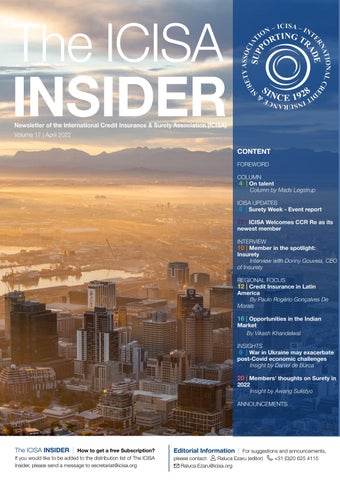
The ICISA INSIDER
The ICISA INSIDER | April 2022
Newsletter of the International Credit Insurance & Surety Association (ICISA) Volume 17 | April 2022
CONTENT FOREWORD COLUMN 4 | On talent Column by Mads Løgstrup ICISA UPDATES 5 | Surety Week - Event report
22 | ICISA Welcomes CCR Re as its newest member INTERVIEW 10 | Member in the spotlight: Insurety Interview with Donny Gouveia, CEO of Insurety REGIONAL FOCUS
12 | Credit Insurance in Latin
America By Paulo Rogério Gonçalves De Morais
16 | Opportunities in the Indian Market By Vikash Khandelwal
INSIGHTS 6 | War in Ukraine may exacerbate post-Covid economic challenges Insight by Daniel de Búrca
20 | Members’ thoughts on Surety in 2022 Insight by Awang Sulistyo ANNOUNCEMENTS
The ICISA INSIDER | How to get a free Subscription? If you would like to be added to the distribution list of The ICISA Insider, please send a message to secretariat@icisa.org
Editorial Information | For suggestions and announcements, please contact: Raluca Ezaru (editor) Raluca.Ezaru@icisa.org
+31 (0)20 625 4115 1
|
April 2022 | The ICISA INSIDER
|
2
|
Foreword
Foreword
|
The ICISA INSIDER | April 2022
Foreword
Dear reader, Welcome to this new Edition of the Insider magazine. It’s the first one of 2022, a year that we’ve probably all looked at with hopes. Sadly, these first months of the year weren’t as expected by most of us, with an ongoing war in Europe for two months already, which impacts the global economy on several layers. Daniel de Búrca, our colleague at ICISA Secretariat, wrote an article on the possible impact of the current war following the post-Covid economic challenges (page 6). At ICISA, not long ago, we organised the first ever Surety Week, an event that was welcomed by different stakeholders working in or with surety products. You can read about the success of this event in our event report on page 5. One of the topics of the ICISA Surety week was “Surety in Emerging Markets”. This was one of the most popular topics of the Surety Week. That is not surprising. Apart from natural curiosity, we all know that a thriving market must growth. Emerging markets do just that. As a natural continuation of this topic , we are highlight in two emerging regions in the edition of The Insider: Latin America and India. Paulo Rogério Gonçalves De Morais explains the commitment of PASA on the development and promotion of credit insurance in Latin America. On India, the newest country to join the global surety market, we’ve got Vikash Khandelwal from Eqaro Surety to show the promise and opportunity of this huge country. Amongst the topics that you may find in this edition are a spotlight on our member Insurety, a welcome message from CCR Re, our newest member and an article outlining the views of our members on the challenges in near future. These views are collected in surveys amongst our members. I am pleased that these results were collected by the newest member of our secretariat, Awang Sulistyo. Furthermore, our opinion column features Mads Løgstrup of the Danish Company Tryg Garanti. Mads shares his thoughts on how to make our industry a better place to work to attract and retain the talent that we need. While we at ICISA Secretariat we’ll continue being busy preparing our upcoming “in person” (isn’t this very pleasing to read?) meeting, the ICISA AGM Week, taking place in May/June in Helsinki, Finland, we hope you will have an inspirational journey through this magazine and that we’ll see many of you soon again. Richard Wulff
3
|
April 2022 | The ICISA INSIDER
| Column
The number of things I know little of is amazing. So most doors are now open. I just need to make up my mind, which is not difficult. I have for some time been trying to get my arms around what it would take to make our industry a better place to work. We are competing for new talent with lots of other industries. And new talents are increasingly shifting their priorities. They want more than just financial compensation. Having now looked into the topic, I am pleased to share 3 current approaches to changing your organization to accommodate new talent. Hot opportunities you could argue:
Mads Løgstrup, Tryg Garanti
On talent In the last edition of the ICISA Insider, Richard Lange wrote an excellent article on environmental matters. He then passed the baton to me to write about a topic of interest to me. No strings, no guidance. It left me considering. Why did this clever person choose me to have the pen? Being an old hand in the industry, yes, I could look back and share experiences and tales of the past. But the industry is not short of old hands who could do the same. And maybe better than I could. And Richard did not look back either in his article – but rather, forwards. So this could not have been the motivation to choose me. And many others have deeper insights and broader outlooks than me. Thinking not least of the lookout towers of Zurich, Munich and Hannover. Or a representative of the emerging credit insurance and surety markets could also have been chosen. Someone deeply into disrupting our old operating models and changing our futures by digital means. But not so. I, the old hand, was chosen. This is a challenge! “When you have a challenge, you must make it your friend” – a quote my mother would repeat. It rarely works, but is an appealing approach. Using this concept, I turn Richard’s invitation into an opportunity to go deeper into a space that I understand little of. Richard would surely be in full support of this approach! |
4
1) The sociocracy. Here your organization is to rely on distributed knowledge, deployed mandates and action orientation. Gives tremendous job satisfaction and creates results. My favorite. 2) Diversity and inclusion. Here you drive value from access to the enlarged pool of talent. And a better balance gives higher employee satisfaction and great results. A “win-win” situation. The “how”, however, seems to be the difficult part. 3) The humanocracy. Reverses the structure and puts humanity in control of your organisation. Bottom up. It’s said to unleash human potential and improve problem solving capacity. Others will understand this better than me. Having now shared these “hot” concepts with you, I suggest you dig deeper yourself or at least get familiar with the concepts. It could change the future not only your organization, but your own experience of the work environment. And this would be in line with what I wanted to achieve with this article: to promote the idea of always looking ahead and for new solutions. And, by the way, this may be the real lure of our industry. A constant source of inconceivable and unpredictable challenges. And perhaps, of inconceivable and unpredictable solutions. Perhaps this is the real selling point when snatching the next talent.
Don’t miss the Summer edition of the Insider Magazine! Jan Mueller from Hannover Re will be the next columnist!
ICISA updates
| April 2022 | The ICISA INSIDER The ICISA INSIDER | April 2022
ICISA Surety Week event report By Raluca Ezaru
The first edition of ICISA “Surety Week” was successfully concluded on 25 February after a week packed with events. With this new initiative, ICISA aimed to organize “A worldwide celebration and exploration of the Surety sector”.
Throughout the week, we had almost we welcomed almost 2000 attendees across our 8 virtual sessions! These attendees were drawn from sureties themselves, but also huge numbers from brokers, servicers, banks, regulators and users of Surety products.
This was an effort to highlight the phenomenal work of our members and the incredible professionals in our industry to a wider audience. Being able to reflect on Surety Week at this stage, we can say it was a great success. And more than that, something to build upon and repeat the success of again!
The conclusion of the first ever ICISA Surety Week highlighted that there is real interest in the Surety sector, and the availability for a transparent dialogue between parties involved in Surety business. But the challenge is now created to keep this dialogue going.
The thinking behind this campaign was primarily to create a new opportunity for dialogue within the surety sector, but also to throw open the doors to the outside world. They surety industry punches above its weight economically and we wanted to highlight the positive role it plays and can continue to play into the future. Throughout the week we heard from experts from sureties who shared their thoughts on challenges and new developments in the sector. But we also extended our invitation to regulators, banks, servicers, as well as users of bonds who could discuss their perspective on our industry or the issues affecting it. Our speakers shared their views on topics as diverse as sustainability and technology, as well as many other important topics facing the industry today. We were pleased to see a genuine “buzz” created around Surety Week, as well as opening of new conversations within our community and the wider audience attending the sessions.
One of ICISA’s role is to support spreading knowledge and best practices on the Credit Insurance and Surety sectors. Surety Week fulfilled this goal and we look forward to hosting it again next year. Equally we look forward to building on this success further with Credit Insurance week later in 2022. We hope you can join us too!
ICISA Surety Week briefly... • • • • •
8 online sessions organized in 4 days; over 800 people registered for the events; 26 specialists spoke during the sessions; 213 individual companies registered (44 sureties, 169 non-surety); over 1800 attendees.
5
|
5
|
April 2022 | The ICISA INSIDER
| Insights
War in Ukraine may exacerbate post-Covid economic challenges By Daniel de Búrca When writing about the pandemic in the June 2021 Insider, I suggested that we were perhaps somewhat unlucky that two “once-in-a-generation events” had arisen so closely together in the form of the 2007/8 Global Financial Crisis and the Covid-19 pandemic. Probabilistically, there’s nothing that says rare events can’t happen soon after to each other, but that doesn’t make dealing with them any easier. Although it appears that this time, most of us can breathe a sigh of relief emerging from the pandemic, the global economy still faces significant challenges to overcome.
Supply chain issues, rising commodity prices, and increasing inflation were all likely to persist for some time. However, with the tragedy of war in Ukraine unfolding before our eyes, we also now see an unimaginable humanitarian disaster, increasing geopolitical tensions, increasing energy insecurity, and a deepening of many of the issues created by the pandemic. And one of the major challenges with the unfolding events of 2022 is how quickly things change.
>>> || 6
Insights |
The ICISA INSIDER | April 2022
For some of these issues, we can hope that in the medium to long term, the experience of them will spur actions which make systems more resilient – particularly regarding energy production and distribution. Equally, while it is not an immediate fix for rising energy prices – perhaps this is also a point of no return in the shift to more sustainable energy. But in the short term, we have both the challenges themselves and the causes of them to overcome. Each being as complex as the other.
As the world reopens from Covid-19 with higher inflation, disrupted energy and supply chains, and sensitive financial markets, our scenario “Conflict escalation” highlight impacts on Europe’s inflation (+100bps), growth (-0.5pp), equity markets (-10%), sovereign and corporate spreads (+2060bps), and policy outlook (dovish pivot, fiscal support reloaded to offset impact). Severity of The initial view following the unprecedented level of sanctions is a clear gradient for economic and government intervention seen around the world during financial markets outcomes. the pandemic was that rising inflation resulting from these actions would be temporary as things generally returned to normal. However, it seems apparent that this period of high inflation we’ve entered will be more persistent and severe than initially expected. This view initially emerged well before the outbreak of war in Ukraine and the impacts that has on various aspects of the global economy. The implications of that conflict on the global economy will be undoubtedly be negative even at this stage. A recent report from Allianz Trade on the likely impact of the war in Ukraine on the global economy demonstrated the difficult times ahead as the world seeks to grow out of the pandemic-induced crisis. Their report notes the following:
Fears related to Europe being cut off from the Russian gas supplies that it currently relies heavily on may not materialize due to the mutual benefit of continuing this trade, although as noted above, there is a growing call for greater energy security from within the EU. What that looks like beyond the short term is unclear. As the Euler Hermes report notes, even during the most frigid periods of the Cold War, gas supply from Russia continued to flow to Europe. Whether the situation is different now remains to be seen.
>>>
>>> 7 | 7 |
April 2022 | The ICISA INSIDER
| Insights
>>> Another challenge related to the geo-political environment facing us is responding to the rapidly expanding sanctions lists. Remaining compliant with sanctions regimes is part of the daily work of most ICISA members, however, the challenge remains for insurers to have access to regular, accurate and consistent information. Again, this should not pose too great a challenge for credit insurers and sureties familiar with these processes, but the circumstances perhaps require extra caution and care than during more normal times. In the wider global context, while rising oil and gas prices are likely to have an impact on a regional basis (depending on consumer or producer status), a March 2022 note from IHS Markit on the geopolitical implications of the conflict suggested that a global recession should be avoided in 2022. Overall, their forecast indicates global real GDP growth in 2022 of 3.3%. Equally, S&P highlights that while the Ukrainian and Russian economies combine for only 1.9% of world GDP, they play an outsized role in certain commodities aside from oil and gas, including several important cereal crops, as well as certain minerals, metals and wood, among others. Their role in fertilizer production is also likely to exacerbate existing high costs and low availability of in agriculture in Europe and beyond.
|
8
The economic impacts noted above will also have impacts on the surety and credit insurance sectors. Rising inflation will naturally have a continuing impact on building materials and other commodities noted above, and any increase in insolvencies due to the economic hit stemming from the war will also have a noticeable impact, although the scale of that is unclear. More generally, however, there are indications that demand for protection continues to grow. This is unsurprising given the circumstances, but in spite of the strangeness of the year so far, we may in fact be looking at a more “normal” year from a loss ratio perspective. That is just a reflection on the emergence from the circumstances of two pandemic years, rather than a comment on war returning to the European continent. Of course, all of this depends on a multitude of variables, including the duration of the war, the responses of different parties, and the economic impact of these aspects. How these issues evolve will remain at the front of our minds – both in our daily lives and our professional lives too. The abstraction of thinking about the potential economic impact does not however, dim the tragedy of the dire humanitarian impact of the war in Ukraine. We’re seeing that things can change rapidly. This article may well be out of date in a few months or even when you’re reading it - and that is in part what the challenge of 2022 looks like!
The ICISA INSIDER The ICISA INSIDER| April | April2022 2022
A Guide to Trade Credit Insurance By the International Credit Insurance & Surety Association A practical and accessible industry-wide reference on Trade Credit Insurance, written by a team of industry experts.
This compact volume is a practical guide for anyone interested in Trade Credit Insurance. The International Credit Insurance & Surety Association (ICISA) presents an approachable but detailed guide written collaboratively by carefully selected industry experts. The guide describes the ‘lifeline’ of the credit insurance product, from the initial application stage to the expiration phase of the policy, including practical use aspects for credit managers. The volume offers compact information on the history of trade, the need for protection against trade credit risks, and solutions offered by credit insurance providers. The focus is on short term credit, including whole turnover policies and single risk policies.
Readership Suitable for anyone interested in Trade Credit Insurance, from credit managers to policymakers.
Key selling points • • • •
Collaboration of a diverse group of experts from top organisations around the world Written in an approachable style, accessible to the non-specialist Includes extended glossary of key terminology Includes a list of relevant resources for further reading
Content Foreword; Introduction; Disclaimer; 1.What is trade?; 2. What is trade credit insurance?; 3. Product types; 4. Risk types; 5. Typical set-up of a trade credit insurance contract; 6. Premium, the price for cover; 7. Day-to-day policy management; 8. Buyer risk underwriting in trade credit insurance; 9. Debt collection; 10. Imminent loss and indemnification; 11. Renewal, expiry, termination of a policy; 12. Single risk business; 13. The single risk insurance market: Private and public players; 14. Reinsurance of Trade Credit Insurance; Trade Credit Insurance resources; Glossary of trade credit terminology
About the Author(s) / Editor(s) The International Credit Insurance & Surety Association (ICISA) brings together the world’s leading companies providing trade credit insurance and surety bonds. ICISA promotes technical excellence, industry innovation and product integrity, as well as addressing business challenges generated by new legislation.
Where to order my copy? The book can be ordered from Barnes&Noble and Bol.com.
9 | 9 |
April 2022 | The ICISA INSIDER
| Interview
Member in the spotlight: Insurety
An interview with Donny Gouveia, Chief Executive Officer at Insurety
Lombard Guarantee has been a long-standing member of ICISA. However, since Lombard Guarantee joined Insurety, now the alliance becomes the representative within ICISA. In the next paragraphs, Donny Gouveia, Chief Executive Director at Insurety, answered the questions we had about Insurety.
Insurety has a presence across Australasian, African and Nordic surety markets. What are the key similarities and differences that you note across these locations and what is it like to work with such a diverse team? The product is obviously similar although we range from issuing unconditional on demand guarantees in Australia to surety guarantees in the Nordics. Our approach and underwriting methodologies are consistently applied and are based on zero loss underwriting principals. We have common counterparties in the various markets, and we aim to provide them with facilities in the various markets we operate in. The markets and operating environments are very different with more underwriting emphasis on the political environments when assessing risks in Africa when compared to more stable economies in Europe and Australia. If you ignore local in-country cultures, the various teams are not as diverse as you may think. People and corporate culture are high on our agenda and we recruit for cultural fit first and ahead of skill.
>>> |
10
Insurety is an alliance of specialist surety teams across 3 continents – Australia, Africa and Europe. The members of the Alliance are Assetinsure, Lombard Guarantee and Nordic Guarantee. Insurety offers standard and customised insurance solutions developed to assist clients in the construction, infrastructure, engineering, transport, mining and energy sectors in our respective regions of operation.
Interview |
What are the challenges, as well as the benefits of being part of an organisation with a global outlook? Our main challenges are around people and ensuring that we have a common corporate culture in all of our offices while still maintaining any local cultures. Our corporate culture or ‘the way we do things around here’ is an important aspect of our underwriting methodology, in that we give our underwriters mandates to make decisions but to also take accountability for the decisions they make. We are aiming to expand into other geographies thus create opportunities for our people while at the same time growing and creating diversification for our stakeholders. While Covid-19 still lingers, we seem to be at the tailend of the pandemic, but wider issues in supply chains, rising inflation and geopolitical instability are emerging - how are you preparing for the post-pandemic world?
The ICISA INSIDER | April 2022
as opportunities, as much as new potential risks. We are continually investing in systems and data analytics that enable us to assess changing market conditions and to stress test the current risk we have under different scenarios. Coming from smaller or emerging surety markets, is ICISA membership important - and what can ICISA do to better support members in similar markets? Over the years we have used the ICISA membership to build networks with other insurers and have also enjoyed the opportunity to engage with the reinsurance market. The various, in person, ICISA meetings are great in getting everyone together in one location to enjoy meeting up with old friends and colleagues in an informal environment.
The world is fast moving and just when you get your head around a pandemic then war erupts in Europe and you need to consider, not only new risks but also new market opportunities. We view market changes and instability
>>> 11
|
April 2022 | The ICISA INSIDER
| Regional Focus
Regional focus: Credit insurance in Latin America By Paulo Rogério Gonçalves De Morais, Vice President of Panamerican Surety Association (PASA)
Almost 15 years have passed since the crisis of the socalled subprime mortgages (2007) and the subsequent global financial crisis (2008), while today we are within the ongoing pandemic crisis. It has been a troubled period during which the world economy has had to overcome a great recession, various regional economic crises with some rescues in between, and now Covid-19. Obviously, a period with many challenges for the credit insurance sector too!
|| 12
In these 15 years, credit insurance production in the Latin American region has exceeded the USD 400million barrier. From USD 152million at the end of 2007, it grew to approximately USD 415million at the end of Q3 2021 (latest data provided by Latino Insurance*).
Regional Focus |
For some this will seem spectacular growth and for others not so much - it always depends on one’s perspective. Some will say that a 173% growth is very significant and others that, in that period, it should have grown much more. Both may be correct to some extent. It is clear that premium growth has been very important, since it has largely exceeded the region’s GDP growth in the same period. According to the Economic Commission for Latin
For some this will seem spectacular growth and for others not so much - it always depends on one’s perspective. Some will say that a 173% growth is very significant and others that, in that period, it should have grown much more. Both may be correct to some extent. It is clear that premium growth has been very important, since it has largely exceeded the region’s GDP growth in the same period. According to the Economic Commission for Latin America and the Caribbean (ECLAC) database, between 2007 and 2020 the GDP growth at current prices was 15%.
The ICISA INSIDER | April 2022
America and the Caribbean (ECLAC) database, between 2007 and 2020 the GDP growth at current prices was 15%. This growth is also seen when we analyze the contribution of credit insurance premiums to the region’s GDP. In 2007 it was 0.004% and in Q3 2021 it reached 0.009%*. This means that, little by little, the sector is imposing itself in the region and is growing at rates much higher than those of the real economy.
This growth is also seen when we analyze the contribution of credit insurance premiums to the region’s GDP. In 2007 it was 0.004% and in Q3 2021 it reached 0.009%*. This means that, little by little, the sector is imposing itself in the region and is growing at rates much higher than those of the real economy.
>>>
13
|
April 2022 | The ICISA INSIDER
| Regional Focus
>>> But whether we like it or not, the truth is that credit insurance premiums in the region do not represent much more than 3.5% of total premiums written worldwide. Very little, if we compare them with other realities. Of course, when we compare the figures with the European market, specifically with the EU, we see that there is still a lot to do to reach minimally similar degrees of penetration. But let us be aware that Europe is the market with the greatest penetration of this product and the oldest, and also that the European Union is the largest exporter of goods and services in the world. Historically too, it has played a very important role, if not decisive, in the penetration of credit insurance. Let us bear in mind that these states have always seen credit insurance as a fundamental instrument for the promotion of exports and international trade, and the socioeconomic development of their different countries. At the Panamerican Surety Association (PASA) we think that the decisive role that credit insurance has played in the development of international trade between Europe and the other regions is yet to reach the Latin American region. Actually, in the vast majority of Latin American markets surety bonds continue to be used as the main guarantee against nonpayment. Maybe the great exception in the region is Chile, where credit insurance has always been very relevant. It is the only country in which credit insurance has a high degree of penetration and is much more important than surety bonds, and also the only one in which the contribution of the sector to the GDP far exceeds the average for the region, 0.033% against 0.009%. Let us not forget that the region encompasses a very heterogeneous reality, with very different scenarios in terms of its economic and social development. Brazil accounts for almost 33% of the region’s GDP and 32% of the population, and is obviously the largest issuer of credit insurance premiums in the region, with 32%, followed by Chile with 24% and Mexico with 19% (Q3 2021 data). But the region comprises 19 countries, with very different economic environments and social contexts. Despite the aforementioned heterogeneity, we think that the economic development potential of the region is enormous and could be greater still if the intra|
14
regional trade in goods and services is intensified. Basically, if the bet taken in the last decades of primacy of exports was more strongly promoted. There has of course been much discussion about the political context of the region, but it is clear that stability is a crucial factor. If that were the bet, credit insurance could become the best ally to explore new markets and boost traditional ones; and it would work as a great driver of foreign trade. Our product can play a major role in offering the different local governments a political incentive for economic and social growth, providing wealth generation and social welfare for the region’s economies. Likewise, credit insurance will have to be “democratized” and adapted to the region. The product will have to reach more SMEs, which represent more than 99% of the companies in the region. These companies generally have more drawbacks to export and in turn, less access to bank credit. This last point is another of the basic factors that must be developed. How can we make credit insurance work as an essential tool for the financial sector—specifically for the region’s banks—in order to mitigate its exposure to credit risk? This would enhance support for trade financing, and in particular, for export transactions. It is not an easy path, but PASA is strongly committed to the development and promotion of credit insurance in Latin America. In recent years, it has been developing a whole set of support, dissemination and training activities in the area, including the promotion of new local operators, which are gradually becoming successful. It is a long and very, very difficult way. But we are excited about it!
Regional Focus |
The ICISA INSIDER | April 2022
MEDELLÍN , COLOMBIA 15 | 15
|
April 2022 | The ICISA INSIDER
| Regional Focus
Opportunities in Indian market By Vikash Khandelwal, Chief Executive Officer at Eqaro Surety India became the youngest member of the global surety market earlier this year with the Insurance regulatory and development authority of India (IRDAI) announcing the surety insurance guidelines on the 3rd of January. The guidelines permit Indian insurance companies with a solvency margin of 1.25 times to write surety bonds to the extent of 10% of the gross written premium subject to a maximum of US$ 67 million in guarantee fees for the year. The guidelines which permit the insurance companies to write only Contract guarantees, Court & Custom bonds came into effect on the 1st of April 2022. The issuance of the guidelines by the IRDAI was followed by a change in the government’s procurement norms permitting surety bonds to be accepted as an approved security for all public infrastructure and procurement contracts.
Opportunity Amongst all the major economies globally, India has been probably the last to start accepting surety bonds for public infrastructure projects. Banks have been catering to 100% of the guarantee requirement cutting across banking lines, locking up productive collaterals and sucking out precious liquidity.
| 16 | 16
The small and medium contractors who were the worst hit had to put up collaterals in the form of real estate to the extent of 100% of the bank guarantee limits. In addition to the collaterals, the contractors were also expected to put up margin money which could be as high as 35% of the guarantees issued.
Regional Focus |
Hence, it’s not surprising that the introduction of Surety bonds has been a long-standing demand of the small and medium contractors. The project awarding bodies have felt the need too. On a recent interaction with the rural roads department of a large state in India, the authorities were troubled with the low levels (and in some cases even absence) of participation by contractors in the bids. The authorities felt that surety bonds would help the contractors participate in the project opportunities thus increasing the number of bids and may even result in a more efficient price discovery for the projects. As such, even though surety as a concept on the market is in its infancy, the size of the opportunity is huge. This is because India is likely to witness the governments continued thrust on infrastructure. This is already visible in the 35.4% increase in the central governments’ allocation of resources towards highways, rural roads, housing, transport, cargo terminals etc. The Central Government is expected to spend close to USD143 billion on infrastructure during this financial year. Last year too, the government had announced USD1.3 trillion worth of investments in the Gati Shakti Master Plan
The ICISA INSIDER | April 2022
for multimodal connectivity and five river-linking projects. To add to this, the National Highway Authority of India and the different state governments cumulatively spend approximately USD100 billion annually on infrastructure. Assuming that the Gati Shakti master plan will have uniform allocation over the next 5 years and that each of these projects will have guarantee requirements equivalent to 25% of the cost of the project, this would make India a USD125 billion market in terms of guarantees issued. In addition to the huge potential that India holds in terms of volumes, there are other factors as well which make India an attractive destination for surety providers. This sector is likely to experience strong tail winds in the form of governmental support The government has been extremely proactive in bringing about the necessary regulatory changes to facilitate the acceptance of surety bonds as an approved security.
>>>
>>> 17 17
|
|
April 2022 | The ICISA INSIDER
| Regional Focus
>>> The Indian government had embarked on a rapid pace of digitisation of public records over the past few years. As such there is good quality data available to the surety underwriter for them to be able to assess the contractor’s ability to fulfil the terms of the contract. The Indian Credit Information Companies Act makes it obligatory on the part of all banks and non-banking financial companies to share credit & financial default related information with all the credit information companies. As a result, India now has a well evolved credit information system available in the country where the underwriter can get all the credit related information for the company as well as its promoters. Further the guidelines allowing the insurance companies to access and share information with banks and the contract awarding bodies will ensure seamless exchange of credit and performance related information and align interest amongst the stakeholders. Over time, the performance related information available with the insurers will help the project awarding bodies with improved decision making ensuring that only qualified contractors are awarded public infrastructure contracts.
|
18
However as always, every opportunity comes with its own share of challenges. And India is not going to be an exception either. Most of the challenges are similar to the ones that any new product or concept is likely to encounter at the time of launch. Surety is at a nascent stage in India. There are negligible levels of surety related expertise available. While the surety insurance guidelines have been notified, that too is a work in progress and expected to evolve over time. Right of recourse: Surety underwriting assumes zero loss. As such it’s imperative that the surety is assured of a full recourse against the principal in the event of a default and the subsequent call on the guarantee. While the Indian Contract Act grants the surety the right of subrogation entitling him to every remedy that the creditor had against the debtor including the debtor’s property, there is no clarity on how the other laws/regulations like the Insolvency & the Bankruptcy code will operate with respect to a surety. Some of the provisions can be quite critical while determining the rights of a surety. Hence its quite imperative that the various relevant laws are aligned with each other to foster an enabling environment for the surety industry. Having said that, it’s important to note that IRDAI has assured the Indian insurance community that it is looking into this aspect and will ensure an early resolution.
Regional Focus | The ICISA INSIDER | April 2022 India has traditionally been a bank guarantee market. Bank guarantees are essentially on-call documents and most of the project awarding bodies are going to expect surety bonds to perform similarly and be extremely wary of moving to conditional guarantees. It’s critical that the various departments are made aware of the changes and the benefits of surety to avoid and overcome any hesitancy to acceptance.
The opportunity is huge and there is the will to implement. In the times to come, Surety Bonds could effectively replace the bank guarantees for projects purely on account of its merits of being able to reduce risks due to cost overruns, project delays, and contractor defaults. While surety bonds have always been viewed as a critical risk management tool, I believe that the surety industry has the potential of taking project execution in India to levels that have never been seen before. It’s a win – win for all!
19
|
April 2022 | The ICISA INSIDER
| Insights
Members’ thoughts on Surety in 2022 By Awang Sulistyo
More countries are expected to lift their COVID-19 restrictions sometime soon as we hopefully move from a pandemic to endemic coronavirus situation. At the same time, businesses are trying their best to make up for losses during periods of lockdown, and people are rushing to enthusiastically enjoy their freedom. In some countries, such as the Netherlands, people are no longer obliged to wear a mask in public places and public transportation. With that in mind – and looking toward the future – no challenge in the 21st century seems more urgent than that of sustainability. This challenge has already seen governments, industries, civil society and individuals mobilised to respond. Although more is needed to address growing concerns. Sustainability has grown as a key focus of our industry and in ICISA. Following on from a first study of ICISA member attitudes and actions on sustainability in 2021, ICISA repeated this survey with surety members in advance of the recent ICISA Surety Week. The level of interest and responses received to this survey is itself telling of the growing importance of sustainability to our members and the wider surety sector. The questions in the survey focused on operational, regulatory and social responsibility aspects of sustainability for insurers and reinsurers in the surety market. Respondents to the survey included companies from Europe, Latin America, North America, Asia, the Middle East/North Africa, and Africa. Sustainability is a global problem and requires global responses – this is well demonstrated in the diversity of the responses we received. As the COVID-19 pandemic impacted our industry in many ways, ICISA wanted to find out how ICISA members are adapting to the current situation. Apart from looking at the sustainability activities of members, the survey also looked at other aspect of the industry to assess the general condition of markets at this stage in the COVID-19 pandemic. The struggle out of the pandemic is clear for the global economy with 60% of respondents expecting 2022 to be a challenging |
20
year for the surety business due to the impact of the surging inflation and supply chain interruptions. At the end of 2020, Ernst & Young LLP (EY US) conducted a survey to see the impact of COVID-19 on the supply chain, and it shows that ”the pandemic had substantial negative effects on supply chains” Naturally, this will have a deeper effect on projects and other activities for which bonding is offered, but overall member seem prepared for the challenge. Looking at the impact of the COVID-19 pandemic more broadly, 52% of the respondents indicate that they expect to see more claims in the 12 months as state support will be lifted. Getting the global economy going again is a chance for governments and investors to emphasize sustainable developments and growth. And doing so now is seen as essential. A survey done in 2020 by Research Insights shows that sustainability has reached a tipping point in the public conscience, with 8 out of 10 customers indicating that sustainability is important to them. This shows that sustainability become now an embedded part of society and people are more attracted to responsible companies. ICISA members have different means of demonstrating their approaches to sustainability in this regard. While some have created specific products for this purpose, the majority of respondents are not marketing products as “sustainable”, “green”, or related concepts. The challenge in surety business is that a more sustainable risk is not necessarily a better credit risk. Comparing the change in views since our previous survey, back in 2021, ICISA members have taken major steps to address sustainability in their underwriting strategies and processes, with the majority of members continuing to make progress towards adopting specific policies on sustainability. In addition, the majority of the respondents also maintain targeted investment strategies related to sustainability – ensuring that both sides of the balance sheet are demonstrating sustainable practices.
>>>
Insights | The The ICISA ICISA INSIDER INSIDER || April 2022
However, there are challenges to becoming sustainable. Almost 40% of the respondents indicate that the regulatory and reporting requirements are the biggest challenge for them, followed by just over 30% stating reputational risk and 15% underwriting and risk modelling as the key concerns. On the other hand, members also see the pressure to act more actively on sustainability from different elements. The biggest pressure faced by the respondents is internal (26%) followed by investors/shareholders (21%), and finally society itself (18%) and regulators/governments (17%). The survey shows that respondents see sustainability as an important area that they need to work on. It also shows that ICISA members agree that sustainability is important for the
company’s internal process and operation as well as its external positioning. It is pleasing to see that the industry is holding up during these challenging years. As well as improving its business to be relevant by incorporating sustainability into its product. The difficult global economic conditions as we emerge from the pandemic and enter a period of geopolitical instability, will also pose challenges for members. This is countered by the strong will of our members to find a solution for these issues.
21
|
April 2022 | The ICISA INSIDER
| Interview
ICISA Welcomes its newest member: CCR Re ICISA members warmly welcomed CCR Re as a new member to the association. In the next paragraphs you can find out more about CCR Re and their reasons to join ICISA.
Member Profile CCR Re is a medium-size reinsurer with a longstanding franchise in traditional property & casualty and life & health reinsurance, as well as in some selected specialty lines (credit, marine, aviation & space, terrorism), in France and abroad. CCR Re was founded in 2016 as a spin-off of CCR’s market reinsurance activities. Since 2016, CCR Re is present in the international reinsurance landscape. Underwriting has been extended to new markets, notably in Latin America, sub-Saharan Africa and the Indian Ocean ring while underwriting teams have been strengthened. Since 2020 CCR’s focus is on opening new markets in Asia, Latin America and Canada, and developing reinsurance Credit&Surety programs worldwide.
Motivation to join ICISA The motivation of CCR Re to join ICISA was to “meet directly with the most important reinsurers and insurers and improve risk management strategies, share knowledge and support business growth on Surety and Credit”. Secondly, they highlighted the need of sharing knowledge to develop sustainable solutions following the Covid pandemic: “Since COVID-19 started in 2020, it has been two years of significant challenges worldwide due to global pandemic, economic lockdown and all the disruptions brought to professional, home and social lives. For insurers and reinsurers in the wider credit insurance and surety sector, the pandemic has brought two types of changes. Operational and strategic changes as risks of non-performance, nonpayment and insolvency increased substantially throughout the year; and changes brought by governments and regulators as different measures and requirements were introduced to keep markets open. Of course, these regulatory and policy steps sit alongside many already existing developments, which are underway, or on the horizon.
a service-oriented partnership, to understand members’ constraints, to give firm answers to requests and to do it in a timely manner.”
Yamilet Morote, Lead Underwriter, Credit & Surety Worldwide
“We are a reinsurer on the market with a high quality of expertise and reinsurance capacity to offer. We look forward to meeting directly with the most Becoming a member of ICISA in this challenging context is a important reinsurers and insurers and improve risk must for sharing knowledge, experience and diverse points management strategies, share knowledge and of views for developing sustainable solutions. CCR Re is support business growth on Surety and Credit.” committed to work very closely with ICISA members through |
22
Interview |
The ICISA INSIDER | April 2022
Expectations CCR Re highlighted one of ICISA’s fundamental roles: the one of creating a platform for discussion between companies from trade credit and surety sectors and most importantly, a platform where CCR Re, as well as other ICISA members benefit equally from their knowledge and experience: “As new member, we look forward to sharing our best practices on underwriting guidelines with talented people of worthy reputation. For sure, we can learn from them as well. Conferences, articles, meetings will give us valuable information in order to analyze and discuss amongst ourselves credit and surety worldwide Risk approaches as insurers or reinsurers.” CCR Re also expressed their wish of meeting the rest of ICISA members: “We are eager to meet all the members in person next summer and discuss the perspectives applied during the pandemic and how they are facing the economic crisis.”
“Looking ahead, we are well positioned to continue our success story initiated in 2016. Our teams are ready to achieve our ambitious business plan by offering a cross-functional multi-branch support Life/Non-Life/Specialty lines - Credit & Surety” Hervé Nessi, Chief Underwriting Officer Topics of interest When it comes to the important topics for discussions between ICISA members today, representatives from CCR Re mentioned the benefit of joining conversations about the growing geopolitical pressures: “Nowadays, Insurers and Reinsurers are facing war, its economic impact, supply chain disruptions and increasing inflation. The context is bringing significant challenges for leaders in many industries. Uncertainties associated with central bank policies around interest rates, the effects of slowto-recover supply chains on the economic rebound from pandemic lows, the hamstringing effects of coronavirus variants on the economy, escalating fuel, food costs, and a slowdown in the Chinese economy are factors contributing to these concerns. As a reinsurer, we have a key role to play by supporting credit insurance companies and looking for new ways of collaborating during these challenges.”
Hervé Nessi & Antoine Poidatz
“We have identified Credit & Surety as a line of business with great potential for profitable growth. We are thus convinced that becoming a member of ICISA will help us to achieve such objective. It will increase our visibility, accelerate our development and enlarge our network. We are also persuaded that we can benefit from the know-how of the ICISA ecosystem to further improve the expertise of our Credit and Surety practice.” Antoine Poidatz, Head of Specialty ICISA Committees membership Asked about their interest on ICISA Committees, CCR Re expressed an interest in joining the Credit Insurance Committee, Surety Committee and Asia Committee in particular, noting their desire to support a dialogue with ICISA members in these key areas.
Other topics of interest include, “public-private market solutions to improve long term resilience of Credit&Surety insurance industry”, as well as “the huge opportunities on contractor bonds, for instance construction market, which could be the key to reboot domestic economies.” 23
|
April TheICISA ICISAINSIDER INSIDER | Announcements April 2022 2022 || The
ANNOUNCEMENTS A note of thanks to Jos Kroon After a quarter of a century dedicated to surety and credit & bond reinsurance, Jos Kroon has decided to retire from Liberty Mutual on the 31st of March of this year after. Jos started as a director of Nationale Borg Maatschappij in 1997. At that time, the company had a total turnover of €25 million. After a brief period as bonding director at Atradius, he returned to the company at the start of its nine years under private equity ownership. In 2019, Nationale Borg was acquired by Liberty Mutual and became part of its European surety operation. At that time, the company was five times the size it had in 1997. When asked what Jos sees as the most important aspect of ICISA, he stated:
“ICISA represents our industry where a collective stance is necessary. But it is also a platform where parties can share expertise and build networks within the industry. This is not only for their own benefit, but also for the sector as a whole. Personally, I have enjoyed the many relationships I built over the years as an active member of the association. I am sure that is what I will miss most about my job.”
Jos was a long-time member of the Management Committee, Vice-President from 2014-2016 and President of ICISA from 2016-2018. We owe him a debt of gratitude for setting ICISA on a track of service-orientation for our members. I am sure that you will join us in wishing him and Christa well. Richard Wulff, on behalf of ICISA
New staff members at Afianzadora Afianzadora welcomes Engineer Gabriel Martinez which has been incorporated as IT Manager and Accountant Silvina Pandiani as new Business and Finance Manager.
|
24
Announcements | The The ICISA ICISA INSIDER INSIDER || April 2022
Kerlijne Van Steen takes the general management role of the Swiss branch of Credendo Guarantees & Specialty Risks
Credendo announced that Kerlijne Van Steen succeeds Christian Hendriks to assume the general management of the Swiss branch of Credendo – Guarantees & Speciality Risks, following the recent approval of the FINMA.
Kerlijne Van Steen Company: Credendo Guarantees & Specialty Risks
As Head of Single Risk, Kerlijne takes on the responsibility for the Geneva-based branch. She has been involved in the merger of Credendo’s two specialized entities to set up Credendo – Guarantees & Speciality Risks. Since September 2020, Kerlijne heads up the single risk teams across offices in Geneva and Vienna.
Aviva appoints Charlotte Jones as Chief Financial Officer
NOW AVAILABLE
Catalogue of Credit Insurance Terminology The new German edition of the catalogue is available. It can be downloaded from the ICISA website at www.icisa.org To order a hard copy, please send an email to secretariat@icisa.org
Aviva has appointed Charlotte Jones as Chief Financial Officer and Executive Director with effect from 5 September 2022. Charlotte was previously Chief Financial Officer of RSA Insurance plc and Interim Chief Executive Officer of the RSA UK & International business. Charlotte has enjoyed a highly successful career in financial services including as CFO of Jupiter Fund Management plc, where she was the member of the Board and Executive Committee with responsibility for finance and corporate strategy. Before that she was Head of Group Finance at Credit Suisse Group and Deputy Group CFO at Deutsche Bank Group. She started her career at EY.
Charlotte Jones CFO Company: AVIVA
25 25
||
April TheICISA ICISAINSIDER INSIDER | Announcements April 2022 2022 || The
Euler Hermes is now Allianz Trade
Clarisse Kopff: “We are now Allianz Trade. What does it mean for our company, for our clients and for our employees? In one word: more. More global expertise and knowledge inspiring more local solutions. More confidence in tomorrow with more opportunities to help businesses grow. More foresight and customized service. More ability to keep up even better with technological transformations. More visibility to attract new talents, and more career opportunities for our employees. There is a lot to be excited about, and we have only just begun to explore the possibilities”
Clarisse Kopff, CEO Allianz Trade
Stecis - Trade Credit Insurance & Surety courses organised in 2022
STECIS, the Trade Credit Insurance & Surety Academy endorsed by ICISA, offers a range of webinars and classroom training courses. The webinars on Trade Credit Insurance and Surety are organised multiple times per year: the next webinar on Trade Credit Insurance is the Fundamentals of TCI and will take place on the 4th of May 2022. The classroom training courses are scheduled to take place in September 2022 on the following dates: 27 & 28 September 2022: Trade Credit Insurance Foundation Course 29 & 30 September 2022: Trade Credit Insurance Advanced Course 27 & 28 September 2022: Surety Foundation Course 29 & 30 September 2022: Surety Advanced Course All classroom courses will take place in the Steigenberger Airport Hotel close to Schiphol Airport/Amsterdam the Netherlands. The courses include the lunches and a dinner at the end of the first training day. The courses are hosted by seasoned expert from the industry and there is enough opportunity to ask questions, discussions and networking. Details information about the webinar and classroom training courses are available on the Stecis’ website: www.stecis.org also further information can be obtained by sending an e-mail to info@stecis.org.
|
26
The ICISA INSIDER | April 2022
ICISA Members
ICISA Evert van de Beekstraat 354 1118 CZ Schiphol The Netherlands +31 (0)20 625 4115 secretariat@icisa.org www.icisa.org
Registered Number: 64391736 27
|