The ICISA INSIDER Publication of the International Credit Insurance & Surety Association
Content
Update Committee Chairs
Volume 12 | October 2017
Dear Reader,
2
The discussions during the recent autumn meetings , focussed in the various Committees on threats and challenges our industry is
Interview Chris Sunderman –
confronted with and how we can adapt our
Blockchain: Driving innovation through co-creation
8
services in a changing environment with shifting demands from our customers; customers first in a changing world. That is what we as
Interview Pietro Lanzillotta – European Surety market
insurers should do. 10 These Autumn Meetings 2017 gave room to reflect on the positive contribution our industry
Column Martin Hochstrasser – The new NEW NORMAL
13
Interview Bert Zandvliet – What else is new?
14
Interview Paul Daas – 40 years so what?
18
Article Rajiv Biswas, Asia more resilient?
21
Announcements
26
STECIS, The Academy
34
has provided over the years to global trade. The need for our industry was seen during the
the interview with Paul Daas, celebrating his
last crisis, but is also visible in current times
forty year anniversary in the industry and with
with improving economic circumstances and
Nationale Borg, gives great insights into our
the further opening up of new markets.
industry. Furthermore, I kindly recommend
Growth in global trade is reflected with over
reading the column by Martin Hochstrasser
2.3 trillion in exposure figures over 2016. The
and the contribution by Rajiv Biswas on
trade credit insurance product has proven to
how resilient Asia is nowadays, twenty years
be robust and to be serving a clear need by
after the Asian crisis. And Chris Sunderman,
traders. But also the demand for surety bonds
Senior Product Manager at ING, specialising
is increasing, aided by current soft market
in Blockchain and FinTech developments at
conditions. Surety members reported in gen-
ING Bank, shares his views on the current
eral a strong overall decrease in claims over
developments in his field of expertise in the
2016 with an increase in written premium
article ‘Chris Sunderman: Blockchain: Driving
and insured exposure.
innovation through collaboration’. And last, but as ever, certainly not least, please read
The current state of the industry and its
the contributions by the various Committee
outlook are positive. That is also the general
Chairs to learn about all the valuable discus-
flavour that is visible in this edition of The
sions that are taking place in the Association.
ICISA Insider. I would like to highlight the interviews with Pietro Lanzillotta from Atradius
I hope you enjoy reading this Edition of The
and Bert Zandvliet from Munich Re, as they
ICISA Insider.
share their views regarding the current surety and trade credit insurance market. But also
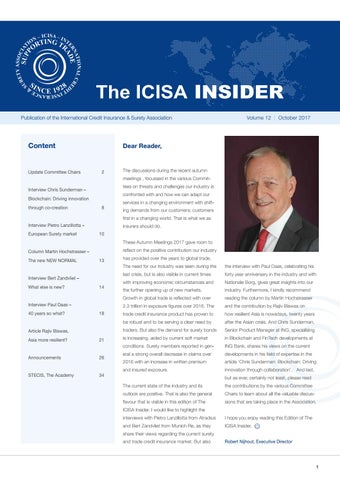
Robert Nijhout, Executive Director
1
The ICISA INSIDER | October 2017 | COMMITTEE CHAIRS
Update Committee Chairs
Asia Committee – Benjamin Gan
For the coming months, the Asia Committee has identified the following proposal which will bring together the contribution from various members -:
Benjamin GAN Chair of the Asia Committee
1. Asia Payment Experience – Given the diversity
Company: SCOR Reinsurance Asia-Pacific Pte Ltd I
of the region, each country in Asia is unique and
Global P&C
different in terms of payment methods, tenor, aging, overdue, probability of default and recovery.
its concern to/lobby with the relevant governments/
On this basis, the committee believes that a survey
authorities to increase awareness and enhance the
conducted by its members in Asia on such payment
existing framework.
behavior will enhance our understanding and building towards improved underwriting and portfolio development.
3. Trade Credit & Surety Training – The members believe that a singular platform to training and conducting specific workshops for the underwriters
2. Financial Information Sourcing – In many develop-
professionalism and reputation of the industry. The
financial figures is lacking and/or companies are not
platform will provide the other members with less of
effectively adhering to the disclosure requirement.
such capabilities to benefit from such exposure and
There may also be a lack of national ID which is
exchange with other members from the industry. The
unique to identifying companies in some countries.
members propose to set up such facility or academy
However, adequate and reliable data are crucial to
with renowned institutions in Asia.
risk underwriting. The members agreed that there is such kind of phenomenon in the region and practices are different. The members discussed on how information transparency and adequacy can be improved in such circumstances. The committee proposed to submit a whitepaper in order to raise
2
(commercial/Risk) and Claims in Asia could raise the
ing countries in Asia, legal framework for publishing
COMMITTEE CHAIRS | October 2017 | The ICISA INSIDER
Committee of Underwriters – Nick Walklett
Despite a decline in election-related risks, policy uncertainty remains at a high level and could well rise further. The rather difficult-to-predict U.S. regulatory, fiscal and foreign policies are undoubtedly a cause
Nick Walklett
for concern. The negotiations of post-Brexit arrangements do not ap-
Chair Committee of Underwriters
pear to be progressing. There are a number of international on going
Company: Tokio Marine HCC international
geopolitical risks. These factors could harm confidence, deter private
Insurance Company Plc
investment, weaken growth and lead to problems for the Credit Insurance markets in a number of countries and sectors.
Technical Topics There does appear to be some growing concerns arising from weak
The following technical topics have been raised:
governance and corruption in a number of emerging markets and the
The monitoring of Buyer Risks to include a discussion on automatic
credit Insurance market needs to be on the look out for specific frauds
processes , information providers, variety of filing regulations, positive
relating to misappropriation of assets or more particularly falsification of
and negative monitoring , reliability of information sources.
financial statements The Standard documentation for the transfer of limits when changing The main topics for this autumn meeting can be analysed between
Insurers. The use of standard documentation and procedures could
the following categories: Countries; Trade Sectors; Technical topics;
help the market where there are queries concerning the cover that is
Specific Buyer Risks and a review of the markets.
given on particular buyers.
Main topics
Fraud: the increase in problems arising from environments where there
Countries
is weak governance and corruption can raise particular issues for the
Angola, Argentina, Brazil, Croatia, Dubai, Ecuador, Nigeria, Qatar,
credit insurance market. The particular areas to be considered are
South Africa, Turkey, China and Russia are all countries that have been
Africa and France.
raised and have interesting issues to discuss. The on-going problems in Turkey; the slowing of the economy in China and increase in ten-
Specific Buyer Risks
sions with the USA particularly with regard to the USA foreign policy
An opportunity to discuss specific buyer risks is available to delegates
towards North Korea effect economic confidence. This agenda item
and can be very useful where there are common goals and the infor-
is always open to allow the addition of any country where there are
mation is in the public domain.
contemporary matters to discuss.
European credit Market Brexit
The round table discussion of the markets represented by the attend-
Brexit has been on the Agenda since the vote to leave the EU was
ing delegates provides an ideal forum to discuss particular market
cast. It is an important issue that has significance to a number of
trends or developments. It is always useful to share knowledge and
European markets and will be discussed at these autumn meetings
experiences from colleagues facing similar pressures and objectives
and probably in the future.
and discuss the specific concerns and challenges that exist in individual markets.
Trade Sectors Construction, Food Retail, Oil and Gas and Steel are the sectors that have been chosen to review this autumn. All key sectors that have high exposures to credit Insurance.
3
The ICISA INSIDER | October 2017 | COMMITTEE CHAIRS
Continuation of the Update
Committee Chairs
Credit Insurance Committee – Judita Svetin
The topics discussed in the Credit Insurance Committee are more and more complex and somehow pointing the future of credit insurance industry.
Judita Svetin Chair of the Credit Insurance Committee Company: SID First Credit
In the last few meetings the Committee always addressed the topic, connected to the digitalisation, big data, cyber risk and fintech.
As a regular topic we discuss credit insurance market and condi-
Although members understanding of mentioned topic can be dif-
tions in members countries (usually as a tour of the table), already
ferent, we all share the opinion that even for quite old fashioned
for some years we all share the experience of a “soft market”. It will
insurance line as credit insurance, these topics are and will be of
be interesting to discuss how much softer can it get?
extreme importance and that all members are paying much attention to them.
On one of the past meetings members agreed that the quality and relevance of topics discussed depend upon proactive approach of
Some topics are like evergreen melodies, they keep popping up
all members, so we made a conclusion to prepare different pres-
on the agenda. In the past (and probably also in the future) the
entation on the market, legislation and other issues for which we
evergreen topics were (are) fraud, claw-back legislation (which is
share interest. A very interesting presentation of the Spanish market
extremely diversified, even in EU countries) and members approach
was given in spring meeting in Malta and we are looking forward to
in servicing the SME´s market.
announced presentation of the UK market/economy, also having in mind Brexit and its consequences for credit insurance industry in
Topic addressed on many meetings (also by inviting distinguished
UK and also in the rest of the EU countries.
external speakers) is sanctions and their influence on the business. Since there are many dilemas and unanswered questions regarding sanctions, one of the future topics in the CIC will be dual - use goods. As far as I am aware, there is no case against credit (re) insurer regarding imposed and prlonged EU sanctions against Russia, so I wonder whether we as an industry really perform sanctions due diligence so excellently or actually this is just another toothless tiger? I am looking forward to further discussion on sanctions, especially with focus on everday` s challenges that members face while executing sanctions due dilligence.
4
One just should not miss the opportunity to attend the meetings!
COMMITTEE CHAIRS | October 2017 | The ICISA INSIDER
Surety Committee – Roberto Castillo
Digitalization and automation will remain a topic for a long long time,
Roberto Castillo
not as a general discussion topic that is hip and therefore needs to
Chair of the Surety Committee
be on the agenda, nor because we are dedicating our precious time
Company: HannoverRe
to act as fortunetellers. It is much more that so many new challenges and questions are consistently arising around this comprehensive topic that we always will be confronted with new trends or develop-
Sometimes you know where a bamboo cane will appear and you
ments that need to be discussed. It is like having a bamboo in your
can even observe it growing, but you have no clue how it will look
garden during a rainy summer, you never know where on your lawn
like in the end. This can be the case when the legislator takes his
you are going to find in the morning the next huge bamboo cane
time to knead and handicraft a new regulation for an existing prod-
that has rapidly grown over night.
uct. We will have an knowledgeable external speaker presenting the new EU Travel Bond regulation to the committee, a vivid discussion
Same with another topic we discussed in our committee meetings
can be expected afterwards.
in Amsterdam, it appeared like a big bamboo cane early Sunday morning in the middle of your garden gate. The garden is the heart
These are only few examples of new topics coming up that will
of Europe and the bamboo cane is a large litigation bond that was in
then keep us busy for some time. There are a lot of bamboo canes
from one day to another. There is no consensus yet whether this is
sprouting all over our surety garden and we will continue to fertilize
a product our industry is willing to develop and to offer capacity for.
the lawn‌gardening is healthy and keeps our industry agile and
The access for sureties is difficult anyway as still many institutions
dynamic.
and courts only accept deposits or bank guarantees. A prerequisite to develop litigation or judicial bonds would require intense efforts of persuasion with the corresponding institutions. This successfully happened in Brazil about six years ago when the general decision to accept surety bonds resulted in an unprecedented premium boost for the local surety industry. During our next committee meeting in Amsterdam our Brazilian members will share with us their experiences with this product until today and also give an overview about the impact of judicial bonds in the market and the challenges that came up.
5
The ICISA INSIDER | October 2017 | COMMITTEE CHAIRS
Continuation of the Update
Committee Chairs
Single Risk Committee – Olivier David
Olivier David Chair of the Single Risk Committee Company: Atradius “In a constantly changing environment, topics of discussion advance at a similar pace, but complex issues need more time for contemplation. Our successful market survey a couple of years ago needs to
The purpose of the Lloyd’s survey is to provide the data to con-
be refreshed, offering an updated benchmark for the structured
vince the banks and their regulator of the performance reliability of
credit and political risk private insurers. Since then, a number of
the single situation non-payment insurance product. This is an aim
new participants have joined the market and we have perceived
we fully support and we will discuss the best way to provide this
significant movements in the frequency and severity of the losses,
support on a practical basis to our fellow insurers.
which should make such an update very relevant to all interested in this industry.
We will also use the opportunity of our gathering to exchange on the prominent product trends of the moment, like aircraft financing
A parallel survey, initiated by the Lloyd’s Political Risk (PRI) Com-
and facultative reinsurance, which are symbolic of a new evolution
mittee, is to gather similar data originated from the brokers’
in the complementary nature of the private market and the Export
records, which should be an excellent reference point to our own,
Credit Agencies. At a time when historical boundaries like tenor
presuming the requested data is not materially different.
and capacity fade away, new opportunities appear for all parties involved.”
Indeed, the content of this Lloyd’s-initiated survey should be focussed on the bank-originated business and how efficient the insurance market has been to indemnify their losses. If, as it is often believed, banks originate the large majority of the income of the structured credit and political risks market, there should be enough overlap between the two surveys to make a comparison relevant.
6
INFORMATION | October 2017 | The ICISA INSIDER
By the International Credit Insurance & Surety Association
A Guide to Trade Credit Insurance A practical and accessable industry-wide reference on Trade Credit Insurance, written by a team of industry experts. This compact volume is a practical guide for anyone interested in Trade Credit Insurance. The International Credit Insurance & Surety Association (ICISA) presents an approachable but detailed guide written collaboratively by carefully selected industry experts. The guide describes the ‘lifeline’ of the credit insurance product, from the initial application stage to the expiration phase of the policy, including practical use aspects for credit managers. The volume offers compact information on the history of trade, the need for protection against trade credit risks, and solutions offered by credit insurance providers. The focus is
Key selling points
on short term credit, including whole turnover policies and
• Collaboration of a diverse group of experts from top
single risk policies.
organizations around the world • Written in an approachable style, accessible to
Readership
the non-specialist
Suitable for anyone interested in Trade Credit Insurance,
• Includes extended glossary of key terminology
from credit managers to policymakers.
• Includes a list of relevant resources for further reading
Contents
About the Author(s) / Editor(s)
Foreword; Introduction; Disclaimer; 1. What is trade?; 2.
The International Credit Insurance & Surety Association
What is trade credit insurance?; 3. Product types; 4. Risk
(ICISA) brings together the world’s leading companies
types; 5. Typical set-up of a trade credit insurance con-
providing trade credit insurance and surety bonds.
tract; 6. Premium, the price for cover; 7. Day-to-day policy
ICISA promotes technical excellence, industry innovation
management; 8. Buyer risk underwriting in trade credit in-
and product integrity, as well as addressing business
surance; 9. Debt collection; 10. Imminent loss and indem-
challenges generated by new legislation.
nification; 11. Renewal, expiry, termination of a policy; 12. Single risk business; 13. The single risk insurance market: Private and public players; 14. Reinsurance of Trade Credit Insurance; Trade Credit Insurance resources; Glossary of trade credit terminology
Where to order my copy To order a copy of the book ‘A Guide to Trade Credit Insurance’, please visit www.amazon.com.
7
The ICISA INSIDER | October 2017 | INTERVIEW
Interview Chris Sunderman, Blockchain Initiative Lead for trade finance at ING Bank
Blockchain: Driving innovation through co-creation Banks are consciously investing in innovation and given the nature of blockchain or distributed ledger technology (DLT), collaboration is inevitable. In the early days of blockchain it was understood that the possibilities and impact of blockchain for many industries, but especially for financials, could and would be a game changer. It will however take time before it will really unlock the mass scale value we are looking for, Chris Sunderman, Blockchain Initiative Lead for trade finance at ING Bank explains. “At ING, we come from 2016 being a year of experimentation, where we were investigating the potential of Distributed Ledger Technology by working with other banks and industry groups, developing the capabilities to propose and provide industry wide standards. Nowadays we are leveraging and capitalizing on that knowledge to deploy real-life solutions in key areas.” Especially in the trade finance industry banks became
According to Chris the days of sandboxing with blockchain
aware, that the chances for a successful development and
are more or less behind us. “As far as I can see the learning
adoption by its stakeholders would improve in a co-creation
and development curves have been steep, especially during
model. “When we look at the trade finance industry, the
the past year. Especially banks have increasingly changed
need for innovation is there, since it is a very traditional and
the Proof of Concept approach and moved towards pilot-
paper based, complex industry. We are already bringing
ing and testing. As a result of this a number of successful
new technology to the trade finance world. However to
experiments have been done in a couple of product areas
stay on top of our game, and to be able to deliver the best
which proved the potential of blockchain and distributed
customer experience we work with IT partners, with our
ledger technology. Easier and faster in processing, with flex-
customers and with fin techs. They supply infrastructure
ibility in execution for both banks and their clients.”
knowledge and we supply trade finance knowledge and knowledge on DLT”, Chris notes.
Challenging for the financial industry Chris notes that consumer behaviour and technological
ING
standards are changing rapidly. “At ING we see most of these changes as an opportunity to further differentiate, which could include disrupting our own business. In the
ING is a global financial institution with a strong European base, offering
era of fast innovation and fin tech companies increasingly
banking services through its operating company ING Bank. The purpose of
disrupt (segments of) the market.” He identifies models with
ING Bank is empowering people to stay a step ahead in life and in business.
and without success and he sometimes detects at the core
ING Bank’s 52,000 employees offer retail and wholesale banking services to
of activities of traditional financials another big challenge
customers in over 40 countries.
ahead of this. “The challenge that is ahead of innovation is the different area of focus of supply (financials) and
ING Group shares are listed on the exchanges of Amsterdam (INGA AS, ING.
demand (market/clients). So, in general we need to validate
AS), Brussels and on the New York Stock Exchange (ADRs: ING US, ING.N).
our thoughts of innovations with stakeholders. That is one
Sustainability forms an integral part of ING’s strategy, which is evidenced by
thing, but another challenge will be adoption of a certain
the number one position among 395 banks ranked by Sustainalytics. ING
innovation or solution by stakeholders, parties, (future) users
Group shares are being included in the FTSE4Good index and in the Dow
in the ecosystem of that innovation.”
Jones Sustainability Index (Europe and World) where ING is among the leaders in the Banks industry group.
He believes that collaboration with fin techs and other industry players is key to be able to improve customer experience and make banking personal, instant and seamless. “Start innovation, take small steps at a time and work closely together, both inter-bank and intra-bank. Find spon-
8
INTERVIEW | October 2017 | The ICISA INSIDER
Chris Sunderman, Blockchain Initiative Lead for trade finance at ING Bank
“The opportunities for the trade credit insurance and surety industry are further digitization and increased speed in execution, reduction of cost and use of paper etc. and ease in processing”
sors for the innovations you want to develop, find partners
also see that other parties, financials, can disrupt the trade
to start development and work according to a plan. Find
credit insurance or surety industry as a result of DLT. Barri-
out why there would be a need for an innovation; check this
ers of entry as a result of DLT are much lower thanks to DLT
with the market, your clients. Collaboration is essential to
and its capabilities. So to that extent…..”
obtain value in many cases.” He underlines the importance of creating a minimum viable ecosystem in order to achieve
He therefore likes to advice ICISA members to learn from
adoption by the participants in the trade finance industry “If
what the banking industry has done so far in blockchain
the perceived solution is not solving a problem, easing pro-
and innovation in DLT. “The first step is difficult, but accept
cesses or reducing hurdles, then you could best stop the
the changing market circumstances, the increased trans-
process, start to discover all over again, redefine and again
parency and rest assured that the competition is not always
check with the market: work agile, fail fast and learn fast.”
your obvious export credit competitor. Other parties may enter your segment and offer comparable solutions, easier
“Start innovation, take small steps at a time and work closely together, both inter-bank and intra-bank. Find sponsors for the innovations you want to develop, find partners to start development and work according to a plan”
structures and sometimes integrated in other services. Start now with innovation: in your own company and by collaborating with your peers, talk to the technology providers, those who know your market, but also think out of the box and be creative.” Chris likes to accentuate it is a step by step process; fail, and start over again. “Talk to your partners and clients, what are they facing? What are the hurdles in their cross border business? Is it complex, what could be easier, etc., etc.“ But he underlines that this process can only be successful through collaboration and the support from top
Opportunities for the trade credit insurance and
management. “The driving force behind successful innova-
surety industry
tions is collaboration and co-creation. Collaboration is es-
Chris sees benefits for the trade credit insurance and surety
sential to get value, and you will see that all innovation must
industry when it embraces the opportunities of blockchain
be driven in IT Operations by the product, but take care
and distributed ledger technology. “The opportunities for
that the business is and stays aligned. We also see that you
the trade credit insurance and surety industry are further
require top management sponsorship for innovation to get
digitization and increased speed in execution, reduction of
things done and to move on. Also involve top management
cost and use of paper etc. and ease in processing.” But
and explain what you are doing and why. Client validation is
besides the benefits, Chris sees also the need for the indus-
essential for management to remain supportive.”
try to adapt blockchain and/or DLT. “On the other hand we
9
The ICISA INSIDER | October 2017 | INTERVIEW
Interview with Pietro Lanzillotta, Atradius Bonding Director
The opportunities and challenges the European Surety market faces The Bonding market in Europe is currently facing many changes. These will probably alter the market completely and will give room to new opportunities. Pietro Lanzillotta, Atradius Bonding Director is experiencing these profound changes. “The European Surety market is currently being flooded
more than € 500 million in business volume of which the
with new competitors from the Americas. At the same
banks’ market share is 50-60%. This creates many op-
time, existing companies are strengthening their pres-
portunities, yet both markets have unique characteristics
ence and expanding their cross-border business to other
that need to be taken into account when approaching
countries.” Pietro believes this growing interest in the Eu-
the business.”
ropean Surety market might be driven by the expected business opportunities created by a potential reduction
But overall Pietro identifies a number of challenges and
in the bonding activity of banks. “The European Surety
opportunities for the European Surety industry in the
market remains however relatively robust, despite the
coming five to ten years. “As a recent trend we see an
oversupply of capacity and uncertainties in some major
increasing cooperation between Surety companies and
economies. There are therefore quite a number of op-
banks to provide cover for risks and to develop distribu-
portunities and challenges the European Surety market
tion. With no doubt such cooperation will derive opportu-
faces”, he adds.
nities for the Surety industry and is seen by many as a win-win situation.” Pietro explains that even though the
“The European Surety market remains however relatively robust, despite the oversupply of capacity and uncertainties in some major economies”
Surety market is driven by banks, capital regulations are pushing them to share some of their risks with insurance companies, providing Surety service. This allows banks to distribute their risk and obtain more cost-efficient portfolio management. Furthermore, Surety companies enable banks to improve their customer relationships and gain market share or access to new, niche markets. For the Surety companies, cooperation with banks gives
European market and the regional peculiarities
access to markets and clients that are otherwise not
According to Pietro, Europe is as a whole a promising
accessible to them.” On the other side he notes that “the
region for Surety. But there are two countries we need
challenge will come from unfolding these new market
to pay close attention to. He notes: “Italy and Germany
distributions. In fact, I consider Surety suppliers as bond
are the largest European Surety markets each generating
underwriters rather than capacity providers. This could present a challenge for us in acquiring new customers
“Italy and Germany are the largest European Surety markets each generating more than € 500 million in business volume of which the banks’ market share is 50-60%”
that might have been used to liaising with capacity providers. While ideally we are pursuing an equal portfolio sharing, potential adverse selection of risk always persists.” But Pietro identifies another challenge for the current Surety providers. “Competition is becoming more challenging, as newcomers are entering the market and existing players are expanding their geographic presence. At the
10
INTERVIEW | October 2017 | The ICISA INSIDER
Pietro Lanzillotta, Atradius Bonding Director
“I see the primary support of ICISA in promoting the concept amongst European institutions and bank associations”
same time, customers’ needs are evolving. Surety provi-
Atradius Bonding
ders are aiming at increasing their market share. Those
Pietro informs that complying with the European Surety
providers that manage to provide excellent service and
market trends, Atradius recently expanded its Surety
flexible, tailor-made solutions to meet customers’ rising
activities into four new countries. “We have extended our
demand, will be able to keep up with the market trends
Surety business to Germany, the Netherlands, Belgium
and stand ahead of their peers.”
and Luxembourg. It is our main target to foster our presence in these countries, while at the same time consolidate our market share in our established markets: Spain,
“Competition is becoming more challenging, as newcomers are entering the market and existing players are expanding their geographic presence”
Italy, France and the Nordic region.”
ICISA and its Surety members “The Association is a forum which gives its members the opportunity to share their views and experiences about market trends and developments, and thus supports efficient business growth and healthy competition”, is his answer to what ICISAs main task is. “I see the primary support of ICISA in promoting the concept amongst
About Atradius Bonding
European institutions and bank associations that legal and regulatory requirements are the main driver of the Surety business.” This is according to him essential as
Atradius is a leading European Surety provider, currently active in 11 countries
“the Surety market is highly dependent on the regulati-
(Italy, Spain, France, Denmark, Finland, Norway, Sweden, Germany, the Neth-
ons and jurisdictions of the different markets. Local legal
erlands, Belgium and Luxembourg). Atradius Bonding works with different
requirements determine to a great extent the characteris-
industries and maintains relationship with a large range of companies by pro-
tics of surety products.” But this is not only a role solely
viding tailored service to customers who need niche products, online services
for the Association. There is also an active role for the
and know-how. Atradius offers- in each of the countries where it is present- a
individual Surety members. “Therefore, it is essential that
disperse variety of products closely linked to the local legal requirements.
ICISA members provide support to European legislation
Similar variety of products could be clustered into five group-wide categories,
groups, proposing changes and valuable input. Teaming
namely: contract bonds, tax duty bonds, payment bonds, compliance & other
up with bank associations will also foster cooperation.”
commercial bonds and other bonds. He highlights another topic that needs to be addressed To find out more about Atradius Bonding, please visit group.atradius.com/
by ICISA in order to serve and protect the strong reputa-
products/bonding.html
tion of the Surety industry. “In recent years we have seen several financial institutions entering the Surety market
11
The ICISA INSIDER | October 2017 | INTERVIEW
Interview with Pietro Lanzillotta, Atradius Bonding Director
“I would like to gauge the interest from the readers in using ICISA as the main statistical information source”
and leaving only a few months later. These financial
In this respect Pietro would like to address especially
institutions caused some level of disturbance in the
the readers active in the European Surety industry. He is
market by offering conditions out of the scope that Su-
convinced that strong European market data is essential
rety providers could bear. I believe ICISA should use the
in promoting Surety and this is currently lacking. “I would
media as a channel to draw attention to the importance
like to gauge the interest from the readers in using ICISA
of having a solid, recognized Surety company with which
as the main statistical information source. Thanks to
companies can partner. At the same time, ICISA should
SFAA and PASA we can retrieve excessive statistics on
emphasize to the beneficiaries - both public and private
Surety markets in the USA and Latin America. The Euro-
- the importance of running a proper screening before
pean market instead lacks robust and consistent market
accepting bonds.”
data at continental level.”
“It is essential that ICISA members provide support to European legislation groups, proposing changes and valuable input. Teaming up with bank associations will also foster cooperation”
Pietro Lanzillotta Pietro Lanzillotta is Atradius Bonding Director since 16 May 2013 and he has full responsibilities of the bonding line of business in Atradius, which includes commercial, risk management and operations in Italy, France, Nordic countries, Germany, the Netherlands, Belgium & Luxembourg.
About Atradius
Before this, Pietro was the CFO of a Dutch company
Atradius provides trade credit insurance, surety and collections services
involved in the Bonding and Reinsurance business,
worldwide through a strategic presence in more than 50 countries. Atradius
where he spent four and a half years.
has access to credit information on over 240 million companies worldwide. Its credit insurance, bonding and collections products help protect companies
He has a long standing expertise and knowledge
throughout the world from payment risks associated with selling products and
in the Surety sector and has worked at various
services on trade credit. Atradius forms part of Grupo Catalana Occidente
positions within Atradius in the period 2003-2008,
(GCO.MC), one of the leading insurers in Spain and worldwide in credit
among which Bonding Operations Executive,
insurance
responsible for the implementation of the Bonding strategy. Prior to this he was the Portfolio Analyst
To find out more about Atradius, please visit www.atradius.com
and Controller of the Bonding Unit. Pietro holds a degree in Statistic and Actuarial Science and passed the exam to become Actuary.
12
COLUMN | October 2017 | The ICISA INSIDER
Martin Hochstrasser, Underwriting Director Global Credit and Surety Reinsurance XL Catlin
The new NEW NORMAL Today is the 9. August 2017. I am writing for The ICISA In-
One of my office colleagues pointed out a stock called
sider. This honourable duty found its way to me via Stefaan
Take Two to me, some time ago. I had heard the name for
Van Boxstael whom I would like to thank thoroughly for
the first time. Well, I started to follow this stock. What do
passing on the pen.
they do? In my language it’s called video games. That’s not quite right. Take Two is a “rockstar” when it comes to
This morning my daily routine in the kitchen where I tend
interactive entertainment, for now foremost in the US. But,
to drink a cup of coffee and listen to DRS 3 got interrupted
they are conquering the world faster than the light. By the
by a painful back flash: in the 7.40 news the Swiss radio
way, they started back in 2005, burned cash for a while,
turned the wheel back to 9. August 2007: On that day the
made some money, burned cash again, made more money
ECB and the FED injected $90bn into the financial system
just before making record losses, simply to rebound again
as the interbank market had come to an halt.
thereafter. Today, Take Two trades at $90 per stock. That propels the company’s market value to $10bn.
It was not the first sign that indicated the start of an abnormal crisis. Months before, HSBC and UBS already
In hindsight, all looked crystal clear, back in 2007 and
had shocked the investment community with bad news like
2008, didn’t it? Actually, that’s not how it was. The lines
write-offs in the US mortgage market and losses related to
were blurry. The Dow Jones Industrial climbed by 10% in
Mortgage Backed Securities. Today, in 2017, the catalyst’s
the 60 days following the above mentioned bad news of 9.
name is probably not subprime. It could be Trump and
August 2007 - to peak in October at 14’100.
Kim, Saudi Arabia and Iran or who knows what.
And, today, it ain’t easier to say where we are in the cycle.
“Renewal related analysis work and decision taking process will remain fairly traditional. Underwriting adapts to changes but does not change as such”
With the Rendez-Vous in Monte Carlo, the 1/1 renewal season kicks off. The 1/1 is the dominant date for treaty renewals in our line of business. Cedants and reinsurers will look for clues regarding the future economic environment and thus capacity requests, scope of cover, potential geographical expansion and the like. Independent of the above mentioned uncertainties and changes I suspect the renewal related analysis work and decision taking process
The press and the social media suggest a new New
will remain fairly traditional. Underwriting adapts to changes
Normal: Tesla has overtaken Ford by market value back in
but does not change as such. In spite of Tesla, cars still
April 2017, BBC reported. On my desk top I have an online
have four wheels. And, I will “take two” …. not stocks, but
analysis tool as underwriters in Credit & Surety usually
beers …. when the next renewal is done.
have. Tesla’s market value stands at $60bn, give or take, today. Ford shows $43bn market value and $3.8bn Net
The pen goes to Stephen Haney from Chubb –
Income for the first six months while EBIT is at $3.1bn. And
with my best regards, Martin.
Tesla? Well, they continue to burn cash at EBIT and Net Income level. In spite of that Tesla outweigh Ford 1.5 times regarding market value.
13
The ICISA INSIDER | October 2017 | INTERVIEW
Interview with Bert Zandvliet, Senior Risk Underwriter MunichRe
“What else is new?” The trade credit insurance industry has seen various developments since the last credit crunch. Based on his thirty year career within trade credit insurance, Bert Zandvliet is able to value the impact of the changes and the effects on the current state of the industry. He clearly identifies major changes over the years, but notes at the same time the basics of the industry will always be the same, ”What else is new?” The last credit crunch impacted the perception of the
freedom to take decisions regarding for example pri-
trade credit insurance market, Bert notes. “The financial
cing, level of credit limits, percentage of cover, etc. “The
crisis had a strong impact on different sides. Some (po-
freedom to maneuver for the insurers to manage the
tential) policyholders and exporters became skeptical
parameters available in a very competitive arena is more
about the trade credit insurance product, as they felt
than before restricted by internal and external guidelines
the product was not always available for them during
and requirements. Additional to that, the economic role
the crisis, a period in which they felt they really needed
of trade credit insurance, especially in exports, is seen
it. On the other hand, insurers and reinsurers were very
clearer by the public in general and issues like sanction
exposed during the crisis, underpinning the importance
regulations, also as a political instrument, have again
of careful and conservative risk underwriting. This
resulted in more complexity in our business.”
certainly led, and is still ongoing, to more profound attention for elements such as risk analysis and accumulation control.” As a third angle, Bert identifies the changed role of supervisory authorities. “Be it national or international, the importance of stricter regulation and supervision, aimed at stability in the market and protection of involved parties, was and is seen.”
“in general clients of trade credit insurance companies have become more demanding”
“The freedom to maneuver for the insurers to manage the parameters available in a very competitive arena is more than before restricted by internal and external guidelines and requirements”
Bert furthermore identifies some significant structural
14
changes that the industry has dealt with as a conse-
The current state of the industry
quence of the credit crunch. “In combination with global
Looking at the current situation of the global trade cre-
developments and risk awareness, one could say that
dit insurance industry, Bert notices a more competitive
in general clients of trade credit insurance companies
market which results in pressure on the quality of deals
have become more demanding. Where for instance
that are offered to the market. “As leading reinsurance
fire insurance is bought because one does not want to
player in the trade credit insurance industry, we clearly
carry the risk by oneself , trade credit insurance has in
notice increased competition between trade credit
most cases been a protection where the potential buyer
insurers in many markets. In individual countries, but for
calculates the benefits against the costs. This tendency
instance also in the London market, where the number
has become ever stronger in the last years.” At the
of participants in credit and related lines is larger than it
same time Bert notes that insurers are as a consequen-
has ever been before. One can see that this has had an
ce of the changed market conditions, limited in their
effect on the behaviour of potential policyholders and
INTERVIEW | October 2017 | The ICISA INSIDER
“in the past certain ‘bad’ or ‘unattractive’ deals would perhaps not reach the market because brokers would advise their clients against it, nowadays due to the very large number of participants, the quality of offers to the market is under pressure”
brokers, as sometimes risks are presented to the mar-
According to Bert increased competition has also
ket that in the past would not have been considered.
triggered a rise in non-traditional and more complex
Where in the past certain ‘bad’ or ‘unattractive’ deals
products. “The increased competition, not just in the
would perhaps not reach the market because brokers
London market, and the logical necessity of insurers
would advise their clients against it, nowadays due to
to maintain market positions or even increase market
the very large number of participants, the quality of
shares, has triggered a high level of ‘creativity’ and
offers to the market is under pressure.” Bert is pleased
innovative drive.” But Bert underlines that not all ideas
to see that as a result the industry sets higher requi-
are really new. “Sometimes we see new approaches
rements in order to select between ‘good’ and ‘bad’
to basically not new business structures, while ‘old
risks, resulting in increasing percentages of declined
dogmas’ do not remain undiscussed or undisputed.
cases by the market.
Products such as single risk cover, non-trade related cover, top-up cover and non-cancellable credit limits,
“Sometimes we see new approaches to basically not new business structures, while ‘old dogmas’ do not remain undiscussed or undisputed”
all types of leasing- and factoring-structures, reversed or not, are examples that now play a more important role in the business than before.” Bert recognises they need to be investigated due to the competitive pressure in the market. “This requires quite some effort and analysis by insurers as well as reinsurers as they are not only offered as a general product, but also on individual requests with particular ins and outs. We see submissions of this nature quite regularly. Clearly, as a reinsurer we want to support our clients where we can and are
Bert Zandvliet Bert Zandvliet, born The Hague 1962, married, three children. Studied Master of Business Law/ Leiden University 1986 and Master of Business Administration/ Newport University Utrecht 1990. He started his career in primary trade credit insurance (product development and technical assistance and trainings for starting export credit insurers in developing countries) and since 1999 at Munich Re on the reinsurance side.
Bert Zandvliet, Senior Risk Underwriter MunichRe
15
The ICISA INSIDER | October 2017 | INTERVIEW
“One would expect participants in the market are able to combine entrepreneurship and innovation with a certain level of discipline and conservatism in risk underwriting”
glad to have an open and in-depth discussion on the
While Bert argues that old ideas have a habit to return
pros and cons of new and often complex products.”
over time, he also notes that the future encompasses some fundamental challenges that need to be ad-
The future of the industry
dressed by the industry in the coming years. “Having
Overall, Bert sees a strong need to embrace innovation
seen different cycles or several swings in the develop-
and the development of new products and processes
ment of the trade credit insurance industry, it is interes-
in order to survive as an industry. At the same time he
ting to see how certain tendencies return over time. Not
emphasizes that existing guidelines and criteria should
always to be translated on a one-to-one basis, but ge-
not be abandoned without caution. “The development
neral ideas may come back, even if they are formulated
of new products and innovation in general is essential
in a different manner. There are however also entirely
to survive and preferably grow in the present times.
new developments that have to be taken into account.
Without innovation one is likely to lag behind rather soo-
For instance, developments in IT, the exceptional
ner than later. On the other hand, it is important that the
growth of on-line business and the growing databases
drive for new products, procedures and techniques is
on past and anticipated future (payment) behavior are
combined with an interest in and a profound knowledge
instruments that may open new doors to our industry
of the background and experience on why criteria and
like never before. Finding the proper balance between these new tools and possibilities, the continuing inter-
“Having seen different cycles or several swings in the development of the trade credit insurance industry, it is interesting to see how certain tendencies return over time”
nationalization and transparency of the market and the ‘rules of the game’ formulated for our industry – not always without good grounds - is likely one of the more important challenges for the coming years”. When asked about the industry’s future developments Bert notes: “This is of course very difficult to comment on, especially in the longer term. One would expect that somehow the growing capacities in markets and also the increasing numbers of market participants
guidelines were formulated in the past in a particular
will regulate itself. Nonetheless, in general this kind of
way.” Bert welcomes ongoing discussions about the
‘regulation’ goes hand in hand with high loss ratios
existing guidelines and criteria and agrees that they
for at least some of the parties involved. On the other
can certainly be disputed and maybe even adapted,
hand, participants come and go and sometimes also
but never be put aside too easily. “One would expect
opportunism plays a role.”
participants in the market are able to combine entrepreneurship and innovation with a certain level of discipline
ICISA
and conservatism in risk underwriting –be it a complex
Although Bert has more than 30 years of experience in
combination - to have the best chances in the longer
the trade credit insurance industry, it is only since 2010
run to be successful. When one is aware why certain
that Bert has been involved with ICISA and in the Credit
products, processes or approaches were not offered
Insurance Committee. Bert emphasises an important role
before or what caused losses in the past, one is more
for ICISA as a platform to discuss new developments. “In
likely to avoid falling in the loopholes certain business
the meetings of the Credit Insurance Committee all of the
structures bring about.”
above mentioned developments are regularly discussed, showing that the consequence of the increased compe-
16
INTERVIEW | October 2017 | The ICISA INSIDER
Endorsed Conferences
tition, combined with more restricted possibilities to vary
ICISA endorses numerous conferences related to
in other elements, like pricing, is a continuous point of
the trade credit insurance, surety and political risk
attention for most players in the market.”
industries:
“Members are happy to exchange views and listen to the considerations of others, despite the relations in the market environment”
Asia Pacific Insurance Summit 2017 (16-17 November 2017, Hong Kong) GTR Nordic Region Trade & Export Finance Conference 2017 (16 November 2017, Stockholm) TXF Private Insurance 2017
He further notes that “more and more members of the
(28 November 2017, London)
Committees are active in the same markets and are not only colleagues, but also competitors. To a certain extent
ExCred New York: Insuring Structured Trade,
this may have limited the ‘freedom’ to speak openly, but
Export & Project Conference
the technical character of the matters that are brought to
(17 October 2017, New York)
the table in the Committee meetings somehow levels this out. Members are happy to exchange views and listen to
Supply Chain Finance Summit 2018
the considerations of others, despite the relations in the
(31 January - 1 February 2018, Frankfurt)
market environment.” Regarding the position of reinsurers in ICISA, Bert likes to consider this role to be informative and distinctive. “The role of the reinsurance members in
More information on our endorsed conferences
the Committees, who usually have a view over many mar-
can be found on the ICISA website.
kets, is according to me also useful in this respect.”
MunichRe Munich Re stands for solution-based expertise, consistent risk management, financial stability and client proximity. This is how Munich Re creates value for clients, shareholders and staff. In the financial year 2016, the Group – which combines primary insurance and reinsurance under one roof – achieved a
Join over 3600 other industry experts in the ICISA group on LinkedIn
profit of €2.6bn. It operates in all lines of insurance, with over 43,000 employees throughout the world. With premium income of around €28bn from reinsurance alone, it is one of the world’s leading reinsurers. To find out more about MunichRe, please visit www.munichre.com
17
The ICISA INSIDER | October 2017 | INTERVIEW
Interview Paul Daas, manager Operations, Nationale Borg
“40 years, so what?” “So what?” was the first reaction Paul Daas, Manager Operations at Nationale Borg, gave when invited to talk about his impressive forty year long career in the industry and with Nationale Borg. Paul is the perfect expert to learn more about the remarkable developments within the surety sector, Nationale Borg and in ICISA. So we are very pleased he shares his insights with us. He started his career at the early age of 19, after he
Industry and product development
had finished school and having worked for the Dutch
Looking at the industry, Paul identifies a consolidation
Customs Authorities for about a year. “I joined the rein-
trend in the market. “Focusing on the European market
surance team, working in the inwards underwriting team.
we noticed that a lot of the specialized players in the
After 9 years I made a switch to become an underwriter
local markets became integrated in larger internatio-
in the direct Surety team, which did not last very long,
nal operating groups and very few really independent
because I was asked to head up the reinsurance team in
companies remained. In the early nineties the large
1988, after some people left to start their own company.
trade credit insurance groups were formed, afterwards
From that date all the reinsurance matters were handled
also investing in smaller local players. Generally results
in my team, inwards and outwards, underwriting and
were okay, with a few hick-ups during crisis years.” He
technical accounting.” In 2008, about a year after the
indicates that the largest problem he was faced with
company was acquired by private equity investors, he
was the financial guarantee crisis in Scandinavia. “It led to bankruptcies and personal dramas in the market. It
“In the early nineties the large trade credit insurance groups were formed, afterwards also investing in smaller local players”
did however create the need for cooperation between reinsurers - which was very successful - and a ban on financial guarantees, from which we are still benefitting.” He indicates further that looking at Nationale Borg’s home markets, being the Netherlands and Belgium, the banks have had and still have a dominant position, despite the Basel capital requirements. “Most banks
moved back to the direct underwriting for about two
produce surety bonds or usually guarantees as a niche
years, leading the reorganization of the commercial
product, with slow processes. In addition the credit
teams and guiding them through the crisis. “Late 2010
lines are generally heavily collateralized, so clients are
I was appointed Manager Operations, largely involved
very open to the market for alternatives, which we can
in Solvency II matters, the new IT system for the
provide. That has not changed over the years. The
direct underwriting, and various other technical
industry itself has not really changed its position towards
and reporting tasks.”
the clients either, but there are more players around, so a larger choice for the market. This does not help in the
“The industry itself has not really changed its position towards the clients either, but there are more players around, so a larger choice for the market. This does not help in the pricing of course” 18
pricing of course.” Looking at developments regarding the product, Paul notes that the product as such has not really changed. “In most markets the majority of the business is still contract and customs/trade bonds. Nationale Borg has developed some smaller special niche products over the years, which have become a solid income base as well.”
INTERVIEW | October 2017 | The ICISA INSIDER
Paul Daas, manager Operations, Nationale Borg
“Now we have around 75 employees, with offices in Antwerp and Nieuwegein”
“Solvency and ratings are more important nowadays in order to continue to be accepted by the beneficiaries”
After a long period of being quoted on the Amsterdam Stock exchange, Nationale Borg was acquired by ING in 1991. Paul remembers: “It was decided to trim down the reinsurance business somewhat, because of the financial guarantee results. Reinsurance accounted for about 75% of the turnover at the time. Being just a tiny part of the huge ING, there were little opportunities to grow the
Present situation of the surety industry and outlook
business. This changed when ING sold the shares to
“From what I see in the market and the information ICISA
HAL and Egeria in 2007.”
members share, the situation is healthy, with solid loss ratios over the last few years. But we all had our problem
The economic climate in 2007 was not helpful to the
cases every now and then, with larger clients defaulting
envisioned high goals set by the company. “We invested
and producing losses under the bonds or guarantees”,
in staff and IT, but had to temporary reduce our ambiti-
Paul evaluates the current status of the surety industry.
ons because of the economic climate. In the reinsurance
“Solvency and ratings are more important nowadays in
activities, however, our turnover more or less doubled
order to continue to be accepted by the beneficiaries. “
since 2007.”
He is also positive about the outlook of the industry. “Because I learned over the years, that there is always
Since 2016 Nationale Borg is part of the US Amtrust
room for professional specialized service providers in our
Group and Paul is pleased with their clear ambition
industry. It is important though, that the industry sticks to
to actively grow the direct surety business within the
the basic rules and that lessons learned from the past will
Group. “The reinsurance company has been transfer-
always be remembered.”
red to an Amtrust entity on Bermuda. We are still very much involved in the daily business of Nationale Borg
Nationale Borg
Re, providing services and staff”, Paul explains and
Paul remembers when he joined Nationale Borg in 1977
likes to add that “currently the independent position,
the company had only about 25 employees with one office
market and product know-how, speed in service and
in Amsterdam. “Now we have around 75 employees, with
underwriting capacity are in my opinion the main USPs
offices in Antwerp and Nieuwegein”, Paul proudly states.
of Nationale Borg.”
19
The ICISA INSIDER | October 2017 | INTERVIEW
Interview Paul Daas, manager Operations, Nationale Borg
ICISA
the meetings give ample room to talk to your colleagues
Besides serving Nationale Borg in various capacities
outside of the meetings.”
over the last forty years, Paul has also been an active member of ICISA for nearly thirty years. “My first ICISA
Paul looks back to forty challenging and satisfactory
meeting was in Amsterdam in 1988, it was the Technical
years in the business, with Nationale Borg and thirty
Sub Committee for Surety, a small group of specialists,
years as member of ICISA. “Being a relatively small com-
mainly producing reports at the time. Many meetings
pany we have to work hard to get things done. An active
followed, including some 15 General Meetings. I had
membership of ICISA helps to accomplish plans and
the pleasure to be the Chairman of the Surety Commit-
projects which otherwise would not be possible.” But
tee for three years, fortunately at that time not as heavily
Paul is not only a professional expert, but also values the
attended as today.”
many friendships he found during his career. “In addition one gets to know a lot of specialists from the market,
“The technical subcommittees were really
some of which have become real friends. For me that is important as well!”
bodies to write reports, whereas the focus is nowadays much more on networking”
Postscript: On behalf of the ICISA Management Committee and the membership, I would like to thank Paul for his professionalism, commitment and his open knowledge sharing over the many
He noticed how ICISA changed over the last three
years he is now an active and notable delegate at
decades. “In my early days the big groups were not yet
the various ICISA meetings. I cherish the many in-
formed and there were always discussions on market
depth discussions with him and I personally hope
positions, competition etc. during the General Meetings.
he will continue participating in many discussions
That is no longer the case. The technical subcommittees
to come.
were really bodies to write reports, whereas the focus is nowadays much more on networking.” He misses the active Committee membership of report writing, but he understands that the increased number of members urged to a new form of Committee membership. “Of course the number of member companies increased and so did the number of attendees, so it makes sense that
“An active membership of ICISA helps to accomplish plans and projects which otherwise would not be possible”
20
Rob Nijhout, executive director ICISA
ARTICLE | October 2017 | The ICISA INSIDER
Article by Rajiv Biswas, Asia-Pacific Chief Economist, IHS Markit
Is Asia More Resilient to Contagion Risks 20 Years after the East Asian Crisis? Twenty years ago, East Asia’s tiger economies were engulfed by a devastating economic crisis that created deep recessions, financial markets slumps and banking crises in many Asian nations. Over the past decade, East Asia’s recovery has been boosted by the rapid economic ascent of China. Led by China, emerging Asia has again shown dynamic growth, and has become the largest growth engine for the global economy since the Global Financial Crisis. With the Asia-Pacific’s share of world GDP having risen from 26% in 2000 to 34% by 2016, its importance in the global economy has increased significantly since the East Asian crisis. Could Asia still be vulnerable to another regional economic crisis that would be a key risk to global growth momentum?
The Impact of the East Asian Crisis
of external debt and relatively limited foreign exchange
Two decades ago, in July 1997, the East Asian financial
reserves. As the regional crisis escalated, the rupiah
crisis commenced with a currency crisis in Thailand.
began to depreciate sharply, creating mounting prob-
Speculative pressure against the Thai baht resulted in the
lems for the large Indonesian corporations which had
depletion of the nation’s FX reserves, forcing the nation
leveraged their balance sheets with substantial foreign
to abandon its currency peg to the USD and move to a
currency borrowings. As the flight of global capital from
managed float, resulting in sharp currency depreciation.
East Asia intensified and the economic crisis worsened, the Indonesian economy began to fall into a vicious
“A number of major Asian economies plunged into protracted recessions, banking crises, major corporate failures and bursting of stock market and property market bubbles”
downward spiral of currency depreciation and rising inflation. The rupiah depreciated from around 2,500 per US dollar in July 1997 to around 14,000 per US dollar by January 1998. As the Indonesian economy fell into a deep recession and large corporations were unable to service their debts, a banking sector crisis unfolded which resulted in the closure of 16 commercial banks by November 1997, and a run on banking system deposits during December
Following the Thai currency crisis, many East Asian tiger
1997 that affected many Indonesian banks, with the
economies were toppled, one after another, by financial
Indonesian financial system having become insolvent
markets contagion, currency crises and capital flight. A
and coming close to total collapse. This was staved off
number of major Asian economies plunged into protracted
by an emergency financial sector program announced
recessions, banking crises, major corporate failures and
by the government in January 1998 which guaranteed
bursting of stock market and property market bubbles.
bank deposits, together with a program under which the government would undertake banking sector restructur-
By August 1997, contagion had spread from Thailand
ing. The IMF provided a series of bail-outs to Indonesia,
to other East Asian economies with significant macro-
with a total of USD 43 billion in IMF loans provided by
economic imbalances. The case of Indonesia illustrates
1998. Many banks were taken over by the government
the severe nature of the economic shocks that hit East
or recapitalized, and the banking sector went through a
Asia. Indonesia’s vulnerabilities included very high levels
protracted period of consolidation and restructuring.
21
The ICISA INSIDER | October 2017 | ARTICLE
Article by Rajiv Biswas, Asia-Pacific Chief Economist, IHS Markit
“Many East Asian countries have also built up their foreign exchange reserves to improve their resilience to volatile international capital flows as well as strengthening their financial resilience by adopting macro-prudential measures when required” Other East Asian economies were also severely impacted
In Malaysia, Dr Zeti Aziz took the helm as Governor of
by the East Asian crisis and its contagion effects, including
Bank Negara Malaysia in 2000 and held that office until
South Korea, Malaysia, Philippines and Thailand. South
2016, driving far-reaching reforms to the Malaysian
Korea and Thailand also obtained IMF bailouts, while the
banking system that resulted in banking sector consoli-
Philippines extended an IMF program already in place.
dation and substantial strengthening of financial regula-
Looking back at the East Asian crisis, a key question is
tion that has made Malaysia a regional leader in com-
whether Asian nations have subsequently built up suf-
mercial banking, with Malaysian banks having become
ficient resilience to economic shocks and constructed
international players with a strong regional footprint in
strong enough firewalls to prevent financial markets con-
the rest of ASEAN.
tagion in the event of another major economic shock. Indonesia, Thailand and the Philippines have also imple-
“a key question is whether Asian nations have
mented substantial banking sector reforms, undertaking
subsequently built up sufficient resilience to economic
ratios and strengthening prudential regulation and super-
shocks and constructed strong enough firewalls to prevent financial markets contagion in the event of another major economic shock”
banking sector consolidation, improving capital adequacy vision of their banking systems. Many East Asian countries have also built up their foreign exchange reserves to improve their resilience to volatile international capital flows as well as strengthening their financial resilience by adopting macro-prudential measures when required. Indonesia and the Philippines have also substantially
Undoubtedly, since the East Asian crisis, Asian econo-
improved their fiscal positions with very substantial
mies that were at the centre of the economic turmoil
reductions in government debt as a share of GDP. Since
have made tremendous progress in addressing the mac-
2004, the Philippines general government debt-to-GDP
roeconomic and financial vulnerabilities that contributed
ratio has more than halved to a new record low of 34.6%
to the financial crisis.
in 2016. In Indonesia, one of the major macroeconomic successes during the two terms of office of President
Among the major achievements have been significant
Yudhoyono was that government debt as a share of GDP
progress in the sophistication of macroeconomic man-
was reduced from 56 per cent in 2004 to just 26 per cent
agement, as well as far-reaching banking sector reforms
of GDP when he stepped down from office in 2014.
that have resulted in stronger prudential regulation of
22
banks, much improved capital adequacy ratios in the
Malaysia, Indonesia, Thailand and the Philippines
banking system, better risk management systems and
have also taken steps to deepen their equity and bond
adoption of macro-prudential measures to manage risks
markets, improving the diversity and liquidity of their
related to real estate lending.
capital markets.
ARTICLE | October 2017 | The ICISA INSIDER
Indonesia: Foreign Exchange Reserves USD billion, end year Source: Bank Indonesia
120 100 80 60 40 20 0
2001
2006
2011
2016
balance of payments and short term liquidity difficulties among the ASEAN+3 nations as well as acting as a supplementary reserve pool to assist international support arrangements to address such crises.
Chiang Mai Initiative
In 2008, the size of the reserves pool was set at USD
A key new mechanism for Asian regional co-operation
80 billion, with China, Japan and South Korea agree-
APAC Share of World GDP to tackle financial crises has also been established Source: IHS Markit
since the East Asian crisis. The Chiang Mai Initiative, in 2000 in the aftermath of the East Asian % of World Gagreed DP
Meeting held in May 2009 decided to expand the
for co-operation among the ASEAN countries plus
total size of the reserves pool to USD 120 billion, with
30
China, Japan and South Korea for financial crisis pre-
China, Japan and South Korea still providing 80 per
vention and resolution, initially built around a network
cent of the total reserves pool.
of bilateral currency swaps. Momentum continued to build for further expansion of
“A key0 new mechanism for Asian regional 2000
2016
co-operation to tackle financial crises has also China APAC been established since the East Asian crisis” APAC Economies Exports to China
20 15 10 5 0
the CMIM facility as the magnitude of the Global Financial Crisis made Asian nations realise that the scale of reserves required for a future Asian regional crisis would have to be considerably larger. Therefore in 2012, at the annual ASEAN+3 Finance Ministers Meeting, the total size of the reserves pool was doubled to USD 240 billion. Under the original CMIM arrangements, the CMIM
Chiang Mai Initiative was initially created in 2000 % of total eThe xports in 2016 Source: government statistics
25
Crisis in 2008-09, the ASEAN+3 Finance Ministers
financial crisis, has also created a regional mechanism
10
30
However, due to the onset of the Global Financial
40
20
35
ing to provide 80 per cent of the total reserves pool.
would only disburse funds if an IMF program was
as a system of bilateral currency swap arrangements
already in place for the requesting country. That IMF
among the ASEAN member nations together with Chi-
conditionality has also been reduced somewhat with
na, Japan and South Korea (ASEAN+3), to strengthen
the CMIM facilities able to disburse 30 per cent of the
regional safety nets for crisis prevention. Discussions
total amount without IMF conditionality.
for such a regional arrangement were galvanized by the financial and economic contagion effects that cre-
An Asian Monetary Fund?
ated economic crises in many Asian economies during
On 29 August 2017, German Chancellor Angela
the East Asian crisis in 1997.
Merkel endorsed the concept of establishing a new
Australia South Korea
Taiwan
Japan
Malaysia
Singapore
Thailand
European Monetary Fund for the Eurozone, building on
At the ASEAN+3 Finance Ministers Meeting held in
the existing European Stability Mechanism. In Asia, the
June 2007, it was agreed that the Chiang Mai Initiative
concept of an Asian Monetary Fund was initially pro-
system of bilateral swaps would be multilateralised,
posed by the Japanese government during the East
to create a single pool of reserve currencies. The new
Asian Crisis in 1997, but was not adopted by Asian
arrangement was named the Chiang Mai Initiative Mul-
countries due to concerns that an Asian Monetary
tilateralisation (CMIM), and had the objectives tackling
Fund could overlap with the role of the IMF.
23
The ICISA INSIDER | October 2017 | ARTICLE
Article by Rajiv Biswas, Asia-Pacific Chief Economist, IHS Markit
“As the Indonesian economy fell into a deep recession and large corporations were unable to service their debts, a banking sector crisis unfolded which resulted in the closure of 16 commercial banks by November 1997” Indonesia: Foreign Exchange Reserves USD billion, end year Source: Bank Indonesia
120
Since 1997, the Asian economic landscape has 100
having risen from just 3 per cent in 1997 to 15 per cent
background80
by 2016. The ASEAN region’s bilateral trade with China
of rising Asian financial co-operation through the 60
has increased from USD 24 billion in 1998 to USD 452
Chiang Mai Initiative, the recent creation of the Asian 40
billion by 2016. The rapid growth in ASEAN exports to
Infrastructure Investment Bank, as well as increasing 20
China has been an important growth engine for ASEAN
changed very substantially, against a
regional economic and investment integration.
0
Consequently the case for an Asian Monetary Fund
over the past decade, notably helping ASEAN through 2001 2006 crisis in 2008-09 2011 when the2016 the global financial US and
could gain renewed traction if the Eurozone proceeds
EU slumped into recessions. Similarly, China has be-
to launch a European Monetary Fund. The functions
come the largest export market for South Korea.
of a new Asian Monetary Fund could include having
APAC Share of World GDP
a regional role for strengthening financial stability, as
Source: IHS Markit
well as crisis prevention and supporting Asian countries with balance of payments crises. The role of an Asian Monetary Fund could also include financial system surveillance and helping Asian central banks to
% of World GDP
40
co-ordinate regional financial system supervision and
30
tackle supervision of large regional banks.
20 10
“The greatest change in the East Asian economic landscape since 1997 has been the rapid rise
0
2000
China
2016
APAC
of China as a global economic power” APAC Economies Exports to China
% of total exports in 2016 ource: government tatistics However the risk of a Ssevere Chinese seconomic slow-
Is Asia Ready for the Next Crisis? Despite the tremendous achievements of
35
many 30 Asian
25 governments in strengthening resilience to economic 20
down or hard landing in which Chinese GDP growth slows to 4 per cent or less remains a potential key downside risk scenario for the East Asian region due to
shocks, the ghosts of the East Asian crisis continue
the significant increase in the importance of China as a
to haunt Asia, with fears that the region could still be
key export market over the past decade.
15 10
vulnerable to another financial crisis. While East Asian 5
governments have made great progress in improving 0 financial resilience, the triggers for the next crisis
Although the risk of a China hard landing remains a
Australia relatively South Korealow Taiwan Japan Malaysia Thailand could probability scenario with Singapore a likelihood of
be very different to the East Asian crisis.
around 20% to 25% of occurring over the next two or three years, China does face significant economic and
24
The greatest change in the East Asian economic land-
financial imbalances. Among these are the high levels
scape since 1997 has been the rapid rise of China as
of non-performing loans in the banking system, the
a global economic power, with its share of world GDP
rapid growth of the shadow banking sector which has
10 0
ARTICLE | October 2017 | The ICISA INSIDER
2000
2016
China
APAC
APAC Economies Exports to China
% of total exports in 2016 Source: government statistics 35 30 25 20 15 10 5 0
Australia South Korea
Taiwan
Japan
Malaysia
Singapore
Thailand
been lightly regulated until very recently, and the large
most vulnerable to the shock waves of a China eco-
increase in Chinese corporate debt as a share of GDP
nomic slowdown. The channels of transmission would
since 2009.
be through weakening trade and investment flows, as well as financial markets linkages such as bank bal-
Macroeconomic modelling of a China hard landing
ance sheet exposures.
scenario using the IHS Markit Global Link Model of the world economy indicate that East Asian countries
Such a risk scenario could also trigger other macro-
are among the most vulnerable in the world to a China
economic vulnerabilities, notably the relatively high
hard landing shock, with Singapore, Taiwan, Hong
levels of household debt to GDP in Malaysia and
Kong, South Korea, Malaysia and Thailand among the
Thailand.
“Foremost amongst these vulnerabilities is the much greater vulnerability to a China hard landing scenario”
Summary Despite the tremendous progress made by emerging Asian economies since the East Asian crisis in improving macroeconomic management and financial systems, there are still significant economic and financial vulnerabilities in East Asia. Foremost amongst these vulnerabilities is the much greater vulnerability to a China hard landing scenario. In order to further strengthen defences against a future economic crisis, building stronger regional co-operation for crisis prevention and resolution is an important task ahead for the East Asian region. Improving regulatory co-ordination to manage financial sector risks and building stronger firewalls to prevent regional contagion during future crises will remain key priorities.
Rajiv Biswas is the Asia-Pacific Chief Economist for IHS Markit.
25
The ICISA INSIDER | October 2017 | APPOINTMENTS & ANNOUNCEMENTS
Appointment of COSEC’s Chairman Lisbon, 31 July 2017 - COSEC’s Executive Commission announces that Maria Celeste Hagatong took office as Chairman of the company, previously occupied by Miguel Gomes da Costa. Maria Celeste Hagatong initiated her professional career as Financial Services Manager by Portugal Ministry of Finance & Public Administration, and later entered BPI
Maria Celeste Hagatong
Bank, where she worked for 33 years. In BPI Bank, Maria Celeste Hagatong worked in the Investment Bank and, since 2002, as
About COSEC
a member of BPI Bank’s Executive Board, being responsible for Corporate Banking
COSEC is the leading Insurer in Portugal for credit insurance, offering the best man-
and Project Finance.
agement support and credit control solutions, as well as bond insurance guarantees. COSEC is also responsible, for account and by order of the Portuguese State, for
For the past 10 years, Maria Celeste Haga-
covering and managing credit and investment risks in political risk countries. COSEC
tong was non-executive Board Member of
is a private company divided equally between BPI Bank (www.bpi.pt), the 4th largest
COSEC, representing BPI Bank.
Portuguese financial group, and Euler Hermes (www.eulerhermes.com), the global leader in trade credit insurance.
Maria Celeste Hagatong was responsible for the launching and promotion of Credit
Further information: www.cosec.pt. Linkedin
Insurance in the Corporate Network of BPI
and Twitter: @COSECSeguroCred
Bank, a very relevant project for COSEC’s affirmation in the Portuguese market.
Farewell to the editor
The ICISA Insider
Edward Verhey, editor of The ICISA Insider since its inception, an-
How to get a free Subscription
nounced that he will leave ICISA this October. I would like to extend a
If you would like to be added to the distribution list of The ICISA
big “Thank You” to Edward for his excellent work on The Insider over
Insider, please send a message to secretariat@icisa.org.
the past 7 years. Thanks to Edward a humble newsletter has grown into a widely-read source of industry information, with a global circulation of thousands
Editorial Information
and quoted by the media. Edward Verhey (editor) The entire team at ICISA wishes Edward every success in meeting the challenges of his new job.
For suggestions and announcements please contact Tim Frijters
Rob Nijhout
T +31 (0)20 - 625 4115 Tim.frijters@icisa.org
26
APPOINTMENTS & ANNOUNCEMENTS | October 2017 | The ICISA INSIDER
ACREDIA appoints Ms. Gudrun Meierschitz in the company’s management board As of 1 July 2017, Ms. Gudrun Meierschitz (47) joined ACREDIA’s Management Board, where she will be responsible for internal services and indemnification/ claims. The economist and risk expert has been working for Austria’s largest credit insurance company for 25 years, where she was most recently head of the Risk Underwriting department responsible for national and international credit decisions. “The Supervisory Board is convinced that,
At the beginning of her career she worked
with Ms. Gudrun Meierschitz in the Manage-
in sales and finally in the contracting depart-
ment Board, ACREDIA is well prepared for
ment, where her expertise was valued as
the existing and future challenges of the credit
Deputy Head Credit Checking.
insurance market. In addition to professional
In addition she completed the master study
expertise and many years of experience in
course ‘Business Consultancy’ at the Fach-
various areas of ACREDIA, Ms. Meierschitz
hochschule Wiener Neustadt, specializing
is particularly distinguished by her vision and
in the topics of company accounting and
her pragmatic approach to the ever-present
auditing.
innovations”, emphasizes the chairman of the supervisory board of ACREDIA and board
Ms. Gudrun Meierschitz, who together
member of the Austrian Kontrollbank, Ange-
with the long-standing directors Karolina
lika Sommer-Hemetsberger.
Offterdinger and Ludwig Mertes will shape the future of ACREDIA, succeeds Helmut
Ms. Meierschitz, a native Carinthian, started
Altenburger, who for personal reasons and
her career at PRISMA Die Kredietversicherung
at his own request did not extend his board
- today a brand of Acredia Versicherung AG.
membership.
Ms. Gudrun Meierschitz
Acredia Group With a market share of 54%, ACREDIA is Austria’s leading credit
the two independent brands OeKB Versicherung und PRISMA Die
insurance company and protects as such open claims in Autria and
Kredietversicherung, with a total exposure of 28.9 billion euros. The
abroad. Acredia is the property of a management holding company -
ACREDIA Group turnover is EUR 87 million.
49% is owned by Euler Hermes AG, Hamburg and 51% is owned by Oesterreichische Kontrollbank AG, Vienna. ACREDIA unites
www.acredia.at
Yearbook – ICISA Yearbook 2016 - 2017 The Yearbook 2016-2017 is available. It can be downloaded from the ICISA website (www.icisa.org). To order a hard copy, please send an email to secretariat@icisa.org
NORWAY SWEDEN IRELAND HUNGARY HONG KONG ARGENTINA INDONESIA FRANCE SWITZERLAND PORTUGAL BELGIUM SINGAPORE POLAND GREECE TURKEY CANADA JAPAN UNITED KINGDOM ISRAEL SOUTH AFRICA SPAIN NETHERLANDS CHINA AUSTRIA AUSTRALIA ITALY KOREA SLOVENIA DENMARK USA GERMANY BRAZIL NEW ZEALAND LUXEMBOURG FINLAND NORWAY SWEDEN IRELAND HUNGARY HONG KONG ARGENTINA INDONESIA FRANCE SWITZERLAND PORTUGAL BELGIUM SINGAPORE POLAND GREECE MEXICO CANADA JAPAN UNITED KINGDOM ISRAEL SOUTH AFRICA SPAIN NETHERLANDS CHINA AUSTRIA AUSTRALIA ITALY KOREA SLOVENIA DENMARK USA GERMANY BRAZIL NEW ZEALAND LUXEMBOURG FINLAND NORWAY SWEDEN RUSSIA IRELAND HUNGARY HONG KONG ARGENTINA INDONESIA FRANCE SWITZERLAND PORTUGAL BELGIUM SINGAPORE POLAND GREECE MEXICO CANADA JAPAN UNITED KINGDOM ISRAEL SOUTH AFRICA SPAIN GERMANY BRAZIL NEW ZEALAND LUXEMBOURG FINLAND SLOVENIA DENMARK USA GERMANY BRAZIL NEW ZEALAND LUXEMBOURG FINLAND NORWAY SWEDEN IRELAND HUNGARY HONG KONG ARGENTINA MOROCCO FRANCE SWITZERLAND PORTUGAL BELGIUM SINGAPORE POLAND GREECE MEXICO CANADA JAPAN UNITED KINGDOM ISRAEL SOUTH AFRICA SPAIN NETHERLANDS CHINA AUSTRIA AUSTRALIA ITALY KOREA SLOVENIA DENMARK USA GERMANY BRAZIL NEW ZEALAND LUXEMBOURG FINLAND NORWAY SWEDEN IRELAND HUNGARY HONG KONG ARGENTINA INDONESIA FRANCE SWITZERLAND PORTUGAL BELGIUM SINGAPORE POLAND GREECE MEXICO CANADA JAPAN UNITED KINGDOM ISRAEL SOUTH AFRICA SPAIN NETHERLANDS CHINA AUSTRIA AUSTRALIA ITALY KOREA SLOVENIA DENMARK USA GERMANY BRAZIL NEW ZEALAND LUXEMBOURG FINLAND NORWAY SWEDEN IRELAND HUNGARY HONG KONG ARGENTINA INDONESIA FRANCE SWITZERLAND PORTUGAL BELGIUM SINGAPORE POLAND GREECE MEXICO CANADA JAPAN UNITED KINGDOM ISRAEL SOUTH AFRICA SPAIN NETHERLANDS CHINA AUSTRIA AUSTRALIA ITALY KOREA SLOVENIA DENMARK USA GERMANY BRAZIL NEW ZEALAND LUXEMBOURG FINLAND NORWAY SWEDEN IRELAND HUNGARY HONG KONG UAE ARGENTINA INDONESIA FRANCE SWITZERLAND PORTUGAL BELGIUM SINGAPORE POLAND GREECE MEXICO CANADA JAPAN UNITED KINGDOM ISRAEL SOUTH AFRICA SPAIN NETHERLANDS CHINA AUSTRIA AUSTRALIA ITALY KOREA SLOVENIA DENMARK USA GERMANY BRAZIL NEW ZEALAND CZECH REPUBLIC FINLAND NORWAY SWEDEN IRELAND HUNGARY HONG KONG ARGENTINA INDONESIA FRANCE SWITZERLAND PORTUGAL BELGIUM SINGAPORE POLAND GREECE MEXICO CANADA JAPAN UNITED KINGDOM ISRAEL SOUTH AFRICA SPAIN NETHERLANDS CHINA AUSTRIA AUSTRALIA ITALY KOREA SLOVENIA DENMARK USA GERMANY BRAZIL NEW ZEALAND LUXEMBOURG FINLAND 3107_ICISA_Yearbook 2016-2017_Digital_V1.indd 1
YEARBOOK 2016 2017
INTERACTIVE EDITION 16-09-16 23:02
27
The ICISA INSIDER | October 2017 | APPOINTMENTS & ANNOUNCEMENTS
Atradius Bonding has expanded its activities in Benelux In line with the long term strategy of Atradius Bonding, a plan for expanding bonding activities into new countries (the Netherlands, Belgium-Luxembourg) was presented and approved by the company’s Management Board in September 2015. As such, Atradius Bonding began operations on the Dutch
The team
market in March 2016, and in Belgium/Luxembourg in April
Eveline Nauta (Senior Sales Representative,
2016.
Bonding NL) has many years of experience in
This gradual expansion is supported by long standing bond-
the financial world. Previous to Atradius, she
ing expertise and market knowledge.
worked 8 years for Nationale Borg. Eveline has also worked for big financial institutions such as
In Benelux, Atradius Bonding offers standard bonding
ING Bank, GE Capital and ABN AMRO. “I look
products, such as contract bonds, custom/tax bonds and
forward to further developing Bonding NL into a
environmental bonds. The short term focus is on expanding
successful part of the Atradius organization.
the business, and working in close cooperation with peer companies and banks.
Christian Bos (Senior Account Manager, Bonding NL), similar to Eveline, has also previ-
“Expanding Atradius’ Bonding presence throughout Europe
ously worked for Nationale Borg, where he
will increase our ability to profitably grow the Atradius bond-
spent 7 years. He has long experience in Client
ing business. The basis of Atradius’ strategic expansion in
Management positions, at different companies.
Benelux is our capability to provide global solutions while at
“Atradius is a true family where everybody
the same time delivering the same conveniences that a local
strives to excel and make Atradius even better
provider would”, says Pietro Lanzillotta, Director Atradius
each day.”
Bonding. Nathalie De Decker (Account Manager, Bonding Belgium/Luxembourg) has a Master degree For more information, please send an email to:
in Law. She started her career at National Borg
Bonding.NL@atradius.com (Bonding Netherlands)
as a lawyer, then as a Relationship Manager.
Bonding.be@atradius.com / Bonding.Lu@atradius.com
She has evolved for more than 7 years allowing
(Bonding Belgium/ Luxembourg)
her to acquire solid experience in the bonding business. “The Atradius Bonding Unit is very ambitious and supportive.”
Atradius Bonding Atradius is a multinational provider of bonds with local service orien-
products closely linked to the local legal requirements. Similar variety
tation. Atradius Bonding is currently active in 11 European countries
of products could be clustered into five group-wide categories,
(Italy, Spain, France, Denmark, Finland, Norway, Sweden, Germany,
namely: contract bonds, tax duty bonds, payment bonds, compli-
the Netherlands, Belgium and Luxembourg). Atradius Bonding works
ance & other commercial bonds and other bonds. Atradius Bonding
with different industries and maintains relationship with a large range
revenue for 2016 is €109.2 million (an increase of 7.3% as compared
of companies by providing tailored service to customers who need
to 2015).
niche products, online services and know-how. Atradius offers- in each of the countries where it is present- a disperse variety of
28
www.atradius.com
APPOINTMENTS & ANNOUNCEMENTS | October 2017 | The ICISA INSIDER
Lennart Ronnquist retires from his position as Head of Atradius Bonding Nordics, Germany and the Netherlands After almost 40 years of dedicated work,
reporting to the Bonding Unit Director, Pietro Lan-
Lennart Ronnquist has decided to retire, as
zillotta. When Atradius Bonding became active in
per 30th June, 2017.
Germany and the Netherlands, the two countries were added to his portfolio. Mr. Ronnquist was
Mr. Ronnquist started working for Atradius back
also the Atradius Bonding representative in ICISA.
in 1994, when it was under the legal name of BG
“I have enjoyed working with Lennart the last
Garanti. He was a Country Manager for Sweden,
years during which time we have overcome
where next to Bonding, he was also in charge of
important challenges, always with a positive spirit.
Swedish Credit Insurance and other business.
He has a great personality and is a wonderful
Mr. Ronnquist joined Atradius Bonding in 2013,
person to talk to”, says Pietro Lanzillotta (Atradius
responsible for the business in Nordics, directly
Bonding Unit Director). Lennart Ronnquist
Atradius announces the appointment of Christian Glössner as Head of Bonding Nordics, Germany and the Netherlands Mr. Ronnquist’s successor is Christian Glössner, who has assumed his new responsibilities as of 19th June. Heading Atradius bonding businesses in the Nordic
Atradius Bonding shortly after the Unit was formed,
region, Germany and the Netherlands he is ulti-
in 2005, as Senior Risk Manager.
mately responsible for sales, customer service and technical risk underwriting. Mr. Glössner is also the
“Christian has deep knowledge of the business
new representative of Atradius Bonding in ICISA.
and his skills are certain. He has a great attitude and it is a real pleasure to work with him. I have no
Mr. Glössner’s journey within Atradius started
doubt he will add further professionalism and busi-
back in 1989 when he joined the company as an
ness knowledge as he leads the Nordic, German
Underwriter. He has spent many years in the Credit
and Dutch teams”, says Pietro Lanzillotta (Atradius
Insurance business, in different positions. He joined
Bonding Unit Director).
Christian Glössner, Head of Bonding Nordics, Germany and the Netherlands
AXIS Capital acquires Novae Group plc On 29th August 2017 Novae Group plc
The transaction is subject to regulatory approval
announced that its shareholders had
and other customary closing conditions and is
agreed to be taken over by AXIS Capital.
expected to close in the fourth quarter of this year. Based on 2016 actual results, the combination of the two companies creates a global specialty re/ insurer with gross written premiums in excess of $6 billion.
29
The ICISA INSIDER | October 2017 | APPOINTMENTS & ANNOUNCEMENTS
Euler Hermes Americas launches Surety in the U.S., Canada, Brazil Euler Hermes, the world’s leading trade credit insurer, announced it has launched Surety – including performance and payment bonds – in its Americas region (U.S., Canada and Brazil). With nearly 100 years of global surety and bonding history, Euler Hermes is one of the world’s most experienced surety providers. The addition of Surety is a natural evolution for Eu-
contractors and surety customers’ beneficiaries and
ler Hermes, as we seek to provide a full suite of risk
financial partners. Certified through the U.S. Depart-
management solutions and business growth support to
ment of the Treasury’s Listing of Approved Sureties,
our customers,” said James Daly, president and CEO
Euler Hermes can structure individualized bonds to
of Euler Hermes Americas. “Surety bonds allow our
meet specific customer needs in the more than $6B
customers to preserve liquidity, leaving cash free for po-
U.S. surety market.
tential new projects. By partnering with Euler Hermes, a customer can ensure its working capital remains intact
With a global surety team of over 150 employees, Euler
and its business continues profitable growth.”
Hermes is uniquely capable of providing true integrated international bond programs, allowing for central man-
Locally in the U.S., Canada and Brazil, Euler Hermes
agement and a single contact for operations in multiple
will partner with specialized surety agents and brokers
countries. The company’s worldwide presence and pro-
and will focus on contract and commercial surety.
prietary global market information allows it to accurately
Contract surety bonds are a common requirement in
calculate risks to proactively support customers.
the construction industry, where Euler Hermes offers bid, payment, performance, supply and maintenance
“When competing for business, companies and
bonds for mid to large contractors, while commercial
contractors need a reliable global surety partner who
surety bonds may be required by local and state law to
understands their plan and their industry,” said Peter
comply with state or federal regulations. Euler Hermes
Quinn, Head of Surety for Euler Hermes Americas.
offers a variety of bonds to individuals, small businesses
“Our team of domestic and international surety experts
and large companies.
provides a high level of knowledge and service to help our customers compete quickly and confidently. Our
Euler Hermes’ investment grade ratings (AA- S&P, A+
personalized approach enables us to find optimal solu-
AM Best) are accepted by corporations and banks
tions for each partner.”
across the globe, making it a solid reference for
Euler Hermes North America Insurance Company Euler Hermes’ regional headquarters for the United States,
a range of sectors. The company employs 430 people regionally
Canada and Brazil is located in Owings Mills, Md. Founded in
and serves clients from more than 50 locations in North America
1893, Euler Hermes North America is the world’s largest and
and Brazil.
longest-established provider of trade credit insurance and accounts receivable management solutions. The company protects and insures around $250 billion of regional trade transactions annually, serving small, medium and multinational clients across
30
APPOINTMENTS & ANNOUNCEMENTS | October 2017 | The ICISA INSIDER
Euler Hermes appoints Massimo Reale as Market Management, Commercial & Distribution director in Italy Euler Hermes has appointed Massimo Reale as Market Management Commercial & Distribution (MMCD) director of Euler Hermes Italy with effect from September 1st 2017. Based in Rome, Reale reports to Loeiz Limon Duparcmeur, Euler Hermes Italy country manager. He succeeds Andrea Misticoni whose new role will be announced separately. Reale takes up the role having previously been Euler Hermes Italy Risk & Information, Claims and
Euler Hermes
Collections director. He became a member of the
Euler Hermes is the global leader in trade credit
Italy executive committee in 2015, having served in
insurance and a recognized specialist in the areas
a number of increasingly senior roles since he joined
of bonding, guarantees and collections. With more
Euler Hermes Italy in 2001 from Banca Antonveneta.
than 100 years of experience, the company offers
Reale graduated with a degree in Business Admin-
business-to-business (B2B) clients financial services
istration from the University of Bari and is a licensed
to support cash and trade receivables manage-
chartered accountant.
ment. Its proprietary intelligence network tracks and analyzes daily changes in corporate solvency
Monica Barcarollo, head of Distribution; Mauro Po-
among small, medium and multinational companies
via, head of Commercial Underwriting; and Domen-
active in markets representing 92% of global GDP.
ico Lup, head of Market Management & Customer
Headquartered in Paris, the company is present in
Service will all report to Reale.
over 50 countries with 5,800+ employees. Euler
Loeiz Limon Duparcmeur said; “Massimo’s exten-
Hermes is a subsidiary of Allianz, listed on Euronext
sive credit risk management experience and deep
Paris (ELE.PA) and rated AA- by Standard & Poor’s
understanding of the industry will further strengthen
and Dagong Europe. The company posted a
and enhance our operational delivery. He will drive
consolidated turnover of €2.6 billion in 2016 and
the expansion of our product range and support our
insured global business transactions for €883 billion
digitalization progress. His risk expertise and com-
in exposure at the end of 2016.
mercial insight will be valuable in helping us further
Further information: www.eulerhermes.com,
improve service for our clients, and strengthen and
LinkedIn or Twitter @eulerhermes.
Massimo Reale
enhance our market leadership.”
Catalogue of Credit Insurance Terminology The new English edition of the catalogue is available. It can be downloaded from the ICISA website
CATALOGUE OF CREDIT INSURANCE TERMINOLOGY
(www.icisa.org). To order a hard copy, please send an email to secretariat@icisa.org English edition
2942_ICISA_Dictionary_UK_V6.indd 1
02-02-17 12:53
31
The ICISA INSIDER | October 2017 | APPOINTMENTS & ANNOUNCEMENTS
Euler Hermes appoints new head of UK Transactional Cover Unit Euler Hermes has appointed Christophe White as head of its UK Transactional Cover Unit with effect from 29th August 2017. Christophe White will manage Euler Hermes’ existing client portfolio, oversee the strategic development of the unit and lead the London TCU team of five underwriters and support staff. He will report to Pierre Lamourelle, deputy Global Head of Transactional Cover Unit. Isabelle Girardet, Global Head of the Transactional Cover Unit said: “We are very pleased to welcome Christophe to the team. He brings strong and valuable experience in the political risk and structured trade credit insurance markets at a time when political and economic uncertainty is driving increasing interest and demand in our solutions.” Christophe White
Christophe White brings 11 years’ experience in political risk and structured credit underwriting experience to
Pierre Lamourelle, Deputy Global Head Transac-
Euler Hermes. Immediately prior to joining Euler Hermes
tional Cover, added: “Christophe’s appointment helps
he was Senior Vice President Trade Credit and Political
strengthen our team to better serve our clients and bro-
Risk at Ironshore Insurance for four years. Previously he
kers and increase our footprint in the London market.”
worked for AIG for seven years where latterly he was Head of International Trade Credit.
Client and broker demand such as mid-term, structured or single transactions is growing faster than traditional
Trade credit insurance (TCI) helps business cover the
TCI products and Euler Hermes is keen to develop the
risk of late or non-payment of invoices when they
market. Christophe White’s appointment follows the
supply goods or services to their clients for payment
announcement of the appointment of Tim Hoggarth
at a later date. Transactional cover is designed to help
and Alexia Parmentier as co-heads of Euler Hermes’s
multinationals, corporates and financial institutions miti-
London Excess of Loss team in January this year.
gate risks such as contract interruption, non-payment, non-delivery, confiscation, or political risk with bespoke medium term, structured or single transaction cover. It enables policyholders to secure non-cancellable limits of up to US$125 million for up to eight year on a single risk – and up to 15 years for some specific transactions. By contrast, traditional TCI policies tend to cover short term (less than 12 months) risks on a whole turnover basis.
32
APPOINTMENTS & ANNOUNCEMENTS | October 2017 | The ICISA INSIDER
Euler Hermes names new ASEAN & China CEOs to lead expansion
Euler Hermes announces two senior executive appointments in its Asia Pacific region. Clemens Philippi is appointed chief executive
According to Euler Hermes the appointments
officer of Euler Hermes ASEAN, with responsi-
underpin the long-term growth strategy in APAC.
bility for the company’s activities in Indonesia,
The focus of the new CEOs will be on customer
Malaysia, the Philippines, Singapore, Thailand
centricity, transformation and profitability. Holger
and Vietnam. He was the deputy chief executive
believes that the key differentiator is delivering
officer for Allianz Global Corporate & Specialty
first-class customer care and ensuring they are
(AGCS) Japan before being promoted to regional
fully supported.
head of market management. Prior to joining Allianz, Clemens held various senior positions in
Commenting on the appointments, Wilfried
AON Luxembourg and London. Based in Singa-
Verstraete, chairman of the Euler Hermes Board
pore, Clemens appointment is with effect from
of Management, said “As a leading and dynamic
August 17th, 2017.
multi-product hub, ASEAN is a key part of our growth strategy. China’s large-scale credit insur-
Benoit Ganzmann has been appointed chief
ance market has significant growth potential. As
executive officer of Euler Hermes China, based in
well as being the second largest economy, China
Shanghai, with effect from September 1st. Benoit
is the largest exporter in the world since joining
previously worked for Euler Hermes in China for
World Trade Organization (WTO) in 2001. With
several years before being promoted regional
the roll-out of its Belt and Road Initiative, and the
risk director in 2015. Benoit has a strong track
fact that more Chinese companies are becom-
record of portfolio quality improvement and driv-
ing global in reach, the need for credit protection
ing enhanced claims and collections capabilities
is expected to rise considerably. Building on
in the region.
this opportunity, these appointments will help
Clemens Philippi
reinforce our market leadership and deliver our Benoit succeeds Victor Jiang who joined Allianz
promise to be the most trusted insurer for our
China General Insurance as chief transformation
clients and partners across the region.”
officer in July. Euler Hermes established the joint venture CPBoth Philippi and Ganzmann will report to Holger
PIC Euler Hermes with China Pacific Property
Schaefer, head of Euler Hermes APAC region
Insurance Company in 2016. CPPIC is the third
who said: “With his wealth of experience, Clem-
largest Property & Casualty (P&C) insurer in
ens is a valuable addition to the leadership team
China, and is one of the few to offer export credit
as we progress our strategic growth in Singapore
insurance in the country. The joint venture is a
and key markets in Southeast Asia. For the Chi-
joint commitment of the two companies to help
na market, we will draw on Benoit’s experience in
Chinese companies navigate challenges they
credit and risk management as well as his strong
face when they venture into new markets.
country knowledge. He will also work closely with
Benoit Ganzmann
our CPIC Euler Hermes joint venture team.”
33
The ICISA INSIDER | October 2017 | STECIS
STECIS Board update September 2017 This year STECIS celebrates its 10 year anniversary. And as every year participants from all over the world came to Scheveningen (The Hague) in April and June for the Basic and Advanced Seminars on Trade Credit Insurance and Bonding. The participants highly appreciated the content of the seminars and rated the tutors highly. Especially the case studies were a success and participants expressed their wish to have even more case studies during their training. Therefore the future courses will be adjusted to meet this demand. STECIS is constantly working on addressing the demands for train-
Left to right: Martin van der Hoek, Rob Klouth (Chairman) and Michael Kennedy
ing in the best possible way and updates its courses regularly. A questionnaire will be sent out in September 2017 to all ICISA members
opments that may also lead to an adjustment of the training material,
offering them the opportunity to share their educational wishes and
create new seminars or one day-one topic courses.
demands in the field of Trade Credit Insurance and Bonding. The out-
The various training seminars are, besides unique opportunities to
come of this exercise will be input for the 2018 planning to be agreed
increase knowledge on Trade Credit Insurance and Bonding, also
by the Board. This may result in an increase in the current number of
interesting networking opportunities. As practice proves, the seminars
training seminars with specific one-topic seminars, fly-in-fly-out days
are a perfect way to create a network in the Trade Credit Insurance and
and alumni days. Also the need for e-learning modules in the field of
Bonding world. This aspect is currently also high on the agenda of the
Trade Credit Insurance and Bonding will be researched to find out
STECIS Board.
whether there is a basis for an investment in the development of elearning modules.
The STECIS Board currently exists of three Board members. However, the future of STECIS looks so promising with increasing activities, it
Furthermore, the Board of STECIS is working on establishing Academ-
has been decided to expend the STECIS Board with two additional
ic Advisory Councils, in order to get up-to-date input on developments
Board members. Each board member will have a dedicated role and a
in the Trade Credit Insurance and Bonding markets from specific ex-
number of tasks among which is also their role as Chair of one of the
perts. In these Councils – that will meet virtually every quarter - topics
Academic Advisory Councils.
will be discussed that are currently getting attention in the Trade Credit Insurance and Bonding markets. STECIS will invite content experts to
STECIS future looks bright and we expect to share more new develop-
take part in these Academic Advisory Councils to discuss these devel-
ments in the next edition of The ICISA Insider. Rob Klouth Chairman
For more information STECIS - The Trade Credit Insurance & Surety Academy Tel. +31 (0) 20 528 51 70 info@stecis.org, www.stecis.org Participants April 2017
34
STECIS | October 2017 | The ICISA INSIDER
The Trade Credit Insurance & Surety Academy STECIS promotes knowledge and professionalism in the
Discount for ICISA and non-ICISA member companies
technical theory and practice of trade credit insurance and
As the International Credit Insurance & Surety Association (ICISA)
surety underwriting. This includes in-depth analysis of industry
strongly endorses the STECIS training seminar programme, ICISA
developments, the terminology and the current market.
member companies receive a 5% discount on the total seminar fee. Companies (ICISA members and non-ICISA members) registering
The participation fee for the basic and advanced training seminars is
three or more participants to one training seminar, receive a
€ 2.200,- for two days and includes all training material, the welcome
10% discount on the total seminar fee.
cocktail & all meals (dinners & lunches).
For more information: www.stecis.org
Training Schedule 2018 STECIS Basic Training
STECIS Advanced Training
Seminar Program April 2018
Seminar Program April 2018
STECIS Trade Credit Insurance Training Seminar
STECIS Trade Credit Insurance Advanced Training Seminar
(Monday 23 – Wednesday 25 April 2018, The Hague, NL) This two-day in-depth basic level training seminar in Trade Credit
(Underwriting & Claims Handling) (Wednesday 25 - Friday 27 April 2018, The Hague, NL)
Insurance for professionals from inside and outside the trade credit insurance industry with up to 3 years of work experience.
‘The Essence of Trade Credit Insurance’ Day 1: Underwriting
Among others the following subjects will be addressed:
Day 2: Claims Handling
Introduction to trade credit insurance, Market overview, Underwriting credit risks; pricing, problem buyer management, credit solutions for
This two-day advanced training seminar in Trade Credit Insurance
different customer segments, Political risk, Detecting early signs of
for experienced professionals (4 years experience and more) is
financial stress, Claims handling, Pre-credit risk, Probable Maximum
modular. Participants can choose to attend one or both modules.
Loss (PML), Reinsurance. STECIS Surety Advanced Training Seminar STECIS Surety Training Seminar
(Wednesday 25 - Friday 27 April 2018, The Hague, NL)
(Monday 23 – Wednesday 25 April 2018, The Hague, NL) ‘Best Practices in Uncertain Times - Underwriting, Claims ‘A Focus on the Fundamentals of Surety’
Handling and Business Development in Surety Today’
This two-day in-depth basic level training seminar in Surety for
Among others the following subjects will be addressed:
professionals from inside and outside the surety industry with up to 3 years of work experience.
A two-day in depth training in underwriting surety and managing risks during a recession. The seminar is aimed at
Among others the following subjects will be addressed:
experienced surety underwriters (recommended 4 years’
Understanding the Surety business in general, Analysis of the Surety
experience or more).
markets worldwide, Objectives and assessment of client and job site visits, Risk management in recession times, Underwriting bonds, Fronting, Risk management policy, Reinsurance, co-insurance and capacity, Early warning signs and reasons for companies to fail.
35
The ICISA INSIDER | October 2017 |
ICISA Members
Landor Associates Via Tortona 37 Milan I-20144 Italy Tel. +39 02 764517.1
cdp sace - Pantone® C Date - Data 25.11.16
Company - Cliente CDP Group
Artwork - Esecutivo 01_sace_PANTC.ai
Country - Paese ITALIA
Implementation - Esecutivista KN
So ware Adobe Illustrator CC
Recommended colours - Colori raccomandati Pantone 199 C
Pantone 281 C
-
-
-
-
-
-
Note Text
Il presente documento è un esecutivo. La stampa laser forniti insieme al presente documento in base fornisce un'indicazione del posizionamento dei colori, all'art. L. 22-4 del codice della proprietà intellettuale. ma in nessun caso si deve fare riferimento per la verifica Sul CD-Rom allegato troverete anche una versione dei colori di stampa. I caratteri tipografici non vengono del documento in outline.
Approval signature - Firma per approvazione
ICISA Herengracht 473
Phone +31 (0)20 625 4115
1017 BS Amsterdam
secretariat@icisa.org
the Netherlands
www.icisa.org
Registered Number: 64391736