The ICISA INSIDER Publication of the International Credit Insurance & Surety Association
Volume 12 | May 2017
Content Dear Reader, Committee Chairs
2
A Guide to Trade Credit Insurance 8
Column Ladislav Artnik
9
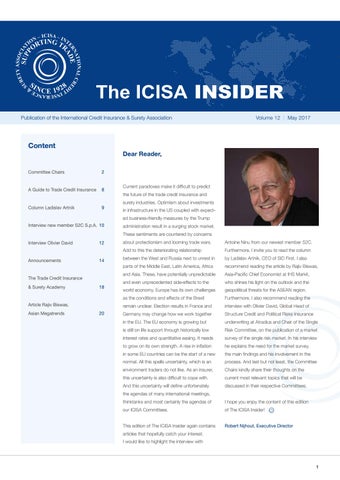
Current paradoxes make it difficult to predict the future of the trade credit insurance and surety industries. Optimism about investments in infrastructure in the US coupled with expected business-friendly measures by the Trump
Interview new member S2C S.p.A. 10
administration result in a surging stock market. These sentiments are countered by concerns
Interview Olivier David
Announcements
12
14
The Trade Credit Insurance & Surety Academy
18
Article Rajiv Biswas, Asian Megatrends
20
about protectionism and looming trade wars.
Antoine Ninu from our newest member S2C.
Add to this the deteriorating relationship
Furthermore, I invite you to read the column
between the West and Russia next to unrest in
by Ladislav Artnik, CEO of SID First. I also
parts of the Middle East, Latin America, Africa
recommend reading the article by Rajiv Biswas,
and Asia. These, have potentially unpredictable
Asia-Pacific Chief Economist at IHS Markit,
and even unprecedented side-effects to the
who shines his light on the outlook and the
world economy. Europe has its own challenges
geopolitical threats for the ASEAN region.
as the conditions and effects of the Brexit
Furthermore, I also recommend reading the
remain unclear. Election results in France and
interview with Olivier David, Global Head of
Germany may change how we work together
Structure Credit and Political Risks Insurance
in the EU. The EU economy is growing but
underwriting at Atradius and Chair of the Single
is still on life support through historically low
Risk Committee, on the publication of a market
interest rates and quantitative easing. It needs
survey of the single risk market. In his interview
to grow on its own strength. A rise in inflation
he explains the need for the market survey,
in some EU countries can be the start of a new
the main findings and his involvement in the
normal. All this spells uncertainty, which is an
process. And last but not least, the Committee
environment traders do not like. As an insurer,
Chairs kindly share their thoughts on the
this uncertainty is also difficult to cope with.
current most relevant topics that will be
And this uncertainty will define unfortenately
discussed in their respective Committees.
the agendas of many international meetings, thinktanks and most certainly the agendas of
I hope you enjoy the content of this edition
our ICISA Committees.
of The ICISA Insider!
This edition of The ICISA Insider again contains
Robert Nijhout, Executive Director
articles that hopefully catch your interest. I would like to highlight the interview with
1
The ICISA INSIDER | May 2017 | COMMITTEE CHAIRS
The ICISA Committee Chairs
Committee of Underwriters – Nick Walklett
The Geopolitical environment is changing dramatically as voters in Europe and across the Atlantic express their desire for change through the Ballot Box.
Nick Walklett
Elections have just taken place in Holland and key
Chair of the Committee of Underwriters
decisions from the electorates in France and
Company: Tokio Marine HCC
Germany are coming up. The stronger than expected support for Marine le Pen could lead to increase domestic tension and deterioration in relations with the
Main topics
EU. Generally across Europe the rise of Nationalism
European credit Market
is resulting in an increase in the debate around the
The Credit Insurance Market in the UK particularly
future of the European Union.
and across Europe is experiencing a time of high competition. The competition focuses on both the
In America the re-ordering of foreign and economic
terms of the policy and the amount of cover available
policies is likely to cause volatility in markets around
on individual buyers.
the globe. There is a higher risk of global trade wars to the economic detriment of all concerned. There are
The round table discussion of the markets represent-
many factors creating uncertainty in domestic mar-
ed by the attending delegates provided an ideal forum
kets and it is not yet known what impact the changes
to discuss particular market trends. It is always useful
will have on the economic prospects of individual
to share knowledge and experiences from colleagues
states and which sectors will be most affected. There
facing similar pressures and objectives.
is the fear that Insolvency rates will increase. The
2
macro-economic changes create a host of interesting
Brexit
topics to discuss and there was a full and interesting
The decision made by the British people on June
Agenda for the spring 2017 meeting in March. The
23rd to leave the EU was a surprise to many. There
committee of underwriters are as ever committed to
are a wide number of issues to consider. There is now
a free and open discussion on any topic chosen by
a rising concern amongst certain large businesses
the attending delegates. The meeting represented an
regarding the implications of a hard Brexit. Banks and
ideal opportunity for delegates to meet other profes-
Insurance companies in particular have serious con-
sionals with similar experiences and pressures to
cerns over what will replace the current passporting
share and discuss current market problems.
arrangements. The location of the head office is likely
COMMITTEE CHAIRS | May 2017 | The ICISA INSIDER
to be an important issue. This will continue to provide an
Other Countries
interesting topic for the committee to debate as the transition
France, Germany, Turkey, China and Russia are all countries that
out of Europe unfolds.
have interesting issues to discuss. The implications for our market following the elections in France and Germany are significant. The
Italian Banking Crisis – Update
on-going problems in Turkey; the slowing of the economy in China
The ongoing Banking Crisis in Italy and the consequences for the
and increase in tensions with the USA; The on going conflict in
credit insurance market continues to be an important subject.There
Ukraine and possible easing of EU sanctions are all matters that have
have been some significant developments since the
an impact on our market.
Autumn meeting: The rejection by the Italian voters in a referendum to amend their constitution; the resignation of the Italian prime minister;
Other Topics/ Case Studies
the bankruptcy of the 500 year old Banca Monte dei Paschi Di Siena
This spring other topics included: Underwriting approach
Spa. All of these have implications for
(Parent or Subsidiary); The maximum limits that can be written on
the Eurozone.
a company; implications of Sole supplier agreements; the rise in bureaucracy/tate bribery/corruption and implications for credit insur-
American Nationalism
ance. There was also ample opportunity to raise any other matters or
The impact of Donald Trump on American politics, International rela-
specific cases for discussion.
tions and world trade has to be a subject we consider in our committee. Due to the size and importance of the American economy and
We have in the committe a good mix of delegates from both the di-
the influence the international policies have around the world we need
rect and reinsurance market and have the opportunity for useful and
to consider the implications for our markets and specific sectors.
interesting discussions on the various topics.
Editorial Information
The ICISA Insider
For suggestions, please contact:
How to get a free Subscription
Tim Frijters (editor a.i.)
If you would like to be added to the distribution list of The ICISA
Edward Verhey (Head of Advocacy & Media Relations)
Insider, please send a message to secretariat@icisa.org.
T +31 (0)20 - 625 4115 secretariat@icisa.org
3
The ICISA INSIDER | May 2017 | COMMITTEE CHAIRS
Continuation of the The
ICISA Committee Chairs
Credit Insurance Committee – Pierre Favre
Pierre Favre The most prominent topics currently on the agenda of the Credit
Chair of the Credit Insurance Committee
Insurance Committee (CIC) are presented below along the catego-
Company: AspenRe
ries Environment, Product, Distribution, Knowledge, Underwriting and Claim, that were used for the review of the CIC activity at the last General Meeting.
DISTRIBUTION - New Trend toward Regionalization We will also conitnue to discuss some evolution observed in the
ENVIRONMENT – Opportunities & Risks
market that some international corporate tend to go back to a
The fast changing economic & societal environment, mainly induced
decentralized mode of buying credit insurance, i.e. preferring buying
by the development in the information technology sector, will keep
multi regional programs at the regional level rather than a single
us busy. We will be discussing topics like Digitalisation, Big Data
global one.
and Fin Tech and how the credit insurance industry can best take advantage of them in its offering over the forthcoming years. By
KNOWLEDGE - The Fundament
adding Cyber Risk, we will continue to discuss the flip side of those
We will continue in developing and revisiting the important database
technologies, i.e. the risk that those represent to the industry as
of knowledge that the CIC has built over the last 20 years.
a risk taker. The Legal Entity Identifier (LEI), established by the Financial Stability Board, was also on the agenda in March as an im-
Finally, with regard to the remaining 2 categories, UNWRITING
portant and almost disruptive topic if we consider the current buyer
and CLAIM, we will always be attentive to any subject arising from
identification process. More recurrent topics, like fraud in emerging
our recurring tour de table.
and developed countries, will remain on the agenda. Further we will follow up on the changes in the Insolvency Law occurring in Italy.
PRODUCT - Increasing Single Risk & Non-Trade We will continue to discuss the current development away from the traditional whole turnover policy toward more finance driven or single risk covers. Also reverse factoring will be on the agenda following the Abengoa claim and the treatment of the insured credit as financial rather than trading debt. Furthermore, insurance of prepayment and consumer credit will be revisited.
4
COMMITTEE CHAIRS | May 2017 | The ICISA INSIDER
Surety Committee – Roberto Castillo
I believe digitalization will be a very prominent topic that will keep us
Roberto Castillo
busy for the coming months and even much longer. This topic is not
Chair of the Surety Committee
completely new for all of us as the digital era is already here for years,
Company: HannoverRe
but the speed of the digital progress and the impact it is having in our daily lives is tremendous. be a totally different animal. It gets more complicated when we have We cannot ignore these trends in our surety community as the
to evaluate and determine aggregate global responsibilities on certain
technological development is changing our near and dear traditional
contractors active in many countries probably in Joint Ventures or
processes, some processes may even become obsolete. The way we
Consortia that are subject to specific local rules. This can be as
communicate with each other and the way we gather or exchange
puzzling as the preceding two sentences.
information has already experienced some profound transformation. A strategic and technological adaption to the ongoing digital challenge
It becomes even more challenging if there is a problem with a bonded
is essential for all players in order to keep pace with the traditional
project on the other side of the border, the claims management and the
competitors or any new players that may irrupt into our industry.
enforcement of counter-guarantees will require quite some expertise
So there is plenty to discuss in the next months in our Committee
and a good network.
about trends, potentials, opportunities, but also threats as a result of the digitalization.
The more global we all get the more we will be confronted with this type of challenges and the more we will be discussing the different
Another ‘alization’ apart from digitalization is the globalization. Contrac-
implications of this subject in our Committee.
tors, it doesn’t matter whether they are large or small, debark in the different parts of the world and become more and more international.
We are looking forward to always very productive discussions and
Sureties are doing just the same thing: they also do cross borders
extraordinary informative presentations and speeches of our members
expanding to other countries, focusing on own growth but also looking
and invited guests as we are accustomed in our get-together.
to accompany these contractors that are their clients to the world. Globalization is making things more complex leading to new challenges for our industry. It starts with different legal frameworks from public procurement to insurance regulations in the different countries where a specific surety product may have the same denomination but can
5
The ICISA INSIDER | May 2017 | COMMITTEE CHAIRS
Continuation of the The
ICISA Committee Chairs
Single Risk Committee – Olivier David
The prominent discussions of the single situation committee in various shapes and forms will consistently revolve around how we will best manage together and influence the various external inputs of the foreseeing future.
Olivier David Chair of the Single Risk Committee
Among the growing number of Insurers attracted by this class, the
Company: Atradius
increasing influence of the specialist brokers as our predominant distribution channel, the volatility of losses severity and frequency across financial or underwriting years, the profound and unevenly
However, one key weakness the single situation structured credit
spread effects of changing regulations (Solvency II, UK insurance
and political risk market suffers from is its low profile with the media,
Act 2015, Basle III, Brexit,…), the support/competition relation-
Business schools, regulators and its targeted insureds. While this
ship with the Export Credit Agencies, the non-trade and financial
market has grown tremendously over the past four decades, thriving
guarantees opportunities, … the topics are numerous indeed, but
through the various economic and geopolitical crisis, supporting a
the key questions each (Re)insurer consistently seek an answer to
significant portion of the infrastructure projects, investments, trade
are: Where are we going? Do I (still) want to be part of the ride? Can
and Bank financings from the West towards the Emerging markets,
I chose my seat? Can I boldly go where no one has gone before?
this activity is often perceived as only performed by the Export Credit Agencies for the long term business and by the monoline credit
The single situation committee involves monoline and multiline
insurers for the trade within 24 months. Only the most sophisticated
insurers, Lloyd’s syndicate and companies, as well as reinsurers. We
industrial companies, commodity traders and international banks
belong to a syndicated market where competitors also need each
access what is also known as the London PRI market. From this
other to be stronger together or to complement one’s limitations.
conclusion, in cooperation with volunteering non-ICISA members,
This is not a win it all, or else lose it all game. Success is not linked
we aim at gathering market wide data and publish them to raise
to size, and growing one’s market share does not have to be at the
the profile of the entire market towards our various and common
expense of the others. The creativity, agility, expertise, leadership,
stakeholders. This should not only allow us to increase our customer
successes of one can also beneficiate the others. Losses are better
base, but also be heard by the various regulators, especially the EU.
swallowed and digested when they are well spread. Syndication reduces volatility, spread best practice, while it increases the size of the accessible opportunities for all. Competition is still at the centre of everyone’s mind, but it is more about being the most reliable best service provider for the long term to have access to the lion share of the business one’s risk appetite seeks.
6
Not a small task, but an exciting one.
COMMITTEE CHAIRS | May 2017 | The ICISA INSIDER
Asia Committee – Zhongzhu Chen
The most prominent discussions are on the following topics: • How to insure multi-line traders (instead of manufacturers) as the policyholders. • How P&C Companies (multiline insurers) compete with a domi-
Zhongzhu Chen
nant player, i.e. a single line credit insurer or ECA in the market.
Chair of the Asia Committee Company: PICC
The committee also considers other market developments, such as: • Consequences of underwriting commodities (iron, etc) trading from or to China or within China, in the past a few years. Some members in the region have experienced losses in this segment. • Sharing payment experience, claims experience while respecting anti-trust regulations. • Reflections after significant losses. • Improving underwriting discipline. • The pros and cons of being a P&C company, a specialized credit insurer or an ECA. • Competition between P&C Companies and specialized single line players in the market.
Yearbook – ICISA Yearbook 2016 - 2017 The Yearbook 2016-2017 is available. It can be downloaded from the ICISA website (www.icisa.org). To order a hard copy, please send an email to secretariat@icisa.org
NORWAY SWEDEN IRELAND HUNGARY HONG KONG ARGENTINA INDONESIA FRANCE SWITZERLAND PORTUGAL BELGIUM SINGAPORE POLAND GREECE TURKEY CANADA JAPAN UNITED KINGDOM ISRAEL SOUTH AFRICA SPAIN NETHERLANDS CHINA AUSTRIA AUSTRALIA ITALY KOREA SLOVENIA DENMARK USA GERMANY BRAZIL NEW ZEALAND LUXEMBOURG FINLAND NORWAY SWEDEN IRELAND HUNGARY HONG KONG ARGENTINA INDONESIA FRANCE SWITZERLAND PORTUGAL BELGIUM SINGAPORE POLAND GREECE MEXICO CANADA JAPAN UNITED KINGDOM ISRAEL SOUTH AFRICA SPAIN NETHERLANDS CHINA AUSTRIA AUSTRALIA ITALY KOREA SLOVENIA DENMARK USA GERMANY BRAZIL NEW ZEALAND LUXEMBOURG FINLAND NORWAY SWEDEN RUSSIA IRELAND HUNGARY HONG KONG ARGENTINA INDONESIA FRANCE SWITZERLAND PORTUGAL BELGIUM SINGAPORE POLAND GREECE MEXICO CANADA JAPAN UNITED KINGDOM ISRAEL SOUTH AFRICA SPAIN GERMANY BRAZIL NEW ZEALAND LUXEMBOURG FINLAND SLOVENIA DENMARK USA GERMANY BRAZIL NEW ZEALAND LUXEMBOURG FINLAND NORWAY SWEDEN IRELAND HUNGARY HONG KONG ARGENTINA MOROCCO FRANCE SWITZERLAND PORTUGAL BELGIUM SINGAPORE POLAND GREECE MEXICO CANADA JAPAN UNITED KINGDOM ISRAEL SOUTH AFRICA SPAIN NETHERLANDS CHINA AUSTRIA AUSTRALIA ITALY KOREA SLOVENIA DENMARK USA GERMANY BRAZIL NEW ZEALAND LUXEMBOURG FINLAND NORWAY SWEDEN IRELAND HUNGARY HONG KONG ARGENTINA INDONESIA FRANCE SWITZERLAND PORTUGAL BELGIUM SINGAPORE POLAND GREECE MEXICO CANADA JAPAN UNITED KINGDOM ISRAEL SOUTH AFRICA SPAIN NETHERLANDS CHINA AUSTRIA AUSTRALIA ITALY KOREA SLOVENIA DENMARK USA GERMANY BRAZIL NEW ZEALAND LUXEMBOURG FINLAND NORWAY SWEDEN IRELAND HUNGARY HONG KONG ARGENTINA INDONESIA FRANCE SWITZERLAND PORTUGAL BELGIUM SINGAPORE POLAND GREECE MEXICO CANADA JAPAN UNITED KINGDOM ISRAEL SOUTH AFRICA SPAIN NETHERLANDS CHINA AUSTRIA AUSTRALIA ITALY KOREA SLOVENIA DENMARK USA GERMANY BRAZIL NEW ZEALAND LUXEMBOURG FINLAND NORWAY SWEDEN IRELAND HUNGARY HONG KONG UAE ARGENTINA INDONESIA FRANCE SWITZERLAND PORTUGAL BELGIUM SINGAPORE POLAND GREECE MEXICO CANADA JAPAN UNITED KINGDOM ISRAEL SOUTH AFRICA SPAIN NETHERLANDS CHINA AUSTRIA AUSTRALIA ITALY KOREA SLOVENIA DENMARK USA GERMANY BRAZIL NEW ZEALAND CZECH REPUBLIC FINLAND NORWAY SWEDEN IRELAND HUNGARY HONG KONG ARGENTINA INDONESIA FRANCE SWITZERLAND PORTUGAL BELGIUM SINGAPORE POLAND GREECE MEXICO CANADA JAPAN UNITED KINGDOM ISRAEL SOUTH AFRICA SPAIN NETHERLANDS CHINA AUSTRIA AUSTRALIA ITALY KOREA SLOVENIA DENMARK USA GERMANY BRAZIL NEW ZEALAND LUXEMBOURG FINLAND 3107_ICISA_Yearbook 2016-2017_Digital_V1.indd 1
YEARBOOK 2016 2017
INTERACTIVE EDITION 16-09-16 23:02
7
The ICISA INSIDER | May 2017 | INFORMATION
By the International Credit Insurance & Surety Association
A Guide to Trade Credit Insurance A practical and accessable industry-wide reference on Trade Credit Insurance, written by a team of industry experts. This compact volume is a practical guide for anyone interested in Trade Credit Insurance. The International Credit Insurance & Surety Association (ICISA) presents an approachable but detailed guide written collaboratively by carefully selected industry experts. The guide describes the ‘lifeline’ of the credit insurance product, from the initial application stage to the expiration phase of the policy, including practical use aspects for credit managers. The volume offers compact information on the history of trade, the need for protection against trade credit risks, and solutions offered by credit insurance providers. The focus is
Key selling points
on short term credit, including whole turnover policies and
• Collaboration of a diverse group of experts from top
single risk policies.
organizations around the world • Written in an approachable style, accessible to
Readership
the non-specialist
Suitable for anyone interested in Trade Credit Insurance,
• Includes extended glossary of key terminology
from credit managers to policymakers.
• Includes a list of relevant resources for further reading
Contents
About the Author(s) / Editor(s)
Foreword; Introduction; Disclaimer; 1. What is trade?; 2.
The International Credit Insurance & Surety Association
What is trade credit insurance?; 3. Product types; 4. Risk
(ICISA) brings together the world’s leading companies
types; 5. Typical set-up of a trade credit insurance con-
providing trade credit insurance and surety bonds.
tract; 6. Premium, the price for cover; 7. Day-to-day policy
ICISA promotes technical excellence, industry innovation
management; 8. Buyer risk underwriting in trade credit in-
and product integrity, as well as addressing business
surance; 9. Debt collection; 10. Imminent loss and indem-
challenges generated by new legislation.
nification; 11. Renewal, expiry, termination of a policy; 12. Single risk business; 13. The single risk insurance market: Private and public players; 14. Reinsurance of Trade Credit Insurance; Trade Credit Insurance resources; Glossary of trade credit terminology
Where to order my copy To order a copy of the book ‘A Guide to Trade Credit Insurance’, please visit www.amazon.com.
8
COLUMN | May 2017 | The ICISA INSIDER
Ladislav Artnik, CEO at SID First.
Grilled Sea Bass It was on a lazy late summer afternoon on Adriatic coast after consuming a perfectly grilled Sea Bass with everything that goes with or over it, when I decided to accept Daniel Stausberg’s invitation to take the pen and write a contribution to our industries common cause. Besides the
Even if it is agreed that insurer is not allowed to cancel the limit, it of
excellent meal and a beautiful view on the sea the decision was also
course doesn’t mean that one cannot try and with proper argumenta-
based on my fast approaching retirement, which obviously aligns with
tion and client’s consent also succeed. It will not always be easy having
certain urge to have a farewell say on the state of our industry. And there
the “burden of proof” on our side but I am also sure that if profession-
is this almost full quarter of a century of experience.
ally executed it will only help regaining necessary trust. And in my view, this is more important than possible occasional loss due to prolonged
Will you be able to survive in the highly competitive EU market consider-
argumentation period.
ing your size of operation? This was the most frequent question coming from all sides (owners,
I am certain that direct communication with the client is so important that
competitors, clients) and all the time.
will never be supplemented by a “machine”. At least as long as there are still people on the other side of the line.
Having survived the major financial crisis, new European Solvency regulation and so far the present really soft market conditions, the answer is
Considering the fast developing disruptive technologies already affect-
obviously positive. All this of course wouldn’t be possible without reason-
ing at least energy and automotive sector and consequently also their
ably good relations with information providers, reinsurers and also clients
suppliers even for short term insurers the ability to detect the companies
allowing us to take a fair share of their “economies of scale”.
heading in the wrong direction will be even more important than just checking their financials. Looking at the smoking signs all over the place
In my opinion, one of the main factors of our success was also our rela-
I just hope that in the future we will still be able to call inside E.U. trade
tively conservative attitude regarding acceptance of “non-traditional” fea-
“almost domestic” and that travel will remain as free as possible.
tures such as insured’s our selection of risk or “non- cancellable” limits. And to my colleagues from ICISA who so often feel that for compliance We have managed to maintain the whole turnover concept for the vast
reasons it is not allowed to discuss sensitive insurance topics, I am
majority of our business insured and will try to continue to do so with
offering (upon request) some very useful tips on preparing grilled Sea
rare exceptions whereby the selection can be treated as being objective
Bass instead.
(financing receivables, single transactions, and so on). It is my pleasure to pass the pen to Stefaan Van Boxstael, general I don’t believe that spreading fear or overemphasizing certain risks is a
manager at Credendo, who will share his thoughts with the readers in
proper sales tool but mere hinting of the possible consequences of the
next ICISA Insider.
wrong own selection normally works. And it is quite possible that a client may in an uninsured loss situation at least consider to blame the insurer for allowing selection. We have also been restraining from offering so called “non cancellable” risks as a standard option. Looking back to the last crisis period and the attitude of many insurers I see this request to formalise the “non cancelability” as certain mistrust and reaction of clients’ to crisis driven numerous credit limit cancellations. We have recently reconsidered our position since in real life, we all know that, a responsible insurer will not just cancel an important (sizeable) and regularly utilized credit limit without previously consulting the client.
9
The ICISA INSIDER | May 2017 | INTERVIEW
Interview with Antoine Ninu, General Manager
S2C S.p.A. - Investing in the Digital Edge
ICISA is pleased to welcome S2C S.p.A. as a member. S2C is an Italian insurance company that was founded in 2010 specialising in surety bonds. In this interview Antoine Ninu shares his thoughts on the increasing need to embrace technological innovation and how collaboration within the ICISA framework can be of vital importance to achieve this.
According to Antoine S2C strives to be a ‘technology
latest methods to manage risks and serve clients bet-
first’ company by making the necessary investments
ter. He notes that “as a result S2C has had continuous
in technology and building up associated skill sets to
growth from its creation with a claim ratio that has
ensure that they are constantly at the forefront of the
consistently been lower than the market benchmark.”
‘S2C persistently strives to have the most up-todate market knowledge and we believe that ICISA membership helps us to have more in-depth access to current trends and analysis’
ICISA membership When asked what Antoine expected from ICISA membership, he explains “S2C persistently strives to have the most up-to-date market knowledge and we believe that ICISA membership helps us to have more in-depth access to current trends and analysis”. He believes that being a member gives him access to new and relevant sources of information in order to have the latest perspective on new developments in surety markets. Having expert assessments and analysis
S2C
from such varied and diverse backgrounds is seen by him as an invaluable resource in increasingly turbulent times. He also realises that ICISA membership is a
S2C S.p.A. is one of Italy’s leading specialist surety providers. The company’s
two-way street and he looks forward to collaborating
team has deep-rooted market expertise both locally in the Italian and inter-
and actively contributing to ICISA’s development. He
national surety markets. The underwriting policy is built on extensive industry
notes “we have a unique opportunity to understand
experience in understanding risk with a strict and rigorous methodology at its
Italian market trends and best practices from our
foundation.
industry with which we can help to provide insight and analysis to other members and share our experience
The company has had continuous growth from its inception, with a claim ratio
to ICISA’s large audience.”
that has consistently been lower than the market benchmark. In 2016, S2C S.p.A. achieved 10.6% year-over-year growth with a combined ratio of nearly
Technological developments
46% and a 3-year average ROE of 12.5%. At the end of 2016, the company’s
Antoine believes that the future of the surety industry
solvency ratio was at 175%. S2C S.p.A. operates from its offices in Rome
will be greatly affected and largely defined by major
and Milan through a broad commercial network managing a diverse portfolio
technological developments. In the near future it will
of multinational and medium-sized companies in various industries.
become increasingly essential for S2C and other play-
The company offers a selected range of sureties primarily focusing
ers in the industry to harness the potential of these
on contract, VAT and customs bonds.
technological disruptions. He further notes that ICISA can play an important role in helping to guide the
For more information about S2C SpA,
industry in accessing informative material and sharing
please visit www.s2cspa.it
best practices. Since its founding in 2010, S2C has made numerous of investments in new technologies
10
INTERVIEW | May 2017 | The ICISA INSIDER
Antoine Ninu, General Manager
‘the fast-paced change in our industry will affect all facets of the surety business, making it crucial to work together as an industry to explore and develop the right procedures and guidelines’ and in upskilling its employees to not only focus on
of no use if talented employees are not trained and
raising productivity and providing better service to its
skilled to take advantage of these. He adds that S2C
clients, but also to remain agile and ready to adapt to
is very much committed to invest and expand training
new methods and workflows. He understands that the
opportunities in order to ensure that experienced staff
fast-paced change in our industry will affect all facets
are not only aware of different methods and inte-
of the surety business, making it crucial to work to-
grated practices, but are also able to apply these in a
gether as an industry to explore and develop the right
successful manner. He emphasizes that “the STECIS
procedures and guidelines to help make the transi-
training program is an excellent example of industry-
tion to increasing automation in the surety business.
led training and networking events that can help foster
He considers ICISA as perfectly placed to provide its
an environment of collaboration and knowledge
members and the industry at large a forum to collabo-
sharing.” He concludes the interview by stating that
rate and share expertise in the use and application of
training initiatives such as this not only enhance the
new technologies.
quality of the workforce, but benefit the industry as a whole.
Education Devoting resources to new technology is important to stay relevant in the markets of tomorrow, but it’s
Catalogue of Credit Insurance Terminology The new English edition of the catalogue is available. It can be downloaded from the ICISA website
CATALOGUE OF CREDIT INSURANCE TERMINOLOGY
(www.icisa.org). To order a hard copy, please send an email to secretariat@icisa.org English edition
2942_ICISA_Dictionary_UK_V6.indd 1
02-02-17 12:53
11
The ICISA INSIDER | May 2017 | INTERVIEW
Interview with Olivier David, Global Head of Structure Credit and Political Risks at Atradius
Structured Credit and Political Risk market survey, a first picture at last! Back in 2015 ICISA’s Single Risk Committee decided to conduct a market survey to gain more insight into the size, growth and structure of the single risk market. Information was to be gathered from a large group of insurers, many of whom were reluctant at first to share their data beyond the association(s) they belong to. This resulted in a timely and challenging process which was coordinated by Olivier David. In this interview he explains among others the need for this market survey, the main findings and the challenges he faced during the process. Please explain the need for a private single risk
gain the trust and the comfort of the non-ICISA members,
market survey?
who were requested to deliver very confidential granular in-
The private single risk market, also known as the Structured
formation. We therefore needed an independent trustworthy
Credit and Political Risk Insurance (SCPRI) market, has
third party to be responsible for the collection, aggregation
grown significantly over the past twenty years, in terms of
and publication of the data. We eventually chose Finaccord,
the capacity that is available and the number of partici-
a market research firm specialised in financial services and
pants. The market provides key support for many western
based in London.
investors, exporters, traders and banks dealing with emerging markets. Still, the market’s existence and capabilities
Your involvement was key to the success of the market survey, could you explain what your role was and why
‘I took it upon myself to leverage my network fostered over the past twenty years, to convince personally each market leader to participate and promote this survey, not for the sake of one association but for the market’s common interest’
this was necessary? Most of the fifty odd insurers involved in this niche market belong to at least one organisation or association (Lloyd’s, the Berne Union, ICISA). While they were all accustomed to share this type of information within their own associations, insurers were very uncomfortable with participating in an initiative driven by another. This created a standstill for many years. The existing surveys of the various associations were done on different bases and had various overlaps. None could represent a reliable picture of the whole market. The London SCPRI market is foremost a market of syndication, built on reputations, respect and trust in individuals
remain known only to the most sophisticated multinational
over years of working together and competing against each
insureds. Its size, growth, profitability and volatility continues
other. The key was to get the support of the most influ-
to be vague to all. In order to change this status quo, a few
ential Lloyd’s syndicates underwriters, beyond the ICISA
years ago the Committee decided to conduct a survey of its
members. They are at the heart of the market and often
members and beyond. The aim of the survey is to raise the
determine the various trends.
profile with potential insureds and regulators, as well as providing a benchmark to all participants, and shed a brighter
I took it upon myself to leverage my network fostered over
light on this thriving insurance class.
the past twenty years, to convince personally each market leader to participate and promote this survey, not for the
12
Why could this not have been done by ICISA and was a
sake of one association but for the market’s common inte-
third party, Finaccord, involved?
rest. Thankfully the idea was well received and I only faced
While ICISA was the driver behind this survey, we needed to
little reticence. The critical mass of industry leaders was
INTERVIEW | May 2017 | The ICISA INSIDER
Olivier David, Global Head of Structure Credit and Political Risks at Atradius.
Do you think it is important to conduct a follow-up study? Should this study be the same or more detailed? It will be important to have recurrent updates so we can see the evolution of the market over time. Ideally we would want to collect data on a regular basis from each critical to create a momentum and achieve a meaningful
participant without imposing too cumbersome a process.
result. Once the principles were agreed in the autumn 2015,
However, with the level of granular detail we would like to
it took nine more months to collect the data from over thirty
see, including insureds’ and risks’ geography, sector, and
insurers. I believe this is the first market wide initiative. Well
cover, I expect it may take a number of years before the
worth it.
value of this detail is felt.
What are the main findings of the market survey? Are
What do you identify as the biggest challenges and
these findings in line with your prior evaluation of the
opportunities for the private single risk market?
private single risk market?
One of the biggest challenges of the private single risk
The main findings of the survey do not only give us a snap
market is to have its value recognised in the growth of the
shot of the income, losses and exposure of the market, it
international trade and cross border investments, so to
shows the evolution since the 2008 crisis, for three classes
attract the interest of more insureds and the support of
of products: contract frustration with sovereign obligors,
regulators.
credit risks with private obligors and confiscation of assets. The overall trends were expected, but the quantum was
What should be the priorities for the private single risk
quite interesting for each product. It was interesting to see
market for the next 5 years?
that the aggregated data shows a size of the market that
In my view, the priority of the market shall be to maintain
was below the estimation of some participants. The renewal
the quality of the underwriting it built its reputation on. The
of this survey with a larger panel might bring the figures
strong growth of the past ten years has brought plenty
closer together.
of new bright talents, many of whom still lack the painful experience of a major economic or geopolitical crisis, or
How can the outcome of the survey be used by ICISA
enough claims experience to build prudence and to grasp
and the private single risk market?
the ambiguities inherent in bespoke wordings.
We will discuss together with all participants the best way to use this data. There is a strong demand from the brokers
In what way could ICISA be supportive in meeting the
to have access to this survey’s results. They want to use
challenges of the private single risk market?
it for marketing purposes, to demonstrate the support
ICISA is already a great advocate of the private single
provided to our Insureds and the value of the product. We
situation market, even though it only has a portion of them
will also discuss how and why we might want to share it
as members. The market survey is a testimony of this
with other stakeholders, especially the EU regulator and the
approach, but is only at its infancy. ICISA also supports
Basle Committee who determines the coming Basle IV rules
the sharing of expertise among its members and beyond,
for our bank insureds and define the competition guidelines
through the annual Open Forum (London) together with
of the Export Credit Agencies.
Lloyd’s and the Berne Union.
13
The ICISA INSIDER | May 2017 | APPOINTMENTS & ANNOUNCEMENTS
The Guarantee USA appoints Dwight Teter as Vice-President and Chief Underwriting Officer Stephen Ruschak, President and Chief Operating Officer of The Guarantee Company of North America USA (The Guarantee USA), is pleased to announce that Dwight Teter has been appointed as Vice-President and Chief Underwriting Officer. Dwight will be providing technical underwriting
“The Guarantee has made great strides in building
leadership, support and authority to The Guarantee
out our North American footprint over the last few
USA underwriting teams, ensuring the success-
years,” says Alister Campbell, CEO of The Guar-
ful achievement of key corporate strategies for
antee Company of North America. “The addition
profitable growth. “Dwight is a tremendous addition
of Dwight Teter to our Senior Management Team
to The Guarantee USA,” says Stephen Ruschak.
will ensure we maintain that positive momentum
“Our team has delivered several years of profitable
and help move our company to the next level in the
growth by successfully partnering with professional
United States.”
surety producers across the United States. Dwight’s extensive experience in the surety industry will help
For more information please visit the website
us to achieve our aim of being a leading provider of
www.theguaranteeus.com.
Dwight Teter
middle market surety products in the United States.” With over 30 years of experience in the surety
The Guarantee Company of North America USA
industry, Dwight brings with him an array of knowledge that extends across various surety segments.
The Guarantee USA underwrites Contract, Commercial and Environmental Surety
Prior to joining The Guarantee USA, Dwight was
through its Home Office in Southfield, Michigan and 19 branch office locations across
Vice President and Regional Underwriting Officer
the United States. The Guarantee USA is licensed to write Surety in
at Liberty Mutual Surety and held numerous surety underwriting positions of increasing responsibility
50 states, Puerto Rico and the US Virgin Islands. Our US Treasury Listing is currently
with Safeco and Ohio Casualty.
$16.9M as of July 1, 2016 with an A.M. Best rating of “A” (Excellent) and a Financial Strength Category of VIII ($100M - $250M).
The fourth largest European credit insurance group to continue under one name: Credendo Three years ago, ONDD Group became Credendo
has offices in 14 European countries. The group is
Group with Delcredere | Ducroire, the Belgian export
active in all segments of trade credit insurance and
credit agency, as parent company. With effect from
offers a range of products covering risks worldwide:
17 January 2017 the names of the various com-
whole turnover short-term credit insurance covering
panies in the group, namely Delcredere | Ducroire,
European and non-European risks, single risk, ex-
Credimundi, KUPEG, INGO-ONDD, Garant and
cess of loss, top up, surety, reinsurance and Belgian
Trade Credit have ceased to exist. The various legal
export credit agency services. In 2015 Credendo
entities will remain, yet bear one single name: Cre-
insured international trade worth 84 billion euros and
dendo. “By adopting one single name for all our en-
earned 390 million euros in premium income.
tities, we would like to present ourselves even more as one international group”, says Dirk Terweduwe,
For more information, visit www.credendo.com.
Group Chief Executive Officer. Credendo is the fourth largest European credit insurance group and
14
Dirk Terweduwe
APPOINTMENTS & ANNOUNCEMENTS | May 2017 | The ICISA INSIDER
Argo Surety Names David Layman Vice President and Chief Underwriting Officer of Contract Surety David M. Layman has been appointed as
and contribute to, every aspect of the growth and
vice president and chief underwriting officer
expansion into our contract surety segment. We are
(CUO) of Contract Surety at Argo Surety.
very excited to have David join us, and appreciate his long-term perspective on growing a portfolio.”
In this newly created role, Layman will be responsible for managing the company’s contract surety portfolio,
Layman comes to Argo Surety with almost three dec-
establishing contract surety underwriting guidelines,
ades of surety experience in underwriting and man-
and recruiting and staffing a contract underwriting
aging contract surety portfolios, as well as involve-
team made up of professionals in several strategic
ment on the agency side of the business. Previously,
cities in the U.S. He will begin in this role effective
Layman served as president and founder of Layman
immediately and will report directly to Joshua Betz,
Surety Services, a contract surety agency based in
Argo Surety President.
San Antonio, Texas. Prior to founding Layman Surety Services, he served as vice president – senior man-
“As we continue to expand our surety business,
ager, Contract Surety at NAS Surety/Swiss Re from
David is joining Argo Surety at the perfect time. He
2002 to 2014. Preceding his time at NAS Surety/
has an excellent track record as a CUO for contract
Swiss Re, he worked at Reliance Surety.
surety, and his vision and entrepreneurial spirit will fit right into our culture,” said Betz. “David has a great
For more information on Argo Surety, please visit
reputation. He is a leader who will be involved in,
the website www.argolimited.com/argo-surety/
David M. Layman
Munich Re: Change in responsibility for Special and Financial Risks Munich Re Group has integrating the “Munich Health” field of business into the Life Re and ERGO operations with effect from 1 February 2017. In parallel, Board Member responsibilities are reallocated, to prepare for the succession of Nikolaus von Bomhard as CEO of Munich Re Group. Doris Höpke
The reinsurance units of Munich Health will
ance Asset Management, Capital Partners
be merged with Munich Re’s Life division,
and the Digital Innovation Initiative. As from
and the primary Health insurance business
the Annual Shareholder Meeting in April,
will be integrated into ERGO Group. This
Doris Höpke will also assume responsibil-
reorganization will improve the strategic
ity for Human Ressources, from Joachim
business development of the entire Health
Wenning, who will succeed Nikolaus von
segment, and also release some cost syn-
Bomhard as Munich Re Group CEO.
ergies. In addition, it will allow to cater for the retirement of Group CEO Nikolaus von
Doris Höpke is very experienced in the
Bomhard, without adding a new
various SFR business segments, having
Board Member.
had management positions in Corporate Insurance Partners, then heading the divi-
Doris Höpke took over responsibility for
sion Aviation/Space/GLUK/New Re, before
SFR since 2005.
Special and Financial Risks (“SFR”) from
becoming the Head of Munich Re Spain
Thomas Blunck on 1 February, who in turn
and subsequently Board Member
For more information, please visit the
is now responsible for the combined Life
for Munich Health. Thomas Blunck has
website www.munichre.com
and Health Reinsurance Business, Reinsur-
been the responsible Board Member for
15
The ICISA INSIDER | May 2017 | APPOINTMENTS & ANNOUNCEMENTS
SID First has launched a new product i.e. Advance Payment insurance. The object of insurance of advance payments are claims against the supplier for the repayment of advance payments. If the supplier does not fulfil his contractual obligation and also does not repay advance payment our insurance company covers up to 90% of advance payment. Nonpayment of the advance payment could be covered against following risks: a) Insolvency of the Supplier b) Protracted default c) Inability to repay the advance payment d) Political risks The Advance Payment insurance product is developed by Mr. Andraz Tinta, Legal Adviser and Mrs. Marija Osojnik Bubnic, M.sc., Director of
Mr. Andraz Tinta, Legal Adviser and Mrs. Marija Osojnik Bubnic, M.sc., Director of
Actuarial and Reinsurance Department.
Actuarial and Reinsurance Department
Changes in the Board of Management at SID First SID First has recently changed the size of its Board of Management to two members. The Board of Management currently consists of Mr. Ladislav Artnik, President and Mr. Igor Pirnat, M.sc, Board member.
Mr. Ladislav Artnik, President
Mr. Igor Pirnat, M.sc, Board member.
Endorsed Conferences ICISA endorses numerous conferences related to the trade credit insurance, surety and political risk industries: GTR Europe Trade & Export Finance Conference
More information on our endorsed conferences
(21 June 2017, Paris)
can be found on the ICISA website.
GTR Asia Trade & Treasury Week (5-7 September 2017, Singapore)
Join over 3600 other industry experts in the ICISA group on LinkedIn
16
APPOINTMENTS & ANNOUNCEMENTS | May 2017 | The ICISA INSIDER
Marc Henstridge succeeds Dominique Charpentier as Atradius’ new Chief Insurance Operations Officer Marc Henstridge will join the Management Board of Atradius N.V. on 1 January 2017, following the retirement of Dominique Charpentier at the end of 2016. Marc Henstridge (48), a British citizen, has
spanning more than 20 years. “Constantly
been with Atradius since 1997. As CIOO
evolving with our customers to find new
he is responsible for Atradius Re, Bonding,
ways to help them safely grow their busi-
Collections, Instalment Credit Protection,
nesses is essential to our customers’ suc-
Project & Process Unit and ITS. Over his
cess. Dominique has been extremely suc-
19 years with Atradius, Marc has served
cessful in helping us reinvent the way we do
in a variety of positions, most recently as
this for our customers and Marc continues
Director of Risk Services in the UK and
to help expand the way we will achieve this
Ireland. In addition to his responsibilities at
going forward” says Isidoro Unda, Chairman
Atradius, Marc also sits on various external
and CEO.
Dominique Charpentier
committees to represent Atradius and the credit insurance industry. He will be based in
For more information,
Amsterdam.
please visit www.atradius.com
After 14 years with Atradius, including the last three years as CIOO and member of the Management Board, Dominique Charpentier (65) retires from an outstanding career in the credit insurance and factoring industries
Marc Henstridge
New appointments at QBE Barry Robinson will join QBE as Head of
sales effort. Kih joined QBE in 2012 as
Asia for trade credit and surety. Barry will
a graduate in QBE’s Melbourne office as
be domiciled in their Singapore office and
underwriter, lastly working within the new
be a member of the global leadership team
business team. Kih has been in Singapore
reporting to Richard Wulff. “Barry has been
as senior underwriter since January 2016
working in our industry since 1994, work-
and will report to Barry Robinson.
Kih Ling
ing for various trade credit insurers and brokers. He has all-round experience in risk
For more information,
and commercial. We are excited to greet
please visit www.qbetradecredit.com
someone with Barry’s experience, all-round knowledge and experience in the region” says Richard Wulff. At the same time, Kih Ling is promoted to QBE’s Head of Singapore for trade credit and surety with regional responsibility for Barry Robinson
17
The ICISA INSIDER | May 2017 | STECIS
The Trade Credit Insurance & Surety Academy
Training and education on Trade Credit Insurance and Surety is provided by STECIS, the educational foundation endorsed by ICISA. STECIS promotes knowledge and professionalism in the technical theory and practice (case studies) of trade credit insurance and surety underwriting. This includes in-depth analysis of industry developments, the terminology and the current market.
STECIS develops two-day training seminars, fly-in & fly-out seminars
The seminar is â‚Ź 2.200.-- and includes all training material, the wel-
and tailor-made in-company training programs. They are all highly
come cocktail & all meals (dinners & lunches). Travel costs and
intensive and interactive with the highest standard of knowledge shar-
any additional expenses (e.g. hotel room, phone, (mini) bar) are
ing and offer a unique networking opportunity. Participation is valued by
not included.
professionals from inside and outside the industry such as the media or civil servants of Ministries and other administrative authorities.
Discount for ICISA member companies As the International Credit Insurance & Surety Association (ICISA)
The basic training seminars are open to participants with up to
strongly endorses the STECIS training seminar programme,
3 years of work experience. The advanced training seminars are open
ICISA member companies receive a 5% discount on the total seminar
to participants who have attended the basic training seminars or have
fee. Companies (ICISA members and non-ICISA members) registering
at least 4 years of relevant work experience.
three or more participants to one training seminar, receive a 10% discount on the total seminar fee.
After each seminar participants were asked to fill in an evaluation form. The figure is constructed using this data and covers the period 2012 till 2016. It includes the basic and advanced seminars for both Trade Credit Insurance and After each seminar participants were asked to fill in an evaluation form. The figure is constructed using Surety.
this data and covers the period 2012 till 2016. It includes the basic and advanced seminars for both Trade Credit Insurance and Surety.
18
STECIS | May 2017 | The ICISA INSIDER
Training Schedule 2017 STECIS Advanced Training Seminar Program June 2017 STECIS Trade Credit Insurance Advanced Training Seminar (Underwriting & Claims Handling) (Wednesday 28 - Friday 30 June 2017, The Hague, NL) ‘The Essence of Trade Credit Insurance’ Left to right: Martin van der Hoek, Rob Klouth (Chairman) and Michael Kennedy
Day 1: Underwriting Day 2: Claims Handling
In April the newly composed Board of STECIS met in The Hague to discuss the successful developments and the future
This two-day advanced training seminar in Trade Credit Insurance
of the training academy.
for experienced professionals (4 years experience and more) is modular. Participants can choose to attend one or both modules.
They decided to increase the number and variety of training seminars and introduce a number of attractive one-day Fly-in & Fly-out
STECIS Surety Advanced Training Seminar
meetings for professionals from inside and outside the trade credit
(Wednesday 28 – Friday 30 June 2017, The Hague, NL)
insurance and surety industry. ‘Best Practices in Uncertain Times - Underwriting, Claims Handling and Business Development in Surety Today’ Among others the following subjects will be addressed: A two-day in depth training in underwriting surety and managing risks during a recession. The seminar is aimed at experienced surety underwriters (recommended 4 years’ experience or more).
Participants April 2017
The basic training seminars in trade credit insurance and
For more information
surety took place in April in The Hague and attracted over 30 participants from all corners of the world.
STECIS - The Trade Credit Insurance & Surety Academy Tel. +31 (0) 20 528 51 70
The various case-studies lead to in-depth discussions between
info@stecis.org, www.stecis.org
the participants and with the expert tutors. But as always the training seminars also provided ample networking opportunities for the participating professionals.
19
The ICISA INSIDER | May 2017 | ARTICLE
Article by Rajiv Biswas, Asia-Pacific Chief Economist, IHS Markit
ASEAN: Asia’s Third Growth Engine Since 2012, the Southeast Asian region has sustained robust economic expansion even as growth momentum has slowed in many other emerging market regions. Indonesia, Southeast Asia’s economic giant, which accounts for around 40% of total ASEAN GDP, has been growing at a robust pace of around 5% per year over the past three years, as has the Malaysian economy. Five other ASEAN economies, namely the Philippines, Vietnam, Myanmar, Cambodia and Laos, have each grown at an average annual pace exceeding 6% GDP growth over the last three years.
ASEAN is forecast to continue to be one of the fastest
With ASEAN economic growth expected to remain
growing areas of the global economy in 2017-18. Over
strong over the next decade, the region’s GDP is also
the next decade, ASEAN is also projected to be one
expected to surpass Japan by 2027, as total ASEAN
of the three growth engines of the Asia-Pacific region,
GDP is projected to reach USD 6.4 trillion.
together with China and India.
ASEAN’s Growth Drivers The combined GDP of the ten countries comprising
One of the most important growth drivers for the ASEAN
ASEAN has grown tremendously since 2000, increasing
region in the past decade has been the rapid economic
from USD 620 billion in 2000 to an estimated USD 2.6
rise of China. While the US, EU and Japan were the
trillion in 2017, measured in nominal USD terms. This
main growth markets for ASEAN exports between the
has catapulted the Southeast Asian region higher in the
1960’s and 2000, China’s economic ascendancy has
global economic order, as ASEAN GDP now exceeds
become a powerful growth driver for ASEAN exports over the past two decades. ASEAN exports to China
‘The combined GDP of the ten countries comprising ASEAN has grown tremendously since 2000, increasing from USD 620 billion in 2000 to an estimated USD 2.6 trillion in 2017, measured in nominal USD terms.’
have risen from USD 35 billion in 2000 to an estimated USD 134 billion by 2015, equivalent to around 11.4% of total ASEAN exports worldwide. China’s investment into ASEAN has also become increasingly significant, with large bilateral investment commitments made to both Malaysia and Philippines in late 2016 when the leaders of both nations visited Beijing in quick succession. A second growth driver for Southeast Asia is China’s One Belt One Road Initiative, which is also playing an
the GDP of India and is already more than double the
important role in boosting investment ties between Chi-
GDP of Australia. On a global scale, the ASEAN regional
na and Southeast Asia. As part of its strategy to improve
economy is becoming an increasingly important eco-
connectivity, China has made significant funding com-
nomic force. Its GDP is forecast to exceed UK GDP in
mitments for infrastructure development in many ASEAN
2017, reflecting the continued rapid ASEAN economic
nations, including Thailand, Cambodia and Laos.
growth as well as the impact of the slumping UK pound following the Brexit referendum in June 2016. ASEAN
China has also led initiatives to create new multilateral
GDP is also forecast to exceed the GDP of France in
development banks to provide infrastructure financ-
2017.
ing for developing countries, notably the AIIB, the New Development Bank and the Silk Road Fund. These
20
0
2000
2010
2020
2030
ARTICLE | May 2017 | The ICISA INSIDER Japan
ASEAN GDP Compared to Japan and India USD trillion Source: IHS Markit 12 10 8 6 4 2 0
India
ASEAN
ASEAN GDP Growth vs Other Developing Countries annual percentage change Source: IHS Markit 5 4 3 2 1
2000
2010
Japan
2020
India
2030
ASEAN
0 -‐1
ASEAN
Russia
LaCn America
ASEAN GDP Growth vs Other Developing Countries institutions have commenced lending activities, and are annual percentage change Source: IHS Markit 4
1
-‐2
ASEAN Insurance Industry Outlook The ASEAN insurance market is expected to grow rap-
markets, with ASEAN countries having access to financ-
idly over the medium to long term outlook, driven by the
ing from all three of these institutions.
sustained strong growth of the Southeast Asian region and trade liberalization for financial services. Under the
2
-‐1
2017
helping to lift infrastructure financing flows to emerging
3
0
Developing Countries
-‐2
2016
5
Sub-‐saharan Africa
ASEAN
A third growth driver for ASEAN is intra-ASEAN trade
ASEAN Economic Community agreement for greater
and investment flows, with intra-ASEAN trade account-
regional economic integration, cross-border barriers
ing for around 25% of total ASEAN exports worldwide.
among ASEAN countries for banking and insurance are
The creation ofLaCn the ASEAN Free Sub-‐saharan Trade Area in 2010 Russia America Developing also in the process of being liberalized. Africa Countries with the removal of tariff barriers on intra-ASEAN trade in goods for the first six ASEAN members was a crucial
Negotiations have been progressing among ASEAN
building block for growth in regional trade. For example,
countries on liberalization of a wide range of insurance
this has helped the rapid development of Thailand’s auto
services, including life insurance, non-life insurance,
manufacturing sector.
reinsurance, insurance intermediation, and insurance
2016
2017
auxiliary services. As part of the ASEAN negotiations on
liberalization of the insurance industry, eight members
‘The ASEAN insurance market is expected to grow rapidly over the medium to long term outlook, driven by the sustained strong growth of the Southeast Asian region and trade liberalization for financial services. ’
have agreed to liberalise cross-border supply of marine, aviation and transit insurance. Singapore has continued to strengthen its position as ASEAN’s leading financial centre and the world’s thirdlargest international financial centre for international banking, wealth management, asset management and insurance services. Singapore has also emerged as the Asia-Pacific hub for international insurance risk
Increasingly over the next two decades, a fourth growth
underwriting.
driver for ASEAN is domestic demand, as rapid growth in household incomes and the number of middle class
Singapore has also become a leading global re-insur-
households drives growth in consumption in fast-grow-
ance hub, with 16 of the top 25 reinsurers having a local
ing ASEAN economies, including Indonesia, Malaysia,
business presence. Over the last decade, Singapore
Philippines, Vietnam, Myanmar, Cambodia and Laos.
has become an Asia-Pacific hub for specialty insurance,
ASEAN governments are also giving a high priority to
and is the second largest market in the world for struc-
increasing public investment in infrastructure develop-
tured credit and political risk insurance after London.
ment as well as to attracting private sector investment into infrastructure projects.
21
The ICISA INSIDER | May 2017 | ARTICLE
Article by Rajiv Biswas, Asia-Pacific Chief Economist, IHS Markit
ASEAN GDP Growth in 2017
real GDP, annual percentage change Source: IHS Markit 8 6
ASEAN Near-Term Growth Outlook Overall growth momentum in Southeast Asia is expected to remain strong during 2017-18. ASEAN’s larg-
4 2 0
est economy, Indonesia, is forecast to grow at a pace of around 5.1% in 2017 after an estimated 5.0% growth rate in 2016. Indonesian domestic demand is expected
2016
2017
to be supported by the transmission effects of significant monetary easing in 2016.
The Impact of Changing Global Trade Policies After achieving five successive years of rapid economic
The World Trade Organization has estimated that the
growth, the Philippines is also expected to maintain
growth rate of world trade volumes slowed to 1.7% in
strong economic growth of around 6.3% in 2017,
2016, the first time it has fallen below the world GDP
underpinned by robust domestic demand, overseas
growth rate in fifteen years. World trade volumes have
worker remittances and the continued expansion of the
grown at only 3% per year since 2012, around half the
IT-BPO industry.
average pace of growth over the past three decades, according to IMF estimates.
‘Asian leaders will be at the forefront of initiatives to defend trade liberalisation due to the importance of exports as a growth engine for many Asian nations.’
Global policymakers have become increasingly concerned about the causes for this slowdown, with fears that an upsurge in global protectionism and rising antiglobalisation sentiment in many countries is weakening underlying world trade growth and eroding further progress towards trade liberalization. The US government’s decision to withdraw from the TPP agreement highlights
The ASEAN frontier economies of Cambodia, Laos,
the risks of such a retreat from trade liberalization.
Vietnam and Myanmar are also expected to show continued strong growth. The medium term outlook
Asian leaders will be at the forefront of initiatives to
for Vietnam looks bright, with the manufacturing sector
defend trade liberalisation due to the importance of ex-
continuing to show strong growth, helped by the recent
ports as a growth engine for many Asian nations. ASE-
EU-Vietnam Free Trade Agreement. This FTA, which is
AN’s export driven economies are particularly vulnerable
due to be implemented from 2019 onwards, will give
to slowing world trade growth, due to the importance of
Vietnamese garments and electronics exports bet-
exports as a growth engine for many Southeast Asian
ter access to the EU market, which is one of the most
economies. According to World Trade Organization es-
important export markets for Vietnam.
timates, the annual growth rate of Asian export volumes slowed from 4.8% in 2014 to around 3.1% in 2015 and
Malaysia, which is an upper middle income economy, is
just 0.3% in 2016. Many Asian industrial economies
forecast to grow at a pace of 4% in 2017, strengthen-
recorded contracting export values during the second
ing to 4.4% in 2018. Improving global growth and the
half of 2015 and the first half of 2016.
competitive ringgit should provide some support for Malaysia’s export-driven economy, with exports of pe-
President Trump’s signing of an executive order confirm-
troleum products benefitting from higher average world
ing that the US will withdraw from the TPP will acceler-
oil prices. The average price of Brent crude is expected
ate a significant shift in the trade policy landscape in
to rise from USD 44 in 2016 to USD 58 in 2017.
the Asia Pacific region. China is likely to play a much stronger lead role in the future Asia Pacific trade archi-
22
ARTICLE | May 2017 | The ICISA INSIDER
‘President Trump’s signing of an executive order confirming that the US will withdraw from the TPP will accelerate a significant shift in the trade policy landscape in the Asia Pacific region.’
tecture through a number of multilateral trade liberaliza-
Key Risks to the ASEAN Outlook
tion initiatives, notably the RCEP (Regional Comprehen-
Although the ASEAN region is expected to continue
sive Economic Partnership) and FTAAP (Free Trade Area
to be one of the fastest growing regions of the world
of the Asia-Pacific).
economy in 2017, there are a multitude of downside risks to the outlook.
China’s President Xi Jinping made a strong call in support of global trade liberalization in his speech at the
The risk of a China hard landing in the next 2 or 3 years
World Economic Forum in Davos, signaling that China
remains a key risk scenario, with ASEAN particularly
will position itself as a champion of trade liberalisation.
vulnerable to the financial markets and supply chain
Initially, the US withdrawal from TPP will galvanise mo-
contagion from of such a shock.
mentum for the successful conclusion of the RCEP, an Asia-Pacific trade liberalization initiative led by China that
Another downside risk is that further US Fed rate hikes
includes the ASEAN ten members as well as Australia,
in 2017 may cause some turbulence in global financial
New Zealand, Japan, South Korea and India.
and currency markets. The risk of rising trade tensions between the US and China with transmission effects throughout the Asian supply chain is another key risk to
‘Although the ASEAN region is expected to continue to be one of the fastest growing regions of the world economy in 2017, there are a multitude of downside risks to the outlook.’
the near-term outlook. The risk of capital flight and currency depreciation in many emerging markets, including some major Asian economies, is also a significant risk over 2017-18. With three US Fed rate hikes expected in 2017, the USD is expected to appreciate further against many emerging market currencies, which could trigger further episodes of capital outflows and volatility for some Asian currencies vis-à-vis the USD during 2017. Geopolitical risks that could disrupt the flow of oil and gas from the Middle East and result in a spike in world oil and gas prices are also a significant vulnerability for the ASEAN region. A number of Southeast Asian countries are highly dependent on imported oil and gas, including Thailand and the Philippines. The escalation of geopolitical tensions in the South China Sea also poses a risk to regional political stability, with long-standing competing territorial claims amongst littoral states remaining unresolved. Some Asia-Pacific political leaders have pointed to the risks of an accidental military clash between competing military powers in the South China Sea, fearing that an unintended escalation could result in a conflict whose consequences could be wide-ranging and unpredictable.
23
The ICISA INSIDER | May 2017 | ARTICLE
Article by Rajiv Biswas, Asia-Pacific Chief Economist, IHS Markit
Internal security risks also remain significant in some
the maritime waters off the Philippines. ASG militants
ASEAN countries, with the threat of terrorism remaining
have also been conducting kidnap-for-ransom attacks in
a key risk. For a number of Southeast Asian countries,
Mindanao and the Sulu archipelago as well as incidents
including Indonesia, Malaysia, Thailand, Singapore and
of kidnappings from the east coast of Sabah in Malaysia.
the Philippines, there is a continuing threat from AQ affiliated terrorist groups as well as ISIS-linked terrorist cells.
Summary
It is estimated that hundreds of Southeast Asian citizens
The long-term growth outlook for the ASEAN region is
from Malaysia, Indonesia and the Philippines have
one of the most favorable amongst all the developing
fought for ISIS in Syria and Iraq, and they are expected
regions of the world. Over the next decade, significant
to continue their terrorist activities if they eventually
further growth in the overall size of ASEAN GDP is
manage to return to their home countries. Piracy in the
forecast, with rapid growth in the size of the consumer
waters off the Malayan peninsula also remains an ongo-
middle class in many fast-growing ASEAN economies,
ing risk despite increasing naval co-operation among
including Indonesia, Philippines and Vietnam. This rap-
ASEAN countries to combat piracy, which has helped to
id economic growth is expected to drive strong growth
contain the threat in the Malacca Strait. However there
in demand for a wide range of insurance services,
have also been a series of recent kidnap-for-ransom
helped by ASEAN initiatives to liberalise cross-border
attacks on shipping by the Abu Sayyaf Group (ASG) in
trade in insurance services between Southeast Asian nations.
‘The long-term growth outlook for the ASEAN region is one of the most favorable amongst all the developing regions of the world.’
Rajiv Biswas is the Asia-Pacific Chief Economist for IHS Markit.
24
The ICISA INSIDER | May 2017 |
INTERVIEW | March 2017 | The ICISA INSIDER
ICISA Members
ICISA Herengracht 473
Phone +31 (0)20 625 4115
1017 BS Amsterdam
secretariat@icisa.org
the Netherlands
www.icisa.org
Registered Number: 64391736
25