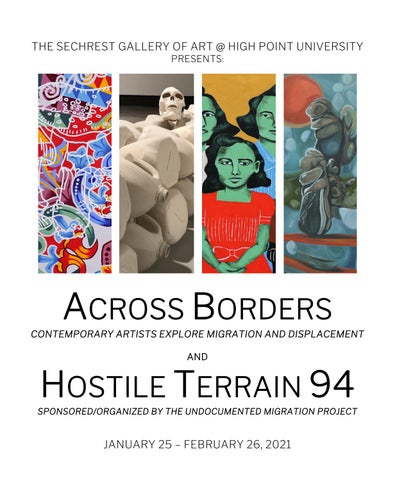
THE SECHREST GALLERY OF ART @ HIGH POINT UNIVERSITY PRESENTS:
ACROSS BORDERS CONTEMPORARY ARTISTS EXPLORE MIGRATION AND DISPLACEMENT AND
HOSTILE TERRAIN 94 SPONSORED/ORGANIZED BY THE UNDOCUMENTED MIGRATION PROJECT
JANUARY 25 – FEBRUARY 26, 2021
ACROSS BORDERS CONTEMPORARY ARTISTS EXPLORE MIGRATION AND DISPLACEMENT THE SECHREST GALLERY OF ART @ HIGH POINT UNIVERSITY
The heightened rhetoric around issues of immigration deployed in political debates during and after a contentious presidential election cycle, coupled with the recent observation of the 400th anniversary of the arrival of the first enslaved Africans to the American colonies, has renewed longstanding conversations and conflicts around American identity and transnationalism. Additonally, awareness of how the COVID-19 pandemic (and the related federal response) has disrupted nearly every aspect of the U.S. immigration system, including the operations of immigration courts, and has profoundly impacted the ability of foreign nationals to travel to the United States in any status has raised concern, particularly for the tens of thousands of people who remain detained despite the high risk of COVID19 transmission in the crowded jails, prisons, and detention centers that U.S. Immigration and Customs Enforcement uses to hold noncitizens. It is within these and other intersecting contexts that we invite visitors to engage with the work of the artists represented in ‘Across Borders.’ This exhibit aims: to center the voices of artists whose lived experiences afford them particular insight into issues of immigration and national identity; to make space for personal conversations about America’s complex and often problematic engagement with these issues; and to celebrate the courage and resilience of those whose lives have brought them ‘Across Borders.’ This exhibition takes place in conjunction with High Point University’s installation of Hostile Terrain 94, a global participatory political art project organized by the Undocumented Migration Project (UMP), that memorializes and bears witness to the thousands of migrants who have died as a result of ‘Prevention Through Deterrence,’ the U.S. immigration policy between Mexico and the United States.
ABOUT HIGH POINT UNIVERSITY’S INSTALLATION OF:
HOSTILE TERRAIN 94 SPONSORED/ORGANIZED BY THE UNDOCUMENTED MIGRATION PROJECT
Hostile Terrain 94 (HT94) is a participatory art project sponsored and organized by the Undocumented Migration Project (UMP), a non-profit research-art-education-media collective directed by anthropologist Jason De León. De León, a 2017 MacArthur Fellow, is an anthropologist whose multidisciplinary approach combines ethnographic analysis of migrant stories, forensic science, and archaeological research in his efforts to understand this process around human migration, specifically the journey from Latin America to the United States. This installation is based on his research and brings to light the lives and deaths of clandestine migrants crossing the U.S.–Mexico border into the Sonoran Desert of Arizona. Hostile Terrain 94 Background Information: In 1994 the Clinton Administration and the U.S. Border Patrol official launched the immigration enforcement strategy known as “Prevention Through Deterrence.”
This was a policy designed to discourage undocumented migrants from attempting to cross the border near urban ports of entry. With these traditional crossing points closed off, it was expected that people would then attempt to cross the border illegally in more remote and depopulated regions where the natural environment would act as a deterrent to movement. It was anticipated that the difficulties people experienced while hiking dozens of miles across what the Border Patrol deemed the “hostile terrain” of places like the Sonoran Desert of Arizona would eventually discourage migrants from attempting the journey. This strategy failed to deter border crossers and instead more than six million people have attempted to migrate through the Sonoran Desert of Southern Arizona since 2000. At least 3,199 people have died, largely from dehydration and hyperthermia, while attempting this journey through
Arizona. In recent years this policy has shifted people towards Texas where hundreds (if not thousands) have perished while migrating through unpopulated wilderness. Prevention Through Deterrence is still the primary border enforcement strategy being used on the U.S./Mexico border today. Pop-Up Installation Synopsis: In 2020 and 2021, 943 pop-up installations will be realized around the globe in locations including Los Angeles, New York, Philadelphia, Detroit, Seattle, Miami, Mexico City, San Pedro Sula (Honduras), San Salvador (El Salvador), and Lampedusa (Italy). These installations consist of a 25-footlong map of the Arizona/Mexico border with ~3500 handwritten toe tags. These tags represent the recovered bodies of people who have died between 2000 and 2020 crossing the US/Mexico border through the Sonoran Desert.
These tags are color coded (manila for identified bodies and orange for the approximately 1,000 unidentified) and are filled out by teams of student volunteers and publicly placed in the exact locations on the map where those individuals were found.
ABOUT THE WORKS FEATURED IN ACROSS BORDERS: The organizers of the exhibit wish to extend their sincerest thanks to the artists who submitted work for consideration. The artworks chosen reflect what we hope is a meaningful diversity of both aesthetics and viewpoints. We are pleased to represent so many artists whose lived personal experiences speak directly to issues of national identity and displacement.
ABOUT THE EXHIBIT’S JUROR: Gui Portel is a queer artist, educator, and organizer who uses "they/them/their" pronouns. They are a latine immigrant and multi-tasking leader with experience in arts organizing, event coordination, group learning facilitation, theatre production, and photography. Portel lives on ancestral lands of the Cheraw and the Occaneechi Band in present-day Greensboro, NC. As a non-binary queer who lived as an undocumented immigrant for over 18 years, Portel believes that since art is culture and culture shapes society, artists should actively consider their roles in both society and community. As a descendant of both Guaraní indigenous matriarchs and Spanish colonizers, they often think about visualizing the amplification of marginalized narratives, collective deviation within social constructs, and the disruption of contemporary art presentation.
Farah Yusuf Ali
HYBRID EXISTENCE Mixed Media, 2019-2020 In my most recent series, "Hybrid Existence", the symbolic imagery is inspired by Moghul Miniature Painting. This artwork is also a reaction against the current global political climate. Being an immigrant, Muslim woman artist of color, post 9/11 in the US has had a huge impact on my work. My religious beliefs, ethnic background and cultural practices are things I am proud of but having to explain and defend them has been the hardest part of adjusting in America on a personal and artistic level. I have used dried leaves as surfaces to paint on. They come from my collection of 20 - 30 year old leaves that I started as a child growing up in Pakistan. Inspired by 16th - 18th century Moghul Miniature painting and the ancient Eastern practice of leaf painting, the imagery is a homage to my cultural roots. Combined with these Asian cultural references are strong Western influences. I have incorporated the Western Modernist square with exotic leaves indigenous to Pakistan and English with Urdu (my native language) newsprint to depict a fusion of cultures. Some of the words in the newsprint are a direct reference to American Pop Culture. This series is symbolic of the two cultures I belong to - the East as well as the West. Hidden within the symbolism are subtle references to the controversial subject of Immigration. These leaves travelled with me for many years wherever I moved. Their story and the stories I have painted on them are similar to mine. It is a bitter-sweet story – the difficult experience of leaving one's home, being uprooted, adapting to a new homeland, learning to embrace it and building new hopeful memories. My collection of leaves continues to grow to this day, like the ongoing journey of an immigrant.
Juan Barroso
263 DEATHS AT THE BORDER IN 1999 Porcelain, underglaze, 2020
My work is about Mexican labor. This includes what immigrants do to survive and the immigrant experience at the border. With the current political situation in America, and immigration policies that dehumanize and force immigrants into the shadows, the humanization of immigrants is important. It becomes difficult to separate people into us or them when it becomes clear that we are all working and fighting to provide a shelter and a decent meal for ourselves, and often a family. As the son of immigrant parents, I hope to pay homage to my people and the dignity with which they work to make a living. I mix 2-dimensional imagery, influenced by personal narratives, with 3dimensional functional forms. I paint images with black underglaze, a small brush, and a pointillism technique. I chose pointillism on functional vessels because the process is time-consuming and labor intensive. My wrists and neck hurt after thousands of dots placed with care and accuracy to produce an image. The process becomes an act of devotion. I cannot think of a better way to show my respect and admiration for my people and their will to survive than with labor of love and time invested. I want my work to be functional as a reflection of the immigrant day laborer. The definition of functional is to be practical and useful, in the same way that the handyman has designed himself to be useful in a variety of ways. While building fences with my father, I learned that idle hands meant more time in the heat of the sun. The idea that standing without purpose should be avoided has found its way into my work.
Nakisa Beiki
UNTITLED Oil on canvas
Nakisa Beiki is an Iranian born visual artist who lives and works in the United States. She is currently a Visual Art MFA student majoring in Drawing in the School of Visual art and Design at the University of South Carolina. Nakisa's work is deeply connected with her own personal and cultural experiences in her homeland country, Iran. Her work aims to probe these experiences by integrating historical motifs with imagery taken from popular culture and contemporary media. She uses elements of the relationship between individual stories and collective memory. In her practice, Nakisa explores the possibilities of representing Iranian art and culture using inspirations from her personal background.
Mario F. Bocanegra Martinez
IMMIGRANT POEM 2020
The migration method and reasons for most immigrants depend on location, unequal job opportunities, or the denial of visas, which forces immigrants to travel as "undocumented". In this motion sequence, a Latin American immigrant narrates his experience from a train crossing Mexico into the U.S. border. In the midst of darkness, this unknown immigrant hides inside an old and dark train wagon. He can only see lights seeping from the wagon’s rusted corners and cracks. Through the glimpses of light, flashbacks appear and disappear as the train continues the long dark journey. Immigrant Poem places the viewer in an environment that is partially unknown. With subtle light abstractions, the viewer is drawn to an experience of listening, reading, and observing. The poetic visual theme evokes the sad and lonely journey that most Latino/a immigrants must endure.
Hediyeh Bondar
ORIGAMI BOAT Acrylic and watercolor on Textile Origami
The shape of a boat has many connotations. Here, I painted patterns in reference to textiles. These shapes represent parts of the boat, such as portals, but also ocean waves. I wanted the overall colors and patterns to have a homey feel, which resonates with the title of the exhibition.
Kendra Brown
INNOCENT UNTIL BLACK Mixed Media, 2020 In the words of Nina Simone, "an artist's duty, as far as I'm concerned, is to reflect the times.” I made this piece to counteract the demonization of black men. I am an African American woman who fears for the safety of my African American brothers, friends, nephews and uncles and I want to respond to the social injustice that is being called out today. The systematic racism that millions of protesters are marching to end. I used a figure of a baby in conjunction with the portraits of five well-publicized, slain black men; Travon Martin, Philando Castile, Mike Brown, Jr., Alton Sterling and George Floyd to show that black men are unjustly viewed as guilty. Each man pictured was not committing a crime, but lives were unjustly taken because they were perceived guilty by either uniformed Police officers or white supremist zealots. The message is that all men are perceived innocent until proven guilty accept in the case of black men. There is a lot of symbolism in this piece. I used wood to signify the painful treatment black men endured thru slavery being hung on trees. I burned the images on the back of the baby to remember that black men were also branded like property. By using these symbols, I hope to raise awareness that the same abhorrent disregard for human life still exists today with the often-unprosecuted killing of innocent black men. The name of the piece is displayed in the hair of my piece because the natural texture of African American hair is still regarded as unkept or unclean. I included the word guilty in the eyebrow of the child to signify wearing the perception of being guilty just by the color of his skin. I wanted the baby to be life sized, so the wood figure is 21 inches tall and is mounted on a 24 X 30-inch canvas. The baby is mounted toward the left bottom corner of a white canvas and has an expression of wonder while looking out to the right. This signifies that the baby is looking out into the future we will create. I hope my piece helps inspire us to create that better future all black men deserve.
Annamarie Buchanan
FORWARD Oil on canvas
Forward was made in contemplation of the body’s movement, and the way in which others respond to the movement of multiple bodies. Originally derived from a collage, this piece is visually influenced by fragments of photographs containing reflections and refractions of biological swarms. My research is inspired by swarms and swarm theory. After traveling to see the purple martin migration, leading to Bomb Island, South Carolina, I documented the purple martin swarm to determine the visually emotive qualities of the swarm’s overall form. Ecofeminist philosophy points out links between the domination of nature and the domination of marginalized groups of humans and seeks to investigate these interconnections among these systems of unjustified domination. Using visual rhetoric, my research aims to determine if there is a link between the way in which people respond to swarms, and the way in which people respond to marginalized bodies.
Esther Elia Esther Elia is a mixed Assyrian/Irish artist from Turlock, California. She currently resides in San Francisco and attended California College of the Arts as an illustration major. Her work focuses on family folklore as the basis for understanding mixed identity, and preservation of oral histories as someone from Assyrian heritage, has led to interest in art that fosters community engagement and historical preservation. Her visual work is a mix of large-scale paintings, sculptural furniture, clothing, and performance. Her work up to this point has been rooted in building a collection of art and text that relates specifically to the Assyrian community. Her most recent work includes furniture pieces, paintings, rugs, and writing that explore themes of identity as a grandchild of Assyrian-Iranian refugees.
BACKGAMMON BOARD Acrylic on beech, 2019 Considering mixed ethnicity through the backgammon board. Considering similar journeys of running from inhospitable conditions: genocide on one side, the Dust Bowl on the other. Considering how those events shaped a generation of survival and coping, creating a sense of understanding between an Assyrian boy and an Irish girl. Claiming the Lamassu as a metaphor for my hybridity.
I’M TRYING TO FIND MYSELF IN YOUR FACES Acrylic on canvas, 2018 No matter how you try and mask it, history seeps through the cracks. A reflection on unsuccessful assimilation.
Bella Kubo
YELLOW Screenprint and audio recording, 2020
please scan the QR code to hear a recording of the artist reading her poem, “Yellow”
As someone who has relocated and moved throughout their entire life, I find myself constantly analyzing and questioning the importance of place. Because of this, I deconstruct my own conflicting sensations of both familiarity and disconnect within my surroundings. I use video, sculpture, sound, installation, and performance to investigate and recontextualize comforts in the mundane. I am particularly interested in the concept of the home as a habitat. I believe this notion specifies one's environment, one's relationship to their environment, one's species, and the state of the environment. Through the investigation of my habitat, I am able to find my place within a larger set of systems. My purpose derives from the desire to identify lineages between my identity and home. BIO: Kubo (b. 1996) is an interdisciplinary artist based in Richmond, Virginia. She rotates throughout the realm of video, sculpture, sound, performance, and installation. Recent shows include the All Media Exhibition at the Detroit Artists Market and the Worldwide Online Art Exhibit hosted by the Anton Art Center. Kubo is currently pursuing a Master's of Fine Arts in the Kinetic Imaging department at Virginia Commonwealth University.
Michael May
PAN AND HIS PIPES It is difficult to talk about Pan and his Pipes without talking about the larger body of work to which it belongs. The Garden Party Series of paintings uses cultural symbols and garden imagery to describe a narrative in which a generally bad person chooses to use their authority for good. The work is split into three categories by season (winter, spring/summer and autumn). Each section of the story is told using flora, fauna and a wide variety of cultural symbols as narrative devices which keep track of the chronology and the nature of events. In the winter, I use symbols to display the unsympathetic nature of my character. This is when plant life is dormant. In the spring/summer, my character embarks on a journey of cheating and misleading which ultimately leads to a position of power. In the autumn, during the harvest, there is a transition in which the character begins to use their authority to help the marginalized. Pan and his Pipes is the first painting in the autumn category. I use two disconnected cultural symbols; Pan, represented as a lichen covered gray statue who is associated with mischief and debauchery and is the only Greek God to have died; and Costa Rican cart painting, which is lively and colorful but is associated with hard labor. Additionally, there is the drawing of the toadstool mushroom, which is poisonous and is often mistaken for a very similar mushroom that has hallucinogenic properties. These dichotomies and Pan’s presence mark the positive shift in my character.
Alex McClay
COURAGE IN RETROSPECT Woven emergency blankets, marking tape, 2020
These three weavings are made from emergency blankets. A friend once described using these blankets as “the coldest warm you can feel” referring to their use as blankets in emergency situations. By tearing them apart and weaving them back together, McClay creates new blankets for survival. By embedding text in the blankets, McClay references the trauma and fear often accompanying moments of survival. Congresswoman Alexandria Ocasio-Cortez once referred to “fear as fuel”. When asked how she gets the courage to do things, she said “It doesn’t feel like courage to me. It’s fear. I’m scared all the time too. These moments are not about ignoring your fear…what you do with fear is that...you turn it into fuel...Courage is just something you see when you play the tape back.” Inspired by this sentiment, McClay wove these blankets as a testament to fear as the fuel for courage and courage as the thing you see and feel in retrospect.
Amuri Morris My work focuses on the manifestation of black identity. This identity always forms to show the consistently powerful presence of the black figure. I'm rewriting the narrative that western visual media has historically established by elevating black figures to the role of the protagonist. There is a definite negative social identity that is imposed upon black youth when the media negates the idea of the "black hero". In the western canon African Americans often have to deal with adversity as a result of our displacement. In “Doll Time” I aim to highlight police brutality with this perverse intrusion of space and injustice toward the vulnerable. This is to show the longstanding nature and intensity of our displacement and otherness. In “Black is Black” I’m exploring the presence of a double consciousness/ dual identity within a mixed-race woman. Here the racial boundaries are not depicted through the interaction between others, but the mental racial boundaries that many people of mixed descent must overcome (it compels the question “how do I identify with my blackness in a multi-racial context?”).
DOLL TIME Oil on canvas, 2020
BLACK IS BLACK Oil on canvas, 2020
Benita VanWinkle
ARE WE ALL EQUAL El Paso, TX, January 2020
This mural was painted by Francisco Delgado in 2006 or 2007. The area of town that it resides in, the Segundo Barrio, (Spanish for “second neighborhood”) sits right at the edge of El Paso and the border to Mexico. The neighborhood was established in the 1880’s and since that time, thousands of immigrants have found this passage as a way to the US. The area is also known as the “other Ellis Island”. You can see Mexico just beyond the large chain-link fences over 15 feet tall with razor wire along the top. I gave my image the title of ‘Are we all equal’ because El Paso is an area that is extremely diverse but with immigration, border issues, border patrols signage everywhere, it feels as if this is an ongoing conversation. The couple that is sitting in front to the left of the mural with the wheelchair brought to my mind another equity, that of being wheelchair dependent or challenged by ambulatory issues. Sidewalks and buses, storefronts and parking lots are NOT created for everyone. Maybe someday we will all be seen as equal, but that might be in the heaven depicted in the mural.