ROMP
HOW TO GROW A BIRDER NOVEMBER/ DECEMBER 2026
CARE
A VERY MERRY SOBRIETY
DAD NEXT DOOR
SINGING TO PORCUPINES FREE
YOUR GUIDE TO A KID-FRIENDLY CITY
IN S ID E
Holiday Calendar page 27
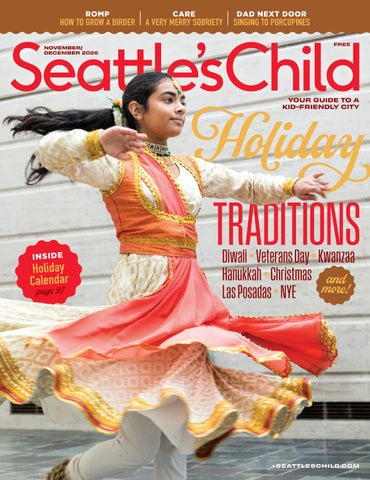
Diwali Veterans Day Kwanzaa Hanukkah Christmas and Las Posadas NYE more!
R SE AT T L E SC HILD.C O M
HOLIDAYS AT THE CENTER featuring
WINTERFEST presented by
ENJOY A DAZZLING ARRAY OF FREE AND AFFORDABLE EVENTS
NOV 27–DEC 31
seattlecenter.com/holidays
Wonder, curiosity & Everything in Between. This winter, only at Imagine. Sock Skating at Sockefeller enter | REAL n oor Snowfall Every fternoon | Visits with Santa | Nutcracker Tea | Daily Walks with rosty & rien s | Tree ighting Santa Sock op | Winter rafts | Plus SO MUCH MORE!
Plan Your Visit! imaginecm.org
2
S E AT T L E ’S C H I L D
Nove m b er/ Decem b er 20 2 6
>>Contents Seattle’sChild
November/December 2026 // Issue 520
WHAT PARENTS ARE TALKING ABOUT..................5 DAD NEXT DOOR...........................7 ROMP......................................................9 CARE......................................................11 FEATURE: HOLIDAY TRADITIONS........14-23 DÍA DE LOS MUERTOS DIWALI VETERANS DAY THANKSGIVING NATIVE AMERICAN HERITAGE MONTH HANUKKAH LAS POSADAS AND PASTORELAS CHRISTMAS EVE CHRISTMAS KWANZAA NEW YEAR'S EVE HOLIDAY CALENDAR................ 27 p.5
D I S C U SSI O N S WITH KIDS A B O U T H O M E LESS NE SS
p.9
BIR DS CO N N E C T SE ATTLE INS P IRE S K I DS TO JO I N T H E FLO CK Find us online at seattleschild.com ON THE COVER A d an ce r at t h e D i wa l i Fami l y Fe sti val at t h e Se at t l e A s i a n Art M u se u m. P H OTO BY J OS H UA H USTO N Nove mbe r/ D e c e mbe r 2 0 2 6
S E AT T L E ’ S C H I L D
3
Seattle’sChild
November/December 2026 // Issue 520 “Seattle is my town. I know this city inside and out… or so I thought until I had kids.” Seattle’s Child is your guide to getting to know your city all over again. Finding things to do, places to eat, and how to get around — it’s a whole new ballgame with kids in tow. We’re interested in how parents make homes in a space-challenged urban environment, how families create community, and what parents are really talking about. Seattle’s Child reflects real Washington families and their broad range of parenting experiences. ANN BERGMAN Publisher, Founder abergman@seattleschild.com JASMIN THANKACHEN Associate Publisher jasmin@seattleschild.com KATHRYN HOLLOWAY Art Director CHERYL MURFIN Managing Editor, Print cheryl@seattleschild.com BRITT THORSON Managing Editor, Digital britt@seattleschild.com JOSHUA HUSTON Photographer ROSE WILLIAMSON Proofreader JEFF LEE, MD Columnist ISABELLA AKALIN GABRIELLE NOMURA GAINOR BRETT HAMIL MELODY IP CHERYL MURFIN ALLISON PETERSON BROOKE PINKHAM RUTH PURCELL ELISHEBA WOKOMA Contributors ADVERTISING NOAH DRETSKE Account Executive noah@seattleschild.com YULIA FIALA Account Executive yulia@seattleschild.com FABIOLA LOPEZ Ad Production Coordinator fabiola@seattleschild.com SARAH KULFAN Ad Designer
Seattle’s Child has provided useful information to parents since 1979. In addition to our magazine, look for our special themed publications — Family Guide, School, Explore, Get Moving!, and SummerTime — distributed free throughout the Puget Sound area. Seattle’s Child is published every other month.
ONLINE seattleschild.com Facebook facebook.com/seattleschild Twitter @SeaChildMag Instagram @seattleschildmag MAIL c/o Postal Plus 1211 E. Denny Way, Seattle, WA 98112 VOICE 206-441-0191 TO ADVERTISE advertise@seattleschild.com STORY IDEAS editor@seattleschild.com CALENDAR SUBMISSIONS calendar@seattleschild.com Include date, time, cost, appropriate ages, address, contact information and description.
4
S E AT T L E ’S C H I L D
Nove m b er/ Decem b er 2 0 26
Don’t miss these stories on 3seattleschild.com
1
2
3
Why I won’t track my kids Op-Ed
Native-owned birth center will open in Columbia City
9th graders perform better with new program, but funding isn't guaranteed
»What Parents
„ Find more local stories for families on seattleschild.com
Are Talking About Education, health, development and more
Deb, who faced difficult choices, is now a Plymouth Housing resident and serves as a member of the Plymouth Board of Trustees. Photo by Joshua Huston
‘Which would you choose?’ Discussions with kids about homelessness by GABRIELLE NOMURA GAINOR
“But Mom, you work at Plymouth Housing. Why can’t you help that person?” We were stopped at a light in Belltown when I drove right past someone sleeping outside. I wished I had the perfect thing to say — but I don’t. The facts are overwhelming. On any given night in King County, an estimated 18,365
people, including about 1,370 families with children, are experiencing homelessness — sleeping in shelters, in their cars, or on the street. Every supportive housing apartment that becomes available already has someone waiting for it, and there are never enough homes for everyone who needs one. Many people wait months — or longer — for a home to become available. This can be a lot to explain to my observant daughters, ages 6 and 8, who care deeply about fairness. Not much gets past them.
Once, after I guessed someone’s cultural background, my oldest stopped me. “Mom, you can’t make assumptions about a person’s identity.” She was right. So now, when the topic of homelessness comes up, I worry less about saying the perfect thing and more about how I’m teaching my children to see other people. These are lessons I first learned as a Japanese-Filipina kid growing up around Pike Place Market. Flower vendors, janitors, CONTINUED ON NEXT PAGE >
Nove mbe r/ D e c e mbe r 2 0 2 6
S E AT T L E ’ S C H I L D
5
�e Easiest Diaper Decision You’ll Make. Premium Bambo Nature diapers delivered to your door. We Deliver. We Pick Up. We Recycle. Used diapers are responsibly recycled to create renewable energy. Easy Mobile App Manage orders, deliveries and pickups with ease.
Babydiaperservice.net • Info@babydiaperservice.net
Find your weekend
FUN!
Sign up for Romp, our free weekly newsletter, to discover the best weekend events (many free!)
» seattleschild.com/subscribe 6
S E AT T L E ’S C H I L D
Nove m b er/ Decem b er 20 2 6
«What Parents Are Talking About CONTINUED
fishmongers, artists, unhoused neighbors, security guards, baristas and tourists all helped to create our neighborhood. My grandmother knew countless people by name. At Obon, the Japanese Buddhist festival where my family honors our ancestors every summer, I saw how no one comes into this world alone. As members of a shared culture, our lives were bound together. When I later learned about the Filipino concept of kapwa — often translated as “shared self”— it challenged me to extend that sense of kinship beyond my own community and recognize the humanity we all share. No matter who you are, I believe that my humanity is inseparable from yours. When I recognize yours, I recognize my own. Rather than asking, “What did this person do wrong?” I want to ask instead, “What happened?” and “What conditions shaped this person’s life?” It might have been a lost job, a health crisis, the death of a loved one, or escaping violence. My friend Deb, a Plymouth resident and board member, had to choose between paying her doctor and paying her rent. “Which would you choose?” I ask my girls. There isn’t a good answer, and that’s the point. When my daughters ask whether someone experiencing homelessness is dangerous, I tell them it’s always okay to move your body away from someone who is yelling or acting unpredictably. We can protect our safety without deciding someone is bad. Sometimes behavior like this is a sign that someone needs help, not a reason to stop caring about them. I’ve met people who used substances to stay awake at night
so they wouldn’t be assaulted, or to cope with unbearable circumstances beyond their control. In King County, Black people make up about 6% of the population but 24% of people experiencing homelessness. Indigenous people make up less than 1% of the population but 15% of those experiencing homelessness, according to data from Chief Seattle Club. It’s another opportunity to ask “What happened?” with my daughters. We deepen the complexity of our conversations about slavery, colonization, racial exclusion — and inequities in housing, education, health care, employment, and the justice system. It would be simple to reassure my daughters that homelessness happens to other people — as long as we make the “right” choices, we’ll be okay. It’s a comforting story because it creates distance between “us” and “them.” But I don’t believe that distance is real. What I can do is teach my daughters to understand that they have a choice in what kind of world they want to help create. They can choose to see the whole person — and let that guide whatever comes next. Sometimes that’s volunteering or donating. Sometimes it’s voting for more housing. Sometimes it’s giving someone a few dollars. Sometimes it’s simply making eye contact, learning someone’s name, or saying hello. I hope that years from now, when they pass someone sleeping outside, they will see one of their own: a human being worthy of care, love and safety. Because there is no “them.” There is only us. ABOUT THE WRITER
Gabrielle Nomura Gainor is Senior Director of Communications at Plymouth Housing, which provides permanent homes and support services to those experiencing chronic homelessness. Learn more at 3plymouthhousing.org.
„ Read all of Jeff Lee’s columns on seattleschild.com
»DadNextDoor A little encouragement from across the fence by J E F F L E E , M D
Singing to porcupines Our fifteen-year-old is a porcupine. Not literally, of course — but she does a remarkably good impersonation. Over the past couple of years, she has become quieter, more solitary, and increasingly spiky. At dinner, when we ask how her day went, we often get monosyllabic grunts. If she fails to follow through on something, or acts unkindly or thoughtlessly, almost any comment from us is heard as judgment or criticism. After dinner, she disappears into her room, headphones on, doing homework or texting. Her light stays on long after we call goodnight through the closed door, and in the morning she heads off to school with barely a wave. Our role has changed so much from when she was little. Back then, she assumed that we were on her side. She trusted us to guide her through life, and we did our best to earn that trust. But what is our role now, when so much of what we say is met with suspicion, annoyance, or disinterest, and whatever is happening inside of her is hidden behind a fearsome array of quills? Is she doing fine in there, or struggling? Is she working things out on her own, or falling down some terrifying rabbit hole? Do our words still penetrate, or do they simply end up impaled on the spikes? Recently, I came across a study in JAMA Pediatrics that reminded me why it matters to keep trying. Researchers at Columbia University followed more than 7,000 American adolescents into adulthood. Those who reported stronger family connections as teenagers went on to have better social connections as adults. That may matter more than ever. We are living through what has been called an epidemic of loneliness. Social isolation is associated with poorer health and shorter lives, while strong social connection is among the most consistent predictors of happiness and life satisfaction. Our relationships do more than help us live longer; they help make life worth living. And our earliest relationships — with our families — may help shape our capacity to build others later. But what can parents do when teenagers seem increasingly sealed inside their own worlds of friends, phones, and kid
culture? How do we help protect them from isolation when they seem increasingly isolated even from us? Years ago, a psychiatry professor told me that many of our deepest personal struggles become entrenched because they are self-reinforcing and progressively isolating. As children and adolescents, we develop ways to protect ourselves from emotional pain. Some are useful; others can become traps. Anxiety leads us to avoid what frightens us, and avoidance makes the world feel more dangerous. Withdrawal protects us from rejection but also deprives us of connection. A hunger for praise can make ordinary disagreement feel like an attack. Over time, patterns like these can harden. We gravitate toward people and situations that confirm the story we already tell ourselves, while avoiding the ones that challenge it. That is one reason a parent’s voice still matters, even when a teenager appears not to want to hear it. We can offer another perspective before those patterns become deeply rooted. So how do we do that when everything we say seems to provoke resistance, defensiveness, or irritation? The answer, I think, is not to shut up and walk away. Nor is it to lecture harder. It is to keep offering whatever connection our children will accept: a ride, a meal, a question asked without interrogation, a joke, a hand briefly placed on a shoulder. And when we need to say something important — especially something they may not want to hear — we can try to say it not as criticism, but as an expression of faith: faith in who they are beneath the defensiveness, and in who they are capable of becoming. I once heard that our job as parents is not simply to tell our children what to do. It is to know the song of their hearts, and to sing it back to them when they forget how it goes. You can’t hug a porcupine that doesn’t want to be hugged. But you can sing to one. Even if she pretends not to hear, she will know who is singing. And perhaps, somewhere beneath the quills, she will still recognize the song. ABOUT OUR COLUMNIST
Jeff Lee sings to any creature who’ll listen in Seattle, WA.
Nove mbe r/ D e c e mbe r 2 0 2 6
S E AT T L E ’ S C H I L D
7
S P ON SORED CON TEN T
»ToolBox
Managing failure and disappointment with kids
Turning setbacks into opportunities for growth
as sports for an academically inclined child — builds resilience through low-stakes experiences. You’re establishing a range of experiences, not intentionally trying to manufacture failure within safe boundaries. • Check in as they struggle with their situation. You want children to come up with ideas for why failure might have happened and how to tackle those problems in the future. Build your child’s autonomy and their belief in their capacity to try new things, fail and try again.
by K A I S E R P E R M A N E N T E
Maybe your child didn’t make the soccer team or failed their first test. Perhaps they didn’t get the lead role in the school play or maybe a Lego project just didn’t turn out as they’d dreamed. When children struggle to achieve a set goal, or a situation doesn’t meet their (perhaps unrealistic) expectations, they can feel a sense of failure. Often, a visit to a therapist’s office may result from “both the failure itself but also the response to the failure,” says Dr. Ashok Shimoji-Krishnan, a child and adolescent psychiatrist with Kaiser Permanente. A poor response to failure can manifest as a blow to self-esteem or identity, or trigger ongoing emotional distress. Children can feel disappointed, depressed, embarrassed, angry, or all of the above. At its worst, failure can lead to overgeneralizing: a failed test can turn into “I’m bad at math,” or worse, “I’m bad at everything.” As a parent, your first instinct may be to swoop in and save the day or tell them they’ll make the team or get the lead next time, just to prevent more tears. Yet, as it turns out, “how you respond to failure is where the real opportunity lies,” for the child and the parent alike, according to Shimoji-Krishnan.
Healthy responses to failure build future success
When children don’t succeed at something, they can learn problem-solving, coping skills and emotional resilience. If failure is treated as a chance to grow, it becomes a routine part of learning rather than a wholly negative experience. After all, even toddlers learn
8
S E AT T L E ’S C H I L D
Courtesy of Kaiser Permanente
from failure by trying new things. In essence, a toddler’s first halting steps also help create a critical-thinking process: “Why didn’t that work? What is my hypothesis? What might work better?” Shimoji-Krishnan says. “When you learn that failing is okay, that it’s part of the process, you learn that failure is not only accepted, but an expected part of growing and learning. It’s an essential way to get better at the things we do,” he says.
First, acknowledge the feelings
“When something falls through, first acknowledge and validate your child’s response, whatever it is. You want to provide guidance as an open and honest communicator, rather than getting angry, rushing to reassure, or giving unwanted advice,” says Shimoji-Krishnan. Take a few minutes to listen without offering solutions, alternatives or other framing. If your child doesn’t want to talk about it, check back in a day or two. It’s emotional first aid that can be easy to miss in the moment. “Some parents may need to work on their responses to their child’s failures, to avoid blasting them for not succeeding,” says the psychiatrist. If the reaction is primarily negative, children can
Nove m b er/ Decem b er 2 0 26
S p ons ored Con te n t
worry about disappointing a parent if they don’t succeed, which can lead to anxiety, withdrawal or avoidance.
Build a better relationship with failure
Once you’re comfortable addressing the disappointment, try these strategies. • Normalize fails by sharing your own. Tell your own athletic and academic flops to show that experience isn’t unique or shameful. “It lets kids know they’re not unique but normal. People fail and know they can reach out to someone who understands,” Shimoji-Krishnan says. • Help set realistic expectations. Check in and ask your child how they expect any new situation to go. Most of the time, they’ll have no idea, but others may have an unrealistic idea of first-time success. • “Kids are going to fail at something, because they’re not perfect at everything,” he says. “Kids who learn to take new risks build resilience for the work and effort that results in success.” • Stretch them into weak spots. Deliberately placing a strong kid in something they’re not good at — such
“They get to expand their brain and muscles in different ways and use that plasticity to try new things and fail in different ways, building resilience to wonder, ‘How do I make it better?’” he says. If your child is struggling with school assignments, you can suggest a conversation with the teacher. Older children can speak directly with the teacher to ask how they can improve their grades. By college age, you want them to have the confidence and ability to connect with the professor on their own, without your help. “It’s not unique to fail, but it’s how we respond to failure that defines whether that was truly a failure or not,” he says. “You can stumble at a marathon and stop running, or you can get back up and keep going.” ABOUT THE DOCTOR
Dr. Ashok Shimoji-Krishnan is a child and adolescent psychiatrist at Kaiser Permanente Capitol Hill Medical Center. When he's not at work, he enjoys spending time with his wife and kids and playing music. S P ON SORED BY
Don’t miss these stories on 3seattleschild.com
5 things to do
1
2
3
Troll Hunt: Find all 17 Dambo trolls in Puget Sound!
New Year’s Day Polar Plunges around Seattle
Holiday Giving: Where to give and volunteer as a family
5 holiday giving trees 1 Wellspring Family Services Giving Tree
»Romp Things to do with kids
Host a gift drive, display Giving Tree tags with QR codes linking to family wishlists, or volunteer to sort holiday gifts. 3tinyurl.com/254azz6p
2 Pike Place Market Foundation
Help provide gifts and warm winter gear for downtown Seattle families, preschool students and others in need through online wishlists, direct donations or gift cards. 3tinyurl.com/hkc3ndx5
3 YMCA of Greater Seattle
Support young adults in transitional and shelter housing by purchasing items from virtual Amazon Giving Trees or donating gift cards. 3tinyurl.com/ydtx4vxk
4 South Seattle College Giving Tree
The making of a birder Birds Connect Seattle inspires kids to join the flock by B R E T T H A M I L
Could your kid become a birder? It’s not that big of a leap, says Hanae Bettencourt of Birds Connect Seattle. “Birds are a very accessible form of nature observation, because you don’t even have to leave your house; you can just look out your window and see a bird and wonder about it and, boom, you’ve suddenly dipped your toe into being a birder!” Bettencourt has been working for Birds Connect Seattle (formerly Seattle Audubon Society) for 17 years, most of that time in youth programming. She’s learned a lot about children’s curiosity
about our avian neighbors. “It’s totally natural for a bird to come into your orbit, and kids are really observant,” Bettencourt says. “They see something and they’re going to ask a question. Once a kid starts realizing that the world of birds is vast, the hook is there naturally.” She also describes what she calls the “Pokémon collection” nature of birding. “When they see one bird and then another bird that doesn’t look like that first bird, then you get a book in their hands and they start looking at all the variety of birds that can be found in a Seattle backyard,” Bettencourt says. “Curiosity gets the better of them.” Birds Connect Seattle youth programs include popular summer nature camps for first- to eighth-graders, with naturalist assistant positions available for high schoolers. The organization also makes school
5 John Stanford International Elementary & Beacon Hill International School Select a gift tag from the Giving Tree near John Stanford’s main office or use the online Giving Tree sign-up. 3tinyurl.com/2s438xf4 —Cheryl Murfin
COU RTESY OF S OU TH SE ATTL E COL L E GE
Teens bird watching with Birds Connect Seattle. Photo by Jovelle Tamayo for National Audubon Society
Help provide holiday gifts for children of students attending the West Seattle, Georgetown and New Holly campuses. Giving Tree tags are available on campus beginning Nov. 9. 3tinyurl.com/n3kkj7ya
CONTINUED ON NEXT PAGE >
Nove mbe r/ D e c e mbe r 2 0 2 6
S E AT T L E ’ S C H I L D
9
«Romp CONTINUED
visits, rents out Education Kits, and hosts field trips at their headquarters in the Downtown Denny Triangle. A recent 4Culture grant lets school groups visit at no cost. Birds Connect's ADA-accessible headquarters includes a retail shop where you can get all your “birdy gifts and goodies,” as well as a museum space with over 650 specimens. Open 10 a.m. to 5 p.m. Tuesday to Saturday, the museum invites kids to see and touch, with staff onsite to answer questions. The current exhibit, The Wonderful World of Owls, runs through the end of the year. Birds Connect also offers a Young Birders program for kids ages 13-18 that includes online meetings with ornithologists, bird-watching trips, and opportunities to work on conservation projects. Emma Perez, a high school freshman, joined the flock through this program. Her interest in birding began at age 8 as a COVID pastime. After falling in love with nature photography on a trip to Yellowstone, she realized the only wildlife she could photograph in her own backyard was birds. “Once you start looking for them, you can’t stop,” Emma says.
10
S E AT T L E ’S C H I L D
Novem b er/ Decem b er 2 0 26
A green heron photographed by Emma Perez.
“Emma didn’t want to go on long hikes, but once I put a camera in her hand, she would hike three times as far,” her mom, Katie, says. “She could just sit and watch a bird for hours. A totally different kid was unlocked!” Emma’s been attending Young Birders, and on the recommendation of one of the
group’s walk guides, she applied for and received a scholarship to the 2026 Western Field Ornithologists Conference. She hopes to present her own research at the next conference. The Perez household is fully immersed in the birding life. They have nine feeders in their yard, which is now an officially certified wildlife habitat, and neighbors have thanked them for all the new birds they’ve brought into the area. Emma’s favorites are the migrants. “They’re not necessarily the prettiest birds, but you can see they’ve been through some stuff,” she says. “They’re sitting on your feeder for five minutes just relaxing in the rain, and you can tell that this is an amazing feast for them.” Of course, there’s no promise any one child will fall in love with birding — even if a parent is supportive and enthusiastic. “I’ve worked at Birds Connect for as long as my kids have been alive and they’ve never been bird-obsessed,” says Bettencourt. But then … “We were in Arizona last year, and there was a roadrunner in the front yard, and of course they both came dashing through the house, like, ‘Tell Mom!’ ‘Mom needs to see this!’ So they’ve definitely developed an appreciation for it.”
Don’t miss these stories on seattleschild.com
1
2
3
Do some good together in November (and December)
Rocking reading at Club and Camp Read-a-Rama
Fall is the time to eat local
»Care
Find more local stories for families on seattleschild.com
Creating communities where kids flourish
Photo by iStock
Navigating the holidays with sobriety Tips from parents in recovery by R U T H P U R C E L L
Editor’s note: In the recovery program tradition of anonymity, some names have been changed. It’s the most wonderful time of the year. Or is it? Let’s face it, the holidays are stressful for everyone. Couples struggle
to find the perfect gift for their partner. Parents plot for months to make the holidays magical for their families. Even young children get stressed as they wonder if their behavior will live up to Santa’s standards. And, with alcohol front and center at many events, the end of the year is particularly challenging for parents in recovery from alcoholism or those trying to abstain from alcohol. Ellen, a Seattle mom, has been in recovery for eight years, but she remembers
those days. “Things would ramp up at Thanksgiving,” Ellen says. “There would be lots of wine and toasts, and I remember many times being hung over before the sun went down. “Then there were the parties for work and with friends, where the alcohol flowed freely. Christmas Eve and Day were a repeat of Thanksgiving, and don’t even get me started on New Year’s Eve. The private joke CONTINUED ON NEXT PAGE >
Nove mbe r/ D e c e mbe r 2 0 2 6
S E AT T L E ’ S C H I L D
11
«Care CONTINUED
among heavy drinkers was to call it ‘Amateur Night’ and stay at home.” So what is a parent to do to stay sober during the holidays? Avoid all situations that involve alcohol? That would likely mean staying at home a lot. Many Seattle parents in recovery have successfully navigated the holidays and have advice for those approaching November and December newly sober. “I think one of the main problems with the holidays is that it is very easy to have unrealistic expectations,” Ellen says. “Another thing I try to remember over the holidays is that I always have a choice. When I feel backed into a corner, and there is only one way to handle a situation (e.g., have this drink), I remind myself that this is rarely the case. The choices may not include
12
S E AT T L E ’S C H I L D
Sobriety tips Alcohol problems touch many Washington families. According to federal data about one in 11 people ages 12 and up had alcohol use disorder in 2023-24. During that same period, 19% of Seattle adults and 17.1% in King County reported binge drinking. Consider these sobriety-protecting tips from local sober parents, Hazelden Betty Ford, Rethinking Drinking and other sources: 1. 2. 3. 4. 5. 6.
Make a sobriety plan for gatherings, people and situations before the holidays. Skip alcohol-heavy events if needed. It is OK and your right to say “no alcohol” for gatherings in your home. Arrange your own ride so you can leave if overly triggered. Tell someone supportive what you need to stay sober at gatherings. Don’t let concerts, school events, shopping and travel crowd out AA and other recovery meetings and therapy.
something I want, but there is more than one way to handle any situation.” A common dilemma for parents new in recovery is whether to serve alcohol in their home. Cassandra, a local mom, explains: “I’m fairly new to sobriety, and I don’t want to be surrounded by all the
Nove m b er/ Decem b er 2 0 26
7. Bring non-alcoholic drinks you enjoy. 8. Keep kids’ holiday expectations manageable to ease your stress. 9. Create new alcohol-free traditions with your own nuclear family. 10. With difficult relatives, set off-limits topics and a plan if boundaries are crossed. 11. Beware the post-holiday slump: Exhaustion, debt, loneliness and sudden quiet create vulnerability. 12. Feeling rocky? Call the local AA support line 24/7: 206-587-2838. 3seattleaa.org
drinking that goes on in my family during the holidays. It’s like if you don’t have a glass of wine in your hand, you must be sick or pregnant.” Cassandra is embracing a “my house, my rules” approach in 2026: “I’ve made it clear that Christmas dinner, which is at our house this year, will be alcohol-free, and
I’m requesting people not BYOB. Maybe that’s selfish, but I’m an alcoholic, and I don’t want the temptation.” That decision is as much for Cassandra’s kids as her own sobriety: “They’re still little, and I don’t want them thinking that alcohol and holidays are the norm like I did growing up, or that you can’t have fun without it,” she says. Parents with long-term sobriety understand that holidays don’t have to be one dilemma after another. There are many positives to abstaining from alcohol, not the least of which is being more present to their kids and families. Katie, a Seattle mom, says sobriety has changed how she parents. “I drank to numb my feelings, and that comes from a place of fear,” Katie says. “I was living in fear, and drank to cope. I was parenting from a fearful place. Recovery means hope, faith and trusting in the universe. Now I’m not afraid of my emotions or my kids’ emotions. I can be present for them.” Chris, a local dad, went through treatment for substance abuse. He says it was the hardest yet most wonderful thing he’s done in his life. “In treatment, I finally became aware of the damage my drinking was doing to my family,” he says. “Keeping my family together was a strong motivator.” In fact, Chris’s wife Diane was motivated to get sober after seeing his transformation: “I wanted to be a fully present parent,” Diane says. “Kids take a lot of energy, and alcohol sapped me of the energy I needed to be a good parent.” “When you go into recovery, your life will change. But the change is for the better. You will find a new way to live,” Chris says.
holiday guide
Evergreen State Fair evergreenfair.org
A festive event for the community to come together and celebrate the holiday season. Join us for a holiday bazaar, entertainment, firepits, inflatable display, pony rides, magical snow, Bingo, costume characters and more! Admission is free, with some activities charging a small fee, and parking is $5. More information at evergreenfair.org.
City of Snoqualmie visitsnoqualmie.com Info@snoqualmiewa.gov
Experience the magic of the holidays in Snoqualmie! From Thanksgiving through New Year’s Day, Snoqualmie lights up with festive cheer. Real-life holiday movie vibes, with small-town charm, magical light displays, and the most charming seasonal atmosphere on the Eastside. Make a trip to Snoqualmie one of your family’s favorite holiday traditions.
Find fun in every season.
KidsQuest Children’s Museum kidsquestmuseum.org (425) 637-8100
Search our calendar by age, location, activity and cost.
» seattleschild.com/calendar
Unwrap a day of discovery at KidsQuest Children’s Museum! From handson STEAM exploration to imaginative, play-based learning, KidsQuest is packed with opportunities for kids to create, experiment, explore, and have serious fun. Best of all, the whole family can join the adventure. Add a little curiosity to your holiday season and make KidsQuest your destination for playful learning, family connection, and memorable moments together. P a id Adve r t is ing S e c t io n Nove mbe r/ D e c e mbe r 2 0 2 6
S E AT T L E ’ S C H I L D
13
Honoring our ancestors
The Bravo family with the ofrenda that is displayed year-round. Photo by Joshua Huston
A family celebrates Día de los Muertos and Undas by M E L O D Y I P
D
ía de los Muertos is recognized every November, but for the Bravo household, remembering loved ones who have passed on is a yearround celebration. In the Covington family’s entryway, an ofrenda (altar) displays framed photos of relatives, friends, and pets. Tucked among the pictures is a quote by poet Linda Hogan that reads, “Suddenly, all my ancestors are behind me. Be still, they say. You are the result of the love of thousands.” “[The ofrenda] is a reminder that our ancestors are always with us, November 1-2 and that the lives we’re living would not be possible without the people who came before us,” said Linet Madeja-Bravo. “I want our kids to grow up seeing that remembrance and honor as a normal and meaningful part of our everyday lives.” Madeja-Bravo, a daughter of Filipino immigrants, and her husband, Christian Bravo, who is Mexican American, are raising their two young daughters to celebrate Día de los Muertos and Undas, a Filipino holiday that combines All
DÍA DE LOS MUERTOS & UNDAS
DINOVEMBER November 1-30 “Holiday Traditions: Dinovember is silly fun our kids never outgrow” at 3Seattleschild.com
14
S E AT T L E ’S C H I L D
Nove m b er/ Decem b er 20 2 6
Saints’ Day and All Souls’ Day. Día de los Muertos is a holiday rooted in indigenous Mexican culture, dedicated to remembering loved ones and recognizing that life and death are a continuous cycle. Celebrations for Día de los Muertos and Undas, which both fall on November 1 and 2, involve cleaning and decorating gravesites, lighting candles, and spending time with family. Every November, the Bravo family adds traditional decorations — marigolds, papel picado (colorful cut paper), and candles — to the ofrenda. They also read picture books about the holidays. “I love [the holidays] because we all get to hang out with each other and your family and relatives are with you,” said 8-year-old Bella. “It celebrates where we came from, and it’s also our cat Zorro’s first Día de los Muertos and Undas.”
Neither parent grew up celebrating these holidays, but decided to start once they had kids, reflecting the fluidity of culture over generations. For Madeja-Bravo, celebrating with her children feels like a form of resistance in a country that can erase or ignore the histories and contributions of some people groups. “Being a mom of Mexican and Filipino kids, while also trying to learn and reconnect with what it means to be a Filipina in the diaspora, isn’t always easy,” Madeja-Bravo said. “So in a lot of ways, these traditions are something we’re discovering together. I’m not trying to create some perfect version of what it means to be Mexican or Filipino, but [I’m] hoping our kids will grow up knowing that these parts of who they are are absolutely worth knowing, celebrating, and carrying forward.”
Sharing the parade An Auburn family’s Veterans Day tradition by C H E R Y L M U R F I N
F The Diwali Family Festival at the Seattle Asian Art Museum. Photo by Joshua Huston
Gifts, pujas, rangoli, lights A ‘HinJew’ family celebrates Diwali by B R E T T H A M I L
T
he daughter of Indian immigrants, Meera Patankar grew up celebrating Diwali, the Hindu festival of lights. She’d get dressed up and gather with extended family to exchange gifts, perform pujas (ritual prayers), and help make rangoli (colorful patterned sand paintings) with her aunties. Now that she has a family November 6-10 of her own, she carries on those traditions with her spouse and 6-year-old daughter. They make diyas (decorative clay lamps), eat yummy food and sweets, light the candles, and visit with other South Asian and “Windian” (white/ Indian) families in her Columbia City neighborhood. “When I was growing up we didn’t do anything for Diwali with a broader Indian community,” she says. “Now we have more community.” One of the centerpieces of their holiday is the Diwali Family Festival
DIWALI
ELECTION DAY November 3 “Election Day: I wish today's teens could hear his voice | Op-Ed” at 3Seattleschild.com
at the Seattle Asian Art Museum each October, where youth mentors from Junior Asha Seattle lead the younger children in activities including art, crafts, fashion, storytelling, and dance. Patankar, who’s a middle school teacher, gets to see some of her own students doing the teaching. “When you have teens mentoring younger kids it’s inspiring. It’s the kind of thing my daughter will talk about later,” she says. “Last fall some of my seventh- and eighth-graders were mentoring and showcasing their art, and seeing this facet of them outside of school and being able to visit with their families — it decompartmentalizes things when you’re in community celebrating.” The celebrations don’t end with Diwali, which runs from November 6 to 10 this year. Patankar’s “HinJew” family — her husband is Jewish — also celebrates Hanukkah. The successive holidays from fall to winter — both following the lunisolar calendar — bring together two traditions and three generations. “We’re really intentional about it. Everyone loves learning about the other family’s traditions, including the elders. The multigenerational piece of this is really powerful.” This “HinJew” hybrid family identity really is a thing — one of her students recently told her about the “Diwanukkah” celebration their family holds every year. Patankar reflects on the similarities between the Hindu and Jewish festivals of lights. “They’re both incredibly ancient in their roots and interpretations over the millennia and what’s been passed along. There are powerful songs and prayers in both Hebrew and Sanskrit traditions,” Patankar says. “We’re a very pluralistic family.”
or retired U.S. Army Col. Jonathan Davenport and his wife, Angie, the annual Auburn Veterans Day Parade is a tradition that would take an exceptional circumstance for them to miss. Honoring military service is a central family value. With his parents’ permission, Davenport enlisted in the Army at age 17 and served for 30 years in a career that included assignNovember 11 ments as a sniper, infantry and cavalry officer, and counterintelligence director. He earned English and Geology degrees from the University of Washington, where he met his wife, Angie. The Davenports have longstanding ties to Auburn and its Veterans Parade. “I first started participating in 1981 as a Boy Scout and DeMolay, and Angie from about 1970 when she was involved with the Black Watch Drum Corps, the American Legion Auxiliary, and the Auburn High School Band.” Over more than four decades, Davenport has participated in the parade as an active-duty service member and as a veteran. He’s also participated as a representative of other
VETERANS DAY
community organizations. “I am one of many past commanders of the American Legion from our family in Auburn, Washington,” he says. “And I have participated in over a dozen different positions and organizations over the years. After the parade, I enjoy going to the VFW and just sitting and talking to fellow veterans. I call it a commiseration with those who ‘speak the same language’ as combat veterans.” As former military dependents, the couple’s two sons (Jeremiah, 35, and Joshua, 32) also grew up speaking the language. They participated in the Veterans Day Parade for years with Lake Tapps Boy Scout Troop 501. Now, the tradition has reached a new generation. The Davenports’ grandson now looks forward to the annual parade, and his grandparents look forward to sharing the experience with him. “It is both of our families’ traditions,” says Davenport. “Jacob is four years old now, and has been coming to the parade every year. Last year he ran out into the street as I walked by to demand, “Uppies!” and cried when he wasn’t allowed to walk the rest of the parade with Grandpa!” Davenport believes attending events that celebrate and honor veterans, including the Auburn Veterans Day Parade, helps kids (and adults) put a face on the country’s freedom: “Seeing the real people who put real ‘skin in the game’ for our country is what makes the sacrifices real to those who otherwise don’t have that personal connection.”
Photo courtesy City of Auburn
Nove mbe r/ D e c e mbe r 2 0 2 6
S E AT T L E ’ S C H I L D
15
Our Thanksgiving Tree A family’s 100+ things to be thankful for by A L L I S O N P E T E R S O N
W
hat began 15 years ago as a crafty urge during her toddler’s naptime has now become an enduring family tradition for Julie Vance’s family. Each November a wall in the family’s living room is transformed into a “Thanksgiving Tree,” a handmade creation that grows with gratitude throughout the month. At the beginning of the month a simple framework of a brown butcher paper trunk and branches is placed on the wall. Then, every evening leading up to Thanksgiving, each family member traces their handprint onto colorful construction paper and cuts it out to create the “leaves” for the tree. Before placing their handprint leaf, they each write one thing they are thankful for on their leaf. By Thanksgiving, over 100 leaves representing the family’s gratitude adorn their Thanksgiving Tree.
The leaves proclaim everything from personal milestones to favorite possessions and the options for gratitude are endless. Simple pleasures like chocolate chip cookies and pizza night find their places on leaves. Many leaves are also dedicated to people who have enriched their lives such as teachers, coaches, friends, family, and “chosen family.” Since the Vance family’s Thanksgiving Tree tradition began, their children have grown from babies and toddlers to teenagers. Even in the throes of busy sports and high school schedules, they all prioritize gathering each evening of the month to continue their tradition of adding their thanks to the Thanksgiving Tree. Year after year, the tree helps to solidify November 26 a lasting tradition that is unique to their family. Looking back, the family can use the Thanksgiving Tree as a sort of family yearbook demonstrating what they were grateful for at one point in time: from the early days of “Mama” and “Minnie Mouse” to “basketball” and “family vacations,” and from tiny toddler handprints to handprints of teenagers that outsize their parents’ prints. The tradition “has reminded me how fast those childhood years go by,” Vance says. “It shows us we have so much to be grateful for. And it’s me hoping this simple tradition will carry on well after our kids leave the house.” When Thanksgiving Day rolls around, the Vance family can stand back and admire that year’s (now giant!) wall of gratitudes. As they prepare their meal, the tree makes a perfect backdrop and reminder of the things they are thankful for. “It’s never perfect,” Julie reflects, “but it reminds me how blessed a life I really have.”
THANKSGIVING
ADVENT SEASON November 29December 24 “Holiday Traditions: Awaiting the arrival” at 3Seattleschild.com
16
S E AT T L E ’S C H I L D
Nove m b er/ Decem b er 2 0 26
Photo courtesy Brooke Pinkham
Native American History Month Celebrating ‘the beauty of our culture and generations of survival, perseverance, and self-determination’ by B R O O K E P I N K H A M
I
n November, we give special attention to the first people of this nation during Native American Heritage Month. For our family and all Indigenous people, this month — and every month — is a time to celebrate the beauty of our culture as well as our generations of survival, perseverance, and self-determination. We honor our elders who have paved the way and November 1-30 held on to our traditions, which guide us and keep us healthy. This month, we also celebrate Indigenous activists, matriarchs, scholars, lawyers, physicians, athletes, scientists, musicians, artists, authors, entrepreneurs, philanthropists, and protectors of our natural environment. Beyond participating in events around the city, I encourage all families to learn more about and
NATIVE AMERICAN HISTORY MONTH
interact with local Indigenous people. Additionally, I encourage you to engage in what might be tough conversations with your family, your child’s school, and other non-Native people in your community.
The Thanksgiving narrative Talk about Thanksgiving. You may have heard that many Native folks aren’t keen on the holiday, and that’s for good reason. First, the story you’ve been told is likely an inaccurate rendition. And second, this holiday regurgitates stereotypical depictions of Native people while trivializing our central role in American history. For a truer history of the Thanksgiving narrative, review the Since Time Immemorial curriculum introduced by the late state Sen. John McCoy and now required in Washington schools. I also recommend listening to “The Mashpee Wampanoag want you to know the full history behind Thanksgiving” at 3NPR.org. The historic miseducation about Thanksgiving has been a prime (but sadly not the only) example of how our school systems have failed all our children, not just Native children. Native American history is American history, and as families and schools, if we don’t teach history from a balanced and accurate perspective, we not only miss out on a well-rounded education, but we avoid the necessary healing process. As you read more about the true history of Thanksgiving, you’ll discover it’s not the same tale of “pilgrims and Indians” parents may have learned in grade school. Although historical interpretations vary, a consistent theme emerging is the impact of colonization
— a force that continues to shape and, in many cases, endanger Indigenous ways of life. We ought to raise children who draw wisdom from diverse stories, particularly those that have been suppressed. And, there is much to learn from common Native core values, such as reverence for elders, sharing of wealth, family values, respect for and a relationship with our natural environment, and healthy ways of living through Indigenous foods and medicines, to name a few.
Racism and stereotypes Misinformation and stereotypical images of Native people are harmful. They erase the contemporary contributions of Native people and fuel ignorant and racist behavior. Statistically, Native people are among the highest population disproportionately affected by almost any negative socioeconomic indicator. Rates of incarceration for Native people are highly disproportionate, as are incidences of police brutality against Native people and violence against Native women and children. There is an epidemic of youth suicide and inadequate healthcare. In addition, many Tribal communities continue to face the destruction of their traditional lands. This month, my family and other Indigenous families celebrate that we are still here, despite historical circumstances. Perhaps on this day your family can form a tradition of supporting community organizations committed to protecting Native culture and ways of life: United Indians of All Tribes Foundation, Seattle Indian Health Board, the Chief Seattle Club, Urban Native Education Alliance, Na’ah Illahee Fund, w b altxw House at the University of Washington, Mother Nation, and Huy to name a few.
HANUKKAH December 4-12 “Holiday Traditions: A holiday with lots of angles” at 3Seattleschild.com Nove mbe r/ D e c e mbe r 2 0 2 6
S E AT T L E ’ S C H I L D
17
Cross-cultural connections A Sephardic Seattle family celebrates Hanukkah by B R E T T H A M I L
I
n the home of Devin Naar and Andrea Soroko Naar and their family, they celebrate Hanukkah in the Sephardic Jewish tradition. Instead of making latkes (fried potato pancakes) to commemorate the holiday’s 8-day oil miracle, they make bumuelos — deep-fried dough balls topped with honey, cinnamon or powdered sugar. “The kids like ‘em, and they’re fun to make,” says Soroko Naar. “You put a dollop of the batter in the oil, and they flip themselves over!” In the Soroko Naar December 4-12 household, they pronounce it HanukKAH with emphasis on the last syllable. That’s how it’s spoken in Ladino, which they speak at home with their two boys. Ladino is a Judeo-Spanish language infused with Turkish, Greek, and Arabic influences and written with the Hebrew alphabet. They hang a banner that says “Hanukkah Allegre,” or “Happy Hanukkah” in Ladino. Sephardic traditions invoke Jewish history dating back to Spain’s 1492 expulsion of Jews,
HANUKKAH
BODHI DAY December 8 “Holiday Traditions: Bodhi Day teaches kids to honor our interdependence” at 3Seattleschild.com
The Soroko Naar family enjoying bumuelos. Photo by Joshua Huston
who went on to spread across the Mediterranean and Middle Eastern worlds and develop their own Jewish culture distinct from the Ashkenazi diaspora of Europe. As Chair of the Sephardic Studies Program at the University of Washington and a descendant of Sephardim from Salonika (Thessaloniki) in Greece, Naar is well-equipped to discuss his lineage and its significance to Seattle. “The food and practices and customs of Sephardic Jews would be transmitted and transformed from Spain to the Ottoman Empire,” he explains. “Greece and Turkey, Bulgaria, Egypt, Israel, and Palestine are parts of that story. All those different geographies and cultures woven together, and then transferred once again to Seattle in the 20th century.” “Seattle has one of the largest communities of Sephardic Jews in the country, after New York and Los Angeles,” he says. “We joke that they must’ve originally come here in the summertime and thought, ‘Oh, this is just like the Mediterranean!’” Many parts of Seattle still bear marks of the Sephardic diaspora, like Benaroya Hall, named after a son of Sephardic Lebanese immigrants, and Pure Fish in Pike Place Market, a
Quiet, comforting Christmas Eve Why we’ve embraced Icelandic Book Flood (Jólabókaflóðið) by A L L I S O N P E T E R S O N
I 18
n the midst of the busy days leading up to Christmas, the Rea family in Bothell slows down S E AT T L E ’S C H I L D
with an international tradition that has become their own. Icelandic Book Flood (called Jólabókaflóðið in Icelandic) is a Christmas Eve tradition of giving books to loved ones and then spending time together reading. The tradition took off in Iceland during World War II when rationing made it difficult
Nove m b er/ Decem b er 2 0 26
fourth-generation family business founded by Sephardic Turkish immigrants in 1911. For Hanukkah, the Soroko Naar family sings along to “Ocho Candelikas,” a catchy, Ladino-language song written in the 1980s by a Sephardic Bosnian folk singer and often recorded with a Latin groove. When they visit their sons’ classes at school to share about Hanukkah, they play it for the kids. Soroko Naar, who is executive director of the Jewish Coalition for Immigrant Justice NW, is keenly aware of the need to forge cultural connections. “It’s been very sweet because when we come into their classes and play ‘Ocho Candelikas,’ the Spanish speakers light up,” she says. “They’re like, ‘We understand!’ I love the cross-cultural, cross-language connections we’re able to make.” Naar muses on what it means to stand at the intersection of so many traditions. “It’s a Jewish culture rooted in Spanish that thrived for 500 years in the Muslim world, so there’s this bridge-building potential,” he says. “As parents, we have to make a concerted effort to reach back and produce something that’s hopefully meaningful and multi-dimensional for our children.”
to find many goods. However, fewer import restrictions on paper goods made books accessible gifts throughout the years of scarcity. Over the years the tradition has become a mainstay in Iceland and, as the Rea family can attest, it has even found its place here. Kayti Rea’s sister-in-law first introduced her to the idea of Icelandic Book Flood several years ago, and they decided to try it out with their own family one Christmas Eve. The tradition was so well received that they have repeated it every year since. What began as a simple idea has turned into a
perennial tradition they share not just together, but also with their extended family. Over the years, Book Flood has evolved to fit the family’s needs and values. Rather than stressing out December 24 over buying yet another expensive gift at Christmastime, they spend time throughout the year browsing used book stores and secondhand shops for books suited for each family member. When Christmas Eve comes around,
CHRISTMAS EVE
CONTINUED ON PAGE 20 >>
Symbolism, color, story Celebrating Christmas with Las Posadas and Pastorelas by A L L I S O N P E T E R S O N
I
n the days leading up to Christmas, Angelica Reyna’s Woodinville family gathers with friends and relatives to celebrate beloved Mexican traditions. From her earliest memories, traditions such as Las Posadas and Pastorelas have been a part of Angelica’s Christmas experience. Now she gets to share these traditions with her own three children. The Christmas holiday parties that mark Las Posadas bring family, friends, and even co-workers together to spend time with others in the family’s community — including those with whom they may not spend Christmas Eve or Christmas Day. Las Posadas is a festive time of gift exchanges, shared food, and well-wishes. Homes are decorated with a sea of poinsettias (Flor de December 16-24 Nochebuena, or Christmas Eve flowers). The red and green flowers are native to Mexico and are an enduring symbol of the season. Traditional Posadas piñatas shaped like the seven-pointed star are broken open to tell part of the story of the Christian faith brought to Mexico during the colonial period. The seven points and bright colors as well as the opened Posadas piñata and its falling goodies symbolize Christian concepts of good overcoming evil. During Las Posadas celebrations the Reynas also attend another important tradition: nativity plays called Pastorelas. During a Pastorela play, the shepherds’ journey to Bethlehem is depicted, with angels guiding the way as the devil tries to lead them astray. When performed at home, children typically play the different roles, making this an all-ages collaboration. Throughout Las Posadas and on Christmas Eve, the Reyna family looks forward to singing a traditional call-and-response song, which reenacts the story of Mary and Joseph searching for shelter in Bethlehem before the birth of Jesus. Celebrating Las Posadas and Pastorelas helps the Reyna family to strengthen community and cultural bonds. As Angelica reflects, the traditions “pass down our cultural traditions and serve as a reminder of the importance and true meaning of what we are celebrating.”
LAS POSADAS & PASTORELAS
Logical + Imaginative + Intense + Verbal + Observant + Hands-on Although gifted children from all racial, cultural, and economic backgrounds exhibit these qualities every day, they still may be overlooked in class. Not so at Seattle Country Day School. We offer all our students an environment where they can ask questions, create, and grow intellectually and emotionally. See if SCDS is right for your child. Reach out today to admissions@seattlecountryday.org. We look forward to hearing from you!
Seattle Country Day School For gifted children, K–8 seattlecountryday.org/admissions
Know an
EXTRAORDINARY parent, caregiver or guardian (or sasquatch)?
Nominate an
UNSUNG HERO TODAY! GO TO www.dcyf.wa.gov/hero
FS_0081 [10-2022]
Nove mbe r/ D e c e mbe r 2 0 2 6
S E AT T L E ’ S C H I L D
19
WINTER SOLSTICE December 21 “Holiday Traditions: Our winter solstice is a day ‘full of anticipation’” at 3Seattleschild.com
Traditions from around the world In this multicultural family, it’s all about the food by I S A B E L L A A K A L I N Photo courtesy Kayti Rea
CONTINUED FROM PAGE 18 >>
each family member receives wrapped books that have been thoughtfully curated for them. After everyone has unwrapped their books, the family gathers around the fireplace and spends a few quiet moments browsing the pages of their new treasures. The books each person receives are a reflection of their life stage and interests at that point in time. Over time, their Book Flood collection becomes a type of family time capsule. For the Rea family, celebrating Icelandic Book Flood together is a way to slow down, spend time together, and focus on something that brings them joy. Kayti explains: “Christmas Eve can be such a busy day — there’s food, family, presents, conversations, and so much excitement — so I love that our night ends in this completely different way. Everything gets quiet, everyone slows down, and we’re all together doing something simple. It has become one of those moments I look forward to most every Christmas.” Kayti has always wanted books to feel enjoyable and comforting for her kids, and Book Flood is a way to reinforce this concept. As she points out, “My kids get to experience receiving a book as a gift that was specifically chosen for them — even if that book has already had another life with another reader. I actually think there’s something kind of wonderful about that. There are so many things competing for everyone’s attention, especially screens, and family life naturally changes as kids become more independent. Having a tradition where we intentionally disconnect for a little while and simply sit together feels increasingly meaningful.”
20
S E AT T L E ’S C H I L D
Novem b er/ Decem b er 20 2 6
‘T
is my favorite season: the fall colors, the colder weather, and the end-of-year gatherings, with all the celebrations that come with them. Well, if you grow up in a multicultural family like mine, this means one more thing: Food! Lots of it, and traditions from around the world. My dad is from Turkey, and he is our household chef. Holiday mornings start early in the kitchen; our countertop is filled with ingredients and spices, in a cacophony of aromas and November 26 & flavors. Dad starts making the crowd-pleaser “meze,” December 25 which means appetizers. Everything is made from scratch: the hummus, the salad, and my favorites: lamb pirzola, lentil kofte and duck rice. Imagine lamb so juicy and flavorful it melts in your mouth with every bite. The kofte is soft and shaped into two-bite pieces. The duck rice, a Portuguese recipe, is tender and filling, with creamy rice and legs and breast of duck cooked to perfection on top, the melting juice giving the creamy rice flavor. In a word: Mouthwatering! My Brazilian mom is in charge of the desserts. Although she is not much into cooking,
THANKSGIVING & CHRISTMAS
Isabella Akalin and her family cook an international feast for the holidays. Photo by Joshua Huston
her desserts are amazing. She makes traditional Brazilian chocolate-fudge balls called “brigadeiro” for every celebration. Made with real chocolate, the brigadeiros are soft, gooey and taste like your next regret. She created a “churros” version, with real dulce de leche topped with a mix of cinnamon and sugar. You can eat 30 of them in one sitting (not kidding, I did that once). But my mom’s grand finale isn’t a traditional Brazilian dessert; it is her original French chocolate mousse. Made without cream (don’t offend her), it takes only four ingredients: chocolate, butter, eggs and sugar. Trust me, nothing beats a French dessert that literally tastes like cloud-heaven; it makes you swoon. My dog, Fifi, actively participates in the festivities. She gets accessorized with red bows in her hair and receives a meal specially made for her with tons of goodies, so she too can take
Santa’s bootprints A messy and precious Xmas morning by C H E R Y L M U R F I N
“O
h NO!” I would shout on Christmas morning when my kids were small.
“Would you look at THAT? He’s done it again!” And my kids would scramble down the stairs to see the long line of bootprints from our front door to the kitchen table to the Christmas tree and back out the door, a muddy
ring of evidence that magic exists. Yes, we had a chimney, but our family worried it was a little too thin for the Jolly Old Gent. I told the kids that their dad and I had known Santa for at least 30 years, so we trusted him with a house key, which I mailed to him at the North Pole on Dec. 23. On Dec. 26, he returned it to us by certified mail, so it wouldn’t get lost in
part in our family’s post-food near-hibernation. We have also adopted a tradition from the United Kingdom: crackers at Thanksgiving and Christmas. We started this tradition when I was a baby. Crackers are those festive paper tubes you pull apart with your friend or parent. Once you hear a SNAP! it opens to reveal a paper crown hat, a joke and a toy. We love holiday crackers, they are always a big hit. Once dinner is over — let’s call it four hours later — a kitchen symphony starts, and the Tupperware dance begins. My parents start boxing food for guests to take with them, a comedy of passing around dishes, lids that don’t fit, and aluminum wrap. Everyone must go home with something to remember us by. “Holiday” in my household means our bellies are happy, hearts are warm and traditions are passed around. Nothing feels more special than that.
the wash when Mrs. Claus tossed the suit in the washing machine. Santa wasn’t the only one sprinkling holiday magic for my kids back then — the U.S. Postal Service in my tale obviously had superhuman turnaround powers. The boot tracks led to the table because that’s where we laid out Santa’s snack, CONTINUED ON PAGE 22 >> Nove mbe r/ D e c e mbe r 2 0 2 6
S E AT T L E ’ S C H I L D
21
CONTINUED FROM PAGE 21 >>
usually Christmas cookies and milk, but one year, a taco from the traditional Christmas Eve tacos and beer: “Maybe he needs protein,” my daughter, then age 5, suggested. One year, we put out a mat for Santa to wipe his feet. We left a note: Dear Santa, Mommy was hoping she wouldn’t have to sweep tomorrow, so we got you this nice mat. Love, M and A When we came down, there were little muddy deer tracks across the floors. Santa left a note on the table with the half-eaten cookies: Dear Mom, I am so sorry about the tracks. Rudolph wanted to taste the cookies, and I couldn’t get him to wipe his feet. Love, Santa I don’t recall how we came up with the bootprints idea. But I do recall my own childhood memory of leaving a snack for Santa, and his accidentally leaving items December 25 around our house: a big black belt, a glove, cookies from Mrs. Claus. I bought the Santa tale hook, line, and sinker. On Christmas Eve the year I was 11, my older sister and I went out caroling. My parents forgot we were out, pulled out the gifts and began wrapping. When we were dropped off back home at 10 p.m., we caught them red-handed, buried in a sea of paper and ribbons. I burst into tears and ran to my bed. “You have to have known it wasn’t real,” my sister said, laughing until she cried. “I didn’t,” I sobbed. I got over it by the next morning and at breakfast my mother swore me to secrecy, which I honored: I never told my little brothers what I knew. Why do we lie to our kids about a rotund, generous old man tracking mud throughout our home while leaving gifts under the tree? For us, sharing the Santa story was less a lie than an invitation to the mystery of gift-giving, the magic of make-believe, and a caring community where someone unrelated to you would want you to experience joy. For the years we believed in him — our kids and ourselves when we were kids — Santa was goodness and kindness and generosity personified, and offered a very real invitation to “follow in his footprints.” Muddy boots and all.
CHRISTMAS
22
S E AT T L E ’S C H I L D
Novem b er/ Decem b er 2 0 26
Elisheba Wokoma hosts Kwanzaa, a celebration of self. Photo by Susan Fried
‘A celebration of ourselves’ Kwanzaa connects African Americans to their roots as Africans by E L I S H E B A W O K O M A
I
didn’t grow up celebrating Kwanzaa like many people I grew up with. My home was very Afrocentric, and in a lot of ways, my generation didn’t need Kwanzaa as much as I see our community needing it now. I grew up before gentrification, before we needed places like Wa Na Wari to exist. My family migrated to Seattle in the mid1970s, and they instantly fell in love with the Northwest. Like many new Black families in the area, we were advised to go to December 26the Central Area to find a January 1 church home and Black community. Then the Central Area is where the Black community bloomed. When I was born in the early 1980s, the Black population in the city hovered around 11 percent compared to now, at 5 percent. The community that helped raise me and gave me belonging no longer exists, and I knew early on that I would need to be intentional about finding Black space and community for my son Emery in a city that has shown so many of us it doesn’t love us. Kwanzaa was created by Dr. Maulana Karenga in 1966 in part to heal and unite the fractured Black community after the 1965 Watts riots, and to help African Americans connect to their roots as Africans. Dr. Karenga wanted an alternative to mainstream commercial holidays – somewhere African Americans could
KWANZAA
celebrate their history, culture, and values. Based on traditional African first-fruit harvest celebrations, Kwanzaa introduced the Nguzo Saba (Seven Principles)—unity, self-determination, collective work, cooperative economics, purpose, creativity, and faith.
Seven Principles (Nguzo Saba) Each day focuses on one core value named in Swahili: • Umoja (Unity): Striving for togetherness in family and community. • Kujichagulia (Self-Determination): Defining and speaking for oneself. • Ujima (Collective Work): Building the community and solving problems together. • Ujamaa (Cooperative Economics): Supporting community and Black-owned businesses. • Nia (Purpose): Working to build and develop the community. • Kuumba (Creativity): Leaving the community more beautiful than before. • Imani (Faith): Believing in the people and the righteousness of the struggle. My family started hosting Kwanzaa a few years ago so we can impart the importance of knowing who you are as a brilliant Black person, but also knowing the importance of gathering with your community. The most fun year was two years ago when we gave all the young people in our family the task of making a presentation about black economics and mutual aid. All our young people made incredible presentations, ranging from the history of Kwanzaa to Black patents to intersectionality. Our Kwanzaa holiday has become an annual celebration of ourselves and provides us with special time to be together when the world and our screens keep us distant. We always make gumbo for dinner, and we bring books that everyone can keep. What we have learned more than anything else is that Kwanzaa is what you make it, and you should make it a lot of fun.
A cheesy turn of the calendar year A Renton family celebrates NYE with raclette by M E L O D Y I P
O
n New Year’s Eve, most of the world eagerly anticipates the countdown to midnight. But for Renton parents Tina and Anke Bendermacher and their 9-yearold daughter, Charlie, the pace slows as friends and family gather for an interactive raclette party centered on a cheese by the same name. The name raclette refers to a creamy, nutty semi-soft cheese, as well as the practice of roasting the cheese to pair with side dishes. This custom originated among European Alpine communities, when shepherds heated up cheese over an open fire and scraped it onto a plate to eat with potatoes. Nowadays, most party hosts, like the Bendermachers, have swapped out the open flame for a raclette grill, which has trays for melting cheese and an open grill for cooking meat and vegetables. December 31 Some families also use a raclette melter that secures a half-wheel of cheese under a heating element or flame to melt the cheese. Growing up in Germany, Anke Bendermacher always celebrated New Year’s Eve over a communal dinner, typically either raclette or fondue. Her family would eat around 8 p.m., then transition into the countdown to midnight. However, this generation of Bendermachers is often in bed before the new year arrives. “We do the raclette and then we usually play board games or watch a good movie,” said Tina. “But we try to do things where we’re constantly engaging with each other.” The DIY dinner party means everyone can enjoy the activity together without someone having to cook. At the Bendermachers’, the meal includes a spread of vegetables, meat, potatoes, drinks, and, of course, cheese. Charlie loves meat and ending the year with one of her favorite foods. “For our family in particular, it means a great deal to continue this tradition,” said Tina. “And it’s a way for us to slow down, have meaningful conversations not just with each other, but also with friends and other family members.”
NEW YEAR'S EVE
NEW YEAR'S DAY January 1 “Holiday Traditions: Hoppin’ John on New Year's Day” at 3Seattleschild.com
Our neighbors deserve safety and joy. Donate now and your gift is matched 2x. solid-ground.org
meet the School Eastside Catholic School eastsidecatholic.org 232 228th Ave. SE, Sammamish 98074 (425) 295-3000 info@eastsidecatholic.org Grades 6 - 12 | Special Ed, Grades 9 - 12
At Eastside Catholic, students in grades 6–12 are known, challenged, supported and inspired. Our inclusive, faith-guided community combines rigorous academics with opportunities in athletics, arts, leadership and service, helping students discover their strengths, pursue their interests and grow into confident, compassionate young people.
What kids love... Being known for who they are, challenged to grow and inspired to explore their interests, talents and passions.
What parents love... A supportive community, caring teachers, strong academics and personalized guidance that help students feel known and prepared for what’s next.
Nove mbe r/ D e c e mbe r 2 0 2 6
S E AT T L E ’ S C H I L D
23
meet the School
Explorer West Middle School
French Immersion School of Washington
explorer-west.org
fisw.org
10015 28th Ave. SW, Seattle 98146 (206) 935-0495 admissions@explorer-west.org Grades 6 – 8
We build confidence, empathy, and resilience through experiential learning, on Outdoor Education trips and in the classroom. Our 8:1 student-teacher ratio ensures every student is valued and supported. Students learn to take risks, seek out new perspectives, stay curious, and share responsibility for their community.
What kids love... Explorer West is a fun, adventurous, and inclusive community. Students here can try everything and get to know everyone!
What parents love... Students are challenged to stretch and try new things. This builds their confidence and develops a growth mindset.
4211 W Lake Sammamish Pkwy SE Bellevue 98008 (425) 407-5695 admissions@fisw.org Grades Preschool – 5
Give your child a world of opportunities at the French Immersion School of Washington. Serving students age 2 through 5th grade, FISW offers a challenging bilingual education in a warm, supportive environment. Students build strong academics, cultural awareness, and confidence while becoming fluent in French. Apply now!
What kids love... • Making friends in a warm, welcoming community • Learning French through fun, hands-on activities • Creative projects, cultural celebrations, and special events
What parents love... • Challenging bilingual education with strong academics • Dedicated teachers who nurture every child • A caring, close-knit school
community
Jewish Day School of Seattle jds.org (425) 460-0200 admissions@jds.org Grade Preschool - 8
About our school Jewish Day School (JDS) is a pluralistic Jewish school where children learn, grow, and thrive from preschool through 8th grade. Our students experience a rich academic program grounded in hands-on, inquiry-based learning, alongside meaningful Jewish learning, traditions, and community. We believe children learn best when they are known, challenged, and encouraged to ask questions, explore ideas, and make connections. Through strong relationships, collaborative learning, and experiences that bring learning to life, JDS helps students become capable, wise, and compassionate upstanders. We create a close-knit community where every child is seen, valued, and supported.
24
What kids love...
What parents love...
At JDS, kids love learning by doing, exploring new ideas, and having a voice in their learning. They love their teachers, close friendships, and being part of a community where everyone knows them. From Jewish holidays and traditions to hands-on projects, special events, and time together, there’s always something to look forward to.
Parents love that JDS truly knows their children. They value the close-knit community, dedicated teachers, and strong academics woven together with meaningful Jewish learning. They appreciate a school where children are encouraged to be curious, confident, compassionate, and engaged—and where families feel welcomed, connected, and part of something special.
S E AT T L E ’S C H I L D
Novem b er/ Decem b er 2 0 26
Pa i d Adverti sing S e c t io n
The Meridian School
Sun Valley Community School
meridianschool.edu
communityschool.org
4649 Sunnyside Ave. N, Ste. 242 Seattle 98103 (206) 632-7154 admissions@meridianschool.edu Grades Pre-Kindergarten – 5
The Meridian School cultivates a balance of mind and heart in PreK-5th Grade learners. Located in Seattle’s Wallingford neighborhood adjacent to a 6.5-acre park, our program extends beyond the classroom, encouraging students to build strong academic foundations while learning to care for themselves, others, and our place.
What kids love... • Student-Centered Education • 30+ Field Trips & Overnight Adventures • Integrated Specialist Classes What parents love... • Data-Driven Curriculum • Authentic Sense of Community • 20% of Families Receive Tuition Assistance • Committed to DEIB community
1 Community School Drive Sun Valley, ID (208) 622-3960 ext 117 Grades Pre-K – 12
SVCS is a pre-K - 12 day and boarding school in Idaho, rooted in relationships and the wilderness. Students are known and challenged by our inspiring faculty. Through exceptional academics, arts, a ski academy, and outdoor leadership, graduates walk into the world with confidence and an authentic sense of self.
What kids love... • Calling their teachers by their first name • Outdoor trips every season of every year • Engl Cup! The joy of an annual school-wide scavenger hunt on skis
What parents love... • Learning is joyful • Independence and resilience developed on outdoor trips, in the arts, and in athletics • Balance: Challenging academics without the constant grind
Seattle Waldorf School seattlewaldorf.org 2728 NE 100th Street, Seattle 98125 (206) 524-5320 info@seattlewaldorf.org Grades Preschool – 8
About our school Seattle Waldorf School is changing the conversation about education. We believe in the power of connection to people and nature, not just technology. We believe in asking hard questions and finding innovative solutions. We believe inspired learning is about passion, not pressure. The Waldorf curriculum develops the human capacities needed to navigate the demands of an ever-changing global environment. Through our innovative educational approach, SWS equips students with powers for critical thinking, synthesis, collaboration, and creativity – enabling them to develop into thoughtful, engaged, and articulate modern citizens.
What kids love...
What parents love...
Early Childhood: Outdoor play, exploration and getting dirty
Parents who choose SWS place a high value on the development of their children’s intellectual capacities, as well as their physical, social and emotional well-being.
Grade School: Close-knit classes, field trips and outdoor learning, sports and movement Middle School: Independent project-based learning, well-rounded academics, strong student/teacher relationships, and adventure trips
Parents cherish the strong sense of community and family-like environment created in each class. Parents love that their children are seen as individuals.
P a id Adve r t is ing S e c t io n Nove mbe r/ D e c e mbe r 2 0 2 6
S E AT T L E ’ S C H I L D
25
meet the School
University Cooperative School
Open Window School openwindowschool.org 6128 168th Pl. SE, Bellevue 98006 (425) 747-2911 admissions@ows.org Grades K – 8
Open Window School is a nationally recognized K–8 program for gifted students. We nurture the head and the heart through accelerated academics and an intentional program of social-emotional learning. Our students grow as empathetic, innovative problem solvers and passionate, purposeful global citizens, prepared with a bias for action to make positive change.
ucoopschool.org What kids love...
5601 University Way NE, Seattle 98105
Our students are surrounded by peers who understand them, freedom to explore passions, and where it’s cool to be smart.
(206) 434-1532
What parents love... Parents value caring teachers, a rigorous yet joyful program, strong social-emotional support, and a welcoming community where their kids are understood.
Grades: Pre-K through 5th grade
Bold questions and messy experiments are welcome! UCS is an independent PK-5 elementary school in NE Seattle and a Best in the PNW winner in the elementary school category. For 50 years, UCS has sparked wonder through outdoor exploration, creative expression, and hands-on learning. Caring teachers and small classes help every child feel known and supported.
What kids love... • Learning that’s active, creative, and fun • Overnight trips that build independence and confidence • A kind community where friendships grow What parents love... • Happy kids who are excited to go to school • Caring teachers who help each child thrive • Meaningful connections with other families
Willows Preparatory School willowsprep.com 12280 NE Woodinville-Redmond Rd., Redmond 98052 (425) 380-5670 admissions@willowsprep.com Grades 5 – 12
About our school At Willows Preparatory School, every learner matters. In small classes with dedicated teachers and a diverse community representing more than 30 countries, students in Grades 5–12 are known, supported, and challenged to grow. As an International Baccalaureate (IB) World School, Willows combines academic depth with personalized learning that develops curiosity, confidence, emotional intelligence, and global perspective. Strong teacher-student relationships create a genuine sense of connection, while experiences from robotics and DECA to athletics, the arts, and service help students discover their strengths and pursue their interests. Expert college counseling prepares adaptable, compassionate learners for college, future careers, and an ever-changing world. What kids love...
What parents love...
A project-based curriculum encourages active learning, critical thinking, and real-world problem-solving.
Students gain a global perspective through the collaborative and rigorous IB framework, which builds cultural awareness and international-mindedness.
Students explore their creativity through specialty classes such as visual arts, performing arts, and design, enriching their academic experience. Small class sizes ensure each student is seen, valued, and supported through tailored instruction and meaningful teacher relationships.
26
S E AT T L E ’S C H I L D
Novem b er/ Decem b er 2 0 26
Pa i d Adverti sing S e c t io n
Inquiry-driven curriculum challenges students to think analytically, explore deeply, and build skills for college and beyond. The program emphasizes understanding concepts and applying knowledge to real-world situations, rather than relying on rote memorization.
»Calendar What's happening around town
Festivals & Events
Village, weekend performances and a New Year’s Eve celebration. Families can also visit separately operated attractions, including the Seattle Christmas Market. Most Seattle Center Winterfest programming is FREE.
SOCK SKATING AT SOCKEFELLER CENTER
Sock Skating at Sockefeller Center Photo courtesy Imagine Children's Museum
SMALL TOWN HOLIDAYS
IMAGINE CHILDREN'S MUSEUM
CHELAN AND MANSON, LAKE CHELAN VALLEY
Opens Nov. 11 Sockefeller Center is open for winter! Lace up your cozy socks and glide into fun at Imagine Children’s Museum’s own sock skating rink. Little skaters explore balance, movement and physics, no ice required! Warm up with hot chocolate amid twinkling lights and festive cheer. Winter magic, with a cozy twist! 3imaginecm.org
Nov. 27, 2026-Jan. 1, 2027 Lake Chelan’s holiday season begins with downtown festivities, including the annual Santa Parade and tree lighting. December offers seasonal shopping, lights and community events in Chelan and neighboring Manson. Many community activities are FREE; individual events may charge.
THE POLAR EXPRESS™
SNOWFLAKE LANE
CHEHALIS-CENTRALIA RAILROAD Nov. 14–Dec. 20
BELLEVUE WAY, NE 4TH TO NE 8TH STREETS, BELLEVUE
Fridays Dec. 4, 11 and 18 at 4:30 and 7 p.m.; Saturdays and Sundays at 2, 4:30 and 7 p.m.
Nov. 27–Dec. 24; nightly at 7 p.m.
Climb aboard for a 75-minute round trip inspired by the children’s book, with live performances, hot cocoa, and a visit from Santa. Children 2 and younger ride free on an adult’s lap. $69 per person; first-class options cost more.
Falling snow, festive music, toy drummers, dancers and illuminated holiday floats take over Bellevue Way every evening. The complimentary parade runs between Bellevue Square and Lincoln Square, with free parking available in The Bellevue Collection’s parking garages. FREE
SEATTLE FESTIVAL OF TREES FAIRMONT OLYMPIC HOTEL Nov. 16–Dec. 1 Families can stroll and admire more than 20 specially designed trees, each dedicated to a young patient. Proceeds from tree sales benefit Seattle Children’s Autism Center and Uncompensated Care. FREE
CHRISTMAS SHIP™ FESTIVAL MULTIPLE PUGET SOUND DEPARTURE POINTS AND SHORELINE LOCATIONS Nov. 27–Dec. 23 Argosy’s lighted Spirit of Seattle sails to waterfront communities with live choir performances aboard. Families can book a cruise or watch scheduled performances from shore. Prices vary by sailing; shoreline viewing is FREE.
KIDSQUEST GINGERBREAD WORKSHOPS KIDSQUEST CHILDREN’S MUSEUM, BELLEVUE Classic Gingerbread Workshops: Nov. 27, 1-3 p.m. and Nov. 28, 10 a.m.Noon and 2-4 p.m.
This celebration offers seasonal décor, ice sculpting, the Winter Train &
Select dates Nov. 28–Dec. 20 Ride the 2-hour North Pole Limited from North Bend or the 40-minute Yuletide Express from Snoqualmie. Both seasonal trains offer families a festive railway outing: the longer North Pole Limited includes a visit with Santa. $39 North Pole Limited; $30 Yuletide Express; tickets required for ages 2+.
THE GREAT FIGGY PUDDING CAROLING COMPETITION PIKE PLACE MARKET Dec. 5; noon–3 p.m. Caroling teams fill Pike Place Market for the 41st annual Figgy Pudding competition, a fundraiser for Pike Market Senior Center & Food Bank. Teams perform around the Market before finalists gather for a stage show and awards. FREE
C-ID SANTA
Decorate a personalized gingerbread house drawing upon inspiration from 700 pounds of candy from a buffet and 60+ gallons of frosting. KidsQuest supplies materials and handles the cleanup.
SEATTLE CHILDREN’S MUSEUM, SEATTLE CENTER
Dec. 12; noon-3 p.m.
Nov. 19, 2026–Jan. 1, 2027
Nov. 27–Dec. 31
NORTH BEND DEPOT AND SNOQUALMIE DEPOT
SEATTLE CHILDREN’S MUSEUM RAINIER RIDGE
Nov. 27, 5-7 p.m. (includes Flight Feathers Ballet dancing from the Nutcracker)
SHERATON GRAND SEATTLE
SEATTLE CENTER
NORTHWEST RAILWAY MUSEUM SANTA TRAINS
Trees with the Family Preview at The Westin Seattle. Families can see designer-decorated trees and enjoy seasonal musical performances and Christmas-story readings, prior to the fundraising gala later in the week. FREE
Nutcracker Gingerbread Workshop:
GINGERBREAD VILLAGE
SEATTLE CENTER WINTERFEST
and its work on type 1 diabetes. FREE; donations encouraged.
Architects, builders and chefs create elaborate gingerbread displays for this longtime Seattle holiday tradition. The public can view the detailed creations while supporting Breakthrough T1D
Nov. 18, 2026–Jan. 25, 2027 Seattle Children’s Museum turns part of the museum into a winter play space where children can try sock skating, miniature sledding, winter-market play and other imaginative seasonal activities. Included with museum admission.
PROVIDENCE O’CHRISTMAS TREES FAMILY PREVIEW
WING LUKE MUSEUM Meet Santa in the historic Chinatown-International District. Pay homage and reconnect with a space that is the foundation of many cultures and heritages. The event is open, and all are welcome. Purchase of one photo required.
WHITE RIVER VALLEY MUSEUM FESTIVAL OF TREES WHITE RIVER VALLEY MUSEUM, AUBURN
THE WESTIN SEATTLE, GRAND BALLROOM
Opening and Holiday Bake Sale:
Nov. 30; 4–7 p.m.
Community partners decorate themed trees for the Museum’s annual holiday display. The season opens with a hol-
Nov. 18; noon–5 p.m.
Kick off Providence O’Christmas
E V E NT S AR E SUB JE CT TO C H A N G E : Please call ahead or check the venue’s website before you go.
Nove mbe r/ D e c e mbe r 2 0 2 6
S E AT T L E ’ S C H I L D
27
iday bake sale; families should check the museum calendar for details. FREE
will be primarily a walk-through experience in 2026, including more than a million lights, a Christmas market, food, activities and costumed characters. Walking tickets start at $35 for adults, $16 for kids, under age 2 FREE. Drive-through-only nights are December 3, 10 and 17, and start at $20 per vehicle.
HOLIDAY SPARK EVERGREEN STATE FAIR PARK Dec. 3-6 A festive event for the community to come together and celebrate the holiday season. Join us for a holiday bazaar, entertainment, firepits, inflatable display, pony rides, magical snow, Bingo, costumed characters and more! Admission is FREE, with some activities charging a small fee, and parking is $5. 3evergreenfair.org
ISSAQUAH REINDEER FESTIVAL
GARDEN D’LIGHTS BELLEVUE BOTANICAL GARDEN Nov. 28, 2026–Jan. 3, 2027 More than half a million lights transform the garden into a wonderland of whimsical plants, flowers, birds, animals and cascading waterfalls. Purchase timed tickets online only. $5-$10. Tickets are date- and time-specific and sold online only (beginning Oct. 15).
Holiday Spark Photo courtesy Evergreen State Fair
COUGAR MOUNTAIN ZOO, ISSAQUAH
DIVING SANTA
Nov. 27–Dec. 23; 10:30 a.m.4 p.m. and Dec. 26–30; 10:30 a.m.-3:30 p.m.
SEATTLE AQUARIUM
Visit Cougar Mountain Zoo for its annual holiday celebration featuring Santa and the zoo’s reindeer. Santa is scheduled Nov. 27–Dec. 23 and other holiday activities continue Dec. 26–30 with shorter afternoon hours. Zoo admission applies; Santa photos require an additional minimum donation.
HOLIDAY MAGIC
Nov. 29-30, Dec. 6-7, 13-14, 20-24; dives at 11:30 a.m. and 2:30 p.m.
Members only: Nov. 30, Dec. 14; dives at 9 a.m.
Santa doesn’t just fly with his reindeer–he also dives into the deep. Watch him swim gracefully in the 120,000-gallon Window on Washington Habitat at the Aquarium. He’ll stop at the window to wave for photos. Included in admission.
WASHINGTON STATE FAIR EVENT CENTER, PUYALLUP
TEDDY BEAR SUITE
Dec. 4–23; 4:30–9:30 p.m.
FAIRMONT OLYMPIC HOTEL, SEATTLE Nov. 28–Dec. 24; daily 10 a.m.–5 p.m.
Holiday Magic fills the fairgrounds with light displays, rides, an ice rink, entertainment, food, shopping and Santa’s Village. The event runs on 12 select evenings — Fridays through Sundays and the three nights before Christmas Eve. Ticket prices vary.
Nearly 100 teddy bears, twinkling lights, candy canes, a digital fireplace and a towering Christmas tree transform a hotel suite into a family photo stop. Donations benefit Seattle Children’s Autism Center and uncompensated care. FREE; donations encouraged.
HOLIDAY BARN LIGHTING
Lights
KELSEY CREEK FARM, BELLEVUE Dec. 5; 5–6:30 p.m. Holiday carols, sheep dressed in lights, children’s crafts and a Santa visit lead up to the barn-lighting countdown. Families also get the farm’s once-ayear opportunity to enter the barn and watch the animals eat their evening meal. FREE admission and parking; tickets for some activities are sold on-site.
WINTER BONSAI SOLSTICE PACIFIC BONSAI MUSEUM, FEDERAL WAY Dec. 12; 4–7 p.m. Stroll through Pacific Bonsai Museum after dark as soft holiday lights illuminate its world-renowned collection. The family-friendly evening includes free hot chocolate, seasonal music and gift-shop browsing, with no reservations or advance tickets required. FREE; $12 adult donation suggested.
WILDLANTERNS
lights illuminate downtown Leavenworth from 6 a.m.–11 p.m. daily. Holiday festivities include gazebo entertainment and seasonal activities. FREE; some activities and performances cost extra.
ZOOLIGHTS
DOWNTOWN PARK, REDMOND
Nov. 27, 2026–Jan. 3, 2027; 4:30–10 p.m.; closed Dec. 24–25
kickoff Dec. 5, 4–8 p.m.
More than 1.5 million lights transform Point Defiance Zoo into a winter wonderland with illuminated animals, bridges, tunnels and other displays. Timed online tickets are required. Zoo’s aquariums are closed during evening Zoolights hours. General admission $16-$22, ages 2 and under FREE.
SANTA YURT & TRAIN
Dec. 1–31; open dawn to dusk
Wander in the garden to enjoy a magical holiday outing with thousands of twinkling lights. Don’t miss the model train village or a visit to Santa’s Yurt. Check the event website for details.
Evergreen Arboretum’s daytime December display uses natural and recycled materials instead of the nighttime lights featured in earlier years. Artists create imaginative ornaments and installations throughout the gardens. FREE
COMMUNITY TREE LIGHTINGS MULTIPLE COMMUNITIES Community holiday-lighting celebrations return around the region. For example, Edmonds tree-lighting ceremony is Nov. 28 from 3–5 p.m. at Centennial Plaza and Shoreline ShoreLights runs Dec. 3, 2026-Jan. 3 2027 at Park at Town Center. Check your local city events calendar for lightings near you.
THE LIGHTS OF CHRISTMAS
DOWNTOWN LEAVENWORTH
WARM BEACH CAMP & CONFERENCE CENTER, STANWOOD
Nov. 26, 2026– Feb. 28, 2027
Select nights Nov. 27– Dec. 28
More than half a million
DECK THE BOUGHS
Nov. 7-Dec. 24
Dates vary
VILLAGE OF LIGHTS: CHRISTMASTOWN
Redmond’s monthlong celebration begins with a Downtown Park kickoff featuring illuminated art, snowfall effects, performances, a luminary trail, free crafts and a kids’ light-fashion show. Light installations remain available into early January. FREE
EVERGREEN ARBORETUM AND GARDENS, EVERETT
Nov. 13, 2026–Jan. 17, 2027; 4–9 p.m. Woodland Park Zoo’s nighttime lantern festival returns with all-new displays inspired by wildlife from seven continents and beneath the ocean. The illuminated experience includes immersive landscapes and an interactive zone. Ticket prices vary by date; ages 2 and under FREE.
Dec. 5, 2026–Jan. 4, 2027;
SWANSONS NURSERY
WOODLAND PARK ZOO, SEATTLE (last entry 8:30 p.m.); closed select nights
REDMOND LIGHTS
POINT DEFIANCE ZOO & AQUARIUM, TACOMA
The Lights of Christmas
Theater, Ballet & Music SEATTLE CHILDREN’S THEATRE: “CHICKA CHICKA BOOM BOOM: THE HOLIDAY SHOW” CHARLOTTE MARTIN THEATRE, SEATTLE CHILDREN’S THEATRE, SEATTLE CENTER Nov. 19, 2026–Jan. 3, 2027 The alphabet characters return in a holiday spin on Seattle Children’s Theatre’s musical, scrambling to decorate a giant Christmas tree through songs, comedy and audience participation. The 65-minute production welcomes all ages and is aimed at children 3 and older. Ticket prices vary.
E V E NT S AR E SUB JE CT TO C H A N G E : Please call ahead or check the venue’s website before you go.
28
S E AT T L E ’S C H I L D
Novem b er/ Decem b er 2 0 26
THE 5TH AVENUE THEATRE: “THE WIZARD OF OZ” THE 5TH AVENUE THEATRE, SEATTLE Nov. 27–Dec. 27 Ruby slippers, flying monkeys and emerald cities. Based on the beloved novel and classic film, this timeless musical bursts with warmth and heart and reminds viewers “there’s no place like home.” Ticket prices vary.
ALLEN THEATRE, UNION ARTS CENTER, SEATTLE Nov. 27–Dec. 27, times vary
PARAMOUNT THEATRE, SEATTLE Dec. 22, 2026–Jan. 3, 2027
Dec. 6; 3 p.m. The Boulding family celebrates 40 years of its Celtic Yuletide tradition in Kent with Celtic harps, hammered dulcimers, whistles, strings and percussion. Guest performers add Irish step dancing, drumming and storytelling to the afternoon holiday concert. $32 general; $30 seniors; $25 youth.
MCCAW HALL, SEATTLE CENTER
SEATTLE SYMPHONY: “THE SNOWMAN”
Nov. 27–Dec. 27 Clara’s holiday adventure returns with Tchaikovsky’s score performed by the PNB Orchestra, Balanchine’s choreography, elaborate sets and colorful costumes. Performances run from Thanksgiving weekend through Dec. 27, including afternoon and evening options on many dates. Ticket prices vary.
BENAROYA HALL, SEATTLE Dec. 5; 11 a.m. and 1 p.m. Families watch the classic animated film while hearing Howard Blake’s score performed live. The family concert program pairs The Snowman with seasonal orchestral music and is designed for younger listeners and
NORTHWEST SINFONIETTA: THE SNOWMAN
and a Santa appearance, led by guest conductor Tigran Arakelyan. The matinee is designed for families, with normal audience chatter expected. FREE
SEATTLE MEN’S CHORUS: “PRANCE & BE MERRY” BENAROYA HALL, SEATTLE, PLUS REGIONAL VENUES
Dec. 12; Tacoma shows at 10 and 11:15 a.m. Northwest Sinfonietta’s free family holiday tradition pairs the animated film The Snowman with live orchestra, narrator and soloist. The program also includes seasonal favorites and a singalong, with two morning performances scheduled. FREE
Dec. 4–22; Seattle performances: Dec. 13, 18, 19 and 22
Seattle Men’s Chorus returns with seasonal favorites, Christmas comedy, costumes, dancing and a holiday sing-along. The regional run includes a Seattle morning performance on Dec. 19 geared toward children. Ticket prices vary; children 12 and younger are FREE at the Dec. 19 kids’ show.
“ELF” IN CONCERT WITH THE SEATTLE SYMPHONY BENAROYA HALL, SEATTLE Dec. 9; 7:30 p.m. and Dec. 12; 2 p.m. and 8 p.m. Watch the holiday comedy Elf on the big screen while the Seattle Symphony performs John Debney’s score live. The film-with-orchestra presentation is one of the Symphony’s 2026 holiday specials and runs across multiple December performances. Ticket prices vary.
SEATTLE FESTIVAL ORCHESTRA HOLIDAY CONCERT AURORA COMMUNITY CHURCH, SHORELINE Dec. 12; 2 p.m. This family holiday concert features seasonal favorites, carol sing-along
Markets
VICTORIAN CHRISTMAS FESTIVAL WASHINGTON STATE FAIR EVENTS CENTER, PUYALLUP Dec. 3–6; 10 a.m.–8 p.m. Thu.–Sat.; 10 a.m.–6 p.m. Sun. The 38th annual Victorian Christmas Festival combines holiday shopping, entertainment, food and seasonal attractions. Thursday and Friday include an early-bird shopping hour at 9 a.m. on Level 2. Parking is free. Online $14, box office $16, kids 12 and under FREE.
EDMONDS MUSEUM HOLIDAY MARKET DOWNTOWN EDMONDS, 118 5TH AVE N Nov. 7, 14, 21 and Dec. 5, 12, 19; 9 a.m.–2 p.m. Local farmers, artisans, makers, bakers and specialty food producers line the streets outside the Edmonds
Fun Runs & Walks
TRANS-SIBERIAN ORCHESTRA CLIMATE PLEDGE ARENA, SEATTLE Nov. 29; 3 and 7:30 p.m. Trans-Siberian Orchestra brings its arena-scale holiday production to Seattle for two performances, combining rock arrangements of seasonal music with theatrical lighting and stage effects. Families considering the show should expect a loud, high-energy concert experience. Ticket prices vary.
Lauren Gunderson’s adaptation places Louisa May Alcott inside the March
BLUE MOUSE THEATRE, TACOMA; ADDITIONAL PUYALLUP PERFORMANCE
KENT-MERIDIAN PERFORMING ARTS CENTER, KENT
PACIFIC NORTHWEST BALLET: “GEORGE BALANCHINE’S THE NUTCRACKER”
Nov. 18–Dec. 26
PARAMOUNT THEATRE: DISNEY’S “BEAUTY AND THE BEAST”
MAGICAL STRINGS 40TH ANNUAL CELTIC YULETIDE CONCERT
Seattle’s annual production returns to follow Ebenezer Scrooge through his Christmas Eve encounters and transformation. The 90-minute production (no intermission) has multiple performances, including one audio-described/ASL and one sensory-friendly performance. $72-$83; limited paywhat-you-choose tickets available for some performances.
JEWELL MAINSTAGE THEATRE, TAPROOT THEATRE, SEATTLE
their grown-ups. Ticket prices vary.
Disney’s touring stage musical brings Belle, the Beast and the enchanted castle to Seattle over winter break. Performances include matinee and evening options and offer a sensory-friendly and an ASL/audio-described performance. Ticket prices vary.
UNION ARTS CENTER: “A CHRISTMAS CAROL”
TAPROOT THEATRE: “LOUISA MAY ALCOTT’S LITTLE WOMEN”
sisters’ coming-of-age story as Jo, Meg, Beth and Amy navigate love, ambition, hardship and family life. Taproot’s holiday-season production includes a closed-captioned performance Dec. 16. Ticket prices vary.
Burn both energy and holiday treats overload. Get the whole family out to run or walk these truly fun races, many with kids’ runs. Search individual schedules and registration online.
November 15 · KIRKLAND TURKEY TROT
· WOODINVILLE TURKEY TROT
December 5 · ELECTRIC COOKIE RUN / SEATTLE 3tinyurl.com/mzy8au44
December 13 · JINGLE BELL RUN / SEATTLE
3tinyurl.com/5nuhamk2
3tinyurl.com/3u452842
3kirklandturkeytrot.com
· TACOMA CITY TURKEY TROT
November 21 · CARNATION TURKEY TROT
· ISSAQUAH TURKEY TROT
· CHASE THE GRINCH OUTTA SNOHOMISH FUN RUN
3tinyurl.com/2s36wttx
3tinyurl.com/3t35d3h3
November 22 · TACKY TURKEY SWEATER 5K 3tinyurl.com/3zvv5xjn
November 26 (Thanksgiving) · MAGNUSON SERIES 3magnusonseries.com
· AUBURN TURKEY TROT · THANKSGIVING DAY APPLE CUP 5K
3tcmaevents.com/turkey-trot
3tinyurl.com/5b36wnw3
· 12KS OF CHRISTMAS / KIRKLAND
· MUKILTEO TURKEY TROT
3tinyurl.com/5n86xckm
3tinyurl.com/wzvkndnt
December 19 · MAGNUSON SERIES HOLIDAY FUN RUN
November 28 · LAST LAP OF THE SEATTLE KIDS MARATHON
3magnusonseries.com
3tinyurl.com/2sm862m8
· GOBBLE WOBBLE TURKEY TROT AT LINCOLN PARK 3tinyurl.com/2wj285mm
3tinyurl.com/5n95s2yb
December 24 · CHRISTMAS EVE UGLY SWEATER 5K RUN & ELF DASH 3tinyurl.com/3svfxtrw
E V E NT S AR E SUB JE CT TO C H A N G E : Please call ahead or check the venue’s website before you go.
Nove mbe r/ D e c e mbe r 2 0 2 6
S E AT T L E ’ S C H I L D
29
Historical Museum on six holiday-season Saturdays. Shoppers can browse gifts, greenery, food and seasonal goods while supporting local small businesses. FREE
Crafts Act’s authenticity requirements. FREE; donations appreciated.
HOLIDAY MARKET AT CARNATION FARMS
CITY OF RENTON HOLIDAY BAZAAR
CARNATION FARMS Dec. 12; 10 a.m.–3 p.m.
RENTON COMMUNITY CENTER
Carnation Farms’ annual Holiday Market brings local artisans and seasonal shopping to the historic farm. Visitors can browse handmade gifts, enjoy warm food and beverages and explore the grounds during a family-friendly winter market day. Check ticket/admission information when reserving.
Nov. 20; 11 a.m.–7 p.m. Nov. 21; 9 a.m.-5 p.m. About 7,000 shoppers are expected at Renton’s two-day Holiday Bazaar, where local artists, crafters and food vendors sell handmade, designed and upcycled goods. The city describes the event as a longstanding opportunity to begin holiday shopping locally. FREE
NOVELTY HILL FARM HOLIDAY MARKETS
CROSSROADS BELLEVUE HOLIDAY MAKERS MARKET
NOVELTY HILL FARM, DUVALL
CROSSROADS MALL, BELLEVUE
Nov. 27–Dec. 13; artisan vendors Saturdays and Sundays, 10 a.m.–5 p.m.
Nov. 14; 11 a.m.-5 p.m. This festive event is designed as a family-friendly afternoon of foods from around the world, live music and holiday fun. The Market takes place inside the mall and features an array of gifts made by local artisans.
Novelty Hill Farm pairs its Christmas tree season with weekend artisan markets featuring pottery, art, candles, baked goods, jewelry, clothing, toys and other locally made items. The holiday vendor run begins on Black Friday and continues on weekends through Dec. 13. FREE market admission.
NATIONAL NORDIC MUSEUM JULEFEST
Magic in the Market Photo courtesy Pike Place Market
NATIONAL NORDIC MUSEUM, SEATTLE Nov. 20–22 Bring the family and step into a winter wonderland of authentic Nordic holiday traditions, live music, handcrafted gifts, cozy Scandinavian apparel and community fun. Tickets on sale Oct. 1; check museum’s event page for details.
HOLLY JOLLY HOLIDAY MARKET CROSSROADS AT THOMAS FAMILY FARM, SNOHOMISH Nov. 27–28; 10 a.m.–4 p.m. Spend Black Friday and Small Business Saturday browsing this event, which offers indoor and outdoor shopping with a large collection of artisans, food and coffee vendors, and a visit from the holly jolly guy himself. Check website for admission information.
HOLIDAY FARMERS MARKET AND CRAFTS FAIR AT THIRD PLACE COMMONS LAKE FOREST PARK FARMERS’ MARKET, LAKE FOREST PARK Nov. 22 and Dec. 13 These are special holiday markets held in addition to the regular farmers market season, featuring handmade crafts from Washington artists and artisans. Grab your grocery bags, pick up fresh foods for your holiday meals, and browse the diverse selection of gifts and artwork.
SEATTLE CHRISTMAS MARKET FISHER PAVILION AND SOUTH FOUNTAIN LAWN, SEATTLE CENTER Nov. 20–Dec. 26; except Thanksgiving
and Christmas Day, hours vary
The German-inspired outdoor market fills Seattle Center with more than 60 local and international vendors, festive food and drink, live entertainment and holiday décor. Little ones will enjoy the carousel and daily “snow” fall. Day or season passes, prices vary.
31ST ANNUAL MAGIC IN THE MARKET PIKE PLACE MARKET, SEATTLE Nov. 28; 11 a.m.–6 p.m. Pike Place Market launches the holiday season with Santa, cookie decorating, ornament making, shopping and live seasonal activity across the nine-acre area. The day builds toward the Market’s annual lighting ceremony and is designed for the whole family. FREE
URBAN CRAFT UPRISING WINTER SHOW SEATTLE CENTER EXHIBITION HALL Dec. 4–6; preview Friday 5–9 p.m.; public show Saturday–Sunday 10 a.m.–5 p.m. More than 150 makers bring clothing, jewelry, toys, housewares, art, food
and other handcrafted goods to Seattle Center. Friday is a ticketed preview night; there is no admission charge for the public marketplace on Saturday and Sunday. Public show FREE; Friday Preview Night ticketed.
PHINNEYWOOD WINTER FESTIVAL PHINNEY CENTER, SEATTLE Dec. 4–6; Friday adults-only preview 5–8 p.m.; Saturday– Sunday 10 a.m.–5 p.m. The 46th annual Winter Festival brings more than 140 local vendors, a juried art show, live entertainment, family activities and seasonal food to the Phinney Center. Friday’s preview is 21+; the weekend marketplace welcomes all ages. General admission $10. Kids under age 12 FREE.
HOLIDAY NIGHT MARKET WITH SANTA PIKE PLACE MARKET, SEATTLE Dec. 10; 5-9 p.m. Enjoy the sparkle of the season during an evening of festive cheer and oneof-a-kind finds. Discover handmade gifts and stocking stuffers crafted by local artisans then stick around for free Santa photos and seasonal treats. FREE
WING LUKE MUSEUM HOLIDAY MARKET WING LUKE MUSEUM, SEATTLE Nov. 21, 11 a.m.-4 p.m. Begin your holiday shopping with intention by supporting local artists. This Market features a range of items created by Asian and Pacific Island artists and small businesses. FREE
UNITED INDIANS NATIVE ART MARKET DAYBREAK STAR INDIAN CULTURAL CENTER, SEATTLE Nov. 21–22 and Dec. 19–20; 10 a.m.–5 p.m. Shop authentic Indigenous art, apparel, jewelry, woodcraft, drums, prints and other work from Native artisans at Daybreak Star Indian Cultural Center. The market supports Indigenous artists and follows the Indian Arts and
E V E NT S AR E SUB JE CT TO C H A N G E : Please call ahead or check the venue’s website before you go.
30
S E AT T L E ’S C H I L D
Novem b er/ Decem b er 20 2 6
Find details on all these and many more events at 3seattleschild.com/calendar
K-12 MATH CLASSES NOW ENROLLING The Russian School of Mathematics is an award winning after-school math enrichment program for K-12 students. Our math classes help children of all levels build a solid math foundation and develop critical-thinking and problem solving skills.
RSM is “among the top 10 schools in the world.” -Johns Hopkins Center for Talented Youth
SCAN HERE Schedule a FREE Math Evaluation!
3 Locations in WA MathSchool.com
Bellevue
(425) 518-6114
Factoria
(425) 230-6452
Classes Now Enrolling!
Redmond
(425) 616-3511
Nove mbe r/ D e c e mbe r 2 0 2 6
S E AT T L E ’ S C H I L D
31