



At the heart of our region’s progress on clean energy is reliable, affordable natural gas, and renewable natural gas. It’s here for you when you need it most—helping you cook for your family, heat your home, reduce emissions, and provide the foundation to expand wind, solar, and tomorrow’s new solutions.
Farmers, workers, and businesses—across the Pacific Northwest—are working together to support you and your family.

















Summer 2020 // Issue 483
“Seattle is my town. I know this city inside and out… or so I thought until I had kids.”
Seattle’s Child is your guide to getting to know your city all over again. Finding things to do, places to eat, and how to get around — it’s a whole new ballgame with kids in tow. We’re interested in how parents make homes in a space-challenged urban environment, how families create community, and what parents are really talking about. Seattle’s Child reflects real Washington families and their broad range of parenting experiences.
ANN BERGMAN Publisher, Founder abergman@seattleschild.com
BOO BILLSTEIN Art Director boo@seattleschild.com
FIONA COHEN Managing Editor fcohen@seattleschild.com
JULIE HANSON Website Editor jhanson@seattleschild.com
LEAH WINTERS Calendar Editor calendar@seattleschild.com
MIKE MAHONEY Copy Editor
JOSHUA HUSTON Photographer
JEFF LEE, MD Columnist









BRETT HAMIL, JILLIAN O’CONNOR, JASMIN THANKACHEN, JOSHUA TRUJILLO Contributors
JASMIN THANKACHEN Admin Coordinator/Project Manager
ADVERTISING KIM LOVE Ad Production Manager klove@seattleschild.com
RACHEL NEVARIL Sales Account Manager rnevaril@seattleschild.com 206-226-7844
by FIONA COHEN / photo by JOSHUA TRUJILLO
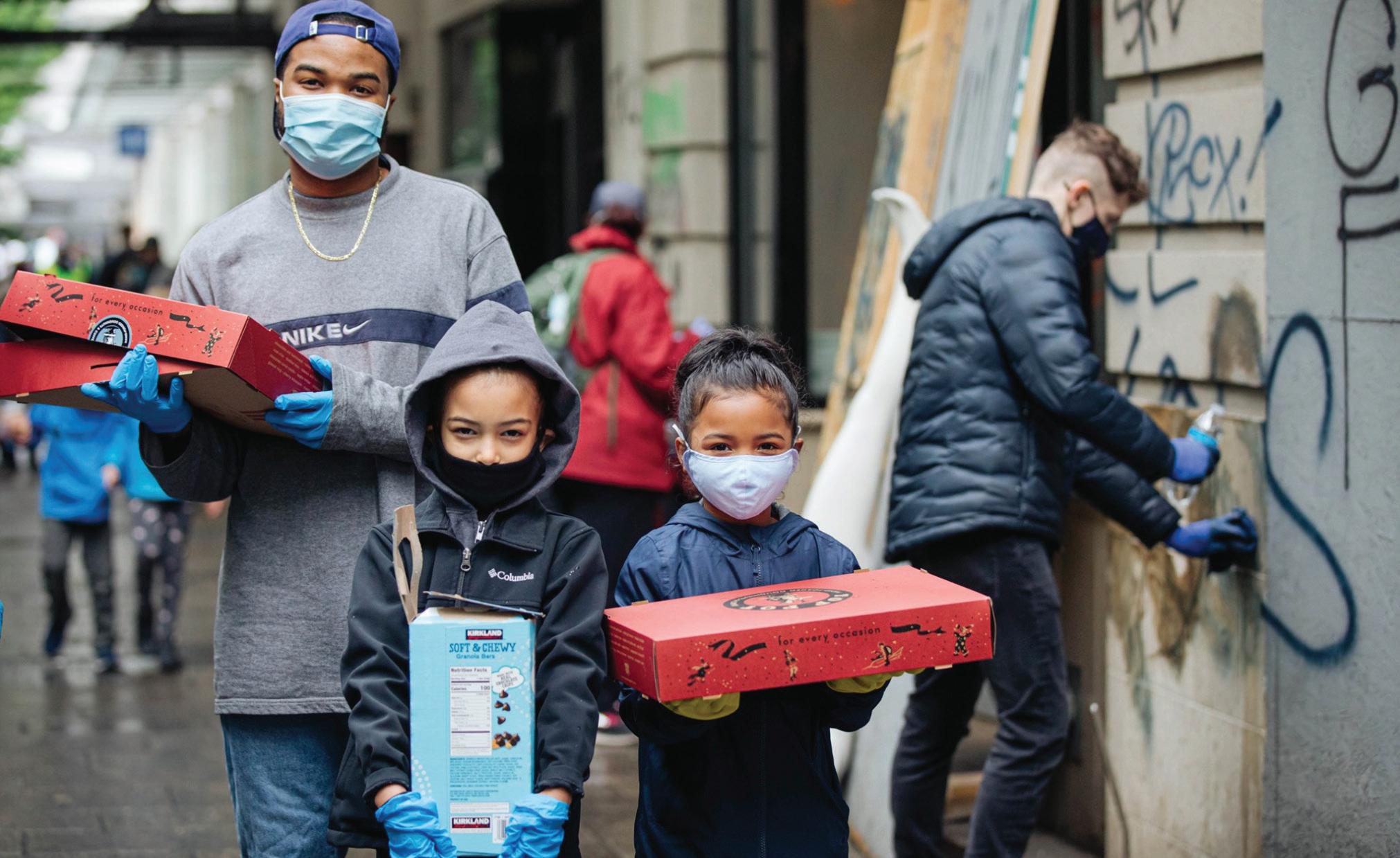
On the last Sunday in May, after a historic march against racism and police brutality had ended with looting and arrests, hundreds of people converged on downtown with gloves, brooms, and an im-
pulse to clear away graffiti and broken glass. Some of them wore signs with social commentary, such as “Racism caused this mess.” And people brought along their kids to help out.
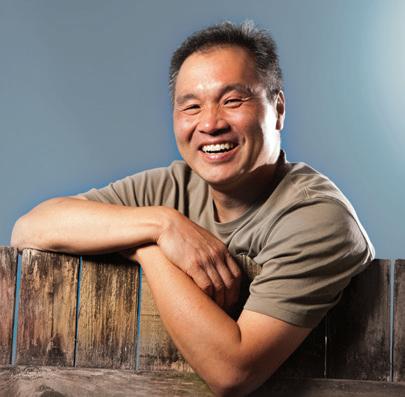
Photographer Joshua Trujillo took pictures of one family delivering food for the volunteers.
“Instead of smelling like tear gas, on Sunday downtown Seattle smelled like paint remover and cleaning chemicals,” Trujillo wrote on his Facebook post about the scene.
After a night of alarming images, it was a
glorious thing to see proof that in this community, good things are happening.
Seattle has serious problems. Many of its residents live subjected to systemic racism that robs them of opportunities, damages their health, and threatens their very lives. A housing shortage and high cost of living means that people who make even middling incomes often struggle to get by. And COVID-19 and the economic downturn have



«What
made life harder for many people. But our city has strengths, too: We volunteer. The Corporation for National and Community Service consistently ranks Seattle in the top 10 among cities for volunteering.
Kids grow up here with volunteering as part of life. Many an elementary-schooler can tell you about clearing weeds, planting trees or watching a parent help build a playground. There’s also a high school graduation requirement: 60 hours of volunteer work.
We are conscientious recyclers. We divert more than 60 percent of what we throw away to recycling or composting. Our kids are surprised when they find there are places people don’t sort all their waste after a fast-food meal. Our lawns turn brown each summer while we save water. Whenever someone makes a list of America’s greenest cities, Seattle is on it.
Another list we’re proud to always be on: America’s most LGBTQ+-friendly cities. Another trait of Seattleites is respect for safety regulations. After the Seahawks won the Super Bowl in 2014, the one fan celebration video that became famous was of a crowd of revelers in Ballard waiting patiently for the light to change before crossing the street. Many a city has been thrown into rioting by a historic sports victory, but Seattle didn’t even jaywalk.
This may be why we did a good job of containing the coronavirus pandemic when it emerged among us. It was the first outbreak discovered in the U.S., but thanks to people staying home and taking precautions, it’s been nowhere near the worst. We
listened to local health experts, put on face masks, gave each other space, and we saved thousands of lives.
We want to make a better world. We throw huge political demonstrations, even when our population is being stalked by a deadly virus. Day after day, at the beginning of June, thousands of people filed down arterial streets, crowds of masked faces as far as you could see. On June 12, a weekday, an estimated 60,000 marched silently in the rain. Following behind on many marches: crews of volunteers bearing pickers and trash bags, removing litter.
We get things done.
This past decade, Seattle has passed a series of generous education levies, taking steps to give all kids here equal access to education.
The Seattle Preschool Program, which provides early childhood education on a sliding fee scale, reached 1,700 children this past year, and it plans to expand. The city also funds the Seattle Promise program, which gives public school graduates two free years of college at Seattle Central, North Seattle, and South Seattle colleges. Starting next school year, this program will include graduates of every Seattle public school.
In 2019, Washington passed the Workforce Education Investment Act, making public colleges vastly more affordable for those with medium or low incomes. For the neediest students, tuition is free. These are tangible changes that will change lives for thousands of Seattle kids and families.
We clearly have a lot more work to do to demolish systemic racism, build a place where all Seattle kids truly have equality of opportunity, and ensure no family fears homelessness or hunger. But if one thing is clear from 2020 so far, it’s that people in Seattle are capable of pulling together to make the city — and the world — better.
For one thing, Seattle is home to some astounding people. Just look at who showed up downtown that Sunday morning in late May.
by JEFF LEE, MD
If we want to teach our children to be anti-racist, we have to expand their definition of “us” from the very beginning
Since the death of George Floyd, and the public outcry that followed, many parents are asking: “How do I talk to my kids about racism?” The answer depends on who your kids are, and what they need right now.
If your children aren’t white, talking about racism isn’t just any talk, it’s The Talk. You’ve been thinking about it since they were born. How do you tell them that some people will fear them, hate them, hurt them — because of the color of their hair and skin or the shape of their eyes? If your kids are Black, especially if they’re boys, you’re wondering how to tell them not to walk through certain white neighborhoods, not to wear a hoodie after dark, not to run or reach into their pockets when the police are there.
If your kids are white, it’s a different talk. How do you help them understand privilege, institutionalized racism and implicit bias? How do you tell them that they are part owners in a legacy of oppression and violence that began long before they were born?
Some parents wonder if they should talk about race at all. Shouldn’t we try to move beyond race, and work toward a race-blind world? Other parents worry that race will be the only aspect of their child’s identity that will matter. They see a racism that’s as ingrained in our culture as gender, class, money or power, and
that for their child could be a matter of life and death.
Race, the way our culture defines it, has no scientific basis. We lump people together into arbitrary categories based on skin pigment, hair color, and historical precedents that have little relation to behavior, physiology or genetics. It’s an imaginary construct, and on a historical scale, it isn’t even that old. The concept of race was promulgated by slave traders during the 17th and 18th centuries, to justify an expanding and highly lucrative market for West African slaves. Slavery had existed throughout history, but had been driven by geography and military conquest, not skin color. The idea of race was just a public relations strategy, designed to make the brutal, largescale trafficking of human beings more acceptable to European sensibilities.
An idea, though, can be a powerful thing. Nationality is an idea. So are corporations, religions, money, and human rights. Because we collectively agree that they exist, they shape and direct our lives. Race is the same way. It’s an idea so powerful that it sometimes kills.
So yes, we need to talk about racism. It’s a moral issue, just like lying and cheating and stealing — a critical piece of any child’s education about right and wrong. But children can only absorb so much at any given age. Detailed discussions of police brutality or systemic racism won’t do much for





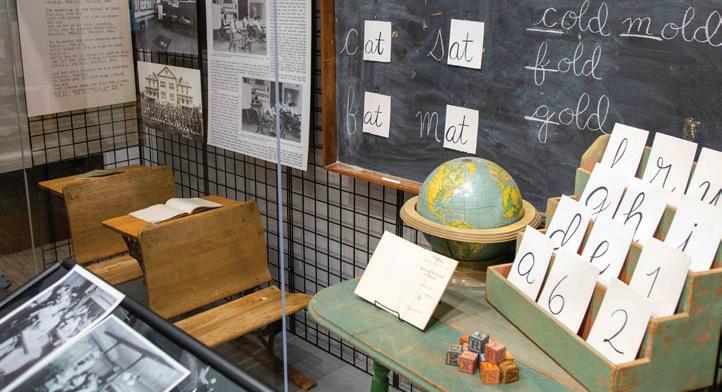
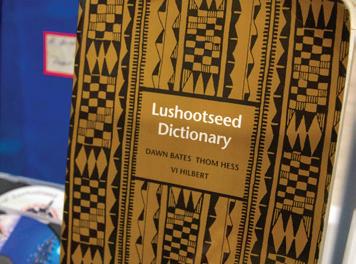
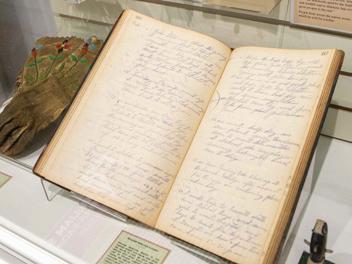


TUE–FRI SAT–SUN Closed 10AM –5 PM 12PM –5 PM
Located less than a mile west of I-5 Exit 199 6410 23rd Ave NE Tulalip, WA 98271 360-716-2600 info@HibulbCulturalCenter.org HibulbCulturalCenter.org


your 4-year-old, except confuse them. Early in a child’s life, when it matters most, we need to speak to them using more than just words. Children, like all of us, are hardwired to label people as “us” or “them.” It’s an impulse we evolved, millennia ago, to survive a hostile world. Young children sort people by appearance — they can recognize racial differences as early as six months of age. Depending on the cues they pick up from the adults around them, some show signs of discrimination and bias as early as preschool. If all our close connections are to family and friends of one race, that molds our definition of “us.” Our experiences with our own race are mostly positive, and we see its members as individuals. But we may only experience those of other races as strangers, or through the distorted lens of our monochromatic culture. This is how they become “them.” We judge them as a group, and we generalize what we observe, or what we’re told. Those generalizations become the stereotypes at the foundation of racism.
The mental hardware for categorization, and the instinct to divide the world into “us” vs “them,” are present in everyone. What differs is how wide a circle our “us” includes. If we want to teach our children to be anti-racist, we can’t wait until they’re old enough for nuanced conversations. We have to expand their definition of “us” from the very beginning. Who are our family friends? Who do we break bread with? Worship with? Go to school with? When we walk down the street, how do we react to the stranger coming the other way?
Our kids are watching. Their brains are sorting, and categorizing, and checking off boxes labeled “us” or “them.” They don’t need our words to follow our lead — they can see for themselves which boxes we choose.
This moment is a turning point — for us and for them.
ABOUT OUR COLUMNIST
Jeff Lee, a family physician, lives, works and writes in Seattle.
„
Gossip from the private lives of animals at Point Defiance Zoo and Aquarium:
3 Tiger sisters Kirana and Kali love giant “popsicles” made of frozen chicken and blood.
3 A musk ox named Charlotte has a new baby, born June 7.
3 Kazu the tapir calf, born last summer, loves having her back scratched.
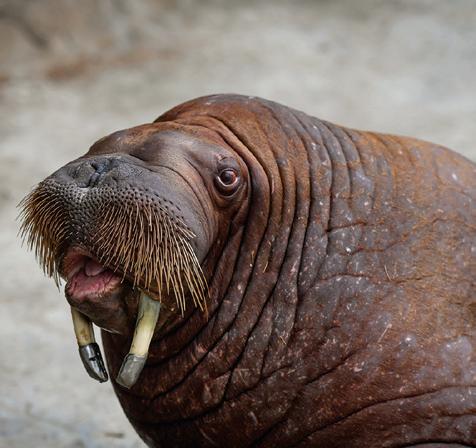
3 Walruses Mitik and Pakak, both 8, are teenage boys in walrus terms, and enjoy mock-wrestling and being loud. pdza.org — Fiona Cohen
FIONA COHEN / photos by JOSHUA HUSTON
We all know Seattle is a beautiful city, but we’re more than just scenery and tech companies. Here are 22 places to walk, learn, play, meet people, eat and explore the many facets of our home. It’s awkward to write a city guide in June 2020, because we have no way of predicting what is going to be open. While we have a plan for how businesses and
institutions are going to return, we don’t know when King County is going to move from one phase of coronavirus precautions to another. Also, the plan for what opens when constantly evolves. At first, libraries were going to be open in Phase 3. Then at the beginning of June, the talk was about CONTINUED ON NEXT PAGE >
5 places to explore Garden parks in bloom
1
Washington Park Arboretum
With 230 acres of trails and plant life on the shores of Lake Washington, many species found only at the park, your family will enjoy a day of exploration, discovery and nature.
3 botanicgardens.uw.edu
2
Kubota Garden
Children will delight in the ponds filled with koi and the bridges over the pond. A beautiful place in Rainier Beach to snap some shots of your children playing in the garden.
3 kubotagarden.org
3
Bellevue
Botanical Garden
Greeted by a gentle waterfall, children are drawn to this park with its many different landscapes; they’ll enjoy the windy paths, the shade of tall trees, and the array of birds, bees and butterflies.
3 bellevuebotanical.org
4
Parsons Gardens
A hidden gem on Queen Anne Hill’s South Slope, this mini garden park is perfect for a game of hide-and-seek in the large gazebo structure or behind one of the many hydrangeas.
3 seattle.gov
5
Kruckeberg
Botanic Garden
With four acres of woodland gardens, it’ll take you more than one visit to cover this beautiful park in Shoreline. The “kids only” website features garden-themed virtual learning resources.
3 kruckeberg.org
— Jasmin Thankachen
< New normal summer CONTINUED
having curbside service for libraries during Phase 2. Pools can reopen in Phase 3, but as we go to press, it appears that Seattle’s outdoor pools and wading pools will not, because they rely on seasonal hiring, and the city currently is in a hiring freeze.
As we publish this, most places on the list are open to some degree. You can go to parks (though the parking lot may be closed), many beloved restaurants are open for takeout, and some of the bigger ones have seating. But this situation will pass. Seattle will transform, as cities do. Be safe, smart, and enjoy the reopening!
market will be returning to its noisy, colorful self.
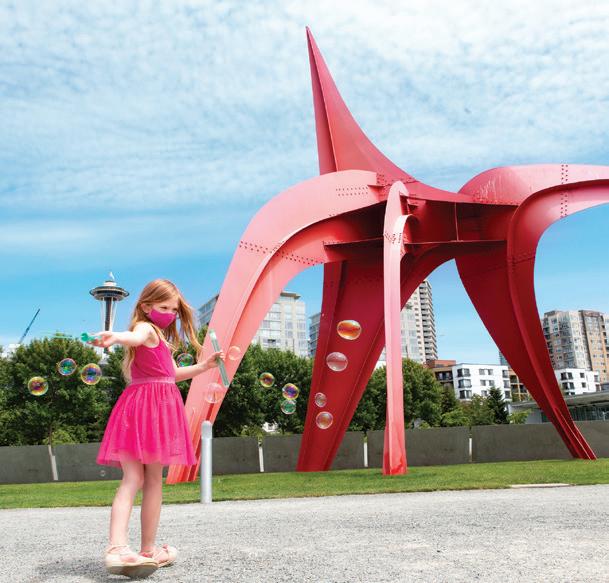
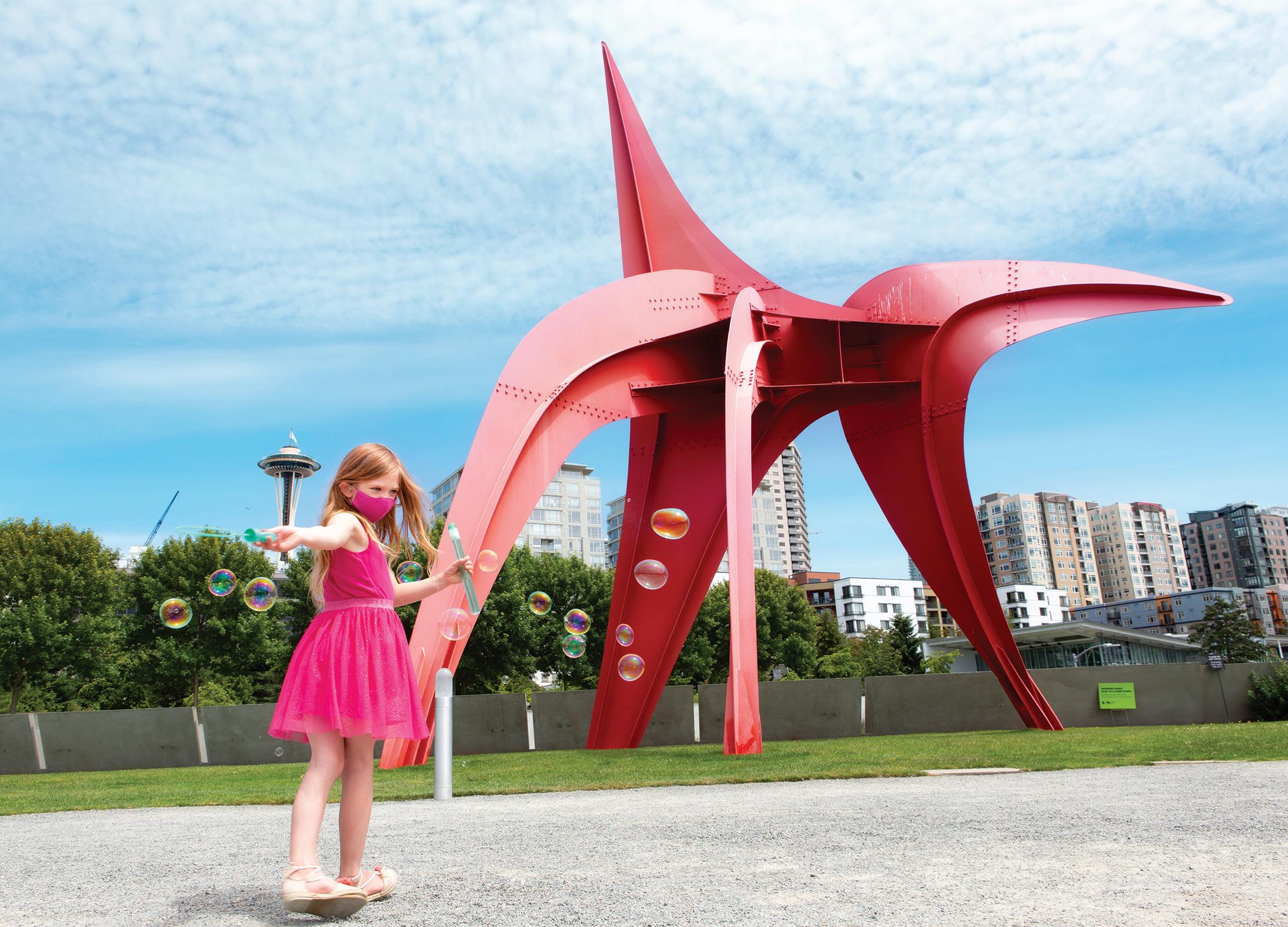
3 Olympic Sculpture Park/ Waterfront: You can’t touch the art, but this is a mind-bending place to explore, and you can walk from here to a small beach, set off along the newly refurbished Elliott Bay trail, or see what’s happening on Alaska Way, the touristy waterfront strip that includes the Seattle Aquarium. Last year the state finally demolished a crumbling old viaduct to make way for… parking lots, so far. But there are plans in the works for great parks and plazas, so watch this space.
3 International District: Come hungry; there are lots of places to eat. Check out the Wing Luke Museum of the Asian Pacific American Experience, if it’s open. You’ll be glad you stopped by the Asian supermarket Uwajimaya for groceries and a look at the fish counter.
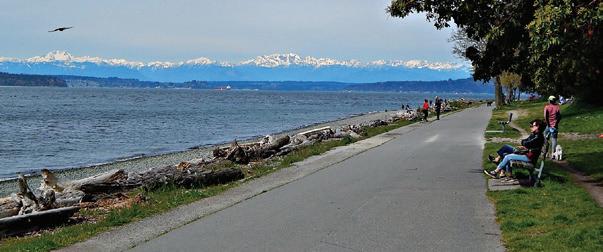
3 Alki Beach: In a city surrounded by waterfront and lakefront, this broad band of sand along Puget Sound is the premier beach haunt. A nearby area of businesses catering to the beach crowd adds to the festive atmosphere.
3 Lincoln Park: This triangleshaped, 135-acre park is bordered on two sides by Puget Sound. Within,
tour a lush forest on a network of trails.
3 South Park: If you happen to be at this end of town around a mealtime, check out the strip of affordable restaurants on 14th Avenue South near South Cloverdale Street. Along with some of the best Mexican joints in town, you’ll find highly rated spots for burgers, pizza and kebabs.
Lake Washington Boulevard
When the Olmsted brothers drew up the plan for Seattle’s parks, the chain of greenery along Lake Washington Boulevard was what they were aiming for. A trail along the lakefront connects a series of beaches, parks and small green spaces to pause in.
Columbia City
This colorful, energetic stretch of Rainier Avenue hosts an independent cinema, a jazz club, and many lovely places to eat, and hosts a hopping Wednesday farmers market in-season.
Beacon Avenue
The stretch of Beacon near the Beacon Hill light rail station is host to a diverse collection of small restaurants. It’s easy to find something affordable and kid-friendly, and convenient to take out for a picnic at nearby Jefferson Park.
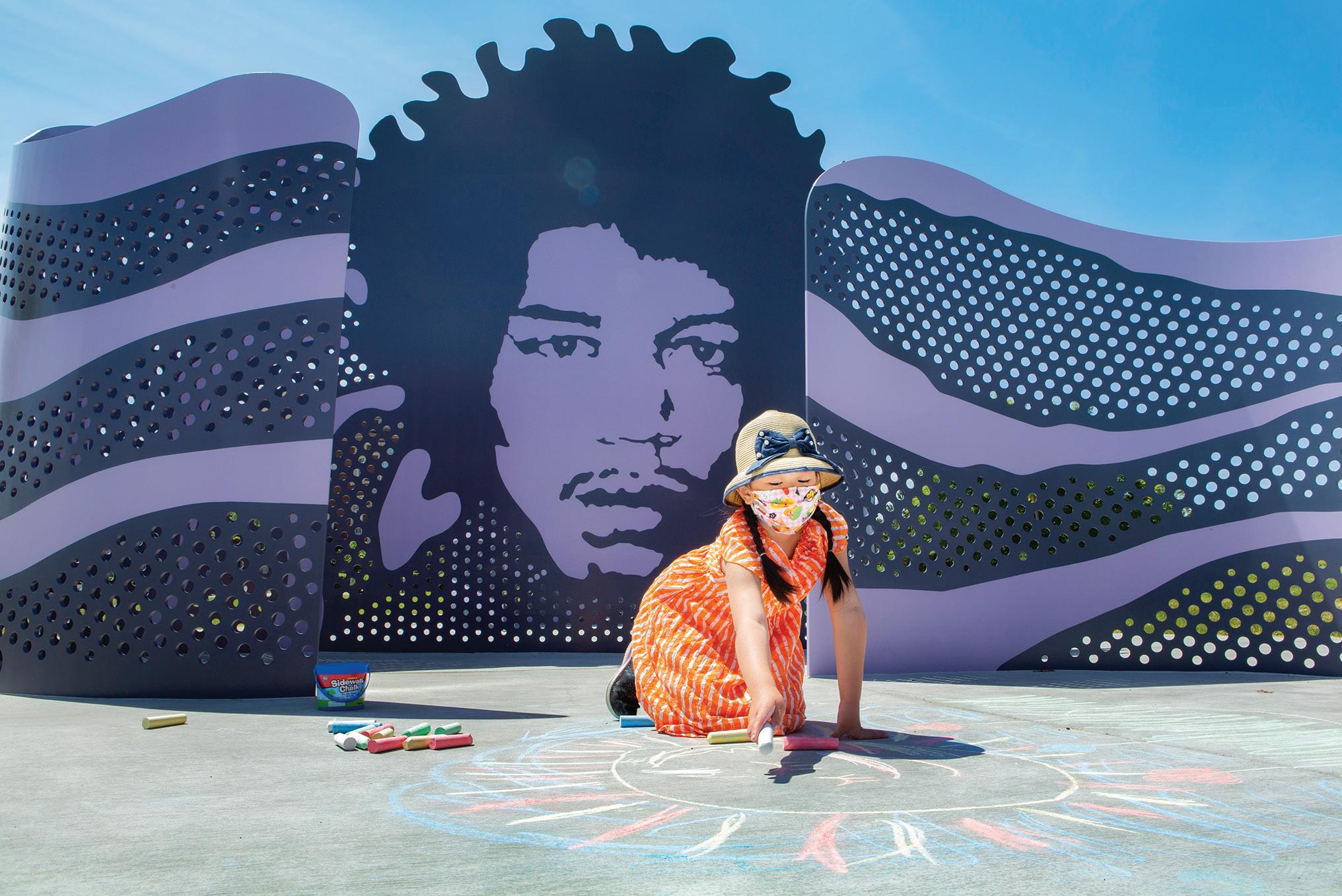
3 South Massachusetts Street between 23rd and 25th Avenues: On the north side of the street: the Northwest African American Museum and the beautiful Jimi Hendrix Park. On the south side of
3 Pike Place Market: So many things about the market as usual — the crowds, the buskers, the fish-tossing, the alleyway lined with discarded gum — are not compatible with a social-distancing lifestyle. The beloved institution, composed of roughly 240 small and eclectic businesses, is open and worth exploring. As Seattle continues to open up, the
3 Seattle Center: When everything is open, there’s more to do here than there is time in the day. This is the home of the Pacific Science Center, Seattle Children’s Museum, Museum of Pop Culture, Seattle Children’s Theatre, the gigantic Artists at Play Playground, and the monumental International Fountain with its 200 jets making intricate patterns.
the street, past a playfield: Seattle Children’s PlayGarden, an ingenious space geared for young children of all abilities.
3 Capitol Hill: The area around the Capitol Hill light rail station is the historic heart of Seattle’s LGBTQ+ community, and hub for the arts, food, fashion and protest. In June, part of it became a police-free enclave of politics, feeding the hungry, and making art, including a beautiful “Black Lives Matter” mural on the blacktop of East Pine Street. Go see it.
3 Volunteer Park: A classic city park at the north end of Capitol Hill, where you can enjoy a summer day on the lawn, climb a cedar tree, check out some iconic public art, and take in a cool view of downtown.
3 Queen Anne Avenue: With Blue Highway Games at the north end and Queen Anne Book Company at the south end, the avenue’s commercial strip atop the hill is a good bet for parents shopping for gifts.
3 Fishermen’s Terminal: The home port of Seattle’s fishing fleet is a great place to go with a child entranced
by boats and machinery. Stop at Little Chinook’s and dine on some expertly fried fish and chips as you watch the action.
3 Discovery Park: It’s less than 5 miles from the Space Needle, but the wild landscape of Discovery Park, the city’s largest public park at 534 acres, feels like a world apart. Big enough for an afternoon hike on nearly 12 miles of walking trails, this park contains forest, meadows, beaches and views across Puget Sound.
3 Green Lake: The home of Seattle’s favorite 2.8-mile running and walking loop is also a place to swim, row, paddle, fish and enjoy the bird life.
3 East Ballard industrial area breweries: The cluster of small breweries in East Ballard includes several places where parents can enjoy a pint while their kids enjoy simple food-truck fare, or play nearby. Two good spots: Populuxe Brewing and Peddler Brewing Company.
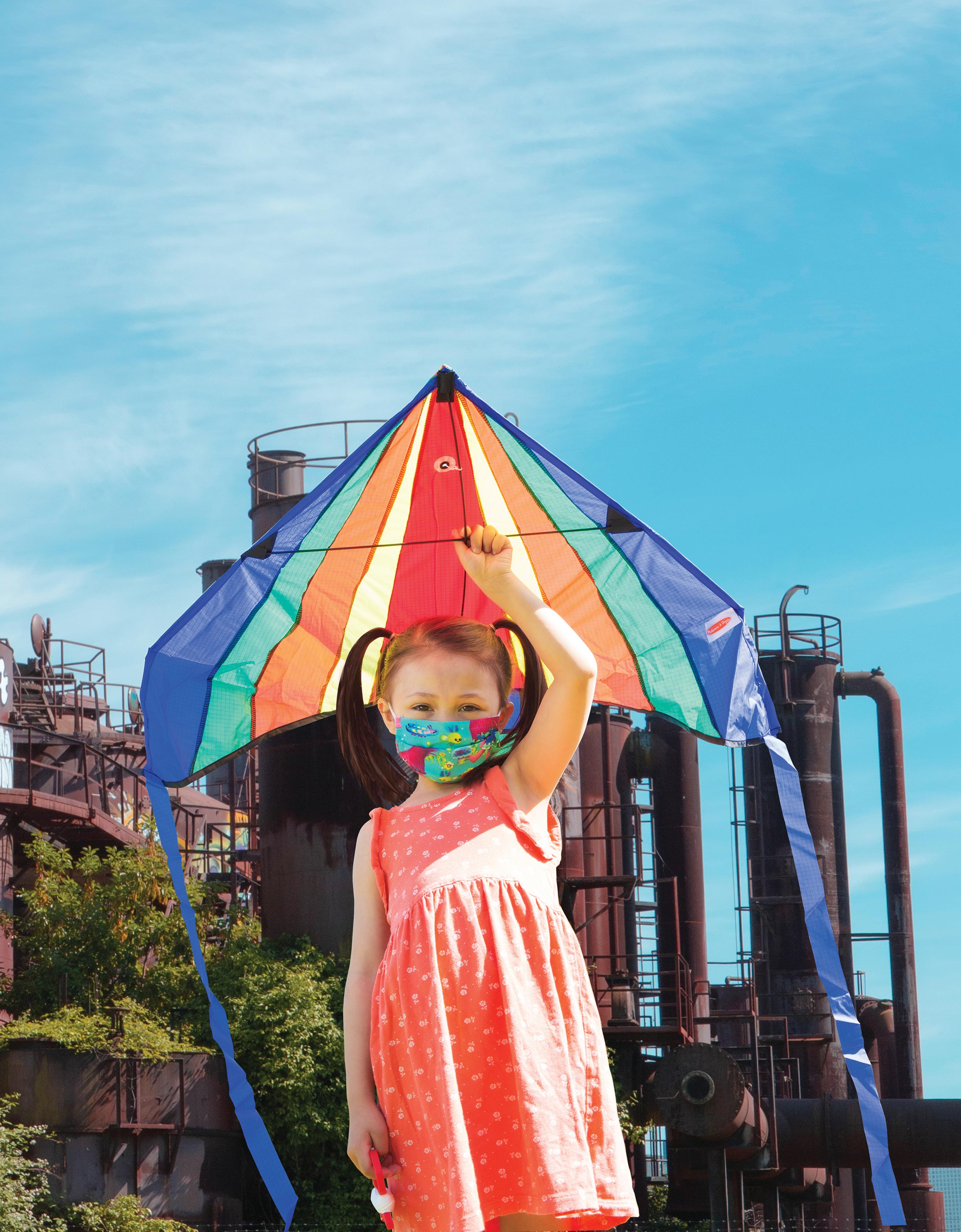
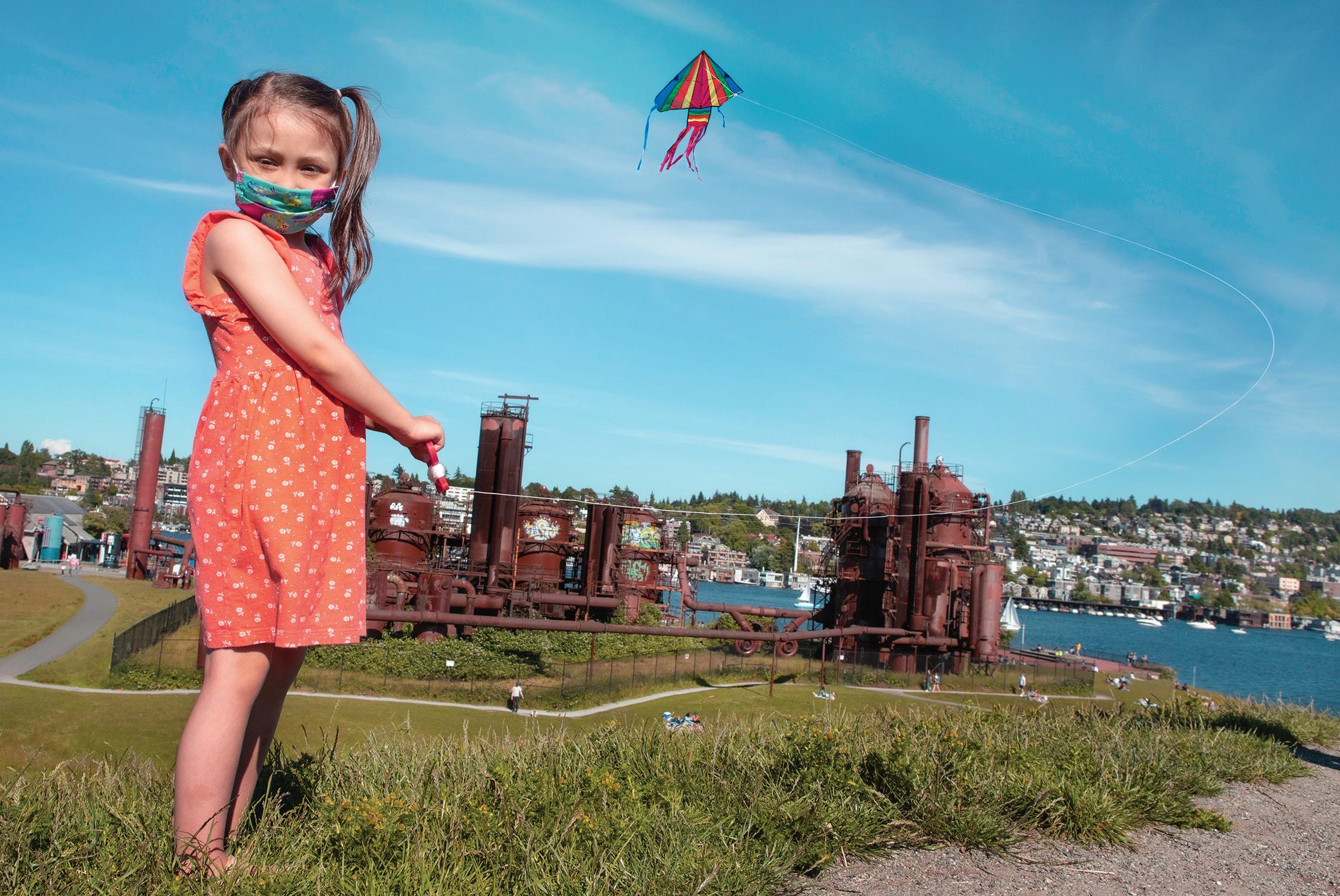
3 Gas Works Park: This scenic spot overlooking Lake Union‘s north end makes dramatic use of its industrial past. What had been contaminated
soil is now a lawn-covered hill, capped with a sundial. People fly kites off it on windy days and sled down it when it snows. Other concrete and steel remnants of the coal gasification plant that once stood on the site now remain as monuments.
3 Magnuson Park: This hub for sports also includes a children’s garden, wetland areas teeming with birds, and a popular beach.
3 U District: The University of Washington attracts students from all over the world, and the restaurants in this neighborhood cater to them. Biang biang noodles, dosas, pupusas and bibimbap are among the many wonderful tastes to try here.
3 Burke-Gilman Trail: This multiuse, 20-mile trail from Ballard to Bothell draws as many as 5,000 daily commuters at peak times, and is also a favorite route for families looking for bike adventures with few cars in sight.
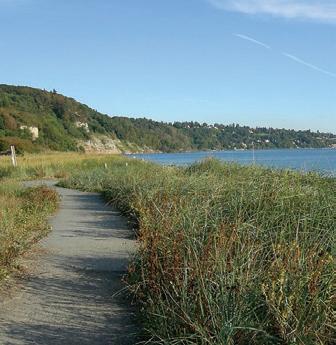
Seattle loves its trails!
A half-dozen good ones: Alki Trail
Neighborhood: West Seattle
Distance: 7 miles (out and back)
Flat, paved and scenic, with postcard-quality views of the Olympic Mountains, the downtown skyline and the activity on Elliott Bay.
Chief Sealth Trail
Neighborhoods: Beacon Hill, Rainier Beach
Distance: 8 miles (out and back)
Expect hills, curves, gardens and surprising viewpoints on Lake Washington and Seattle.
Washington Park
Arboretum
Neighborhoods: Montlake, Madison Park, Capitol Hill Distance: 2 miles for the loop trail, up to 1 mile each way for the waterfront trail.
Contemplate trees in all their variety (there are more than 50 species of maple alone), or take a boardwalk out on the lake to outlying islands.
Discovery Park
Neighborhood: Magnolia Distance: Biggest loop is 4.4 miles
You can explore meadows, find secret ponds, forest-bathe or enjoy broad beaches that grow wide at low tide. Carkeek Park
Neighborhoods: Broadview, North Beach/Blue Ridge Distance: Up to 3 miles
The most popular walking route in this woodsy waterfront park follows the course of Piper’s Creek, a salmonbearing stream.
Union Bay Natural Area Neighborhoods: University District, Laurelhurst Distance: 1-mile loop
This area of cottonwoods, meadows and wetlands next to the UW is a haven for birds and those who love to watch them.
Washington State Parks’ yurts, cabins and houses are waiting for you
by JULIE HANSON
Did you know that you can enjoy Washington’s many and varied state parks without sleeping on the ground and cooking over a fire? (Unless, of course, you want to.)
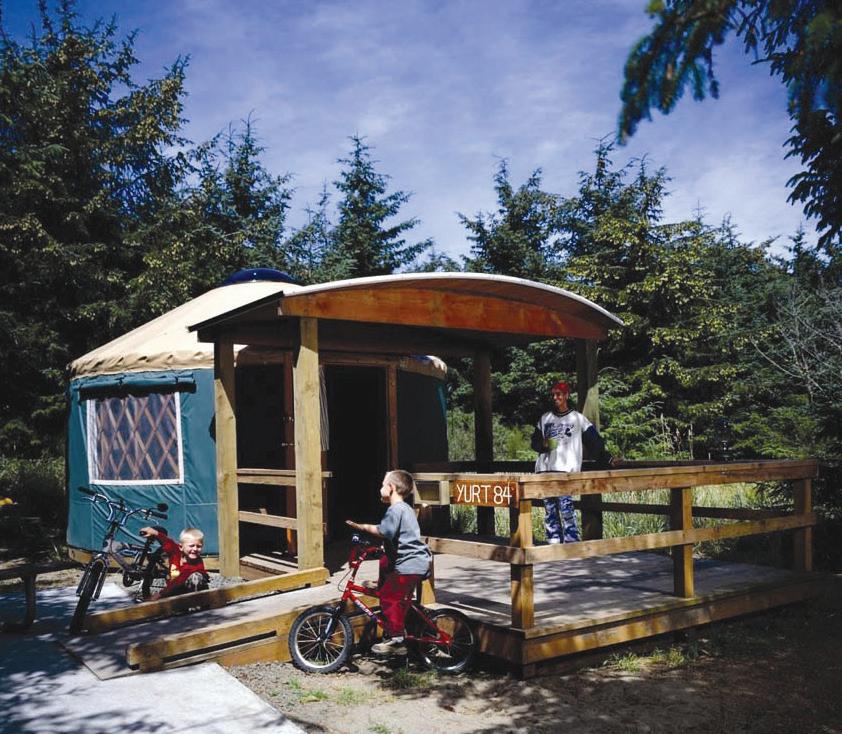
At least two dozen state parks, most of them on the west side of the state, rent what they call “roofed accommodations,” which include yurts, cabins and houses, both historic and contemporary.
Where to go? That depends on your family’s travel style, and what you’re looking for in a not-quite-roughing-it getaway:
Cama Beach State Park on Camano Island has simple, cozy waterfront cabins. You can wear yourselves out trooping along the many trails and, of course, exploring the beach. (The park next door, Camano Island State Park, also has cabins for rent, but not as many.) Then you can roast hot dogs and

marshmallows on the grill outside your cabin, and fall asleep to the sound of the waves.
At Fort Worden and Fort Flagler (both outside Port Townsend), you can rent the homes where military officers once lived with their families. Send the kids out to march on the parade ground, and look for deer, while you enjoy the view from a big front porch. Fort Flagler also has an extensive network of bunkers built into the ground.
Cape Disappointment on the Long Beach Peninsula has both yurts and a former lighthouse keeper’s quarters, right in the heart of Lewis and Clark territory. (There’s an excellent Lewis and Clark Interpretive Center.)
Have you heard of Kanaskat-Palmer State Park? Neither had I, until recently. It’s gorgeous, located on the Green River in southeast King County, and it has yurts!
Pack food and goodies and games and get ready to enjoy nature (and very likely some history, too) while not venturing very far from home.
Having your own family cabin is conducive to social distancing, but you’ll need to take care on beaches and in other potentially crowded public areas. (And if you’re like me, you’ll dream of renting one of the old houses for a big family get-together or moms’ weekend. Maybe next year!)
Availability may vary as facilities gradually reopen this summer. Also, read the fine print about the property you’re interested in. Each one is different: You may need to bring your own linens, or there may be limits on how much cooking you can do indoors. Your rental may or may not have a bathroom. Pets are allowed in some places; smoking is not. A few even have TVs, and many are stocked with games.
q parks.state.wa.us/101/Rent-a-place
















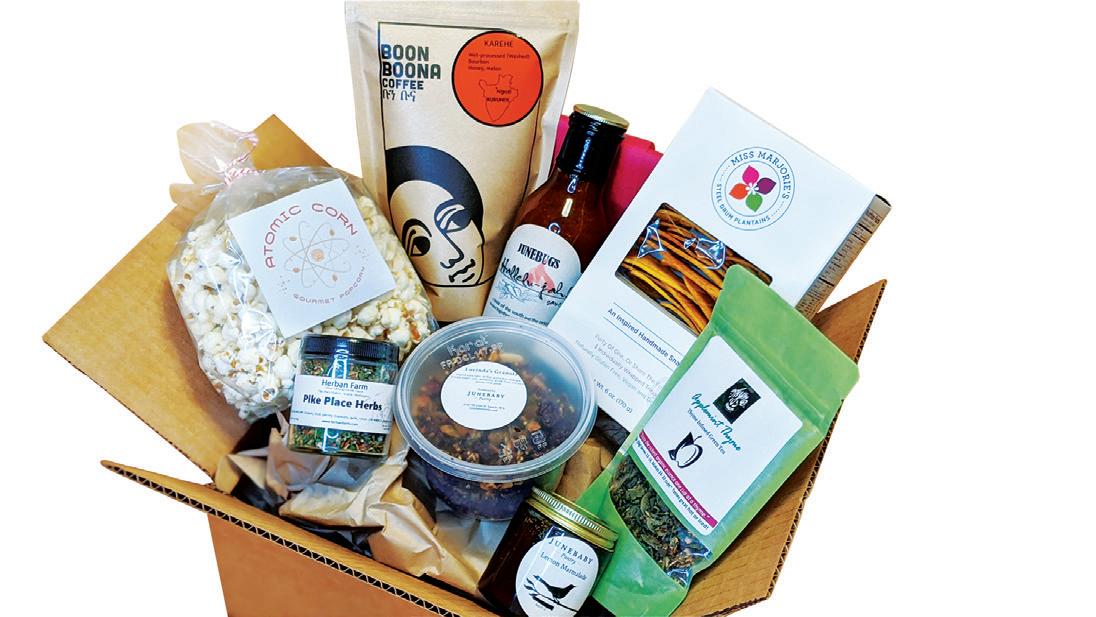
Known for their informative and filling food journeys, Savor Seattle Food Tours has switched gears to bring you produce, fruit, flowers, salmon and other products sourced from farmers and retailers at Pike Place Markets. Now they’re offering a Seattle Solidarity Box, featuring 11 items from local, Black-owned small businesses. savorseattletours.com
— Jasmin Thankachen
7 great family-friendly restaurants to rediscover
by JILLIAN O’CONNOR / photos by JOSHUA HUSTON
After being cooped up for months, most parents are admittedly in a bit of a food rut. This summer, these family-tested Seattle restaurants can help you escape home cooking with takeout, and some will be offering the luxury
of dine-in service, too. (Check the website or call for the most up-to-date information.)
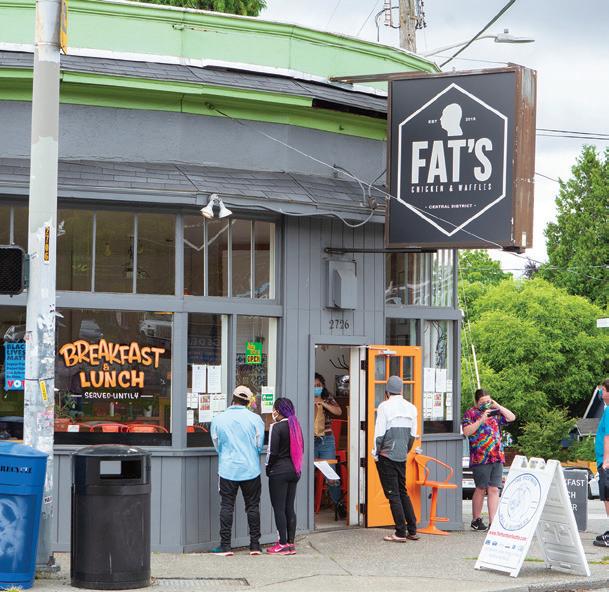
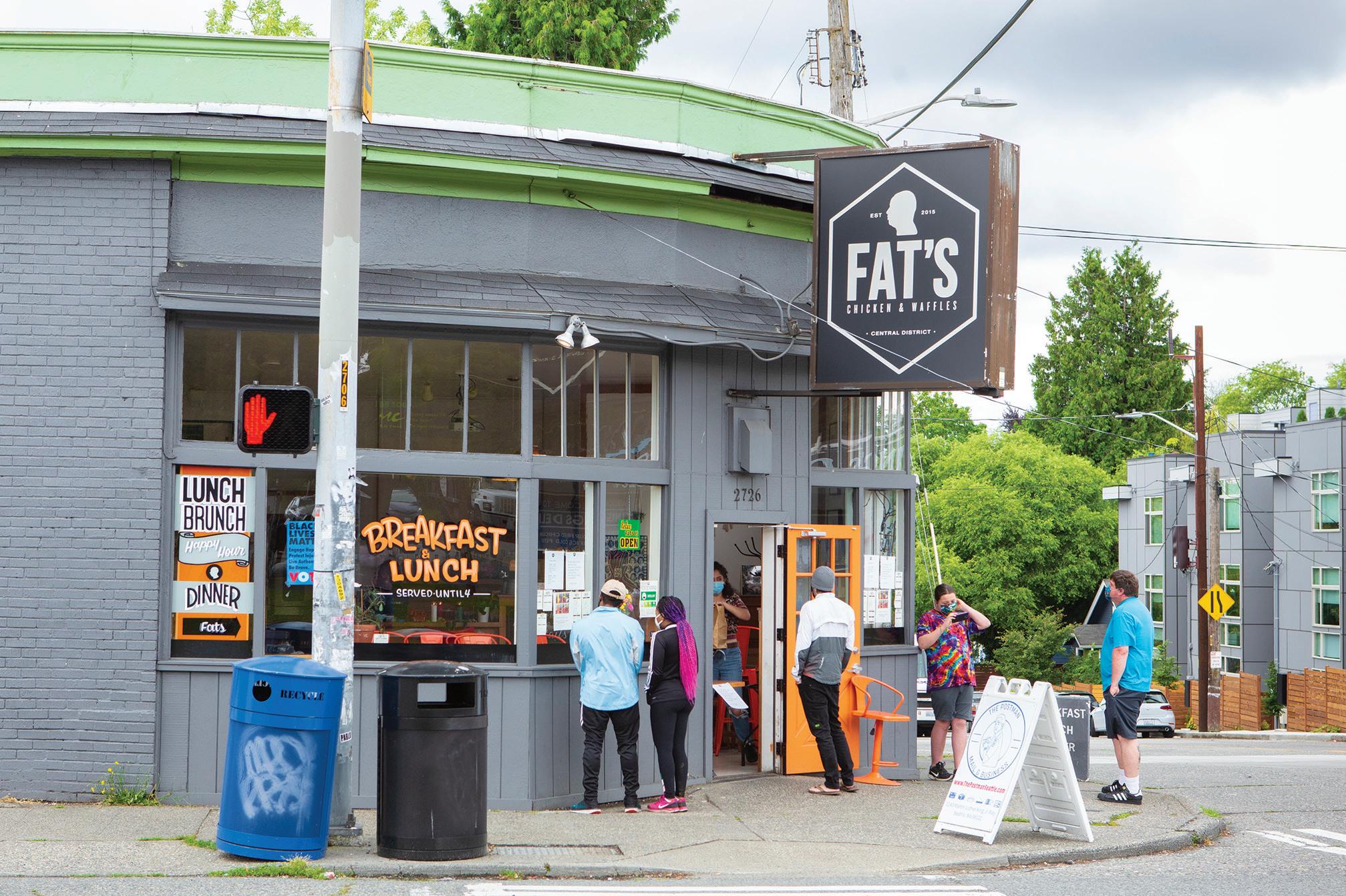
Fat’s Chicken and Waffles (Central District): If you’re craving something savory, like shrimp and grits (or red beans and rice, or catfish,
or a fried-green-tomato sandwich), or a mix of sweet and salty, like fried chicken and waffles, you’re in luck for dinner or brunch at this beloved Southern favorite. Kids love the fabulous mac and cheese and fried fruit pies for dessert. Highlight: The honey butter chicken biscuit sandwich. 2726 E. Cherry St., fatschicken andwaffles.com
Sweet rewards Cold Plate in the University District, offering Thai-style ice cream and other treats. Sweet cream poured on a cold slab, mixed and rolled into cylinders. Top with fresh fruit, decadent sauces and sprinkles… mmm, mmm, good! 5240 University Way NE, coldplate dessert.com
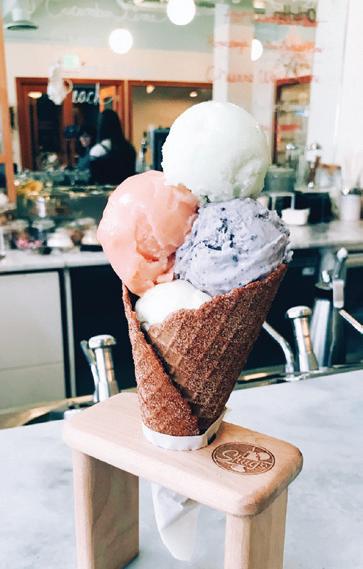
1The perfect treat for a hot summer’s day (or any day, really), check out Shug’s Soda Fountain & Ice Cream located in the heart of Pike Place Market. Sourcing local ice cream and sorbets from Lopez Island Creamery, the shop offers flavors like Curious George and Sunday Market, along with shakes and malts. 1525 1st Ave., shugssoda fountain.com
3 Craving soft-serve with a twist? Head over to Nana’s Green Tea, offering matcha ice cream swirled with chocolate or vanilla and a smattering of boba. 1007 Stewart St., Suite 103, nanas greenteaseattle.com
— Jasmin Thankachen
Elliott Bay Brewing Company (West Seattle, Lake City Way, Burien) The pub fare for grownups — rotating chili specials, the tempura fish and chips, and the burgers — is outstanding, and the kids’ menu is about as extensive as I’ve seen, including chicken tenders as well as the fancier grilled chicken with sautéed veggies. (Extra perk: In a brewpub, no one can hear your kid screech.) elliottbaybrewing.com
House of Hong (International District): Cantonese dumplings hold a special place in many kids’ hearts, and House of Hong will give them a great sampling of the time-honored tradition of weekend dim sum, now available for takeout and delivery. 409 8th Ave. S., houseofhongseattle.com
Mioposto (Mount Baker,
Admiral District, Ravenna, Mercer Island): My husband and I are East Coast transplants — and visited Naples last year — so we have all sorts of haughty assumptions about pizza. Mioposto is doing a great job, both with feeding the kids and keeping the pizza real. (Noteworthy: the beet, feta and orange salad, and curbside cocktails to go.) miopostopizza.com
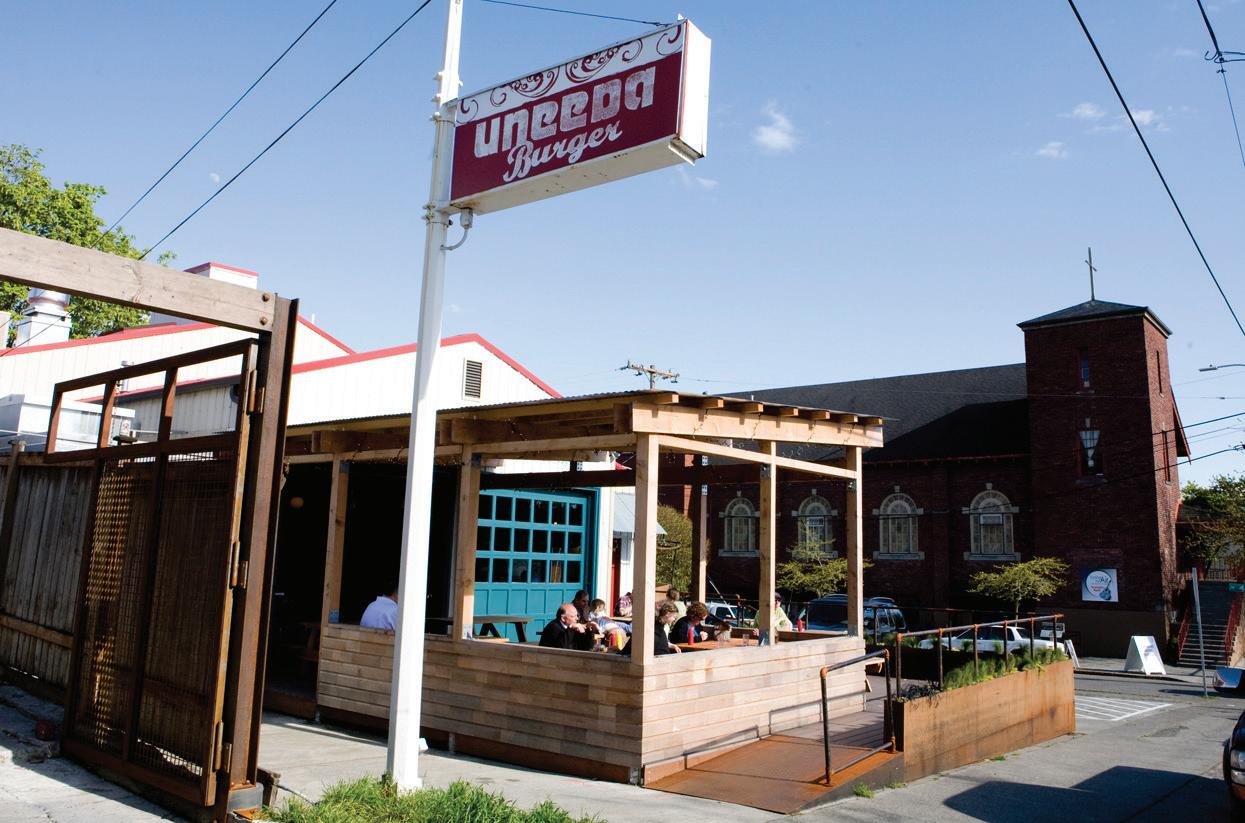
Uneeda Burger (Fremont): With shakes for kids and beers for grownups, it’s a burger place you won’t tire of quickly. Highlights include all the burgers, with toppings ranging from plain to the usual lettucetomato-onion to the fancy, like blue cheese and caramelized onions. There are a few non-bovine standouts, namely the Buffalo chicken sandwich, quinoa bowls and the rockfish sandwich. 4302 Fremont Ave. N., uneedaburger.com
The Comfort Zone (Columbia City): A mother-daughter team
presents soul food with stellar menu items like fish and cheese grits, hush puppies, black-eyed pea dip, oxtails with rice and a variety of po’ boy sandwiches. (Pickier kids love the mac and cheese and cornbread.) 5016 Rainier Ave. S., thecomfortzonesoulfood.com
Issian Japanese Stonegrill (Wallingford): A great adult restaurant you can also take
little ones to. Our gourmet child’s favorites have included chirashi don (sashimi on rice), takoyaki (fried octopus dumplings) and grilled baby octopus on a stick, while the fussy one sticks happily with other izakaya fare like yakitori (grilled chicken on a skewer), JFC (Japanese fried chicken) and gyoza. 1618 N. 45th St., issianjapanesestonegrill. weebly.com
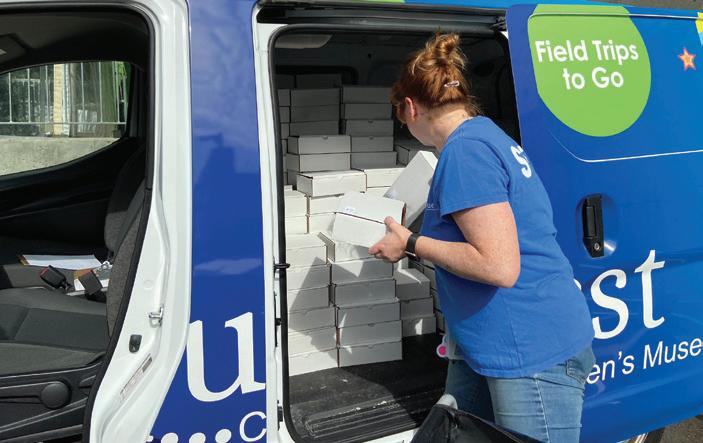
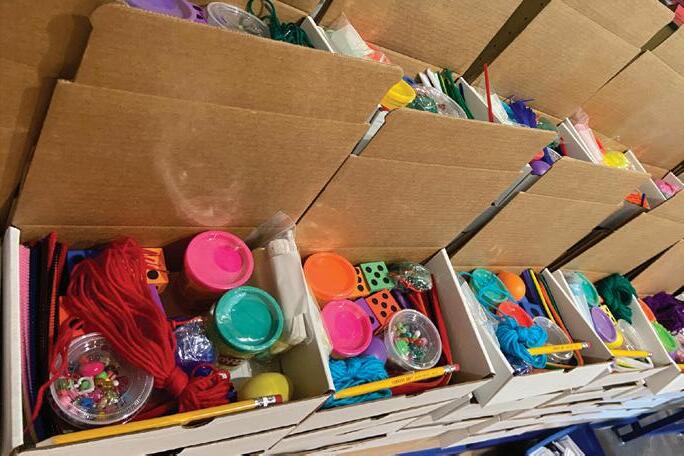
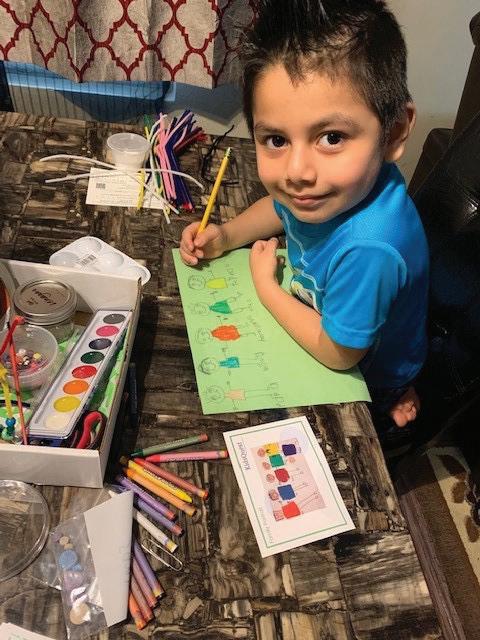
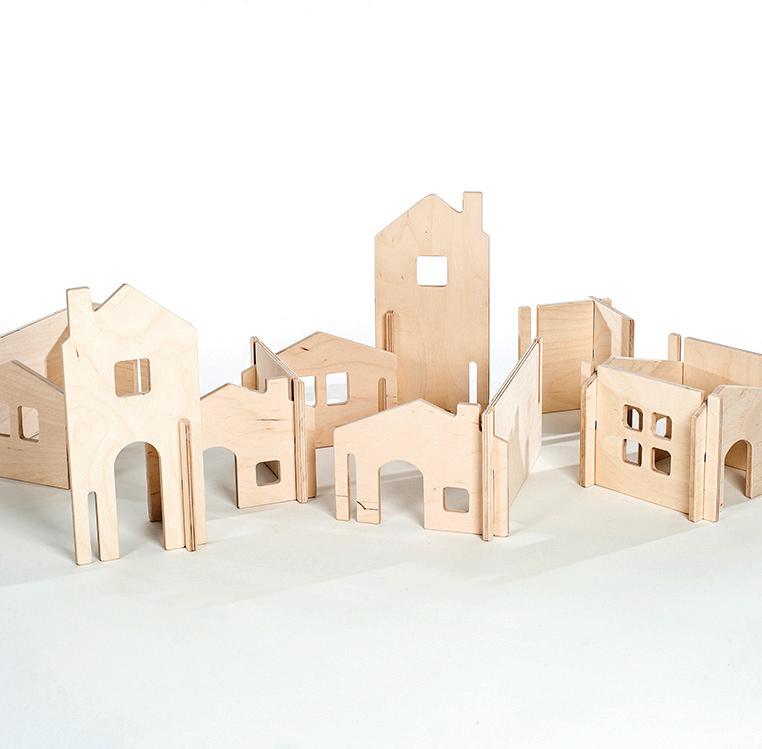
Dave Minnery and his wife Adrienne make heirloom-quality sustainable wood toys, including custom “name” puzzles and modular wood sets, in their homebased woodshop. “We wanted to offer well-designed and -crafted toys that were safe, natural and engaging, while also supporting our family lifestyle,” Dave says. manzanitakids.com
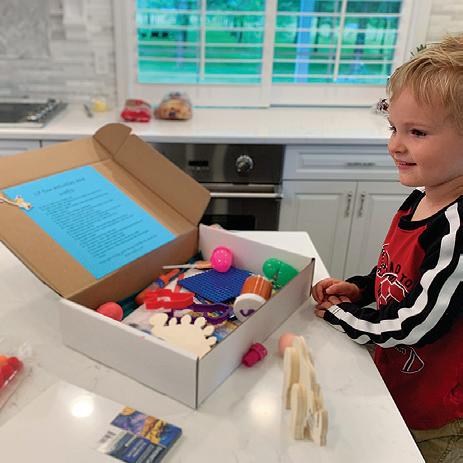
After a terrible airplane experience with her toddler, Megan Bergerson created the “busy box,” a cardboard container of ageappropriate, mess-free independent activities. Customize with your child’s name, interests and favorite colors. “I get excited when I find new things and am constantly thinking of new box ideas,” she says. etsy.com/shop/BusyKidCo
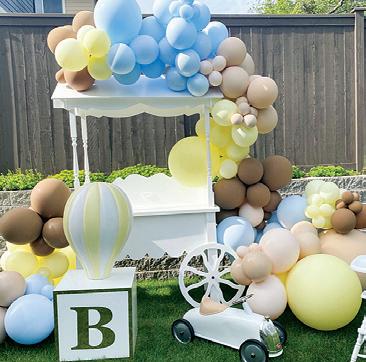

Working with up to 200 balloons per display, Doina Lungu spends 3 to 4 hours creating colorful arches, balloon bunches and bouquets. With summer celebrations, Doina is excited to get outside and create: “I love to help customers with their event planning, and I love thinking of new design ideas using pastel colors in different displays.” instagram.com/thetreasurecorner
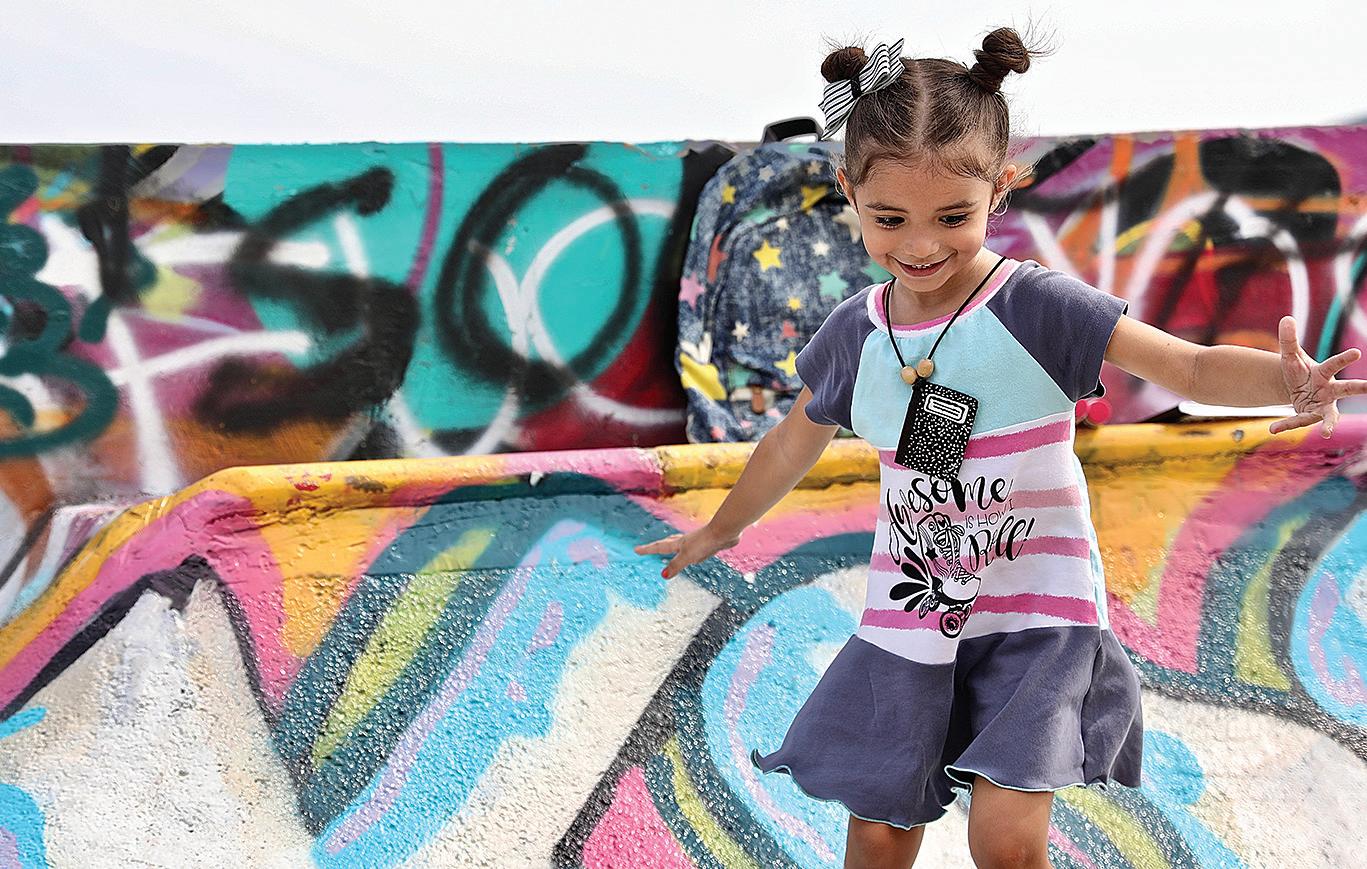
“My passion is upcycling and working at a small scale, so I can help eliminate waste,” says Claudia Cerrato, owner, designer and creator of outfits for City Kid Style. Every garment is hand-sewn by Cerrato with materials she finds at various thrift stores. citykidstyle.com Things
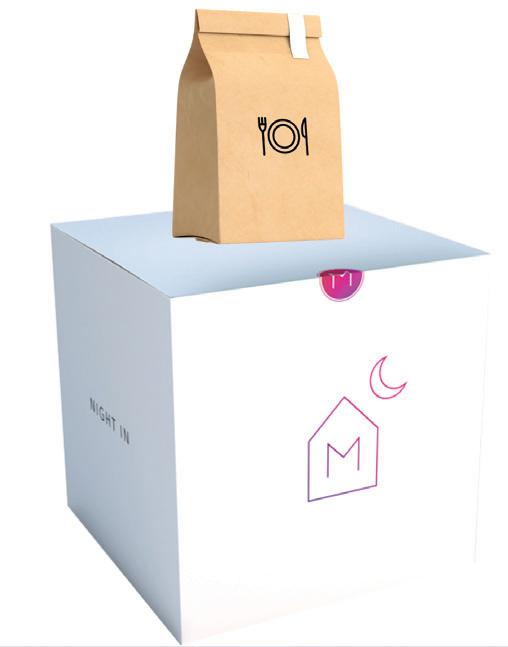
Date Night can get complicated, with finding a sitter and making reservations. That’s where Mystery steps in with their date-night-in packages. Filled with dinner for two from a local restaurant, activities for the evening and other products from local retailers, part of the date-night fun is finding out what’s in the box. trymystery.com