Psychology of Deskilling
AI is everywhere now. It can draft essays, solve equations, generate images, even brainstorm ideas. At first, it feels like magic. Tasks that once took hours writing, coding, creating can happen in seconds. It’s fast, it’s impressive, and it’s hard not to rely on. But with speed and convenience comes something subtler: a slow shift in how we think and work, sometimes called deskilling.
The psychological effects go beyond skill loss. Immediate results from AI can reinforce a preference for speed over struggle. Thinking through a problem, experimenting, or revising ideas takes patience qualities that are quietly practiced less often when a machine steps in. Over time, people can begin to rely on external solutions, trusting the output more than the process of figuring it out themselves. Confidence in independent thinking can waver, even subtly.
Deskilling is not evenly distributed. Early learners, students, or those practicing new skills may notice it sooner, but even experienced professionals can experience its slow creep. The temptation to outsource thinking is strong when the results seem better, faster, or easier. And each time we let the machine handle something, we practice the habit of reliance rather than the act of skillful effort.
AI&TheClassroom
Earlier this month, my friend told me that she had been accused by her teacher of using AI, and that since then she had stopped trying to produce “good” writing. Later that day, another one of my friends expressed a lot of stress and concern about false AI accusations. They are not anomalies, and I realized the very existence of false accusations was creating a lot of fear in the academic environment. As a result of these conversations, in this essay I will be breaking down the accuracy of AI checkers, the biases they have, and finally, their effect on students…
The first piece to this story is the commonality of AI usage in schools. A survey collected by Science Direct found that 19.68% of public high school students self-reported using AI to “write all of a paper, project or assignment,” while only 1.45% of private school students reported the same. AI usage overall is at least twice as common in public school students than private. Private school teachers generally don’t have to be as concerned with AI generated work, which is why private school students, such as myself, can afford to be a lot less concerned with being accused of using AI. My friend goes to a public school, and told me she was really concerned with AI accusations due to their prevalence, and often adjusted her writing to sound less formal—or less “Chat GPT.” Being accused of AI is demoralizing, she told me that since she was accused she tries less on assignments out of fear her time and hard work will be discounted by an AI checker.
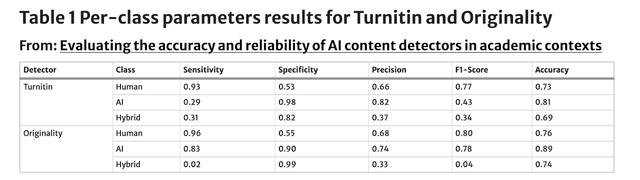
The accuracy of AI checkers is much more convoluted than it may appear at first glance. “Evaluating the accuracy and reliability of AI content detectors in academic contexts” by Hadra et al. (2026) in the International Journal for Educational Integrity, collected data on the following characteristics:
“Sensitivity (Sen) /RecallAI: This measure describes out of all actual AI-authored texts, how many were correctly identified by the detector. Specificity AI (Spec): Specificity indicates out of all non-AI texts; how many were correctly identified as not AI-authored. PrecisionAI: Precision indicates out of all texts predicted as AI-authored, how many were actually AIauthored. F1-ScoreAI: F1-score is the harmonic mean of Precision and Recall. Accuracy AI (Acc): The accuracy indicates the overall rate at which the detector correctly classifies both AI and non-AI texts.”
The table reveals that bothTurnitin and Originality are susceptible to misclassifying AI work as human, however, both checkers showed a strong ability to identify human work correctly. Neither checkers were adept at detecting hybrid work as partly AI written. The low error rate in false positives does not represent a complete go-ahead to rely solely on these checkers.
If, at most, one out of every hundred students gets falsely flagged for AI usage, 150,000 American public high school students would be falsely accused of AI.
I have personally written around 12 essays this year for my history and english classes (this number is on the higher side for most high school classes), and if that trend is consistent throughout my high school career, I will have written 48 essays upon my graduation. That is 48 separate opportunities to be falsely accused of AI. At a 1% error rate I would have a 50% chance of being accused of AI throughout my high school career, assuming I graduate in 4 years and I take English and History classes throughout those four years. That is 1,800,000 high school students every year (this does not account for repeated accusations). A one in four chance. Most estimates of false positives range from 1% to 15%. There are no reliable estimates under 1%, to my knowledge. A 15% false positive rate on one essay would affect 2,250,000 students. False positives could then potentially affect up to 27,000,000 essays annually. There were 15,000,000 public high school students last year. At the highest estimate, that is over a 100% chance of your work being accused of AI falsely. Is preventing cheating really worth it?
My friend generously gave me a copy of her essay titled “Champion Speech” that her teacher flagged as AI. The essay is a proposal for National Snoopy day. The essay goes over Snoopy's history, prominence, and cultural impact. I am going to pull a few sentences from that essay that probably contributed to the accusation. She wrote,
“It’s easy to wonder if Snoopy really deserves all the honors he already has, much less a national holiday, considering that he’s a bit of a menace. But honestly, he was never meant to be a role model.”
The blacked out portions are not relevant to the conversation. She is following a useful and valid persuasive writing principle: A common belief, hypothetical, or doubt followed by contrasting fact or limitation to the previous thought. The purpose of this structure is to assume a persuasive but truthful narrative, as the author gets to present the opposing thought and then immediately refute it. Unfortunately, AI also commonly uses this structure for the same purposes. AI wants to appear truthful and conscious of opposing narratives, which often results in the structure above. Another example of a similar structure is,
“These perceived imperfections haven’t only made him so adored by the public, but also incredibly influential to other cartoonists.”
This follows the same structure: A general belief followed by an expansion of that belief. The easiest way to avoid being accused of AI because of this type of sentence structure is to use it sparingly. Most writers use some version of this sentence in a persuasive essay or speech; AI uses it in every sentence. It’s easy to wonder if AI has a monopoly on structural contradictions, considering its reliance on them. But honestly, as long you do not over use this struture your writing will sound perfectly human. If you find yourself unable to detach from said structure, try: The easiest way to skirt AI’s perceived monopoly on sentence contradictions, considering its reliance on them, is simply not to mimic AI’s over reliance on them. I understand that adapting your writing to avoid AI accusations is tiring and demoralizing, and you may think that this structure is the best way to establish a persuasive point, but consider that repeating the same structure sounds bland anyway. Honestly, diversity in prose is always best practice.
AI checkers should never be the end all be all for students' work.
It is awful for students to be constantly cornered with false positives, not to mention the clear bias in AI checkers that should immediately prove its damage. Both the mental consequences of AI checkers and the physical consequences of cheating allegations like permanent zeros, failing classes, academic suspension, and expulsion affect public school students at a much higher rate than private school students. There is a serious issue of higher consequences for neurodivergent students, ELs, and poorer students. The result of AI paranoia is not less AI usage but decrease of morale amongst student populations.
My recommendation for teachers grappling with rampant AI usage is to create assignments that do not perform well with AI, like class discussion or physical work. My second suggestion is to believe students are acting in good faith, AI is not known to produce high quality work, the natural consequence of poor grades is enough of a punishment. Also consider that if AI can complete the work you assign better than your students can (provided your students are not eight years old), your assignments are not actually assessing the right things. You may notice I haven’t discussed the benefits of AI in the classroom, I will not. Not because there are none, but because I do not want to encourage AI usage. The negative economical and environmental effects of AI, to name a few, are beyond the scope of this essay, but are not beyond the scope of my consciousness.
Articles
Your Brain and AI - Michael Rosales, 2026
Psychology of Deskilling - Oliver Mosher, 2029
Appreciation of Human Art - Emrie Benn, 2029
Thievery - Stella Liao, 2029
AI & The Classroom - Lillian Kline, 2027
Art
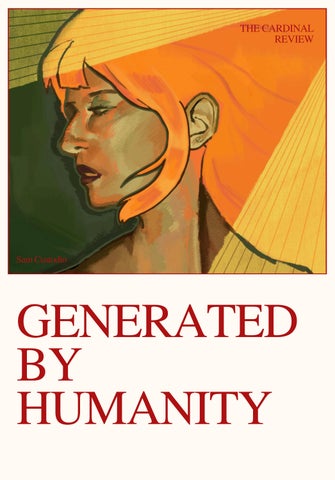
Cover - Sam Custodio, Hanford HS, 2029
Chess - Jalen Meeker, 2029
18:36 - Milena Silk, 2029
Jerboa - Stella Liao, 2029
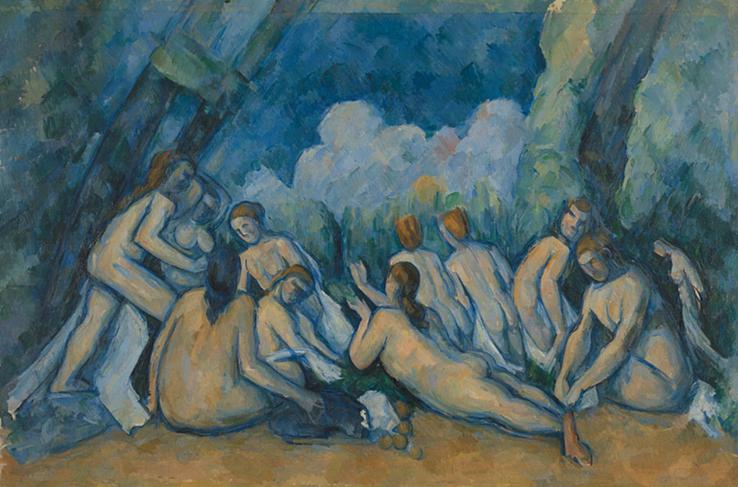
Bathers - Paul Cezanne