0.5
2
1
0.7
∞
0.38
Vol. 9
9th graders taking Environmental Science measure the dimensions of trees on the Seattle University campus as they calculate carbon sequestration. Students start the course by learning about increasingly complex phenomena in the natural world—then they apply those fundamental concepts to examine how humans interact with the environment, the impact of industrialized machinery, and climate solutions.
2
SAAS IN FOCUS: Volume 9 // 2026
3
CREDITS
Editor Sarah-Mae McCullough
Layout & Graphic Design Todd Rotkis
Photography Todd Rotkis
Writers Giselle Furlonge Tesora G. ’27 Sarah-Mae McCullough Rob Phillips
SAAS Marketing & Communications Team Connor Heikkila, Social Media & Digital Content Manager Sarah-Mae McCullough, Editorial Content Manager Todd Rotkis, Visual Media Manager Andrew Spitzer, Digital Marketing & Communications Manager
During the first major reunion in the new Upper School building, alumni admire class photos reaching as far back as 1984.
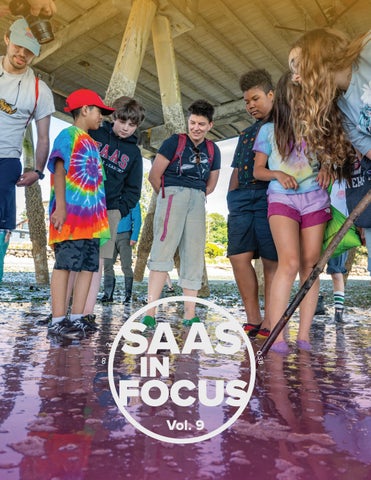
On the Cover: During one of the Puget Sound’s lowest tides of the year, members of the Middle School Adventure Club went tidepooling and learned about marine life at Constellation Park in West Seattle. The club’s nature outings—hiking, camping, kayaking, and more—run from March to May, with no experience needed and no extra cost to families.
4
SEATTLE ACADEMY NON-DISCRIMINATION POLICY
Seattle Academy admits qualified students and provides Equal Employment Opportunities to all individuals without regard to race, color, religion, sex (including gender identity, gender presentation, and sexual orientation), national origin, disability, genetic information, marital status, or other legally protected statuses in accordance with applicable federal, state, and local laws. It expressly prohibits any form of harassment or discrimination of the same in any of its programs, activities, educational policies, scholarships or other financial aid programs, and terms and conditions of employment.
SAAS IN FOCUS: Volume 9 // 2026
5
TABLE OF CONTENTS
9.
A Letter from the Co-Heads of School
30.
Speech & Debate State Champs, new classroom projects, and more
Staying focused on our North Star By: Giselle Furlonge and Rob Phillips, Co-Heads of School
10.
16.
Finding Purpose in the Age of AI
36.
What becomes most valuable in education when intelligence is abundant?
44.
12 Ways We Questioned, Imagined and Created in the New Upper School Building
50.
SAAS on the National Stage
Year-in-Review: The Arts at SAAS Scholastic Art & Writing Awards, Strings program growth, and more
Year-in-Review: Outdoor & Travel at SAAS Weekend Adventures @ SAAS launches, meet our newest team members, and more
58.
How faculty, staff, and students contributed to the 2026 NAIS conference
After completing their last full week of regular coursework, the Class of 2026 gathered in the Upper School courtyard for a favorite SAAS tradition: Senior Send-Off. After counting down from 10, they threw old coursework into the air, saying a joyful goodbye to formal classes at SAAS. For the remainder of the school year, they’d focus on their Senior Projects, interning off campus in labs, clinics, offices, studios, and more. 6
Year-in-Review: Athletics at SAAS New spring sports, Next-Level Athletes, and more
What discovery, excellence, and connection look like—together on one block
28.
Year-in-Review: Academics at SAAS
SAAS In A Word: ‘Opportunity’ From a rising senior who’s tried just about everything By: Tesora G. ’27, Marketing and Communications Intern
62.
Agile Intelligence
78.
Preparing kids to shape the future—not just live in it By: Rob Phillips, Co-Head of School
66.
A Partnership Like No Other Celebrating two key wins from the decade-long SAAS-South Park partnership
70.
74.
Contributing Boldly Seniors use what they learned in American Studies to make an impact outside the classroom
77.
Three rising seniors revived a beloved SAAS tradition: Bee Club
82.
Seattle Challenge The capstone Middle School experience
30 Years of SAAS What’s kept our longest-tenured faculty at SAAS?
88.
A Graduation Like No Other Inside SAAS’s one-of-a-kind commencement ceremony
Game On Engineering meets the arts and humanities in a popular new Middle School club
The Bees are Back
94.
SAAS Makes History Supporting a Bold Future Reflecting on the record-breaking SAAS in the City 2026—and thanking our alumni
100. Meet Our New Trustees Five committed changemakers join SAAS’s board
102. In Loving Memory Alumni memoriam page
SAAS IN FOCUS: Volume 9 // 2026
7
8
LETTER FROM THE
CO-HEADS of SCHOOL Every generation of educators inherits the same responsibility: to prepare young people for a future they cannot fully predict. That responsibility feels especially urgent today. Artificial intelligence is reshaping how we learn, create, and solve problems. New technologies continue to transform the workplace. The world our students will inherit is changing at an extraordinary pace, requiring schools to continually ask what knowledge, skills, and habits of mind will matter most. At SAAS, we believe preparing students for that future doesn’t mean chasing every new trend. It means remaining deeply rooted in our mission while never standing still. We are constantly asking how we can better serve students—through our curriculum, our programs, our teaching, and the experiences we create each day. Education, like the world itself, is always evolving. We believe schools should evolve thoughtfully alongside it. This issue of In Focus reflects that spirit. You’ll read about faculty who are reimagining learning, students who are pursuing ambitious ideas, alumni who are making meaningful contributions in their
communities and professions, and the many ways our programs continue to grow in response to a changing world. This year also marked a significant milestone for Seattle Academy. The opening of our new Upper School building completed a vision years in the making: bringing our Middle and Upper Schools together on one city block. While the new spaces are extraordinary, what has made this year truly remarkable hasn’t been the building itself—it’s been the people. This year, students have connected with each other as never before, faculty had opportunities to collaborate in new ways, and everyday moments ensured that every student is known, challenged, supported, and inspired. That same commitment to thoughtful evolution extends beyond campus and classrooms. This year, we’ve also reflected on the language that shapes our community, refining our Guiding Principles and introducing new Culture Principles that reflect both who we have always been and who we aspire to become.
The words have evolved, just as our campus has evolved. But the purpose is constant, and is distilled in our Mission Statement: We are a dynamic community that challenges students to question, imagine and create in order to contribute boldly to a changing world. That's an active and living mission, with powerful verbs. But three less obvious words—“in order to”—are fundamental to the Why of Buildings, the What of Culture Principles, and the How of what happens at SAAS every day. Those three words point to our purpose and to the student experience in and out of the classroom. The words “in order to” point to the North Star of our mission, which is: “to Contribute Boldly to a Changing World.” Working to achieve that is the What and the Why of what we work so hard and so joyfully to do together each day. It is the What and the Why of our Culture. As a new school year approaches, we are grateful for the families, alumni, faculty, staff, trustees, and friends whose partnership helps keep us focused on that North Star.
Rob Phillips & Giselle Furlonge Co-Heads of School
SAAS IN FOCUS: Volume 9 // 2026
9
Article title in Ghost Font, an anti-AI font that can be read by humans but not by leading AI models. Create your own message at mixfont.com/ghost-font
Finding Purpose in the Age of AI As artificial intelligence reshapes how we learn, work, and create, schools face new challenges and opportunities—but the deeper purpose of a SAAS education hasn’t changed. By: Giselle Furlonge Co-Head of School Since OpenAI's launch of ChatGPT in the fall of 2022, artificial intelligence has taken root in schools with remarkable speed. Students use generative AI to brainstorm ideas, explain concepts, generate images, solve problems, write code, and answer questions, and its influence on education, work, and society will only continue to grow.
I am often asked what I think about AI and how SAAS approaches the topic. Those conversations frequently begin with practical questions about appropriate use, assessment, and academic integrity— important topics we’ve thought about deeply and cover in SAAS’s handbook and faculty training.
But I find myself returning to a more fundamental question: What is the purpose of education in an age of AI? The answer to that question should shape our approach to AI—not the other way around.
What Becomes Valuable When Intelligence Is Abundant? As I have wrestled with AI's implications for schools, I’ve returned again and again to a deceptively simple query: What becomes most valuable when intelligence is abundant? 10
We have spent centuries building institutions designed to help people acquire knowledge and expertise because both were relatively scarce. AI does not eliminate the need for either, but it changes the landscape in
which they are developed and applied. As access to knowledge becomes increasingly abundant, the question for schools is no longer simply what students know, but what they do with what they know.
As answers become abundant, the ability to ask meaningful questions grows even more important. As information becomes limitless, discernment becomes essential. And as content can be generated instantly, originality, judgment, and purpose become increasingly valuable.
what is accurate, misleading, incomplete, or biased. They cannot exercise judgment without something upon which that judgment rests. Knowledge remains foundational.
they can determine what deserves their attention, navigate ambiguity, make ethical decisions when the answer is not obvious, and ask questions that genuinely matter. These have always been educational goals. AI simply brings them into sharper focus.
This does not mean that knowledge matters less. In many ways, it matters more.
If AI can write, calculate, analyze, and generate, then the central task of education may become less about producing intelligence and more about cultivating wisdom.
Students cannot evaluate an AIgenerated response if they lack the understanding to recognize
The questions that matter most are not whether students can access information, but whether
And perhaps nowhere is that shift more visible than in the way we think about learning itself.
The Value of Friction The most interesting part of the conversation about AI isn’t actually about AI at all.
We do not create these experiences because they are efficient; we create them because they are transformative.
It’s about friction. Schools have always created opportunities for productive struggle. Students wrestle with ideas. They revise writing. They grapple with ambiguity. They solve problems whose solutions are not immediately apparent. They encounter challenges that require persistence, reflection, and resilience.
Learning often happens in the space between not knowing and knowing. The process of struggling with an idea, revising a piece of writing, performing in front of an audience, or working through a difficult problem is not separate from learning. It is often the mechanism through which learning occurs.
SAAS IN FOCUS: Volume 9 // 2026
11
This is what makes the current moment so fascinating: AI is remarkably good at removing friction. When a student is stuck on an essay, AI can generate a draft. When a reading feels challenging, AI can summarize it. When a problem seems difficult, AI can offer an explanation or walk through the steps. Sometimes this is incredibly helpful for a student. AI can make learning more accessible, help students move beyond unnecessary barriers, and create new opportunities for exploration and creativity.
But sometimes friction is exactly where learning happens. As educators, we are increasingly called to distinguish between the forms of friction that hinder learning and the forms of friction that produce it. When does technology deepen understanding? When does it bypass it? When does support create opportunity, and when does it short-circuit growth?
what experiences help young people develop confidence, resilience, independence, and intellectual curiosity. Ultimately, the question is not whether students should use AI. The question is: How do we preserve the conditions under which meaningful learning occurs? That challenge extends well beyond the classroom.
These questions cannot be answered through blanket rules or simple policies. They require judgment. More importantly, they require us to think carefully about
More Than the Future of Work In the present moment, many conversations about AI shift toward jobs, careers, and the future of work.
opportunities that we cannot fully predict, and they will need the adaptability and confidence to navigate continual change.
That’s understandable. AI will undoubtedly continue to reshape the workplace, and today's students will enter a world in which adaptation and lifelong learning are increasingly important.
But AI is not only changing work. It’s changing:
But focusing only on work risks missing the larger story.
12
• • • • •
Creativity Authorship Our relationship to truth and expertise How we communicate How we connect with one another
Schools are not merely workforce development programs. While preparing students for future careers is important, education has always served a broader purpose: helping young people become thoughtful citizens, engaged community members, capable leaders, and fulfilled human beings.
These are educational questions, too.
Certainly, AI will continue to reshape the world of work. Our incoming sixth graders, members of the Class of 2032, will encounter careers and
At SAAS, we want students to understand both the power and the limitations of AI. We want them to experiment, create, question,
As educators, we are not only asking how students will use AI in their future careers. We are asking how AI might shape the way they think, create, relate, and understand themselves and the world around them.
and adapt. We want them to build foundational skills, exercise sound judgment, and engage emerging technologies with integrity and purpose. Most of all, we want students to recognize that powerful tools do not relieve us of responsibility. If anything, they increase it. The challenge before schools is not teaching students how to compete with machines. It is helping them become more fully human alongside them. AI may change what students can do in ways we can scarcely imagine. Our work is to help them understand who they are becoming and how they will use their knowledge, wisdom, and sense of purpose to contribute meaningfully to the world. That has always been the deeper purpose of a SAAS education.
Meet SAAS’s AI Instructional Coach SAAS is committed to creating an environment where students use AI thoughtfully and responsibly— where every student understands the strengths, limitations, and ethical challenges surrounding this rapidly changing technology. As one step toward fulfilling that commitment, we’re introducing a new, full-time role for the 2026-2027 school year: an AI Instructional Coach. The longtime scholar stepping into it, Mark Betnel, isn’t new to SAAS. He’s been teaching Innovations and science courses, developing new curricula in the Upper School, and exploring the ethical use of emerging technologies for the past 13 years. Mark holds master’s degrees in philosophy and physics, and a Ph.D. in physics from Boston University. His 25-year teaching career has been driven by a passion for helping students develop not just knowledge, but also the critical thinking and ethical reasoning skills needed to apply it. Since joining SAAS in 2013, he’s taught physics and Innovations and helped develop new courses such as “Foundations in Computational Thinking: AI and Ethics.” In 2024, he began helping faculty and students navigate the implications of AI as a part-time coach. Now, he’ll serve in this critical function full-time. As SAAS’s AI Instructional Coach, Mark will continue working with teachers to refine their assessment approaches and establish clear guidelines for AI use that empower students without limiting their skill development. He’ll support students as they consider
AI’s impact on their learning and the possibilities or challenges it may pose in their futures. Through the community surveys he’s conducted, Mark understands the range and depth of perspectives on AI in our community and is committed to “keeping both ends of the scale in mind as the conversation and the technology evolves.” “The conversation is focusing on defining the purpose of education and how to achieve it, no matter the direction technology takes us. … Students and teachers at SAAS are remarkably thoughtful in the discussions they’ve been having,” Mark said. “Working in a community centered on learning to ‘Question, Imagine, and Create’ turns out to be fantastic preparation for world-changing technologies.”
SAAS IN FOCUS: Volume 9 // 2026
13
Comparing AI and human learning (above) “Foundations in Computational Thinking: AI and Ethics,” a course launched by Innovations teachers Mark Betnel and Nicole Marvin, draws on computer science, philosophy, ethics, and sociology to explore emerging technologies. In a tic-tac-toe project this past school year, students compared AI and human learning. They played against each other, then against two different computer programs. Then, they discussed their own strategies, how the programs work, and what “training regimes” could make AI learn the game more effectively. Among their main takeaways: AI tends to learn by working through many examples faster, while humans learn faster from fewer examples. And while AI systems can seem perfect, they do make mistakes, which are often linked to their training process. “This was a first example of an AI-inspired program in action, so we can begin to learn how AI systems are created and used,” says Mark. The goal is to “understand them well enough to make good judgments about how or whether to use them ourselves.” Learning to asses AI feedback (below) SAAS faculty members incorporate AI into assignments thoughtfully, giving students agency over how they use (or don’t use) the tool and encouraging them to interpret AI results critically. For example, 6th-grade English teacher Krista Barbour gave students the option to receive feedback from the AI grading tool CoGrader in addition to her feedback on select assignments this spring. She reiterated that students’ own judgment and her guidance are the ultimate authorities, giving kids the chance to think through the tool’s abilities and limitations.
14
Advanced Programming (above) This winter, students in Advanced Programming chose to either use AI or to code manually to complete their capstone projects— which ranged from an app teaching teens about investing to a Tetris-style game. Then, they compared the advantages and challenges of each approach. Alongside working at a fast pace to plan and implement projects independently, students in the highlevel Innovations course are thinking critically about when it makes sense to use AI and when it doesn't as they build coding skills. Independent Studies (below) Students passionate about applying AI in purposeful ways can pursue Independent Studies, supported by Innovations and Robotics faculty. This year, Emi E. ’27 built a bionic arm that interprets brainwave frequencies through an AI model she trained. If scaled up, she hopes the model could become a low-cost option for stroke patients and be available in developing countries. The project won first place in the Washington State Science and Engineering Fair’s Robotics and Intelligent Machines category this spring. Trammell W. ’26 built a Raspberry Pi (a type of small computer board) running a compressed AI model designed explicitly for math tutoring. The system, designed to make math support more accessible, runs without WiFi and plugs directly into the TI-84 calculators that many students already own. Rather than just providing answers, it guides students through problems the way a tutor would: "What's the first step? What are you trying to find? What formula might help here?"
SAAS IN FOCUS: Volume 9 // 2026
15
12 Ways We Questioned, Imagined, and Created in the New Upper School Building
12 Ways We
Questioned, Imagined, and Created in the New Upper School Building
16
When the Upper School building opened on September 4, 2025, uniting SAAS’s campus on one urban block, we knew it would expand opportunities for students and faculty. Its five floors were designed for innovative, hands-on curriculum, cross-disciplinary collaboration, and community building across grades. What we didn’t know was exactly how SAAS kids and adults would make the most of the space. What creative projects would they pursue, what new curriculum would they develop, and what community traditions would they start, given the resources to dream even bigger? The 2025-2026 school year answered those questions on a daily basis. Here are just 12 examples of the discovery, excellence, and connection that unfolded in the Home of the Upper School this year.
SAAS IN FOCUS: Volume 9 // 2026
17
Crafting Guitars From Scratch Three rising juniors blended their interests in music and woodworking to build fully functional, electric guitars from scratch in the new woodshop—supplying SAAS’s Music Production program with one-of-a-kind, studentmade instruments. George A., Miles N., and Kai A. worked closely with Innovations Shop Manager Caleb Campbell to complete the ambitious project. Starting in the middle of the winter trimester, they used the woodshop almost daily during lunch and Community Time to lasercut fretboards and sand guitar bodies, iterating and reiterating as they learned by doing. “Everything in [the woodshop] I know how to use now, and I didn’t before,” said George, who hopes to make more guitars next school year, potentially starting a club around the activity. “We’ve learned so much from doing this the first time. I want to go back and do it again and try to hold myself to a higher quality standard.”
18
Gathering Generations of Cardinals At SAAS’s first Alumni Reunion in the new Upper School, over 140 guests toured campus, listened to warm words from SAAS leaders and alumni, and mingled in the courtyard as a live DJ spun tunes. The event honored alumni from graduating classes ending in ’1s and ’6s, some of whom were seeing SAAS unified on one block for the first time. “I’m in awe,” said Reunion Chair Jack Rosen ’01 about being back on campus. “It’s just incredible how the school has grown over these years, and I’m so excited for SAAS and the community.”
Creating at New Levels in SAAS Shops After one year of honing foundational skills in SAAS’s new wood- and metal-working studios, more students than ever are ready to delve deeper. Starting next year, they can register for higher-level courses: Intermediate Welding, Intermediate Woodworking, and Intermediate Sculpture. The growing curriculum reflects student passion and skill, as well as elevated resources. This past year, “I watched students go from zero knowledge of what welding is, all the way to the point of practicing their TIG welding, which is one of the most complicated welding systems around,” said Upper School Innovations Teacher Caldwell Rohrbach. “It’s been really rewarding to see kids get a glimpse of what it’s like to use their hands and build and be creative,” and then take those skills to the next level.
SAAS IN FOCUS: Volume 9 // 2026
19
SAAS IN FOCUS: Volume 9 // 2026
19
A HUGE THANK YOU our 2025-2026 SAAS FACULTY & STAFF
20
22
Forging Lifelong Connections With faculty, staff, and students across grade levels united on one block, every passing period, every lunch, and every Community Time has become a stronger opportunity for connection. Sometimes that looked like hacky sack games or spontaneous conversations in the courtyard. Or impromptu study sessions in the Reading Room. Or new friendships forming on couches in the commons. “I've connected with and met and talked to so many people that I don't think I would have talked to otherwise,” says Morgan B. ’27. “The new building has brought a different kind of vibe to SASS… It has brought such a welcoming and social energy to the SAAS community, and it's honestly something that I hope stays here forever.”
SAAS IN FOCUS: Volume 9 // 2026
21
SAAS IN FOCUS: Volume 9 // 2026
21
Saying Goodbye to Seniors The 2025-26 school year began with a Senior Class Breakfast in the Upper School courtyard. At 7:30 AM on September 4, members of the Class of 2026 became some of the very first SAAS students to step foot in the new Upper School building. They ended the school year with a brand-new courtyard tradition: Senior Sunset Dinner. “Saying goodbye is incredibly difficult, which is why we do stuff like tonight,” Co-Head of School Rob Phillips said to the courtyard filled with 2026 grads and their families. It’s why senior year is packed with only-at-SAAS traditions, from the Senior Send-Off (when soon-to-be grads countdown from 10 before throwing old schoolwork up into the air) to Senior Project Night (where students share takeaways from their month-long internships). This year, the Home of the Upper School became a shared backdrop for many of those long-lasting memories.
22
22
Designing Live-Work Spaces for Local Artists SAAS’s Innovations program expanded alongside our campus. In the new Architectural Design class, Upper Schoolers prototyped live-work spaces for real, Pacific Northwestern artists. They researched and reached out to their artist of choice—from Seattle-born muralist Stevie Shao to SAAS Visual Arts & Media Teacher Ray Mack—then translated their unique tastes and needs into an individualized design. Think: a floor plan with plenty of natural light for a painter or good ventilation and a drying zone for a ceramicist. Throughout the iterative project, students shared their mood boards, floor plans, and eventually 3D prototypes. During their presentations, faculty meandered through the spacious second-floor seminar room and hallways to take in each project and provide feedback.
SAAS IN FOCUS: Volume 9 // 2026
23
Learning From the Athletes Among Us Cardinal Council, a leadership team of Upper Schoolers representing their fellow studentathletes, launched a new event in the inviting, second-floor commons. At the inaugural Cardinal Conversations, students and faculty heard from a panel of retired college and professional athletes on this year’s theme: Life After Sports. The panel featured a wide range of talented athletes who’ve translated their sports-oriented mindsets, grit, and skills across arenas: Sarah Smith (SAAS psychology and math teacher, former US National team rower), Rick DuPree (SAAS DEIB Coordinator, former University of Washington football player), Ally Choate (SAAS PE and health teacher, former Seattle University softball player), Ella Skoglund ’21 (SAAS alum, Investment Analyst, and former Occidental College lacrosse player), Hunter Bryant (former University of Washington and NFL player), and Grace Vander Griend (Associate Project Engineer and former University of Washington rower).
Hosting a Major Speech & Debate Tournament SAAS hosted around 180 students from 13 Seattle-area schools in the new Upper School building for an important Speech & Debate tournament in January—a runoff for the Washington State Championship. Nearly 80 volunteer parent judges and members of SAAS’s dedicated Rhetoric Department (including Speech & Debate Head Coach Chris Goodson and Assistant Coach Alexander Martinez) made the event possible, and five Cardinals qualified for State at the tournament: Ria A. ’29, Zoey E. ’27, Hamsini R. ’28, Alex H. ’28, and Harlem Y. ’27. “Having five floors of new classrooms to utilize for competition spaces, as well as larger community spaces for judges, volunteers, tournament logistics, and the Award Ceremony made the tournament a huge success,” Chris said. “In the words of one district coach: ‘Best tournament of the year!’”
24
Dreaming up the Future, with College Reps and Advisors Around 130 college representatives connected with SAAS seniors in the fourth-floor commons. With long wooden tables and floor-to-ceiling windows looking out over the courtyard, this Upper School hub quickly became known for its “collegiate atmosphere,” as Director of College Advising Melanie Reed put it. Throughout school days in the fall, reps from Tufts University, Scripps College, and countless others helped students imagine and plan for their futures. After school four days a week, one or more of SAAS’s six full-time college advisors were stationed in the commons, answering questions from kids across grade levels. “The room was really thoughtfully built to accommodate this kind of interaction,” Melanie said. “The reps present well in the space, the students are enthusiastic and attentive. Overall, the new building is this container for so much interaction and happiness.”
SAAS IN FOCUS: Volume 9 // 2026
25
Producing and Performing Original Music The 2025-26 school year was an eventful one for SAAS's Music Production program. Two new large classrooms and a recording studio in the new Upper School meant more opportunities than ever for students to write and produce their own music. The Advanced Music Production class was honored to be selected to perform their song “Find Love” and other originals at the National Association of Independent Schools’ conference in February, where they brought down the house. The Intermediate Music Production class released an original track, “Lives and Breathes,” across streaming platforms and performed it at SAAS in the City 2026. Student performances on campus were also next-level. The Music Production classroom features sliding glass doors that open into the courtyard, creating an inviting venue where Upper Schoolers held three Block Parties this year—highenergy shows ending each trimester with a set of original, student-produced music. Building on this longstanding tradition, kids also used the venue to hold their own concerts during lunch periods. Aleah B. ’27 drew crowds to the courtyard in April as she performed songs off her debut R&B EP, Conversations.
26
Taking Textile Skills Outside of Class Inspired by SAAS’s growing Sustainable Fashion Design class, Jude S. ’27 and Oliver P. ’27 founded a makers group for students this year. Textile Club is “a space for people to learn and further their ability in the textile arts—everything from needle felting to sewing to fashion design,” Oliver said. With support from club advisor and Innovations teacher Ginger Reinauer, the group gathered every Tuesday during Community Time in Upper School 216, a spacious room equipped with sewing machines, felting materials, and big glass windows letting natural light in. This year’s projects included quilts, handbags, and athletic wear. Members also offer clothing repairs for the SAAS community, hemming pants or reattaching buttons to promote sustainability and give well-loved items a second life.
Blending English and History in a New 10th-Grade Course With larger, flexible classrooms in the Upper School, SAAS’s curriculum expanded to include Humanities 10, an integrated English and history option for sophomores. Led by a teaching pair (an English teacher and a history teacher), 10th graders studied Modern World History through nightly reading, then applied those readings in simulations, writing assignments, seminar discussions, and performances. “Blending English and history together helps give a face and a name to historical movements through the emotions evoked in the characterization in literature,” said English teacher Alex Rouse. “It gives an element of ‘so what?’ to the fiction students read as they learn about the real events that shaped the stories.”
SAAS IN FOCUS: Volume 9 // 2026
27
SAAS
on the National Stage SAAS leaders, faculty, and students played key roles in the nation’s largest conference for independent schools this spring. The National Association of Independent Schools (NAIS), which represents nearly 1,700 schools across the country, drew more than 5,000 attendees to its annual conference, Thrive, in February. This year’s gathering was held at the Seattle Convention Center, less than a mile from our school’s campus. But beyond proximity, SAAS was invited to host and participate in several Thrive events. Here are some of the ways our faculty, staff, and students contributed unique expertise to NAIS’s nationwide community.
Above: Co-Heads of School Rob Phillips and Giselle Furlonge led a workhop entitled, “Two Heads Are Better Than One: A Leadership Model to Build Organizational Agility and Foster Innovation,” about how a shared leadership model can strengthen innovation and institutional resilience. Below: Giselle was selected to moderate NAIS’s Independent Insights panel, a conversation between some of the country’s top leaders in independent education.
28
SAAS Records, our cohort of Advanced Music Production students, performed two original songs, two covers, and a DJ set at the Convention Center.
Above: Dozens of alums from Columbia University’s prestigious Klingenstein Center programs—including eight SAAS faculty and staff members—gathered for a heartwarming reunion in our new Upper School building. Below: More than 60 educators from around the country and beyond toured SAAS and attended presentations by our faculty on topics ranging from college advising to mental health counseling.
SAAS IN FOCUS: Volume 9 // 2026
29
Achievement in Action Academic Excellence at saas
30
Expansion, iteration, and creativity marked this year of SAAS academics. That looked like new interdisciplinary classes, innovative projects, and growing academic teams. Every offering supports SAAS’s definition of “academic excellence”—a dynamic process defined not just through grades and scores but by cultivating the skills and mindsets that lead to success in college, careers, and life.
A Selection of Academic Highlights from the 2025-26 School Year National Merit Scholars
The National Merit Scholarship Corporation recognized 15 SAAS students this year. Four 2026 graduates, Brayden F., Aiki K., Linden L., and Maxine L., were named National Merit Semifinalists for their exceptional academic abilities—an honor awarded to just 1% of high school students nationwide.
Innovations Business Plan Competition
At SAAS’s fourth annual Business Plan Competition, Upper Schoolers developed innovative business ideas in response to the prompt: “How can we bring families together outdoors?” 15 judges and mentors supported and challenged students before celebrating the winning team: Cedar L. ’28, Jackson B. ’28, and Kaian A. ’28. Their business idea, SUMMIT, would use wash-in bug repellent, jewelry, and sprays to keep mosquitoes away, supporting environmental stewardship and stress-free family vacations.
Speech & Debate
57 SAAS students competed across 10 Speech & Debate tournaments this past school year. Two placed first at the Washington State Speech and Debate Championship: Hamsini R. ’28 (Informative Speaking) and Harlem Y. ’27 (Spoken Word Poetry). Both State Champs, along with Sid S. '27 (Extemporaneous Speaking), qualified for the National Speech & Debate Tournament held in Richmond, Virginia. SAAS Speech & Debate Head Coach and Upper School Rhetoric teacher Chris Goodson was named Puget Sound District Coach of the Year by the Washington State Forensics Association.
More Rhetoric Teams
Both of SAAS’s Mock Trial teams competed at Districts, with the Red Team placing 3rd and moving on to State. At State, six students were nominated for Best Witness or Best Attorney, and Gabriela B. ’26 won the Outstanding Witness Award. Nine students participated in the statewide Youth Legislature Session in Olympia, with two successfully passing bills: Phoebe G. ’27 and Maeron B. ’26. 41 students participated in seven Model United Nations conferences across three states, with several students earning recognition: Owen S. ’28 (Outstanding Delegate); Quinn K. ’29 (Honorable Mention); Owen and Jasmine D. ’27 (Best Position Paper & Verbal Commendations); and Grayson B. ’26 and Eva F. ’27 (Staffing Honors).
SAAS IN FOCUS: Volume 9 // 2026
31
academics
Clockwise from the top left: 10th-grade English students hone analytical writing and critical thinking skills; seniors taking Physics experiment with mass, traction, and stability as they figure out how to design the perfect shoe for specific customers; 6th graders collaborate with visitors from the University of Washington’s Clean Energy Institute to build small solar panels; and 8th graders share findings from their original research projects during the 8th Grade Symposium.
32
SAAS IN FOCUS: Volume 9 // 2026
33
Clockwise from the top left: 8th graders negotiate deals and trade resources as they represent different countries in the “Political Power Simulation;” 11th graders present what they’ve learned about The Great Migration in United States History; Upper Schoolers integrate their language skills by performing “Little Red Riding Hood” in French; and 9th graders apply frameworks such as utilitarianism and the ethics of care to modern dilemmas during the Ethics Bowl.
34
SAAS IN FOCUS: Volume 9 // 2026
35
36
S A A S t a s c i t e l h t A s t h g i l h g i h n o s a e s y b n r a e Seaso y d n o c e s s ’ S A A S m o r f e u g a e L o r in the Met
SAAS IN FOCUS: Volume 9 // 2026
37
Fall
After debuting in the Metro League’s Sound Division last year, the girls’ varsity volleyball team jumped to the Mountain Division. In this highly competitive tier, they won three playoff matches, qualified for the District Tournament, and topped off the season by winning the Metro League Sportsmanship Award. Individual honors went to Avery M. ’27 (First-Team AllMetro League), Gabriela B. ’26 (Second-Team), and Cate A. ’26 (Honorable Mention). In other Upper School wins: Girls’ soccer and boys’ ultimate qualified for League playoffs. Boys’ golf finished second in the Metro Tournament, and girls’ golf finished fifth. Emmy S. ’27 made it to the State Meet in Cross Country with three other athletes moving on to Districts. At the Middle School level, 46% of students represented the Cardinals across soccer, cross country, and volleyball. The Boys CYO 7 soccer team finished the regular season undefeated (7-0). Head Coach Craig Tomlinson, a former Seattle Sounders player, couldn’t be prouder of the team’s mindset and growth. “They grew as soccer players this season, showing progress, sportsmanship, and respect for the game,” he said. “They represented what SAAS Athletics is all about.”
38
Winter
Our girls’ and boys’ basketball teams both ranked #1 in the Sound Division, and both head coaches were named Basketball Coach of the Year in their respective categories (girls’ coach Taylor Mulberg and boys’ coach Ryan Webb). Individual honors went to Calla N. ’26, Ava E. ’28, and Zane Z. ’28 (First-Team All-Metro Sound Conference); Jaden A. ’28 and Malachi D. ’26 (Second-Team); and Isley W. ’26 (Metro Sound Defensive Player of the Year). In wrestling, both the boys’ and girls’ teams won the State Academic Award for the highest GPAs. 11 athletes qualified for the State Tournament, with Aitan P. ’26 finishing 6th at State and Saniyah M. ’26 finishing 7th. This year, flag football at SAAS evolved from a club to an official WIAA sport. Six girls earned AllMetro honors: Malea C. ’26 (FirstTeam); Gabby D. ’26 (SecondTeam); and Marissa C. ’26, Cora G. ’26, Kaelyn O. ’26, and Tiffany T. ’26 (Honorable Mention). Dance Team qualified for State, and our inaugural, 19-member Cheer Squad led home crowds in cheering on our basketball teams at select home games. In Middle School sports, over 110 student-athletes played basketball across nine teams, with the boys’ Red Team finishing undefeated in the Cross Town Middle School League. Another 80 middle schoolers participated in futsal and tennis.
SAAS IN FOCUS: Volume 9 // 2026
39
Spring
Our newest spring sports soar In their second-ever season, SAAS’s baseball team finished second in the Sound Division of the Metro Conference. Three seniors were recognized individually: Eli H. ’26 (1st-Team All-Metro and Metro Sound Conference Most Valuable Player); and Cole B. ’26 and Dashiell S. ’26 (2nd-Team All-Metro). Eli was named the Gatorade Washington Baseball Player of the Year—a top honor in high school sports—joining a legacy that includes MLB stars like Clayton Kershaw and MacKenzie Gore. Our brand-new fastpitch softball team landed third in the Metro Sound Conference, with three players named 2nd-Team All-Metro (Sophia M. ’27, Abby F. ’28, and Maya L. ’28). The inaugural team is coached by three former D1 Seattle University softball players: Izzy Gilman-Geronimo (SAAS PE teacher), Ally Choate (SAAS PE and health teacher), and Stefanie Madrigal (SAAS substitute teacher). Their background “gives us a shared understanding of what it takes to compete and succeed at the next level,” Ally said. “We know that the best athletes are flexible, coachable, and willing to receive feedback. … We want our athletes to develop not only as softball players but also as people who can embrace challenges, adapt, and continue improving throughout their lives.”
40
More spring sports The 2026 track season saw 25 SAAS athletes qualify for the Metro Championships, 22 athletes qualify for the District Championships, and 15 athletes qualify for the State Meet. Three athletes placed at State: Maxine C. ’27 (2nd in the 400m), Amara P. ’26 (4th in pole vault and 7th in discus), and Dionysus S. ’26 (3rd in the 200m, 5th in the 100m, and 7th in the 400m). Jasper E. ’27, Dionysus, and the relay team made up of Dionysus, Ellis B. ’26, Ray M. ’27, and Russell S. ’27 were all named Metro Champs. SAAS track stars set nine new school records this school year. In lacrosse, the boys’ team finished third in the Metro Private League, with Cole B. ’26 (1st-Team All-Metro, Washington State Academic All-American Team for the second year in a row) and Will C. ’27 (2nd-Team All-Metro) earning individual honors. The girls’ team finished fourth in the Independent League of the WSLA and received the Team Sportsmanship Award. 1st-Team All-Metro honors went to Malea C. ’26 and Georgia G. ’26. The boys’ soccer team qualified for the Metro Playoffs, with four players earning individual honors: Nikhil B. ’27 (Second Team), Henry P. ’27 (Second Team), Sebastian T. ’29 (Second Team), and Evan S. ’27 (Honorable Mention). Also across the Upper School: Phoebe G. ’27 and Haven B. ’26 qualified for the State Tournament in golf, boys’ soccer qualified for the Metro Playoffs, and Ian B. ’27 qualified for the District Tournament in tennis. In the Middle School, nearly 200 kids played lacrosse, golf, track, ultimate, and volleyball. The boys’ lacrosse team won the prestigious Washington Cup Tournament, and the girls’ 6th-grade volleyball team made it as far as the JV CYO semifinals.
SAAS IN FOCUS: Volume 9 // 2026
41
Next-Level Athletes 13 recent SAAS grads are on their way to play seven different sports at the college level. We celebrated them at our annual Next-Level Athletes ceremony this past spring. Friends, family, faculty, and staff gathered to cheer on their next steps, capture the day with photos, and witness the seniors take a pledge: Once a Cardinal, always a Cardinal. Above, left to right: Samantha B., wrestling at Menlo College Malea C., lacrosse at Pomona College Gabby D., tennis at Xavier University Sam L., fencing at Haverford College Stella H., rowing at Columbia University Calla N., basketball at Colorado College Amara P., track & field at Washington University in St. Louis Lindsay W., rowing at Santa Clara University Eli H., baseball at Vanderbilt University Cole B., lacrosse at Vassar College Miller W., rowing at Brown University Dionysus S., track & field at Montana State University-Bozeman Not pictured: Reni D., cross country and track & field at Whitman College
42
Sports Contribution Awards Below: These annual SAAS awards celebrate students who’ve made outstanding contributions to Cardinal Athletics through leadership, courage, sportsmanship, and excellence. This year’s girls and boys awards went to Tucker S. ’26 (pictured second from right; golf, basketball, and lacrosse) and Malea C. ’26 (pictured fifth from left; soccer, flag football, and lacrosse).
SAAS IN FOCUS: Volume 9 // 2026
43
44
The Arts
at SAAS Creativity is a life skill. That belief fuels SAAS’s Visual & Media and Performing Arts programs. Through music, theater, dance, and visual arts, students learn to express themselves, to make sense of the world, to navigate ambiguity, and to imagine what doesn’t yet exist.
SAAS IN FOCUS: Volume 9 // 2026
45
Student Achievement in the Arts Washington State Thespian Festival This year’s Advanced Acting cohort earned recognition as Superior (National Qualifiers) in Ensemble Acting, as they’ve done almost every year. Annika C. ’26 and Sophia N. ’28 were National Qualifiers in Monologue, with 15 other students awarded Excellent (State Honorees).
Elliott Bay Music Educators' Association Solo and Ensemble Contest SAAS’s Upper School String Ensemble earned an Excellent rating, and Mona M. ’27 qualified for State, where she received Superior ratings in the Double-Reed Division. Several small chamber ensembles also participated, and several SAAS vocal ensembles and soloists received Excellent or Superior ratings. The Tenor/Bass Choir placed first and qualified for State.
The Great Figgy Pudding Caroling Competition Jazz Choirs I & II won the Best Choral Performance Award at the 40th Annual Great Figgy Pudding Caroling Competition—leading to them sharing the Pike Place Market stage with superstar singer-songwriter Brandi Carlile. The beloved holiday event draws nearly 10,000 people each year and serves as the most important fundraiser for the Pike Market Senior Center and Food Bank.
Reno Jazz Festival A Jazz Band I combo featuring Hudson A. ’28, Zach F. ’26, Eli F. ’28, Sebas H. ’26, Jack M. ’26, and Trammell W. ’26 won 3rd place. And back in Seattle, the combo of Zach, Sebas, Jack, and Trammell was selected for a School of Jazz recording session at the public radio station KNKX.
Scholastic Art & Writing Awards More than 20 SAAS students won awards through the nation’s longest-running recognition program for creative teens. In addition to Silver Key Awards and Honorable Mentions in the regional category, 11 students received Gold Key Awards, progressing to Nationals: Reese G. ’26, Coco R. ’28, and Dylan T. ’27 (Visual Arts); Hudson A. ’28, Lalia B. ’26, Thomas G. ’29, Simon H. ’27, Miles L. ’27, Kaelyn O. ’26, Jolie P. ’26, and Lola S. ’27 (Photography).
Film Festivals The music video “Skin,” filmed by Luke S. ’27 with music and acting by Sebas H. ’26, was screened at the National Film Festival for Talented Youth, the world’s largest film festival for emerging filmmakers. Oren G. ’27’s film You was selected to screen at the Student Awards Film Festival in Los Angeles, and his script for Stairway to Heaven was selected as a Quarter Finalist at the Wiki Screenplay Contest.
More Visual Arts Highlights Olivia L. ’27 won 5th place in the Still Life category of the Washington State High School Photography Contest. Reese G. ’26’s ceramic work was selected to be shown at a conference held by the National Council on Education for the Ceramic Arts.
46
Above: Students in SAAS’s 6th Grade Beginning Violin class—one offering in the school’s growing Strings program—play “Deep Sea Fandango” at the winter End of Tri showcase with SAAS teacher and Seattle Symphony performer Liza Zurlinden. Below: Upper Schoolers jam in the new building’s Music Production classroom with teacher and Grammy-nominated producer Amos Miller.
SAAS IN FOCUS: Volume 9 // 2026
47
SAAS’s Visual & Performing Arts program spans dance, music, theater, and visual and media arts, with nearly 50 performances lighting up the school calendar every year and over 130 students building their portfolios and professional skills in advanced-level courses. Course options range from Musical Theater and Sketch Comedy TV Writing to Fiber Arts and Documentary Film.
48
SAAS IN FOCUS: Volume 9 // 2026
49
& r o o d t m u a O r g s ’ o S r A P A S avel Tr
s p e e K wing o r G 50
. s p i r t w e N s. to nces. r t e n b em mitme xperie m am e com ent e e t New he sam al stud T ation rm o f s ran
t
SAAS IN FOCUS: Volume 9 // 2026
51
The mission of SAAS’s Outdoor & Travel Program is student growth. It’s the moments of growth that happen when kids challenge themselves by backpacking through the Swiss Alps, immerse themselves in Argentinian culture, or navigate discomfort while learning to ski or camp in our own Pacific Northwestern backyard. In support of that mission, the program itself has been growing. New team members and new adventures, alongside longstanding traditions, have expanded SAAS’s Outdoor & Travel offerings over the past few years.
9th graders at SAAS begin their Upper School experience by bonding as a class through a 30-year school tradition: the Odyssey Trip. Named for Homer’s epic Greek literature, this legendary camping adventure lets new high schoolers build relationships, reflect on their educational journeys, and expand their comfort zones.
52
With that evolution, “the greatest benefit has been for our students,” says Matt Edenfield, Outdoor Trips & Travel Director. “Whether they're learning a new skill, stepping outside their comfort zone, or discovering a new place and perspective, we've been able to provide more opportunities for growth, connection, and adventure than ever before.” During the 2025-26 school year, about 240 students opted into 19 trips, in addition to gradelevel adventures that every class experiences together.
Some trips were new—such as Middle Schoolers working with scientists in Puerto Rico to study climate change’s impact and Upper Schoolers learning about Singapore’s culture firsthand. Others were returning favorites, like the Middle School Puget Sound Sailing Trip or the serviceoriented New Orleans Trip for Upper Schoolers. The Outdoor & Travel Program also added a new day-trip option: Weekend Adventures @ SAAS. The Upper School offering included five hiking and rock-climbing excursions
On SAAS’s Puerto Rico trip this spring, 7th and 8th graders conducted field experiments and explored the country’s diverse microclimates, endemic species, and marine life.
around Washington last fall. It’s a complement to SAAS’s Ski Bus, which takes students across grade levels to Stevens Pass throughout the winter. These micro-adventures make growthoriented, outdoor experiences more accessible. “It's all about reducing the barrier of entry into the outdoors and a bit about appreciating the incredible outdoor playground we have in our backyard,” says Outdoor & Travel Coordinator Will Hinman, who leads the Ski Bus and worked with 12thGrade Dean Tom Harrington to launch Weekend Adventures @ SAAS. “Whether it’s just hard to get a ride to the mountain in
the winter or you want to get into hiking but aren’t ready for a backpacking trip, we want to offer something to support your level of interest.” Behind SAAS’s expansive trip offerings is a mighty, growing Outdoor & Travel team and widespread faculty participation. Over the past two years, Will (11th/12th Grade Coordinator and Outdoor & Travel Coordinator) and Lauren Marziliano (Outdoor Trips & Travel Assistant Director) joined the trips team. (Turn the page to learn more about this passionate duo and their unique strengths.) Throughout the 2025-26 school year, the team hosted wilderness first
aid certification courses and collaborative planning sessions with SAAS faculty interested in leading or supporting trips. “Building a strong network of trained and engaged trip leaders increases both the depth and sustainability of the program,” Matt said. “It allows us to offer a wider range of experiences, share expertise across departments, and create more opportunities for students to learn from passionate educators in the field.” That type of growth, he said, creates “richer experiences for the SAAS community.”
“The trip I can't seem to stop saying yes to is the Middle School Yukon Trip. ... [It’s] a perfect intro to the backcountry for kids at any level of outdoor experience. We take rising 7th- and 8th-grade students canoeing over 150 miles, carrying all of their food and gear for the entire trip. The river is beautiful, and we fish, scavenge for wild rhubarb on hikes, and have a great time. My favorite part of the trip tends to be watching as the students take on some basic responsibilities for themselves, like cooking all of their own meals. We typically do some reflection as a part of the trip, and towards the end, we always hear a chorus of, ‘Now I really appreciate the things my parents do for me at home.’” —Will Hinman, 11th/12th Grade Coordinator and Outdoor & Travel Coordinator
SAAS IN FOCUS: Volume 9 // 2026
53
SAAS students immerse themselves in local culture in Argentina and France, volunteer in New Orleans and build outdoor skills in Alaska.
54
Meet the Newest Members of SAAS’s Outdoor & Travel Team
Lauren Marziliano
Outdoor Trips & Travel Assistant Director Lauren spent more than two decades in education and outdoor recreation before arriving at SAAS in 2025. That time included teaching high school environmental science in Burien, traipsing through the Cascades with students, and then directing summer programs and student life at an independent school in Idaho. What drew her to SAAS? “The expansive nature of the SAAS Outdoor & Travel Program,” Lauren said. “Trips are happening both locally and globally and incorporate the outdoors, community service, multicultural competency, and ecological awareness. I have loved that SAAS Trips prioritize student growth through discomfort as students stretch their comfort zones in unfamiliar environments.” She’s glad to be back in Washington, exploring outdoor spaces with students and faculty—particularly through backpacking, Nordic skiing, mountain biking, and canoeing. “We got so lucky by having Lauren join the SAAS community and the Trips team,” said Matt Edenfield, Outdoor Trips & Travel Director. “She’s a skilled outdoor leader and gifted educator, but what really distinguishes Lauren is her ability to make everyone feel seen, welcomed, and connected.”
Will Hinman
11th/12th Grade Coordinator and Outdoor & Travel Coordinator Will joined SAAS as an Upper School coordinator in 2021, but expanded his role to support the Outdoor & Travel Program just two years ago. In addition to launching Weekend Adventures @ SAAS, orchestrating Ski Bus, leading the Middle School Yukon Trip this year, and more, he manages SAAS’s Gear Room—a massive collection of outdoor gear available for the whole program. The Gear Room makes SAAS’s signature, grade-wide adventures, like the 9th-grade Odyssey Trip and the Senior Yukon Trip, possible. (“If you want to imagine prepping for the Odyssey, just think about packing up the car for a camping trip with a family of six, then double that, then multiply that by 22,” Will said.) Additionally, accessible gear means accessible and inclusive outdoor adventures. “It’s our mission to support every student’s ability to participate in the Outdoor and Travel Program,” Will said. “This past year, we lent key items of gear to over 130 students on the Senior Yukon Trip. Hopefully, we’ll top that next year as we continue to work on growing our supply of gear!” In addition to expert gear management, outdoor expertise, and a jack-of-all-trades skillset, Will’s positivity energizes SAAS’s outdoor programs. “Will is the epitome of a ‘super utility player’ at SAAS,” Matt said. “He can do it all: facilitate retreats, teach classes, lead trips, coordinate logistics, and mentor students. And on top of that, he does it all with contagious enthusiasm!”
SAAS IN FOCUS: Volume 9 // 2026
55
“My personal favorite trip this year was definitely the Senior Yukon Trip! I’m in my 22nd year of working in schools and leading outdoor trips with students, and it’s by far the most unique trip of which I’ve ever been a part. I don’t know of any other school-based outdoor program that takes 180 students to a remote, snowy environment where they get to see the Northern Lights, drive a dogsled team, and participate in glass blowing, all on a frozen lake.” —Lauren Marziliano, Outdoor Trips & Travel Assistant Director
Clockwise from the top: The Class of 2026 forms lifelong memories on the Senior Yukon Trip, Upper School students explore Singapore’s history and culture, and Middle Schoolers kayak through the San Juan Islands.
56
“To see Singapore, where the green space is well integrated into the city—it’s free, it’s lush, it’s vibrant—is something that I don’t think the students had ever experienced before. Couple that with the historical and cultural aspects; this is a country that’s only 60 years old and has come so far in housing policy, in education, in language, in diversity and equity. That’s what students took away from the trip: a different lens.” —Nick Yeh, Middle and Upper School Innovations & History Teacher
SAAS IN FOCUS: Volume 9 // 2026
57
SAAS in a Word?
‘OPPORTUNITY’ By: Tesora G. ’27, Marketing & Communications Intern
At SAAS, we value breadth as much as depth, encouraging students to sample from a remarkable range of opportunities. Here’s what that looks like—as told by a rising senior who’s tried just about everything. 58
If I had to describe Seattle Academy with one word, I would choose “opportunity.” When I joined SAAS as a freshman from Mercer International Middle School, I felt nervous about entering a new environment. Yet, that feeling was quickly replaced by curiosity and excitement as I stepped into what this school has to offer. Rather than selecting a single path at SAAS, I had the opportunity to explore many different interests. The freedom to move between academics, arts, athletics, leadership, and entrepreneurship shaped me into a well-rounded, engaged member of my community.
Finding Unexpected Passions in the Classroom Many of my academic classes at SAAS have pushed me beyond my comfort zone and into subjects I didn’t expect to enjoy. I’ve learned to think in new ways and discovered interests I didn’t know I had. For example, my junior-year humanities course, Honors English 11, completely changed my perspective on English. Through close reading and literary analysis, I began to appreciate how authors use symbols, themes, and storytelling to reveal deeper truths about the human experience. In discussions about my favorite novel this year, The Great Gatsby, we broke down how clothing is a symbol of class, and how seemingly simple details can unlock new perspectives on characters. I started to see English class
as being full of essential life messages rather than just words conveying a plot. Although I have never been particularly drawn to science, I discovered an unexpected passion through my Forensic Science elective. As someone who has always loved mysteries and detective stories, I was fascinated by learning the scientific methods used to analyze evidence and solve cases, and by practicing techniques such as examining hair follicles under a microscope and determining blood types. I can now say that a science class is one of my favorite SAAS courses.
Expressing Myself in the Arts Two of my first SAAS classes, Introduction to Music Production and Introduction to Dance, immediately gave me creative outlets at school. In Music Production, I used software to create original tracks in collaboration with friends. I had so much fun writing “Growing Up,” an original song about the transition from kid to teenager. Later, my friend and I performed it at Block Party, a show put on by Music Production students at the end of every trimester.
Introduction to Dance reignited my passion for dance, which I’d lost touch with after doing ballet, hip hop, and tango when I was younger. Beyond completing a graduation requirement, I had a blast rehearsing the hip hop choreography to “Jimmy Cooks” by Drake. I had an even better time performing it in front of the entire school at our arts showcase, End of Tri. Through SAAS’s Dance program, I’ve grown as a performer, developing my stage presence and choreographic precision, and I became a member of Advanced Dance. That wouldn’t have happened without the excitement of my intro class.
SAAS IN FOCUS: Volume 9 // 2026
59
Lessons From the (Athletic) Field SAAS’s soccer program has meaningfully shaped my high school experience. Our team, Girls Varsity, spends 10+ hours together a week during the soccer season, building connections through practices, games, shared challenges, and team bonding. One of my favorite days of the season is Fallapalooza, a schoolwide celebration of fall sports. The team spends the afternoon together, braiding hair and making TikToks, then arrives at the Starfire Sports Complex with our music blasting and spirits high. Getting our names and numbers called before kickoff, then playing for our vibrant home crowd as the headline game under the bright stadium lights is one of the most amazing feelings. Throughout each season, we celebrate the wins and joys and push ourselves to overcome physical and mental hardships. These efforts have helped me improve as a player and, more importantly, as a leader and a person.
60
Leading with Purpose As someone who enjoys socializing, connecting, and leading, finding spaces to use my voice has been core to my high school experience. As a student representative at Open House, I welcome prospective families and speak on student panels, sharing my experiences with performance arts, athletics, and the community at SAAS.
I've also been a member of the Upper School Associate Student Body, which has allowed me to contribute to the school's spirit and community. I helped plan school events like assemblies and dances—including managing decorations for our inaugural Homecoming Dance last year. These experiences showed me the intention and collaboration that go into creating meaningful events.
Becoming an Entrepreneur One class that closely aligned with my interests is Entrepreneurial Leadership. Throughout the course, we explored what it means to be an effective leader while applying market research and problem-solving skills to real business challenges. I especially enjoyed working with external entrepreneurs, including SAAS alum and HI Foods founder Maria Miracle ’10, serving as a student consultant for a local candle company, and learning from my mentor, Cathy Barnett, and her journey founding the dance studio PopRox Dance. I gained a window into the world of entrepreneurship and learned the value of collaboration, adaptability, and creative thinking in business. As an entrepreneur, I showcased my lip gloss business, Tesora
Glow, through pop-up shops at two SAAS sporting events. Faculty like Brandon Hoang helped me set up my displays. Having the support of my school community for a personal endeavor was incredibly meaningful. I felt genuinely supported in pursuing my own ideas and bringing them to life. This past trimester, I interned with the SAAS Marketing and Communications department. Spending several days each week in the lively office on the third floor of the Upper School building, I gained insight into the behind-the-scenes work of telling our school’s story. From creating social media content to selecting photos for SAAS Graduation, I saw how creativity, strategy, and attention to detail work together in communications. I am very grateful for this valuable professional experience, and I’ll carry it with me beyond high school.
More Than One Path At SAAS, I’ve explored many opportunities in leadership, entrepreneurship, academics, arts, and public speaking. Each experience challenged me to grow in new ways and discover essential aspects of my identity. The freedom to pursue different interests has made me a more curious and creative person who embraces challenges. I know I’ll carry these incredible lessons with me. Looking beyond high school, I want to blend my passions for leadership and creativity with the entrepreneurial and communications skills I’ve grown at SAAS. No matter where I go next, I hope to bring the curiosity, collaboration, and sense of community that have made my experiences so meaningful.
SAAS IN FOCUS: Volume 9 // 2026
61
Agile Intelligence SAAS isn’t just preparing students to live in the future. We’re preparing them to shape it. By: Rob Phillips, Co-Head of School For Mara Riley ’16, things were not going to plan. She was running the 300-meter hurdles at the district track meet. Mara had the top time in the state in her division and a great opportunity to achieve a goal of becoming a State Champion. But to win State, you have to get there. Through the first half of the race, all was going well. She was out ahead of the pack, in a rhythm and on pace. But with three hurdles remaining, her foot clipped a hurdle, knocked her off balance and sent her sprawling to the track. Mara’s race had not followed the plan. In fact, things had gone sideways.
62
We’ll return to Mara lying there on the track. But let’s take a step back and think about the race that our current students are preparing to run. *** Our current 9th graders are the class of 2030—they’ll likely be out of university and fully into the workforce in 2035. The 8th graders who apply to SAAS in the fall of 2026 will graduate from high school in 2031. The 5th graders who are applying to start middle school at SAAS in the fall of 2027 will graduate from high school in 2034, before finishing college and joining the workforce in 2040.
That’s a paragraph that you might need to re-read. For our current 9th graders, that’s nine years of AI-driven change. That’s nine years of macro-economic shifts, political changes, social innovation and disruption. Think about how much has changed in the last nine years. And the pace of change is not slowing down or even stagnating. If anything, it’s speeding up, faster than we can fully grasp and track, and certainly faster than educational institutions tend to think, act and adapt.
Most schools, including independent schools, are arguably preparing students for a past that no longer exists. They’re at best preparing students for 2020, not 2040. When schools talk about preparing students for the future, I can’t help but wonder what they actually mean, what they’re actually doing, and if they’re really future-forward at all. Many are investing more in defending what they do than considering what should change. Others see the need for change but are paralyzed. They’ve caught a foot on a hurdle, have hit the track, and don’t know what to do. And the race isn’t going to halt while they try to figure it out. At SAAS, we aren’t fortifying the barricades against change, and we aren’t paralyzed by its intensi-
ty and complexity. We’re focused on how to best equip our graduates with the tools to “contribute boldly to a changing world.” We’re not just preparing them to live in the future, or to react to it. We’re preparing them to create, to adapt, to lead. To shape the future. *** Which brings us back to Mara. She was, by any measure, a remarkable student athlete. By the time she reached the spring trimester of her senior year, she had competed at the National Tournament of Champions in Speech and Debate, been named a National Merit Commended Scholar, traveled with classmates on a school service trip to Zambia and on a wilderness trip to the Yukon, and secured a senior internship with the FBI.
SAAS alum Mara Riley ’16 has exemplified the adaptability and resilience at the core of a SAAS education since her time in the Upper School, whether it was on the track, on an international trip, or as a Speech & Debate champion.
SAAS IN FOCUS: Volume 9 // 2026
63
Drive and motivation? Top notch.
And now, on the track.
Talent and ability, in multiple areas? Check.
She got up, caught up and advanced to the State Championships. It wasn’t her best race, but she didn’t let a fall define her.
She knew how to set a goal, develop a plan to achieve it, and then get to work. And yet, with three hurdles to go, she had a full-on wipeout. She later remembered thinking, “I can’t believe this is happening. Why me? Why now?” But then a stronger voice pushed that doubt aside. She remembered the coaching she’d gotten so many times at SAAS: “Control the controllables. You can’t control what just happened, but you can control what happens next.” She’d learned that lesson over and over again, in different contexts, and had put it into action in the classroom, on the soccer field, in the wilderness, on stage, in the science lab…
64
She did not fall at the State meet. She did run her best time, set a new school record, and win the race. She was a State Champion, thanks to an ability to adapt, to act, and to keep going. *** For many schools—including and especially private schools— the question of the day is “what do we do about Artificial Intelligence?” The rapid rise of AI has provoked a remarkable combination of consternation, rhetoric and defensiveness. It feels a little bit like AI is the hurdle, and schools have found themselves sprawling on the track—or fear they soon will be.
At SAAS, we believe that this fundamental challenge is also a powerful opportunity for a rising generation of leaders to articulate an original vision, create a path forward and adjust as the context changes. That is, above all, an Agile Intelligence: an ability to integrate skills and knowledge in moments of action, the courage to take risks, and the confidence to “question, imagine and create.” At SAAS, we are relentlessly and joyfully committed to preparing our students to thrive in the future, to shape it, and to lead in it. We are committed to producing a generation of leaders who, like Mara, can adapt when things don’t go to plan. And for Mara, that race, or the State Championship race that followed, wasn’t the end of the story. After her senior year at SAAS, she attended and graduated from the United States Naval Academy. Her adaptability and determination now serve her well as a Captain in the U.S. Marine Corps, where she commands a Light Armored Reconnaissance company—a unit that serves as the eyes and ears of Marines in combat. I can picture her unit ending up in a tough spot, where things hadn’t gone to plan, and somebody in the unit saying, “I can’t believe this is happening.” And Mara responding, “Then don’t let it. We can’t control what just happened, but we can choose what happens next. This is what we’re going to do ... let’s go.”
SAAS IN FOCUS: Volume 9 // 2026
65
A Partnership Like No Other A unique public-private partnership between SAAS, the South Park community, and the City of Seattle has grown steadily over the past decade. This year, we celebrated two key outcomes: a renovated community space and a decade of free youth programming. It seemed unlikely, maybe even implausible, back in 2016. How could an independent school on Capitol Hill and a South Seattle neighborhood fighting for public resources—two distinct communities separated by seven miles—form a longlasting partnership? It seemed a tall order for SAAS and the South Park community to combine their different resources and strengths to support kids, let alone to spark one transformative project after another: a community center, an athletic field, hundreds of hours of free youth programming. Could they possibly, alongside the City of Seattle and the Seattle Parks Foundation, pilot a first-ofits-kind public-private partnership in the Emerald City? But SAAS Co-Head of School Rob Phillips thought about these questions differently. “How could we not?” It was a path
that reflected shared priorities between SAAS and South Park: access for all and opportunities for young people. It was a good idea and, as the old SAAS motto goes, “Nothing supersedes a good idea.” 10 years of advocacy by South Park leaders, support from SAAS, thoughtful partnership, and collaboration with the City of Seattle have since created profound results. This year, we celebrated the opening of the redeveloped South Park Campus, with a renovated community center, playground, dog park, parking lot, and more—a welcoming third space for the South Park community, with an athletic field that SAAS Athletics will rent during select times. This year also marks 10 years of SAAS faculty and students providing free youth programs spanning sports, robotics, music production, and art for kids in South Park.
While these milestones are significant, the partnership runs deeper than a field or a camp. It’s a long-term connection between community members who share a commitment to putting kids first—a commitment so powerful it begged the question: How could we not?
The Beginning of a Longtime Partnership Two once-separate missions, two communities striving to support young people, came together to form the SAAS-South Park partnership. The first: a dedicated group of South Park community members, fighting to improve their neighborhood. Community leaders, including Paulina López (Executive Director of the Duwamish River Community Coalition), Robin Schwartz (Advocacy and Community Resilience Manager at DRCC), Carmen Martinez (Director of the Duwamish Valley Youth Corps), and Rogelio Riojas (President of Sea Mar Community Health Centers), and many other residents, had long been advocating for greater public green spaces and opportunities for youth on their side of the Duwamish Waterway. The Seattle Parks Foundation, a nonprofit that partners with local Left: South Park community leader Paulina López (holding the scissors), SAAS South Park Program Director Craig Tomlinson (in the red shirt), Seattle Mayor Katie Wilson (in the yellow shirt), and other project partners cut the ribbon for the newly redeveloped South Park Community Center on May 9, 2026.
66
Craig Tomlinson, SAAS's South Park Program Director, leads six weeks of South Park Summer Camp every year, plus after-school programming at Rainier Prep and Concord International Elementary School throughout the year.
communities to champion parks, worked with South Park residents to identify their top priorities for public spaces, creating the South Park Green Space Vision Plan in 2014. Redeveloping the South Park Community Center and its surrounding outdoor spaces was at the top of the list. The need was clear, but the path for funding wasn’t yet.
with a local community. Located on a city block, SAAS needed more field access to support its student-athletes. But SAAS’s definition of “partnership” didn’t mean just paying for a field. School leaders wanted to find “a community that we could really engage in, invest in and learn from, and build a deeper relationship with,” Rob said.
Meanwhile, SAAS was pursuing its own big idea: forming a public-private partnership to create a shared athletic field
Around 2015, two SAAS alumni parents—Jodi Green, a Seattle Parks Foundation board member, and Mike Halperin, a SAAS
By the Numbers: South Park Campus and South Park Summer Camps •
$4 million donated by SAAS to build the multi-sport, synthetic playfield at the South Park Campus
•
375 annual hours during which SAAS Athletics can rent the playfield during sports seasons (7.5% of its total availability)
•
6 weeks of free summer camp each year bring athletics, robotics, and art activities to South Park, led by SAAS faculty and students
•
2 public schools in South Park where SAAS provides afterschool programming
SAAS IN FOCUS: Volume 9 // 2026
67
How could we not? In 2019, SAAS signed off on the $4 million fundraising commitment, and the Seattle City Council passed Council Bill 119496, which laid out the strategy for funding and managing the field. The playfield was a key component in the South Park Campus redevelopment. But the agreement was also emblematic of the deeper connection that had formed between SAAS and the South Park community. The partnership went far “beyond the dollar investment,” said Paulina López, a community leader and Executive Director of the Duwamish River Community Coalition. “We saw a long-term commitment between SAAS and the South Park community… the opportunity to understand how to work with each other.”
A Field, a Camp, and So Much More Honorary Trustee—recognized the opportunity for SAAS to help create a new athletic field at South Park’s Community Center. Rob agreed that the idea had potential. He started attending weekly meetings at the South Park Community Center in 2016, learning from residents as they discussed local issues like traffic, environmental progress, programs to support kids, and the need for more outdoor spaces. With advocacy from South Park community members and support from SAAS, a path to renovate the South Park Community Center and Campus emerged. SAAS would raise $4 million to fund a multisport turf field and LED lights for community and school use. The Seattle Parks and Recreation
68
Department and the South Park community would draw on public grants and private donations to renovate other parts of the campus, including the community center, a playground, an outdoor fitness zone, a dog park, and a parking lot. SAAS’s Board of Trustees was initially cautious about the plan’s feasibility. They wanted to know, “Can we get the City Council to approve it? Can we come to an agreement that all four of these entities can agree on?” Rob said. “There's a reason that nobody else has ever done this before. But if anyone can do it, it would be South Park leaders, the Parks Foundation, and SAAS.” It was a proposal that would drive forward access, engagement, and opportunities for kids.
Over the past decade, two major projects have grown from the SAAS-South Park partnership: the South Park Campus and the South Park Summer Camps. Each serves the overlapping SAAS and South Park communities in critical ways. The new South Park Campus expands opportunities for SAAS Athletics, while prioritizing the needs of the South Park community. The playfield with LED lights lets community members and sports teams stay active outdoors year-round, even on dark winter evenings. Seattle Parks and Recreation, which owns the campus, will keep the field out of the field scheduling system for up to five years to provide no-barrier, drop-in time for community members—a condition for SAAS’s
participation. SAAS Athletics will be able to rent the field for a total of 375 hours annually, or 7.5% of its total availability, during school sports seasons. Beyond athletics, the campus is a crucial third place for the neighborhood. On a sunny afternoon this May, hundreds of community members gathered outside the just-renovated Community Center for a ribboncutting ceremony. Project partners, including Rob and Seattle Mayor Katie Wilson, spoke about the space’s impact before snipping the symbolic blue ribbon. It’s a place for neighbors to meet, for parents to access childcare, for kids to play sports, and for families to gather. Paulina addressed the kids and teens in the crowd: “I’m sorry for the soccer matches you missed, I’m sorry for the basketball matches you missed … but this is for you. We have worked very hard for you [with] all these beautiful partners. … This is your park. And this is what you deserve.” A few months later, she shared: “We’ve seen so many kids come back that we haven’t seen in ages. … The park is full of families every day.”
One of the youth programs activating the space is the South Park Summer Camp—another key outcome of the SAAS-South Park partnership. In the Council Bill, SAAS committed to offering 50+ hours of no-cost youth programming annually, starting at the field’s opening date. But faculty and students have wellsurpassed that commitment. Craig Tomlinson, SAAS PE teacher, coach, and now full-time South Park Program Director, started collaborating with the Community Center to support soccer programs in 2016. He ran SAAS’s first South Park Summer Camp in 2017, with just about 20 kids participating in athletics for a week. The camp grew year by year. Now, it entails six weeks of athletic, music production, art, and robotics activities, led by SAAS faculty and student volunteers and serving hundreds of kids. Craig also leads afterschool enrichment at the middle school Rainier Prep and Concord International Elementary School. The camp has been a growth opportunity for everyone involved, Craig said. Faculty and students offer their resources and skills from signature SAAS programs—from Music Production to Robotics—and they get to
stretch themselves as leaders and engaged community members. “For our students and staff, it’s an opportunity to not just have an impact, to make a difference, but to grow as a person as well,” Craig said, “whether it’s learning how to communicate in Spanish or expanding the skills of working with people. It’s a chance to gain a different perspective.” More than a field or a camp, the SAAS-South Park partnership has become a way to learn from each other, form lasting relationships, and adapt to kids’ needs as they come up, now and into the future. It’s also a successful public-private partnership that could become a template for others like it. “What if other schools in Seattle engaged in a relationship with a community like South Park in the way we have?” Rob said. “This is one school, one neighborhood, one partnership where we’re learning from each and lifting each other up. But what if there were three more of these in our city? What if there were five? What if they were 10?” How could we not?
SAAS IN FOCUS: Volume 9 // 2026
69
70
Engineering meets the arts and humanities in a popular new Middle School club. An English teacher, an Art teacher, an Innovations Department leader, and a Robotics coach walk into a first-floor Middle School classroom… It’s not the start of a joke. It’s the interdisciplinary team behind a distinctly SAAS offering: Game Design Club. On a Tuesday after school, around 25 kids are chatting among themselves and asking teachers questions as they create the video and board games they’ve dreamt up. Some test out the arcade-style games they built in SAAS’s woodshop, then wired themselves, with help from Director of Academic Systems, Innovation and Strategy Cameron Buckley. Others refine their original computer games, crafting characters and worlds with the programming language Scratch. The day’s special guest, Phil Spencer—who spent nearly a decade as the Executive Vice President of Gaming at Microsoft—moves from table to table, offering students feedback and encouragement. SAAS’s new Middle School Game Design Club blends engineering, the humanities, and the arts. Kids follow their own interests, guided by diverse faculty and impressive industry professionals. It’s the type of future-forward learning that “only a school like SAAS can do on this scale,” said Gerald Elliott, SAAS Robotics Program Director and Game Design Club leader. The club launched this past winter, with two after-school meetings a week and an optional, four-hour Saturday session. It’s part of SAAS’s expansive Robotics offerings. The program has grown
SAAS IN FOCUS: Volume 9 // 2026
71
steadily under Gerald’s leadership since 2013, with Middle and Upper School options spanning rocketry, underwater robotics, aviation, the FIRST Robotics Competition League team SAASquatch, and more. Over 200 kids participate each school year. Starting in 2025, expanded Innovations spaces and classes in the new Upper School building have created more opportunities than ever for kids to discover and explore their engineering passions. An important addition to SAAS’s Robotics program, Game Design Club combines wide-ranging disciplines to build a highly actionable skill set. On the humanities side, English teacher Jordan Cardinale and Visual Arts teacher Sonja Peterson guide kids in developing compelling characters, storylines, and worlds for both video and board games. As AI’s ability to generate code increases, that imaginative ability is critical in the gaming world. “Now, when you teach tabletop gaming, you’re actually preparing someone to work at Xbox in the future,” 72
Gerald said. “What you'll need to do is be able to brainstorm mechanics. How will this character move through your game? How do you win? Is it cooperative or competitive?” Meanwhile, Gerald, Cameron, and Neil Little (Educational Technology Systems Engineer) teach STEM and design skills: building gaming PCs through electrical engineering, programming video games, and 3D printing game pieces. With supervision, middle schoolers can use the woodshop and digital fabrication lab in the new Upper School building to build original arcade and board games. Another core SAAS tenet driving the club is that projects are student-led. Kids who discover an interest in design through SAAS’s Middle and Upper School Innovations curriculum can use their newfound passion and skills to create whatever their imaginations come up with.
“Innovations teaches engineering during the day, blocks one through eight, and then Robotics keeps that going after school,” Gerald said. “If kids have an intrinsic motivation, if they love learning engineering or they like gaming, we can turn that spark into a full fire.” Kepler F. ’31, a club member who was working on a 3D computer game this winter, said he likes being able to choose his own project, while still having plenty of faculty support. “My favorite thing is the freedom,” he said. “It’s the structure of, ‘maybe do this, maybe do that,’ the pointing in a certain direction… but also having the freedom to make whatever game you really want.” In addition to faculty across departments, Game Design Club draws on SAAS’s rich network of gaming professionals. Phil Spencer, Jessie Adkins (a software
engineer at the leading video game company Electronic Arts and SAAS Upper School Robotics coach), James Lee (who’s worked at Wizards of the Coast, the company behind hugely popular table games like Magic: The Gathering and Dungeons & Dragons), and others shared their expertise with middle schoolers this winter. “Video games are the future of entertainment, and Seattle is the Hollywood of gaming,” Gerald said. SAAS students now have abundant opportunities to make connections in the booming field. Through Game Design Club, they’re learning all sides of the industry—and developing creativity, collaboration, and design-thinking skills that will take them far in any discipline.
SAAS IN FOCUS: Volume 9 // 2026
73
Contributing Boldly Students hone critical thinking and persuasive speaking skills in SAAS’s signature American Studies class— often taking them beyond the classroom, as thinkers, doers, and dreamers in their communities. “What do we owe each other, and how do we know?” It’s a guiding question in American Studies, SAAS’s famously challenging and transformative honors humanities course for 11th graders. Students consider it as they dive into American literature and American history, collectively produce over 1,000 pages of constitutional research, or develop and defend ways to address a fictional constitutional injustice during the Civil Disobedience project. They think critically as they consider “How do I fit into this big puzzle of all the people around me in my community?” said History Department Chair and Upper School Teacher Lisa Feiertag. They also sharpen the writing, speaking, and rhetoric skills needed to effectively convey their conclusions. Every year, American Studies students use those tools in classroom simulations and thesis defenses—and sometimes far beyond the classroom, too. In the following pages, read about two 2026 SAAS graduates who’ve used their voices to “Contribute Boldly” to their communities, drawing on both skills built in class and their own tenacity, agility, and intellect.
“
”
74
On the Frontlines of a Fight for Inclusive Education A push for more inclusive history curriculum in Washington’s public schools continues—and this past school year, Mindy Dong ’26 played a front-and-center role. She’s a member of Make Us Visible, a national organization working to integrate Asian American contributions, experiences, and histories into K-12 classrooms. Over the past few years, she’s supported that mission through advocacy, marketing, and research. This spring, Mindy drew on her lived experiences and the public speaking skills she honed in American Studies to address the Washington State Legislature, urging them to vote yes on Make Us Visible’s bill, SB 5574. If passed, it would revise curriculum standards to include Asian American and Native Hawaiian/Pacific Islander, Latino American, and Black American history in public schools’ social studies courses. While the bill was tabled this session, Make Us Visible’s nation-wide advocacy and Mindy’s commitment to advancing equity continue. “I want to see all students—Asian students, students of color, all students who don’t see themselves represented in history. I want them to feel that spark of ‘Oh, they’re talking about me,’ and raise their hand and engage
in these topics,” Mindy said. In the long run, she hopes inclusive education helps “build a more equitable society and dismantle things like the model minority myth, discrimination against people of color, and stereotypes that plague our communities.” Mindy got involved in the fight for representation during her sophomore year, when a friend at SAAS introduced her to Make Us Visible. As an immigrant who arrived in the United States from China at age 9, “a lot of my educational experience in America has been very Eurocentric,” she said. It was easy to decide: “I want to get involved.” Throughout her Upper School experience, Mindy’s advocacy skills and passion for civic engagement grew. Taking courses like Asian American History reinforced the value of inclusive history curriculum. In American Studies, she practiced formulating, presenting, and defending arguments in real time. She also writes her own blog, Asian Voices, which sheds light on challenges faced by Asian Americans.
mittee, she connected her own experiences facing the “model minority myth” to the importance of inclusive education. “The AMSTED [American Studies] presentations prepared me super well; I wasn’t nervous,” she said. “Knowing I was speaking up for something I really believed in gave me courage. When I was up there giving my testimony, looking at the Senate committee, seeing them nod, it made me feel happy that my voice was getting heard.” As Mindy heads to the University of Michigan’s Ross School of Business this fall, she plans to blend her interest in economics—discovered through SAAS’s honors micro- and macroeconomics classes—with her passion for education and equality. “I care a lot about dismantling economic inequalities, and some of the inequalities stem from widespread ignorance and discrimination,” she said. “Those roots tie into education.” In true SAAS fashion, she hopes to merge disciplines as she “Contributes Boldly to a Changing World.”
Collectively, those experiences prepared her for January 14, 2026, when Mindy joined 16 other Washingtonians in Olympia to advocate for SB 5574. Speaking to eight members of a Senate com-
SAAS IN FOCUS: Volume 9 // 2026
75
New Ways to Think About the Past Those perusing the shelves of local shops Elliott Bay Book Company or Third Place Books last fall may have come across a title from Ramsey Mesiwala ’26. His passion-project-turned-publishedbook, “Scales of History: A Moral System for the Giants of the Past,” had just been released. Blending history and moral philosophy, it offers readers a new way to evaluate important figures from the past. The project started with a spark of curiosity during Ramsey’s freshman year. While listening to debates around icons of history like Napoleon, and whether they deserve praise or criticism, he became fascinated with “trying to create a system to judge historical figures,” he says. Do we scrutinize them against modern standards or dismiss their sins as products of their time? Exploring this question in his free time led to an essay. The essay kept expanding until it needed chapters. Eventually, it became an 166-page book, laying out three core vices and virtues against which we can judge the “Giants of the Past.” To get the philosophical deep dive into shape for publication last summer, Ramsey relied on a lot of persistence, his penchant for reading and writing, and support from family and SAAS faculty. The biggest factor—grit—came partially from an unexpected source: sports. “There’s a lot of self-accountability you learn from sports,” says Ramsey, who ran cross country and track & field at SAAS. “That’s the biggest thing when it comes to doing a project like this; just showing up and
76
writing your 500 words a day.” Many hours of reading and writing about history and politics, including in SAAS classes like American Studies, went a long way, he said. So did encouragement from family and feedback from his American Studies teacher, Lisa Feiertag. Lisa was thoroughly impressed when she learned about the book, which was already nearly complete, and was happy to support the final draft, she said. “Finding places where a kid can dig in and explore a really personal area of interest is awesome,” she said. “Any kid could choose a pathway like this, but it requires trusting themselves in their area of interest and gaining confidence in sharing that interest with others.” Ramsey, a regional winner of the Ninth Circuit Civics Contest for student essays and a former U.S. House of Representatives intern, will study economics at the University of Chicago this upcoming year. Is another book coming down the pipeline? Maybe one day, “if it feels right,” he says. “I definitely would like to write more.”
Civic Engagement Starts in the Middle School: Seattle Challenge This spring, 8th graders navigated the city as they learned about and volunteered with a total of 35+ local nonprofits. During the annual Seattle Challenge—a threeday Middle School capstone experience that’s been running for 30 years—kids develop a deeper understanding of the needs and challenges faced by people across Seattle. They discover how they can contribute, both individually and collectively. Most of each Seattle Challenge day is spent actively volunteering with organizations like Marra Farms, Compass Housing Alliance, and Recovery Cafe. Kids also learn from nonprofit staff about their mission and programs, and participate in structured reflection and dialogue, thinking critically about the stories and social systems they’ve encountered. In between, each Seattle Challenge group bonds as they share a meal in a park, chat while taking public transit, or explore a new neighborhood together.
This year, 8th graders also used their newfound knowledge and perspectives to design their own nonprofit organizations. In the new “Cardinals Care: Compassion in Action” project, kids worked together in small groups to identify needs within their communities. They picked an issue, like healthcare gaps or access to educational programming, and mapped out ways to address it. Their processes entailed interviewing real changemakers about leadership structures, program impacts, and nonprofit business models, and presenting their findings to their Middle School peers. The capstone Middle School experience prepares students for more independent service in the Upper School, where they’ll invest at least 120 service hours toward causes they care about. More importantly, it lays a foundation of collaboration, critical thinking, and civic agility, supporting a lifetime of community engagement.
SAAS IN FOCUS: Volume 9 // 2026
77
With persistence, passion for sustainability, and help from an alum, three rising seniors have revived a beloved SAAS experience: Bee Club. A half dozen glass jars filled with dark amber honey, on a back shelf in Arts Center 201, have become a thread connecting two generations of Cardinals. “Seattle Academy Amber: Nectar from the Tree of Learning,” each jar’s label reads, next to a denoted year: 2009. Until recently, the jars were just remnants of SAAS’s former Bee Club. Students taking Tom Flood’s Sculpture and Sustainability classes in AC 201 would sometimes use the honey— collected years ago from the hives that once buzzed on the Arts Center’s roof—to sweeten their tea in the morning. Then, those jars became the spark of curiosity and inspiration that led to Bee Club’s revival in the 2025-2026 school year.
78
A few years ago, Sculpture students Annalise K. ’27 and Charlie M. ’27 asked Tom about the SAASbranded jars. Tom introduced them to Bee Club, which he had supported when the student group was active, approximately 2002-2016. He told them: “Go talk to Caldwell [Rohrbach ’08],” a SAAS alum, former Bee Club member, and current Innovations teacher. With Caldwell and Tom’s support, Annalise, Charlie, and their classmate Harriet O. ’27—who’d recently rediscovered her love of bugs through SAAS’s Entomology class—began a year-long journey to bring back Bee Club. As of spring break 2026, a hive once again hums on top of the Arts Center. Getting there wasn’t easy. For the student leaders, it involved months of research and fundraising, assembling a beehive, and building a stand for it from scratch. But in classic SAAS fashion, Bee Club was made possible twice over, thanks to the initiative of highly motivated kids, support from dedicated faculty members, and a penchant for bold ideas that make the world better.
‘Some Things Stick’: Bee Club Makes a Lasting Impression Caldwell initially joined SAAS’s first Bee Club because of his strong connection to two teachers— but then found he was fascinated by bees’ complex communication systems and outsized environmental impact. Previous teachers Melinda Mueller (a science teacher and founding SAAS member) and Dexter Chapin (who taught anthropology and zoology) advised the club when Caldwell was starting out in the Upper School. “I just couldn't get enough of those two teachers, and so I wanted to be a part of whatever they were doing,” he said. That’s how he became part of a solution to pressing environmental issues. About a third of the food eaten in the U.S. comes from crops pollinated by bees, according to the Food and Drug Administration, and urban bees support biodiversity by pollinating parks, gardens, local farms, and other green spaces. Tom hoped that Bee Club would give kids “a more keen interest in nature and human participation in the natural world,” he said. Mission accomplished: Caldwell and his peers enjoyed learning about bees’ environmental impact, as well as putting on bee suits to harvest honey and pouring wax into small plastic tubes to make lip balm.
SAAS IN FOCUS: Volume 9 // 2026
79
80
The initiative demonstrated SAAS values: a willingness to try new, unexpected endeavors and a belief in the power of an original idea, Caldwell and Tom reflected recently. “One of the things that [former Heads of School Jean Orvis and Joe Puggelli] used to say is that nothing supersedes a good idea, and they would let us give a lot of stuff a try,” Tom said. “Some things stick, and some things don’t. This is one that stuck.” While Bee Club dissolved around 2016, the jars of honey remained in Arts Center 201, crystallizing this unique SAAS chapter until the bees returned.
‘Anything’s Possible’: A SAAS Staple Returns What was the process of reviving Bee Club like? “Very long,” Annalise said this spring, laughing with Harriet and Charlie on a bench in the new Upper School building. In addition to researching beekeeping, selecting a hive, and fundraising $800 to buy it, they had to time the colony’s installation for spring, when nectar and pollen are abundant, they explained. This spring, over a year after the students decided to revive Bee Club, Caldwell and Tom installed the bee colony on the Arts Center roof. Now that it’s up and running, Bee Club’s focus is maintenance and monitoring: making sure the bees’ new combs are filling the frames inside the hive correctly and that the bees have enough food and pollen. They hope to start harvesting honey this fall or next, and that Bee Club will support local ecosystems and environmental education.
“A lot of people are scared of bees… but they’re really important,” Harriet said. “It’s good for people to be more aware of how they impact us.” Bee Club is an example of the learning that makes SAAS so distinct, Tom and Caldwell said—learning that’s driven by student agency, is connected to our Seattle community, and spans disciplines. Students initiated the project, exercised real-world skills as they contacted local distributors and mapped out timelines, and drew on what they’ve learned in Science, Innovations, and the Arts. “The kids are driving this,” Tom said. “That’s one of the hallmarks of the school from back then that’s still apparent today. It’s still part of the DNA of SAAS.” Alongside their own persistence, the Bee Club leaders say Tom and Caldwell’s support, resources like woodshop tools (which they used to build the hive’s base), and SAAS’s emphasis on student-led projects helped the club take off. “The special part about SAAS is that people are willing to engage with your interests and dive deeper,” Harriet said. “No one’s been like, ‘No, you can’t do that. How are you going to raise $800? That’s crazy.’ Everyone has said yes and helped us so much.” Bringing Bee Club back showed the trio: “If you want to do something, there’s a way to get it done,” Annalise said. “Anything’s possible here.”
SAAS IN FOCUS: Volume 9 // 2026
81
The school’s longest-tenured faculty and staff reflect on what’s changed, what hasn’t, and what’s kept them here for over three decades. In 43 years of operation, Seattle Academy’s program, campus, and resources have grown tremendously. Other aspects of SAAS—including our community’s resourceful, unstoppable spirit and commitment to knowing every kid— haven’t budged an inch since the doors of the Temple Building opened for classes in 1983. Six current faculty and staff members are uniquely qualified to speak to that. Those who’ve passed their 30year work anniversaries—George Burpee, Julie Gommi, Rob Phillips, Linda Spangler, Fred Strong, and Steve Retz— have now been at the school for at least 70% of its lifetime.
82
This spring, George, Julie, Linda, Fred, and Steve gathered in the Arts Center to reflect on the past three decades at SAAS (Co-Head of School Rob Phillips gets his own spotlight on page 85). Chatting under the theater’s stage lights, each member of the 30-year club took a turn in the famous Hot Seat, a prized relic that was used at Graduation for many years to toast each senior. They shared what’s kept them at SAAS for so long, looking back on what has, or hasn’t, changed. Here are just some of their reflections.
Linda Spangler
Steve Retz
Fred Strong
Administrative Assistant, Arts Department
Upper School History Teacher
Dean of Arts
After coming across a classified ad for SAAS’s Administrative Assistant role in 1989, Linda joined the school when it was just six years old. She was coming from the University of Idaho—“a college campus with rolling hills”—and SAAS’s urban environment was an abrupt change, she said. “But [Founding Head of School] Jean Orvis and [founding administrator] Gayle Pearl were fabulous, and I worked with them closely for years and years. We still keep in touch.” Relationships with both faculty and students have made SAAS deeply special to Linda. She’s worn many hats here, including Administrative Assistant to the Director of School and Assistant Director of Admissions. Currently, you’ll find her in the Arts Center office helping produce SAAS shows, warmly welcoming students every morning, and “razzing them quite frequently about being late,” she said. What’s kept you at SAAS? You don't have to be a teacher to make a difference here. I feel very blessed to have been able to make a difference in many colleagues' and kids' lives. Some institutions are very hierarchical. Here it wasn't. We all pitched in, and I always felt I was part of something important. Over the years, many kids have said they’re grateful to walk in and see someone who smiles and says, "Good morning"… I just feel at home and valued and appreciated. That is something you don't find everywhere. When you do find it, you stick with it.
Steve can’t exactly compare his SAAS experience to other work environments—since he’s never worked anywhere else. But what he can say is this: “I have been a true believer in the kinds of relationships we are able to create here. I don't think that happens everywhere.” Since joining SAAS in 1994, he’s taught history across grades 8-12. In his second year at SAAS, he founded the Youth Legislature program, which has continued to have a delegation every year since 1995. He’s also served as History Department Chair and was a Mock Trial coach from 2006 to 2009. What’s kept you at SAAS? I’ve had the good luck not only to have really good relationships but also to be mentored by colleagues. I wouldn’t be half the educator I am without people like [former SAAS history teacher] Canfield Smith and [former science teacher] Melinda Mueller. There’s so much care for one another and helping each other out to be as good in our roles as we can be. That’s been a big deal to me… The spirit of the scrappiness that was present in the mid-90s is still part of what we do. The way that we’ve grown has always been informed by that ethos that nothing was too weird, nothing was too big or too small. There’s this sense that anything could be an opportunity.
Fred was teaching English at an 100-year-old independent school in Pennsylvania in the 1980s when he first heard of SAAS. A new student, who’d been in one of SAAS’s first classes, had just moved from Seattle. When she described the brand-new, scrappy urban school she’d been attending, Fred’s interest was piqued. While job-searching in Seattle in 1989, Fred met Founding Head of School and visionary leader Jean Orvis. “I just knew instantly this was an educator I really wanted to work for,” he said. “It was obvious she had a vision for building a truly student-centered school.” Since 1990, Fred’s held many titles at SAAS, including English and History Teacher, Head of Middle School, and Dean of Faculty. In 2016, as the school continued to grow, he honed in on his current role supporting the Visual & Media and Performing Arts departments. What’s kept you at SAAS? The people here. They're creative, smart, and willing to work really hard. They don't sit back and wait for somebody to take care of things for them. They pitch in and help out, taking responsibility for the group and not just themselves. The school has an incredible spirit. Nobody’s going to say, “You can’t do that.” We’re going to figure out a way. Everybody's so focused on the mission and putting kids first.
After working at SAAS for 37 years, Linda Spangler still has the newspaper classified ad that led to her first role at the school.
SAAS IN FOCUS: Volume 9 // 2026
83
Julie Gommi
George Burpee
Accounts Receivable Manager
Middle School World Languages Teacher
When Julie started as an Accounting Assistant at SAAS in 1996, there wasn’t designated office space for her on campus. Instead, she sat at the front desk of the Temple Building. “It was difficult to get my work done, because I also had to be the backup front office person,” she said. “But I’m so happy about it now, because that is how I knew everybody, all the students and their families.” Over the years, alongside her accounting roles, Julie has cherished getting to know community members and supporting all sorts of SAAS events. She looks back fondly on the kids and staff she’s built relationships with and the senior pranks that used to happen every spring. For example, the class of 1997 put a plastic kiddie pool filled with goldfish in the lobby of the Temple Building as their senior prank. “It’s never been the same day twice,” she said. “And it won’t ever be.”
Four years into his teaching career, George started at SAAS in 1994. Since then, “no two years have ever felt the same,” he said. He’s become a cornerstone of the Middle School academic program, teaching English, History, Latin, and beyond. Starting in 2004, he took a fourteen-year hiatus from the classroom to serve in the administration, including twelve years spent as Head of Middle School. Once he returned to teaching, George designed SAAS’s signature Foundations of World Languages class, an interdisciplinary 6th-grade course that gives students a deeper understanding of the power of language.
What’s kept you at SAAS? The relationships. It was so cool getting to know all of these people, especially in the Temple. I remember kids would stay after school and come to the front office to hang out until their parents came and got them… I’ve also enjoyed growing with the school. I’ve done quite a few different jobs, and that has made me want to stay here because I never knew what I'd get to do next!
84
What’s kept you at SAAS? I attribute a lot of it to the school’s origin story. Anybody who leaves another school in early October and says, “We’re going to set up our own shop”— you’ve got to be gutsy. That just informs so much of what we still do to this day. Another thing that’s so amazing about this place is that kids aren’t allowed to specialize. They can’t come in and say, “I only do math and science.” The mathematicians will have to perform, and the performers will have to do math. That daily blasting out of comfort zones is just extraordinary. We get to see the incredible insights and growth that kids make.
Rob Phillips Co-Head of School 2026 marks Rob’s 35th year at SAAS. Those three and a half decades have brought many important firsts. Rob created the Seattle Challenge, a service-focused capstone experience for 8th graders, and SAAS’s signature honors humanities course, American Studies. He taught the school’s first entrepreneurship courses and expanded the Outdoor & Travel Program with student wilderness trips throughout the American Southwest, Southeast Alaska, Western Canada, and the Alaskan and Canadian Arctic. A longtime soccer and track coach, Rob played soccer at Seattle Pacific University and coached SAAS’s girls' team to four state championships. Broadly educated in anthropology, comparative religion, history, and literature, Rob earned a Leadership Executive MBA from Seattle University and has served on numerous community and educational boards. He was appointed Head of School in July 2018 and, beginning in 2025, pioneered the Co-Head of School model alongside Giselle Furlonge. At SAAS in the City 2026, alum and former Head of Upper School Makenzie Brandon ’09 introduced Rob, reflecting on his strengths as a coach, mentor, and leader.
An excerpt from Makenzie’s speech, lightly edited for length: It was early in my freshman year at one of our first soccer games, and we ran off the field for halftime. We were up 2-0, and we were feeling good. Rob’s halftime speech: “There’s nothing I worry about more than a 2-0 lead.” We were a little confused, but we got the point: Don’t take our foot off the gas. We could think the job was done. Fast forward to the start of my senior year. We are more skilled and more experienced at this time. We'd had some success, and as we stood there on the sidelines of the first varsity practice of the season, steam rising from our bodies, Rob looked at us, and he sternly said, "There's nothing more dangerous than a team full of potential. Potential doesn't mean anything.” These two lines have stayed in my head all these years. There's nothing worse than a 2-0 lead. There's nothing more dangerous than a team full of potential.
faculty member and a leader at SASS, he will always be the best coach I've ever had. What the greatest coaches do, what Rob does—what I think is actually his natural genius—is he knows exactly where to set the bar. He didn't let me stay up 2-0. He didn't let me sit in potential, even when I was comfortable, even when I had a lot of success. He set the bar for me just below impossible, but far beyond plausible. And then he met me there with both conviction and what felt like unfounded faith that I'd figure it out. I've now watched him do that not just for me, but for an entire school community, pushing the bounds of what I thought was possible for the school that I grew up in. What I've learned from Rob over the years is this. Potential isn't the point. It’s what you do with it. We are all capable of far more than we think, and what makes a difference is having someone who really sees that and pushes you. Rob, thank you for being that person in my life.
While Rob stands here today as the Co-Head of School, 20 years ago, I first met Rob as my soccer coach. While we've shared many stages of life, first as a student, and then when I was a
SAAS IN FOCUS: Volume 9 // 2026
85
The Class of 2030—along with enough friends and family to pack the Middle School Gym— celebrated the completion of their Middle School journeys on June 10. The Moving Up Ceremony marked their transition to the Upper School with moving speeches, energetic performances, and reflections on years behind and years ahead. This year’s five 8th-grade speakers shared how they’ve grown through the Seattle Challenge (more on page 77), how they’ve shaped their campus community through the Seattle Academy Leadership Team, and more. 8th-grade artists regaled the audience with hip hop dance choreography, a band cover of Lorde’s “Royals,” films shot in Visual Arts 8, and an original song about the return of summer called “Missing You.”
86
Countless moments on stage pulled at the audience’s heartstrings. Speaker Edomias T. ’30 reflected on how SAAS “became more than just a school to me; it became a community, a family, and a place where I figured out who I am.” Co-Head of School Giselle Furlonge shared a photo from the class’s first day in the Middle School. The night was also full of laughs. The crowd got a kick out of seeing faculty speaker Nate Abbott ’16’s photo from his own Moving Up ceremony. And yes, there was a backflip as graduates walked the stage to receive their diplomas—thank you, Brennan S. ’30! Not just a “goodbye,” Moving Up is an enthusiastic welcome
to the Upper School. In a video of advice from the Class of 2026 that was played during the program, recent graduates imparted their wisdom: Try everything the Upper School has to offer, cherish the strong sense of community on campus, and go on the iconic Senior Yukon Trip. Tarana B. ’27, an Associated Student Body leader in the Upper School, took to the stage to remind Middle School graduates to “soak in every moment” of high school. “The version of you in 2030 will be remembering you now and smiling,” she said. “Ahead of you—and take my word for it—will be some of the most precious four years of your life.”
“My experience over the last three years at SAAS really changed me. Seattle Academy became more than just a school to me; it became a community, a family, and a place where I figured out who I am. What really makes SAAS special is the people. The teachers here really care about you. The coaches push you because they see potential in you, even when you don’t see it in yourself. This place gives people the chance to grow into themselves, and I’ll always be grateful for that.” — Edomias T. ’30, Moving Up speech
SAAS IN FOCUS: Volume 9 // 2026
87
Whether you’ve been to zero SAAS Graduations so far or—like Co-Head of School Rob Phillips—35, you won’t know quite what to expect. Some defining characteristics have been setting SAAS Graduations apart since the 1980s: Student voices, student performances, and student speeches fill the evening, sometimes described as “part commencement, part concert.” Every year, SAAS Graduation traditions tell the Story of the Kid, the Story of the Class, and the Story of the School. But no SAAS Graduation is quite like the one before it. The student agency deeply ingrained in SAAS culture means every graduating class makes their night fully their own. It also means that each Graduation is delightfully unexpected. Here are three core Graduation traditions that have embodied SAAS’s spirit over the years—and what they looked like for the distinctly creative, resilient Class of 2026.
88
The Peter Gunn Theme Song You won’t hear the traditional Pomp and Circumstance as you take your seat. While we don’t know exactly which of the early graduating classes chose the Peter Gunn theme song as the processional, we suspect it was the Class of 1987 who charted a different path. Those graduates wanted to reflect their bold attitudes and their originality as SAAS students. Every year since then, a band comprised of faculty members and students has kicked off the ceremony with a cover of the harddriving, big-band jazz number. It’s not just Arts faculty who share their musical talents. This year’s band featured History Department Chair Lisa Feiertag, World Languages Teachers George Burpee and Mickael Drouet, Performing Arts Teachers Stuart MacDonald and Mark Taylor, Dean of Arts Fred Strong, and students Leo S. ’26, Brayden F. ’26, and Anthony A. ’27.
SAAS IN FOCUS: Volume 9 // 2026
89
A Moment for Every Kid SAAS’s commitment to “Know the Kid” has always guided every aspect of Graduation. It started with the “Hot Seat,” a bright red, throne-like, wooden chair that still lives in a corner of Rob’s office. Through 2016, every graduate had a moment in the seat while faculty spoke about their journey at SAAS. As class sizes grew, the seat itself eventually retired. But the spirit of knowing and celebrating every student remains strong. Students customize their own ways of crossing the stage for their diplomas—fist bumps, dance moves, an occasional backflip. SAAS tells the story of each kid and the class through photo collections, Senior Reflection Videos, and the Senior Book (a memento passed out at the door, featuring bios, memories, and reflections from every graduate). On June 2, 2026, the graduating class created their own one-of-akind Graduation memory during an energetic rock performance by the student band Paper Cut. Seniors surprised everyone in McCaw Hall (including Co-Heads of School Giselle Furlonge and Rob Phillips and the dedicated Events team who runs Graduation) with a coordinated rush into the orchestra pit to dance, before returning to their assigned seats. “That was not in the plan—and that was such an awesome, SAAS move,” Rob laughed from the stage a few minutes later. Giselle agreed: “This moment, this performance, exemplified what makes a SAAS graduation so special.”
90
The Hot Seat is used to celebrate each graduate individually during the 2014 SAAS Graduation.
Students in the Spotlight A SAAS Graduation program features… Students, students, and more students! Rather than bringing in outside voices, seniors nominated by their peers share their wisdom and perform everything from theater excerpts to contemporary dance. This year’s performances include works by Advanced Acting, Advanced Music Production, Advanced Film, Advanced Visual Art, The Onions (Jazz Choir I), and Advanced Dance, plus a senior jazz combo, a special student band appearance, and a solo vocalist. The audience members weren’t just passive observers. Responding to the dynamic energy on stage, they clapped along as Sinai Pollard belted out an inspiring, original song, “I Believe,” and participated enthusiastically as Advanced Acting led them through a mini acting warm-up. Student speeches tell the Story of the Kid, the Story of the Class, and the Story of the School in students’ own words and through their experiences. Turn to page 93 for highlights from 2026’s speakers.
SAAS IN FOCUS: Volume 9 // 2026
91
Graduation
2026 SAAS Graduation By the Numbers
187
graduates
8
student speakers
6
student performances
44.16
minutes of Senior Reflection Video footage
14
total hours of rehearsal at McCaw Hall
32, 922 words of student reflection in the Senior Book
561
unique photos displayed on the Senior Slideshow
92
91
unique colleges that the Class of 2026 will attend Arizona State University ATP Flight School Babson College Bates College Berklee College of Music Boston University Brown University California Polytechnic State UniversitySan Luis Obispo Case Western Reserve University Clemson University Colorado College Colorado School of Mines Columbia University Connecticut College Dartmouth College Drexel University Eckerd College Fashion Institute of Technology Fordham University Georgia Institute of Technology Gonzaga University Green River College Hampton University Harvey Mudd College Haverford College Howard University Indiana University-Bloomington Kalamazoo College Lewis & Clark College Loyola Marymount University Macalester College Menlo College Montana State University Mount Holyoke College New York University Northeastern University Northwestern University Oberlin College Occidental College Oregon State University Parsons School of Design Pomona College Prairie View A & M University Pratt Institute Purdue University
Rice University Rochester Institute of Technology San Diego State University Santa Clara University Savannah College of Art and Design Seattle University Shoreline Community College Smith College Southern Methodist University Spelman College Swarthmore College The New School Trinity College Tufts University Tulane University University of Arizona University of British Columbia University of California-Los Angeles University of California-Santa Barbara University of Chicago University of Colorado-Boulder University of Denver University of Maryland-College Park University of Michigan-Ann Arbor University of North Carolina-Chapel Hill University of Oregon University of Portland University of Rochester University of San Diego University of South Carolina-Columbia University of Southern California University of Texas at Austin University of Toronto University of Utah University of Washington-Seattle Vanderbilt University Vassar College Villanova University Wake Forest University Washington State University Washington University in St Louis Wesleyan University Western Washington University Whitman College Xavier University Yale University
Senior Voices
Chosen by their peers, seven 2026 graduates shared memories and insights with a packed audience at McCaw Hall. Watch the ceremony and their speeches at seattleacademy.org/graduation. “While we can acknowledge that our stories closely align with the American Dream—coming from an immigrant whose mother and father did not understand the American systems, or from a low-income family that struggled to afford rent, to attending top universities—we want to challenge these misconceptions that it was only hard work that got us here and acknowledge the blessings we have received. Rainier Scholars opened that first door, giving us the experience to compete in the independent school process. And SAAS, SAAS opened every door after that. It was SAAS that took everything Rainier Scholars planted in us and gave it room to grow. It was SAAS that challenged us in ways we couldn’t have prepared for and then made sure we never faced those challenges alone. It was SAAS that put us in rooms, classrooms, legislative chambers, community meetings, and told us through every assignment and every conversation that our voices matter and our ideas are worth developing.” —Gabby D. & Fiona B., in a tag-team speech “There’s that old term ‘Renaissance man’ to describe people with outstanding knowledge in multiple areas. Class of 2026, we are a Renaissance grade… Among us is a Broadway actor, a speaker
at the UN, a future MLB player, countless other athletes, artists, and visionaries who will make great strides in whatever they decide to pursue.” —Ramsey M. “I came to SAAS with this wall built around anything creative. But then SAAS forced me to take elective courses like dance, music production, and art, and somewhere along the way, that entire wall was broken. Art especially opened my eyes. I realized creativity isn’t just painting a perfect picture. It’s expression, it’s building things with your hands, it’s taking ideas from your mind and putting them into reality.” —Max W. “What’s made my SAAS experience so special is this… It’s the security guards who say hi every morning, the cleaning staff who have the nearly impossible job of looking after dirty, sticky high schoolers, and my core teachers, whose enthusiasm for teaching allowed me to explore new and controversial topics I know many of my peers across the country don’t have access to.” —Satchel G.
there’s nothing stopping us from skipping the readings or the classes. Where we’ll have to juggle our newfound freedom, and where nothing is more important than being able to think for ourselves.” —Maxine L. “As much as we may want it, life isn't going to slow down for us… Your schedule will fill up, your days will get busier, and there will always be a million other things you could do. But in the middle of all of that, you are the one that decides where your time goes. Choose to spend your time on what you love. Choose to try the things that you’re curious about. Choose to show up for the people who matter. Because in the end, your life will not be defined by how busy you were, but by what you chose to do with your time.” —Sophie L.
“We students carry an equal, if not greater, burden in learning. We hold the greatest stake in it. And the greatest challenge is determining for ourselves what is worth learning. This is especially prevalent as we enter a point in our lives with less to no structure—where
SAAS IN FOCUS: Volume 9 // 2026
93
SAAS MAKES HISTORY SUPPORTING A BOLD FUTURE
94
The SAAS community made history this spring, raising a record-setting $5,500,000+ through SAAS in the City 2026. The annual celebration and fundraiser supported All In For Build Bold, a campaign to create one unified SAAS campus, connected on one block by the new Upper School building. On March 28, over 1,100 community members—from SAAS parents and grandparents to alumni and faculty—gathered at the Seattle Convention Center to support that vision. Under a canopy of amber lights, they danced, clapped, and sang along as more than 200 student performers and seven alumni speakers took to the stage. The evening’s 10 music and dance numbers exemplified the professionalism and student expression found in SAAS’s Arts program. Just a few examples: SAAS students and alumni performed with 3x GRAMMY Award-winning artist Ben Harper (who also headlined the event’s after-party), and Intermediate Music Production captivated the crowd with an original song, “Lives and Breathes,” produced in the new Upper School’s Music Production studio. No one can articulate the transformative SAAS experience like an alum. Alumni ranging from the Class of 1984 to the Class of 2018, and from world-class musicians to a global consultant and a fashion entrepreneur, shared how SAAS shaped their journeys. Wendy Sutter ’84’s speech traced the school’s growth, from scrappy origins to the expansive, purpose-built campus supported by All In for Build Bold today. “The scale has changed. The buildings have changed. The technology has changed,” said Wendy, who joined SAAS in its inaugural year. “But the courage has not. When I walk through Seattle Academy today and see science labs, engineering studios, entrepreneurship programs, digital innovation, I don’t just see growth. I see the continuation of a mindset that says: Disruption is not an obstacle. It is an invitation.” The 2026 celebration honored both SAAS’s roots and the bright future secured through All In For Build Bold. As Board of Trustees Co-Chair Martinique Grigg told the Summit Center audience: “Your generosity has brought us to this moment. So, thank you.” Read about the impact of our newly unified campus on page 16.
SAAS IN FOCUS: Volume 9 // 2026
95
Thank You to Our 7 Alumni Speakers at SAAS in the City 2026 Sherika “Sheri” Shnider ’08 When Sheri launched her community organizing career with KABOOM!, a national nonprofit working to end playspace inequity, she faced a difficult truth: Many of the kids she engaged with didn’t have adults in their lives to advocate for them. “I came from SAAS, a place where the only thing I knew adults were capable of was advocating for me,” she said. “Where if I was having an issue, it wasn’t, ‘Good luck,’ it was, ‘Let’s sit down together and figure out how we can get you through this.’ Many of the kids I was working with didn’t have that.” So, Sheri became that. Since her work with KABOOM!, she has graduated from the University of Maryland Francis King Carey School of Law, represented kids as a defense attorney, fought to end the use of cash bail and solitary confinement for young people, and trained advocates, attorneys, and students on how racial bias shows up in legal systems. Currently, she serves as the Chief Operating Officer of Centralized Services for the Maryland Department of Juvenile Services. She’s still in touch with the SAAS adults who advocated for her—including history teacher Steve Retz, who helped her discover her passion for law. Alexander Donald ’14 As a member of The Onions—SAAS’s premier Jazz Choir I—Alex learned to master complex works with laser-like focus. He practiced building collaborative relationships with other creators and grew more and more confident in the spotlight. Later, he brought those same skills into a different creative field: fashion entrepreneurship. After four years at the brand Brain Dead, where he developed seasonal collections shown in Paris and sold to retailers globally, Alex founded his own studio, PGG, which designs for brands around the world. His advice for current SAAS students: “Let your curiosity guide you, dive into every course or group that provides you even the faintest sliver of interest, and once you find a place you trust, try trusting it for a while… Immerse yourself in the details, and on the other side, you’ll find a life of depth, expanding knowledge, and fulfillment.”
“When I walk through Seattle Academy today and see science labs, engineering studios, entrepreneurship programs, digital innovation, I don’t just see growth. I see the continuation of a mindset that says: Disruption is not an obstacle. It is an invitation. … The scale has changed. The buildings have changed. The technology has changed. But the courage has not.” —Wendy Sutter ’84
96
Makenzie Brandon ’09 As an honors student, basketball star, and soccer State champion at SAAS, Mackenzie learned a key lesson over and over: You can do things you don’t think you can do and get better at things you aren’t good at yet—but could be. She brought those lessons with her to play basketball at Occidental College, earn an MBA from the University of Washington Foster School of Business, and return to SAAS as the Dean of Student Life and Head of Upper School. Currently, she shares what she’s learned with leaders around the world as Director at BTS, a global management consulting firm. “What I appreciated most about my SAAS coaches and teachers was how well they knew me, believed in me, and saw capabilities of mine I didn’t see myself,” Makenzie said. At SAAS in the City 2026, she introduced Co-Head of School Rob Phillips by reflecting on the oneof-a-kind mentorship and leadership he’s provided to both her and the whole SAAS community—read more on page 85. Wendy Sutter ’84 Wendy joined SAAS in its inaugural year, 1983, with the dream of making it big as a classical musician. SAAS’s rigorous coursework, emphasis on creativity, and adaptable, supportive environment that encourages kids to pursue their individual passions made it the right fit, she said. Since then, she’s graduated from The Juilliard School, toured as a cellist with some of the most famous dancers and musicians in the world, launched a successful music festival, Chamber Music at Churchtown, and studied at Stanford’s Graduate School of Business. Her journey exemplifies the same values she used to describe SAAS’s founding: passion, courage, and ingenuity. “In the spirit of innovation, it was pretty remarkable that these adults were able to put together this school under so much pressure,” Wendy reflected on SAAS’s origins. “That’s a really great example of innovation and passion and courage. The passion those educators had to keep their work going and start a new school—that’s pretty bold. Sometimes you just have to put the dream first.”
SAAS IN FOCUS: Volume 9 // 2026
97
Brook Geleta ’18 When Brook thinks about his time at SAAS, he thinks about basketball. After joining SAAS in 7th grade, he started playing on an organized team for the first time and showed up to everything: summer league games, 6 AM workouts, pick-up runs. Along the path from amateur to skilled athlete, “SAAS taught me what that process actually means,” he said. “It taught me what hard work looks like… How to trust the process even when you can’t see the outcome yet.” Now a student at the University of Washington School of Medicine and a Clinical Research Coordinator at Fred Hutch Cancer Center, “I carry those same lessons with me every single day,” Brook said. “Because at the end of the day, whether it’s on a basketball court or in a hospital, it’s the same mindset: show up, put in the work, and trust that what you’re building will make a difference.” Alexa Jarvis ’08 Once known as “the girl with the really good singing voice” at SAAS, Alexa turned her talent into a career in theater and music— culminating in a full-time, 8-season career with the GRAMMY Awardwinning Metropolitan Opera Chorus in New York City. Last summer, she listened to her gut and made a bold pivot. She resigned her tenure from the Met, moved across the country with her husband and three small children, and completed a nine-month apprenticeship to become an end-of-life midwife, beginning what she describes as “my life’s work.” Both Alexa’s performance skills and her conviction in her inner knowing flourished at SAAS, she said. She hopes new SAAS grads will cultivate those instincts, too: “Tune out all the noise and the societal pressure,” she encourages. “Trust the inner compass that you’ve spent the last seven years building at SAAS.” Caldwell Rohrbach ’08 After SAAS, Caldwell played collegiate lacrosse at Gettysburg College, coached at Amherst College, and became an expert outdoors guide and U.S. Coast Guard Captain. Then he brought the skills he’d honed back to SAAS, teaching classes like Foundations in Design Thinking, Woodworking, and Metal Fabrication and Design alongside the teachers who shaped his own education. Among them: Innovations teacher Tom Flood, who taught Caldwell to weld back in middle and high school. Their decades-long connection illustrates a core SAAS philosophy: Know the Kid. “SAAS teachers get to know students in a really authentic way and have the ability to connect on a deeper level than what happens at the average school,” Caldwell said. “That’s evident in the fact that we come back as alumni and want to work alongside our former teachers.”
98
SAAS IN FOCUS: Volume 9 // 2026
99
Meet our New Trustees! We’re excited to welcome five new Board of Trustees members, each bringing deep leadership experience and a shared commitment to SAAS’s mission.
Jo Callahan Parent of Ellie C. ’31 Jo is the Principal of Hess Callahan Grey Group (HCG), a real estate firm that focuses on developing sustainable, award-winning commercial office projects in Seattle. Her 15+ years of experience in real estate include legal and development roles, earning her recognition by the Puget Sound Business Journal Commercial Real Estate Leadership Awards as 2019’s “Up and Coming Developer.” Her projects have been recognized with awards such as NAIOP WA Office Development of the Year, NAIOP WA Sustainable Development of the Year, and the Architizer A+ Award. Jo holds a Bachelor of Arts from Yale (where she rowed for the women's crew), a Master of Science from the London School of Economics, and a law degree from the University of Washington. Jo is a former board member of the Henry Art Museum, a former member of the Seattle Cancer Care Alliance Facilities Committee, and a current board member at Bertschi.
Ira Gerlich Parent of Maxwell G. ’32 Ira is a Partner at evolution Projects, a Seattle-based property development company, and a co-owner of several hospitality ventures, including Sea Creatures and Great State Burger. He is also the owner of Stone Way Auto, an event space in the Fremont/Wallingford neighborhoods. Before focusing on building community in the Seattle area, Ira worked for five years on the Mammoth Mountain Ski Patrol. Ira has a Bachelor of Business Administration in Marketing and Finance from the University of San Diego and is a graduate of Seattle Prep. Additionally, Ira serves on the board of evo.com and is passionate about supporting Seattle Children’s Hospital and all things mental health.
Amit Mehta Parent of Zara M. ’32 Amit is Vice President at Eagle River, a private investment firm, where he has led the firm's investment activities and operations since 2006. Previously, he held executive roles in the technology and telecommunications industries, including at Nextel Partners and Monet Mobile Networks. He has also advised and served on the boards of both early-stage and established companies. He earned his bachelor's degree from Georgetown University and a Master of Business Administration from the University of Chicago Booth School of Business. Amit and his wife, Rebecca, have two daughters. One attends Seattle Academy, and the other attends elementary school.
2026-2027 Board of Trustees Halsey Bell, Mohit Bhende, David Byers, Jo Callahan, Dwane Chappelle, Jessica Crain, Loretta Douglas ’08, Matt Echohawk-Hayashi, Jennie Fox, Angela Gaynor, Ira Gerlich, Martinique Grigg, Allison Hintz, Austen Holman ’04, Karen Huh, Claudia Hung, Aimee Johnson, Dwayne McClain, Amit Mehta, Jill Nishi, Brian Oseran ’96, Nick Parker, Babak Parviz, Bill Predmore, Mimi Rosen, Kirsten Saint Clair, Nesib CB Shamah, Anthony Shoecraft, Aravind Swaminathan, Mark Vadon, Whitney Vaughn ’03, Anna Woodard
100
Brian Oseran ’96 Brian is a principal at Meriwether Partners, a Seattle- and Portland-based commercial real estate investment and development company, where he is responsible for property acquisitions, dispositions, and asset management as well as the firm’s development activities. Brian’s real estate career has included positions with Investco Financial Corporation, Pelican Partners, LLC, and Martin Smith Inc. He holds a degree in economics from Occidental College. Brian also currently serves on the Board of Directors of Evergreen Real Estate Operating Companies. He is a member of the Seattle Academy Class of 1996 and previously served on the SAAS Board of Trustees from 2016-2025, during which he held the roles of Board Secretary, Facilities Committee Chair, and Chair of the Home of the Upper School Building Task Force.
Whitney Vaughan ’03 Whitney is the Chief Financial Officer of the Seattle Art Museum. She previously served as CFO of Big Fish Games, a Seattle-based gaming company, and also led finance for Prime Gaming at Amazon. Prior to those roles, Whitney spent nearly 4 years at Wrench, Inc., where she served as Director of Finance and Vice President of Finance, helping scale the company from an earlystage startup into a nationally recognized brand. A 2003 graduate of Seattle Academy, Whitney earned a Bachelor of Arts in Accounting, with a minor in Business Administration, from Western Washington University.
Board Chair Martinique Grigg speaking at SAAS in the CIty in March 2026.
SAAS IN FOCUS: Volume 9 // 2026
101
In Loving Memory Sid Callaghan ’15 Ian Metler ’94 Gareth Moore ’89
102
SAAS IN FOCUS: Volume 9 // 2026
103
Non-Profit Org. US Postage PAID Seattle, WA Permit No. 3706
SAAS IN FOCUS: Volume 9 // 2026 SEATTLE ACADEMY OF ARTS AND SCIENCES 1201 E. Union St, Seattle, WA 98122 www.seattleacademy.org @seattleacademy
In the 12th-grade humanities elective History of Memory, seniors explored a central question: How reliable is memory? To find out, they competed in a water-balloon-fueled game of capture the flag. Later, they reviewed GoPro footage of the “Battle of the Seattle University Green,” compared it to their firsthand accounts, and reflected on how human memory influences our understanding of history.