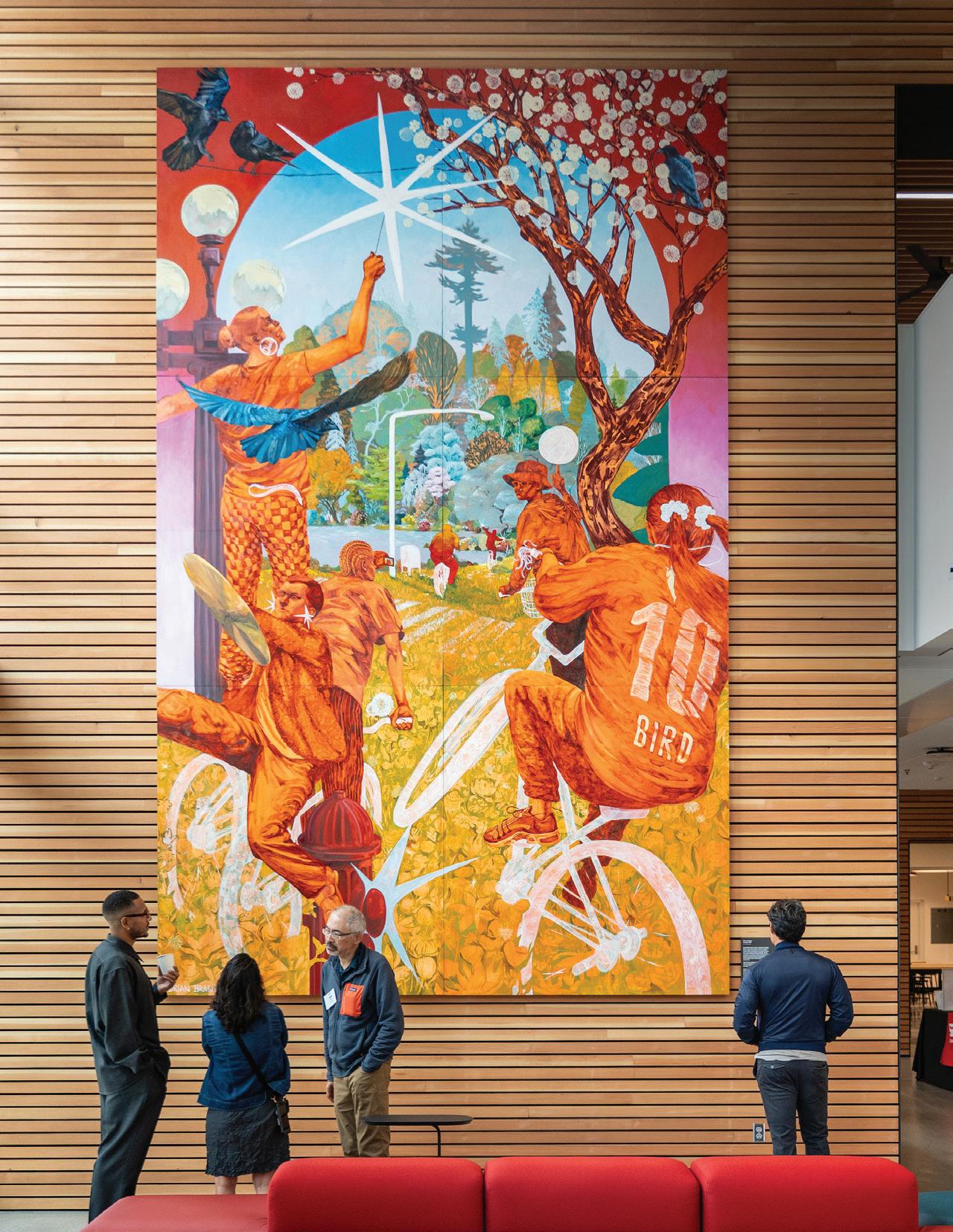
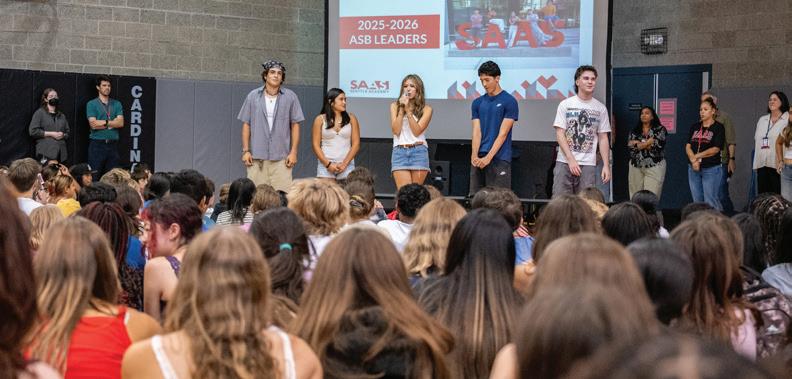
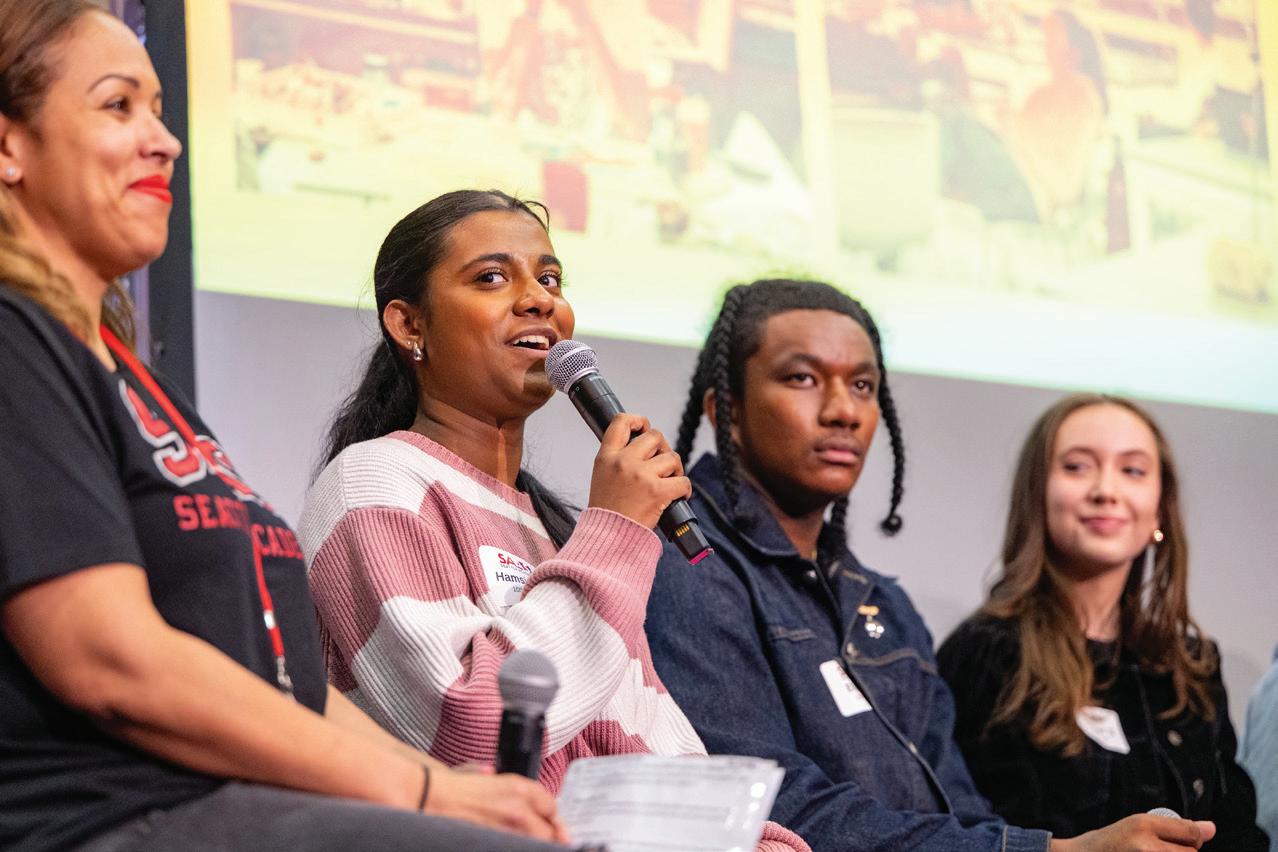
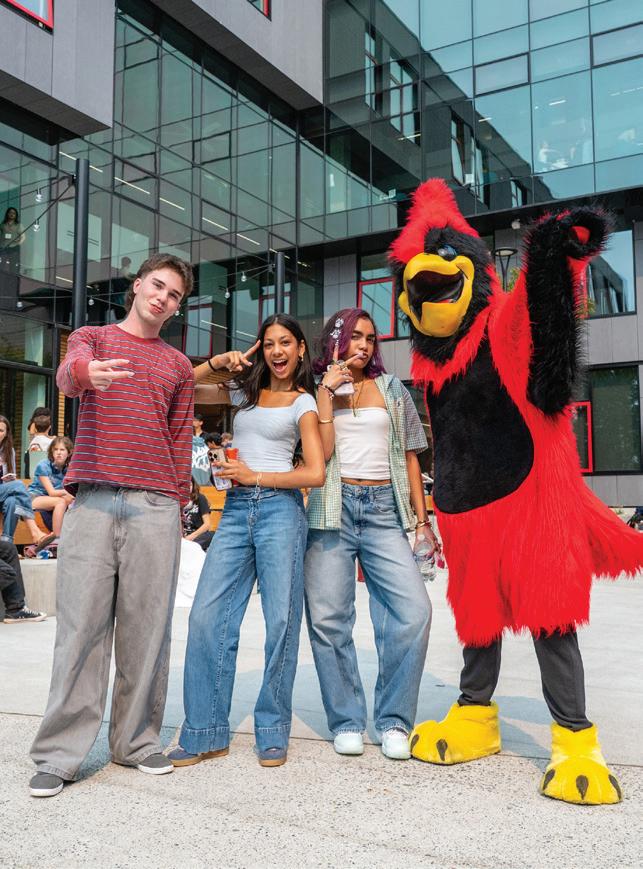
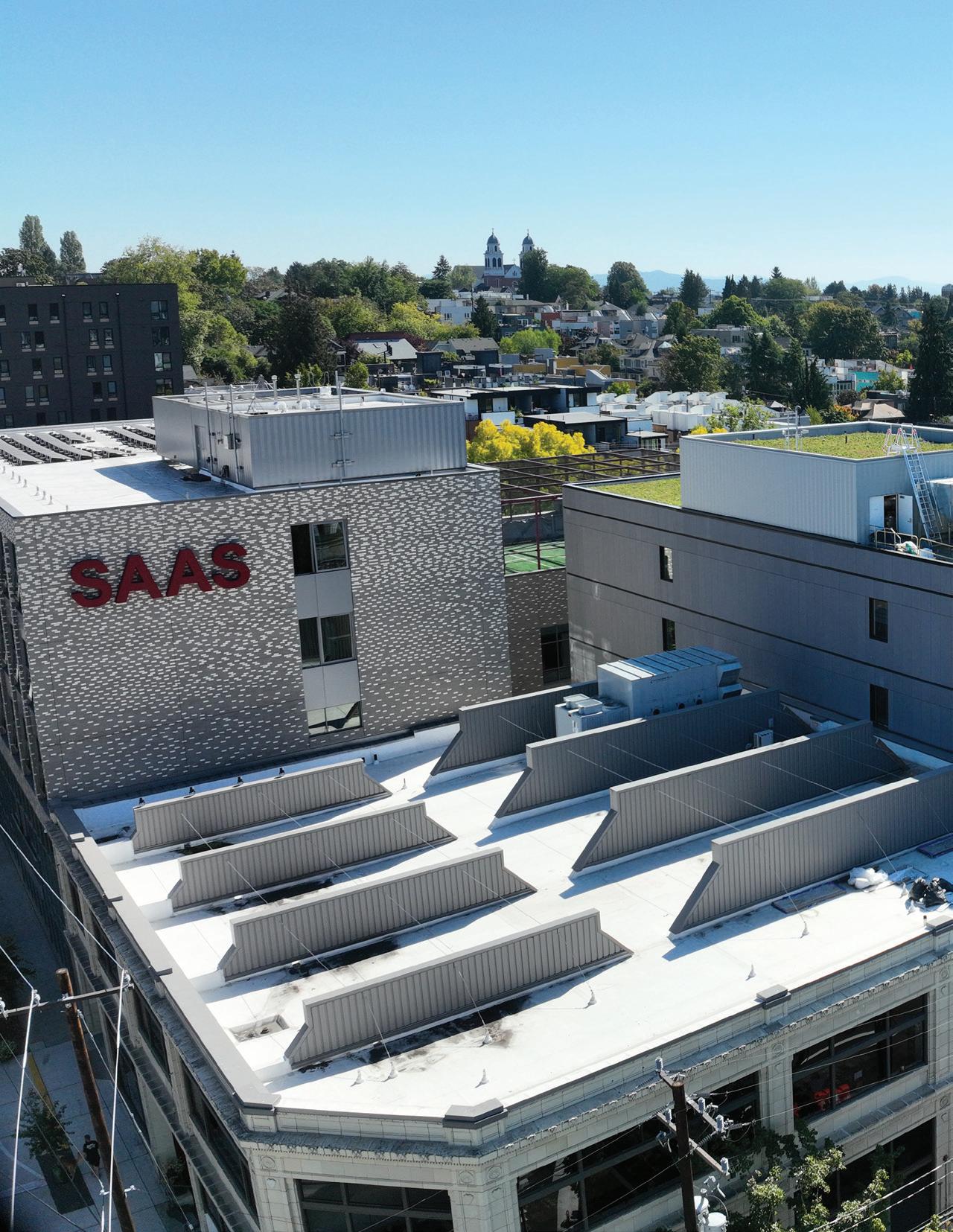
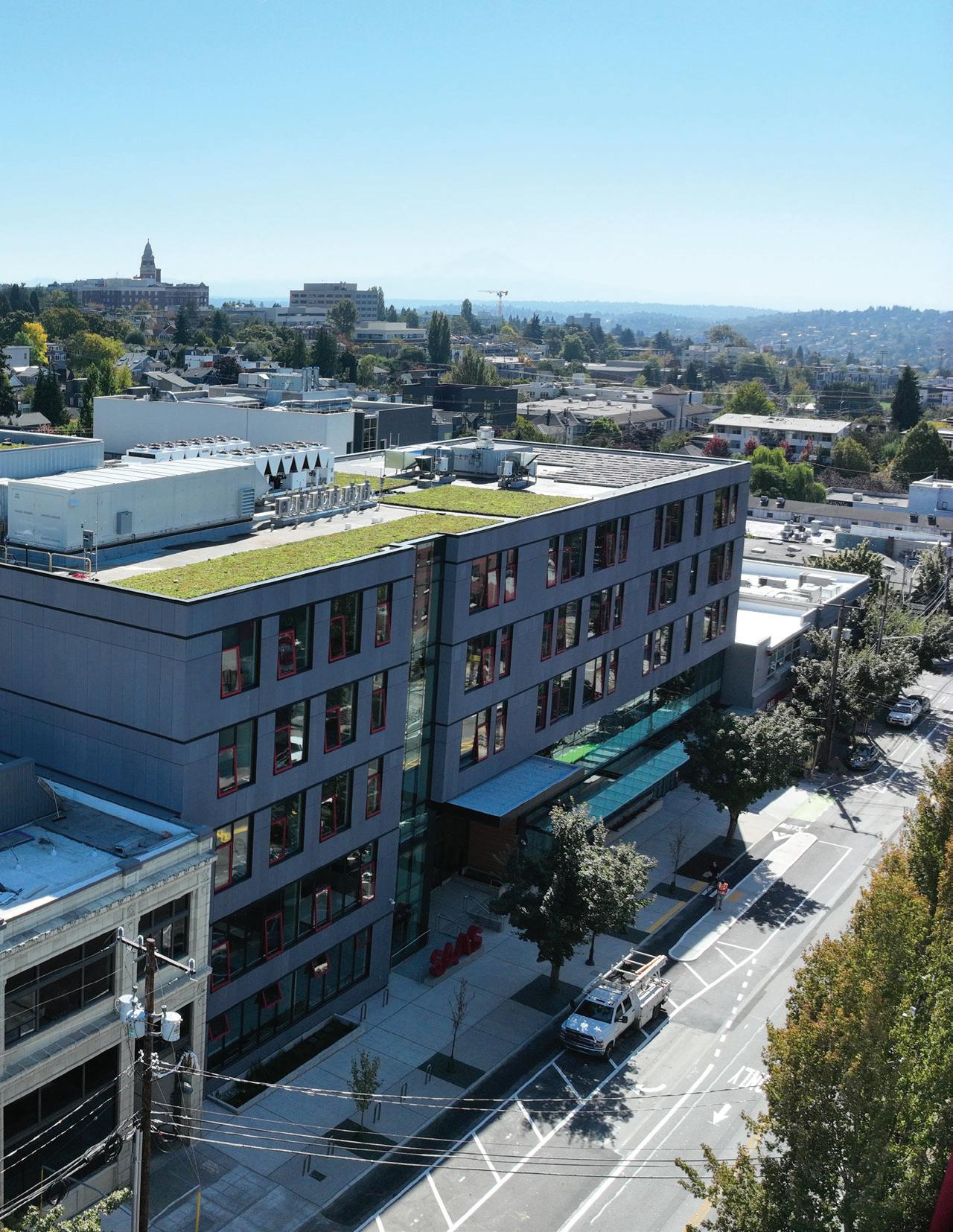
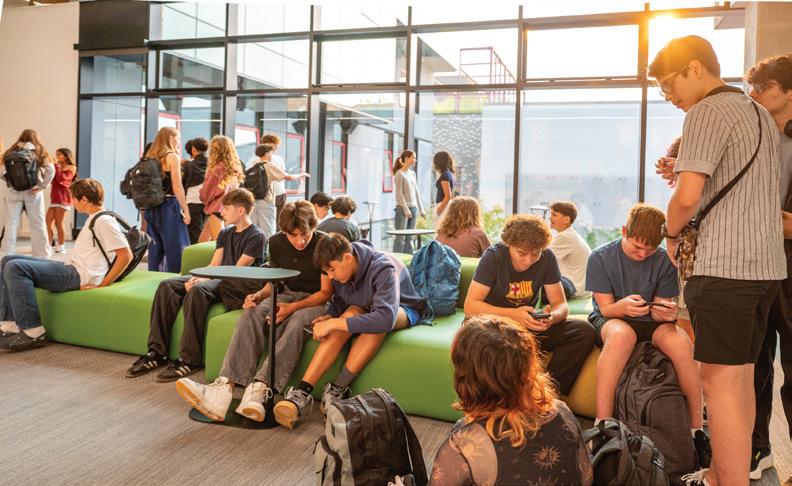
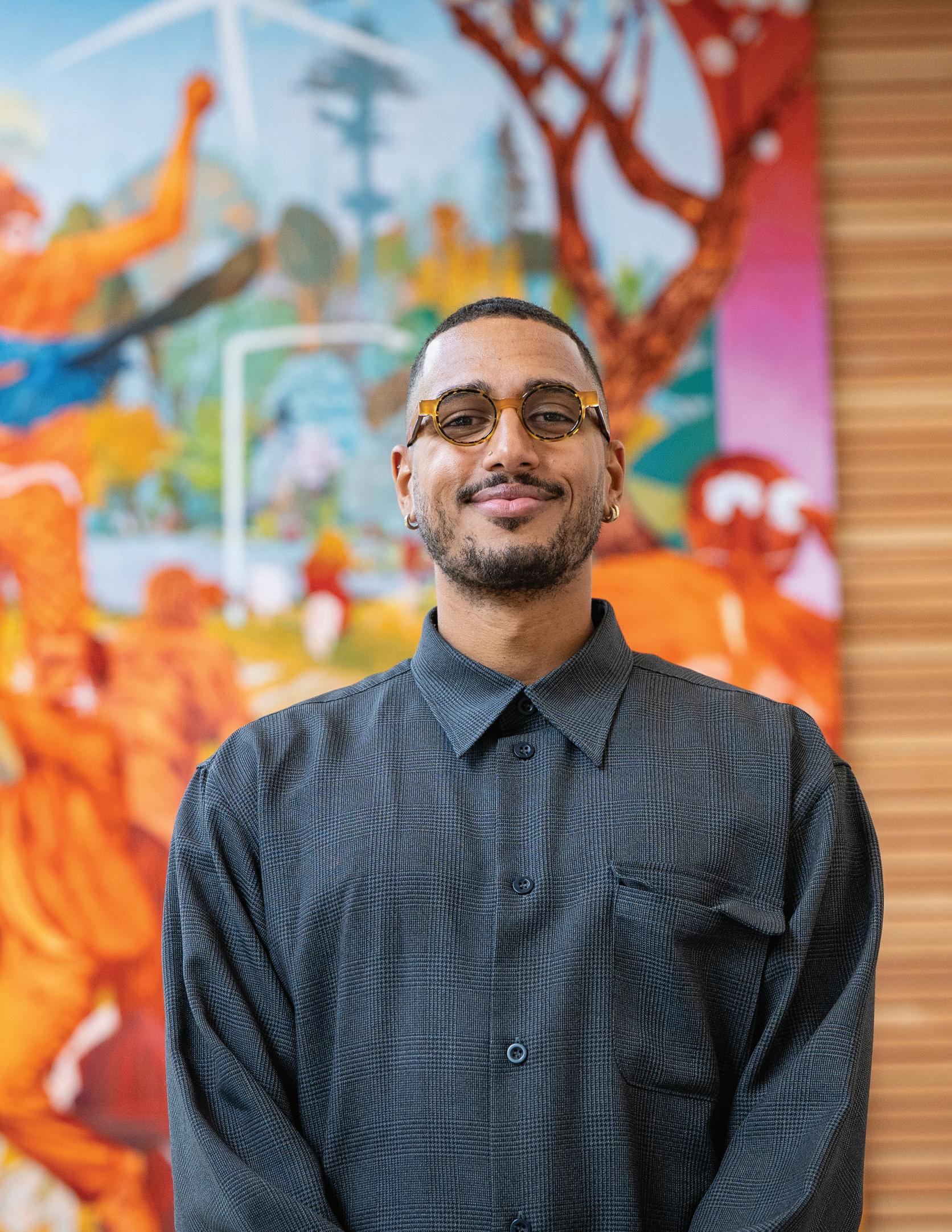
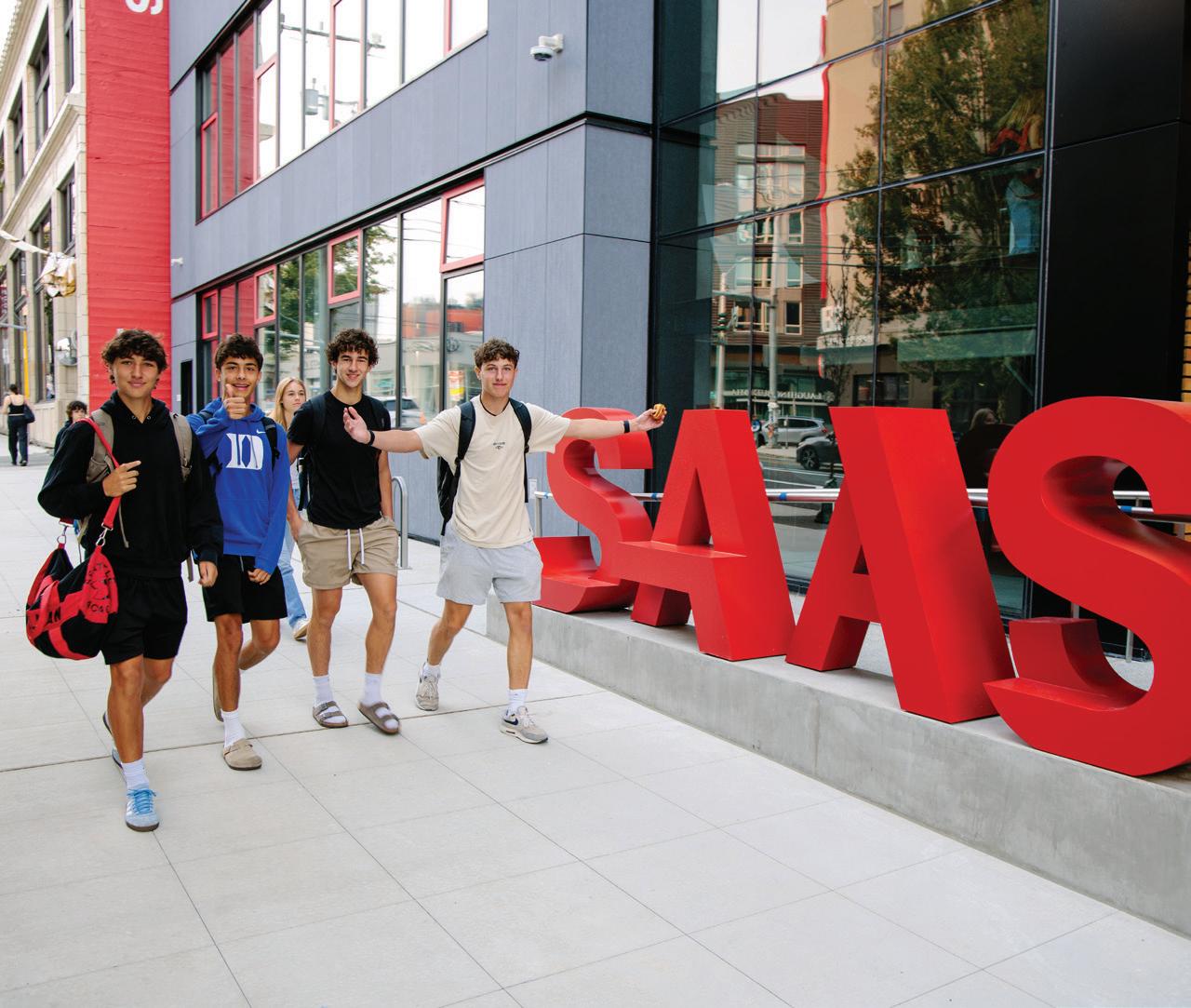
"Passage," a mural created by artist and alum Adrian Brandon ’11, greets students, faculty, and visitors as they enter SAAS’s new Upper School building. It’s a work of art about and for SAAS, designed to reflect our values and inspire our students.
Editor
Sarah-Mae McCullough
Layout & Graphic Design
Todd Rotkis
Photography
Todd Rotkis
Writers
Kristina Ciari
Giselle Furlonge
Sarah-Mae McCullough
Madeline Pennington
Rob Phillips
Additional Photography
James Andrews
Jeff Halstead
Luke Jacobson '28
SAAS Marketing & Communications Team
Sarah-Mae McCullough, Editorial Content Manager
Todd Rotkis, Visual Media Manager
Andrew Spitzer, Digital Marketing & Communications Manager
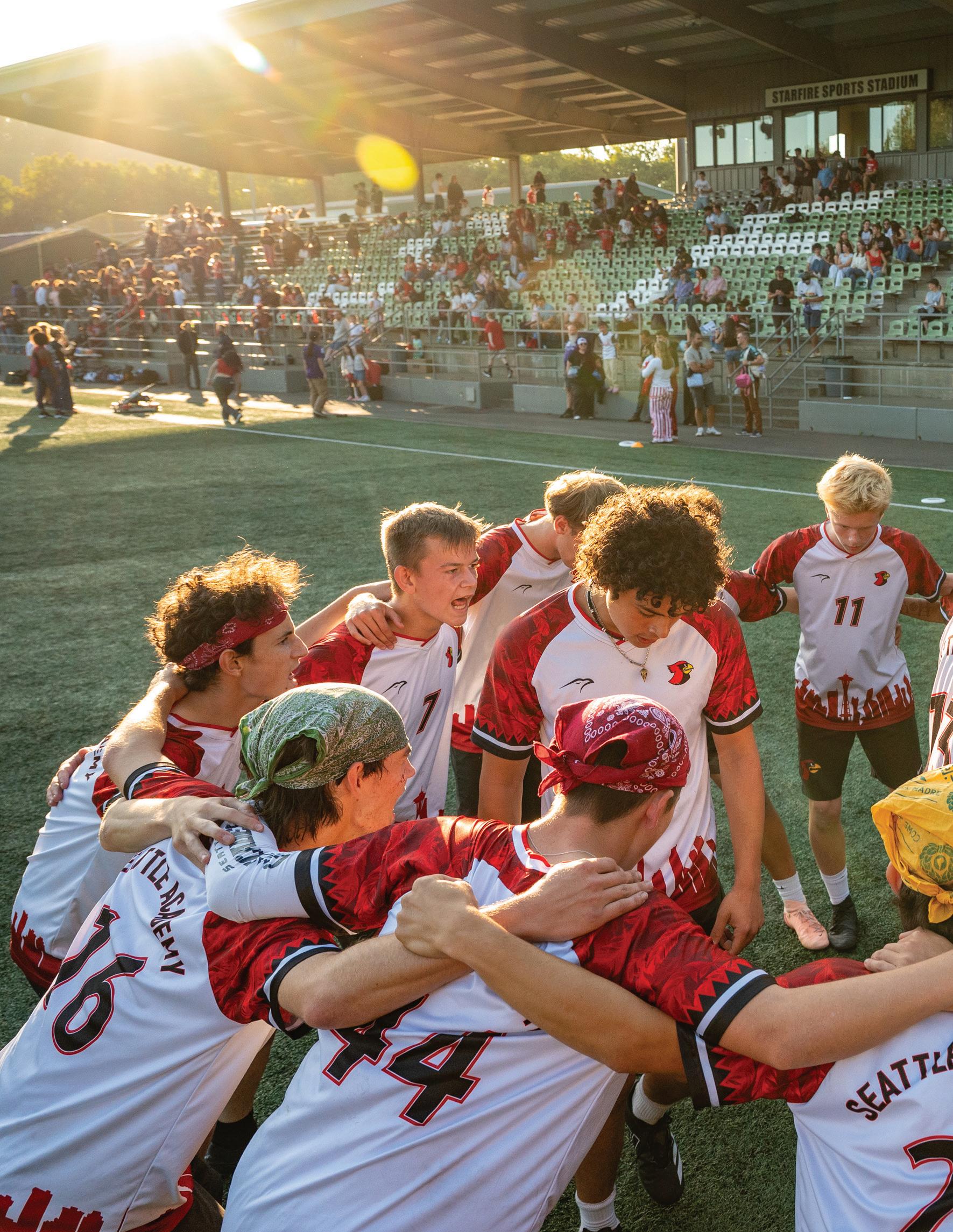
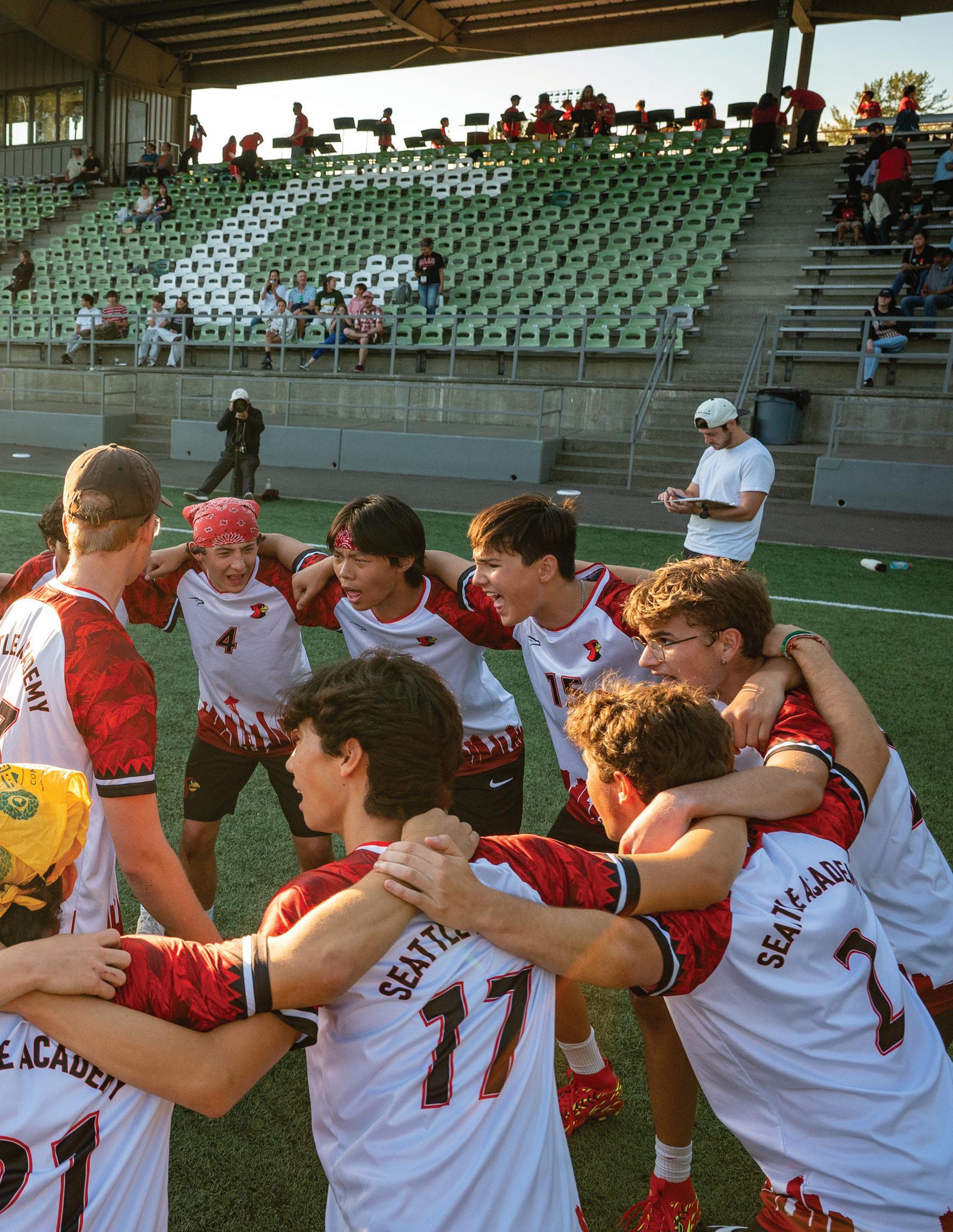
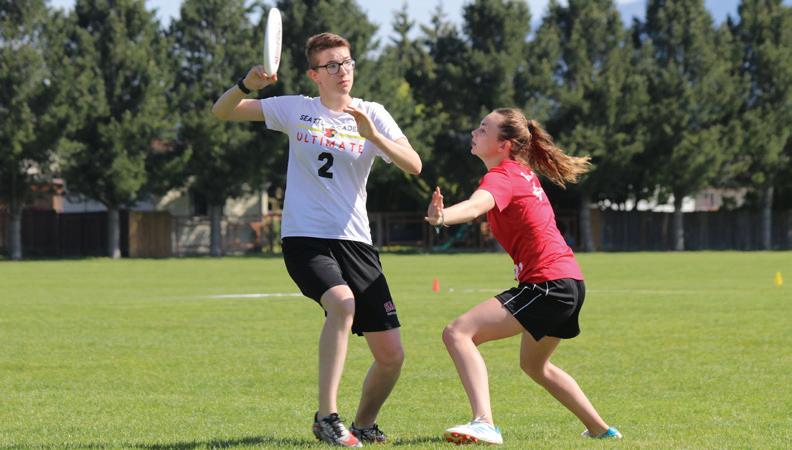
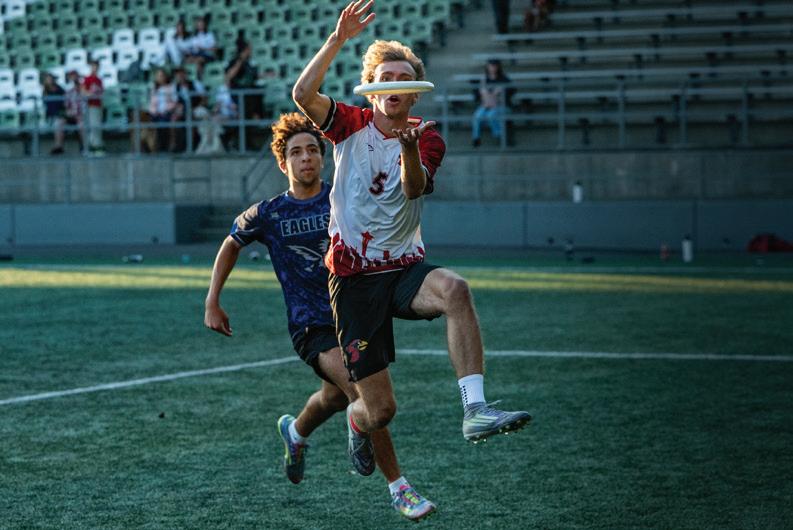
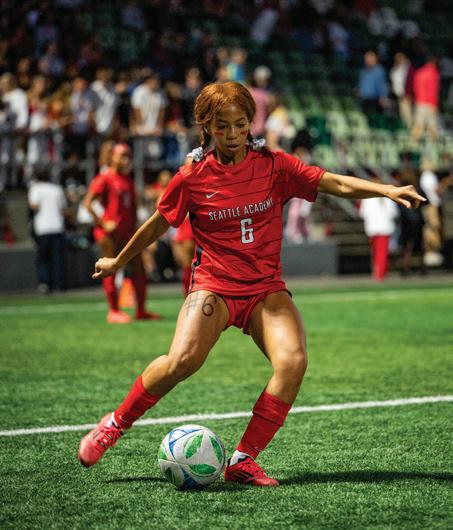
SAAS varsity ultimate players put their heads together before a Fallapalooza game. At the annual celebration of fall sports, hundreds of students, families, and faculty members gather to cheer on soccer and ultimate games, with the Upper School Competitive Dance Team, the SAAS Onions jazz choir, Pep Band, and Drumline adding to the event’s contagious energy.
On the Cover:
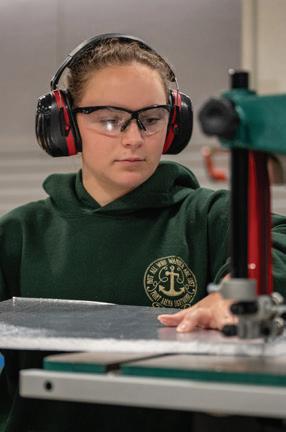
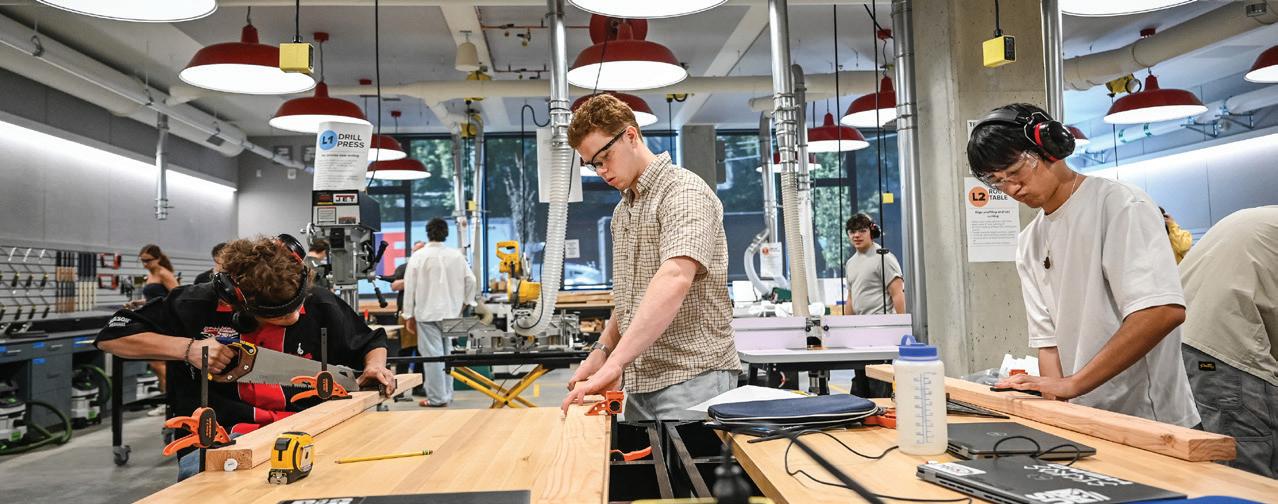
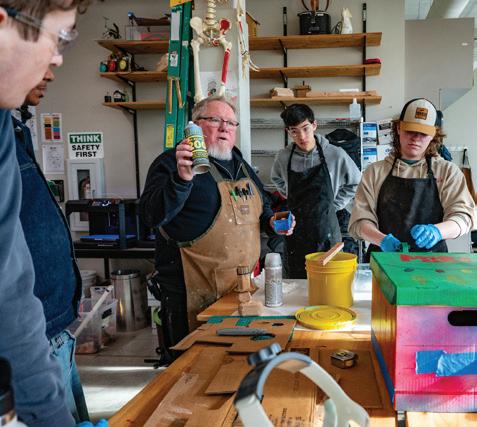
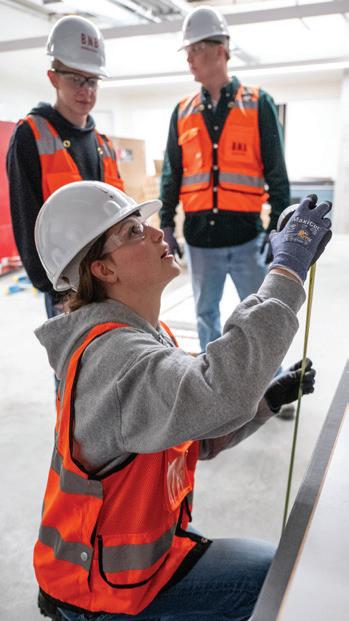
In SAAS’s state-of-the-art metal shop, students taking Metal Fabrication and Design plan and create their own projects using tools like plasma cutters and MIG welders. The focus is on safety, creativity, and skill development.
SEATTLE ACADEMY NON-DISCRIMINATION POLICY
Seattle Academy admits qualified students and provides Equal Employment Opportunities to all individuals without regard to race, color, religion, sex (including gender identity, gender presentation, and sexual orientation), national origin, disability, genetic information, marital status, or other legally protected statuses in accordance with applicable federal, state, and local laws. It expressly prohibits any form of harassment or discrimination of the same in any of its programs, activities, educational policies, scholarships or other financial aid programs, and terms and conditions of employment.
TABLE OF CONTENTS
9. A New Approach to SAAS In Focus
A letter from our school leaders
By: Rob Phillips and Giselle Furlonge, Co-Heads of School
10. 'Dreamers and Doers' Revisited
An essay from 2017 is as relevant as ever today
By: Rob Phillips, Co-Head of School
12. Dreamers and Doers
Empowering students to navigate unprecedented levels of change
By: Rob Phillips, Co-Head
of School
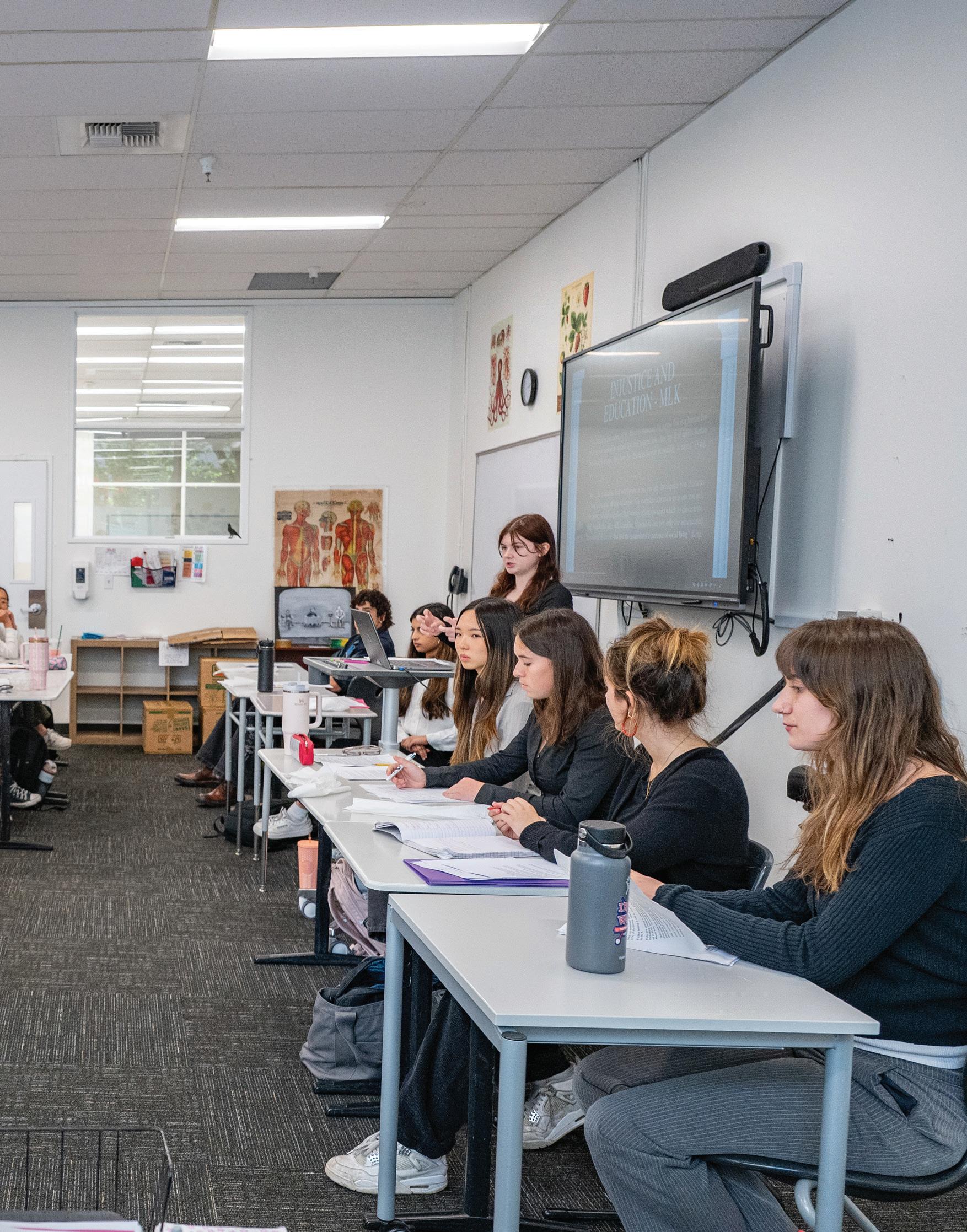
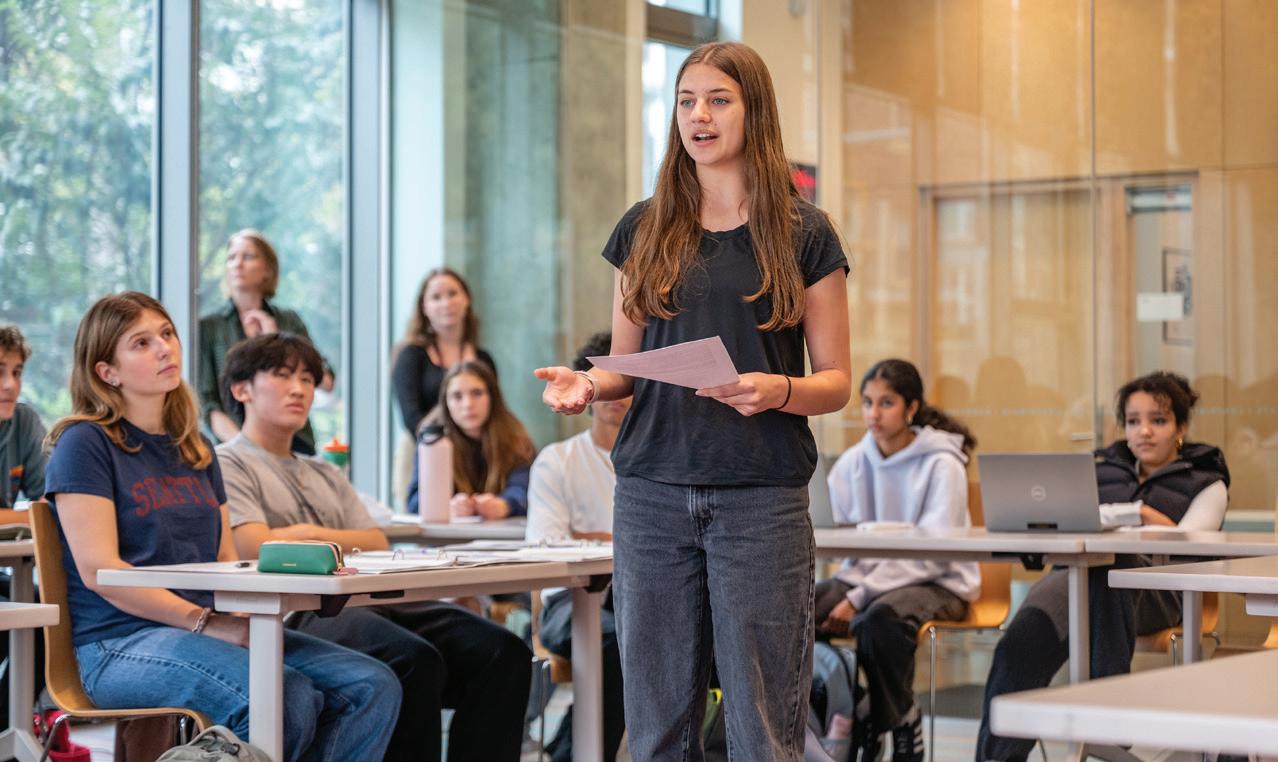
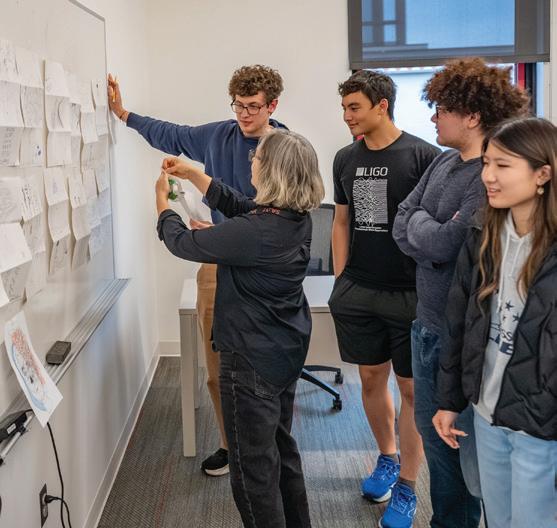
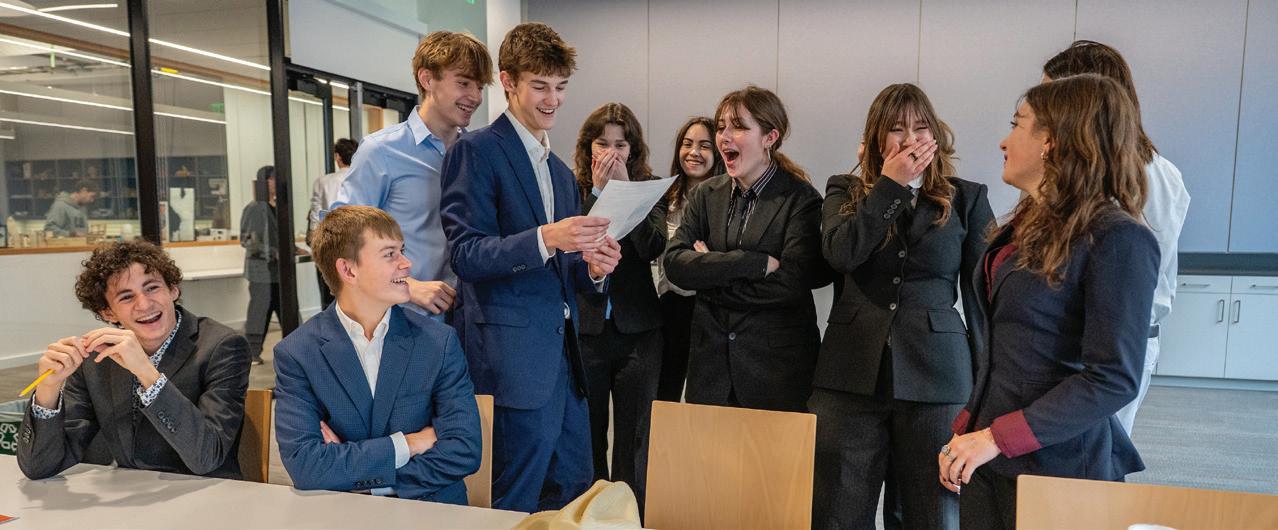
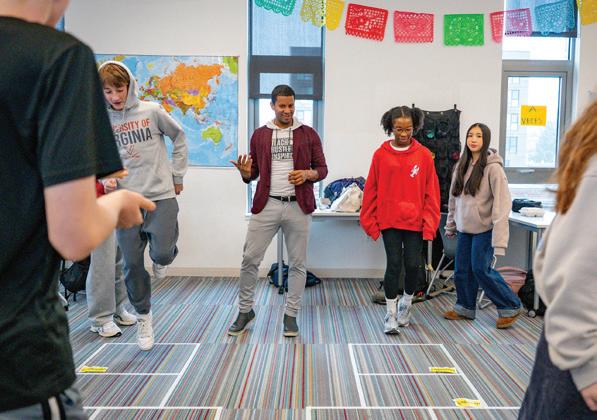
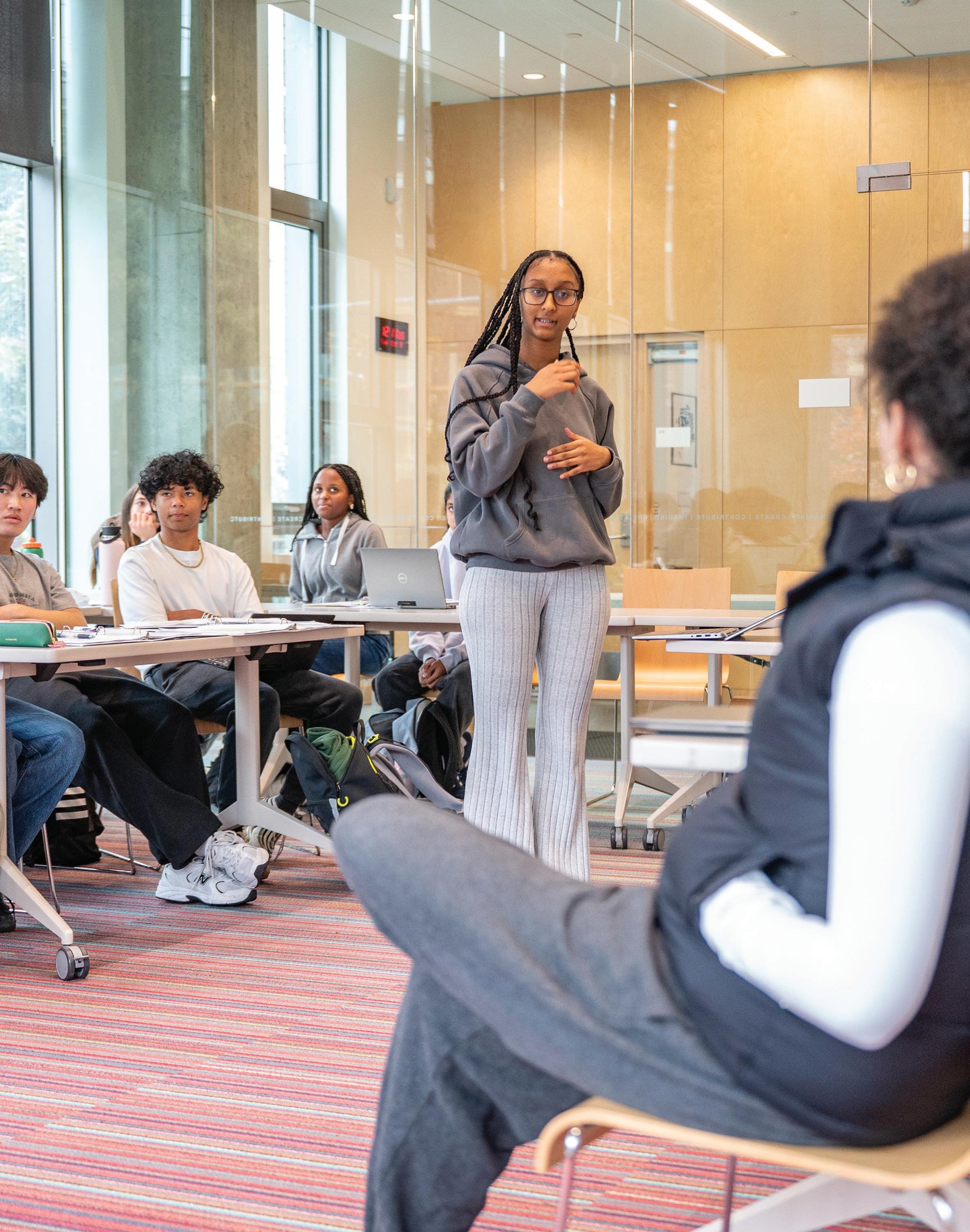
In American Studies—a signature SAAS class that integrates American history and English students present their strategy for the Civil Disobedience Project. Each group chooses a fictional scenario where social, moral, and constitutional injustice is occurring and plans a negotiation strategy that could involve an act of civil disobedience, drawing on what they’ve learned about history and politics.
18.
Ready to Shape the Future
How SAAS kids grow into innovators for life By: Giselle Furlonge, Co-Head of School
22. Programs at SAAS
STEM Spotlight
Humanities Spotlight
Innovations Spotlight
World Languages Spotlight
Rhetoric Spotlight
Robotics Spotlight
Arts Spotlight
PE and Wellness Spotlight
Athletics Spotlight
Outdoor and Travel Spotlight
Student Leadership Spotlight
Service Spotlight
48. Learning From the Pros
SAAS arts faculty are both expert teachers and working artists
60. From Elite Athletes to Educators
What these former high-level athletes bring to SAAS
74. SAAS Summit
Highlights from our signature speaker series
76. Alumni Stories
Revolutionizing environmental movements, founding successful startups, and more
87. A Partnership Built on Shared Values
SAAS and Rainier Scholars work together to put kids first By: Kristina Ciari, Interim Director of Marketing & Communications at Rainier Scholars
90. One School, One Block
How the new Home of the Upper School building has changed the game for SAAS
94. Alumni Spotlight
After national success as an artist, Adrian Brandon ’11 gives back to SAAS
96. Founding SAAS
The urgency, ingenuity, and deep belief that shaped the school’s birth
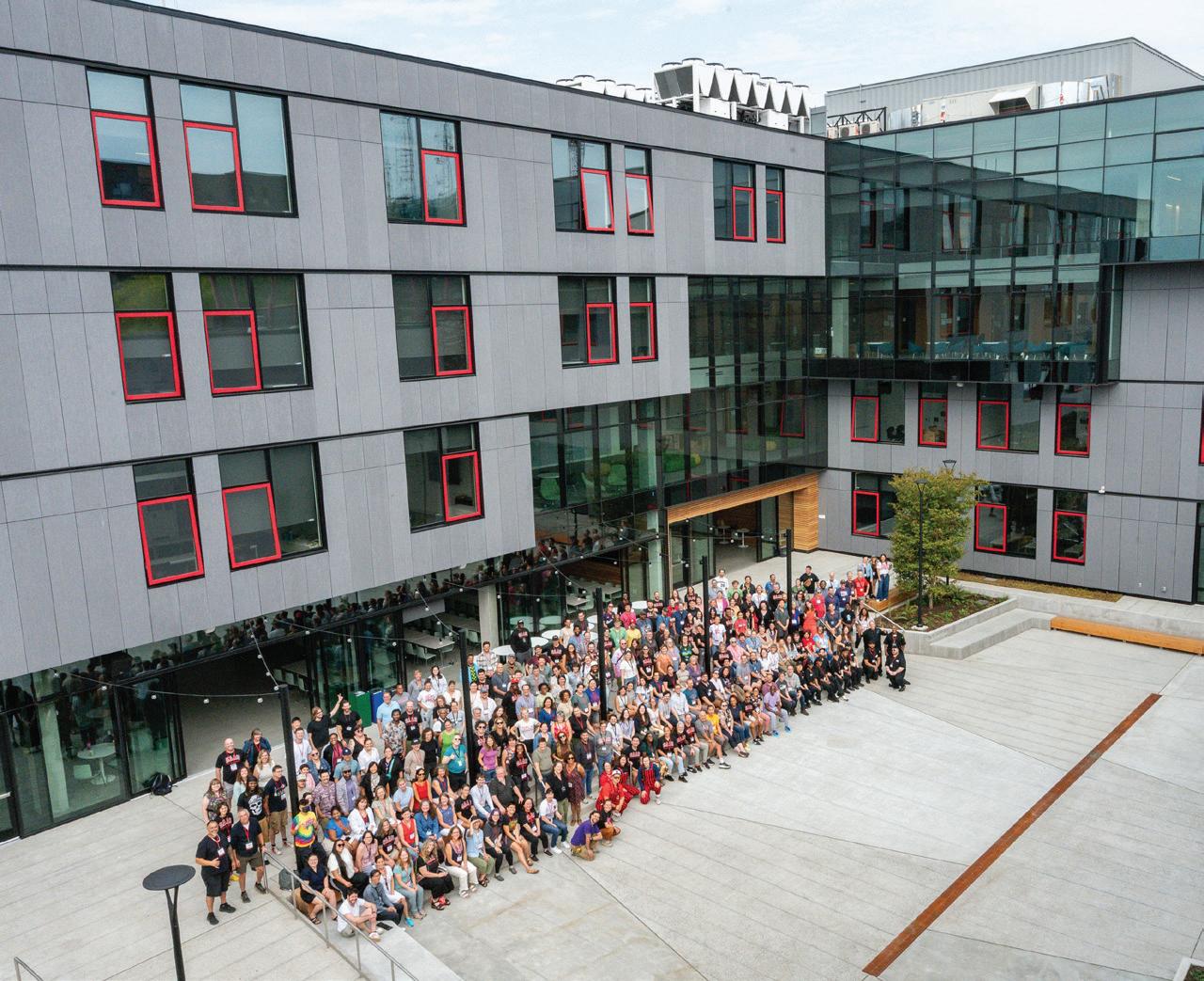
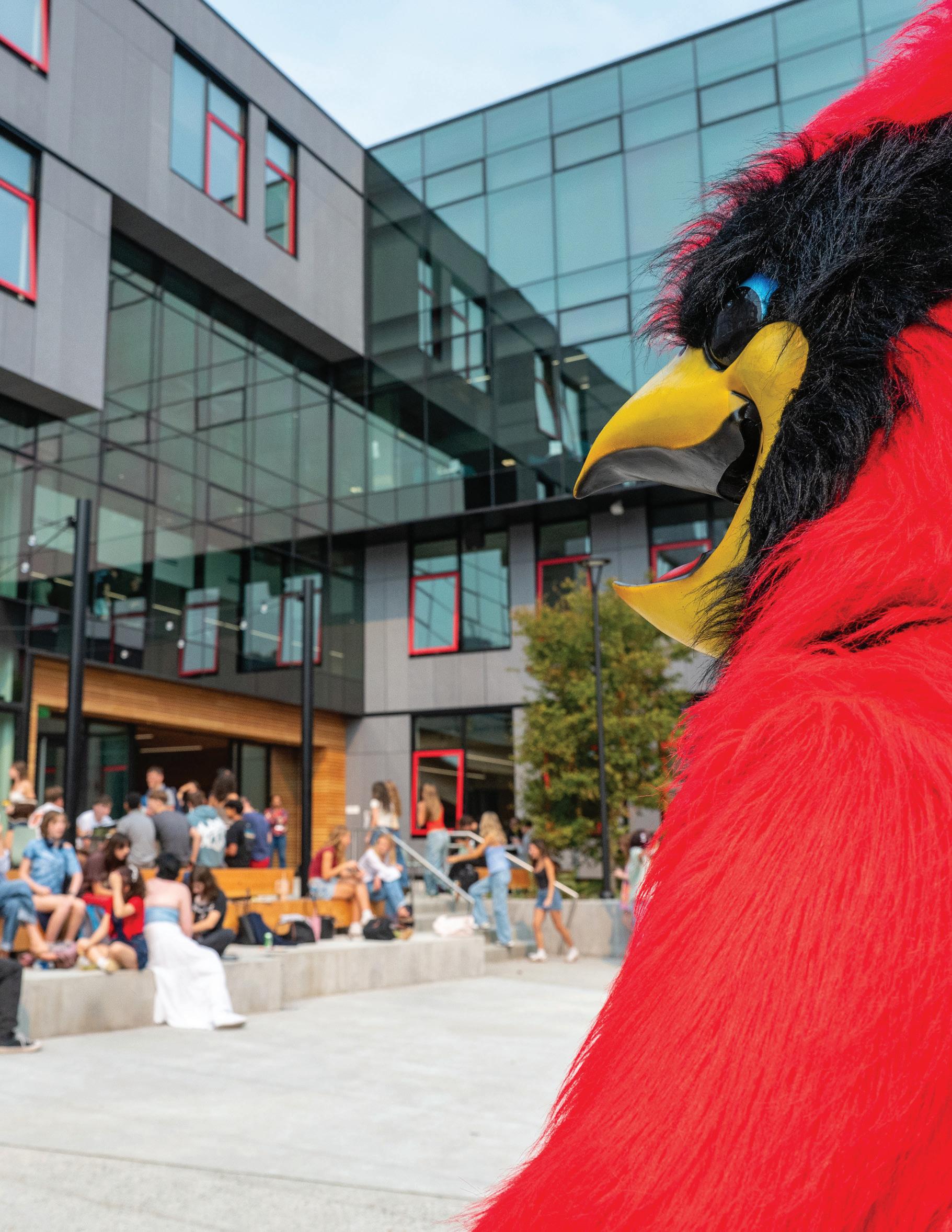
At the start of the 2025-26 school year, SAAS faculty and staff gathered in the 11,000-square foot courtyard of the new Upper School building.
SAAS IN FOCUS LETTER FROM THE CO-HEADS of SCHOOL
Welcome to this new edition of SAAS In Focus. In true SAAS fashion—where innovation, reflection, and responsiveness guide our work—you’ll notice something new in your mailbox: distinct versions of this magazine specific to our Middle and Upper Schools. Each division has its own rhythm, its own developmental focus, and its own unique constellation of teachers, programs, and signature experiences. Embracing our spirit of innovation, we’re experimenting with a format that better illuminates these distinct learning environments and brings you closer to the classrooms, studios, labs, and communities that nurture and challenge our students at every stage.
Whether you’re a current parent or student living the SAAS experience each day, a prospective family just beginning to explore who we are, an alumni parent whose support helped build the foundation we stand on, or one of our extraordinary alumni—you are all part of what makes our community vibrant, and we’re grateful for the many ways you continue to shape, sustain, and inspire SAAS.
This issue also highlights something we are deeply proud of: our alumni. Across a wide range of fields and professions, SAAS graduates are living our mission—to question, imagine, create, and contribute boldly to a changing world. Their achievements, leadership, creativity, and commitment to their communities speak to the impact of an education that centers curiosity, courage, and purpose. In these pages, you’ll see how our graduates are putting what they learned at SAAS into action.
Even as we spotlight the distinctiveness of each division and celebrate the wide-ranging accomplishments of our graduates, this issue is also a reminder of what unites us. This year marks a significant milestone in the SAAS story—the opening of our new Upper School building and the unification of our campus on the 12th Avenue block.
SAAS is one block, one mission, one community. No matter where someone is on their SAAS journey—as a new family, a long-time supporter, or an alum forging their path—they remain connected by a shared experience and a shared belief: that young people excel when they are known, challenged, supported, and trusted.
We hope this special edition of SAAS In Focus deepens your understanding of the extraordinary teaching, learning, and living happening across our campus and beyond—and reminds you of the entrepreneurial spirit that makes SAAS, SAAS.
Thank you for being part of our ongoing story.
With appreciation,
Rob Phillips & Giselle Furlonge
Co-Heads of School
'DREAMERS and DOERS' Revisited
by Rob Phillips, Co-Head of School
“Dreamers and Doers” was first published in our SAAS In Focus magazine in the fall of 2017. The idea for the essay began in the moment described in its opening pages and scribbled into a journal by a campfire in the Yukon. Most of the rest of the essay was completed in a cabin on Fox Bay, on the shores of Lake Laberge in the Yukon territory.
That cabin, that bay, and that lake all hold special memories. Generations of SAAS kids have launched canoes from those beaches to paddle down the Yukon River during summer adventures, and thousands of SAAS alumni
have finished their senior year on those same beaches—but in the early spring, on the Senior Yukon Trip, camping out on a frozen lake under the Northern Lights.
And just as generations of SAAS students have returned to that same beach, that same cabin and that same campfire, I find myself returning to the ideas I first explored in “Dreamers and Doers,” now from a different vantage point in 2025.
In the original essay, I explored the impact of a world turned upside down by the overnight disruption of the transcontinental fur trade. I can’t help thinking back to what we didn’t know was ahead of us in the summer of 2017: the pandemic, the murder of George Floyd and the nationwide reckoning that followed, the rise of generative AI, and elections that reshaped political and social norms. The “overnight disruption” I contemplated by that Yukon campfire has since manifested in ways far more immediate and intense than I could have imagined.
“SAAS is a place for dreamers.”
—Craig Tall, Seattle Academy Founding Trustee
The questions I posed to students and graduates then feel even more urgent now— especially these: “What is being prototyped in a lab right now that is changing what employers need from workers, teams, and leaders? How are robotics, artificial intelligence, and virtual reality reshaping the world and workforce in real time? Which jobs that parents hold today won’t exist in ten years?”
The core question of the essay was: How should schools prepare students for the future in a time like this?
“Dreamers and Doers” doesn’t pose a definitive answer to that question, but I did offer compass points to help us find our way to answers. At SAAS, we focus every single day on the knowledge that the 6th graders beginning
their SAAS journey in the fall of 2026 are the class of 2033; the 9th graders who enter the high school next fall graduate in 2030, and by 2035 will be engaged in a dynamic world at a complicated time in history.
One would think that all schools are focused on their students and their future, and are designing their programs in the present for those realities.
Unfortunately, most schools aren’t preparing students for 2035—or even for 2025.
And while we can’t know what the future holds in 2033 or 2035, any more than I knew what the future held when I wrote “Dreamers and Doers” in 2017, we do know what it means to equip our students with the tools to “contribute boldly to a changing world.”
That work begins by preparing them to do more than simply be “ready” for the future.
We want them to lead in the future—not just live in it.
We are committed to equipping our students with an entrepreneurial mindset.
We want them to step into the future with confidence, agility, and resolve.
We want them to shape the future as Dreamers and Doers.
Originally Published in 2017
Dreamers and Doers
Echoes of the Past, Vision for the Future
by Rob Phillips, Co-Head of School
We eased the canoe towards the willow-covered bank and into the faster current that runs along the outer edge of the river’s turn. We were just a day into a week-long family canoe trip, on a river more than two thousand miles from Seattle in northern Canada, and anxious to set up our first camp. Our eyes were on the river’s edge, looking for a likely camping site.
Which is partially why we were completely surprised by the sudden noise in the water, just a few feet ahead of our boat and towards the main channel.
When we heard the loud “Thwack!” right off of the canoe’s bow, we were all startled enough to send a shudder through the heavily laden canoe, and it took us a couple of breathless seconds to realize that we hadn’t run into a rock or submerged tree, and there wasn’t a bear or moose chasing us.
There was, however, one of the North’s most impressive and prolific creatures right in front of us. A beaver had eased out of one of its hidden canals that connected the river to a beaver pond a ways back in the trees, and had whacked its tail in the water as a warning that we were encroaching on its turf.
We watched for a little longer, drifting in the current, and then we resumed paddling.
I put my foot in cold water and hold it there: early mornings they had to wade through broken ice to find the traps in the deep channel with their hands, drag up the chains and the drowned beaver. The slow current of the life below tugs at me all day. When I dream at night, they save a place for me, no matter how small, somewhere by the fire.
William Stafford, American poet
A few minutes later, we paddled ashore on an island in the middle of the river, set up camp, and soon had a campfire going on the river bank.
As we sat by the fire, sipping coffee and hot chocolate and talking about the highlights of our day, we all agreed that finding this great campsite was topped only by getting to see the beaver up close and in action. They’re a remarkable animal, and their activities have played a central role in reshaping the landscape and human history of North America.
As my family reflected on our day, I reflected on what I knew about the pivotal role the beaver has played in the exploration of the North American frontier. Beavers were at the center of a complex and lucrative resource-based economic system that was central to both American and Canadian history.
But successful systems have a way of lulling their participants into a false sense of confidence and permanence...and then crashing spectacularly.
That false sense of confidence and permanence was dashed one day in London in 1854, when Prince Albert decided NOT to wear his ever-popular and classy beaver felt top hat. He selected a silk top hat instead and wore it to a big party. In so doing, he launched a new fashion craze, and within a few short years, the beaver trade was snuffed out like a candle at bedtime.
I thought about how those graceful, industrious, and remarkable beavers that my family had encountered as we paddled serve in many ways as a good example of how entrenched assumptions, trusted
systems, and venerated institutions can come crashing down virtually overnight.
And it doesn’t always take wars or elections or advanced technology to bring down our assumptions, systems, and institutions.
Sometimes, all it takes is wearing a new hat to a big party.
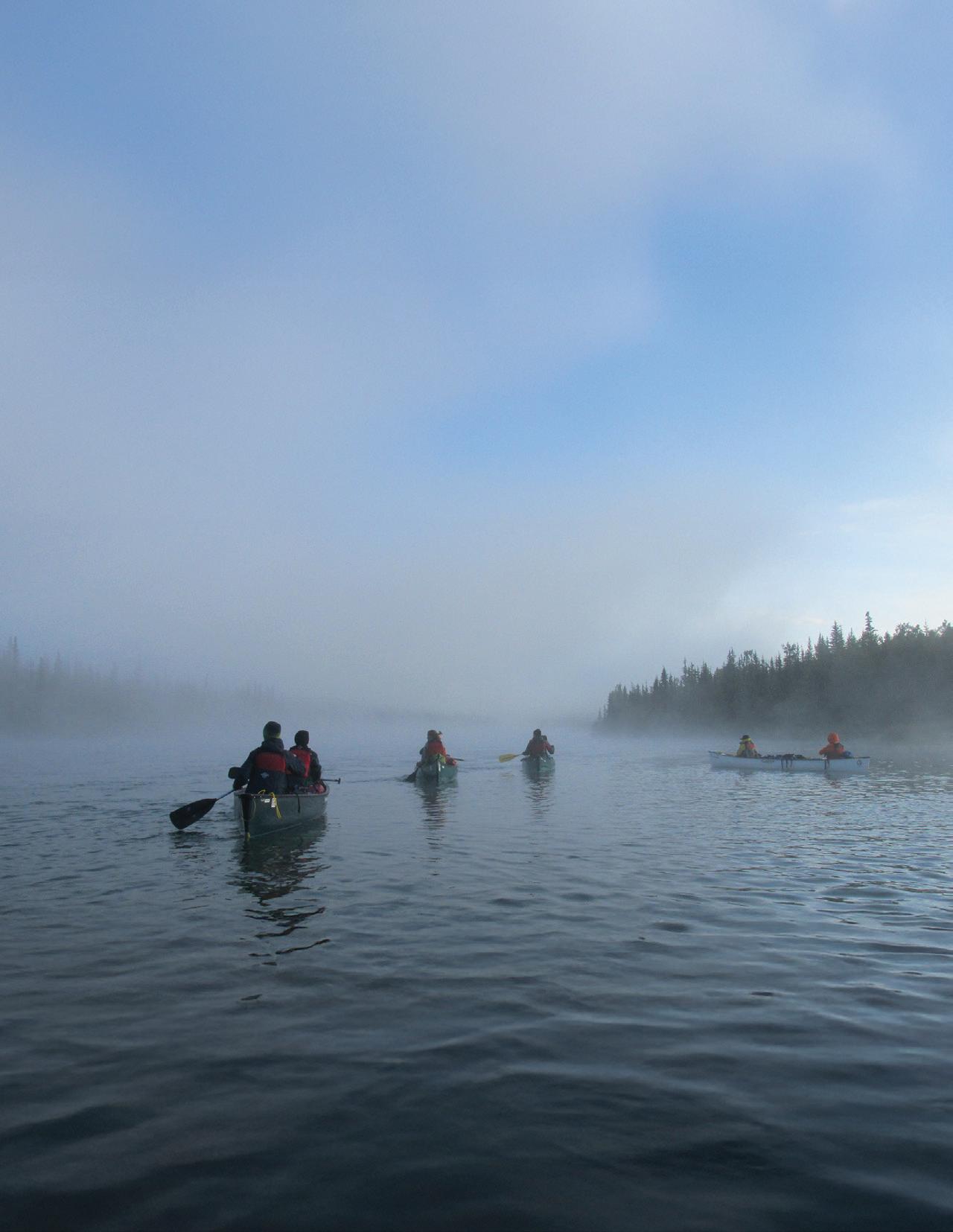
Long after my family had gone to bed, I sat by the campfire, drinking coffee and looking out over the river. A little after midnight, the sun dipped below the horizon into the perpetual dusk of the northern summer, and a mist settled over the river.
I peered into the wisps of fog and felt like I could almost see the canoes of the old beaver trappers emerging, heading downriver with bales of fur.
Generations of Native Americans, Canadian Voyageurs, and rugged American fur traders paddled the rivers of the North and West and set up their camps, secure in the belief that they were part of an economic system that was lucrative and completely reliable.
As I sat staring at the river, I wondered what assumptions we have for our kids and their futures that might be similarly flawed. What systems have we placed too much faith in? What questions aren’t we asking that we should be?
Part Two Beaver furs had long been valued in European civilizations, in large part because beaver fur is uniquely adaptable to being shaped into felt. In fact, in the oldest versions of Cinderella’s story, her slippers were made of felt from furs rather than from glass.
In the late 1660’s, an ounce of gold was not unheard of as the price for a beaver hat. So as the European exploration of North America continued apace, gold-hungry explorers quickly recognized that the millions of beaver dams dotting the landscape were the REAL gold mines.
And for many of the more than 500 Native American nations who lived in the land that was being “discovered and explored” by the Europeans, trading in the plentitude of beavers for tools, weapons, food, and blankets was a different but equally alluring and lucrative sort of gold rush.
In fact, a native trapper from the Cree Nation could, at a Hudson Bay post in the 1730’s, trade 10 beaver pelts for a brass kettle, 20 iron fish hooks, 2 hatchets, 8 knives, 20 flints for fire- starting, a gun and ammunition, 2 pounds of sugar, 2 pounds of tobacco, and 1 pound of trade beads. That haul, for a Cree trapper, represented enormous wealth – and all for an animal that lived nearby in abundance.
But once the Cree trapper had staked his well-being on procuring a yearly supply of trade goods by trapping for the specific animals valued by the Hudson’s Bay traders, he had become on many levels a servant of the fur trading system.
Which meant that, whether he recognized it or not, his wellbeing was tied to the cross currents and riptides of a global economy and—unfortunately—to the whims of European fashion.
For over 200 years, the circumstances of global enterprise and the whims of European fashion intersected in ways that produced favorable economic terms for the fur trade. The wealth generated by the fur trade was staggering, and that wealth and opportunity was distributed across a wide geographic and demographic spectrum.
Until it all suddenly came crashing down.
Within a few years of Prince Albert’s silk hat debut in 1854, the once politically powerful and eminently profitable Hudson’s Bay Company was in shambles, and the curtain closed on a profitable business and an entire
resource economy that had thrived for over 200 years.
And the individual trappers?
Prince Albert’s fashion switch created an economic tidal wave that started in Europe, swept over the Atlantic, and smashed across the western settlements and the fur trading infrastructure of North America.
Hardest hit were the trappers who were the very foundation of the fur trade. “Early mornings / they had to wade through broken ice / to find the traps in the deep channel / with their hands, drag up the chains,” as William Stafford writes in the poem that begins this piece.
The skills they had acquired and honed became irrelevant or of limited value in the new economic contexts.
The resource was played out, and their skills were obsolete.
Part Three
I see a number of discouraging parallels between the trust trappers once placed in the fur trade and the faith that our society asks students and parents to place in the American educational system.
Students collect knowledge and some fundamental skills, not unlike the way trappers were asked to collect furs. Trappers had a very specific role to play in a transcontinental supply chain. Success and failure were defined in concrete and unambiguous terms.
The architects of the modern American educational system were focused on America’s transition from an agricultural to
industrial society, with students as the metaphorical products of an assembly line; ironically, students were also literally being trained to work on assembly lines.
The result: a modern American educational system that emphasizes standardized tests, standardized skills and knowledge, and standardized outcomes. And as in the case of the fur trade, success and failure are defined in concrete and unambiguous terms.
While the growth of private and independent schools was often in part a reaction against an educational assembly line aimed directly at industrial era jobs, many private and independent schools eventually accepted a dubious assumption: they accepted the premise that a meaningful education is whatever the most selective colleges define as success.
Many independent secondary schools and many colleges share the fundamental assumption that getting kids into the “best” possible colleges will automatically, magically prepare them for what comes next.
In making that assumption, independent schools haven’t moved away from the industrial era assembly line and its standardized product at all; they’ve merely targeted the assembly line to produce a different standardized product. And that product is determined by whatever the current criteria for the college admissions process calls for.
It’s not hard to visualize students as modern day trappers who,
after traversing the landscape of kindergarten through college, show up at the trading post with a canoe full of furs—in this case, their canoes are their brains crammed with bales of information gleaned by doing a ton of homework, writing scores of research papers, and taking countless quizzes and tests. They’ve done everything they’ve been asked to do.
A sixth grader who enters Seattle Academy in the fall of 2018 will most likely leave college and enter the work force in 2029. So that’s when they’ll “paddle” into the trading post of the Real World, with a canoe full of knowledge and skills to trade for entry into the job market.
What are the odds that the information, and even the skills, that they arrive with will be relevant and valued?
What will they know that can’t be answered faster by asking Siri or Alexa?
Lest our students and our children fall victim to the same trust in assumptions that befell the fur trade, they need to learn to ask the right kinds of questions–essential questions— about the Present and the Future.
“What’s happening in the world, not just in our backyard?” “What socio-economic fault lines are widening, and why?” “How can we better understand and address the ongoing divisions in our communities, and the deep and real impacts of historic injustices?” “What is being prototyped in a lab right now that is changing what employers need from their workers and
teams and leaders?” “How are robotics and artificial intelligence and virtual reality impacting the world and the workforce in real time?” “What are the jobs that their parents have right now that won’t not exist in 10 years?”
Those are not questions that are asked, much less well-answered, in most curriculums, on standardized tests, or in private school admissions brochures. And they aren’t questions that students are usually asked to respond to in the typical college admissions process.
Part Four
We ask ourselves those questions at Seattle Academy every single day.
The rate of change facing today’s generation of middle and high school students upon graduation means that changes are occurring at an unprecedented rate in all facets of human existence.
The changes are not occurring at a constant rate, the way the tides erode a beach, or at the speed that our kids outgrow their clothes, or even at the rate that traffic builds into rush hour.
Seattle Academy doesn’t claim to have the answers to the questions above or to the underlying question, “What does the future hold for our students?”
But if we’re going to empower our students to face an unprecedented rate of change— that dynamic and challenging and potentially exciting future— we ourselves must think differently about what it means to educate them.
If our graduates are going to be able to meet the future head on, rather than be side-swiped by it, we must arm them with an array of diverse and meaningful skills that they will have tested and honed in moments of action. They will need to be able to think and act and speak on their feet, which requires a special kind of grace under pressure.
If our graduates are going to have a shot at effectively solving the problems they’re inheriting today, much less the challenges they’ll be asked to tackle ten to twenty years from now, they’re going to need to rely on a collaborative competency. And they’re going to need to be able to act upon a recognition and respect for inclusivity as the most practical and effective way to get multiple vantage points and multiple skill sets into the mix. We’re going to have to produce a generation of leaders who are adept at rethinking what’s possible and at envisioning and implementing creative,
innovative, and sustainable solutions. They’ll need to be able to see opportunities that nobody else has identified yet.
Unfortunately, schools often close rather than expand the aperture on how a student sees opportunities and thinks about what’s possible. Schools do that by defining Talent, Potential, and Giftedness in narrow and conventional ways.
Our schools are filled with brilliant pattern thinkers who comprehend the world on a deep level but who perhaps process traditional academic material more slowly.
So they aren’t considered Talented—by their teachers, their families, or even by themselves.
Our schools are filled with students who make and remake whole worlds with their hands, but who aren’t the type of verbally facile thinkers that schools are oriented towards rewarding.
So the kids who are better at doing than at saying see their Potential discounted.
Our schools are filled with kids who have an emotional intelligence that allows them to truly listen to others, to see a way to bring people together, and to get the most out of any group they’re placed in—but perhaps they struggle with traditional tests.
So their Gifts of emotional intelligence and intuition are either dismissed or at best patronizingly relegated to a supporting role for those who excel in the analysis of ideas and information.
Ironically, those very students whose Talent, Potential, and Giftedness are discounted and dismissed may be the very people who are now and will continue to be best able to see around the next corner: to think about, anticipate, and prepare us all for the future.
The future requires a generation of leaders who are willing to dare, who aren’t paralyzed by a fear of failure or limited by the narrow definitions of success that so many educational institutions have committed themselves to.
Part Five
I sat around the fire long enough to watch the sun peek back up over the mountains in the early morning hours. And I stayed up long enough to watch the beavers emerge from their hidden canals into the river, eager to tackle their morning chores.
As I peered out into the early morning mist and thought about trappers and silk hats and the beavers swimming across the river, my head was filled with mostly unanswered questions.
But as the fire burned down, and as I sat there thinking, one of the beavers again crossed in front of me as I gazed out at the river, as if to say, “What about us? Those trappers are gone, but we’re not. We’re still here, swimming back and forth across the river, building our dams and canals and beaver lodges.”
And watching them steadily at work as the sun warmed away the mist on the river, I remembered that what was most unique about the beaver is how they are eminently at
home in their environment. They are capable of adapting as their environment changes. And they can do more than adapt to change—they can shape it, make it, lead it.
Beavers are Architects and Engineers. They are Builders and Shapers.
They have Creativity and Resilience in abundance. They are undaunted by challenges; they know what it takes to succeed; they are Doers. And perhaps they are Dreamers, as well.
So maybe, just maybe...while they’re building their dams and canals and houses, they’re also showing us how to understand Creativity and Resilience, and Talent, Potential, and Giftedness; and how to envision the task of preparing our students and our kids for an unknowable but fast approaching future.
Some time when the river is ice ask me mistakes I have made. Ask me whether what I have done is my life. Others have come in their slow way into my thought, and some have tried to help or to hurt: ask me what difference their strongest love or hate has made. I will listen to what you say. You and I can turn and look at the silent river and wait. We know the current is there, hidden; and there are comings and goings from miles awaythat hold the stillness exactly before us. What the river says, that is what I say.
-William Stafford, American poet
Ready to Shape the Future
by Giselle Furlonge, Co-Head of School
In Rob’s essay “Dreamers and Doers,” he invites us to consider how rapidly shifting assumptions and systems demand new ways of preparing young people for a future defined by constant change. His reflection on the beaver—creative, resilient, and utterly at home in a transforming environment—offers a powerful symbol of the kind of learner our world requires: adaptable, curious, and ready to shape what comes next.
At SAAS today, those qualities are not accidental outcomes. They are the result of an intentionally designed ecosystem of diverse learners, immersed in a curriculum that values breadth as much as depth, process as much as product, and the interplay of disciplines rather than their separation. Our students—our Dreamers and Doers—are not defined by one type of achievement or one narrowly defined pathway. They thrive because they are exposed to a wide range of learning experiences that develop a flexible, transferable skill set.
Why Range Matters
In his book Range: How Generalists Triumph in a Specialized World, David Epstein argues that people who succeed in complex, rapidly changing environments are those who have sampled widely, built a broad base of knowledge, and cultivated the ability to draw connections across seemingly unrelated fields. They become excellent not because they specialize early, but because they explore widely, build adaptive thinking habits, and learn how to apply ideas in new contexts.
Epstein’s research aligns seamlessly with what SAAS has long believed: students need range to navigate the uncertainty and complexity of the world beyond school.
While the traditional educational model—and many college-driven systems—still reward narrow specialization, SAAS embraces a fundamentally different philosophy. We structure our academic program so students move fluidly among disciplines: from robotics to sculpture, chemistry to rhetoric, literature circles to economics simulations, improv ensembles to engineering design labs. Along the way, they cultivate the kind of broad, integrative thinking that allows them to approach unfamiliar challenges not with anxiety, but with confidence.
Excellence as a Process
of Becoming
In his “Dreamers and Doers” essay, Rob notes that many schools still function like assembly lines. They reward specific kinds of thinkers and overlook others whose gifts unfold differently. At SAAS, we define academic excellence not as the mastery of a prescribed set of outputs but as the process of learning itself—a process that varies from kid to kid, and that is strengthened by encountering a wide range of tasks, people, and ideas.
Excellence at SAAS means:
• Collaboration—learning to work with people who do not think as you do.
• Resilience—persevering when something is hard, revising, rethinking, and trying again.
• Risk-taking—being willing to attempt something unfamiliar without the guarantee of success.
• Creative transfer—applying insights from one field to solve problems in another.
• Communication—finding confidence in one’s own voice while developing the ability to truly listen.
These skills are not incidental to our mission. They are our mission. They are exactly what Epstein identifies as the hallmarks of the generalist mind—and exactly what our students practice every day.
A Diverse Ecosystem of Learners
Our classrooms reflect a broad range of learners: pattern thinkers, makers, analytical writers, intuitive listeners, students who learn through doing, students who excel in dialogue, and students who discover their strengths slowly but powerfully.
In engineering class, a student who processes slowly may spot the flaw no one else noticed. In humanities, a student with deep empathy may help a group navigate conflict. In woodworking, the student who prefers to “think with their hands” might generate the breakthrough prototype.
At SAAS, we depend on the variety of our students to fuel an ecosystem that not only strengthens academic learning, but also nurtures the broader human capacities of adaptability, awareness, and perspective-taking—all skills that students need to engage in a complex world.
Learning That Transfers
One of Epstein’s core findings is that generalists excel because they have learned how to transfer knowledge: how to take an insight from one discipline and apply it to another. This is the heart of a SAAS education.
When students debate constitutional law in the morning and engineer solar-powered devices in the afternoon, when they move from choreographing a dance piece to analyzing ecological systems in science, or when they build a data visualization that requires both creative design and mathematical modeling, they are strengthening the connective tissue of their learning.
They are learning how to learn—how to adapt to unfamiliar demands, integrate information, collaborate across differences, and lead with curiosity.
Prepared for the Unknown
When SAAS graduates step into the next chapter, they bring with them not just content knowledge but an array of transferable skills: the capacity to ask essential questions, navigate uncertainty, build and sustain community, and keep going when something is challenging.
They move into the world like the beavers Rob describes—creative, resourceful, unafraid of complexity, and adept at shaping the landscape around them.
Dreamers and Doers for the Future
In a world that demands broad thinkers, collaborative leaders, and imaginative problem-solvers, SAAS students are the Dreamers and Doers we need. They grow into innovators for life not by specializing early, but by engaging deeply, widely, and bravely in the full range of learning that SAAS makes possible.
At SAAS, excellence isn’t a single destination. Excellence is the readiness to step into a complex world—and to shape it. We grow self-reliant learners who can navigate complexity, draw connections across fields, and bring curiosity, resilience, and initiative to every challenge they encounter.
How SAAS Structures 'Range': Our Graduation Requirements in Action
1. Breadth Across Disciplines
Students at SAAS graduate with experience in a wide spectrum of disciplines. From elective opportunities in sixth grade to capstone projects in high school, students “try on” new domains of learning. These experiences mirror what David Epstein describes as the power of sampling: discovering strengths, expanding perspectives, and building confidence through exploration, not early specialization. This broad exposure strengthens flexible thinking and helps students make connections across fields.
2. Innovation & Creativity Built In
Beyond the core academic requirements, SAAS students complete foundational courses in Computational Thinking, Entrepreneurship & Design, and Financial Literacy. Robust requirements in the arts ensure that creative expression, performance, and making are essential parts of learning. This way, all students—not just those opting into STEM or the arts—gain experience in creative problem-solving, design, and application.
3. Transferable Thinking Skills
SAAS classrooms emphasize analyzing patterns, communicating effectively, iterating designs, solving open-ended problems, and collaborating across differences. These skills travel with students, allowing them to apply knowledge from one context to entirely new challenges. Students can also pursue additional elective credits to deepen areas of interest, sample new interests, or combine disciplines in an independent study. This flexibility supports the kind of sampling that generalist success depends on. Students aren’t locked into early specialization but encouraged to explore across fields.
4. The Confidence to Navigate the Unknown
Whether stepping on stage, entering a robotics competition, leading a policy debate, or building a prototype from scratch, students practice operating in unfamiliar territory. They learn to take risks, revise, adapt, and keep going. These hallmarks of the generalist mindset are essential for building a wideranging toolkit that prepares students to adapt, lead, and think expansively.
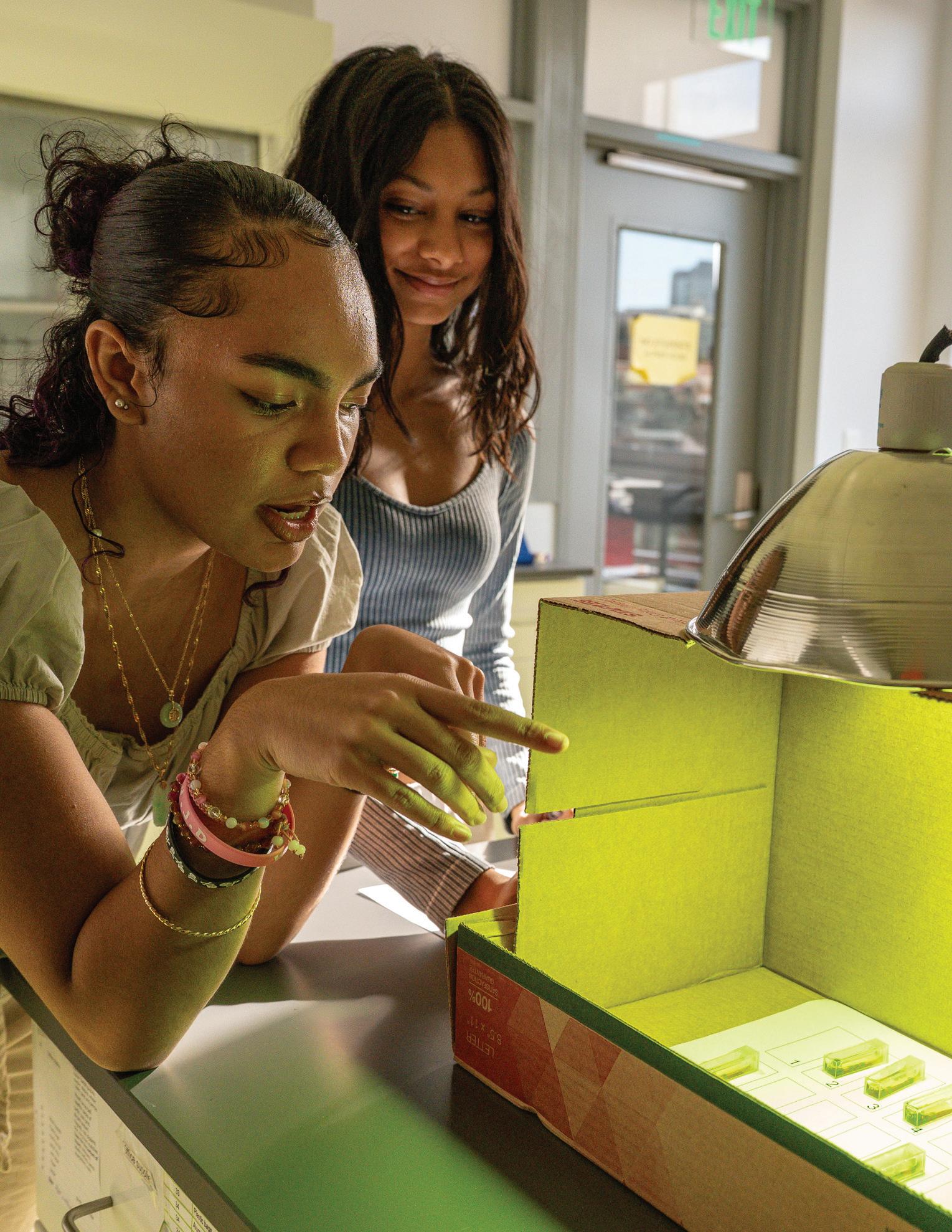
In a lab activity using algae beads—spheres filled with live microalgae—students examine biological processes like photosynthesis and cellular respiration.
SAAS SPOTLIGHTS: STEM
Faculty Profile: MARTIN BRAKKE
Science Teacher
Martin’s career began with a passion for science: studying chemistry at James Madison University in Virginia. After earning a Master of Arts in Science Education and a teaching certificate at the Maryland College of Notre Dame, he shared his enthusiasm for the subject with students in Colorado, Maryland, Venezuela, and Switzerland, before arriving at SAAS in 2012.
Outside of the classroom, Martin is known for sharing his passion for the outdoors on SAAS backcountry ski trips and the annual Senior Yukon Trip. In the classroom, he’s known for demonstrating complex scientific concepts in actionable and highly memorable ways.
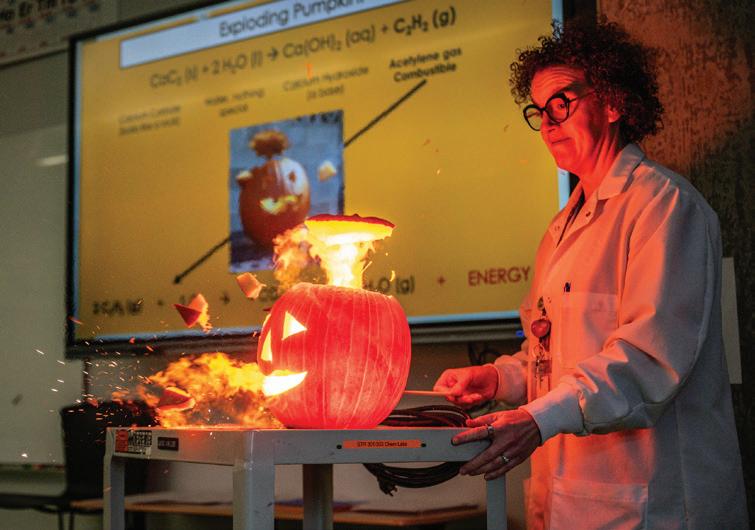
Every year around Halloween, for example, chemistry students learn about combustion reactions and how to make acetylene gas with calcium carbide and water through Martin’s “exploding pumpkin” lesson. Other lesson plans of his involve burning cheese puffs, etching medallions, and making candy canes.
Students in Martin’s advanced science courses “are like sponges for learning college-level content,” he says, “but they also love to find experimental applications for their learning”— a common practice at SAAS.
STEM By The Numbers
80 acres of rare oak woodland and prairie grassland habitat at the Glacial Heritage Preserve in Olympia, Washington— representing just 2.6% of this restored ecosystem—serve as a living laboratory where 11thgrade biology students conduct immersive ecological field studies.
1,950 algae beads containing Chlorella vulgaris enabled students to explore the relationship between light color and photosynthesis, turning microscopic organisms into powerful teaching tools.
20 students participated in the American Mathematics Competitions program, challenging themselves academically by taking the AMC 10 or 12 on campus.
17 original research studies spanning experiments, surveys, and interviews were designed and executed by Advanced Psychology students, applying scientific methods to understand human behavior.
61 sections across 16 different STEM electives will be offered in the 2025-26 academic year, providing unprecedented opportunities for students to pursue their scientific passions.
1,300 spinach (Spinacia oleracea) leaf disks were carefully prepared by 11th graders to investigate how light intensity and CO2 concentration impact photosynthetic rates, bringing cellular processes to life.
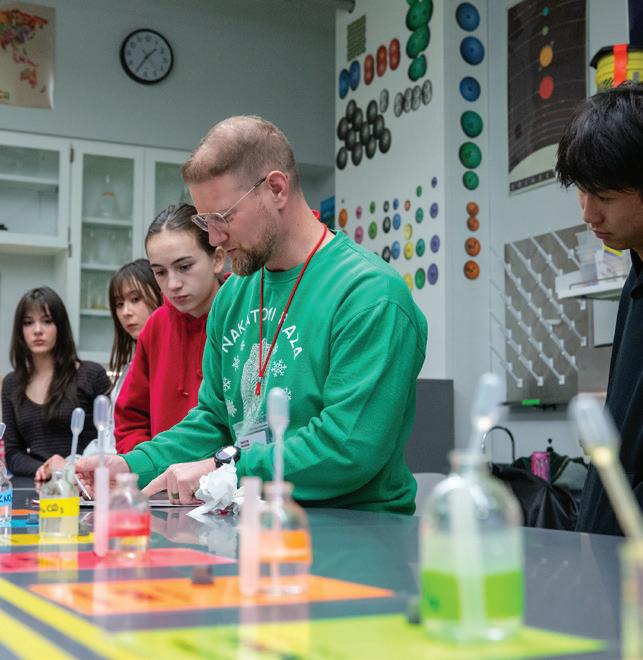
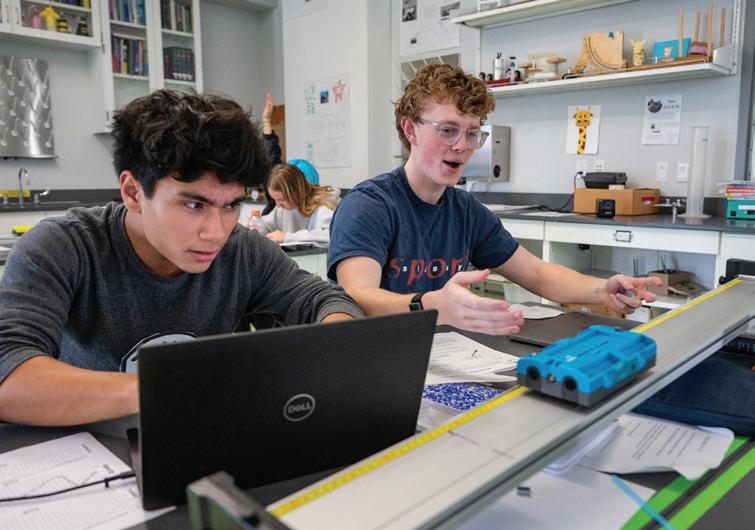
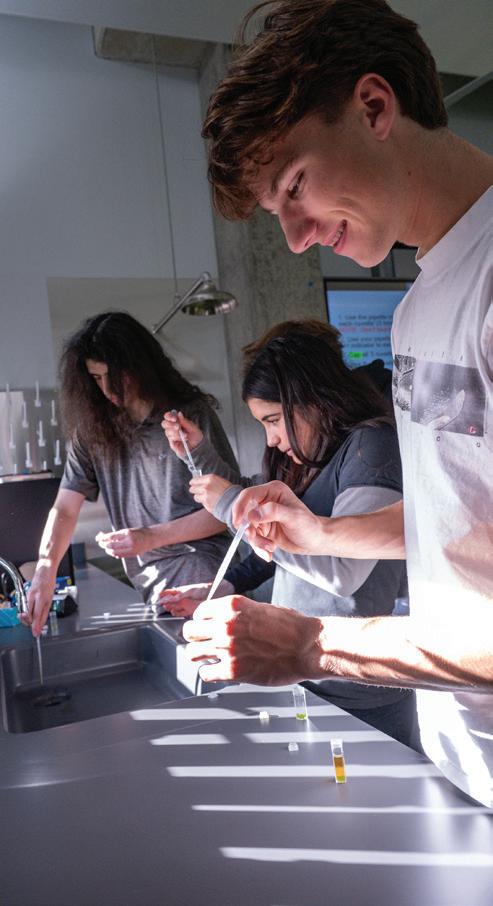
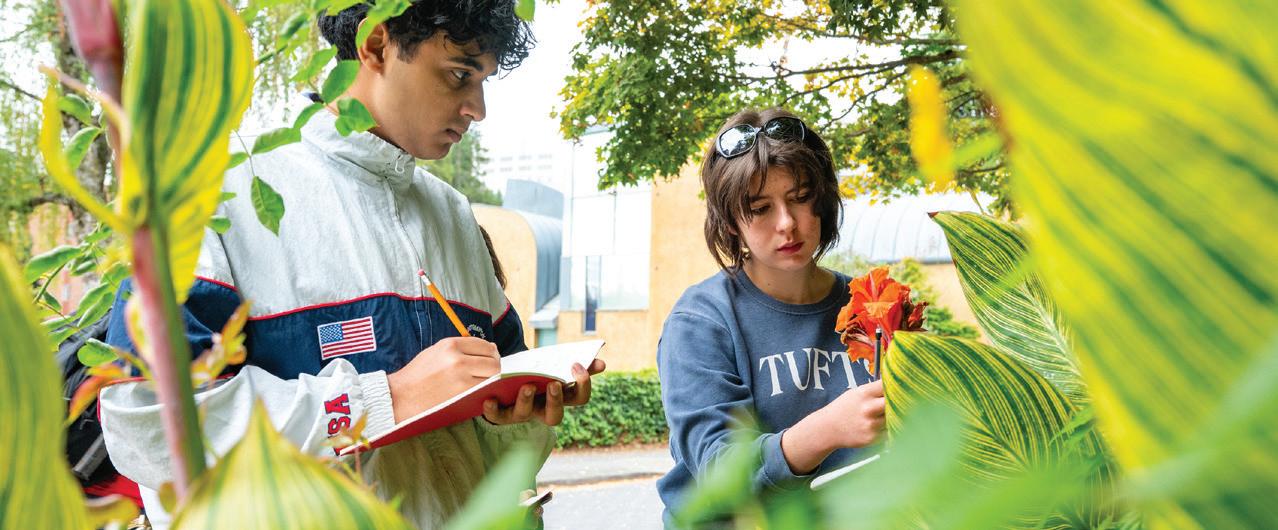
Clockwise from top left: In Upper School science classes, students explore physics and biology concepts through hands-on lab work, observe flower structures in SAAS’s botany class, and study chemical reactions through the highly-anticipated “Exploding Pumpkin” lesson plan that happens every October.
Meet an Alum in STEM: ELI ETZIONI,
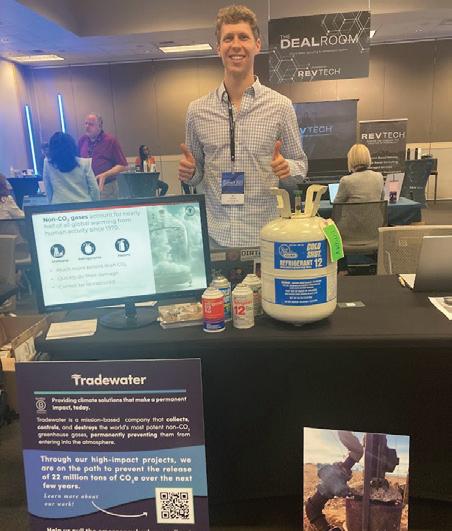
Class of 2014 Partnerships Manager at Tradewater
Eli works in partnerships and business development at Tradewater, a climate-tech company that collects, controls, and destroys some of the world's most potent greenhouse gases. By destroying old, harmful refrigerants before they can leak into the atmosphere and plugging orphaned oil and gas wells that are actively releasing methane, the company generates high-quality carbon offset credits to fund its ongoing climate mitigation efforts.
In his role, Eli spends his days building relationships with sustainability leaders at corporations, universities, and advisory groups. These partners come to Tradewater seeking to develop thoughtful, high-impact carbon credit portfolios that align with their environmental goals.
One challenge Eli frequently navigates is skepticism toward carbon credits—even among people working in climate technology and sustainability. To address this, he takes an evidence-based, storytelling approach. He shares firsthand accounts from the landowners and communities Tradewater works with, presents data from the company's greenhouse gas measurements, and draws on high-level climate science from organizations like the IPCC to underscore the importance of superpollutant elimination. His goal is to help stakeholders understand how impactful the right carbon credits can be when deployed strategically.
Through this work, Eli bridges the gap between climate science and corporate action. He helps organizations make meaningful contributions to emissions reduction while supporting Tradewater's mission of eliminating some of the most damaging pollutants on the planet.
ADVICE TO CURRENT AND FUTURE STUDENTS: “Push yourself to try something at SAAS that takes you out of your comfort zone. If I had gone to any other high school in Seattle, I think it's extremely unlikely that I would have done speech and debate. But I'm so glad I did. Some of my SAAS friends took a leap of faith and took Advanced Acting and still talk about it to this day. My younger brother Noah, also a SAAS alum, did improv. I think SAAS does an amazing job making slightly nerve-wracking opportunities feel accessible, and I would encourage you to lean into that in your own way.”
Students in Honors English 11 grow as thinkers through creative, personal, and analytical writing.
SAAS SPOTLIGHTS: HUMANITIES
Faculty Profile: MEGAN LUCCHESI
English and History Teacher and Coach
After studying literature and history at The University of Tampa, Megan earned her master’s in literature with an emphasis in medieval studies at Western Washington University. There, she taught undergraduate English classes, before joining SAAS in 2020.
Now, she teaches Honors English, Honors History, and a signature SAAS class famous for spanning both English and history disciplines and challenging students: American Studies. 11th graders in the course examine the concept of the American Dream and patterns in American history through research papers, presentations, and a thesis defense. The class is a chance to build critical thinking, confidence, and students’ ability to articulate their ideas.
“In American Studies, kids might come into the class thinking there’s one right answer to something or one pathway to something, but from day one, we’re getting them to question that,” says Megan. “It’s built into the fabric of the class that there’s not one pathway. We’re getting students to trust their intuition and decision-making, to know that they can make choices to boldly change the world.”
HUMANITIES
By The Numbers
27 unique, teacher-crafted trimester courses await senior English students, offering deep dives into topics ranging from magical realism and gothic literature to sports journalism and the profound works of James Baldwin.
40 full-length books engage SAAS students from 6th through 12th grade, spanning every genre—novels, plays, memoirs, journalistic non-fiction, and more—building a foundation of literary excellence.
1,380 pages of constitutional research are produced annually by American Studies students, demonstrating deep engagement with the foundations of our democracy.
40 exceptional individuals populate the research list for 10th grade history's "Outliers" project, inspiring students to explore what makes people truly remarkable.
14 ethical scenarios challenge 9th graders in Ethics Bowl-style debates, where students wrestle with complex moral implications and develop sophisticated reasoning skills.
143,000 words poured forth from the junior class in their personal narrative essays, transforming lived experiences into powerful written expression.
21 philosophers await in the “Agora” project, where 12th grade history and philosophy students engage these great thinkers as interlocutors, exploring the origins and evolution of philosophical thought.
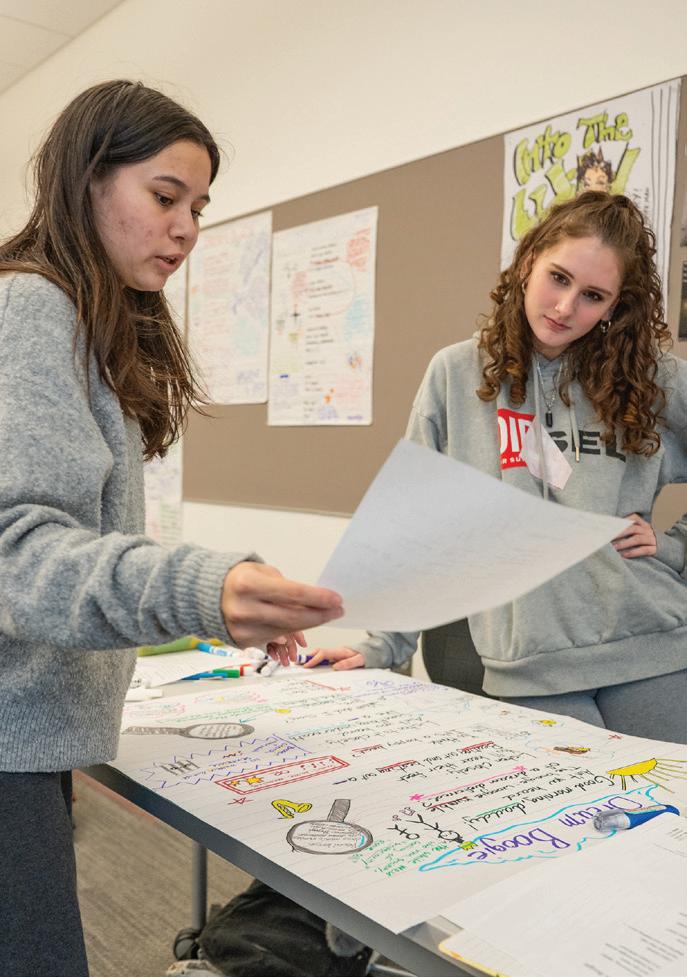
Clockwise from top left: English students interpret and analyze texts through visualizations, 11th graders in American Studies play various roles in a Cold War simulation, and students studying philosophy openly discuss ideas in the Agora Project.
Meet an Alum in the Humanities: JASPER PEET-MARTEL,
Class of 2010
Program Manager at Conducive Space for Peace
Jasper currently works with a Danish-based international NGO focused on peacebuilding and strengthening global civil society. As a program manager, he leads a combination of strategic and hands-on project work, including designing and co-leading global initiatives, coordinating research and learning efforts, and supporting policy engagement with governments and multilateral organizations. Facilitation and relationship-building with people and organizations worldwide are among the aspects of his work he finds most rewarding.
Prior to his current position, Jasper worked at USAID on a global program advancing locally led solutions to international development challenges. There, he led new partner engagement across a roughly $35 million portfolio encompassing dozens of projects in more than 25 countries. His responsibilities included advising on project design and technical approaches alongside locally based organizations and building learning frameworks to advance local leadership for more impactful U.S. foreign assistance.
Across his career, Jasper is most energized by identifying ways to support community-driven solutions so they can scale into lasting, meaningful change on some of the world's most pressing challenges.
FAVORITE THING ABOUT SAAS: “English classes at SAAS showed me how important clear writing and communication are, and learning to express ideas with humanity, introspective cross-cultural sensitivity, and clarity is something I rely on every day at work.”
SAAS SPOTLIGHTS: INNOVATIONS
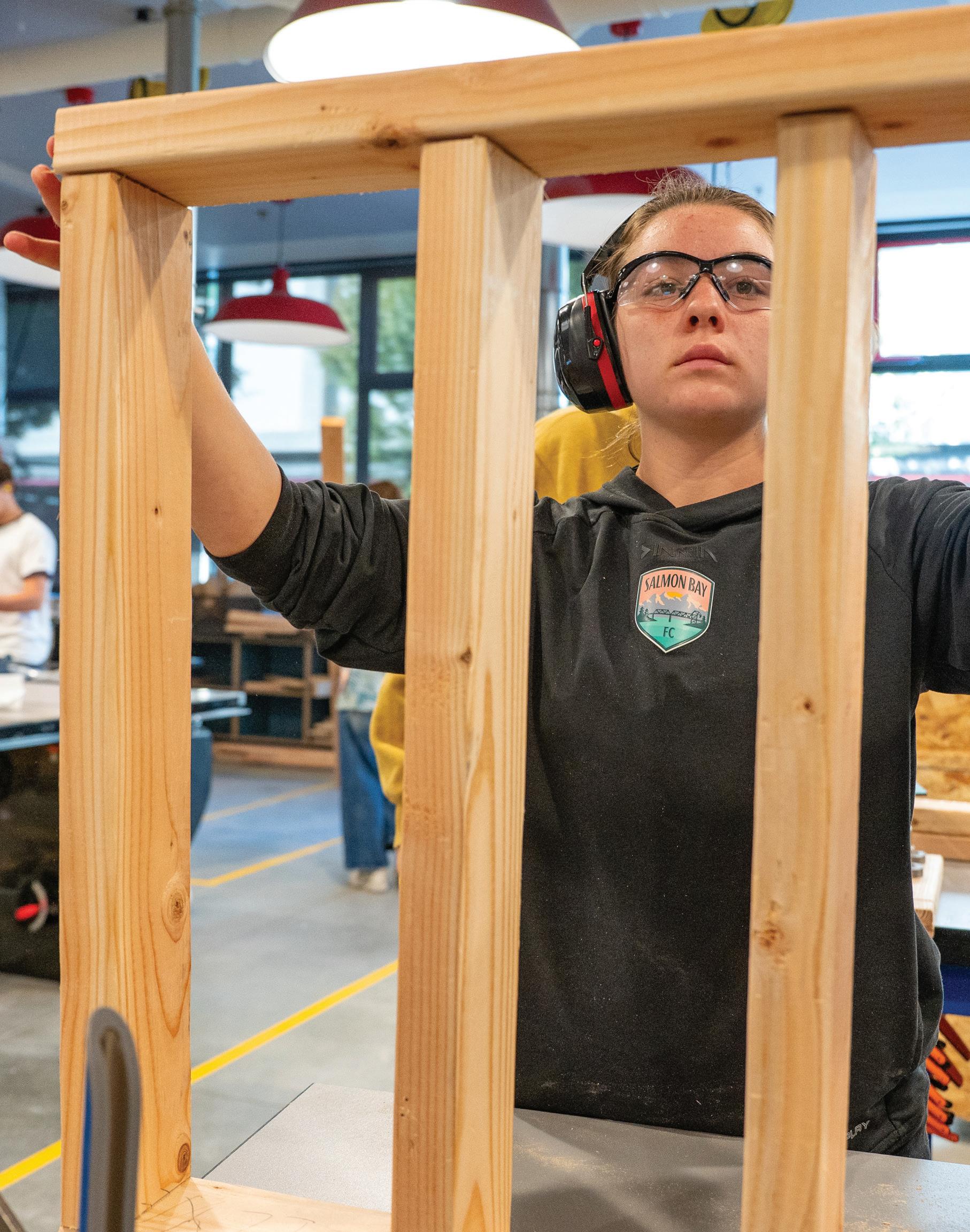
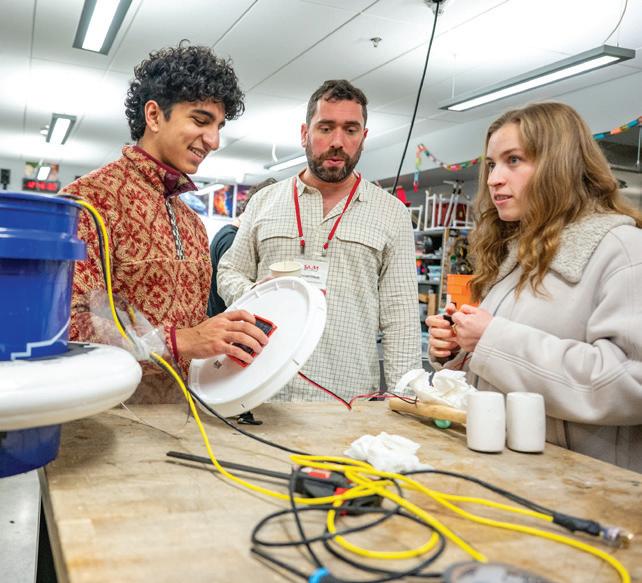
Students build pony walls in Foundations of Design Thinking— a class where empathy-driven problem solving meets creativity.
Faculty Profile: GINGER REINAUER
Innovations Teacher
Ginger is endlessly driven by a desire to make people, especially women or non-binary people, feel like they belong and are seen. During her time at Western Washington University, she started a non-profit to teach low income middle school girls robotics and programming. This set the stage for her love of teaching to blossom, and she’s since taught in various makerspaces around Seattle.
Ginger previously worked as a full stack UX designer, building logistics software for businesses such as Nordstrom and Nike. In 2024, she made the switch from tech to teaching and hasn't looked back. She loves seeing students try new things and helping them find hidden potential. Outside of SAAS, Ginger is a published author, a prolific sewer, and a fledgling woodworker.
At SAAS, Ginger combines her technical and creative skill sets while teaching Innovations classes. In her Prototyping with CAD and 3D Printing class, students excited about engineering, product design, or architecture use tools like laser cutters and 3D printers to design and create real objects their peers can use. In Sustainable Fashion Design, Ginger guides students toward a comprehensive understanding of the fashion business, including supply chain management, consumer behavior analysis, and hands-on techniques for upcycling textiles.
“My favorite thing about SAAS is the community. I love the people I get to work with and the diversity of backgrounds and skills we all can offer to students,” says Ginger. “It's amazing to see all the classes we're able to pull together because we're a swiss army knife of abilities—especially the Innovations department!”
INNOVATIONS By The Numbers
55 sections of Upper School Innovations courses launch students into human-centered problem solving, where they design, prototype, and build reallife projects, develop ways to address social problems, and explore emerging technologies.
9,000 square feet of brand-new Innovation space opened with our new Upper School building this fall— housing everything from power tools to microcontrollers—where students design, build, code, solder, sew, and collaborate.
324 new businesses pitched by students turned classrooms into incubators. In our Building a Business class and intraschool Business Plan Competition, students test their assumptions, build financial models, and pitch their ideas to panels of local entrepreneurs.
450 laser-cutting jobs etched and sliced everything from furniture pieces to functional engineering components, empowering students to turn digital designs into tangible objects.
2,906 course requests poured in from students eager to think creatively, build boldly, and pursue ideas that matter—showing how central Innovations has become to the SAAS learning experience.
24 new sewing machines whirred to life this school year as students stitched projects for our Sustainable Fashion class and other entrepreneurial undertakings.
146 dovetail joints have been cut in the woodshop so far this year. The strong, interlocking woodworking joint showcases students’ patience, precision, and craftsmanship.
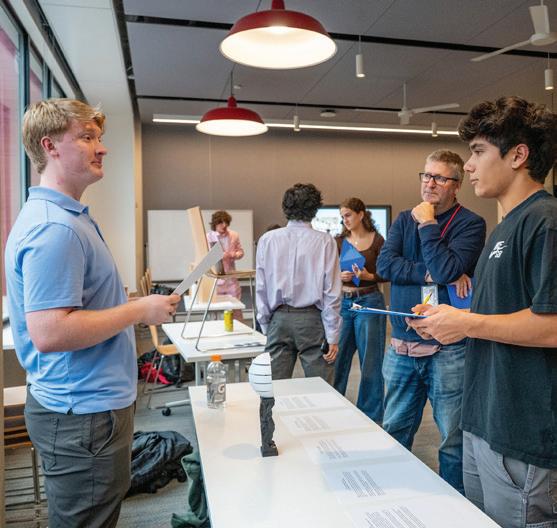
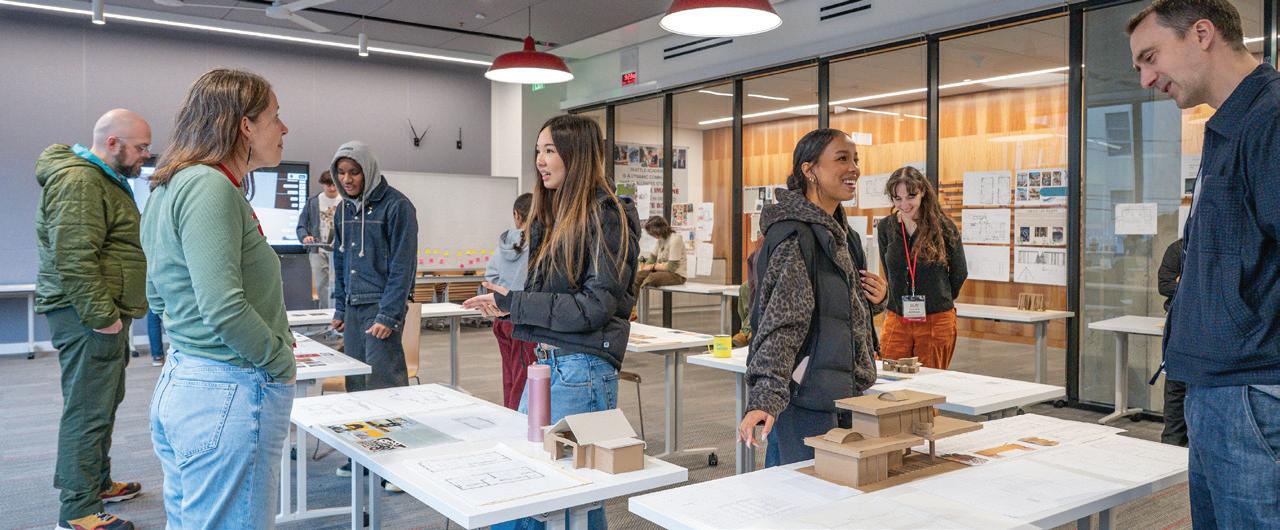
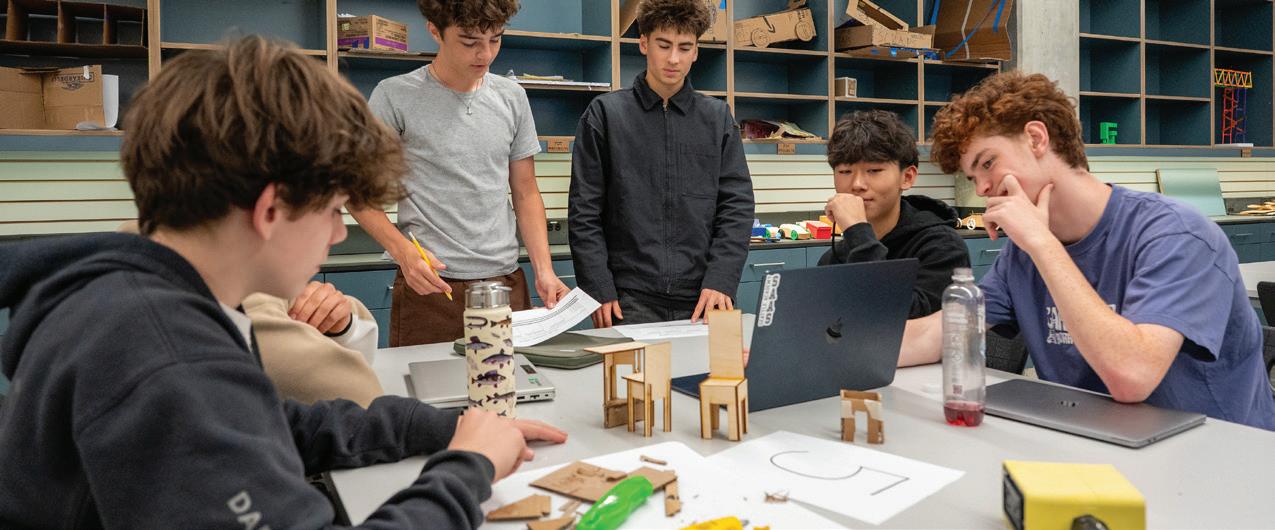
From top to bottom: Architecture students present the live-work spaces they designed for local artists, Design Thinking students build derby cars, and CAD Prototyping students share their chair designs, optimized for ergonomics, stability, and comfort.
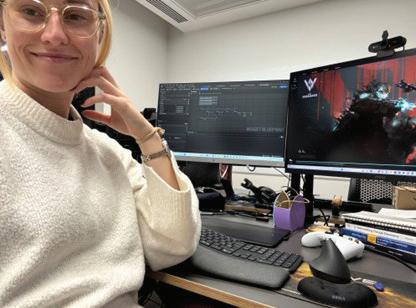
Meet an Alum in the Gaming Industry: SIERRA LORENZINI, Class
of 2015
Senior UI/UX Designer at CCP Games
As a Senior UI/UX Designer at CCP Games in London, Sierra works on Eve Vanguard, a first-person online game set in the universe of Eve Online. After graduating from Duke University, she has built her entire professional career in the gaming industry, with previous roles at two of the world's largest platforms: Xbox and PlayStation.
Her work sits at the intersection of design and player experience. She both implements game interface elements—the visual systems players interact with on screen—and ensures that the game is understandable, balanced, accessible, and above all, fun for real players. It's a discipline that requires both technical precision and deep empathy for how people actually engage with games.
Since joining CCP in March, Sierra has already contributed to a range of projects, including directional waypoint markers and the game's tutorial system. She's currently focused on redesigning the frontend menus to work seamlessly across both mouse/keyboard and gamepad inputs—a critical challenge for games that span multiple platforms.
Her day-to-day workflow moves between prototyping and implementing game elements, and ongoing collaboration with designers, artists, and engineers to ensure every element contributes to a cohesive player experience. It's work that blends creativity, technical skill, and a passion for gaming into a career doing exactly what she loves.
FAVORITE THING ABOUT SAAS: “I distinctly remember having to dress up as the philosopher Machiavelli and wearing this absurd robe with my hair gelled back, sitting in front of my class, having to argue that the ends always justify the means. Whenever I tell that story to my friends, they look at me like I'm crazy and say something to the extent of ‘what kind of high school did you go to?’ And to them I say, ‘I went to a school that forced me to see from another's point of view, articulate moral arguments, and be ok with looking silly in front of other people.’ These are all really valuable skills, and I'm very grateful I got to learn them so early in life. I know many who still haven't.”
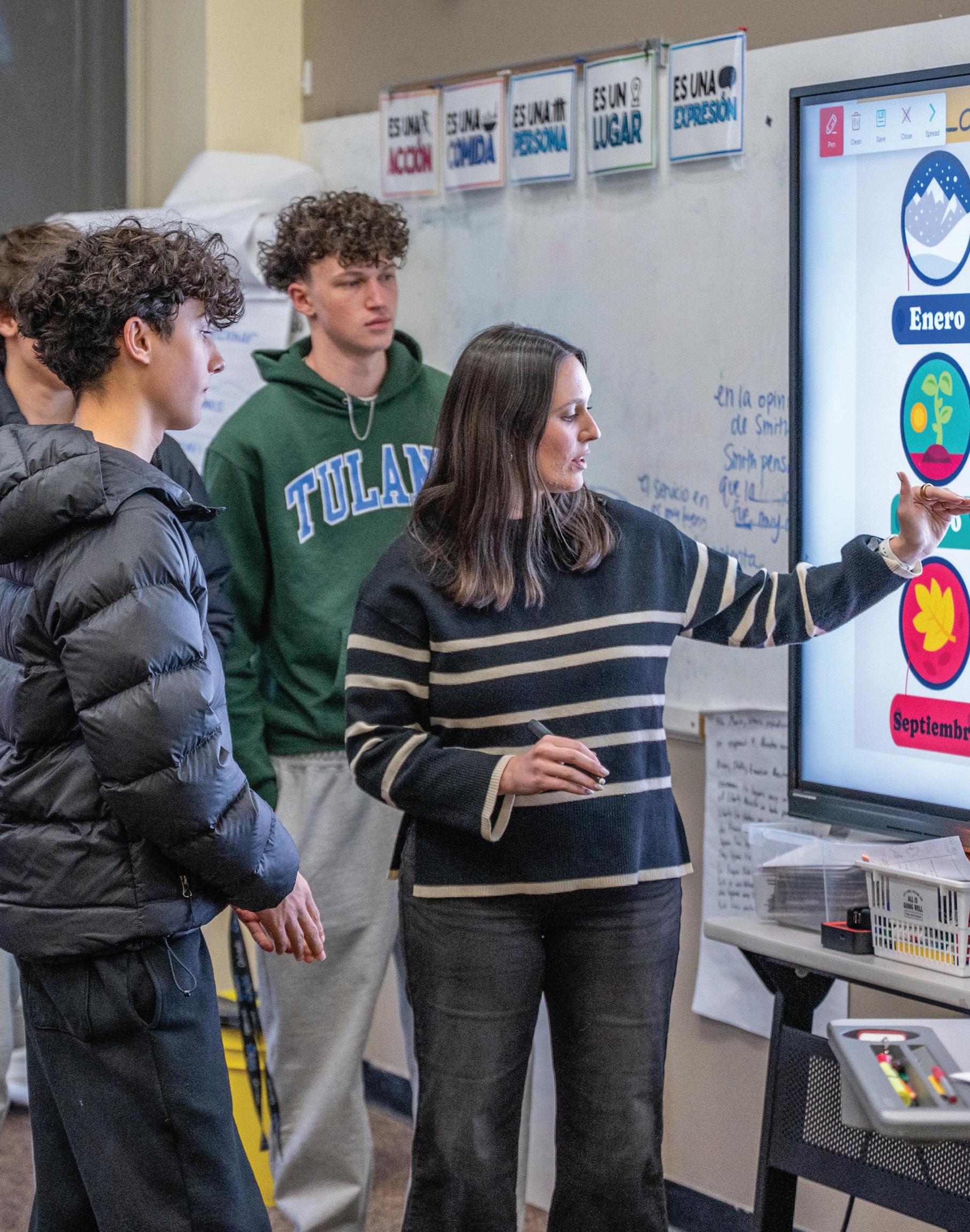
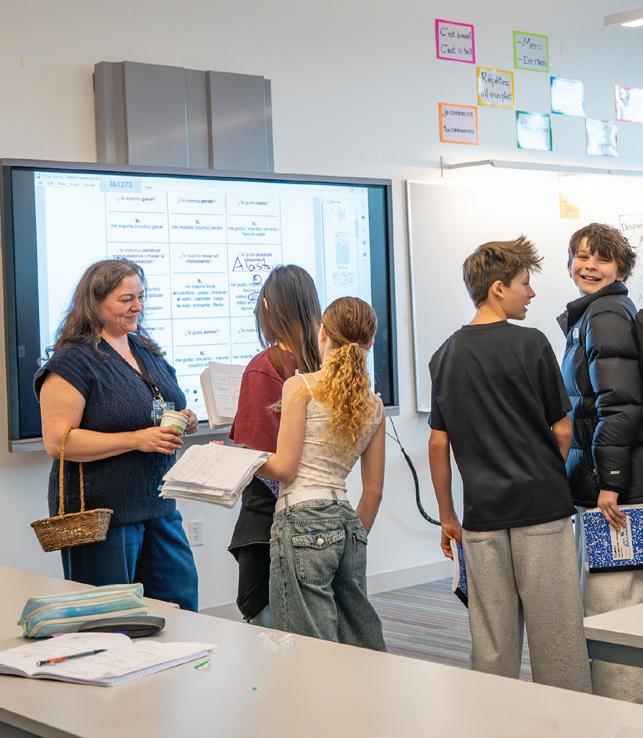
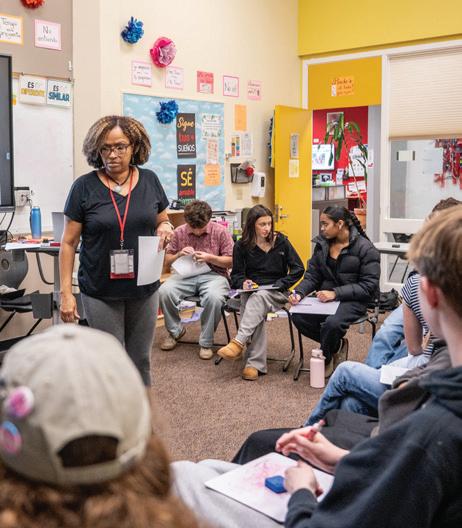
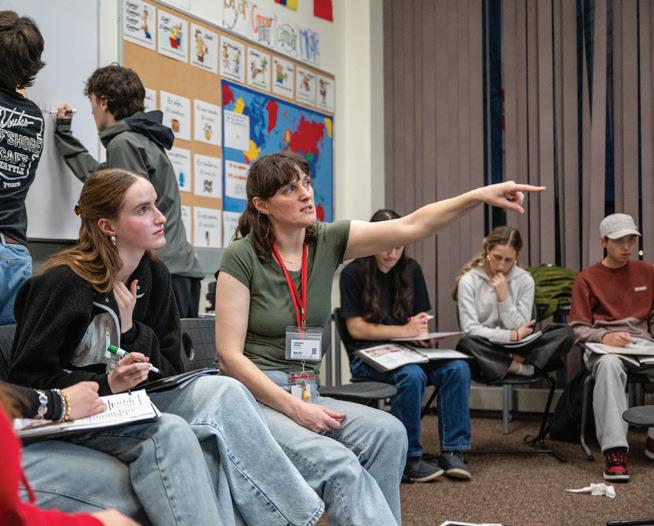
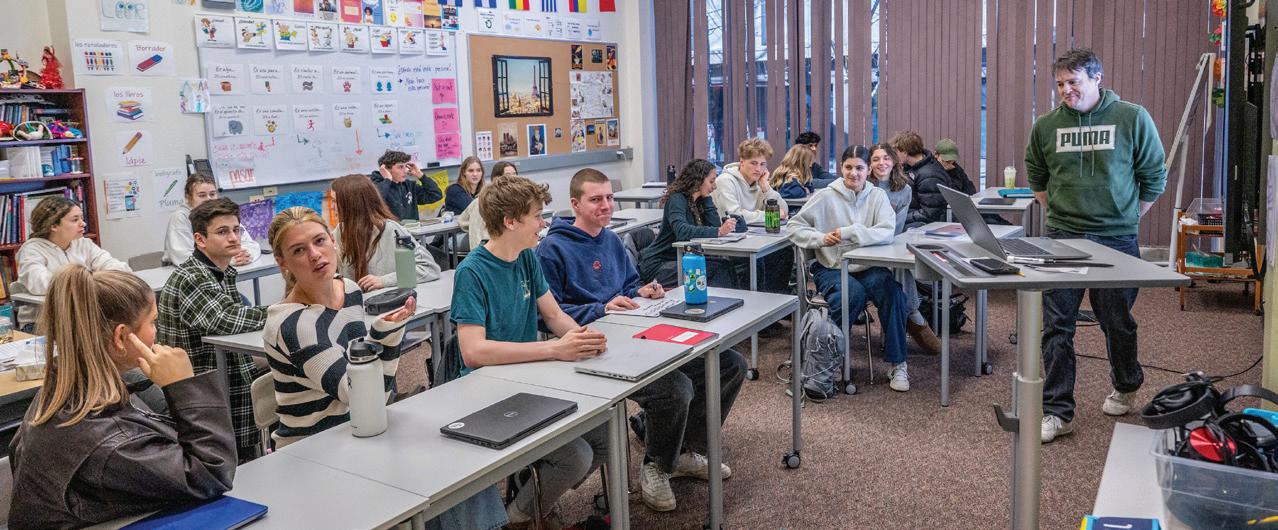
Spanish classes at SAAS emphasize practical communication skills, cultural competencies, and confidence in navigating real situations in a different language.
Faculty Profile:
STEPHANIE BLOOM
World Languages Teacher
Stephanie brought a layered linguistic background to SAAS when she joined our World Languages department in 2000. Born in Seattle, she grew up in California, France, and Spokane in a bilingual Frenchspeaking family. After earning her Master of Spanish Literature from the University of Washington, she spent a year working at a language school and singing in cafés in Oaxaca, Mexico.
At SAAS, Stephanie brings language classes to life. “You might picture, ‘oh, they’re just filling out worksheets.’ No, it’s not worksheets,” she says, describing a typical day in her classroom. “We’re constantly getting kids to stand up, talk to each other, bounce ideas off each other, be okay making mistakes while they’re talking.”
What’s kept her at SAAS for over two decades is—among other things—the school’s commitment to knowing each student. “We want to really get to know every kid, how they learn, and what makes them tick, and connect them with things they might be interested in,” she says, “because we have so much to offer here.”
WORLD LANGUAGES
By The Numbers 17
Conversation partners engage with each student in the average world language class, ensuring ample opportunities for authentic dialogue and cultural exchange.
39
"Nichos" were lovingly crafted by Upper School Spanish students to honor deceased public figures, bringing the rich traditions of Día de Muertos to life through meaningful research and artistic expression.
0
English words are allowed during French 5's spirited "hot takes" on cultural touchpoints—a testament to our students' fluency and commitment to full immersion discussions.
6
Distinct teas were savored and described during cultural immersion activities in Chinese classes, connecting language learning to sensory experiences and traditions.
10
Doctor-patient scenarios challenged Honors Spanish 5 students to navigate complex medical conversations, preparing them for real-life professional communication in the language.
Upper School language classes at SAAS include seven levels of Spanish, six levels of both Mandarin and French, and an academic Spanish course for heritage speakers, all incorporating active learning and real conversations.
Meet an Alum Making a Global Impact: MARGAUX JOHNSTONE, Class of 2021
Princeton in Asia Fellow in Kazakhstan
As a Princeton in Asia Fellow based in Almaty, Kazakhstan, Margaux is immersed in diverse projects. During the week, she teaches a public speaking course at Narxoz University, helping students develop communication skills that are essential for professional and civic life. Alongside her teaching, she contributes research and writing on air pollution at the Sustainable Kazakhstan Research Institute, addressing one of the region's most pressing environmental and public health challenges.
Margeaux also organizes guest lectures for students, collaborating with partners including the United Nations to bring global perspectives and expertise into the classroom. This multifaceted fellowship allows her to blend education, research, and international engagement in meaningful ways.
She describes the experience as deeply rewarding, particularly her work with students at Narxoz University. Their ambition, creativity, and drive to make a difference have left a lasting impression on her. Their enthusiasm and dedication remind her of students she knew at SAAS, reflecting a shared spirit of curiosity and purpose that transcends geography.
ADVICE TO CURRENT AND FUTURE STUDENTS: “Experiment! While you have all of the wonderful support and resources of the SAAS community, try as many things as possible. You never know what will stick, and you’ll never regret trying something, even if it feels unrelated to your future as you see it now.”
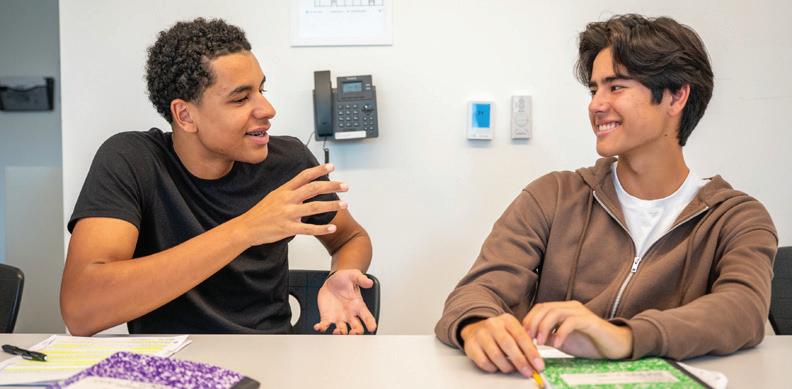
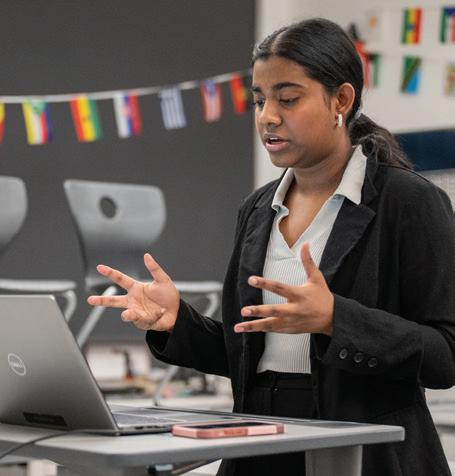
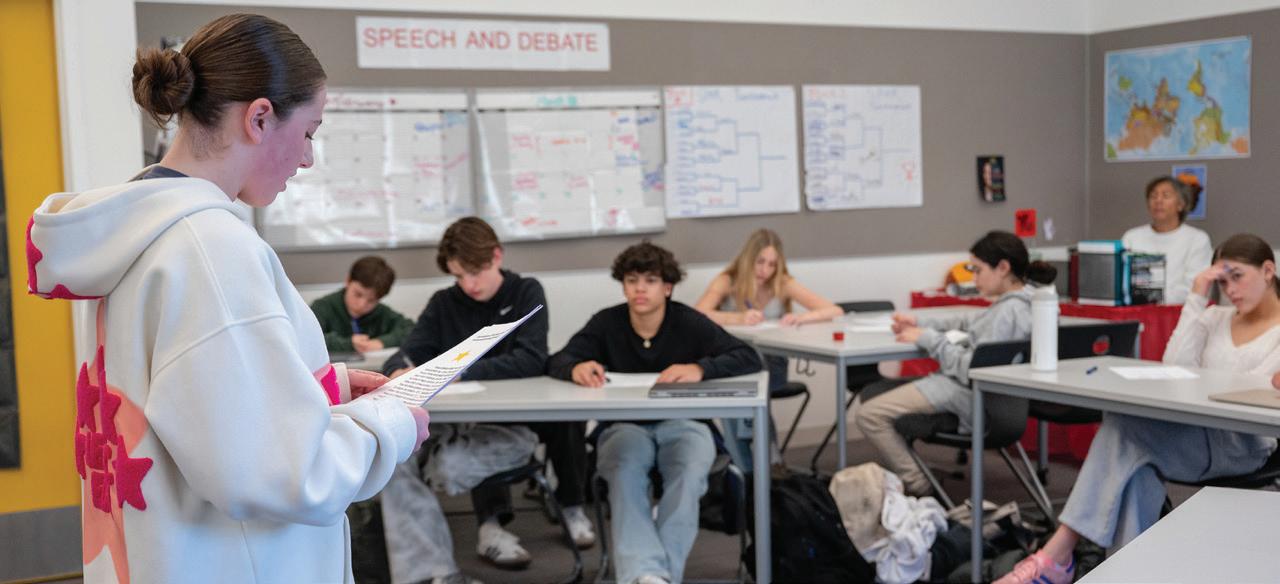
In Mock Trial, students learn about the legal process, legal reasoning, case presentation, and the function of lawyers in society as they prepare and present mock court cases.
Faculty Profile: CHRIS GOODSON
Rhetoric and Speech & Debate Teacher
Chris uses his extensive theater background to help students blossom as public speakers in our Rhetoric department. He holds an acting degree from Cornish College of the Arts, a master’s degree in theater arts from California State University, Los Angeles, and a PhD in Theater History and Theory from the University of Washington, where he researched the use of theater as a tool for community storytelling and empowerment. Before coming to SAAS, he taught cinema history, theater history, and dramatic literature at Seattle University and the University of Washington.
Now, Chris shares his mastery of communication and performance through rhetoric classes like Introduction to Rhetoric, Debate, and Speech, and as Head Coach of SAAS’s Speech and Debate program. He loves watching students grow their confidence, their quick thinking, and their ability to convey complex ideas—and sometimes take the leap from taking a rhetoric course to joining an academic team, where they’ll practice and compete outside of school.
“Oftentimes, students come into a course unsure of themselves and then, by the end of it, they’ve completely transformed into this person who exudes confidence,” he says. “Someone who wants to do more beyond the classroom, who wants to mentor other kids.”
RHETORIC
By The Numbers
6 competitive teams thrive under the Rhetoric Department's guidance: three class-based teams—Speech, Debate, and Mock Trial—and three extracurricular powerhouses— Model United Nations (MUN), Youth Legislature, and Ethics Bowl. Each one builds critical thinking and public speaking skills.
3 major competitive events will be hosted on campus in 2025-2026: SAASMUN, Mock Trial Jamboree, and the District 2 State Run-off for Speech & Debate—positioning SAAS as a regional hub for student rhetoric.
10 multi-county tournaments challenge our Speech & Debate team every season, providing opportunities to test skills against the region's top orators and thinkers.
300 student speeches are meticulously crafted and delivered each trimester in Intro to Rhetoric and Rhetoric 7—totaling over 900 speeches annually that build confidence and communication mastery.
6 practicing attorneys volunteer their expertise as Mock Trial coaches, bringing real-world courtroom experience and mentorship to aspiring legal minds.
$18,000 in Jeremy Houk Scholarship funds has empowered exceptional Speech, Debate, and Mock Trial students to attend prestigious summer programs in Forensics and Mock Trial. Named for SAAS alumnus Jeremy Houk '02, a talented Lincoln-Douglas debater who tragically passed away in 2003, this endowment created by his parents continues Jeremy's legacy by nurturing student leaders who share his dedication to rhetoric.
Rhetoric courses at
include Introduction to Rhetoric—where students build a foundation of research, writing, and oratory skills—plus Debate,
SAAS
Speech, and Mock Trial.
Meet an Alum in the Business of Rhetoric: AUGUSTA CHAPMAN,
Class of 2014
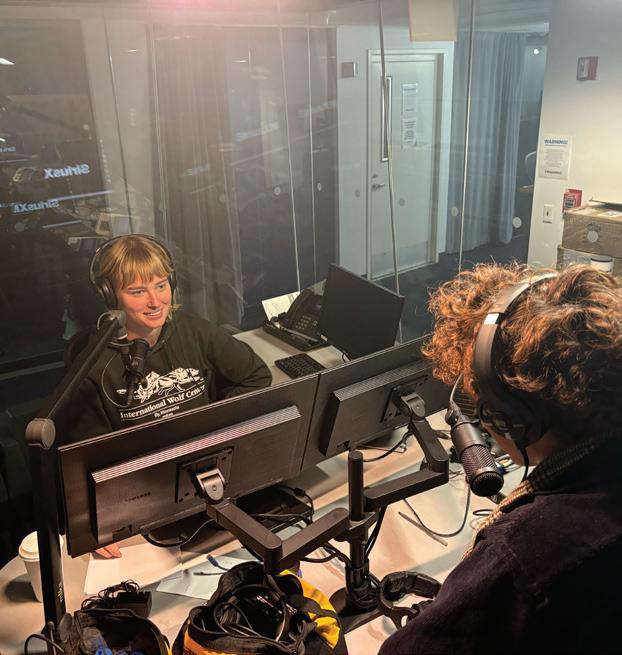
Associate Producer for Freakonomics Radio
Augusta is an associate producer at Freakonomics Radio, a podcast and radio show broadcast on NPR. She shepherds episodes from their earliest stages all the way through publication—a process she describes as a marathon-length puzzle.
Her recent series on horse markets illustrates the scope of her work. What began as a casual conversation between host Stephen Dubner and an economist who happens to be an equestrian evolved into a deep exploration of equine economics. Augusta dove into academic research, cold-emailed authors, and conducted preliminary interviews with a remarkable range of experts—economists, medieval historians, horse archaeologists, and insurance agents specializing in equine pricing, among others.
From there, she moved into the interviewing phase, booking guests for in-studio conversations, conducting additional research, preparing for interviews, reading books, and collaborating with colleagues on big thematic questions about what each episode is really about. The work sometimes takes her on real adventures; for the horse series, she attended a live auction in central Kentucky featuring 4,000 yearling racehorses, and she witnessed several sell for over $1 million each.
Once interviews reach a critical mass, Augusta creates 15-25 page scripts for hour-long episodes to hand to her editor. Through collaboration with hosts, engineers, coordinators, and fellow producers, a script then becomes a finished podcast and radio show.
FAVORITE THING ABOUT SAAS: "I remember all the reading and debating in class at SAAS—hours going at it with classmates about everything from Malcolm X and Watergate to free will to the novels Sometimes a Great Notion and Native Son. Now, I take that process of constant questioning and apply it to my work in radio and writing. It's a hands-on way of understanding, where ideas are like objects you pick up and get to know by reading and writing and talking and thinking, turning the perspective around and around."
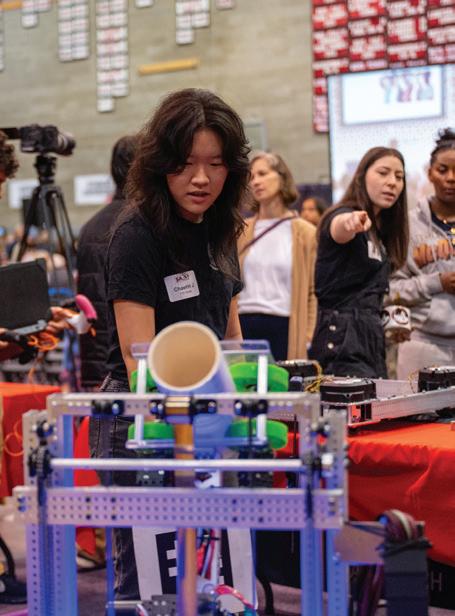
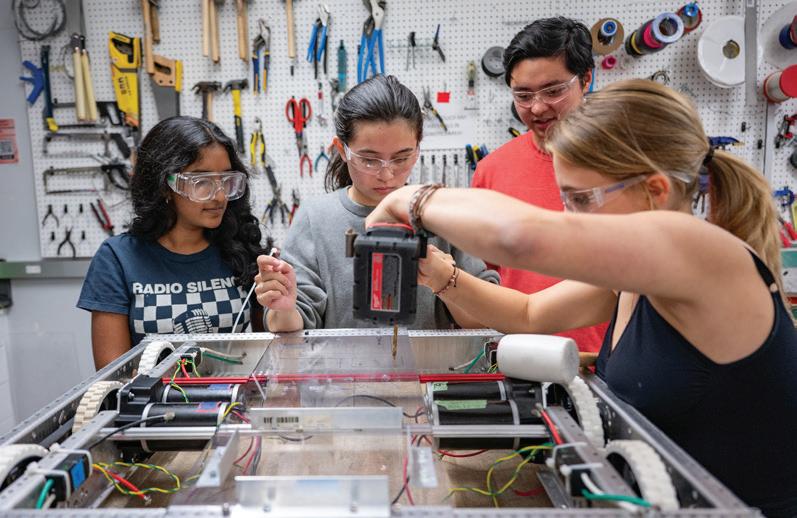
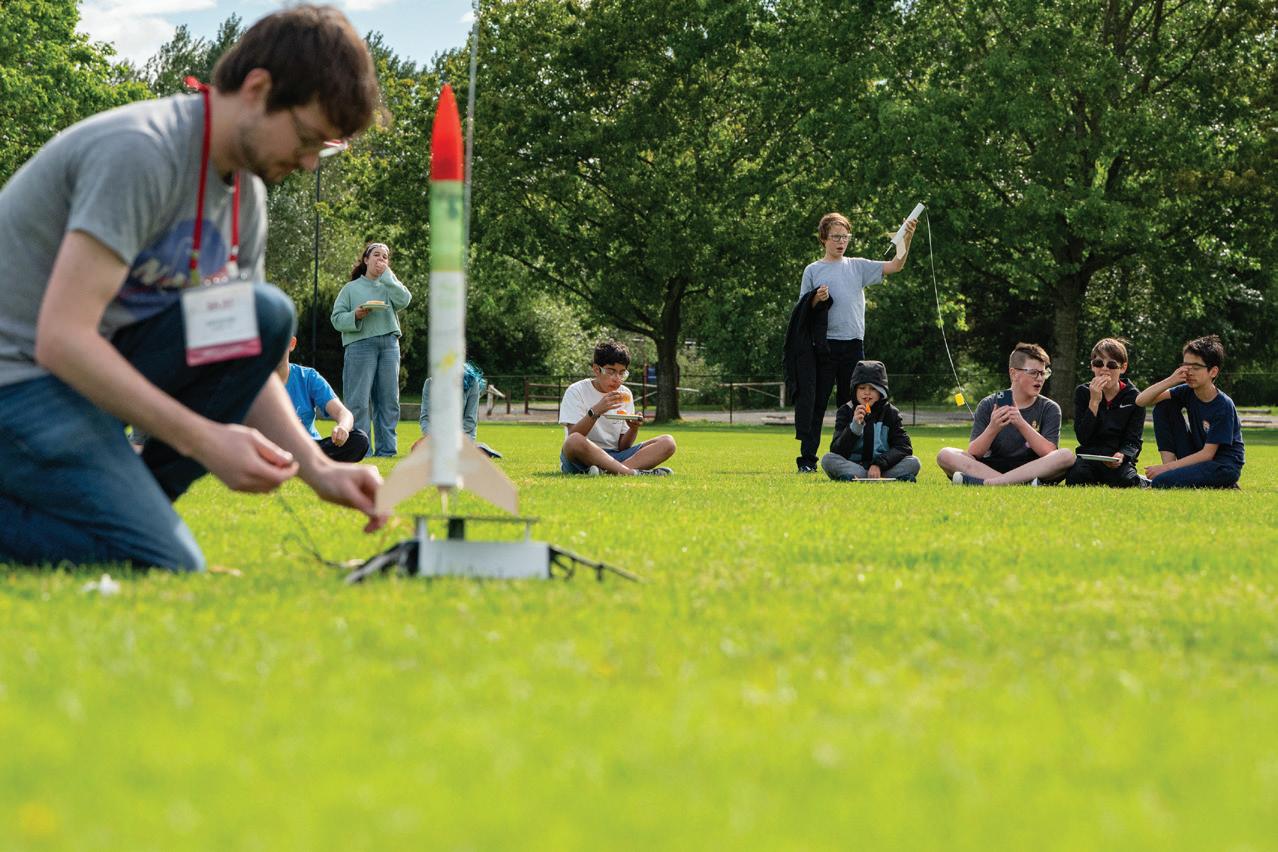
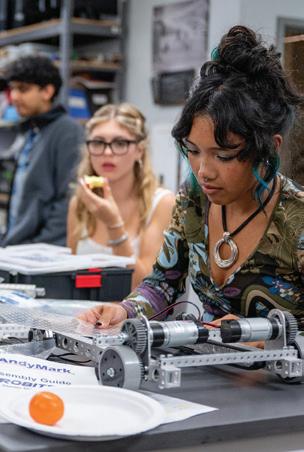
Clockwise from top left: Members of the award-winning SAASquatch Robotics team share their work at a SAAS Open House, upper schoolers work on their robot in the STREAM robotics lab, and students participating in Aviation Robotics launch the radio-controlled rockets they designed at our annual Flight Fest.
SAAS SPOTLIGHTS: ROBOTICS
Faculty Profile: GERALD ELLIOTT
Robotics Program Director
When Gerald started working at SAAS in 2013, the school had just twenty kids participating in our robotics program. Fast forward to today, and he’s grown the program to be one of the largest in the Pacific Northwest. More than 200 students participate annually, and Gerald has coached teams to six different world championships across three leagues.
Originally from Seattle, Gerald attended the University of Washington, where he earned a double major in History and Philosophy of Science before completing a Master of Teaching degree. At UW, he worked as a scientific instrument maker in the Oceanography Department for ten years before joining SAAS.
This year, he oversaw our robotics program as it doubled its course offerings and dramatically expanded after-school opportunities, thanks to our new Upper School building. Gerald believes that technical literacy strengthens every kind of thinker and welcomes students of all backgrounds, learning styles, and experience levels into SAAS robotics.
“Our students aren’t just building robots; they’re learning to navigate ambiguity and contribute to fields that don’t yet exist,” he says. “We hope kids join robotics because it is a fun way to learn cool skills— and because it prepares them for a dynamic future.”
ROBOTICS
By The Numbers
25
Robots designed and constructed by Upper School students, showcasing hands-on engineering in action.
140
Students actively participating across 16 specialized teams within SAAS Robotics.
17
Industry mentors from leading Pacific Northwest technology and engineering organizations dedicated their expertise to guiding our students.
4
Core competencies developed through our robotics program:
• Software development & programming
• Mechanical engineering & fabrication
• Electrical engineering & circuit design
• Computer-aided design (CAD) & prototyping
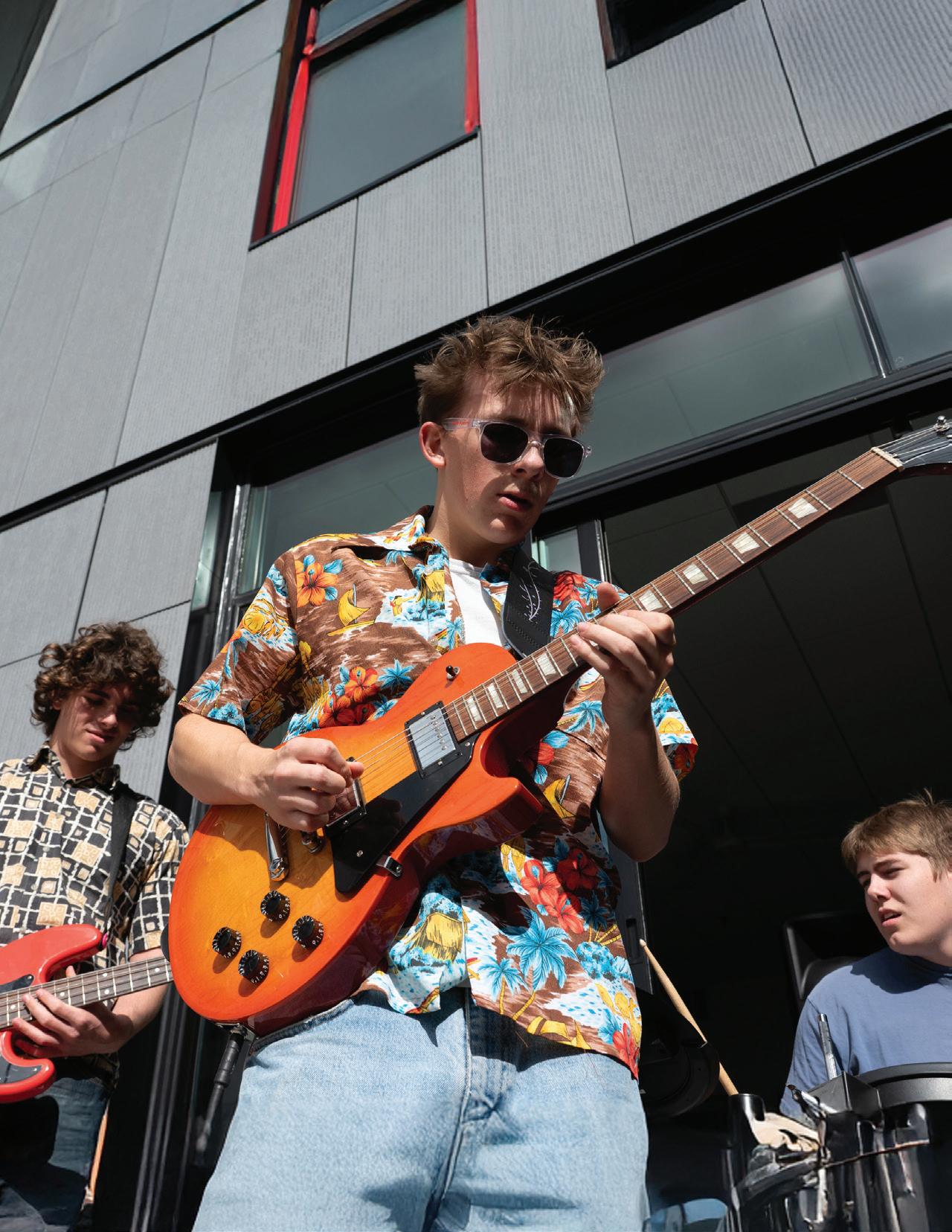
SAAS’s student band Paper Cut delivers a lunchtime performance in the new Upper School courtyard.
Faculty Profile: AMOS MILLER
Music Production Teacher
If you’re a hip hop fan in Seattle, you’ve almost certainly heard Macklemore and Ryan Lewis’ “Wings,” a powerful song dissecting the pitfalls of consumerism. But you may not know that Amos, a music production teacher at SAAS and acclaimed producer, played an important role in creating it—earning him a GRAMMY nomination in 2014. He worked with a local group of middle schoolers to produce the chorus, which features people singing in unison.
Building a career at the intersection of youth development and making music professionally is “what I’m most proud of,” says Amos. He’s facilitated music production workshops for young people around Seattle since 2003 and, in 2010, was honored for his work in the community with an invitation to “In Performance at the White House: A Celebration of Music from the Civil Rights Movement.” In 2015, he joined SAAS and started our signature Music Production program, which guides students in composing, producing, and recording original music using professional-grade equipment.
"We create a safe space for kids to express themselves in all genres of music,” he says. “It’s not about learning someone else’s song. It’s about, 'How do I find my own song?'"
ARTS By The Numbers
50 Upper School classes across theater, dance, music, and visual arts help students at every level develop an important life skill: creativity.
48 performances light up the SAAS calendar annually, from energetic Block Parties and polished advanced ensemble productions to our SAAS in the City showcase, graduation ceremonies, and special community events.
20 National competition awards were earned by SAAS Visual Arts & Media students in 2025, demonstrating excellence that's recognized far beyond our campus walls.
8 Upper School fashion designers showcased their creative vision at Bumbershoot's prestigious High Fashion High Show, bringing SAAS talent to Seattle's premier arts festival.
27 dedicated faculty members comprise the SAAS arts department, bringing diverse expertise and passion to nurture students' creative journeys.
5 sections of Sustainable Fashion and 2 sections of Fiber Arts now fill each year, reflecting growing student interest in textile arts that blend creativity with environmental consciousness.
135 students push their artistic boundaries in advanced-level classes spanning visual arts, dance, acting, and music—each developing their unique creative voice.
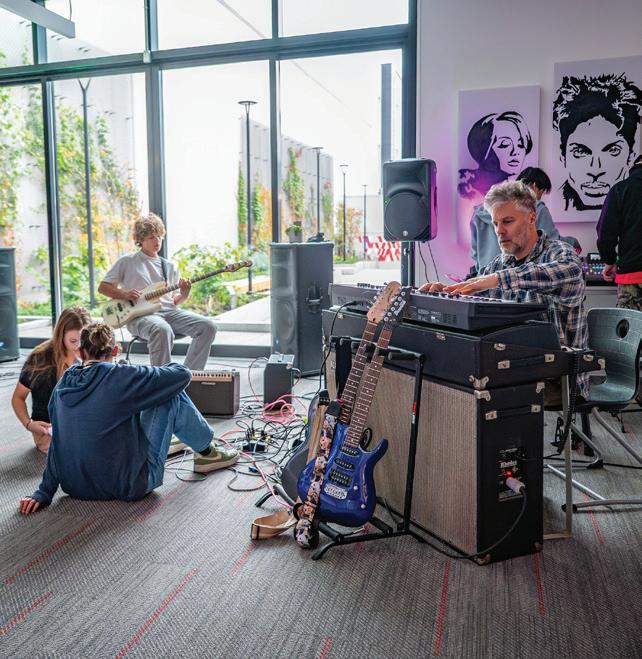
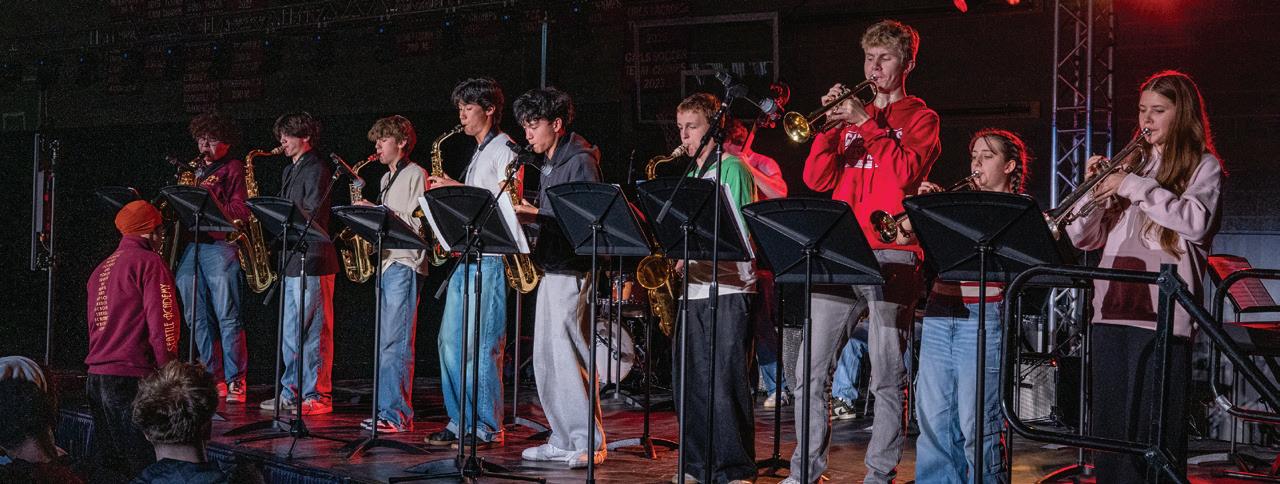
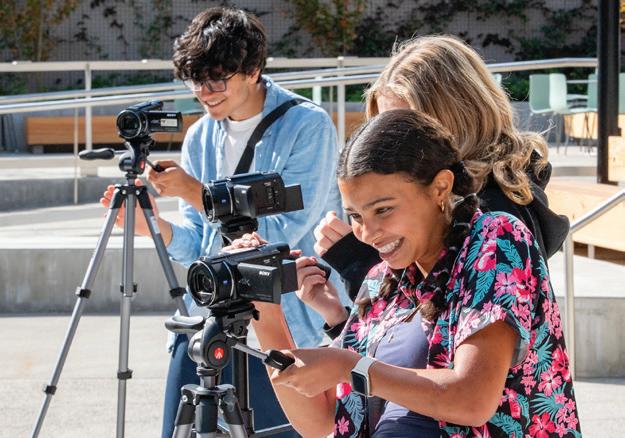
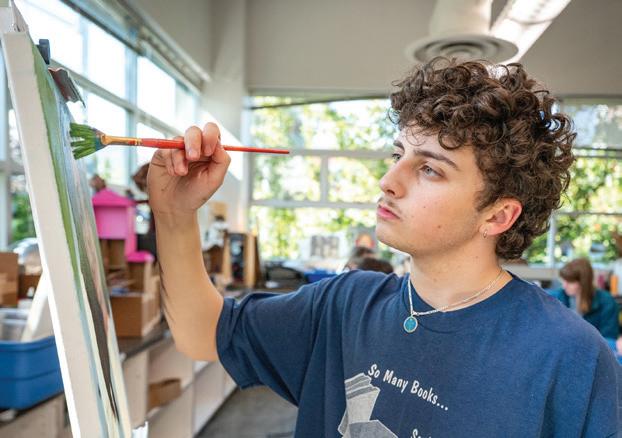
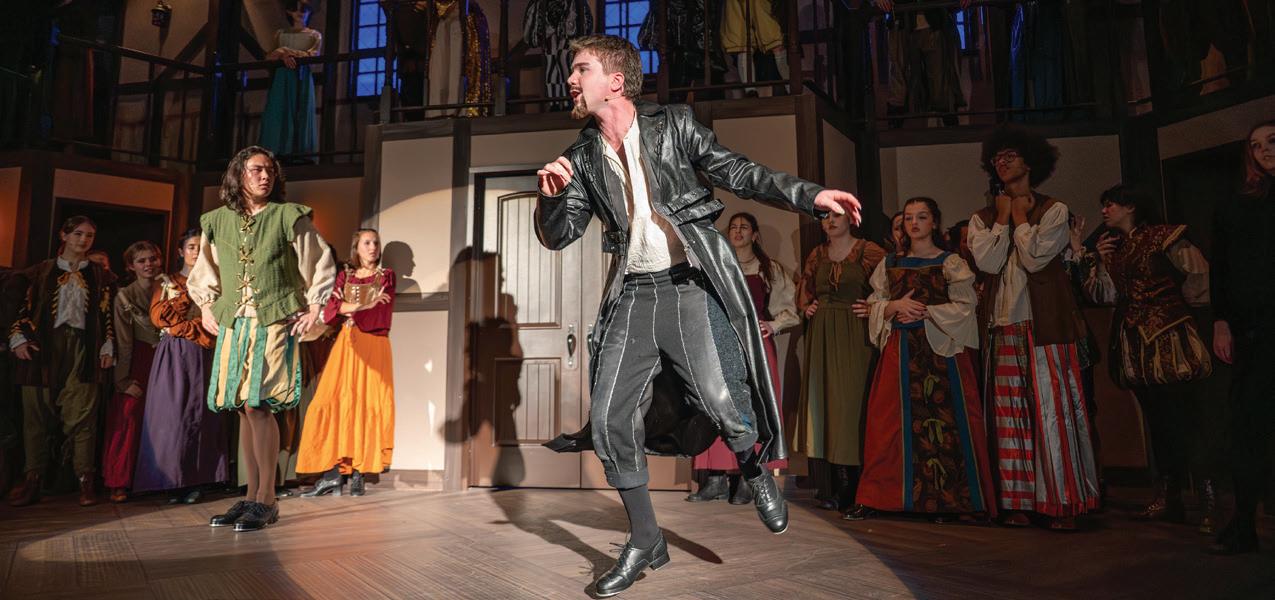
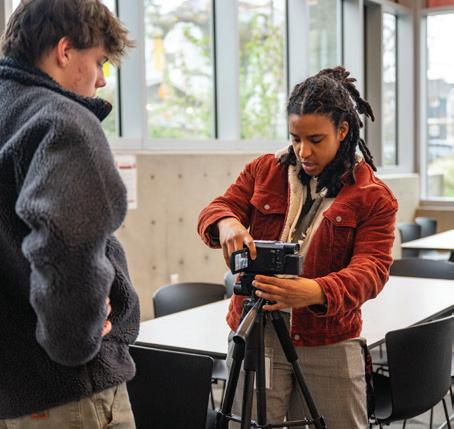
Clockwise from top: Jazz band students perform at SAAS’s End of Tri showcase, Advanced Visual Art students build their skills and portfolios, Upper Schoolers perform in the SAAS production of Something Rotten, and Intro to Film students practice using camera equipment in the Upper School courtyard.
Meet an Alum in the Arts: JAMIE PEARL,
Class of 2016
Photographer and Videographer
A photographer and social-first videographer based in Brooklyn, New York, Jamie’s work centers on portraiture and spans fashion, beauty, celebrity, editorial, commercial, and event photography.
Her portfolio includes projects for Nike, Air Jordan, Coach, H&M, Tommy Hilfiger, Steve Madden, Reebok, and Hoka. In the beauty and lifestyle space, she has shot for Kiehl's, Drunk Elephant, Starbucks, Shake Shack, and Blank Street Coffee. Her editorial credits include work for The New York Times, Cosmopolitan, Billboard, Paper Magazine, NYLON, Travel + Leisure, HypeBae, and Highsnobiety.
Beyond brand and editorial work, Jamie has provided personal capture for celebrities and artists including Alix Earle, Saweetie, Doechii, Nelly Furtado, and Dennis Rodman, as well as projects with Warner Records Music.
Whether she's on set for a fashion editorial with Urban Outfitters, covering an event for NYLON, or creating content for platforms like Pinterest and Shopify, Jamie brings a versatile eye and social media savvy to every project. Her ability to move fluidly between commercial, editorial, and celebrity work has made her a sought-after collaborator in New York's creative scene.
FAVORITE CLASS AT SAAS: "My favorite class at SAAS was Black and White Film Photography—my first introduction to the medium that truly shaped my entire life. I also did an independent study with art teacher Lily Hotchkiss exploring mixed media collages that incorporated my photography, which really expanded my idea of what photographic art could be."
Learning From the Pros
Our dedicated Arts faculty excel both as teachers and as working artists—bringing professional skill, projects, and connections into the student experience.
The 27 faculty members leading the Performing & Visual Arts departments at SAAS share one distinctive trait: they’ve each built careers blending education and professional art-making. Both skilled teachers and working artists, they create experiences for students that are deeply rooted in today’s real arts world.
In the classroom, our faculty inspire self-expression and teach fundamental skills to kids at every level. “All of our teachers are active creators who know how to flex projects to fit the needs of each student,” says Annalise Olson, Visual & Media Arts Department Chair and teacher. “They’re very attuned to the kids and create accessibility into all different art forms,” from ceramics to filmmaking to hip hop dance.
Outside the classroom, our faculty are also artists who share their work with our broader Seattle community and beyond. In a typical year, you’ll find SAAS teachers screening their films at festivals around the country, setting their dance choreography on local stages, performing with the PNB Orchestra, Seattle Symphony, and regional orchestras, showing their paintings or ceramic pieces in art galleries, and more.
Together, these strengths create a powerful experience for students. Supported by dedicated educators, they get to step into what it really means to be an artist in today’s world— learning from their teachers’ professional experiences, taking on real-world projects, and forming valuable, professional connections.
One way all this shows up is through a curriculum that connects to Seattle’s art scene. Students in Annalise’s Graphic Design class have designed posters for an event at the Showbox SoDo. Other students have worked with outside professionals through faculty connections with the 5th Avenue Theater, KNKX’s professional mentorship program, Love City Love, Sharing the Stage, and other organizations.
“To work with people outside of SAAS and be launched into a real-world setting like that is really good practice,” says Annalise.
Having professional artists as mentors also means that students get a glimpse into a wide range of career paths in the arts. And they pick up insights about what it would take to blaze their own path. “It’s really nice to see art careers in action,” says Nat S. ’28, a sophomore who’s taken dance, theater, and visual arts at SAAS. “It gives me a lot of hope for the future.”
Whether students want to develop a career in the arts or a personal creative practice, our arts department is filled with topnotch role models. “Looking at
our faculty, you see examples of people in a lifelong art practice,” says Michael Cruz, Performing Arts Department Chair. “People who are always learning.”
Our faculty also tap their expansive professional networks to bring in guest artists, allowing students to form professional connections. In the dance department, for example, guest instructors and choreographers visit on a weekly basis, exposing students to diverse styles. In a speaker series that film teacher Gabrielle Johnson runs in our Advanced Film class, students meet industry professionals, learning about different filmrelated jobs and pitching their own ideas.
One more commonality among our arts faculty: their passion for their art forms energizes their teaching. It infuses enthusiasm and care into each class, project, and school performance.
“What we share,” says Michael, “is that we can see that spark of joy or that spark of discovery” when students find a creative passion. “That looks familiar to us, and we care deeply about providing the circumstances in which those sorts of sparks can happen.”
“In an arts education, students are developing the skills to take something they have in their imagination and execute it to their satisfaction. They’re working on projects where there’s no one right answer. And they’re going to carry those skills with them, wherever they go.”
– Fred Strong, Dean of Arts
What Our a rts Faculty
a re Up t o a fter Class
Here are just a few examples of the rich backgrounds and projects our arts faculty bring to our school and our community.
Strings: Both of our strings teachers, Kim Zabelle and Liza Zurlinden, perform regularly with the Pacific Northwest Ballet. Liza also plays with the Seattle Symphony, and performing arts teacher Danae Howe sits on the symphony’s Board.
Dance: Dance Program Lead Alicia Mullikin is founder and director of El Sueño, an organization that uses art as a platform for community engagement, healing, and empowerment of marginalized communities. Dance teacher Amy Lambert wrote, choreographed, and produced This is a Drama/Comedy for her own dance company, RicketySticks Dance-Theater, and she also choreographs and dances professionally in Seattle.
Media: Film teacher Gabrielle Johnson recently presented her documentary Living in Silence at the United States Conference on HIV/AIDS and at the Charlotte Black Film Festival. She also serves as an assistant editor for a documentary film about the Seattle Black Panthers.
Visual Art: Sculpture and Innovations teacher Tom Flood has had a long career creating public and private sculptures. His public works around Seattle include the Madrona Tree sculpture at Madrona Elementary, the Millennium Flower Sculpture at Nova High School, and Pike Station, an eco-friendly, seven-unit residential/ commercial building, which won an American Institute of Architects award.
Vocal Music: Kaitlin Webster teaches and directs Middle and Upper School Theater classes and shows; and she also teaches Middle School vocal ensembles and directs the after-school Vocal Project. Kaitlin performs in Seattle choirs, including the University Unitarian Loft Choir.
Theater: Theater teacher and director Mike Cimino’s performance career has taken him to all fifty states on various tours. In Chicago, he worked at Second City and Steppenwolf. He has written for TV shows such as “Everybody Loves Raymond” and has produced original plays and musicals for local companies such as the 5th Avenue and Village theaters, and he continues to perform in the region.
Band: Mark Taylor, 6th and 7th grade band teacher, is one of the most in-demand saxophonists in the Pacific Northwest and a mainstay on the Seattle jazz scene. Mark is a member of Thomas Marriott’s band, Human Spirit, the Seattle Repertory Jazz Orchestra, and he regularly joins the Seattle Symphony for pops concerts and when they perform movie soundtracks live at Benaroya Hall.
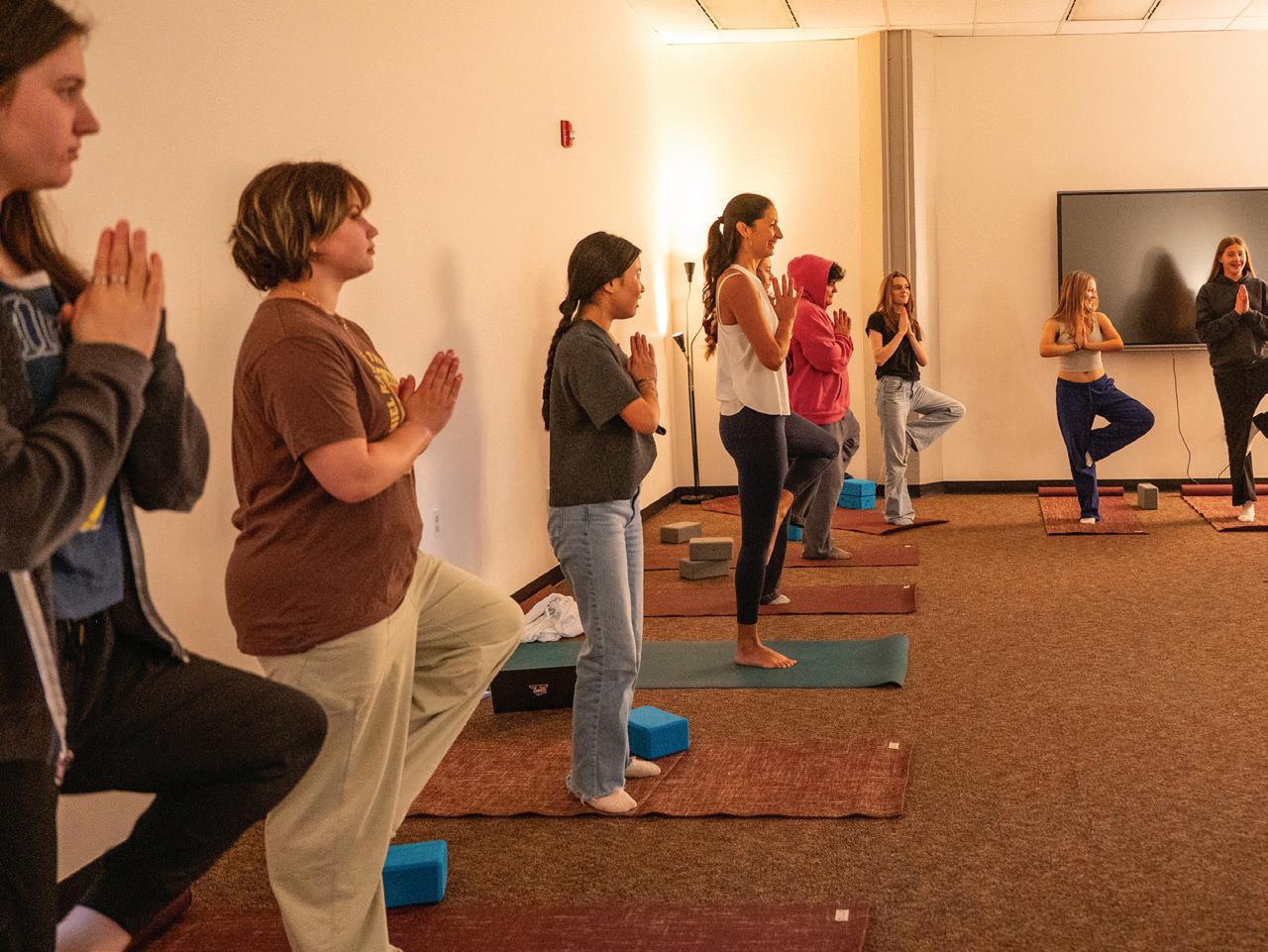
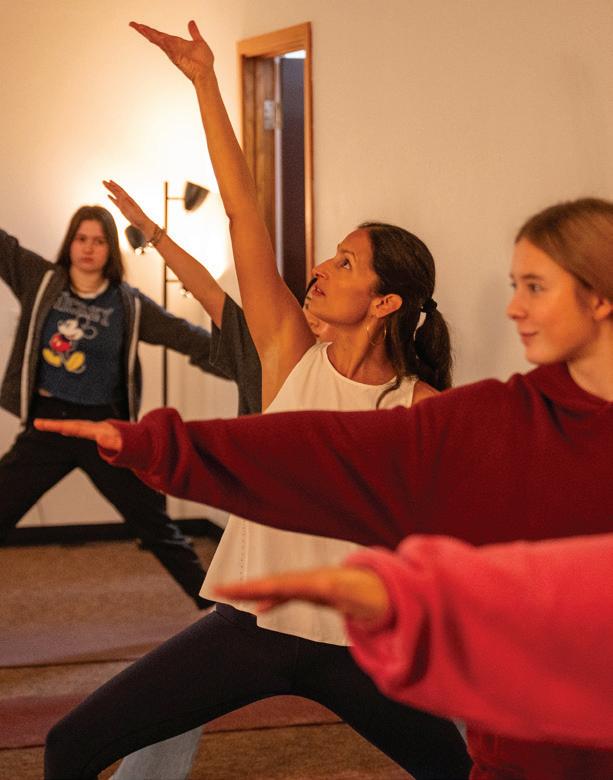
At SAAS, yoga students explore the ancient practice through the tools of selfknowledge and study, movement (asanas), breath work (pranayama), meditation, and relaxation techniques.
SAAS SPOTLIGHTS: PE/WELLNESS
Faculty Profile: NURA MADJZOUB
Yoga Teacher
Nura brings to SAAS 20 years of experience teaching yoga in different countries and to different populations—from middle schoolers to octogenarians. She has a bachelor’s degree in visual arts from Bennington College and has studied yoga, massage therapy, Pilates, and other healing modalities, which she draws on in her classroom teaching. In her Upper School yoga classes, students explore the ancient practice of yoga through the tools of self-knowledge and study, movement (asanas), breath work (pranayama), meditation, and relaxation techniques.
Born in Germany, raised in Zimbabwe, and having spent her adult life in Vermont, New York, Switzerland, and Canada, Nura also has a passion for travel. She’s run yoga retreats internationally for the past decade and recently launched a SAAS trip to the Caribbean Island of Curacao. There, students combine daily yoga and mindfulness practices with learning about the area's ecology from scientists.
PE/WELLNESS
By The Numbers
6
Mindfulness activities are offered throughout the trimester for 9th graders, empowering them to discover which coping strategies work best for them.
3
Annual visits to the Gates Foundation enrich our Global Health curriculum, where students witness firsthand how creativity and innovation drive positive health impacts across the world.
5
Fundamental lifts—squat, deadlift, bench press, overhead press, and barbell row—form the foundation of learning in Strength and Conditioning, as students learn proper technique and build functional strength.
12
Students and 3 teachers will journey to the Caribbean over spring break for the immersive Upper School Yoga and Ecology trip, blending wellness practices with environmental exploration.
3
Minutes of planking becomes a goal for students in Strength and Conditioning, building core strength and mental resilience throughout the trimester.
During SAAS’s Health Weeks each trimester and in 9th grade health class, students explore topics like adolescent brain development, stress reduction, sleep, nutrition, and sexuality education.
Meet an Alum Working in Wellness: PHILLIP BERRY, Class of 2006
Manager and Co-Owner at Athletic Form
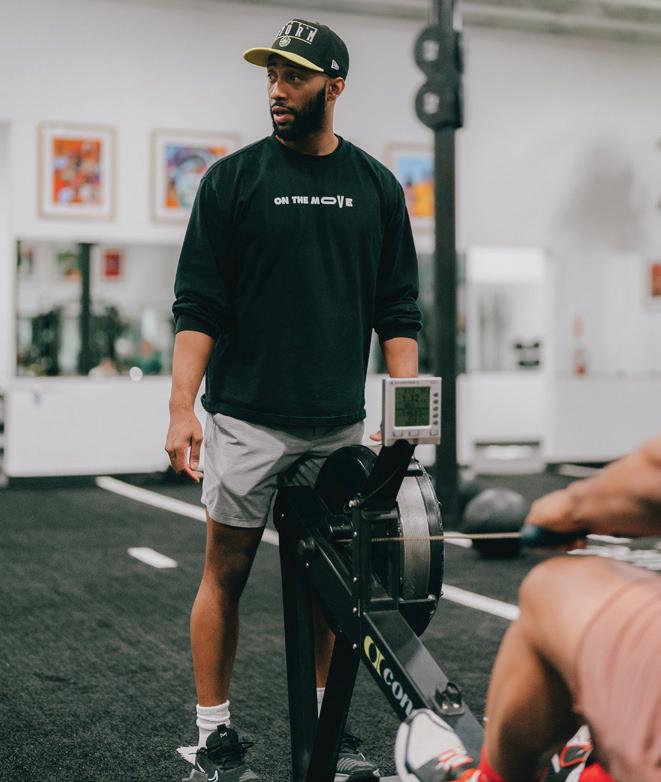
Phillip is the manager and partial owner of Athletic Form, a fitness facility in Seattle's SODO neighborhood. He grew up in South Seattle and attended Hawthorne Elementary and University Prep Middle School before transferring to SAAS for his sophomore year. His connection to the school deepened as he continued coaching there until 2013, spending a decade as part of the SAAS community.
After high school, Phillip attended the University of Washington to study architecture before discovering his true passion lay elsewhere. Following time away from academics—during which he coached at SAAS and worked in fitness—he returned to school and earned a degree in kinesiology from Washington State University. The bold move was inspired by the encouragement of his mentors at SAAS, Lauri Conner and Rob Phillips.
At Athletic Form, Phillip continues his connection to SAAS, working with students through the facility's student athlete program and even collaborating with SAAS’s track team. He credits SAAS with teaching him to step outside his comfort zone—from entering photography contests to performing on stage to embracing the outdoors on the Senior Yukon Trip. Today, he remains dedicated to supporting young people as they discover their own passions.
FAVORITE THING ABOUT SAAS: “I was incredibly fortunate to create relationships with the SAAS faculty and staff, particularly with my high school track coach, who turned into a lifelong mentor. Throughout my track years and into young adulthood, they provided unwavering encouragement, especially during moments of uncertainty about returning to college to pursue new interests. Their reassurance that it was never too late to go after my dreams is what pushed me to go back to school to get my kinesiology degree. It’s a message that continues to inspire me today.”
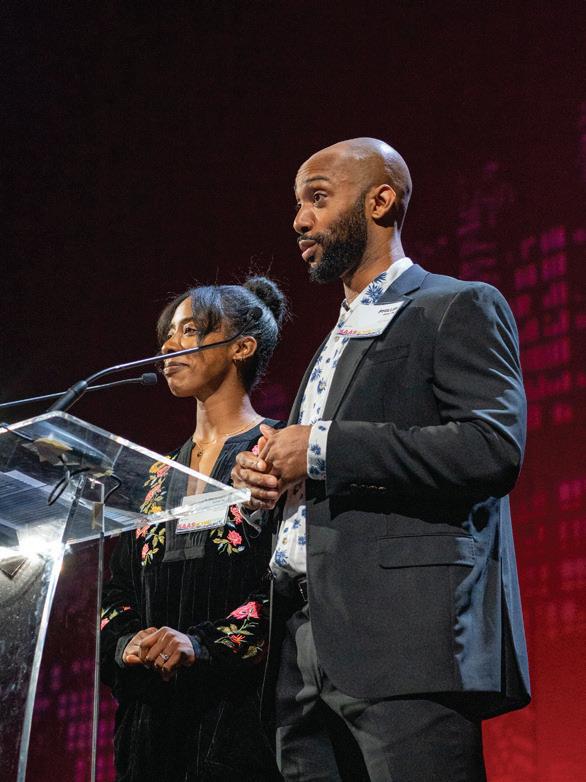
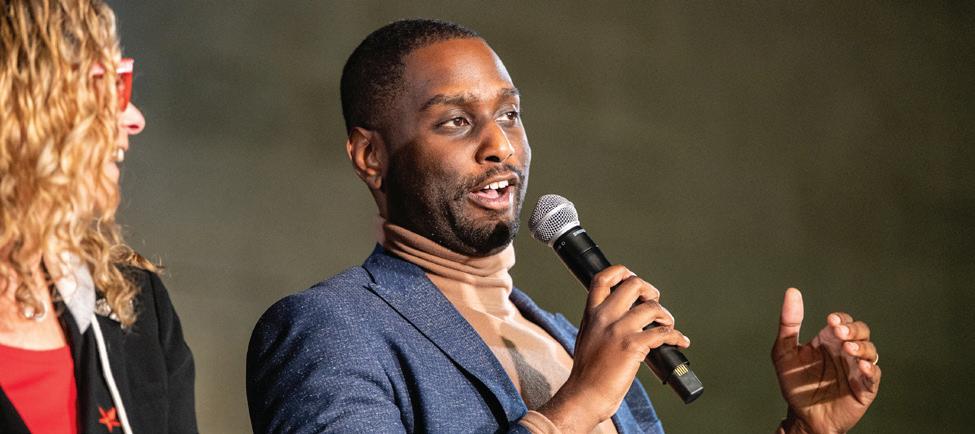
Phillip Berry ’06 joins his sister, Achijah Berry ’10 (also an alum and a current SAAS dean), in speaking at SAAS in the City, our largest community-wide celebration of the year.
SAAS SPOTLIGHTS: ATHLETICS
SAAS Baseball had a standout debut season in the spring of 2025, finishing third in the Metro Sound Conference.
Faculty Profile: MAX BAYERN
Assistant Athletic Director
Max brings a rich and varied background in youth development and sports to SAAS. He’s spent time working as an Athletic Director at the Boys and Girls Club, Assistant to the Principal and Director of Admissions at Seattle Preparatory School, a baseball coach at Shoreline Community College, and a baseball and basketball coach at Seattle Prep. He holds a master’s degree in athletic administration from Central Washington University.
At SAAS, Max helps lead and develop our athletics department, supports our student-athlete leadership program, the Cardinal Council, and coaches sports including baseball, flag football, golf, and basketball. Last year, he supported the launch of two brand-new teams: girls flag football and boys baseball. Both inaugural teams showed up with inspiring enthusiasm, skill, and dedication.
“I remember the first day of flag football practice, when some of the athletes had never thrown or caught a football. But everyone was learning and soaking it up, and at the end of it, I remember saying how proud of them I was,” says Max. And in the first baseball season last spring, “it was an outstanding experience to collaborate with our student-athletes, coaches, and SAAS community,” he says. “The inaugural team built the foundation and excitement for the future Cardinal baseball players.”
ATHLETICS
By The Numbers 13
Seniors from the class of 2025 are taking their talents to the next level as college athletes. 35 SAAS athletes have competed at the collegiate level since 2022.
38
Upper School teams competed throughout the 2024-2025 season, offering Cardinals countless opportunities to represent SAAS with pride and determination.
494
Upper School students participate in athletics, with many multi-sport athletes embracing the challenge of competing throughout different seasons.
11
school records were shattered, 3 Metro Championships were claimed, and 2 State Academic titles were earned in the last year. Cardinals continue to soar to new heights both on the field and in the classroom!
SAAS cross country, soccer, volleyball, and ultimate athletes (among many other sports) compete at a high-level in the Metro League, a storied athletic conference in Washington.
Meet an Alum in Athletics: CAM BARWICK, Class of 2011
Vice President of Investment Strategy & Analytics at Harbinger Sports Partners
Cam recently joined Harbinger Sports Partners as Vice President of Investment Strategy & Analytics. Harbinger is a sports investment fund specializing in acquiring minority ownership stakes in franchises across the "Big 3" professional sports leagues—the NFL, NBA, and MLB.
In his role, Cam is responsible for sourcing and evaluating investment opportunities across the sports landscape. This means identifying potential deals, conducting rigorous financial analysis, and helping determine price points. It's a position that sits at the intersection of sports, finance, and strategic decisionmaking—requiring both quantitative acumen and a deep understanding of what drives value in professional sports franchises.
While fellow Seattle Academy alumni might lobby for investments in the Seahawks or Mariners, Cam's focus remains on the numbers. His job is to cut through the emotion and evaluate opportunities with analytical rigor, helping Harbinger make smart, disciplined investments. It's a role that combines analytical expertise with the dynamic world of professional sports ownership, positioning Cam at the forefront of this investment landscape.
FAVORITE CLASS OR PROJECT AT SAAS: “The end-of-year American Studies project, Civil Disobedience, was particularly formative. We worked with a randomly-determined group of students for weeks on end with a singular deliverable at the conclusion of the project. The skills that are honed in that environment—team-building, collaboration, negotiation, debate, and public speaking—mirror so much of the work I’ve done later in life.”
From Elite Athletes to Educators
In a math class at SAAS this fall, the 8th graders in the room had fallen completely silent. Their eyes were glued to their teacher, Ginnie Crawford, as she captivated them with tales from her career as a professional track and field athlete, competing as a two-time national champion on Team USA.
There are 10 hurdles in a race, Ginnie explained. During practice, she’d run the hurdles 20 times. How many hurdles did she jump each practice? (Students did the math: 10 x 20 = 200.) 200 hurdles is what it took to prepare for a race; that’s the power of repetition. “The more you practice something, the better you get,” Ginnie said. “That’s why we have independent practice in math.”
As a math teacher, Middle School dean, and basketball and track and field coach at SAAS, Ginnie draws on her background as a professional athlete daily. Whether designing creative lesson plans, mentoring students,
or coaching at a game, she conveys the lessons she learned as a track star: the perseverance, teamwork, and positive self-talk that apply on the sports field and in so many other arenas of life.
Transitioning from professional athlete to educator may seem like an uncommon path. But at SAAS, it’s anything but. Our classrooms, hallways, and athletic fields are filled with former elite athletes channeling their passion and drive into supporting students—Major League Baseball and Soccer veterans coaching SAAS sports teams, former Division I athletes and coaches teaching PE, a previous U.S. National Team rower training students on the mental side of sports, and more.
These teachers, coaches, and leaders have followed common threads of excellence and teamwork through their sports careers and their time at SAAS. Now, they use their first-rate athletic backgrounds in varied ways, helping make SAAS the
At SAAS, a cohort of former professional and high-level athletes share their winning mindsets, resilience, and penchants for teamwork, strengthening our school community in expected and unexpected ways.
rigorous, close-knit community that it is.
One such common thread is a drive for continuous growth and improvement. “As an athlete, you’re wired to try to be the best in the world,” says Ginnie, “and that goes anywhere with you.” It’s a value that rings true in our school culture, she says.
At SAAS, that looks like constantly elevating our student programs, developing new opportunities for kids to explore passions, and supporting faculty so they can best support each individual student.
It’s an attitude of, “we’re going to create the best school in the Pacific Northwest, the best student experience,” says Ginnie. “Students who come here are going to get something they won’t get at any other school.”
Another thread that reaches from athletic fields to the SAAS experience: teamwork. Faculty at
“Ginnie is one of the best coaches I’ve had. She’s helped me improve my confidence and pushed me to do things I wouldn’t do on my own. I always remember when she told me she wants me to be like her or better—it stays with me that she thinks I can do it.”
– Laila B. ’27 on working with Ginnie Crawford
SAAS continuously collaborate across disciplines and step up to support each other and students, says Craig Tomlinson, a former Seattle Sounders player who’s coached, taught PE, and led community development initiatives at SAAS since 2001.
“It takes me back to my time as a team member,” he says. “What it means to be a teammate, to be unselfish, doing what it takes to achieve a collective goal… at SAAS, there’s a teamwork mentality with how we communicate and appreciate each other.”
The athletes-turned-educators in our community also bring powerful mindsets that serve every student. Athletic success is built on a growth mindset, adaptability, and resilience—qualities deeply valued at a school that emphasizes innovation and entrepreneurship.
One distinct example: SAAS math, psychology, and Study Skills teacher Sarah Smith. Drawing
on both her psychology degree and her time rowing on the U.S. National Team, Sarah coaches students on their mindsets through her mental training program in our athletic department and her Performance Psychology class. She teaches the mental tools needed for optimal performance across arenas: anxiety regulation, imagery, positive self-talk, setting process-based goals, and more. The impact on students is profound.
“Mental training puts a huge emphasis on confidence and progressing as a person in order to progress as an athlete, so I think all of the skills transfer into life outside of sport,” says Sadie Honig, ’25, who built a mental toolkit with Sarah at SAAS and now runs cross country at Colorado College. “It’s not only impacted my level of performance, but it has also increased the amount of fun that I have in my sport.”
In and outside of Sarah’s mental training program, the unstoppable mindsets of pro athletes shine
through at SAAS. Ginnie often finds herself coaching studentathletes and math students alike through challenges that feel daunting. Sometimes just sharing her own experiences or perspective can make a big difference.
“I think about the way I responded when I didn’t make the team or didn’t win the race… you pick yourself back up and try again,” she says. “And you can apply that to anything.”
The same lessons that helped numerous SAAS faculty excel as high-level athletes help students grow across arenas, says Ginnie. Whether in athletics, academics, the arts, or beyond, SAAS kids are developing universal keys to success: strategies to set and pursue effective goals, mindsets that center growth, and the resilience to adapt through challenges, big or small.
In Good Company
Meet Some of the Elite Athletes and Coaches Who’ve Joined Us at SAAS
Ginnie Crawford
As a college athlete at the University of Southern California, Ginnie won four National Collegiate Athletic Association championships, was an All-America selection for the university, and earned Pac-10 Freshman of the Year. Her success in college paved the way for a professional track & field career, which included representing the USA on four World Championship teams, winning two USA championships, and competing in over 20 countries. Now, Ginnie builds community and mentors students as the 8th Grade Dean of Students, a math teacher, and a basketball and track and field coach at SAAS.
Achijah Berry ’10
Craig Tomlinson
After graduating from The Ohio State University, Craig started his professional soccer career with the Tennessee Rhythm, then was acquired by the Seattle Sounders where he was a consistent starter for nine years. His 135-game soccer career included 22 goals and seven assists. He also participated in Jamaica’s national senior soccer team program. At SAAS, Craig coaches soccer, teaches PE, and directs the school’s youth development programs in the Greater Seattle area, including South Park Summer Camps and Rainier Prep enrichment programs.
After graduating from SAAS in 2010, Achijah was recruited by the University of Oregon, where she was a four-year starter on the women’s soccer team. Her senior year, she became the team’s cocaptain and had the most playing time of any player: 1,739 minutes. After graduating with her degree in Family and Human Services, she returned to SAAS and is now the Middle School Dean of Student Life, a PE teacher, and a soccer coach.
Izzy Gilman-Geronimo
Izzy competed on Seattle University’s NCAA Division I softball team as a four-year starter, becoming a three-time MVP for the team and earning First-Team All-Conference all four years. After graduating with a business degree, she earned a master’s in Sports Business and leadership while working for the university’s Athletics Department, the Seattle Storm, and Girls on the Run. She coached SU’s softball team for a year and is currently a Player Development Coach at the Seattle Fastpitch Club. At SAAS, Izzy teaches PE and will guide the new girls softball team as Head Coach this spring.
Ryan Webb
Ryan played basketball for Seattle University before going into professional athletics as a coach. As an Assistant Coach for the Seattle Storm, he was part of two WNBA Championship teams. He joined SAAS in 2025 as our Head Coach for boys basketball.
Ally Choate
Ally’s tenure as a standout outfielder on Seattle University’s NCAA Division I softball team includes First Team All-WAC honors and earning spots on the NFCA All-Region Second Team and the NCAA Tournament All-Seattle Regional Team. Her career totals include 210 hits and 120 runs scored, ranking her among the top players in SU’s history. In addition to teaching PE and health classes at SAAS, she will support the school’s inaugural softball team as an assistant coach.
Brad Evans
Jason Bay
During his 11 years playing MLB (including with the Seattle Mariners), Jason was a three-time Major League All-Star, a Silver Slugger Award winner, and a MLB Rookie of the Year. Originally from Trail, B.C., Jason won the Canadian Baseball Hall of Fame’s Tip O’Neill Award three times, suited up for the Canadian national team at the 2006 and 2009 World Baseball Classics, and was added to Baseball Canada’s Wall of Excellence in 2014. He now coaches our boys varsity baseball team.
Brad’s 12-year Major League Soccer career included 9 years on the Seattle Sounders (including time as captain), 28 goals, 27 caps for the U.S. Men’s National Team, and multiple years of being an MLS Cup and Lamar Hunt U.S. Open Cup champion. He then carried his passion for sport into radio broadcasting, podcasting, making soccer more accessible for all through the RAVE Foundation, and coaching. At SAAS, he’s spent the past five years coaching the boys and girls varsity soccer teams.
“Mental training [with Sarah Smith] has not only impacted my level of performance, but it has also increased the amount of fun that I have in my sport… It puts a huge emphasis on confidence and progressing as a person in order to progress as an athlete, so I think all of the skills transfer into life outside of sport.”
– Sadie Honig ’25, recent SAAS grad and cross country runner at Colorado College
On SAAS’s Swiss Alps Backpacking Hut Tour, students hike about 5-12 miles per day, completing around 60 miles of the Via Alpina trail.
SAAS SPOTLIGHTS: OUTDOOR AND TRAVEL
Faculty Profile: MATT EDENFIELD
Outdoor & Travel Director
Matt draws on more than 15 years of experience in outdoor education as he leads SAAS’s Outdoor & Travel program. He earned a bachelor’s in Adventure Education and a master’s in Organizational Leadership before working with the nonprofit Outward Bound and the National Outdoor Leadership School for over a decade. After accruing more than 150 “field weeks” leading adventures throughout the American West and South America, he began teaching at Gonzaga University, where he established the Immersive Outdoor Learning Program.
At SAAS, Matt is enthusiastic about creating transformational learning experiences for students. He and his colleagues in the Outdoor & Travel department design and promote adventures based in outdoor engagement, academic inquiry, and cultural learning, fueled by faculty participation and student enthusiasm.
“Engagement is the unifying factor in our travel program—engagement from families, students, staff, faculty, community members, and our partner organizations,” says Matt. “I’ve never seen a community of educators who are as invested and committed to curating truly life-changing adventures for their students.”
OUTDOORS AND TRAVEL
By The Numbers 12
Trips are offered to Upper School students through our Outdoor & Travel program this school year, with opportunities for cultural and language immersion, outdoor adventures and education, and service learning.
125,706
Miles will be logged by SAAS students in 2026 as they embark on extraordinary journeys to Tanzania, Singapore, Red River Gorge, and Costa Rica— expanding their worldviews through immersive global experiences.
80+
Tents dotted the Pacific Northwest landscape as the class of 2029 embraced the wilderness, camping under starlit skies during the 9th Grade Odyssey Trip.
22
Full kitchens were masterfully set up by SAAS students across 3 state parks, creating outdoor dining experiences that fed over 200 freshmen during the annual, transformative Odyssey trip.
160
Students carved their way down the slopes this season through the SAAS Ski Bus program, building community and confidence on the mountain.
Students create lifelong bonds and memories on the Senior Yukon Trip, the Backcountry Ski & Splitboard trip, and other signature SAAS adventures.
"That’s the magic of SAAS. It’s a place that helps you surprise yourself—where trying something new, or even a little scary, becomes second nature because of the support around you. It creates an environment of belonging. Your comfort zone widens each day as you take little leaps and watch your friends do the same.
That feeling of discovery—of stepping into the unfamiliar—went far beyond the classroom at SAAS.
Kayaking alongside whales in Alaska with your teachers.
Spending science class in the arboretum on bird-watching field trips.
Picking up pole vaulting… just because.
Joining your first musical senior spring.
Starting a new club like Model UN.
Or spending sunrise on the Ganges River in India, silently taking in the morning rituals with your best friends.
Tell me: at what other school can you do those things? I’ll wait! Simply put: this is not a normal middle or high school… it’s an exceptional one. This is a place that shapes your character in big and small ways—inside and outside the classroom—and fills your life with a mosaic of memories that stick with you forever."
—Rosalie Forman Samuels '09
Rosalie Forman Samuels ’09 (center, in the red shirt) participated in SAAS’s India trip in 2008.
2025-2026
OUTDOOR AND TRAVEL
UPPER SCHOOL
Mid Winter Break
Costa Rica
Backcountry Ski & Splitboard
Senior Yukon
Spring Break
Depth & Breadth of Singapore
Caribbean Ecology & Yoga
Hawai'i Culture & Survice
Argentina
Red River Gorge Rock Climbing
HBCU Tour & Cultural Experience
Summer
New Orleans
France
Tanzania Immersion
Swiss Alps Backpacking Hut Tour
MIDDLE SCHOOL
Mid Winter Break
Methow Valley
Spring Break
Puerto Rico
Summer
Smith Rock Climbing
Puget Sound Sailing
San Juan Islands Sea Kayaking
6th Grade Alaska
Middle School Yukon
Clockwise from top left: Student Ambassadors connect with new and returning SAAS families at our All-School Summer Social, the Alianza Latina affinity group hosts a celebration with a piñata, elected members of the Associated Student Body present during an assembly, and student panelists share their experience at a SAAS Open House.
SAAS SPOTLIGHTS: STUDENT LEADERSHIP
STUDENT LEADERSHIP AND CLUBS AT SAAS
At SAAS, leadership and community building is woven into the fabric of student life. Upper School students can shape school culture by serving in ASB (Associated Student Body), where they propose and implement ideas to improve our community. Upper Schoolers also welcome families and guide conversations as Student Facilitators at internal and external events, mentor Middle School peers through our Cardinal Connectors program, and represent athletics through Cardinal Council.
Over 60 clubs and 14 affinity groups offer plentiful opportunities for students to find their own leadership voices, as well as to explore passions and form friendships.
“One of the things I love most about SAAS is the emphasis on culture and community,” said senior Elijah S. ’26 at our Open House this fall.
“Every student is given the opportunity to start their own club based on any interest they have. I started the Street Wear Fashion Club [and I’m] the leader of the Asian American Pacific Islander affinity group. That’s big for me… affinity groups make it so much easier to connect with your culture and connect with people who share the same experience.”
LEADERSHIP AND CLUBS
By The Numbers
164 students hold competitive leadership roles (via election or application), including 22 ASB officers/class representatives, 43 affinity leaders, 52 facilitators, 16 Cardinal Council members, and (soon-to-be) 28 Cardinal Connectors—all working together to strengthen our school community.
67 student-led clubs (and counting!) offer diverse opportunities for exploration and connection, each guided by one or more dedicated student leaders who bring their unique visions to life.
520 tickets sold for SAAS's first-ever Homecoming dance produced by the ASB. At the event, students celebrated in the Upper School Atrium while a SAAS student DJ kept the energy high with original beats— marking a historic moment for our community.
17 ninth-graders stepped up to run for just four class representative positions, creating a competitive race that gave students the full democratic experience of both primary and general elections.
470 students signed up for one or more clubs at the fall club fair, demonstrating incredible enthusiasm for getting involved. This year, these clubs can raise funds by hosting concessions at on-campus athletic events, empowering students to support their own special initiatives and projects.
Clockwise from top left: Students step beyond the classroom as they complete their Senior Projects—internships at labs, offices, hospitals, schools, and much more—raise money for global causes through UNICEF Club, and volunteer on SAAS’s New Orleans trip.
SAAS SPOTLIGHTS: SERVICE
Faculty Profile: RACHEL LEAVITT-BARON '08
Community Action Program Coordinator and Study Skills Teacher
As Community Action Program Coordinator, Rachel brings active learning into real-life contexts for students. The projects she oversees include the Seattle Challenge, an 8th grade capstone experience where students explore the city, learning about and volunteering with local nonprofits. She also manages SAAS’s Senior Projects, internship experiences where 12th graders work in labs, classrooms, art studios, offices, and other professional settings, gaining insight into careers and causes they care about.
A SAAS alum, Rachel studied psychology at Goucher College after graduating. Following four years of teaching special education in Boston Public Schools, she returned to Seattle, earned her Masters of Education at Antioch University Seattle, and started teaching Study Skills at SAAS.
Now, through active learning experiences like Senior Projects, she gets to help SAAS kids “realize that they’re capable of showing up in the world as full humans—not just students,” she says. “That they can enter a new space, ask good questions, offer something of value, and learn in a different way. I hope it makes them feel excited and more prepared for whatever comes next.”
SERVICE
By The Numbers
29,100
Volunteer hours contributed by the class of 2025 to our local community—a remarkable legacy of service throughout their high school journey.
700
Hours of service logged by a single dedicated senior in 2025, exemplifying extraordinary individual commitment.
234
Different service organizations have already been supported by the class of 2026, demonstrating the breadth and depth of their community engagement.
HOW GENERATIONS OF THE SAAS COMMUNITY LIVE OUT OUR MISSION THROUGH THIS SIGNATURE EVENT ON CAMPUS.
to right: Summit speakers Colleen Echohawk (parent of True Echohawk-Hayashi ’25 and Zoey E. ’27), Jamal Crawford (parent of London C. ’31), Aimee Johnson (parent of Myka J. ’30 and Siena J. ’32), Andrew Newsome ’12, Kris Engskov (parent of Jack E. ’31 and Ava E. ’28), and moderator Makenzie Brandon ’09
At our biannual SAAS Summit, hundreds of community members gather to experience our mission in action.
The speaker series, now in its fourth year, features panels of innovative leaders across fields—all SAAS alumni or family members. Whether the focus is on conservation, social entrepreneurship, or civic engagement, each discussion inspires listeners to question boldly and think deeply about the challenges of our time, and to contribute meaningfully toward solutions.
“SAAS Summit is part of our school’s ongoing commitment to convene communities in ways that are at once aspirational, pragmatic, and transformative,” says Co-Head of School Rob Phillips. “The thread throughout all of the Summits and sessions is the recognition that while the problems in the world are real and growing, our students—and all of us—have power and potential that needs to be nurtured, celebrated, and activated.”
Left
Launch and Ascend: Highlights From This Year’s Panels
This school year, our Summit panels have centered two powerful themes: “Launch” and “Ascend.” At the October event, panelists shared insights from the endeavors they’ve launched themselves—such as an investment firm that nurtures minority-led businesses (Andrew Newsome '12), a career managing major music artists (Austen Holman '04), and a healthcare company that’s transforming dementia care (Kris Engskov). Then attendees celebrated the launch of our new Upper School building with interactive tours across its five floors. (Read more about the new building’s impact on page 90.)
In January, our accomplished speakers discussed the breakthroughs that let them “Ascend” to remarkable heights. Those achievements include leading the community organization The Opportunity Hub (Nanda Prabhakar '95), founding the tech company Keyplay (Adam Schoenfeld '01), an 11-year Major League Baseball career (Jason Bay), and much more.
Across both panels, lessons of resilience, adaptability, and community shone through. Tales of bold entrepreneurship, creative problem solving, and deep relationships revealed keys to success.
Colleen Echohawk, a SAAS parent, award-winning social justice advocate, and current CEO of Community Roots Housing, hopes to help younger generations “understand the value of community,” she said during the October panel. “I’m a moonshot thinker every single time… Part of why I’ve been able to go for it is that I have this community backing me up.”
“One of the things I love about SAAS is this building of friendship and community and knowing that you have people behind you that have your back,” Colleen said.
We’re deeply grateful to each member of our community who fuels our shared mission with their unique experience, passion, and expertise.
Alumni Stories: Leaders Who Give Back
One of the most distinctive aspects of SAAS Summit is that every panelist is directly connected to our community. Alumni, current and former parents, and even grandparents share the insights that have mattered most to them. Their perspectives help students see pathways and possibilities reflected through people who understand our school and who lead with distinction in their own fields.
In the pages that follow, we’re proud to highlight the contributions of ten alumni who have returned to SAAS as Summit panelists. They’ve each brought their own story, expertise, and leadership back to the community that helped shape them. Keep flipping through this edition to read each alum’s “Then to Now” journey, exploring the experiences that shaped them as students and the paths they’ve pursued since leaving SAAS.
ALUMNI AT SUMMIT
TARA MOSS, Class of 1999
Co-Executive Director at Purpose. Dignity. Action.
Spoke at: “Civic Engagement and Social Entrepreneurship” SAAS Summit in 2024
Tara Moss had the unique experience of being a part of the first group of athletes to win a state championship at SAAS, as a part of two relays that brought home titles in the spring of 1998.
The irony is this: When she first joined the SAAS track team, she couldn’t jog one lap around the track without having to stop and walk. But she stuck with it, learned how to turn the walk into a jog and then the jog into a sprint, and discovered that the right combination of determination and talent can take you a long way.
That mindset has taken her to leadership roles including being Executive Director at Street Outreach Services, Operations Director of Real Change Homelessness Empowerment Project and, today, Co-Executive Director of Purpose. Dignity. Action. (PDA), a nonprofit that “plants seeds for a world rooted in community and care instead of punishment and neglect.”
Today, Tara’s SAAS experience has entered a new chapter. As the proud parent of a SAAS Middle School student, she sees the value of “having mentors that see beyond what you see for yourself,” through the eyes of her daughter.
Tara’s “Then to Now” takeaway: "The lessons I learned at SAAS have lasted a lifetime. I constantly strive for excellence but understand that effort is as important as the outcomes. I am comfortable with the possibility of failure. I understand that community support is vital and the value of having mentors that see beyond even what you see for yourself at times."
Left to right: Summit speakers Matthew Fulle ’13, Ethan Bancroft ’05, Gabriel Greschler ’14, Tara Moss ’99 (parent of Zoe A. ’30), Sophie True ’16, Laney Flood ’16, and Ellis Andrews ’20
“Entrepreneurship and Innovation” SAAS Summit moderators Ben Bergman ’00 and Maddie Lee ’15
BEN BERGMAN, Class
of 2000
Senior Correspondent at Business Insider
Spoke at:
“Entrepreneurship and Innovation” SAAS Summit in 2023
Ben Bergman had an epiphany early on in his SAAS career. He took it to heart, and it has served him incredibly well ever since. The realization: Doing a lot of things that you aren’t great at actually sets you up to achieve and sustain success once you figure out what you are great at.
As Ben wryly noted, “I loved playing basketball. Unfortunately, I wasn’t naturally talented.”
“But I kept playing, stayed committed, and concentrated on finding ways to get better and help the team,” he said. “And like many things I did at SAAS, basketball forced me far out of my comfort zone. It showed me: If I could sink a jump shot with a thousand people watching at Basketball Mania or navigate an icy trail on the Alaska trip or keep a tune in front of a huge auditorium at End of Tri performances, what couldn't I do?"
What has Ben done? He graduated from Occidental College, got a fellowship at Columbia Business School, was a reporter and producer for NPR, has written for the New York Times, and produced award-winning investigative documentaries. Today, he's a senior correspondent covering tech at Business Insider and regularly appears on CNN and other channels to provide economic analysis. He also speaks at conferences around the world and served as a moderator at the World Economic Forum in Switzerland in January.
Ben's “Then to Now” takeaway: "I meet people all the time who say their middle and high school experience was ordinary and forgetful. SAAS was anything but ordinary for me.”
ALUMNI AT SUMMIT
JAKE BYRNE, Class of 2003 Head of Implementation at innDex
Spoke at: “Entrepreneurship and Innovation” SAAS Summit in 2023
Jake Byrne’s journey has taken him from SAAS to locations across the West Coast, to London, back to Seattle, and back to London again. He’s worked on job sites from the mountains of Methow to the hills above Los Angeles, and he’s held positions from a construction manager working on Central London’s largest mass timber office building to serving on the SAAS Board and on the Facilities Committee that planned and executed the new Home of the Upper School building.
At every phase of his journey, and in all of the roles he’s held at dozens of job sites, Jake’s foundation at SAAS has served him well. “I was able to try things, make mistakes, stick with it and keep working on the problem until I found a solution,” he said. “That, plus being able to work with different kinds of people is key, and I’ve learned that lots of people don’t have those skills or mindsets.”
In high school, Jake excelled as an athlete and a competitive rodeo rider. He translated his experiences on SAAS wilderness trips to becoming a student leader—then, during his college years, a SAAS trip leader guiding adventures through remote wilderness areas throughout Alaska, the Yukon and the Northwest Territories.
Today, you can find him on construction job sites across the UK. Jake is the Head of Implementation at innDex, a cutting-edge startup focused on the application of innovative software for the construction industry.
Jake’s “Then to Now” takeaway: “Hard work is fun—not easy, but fun, and rewarding. Paddling for hundreds of miles in Alaska was hard work, fun, definitely not easy, and definitely rewarding. That’s a lesson that I learned at SAAS that I lean on every day.”
Left to right: Summit speakers Jake Byrne ’03, Mark Reddington (parent of Parker Reddington ’05, Madeline Reddington ’07, Augie Bartlett ’17, and Rusha Bartlett ’19), Rahul Shendure (parent of Shanti Shendure ’25), Maddie Lee ’15, and Japhet Koteen ’91
Summit speakers Austen Holman '04 and Aravind Swaminathan (parent of Nikhil Swaminathan ’24 and Lily J. ’27)
AUSTEN HOLMAN, Class of 2004
General Manager at Diamond West Records
Spoke at: “Entrepreneurship and Innovation” SAAS Summit in 2023 and “Ascend” SAAS Summit in 2025
Austen Holman attributes her success in the competitive music industry, in part, to her time at SAAS—but not in the way you might guess.
While she participated in musicals and vocal ensemble, what laid the foundation for Austen’s inspiring career in music artist management was, in her words:
"The Alaska trips, the State track meets, the Speech and Debate tournaments, the vocal shows, the safe and honest classroom discourse, and the incredible community that surrounded me during my most vulnerable and formative years. I have the confidence to speak up, to perform, to push my physical and mental limits.”
After SAAS, Austen graduated from the University of Washington and launched a career in the music industry. She has been in artist management for over two decades, working with artists including Sharon Jones, Arctic Monkeys, St. Vincent, and Future Islands.
Austen is currently a General Manager at Diamond West Records, a label specializing in soulful sounds from around the globe that she started with her husband, Jared Tankel. Their clients include the Budos Band, Latin Grammy nominee Rogê and the Menahan Street Band, whose music has been sampled by Eminem, Jay-Z, Kendrick Lamar, Travis Scott, and many others. And her journey has brought her back to SAAS as a Summit keynote panelist, an advisor to the Music Production program, and a member of the SAAS Board of Trustees.
Austen’s “Then to Now” takeaway: Learning “to ask questions and say things that might be uncomfortable; to raise your hand and not have to have a rehearsed expertise behind what you're going to say. I have gotten far in my career by being inquisitive and curious and asking people for help.”
ALUMNI AT SUMMIT
ALEC TURNBULL, Class of 2004
Co-Founder of Climate Tech Cities and Climate Film Festival NYC, and Chief Technology Officer at New Forecast
Spoke at: “Climate, Conservation, and Citizenship” SAAS Summit in 2024
Alec Turnbull’s academic path was characterized by an intellectual excellence and restlessness—motivated by the “why” as well as the “what.”
After SAAS, he attended Columbia University, where he continued this path of exploration by studying physics before switching his major to history. He dabbled in theater, worked for the school paper and eventually taught himself how to code and build websites.
That led to a career in tech in New York City, where Alec spent nearly a decade in software engineering before rising to Vice President of Product and Engineering at Dotdash Meredith, the world’s largest publisher.
But a growing sense of urgency pulled his attention in a different direction, as he saw the devastating effects of climate change intensifying. Alec remembers feeling a deep responsibility to act. “Climate had been in the back of my mind as something important to work on for some time, even back in my SAAS days,” he said. “But I didn’t feel like I was the right person for the job or had the right skill set. In 2020, it became clear that maybe we all need to be working on this.”
Today, Alec is deeply entrenched in the climate sector. He co-founded Climate Tech Cities, now the largest place-based climate tech community in the world, with 10,000 members in New York City and chapters in San Francisco, Los Angeles, Seattle, and beyond. In addition to organizing meetups, Alec also launched the Climate Film Fest, a climate-themed event that attracted over 2,800 attendees in its inaugural year.
Alec’s “Then to Now” takeaway: “It’s not about being the ‘right’ person, but about figuring out where I can fit in.”
MAKENZIE BRANDON, Class of 2009
Business Strategist and Management Consultant; Associate Director at BTS
Spoke at: “Ascend” SAAS Summit and “The Big Launch and Fireside Forum” in 2025
Over and over again, key lessons were learned and reinforced for Makenzie Brandon throughout her student experience at SAAS: You can do things you don’t think you can do and get better at things you aren’t good at yet—but could be. That was true in the classroom, on the basketball court and soccer field, and as a leader.
“What I appreciated most about my SAAS coaches and teachers was how well they knew me, believed in me, and saw capabilities of mine I didn’t see myself,” she said.
Makenzie’s connections to SAAS run deep. In the Middle and Upper Schools, she excelled as an honors student, basketball star and soccer State champion. After SAAS, she was a WBCA All-American basketball player at Occidental College and earned an MBA from the Foster School of Business at the University of Washington. She eventually returned to SAAS as the Dean of Student Life and Head of Upper School, among other roles.
Today, Makenzie works in leadership development, teaching the same core lessons she learned at SAAS to emerging leaders across the globe as Associate Director at BTS, a global management consulting firm. Here’s how she explains her role: “I spend a lot of time creating and leading learning and development programs centered on building leaders’ business acumen, change leadership, and leadership capabilities that align to an organization’s strategy and future vision.”
Makenzie’s "Then to Now" takeaway: “Cultivate an undying curiosity to learn and passion to improve, even if marginally, each day. I learned never to shy away from the gritty, on-the-ground hard work it takes to get things done.”
ALUMNI AT SUMMIT
DANIEL GOLDSTEIN, Class of 2011
Entrepreneur, Consultant and MBA Candidate
Spoke at:
“Climate, Conservation and Citizenship” SAAS Summit in 2024
Daniel Goldstein is living proof of the vibrant link between the arts and entrepreneurship. He draws from the same well of creativity to succeed as a business owner, consultant, and strategist as he drew from as a member of the Onions, SAAS’s award-winning jazz vocal ensemble.
Reflecting on his SAAS experience, “the most stand-out aspect of my time there was the constant and endless opportunities,” he said. “At the time it felt so normal that I don't think I really appreciated it." In addition to being a leading voice in Jazz Choir I, Daniel ran track, starred in SAAS musicals like “Hairspray” and “The Wiz,” and went on the Senior Alaska Trip.
After SAAS, Daniel continued to draw from the same well of creativity as a student studying music and business at the Berklee College of Music, in a variety of roles from consulting to e-commerce management, and now as an MBA candidate focusing on entrepreneurship at the Pepperdine Graziadio Business School.
He also continues to rely on lessons learned at SAAS as the founder and owner of NachoPlants, a business specializing in buying, selling, marketing, and caring for rare plants. The keys to being a successful performer translate directly to succeeding as a small business owner—creativity, initiative, a willingness to show up every day, and a commitment to learning and growing.
Daniel’s “Then to Now” takeaway: "The ability to try anything you want at SAAS and the culture of inclusivity has continued to resonate with me, and I find myself applying it often in my personal and professional life."
Left to right: Summit speakers Daniel Goldstein '11, Tere Carral (parent of Gabriel O. ’26), Greg Bear (parent of Charlie B. ’28), and Damien Huang (parent of Indy H. ’28 and Sebas H. ’26)
MARIA MIRACLE, Class of 2010
Founder of HI Foods and Kobe Scholar at Oxford University
Spoke at: “Climate, Conservation, and Citizenship” SAAS Summit in 2024
When Maria Miracle chose to attend SAAS and not Issaquah High School, she wasn’t entirely sure what she was looking for, but she knew she wanted to take a path less traveled. As it turned out, that path took her not only to SAAS, but eventually to Georgetown University’s School of Foreign Service and to Africa, where she worked with a variety of organizations before becoming Executive Director at the Akilah Institute in Rwanda.
The lesson: Say yes to opportunities and challenges. Maria learned the value of that at SAAS, when—despite her initial wariness—she was persuaded to try speech and debate. The result was success at the state and national levels, including a scholarship to study at the Stanford Forensics Institute and National Degrees of Merit from the National Forensic League. Her achievements in speech and debate gave her the confidence to run for and serve as student body president—a role that deepened her understanding of leadership and how closely it is tied to embracing opportunities and challenges.
Today, Maria is pursuing a dual track. She’s studying global health as a Kobe Scholar at Oxford University and is the founder and CEO of HI Foods, a first-of-its-kind startup connecting the gut to reproductive and menstrual health. It’s based in the belief that “customers are hungry for products that integrate evidencebased nutrition, ingredients sourced with integrity, and genuine care for the female health experience.”
Maria’s “Then to Now” takeaway: “Listen to the people who have a vision for you that you might not have for yourself. Don’t listen to the voices that tell you what you can’t do—even when that voice is your own. I came to SAAS with a limited view of my potential, but I had so many teachers who helped me find my voice.”
Left to right: Summit speakers Daniel Goldstein ’11, Maria Miracle ’10, Maddie Lee ’15, Sarah Woo ’17, and Morris Vasser ’20
ALUMNI AT SUMMIT
ANDREW NEWSOME, Class of 2012
Co-Founder and Managing Director at Parrish Street Capital; Director of Mergers, Acquisitions & Partnerships at Greater Cleveland Partnership
Spoke at: “Entrepreneurship and Innovation” SAAS Summit in 2023 and “Ascend” SAAS Summit in 2025
For Andrew Newsome, the spark that lit the fire came in a SAAS Microeconomics class. He discovered that he “was curious not only about numbers and models,” he said, “but also about people, decision making, and strategy.”
That spark set him on a path that led him to study Human & Organizational Development at Vanderbilt University and hold several high-impact leadership roles, such as Vice President of the investment firm ScaleCo Capital and his current role as Director of Mergers, Acquisitions & Partnerships at one of the largest metropolitan chambers of commerce in the nation.
Andrew was recently recognized as a 2025 Emerging Leader by Who’s Who in Black Cleveland and as one of Crain’s Cleveland Business 2025 Notable M&A Dealmakers. He has also been honored on Forbes’ 30 Under 30 Cleveland list, Crain’s Cleveland 20 In Their 20s list, and as part of the Black Professionals Association Charitable Foundation’s 40 Under 40 Emerging Legends.
His most cherished career accomplishment, however, is starting Parrish Street Capital, a firm specializing in investing in minority-owned and -led businesses.
Andrew’s “Then to Now” takeaway: "The biggest thing SAAS gave me was confidence. It created an environment where you were encouraged to try new things and it was okay to fail. By the time I got to college and then into my career, I was comfortable taking risks, speaking up, and entering unfamiliar situations. That mindset gave me the courage to make the leap into entrepreneurship."
NITHYA MENON, Class of 2012
Head of Product & Technology at Okra Solar
Spoke at:
“Climate, Conservation, and Citizenship” SAAS Summit in 2024
Throughout her time at SAAS, Nithya Menon was a self-described “science kid.” She excelled in her STEM classes, took as many science electives as possible and was certain that a career in science was a part of her future.
But during a recent visit to SAAS, when asked to reflect on the most impactful course she took at the school, she unequivocally identified American Studies, an honors 11th grade class that blends English and history. The reason?
"As a scientist, I was well on my way to knowing how to solve problems,” she said. “But American Studies taught me how to identify and think through the problems I wanted to solve.”
Her search for the problems she wanted to solve led her to an engineering degree at Harvey Mudd College, and then various engineering roles ranging from product design to software development before she had the “aha” moment that crystallized her desire to make an impact.
“I knew I wouldn’t be fulfilled in a career I didn’t truly believe in,” she said. “I became committed to figuring out how I could combine my engineering background with a social mission.”
Today, Nithya is revolutionizing energy access through Okra Solar, a company she co-founded in 2016. As Head of Product & Technology, she leads efforts to deliver electricity to remote, off-grid locations around the world.
Nithya’s “Then to Now” takeaway: "Being surrounded every day by teachers and staff who give so much love and care to their job helped me realize that that was what success would feel like. And through every doubt or adversity, it is this bold and committed culture that is firmly rooted within me and guides me every step of the way.”
SAAS AND RAINIER SCHOLARS
For more than two decades, we have partnered closely with Rainier Scholars, a nonprofit supporting students who are most underrepresented on college campuses and face the greatest number of barriers to achieving a college degree.
SAAS welcomed its first Rainier Scholar to campus in 2003. Since then, our longstanding relationship has been rooted in our shared values, shared purpose, and a commitment to putting kids first. The 2025-26 school year marks another shared step. We're thrilled to deepen our partnership by serving as a host for Rainier Scholars' Academic Enrichment Phase on our campus. Each Saturday, we welcome these incredible scholars into our community as they pursue their academic goals and grow into the leaders of tomorrow.
This fall, we were honored to be featured in a Rainier Scholars article highlighting our impactful partnership. We couldn’t have put it better ourselves—so we invite you to dive into this conversation between Rainier Scholars’ Director of Marketing and Communications and our Co-Heads of School at SAAS.
SAAS Co-Heads of School Giselle Furlonge and Rob Phillips pose with Rainier Scholars CEO Eddie Lincoln (center) at a SAAS Summit event.
GUEST PERSPECTIVE
A PARTNERSHIP BUILT ON SHARED VALUES
By: Kristina Ciari Interim Director of Marketing & Communications at Rainier Scholars
At Rainier Scholars, we’re fortunate to work with many amazing partners who share our commitment to transforming educational opportunities for students of color. But few partnerships run as deep—or have been as transformative—as our relationship with Seattle Academy of Arts & Sciences (SAAS).
This year marks a significant milestone in our collaboration as SAAS opens its doors to host the Academic Enrichment Phase (AEP) on their beautiful campus for our Seattle scholars. We recently sat down with co-heads of school Rob Phillips and Giselle Furlonge to learn more about this partnership and what it means to both organizations.
Day 1 Partners
The story of our partnership with SAAS begins in the early days of Rainier Scholars. Rob received a call from Ronnie Cunningham, an educational psychologist and early staff member at Rainier Scholars, in the early 2000s. After meeting a few of our scholars, Rob immediately knew he wanted to make a home for them at SAAS.
That first connection led to two students from our inaugural cohort attending SAAS the following year—including Tisa McElroy, who later became a SAAS board member and now works at Boeing.
“The relationship has been deep
for a very, very long time, almost since day one,” Rob said. “Lots of SAAS faculty members have taught in the Rainier Scholars Program or worked at Rainier Scholars. Rainier Scholars faculty members have come and taught and worked here. They’ve advised and informed how we think about kids in our shared community.”
This deep interconnection has created something special. As Rob puts it: “In some ways, we don’t even really think of it as two separate organizations. We think of it as a part of a family. We’ve been working together for a really long time with lots of crossovers.”
Shared Commitment to Access and Opportunity
For Giselle, who joined SAAS seven years ago, the partnership holds personal meaning. Originally from the East Coast, Giselle attended independent schools through the Stepping Stone Foundation, an access program similar to Rainier Scholars.
“The role that access programs— like Stepping Stone, Prep for Prep, And Prep 9—play within the ecosystem of an independent school is really personal for me,” Giselle said. “It’s not just about access. Different kinds of kids from different communities transform us as a school. They shape who we are as a community.”
This perspective has helped SAAS understand that their partnership with Rainier Scholars isn’t just about providing space— it’s about defining who they are as a school community.
“That commitment to access is deep and not perfunctory or performative. That level of partnership is really important to how we define community here,” Giselle said.
When Partnership Means “Of Course, Yes”
When we approached SAAS about hosting our Academic Enrichment Phase, their response was immediate and enthusiastic.
“It was the shortest deliberation ever,” Rob laughed. “We knew immediately that we wanted to figure out how to do it.”
Giselle’s response was even more succinct: “That’s a no brainer.”
This immediate ‘yes’ reflects SAAS’s broader philosophy about community access. As Rob explained: “We’ve had the good fortune to build this incredible campus. And the question has always been, how do we make it more accessible to community members and key partners?”
Shared Values
SAAS didn’t just provide space. They also arranged for our
scholars to receive breakfast on Saturday mornings—a gesture that speaks to their understanding of what students need to thrive.
“We think a lot about the things that kids need in order to learn, and food’s a big part of that,” Giselle said.
The decision to provide breakfast aligns with SAAS’s existing values—values that we share at Rainier Scholars. “There’s a whole bunch of kids getting here at 7:30 in the morning for breakfast, supported by our financial aid,” said Rob. “So, it was kind of an automatic assumption that we’d do this for Rainier Scholars too. Our thinking is that this isn’t a separate community coming and using our building. Rainier Scholars is part of our community, and therefore our community benefits are also their benefits.”
Shared Vision
What makes this partnership so powerful is the alignment between our organizations’ values and approaches. Both Rainier Scholars and SAAS focus on making transformational changes rather than incremental adjustments.
As Rob put it, “Most independent schools are giving small scholarships to the upper middle class to fill seats. We’re going in the opposite direction; we’re going all in for families to change the trajectory of generational impact.”
Both organizations have also faced skeptics who doubted their missions were possible. “People said to Rainier Scholars, ‘you’re
not going to be able to carve out a foothold. People said to SAAS, ‘you’re never going to be able to survive as a school.’ We’ve both defied the limitations that people tried to put on us,” Rob said.
This shared experience of proving doubters wrong has created a special bond between our organizations.
Looking Toward the Future
As SAAS settles into their unified campus, both Giselle and Rob see this partnership as part of a broader vision for what schools can be in their communities.
“Who we want SAAS to be in this city is not a private school in a gated community up on a hill and an ivory tower. We want to be working in partnership with organizations to make this city better,” Giselle said. “We hope that these partnerships will continue, not just to enrich us and define us, but to actually change the trajectory of kids’ lives in Seattle and beyond.”
Rob shares this ambitious vision: “Wouldn’t it be amazing if we could help the city rethink what’s possible for our kids in our community?”
Thank You, SAAS
“What makes this partnership truly special is the mutual respect and trust between our organizations,” said Eddie Lincoln, CEO of Rainier Scholars. “We’re so grateful to have found such incredible partners. We consider ourselves lucky to be part of the fabric of Seattle Academy of Arts & Sciences and their work to contribute boldly to a changing world.”
Giselle couldn’t agree more. “We find not just common ground, but fellowship with organizations that put kids first, and that are persistent about putting kids first, and that’s what I feel with Rainier Scholars.”
As we begin this new chapter where our Academic Enrichment Phase programs are hosted at SAAS, we’re filled with gratitude for partners who don’t just support our mission—they live it alongside us. Rob and Giselle, thank you for opening your doors, your hearts, and your community to our scholars. Thank you for seeing our partnership not as two separate organizations working together, but as a family.
Here’s to continued collaboration, shared success, and the amazing things we can accomplish when we put kids first, together.
HOME OF THE UPPER SCHOOL
By
The Numbers
5 stories and 105,000 square feet of purpose-built classrooms and inviting community spaces
38 new learning spaces, including a metal shop, woodshop, two music production rooms, two digital fabrication labs, flexible classrooms, and a seminar room
11,000 square feet of outdoor courtyard space
0 fossil fuels burning in the all electric, commercial kitchen
1 integrated urban campus, united by the Upper School building and fostering a sense of community and pride
ADRIAN BRANDON, Class of 2011
Artist and Designer
Spoke at:
“Ascend” SAAS Summit in 2025
If you wanted to find Adrian Brandon in high school, the best bet would have been the gym. An accomplished hoop star who played with a distinct sense of style and flair, he led the SAAS team to a league championship and the State tournament, and was named the League MVP.
But even then, there was more to Adrian than just “Adrian the basketball star.” He took challenging honors classes, went on SAAS trips to the Yukon, Alaska, and India and, as a senior, took an even bigger risk by appearing on stage in a SAAS production of the musical Hairspray
So it wasn’t much of a surprise to see Adrian continue with his basketball career and double major in Studio Art and Sustainable Design at Pitzer College, spend a year in Taiwan as a Fulbright Scholar, or break onto the national scene as a visual artist.
Adrian has been commissioned to create artworks for Google, ESPN, Twitter/X, American Express, Walmart, Amazon, NPR, and Forbes, and he’s illustrated two children’s books.
But while his work has received critical acclaim and commercial success, that’s not what drives him.
"I really try to capture the full spectrum and range and focus on my experience as a Black man in this world,” says Adrian. “We have a vibrancy and an ability to shine. I think that’s a really beautiful thing to show.”
In recent years, Adrian has returned to SAAS in multiple capacities. He spoke at SAAS Summit as a panelist in 2024 and, in 2025, he created a mural for the new Upper School building while working with students as an artist in residence.
Adrian’s “Then to Now” takeaway: "I feel grateful to have grown up in a SAAS community that saw and celebrated all of me. That valued my voice. That pushed me to try new things, to take risks, and never asked me to leave a piece of my identity at the door."
Artist and alum Adrian Brandon’s large-scale oil painting “Passage” greets students, faculty, and visitors as they enter the new Upper School building. It’s a piece of art about community, freedom, and honoring the journey rather than just the destination. (View the full "Passage" mural on page 2.)
“I created the mural as a reminder for students to recognize and celebrate every victory—big or small—along their road to adulthood,” says Adrian. “The figures in ‘Passage,’ rendered in vibrant sepia tones, symbolize the longstanding values of Seattle Academy that remain constant as the school navigates new waters.”
A Conversation with Founding and Honorary Trustee Craig Tall
One of Seattle Academy’s original trustees reflects on the urgency, ingenuity, and deep belief that shaped the school’s birth.
When Seattle Academy opened its doors in 1983, nothing about its existence was guaranteed but the determination of its founders.
A small but bold group of trustees, parents, teachers, and students had left Seattle’s Northwest School in urgent need of something different than what the current educational landscape could offer. In under two months, they turned an idea into a functioning school.
Helping lead that sprint was Craig Tall, founding trustee at SAAS. The school’s origin story began with a sense of necessity, he explained. Craig and several other parent-trustees left The Northwest School
due to “financial challenges, communication breakdowns, and a growing sense of uncertainty,” he said, as well as philosophical disagreement about the role of the board and administration in school governance.
That created a “real crisis,” he said. “Our daughters had already started the school year, and it was too late to enroll them elsewhere. So what felt like the only option emerged—to start a new school.”
Within a matter of weeks, they secured a lease at Capitol Hill’s Temple De Hirsch building, SAAS’s first home. They brought on Jean Orvis, founding Head of School, and coordinated with teachers
interested in joining this rapidly emerging urban school. They organized meetings with parents to help them understand what a path forward at SAAS would look like. And on October 12th, they opened with 72 students.
“That was the beginning of the real SAAS story,” Craig said. “People saying yes to something they had no roadmap for.”
This fall, Craig sat down with Co-Head of School Giselle Furlonge to reflect on the school’s beginnings. Below, he shares what defined the early SAAS culture, why the founding spirit still matters, and what it means to witness SAAS now through new eyes.
Giselle Furlonge: You said starting a new school felt like “the only option.” But what inspired you and the other founders to start Seattle Academy, in particular?
Craig Tall: As a suburban family, I didn’t feel our kids would get the exposure to city life, diversity, and the changing world that we wanted for them. We wanted our girls to leave our neighborhood bubble on Mercer Island, ride a city bus, navigate parts of Seattle that were unfamiliar, and learn to deal with challenges.
Craig Tall poses with several SAAS Honorary Trustees, including founding Head of School Jean Orvis. Left to right: Lex Lindsey, Craig, Jean, Mary Dunnam, Martha Wyckoff, and Maggie Walker.
We didn’t know anything about starting a school, and I certainly didn’t know what it would take. But a few of us believed we could create an urban school that gave our kids those experiences.
Giselle: What do you remember about opening day at Temple De Hirsch?
Craig: I remember dropping my daughters off and thinking, “This is miraculous. Remarkable.” I mean that sincerely. We’d gone from chaos and uncertainty to a functioning school in about three weeks.
The building still had artwork on the walls from weekend Temple programs, and yet we had classrooms, teachers, and students ready to learn. We didn’t have traditional facilities, but we did have people—people who believed in an urban, forwardlooking learning environment. Every time a new student joined, we literally high-fived. And by the end of our first year, we had grown to more than 90 students. It was all incredibly exciting.
Giselle: What defined SAAS’s culture in those first years?
Craig: Scrappiness. Absolutely. We had one building, so we “leeched” space across Capitol Hill—Seattle University classrooms, the Broadway playfield, even a tiny arts satellite with a pole right in the middle of the performance space.
But more than that, we had people. Even in those early days, we said, “It’s not about buildings—it’s about teachers.” In the beginning, we purposefully didn’t focus on buildings. We told people: It’s about the teachers.
“I entered SAAS [around 40] years ago when the school was brand new…There was no STREAM building, no shiny new middle school, no arts building, in fact there was no building at all. There was instead a small cohort of teachers, administrators, staff, and board members who shared a vision of a new school…The institutional ideals that we think of today as defining a SAAS education existed but without a name. Ideals like the Culture of Performance and Know the Kid…As our son was reaching middle school age, I wanted to send him to SAAS. I wanted him to have the same experience I had— where he wouldn’t fall through the cracks.”
– David Campbell ’86
We sought teachers who had realworld experience, people who had lived interesting professional lives before they became educators. That was the SAAS pitch: join a school that prepares kids to live in a changing world. I think that shaped everything.
Giselle: You’ve watched SAAS grow for more than 40 years. What does it feel like now?
Craig: It’s incredible. I don’t think any of us could have imagined a full city block of SAAS buildings, two gyms, an arts center, the innovation spaces—any of it. Back then we were just trying to get through the week.
But what has stayed constant is the spirit. The courage. The willingness to take risks. The belief that kids grow by standing up on stage, trying something new, overcoming fears. That’s always been central. We asked kids to do things they were uncomfortable with. I’m sure it changed their lives.
Giselle: What do you hope future trustees, families, and school leaders always remember about SAAS’s founding?
Craig: That SAAS was founded on courage, purpose, and people.
We didn’t have buildings at the beginning; we had teachers, parents, and students who believed that something new and extraordinary could be built together. I hope future leaders continue to take bold steps, but always with thoughtfulness and responsibility.
And I hope the school never loses its scrappy spirit. Thoughtful, but scrappy. That’s the SAAS way, and I hope it always will be.
Meet Founding Trustee Craig Tall
While playing a pivotal role in founding SAAS, Craig had a wealth of experience to draw on. He’s spent more than 20 years in the employee benefits and executive compensation field, helping organizations support their people and strengthen performance.
He’s also served on the boards of the Space Needle Corporation, American Heart Association, Leukemia Society, Pacific Northwest Ballet, and other corporations and nonprofits. At the time of SAAS’s founding, he was guiding Washington Mutual as Vice Chairman of Corporate Development.
Craig’s extensive background in organizational growth and commitment to community service uniquely positioned him to take on a critical and unprecedented challenge: starting a new school in a matter of weeks.
Some Things Never Change: Reflections From One
of SAAS’s First Students
Kristina Tall, Craig’s daughter, entered Seattle Academy as a seventh grader in its inaugural year, along with her sister, Lyssa '87. Four decades later, she is now a SAAS parent herself. Having seen SAAS’s complete journey—from the first-ever day of classes to the opening of our newest building this year—she’s glad to say one thing never changed: the extraordinary commitment and skill of SAAS teachers.
“The teachers and their dedication stand out the most,” she says, reflecting on her time at SAAS during the school’s first few years. “School was never easy for me. But I always felt cared for, academically and emotionally. They were attuned to what was going on with us, especially in those early years as a brand-new school.”
Over 40 years later, some memories haven’t faded: Bill Orvold’s history class. Chris O’Leary’s math class. Jack O’Connell’s French class. Jean Orvis’s Latin class. Melinda Mueller’s science class.
“I remember every one of them,” she says. “Their relationships with us— that stayed with me. It shaped how I value relationships now.”
Two years ago, Kristina’s son told her that his current school wasn’t working for social reasons, and he needed a change. She started looking at the SAAS website and read about the principle Know the Kid—SAAS’s commitment to recognizing and honoring each student’s strengths, challenges, and story.
“It stopped me in my tracks. That’s what I remember—how the teachers knew me,” she says. “Having [my son] here now is incredible. It’s emotional. To remember how scrappy those beginnings were, and to see the trajectory of the school… It's humbling.”
In line with Know the Kid, Kristina’s hope for her son and every kid at SAAS is that “they experience the same level of dedication from their teachers that we did.”
“I hope they go out into the world trusting themselves: their choices, their decisions, their direction,” she says. “That sense of curiosity, passion, and learning that was rooted in my experience at SAAS—I hope they carry that with them. And I hope they trust themselves deeply because of their time here.”
Kristina Tall joined SAAS during its inaugural year in 1983.
Seattle, WA
Permit No. 3706
SAAS IN FOCUS: Upper School
Volume 8 // 2026
SEATTLE ACADEMY OF ARTS AND SCIENCES
1201 E. Union St, Seattle, WA 98122 www.seattleacademy.org @seattleacademy
On September 4, 2025, SAAS hit a major milestone: We opened our doors for the first day of school with the new Upper School building uniting our whole community on one block.