Sustainability in the Holistic Spirit of Integral Ecology
SEATTLE UNIVERSITY MISSION
Seattle University is dedicated to educating the whole person, to professional formation and to empowering leaders for a just and humane world.
OUR COMMITMENT
“We will commit to institutional participation in Pope Francis’ Seven-Year Journey Toward Integral Ecology through the Laudato Si’ Action Platform and in community with other Catholic universities.”
—Foundational Goal of Seattle University’s Reigniting Our Strategic Directions 2022–2027
REFLECTION ON OUR COMMITMENT
To commit is to choose a path not only of intention, but also of transformation. In embracing the Laudato Si’ Action Platform and Laudato si’’s vision of integral ecology, we are saying yes to a deeper conversion—one that calls us beyond isolated efforts toward a shared, sustained journey of ecological and social renewal.
This commitment situates our university within a global community of Catholic institutions discerning how best to care for our common home. It invites us to align our teaching, research, operations, campus and community engagement and spiritual life with a vision that recognizes the profound interconnectedness of all creation and the inseparability of environmental and human dignity.
In this, we join a wider movement inspired by Pope Francis—one that calls us to reimagine what it means to be an institution of higher education in service of the world.
LETTER FROM THE PROVOST
Dear Members of the University Community,
In June 2015, Pope Francis issued his groundbreaking papal encyclical Laudato si’: On Care For Our Common Home. As a world leader and the leader of the Catholic Church, Pope Francis called us to acknowledge climate change as an imminent threat to our world. Several main themes run through the Laudato si’ encyclical—the intimate relationship between the poor and the fragility of the planet; the conviction that everything in the world is connected; the critique of new paradigms and forms of power derived from the inappropriate use of technology; the call to seek other ways of understanding the economy and progress; the human meaning of ecology; the serious responsibility of international and local policy; and the throwaway culture and the proposal of a new lifestyle.
The encyclical paved the way to the Laudato Si’ Action Platform (LSAP), a papal initiative launched in 2021, to envision sustainability in the holistic spirit of integral ecology and to redefine and rebuild our relationship with each other and our common home. The LSAP supports institutions, communities and families to discern and implement a response to Laudato si’ by guiding actions.
In response to Pope Francis’s invitation to higher education institutions, Seattle University signed a letter of commitment in September 2021 to participate in the global Laudato Si’ Action Platform (LSAP). As stated in the foundational goal of Seattle University’s Reigniting Our Strategic Directions 2022- 2027 “We will commit to institutional participation in Pope Francis’s Seven-Year Journey Toward Integral Ecology, through the Laudato Si’ Action Platform and in community with other Catholic universities.”
A Seattle University Laudato Si’ Action Platform Executive Committee leadership structure was created to oversee, facilitate and adequately coordinate the implementation of the LSAP priorities and goals on campus and to create a system of communication, collective participation, reporting as well as accountability from all parties involved. The LSAP leadership team finalized, in February 2023, SU’s Laudato Si’ Action Plan, including four main priorities that span across campus operations, departments, and partnerships.
I am very proud of the way the Seattle University community has embraced the LSAP. While we have more to accomplish, it is important to take stock of the achievements thus far. Our approach to implementing LSAP is grounded in Seattle University’s educational mission. As a Jesuit and Catholic University, we are committed to caring for the earth, our common home, one of the universal apostolic preferences of the Society of Jesus. This commitment calls us to respond to the challenge in an intentional way as an institution of higher education, using the tools of the university.
This publication serves both to share the accomplishments that have been made over the past five years in our university’s Laudato Si’ journey and to present SU’s plan moving forward. Specifically, we will continue to lead with the following updated set of priorities as adopted by the LSAP Executive Committee in March 2026:
1. Integrate integral ecology across the curriculum and research
2. Achieve climate neutrality and reduce Seattle University’s environmental footprint
3. Practice socially responsible consumption, purchasing and investment
4. Develop a sustainable campus culture and deepen engagement and public advocacy
5. Amplify Seattle University’s sustainability impact and strengthen recruitment and advancement strategies
I wish to thank all of those involved directly in this initiative as we live out our commitment to sustainability in the holistic spirit of integral ecology. I welcome the engagement of the entire Seattle University community as we continue to move forward.
Sincerely,
Shane P. Martin Provost
OUR COMMITMENT TO SUSTAINABILITY
Sustainability is Core to Our Jesuit, Catholic Identity
As a Jesuit, Catholic university, Seattle University’s ethos calls us to revere the life-giving force of the natural world, to care for our common home as responsible stewards of the planet and to work for justice so that no people are disproportionately affected by environmental degradation.
Seattle University’s commitment to sustainability is grounded in Jesuit values that date back nearly 500 years. We take our inspiration from St. Ignatius, the founder of the Jesuits, who encouraged his early companions to “Find God in All Things.” In 2015, Pope Francis issued his encyclical on the environment, Laudato si’, challenging humankind to take responsibility for the planet and be mindful of those who are suffering most from the ecological crisis now before us. And in 2019, the Society of Jesus released its four global “apostolic preferences,” explicitly making “On Care of Our Common Home” a vital part of their apostolic mission for the next 10 years.
Over the past decade, Seattle University has made significant commitments and taken subsequent action to embed sustainability in the long-term development of the university: from signing on to the American College and University Presidents’ Climate Commitment (ACUPCC) in 2007, creating a Climate Action Plan (2010) and establishing the President’s Committee for Sustainability (PCS—2011) to developing a Center for Environmental Justice and Sustainability (CEJS—2013). Since 2016, Seattle University has joined the 1,000+ universities and colleges that use the Sustainability Tracking, Assessment and Rating System (STARS). STARS facilitates the assessment of our campus’s sustainability performance and our contribution to the United Nations 17 Sustainable
Creation of the President’s Committee for Sustainability (PCS).
2011
Signatory of the American College & University Presidents’ Climate Commitment (ACUPCC).
2007
2010
Adoption of the university’s first Climate Action Plan.
Seattle University landscaping goes all organic and pesticide-free.
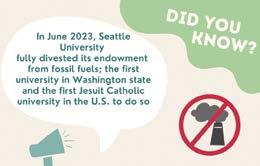
Full divestment of SU’s endowment portfolio from fossil fuels.
Creation of the Laudato Si’ Executive Committee and adoption of the university’s first Laudato Si’ Sustainability Action Plan.
First AASHE STARS Gold Rating for Seattle University.
Opening of the Center for Environmental Justice and Sustainability (CEJS).
2025 2026
Commitment to reach net-zero greenhouse gas emissions across scopes 1 and 2 by 2045.
Launch of the Institute for Environmental Justice and Sustainability (IEJS).
Seattle University receives the Puget Sound Business Journal Award for Environment and Sustainability Operational Excellence.
Adoption of SU’s first sustainable purchasing policy, including a green fleet policy.
Signatory of the Laudato Si’ Action Platform 7-year Journey toward Integral Ecology. Adopted as a foundational goal in the University’s Reignited Strategic Directions (2022-2027).
Development Goals through operations, programs, actions and policies. In 2021, Seattle University’s aspiration to lead on sustainability and environmental justice was reinforced by the Reigniting Our Strategic Directions (2022-2027) foundational goal to institutional participation in Pope Francis’ Seven-Year Journey Toward Integral Ecology through the Laudato Si’ Action Platform, putting concrete action behind the goals outlined by Pope Francis in his 2015 encyclical. This resulted in the creation of the university’s Laudato Si’ Executive Committee and the adoption of our first Laudato Si’ Sustainability Action Plan encompassing 4 priorities and 27 goals. Most recently the university reached the major milestone of divesting its endowment from fossil fuels (June 2023), made a commitment to reach net-zero greenhouse gas emissions across scopes 1 and 2 by 2045 and launched the Institute for Environmental Justice and Sustainability, embodying the institutionalization of our Laudato Si’ commitment and action plan.
OUR INSPIRATION
“An integral ecology is inseparable from the notion of the common good, a central and unifying principle of social ethics. We must realize that a true ecological approach always becomes a social approach; it must integrate questions of justice in debates on the environment, so as to hear both the cry of the earth and the cry of the poor. There can be no renewal of our relationship with nature without a renewal of humanity itself.”
—Pope Francis
REFLECTION ON OUR INSPIRATION
An integral ecology calls us into deeper relationship. It challenges us to examine the ways we have become disconnected and to undergo a conversion that is at once personal and communal.
The call to the common good becomes, then, a call to discernment and awareness of the interconnectedness between the social and the environmental challenges of our time. How are we being invited to respond? Where are we being led to act with greater justice, humility and love? This is not a distant ideal, but a daily practice of choosing rightly ordered relationships—with creation, with our neighbors and within ourselves.
In this inspiration, we are moved not by obligation alone, but by a deepening awareness that care for our common home is inseparable and interconnected from care for one another.
OUR FRAMEWORK OF INSPIRATION
United Nations 17 Sustainable Development Goals (SDGs)
Laudato Si’ Action Platform Goals (LSAP)
LAUDATO SI’ ACTION PLATFORM (LSAP)
In 2015, Pope Francis published his second encyclical, Laudato si’ (“Praise Be to You”), with the subtitle “On Care for Our Common Home.” In the encyclical, Pope Francis laments environmental degradation and global warming, critiques consumerism and irresponsible development and calls on all people of the world to take “swift and unified global action.”
This call led to the creation of the Laudato Si’ Action Platform, a papal initiative launched in 2021 by the Vatican Dicastery for Integral Development to envision sustainability in the holistic spirit of integral ecology and to redefine and rebuild our relationship with each other and our common home. The Action Platform supports institutions, communities and families to discern and implement a response to Laudato si’ by guiding actions.
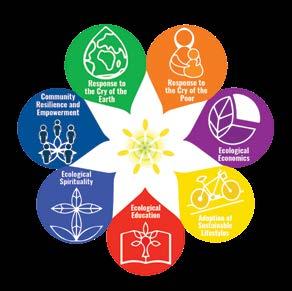
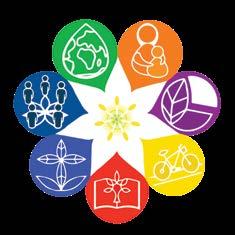
THE SEVEN LAUDATO SI’ ACTION PLATFORM GOALS
Response to the cry of the earth is a call to equitably address climate change, biodiversity loss and ecological sustainability.
Response to the cry of the poor is a call for global solidarity with special attention given to vulnerable groups such as Indigenous communities, refugees, migrants and children.
Ecological economics acknowledges that the economy is a sub-system of human society, which itself is embedded within the biosphere—our common home.
Adoption of sustainable lifestyles is grounded in the idea of sufficiency—living with just enough and not excess—to ensure a good life for all.
Ecological education refers to the need to re-think and redesign curricular and institutional reform in the spirit of integral ecology to foster ecological awareness and action.
Ecological spirituality encourages greater contact and connections with the natural world in the spirit of wonder, praise, joy, happiness and gratitude.
Community resilience and empowerment is crucial to care for creation at local, regional, national and international levels.
UNITED NATIONS SUSTAINABLE DEVELOPMENT GOALS
(SDGs)
In 2015, the United Nations published Transforming Our World: The 2030 Agenda for Sustainable Development, a “plan of action for people, planet and prosperity.” The publication outlines 17 Sustainable Development Goals (SDGs), as well as 169 targets and associated indicators, forming a 15-year agenda intended to balance “the three dimensions of sustainable development—the economic, social and environmental.” It seeks to strengthen universal peace in larger freedom and recognizes that eradicating poverty in all forms and dimensions is the greatest global challenge and an indispensable requirement for sustainable development.
SUSTAINABILITY TRACKING,
ASSESSMENT & RATING SYSTEM (STARS)
The Association for the Advancement of Sustainability in Higher Education’s (AASHE) Sustainability Tracking, Assessment & Rating System™ (STARS) is a reporting tool for colleges and universities to assess and measure their overall sustainability performance. Because the framework shares a similar intent and scope as the United Nations Sustainable Development Goals, at a very high level an institution’s STARS score or rating can be used to demonstrate progress toward helping deliver the SDGs. In addition, the Laudato Si’ Action Platform pointed to AASHE’s STARS as a Laudato Si’ program. Seattle University uses the STARS report to assess how our campus practices align to the SDG and LSAP goals and to support our short- and long-term sustainability action planning. Seattle University has submitted four STARS reports since 2016 with each obtaining a GOLD rating. With our 2024 score, Seattle University placed #10 of all 1000+ STARS registered U.S. higher education institutions.
• 2016: GOLD rating with a score of 69.41
• 2018: GOLD rating with improved score of 75.64
• 2021: GOLD rating with improved score of 79.39
• 2024: GOLD rating with improved score of 83.87
PLAN OF ACTION
“Today, the analysis of environmental problems cannot be separated from the analysis of human, family, work-related and urban contexts. In any discussion about a proposed venture, a number of questions need to be asked in order to discern whether or not it will contribute to genuine integral development. What will it accomplish? Why? Where? When? How? For whom? What are the risks? What are the costs?
Who will pay those costs and how? In this discernment, some questions must have higher priority.”
—Pope Francis
REFLECTION ON OUR PLAN OF ACTION
At its core, this plan of action calls us to a deeper kind of discernment—one that recognizes that environmental concerns can never be separated from the human realities in which they are embedded. The questions before us are not merely technical or strategic—they are moral, communal and spiritual. They require an infusion of values—of justice, dignity and care—into every level of analysis and decision-making.
This plan must therefore be understood not as static or final, but as a living document, one that remains attentive and responsive to the evolving challenges of our time. The “signs of the times”—ecological crisis, social fragmentation, economic inequity and cultural diversity—demand ongoing reflection, dialogue and adaptation. A living document listens as much as it directs, it grows as communities grow, it changes as new insights emerge and it insists on genuine inclusivity of those communities most often excluded from decision-making processes.
In this way, the plan becomes more than a roadmap—it becomes a practice of collective responsibility, grounded in solidarity, animated by ethical clarity and open to transformation.
SUSTAINABILITY IN THE HOLISTIC SPIRIT OF INTEGRAL ECOLOGY
FIVE SEATTLE UNIVERSITY PRIORITIES
PRIORITY 1
Integrate Integral Ecology Across the Curriculum and Research
PRIORITY 3
Practice Socially Responsible Consumption, Purchasing & Investment
PRIORITY 2
Achieve Climate Neutrality and Reduce Seattle University’s Environmental Footprint
PRIORITY 4
Develop a Sustainable Campus Culture and Deepen Engagement & Public Advocacy
PRIORITY 5
Amplify Seattle University’s Sustainability Impact and Strengthen Recruitment and Advancement Strategies
INTEGRATE INTEGRAL
ECOLOGY
ACROSS THE CURRICULUM AND RESEARCH
The Goals for Priority 1 were adopted in March 2026 by Seattle University’s Laudato Si’ Executive Committee and are building on the original goals of 2023, many of which have been accomplished.
1. ACCOMPLISHED By June 2023, the Reimagine and Revise the Curriculum (RRC) Working Group for “Sustainability and Climate Change” will formulate a university-wide definition of sustainability.
—The following sustainability definition has been adopted by Seattle University: “We define sustainability as meeting the needs of present and future generations through actions that support human and ecological health, social justice, and economic well-being.” (2023)
2. ACCOMPLISHED AY 2022-2023 and AY 2023-2024: The Reimagine and Revise the Curriculum (RRC) Working Group for “Sustainability and Climate Change” will collaborate with faculty to develop curricula with an undergraduate student learning outcome that focuses on sustainability and/or climate change in the holistic spirit of integral ecology. The aim is that every student graduates from Seattle University with an understanding of those concepts.
—In just under two years, 75% of our undergraduate departments/programs strengthened existing or identified new ways to devote curricular focus to sustainability and climate change or identified new discipline-specific opportunities to expand this work in the coming years. 25% of all new or revised courses funded through the RRC initiative aligned with the Sustainability and Climate Change priority area.
3. NEW Starting AY 2025-2026, the university will support the development of curricula in the University Core (UCOR) to ensure that every Seattle University graduate has an opportunity to develop their interest in and deep understanding of sustainability and climate change. This will be done through:
• The development and implementation by Summer 2027 of a new “Climate and Sustainability” Pathway in the University Core
• The development and implementation by Summer 2027 of a new signature UCOR seminar including many sections that address questions of climate, environmental justice and sustainability
4. ACCOMPLISHED AY 2022-2023 and 2023-2024: the Reimagine and Revise the Curriculum (RRC) Working Group for “Sustainability and Climate Change” will collaborate with colleagues from across campus in our existing graduate programs to support education on sustainability and/or climate change in the holistic spirit of integral ecology.
—In just under two years, 70% of our graduate departments/programs either strengthened existing or identified new ways to devote curricular focus to sustainability and climate change or identified professionally relevant opportunities to expand this work in the coming years.
5. NEW Over the next two years (AY 2026-2028), the university will advance the development of sustainability-focused graduate offerings, certificates and programs.
6. ACCOMPLISHED Rewrite the Sustainability Literacy Assessment sent to freshmen and seniors each year and seek to improve distribution and response rate.
7. NEW In AY 2026-2027, pilot the Sustainability Literacy Assessment in UCOR classes, update where needed and plan for broader implementation in AY 2027-2028.
8. ACCOMPLISHED AY 2023-2025: Identify needs and recommend activities and funding strategies with which the institution can further support faculty development of teaching, research and cocurricular activities. A specific short-term need within this goal is to identify or repurpose funding for faculty fellowships to support environmental justice and sustainability scholarship.
9. NEW In 2026, launch the Institute for Environmental Justice and Sustainability to advance solutionfocused scholarship, facilitate instructional and curricular development and foster applied student learning projects that address climate change, environmental justice and support the sustainability needs of the university and our broader community.
10. IN PROGRESS The Institute for Environmental Justice & Sustainability (IEJS) and the Institute for Catholic Thought and Culture (ICTC) will inventory courses, faculty research and student local and global experiential learning opportunities in relation to their sustainability component; map them to the Laudato Si’ Action Platform Goals and the United Nations’ Sustainable Development Goals (SDGs); track progress by conducting a biennial faculty research survey and course analysis; and publish an updated repository online every other year. Ideally, the university would formalize sustainability course listings for current and prospective students in the institution’s course catalog.
PRIORITY 2
ACHIEVE CLIMATE NEUTRALITY AND REDUCE
SEATTLE UNIVERSITY’S ENVIRONMENTAL FOOTPRINT
The Goals for Priority 2 were adopted in March 2026 by Seattle University’s Laudato Si’ Executive Committee and are building on the original goals of 2023, many of which have been accomplished.
1. ACCOMPLISHED In Fall 2022, in partnership with a consulting firm, develop a “Zero Carbon Over Time Infrastructure Plan” (ZoT). This involves establishing a baseline to develop a phased transition to electrification and use of on-campus renewable, clean sources of energy, guidance for capital planning and future construction and strategies for energy management and conservation.
—Since completion of the report in 2023, SU Facilities uses the recommendations as a decarbonization reference and building by building baseline.
2. NEW In accordance with the 2015 Paris Agreement targets, the Science Based Target Initiative for Faith, Washington state legislation and the City of Seattle’s Building Emissions Performance Standards (BEPS), Seattle University is committed to cutting Scopes 1-2* greenhouse gas (GHG) emissions 33% by 2035 from baseline year 2026, 66% by 2040 and reaching net zero GHG emissions across Scopes 1-2 by 2045. While Seattle University develops and implements decarbonization strategies to meet the 2045 target, the university will (i) continue to purchase offsets to compensate for the remaining scope 1 and 2 emissions generated until the intermediate and end target dates are achieved (see Goal 3) and (ii) develop a set of recommendations to reduce Scope 3 emissions from commuting, air travel, and purchased goods and services (see Goal 6).
3. IN PROGRESS Each fiscal year, between November and March, the Institute for Environmental Justice and Sustainability (IEJS) and Priority 2 stakeholders will update the university’s carbon offset portfolio and select projects that meet the university’s offset purchasing criteria, supporting co-benefits and meeting third party verification standards.
4. ACCOMPLISHED During FY 2023, start development of a university-wide green fleet policy, including the expansion of EV stations.
– In 2024, the University adopted a Policy on Sustainable Procurement including a Green Fleet Policy which outlines the requirements for new vehicle purchasing and leasing that will support the university’s shift to alternative fuel options.
5. NEW Beginning in FY 2026, start implementation of the Green Fleet Policy (adopted in 2024) across all university areas with a target date of 100% electric vehicle (EV) use for light vehicles (passenger vehicles, light trucks, vans for short distance trips, carts) by 2030, where electric models exist on the market to suit the operational needs of the university. Adopt an EV station policy to standardize EV infrastructure, including a comprehensive assessment of target sites and capacity for electric vehicle supply equipment (EVSE) infrastructure.
6. IN PROGRESS During FY 2027, start development of a set of recommendations to reduce Scope 3 emissions from commuting, air travel and purchased goods and services.
7. ACCOMPLISHED By 2024, complete a baseline study of SU solid, non-hazardous waste.
—A baseline study of the university’s solid, non-hazardous waste was completed in 2025.
8. NEW Using the results of the 2025 Zero Waste baseline study, create an action plan including cost estimate to reach the goal of 90% waste diversion from 66% in baseline year 2025 while minimizing waste generation year over year. Start the implementation of Seattle University’s zero waste action plan.
9. UPDATED Beginning in FY 2027, adopt and start implementation of full campus decarbonization that involves a phased, planned approach including different strategies and methodologies (centralized vs. decentralized, individual building vs. central plant, energy use reduction…), different sectors (private and public partners), and aligns with state and city regulations. This will also include identifying feasibility for energy storage, on-campus renewable energy production and a Green Revolving Fund to support and sustain sustainability projects in operations. Establish a dedicated capital fund to support the university’s decarbonization in campus operations. Example of a near–term opportunity Seattle University is exploring a “Thermal Energy Networks” (TENs) project in partnership with Puget Sound Energy (PSE) that would position Seattle University to achieve a 60% reduction in carbon emissions.
10. UPDATED During FY 2026-2027, enhance the internal water dashboard to measure and support water conservation and efficiency opportunities and benchmarking. Use this data to evaluate and identify target sites for water reuse technologies in future retrofits and new construction. Explore the opportunity for a water study, including cost analysis.
11. NEW In collaboration with the Institute for Environmental Justice and Sustainability (IEJS) and other campus stakeholders, develop and grow academic partnerships that support on-campus operational needs and institutional sustainability goals while advancing student experiential learning, sustainability literacy and green skills by leveraging our campus grounds and building infrastructure as a living classroom and immersive learning environment.
12. UPDATED Advance sustainability in dining at Seattle University targeting the following goals:
• Increase plant-based purchasing of food and beverages from 18% in FY 2025 by 2-3% year over year. The goal will be re-evaluated, based on student demand changes over time.
• Increase verified sustainably or ethically produced food and beverage purchasing from 6% in FY 2025 by 1-2% year over year. The goal will be re-evaluated, based on student demand changes over time.
• Increase Redhawk Dining’s social spend in alignment with Seattle University’s diverse supplier policy from 5% in FY 2025 by 1% each year up to 10%.
• Reduce food waste 50% by 2030 from baseline year 2019.
*Scope 1, Scope 2 and Scope 3 are the three categories used worldwide—through the Greenhouse Gas Protocol—to classify where an organization’s greenhouse gas (GHG) emissions come from.
Scope 1 = Direct emissions from owned or controlled sources (e.g. natural gas burned in furnaces to heat buildings, campus fleet, fertilizer for landscaping)
Scope 2 = Indirect emissions from purchased energy (e.g. electricity purchased from Seattle City Light)
Scope 3 = All other indirect emissions across the value chain (air travel, commuting, waste disposal, purchased goods and services)
PRACTICE SOCIALLY RESPONSIBLE CONSUMPTION, PURCHASING AND INVESTMENT
The Goals for Priority 3 were adopted in March 2026 by Seattle University’s Laudato Si’ Executive Committee and are building on the original goals of 2023, many of which have been accomplished.
1. ACCOMPLISHED In FY 2023, the Procurement Office will continue to work with campus stakeholders to build upon accomplishments achieved regarding Seattle University’s institution-wide ethical, equitable and sustainable procurement policy. Benchmark and update existing policies and guidelines to ensure consistency with industry standards. Communicate and support implementation regarding any policy revisions. Additionally, include a focus on Seattle University’s Supplier Diversity initiative.
– In 2024, the University adopted a Policy on Sustainable Procurement.
2. UPDATED Identify opportunities to advance ethical, equitable and sustainable purchasing for multiple categories and commodity areas that support the university’s goal to reduce scope 3 emissions from purchased goods and services (LSAP Priority 2, Goal 6) and to make continued progress toward zero waste (LSAP Priority 2, Goal 8). Benchmark and update existing policies and guidelines, where applicable, to ensure alignment with industry standards. Communicate any policy revisions and support their implementation.
3. ACCOMPLISHED In FY 2023, create the LSAP Socially Responsible Investments Working Group with membership to satisfy the STARS “Committee on Investor Responsibility” (CIR) criteria.
4. ACCOMPLISHED By June 30, 2023, fully divest the marketable portion of the endowment from any investments in companies owning fossil fuel reserves in accordance with the resolution passed by Seattle University’s Board of Trustees in September 2018.
5. UPDATED Advance the implementation of SU’s sustainable investment efforts with the goal to include socially responsible investing to the extent practical and appropriate as the Outsourced Chief Investment Officer (OCIO) evaluates all investments for the endowment by considering Environmental, Social and Governance (ESG) criteria. The LSAP Socially Responsible Investments Working Group will collaborate with the endowment’s OCIO on report content and cadence of ESG considerations in the selection of investment funds and managers. Reporting to be presented to the Investment Committee of the Board of Trustees and to the LSAP Socially Responsible Investments Working Group.
6. UPDATED The LSAP Socially Responsible Investments Working Group will provide feedback to the Retirement Plan Investment Committee (RPIC) on the current socially responsible investment array available.
PRIORITY 4
DEVELOP
A
SUSTAINABLE
CAMPUS
CULTURE AND DEEPEN ENGAGEMENT & PUBLIC ADVOCACY
The Goals for Priority 4 were adopted in March 2026 by Seattle University’s Laudato Si’ Executive Committee and are building on the original goals of 2023, many of which have been accomplished.
1. IN PROGRESS Annual Celebration and Campus Engagement: Continue the annual Laudato Si’ University Celebration in collaboration with internal and community partners to deepen understanding of Laudato si’ principles, elevate efforts and actions across campus, and highlight the impact of community engagement and shared mission.
2. IN PROGRESS Co-Curricular Formation and Public Advocacy: In collaboration with institutional stakeholders, provide co-curricular integral ecology-focused trainings, formation, seminars and programming with and for faculty, staff and students designed to promote informed public advocacy and campus engagement. Center our work on the continued building and sustaining of authentic relationships with local, Native and Black, Indigenous and People of Color (BIPOC) communities.
3. IN PROGRESS Data-Informed Action and Campus Climate Assessment: Collaborate with the Office of Institutional Effectiveness to receive the data from existing structured assessments from Human Resources, the Office of Diversity and Inclusion and the Institute for Environmental Justice and Sustainability (IEJS) that would inform our work, such as the Workforce Engagement Survey, Campus Climate Survey and STARS reporting. Together with the IEJS, we will deploy the Sustainability Campus Culture Survey every three years to gain insight into our campus community’s values and perspectives and to guide ongoing efforts to cultivate a more sustainable campus culture.
4. IN PROGRESS Student Leadership and Peer-to-Peer Sustainability Programs: Establish new and elevate existing peer-to-peer student sustainability outreach programs, creating regular opportunities for collaboration, shared learning and an experience of ecological spirituality. Identify and pursue funding opportunities to establish a small grants initiative for student peer-to-peer sustainability efforts.
AMPLIFY SEATTLE UNIVERSITY’S SUSTAINABILITY
IMPACT AND STRENGTHEN RECRUITMENT AND ADVANCEMENT STRATEGIES
1. NEW Enhance marketing and communications to amplify the university’s sustainability and environmental practices, educational programs, engagement opportunities, scholarly achievements and community contributions.
2. NEW Develop targeted efforts to bolster our recruitment, retention and reputation.
3. NEW Advance donor development and funding opportunities in support of Seattle University’s Laudato Si’ commitment and university-wide sustainability efforts.
SEATTLE UNIVERSITY LAUDATO SI’ LEADERSHIP
STRUCTURE (2026 onward)
To maintain institutional commitment to sustainability rooted in the spirit of Laudato si’ and the holistic vision to integral ecology, the following leadership structure has been adopted. The Laudato Si’ Executive Committee will oversee the implementation and infusion of the Laudato Si’ Sustainability Action Plan priorities and goals, create a system of communication and collective participation and promote accountability from all parties involved. The Institute for Environmental Justice and Sustainability will support the Executive Committee in coordinating each of the Laudato Si’ priorities.
LAUDATO
SI’ EXECUTIVE COMMITTEE
Executive Sponsor: Senior VP for Academic Affairs
Executive Committee Members: President, Provost, CFO, VP Mission Integration, Senior VP Academic & Student Affairs, Senior VP for University Advancement, Chief Marketing Officer, Associate VP & Dean of Admission Undergraduate Admissions, Directors of the Institute for Environmental Justice and Sustainability
1
INSTITUTE FOR ENVIRONMENTAL JUSTICE AND SUSTAINABILITY
2
3
EACH PRIORITY TEAM CONSISTS OF
• Executive Lead
• Co-chair(s)
• One or more working groups composed of faculty, staff, students and stakeholders
ACKNOWLEDGEMENTS
Our sincere gratitude goes out to the following Seattle University community members who have contributed to the development and implementation of the Laudato Si’ Action Platform structure, priorities and goals from 2021-2026.
Executive Sponsor: Provost Shane P. Martin, Senior VP for Academic Affairs, Jodi O’Brien Co-chairs: Tanya Hayes, PhD; Charles Tung, PhD
Reimagine and Revise the Curriculum Working Group (RRC) for “Sustainbaility and Climate Change”: Tanya Hayes, PhD; Phillip Thompson, PhD; Mark Jordan, PhD; John Armstrong, PhD; Wes Lauer, PhD
Repository Working Group: Estefanía Kendall, Victor Chimenti, Kennedi Fines (student), Yolanda Cieters
Stakeholders: Lydia R. Cooper, PhD; Eric Severson, PhD; Hilary Hawley, PhD; John Fleming; the Office of Research and Sponsored Projects: Jenna Isakson, Sarah Bricknell, Kara Luckey; the Center For Faculty Development: David Green, PhD; the Center for Community Engagement: Nicholas Stubbs, Kent Koth, Cecilia Morales, PhD; Laura Spitz, JSD; Joe Orlando; Jeanette Rodriguez, PhD; Nancy Tuchman, PhD (Loyola Chicago University)
Laudato Si’ Priority 2:
Executive Sponsor: CFO Wilson Garone (2022-2023), CFO Chris Malins
Co-chairs: Robert Schwartz, Wes Lauer, PhD
Zero Waste Working Group: Shannon Britton, Nathan Wolk, Yolanda Cieters, April Atwood, PhD; Student Fellows: Mira Martin, Maya Patton, Kylie Wong
Stakeholders: Elijah Nerger, Chuck Nerger, Donna Horn, Breena Stoner, Joe Cater, Whitney Wedge, Michelle Conklin, Kara Wittmer, Nathan Gregory, Sarah Cox, Melissa Vannarath, Tanya Hayes, PhD; Daniel DiLeo, PhD (Creighton University)
Laudato Si’ Priority 3:
Executive Sponsor: CFO Wilson Garone (2022-2023), CFO Chris Malins
Co-chairs: Anthony Goodwillie (2023-2025), Bret Myers (2022-2024), Joe Cater
Sustainable Purchasing Policy Working Group: Anthony Goodwillie, April Atwood, PhD; Yolanda Cieters; Students: Daniel Truog, Allison Mettler
Laudato Si’ Socially Responsible Investment Working Group: Joe Cater (chair), Mike Allende, Yolanda Cieters, Wes Lauer, PhD; Dr. Vinay Datar, PhD; Students: Gloria Koomson, Joshua Baron
Stakeholders: Lara Branigan, Chuck Nerger, Elijah Nerger, Redhawk Dining Team: Andrew Gaynor, Joel Anschell, Monalisa Prasad (VP Sustainability Chartwells Higher Education); Robert Schwartz, Breena Stoner, Donna Horn, Kriston Sanders, Kartika Garg, Heather Geiger, Richard Cota, Shannon Britton, Albert Vanderhoeven, Don Kustus, Cathy Cao, PhD
Special thanks to the Marketing Communications team for their support in creating this publication.
Laudato Si’ Priority 4:
Executive Sponsor: Alvin Sturdivant, EdD (2022-2024); VP of Mission Integration Catherine Punsalan-Manlimos, PhD; Senior VP for Academic and Student Affairs Tamara A. Herdener
Co-chairs: Kent Koth (2022-2023), Luke Lavin, PhD; Colette Taylor, PhD
Priority 4 Working Group: Edward Donalson III (2024), Julius Moss, EdD, Nodia Rogers, Nicole (Nikki) Bashaw (2024), Alex Booker (2024)
LSAP Celebration Planning Team: the Institute for Catholic Thought and Culture: Jeanette Rodriguez, PhD; Jessica Palmer, Estefanía Kendall, Sophia Cofinas (student); the IEJS: Tanya Hayes, PhD; Sophia Hampton, Yolanda Cieters, Jacob Caddali (student)
Stakeholders: Outdoor Recreation, MOSAIC Center, Wellness and Health Promotion, Center for Student Involvement (CSI), Student Government of Seattle University (SGSU), Wellness Café and Food Pantry, the Institute for Catholic Thought and Culture (ICTC), Institute for Environmental Justice & Sustainability (IEJS), Center for Jesuit Education (CJE), Center for Ecumenical and Interreligious Engagement (CEIE), Center for Social Transformation and Leadership (CSTL), University Ministry, KXSU, Education Abroad, the Lemieux Library, Redhawk Dining, Career Engagement, Sustainable Student Action (SSA), Environmental Law Society (ELS), Native American Law Students Association, Indigenous Peoples Institute (IPI), Residence Hall Association, Stoke
The Inaugural Laudato Si’ Steering Committee (2021-2022) for their groundwork in guiding the university to integrate sustainability holistically across Campus areas.
Shannon Britton, Yolanda Cieters, Jessica Ludescher Imanaka, PhD; Estefanía Kendall, Jessica Palmer, Jeanette Rodriguez, PhD; Mike Thee, Phillip Thompson, PhD; Jennifer Tilghman-Havens, PhD; Lupita Torrez, Patrick Twohy, S.J.; Jason Wirth, PhD; Sophia Cofinas (student), Dion Wade
STUDENT EMPLOYEES AND INTERNS (2021-2026) AT THE INSTITUTE FOR ENVIRONMENTAL JUSTICE AND SUSTAINABILITY (IEJS)
The amazing current and past student employees and interns who have made the work at the IEJS possible: Ruby Ranoa, Ashley Hagar, Kennedi Fines, Erika Moore, Marina Morales, Zainab Ahmad, Vitoria Cassol, Judith Johnson, Roma Gadhiwala, Sarah Torset, Daniel Truog, Allison Mettler, Nicole “Nikki” Bashaw, Brooke Kierzek, Julieta Dentone, Anna Trudo, Alice Gilson, Frances Pappajohn-Goldade, Sabrina Castron, Kyrie Sisouvong, Jessica “Jess” Woolfolk, Jacob Caddali, Kelli Che
STARS LIASONS
This work could not have come to fruition without the data and information provided by the following partner offices in support of our STARS sustainability reporting:
Academic Assembly, Institute for Environmental Justice & Sustainability, Sundborg Center for Community Engagement, Center for Social Transformation and Leadership, Controller’s Office, Environmental Health and Safety Office, Facilities Services, Grounds and Landscaping, Housing and Residence Life, Human Resources, Institute for Catholic Thought and Culture, Innovation and Entrepreneurship Center, Office of Institutional Effectiveness, Jesuit Community, Lemieux Library and McGoldrick Learning Commons, Managed Print Services, Marketing Communications (MarCom), Office of Diversity and Inclusion, Office of Institutional Equity, MOSAIC, Office of the Chief Financial Officer, Office of the Provost, Orientation Programs, President’s Office, Procurement Office, Redhawk Dining (Chartwells), Residence Hall Association, Staff Council, Transportation and Parking Services, Undergraduate Admissions, University Advancement, Washington Higher Education Sustainbaility Committee, Central Washington University: Jeffrey Bousson
VISION
At Seattle University, we are committed to an ecological conversion that opens minds and hearts to the sacred task of caring for our common home. This commitment is rooted in ethical responsibility and solidarity between all peoples and future generations. We envision sustainability in the holistic spirit of integral ecology and will adopt institutional practices that are socially just, support human and ecological health and promote economic well-being.