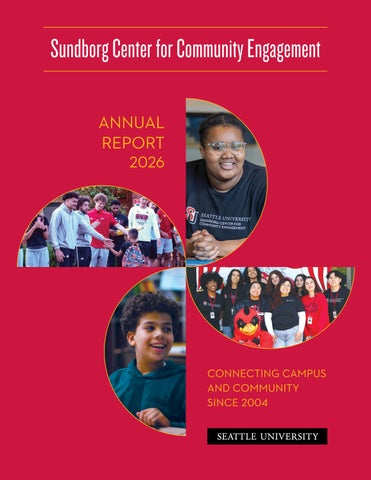
Sundborg Center for Community Engagement ANNUAL REPORT
2026
CONNECTING CAMPUS AND COMMUNITY SINCE 2004
Hope in Action
3
Hope-filled Numbers
4
Impact
5
Seattle University Youth Initiative
6
Early Learning
8
CEL in Action
10
Partnership in Action
12
Student Experience
14
ABOUT THE SUNDBORG CENTER FOR COMMUNITY ENGAGEMENT Since 2004, the Sundborg Center for Community Engagement (CCE) has connected Seattle University students, faculty and staff with families, youth, community-based organizations, government institutions, neighborhood leaders and others through direct service, philanthropy, activism, policymaking, social entrepreneurship and community-based research. CCE draws upon five values to guide our work: Justice, Relationships, Community, Learning and Humanity. Inspired by the university’s Jesuit, Catholic ethos, CCE strives to lead as an anti-racist organization working toward a 2030 place-based vision that leverages the university’s resources to advance justice, remove institutional barriers and educate changemakers.
2 / Sundborg Center for Community Engagement
Connect with Us: 206-296-2569 cce@seattleu.edu 901 12th Ave, SINE 140, Seattle, WA 98122-1090 www.seattleu.edu/community-engagement
Dear Friends and Partners of the Sundborg Center for Community Engagement (CCE), This past spring, at the end of a focus group with some of our student leaders, I asked the students if there were additional ways we could support them. After a long pause, one student offered a reflection that I’ve been thinking about ever since: “I learn so much through my work at CCE, but I often feel depleted. Where is the hope?” This student’s response encapsulates what many of us feel every day. Without a doubt, we live in challenging times. The deluge of negative news can feel overwhelming. When compounded over weeks and months, we can easily fall into despair. So where is the hope? If we slow down and look for the signs, hope is all around us. At CCE, we have witnessed hope in action—in classrooms and neighborhoods, in conversations between those who arrived as strangers and left as collaborators, and in partnerships built across lines that too often divide us. This report offers some examples of how we cultivate hope: • Celebrating 15 years of the Seattle University Youth Initiative (SUYI). Earlier this year, the Sundborg Center hosted a SUYI Showcase that brought together over 200 scholars, families, SU students, and other campus and community partners to celebrate 15 years of partnerships, programs, and connection. • Leading the way with our students. One of our 130 student employees, Sydney Loria, recently received an award from Governor Bob Ferguson. • Creating a shared vision for Seattle. This summer, more than 100 faculty, staff and community partners attended a CCE sponsored day-long Engaging Seattle conference that explored what it means to work for a more just city of Seattle. • Contributing to the national conversation. Erica K. Yamamura and I recently co-edited a new book, Leading Place-Based Community Engagement Initiatives in Higher Education, offering lessons and practices for other colleges and universities to draw upon to deepen their community engagement efforts. • Developing a national model of a community engaged curriculum. Seattle University will soon launch a new, innovative curriculum that will be one of the most expansive community engaged learning frameworks in the country. On a personal note, this will be the last time I write a letter for the CCE Annual Report. After 22 years of leading CCE, I am leaving my role in January 2027 to begin a new chapter of my life. Thank you for sharing this journey with me and for supporting this impactful and transformative work. Together, we can cultivate a hope-filled future. With gratitude,
Kent Koth Executive Director CCE Annual Report 2026 / 3
Hope-filled Numbers HOPE AND GRATITUDE Thank you for fueling our mission, CCE supporters! This year, one of the main ways we find hope is your continued partnership. For more than 20 years, your financial support has provided the stability we need to connect campus and community, allowing us to face deeply entrenched societal challenges together. In philanthropy, hope is not a passive wish that things will magically improve—it is an active, courageous choice to make things better. To invest in CCE is to care deeply about our students’ outcomes and our community’s future. Your generosity elevates us from optimism into active, gritty hope.
Seattle University has received its second Carnegie Community Engagement Classification, recognizing Seattle University for its exceptional commitment to community engagement.
Recently, former Seattle University President Father Stephen Sundborg spoke about the role faculty and staff play in “accompanying a student as they create a hope-filled future.” Your support makes that accompaniment possible. Through your generosity, our students and community partners experience hope not merely as an idea, but as something tangible and transformative. As we look ahead, we remain committed to careful stewardship of the resources you entrust to us, so our students continue to find hope in action. Thank you for your enduring trust and vital support.
Donate to support this work!
With gratitude, Emily Bergstrom CCE Director of Development
OUR 2026 FISCAL YEAR FINANCES AT A GLANCE Here’s a look at what it takes to propel the Sundborg Center for Community Engagement.
FY26 Expenses: $3,857,224 Campus and Community Partnerships $642,837 17%
Systems Change $717,584 18%
4 / Sundborg Center for Community Engagement
FY26 Funding Sources: $3,857,224 Endowments $364,636 9%
Operations $724,722 19%
University $343,265 9%
Individual Donors $1,934,283 50%
Seattle U Youth Initiative $1,772,082 46%
Service Contracts $413,155 11% CCE Reserves $235,881 6%
Corporations and Foundations $566,004 15%
FY26 Funding Sources reflect all gifts given in FY25, 7/1/24 – 6/30/25
Pursuing Local and National Impact FACULTY MEASURING IMPACT CCE partners with faculty members to measure the impact of SU’s community engagement efforts. Here is what they’ve been doing: • Over the past two years, Professor Dr. Ashli Tyre, who directs the School Psychology program in the College of Education, has supported planning and evaluation efforts for the Yesler Terrace Legacy Commitment. This included meeting with CCE staff, program partners and community representatives, observing programming in practice, reviewing program reports and gaining feedback. Conversations were facilitated to identify priorities and practical approaches for gathering information that could support reflection, continuous improvement and future decision-making. • This year, Dr. Kathryn Bollich-Ziegler, assistant professor in Psychology, partnered with Dr. Cecilia Morales, CCE’s senior director of Campus and Community Partnerships, on a study of the impact of community engaged learning (CEL) courses on undergraduate students. After consulting with CCE’s Campus and Community Advisory Boards, Drs. Ziegler and Morales created a pre/post survey that will measure students’ civic efficacy, sense of belonging, social justice attitudes and other areas of growth before and after completing a CEL course. • This year, Dr. David Fainstein, former faculty in the College of Education, collaborated with Graduate Research Assistant Rachel Tang to operationalize a framework for the Seattle University Youth Initiative (SUYI). Through an integrated, community engaged scholarship approach, they worked closely with CCE and SUYI leadership, program managers and graduate assistants to iteratively develop program-specific evaluation tools. This ongoing work empowers SUYI to tell its story and continually lift up the transformative impact within a vibrant central Seattle community.
GUIDING OTHER COLLEGES AND UNIVERSITIES: NEW BOOK
Each chapter offers both inspiration and practical guidance, presenting promising practices and lessons learned while redefining the concept and development of place-based engagement. The book highlights the transformative power of these efforts, demonstrating how institutions can creatively address societal challenges, build stronger community relationships and drive institutional change.
EDITED BY AND ERICA KENT KOTH K. YAMA MURA
Following-up on their 2018 book, Place-Based Community Engagement in Higher Education, CCE Executive Director Kent Koth and LEAD California Executive Director Erica Yamamura recently published a new book, Leading Place-Based Community Engagement Initiatives in Higher Education. This edited collection spotlights the leadership behind contemporary examples of place-based community engagement in higher education.
LEADIN BASED C G PL ACEOM ENGAGE MUNIT Y INITIATI MENT V E S IN HIGHER EDUCAT ION PROMISIN AND LES G PR ACTICES SONS LE A R N ED Edited by KE NT KOTH A K. YAM AMURA
AND ERIC
CCE Annual Report 2026 / 5
Seattle University Youth Initiative (SUYI) HOPE IN THE MOMENT AND BEYOND Greetings, Beloved! Ancestor James Baldwin told us that, “Hope is invented every day.” The Seattle University Youth Initiative aims to facilitate an ecosystem that amplifies holistic, educational opportunities in the community for youth and families to flourish. This commitment shows up in all we do and anchors us in the desire to engage in our work in ways that support sustainable thriving and nourish the wholeness of our communities. One of the most powerful ways in which we can and do live this is by embracing hope— hope deeply rooted in the loving actions of educational justice and liberation. Through our work in and with our partner schools, many partner community organizations, and Seattle University campus partners, we can walk alongside SU students, Pre-K to 12th grade scholars and families in ways that promote hope rooted in action. As you read on, you will see how hope in action manifested in our programs this year. Additionally, hope was brought to life as we celebrated 15 years of the Youth Initiative with community, when students and community came together to learn and grow and when progress was made in developing evaluation tools and methods that will allow us to more meaningfully understand the impacts of our work. Hope is not passive. It is a muscle we must choose to exercise. It requires us to actively engage with courage, bravery, vulnerability and, as James Baldwin reminded us, to choose to invent it every day. We remain committed to doing this through the work of the Seattle University Youth Initiative.
LaKesha Kimbrough
With love,
Senior Director of SUYI
15 YEARS
LaKesha and the SUYI Team
Seattle University Youth Initiative
300
43 Afterschool participants and 22 classrooms supported at Bailey Gatzert Elementary
25 333
SUYI Scholars involved in consistent year-long programming
6 / Sundborg Center for Community Engagement
SU mentees at Washington Middle School
1704 Number of children and youth involved in CCE programming
individual swim lessons supported between July 2025 and June 2026 at the Downtown Seattle YMCA
477 Change Makers program hours
Hope In Action through the Seattle University Youth Initiative THE REDHAWK ACADEMIC MENTORING PROGRAM (RAMP) • RAMP at Bailey Gatzert Elementary fosters meaningful connections and holistic growth through instruction, play and joy-filled enrichment. At Gatzert, 31 SU students walk alongside Gatzert scholars in classrooms and through the afterschool program as they learn new skills and navigate challenges. This past year, we also supported field trips, family nights and school events that provide joyful and memorable learning experiences. • RAMP at Washington Middle School curates a loving and welcoming space where 24 SU students provide support to 25 mentees through weekly mentoring sessions. This year we also led and supported several creative afterschool programs such as Big World Breaks’ Washington Middle School Drumline. • Change Makers mobilized 10 SU students to work alongside 20 Garfield High School students, creating meaningful change for themselves, for others and for justice. Through workshops, community events and an annual summit, scholars and mentors imagine a world they want to live in and take steps to make that vision a reality. In fall 2025, we welcomed our first cohort of three Change Makers as first-year undergraduate SU students. Read, Inspire, Support, Educate (RISE) early learning creates joyful, nurturing learning experiences where every child feels seen, supported and inspired. Through literacy, language and social-emotional learning, this past year 32 SU student mentors built meaningful connections with more than 140 Pre-K scholars in eight central Seattle early learning classrooms. Family Engagement continued to maintain and build meaningful community and partnerships among dozens of local families and caregivers. Led by SUYI Family Connectors, who support engaging families with our programs, classes such as Dance with Yui and Art with Momo created shared spaces for connection. Our family dinners and major family events, such as our annual Seattle Sounders and Seattle Reign games, brought together hundreds of families for fun and educational experiences. Finally, for the first time this year, we sponsored swim lessons for 25 scholars and caregivers continued to offer opportunities for 30 scholars to attend Nike Summer Sports Camps at SU.
t
Yesler Terrace Legacy Commitment (YTLC) and the Yesler Community Services Committee (YCSC) center community as the experts in measuring, assessing and allocating more than $300,000 for youth-serving programs at Yesler Terrace. With six of the nine YTLC members being Yesler Terrace residents, YCSC is an embodiment of our belief that those most impacted by the work should determine the direction of the work. The YCSC 2025-2026 accomplishments include establishing bylaws, committee terms and roles, completing training on bias, confidentiality and data collection, completing a community assessment, revising processes for meetings, evaluating all program and service organizations, their proposals and contract renewals, and reducing the risk for conflict of interest.
View YTLC Annual Report
CCE Annual Report 2026 / 7
Evolution of Early Learning RISE: READ, INSPIRE,SUPPORT, EDUCATE RISE is a new version of CCE’s previous Jumpstart program that the federal government cut in 2025. Supporting teachers and families, RISE places trained university students in Pre-K classrooms to work with young learners one-on-one and in small groups. The RISE curriculum was intentionally designed to reflect the multifaceted identities of the Pre-K scholars who are represented in the classrooms and communities we support. Engagement with RISE allows young scholars to see, hear and learn about themselves and their peers through a positive, joyful learning environment that encourages foundational skill building and a meaningful start to their academic journey. RISE is infused with hands-on opportunities for young scholars to develop oral language skills, engage in guided explorations, interact with culturally relevant books and strengthen social-emotional skills —all fundamental building blocks for school readiness and success.
LITERACY CARNIVAL This past spring, the RISE Literacy Carnival brought together 48 family and community members to celebrate the joy of reading, learning and connection. Rooted in the stories and unit themes explored in RISE classrooms throughout the year, the event brought literacy to life through carnival-inspired games and activities for RISE families. The event also provided families with opportunities to connect with the student mentors who, each week in the classrooms, guided and encouraged their scholars. The annual Literacy Carnival reflects RISE’s commitment to making literacy engaging, accessible and meaningful. By extending books beyond the classroom and creating shared experiences for the whole family, we foster a love of reading, strengthen relationships and inspire children to see learning as both joyful and powerful.
8 / Sundborg Center for Community Engagement
t More than
8,100 hours of RISE programming, including afterschool literacy and in-class support.
256 days of programming across all nine classrooms at four sites.
Campus Engagement STUDENT LEADERSHIP AND ENGAGEMENT GRANTS With support from the Shinnyo-en Foundation, CCE offered five grants of up to $2,000 each to SU student-led organizations this year. These grants offered students the opportunity to engage with the local community while supporting the needs and priorities of community organizations. Grants were awarded to: • The United Filipino Club for a poetry and literature event on the powerful stories of Filipinx poets and writers, with donations supporting typhoon relief in the Philippines. • Latinos United for Change and Advocacy (LUCHA) for El Mercadito, a market and festival hosted on campus centering Latine communities. • Hui O’ Nani Hawaii Club for participating in a vendor fair of local Hawaiian businesses where they provided activities for young children, and hosted another event that educated attendees about how to prepare and enjoy Poi. • Khmer Student Association (KhSA) for a New Year celebration, gathering donations and support for Watt Dhammacakkaram’s ongoing language programs. • Rotaract Club for three projects: 1. Providing exercise equipment for older adults 2. Providing safe sexual health and women’s reproductive health care materials for Seattle Public Schools 3. Distributing meals to those facing food insecurity.
SEATTLE FLAVORS & FUTURES Seattle Flavors & Futures connected Seattle University students with local nonprofits in a lively fair style event where partners shared volunteer, internship and job opportunities. Local restaurants provided culturally diverse cuisine that reinforced the event’s commitment to supporting neighborhood businesses and strengthening community ties. Prior to the main event, partners also connected with one another over a networking lunch.
CCE Annual Report 2026 / 9
Campus + Community BUILDING A PLACE-BASED CURRICULUM CCE and our campus partners recently began an ambitious effort to implement one of the most engaged university curricula in the country. When the new Core Curriculum launches in the 2027-2028 academic term, all undergraduates must complete a community engaged learning course. In addition, UCOR 1000 will engage students in place-based learning, introducing them to stories and issues that shape Seattle, while preparing them to engage intentionally with local communities. Accomplishing this vision requires new efforts from CCE to support our campus and community partners. This year, we launched two new programs that allow faculty to come together for collective, rather than individual, impact. Faculty Teaching Circles bring together faculty from different disciplines to discuss their engaged courses, share ideas and receive feedback. The Engaged Curriculum Program supports faculty and community partners working collaboratively across two years to develop a sustainable commitment to community engaged learning courses within SU degree programs. I’m grateful to the many supporters of this work, including the Arthur Vining Davis Foundations, the Sinegal Family Foundation and Karl and Carol Ann Barnickol, ’64. This curriculum will prepare all SU graduates to meet the challenges of the present and build a more just and humane future. Yours in partnership,
Cecilia Morales, PhD Senior Director of Campus and Community Partnerships
Cecilia Morales, PhD
PROFESSIONAL FORMATION FOR ALL Since 2009, Multimedia Resource and Training Institute (MMRTI) has provided Yesler Terrace families access to technology-driven programs, education, multimedia training and other services. Through a new partnership led by Dr. Pao-Yin Huang, assistant clinical professor of Counseling, those services have broadened to include much more. After attending a CCE Neighborhood Walk, Dr. Huang helped design a career counseling course where master’s students’ skills could support MMRTI’s goals of drop-in sessions for personalized career plans, summer internship connections and general career advice. The results were powerful. MMRTI received more than 35 applications for their Summer Youth Media Internship and Mentorship Program. SU students practiced building relationships, listening to clients’ needs and drawing on appropriate tools and frameworks to determine effective plans. Thanks to Dr. Huang’s engagement and partnership, the impact continues to grow. Additional faculty are bringing students to MMRTI and Dr. Huang’s students have expanded to work with other agencies. “A career is not only about what job you do or what career trajectory you go with in the future,” says Dr. Huang. “I think it’s also about ... how do you picture your life with this component? It’s really an exploration through [living] your life fully.”
10 / Sundborg Center for Community Engagement
113,220
student C EL hours in the 202 5-26 academic year
602
CEL course sections from the 2025-26 course count
Engaging Seattle Conference On June 17, 2026, CCE hosted a first of its kind event, Engaging Seattle: Coming Together for a More Just City. Campus and community partners gathered for the day-long conference on exploring lessons and practices that guide their work. Through panels, keynotes and breakout sessions, attendees discovered new strategies for partnering across institutions and organizations, reflected on stories of suffering, resistance and transformation and shared opportunities to collaborate around community-driven research questions. The wisdom and insights shared were remarkable, but the truly invaluable gift was spending time with one another learning together, celebrating and building relationships. Pre-conference experiences the day before allowed campus and community partners to attend “A Way of Companionship Workshop” led by Sacred Streets, Wing Luke Museum’s Redlining Heritage Tour, or a historical walk along the Central Seattle Waterfront with HistoryLink’s Jennifer Ott. The morning’s intergenerational panel had a lively discussion on how they have created spaces of belonging for themselves and their communities, especially in moments—pre-Civil Rights and more recently—when those communities have been subject to discrimination or erasure. Stories inspired the audience to embrace both the joys and heartaches of building community. Andrea Caupain Sanderson, co-architect and managing partner of the Black Future Co-op Fund, delivered a powerful keynote address, challenging listeners to “get into right relationship with the wisdom in the [Central District]” and other neighborhoods that surround campus. Only by knowing the history of Seattle and building real relationships across differences, even when it is uncomfortable or requires us to slow down, can we live into healing-centered leadership.
“We know that truly inclusive and justice-centered work can only move at the speed of trust. And we know that our relationships are the essential foundation that will allow our work to outlast all our leadership transitions, budget cuts, and the current national administration.” Dr. Cecilia Morales
Following a day of breakout sessions, attendees enjoyed a reception and art-based reflection activity led by Seattle ReCreative.
Andrea Caupain Sanderson
Intergenerational panel CCE Annual Report 2026 / 11
Community Partnerships PARTNER FEATURE: BYRD BARR PLACE Byrd Barr Place has been providing essential human services in Seattle’s Central District for more than 50 years. Originally founded in 1964 as the Central Area Motivation Program (CAMP), in 2018 the organization renamed itself Byrd Barr Place in honor of local civil rights champion Roberta Byrd Barr. While the organization was formed as and will always be by and for the Black community, Byrd Barr Place works for racial and economic justice for all marginalized people and for societal health as a whole. They also do policy and advocacy work on behalf of their community with foundations and organizations and support the work of other community-centered organizations with aligned missions. CCE has a long history of partnering with Byrd Barr Place, but significantly deepened our relationship in 2022. Since then, hundreds of SU students from a variety of majors have worked with the organization through community engaged learning courses by working in “The Market,” a food bank open to anyone in need, stocked with healthy foods and non-grocery essentials, with many items provided by local growers and grocers. Through community engaged learning courses, students have also assisted Byrd Barr Place with projects, most recently helping them put together a social media marketing strategy and providing photography support at community events. “The CCE has been helpful in a number of ways,” says Tiffany Kelly-Gray, Byrd Barr Places’ Impact Director. “They [most recently] connected students for marketing support … with our small marketing budget that has been incredibly helpful. They were wonderful.”
NEIGHBORHOOD WALK IN LITTLE SAIGON Connecting campus with community is a core part of our mission. To educate students, faculty, staff and donors about the surrounding communities, this year CCE guided nine walks for more than 45 participants, plus two larger guided immersions to the CID and Seattle waterfront for Engaging Seattle pre-conference events. Our community partners generously hosted our walking groups, shared their focus and work and described the history and present context of the neighborhoods they are proud to call home. We see the impact of these walks when participants take what they learned to enhance their efforts to impact positive change.
12 / Sundborg Center for Community Engagement
Tiffany Kelly-Gray Impact Director, Byrd Barr Place
The Student Experience at CCE This past spring, two CCE student employees were honored for their perseverance and awarded scholarships through University Advancement.
Nani Ozelotzin-Hernandez, ’27 Nursing CCE RISE Program Team Leader Student Employee My SU Journey: “Seattle University has prepared me through hands-on clinical experiences and a strong focus on justice and empathetic care. I now feel able to explore postgraduate options, such as nurse practitioner programs and plan to use my education to improve health care access for Indigenous communities.” Why SU: “I chose Seattle University because of its strong commitment to social justice, service and community-centered care, which aligns with my values. My passion for nursing is rooted in a desire to address health inequities and advocate for Indigenous communities who continue to face barriers to accessing quality health care.”
Sofia Torres, ’28 MEd, CCE Change Makers Student Mentor My SU Journey: “I am a student teacher at Garfield High School, where I am also working as the Graduate Assistant for the Change Makers program, in which I oversee 10 undergraduate mentors and six undergraduate tutors. We provide academic, social-emotional and college and career mentorship to low-income students of color at Garfield High School.” Why SU: “I chose Seattle University because of the College of Education’s focus on social justice and the advancement of educational equity. It was because of programs like Seattle University’s that I had educators that supported me, and helped me access the necessary tools and programs to achieve my goal. Now I feel certain in my ability to reciprocate this favor for other students and SU was the best fit for this.”
RETHINKING THE CCE STUDENT EXPERIENCE In summer 2025, CCE conducted a student survey and received important feedback. In response, a small working group of staff and students formed to update learning goals for student employees and revise the trainings and experiences the center will offer going forward. CCE’S NEW LEARNING GOALS FOR STUDENTS INCLUDE: 1. A commitment to racial equity 2. A belief that our work alongside community contributes to a more just and humane world 3. Develop positive intergenerational relationships with scholars and/or others 4. An understanding that CCE is a resource for support 5. An understanding of one’s own approach to leadership To address these goals, this next year CCE will continue to offer its racial equity training while adding new activities such as a community immersion and a leadership training. Through this revised process, CCE student employees will be more fully prepared to lead now and also upon graduation. CCE Annual Report 2026 / 13
CCE Student Employee Highlights Diego Perez, ’26, RISE Team Leader Theology and Religious Studies/Catholic Studies Growth Reflection: “My leadership skills have grown the most since coming to SU. I’ve learned to manage time not just for me but also for a group of people to complete projects and formulate our thoughts together to get what we want done. Being able to work in the classroom and with younger kids I have learned to view the world in a wider perspective, which has allowed me to better understand where people come from and their cultures. I truly believe that I have learned important life lessons and skills that I am going to be able to use in my professional life.”
Simon Tesfaye, ’29, Change Makers Mentor Mathematics major, Data science minor On leadership: “As a leader, I pushed myself to interact and make myself a comfortable communicator for all the boys in Change Makers, especially the Black men, because I understood that opening up to people of other demographics for us is hard because we think that we aren’t understood by other groups of people. So, being able to talk to them over the sessions helped them grow more comfortable with me ... It was rewarding to see them open up more, little by little.”
Peter O’Rourke, ’28 MEd, Graduate Assistant with RAMP at Bailey Gatzert Elementary School Counseling and Clinical Mental Health Counseling On leadership: “I’ve learned a lot about being a leader through plugging gaps. We try to empower our undergraduate mentors to plan and implement the program. Supporting them in doing so and then finding ways to support without taking over has been a great experience in patience and observation for me ... All the team leads for our different programs have done an amazing job of building their teams and also building a relationship with administration. The dedication to not only work as a mentor to the scholars, but also seek further responsibility, is amazing and I love working with them.”
Sydney Loria, ’27, RISE Team Leader College of Nursing and Health Sciences Sydney Loria, ’27, is an inspiring and civically engaged multitasker. Named a recipient of the 2026 Washington Campus Coalition (WACC) Governor’s Student Civic Leadership Award, Loria is also a student employee in RISE, CCE’s early learning community program. The award from Washington Governor Bob Ferguson recognizes outstanding student leaders at Washington Campus Coalition member campuses for their work in civic engagement and social entrepreneurship.
Watch a video for more on Sydney’s award and achievements
“Sydney has been one of our integral leaders through our RISE program,” says CCE Executive Director Kent Koth. “We’re so delighted that she was recognized for her skills and her commitment and how she lives out her values every day.” In addition to the Governor’s Award, Loria was recently selected for the Seattle University President’s and Chancellor’s Student Civic Leadership Award.
14 / Sundborg Center for Community Engagement
2025 – 2026 Professional Staff
CCE Staff
Community Advisory Board
Sabrina Alex, ’21 Benji Anderson, ’16 Emily Bergstrom Sarah Hernandez-Torres, ’21 Lauren Howard, ’22 Kendall Johansen, ’24 LaKesha Kimbrough Kent Koth Gia Ledesma Robin Lesh Stephanie Lewis Liz Lin Cecilia Morales Aileah Slepski Shruthakeerthi Shettigar, ’23 Makaelah Smith, ’18, ’26 Nicholas Stubbs Braden Wild, ’18
Evelyn Allen Rod Brandon Dwane Chappelle Val Gorder Rodney Hines Ted Howard Jaime Lee Eduardo Peñalver Susan Yang
Graduate Assistants
Campus Advisory Board
Martina D'Ambrosio, ’26 Jade Dikelski, ’28 Iman Hassan, ’26 Richard Ledesma, ’26 Peter O’Rourke, ’28 Juyoung Rim, ’27 Devanshi Shah, ’28 Sophia Torres, ’28
Nick Ames Charisse Cowan Pitre Butch de Castro Seth Endo Darozyl Touch, ’14 Kathryn Troxel Lindsay Whitlow
Fund Development Advisors Carol Ann Barnickol, ’64 Gretchen Brennan Laury Bryant Val Gorder Maureen Lee Katie Renschler, ’96 Ruth Tressell, ’84
EVELYN ALLEN, LONGTIME COMMUNITY LEADER After serving on CCE's Community Advisory Board for more than 20 years, Evelyn Allen retired and stepped off the board this past spring. Thank you, Ms. Evelyn, for your wise counsel and consistent support. You made a huge difference!
CCE Annual Report 2026 / 15
CCE ANNUAL REPORT 2026