Victory for Working Families, Taxpayers and Public Safety
by Cary Edgar SEANC Asst. Communications Director
On May 24, SEANC gained a victory for members, families and taxpayers by successfully defeating an attempt by the Department of Public Safety (DPS) to privatize the jobs of 2,000 state prison health care workers.
Opposing privatization is SEANC’s No. 1 policy platform objective, as voted on by the 2011 convention delegates. Earlier this year, DPS issued a request for proposals for companies that would privatize inmate health care – a move that surprised legislators. If DPS had succeeded in their plan, thousands of state employees would have lost their jobs.
SEANC has been fighting this privatization effort for months, holding forums with correctional personnel across the state and talking to legislative leaders about the dangers of privatizing these jobs.
who
about the dangers of privatizing inmate health care, including pay-to-play campaign contributions, unsafe prisons and lawsuits.
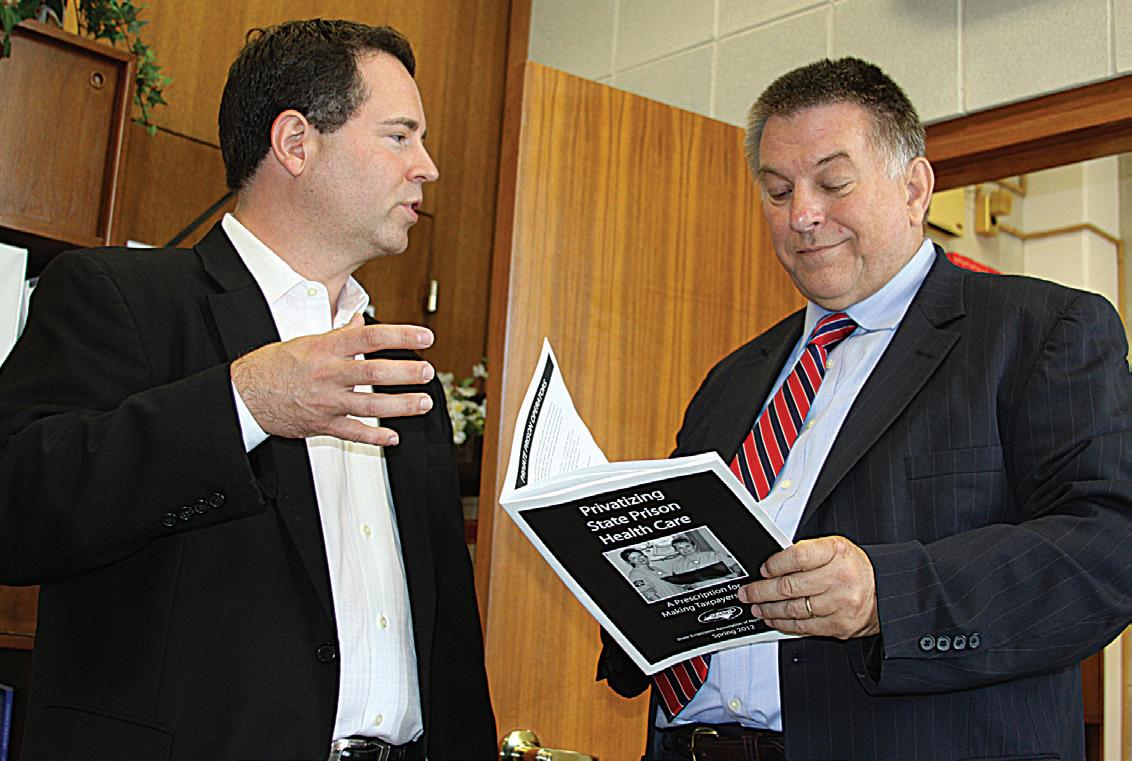
To educate legislators, SEANC published a scathing 68-page report detailing the pitfalls of privatizing inmate health care. The report, titled “Privatizing State Prison Health Care: A Prescription for Making Taxpayers Sick,” was given to every member of the General Assembly by SEANC lobbyists and leaders. You can read the report at http://bit.ly/KK4e87.
The report detailed cautionary tales from 33 states and the District of
After reading SEANC’s report, legislators understood the importance of slowing down the privatization train. They were especially concerned about how wasteful privatization would have been with taxpayers’ money.
When the issue came up for discussion on the floor of the General Assembly, legislators unanimously voted to halt the privatization effort during the 2011-2013 biennium as part of a Medicaid fix bill. The bill went straight to Gov. Beverly Perdue’s desk and she signed it into law on May 24.
The efforts to halt this privatization
threat were bolstered by hundreds of phone calls and emails made by SEANC members to voice their concerns to elected leaders.
District 26 Chairman Stanley Gales, a DPS employee, called several legislators to underscore the public safety risk of privatizing inmate health care, saying, “People sometimes forget that privatizing a vital prison role puts the surrounding community at risk. These inmates need health care, but they also need it to be provided by someone who is properly trained for what can be a dangerous task.”
In particular, SEANC would like to thank Sen. Tom Apodaca (R-Henderson) and Rep. Nelson Dollar (R-Wake) who made the wise decision to invest in this core public service and the people who provide these health care services.
cedgar@seanc.org
Columbia
have learned hard lessons
PHOTO BY TONI DAVIS
SEANC Executive Director Dana Cope, left, presents House Majority Leader Rep. Paul “Skip” Stam with a copy of the association’s 68-page report about the failures of prison health care privatization in 33 states and the District of Columbia.
Why SPA Coverage Matters to You Counselor’s Comments
During every recent legislative session, some state agency or institution has tried to remove employees from State Personnel Act (SPA) coverage. Recently, it has been the UNC system. Since we can expect these attempts to continue, it is a good idea to review the reasons why SEANC members have consistently opposed removing state employees from the protections of the SPA system.
What Does the SPA Protect?
Harris
State employees covered by the SPA system are guaranteed many rights, the most basic of which are the rights to be hired on the basis of merit and to be discharged for disciplinary reasons only where there is just cause. These two protections form the backbone of the merit-based personnel system that keeps North Carolina state government from becoming a “spoils” system, where every newly-elected politician can clean house and hand out jobs to their friends. This merit system provides North Carolina citizens with a government staffed by experienced professionals who can effectively and efficiently deliver the services they expect and deserve.
by Tom Harris
sEaNC gENEral CouNsEl
which they are adopted and amended is equally important. SEANC has a long track record of influence in the legislative process. A large number of SPA rights and benefits were suggested by SEANC, and many unwise and unwanted SPA changes have been successfully opposed by the association. Even when the State Personnel Commission adopts rules affecting SPA rights and benefits, the Administrative Procedures Act (APA) requires public hearings that provide SEANC with the opportunity to weigh in and either modify or completely block that proposed rule.
Important SPA rights
n Whistleblower protection
n Privacy of personnel records
n Freedom from illegal discrimination
n Priority promotion rights
n Priority reemployment rights after reductions-in-force
n The right to have false information removed from personnel records
n Veterans’ preferences
n A fair position classification system
n Longevity pay
n Severance pay
n Vacation, sick leave and holidays
Courts recognize the SPA system’s just cause requirement as giving each career state employee a property right in their job – creating an exception to the employer’s usual right to discharge an employee at will.
SPA Rights = Protected by Law
These rights and benefits are backed by the law and, thus, are enforceable in the courts. It’s not just that these rights and benefits are important in their own merits, but the process by
Employees exempted from the SPA system often lack the protections provided by those adoption processes. For example, the UNC system proposed in SB 575 that once their SPA employees were exempted from the SPA, the UNC system Board of Governors would be given the authority to adopt all UNC system personnel policies. However, since the UNC system is exempt from the rulemaking requirements of the APA, there is no statutorily-required process that includes a public hearing or the opportunity for legislative review before the policies they adopt become effective. Moreover, the policies adopted by the UNC system Board of Governors would lack the force of law that formally administrative rules have. For example, North Carolina courts have consistently held, and the U.S. Supreme Court has recognized, that mere policies, as opposed to statutes, do not create for North Carolina public employee property rights in their jobs.
Most SEANC members would agree that the SPA system is far from perfect. But this does not justify effectively repealing the SPA by exempting large groups of employees from its coverage. Instead, any desirable changes should be made by amending the SPA itself in a manner that preserves both the legal enforceability of SPA rights and benefits and legislative involvement in the process for amending those rights and benefits.
tharris@seanc.org
North Carolina General Assembly House of Representatives
Representative Alice L. Bordsen
300 N. Salisbury Street, Room 602
Raleigh, North Carolina 27603-5925
April 25, 2012
Dear Mr. Cope,
63rd District
Alamance County
I read with interest your Point of View in the News and Observer today and am in complete agreement with you about privatization of government tasks/ responsibilities. Aside from the failure of privatization to save money, there are other problems that are created by privatization of government services. We are moving down a dangerous road as we buy the argument that government should be run like a business and that we should privatize whenever possible. There is no argument that honestly justifies using public dollars to guarantee private profit.
I especially worry about the privatization of inmate medical. This prison population is one that seldom has advocates and is difficult to work with. It is a population that is a challenge for the State workers who are employed to manage our inmate population, workers who are seldom sufficiently paid as it is. We are required to provide basic health care to our inmates. But where will the oversight and advocates arise to oversee a for-profit entity to which we transfer that health care, an entity which has as its primary purpose the creation of a profitable return on the investment that created the entity? The potential for insufficient health care is enormous. The responsibility for inmate medical needs to remain with the State and its employees.
Sincerely,
Rep. Alice L. Bordsen
Email from Sen. Ralph Hise (R-Mitchell)
Legislators Praise SEANC’s Opposition of Prison Health Care Privatization
Letter from Rep. Alice Bordsen (D-Alamance)
From: Sen. Ralph Hise
Date: April 25, 2012 2:53:43 PM EDT
To: dcope@seanc.org
Subject: Inmate health care
Dana,
I read with interest your editorial in the News & Observer on the continued efforts of the Department of Public Safety to outsource prison health care. I have been trying to get a handle on and better understanding of this situation for the past few weeks and would welcome your suggestions and ideas on anything the legislature can do to slow down or halt this process.
I can be reached by email, or please feel free to give me a call at my office or on my cell phone. I look forward to hearing from you at your convenience.
Senator Ralph E. Hise, Jr. North Carolina Senate – 47th District
Quotes to Note
“It’s certainly not good for the taxpayers, and it’s not good for the prison systems and it’s not good for our employees.”
SEANC Executive Director Dana Cope, referring to the failure of prison health care privatization in 33 states and the District of Columbia and how such an experiment in North Carolina would surely be a failure as well, in the May 23 WRAL-TV story, “NC House wants to go slow on prisoner health care.”
“Last year, they [House Republicans in Raleigh] made a promise to our seniors and retirees that they would fund retirement. Now they want to break that promise with a new budget that would take away money for things like food, medicine and rent.”
Radio ad released in Raleigh on May 29 in response to the N.C. House Republicans’ budget proposal that breaks the promise made from last year’s budget to fund a cost-of-living adjustment for state retirees.
“It’s a broken promise. That’s not
right.”
SEANC Executive Director Dana Cope, criticizing House Speaker Thom Tillis for the absence of funding in the N.C. House budget for a costof-living increase for retirees, in the May 29 Associated Press article, “N.C. House panel eases school district funding cuts.”
@binker:
Medicaid fix contains a provision ordering prisons to delay efforts to privatize prison health care. That’s a win for SEANC. #ncga
Twitter post on May 23 from WRAL-TV investigative reporter Mark Binker, citing a victory for SEANC members when efforts to privatize the jobs of 2,000 prison health care workers were put on hold through language inserted to a bill that otherwise dealt with fixing Medicaid. The bill went straight to Gov. Beverly Perdue’s desk and she signed it into law on May 24.
“State
employees and retirees have excellent memories come November!!”
SEANC District 24 Chairwoman Anne Marie Bellamy, reminding legislators that the general election results in November may be affected by their current policy decisions, in a June 2 post on the SEANC Facebook page.
Be sure to “Like” SEANC on Facebook at facebook.com/seanc.Local2008 and follow the association’s Twitter feed @seanc2008 . The best interactions will be included in Quotes to Note each month.
SEANC members enjoy the convenience of using Colonial Life’s Call Center to apply for coverage over the phone with one of our SEANC benefit counselors.
Here’s What to Do:
= Visit the Colonial Life website or obtain a SEANC Handbook for specific product information you’ll need prior to calling the Call Center.
= Dial the Benefit Enrollment Call Center toll free at 1.866.265.3599.
Policies have exclusions and limitations that may affect benefits payable.
Colonial Life Products: connect.coloniallife.com/seanc
= Accident Insurance - (with optional spouse disability option available at an additional cost)
= Cancer Insurance - (with optional $5,000 initial diagnosis benefit)
= Critical Illness Insurance - (up to $50,000 in benefits, with no taxes being due at the point of claim)
= Disability Insurance - (on/off-job coverage with preferred AAA rates)
= Hospital Confinement Indemnity Insurance
= Universal Life Insurance - special underwriting considerations
= Whole Life Insurance
forget the SeAnC ViSion plAn optionS DUring open enrollment oCtober 1-26, 2012
SCHOLARSHIP FOUNDATION
Hit the Links for Those Hitting the Books
by JoNaTHaN owENs
SEANC Communications Specialist
The Don Jones Memorial Golf Tournament returns this fall after a year off. Usually held on Father’s Day weekend, the event is scheduled for Aug. 10 this year at Keith Hills Country Club in Buies Creek.
The tournament will be played in a fourplayer team, Captain’s Choice format. Players who enter as individuals will be placed with others in order to create teams. The tournament is open to anyone who wants to play, not just SEANC members.
Proceeds from the tournament benefit the SEANC Scholarship Foundation.
Hole sponsorships are also available for a donation of $100. A sign will be placed on one of the tees advertising your sponsorship. Deadline for hole sponsorships is July 23, 2012.
For more information on the tournament or for sponsorship opportunities, contact Renee Vaughan at 800-222-2758 or rvaughan@seanc.org.
Entry fee is $50 per person or $200 per team entry. Mulligans will be available at $5 for two with a maximum of two per player. Hotel accommodations are available at a reduced rate at the Comfort Inn in FuquayVarina, approximately 25 miles away from the course.
jowens@seanc.org
The Reporter, USPS 009-852 (ISSN 1069 2142), is published nine times a year in the months of February, March, April, May, June, July, September, November and December for $2.50 per year, per member, by the State Employees Association of North Carolina, Inc., P.O. Drawer 27727, Raleigh, NC 27611-7727. Periodicals postage paid at Raleigh, NC, and additional offices.
POSTMASTER
Send address changes to: THE REPORTER P.O. Drawer 27727 Raleigh, NC 27611-7727
SEANC accepts advertising material from companies and persons seeking to communicate with SEANC members. Acceptance of this advertising does not indicate SEANC approval or endorsement of any representation that the message, product or service is as represented by the advertiser. SEANC accepts no responsibility and shall not be liable for any use of or reliance on any such information, product or service. SEANC is a private entity and is under no obligation to carry advertisements of any nature, political or otherwise, that may be viewed as contrary to the interests of the association and its membership.
SEANC Pulls Double Duty at SEIU Convention
by ToNi davis
SEANC Communications Director
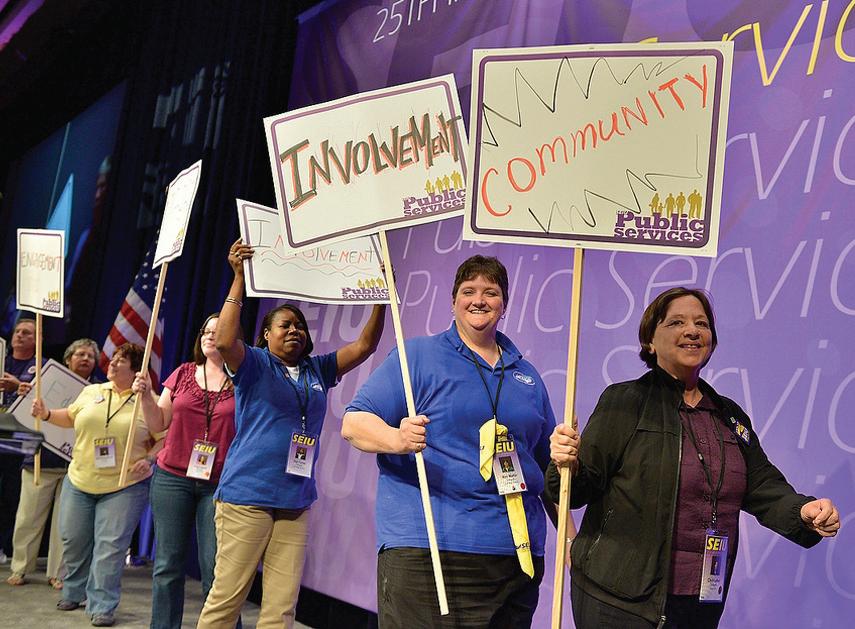
DENVER – While folks back home in North Carolina enjoyed the Memorial Day weekend, nearly 80 SEANC members joined 3,000 delegates from around the world at the 25th SEIU International Convention in Denver, Colo., May 28-30.
The theme for the convention was “Lead. Unite. Fight. Win for the 99%.” Agenda items included a unity day for all public service members, election of officers and approval of a new Member Leadership and Action (MLA) program.
SEANC members enjoyed meeting other state workers and sharing our past year’s victories. District 10 Chairwoman Kim Martin told delegates about SEANC’s successful Take Pride in Carolina campaign, where members compiled more than $10 billion in budget savings options that resulted in protecting members’ jobs in last year’s budget cycle. She also learned that North Carolina’s budget challenges were not unique to this state. Martin explained on the association’s Facebook page, “It is nice to know we are not in this alone. People across this nation are facing the same struggles we are in NC. They are also fighting for better pay and worker rights. WE ARE THE 99%.”
Delegates highlighted the convention theme with a protest at Wells Fargo that drew thousands of marchers aiming to make wealthy corporations pay their fair share of taxes.
SEANC’s delegates were also treated to a reception at the Colorado governor’s mansion along with fellow SEIU members from the South and Southwest.
PHOTO BY BRENDA HOOKER
Cope, Johnson Elected to Leadership Positions
The convention unanimously reelected SEIU President Mary Kay Henry and Public Services Executive Vice President Eileen Kirlin to four-year terms. SEANC Executive Director Dana Cope was elected as a vice president and President Charles Johnson was re-elected to the International Executive Board.
Ready, Set, Member Action!
Convention delegates approved a MLA program that will train thousands of members to lead activists who will work toward a fair economy by challenging wealthy corporations, winning elections and holding politicians accountable who stand with the 1 percent. Delegates to the SEANC convention in Greensboro this September will be trained in the new MLA program.
Delegates Make 500 Contacts to General Assembly
The N.C. House announced its budget while delegates were in Denver and the news wasn’t good (see back page article). In Raleigh, SEANC’s five lobbyists in the General Assembly and the communications staff worked overtime to send action alerts to members and field questions from the press. In
SEANC delegates attending the 25th SEIU International Convention in Denver, Colo. May 28-30, participate in a member parade to fight for the rights of middle class working families. Pictured, second and third from right, are District 10 Chairwoman Kim Martin and District 36 delegate Diane Carter.
SEIU Convention by the Numbers
n 1 SEANC delegate elected as an SEIU vice president
n 1 SEANC delegate re-elected to the International Executive Board
n 1 radio commercial written and aired – listen to it at http://bit.ly/JrVCiv
n 200+ news articles where SEANC weighed in on the N.C. House budget
n 78 SEANC delegates and guests n 500+ telephone calls made to N.C. House members
Denver, SEANC staff immediately set up a command center in the lobby of the convention hall and started selecting legislators for delegates to contact by telephone, email and social media in support of a pay raise and retiree cost-ofliving adjustments in the proposed budget. SEANC staff also wrote informational flyers for delegates and a radio commercial during the holiday weekend and had it on the air before the budget vote.
District 19 Chairwoman Angela Lyght said, “It was awesome to see and hear us working as a team to handle business on the home front while being thousands of miles away!”
tdavis@seanc.org
P.O. Drawer 27727
Raleigh, NC 27611
State Employees, Retirees Earn First Pay Raise Since 2008
SEANC Never Gave Up — Also Scored 5 Days of Vacation for
by Cary Edgar SEANC Asst. Communications Director
For the first time since 2008, the state budget includes a pay raise for state employees, a cost-of-living adjustment (COLA) for retirees and five additional days of paid leave for state workers. The budget went to Gov. Beverly Perdue but she put state employees’ pay and public services at risk by choosing to veto it for the second year in a row. Legislators gathered in Raleigh before the July 4 holiday and voted to override her veto.
Differences Between Original House and Senate Budgets
The House budget contained a one-time $250 bonus plus five days of vacation days. Retirees were shut out entirely. The Senate budget offered a 1.2 percent raise to active state employees and a 1 percent COLA to retirees. The House
did not adopt the Senate’s budget and a House-Senate conference committee was appointed to iron out the differences.
SEANC Successfully Lobbies for Pay Raise + More Leave
SEANC lobbyists, at the direction of Executive Director Dana Cope, later scored another victory by gaining an additional five days of annual leave for state employees as part of a last-minute budget corrections bill.
The finalized budget includes:
n 1.2% base pay increase for state employees
n 1% COLA for retirees
n Five additional days of paid leave for active state workers
SEANC Legislative Affairs Director Ardis Watkins told WRAL-TV on June 20, “(It) is not as much as we’d like to see,” regarding the 1.2 percent raise, “but the
State Workers
Senate took a step in the right direction, and we’re glad to see the end result.”
The veto override wouldn’t have been possible without the heroism of House Reps. Darren Jackson, Marcus Brandon and Marian McLawhorn. These legislators sided with public workers and voted in favor of overriding the veto. SEANC also thanks House and Senate leadership for working together on passing this budget.
Rep. Darren Jackson spoke in favor of state workers on the House floor, saying, “I don’t represent the Democratic Party or the Republican Party. What I represent are my constituents. [A raise of] 1.2 percent is a lot to my constituents. I am not willing to leave it (the pay raise) here tonight, and that’s why I am going to vote to override.”