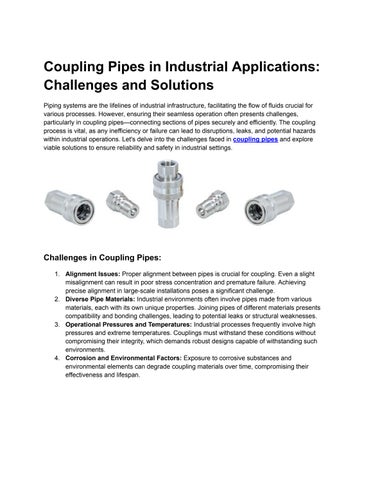
Coupling Pipes in Industrial Applications: Challenges and Solutions Piping systems are the lifelines of industrial infrastructure, facilitating the flow of fluids crucial for various processes. However, ensuring their seamless operation often presents challenges, particularly in coupling pipes—connecting sections of pipes securely and efficiently. The coupling process is vital, as any inefficiency or failure can lead to disruptions, leaks, and potential hazards within industrial operations. Let's delve into the challenges faced in coupling pipes and explore viable solutions to ensure reliability and safety in industrial settings.
Challenges in Coupling Pipes: 1. Alignment Issues: Proper alignment between pipes is crucial for coupling. Even a slight misalignment can result in poor stress concentration and premature failure. Achieving precise alignment in large-scale installations poses a significant challenge. 2. Diverse Pipe Materials: Industrial environments often involve pipes made from various materials, each with its own unique properties. Joining pipes of different materials presents compatibility and bonding challenges, leading to potential leaks or structural weaknesses. 3. Operational Pressures and Temperatures: Industrial processes frequently involve high pressures and extreme temperatures. Couplings must withstand these conditions without compromising their integrity, which demands robust designs capable of withstanding such environments. 4. Corrosion and Environmental Factors: Exposure to corrosive substances and environmental elements can degrade coupling materials over time, compromising their effectiveness and lifespan.
Solutions to Overcome Coupling Challenges: 1. Precision Engineering and Technologies: Advanced engineering and technology solutions, such as laser alignment systems, facilitate accurate alignment during installation. Innovations in coupling designs allow for greater tolerance to misalignment, reducing the risks associated with imperfect alignments. 2. Adaptive Coupling Designs: Manufacturers are developing couplings with adaptable features capable of accommodating various pipe materials and diameters. Universal couplings that work across different pipe types enhance flexibility and efficiency in installations. 3. High-Performance Materials: Utilizing high-grade materials resistant to corrosion and extreme conditions significantly enhances the durability of couplings. Stainless steel, carbon steel, and alloys with superior corrosion resistance are becoming prevalent in coupling designs. 4. Regular Maintenance and Inspection: Implementing a proactive maintenance schedule and regular inspections can identify potential issues early on, allowing for timely repairs or replacements. This preventive approach helps extend the lifespan of couplings and ensures uninterrupted operations.
Future Trends in Pipe Coupling: The evolution of pipe coupling technologies continues to progress, with ongoing research and development focusing on:
1. Smart Couplings: Integration of sensor technologies and data analytics within couplings allows real-time monitoring of conditions like temperature, pressure, and stress. This data aids predictive maintenance, preventing failures before they occur. 2. 3D Printing: Additive manufacturing or 3D printing offers the potential for custom-designed couplings, optimizing performance, and reducing material waste. 3. Nanotechnology Integration: Nanomaterials exhibit exceptional strength and resistance properties. Incorporating nanotechnology into coupling materials can enhance their durability and performance under extreme conditions. Conclusion: Coupling pipes in industrial applications pose significant challenges, but advancements in engineering, materials, and technologies offer promising solutions. Adaptable designs, high-performance materials, and proactive maintenance strategies are pivotal in ensuring the reliability and safety of piping systems. As the industrial landscape evolves, embracing innovative coupling solutions will be crucial to optimizing efficiency and minimizing operational risks.