THE OFFICIAL MAGAZINE OF THE STEEL ERECTORS ASSOCIATION OF AMERICA
STRUCTURAL STEEL PROJECTS HIGHLIGHT PRECISION
18 Integrate Detailing in Project Workflow 22 When Rigging Requires Fresh Thinking 34 Plan for Safety, Protect Productivity
Gain Insight and Control into Every Stage of your Steel Fabrication Production Built for Structural Steel Fabricators
Full Production Control Align Stations and Workflows with Configurable Alerts and Rules for Smooth Enforcement.
AISC Compliance
Production Planner
Customize Controls to meet your Quality Control Program and Maintain AISC Standards.
Plan Smarter with Work Packages and know Exactly Where your Production Stands.
Tekla PowerFab
Real-time Analytics
Sync Production, Loading, and Delivery Data in Real Time with full Tekla Integration.
Monitor Job Progress and Quality Metrics in Real Time to Spot Issues Early and Take Action.
Inventory Management Maintain Inventory Accuracy with Streamlined Receiving, Movement, and Inventory Audits.
Trusted Tools with Tangible Results “We transitioned from an outdated steel tracking system that lacked realtime product visibility and had a complicated user interface to a modern, user-friendly application that gives us insights into our production process.” - Cobb Industrial, Inc. SEAA Convention SPONSOR & EXHIBITOR BOOTH #15
Learn More
Steel Tracking is Evolving
www.steelcoded.com 404-436-2270 connect@steelcoded.com
of n
MPSPECIALTY.COM MPSPECIALTY.COM MPSPECIALTY.COM
IF YOU LIFT, ERECT, IF YOU LIFT, ERECT, IF YOU LIFT, ERECT, HAUL, OR RIG IT: HAUL, OR RIG IT: HAUL, OR RIG IT: WE INSURE IT. WE WE INSURE INSURE IT. IT.
M&P Specialty Insurance provides M&P Specialty Insurance provides insurance and risk management M&P Specialty Insurance provides insurance and risk management services for heavy and moving insurance and risk lifting management services for heavy lifting and moving industries. services for heavy lifting and moving industries. industries.
INDUSTRY INDUSTRY INDUSTRY SPECIALTIES: SPECIALTIES: SPECIALTIES: STEEL ERECTORS STEEL ERECTORS ERECTORS STEEL ERECTORS HEAVY HAULERS HEAVY HEAV Y HAULERS HEAVY HAULERS CRANE RENTAL CRANE CR ANE RENTAL CRANE RENTAL RIGGING RIGGING RIGGING FABRICATORS FABRICATORS FABRICATORS FABRICATORS STRUCTUAL MOVERS STRUCTUAL MOVERS STRUCTURAL MOVERS STRUCTUAL MOVERS
THE M&P DIFFERENCE THE M&P THE M&P DIFFERENCE DIFFERENCE Licensed nationwide, M&P Specialty Insurance offers comprehensive coverage,
Licensed nationwide, M&P Specialty Insurance offers comprehensive coverage, excellent service, competitive premiums. Underwritten by A+ rated Licensed customer nationwide, M&P and Specialty Insurance offers comprehensive coverage, excellent customer service, and competitive premiums. Underwritten by A+ rated carriers, customer our team service, emphasizes importance of alignment betweenbyinsurance excellent and the competitive premiums. Underwritten A+ rated carriers, our team emphasizes the importance of alignment between insurance products, contractual detail, and risk management practices. carriers, our team emphasizes the importance of alignment between insurance products, contractual detail, and risk management practices. products, contractual detail, and risk management practices.
CONTACT JASON MCELRATH TODAY
CONTACT JASON MCELRATH 1179 Sunset Blvd. West Columbia, SC 29169 | 803 -936-1601TODAY | Jason@MPSpecialty.com CONTACT JASON MCELRATH 1179 Sunset Blvd. West Columbia, SC 29169 | 803 -936-1601TODAY | Jason@MPSpecialty.com 1179 Sunset Blvd. West Columbia, SC 29169 | 803 -936-1601 | Jason@MPSpecialty.com
•
c nnector CONTENTS | FALL EDITION | OCT 2026
F E AT U R E S
18
MANAGEMENT Beyond the Drawings By Lance White
Treating detailing as part of the project workflow
22
IN THE FIELD Solving the Lift Together By Tracy Bennett
Early collaboration contributes to safer, more efficient project plans
COV E R STO RY PLANNING FOR EXTRAORDINARY
26
Erectors Navigate Demanding Requirements and Harsh Conditions
D E PA R T M E N T S
By Mike Larson
PERSPECTIVE ASSOCIATION NEWS PRODUCT FOCUS BUSINESS OPERATIONS TOPPING OUT
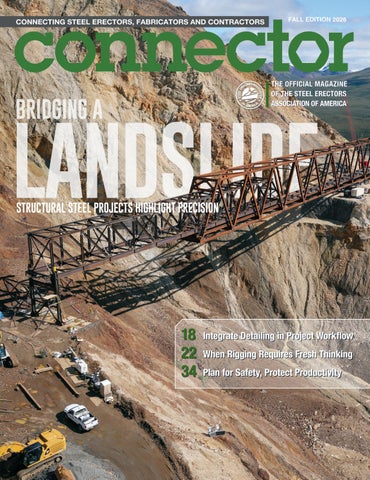
A bridge over an active landside and a live-fire training facility for first responders—SEAA’s 2026 winning Projects of the Year highlight the versatility and problemsolving abilities of steel erectors working in vastly different environments. On the Cover: The 475-foot Pretty Rocks Bridge restores access to 47 miles of Denali Park Road by replacing a section of the road that was wiped out by a progressive landslide.
8 10 14 34 38
The Steel Erectors Association of America (SEAA) is dedicated to advancing the common interests of all engaged in building with steel. The Association promotes safety, education, and training for steel erector trades, develops and promotes standards, and cooperates with others in activities impacting commercial construction. Learn more at SEAA.net and follow us on LinkedIn, Facebook, Instagram, YouTube and Flickr.
GET 3 FREE
JOIN
NOW SIGN UP IN OCTOBER. Start using 2027 Member Benefits Right Away! Spend $1,630
Average Fee
Receive $30,000
Value in Benefits
✓ Dozens of Benefits for Back Office, Safety & Training, Operations, and Vendors
✓ New Programs for Travel Planning, Training Videos in Spanish, and Awards
✓ AISC Member Discounts and Certification Reimbursement + Dozens of other Member to Member Discounts
3 FREE Months
WE ARE HERE TO HELP Hunter Telleri Director of Membership and Business Development Mobile: 908-892-0990 Hunter@seaa.net www.seaa.net
6 | THE STEEL ERECTORS ASSOCIATION OF AMERICA
THE OFFICIAL MAGAZINE OF THE STEEL ERECTORS ASSOCIATION OF AMERICA SEAA is the only national trade association representing the interests of steel erectors, fabricators, and related service providers. Connector reaches both small and large contractors working in union and open labor markets.
Steel Erectors Association of America 353 Jonestown Rd, Suite 207 Winston-Salem, NC 27104 336-294-8880 www.seaa.net OFFICERS & EXECUTIVE STAFF Chris Legnon, President Carrie Gulajan, President-Elect Glen Pisani, Industry Member Vice President Bryan McClure, Associate Member Vice President Marc Cox, Secretary Jason McElrath, Treasurer PUBLISHING PARTNER Chris Harrison, Publisher chris.harrison@seaa.net Phone 660-287-7660 Tracy Bennett, Managing Editor editor@seaa.net Phone 816-536-7903 Macie Murie, Assistant Editor macie@mightymomedia.com Jud Kite, Art Director jud5483@gmail.com ADVISORY COMMITTEE Nick Caratelli, Chairman, Nelson Stud Welding Geoff Kress, Vice Chairman, Gardner-Watson Decking Tammy Dean, Gardner-Watson Deckng Tyler Jones, Cumberland Steel Co. Jerry Morganelli, MAS Building & Bridge Jackson Nix, Shelby Erectors Kate Ouellette, GWY Jim Simonson, Steel Service Katy Williams, Williams Industries Connector™ is published quarterly by the Steel Erectors Association of America 4948 Martin View Ln, Suite 207 Winston-Salem, NC 27104
Copyright 2026 by the Steel Erectors Association of America. No material may be reprinted without permission from the Executive Director. While the information and recommendations contained in this publication have been compiled from sources believed to be reliable, the Steel Erectors Association of America, its affiliates, employees, contributors, writers, editors, designers, photographers, and media advisory committee, makes no guarantee as to, and assumes no responsibility for, the correctness, sufficiency or completeness of such information or recommendations and cannot be held responsible for the outcome of any action or decision based on the information contained in this publication or claims made by advertisers. No part of this publication may be reproduced in any form without prior written permission of the Publisher. Permission is only deemed valid if approval is in writing.
PERSPECTIVE By Pete Gum
MOMENTUM WITH PURPOSE
N
umbers do not tell the whole story of an association, but they can reveal when something meaningful is happening. At SEAA, they point to an organization that is growing because members see value in what it provides—and to a membership that increasingly reflects the breadth and strength of the industry. Over the past five years, SEAA membership has grown by more than 65%, and six of the top 10 U.S. steel erectors are members. By comparison, the 2026 Membership Marketing Benchmarking Report found that only 38% of associations surveyed experienced membership growth in the previous year, a near-historic low in the report’s 18-year history. SEAA’s momentum tells us companies see this as a place to learn, build relationships, strengthen their teams, and help shape the future of our industry. Those connections matter especially now. FMI forecasts that data center construction will grow 21.4% to $60 billion in 2026, even as total U.S. construction spending declines 1.3%. In a recent discussion, SEAA members confirmed that the data center boom is creating extraordinary demand for erectors—but also compressed schedules and increased labor and coordination pressures. Abundant work can tempt contractors to add projects and employees faster than their processes, leaders, and controls can support. Peer insight and practical resources can help companies grow without sacrificing safety, quality, or operational discipline.
Growth that Reflects the Industry SEAA brings together erectors of different sizes, labor models, markets, and regions, along with the companies that support their work. More than 14% of SEAA’s erector members are signatory to the International Association of Bridge, Structural, Ornamental and Reinforcing Iron Workers, compared with approximately 11% of the industry as a whole. That range of perspectives makes the association and the industry stronger. Retention tells another important part of the story. During the past five years, SEAA’s average annual member retention has ranged from 89% to 96%, compared with a national construction trade association average of approximately 82% to 85%. Companies are not only joining; they are choosing to stay. Association research suggests that recruitment and renewal depend on answering one question: What is in it for me? The fundamentals remain networking, education, and belonging—value that SEAA works to deliver throughout the year. Pete Gum is Executive Director of SEAA.
8 | THE STEEL ERECTORS ASSOCIATION OF AMERICA
Training That Moves With the Industry The work our members perform continues to evolve, and our training initiatives must evolve with it. Two recent examples are a Mass Timber Erection Training and Field Leadership & Communication Workshop. Held in July in Grand Rapids, Michigan, in conjunction with WoodWorks and Pioneer Construction, the hands-on mass timber program prepared erectors to work safely and productively in this growing market. The Field Leadership workshop, scheduled for October 15 in Raleigh, North Carolina, addresses another need voiced by members. Erectors must develop field leaders from within, but moving from skilled craft professional to foreman or superintendent requires an entirely new set of skills. This focus on applied learning aligns with broader event research. A 2026 Freeman survey found attendees would prefer to spend 54% of their time outside traditional session rooms. Their priorities included gaining applicable insights and interacting with peers—exactly the kind of learning SEAA’s workshops and hands-on programs are designed to provide.
Recognizing the Modern Erector SEAA also recently launched the Modern Erector certification for companies that demonstrate commitment to their teams and their customers. Strong companies are built on more than production. They invest in training and career development, operate responsibly, create healthy workplaces, and deliver the safety, quality, and professionalism customers expect. This certification recognizes those practices, providing a meaningful point of distinction for those companies that can achieve it. Read more about it on page 12.
Built by Members None of this happens by accident. SEAA’s board of directors, committee members, and numerous volunteers contribute the ideas, expertise, and time that move the association forward. Membership growth is not the end goal. The goal is to turn that momentum into better training, stronger companies, greater opportunities for ironworkers, and continued progress for structural steel erection. The numbers tell us SEAA is moving in the right direction. Whether you have been involved for years, just joined, or are considering joining, I encourage you to take part, share your perspective, and make the most of the community we are building together.
•
COOPERSTEEL.COM NASHVILLE, TN | SHELBYVILLE, TN | FLORENCE, KY (931) 684 - 7962
PRE-CONSTRUCTION PROJECT MANAGEMENT FABRICATION FIELD OPERATIONS STEEL ERECTION
Connector | FALL EDITION OCTOBER 2026 | 9
ASSOCIATION NEWS
EVENTS & ACTIVITIES Steel Connections Key West January 14, 2027 Board Meeting, Peer Group, Meet & Greet Pier House Resort and Spa Key West, Florida SEAA Convention & Trade Show March 23-26, 2027 Concord, North Carolina
Who Are the Steel Strong Women in Your Organization? Nominations are now open for SEAA’s Steel Strong Women in Construction, recognizing women whose work, leadership, and contributions are helping move the steel construction industry forward. Nominations are due November 16, 2026. The recognition is open to women across the industry, from ironworkers, welders, riggers, and crane operators to project managers, estimators, safety professionals, executives, and company
owners. Nominees may be recognized for professional achievements, leadership and mentorship, contributions to their teams and projects. Both SEAA members and non-members are eligible to participate, and nominations may be submitted by employers, colleagues, or the women themselves. All nominees will be recognized during Women in Construction Week, March 7-13, 2027.
SEAA Partners with BBSI to Expand Employee Benefit Options SEAA members now have access to competitive employee health benefits through the association’s partnership with BBSI, a SEAA Preferred Vendor experienced in supporting construction and trade businesses. The program combines group buying power with plan selection, enrollment and ongoing administrative support. Available options include medical, dental, vision and ancillary coverage, with national carriers such as Aetna and additional regional choices depending on location. BBSI can help employers compare networks and coverage, evaluate affordability and contribution
strategies, coordinate open enrollment, integrate payroll deductions and manage eligibility throughout the plan year. Members also receive assistance with required notices, reporting and documentation associated with ACA, ERISA, COBRA and HIPAA requirements. Ongoing utilization reviews and renewal planning can help employers make informed decisions and manage costs over time. SEAA members may request a customized, sideby-side benefits proposal at no cost or obligation. In some situations, employers may be able to change plans before their current renewal date.
Safety and Craft Training Awards Recognize Company Excellence SEAA members can earn recognition for the programs and practices that support strong performance long before a project tops out. The 2027 Safety and Craft Training Excellence Awards honor companies committed to developing skilled ironworkers and maintaining strong safety programs. The Craft Training Excellence Award evaluates training activities, with companies competing against employers of similar size. Recognition levels include World Class, Premier, and Gold, and 10 | THE STEEL ERECTORS ASSOCIATION OF AMERICA
World Class recipients are eligible for a $1,500 craft training grant. Separate Safety Excellence Awards are available for erectors and fabricators. Companies earn points based on EMR, OSHA logs and citations, safety programs, and training. Submissions are evaluated in a blind review by SEAA's Safety & Education Committee. Craft Training entries are due December 1, 2026. Safety Excellence submissions are due January 22, 2027.
STRONGER BENEFITS FOR SEAA MEMBERS BUILT FOR STEEL ERECTORS. BACKED BY BBSI.
SEAA has partnered with BBSI to help members access high-quality, affordable employee benefits with full-service administration.
AVAILABLE PLANS
WHY CONTRACTORS CHOOSE BBSI
Medical, Dental, Vision
Better Pricing Competitive rates through a larger risk pool
Disability & Life Insurance HSA / FSA & EAP Voluntary Accident & Critical Illness Ancillary Options
Trusted Carriers Access to national providers like Aetna, Kaiser & Blue Cross Blue Shield Simplified Administration Payroll integration, enrollment, and ongoing support
Cost Control Over Time Data-driven strategies to help stabilize premiums
OUR SUPPORT MODEL From selecting the right plan to year-round support, BBSI makes benefits easier - keeping you compliant, empowering your team, and driving smarter cost decisions. 70+ local markets nationwide
96% client retention
ESAC Accredited SOC 1 Certified
DON’T WAIT FOR YOUR PLAN RENEWAL! Scan the QR code for a free, no-obligation benefits quote. Connector | FALL EDITION OCTOBER 2026 | 11
SEAA Seeks Standout Projects for 2027 Awards SEAA is looking for projects that demonstrate what it takes to overcome challenges and deliver exceptional work. Entries for the 2027 Project of the Year Awards are due December 1, 2026—earlier than last year. The awards recognize structural steel, miscellaneous metals, and reinforcing steel projects, with an emphasis on not only the finished project but the challenges, planning, problem solving, and execution behind it.
Award categories include Structural Steel, with four classes based on steel contract value; Miscellaneous Metals, with two classes; and Reinforcing Steel, with categories for building structures, transportation, industrial/utility, and specialty projects. Projects must have topped out in 2025 or 2026 and been completed without a significant accident or injury as defined by the program criteria. The awards are open to both union and open-shop SEAA members in good standing.
New Certification Measures Organizational Excellence SEAA has launched Modern Erector, a new certification program designed to recognize steel erection contractors with established systems and practices across key areas of business performance. The third-party certification evaluates companies in six areas: business operations; culture and employee engagement; safety and risk management; employee experience and benefits; training and workforce development; and quality and technical excellence. Together, the criteria are intended to provide a broader measure of organizational strength beyond any single area of performance.
Modern Erector was developed specifically for the steel construction industry and encompasses structural steel, reinforcing steel and metal decking disciplines. Companies that earn the certification can use the credential to demonstrate established practices during prequalification, bidding and negotiations, while also supporting efforts to recruit and retain employees. The program is open to steel berection contractors that have been in business for at least three years. All applicants receive feedback on their performance, providing a roadmap for strengthening culture, training, safety and operations. SEAA members receive discounted application fees.
•
MEET NEW MEMBERS Bennett Services, Greenfield, Indiana, specializes in structural and miscellaneous steel detailing, design-assist, and engineering coordination for steel fabrication and erection projects.
Tippen Steel Services, Boyd, Texas, a structural steel contractor serving commercial, industrial, energy, infrastructure, and institutional projects.
Lazear Capital Partners, Grandview Heights, Ohio, is an investment banking firm specializing in ESOP transactions, mergers and acquisitions, and ownership transition advisory services.
Trucordia Insurance, Richmond, Virginia, offers insurance and risk management solutions for the construction industry, including workers’ compensation, general liability, builders’ risk, commercial auto, and surety bonds.
Martin's Steel Works, Inc., Vacaville, California, specializes in structural steel erection, miscellaneous metals, stairs and railings, and pre-engineered metal buildings.
Welding America LLC, Loveland, Colorado, is a specialty trade contractor serving the construction industry. Referred by: Bryan McClure, Trivent Safety Consulting
Skidmore Wilhelm, Solon, Ohio, manufactures bolt tension calibrators used to verify proper pretension in high-strength structural bolting applications. Referred by: Kate Ouellette, GWY
12 | THE STEEL ERECTORS ASSOCIATION OF AMERICA
MEMBER DIRECTORY>>
MODERN ERECTOR CERTIFICATION
Raising Standards. Recognizing Leaders. The Modern Erector Certification is SEAA’s industry-defining credential for steel erection contractors committed to excellence in safety, culture, workforce development, and operational strength. This is a third-party validation that your company represents the highest standard of what it means to be a modern ironworking organization.
WHY MODERN ERECTOR MATTERS • Stand Out in a Competitive Market • Attract and Retain High-Quality People • Strengthen Your Culture • Drive Operational Cost Reductions
Earn instant credibility with general contractors, owners, and public agencies. The certification differentiates your company during prequalification, bidding, and negotiations by demonstrating that you operate with professionalism. Today’s workforce expects more than a paycheck. Modern Erector companies demonstrate commitment to employee wellbeing, training, communication, and leadership — making you an employer of choice. Modern Erector companies report stronger engagement, higher morale, and reduced turnover as a natural outcome of the practices required for certification. Achieving the credential enhances your risk management and safety portfolio, putting your company in a position to positively influence your standing with insurers. By pursuing the credential, companies gain insight into where they excel and where improvement will drive greater stability, retention, and growth.
BECOME A MODERN ERECTOR. LEAD THE INDUSTRY FORWARD.
The Modern Erector Certification elevates not only your company, but the entire steel construction profession. By achieving this certification, you help strengthen the future of the industry.
LEARN MORE AT
PRODUCT FOCUS
Link-Belt Crawlers at Work Big B Crane of Burleson, Texas, has three Link-Belt lattice crawler cranes working on the parking garage for the new Sunset Amphitheater in McKinney, Texas, a project involving Basden Steel Corp. and Deem Structural Services. The 298 Series 2, 248 HSL and 228 HSL are lifting and placing rebar and forms for the structure, which included 69 elevated slab pours and 45,000 cubic yards of concrete. The work required approximately 200 workers and 32 weeks from the first pick to the last.
Built for Movement FallTech has introduced the CTR Class 1 SRL, a self-retracting lifeline engineered for ladder climbing, maintenance work and other overhead anchorage applications where mobility and efficient movement are important. The CTR is designed to support smoother walking-speed movement while reducing nuisance lockups. Its compact construction is paired with FallTech’s external Armored EA Energy Absorber, which provides smoother, more predictable deceleration during fall arrest without increasing fall clearance requirements. Available in 20-, 30- and 60-ft models, the CTR Class 1 SRL is designed to provide lightweight, durable fall protection for everyday jobsite applications.
14 | THE STEEL ERECTORS ASSOCIATION OF AMERICA
SkyTrak Telehandlers Get an Update JLG has redesigned its SkyTrak 10042, 10054 and 12054 telehandlers with updated technology, controls and serviceability for heavy lifting and material handling applications, including steel erection. The three models offer capacities from 10,000 to 12,000 lbs. and maximum lift heights ranging from 42 ft, 1 in. to 53 ft, 2 in. Updates include a new control system with diagnostics, a larger LCD display, improved load charts and an electric-over-hydraulic joystick with integrated auxiliary hydraulic and attachment tilt controls. JLG’s ClearSky Smart Fleet two-way communications platform comes standard, while available options include Load Stability Indication, operator-presence technology, a multi-view reverse camera and reverse sensing system.
More Power in the Field Lincoln Electric’s new Frontier 500X diesel engine-driven welder/generator is built for demanding jobsites, including structural applications. The machine delivers up to 525 amps of welding output and 20 kW of continuous three-phase auxiliary power, with multi-process capabilities for Stick, MIG, flux-cored, TIG, arc gouging and sub-arc welding. A 7-in. digital display provides access to memory settings, maintenance alerts and PIN security, while CrossLinc technology enables operators to adjust weld settings at the arc without an additional control cable. Auto-Stop/Start technology is designed to reduce fuel consumption and engine wear, and an ArcLink connector option supports mechanized welding applications.
Connector | FALL EDITION OCTOBER 2026 | 15
Siteline Adds Lien Rights Management Siteline’s new Lien Rights Management feature helps contractors track statespecific lien requirements and deadlines alongside their existing billing and collections workflows. Teams can see which projects are protected, at risk, or missing information, then generate required notices and send them by certified mail directly through the platform. The feature is designed to help contractors manage lien rights without relying on separate spreadsheets, calendars, or disconnected processes.
DEWALT Expands Atomic Lineup Grinding and finishing in tight spaces can make tool access just as important as power. DEWALT’s new Atomic 20V MAX Extended Die Grinder combines a slimmer profile with cordless performance for work in confined areas. The tool features a 35 percent slimmer neck and delivers up to 20 percent more power than a 0.5hp pneumatic die grinder. A 1/4-in. collet accommodates a range of accessories, while a variable-speed trigger provides speeds up to 24,500 rpm. Safety features include an anti-rotation system that stops the wheel when a pinch, stall or bind-up is detected, and an electronic brake designed to stop the wheel within 1.1 seconds of releasing the trigger.
MEC Enters the Crane Market MEC Aerial Work Platforms is expanding into the crane market with the new CD-9T, a 9-ton diesel carry-deck crane designed for lifting and material placement in the 8- to 10-ton class. The CD-9T features a low-profile design intended to provide operators with 360-degree visibility around the machine, along with a larger cab and controls designed for smoother positioning and load placement. The new model marks MEC’s first entry into the carry-deck crane category as the company expands its North American equipment lineup beyond mobile elevating work platforms. 16 | THE STEEL ERECTORS ASSOCIATION OF AMERICA
AI Takes on Project Risk Document Crunch, a Trimble company, has expanded its construction-focused AI platform from individual document review to project-level risk analysis. The system reviews contracts, specifications, markups, flow-downs, addenda and other project documents together to identify risks and potential scope gaps that may not be apparent when documents are reviewed individually. Through Project Assist, users can ask questions across a project's document set and generate deliverables including redlines, submittals, notices and RFIs. Responses include citations back to source documents so teams can verify information against current project requirements. Ben Hur Construction Co., an early user of the expanded platform, reports reducing contract and scope review time by approximately 80 percent.
Tying Into Tool Technology MAX USA Corp. has introduced the RB613T-C Connected TwinTier, a rebar tying tool. Designed for demanding rebar applications, the RB613T-C can tie combinations up to #9 x #10 rebar and completes a tie in approximately half a second, about 15 percent faster than the RB611T. The tool delivers approximately 4,300 ties per charge and is compatible with the TW1061T Wire Series. Cellular and GPS connectivity allows contractors to track tool locations in real time through a web-based management platform. Tracking remains active without the tool being powered on and can continue for up to 30 days even when the battery is removed. Users can also establish geofenced boundaries and receive alerts when a tool leaves a designated area. A Tool Diagnostic View provides condition updates, maintenance recommendations and error alerts with step-by-step troubleshooting information, helping crews identify issues and minimize downtime.
•
Connector | FALL EDITION OCTOBER 2026 | 17
MANAGEMENT By Lance White
The Grand Rapids professional soccer stadium, winner of the National Institute of Steel Detailing’s 2026 Edge Award for Best Structural Steel Project, illustrates how detailed modeling brings thousands of individual pieces into a coordinated system. The model becomes most valuable when the information it contains supports the project workflow from detailing through fabrication and erection.
BEYOND THE DRAWINGS Treating Detailing as Part of the Project Workflow
S
tructural steel detailing is often viewed in simple terms: the fabricator provides the contract documents, the detailer produces shop and erection drawings, and the project moves forward. In reality, the drawings are only one part of the value a detailing team can provide. Information developed during detailing touches material procurement, fabrication, project management and erection. Fabricators should therefore think about detailing as part of their overall project workflow—not simply as a drafting service.
Understand the Fabricator Behind the Standards In my role with IDS, I've visited fabrication shops of just about every size and shape, and one thing becomes obvious very quickly: no two operate exactly alike. Lance White is the Director of Business Development for International Design Services, Inc. (IDS), a structural steel detailing and engineering firm serving fabricators throughout the United States. His role focuses on building long-term industry partnerships, improving the fabricator-detailer relationship, and identifying ways that technology, early collaboration, and better communication can improve project outcomes.
18 | THE STEEL ERECTORS ASSOCIATION OF AMERICA
One particularly memorable visit was to a smaller, local fabrication shop whose standards required us to splice beams longer than 40 feet. On paper, that could easily look like just another fabricator preference. Once I visited the shop, the reason became obvious. The layout of the property, parking lot and shop entrance meant that roughly 40 feet was the longest piece of material they could physically maneuver into the building. That example has stuck with me. Understanding why a standard exists gives the detailing team an entirely different perspective. A good detailing standard can define drawing conventions, material and ABM requirements, preferred connections, file formats and model requirements. But the most important thing to remember is that a detailing standard should be specific to your company. It should not simply repeat general industry standards the detailing team should already know. At a minimum, the standard should address: Material and ABM requirements. Define how the fabricator buys material, what information purchasing needs and when. An ABM isn’t simply another deliverable; someone is using it to buy steel and keep the project moving.
Connector | FALL EDITION OCTOBER 2026 | 19
Drawing and piece-mark conventions. Establish how information should be presented, organized and identified, including piece marks, sheet organization, dimensioning, material callouts, connection details, weld and bolt information, and naming conventions. Connection preferences and typical details. Identify preferred approaches up front so the detailing team doesn’t repeatedly detail conditions in ways that don’t fit how the fabricator intends to build them. Shop capabilities and limitations. Document equipment, processes or physical constraints that affect detailing decisions. The 40-foot beam example illustrates why understanding the reason behind these requirements matters. Digital deliverables and data requirements. Identify required CNC, KISS/XML and model files, reports, bolt information and other data, including how and where that information will be used. Project communication and release expectations. Define who receives RFIs, how holds and revisions are communicated, what constitutes a release and who needs to know when something changes. The people who use the information should also have a voice in the standard. Estimating knows what it needs early; project managers know where communication breaks down; the shop knows what makes fabrication easier or harder; and erection can identify decisions that affect field work. Everyone doesn’t need to write the standard, but everyone should have input. The standard should also evolve. New equipment, software, automation or purchasing processes should trigger a review, as should recurring RFIs, fabrication problems or lessons from completed projects. Over time, a long-term detailing partner should develop institutional knowledge about how the fabricator operates and apply lessons from one project to the next.
Communication Is Part of the Deliverable Steel projects change. Design documents are revised. Schedules move. Release priorities shift. RFIs create new information. A technically capable detailing team can still create problems if those changes aren’t communicated effectively. A fabricator would rather hear on Tuesday that a Friday submittal is at risk than receive a last-minute RFI Thursday night. Good communication comes from established expectations for how RFIs, revisions, holds and schedule changes are managed—and who raises a hand when something begins to affect the project. Technology can make communication easier. Project portals, shared models, automated reports and digital RFI logs can improve visibility, but they cannot replace someone taking ownership of an issue.
Connect Detailing to the Fabrication Workflow Modern detailing produces considerably more information than a set of PDF drawings. Models and detailing databases can support material lists, CNC information, bolt lists, KISS or XML files and other downstream data. As fabrication becomes more automated, the consistency and usability of that information becomes increasingly important. Instead of only asking, “When will the drawings be ready?” fabricators should also ask how the information being created fits the way the project will be fabricated. A highly automated shop may 20 | THE STEEL ERECTORS ASSOCIATION OF AMERICA
have different requirements from an operation with more manual processes; what matters is that the detailing team understands the environment it is supporting. CNC data provides a straightforward example. That information isn’t being produced simply because CNC files appear on a deliverables list. That data may ultimately drive equipment on the shop floor. If the detailing model, piece information or output isn’t configured around what the fabricator’s system requires, someone in the shop may have to manually manipulate or re-enter information that should have flowed directly from detailing. At best, that creates extra work and defeats part of the reason the fabricator invested in automation. At worst, it creates another opportunity for error. The larger lesson is that a detailer should understand where the information goes after it leaves the detailing team’s hands. Knowing how downstream data will be consumed changes how you think about the importance of producing it accurately and consistently.
Keep Project Information Through the Handoffs One of the biggest risks as a project moves from estimating and preconstruction into detailing, fabrication and erection isn’t losing a drawing—it’s losing the reason behind a decision. Scope, sequencing, schedule or special conditions discussed during estimating may be clear at the time, but that context can disappear as the project moves to operations and detailing. Meanwhile, RFIs are answered, design drawings are revised, schedules move and release priorities change. Without a clear process, people can quickly be working from different versions of what they believe is current. Fabricators and detailers should agree where current project information resides, maintain clear RFI and revision logs, and define responsibility for communicating changes. Technology can help maintain that source of truth, but someone still has to own it.
Bring Detailing Knowledge Into the Project Earlier Traditionally, the detailing team becomes heavily involved after award, when many assumptions about scope, material and project complexity have already been made. Earlier collaboration can provide better information before those decisions are locked in. One example is estimodeling—developing an early structural model from design documents to support estimating and preconstruction. The goal isn’t a fabrication-ready model before award; it is better information while important decisions are still being made. An early model can provide additional visibility into quantities, member counts, material requirements and areas of complexity. Depending on the project, it can also identify scope questions worth investigating before they become production issues. Earlier involvement can also identify repetitive conditions, opportunities for standardization, shipping restrictions or preferred approaches to shop versus field assembly. Bringing detailing and engineering into those conversations earlier gives the team more options before drawings are complete, material is purchased or fabrication begins. That collaboration doesn’t mean the detailer independently decides how something should be fabricated or erected.
Estimodeling isn’t necessary for every project, and neither it nor other detailing technologies should be used simply because they are available. Whether it’s 3D modeling, automated connection design, model-sharing or fabrication downloads, the question is whether the technology improves accuracy, provides information sooner, reduces repetitive work or better supports the fabricator’s systems. The most sophisticated model in the world still won’t know that a 45-foot beam is five feet too long to make the turn from the parking lot into that local shop I visited unless that information is communicated. Technology should solve problems, not replace relationships. Understanding how the project will be shipped and erected can also influence how the detailing team organizes its work. While the erector determines how the steel goes into the air, knowing that plan gives the detailing team important context. Specific sequences, shipping limitations or erection priorities can determine which work and releases need to come first. Without that context, a detailer may meet the drawing schedule but deliver the wrong information at the wrong time. Meeting a drawing deadline isn’t always the same as supporting the project schedule.
From Project Vendor to Business Partner The difference between a detailing vendor and a partner isn’t software, geography or company size. A vendor receives information and produces a deliverable. A partner wants to understand the
fabricator’s business: How does the shop operate? What does the project management team value? What caused problems on the last job? What should the detailing team do differently next time? Some of the most valuable time I spend is visiting our partners— walking through their shops, meeting their people and learning why they work the way they do. Understanding why a standard exists, what information a project manager needs and what frustrated the shop on the last project allows us to carry those lessons into the next one. That relationship is also two-way. Detailers need clear priorities, current information, timely decisions and realistic schedules. Fabricators need responsiveness, transparency, capacity, accountability and consistent performance.
Look Beyond the Drawings Drawing accuracy will always matter, but it doesn’t tell the whole story. Fabricators should also evaluate how well the detailing process communicates information, supports fabrication, responds to change and contributes to the broader project team. They should also consider whether the relationship is improving over time. The question shouldn’t simply be, “Did we get good drawings?” It should be, “Is our detailing partner helping us execute better projects?” That is where the greatest value of a long-term detailing relationship can be found.
•
Connector | FALL EDITION OCTOBER 2026 | 21
IN THE FIELD By Tracy Bennett
SOLVING THE LIFT TOGETHER Early Collaboration Contributes to Safer, More Efficient Project Plans
W
hen Williams Steel Erection Co. Inc. began considering how to renovate a historic warehouse in Washington, D.C., the most apparent approach was also the most familiar. The steel erection team envisioned dismantling the existing roof, raising the walls about 10 feet and then erecting the roof steel again. The plan changed when the company’s rigging specialists joined the discussion. Instead of taking the roof apart, the team engineered a hydraulic system that raised the entire roof structure in one piece. The approach saved time and cost, preserved more of the historic structure and reduced potential exposure to asbestos and lead. The example demonstrates what can happen when people with different expertise examine the same challenge. “When we’re erecting standard beams and columns, that’s an operation we’ve done a thousand times,” said Matt Skinner, Vice President of Williams Steel Erection Co. Inc. and Williams Construction Services. “We know what the risks are from a safety point of view. We know where the quality risks are. We know how to be efficient.” When the work falls outside that familiar box, crane providers, rigging specialists and engineers can introduce different methods. Skinner also cautioned against limiting rigging to slings, shackles and other gear suspended from a crane hook. “Rigging can be jack and slide, it can be gantries, it can be just plain old bull rigging with rollers.” Tracy Bennett is editor of Connector magazine and President of Mighty Mo Media Partners, a PR firm representing the construction industry.
Budget for a Better Plan Collaboration should begin before mobilization—and preferably while the job is still being priced. Williams operates its own crane and rigging division, but its internal structure does not eliminate the need for coordination. Skinner said the people managing steel erection do not possess the same detailed crane knowledge as those managing crane operations. The company considers those needs during the bid, award, pre-job planning and execution phases. Cumberland Steel Co. follows a similar progression with outside resources. Its preconstruction team uses experience and previous job data to flag conditions likely to require specialized rigging, explained Zach Mullinax, Vice President of Operations. The estimate may initially carry an allowance; after turnover to field operations, the company determines whether to handle the work internally or engage a rigging engineer, crane provider or other specialist. “We have a lot of contacts and relationships in the industry, and we rely on that if it’s something we don’t necessarily do every day or it’s a one-off,” Mullinax said. That outside perspective can come from a company such as Bay Crane, which provides crane rental, specialized rigging, heavy transport and engineered lift planning. A crane and rigging specialist contributes more than equipment: They bring detailed knowledge of crane capabilities and limitations, access to specialized devices and experience solving movement challenges across a wide range of projects.
22 | THE STEEL ERECTORS ASSOCIATION OF AMERICA
The Dulles Corridor Metrorail project performed by Williams Steel Erection was a 2019 Project of the Year award winner. Due to the bridges’ complex geometry and placement spanning roadways, the company used an accelerated bridge construction method. Bridges were completely assembled on the ground in laydown yards, hauled to their destination on heavy-haul trailers, then hoisted in place. All the bridges had the same cross section but varying lengths, so the rigging team created custom, reusable assembly jigs that fit the profile of the bridges. The company invested time to develop custom rigging that wasn’t too large and would work for all the bridges, which created efficiencies during erection phases. READ MORE ABOUT IT >>
On complicated projects, Bay Crane may develop a preliminary system during bidding, explained Chief Engineer Kevin O'Neill, P.E. “The best outcome can only arise from proper pre-planning, getting everybody on board and giving sufficient time to provide a plan,” O’Neill said. Unusual rigging is not production work. Estimators should allow for engineering, specialized equipment or fabrication, additional project-management time, testing and contingency. Skinner cautioned that this can take longer and cost more than the first estimate suggests. Failing to account for that complexity can erase the advantage of winning the work.
A coordinated three crane pick of a 186-foot truss was a solution Cumberland Steel arrived at through communication with engineers and crane operators. The third crane was used to control deflection.
Define the Problem First Early involvement delivers limited value if the erector requests specific equipment based on an assumed solution, without revealing the actual problem. Skinner recalled an employee spending nearly two weeks trying to obtain a particular item from a vendor. When the parties stepped back and discussed the larger objective, the vendor recommended an entirely different route. The lesson learned was to fully explain the problem to allow for fresh ideas. He suggests identifying where the load starts, where it must ultimately be placed, and what stands between those points. That broader explanation gives the crane provider the information needed to evaluate both the load and the site. O’Neill said that includes verified weights, dimensions, center of gravity, attachment points and shipping orientation. Just as important are the pick and set locations, crane access, ground conditions, obstructions and the full path the load must travel. Cumberland brings drawings, markups, photographs, dimensions and when they
Rigging specialists from Williams Steel Erection devised a plan to lift a roof with hydraulic jacks rather than dismantling it and re-erecting it.
exist, 3D models to the conversation, so specialists can see the conditions for themselves. Rather than arriving with a single solution, the field team often puts several possible methods on the table and asks the rigging or crane provider to work out which one fits the equipment and the site. Sometimes that takes a single meeting. Sometimes it takes six or seven passes. Getting people on site and talking through it in person is what
surfaces the constraints that never show up in a drawing or an email thread. Experience matters, but Skinner also recommends seeking opinions from the field and from people who are not constrained by the way the work has always been performed. An operator, foreman, rigger—or even a less experienced employee willing to ask a basic question—may identify the idea that changes the plan. Connector | FALL EDITION OCTOBER 2026 | 23
1
1
2
Some devices are designed for one appliCheck Out the Member Directory at SEAA.net 1
2
1
2
2
cation and then remain in the crane yard until another unusual challenge appears. That rigging engineering expertise is part of a crane rental partner’s value. “We don’t just have cranes,” O'Neill said. “Sometimes we have ideas and good solutions.” “Erectors cannot take advantage of solutions they do not know exist. By opening its facility and demonstrating specialized BAY CRANE rigging methods for SEAA, Bay Crane helped The load transfer triangle diagram shows how the load can be our members expand their understanding of what is possible,” said Glen Pisani, Steel shifted from crane hook #1 to crane hook #2. Division Manager, MAS Building & Bridge, Inc. “Creating opportunities for that kind of practical knowledge-sharing is an important benefit of membership and one of the ways SEAA helps companies continue improving how they plan and execute their work.” BAY CRANE SERVICE, Inc 11-02 43rd Avenue, Long Island City, NY, 11101 Tel: 718 392 0800 www.baycrane.com
©
Plan with the People Who Execute It Troy “Twig” Terwilliger, Cumberland Steel’s Field Operations Manager, described the erection of a 186-foot truss assembled on the On the cantilevered load bar, a moveable counter-weight can ground. Two large cranes were positioned at keep the load bar level and eliminates the need for crane hook the primary pick points, while a third assist adjustments when picking or setting a cantilevered lifted load. crane controlled deflection as the truss was raised. Once it reached the required orienExpand the tation, the assist crane was released and the primary cranes moved the truss into place. Rigging Toolbox In 2025, Bay Crane invited SEAA board memAnalysis by a third-party rigging engineer bers to its facility for demonstrations of two showed that raising the truss without the specialized rigging tools used in constrained assist crane could produce enough deflection lifting environments: a 50-ton load-transfer to damage or shear the splice plates. The triangle and a cantilever beam system. solution resulted from an exchange among In a four-leg sling arrangement, O’Neill the erector, engineer and crane operators— explained, small differences in sling length, not simply selecting cranes based on the attachment elevation or center of gravity assembly’s nominal weight. can prevent the load from being distributed On a complicated bridge-raising project, equally among all four legs. An equalizing O’Neill saw the same collaboration at work triangle adjusts to distribute loading more as ironworkers maneuvered reinforcing steel effectively between the lines below it. Larger through existing arch trusses and temporary versions, such as the custom 50-ton triangle encapsulation. Each member presented a Bay Crane demonstrated, can also help trans- different load path and orientation problem, fer a load between cranes or hook blocks. and some placements required the cranes Bay Crane also demonstrated a cantilever to telescope under load. Bay Crane helped beam system that offsets a load horizontally the team understand the cranes’ operational from the crane hook. A movable counter- limits, including accelerated wear on boom weight maintains balance as the load moves, components. The method remained viable, but allowing the system to reach beneath an the consequence demonstrated why equipoverhang, insert a component through an ment knowledge must inform the plan. opening or remove equipment surrounded Riggers, ironworkers and crane operators by other structures. can identify access problems, pinch points, BAY CRANE
BAY CRANE SERVICE, Inc 11-02 43rd Avenue, Long Island City, NY, 11101 Tel: 718 392 0800 www.baycrane.com
©
24 | THE STEEL ERECTORS ASSOCIATION OF AMERICA
sequencing conflicts and equipment-use issues that may not be evident in calculations or drawings. Their input should be gathered before specialized equipment is purchased or fabricated, while the plan can still be adjusted without adding delay or cost. The operator is particularly important when the procedure requires an unusual configuration or movement. “You don’t want to pop it on him at Midnight, when the road’s closed and you’ve got 25 people standing around waiting,” O’Neill said. Early field involvement also reveals whether crews need training or rehearsal before execution. Bringing equipment in early allows riggers, ironworkers and operators to learn how it functions and identify practical limitations without the pressure of an active jobsite. While preparing to set 31 pedestrian bridges for the Dulles Corridor Metrorail project, the Williams team erected mock bridge piers in a staging area and practiced transporting, setting and removing a bridge before beginning work during interstate closures. Not every project has the budget or space for a full-scale trial, but a tabletop walkthrough, yard practice or partial dry run can still expose missing steps or incorrect assumptions. Skinner also emphasized that inspection records, certifications and supporting calculations should not bury the instructions needed to perform the work. The field portion should present a clear order of operations, identify important decision points and include the equipment information and relevant manual pages crews may need. “A work plan needs to be a working document for the people that actually have to execute it,” said Skinner.
Build the Relationship First Williams benefits from having erection, crane, rigging and fabrication capabilities within related divisions. Other erectors can gain many of the same advantages through long-term relationships with crane providers, rigging specialists, engineers and fabricators. Repeated work builds familiarity with equipment, site requirements and commuSummeritEdition: Julytrust 2026 nication. More importantly, builds the Ad Deadline: June 19 needed to reveal the full problem and invites Chris.Harrison@seaa.net an alternative solution. 660-287-7660
•
EMPLOYEE OWNED
Connector | FALL EDITION OCTOBER 2026 | 25
COVER STORY By Mike Larson
IN THIS ISSUE DENA Polychrome – Pretty Rocks Bridge, Denali National Park, Alaska Structural Steel Class IV (Over $2.5 Million) Erector: KWH Constructors, Inc. Fabricators: Gunderson Marine, LLC (Main Truss, Guard Rails, and Temporary Works) and Schuler Machine & Tool Co. (SPS Deck Panels) Architect: Jacobs Engineering Group, Inc. Construction Owner/GC: Granite Construction Co. Project Owner: FHWA Federal Lands Highway Contract Value: $55,037,847 Tons of Steel: 1,675 Spring Fire-Training Facility, Spring, Texas Structural Steel Class III ( $1 Million to $2.5 Million) Erector: Flex-Erect Fabricator: Graywolf Architect: Tovani Hart Construction Owner/GC: SpawGlass Project Owner: Harris County ESD 7 Contract Value: $1,244,941 Tons of Steel: 300
PLANNING FOR A
bridge over an active landside and a live-fire training facility for first responders—SEAA’s 2026 winning Projects of the Year highlight the versatility and problem-solving abilities of steel erectors working in vastly different environments. Both contractors landed their projects based on experience and past success. Both were tasked with building something that could perform in harsh environments: one to withstand repeated fire, the other to span a landslide in Alaska’s rugged climate. Each project required tight coordination. Construction of the fire training complex took coordination with different trades as the specs and schedules continually adjusted. The bridge launch over an active landslide took precise planning with no room for variation between an entire project team, from design to engineering, fabrication, shipping, and construction. Mike Larson is a journalist with more than 45 years of experience writing about equipment, engineering, and construction. He is editor emeritus of Crane Hot Line magazine.
26 | THE STEEL ERECTORS ASSOCIATION OF AMERICA
Open exclusively to SEAA members, the Project of the Year award competition recognizes creative problem solving and commitment to executing on time and within budget. Entrants can compete in four categories of Structural Steel, based on project value, two levels Miscellaneous Metals, and, new this year, Reinforcing Steel. Read about the other three winners in the Summer issue of Connector. To learn how to enter the SEAA 2027 Project of the Year competition, visit seaa.net/project-of-the-year. Submissions are due December 1.
BRIDGE OVER TROUBLING LANDSLIDE KWH Constructors, Inc., was instrumental in the design, fabrication, assembly, and installation of 1,675 tons of steel for a 475-foot-long Warren truss bridge and the temporary structures needed to slide the bridge into place in Denali National Park, Alaska. The bridge restores access to the park's only road.
The 475-foot Pretty Rocks Bridge restores access to 47 miles of Denali Park Road by replacing a section of the road that was wiped out by a progressive landslide.
AWARD-WINNING ERECTORS NAVIGATE DEMANDING REQUIREMENTS TO DELIVER STRUCTURES THAT WITHSTAND HARSH CONDITIONS
EXTRAORDINARY The Pretty Rocks Slide Bridge, which began design in late 2022 and was opened in September 2025, spans a gap created by a progressive landslide that wiped out a section of the single-lane Denali Park Road that sat 45 miles into the park. Losing that section of road cut off access to the remaining 47 miles of Denali Park Road, which leads to several park features and camps. The Federal Highway Administration and the National Park Service hired Granite Construction Company to build a bridge that would restore access. Granite named KWH Constructors as the subcontractor for structural steel erection based on KWH’s experience in arctic and sub-arctic climates, and its experience in structural steel design and construction. Additionally, the company has an in-house engineering division, Somerset Construction Engineering, which designed the launch bed, launching truss, receiving tower, and lowering frame to build and install the bridge. A Warren truss bridge installed by a bridge-launch system was selected as the solution. To accelerate the structural steel supply schedule, KWH introduced a process called Integrated
Design & Detailing (ID&D). In February 2024, the bridge erection methodology was selected, and KWH hired a bridge detailer, DBM Vircon, to participate in the ID&D process. To meet the project requirements, the team (KWH, Granite, DBM Vircon, Jacobs, and FHWA) met at least three times per week until the design was complete. Using ID&D, the team completed the bridge steel design in about five months, more than twice as fast as it would have taken using traditional methods. 3D Integrated Design Detailing allowed shop drawings to be completed concurrently with the bridge design, erection planning, and site planning. The mill order for the main steel members was placed in May 2024, only two months after the design started. The ID&D process allowed critical decisions to be made in hours, not days, weeks, or months.
Building a bridge in 4500 sq feet The temporary components needed to install the bridge, designed by Somerset and installed by KWH, included four
Connector | FALL EDITION OCTOBER 2026 | 27
Tiedowns held the bridge securely to the launch bed even with a 65-ton telescopic crawler crane sitting on sections with nothing but air beneath.
To build the bridge, including the cantilevered sections, KWH used a 65-ton telescopic crawler crane inside the structure. Tiedowns held the bridge securely to the launch bed even with the crane sitting on sections with nothing but air beneath. When the bridge structure was done, KWH built the 344’3” long launching truss inside of it and telescoped the truss across the gap to the receiving tower on the west side. Specially designed roller assemblies enabled the truss to telescope while also holding it securely to the bridge structure. The launching truss continued extending until it reached the receiving tower, which had been built on the opposite side of the landslide to support the free end of the launch truss and adjust its elevation. The launch truss was then locked to the bridge, forming a combined truss which was pulled across the landslide gap to the receiving tower by two strand jacks. As the launch progressed, sections of the launch truss were dismantled once they crossed the receiving tower. When the bridge was in final longitudinal position, jacks in the receiving tower lowered its west end about 10 feet onto the abutment, where it was welded in final position. KWH then installed the bridge deck, a sandwich plate system (SPS) that was lighter and more practical than trying to pour a castin-place concrete deck at such a remote site.
No Time for Delays
To make sure everything would fit in the field, KWH completely assembled all components in Oregon before shipping them to Alaska.
key pieces: a launch bed, a launch truss, a receiving tower, and a lowering frame. Almost immediately, KWH stashed the receiving tower, power packs, strand jacks, and other equipment that would be needed on the west side of the gap. “We wanted to get what we needed over there before the landslide completely took out the section of road,” said KWH project manager Justin Sieg. “Those things were cached there two years before they were used.” Next KWH built the launch bed on the east side of the gap, which remained accessible throughout the project, to support assembly of the main (permanent) bridge truss and provide a launching track. The bridge was stick-built in 10 sections, each 47½ feet long. The first three sections were built on the launch bed. The next two were built cantilevered on the end of the bridge away from the gap. After that, five sections were built cantilevered over the gap the bridge would eventually span. “We built a 475-foot bridge on a section of ground 30 feet wide and 150 feet long,” said Sieg. 28 | THE STEEL ERECTORS ASSOCIATION OF AMERICA
Because of the urgent need to complete the project and an Alaskan construction season that runs only from about May through September, steel fabrication, material shipping, and erection sequencing had to be planned and coordinated well in advance with little room for delays. The remote site location also created major access, supply, and logistics challenges, including limited transportation routes; long, high-cost shipping; and restricted site access. To get steel to the jobsite, it was trucked from Portland, Oregon, to Seattle, Washington. Next it traveled by barge to Whittier, Alaska, where it was loaded onto trains that took the steel to Fairbanks. Finally, it was trucked to a staging location just outside the Denali Park entrance. Since the park trucks were only allowed to navigate the narrow and crowded park road at night, the steel for the next day’s work was offloaded outside the park and then re-loaded on trucks that could travel on the park road. “Everything had to be planned and done carefully and precisely,” said Sieg. “If you were missing a piece, you wouldn’t see it until the next day.” To make sure everything fit properly, KWH assembled all components in Portland before disassembling it and shipping it to Alaska. “If you would have needed a replacement part, it would have taken a month to get to the site,” said Sieg. “Fortunately, our painstaking care on the front end and the quality of our fabricator resulted in everything fitting perfectly. We put in about 50,000 bolts in all, and we didn’t have to ream a single hole. Everything lined up perfectly.”
Wind Effects Undoubtedly, the jobsite’s most significant risk for this project was wind. “We were most at risk when the launch truss was extended but not all the way to the receiving tower,” said Sieg. “But the wind was a factor whenever we lifted anything.”
SAFE. PRECISE. ON TIME. FL CGC1514810
Estimating: Geoff Kress: 727.463.3074 Jason Kulvinskas: 727.463.3078 Patrick Forrest: Patrick.f@gwdeck.com www.gwdeck.com | FALL EDITION OCTOBER 2026 | 29 World Class Safety Award WinnerConnector 2022-2025
To get an idea of how wind would affect the structures it was going to build, KWH had a specialist company run wind tunnel tests on scale models and then provide site-specific, hour-by-hour forecasts during construction. In the end, KWH and the rest of Granite’s team completed designing, fabrication, construction, and installation of the Pretty Rocks Bridge safely, efficiently, and ahead of schedule. “The techniques, technology, and teamwork that led to success on this job can be leveraged to build bridges faster in the future,” said Sieg.
PRECISION UNDER FIRE The Spring Fire Training Facility provides a state-of-the-art environment for training current and future generations of firefighters. Owned by the Harris County Emergency Services District 7 and located in Spring, Texas, the facility consists of four buildings that were designed and constructed as a durable, realistic, and adaptable complex where trainees can safely practice essential firefighting skills. The training facility’s huge logistics center has a 52,000-squarefoot “apparatus bay” for storing and maintaining fire trucks and conducting classroom training. The building also houses storage rooms, offices and workshop areas. Other structures built for this project can withstand the repeated heat and water of live fire drills. The project’s general contractor, SpawGlass Construction Corp., chose Flex-Erect as the steel erector based on Flex-Erect’s extensive experience handling precise geometry, demanding finish requirements, and evolving field conditions while staying on schedule and maintaining high quality. Though Flex-Erect set some 300 tons of structural and miscellaneous steel on this job, its scope of work included far more than conventional structural framing. The training facility incorporated multiple elevations, varying roof slopes, tiered platforms, crane runway systems, and lots of miscellaneous steel integrated directly into the building’s training functions. Successful completion required both accuracy and adaptability. Rather than treating the job as a linear erection sequence, FlexErect approached it as a coordinated assembly process, continuously verifying layout, elevations, and alignment to ensure all components worked together as intended.
Everything but the Sink “Our responsibilities included supplying, handling, hoisting, rigging, and erecting all the required steel components, from major structural beams, columns, braces, trusses, and frames to various tubes, channels, angles, and plates,” said Chris Dodson, Flex-Erect’s vice president of preconstruction and estimating. Flex-Erect also handled the equally robust specialized miscellaneous steel, which was tailored to training firefighters. “We furnished and installed interior and exterior stairs, landings, guardrails, ladders, roof hatches, terrace railings; overhead door jambs and lintels; mechanical screen wall framing; trash gates; vanity support brackets; and canopy steel,” said Dodson. “In one building, we also provided bridge crane runway beams to support equipment used during technical rescue and high-angle training exercises.” 30 | THE STEEL ERECTORS ASSOCIATION OF AMERICA
Inside the logistics center's apparatus bay, nine large trusses hold up the multi-level roof. The 52-foot ceiling height in the center allows full extension of fire trucks' aerial ladders.
In addition, Flex-Erect installed both the floor and roof deck systems, placed deck edge angles, ledger angles, and slab-edge steel, and installed all decking fasteners and welded attachments. “Shear-stud placement also fell within our scope,” said Dodson. “The facility’s rigorous operational demands required that all edge conditions and deck support angles be installed with careful attention to long-term durability and alignment.” Beyond installation, Flex-Erect managed the full layout for its steel work and ensured proper elevation and alignment through shim placement and field verification, as well as all primer and galvanizing touch-up at welded connections.
Complex Geometry, Coordinated Effort The Spring Fire Training Facility presented a series of unique challenges that stemmed from the facility’s highly specialized purpose, architectural complexity, and the way multiple trades and materials intersected. One major challenge was maintaining the required precision. The facility is made up of many small, interdependent steel elements rather than large, repetitive framing. Multiple slope pitches,
D
4
D
w
SAFE. PRECISE. ON TIME.
Duke Perry, VP of Sales/Operations 404.808.0504 Duke.p@gwstuds.com www.gwstuds.com Connector | FALL EDITION OCTOBER 2026 | 31
World Class Safety Award Winner 2022-2025
All the exposed steel came with a museum-quality finish. Welds had to be ground smooth and painted so they were virtually invisible. The bright white spots are welds in the process of getting the architectural finish.
tiered elevations, and irregular geometry required a level of layout accuracy far beyond the typical. Small dimensional deviations could have created large alignment issues across the structure, particularly where structural steel tied directly into decking systems, architectural features, or crane runway beams, which had to stay within a 1/16inch tolerance. Maintaining proper elevations, slopes, and alignments demanded continuous field verification, shim adjustments, and rechecks throughout erection. A second challenge was coordination between trades, which became a central focus as the project progressed. Some steel elements relied on brick construction for support, an arrangement different from the usual steel-first sequencing. This required Flex-Erect to work closely with the masonry team and general contractor to adjust work plans in the field. The erection crew often shifted between areas of the building to maintain productivity, accepting a less efficient workflow in favor of keeping the project moving forward. That flexibility reduced idle time and prevented larger schedule disruptions. Equipment challenges also required quick adaption.
One of the facility’s unique features is this stairway without supporting posts beneath. Like much of the project’s exposed steel, it came in pre-primed and needed to be handled with extra care.
Installing the apparatus bay’s nine 115-foot-long, 35,200-pound clear-span roof trusses at a top height of 52 feet required two cranes. One of them had repeated mechanical failures that disrupted planned lifts and forced adjustments to erection sequencing. When the crane broke down, Flex-Erect modified erection sequencing and focused on other tasks until the crane was working again.
AESS Takes Extra Care The largest section of the training facility is the apparatus bay, which stands just over 302 feet long, 115 feet wide, and 52 feet high. It allows full-sized fire trucks to fully extend their aerial ladders inside. The bay is not only used to store, test, and maintain equipment; it also serves as a group assembly area. The building’s designer called for the apparatus bay to feature exposed structural steel that is beautifully finished to Architecturally Exposed Structural Steel (AESS) Level 3 and 4 standards. That level of finish is unusual for an industrial-style training facility and required additional labor and specialized craftsmanship to meet aesthetic requirements without compromising structural performance. AESS Level 3 requires welds to be contoured, blended, and smooth. Level 4 requires “museum-grade” welds that are
32 | THE STEEL ERECTORS ASSOCIATION OF AMERICA
ground smooth, filled, and finished so they are invisible, even up close. These requirements changed the welding process to a multi-step operation throughout the erection process: welding, inspection, grinding, and finishing, followed by primer touch-up to maintain corrosion protection. All steel came pre-primed, which required careful protection during delivery, hoisting, and installation to preserve the finish. Carpet, cardboard, and nylon straps were used to prevent damage. Many times, paint hid piece markings, so crews identified them by carefully measuring and cross-referencing shop drawings in the field. That added time and coordination to each lift. In addition, some turnbuckles came preassembled and primed, but with paint buildup that prevented a proper fit. They also lacked identification and did not match the drawings, so they were re-fabricated and re-threaded in the field. Collaboration was a defining part of the project’s success. Flex-Erect maintained consistent communication with inspectors, crane operators, masonry crews, and the broader project team to resolve issues as they arose. Strong field leadership enabled decisions to be made quickly and confidently, keeping work progressing despite shifting conditions.
•
Think you know how to install this? There’s risk in being wrong. When a steel joist seat has slots, it must be addressed in either one of two ways. Failure to act could lead to dangerous uplift issues.
Get the installation details: Connector | FALL EDITION OCTOBER 2026 | 33 newmill.com
BUSINESS OPERATIONS By Logan Campbell, CHST, and Andrew Gustafson, CHST
PLAN FOR SAFETY, PROTECT PRODUCTIVITY
M
ost steel erectors do not need to be convinced that safety affects profitability. An incident can result in medical expenses, damaged equipment, investigations, downtime and schedule delays. Those costs are easy to understand. But focusing only on the cost of injuries misses a significant part of safety’s return on investment. Long Logan Campbell, CHST before an incident occurs, the same weaknesses that create safety exposure are often already costing the project money. Poor planning can leave a crew waiting on material. An erection sequence that no longer fits field conditions can require steel to be handled multiple times. A change in crane access can turn efficient picks into hours of repositioning. When crews continue working after conditions have changed, small problems can quickly become expensive ones. The better way to think about safety ROI is to look at whether safety processes improve field execution. Good planning, reassessment, verification and communication do more than prevent injuries. They protect productive time.
is technically still working, but very little productive work is occurring. The effects can compound. One sequencing problem can disrupt the crane, connectors, bolt-up crew, welders, decking crew and subsequent deliveries. What started as a relatively minor planning issue can eventually affect several work groups. That makes pre-task planning more than a safety exercise. It is also a production tool. On one Cooper Steel project, for example, a crew was preparing to set roof joists when the foreman discovered that another contractor had occupied part of the planned crane staging area. That changed the crane’s operating radius and invalidated assumptions in the original lift plan. Rather than work around the problem, the crew stopped. They recalculated the lift, repositioned the crane and modified the erection sequence. The process cost about an hour.
A useful rule: If field conditions no longer match the assumptions used Hidden Costs of Poor Planning Andrew Gustafson, CHST Steel erection depends heavily on flow. Material, to develop the plan, reassess it. equipment, access and manpower have to come together at roughly the right time and place. When that flow breaks down, the cost accumulates quickly. The obvious expenses—another crane day, an equipment rental extension or overtime—usually get attention because there is an invoice attached to them. Less obvious are the cumulative productivity losses. Consider a six- or eight-person erection crew that spends two hours waiting on material, moving incorrectly staged steel, changing rigging, relocating equipment or working around another trade. The project Logan Campbell is a Strategic Field Safety Specialist ad Andrew Gustafson is a Field Safety Training Manager. Both safety professionals work for Cooper Steel, Nashville, Tennessee.port of AI, based on her own original concepts and perspectives.
34 | THE STEEL ERECTORS ASSOCIATION OF AMERICA
Continuing with the original plan could have resulted in multiple crane relocations, inefficient picks or overload concerns, followed by potentially significant rework and schedule recovery. The hour spent planning was not an hour lost. It protected the hours—and potentially days—that followed.
A Good Plan is Allowed to Change Planning, however, is only valuable as long as the assumptions behind the plan remain valid. Steel erection rarely happens under static conditions. Weather changes. Material arrives out of sequence. Laydown space disappears. Design revisions are issued. Equipment gets substituted. Another trade occupies an area that was expected to remain open.
Connector | SUMMER EDITION JULY 2026 | 35
Even personnel changes can matter. Replacing an experienced foreman, crane operator or key crew member may change an assumption behind how the work was intended to proceed. A useful rule is simple: If field conditions no longer match the assumptions used to develop the plan, reassess it. The important part is making reassessment a normal part of executing the work, rather than treating it as evidence that the original plan failed. A plan is based on the best information available when it is developed; it is not a promise that conditions will remain the same throughout the shift. When the information changes, the plan should be allowed to change with it. That does not mean every change requires an extended shutdown. It means determining whether the original sequence and controls still make sense. Weather, material availability, crane access, equipment substitutions, design revisions, changes in temporary bracing or even personnel changes can alter assumptions that were valid only hours earlier. This is especially important during the messy transition points that are difficult to capture in written procedures: a crane is still connected, bolting is incomplete, temporary stability conditions have changed or the sequence has been revised. The temptation is often to keep moving because the crane and crew are already working. But there is a difference between stopping production and stopping bad production. Stop Work Authority can therefore be viewed as an operational control, not simply a safety policy. Imagine a member is in the air and the load begins behaving differently than expected. The center of gravity may be different, the member may begin rotating or the rigging may not control it properly. Continuing because the load is already airborne might appear to save time. Lowering the member, reassessing the rigging and making the pick again could cost 10 minutes. But continuing could lead to damaged decking, bent material, equipment damage, rework—or an incident that shuts down the operation entirely. For Stop Work Authority to function this way, management's response matters. If every stop immediately becomes
an investigation into who caused a delay, employees learn that stopping carries a penalty. Eventually, they become more inclined to work through problems.
sequencing, damaged equipment, procedures or design conflicts before they create a larger loss. Treating that information as an opportunity to learn gives the company a chance to
When company culture discourages reporting, the result isn't fewer problems. Management simply has less information about the problems it already has. The objective is not stopping work. It is correcting the operation early enough for productive work to continue.
Verify the Work, Not Just the Paperwork The same distinction applies to safety documentation. A completed JHA, lift plan or erection procedure proves that a document exists. It does not prove that the controls described in it are influencing the work. Field verification asks a different question: Does what we are physically doing match what we said we were going to do? For a lift, that means looking at the actual crane location, radius, rigging, load, access, exclusion area and landing location. For fall protection, it means verifying where employees are actually connecting. For erection sequencing, it means confirming the steel is being erected according to plan and temporary stability requirements remain satisfied. One of the simplest verification methods is talking with the people doing the work. Ask a connector, foreman or operator what the critical controls are and what happens next. Their ability to explain the plan in practical terms can reveal more about its effectiveness than a signature on a form. Reporting provides another form of verification. Companies can unintentionally discourage reporting when employees associate reporting a near miss or minor incident with blame, excessive scrutiny or negative consequences. Over time, workers begin filtering what management gets to know. The result isn't fewer problems. Management simply has less information about the problems it already has. Near misses and reported concerns can reveal problems with rigging, access,
36 | THE STEEL ERECTORS ASSOCIATION OF AMERICA
correct a weakness while it is still relatively inexpensive.
Measure Safety ROI Incident rates still matter, but they are lagging indicators. They tell management what has already happened. Measuring safety ROI also requires looking for evidence that the organization is getting better at identifying and controlling problems before they become incidents. Three areas can provide a clearer picture: planning, reporting and corrective action. Are JHAs, lift plans and erection plans actually changing how work is performed? Are employees identifying useful near misses, equipment concerns and operational conflicts? When a problem is discovered, does the organization correct it and transfer that lesson to other projects—or does the same issue keep appearing? Similarly, the quality of pre-task planning, supervisor and employee engagement, and work execution reliability are indicators that safety processes are becoming embedded in daily operations. Fewer deviations, rework problems and operational disruptions provide evidence that the investment is affecting more than the safety record. Ultimately, the return on safety isn't found only in injuries avoided. It also appears in crane hours that aren't wasted, material that isn't handled twice, work that doesn't have to be redone, schedules that aren't disrupted and crews that recognize when conditions require a different approach. When planning improves, information moves freely and field decisions get better, safety and production stop competing with one another. That is where the return on safety becomes visible—in safer work, fewer disruptions and stronger productivity.
•
From Accounting to Welding
Up Your Game with Member to Member Discounts Just one of the reasons SEAA has a 90% member retention rate.
Exclusive Deals to Help You Run your Business
Join now
908-892-0990 | hunter@seaa.net Hunter Telleri Director of Membership and Business Development As of 9/24/25
TOPPING OUT READ MORE ABOUT IT >>
POLL SHOWS IMPACT OF MENTAL HEALTH TRAINING Stigma remains a barrier to mental health conver- comfortable discussing mental health at work, compared sations in the workplace. In a 2025 poll conducted with 43% of those without training. The findings point to the role training can play in by the National Alliance on Metal Illness (NAMI) and market research firm Ipsos, 41% of respondents cited creating a workplace where employees feel supported stigma or judgment as a reason employees may hes- and better equipped to have conversations about itate to discuss mental health at work. However, the mental health. survey also shows the impact training MENTAL HEALTH TRAINING MAKES A DIFFERENCE has on employees. Employees who received mental health training reported stronger workplace support WITH TRAINING WITHOUT TRAINING Among those and greater comfort discussing mental health. with training, 86% 86% said they feel their Manager cares about them 70% manager cares about them, compared Company prioritizes mental health 69% 40% with 70% of employees without training. 58% Likewise, 69% said Comfortable discussing mental health 43% their company prioritizes mental health, Worried about being judged 43% 52% versus 40% without training, and 58% felt
•
Source: 2025 NAMI/Ipsos Workplace Health Poll Source: 2025 NAMI/Ipsos Workplace Mental HealthMental Poll
"According to ABC Chief Economist Anirban Basu, construction backlog fell to its lowest point this year in July. “The data center boom masks the depth of this weakness, as there is a lack of momentum in any other segment. The 88% of ABC contractors that are not under contract to work on a data center had an average of 7.5 months of backlog. That compares poorly to the 12% that are under contract to work on data centers, which have 11.4 months of backlog.” — Anirban Basu Chief Economist for the Associated Builders and Contractors WINTER EDITION 2025
THE OFFICIAL MAGAZINE OF THE STEEL ERECTORS ASSOCIATION OF AMERICA
MAGAZINE THE OFFICIAL L ERECTORS OF THE STEE OF AMERICA ASSOCIATION
CTIO CONSTRU
N
DS RENSAFETY T SMART 2026 ING TECH IN AND ADVANC MATERIALS, EDULES, NEW FASTER SCH AI AND DIGITAL TOOLS ARE TRANSFORMING SAFETY & TRAINING
UP NEXT 14 Recent Court Ruling Clarifies OSHA Limits 18 Essential Equipment Spotters 30 6 Tax Reforms for Construction 18 22 48
t Works h Stack Tha Building a Tec for Safety ge Matters Why Langua e Point erag Lev ver The Lien Wai
14%
14% of SEAA erector members are union contractors, compared to about 11% across the industry.
> CAREER PATH &TRANSITION TRAINING > PROCESS IMPROVEMENT FALL EDITION, DECEMBER 2026 >— OSHA INSPECTIONS Jack Nix, SEAA President and COO of Shelby Erectors4 AD DEADLINE : DECEMBER > CONTROLLING EMR Chris.Harrison@seaa.net | 660-287-7660
38 | THE STEEL ERECTORS ASSOCIATION OF AMERICA
D
VUL_NGD
OR
E
N
V
C
H
DO T A
IL
DE
CK +
AI PINT
L®
A
FUTUREPROOF T O D A Y F O R W H A T E V E R C O M E S T O M O R R O W. New construction architecture requires special consideration for the inevitability of future upgrades. That’s why modern construction projects need hanging solutions that are built for speed, versatility, and adaptability to ensure quick and seamless renovations. To help meet that challenge, Vulcraft-Verco has developed the PinTail® Anchor, an innovative hanging solution that works exclusively with our Next Generation Dovetail Floor Deck, and are specifically designed to futureproof today’s construction projects for tomorrow’s renovations.
PINTAIL® ANCHOR THREADED ROD AND NUT NOT INCLUDED
26
0
N E X T G E N E R AT I O N
DOVETAIL DECK VUL_NGDDFutureproof_Ad_Connector_092026.indd 1
8/6/26 8:35 AM