SECTION E
SUNDAY • MARCH 21, 2021
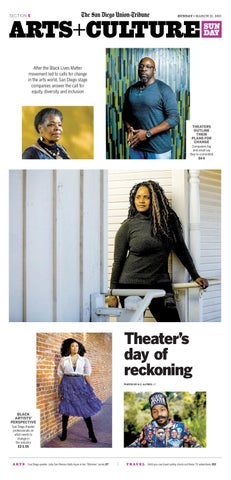
After the Black Lives Matter movement led to calls for change in the arts world, San Diego stage companies answer the call for equity, diversity and inclusion
THEATERS OUTLINE THEIR PLANS FOR CHANGE Companies big and small say they’re committed E4-5
Theater’s day of reckoning PHOTOS BY K.C. ALFRED U-T
BLACK ARTISTS’ PERSPECTIVE San Diego theater professionals on what needs to change in the industry E2-3, E6
ARTS
San Diego painter Julia San Roman finds hope in her ‘Glimmer’ series E7
T R AV E L
Until you can travel safely, check out these TV adventures E13
E2
THE SAN DIEGO UNION-TRIBUNE
T H E A T E R'S
D A Y
O F
SUNDAY • MARCH 21, 2021
R E C K O N I N G
‘It’s
Monique Gaffney is a longtime San Diego actor and dramaturg and is the daughter of the late Floyd Gaffney, who co-founded the Department of Theatre & Dance at UC San Diego and from 1971 until his death in 2007 helped lead San Diego’s Common Ground Theatre, one of the nation’s oldest Black theater organizations.
I
grew up surrounded by the influences of a father immersed in the world of Black theater after Langston Hughes approached him following his avant-garde performance at Adelphi University and asked, “… (you ever) think about doing Black theater?”
A H M E D
K .
D E N T S
‘Statements are the easy part. The follow-through is the measure’ Ahmed K. Dents is the development and artistic associate at San Diego Repertory Theatre.
S
et against the background of a raging pandemic coupled with a racial and cultural reckoning not seen since the civil rights movement, the issues of race, equity, inclusion and representation now have the most prominent seats in American theater houses. In the shadow of “We See You White American Theatre” and theater companies big and small (predominantly White) making statements of solidarity with Black Lives and promising anti-racist practices and a new era of equity, the question arises: Is it real? Alternatively, does this fade when things get “back to normal”? Does it all become a memory when “Black Lives” are not trending? I pose these questions daily with my own organization at San Diego Rep. If this is a serious endeavor, then everything at respective organizations has to be questioned at every level. How can you expect true diversity and representation of thought, production and art if your board of trustees is mostly White or of one upper economic class? What is the racial and gender makeup of your leadership staff? How culturally aware is leadership and how personally invested are they in that sense? What are your hiring practices, not just at administration and production levels, but what is does your pipeline look like in regards to bringing young people in at entry-level and front-of-house positions? Are you hiring and contracting with directors, actors, designers and other creatives that can bring true representation of multicultural works to the stage instead of relying on your limited interpretation? This gut-wrenching, honest and self-confrontational work needs to be engaged by theater companies from top to bottom to be the transformational organizations that they claim to want to be. The statements are the easy part. The follow-through is the measure. u
“Does it all become a memory when ‘Black Lives’ are not trending?”
K.C. ALFRED U-T PHOTOS
“We don’t want to be asked to lay out our trauma to tell you how to make change.”
THE SAN DIEGO UNION-TRIBUNE
M O N I Q U E
E3
SUNDAY • MARCH 21, 2021
G A F F N E Y
time to even the playing field’ At least that’s the story I’ve been told. This rich legacy has defined my experience and greatly shaped the artist I have become. I watched my dad teach and direct theater until the day he died. I remember going to rehearsals sometimes, going to countless opening nights, and tiptoeing downstairs to dance the night away at the cast parties. I remember staring at the framed poster of a Black man dressed in his finest leisure suit complete with bell bottoms, and a fedora covering part of his full afro that extended across his square shoulders. The words “No Place to Be Somebody” printed at the top. I was schooled about my place in this world: That Black is
beautiful and to be celebrated, but that there were also those who feared my Blackness. As history has shown, the past struggles of racial inequality persist. There has always been a price to pay for freedom in this country for all people of color. I’ve said it before, but I’ll say it again, it is political to be a person of color. Being Black is in right now, as the day of reckoning arrives slowly. Black culture is at the center of public affairs in this country. Conversations that are long overdue, and rarely (or never) happen, are now happening. Demands have been made locally and nationally. Numerous “statement letters” in support of racial equality and inclusivity have been
“Being Black is in right now. ... I don’t know how long that door will be open, though.”
created and posted for all to see. Space has been created for BIPOC (Black, Indigenous and people of color) artists to be heard. I don’t know how long that door will be open, though. The question remains how many theaters will truly hold themselves accountable and keep their word. Honoring promises to do better is not enough. Action is necessary. While it’s important to be supportive, recognizing the harm done from the past and accepting the call to change is essential. Only time will tell, I suppose. I feel like writing a long letter, much like James Baldwin did to his nephew in “The Fire Next
K.C. ALFRED U-T PHOTOS
J O Y
Y V O N N E
J O N E S
‘We want access and opportunity’ Joy Yvonne Jones is a San Diego actor, playwright and member of the San Diego Black Artists Collective.
I
t took eight minutes and 46 seconds of a viral video where a man unnecessarily lost his life at the hands of police officers for everyone to go “Oh yeah ... Black lives DO matter.” I appreciate the energy that everyone is putting towards change, but if I’m honest, Black artists have been waiting for you, the institution, to become tired and tell us that we have to wait, because “change takes time.” Which, to us, means our cause is no longer popular. What we really want is to not have to wait for the next public lynching of a Black person for us to matter again. We don’t want to be asked to lay out our trauma to tell you how to make change. Simply, listen the first time. Don’t make us repeat ourselves. WE WANT ACCESS AND OPPORTUNITY: • Recognize when you’re determining an artist’s qualifications based on privilege • Decentralize Whiteness in the way that you tell stories • We want our stories to be a regular part of your programming, not just in February or on Juneteenth • We want to seriously be considered in casting, not just to give the illusion of diversity • Recognize that our experiences give depth to our work and should be celebrated instead of suppressed Artists of color have to do more to be considered professional. We have to be able to hold our own in White institutions while maintaining what makes us authentically ourselves. We are willing to have this conversation because, no matter how skeptical, we are passionate about our craft and we believe in your capacity to do better. So, listen to us when we tell you something is wrong, and make a change. Finally, do not expect a pat on the back for “trying.” THIS TOOK TOO LONG. u
Time,” in honor of what it means to be Black in America. The journey from being considered three-fifths a person, as boasted by the Constitution to enable the South to get more votes, to being considered a whole person has been fraught with much violence — mentally, physically and spiritually. It does something incomprehensible to a person when they’re seen as something of no value — aka inferior. It breeds a society of implicit bias, thereby perpetuating stereotypes and preconceived notions of race and discrimination. To see Black bodies still hanging from trees (like those of Dominique Alexander in Manhattan and Robert Fuller in Palmdale); knees pressed against necks (like George Floyd, and in 1963 the photograph of two White officers watching three White officers assault a Black woman on the ground with the caption, “Birmingham Cops Manhandling Negro Woman”); continued police brutality; and to witness the violence experienced by Black protesters policed in the streets versus the treatment of White protesters in the Capitol riots, I can see we still have a long way to go. If the righting of wrongs isn’t discussed, then there’s little chance for the evolution of change. The pain embedded in the past will only heal if it is faced head on; otherwise everything gets stuck. Conversations don’t happen, and movement forward is either hindered or it moves in slow motion, causing change to be irrelevant. For all voices truly to be heard, not only is it important to tackle institutionalized racism by attending EDI (equity, diversity and inclusion) trainings, and learning how to be anti-racist, but also the deeper, challenging work of identifying implicit bias. People need to be made aware of how their subconscious thoughts and beliefs can influence their behavior towards all people of color. The mini character assassinations that people of color encounter daily have to end. Racial inclusivity calls for the elimination of barriers in order to create access. This means more identityconscious casting, more BIPOC artists in charge and in the board rooms, and more opportunities to audition and create work. Indepth conversations about representation also need to happen. White theaters need to “think outside of the box” and question what representation means and how to effectively do it. It’s time to even the playing field, and that’s more possible now because of digital platforms. Also, now theaters can produce and promote their shows, without worrying about big budgets to pay the actors and production teams. This opens the door for collaboration and less competition, and further helps to dismantle a systemic problem. In the words of the late, great pioneering artist extraordinaire Douglas Turner Ward, who wrote an article in The New York Times titled “American Theatre: For Whites Only?”: “With rare exceptions … American legit theatre, even at its most ambitious seriousness, is essentially a theatre of the Bourgeois, by the Bourgeois, about the Bourgeois, and for the Bourgeois. A pretentious theatre elevating the narrow preoccupations of restricted class interests to inflated universal significance, tacitly assuming that its middleclass, affluent-oriented absorptions are central to the dominant human condition. A theatre rarely embracing broader frames of reference or more inclusive concerns.” Although written in 1966 at the height of the civil rights movement, few things have changed, and that is not enough. Serving as the dramaturg for Common Ground Theatre’s digital theater production of Douglas Turner Ward’s “Day of Absence,” I was reminded of all the dehumanizing experiences Black people faced trying to live in this world. Especially the Black actor who endured the mockery of minstrel shows and White actors in blackface, and was crudely acknowledged, denied existence because of skin color. The problem with the prescriptive institution of racism is how it has limited the dreams and aspirations of the BIPOC artist. It is time for a healing, time to renew government support and sponsorship in the arts. Create new programs (far better than FDR’s Federal Theatre Project of the 1930s) that are well funded and truly offer artists an equitable wage to earn a living. Some are in the works, but we need more. In the words of Langston Hughes, “What happens to a dream deferred?/ Does it dry up like a raisin in the sun/Or fester like a sore — /And then run?/Maybe it just sags/like a heavy load/Or does it explode?” u
E4
T H E A T E R'S
THE SAN DIEGO UNION-TRIBUNE
D A Y
O F
SUNDAY • MARCH 21, 2021
R E C K O N I N G
How local theaters are changing
Jacole Kitchen, La Jolla Playhouse
Dea Hurston, San Diego playwright and philanthropist
Responding to demands to level the playing field for Black artists and other underrepresented groups, San Diego companies are implementing new anti-racist policies, hiring rules and plans for more diverse programming
I
BY PAM KRAGEN
n William Shakespeare’s play “Hamlet,” the young Danish prince instructs a troupe of actors that the purpose of their work is “to hold, as ’twere, the mirror up to nature” to honestly reflect the world around them. Four centuries later, American theaters are now being asked to take a closer look in that mirror. For far too long, many say, U.S. theaters’ leadership, performers, the plays they produce and the audiences they serve have remained predominantly White, even though 40 percent of the U.S. population is not. On July 8, 2020, a coalition of hundreds of BIPOC (Black, Indigenous and people of color) artists who grew tired of waiting published a sweeping 29-page list of demands for transformational change called We See You White American Theater, which can be read online at weseeyouwat.com. The document listed hundreds of demands for new policies, programs, practices and investments to level the playing field, including devoting 50 percent of jobs onstage and behind the scenes to people from BIPOC communities.
We See You W.A.T., as it is more commonly known, arrived when theaters across America were closed. Although the pandemic has devastated the industry, several local theater leaders say the shutdown gave them the time they needed to tackle this problem in a meaningful way. Since July, more than 100 of the nation’s largest theaters — including San Diego’s Old Globe, La Jolla Playhouse and San Diego Repertory Theatre — have responded to We See You W.A.T. with new anti-racist policies and plans. For Freedome Bradley-Ballentine, associate artistic director and director of arts engagement for the Old Globe, the historic importance of We See You W.A.T. can’t be underestimated. “It’s the Magna Carta of the theater world,” said Bradley-Ballentine, a Black theater artist who joined the Globe’s leadership staff in 2015. “Some people, when they first read it, were taken aback by the tone of the demands. But there have been people asking for space since the Black Arts Movement, and after 50 years of gently asking, these people said, ‘MOVE!’ People always say, ‘I don’t know what BIPOC people want,’ well this is a document that lays it all out.” Why is this happening now? The killing of George Floyd on May 25 was the flashpoint for the Black Lives Matter movement and, subsequently, We See You W.A.T. Jacole Kitchen, who is artistic programs manager and local casting director at La Jolla Playhouse and also executive director of the San Diego Performing Arts League, said the theater industry has long been seen as progressive in its programming, but there are clear blind spots in how theater companies operate. “One of the reasons it took so long is we don’t always realize there’s a problem until somebody tells us there’s a problem,” said Kitchen, who is Black. A lot of time we’re able to say, ‘I understand, but I’m not a part of the problem.’ A lot of these institutions weren’t recognizing, previous to this, how great an issue it was.” The clearest example of this in San Diego was the fumbled launch last May of a coalition of 28 local theater companies who united under the “One Theatre. One Story.” marketing banner to raise awareness about their plight in the early months of the pandemic. But the launch of “One Theatre” caused an uproar because none of the theaters in the group had BIPOC leadership, an unintentional slight that Kitchen called “the giant white elephant in the pandemic room.” To remedy the situation, One Theatre was replaced in September with a new and more diverse, 45-member organization called the Theatre Alliance, which is operating in partnership with the San Diego Performing Arts League. The Alliance is overseen by nine ambassadors, of which four are BIPOC artists, including Kandace Crystal, an actor and director who is also artistic director of American History Theater and associate artistic director of Trinity Theatre Company. Crystal, who is Black, oversees the Alliance’s periodic virtual member roundtable discussions that she said have been highly productive but have also occasionally grown heated. “People have to be willing to do the work and have those missteps when they screwed up royally, where they can not just apologize but make it right,” Crystal said. “We have people who don’t agree with points, but it’s all about the communication. Marriages fail
when there’s no communication, and theater is a bit of a marriage. There’s a lot of pushing through the muck, and the people in the alliance are willing to do that.” Besides seeing more people of color onscreen in locally produced virtual production this past year, San Diego audiences have likely heard a new addition to most preshow speeches driven by We See You W.A.T. — an acknowledgment to the Kumeyaay people, who occupied this region long before Spanish, Mexican and American people arrived. Dea Hurston, a playwright and longtime local theater philanthropist, said that the last year of pandemic-related closure has been a terrible one for San Diego theaters and the new reckoning process has been messy. But she’s optimistic about the future. “People are unsure if theater will return and what that will look like when they do,” said Hurston, who is Black. “I think theater will survive, and it has a responsibility to return, but not as it was. This past year has provided an opportunity for the reopening of theater that will look like it should — which is a supportive, creative, inclusive community that tells stories.” Today’s “Theater’s Day of Reckoning” special project offered San Diego theater leaders and local Black theater artists the opportunity to talk and write about their views on the topic of social justice in the industry. We put out a call to all 45 members of the Theatre Alliance in San Diego for their antiracism plans. Twenty-one companies responded. What follows are encapsulations of the equity, diversity and inclusion plans and antiracist statements that we received. Wherever possible, we are including a web link where readers can go online to read the complete documents.
Old Globe
In October, San Diego’s oldest and largest theater published its five-page Social Justice Roadmap, an extensive five-year plan supported by a $2 million fund to bring it to fruition. The plan has four phases, the first of which is now under way. Phase One includes new hiring initiatives that led to the recent promotions of Freedome BradleyBallentine and MFA program director Jesse J. Perez to senior positions; employee workplace culture training; and expanded representation of BIPOC members on the board of directors. Phase Two, launching when the Globe reopens, will include an expanded number of plays written and directed by BIPOC artists in productions with creative staffs that are 50 percent BIPOC; a new BIPOC resident artist program; expanded and inclusive community arts engagement efforts; inclusionminded paid internships and five-day workweeks; and new volunteer opportunities for BIPOC communities. Phase Three begins in 2022 with additional BIPOC hiring and programming; the creation of two paid fellowships for BIPOC artists; and the hiring of an audience development manager to raise awareness in BIPOC communities. Phase Four spans from 2023 to 2025 and will include new programming at the theater’s Tech Center in southeastern San Diego; a residency or co-productions with a BIPOC theater company; expanded recruitment of BIPOC job candidates; the creation of a director of equity position at the senior level; and a new position for an multimedia reporter who will represent the Globe to diverse
constituencies. The full plan can be found online at theoldglobe.org/ the-old-globe-social-justiceroadmap. Artistic director Barry Edelstein said only about 20 percent of the Roadmap work will be visible to the public, meaning its work onstage and in community engagement programs. By necessity, Edelstein said, the changes must go much deeper in order to “interrupt and dismantle” the longestablished systems that created the same outcomes. “For White people who are being asked to listen in a new way, sometimes the language can be uncomfortable,” Edelstein said. “No person of conscience would think of themselves as a White supremacist, but what we’re talking about are systems of White supremacy. When I read We See You W.A.T., the most powerful impression I have is the legacy of pain and hurt. So when someone comes to you and says, ‘I’m in pain,’ the right human response is to say, ‘I hear you, I see that, and let me make space for that and respect for that.’ ” Edelstein said that when he arrived at the Globe eight years ago, he could count on one hand the number of women hired to direct Shakespeare plays in the company’s now 86-year history. Since then, half of the Globe’s Shakespeare directors have been women. Hiring of BIPOC directors, writers and performers has also increased dramatically, and with positive results. Edelstein’s 2017 staging of “Hamlet” — being reprised next month in an audio production on KPBS Radio — had a cast that was more than 60 percent Black. It was the most successful Shakespeare production in Globe history. The Globe was able to turn out this ambitious plan rather quickly because Edelstein said the company has been working on its blueprint for the past six years. In 2015, Edelstein hired BradleyBallentine to expand outreach to diverse communities. In 2017, the Globe crafted a statement of values focused on inclusivity; in 2019, the Globe’s board approved a strategic plan for equity, diversity and inclusion; and in February 2020, the Globe opened a conversation with the newly created San Diego Black Artists Collective, of which Bradley-Ballentine is a founding member. Bradley-Ballentine said he’s extremely proud of the Social Justice Roadmap because much of it was born out of dialogue with members of the BIPOC community. “The work we’ve done the past few years — before the murder of George Floyd — helped us so that when that awful tragedy happened we were able to pivot relatively quickly, because we already had a model on how we wanted to work with communities,” Bradley-Ballentine said.
La Jolla Playhouse
On June 3, La Jolla Playhouse unveiled its two-page Anti-Racism Action Plan, which covers changes planned in 2021 and 2022. It includes issues relating to programming choices, artistic hiring practices, pay equity, staff training and more. The plan calls for three of the plays in the Playhouse’s six-show 2021-22 subscription season to be written by BIPOC writers, including one person new to the Playhouse; at least one new BIPOC director and one new BIPOC designer in the season; half of all new commissions will go to BIPOC writers; artist residencies will prioritize BIPOC artists; the creation in 2022 of two-year fellow-
Matt Morrow, Diversionary Theatre
Francis Gercke, Backyard Renaissance Theatre
Catherine Hanna Schrock, Blindspot Collective
David Ellenstein, North Coast Rep
Christopher Ashley, La Jolla Playhouse
Jennifer Eve Thorn, Moxie Theatre
ships for a BIPOC director and BIPOC stage manager; paid and inclusive internship opportunities; and more. The Playhouse also recently expanded its board by five seats to be more diverse. The complete plan can be found at lajollaplayhouse.org/ljp-antiracismstatement. Playhouse artistic director Christopher Ashley said that the action plan was created through a monthlong series of staff meetings where BIPOC employees talked candidly about their experiences — good and bad — working at the Playhouse. “Every sentence we put in front of people, they really beat it up. Everyone had powerful, urgent opinions,” Ashley said on a recent episode of San Diego Repertory Theatre’s “We Are Listening” interview series. “There’s some things we’re proud of, but there’s a lot of work to do.” One of those employees was Playhouse artistic programs manager Jacole Kitchen, who said the conversations were challenging and slow-moving, but they were necessary to ensure the resulting plan was more than just meaningless “box-checking.” Besides creating new opportunities for BIPOC artists, the new plan also includes outreach to artists with disabilities and in the LGBTQ community. “This is not fast work, and that’s why it’s been a problem up until now,” Kitchen said. “In the past, it’s been something we could Band-Aid and fix. But that’s not authentic. Change isn’t going to happen fast.” Ashley said there will be challenges ahead. American theater audiences are more comfortable attending theater where everyone looks like them, and theater subscribers are less diverse. But theater audiences are more socially progressive than the general public. “I don’t know how you convince big parts of America to open their hearts and minds, but theater is a self-selecting group,” Ashley said. “You want to engage with something when you walk in the door. Theater audiences can change their minds. That makes me hopeful. People who want to see theaters are capable of change.”
Action Plan on Nov. 9. The fivepart plan builds on the Rep’s long-established history as one of the most inclusive theaters in San Diego County. Since 1988, the Rep has produced 55 main-stage plays by Latinx playwrights, the most by any English-language theater in the country. The Rep also has a long history of producing plays with 50 percent BIPOC artists. In 2005, the San Diego Theatre Critics Circle honored the Rep with a special award for its dedication to diverse programming. The new action plan will be rolled out over three to five years. It includes committing to half of all season and festival plays by playwrights who are BIPOC and female-identifying; the expansion of roles for BIPOC, LGBTQ, women and artists with disabilities; the creation of a BIPOC play festival, a Black Lives Matter play-reading series, an annual Juneteenth play event, and a Jewish play-development program; staff anti-racism training; the creation of new artistic and general manager positions for leaders from the BIPOC, LGBTQ and female communities; staff equity training; and expanded conversations and partnerships with diverse communities. The full text can be found at sdrep.org/equitydiversityandinclusionstrategicactionplan.php. Rep co-founder and artistic director Sam Woodhouse said many of the items on the action plan have already been implemented. Last summer, he and Rep artistic associate Ahmed K. Dents launched the Zoom/podcast series “We Are Listening,” featuring illuminating and often frank discussions between Dents and local and regional Black theater artists. The series has touched on so many important issues, the La Jolla Playhouse and Old Globe signed on last fall as presenting partners. The Rep was a co-presenter of last fall’s The Breath Project festival of 8-minute, 46-second filmed plays inspired by George Floyd’s death; it recently launched its inaugural Black Voices play-reading series, now under way through April 5; and it will stream the Motown musical “Higher and Higher” beginning Monday. Also coming soon are the rap musical “Hype Man” and new commissions by American Indian, Filipino
San Diego Repertory Theatre
San Diego Rep issued its Equity, Diversity and Inclusion Strategic
THE SAN DIEGO UNION-TRIBUNE
Kristianne Kurner, New Village Arts
Kandace Crystal, Trinity Theatre Company
opment director Catherine Hanna Schrock said the impact of We See You W.A.T. was to “affirm the trajectory” the company was already on and invigorate its practices on and offstage. “Our vision is to create transformative theater that amplifies marginalized voices, illuminates untold stories, bridges disparate experiences and energizes vulnerable communities,” said Schrock, who is Egyptian-American. Her Blindspot co-founder, artistic development director Blake McCarty, is a queer White male. Blindspot’s nine-point equity, diversity and inclusion plan includes its ongoing in-depth work with communities and multicultural groups to uncover stories that have so far yielded plays on the San Diego refugee experience, racial injustice, living with disabilities, American Indian history and stories about Filipino World War II veterans, LGBTQ life and today’s youth. Its current project is “Safa’s Story,” an anti-racism play for grade schoolers that has been made available on film for at-home learning. All of the shows the company has produced have majority non-White casts, Schrock said.
San Diego Musical Theatre
Sean Murray, Cygnet Theatre
Kimberly King, Teenage Youth Performing Arts Theatre Company
Sam Woodhouse, San Diego Repertory Theatre
San Diego Musical Theatre president and co-founder Erin Lewis said the company’s staff is highly diverse, with employees who are transgender, gay, Black, Asian, women and a U.K. immigrant. Work on an official plan is under way. But in the meantime, Lewis said equity, diversity and inclusion work has included conversations with regional groups to develop a list of BIPOC artists for work assignments, and SDMT productions always feature audition notices aimed to attract BIPOC artists. The company participated in Media Inclusion Group’s “Raise Your Voice” competition for BIPOC playwrights, and it plans to present a reading of a “Raise Your Voices” script later this year. The company is also planning to expand its board of directors to include more BIPOC members, she said.
Moxie Theatre
Barry Edelstein, Old Globe
Freedome Bradley-Ballentine, Old Globe
and transgender playwrights. The Rep is also supporting the development of new plays by Black playwrights Nambi E Kelley and Giovanny Camarena. Woodhouse is in his 45th year of leadership at the Rep. As a result, some of the company’s strategic plans include preparation for finding his successor when he retires. One of the most controversial demands in the We See You W.A.T. document was term limits for theater leaders, demanding they resign if they’ve been an executive leader at the same institution for 20 or more years. Woodhouse said he knows people are looking at him when it comes to that clause in the list of demands. He said he is planning to step down in the not-too-distant future. “I used to say the most direct way to address these issues is for me to quit,” Woodhouse said in a recent “We Are Listening” episode. “Hopefully when I move on, which will be sooner rather than later, the person who comes into my chair will be a person of color. I am personally committed to that. I hear that call and it makes sense to me. There’s a whole raft of high-level new artistic directors of color making an impact in the field.”
Diversionary Theatre
As the nation’s third-oldest LGBTQ theater, Diversionary has a long been a safe space for the queer community and its allies. But in the wake of the Black Lives Matter movement, the company developed a 30-point Anti-Racist Action Plan. One of the key points in the plan was establishing an artistic fellowship program that will serve to elevate and train a future LGBTQ BIPOC artistic producer in a senior position. That fellowship position was filled last September by Andréa Agosto, who is Black. The company has also committed to have at least two LGBTQ BIPOC playwrights represented in a fourto five-show main-stage season; launching a commissioning program for LGBTQ BIPOC playwrights by the end of the 2022 season; and the reaffirmed commitment to have BIPOC and LGBTQ BIPOC artists involved in every show and in arts education programs. There will also be anti-
racism training for staff, artists and ushers; efforts to hold space for anti-racism dialogue; and distributing and marketing anti-racism resources. The full plan can be found at diversionary.org/antiracist-action-plan. In its anti-racist statement, the company, led by executive artistic director Matt Morrow and managing director Jenny Case, said: “Diversionary is a radically antiracist space that is safe for all of our artists, arts administrators, theater practitioners, and patrons. We recognize that systemic racism has prevented BIPOC people in America from enjoying an equitable, healthy, prosperous life.”
Cygnet Theatre
Cygnet Theatre artistic director Sean Murray said he hasn’t issued a formal action plan yet because he’s not sure how big a staff or budget the company will be working with when it’s finally able to resume production later this year. “One thing we felt is that we don’t want to make promises unless we can back them up,” he said. “We’re not in the position to hire anyone and do plays by anybody until we can get back in there and know what we’re doing.” Some of the work the company has done behind the scenes over the past year is to add five new BIPOC members to its board of directors, including two actors, who Murray said have added a fresh perspective. The staff is now undergoing anti-racism training, and it is choosing more diverse plays for its online theater classes. The theater’s community engagement committee also has a new focus on improving accessibility to the theater for underrepresented populations. Last fall, Cygnet commissioned three new plays by an AsianAmerican and two Black playwrights for its Finish Line: A Bill and Judy Garrett Commission. Murray said the company has always hired diverse casts and crews, but there are discussions under way on how to expand that in the future.
Blindspot Collective
Blindspot Collective was founded in 2016 with the mission to produce “radically inclusive” programming. Community devel-
E5
SUNDAY • MARCH 21, 2021
Moxie Theatre, whose mission is to create more diverse and honest images of women, has published a two-part anti-racist plan with a twist. Moxie’s plan commits to many of the demands from We See You W.A.T. for 50 percent representation of BIPOC artists, but with the inclusion of “women+” artists, which includes trans- and cisgender women and nonbinary people, as well as women+ with disabilities. By 2022, a primarily BIPOC committee will join the board of directors to assist with play selection; and beginning in 2022, Moxie’s website will display the comparative dollars earned by White vs. BIPOC artists. Moxie also has plans for ensuring anti-racist marketing and critiquing by the media. The full plan can be found online at moxietheatre.com/antiracist. “This is an opportunity to do what we do best and to do it even better than before,” Jennifer Eve Thorn, Moxie’s executive artistic director, said in an email. “Moxie’s mission from day one has been to create more diverse and honest images of women+ for our culture. To become fully anti-racist is to become the truest version of Moxie, fully in line with our mission in the deepest way possible. We’re excited to do this work.”
Vanguard Theatre
Vantage Theatre executive director Dori Salois said her 37year-old theater company was launched with a focus on diverse programming and casting. Salois said she cast the title role in “Cadenza: Mozart’s Last Year” with a Black actor; staged “Man of La Mancha” as a protest against the anti-immigrant Proposition 187; recently produced a reading of “The Spin Doctor” about the rising White supremacist movement; and had long-running school shows about Harriet Tubman and Frederick Douglass. She said Vantage was the first local theater company to produce shows at the WorldBeat Cultural Center and Centro Cultural de la Raza in Balboa Park. “Diversity and inclusion are essential for the arts to thrive,” she said. “Without it, we are merely creating in a cultural vacuum, living in an arid desert that denies reality and provides no sustenance for the soul.”
North Coast Repertory Theatre
North Coast Rep has posted a four-point Diversity & Inclusion statement on its website that represents the views of its board of directors, artistic director David Ellenstein, staff, artists, educators and volunteers. It says the company is committed to respecting the range of human difference across categories of race, ethnicity, gender, gender identity, sexual orientation, gender expression, religion, age, socio-economic status, education level, language, physical appearance, physical/mental ability, beliefs, perspectives and values. It also commits to creating welcoming and accessible spaces for all people, providing opportunities for
participation to all and identifying and eliminating barriers that exclude. The full statement can be found online at northcoastrep.org/ diversity-inclusion.
New Village Arts Theatre
Kristianne Kurner, executive artistic director of Carlsbad’s New Village Arts, said the company’s equity, diversity and inclusion plans will be published on its website in early April. The staff has been developing the plan during weekly Zoom meetings, with inspiration from the We See You W.A.T. document. Here is some of the work now under way at NVA: anti-racism training; development of two world-premiere plays with 12 BIPOC artists; free monthly film screenings featuring BIPOC artists; and the creation of a Teatro Pueblo Nuevo Scholarship Fund. Coming soon: creative team and acting roles will be offered to at least 50 percent BIPOC artists, and the hiring of more BIPOC designers and staff.
Lamb’s Players Theatre
Lamb’s Players producing artistic director Robert Smyth said that rather than publish a statement on demand, the company plans to show its commitment to diversity through its actions. This includes an increased commitment in future seasons to programming works that celebrate diversity. In its coming season, the company plans to produce the work of a local Black playwright that’s a musical biography on jazz singer Ethel Waters. “We’re grateful to be part of a community that promotes equality, diversity and inclusion and look for more ways to do that,” Smyth said. “We believe Black Lives Matter is important. White people in this nation need to recognize that it’s our last big hurdle to bring forward people who not only used to be in slavery but people who were made into a lower caste in a culture that has locked them into place.”
The Roustabouts Theatre Co.
The Roustabouts published a statement on its website rejecting bigotry and committing to further diversity “on our stage, backstage, in crew opportunities and other areas of operation, regardless of race, ethnicity, sexual orientation, gender, age, disability, religion, or social status.” The full statement can be found at theroustabouts.org/edi-statement. The company is now working on a co-production with American History Theater and TYPA (Teenage Youth Performing Arts Theatre Company) of Katori Hall’s play “The Mountaintop.” The play, about Martin Luther King Jr. on the day before his assassination in 1968, will stream April 24 through May 16.
Backyard Renaissance Theatre
Founded in 2015, Backyard Renaissance has yet to publish its anti-racist plan, but artistic director Francis Gercke has listed some of the company’s efforts at inclusion. Two of the company’s three founders are either BIPOC or LGBTQ. The company has produced original plays and world premieres written by female, queer and BIPOC playwrights. The company uses diverse casting procedures and seeks out women, queer and BIPOC playwrights.
Coronado Playhouse
Coronado Playhouse will soon launch a new website to mark its 75th anniversary, which will have a landing page for its planned equity, diversity and inclusion statement. Anthony Zelig, production manager for Coronado Playhouse, said the details are still being finalized but the company has expanded the diversity of its board over the past two years with four members who are BIPOC and/or women. The company is also diversifying its programming. On Friday, it opened a production of Djanet Sears’ “Harlem Duet,” directed by Kandace Crystal of Trinity Theatre and American History Theater. “We firmly recognize the need for change in our community, and we are looking forward to continuing to develop a broader family of artists and patrons at the Playhouse,” Zelig said.
Patio Playhouse
Patio Playhouse, an Escondido community theater run by artistic manager Matt FitzGerald, adopted a diversity statement and a 21-page policy on diversity, inclusion, harassment and consent last spring. The statement says Patio Playhouse: “asserts its dedication to diversity and inclusion of all people, regardless of ethnicity, race, religion, sexual orientation, gender, age, disability or social status. Patio Playhouse is intent on advancing equality and diversity be it on stage, backstage, designing, production, operations or any other activity or sphere of influence. Patio Playhouse believes that everyone deserves equal opportunity, to be treated with respect and dignity, to receive encouragement to reach their full potential and to be free from discrimination.” The new policies include the consideration of hiring diverse
casts and creative teams and allowing discussions with show participants regarding staging culturally based violence, use of accents or dialects, use of blackface or brownface makeup, and more. The full document can be found at patioplayhouse.com.
Write Out Loud
Write Out Loud co-founders Veronica Murphy and Walter Ritter, who specialize in oral presentations of plays, poems, books and stories, have issued the following anti-racist statement: “Write Out Loud has a history of providing free programming that is accessible to people of all ages and genders and across all ethnicities and socio-economic situations. The organization, staff and board, will redouble its commitment to finding ways to dismantle systemic racism and inequalities in our society while providing a place for diverse voices to be heard. Evaluating equity policies and procedures companywide will include listening carefully to our BIPOC cohorts and audiences and will consist of ongoing examination and dialogue to discover methods that will assure accessibility and equity in every area of the organization, and for those we serve.”
TYPA
TYPA, an acronym for Teenage Youth Performing Arts company, has an anti-racist statement on its website that says the company, co-founded by Black theater artists Kimberly King and Imahni King-Murillo, was started out of a love for San Diego’s youth, and the “continuous, unchecked violence upon our Black youth is an active destruction of their futures and an affront to all youth.” “TYPA stands against racism, against police brutality, against anti-Blackness, and against all systems that stand to keep systemic oppression alive. We mourn the lives lost; we say their names as they join the ancestors because their lives were taken prematurely by the persistent weaponization of racism. ... We stand with the Black theatre community and all antiracist organizations that are working to combat anti-blackness and racism. We are resolute against hate. It must be undone. TYPA will advocate, disseminate and provide a platform for Black theater artists to be seen, heard and celebrated,” the statement reads. For the full statement, visit typatheatrecompany.org.
Wildly Successful Theatre Co.
This fledgling company, which in the past has been dedicated to helping train rising theater artists, has yet to produce its first full season of plays. As a result, artistic director Siri Elena said she has spent the past year developing a plan of action in the wake of We See You W.A.T. As she plans her first season, Elena said she’s been reading more scripts by LGBTQ and BIPOC playwrights and networking to recruit more diverse voices to determine “what our post-pandemic seasons will look like, with a mind on bringing people to the table and letting them have their work seen, heard and celebrated.”
Patchwork Theatre Company
Patchwork Theatre was created last March as a way for idled theater artists to collaborate during the pandemic. Founded by Kian KlineChilton and two fellow recent college theater graduates, it is still formulating its plans. But KlineChilton, who is Black, said Patchwork is dedicated to diversity. “It is celebrating size, gender, race and all the qualities that make us unique,” he said in an email. “In championing that thought, we continue to create a space where young voices of color can begin to shape and flourish who they are meant to be as artists. We challenge and question, not to create conflict, but to raise awareness as to how we can continue to better ourselves. In doing so, we begin to shape a better and brighter future. We are a collective dedicated to championing its young and uprising community of artists and embracing new forms of theater. We are committed to advocating for inclusion in the arts and creating during a time when conventional theater isn’t being made. It’s a chance to dive into the new and imaginative. It’s a celebration of innovation. It’s a reminder and dedication of passion.”
Trinity Theatre Company
Trinity Theatre, which offers youth and adult theater productions and training, has been working to present more inclusive programming over the past year. Associate artistic director Kandace Crystal said the company has partnered with Kitabu Club Adventures, a Black-owned book club for children that offers diverse titles so kids can see themselves in the stories they read. Another way Trinity aims to make all children, including those who are nonbinary, feel welcome is changing the name of its recent “Jack and the Beanstalk” play to “J. and the Beanstalk.” “That one change lets kids know that we’re here to include you in this conversation, that we see you,” Crystal said. pam.kragen@sduniontribune.com
E6
THE SAN DIEGO UNION-TRIBUNE
T H E A T E R'S
D AY
O F
SUNDAY • MARCH 21, 2021
R E C K O N I N G
K I M B E R LY K I N G
‘Well, here we are again, but this time feels different’
Kimberly King is the managing director and dramaturg of TYPA Theatre Co. (Teenage Youth Performing Arts Theatre Co.), an arts educator, a teaching artist at the Old Globe and a board member for San Diego Junior Theatre. “I went down to the crossroads Tried to flag a ride I went down to the crossroads Tried to flag a ride Nobody seemed to know me Everybody passed me by.” — Robert Leroy Johnson
I
W I L L I A M
t’s not as if we haven’t stood at this crossroads before. Year after year, we witness majority White casts of White-authored, Whitedirected and White-produced “classics.” Folks see with their own eyes which stories and voices the American theater community treasures enough to keep alive, treasures enough to espouse and allow it the narrative dominion of a bully, a master. Well, here we are again, but this time feels different. I don’t believe The Woke are going to silently ignore another season of 70-year-old misogynistic musicals laden with microaggressions while Micki Grant, Amiri Baraka, Dominique Morisseau, Idris Goodwin, and a ridiculously untapped wealth of BIPOC playwrights wait on the sidelines for the one “ethnic” slot of the season. I believe theaters that refuse social justice will suffer a continued pandemic of empty seats. Disenfranchise-
‘ B J ’
“Let’s skip the tired lip service and cut to the chase: invite accountability.” ment can be reciprocated. But we fear correction. When I was a student, those red slashes on my homework indicated a failure to glean. But the failure was the lack of opportunity to commune with my mistake, learn what was wrong, fix it. Many of us are encouraged by the corrective actions of theaters who have developed articulate maps to social justice. More than simply noticing problems of inequity within primarily White institutions, some have publicly published statements of action. Great! Let’s skip the tired lip service and cut to the chase: invite accountability. I look forward to more local and national theaters publicly outing their inequity — passive or otherwise — and turning the corner to embrace their own map to correction. It’s not a crime to make mistakes, but it’s the oldest of clichés to defend and refuse to rectify the mistake. Feedback and correction is wherein lies growth and improvement. That is the teacher in me talking, so you can bet that is what I’m telling your kids. u
R O B I N S O N
‘Our industry and world will evolve, with or without you’ William “BJ” Robinson is a San Diego actor, musical director and music teacher. He wrote this with Ciarlene Coleman, a San Diego actor and playwright.
T
he past year has been a never-ending trial of ethics, economics and artistic integrity for San Diego performing artists of color. As we slowly approach a “return to normal,” we BIPOC artists advocate for our industry to be better than it was before the pandemic. The tough truth is that much of San Diego theater was founded on inherent elements of misogyny, racism and White supremacy. Today, the greatest challenge is getting those with power and control in San Diego theater to hold themselves and their organizations accountable. Historically, BIPOC performing artists have made countless efforts to address instances of racism in our industry. Instead of being met with open discussion, we are typically met with dismissal and silence. Because of this treatment, many BIPOC artists are abandoning our community completely, seeking work either outside of San Diego or outside of the arts industry entirely. To us, it has become clear that San Diego theaters — all of which are PWIs (“predominantly White institutions”) — currently lack the capacity to meet the needs of BIPOC artists. The Theatre Alliance of SDPAL (San Diego Performing Arts League) lists over 45 member organizations. Of these, only five organizations have published anti-racist action plans. After contacting 20 of the organizations that did not release action plans, 10 never responded, three questioned motive, and six provided more insight. One artistic director mentioned that having conversations on race, going through diversity training, and deliberately putting focus on BIPOC artists was simply: “... just not what (they’re) comfortable with.” We acknowledge that change and growth are not easy, but it is what BIPOC artists should expect from the organizations that employ us. Change is exactly what artistic leaders need to put themselves through, because we ensure that our industry and world will evolve, with or without you. u
“Today, the greatest challenge is getting those with power and control in San Diego theater to hold themselves and their organizations accountable.”
K.C. ALFRED U-T PHOTOS
THE SAN DIEGO UNION-TRIBUNE
E7
SUNDAY • MARCH 21, 2021
Finding the light Painter Julia San Roman channels hope and catharsis in her ‘Glimmer’ series, on display at Sparks Gallery BY SETH COMBS
T
he subjectivity of art often comes down to timing. That is, the way a certain artist or movement’s work can affect the viewer is often highly dependent on what that viewer is going through in their own life.
Julia San Roman had always been peripherally familiar with the iconic California Light and Space movement, the loose collective of regional artists working in the 1960s and ’70s. She recollects that the geometric and illuminative works of artists like James Turrell and Robert Irwin always spoke to her, but never directly informed her own work, which largely consisted of more figurative oil paintings and self-portraits. But when San Roman’s husband, Brian, was diagnosed with cancer in 2011, she found that the Light and Space movement works just hit her differently. “I suddenly connected with it so much. I studied the movement as much as I could. I know their work was mainly about perception, but for me, I still found the experience to be so mystical,” says San Roman. “When my husband would sigh from lack of energy from the chemotherapy, I could see a ray of light coming through the clouds. I would often call it the light of hope.” In fact, it’s easy to detect that “light of hope” in the works that make up San Roman’s “Glimmer” series, which is currently on display at Sparks Gallery through April 25. The abstract pieces, made up of geometric and prismatic rays of light beamed and sometimes overlain on cloud patterns, offer a glimpse into not only San Roman’s artistic journey during her husband’s illness, but also her attempts to remain hopeful after his death. “I transitioned to ‘Glimmer’ because, at the end of his life, the only thing that would make me happy was my work,” says San Roman, who used a Rothko-like immersion-in-color approach to the paintings. “I needed color, and the only color I could get was from my paint, so I decided to paint the light spectrum.” The “Glimmer” series is also representative of another step of San Roman’s artistic journey, and a journey that began relatively late in life. While she says she’s always been an artist at heart, San Roman, who is originally from Spain, pursued biology while attending a university in Madrid. She moved to San Diego right out of college after one of her former professors invited her to La Jolla to spend time with his family. She ended up getting an internship at the Scripps Clinic and Research Foundation.
COURTESY PHOTOS
“Polymita” is part of Julia San Roman’s “Glimmer” series, abstract pieces that offer a glimpse into not only her artistic journey during her husband’s illness, but also her attempts to remain hopeful after his death.
Julia San Roman’s “Glimmer” When: Through April 25 Where: Sparks Gallery, 530 Sixth Ave., San Diego Phone: (619) 696-1416 Phone: sparksgallery.com After gaining her doctorate 10 years down the road, she took a sabbatical from science and began taking art classes at Grossmont College. San Roman says she had been painting before starting classes in Spain, but had put it on the back burner over the years. “I was transformed by the classes at Grossmont,” says San Roman. “It was an epiphany. I never went back to science except to help my husband part time. I discovered myself. I love science, but my soul is more connected to art.”
Still, once she returned to painting, San Roman says it took her a while to find her artistic voice again. One thing she says has always come naturally was becoming inspired. Before starting art, she’d often travel and take pictures of places and people that inspired her. But when it came to painting, she was often her own worst critic. “I wanted to do art that had a meaning. Art that spoke of something, not just decoration,” says San Roman. “So I had to work very hard at it.” Much of San Roman’s early work is more figurative in nature. She’d often use her own body as a model for series such as “Brief ” and “Full Circle,” but only because she didn’t have anyone else to pose for her. She says she “knocked on so many doors” to promote her work, but many people would often take her work to be selfobsessed. “Even when I started to get known, I still found it wasn’t easy for me,” says San Roman. “I still wonder what it was, but someone once told me that I’m too full of myself and that I only spoke of myself. But for me, contemporary art has to be about the way the artists themselves interiorize the outside. If you don’t put yourself in the work, it’s decoration.” The “Cante Jondo” (2009) and “Dissasociation” (2011) series were San Roman’s first foray into working outside of figurativism and portraiture. “Disassociation,” with its dark, nimbus cloud formations and obscured hints of sunshine, could easily be seen as a prelude to “Glimmer,” a series she now views as “the trunk, and the rest are branches.” “(‘Glimmer’) is where I feel I really found myself,” says San Roman. “For me, it is a coming-ofage series. I would continue doing it for the rest of my life.” In addition to the “Glimmer” exhibition, San Roman will be showing work from her “The Hours” series at “Twenty Women Artists: Now,” a new group exhibition at the Oceanside Museum of Art running through Aug. 1 and opening with a virtual reception March 25. The “Hours” portraits were inspired by her experience working with immigrant workers at a workers’ compensation department at a Chula Vista clinic. “My work up until now has been very autobiographical, my experiences, and whatever I have inside me,” says San Roman, who plans on continuing “The Hours” to possibly include portraits of children held in U.S. detention. “ ‘The Hours’ is talking about the immigrant worker, and that is outside of me, but it’s also about my perceptions of them, so in a way, it’s about me.” Combs is a freelance writer.
E8
THE SAN DIEGO UNION-TRIBUNE
SUNDAY • MARCH 21, 2021
Salute to Peter Green
Fleetwood Mac founder, who died last year, is honored in a star-studded tribute concert film that will be released soon BY GEORGE VARGA
F
ew music legends have burned as brightly or faded as quickly and tragically as the late Peter Green, the brilliant guitarist, singer and songwriter who in 1967 founded the English blues band Fleetwood Mac and steered it to rock stardom before quitting in 1970.
He is saluted by an all-star lineup in the new concert film, DVD and double-album “Mick Fleetwood & Friends Celebrate the Music of Peter Green and the Early Years of Fleetwood Mac,” which was held in 2020. It debuts on demand April 24 on nugs.net and will be released April 30 in Blu-Ray, CD and vinyl formats. Guests range from ZZ Top’s Billy F. Gibbons, Metallica’s Kirk Hammett and Oasis co-founder Noel Gallagher to The Who’s Pete Townshend, Aerosmith’s Steven Tyler, original Fleetwood Mac guitarist Jeremy Spencer, and three current members of the band Green once led — Fleetwood, Christine McVie and Neil Finn. A famously troubled soul, Green was 73 when he died in his sleep in July. As a young man, he wrote and sang such enduring Fleetwood Mac classics as “Black Magic Woman,” which became a worldwide hit for Santana, “Oh Well, Pt. 1,” which has been covered by everyone from Haim and Aerosmith to Jason Isbell and the late Tom Petty, and “The Green Manalishi (With The Two Pronged Crown),” which has been covered by such bands as Judas Priest, The Melvins and Corrosion of Conformity. That his music endures is as undeniable as the fact that Green, sadly, started his downward spiral as a young man and never recovered in his lifetime. “When I look back on Fleetwood Mac, there are things I would have done differently,” the musician born Peter Greenbaum said in a 1998 Union-Tribune interview to preview his sluggish performance at San Diego Street Scene with The Splinter Group. Green, who suffered from schizophrenia and the cumulative effect of too many LSD trips and too many prescription tranquilizers, left music altogether in 1971. He did not record again until the end of that decade. His sporadic, on-again/off-again career after that came to a complete standstill in 2009. He died barely five months after the 2020 London tribute show in his honor, which he was invited to but did not attend. “The concert was about celebrating the joy of who Peter Green was and what he did, creatively, so I’ve always steered away from (discussing his decline),” said drummer Fleetwood, who has led each of the many subsequent Fleetwood Mac lineups since Green quit 41 years ago. “But I’m fine talking about that, too, since you interviewed him. For me, though, this is not about the ‘long fingernails’ or someone who became disengaged from creating — and from life — who fell prey to the voices in their head and (moved away) from what we would consider a more ‘normal’ state of mind. This film and concert are all about celebrating someone who was vibrant.”
MARK LENNIHAN AP
British guitarist and songwriter Peter Green, a founding member of Fleetwood Mac, warms up backstage before performing with his band The Splinter Group in New York in 2001.
‘He made me sweat,’ said B.B. King
Thankfully, there is much to celebrate about Green’s short but inspirational musical heyday. No less an authority than B.B. King once told Fleetwood that Green was the only English guitarist whose playing “made me sweat — he had the sweetest tone.” Green formed Fleetwood Mac in 1967 with two other members of John Mayall’s Bluesbreakers, the band in which the then-teenage guitarist had replaced Eric Clapton in 1965 and again in 1966. Green named the new band after Mayall’s soon-to-be-former rhythm section of drummer Fleetwood and bassist John McVie. But Fleetwood is quick to stress that he, Green and McVie never had a plan to leave Mayall, who also performed at last year’s tribute concert. “There was no inclination to form Fleetwood Mac when any of us were in the Bluesbreakers,” the 73-year-old drummer said, speaking from his home in Lahaina on the Hawaiian island of Maui. Green quickly established the new band, whose first album was credited to “Peter Green’s Fleetwood Mac,” as one of England’s top blues attractions. By 1968, he began to deftly add elements of Latin music, rockabilly, jazz and more. The music that resulted influenced artists on both sides of the Atlantic, from the young Carlos Santana in San Francisco to The Beatles in London. Witness Fleetwood Mac’s dreamy 1968 instrumental “Albatross,” which topped the singles charts in England. It was later cited as a direct inspiration by George Harrison for The Beatles’ similarly atmospheric “Abbey Road” album song “Sun King.” Fleetwood, who was Harrison’s brother-in-law for most of the 1970s, is convinced that, had the former Beatle not died in 2001, he could very well have volunteered to perform a song at the 2020 concert honoring Green. “I have a quite
BMG RIGHTS MANAGEMENT (UK)
“Mick Fleetwood & Friends Celebrate the Music of Peter Green and the Early Years of Fleetwood Mac” debuts on demand April 24 and will be released April 30 on Blu-Ray, CD and vinyl. lovely, presumptive feeling that George might well have walked on that stage, played ‘Sun King’ and explained how it influenced The Beatles,” said Fleetwood, who spent several years planning the tribute in between his tours with Fleetwood Mac. “It kind of hit me at the concert that not only was it connected to Peter — someone I knew really well, musically and personally — but that everyone on that stage was connected to Peter, whether they knew him (personally) or not. “Talk to Billy Gibbons and he’ll tell you that, much like himself, Fleetwood Mac’s members had grown up listening to American blues and that African American culture was a connective way before we met. Fleetwood Mac, like Billy and ZZ Top, started off playing blues shuffles and emulating our blues heroes — Elmore James, Robert Johnson, Eddie
Boyd, B.B. King — and I don’t want that to be forgotten.”
Key advice from Peter Gabriel
Through a mutual friend, Paul Hoenderkamp, Fleetwood invited Green to attend the sold-out tribute at the London Palladium. It took place Feb. 25, 2020, on the cusp of the coronavirus pandemic shutting down concerts, live events and much of the world. “Paul was a great friend of Peter’s until the day Peter died. He and Peter used to love to go fishing together,” Fleetwood said. “Peter knew we were doing the show and probably couldn’t have given a damn, in the nicest possible way, because he had no ego, zero, none. “Paul said, ‘Oh, Peter knows; it’s a matter of how he feels when he wakes up that day.’ I hoped he would be there, and I had a seat for him. But I told Paul, ‘Don’t tell me if he’s coming or not, because I sort of don’t want to know.’ And
Peter didn’t come. But I sent Paul a couple of the rough mixes of (recordings of) the concert, and I think Peter heard a couple of them (before he died).” Conspicuously missing from the lineup of musicians who performed at the tribute is John McVie. He has been one-half of Fleetwood Mac’s rhythm section in each of the band’s many iterations since its inception 54 years ago. “John was not able to be there, somewhat ironically,” Fleetwood said. “He is my best friend. John was one of the first people I asked, and he said, ‘I’ll try to do it.’ Then, the planning of the concert drifted over two years. I would have loved for John to be there. He was unconditionally forgiven ahead of time for not coming. And I’m amazed at how many people I asked two years earlier to play the show came and did.” Fleetwood credits Peter Gabriel, who was in the audience for the tribute concert, for giving gave him sound advice when the drummer was planning the event. “Peter Gabriel loved Peter (Green), and he told me very clearly: ‘Don’t let this get out of control. Have it unfold as naturally as possible,’ ” Fleetwood said. “What he meant was, ‘Don’t let it become a zoo.’ And it did not. It was very personal for everyone who was there to be able to play and sing Peter Green’s songs.” The subsequent concert brought Fleetwood full circle. Another circle was completed during the performance of “The Green Manalishi (With The Two Prong Crown),” which was the last song Green wrote and recorded with Fleetwood Mac before quitting the band in 1970. The version performed at the 2020 tribute features Metallica’s Kirk Hammett soloing on the fabled 1959 Les Paul guitar that Green played on such Fleetwood Mac classics as “Black Magic Woman” and “Oh Well.” Hammett bought the guitar, which had several previous owners after Green, in 2014 at the advice of Led Zeppelin co-founder Jimmy Page. “Peter Green had that Les Paul the first time I met him in 1965 when I was in Peter Barden’s Band, The Peter B’s,” Fleetwood said. “He came in to audition — a little guy, very handsome, with a lot of confidence.” Ironically, Fleetwood admits to having been nonplussed at first by Green’s economical, no-nonsense playing. So, he notes, was Dave Ambrose, The Peter B’s bassist. “After Peter (Green) played, Peter Bardens said, ‘That guy’s incredible!’ ” Fleetwood recalled. “I confess that I said to Peter (Bardens), ‘But he doesn’t play very much.’ And Dave said, ‘Yeah, I noticed that, too.’ Peter Bardens turned around and, basically, pulled rank on us. He said: ‘You’re both wrong. This guy is really special.’ So, Peter Green joined the band and, within a week, I was thinking, ‘Thank God, no one listened to what I said.’ “I didn’t understand then that less is more, musically. Playingwise, I learned that from Peter Green. That was a reflection of the power of someone who had the confidence, didn’t buy into showing off, and wanted to work. ... “That’s the lasting lesson for me that I learned from Peter. I can look at Christine (McVie), or Stevie (Nicks), or other people who have been in Fleetwood Mac, and my comment has always been: ‘Is what they’re doing moving me?’ That’s what I learned from Peter — I’m always looking for passion.” george.varga@sduniontribune.com
KEYSTONE FEATURES GETTY IMAGES
Fleetwood Mac in 1968 when the single “Albatross” was topping the British charts. From left: Mick Fleetwood, Peter Green, Jeremy Spencer and John McVie.
THE SAN DIEGO UNION-TRIBUNE
E9
SUNDAY • MARCH 21, 2021
“The History of Joy” cinematic series What: Signature event of Vanguard Culture’s 2021 season, “ALCHEMY: Exploring the Magic of Human Connection” When: “Social Justice,” Thursday; “Generations & Sacred Rituals,” June 24; “WomenX,” Sept. 23; “Our Earth,” Nov. 18. All screenings begin at 7 p.m. Tickets: $15 per film, $50 for the series. Creative industry professionals receive 20 percent discount. All ticket-holders will receive complimentary access to ART San Diego Contemporary Art Fair on Oct. 1-3 ($15 value). Online: vanguardculture.org
“Social Justice,” part of “The History of Joy,” features large portraits of homeless people by San Diego artist Neil Shigley.
‘Get out of our comfort zone’
The road to joy
KATHRYN CAUDLE
Film series presented by Vanguard Culture captures real-life stories of struggles and successes BY MARCIA MANNA
T
he journey to finding joy can feel like the search for a distant, even unattainable, destination. Yet the shared knowledge of Nobel Peace Prize laureates Archbishop Desmond Tutu and the Dalai Lama affirms that achieving a sense of bliss, even in turbulent times, is possible, right here, right now. Their collective wisdom, published in “The Book of Joy,” has inspired a group of local arts organizations to unite in the creation of a four-part cinematic series that launches this month.
Vanguard Culture, a nonprofit that supports creative industries, has teamed with The Rosin Box Project contemporary ballet company and poet Gill Sotu to produce “The History of Joy,” the signature event of its 2021 season, “ALCHEMY: Exploring the Magic of Human Connection.” The films reflect the real-life challenges of altering the perspective of others — and ourselves. “The underlying message of ‘The History of Joy’ is that the road to joy is not always joyful. In fact, it can often involve fear, anxiety, disappointment and struggle,” says Susanna Peredo Swap, Vanguard Culture’s founder and executive director. “Everything that humanity has lived through this past year, and continues to live through, is not for nothing. We can find a path to joy, not in spite of the struggles, but because of them.” The four films have specific themes, beginning with “Social Justice” screening Thursday, “Generations & Sacred Rituals” on June 24, “WomenX” on Sept. 23, and “Our Earth” on Nov. 18. “Generations & Sacred Rituals” deals with generational differences in a poignant and entertaining way, and “WomenX” tells diverse stories from a female viewpoint. “Our Earth” focuses on environmental concerns.
How to reach us UNION-TRIBUNE ARTS + CULTURE Michael James Rocha Arts & Entertainment Editor PHONE: (619) 299-3131 FAX: (619) 260-5083 ADDRESS Arts, Union-Tribune, P.O.Box 120191, San Diego, CA 92112-0191 WE WANT YOUR SUBMISSIONS If you are a poet and would like your work to be considered for publication, please email Nina Garin at nina@pacificsandiego.com
Each segment showcases a narrative that expresses more than one perspective and draws from an amalgam of artistic genres, including dance, opera, film, puppetry and theater. In “Social Justice,” for instance, the audience will see large portraits of homeless people by artist Neil Shigley, who often interviewed his subjects as part of his “Invisible People” project. Their personal stories, etched into their faces and visibly enlarged, make a powerful introduction. “Social Justice” includes creative contributions from the Pacific Arts Movement, North Coast Repertory Theatre, the San Diego African American Museum of Fine Art and the San Diego Repertory Theatre.
Two sides, one foundation
One of the theatrical components takes place at a rally, where two actors, a Black man and a White woman, play four parts, assuming both liberal and conservative versions of themselves. Sotu, a Navy veteran, playwright and an award-winning poet, wrote the script. His task was to connect the theme of social justice, which is often marked by anger, hurt and fear, with the foundational “eight pillars of joy” revealed in “The Book of Joy” — perspective, humor, humility and
NELVIN C. CEPEDA U-T
acceptance, along with forgiveness, gratitude, compassion and generosity. While researching, Sotu discovered online news footage of a Black Lives Matter protest in Dallas. Blacks marched on one side of the street, and a counterprotest of mostly White Republicans and one Black man marched on the other side. The groups acknowledged each other, started introducing themselves and ended their protest with hugging and prayer. The scene gave Sotu ideas for shaping the “Social Justice” segment. “It showed that we can argue fundamentally, but still respect each other as human beings,” Sotu says. “That was the joy in it. One of the things I learned is that joy isn’t always a wonderful and fantastic kind of feeling. It’s being comfortable in your own skin and accepting the things around you. There are things that you have to fight for, but you can still do that in the manner of common human decency. That’s what our great leaders have taught us.”
“One of the things I learned is that joy isn’t always a wonderful and fantastic kind of feeling. It’s being comfortable in your own skin and accepting the things around you.” Poet Gill Sotu
The Rosin Box Project dancers are featured in all four segments of “The History of Joy” and perform as rally participants behind the actors in “Social Justice.” Artistic director-videographer Carly Topazio works behind the camera to catch it all on film. Topazio founded The Rosin Box Project and says she was attracted to “The History of Joy” because of its many points of view. The themes resonate to the dancers, who represent conservative and liberal roles with contemporary choreography that supports the dialogue. “It’s something everyone will relate to,” Topazio says. “In recent months, there has been an awakening in the younger generation. They are more aware of the importance and gravity of the political climate.” The “History of Joy” series gives dancers an opportunity to get out of their comfort zone, and Topazio says it fits the company’s artistic direction. “We don’t want to just be a single-lane dance company,” she says. “My mission from the beginning, and one thing I love to do, is to get out of our comfort zone. I think growth is the most exciting thing for any artist. Exploring new areas and trying new things is scary, but it is everything we want to do.” The pillars of gratitude and acceptance play a role in Topazio’s perspective, and that, she says, makes her joyful. “Like many others, I’ve built my life around art,” she says. “At a time like this, for me, it’s a lot of reminding myself of what makes me happy and just believing in that. The arts will be tumultuous, and there are a lot of unknowns right now. But I don’t think that determines what I take away from it or how it affects me. Dancing and creating will always bring me joy.”
Making connections
Archbishop Desmond Tutu is quoted as saying, “It does help quite a lot to see yourself as part of a greater whole,” and that point, Peredo Swap says, is key to a flourishing arts community. Vanguard Culture has a spreadsheet of resources that name the executives of San Diego’s arts organizations. Peredo Swap’s goal is to make connections that are vital to survival. “What brings me joy is when I introduce people from two completely different creative sectors and worlds and they are able to work together and support one another,” she says. “The San Diego arts community will not succeed unless there is collaboration,” she stresses. “We do not need to reinvent the wheel. We don’t need to be fighting for the same funding when there are resources we can share. We have to live in service of one another if we are to get through this pandemic together.” Manna is a freelance writer.
POEMS
FLOWERS OF LIGHT
WHEN
By Al Malhotra
By Cliff McReynolds
The God-light shone on schedule at morn, The dark foreboding hump on the hill looked harmless now; travelling waters which had reflected the moon, trees’ flailing arms, bird wings bat shriekings, animal lappings ... now glinted in ethereal diamonds; little things that had cringed in fear now ran free in warmth that spread on the same nature-scape. Flowers, in different heads of color, that had bend down in night moisture and a dark blanket, half-asleep, now awoke smiling and became flowers of Light. Malhotra writes modern poetry and music. Born in India, he now lives in Clairemont with his artist wife.
When I became a shooting star my soul soared infinitely high and far. No-one remembered death or pain or war and love was a sea without shore. I could see all things as they are when I became a shooting star. McReynolds is a professional artist and recovering widower. He has lived in La Jolla since 1970.
E10
THE SAN DIEGO UNION-TRIBUNE
A tense, seductive nightmare
RECOMMENDED READS
Welcome to our literary circle, in which San Diegans pass the (printed) word on books
In Sara Davis’ debut novel ‘The Scapegoat,’ an eerie loner is pulled into a reckoning with the past
Kelly Orazi Job: Manager, Mysterious Galaxy
2021; 224 pages)
SUNDAY • MARCH 21, 2021
BY JOAN FRANK
I
She recommends: “Women and Other Monsters” by Jess Zimmerman (Beacon Press,
Why? “Women and Other Monsters” is a fresh and invigorating reflection of ancient mythology, gender and the modern world. Jess Zimmerman re-examines monstrous women of Greek mythology — the Siren, the Hydra, the Fates, Medusa, etc. — and applies her findings not only to her own life experiences, but to the world at large. The result is part memoir, part literary analysis and part manifesto. Fresh and feminist at its core, “Women and Other Monsters” will gut punch you with its realness, its relatability and its monstrousness.
Ramona Price Job: Youth Services Librarian, 4S Ranch Branch, San Diego County Library She recommends: “Uprooted” by Naomi Novik (Del Rey, 2015; 438 pages) Why? In this fairy-tale-inspired fantasy, 17-year-old Agnieszka lives in a cozy rural valley bordered by a malevolent Wood, its evil influence kept at bay only by the powerful, mysterious wizard known only as the Dragon. While the Dragon’s powers allow the inhabitants of the valley to live happy, peaceful lives, he demands a steep price for his protection — every 10 years, he takes a young woman to live with and serve him in his fortified tower. To everyone’s surprise, he chooses clumsy, awkward Agnieszka, and that choice changes everything, not just for her, but for the Dragon, the valley and the Wood. The strong female characters, complex worldbuilding, and rich Eastern European-inspired setting will draw you into this layered tale where nothing is as it seems.
s “The Scapegoat,” Sara Davis’ debut novel, in fact a “propulsive and destabilizing literary mystery,” per its backcover blurb? It is — and then some. Reading this bizarre, arresting tale, you may not always feel clear about what you are tracking, but you’ll absolutely want to track it. The novel’s power and steady control manifest in its voice: that of an eerily inward, single male, perhaps in his 30s, who lives monkishly, working at a Stanford-like university in a fog-veiled setting (California’s Bay Area). From the start this nameless narrator exudes shyness, loneliness and social ineptitude; monotony makes him hyper-watchful. But soon his observations begin to disturb and puzzle us. When a colleague named Kirstie (presumably youngish and attractive, though it’s never stated) enters the department’s break room after her run, the narrator is tensely vigilant. “She was dressed ... entirely in athletic clothing ... Her cheeks were flushed, and the triangle of flesh below her collarbone was flecked with beads of perspiration ... She moved closer to me and I could smell the scent of her freshly exercised body in the small, windowless room.” Does the narrator desire Kirstie? Is he repulsed by her? That “windowless room” easily doubles for his claustrophobic, frantic mind, a second-guessing fret-machine that is solitary, somber and doubt-riddled. It seems the narrator’s father has recently died. No details emerge — only that the “circumstances surrounding his death” bother the narrator. “Not only that, but someone was trying to tell me something about these circumstances, or so I thought,” by dropping into the narrator’s mailbox a circled real estate listing for the narrator’s father’s house. The narrator then resolves to “investigate.” Note the above “or so I thought,” an early key. One of this novel’s striking achievements is to offer murky conjecture in crisp, dry, stately (yet unshowy) prose. Those calm rhythms soothe, at first: The narrator mulls his life while making coffee and meals; he washes dishes, tucks himself into bed. “Did I already have a glass of water on the nightstand? I did.” He pokes arid fun at the Swedish mystery novel he’s reading, a winking counterpoint reminding him that all literary detectives tend to be “a divorced man with unhealthy eating habits and a weakness for Maria Callas ... If only real life could be like this, I thought, thinking of the book, its trends so clearly recognizable.” Posing as a potential buyer, the narrator visits the advertised house for sale. There
&A Meet Q
“The Scapegoat” by Sara Davis; Farrar, Straus and Giroux; 224 pages he raids a closet, retrieving a piece of paper from his father’s coat. It bears the name of a local hotel, written — we’re told — in his father’s hand. Please stand by. Events that seem to commence plausibly later unravel or go grainy. Our narrator agrees to have drinks with department colleagues and an unpleasant, coarse “guest lecturer” who cajoles him into giving her a lift back to — right — the above-named hotel. There he’ll encounter characters and events resembling those from “The Shining.” Apparently the hotel’s site carries a ghastly, genocidal history, which seeps, by creepy turns, into the “investigation.” Nothing’s certain — except that this is not, strictly speaking, a ghost story. In the drunken lecturer’s hotel room, the narrator coolly repels her personal questions: “I had never quite succumbed to the habit, so dear to the American heart, of casually trading confidences.” Urging her to sleep, he searches her room for “clues” (“What a childish word to use. But all the same.”). Then he finds something unspeakable. And the nightmare is off and running. The narrator tries to follow an unpromising trail, meeting improbable — yet sometimes teasingly possible — others. Certain thematic underpinnings peek through: our dismissive relationship to an unconscionable past; life’s innate uncertainty, “where
WHAT’S NEW
there isn’t time to say what one really means.” The narrator’s confusions and resentments build, “as if an opportunity that had been promised to me had just been taken away.” “Scapegoat” proves difficult to describe without spoiling. Menace gathers. So does a marvelously calibrated pace and tension. As with some of our best haunted fiction (“The Turn of the Screw,” “The Haunting of Hill House”), the story obeys an internal, quasi-demonic logic. But its monsters finally strike us as human, as does the reckoning that must occur. Episodes from the narrator’s earlier life, slyly and quietly layered in, prove significant — sometimes shockingly. In its telling, “Scapegoat” manages to interleave tokens of wry wisdom — about American culture, academic and social life, marriage, dailiness: “So this will be one of those days ... made mournful by lack of sleep.” At its heart, though, the novel feels like a postmodern hybrid — first, as a dark interrogation of how we handle history. At the same time, it stands as a twisted testament to the purringly efficient selfsabotage of the human mind. Despite moments of “Redrum”-like excess, “Scapegoat” is breathtakingly seductive: a noir dream watched through a handheld camera. Frank’s newest novel, “The Outlook for Earthlings,” was published last fall by Regal House Publishing. She wrote this for The Washington Post.
NEW YORK TIMES BESTSELLERS Fiction 1. “Life After Death” by Sister Souljah (Atria/Emily Bestler) 2. “The Four Winds” by Kristin Hannah (St. Martin’s)
the author
3. “Klara and the Sun” by Kazuo Ishiguro (Knopf) 4. “Dark Sky” by C.J. Box (Putnam) 5. “The Affair” by Danielle Steel (Delacorte)
“Infinite Country” by Patricia Engel (Avid Reader Press/Simon & Schuster): A Colombian family splintered by borders tells its five-voiced story, as one daughter tries desperately to escape a correctional facility. Award-winning novelist Patricia Engel (“Vida,” “The Veins of the Ocean”), a dual citizen of the United States and Colombia, uses Andean myths to punctuate a story about heredity, love and safety.
Marie Lu Marie Lu is the No. 1 New York Times bestselling author of the Legend series, the Young Elites trilogy, “Batman: Nightwalker,” the Warcross series, “The Kingdom of Back” and “Skyhunter.” She graduated from the University of Southern California and jumped into the video game industry as an artist. Now a full-time writer, Lu lives in Los Angeles with her illustrator/author husband, Primo Gallanosa, and their son.
“The Committed” by Viet Thanh Nguyen (Grove/Atlantic Inc.): In 2015, “The Sympathizer” electrified readers — and won a Pulitzer Prize — with its portrayal of a halfFrench, half-Vietnamese Army captain running espionage in Los Angeles. Now Viet Thanh Nguyen takes his protagonist to Paris, where he turns to drug dealing with his “blood brother” Bon.
CALENDAR
Purchase “Skyhunter” at bookshop.org.
ADVENTURES BY THE BOOK, (619) 300-2532 Online: adventuresbythebook.com
Virtual Q&A Series Moderated by Abby Hamblin, The San Diego Union-Tribune
Thursday, April 1 at 12:30 p.m. Facebook.com/sandiegouniontribune
The Fab Four of Historical Fiction: A Virtual Adventure: Patti Callahan, Sadeqa Johnson, Martha Hall Kelly and Kate Quinn, 11 a.m. Saturday. MYSTERIOUS GALAXY, (619) 539-7137 Online: mystgalaxy.com Virtual event with Barry Lyga, “The Flash Crossover Crisis,” 7 p.m. Monday. Virtual event with Heather Graham (“Danger in Numbers”) with guest R.L. Stine, 4 p.m. Tuesday. Virtual event with Beth Kobliner (“So to Speak”), 6 p.m. Wednesday. Virtual event with C.K. Donnelly (“Trine Rising”), 7 p.m. March 29.
SAVE THE DATE
for our 5th annual event!
AUGUST 21, 2021 For more information, visit sdfestivalofbooks.com #grababook @sandiegofob @sd.festivalofbooks Brought to you by
WARWICK’S, (858) 454-0347 Online: warwicks.com Virtual event with Patti Callahan in conversation with Liz Fenton and Lisa Steinke, discussing “Surviving Savannah,” 4 p.m. Tuesday. Virtual event with Donna Leon in conversation with Jeniffer Thompson, discussing “Transient Desires,” noon Wednesday. Registration required. Virtual event with Sue Monk Kidd in conversation with Jeniffer Thompson, discussing “The Book of Longings,” 4 p.m. Wednesday. Registration required. Virtual event with Chelsea Clinton and Atia Abawi discussing “She Persisted: Sally Ride,” moderated by Dr. Karen Flammer, 4 p.m. Tuesday. Registration required.
6. “The Midnight Library” by Matt Haig (Viking) 7. “The Lost Apothecary” by Sarah Penner (Park Row)
8. “The Vanishing Half” by Brit Bennett (Riverhead) 9. “Infinite Country” by Patricia Engel (Avid Reader/Simon & Schuster) 10. “A Court of Silver Flames” by Sarah J. Maas (Bloomsbury) 11. “What’s Mine and Yours” by Naima Coster (Grand Central) 12. “The Invisible Life of Addie LaRue” by V.E. Schwab (Tor/Forge)
Nonfiction 1. “How to Avoid a Climate Disaster” by Bill Gates (Knopf) 2. “Just as I Am” by Cicely Tyson with Michelle Burford (HarperCollins) 3. “Caste” by Isabel Wilkerson (Random House) 4. “Think Again” by Adam Grant (Viking) 5. “Untamed” by Glennon Doyle (Dial) 6. “Greenlights” by Matthew McConaughey (Crown) 7. “A Promised Land” by Barack Obama (Crown) 8. “Walk in My Combat Boots” by James Patterson and Matt Eversmann with Chris Mooney (Little, Brown) 9. “The Sum of Us” by Heather McGhee (One World) 10. “Hunt, Gather, Parent” by Michaeleen Doucleff (Avid Reader/Simon & Schuster) 11. “Four Hundred Souls” edited by Ibram X. Kendi and Keisha N. Blain (One World) 12. “Breath” by James Nestor (Riverhead)
WARWICK’S TOP SELLERS 1. “The Rose Code” Kate Quinn 2. “Alone” by Megan E. Freeman 3. “The Code Breaker” by Walter Isaacson 4. “The Midnight Library” by Matt Haig 5. “Klara and the Sun” by Kazuo Ishiguro 6. “We Begin At the End” by Chris Whitaker 7. “Dusk, Night, Dawn” by Anne Lamott 8. “The Committed” by Viet Thanh Nguyen 9. “What Could Be Saved” by Liese O'Halloran Schwarz
10. “Transient Desires” by Donna Leon
THE SAN DIEGO UNION-TRIBUNE
E11
SUNDAY • MARCH 21, 2021
V I RT UA L LY S P E A K I N G
WHAT’S NEW IN THE ARTS At Quint, ‘Walking on Water’ is still relevant after all these years BY DAVID L. CODDON
T
BRONSON FARR
Josh Breckenridge will release his new album under the name J. Breckenridge.
A music-filled break in Fallbrook
hanks to the magic of FaceTime, I took a personal virtual tour last week of the new 3,000-square-foot Quint Gallery art space in La Jolla. (In-person visits are available by appointment only.) My hosts were owner/founder Mark Quint and gallery director Isabel Westlake. The main attraction? “Walking on Water,” an installation by Chilean artist Alfredo Jaar. Jaar’s provocative work — borrowed from a Del Mar collector for this exhibition — is composed of photographs on light boxes depicting migrants crossing the Rio Grande from Mexico into the U.S. We only see the torso and legs of these men, which mirror your own legs as you walk past each light box. Mirrors situated behind each light box reflect a different image and expand your immersive experience with Jaar’s piece. “The beauty of the installation is that as you get closer, like everything in life, you get so much more information and you start participating because you can see part of your own journey exploring it,” Westlake said. Added Quint: “You see your own legs walking, so you really become part of the piece.” Though “Walking on Water” was created in 1992, its timeliness and its relevance to this part of the country in particular is undeniable. “(It’s relevant) politically, of course, due to the migration thematic it portrays,” Westlake said, “but also socially since the full picture remains forever elusive despite our personal attempts to engage, question, reflect, ponder, wonder. “At the end of the day, we viewers never get our feet wet. But the art definitely takes us one step closer, and we happen to live in a region where this resonates deeply.” “Walking on Water” will be on exhibit through April 24. Also part of the new Quint space is the attached The Museum Of …, which currently features photography by Richard Ross in an exhibition titled “Museology.” quintgallery.com
Broadway veteran Josh Breckenridge writes album while stuck at home BY PAM KRAGEN
B
ack in 2003, San Diego theater star Josh Breckenridgegraduated from Fallbrook High School and headed east for college and then New York City, where he lived and worked steadily for more than a decade until the lights went out on Broadway last March. Since May, Breckenridge has been back in Fallbrook, living in a motor home in his mom’s driveway, and working on a new project that has been a lifetime dream. In June, he’ll release his first album under his music persona “J. Breckenridge.” He wrote and sang all of the songs on the 12-track album, a mix of pop, R&B, jazz and doo-wop. The second single, “Y.O.U.” — about the benefits of therapy for maintaining good mental health — was released Tuesday. Breckenridge said that while he has loved his musical theater career and the work he’s done in film and on television — including recent TV roles on CBS’ “Blue Bloods” and NBC’s “The Blacklist” — being able to write and perform his own material has given him an outlet he hasn’t enjoyed since he performed in a boy band in high school. “I feel the most fulfilled when I’m creating something myself,” he said. “It’s one thing to perform someone else’s words and portray different characters, but to bring my own emotions and stories and experiences from my mind to the stage has been a pipe dream of mine. This ’rona moment has really made the time for me.” Breckenridge was a high school sophomore when he moved with his family to Fallbrook from Lompoc in 2001. Invigorated by Fallbrook High’s robust drama program, he quickly be-
CAKEWATCH Today: Actor Kathleen Widdoes (“As the World Turns”) is 82. Actor Marie-Christine Barrault is 77. Singer-keyboardist Rose Stone of Sly and the Family Stone is 76. Actor Timothy Dalton is 75. Singer-guitarist Rodger Hodgson (Supertramp) is 71. Singer Russell Thompkins Jr. of The Stylistics is 70. Comedian Brad Hall (“Saturday Night Live”) is 63. Actor Sabrina LeBeauf (“The Cosby Show”) is 63. Actor Gary Oldman is 63. Actor Kassie Depaiva (“Days of Our Lives”) is 60. Actor Matthew Broderick is 59. Actorcomedian Rosie O’Donnell is 59. Actor Cynthia Geary (“Northern Exposure”) is 56. Musician DJ Premier of Gang Starr is 55. Musician MC Maxim of Prodigy is 54. Actor Laura Allen is 47. Actor Sonequa Martin-Green (“Star Trek: Discovery,” “The Walking Dead”) is 36. Actor Scott Eastwood (“The Longest Ride”) is 35. Actor Jasmin Savoy Brown (“For the People”) is 27. Actor Forrest Wheeler (“Fresh Off the Boat”) is 17. Monday: Composer Stephen Sondheim is 91. Actor William Shatner is 90. Actor M. Emmet Walsh is 86. Singer-guitarist George Benson is 78. News anchor Wolf Blitzer is 73. Composer Andrew Lloyd Webber is 73. Actor Fanny Ardant is 72. Sportscaster Bob Costas is 69. Country singer James House is 66. Actor Lena Olin is 66. Singer-actor Stephanie Mills is 64. Actor Matthew Modine is 62. Comedian Keegan-Michael Key of Key and Peele is 50. Actor Will Yun Lee (“Hawaii Five-0”) is 50. Actor Guillermo Diaz (“Scandal”) is 46. Actor Anne Dudek (“Mad Men”) is 46. Actor Cole Hauser (TV’s “Yellowstone”) is 46. Actor Kellie Williams (“Family Matters”) is 45. Actor Reese Witherspoon is 45. Actor Constance Wu (“Fresh Off the Boat”) is 39. Tuesday: Singer Chaka Khan is 68. Actor Amanda Plummer is 64. Actor Catherine
came a standout at the school, and then at Moonlight Amphitheatre in Vista and at San Diego Junior Theatre. Breckenridge credits Moonlight founder Kathy Brombacher and Fallbrook High drama teacher Florine Villane as mentors who developed his talent and gave him roles not usually played by Black actors, like the title role in Li’l Abner and Albert Peterson in “Bye Bye Birdie.” After high school, Breckenridge earned a degree from the University of Cincinnati College Conservatory of Music then moved to New York, where he landed his first Broadway role just three months later. His Broadway credits include “The Scottsboro Boys” and the La Jolla Playhouse-born musical “Come From Away,” where he was working as an understudy for five roles and as the show’s dance captain when COVID-19 hit. For the first two months of the pandemic, Breckenridge quarantined alone in his Hamilton Heights apartment with his Wheaten terrier, Teddy. That’s when he wrote all of the songs for his new album, accompanying himself on ukulele. The lyrics, he said, reflect that period, with nothing but time on his hands to reflect on his life choices, his family, his mental health and past relationships. The album’s title is “Monotony.” “It was reflective on my head space and emotional space when my show was dead-ended and I was in my small apartment with my dog and that’s all there was. That was the epitome of monotony,” he said. “It deals with all the shades and emotions we end up going through when we’re thrust into this monotonous stage where silence can be so loud sometimes. It forced me to recall failed relationships, my own struggles with anxiety and de-
pression, and my experiences as an African-American male in this current time in society.” Last May, when it became clear Broadway wasn’t going to return for a long time, Breckenridge sublet his apartment and moved back home to Fallbrook. He said it has been a joy reconnecting with his mom, brother and old friends and having time to work from afar with a producer on his debut album. The first single, the wistful love song “Come to Me,” was released last month, and its video — filmed mostly on a sunny beach in Southern California with backup dancers — has racked up 22,000 views from around the world. The soon-to-be-released third single, “Home Is Where the Art Is,” is about the guilt he felt moving so far from his family 18 years ago. Another song with deep personal meaning is “Six Minutes,” about the last phone conversation he had with his dad in 2019, just three days before his father died of a heart attack. Breckenridge said that if all goes well, he’ll move back to New York in mid- to late summer to get back to work on “Come From Away.” He’s also eager to see if the album’s release will offer him some concert opportunities. He said this unplanned year away from work has been difficult but also fruitful. “It was Mother Nature’s plan for us all to sit down for a second. With this wake-up call, there have been many pros in a sea of cons. But for me, this has been a godsend moment. I am excited to get back to the show, but also a little torn and hopeful that I can live in this moment a little more.” For more on Breckenridge’s music and theater work, visit j-breckenridge.com.
Keener is 62. Actor Hope Davis (“The Matador,” “About Schmidt”) is 57. Actor Richard Grieco (“21 Jump Street”) is 56. Actor Marin Hinkle (“The Marvelous Mrs. Maisel,” “Two and A Half Men”) is 55. Singer-keyboardist Damon Albarn of Blur and of Gorillaz is 53. Bandleader Reggie Watts (“The Late Late Show with James Corden”) is 49. Actor Randall Park (“The Interview,” “Fresh Off the Boat”) is 47. Actor Michelle Monaghan is 45. Actor Keri Russell is 45. Actor Nicholle Tom (“The Nanny”) is 43. Country singer Brett Young is 40.
Alonso (“Avatar,” “Fast and Furious”) is 50. Actor Domenick Lombardozzi (“The Wire”) is 45. Actor Lee Pace (film’s “The Hobbit,” TV’s “Pushing Daisies”) is 42. Comedian Alex Moffat (“Saturday Night Live”) is 39. Singeractor Katharine McPhee (“Smash,” “American Idol”) is 37. Comedian Chris Redd (“Saturday Night Live”) is 36. Rapper Big Sean is 33. Actor Matthew Beard (“The Imitation Game”) is 32. Actor Kiowa Gordon (“Twilight”) is 31.
Wednesday: Actor William Smith (“Conan the Barbarian,” “Any Which Way You Can”) is 88. Singer Nick Lowe is 72. Comedian Louie Anderson is 68. Actor Robert Carradine (“Revenge of the Nerds”) is 67. Actor Donna Pescow is 67. Actor Kelly LeBrock is 61. TV personality Star Jones is 59. Actor Peter Jacobson (“House”) is 56. Actor Lauren Bowles (“True Blood”) is 51. Actor Lara Flynn Boyle is 51. Actor Megyn Price (“Rules of Engagement,” “Grounded For Life”) is 50. Actor Jim Parsons (“The Big Bang Theory”) is 48. Drummer Chad Butler of Switchfoot is 47. Actor Alyson Hannigan (“How I Met Your Mother,” “Buffy The Vampire Slayer”) is 47. Actor Amanda Brugel (“The Handmaid’s Tale”) is 44. Actor Olivia Burnette (“Sons of Anarchy”) is 44. Actor Jessica Chastain (“Zero Dark Thirty,” “The Help”) is 44. Actor Amir Arison (“The Blacklist”) is 43. Actor Lake Bell (“The Practice”) is 42. Actor Philip Winchester (“Chicago Justice,” “Chicago Med”) is 40. Dancer Val Chmerkovskiy (“Dancing with the Stars”) is 35. Actor Keisha Castle-Hughes (“The Nativity Story,” “Whale Rider”) is 31. Thursday: Film critic Gene Shalit is 95. Singer Anita Bryant is 81. Actor Paul Michael Glaser (TV’s “Starsky and Hutch”) is 78. Musician Elton John is 74. Actor-comedian Mary Gross is 68. Actor Brenda Strong (“Desperate Housewives”) is 61. Actor Marcia Cross (“Desperate Housewives”) is 59. Actor Lisa Gay Hamilton (“The Practice”) is 57. Actor Sarah Jessica Parker is 56. Turner Classics Movies host Ben Mankiewicz is 54. Actor Laz
pam.kragen@sduniontribune.com
Friday: Actor Alan Arkin is 87. Actor James Caan is 81. Singer Diana Ross is 77. Singer Steven Tyler of Aerosmith is 73. Singer-actor Vicki Lawrence is 72. Actor Ernest Thomas (“Everybody Hates Chris,” “What’s Happening”) is 72. Actor Martin Short is 71. Country singer Ronnie McDowell is 71. Country singer Dean Dillon is 66. Country singer Charly McClain is 65. Talk show host Leeza Gibbons is 64. Actor Ellia English (“The Jamie Foxx Show,” “Curb Your Enthusiasm”) is 62. Actor Jennifer Grey is 61. Actor Eric Allan Kramer (“The Hughleys”) is 59. Actor Michael Imperioli (“Life on Mars,” “The Sopranos”) is 55. Country singer Kenny Chesney is 53. Actor Leslie Mann (“Knocked Up,” “This Is 40”) is 49. Actor T.R. Knight (“Grey’s Anatomy”) is 48. Rapper Juvenile is 46. Actor Amy Smart (“Road Trip,” “Felicity”) is 45. “Face the Nation” moderator Margaret Brennan is 41. Actor Keira Knightley is 36. Actor Carly Chaikin (“Mr. Robot,” “Suburgatory”) is 31. Saturday: Actor Julian Glover is 86. Actor Jerry Lacy is 85. Actor-director Austin Pendleton is 81. Actor Michael York is 79. Jazz musician Dave Koz is 58. Movie director Quentin Tarantino is 58. Actor Ben Koldyke (“Masters of Sex,” “How I Met Your Mother”) is 53. Actor Pauley Perrette (“NCIS”) is 52. Singer Mariah Carey is 51. Actor Elizabeth Mitchell (“V,” “Lost”) is 51. Actor Nathan Fillion (“Castle”) is 50. Singer Fergie of Black Eyed Peas is 46. Actor Emily Ann Lloyd is 37. Actor Brenda Song (“The Suite Life of Zack and Cody”) is 33. Singer Kimbra is 31. Singer Halle Bailey of Chloe X Halle is 21. ASSOCIATED PRESS
“Walking on Water” by Alfredo Jaar
Classical music I’m in a New York state of mind when I dwell on visual art, and as such am missing the Metropolitan Museum in the Big Apple. The Midtown Met is open again, with limited capacity restrictions, but it’s continuing its MetLiveArts virtual programming. In a classical music digital premiere titled “Cadence: The Sounds of Justice, the Sounds of a Movement,” museum works provide an integrative backdrop for a program conceived by Anthony McGill, first-chair clarinet of the New York Philharmonic.
QUINT GALLERY
you can revisit its archival features on the museum website. There’s a ton of Ringo and Beatles historical information to read, as well as backstory on his All Starr Band, a San Diego favorite that has included luminaries such as Joe Walsh, Todd Rundgren and Jack Bruce. Photographs from the exhibition don’t translate too well for virtual viewing, but there’s a playlist of remastered recordings you can listen to using Spotify that includes “Lend Me Your Comb” from Rory Storm and the Hurricanes, a Liverpool band whose drummer was you-know-who. grammymuseum.org/museum-athome/revisit-ringo-peace-love
Blues/world music
Anthony McGill
“Cadence,” in which McGill performs along with the Catalyst Quartet (violinists Abi Fayette and Karla Donehew Perez, Paul Laraia on viola and Karlos Rodriguez on cello), is a musically textured tribute to McGill’s ancestral family that migrated from the South to Chicago set to works by composers Richard Danielpour and Adolphus Hailstork. During much of the 52-minute program, McGill and the quartet are framed by a painting by African American artist Kerry James Marshall, whose work is part of the Metropolitan Museum’s collection. “Cadence” is a convergent experience that brings sight and sound together affectingly. metmuseum.org
Pop music The first drummer to have had a major exhibition dedicated to him at the Grammy Museum was Ringo Starr. Big surprise, right? Good guy Ringo deserves it, though, and at 80 years old, he’s still full of stories and is fab (a little Beatles-era lingo for you) to listen to. You can do so starting today when the museum premieres a new interview with Starr. Topics will include Ringo’s recent book “Ringo Rocks: 30 Years of the All Starrs 1989-2019” and a new EP featuring Paul McCartney and Dave Grohl with a timely title: “Zoom In.” The Starr exhibit at the Grammy Museum in L.A. closed in 2014, but if you didn’t get the chance to see it,
The great Taj Mahal is 78 years old but still an audience pleaser, even if that audience is a virtual one. The $25 it costs to access one of his livestreamed concerts (via the Mandolin platform) from the UC Theatre Taube Family Music Hall in Berkeley is practically a bargain. When I Zoomed in, Mahal and his six-piece backing Phantom Blues Band played for 90 minutes, a longer show than most of the digitally delivered concerts I’ve paid for the past year. These old guys aren’t phoning it in either, especially Taj, whose fun-loving stage presence and words of wisdom (“You don’t need to go to the gym if you sing like this every night!”) will make you forget your troubles.
Taj Mahal
As always with a Taj Mahal show, the repertoire is a mixture of traditional blues and world music stylings echoing zydeco, calypso and reggae. The seated Mahal doesn’t play guitar on every number — band member Johnny Lee Schell does most of the heavy lifting there — but if he doesn’t have one kind of ax or another in his arms, he’s picking a ukulele or mouthing a harmonica. You might find yourself dancing in your own living room, dance partner or not. One more Taj Mahal show from the UC Theatre is available: 6 p.m. Pacific time on Saturday. boxoffice. mandolin.com/pages/taj-mahal
Coddon writes the Union-Tribune’s Arts+Culture Newsletter, which is published every Thursday. Portions of that newsletter are published in this column. To get the newsletter in its entirety, sign up for it at sandiegouniontribune.com/utartsculture.
E12
THE SAN DIEGO UNION-TRIBUNE
SUNDAY • MARCH 21, 2021
and Birdie (Dannah Lane) a lesson in feminism and the art of persuasion.
BEST B ETS Sunday
“Superman & Lois”: The CW, 9 p.m. As Smallville celebrates its first Harvest Festival since Martha’s passing, Clark (Tyler Hoechlin) is reminded what his mother meant to him and learns a lesson that will help him move past her death. Meanwhile, Lois (Elizabeth Tulloch) makes a breakthrough in the investigation of Morgan Edge (Adam Rayner). Lastly, Kyle (Erik Valdez) tries to reconnect with Lana (Emmanuelle Chriqui), but it seems like he might be falling back into his old ways.
“America’s Funniest Home Videos”: ABC, 7 p.m. In this episode, it’s kids getting upset for dumb reasons, including a girl who is upset she can’t stop eating vegetables because they taste so good; birds on the attack featuring a wild turkey who chases a man in his own front lawn; and moms discovering the messes kids made while they were in the other room. “Love at Sunset Terrace”: UPtv, 7 p.m. In this romantic tale, an interior designer (Ellen Woglom) travels to the seaside town where her grandmother once painted and brings a widowed dad (Carlo Marks) and his artist-friendly B&B back to life.
“Genius: Aretha”: Nat Geo, 9 p.m. Sunday Season premiere. After exploring Albert Einstein and Pablo Picasso in its first two installments, Nat Geo’s Genius series depicts the transcendent life, career and music of Aretha Franklin over a four-night, eight-episode third season. Playing the Queen of Soul as an adult is Cynthia Erivo, an Emmy, Tony and Grammy winner and Oscar nominee. Courtney B. Vance plays her influential father, the reverend and civil rights activist C.L. Franklin. The ensemble cast also features Tip “T.I.” Harris, David Cross, Malcolm Barrett and Pauletta Washington.
“Bless the Harts”: Fox, 7:30 p.m. Jenny (voice of Kristen Wiig) spends the weekend away at a wild bachelorette party in the new episode “Nose Bud.” “American Idol”: ABC, 8 p.m. In this two-night event, the search for the next superstar continues. With surprise twists no one saw coming, fan favorites from auditions return to the stage for the Genre Challenge to sing their hearts out in hopes of making it through to the next round.
Monday “Deliciousness”: MTV, 7 p.m. Season premiere. Back for seconds. “Deliciousness,” the food-themed “Ridiculousness” spinoff hosted by Tiffani Thiessen, returns for Season 2. Thiessen and the dais of foodies including Angela Kinsey, Kel Mitchell and Tim Chantarangsu celebrate the things we love to indulge in — food and drink. “Hoarders”: A&E, 8 p.m. Season premiere. Eric is forced to deal with his emotional grief as the cleanup process uncovers the beautiful interior design left by Eric’s late wife Sylvie. Having 10,000 or more articles
SU
ABC CBS NBC FOX CW MYTV KPBS KUSI UCSD AZTC TELE UNIV A&E AMC ANIM BET BRAVO CMT COM CTN
7:00
of clothing and an entire house filled with online purchases, will the cleanup experts even be able to help Eric arrange a manageable life? Being hampered by the weather and Eric’s stubbornness to throw away new items, the hoarders crew is pushed to their limits. “American Idol”: ABC, 8 p.m. Following Sunday’s electrifying kickoff to Hollywood Week, “American Idol” continues the two-night event, challenging this season’s hopefuls with Hollywood Duets, as the iconic Hollywood Week wraps up. With unexpected surprises, “Idol” hopefuls continue to compete for their chance to make it through to the next round, coming one step closer to being crowned America’s next superstar. “The Good Doctor”: ABC, 10 p.m. When a renowned surgeon comes to St. Bonaventure for treatment, the team’s enthusiasm is quickly overshadowed by the doctor’s
7:30
America’s Funniest Home Videos (N) (CC) 60 Minutes (N) (CC)
8:00
8:30
behavior. After studying his case, Shaun sees a pattern he recognizes. Meanwhile, Shaun and Lea are forced to make a life-changing decision that will alter the course of their relationship. “Breeders”: FX, 10 p.m. Season premiere. FX’s “Breeders” returns for a 10-episode second season with two episodes tonight. There’s a time jump forward as Luke (Alex Eastwood) is now 13 years old and Ava (Eve Prenelle) is 10. Expect new and uncharted complications for parents Paul (Martin Freeman) and Ally (Daisy Haggard) as they wing it through a chaotic mix of stretched resources and a lack of time.
Tuesday “The Flash”: The CW, 8 p.m. The Flash (Grant Gustin) must deal with Abra Kadabra’s (guest star David Dastmalchian) sudden return to Central City. The villain is back
9:00
9:30
American Idol “406 (Hollywood Week: Genre Challenge)” Hollywood week; genre challenge. (N) (CC) The Equalizer Prisoner is NCIS: Los Angeles “The wrongly accused of murder. Bear” (CC) The Voice “The Blind Auditions, Part 5” The coaches seek Ellen’s Game of Games “Get America’s best voice. (CC) Dizzy With It” (N) (CC) Cherries Wild Bless the The Simpsons The Great Bob’s Burgers Family Guy (N) Harts (N) (N) North (N) (N) (CC) News 8 at Schitt’s Batwoman Batwoman’s abili- Charmed The sisters take on 7pm (N) Creek ties are tested. (N) (CC) the Tomb of Chaos. (N) (CC) Pure Outdoor The Immor- The Big Bang The Big Bang The Big Bang The Big Bang tals Theory (CC) Theory (CC) Theory (CC) Theory (CC) Fascism in Rick Steves’ Howards End on MasterHowards End on MasterEurope Europe (CC) piece (CC) piece (CC) The Big Bang The Big Bang Last Man Last Man Storm of Suspicion “Flooded Theory (CC) Theory (CC) Standing Standing by Mystery” Biological Rhythms Irish Women of Resilience Subversives Discussion of the film Lingua Franca (2019). Lucha Azteca Lo que callamos las mujeres Lo que callamos las mujeres
10:00
with a vengeance and a score to settle. Meanwhile, Allegra (Kayla Compton) deals with a tricky situation and Caitlin (Danielle Panabaker) suspects something is off with Frost. Iris (Candice Patton) is forced to look at a dark moment in her past. “Holmes Family Effect”: Fox, 8 p.m. Season finale. Season 1 of this heartwarming homerenovation series wraps up tonight with “One Step at a Time,” in which the Holmes family helps freshen up the Working Gear Clothing Society, and “Hold the Fort,” in which the Holmes family helps to revitalize a youth center. “Kenan”: NBC, 8:30 p.m. When Kenan’s (Kenan Thompson) former boy bandmate turned huge pop star comes to town, Kenan finds himself doubting Gary’s (Chris Redd) effectiveness as a manager and contemplates a change. Meanwhile, Mika (Kimrie Lewis) gives Aubrey (Dani Lane)
10:30
Who Wants to Be a Millionaire (N) (CC) NCIS: New Orleans A suspicious death aboard a ship. Good Girls Beth and Dean deal with his arrest. (N) FOX 5 News FOX 5 Sports at 10:00pm Final (N) Seinfeld “The Schitt’s Movie” (CC) Creek Seinfeld “The Seinfeld “The Gum” (CC) Rye” (CC) Great Performances at the Met (Season Premiere) (CC) KUSI News at Ten (N)
11:00
10News at 11pm (N) CBS News 8 at 11PM (N) NBC 7 News at 11 (N) FOX 5 News at 11:00pm Friends (CC)
11:30
Sports XTRA NCIS: New Orleans NBC 7 Sportswrap The Issue Is Friends (CC)
Schitt’s Schitt’s Creek Creek Survival Guide for Pain-Free Living With Peggy Cappy KUSI News at Pawn Stars 11:00PM (N) (CC) COVID-19 and Publications Planning Meditation
Lo que callamos las mujeres La Resolana
Exatlón Estados Unidos (N) (SS)
Pelicula: “Fighting” ›› (2009) Channing Tatum. Un joven Noticias Tele- TYM Zona se convierte en un campeón peleador callejero. (PG-13) (SS) mundo FDS mixta (N) Aquí y ahora (N) ¿Quién es la máscara? (N) Vecinos (N) María de Noticiero: Fin Todos de Semana Storage Wars Storage Wars Storage Wars Storage Wars Storage Wars Storage Wars Storage Wars Storage Wars Storage Wars Storage Wars (CC) (CC) (CC) (CC) (CC) (CC) (10:01) (CC) (10:32) (CC) (11:04) (CC) (11:34) (CC) The Walking Dead (6:50) The Walking Dead (7:52) The Walking Dead “Splinter” Talking Dead Guests discuss The Walking Dead Eugene “Find Me” (CC) “One More” (CC) (N) (CC) episode 1020. (N) (CC) and the others are captured. Lone Star Law Locating drug Lone Star Law: Bigger and Lone Star Law “Guns and Lone Star Law (10:01) A car Lone Star Law (11:01) “Stray smugglers. Better (N) Meth” (N) crash turns into a manhunt. Bullets” Movie: “Tyler Perry’s Why Did I Get Mar- Movie: “Think Like a Man Too” ›› (2014) Adam Brody, Michael Ealy. Tyler Perry’s The Oval Securied?” (5:00) ›› (2007) Tyler Perry. (CC) Compromising situations jeopardize a romantic weekend. (PG-13) (CC) rity is threatened. (CC) The Real Housewives of The Real Housewives of Married to Medicine “New Watch What Bravo’s Chat The Real Housewives of Atlanta (N) (CC) Atlanta (N) (CC) Year, Old Feuds” (N) (CC) Happens Live Room (N) Atlanta (CC) Movie: “Draft Day” (5:30) Movie: “Twister” ››› (1996, Action) Helen Hunt, Bill Paxton. Storm Movie: “The Guardian” ›› (2006, Drama) ›› (2014) Kevin Costner. chasers race to test a new tornado-monitoring device. (PG-13) (CC) Kevin Costner, Ashton Kutcher. (PG-13) (CC) Movie: “Vacation” (6:30) ›› (2015) Ed Helms. Rusty Gris- South Park Animated. Citi- South Park South Park South Park South Park wold and family take a road trip to Walley World. (R) (CC) zens clamor for the vaccine. “The F Word” (CC) (CC) “Probably” County Connection County Connection Board of Supervisors
Naked and Afraid: Uncen- Naked and Afraid (N) (CC) Naked and Afraid: Uncen- Naked and Afraid (11:01) sored (N) (CC) sored (10:01) (CC) “Bad Blood” (CC) Movie: “Fifty Shades Freed” (7:15) › (2018, Romance) Dakota Johnson. Movie: “He’s Just Not That Into You” ›› (2009) Ben Affleck. Men and E! Dark events surround Christian Grey and new wife Anastasia. (R) (CC) women navigate through complex relationships. (PG-13) (CC) 2021 NCAA Women’s Basketball Tournament First Round: SportsCenter (N) (CC) SportsCenter (CC) ESPN Teams TBA. (N) Tournament of Champions Tournament of Champions “The Bracket Begins” The first The Great Food Truck Race Beat Bobby Beat Bobby FOOD (6:30) (CC) round battles begin. (N) (CC) “Alaskan Alliance” (N) (CC) Flay (CC) Flay (CC) Movie: “Deadpool” (5:30) Movie: “Bohemian Rhapsody” ››› (2018, Biography) Rami Malek, Lucy Boynton. Singer Movie: “Bohemian RhapsoFX ››› (2016) (R) (CC) Freddie Mercury and Queen find success in the 1970s. (PG-13) (CC) dy” ››› (2018) (PG-13) Home Town A couple looks to Home Town Angie finds her Home Town (N) (CC) Home Town A couple moves Home Town A family needs a HGTV be closer to her mom. dream home. (N) (CC) to Mississippi. (CC) home with more space. The Men Who Built America The Food That Built America The Food That Built America Modern Marvels (10:03) The The Food That Built America HIST (6:00) (CC) “Chip Dynasties” (CC) (N) (CC) Wise production facility. (N) (11:05) “American Cheese” Blue Bloods New York City Blue Bloods A murder atBlue Bloods “Trust” Eddie Blue Bloods Eddie introduces Blue Bloods “Stirring the ION experiences a blackout. tempt on a fertility doctor. and her new partner fail. Jamie to her mother. Pot” Erin and Frank clash. Academic League “Castle Arts in Every Classroom: Bridging Destinos: GED Connec- Arts 21 DW Newshour: Late Night ITV Park vs. Otay Ranch” Workshop World History Introduction tion (CC) Edition Two and a Two and a Two and a Two and a Half Men (8:45) Two and a Two and a Two and a Two and a Two and a LAND Half Men Half Men Half Men Lyndsey breaks up with Alan. Half Men Half Men Half Men Half Men Half Men Movie: “V.C. Andrews’ Pearl in the Mist” (2021, Drama) Movie: “Flowers in the Attic” (10:03) (2014, Suspense) Movie: “V.C. Andrews’ LIFE Heather Graham, Ellen Burstyn. (NR) (CC) Ruby” (6:00) (2021) (NR) (CC) Marilu Henner, Gil Bellows. Premiere. (NR) (CC) The 80’s: The Decade That The 80’s: The Decade That Genius: Aretha “Respect” Genius: Aretha Aretha catches the attention of Jerry WexNATG Made Us (CC) Made Us “Super Power” (Season Premiere) (N) (CC) ler; Little Re has her first touring experience. (N) (CC) 20/20 on OWN “BFFs From 20/20 on OWN A surgeon’s 20/20 on ID Heather thought 20/20 on OWN The arrest of 20/20 on OWN A family man OWN Hell” Skylar Neece’s friends. plan to murder his ex-wife. she knew her life story. (CC) a serial killer. (CC) mysteriously vanishes. In Ice Cold Blood An apartment fire proves to be arson. (N) Snapped “Jennifer Clark” A Dateline: Secrets Uncovered Dateline: Secrets Uncovered OXY (CC) Georgia man is missing. A cold-blooded serial killer. “The Mystery Man” (CC) Bar Rescue A womanizing Movie: “Indiana Jones and the Temple of Doom” ››› (1984) Harrison Movie: “Indiana Jones and the Last CruPARMT owner and his enraged wife. Ford. Indy squares off against bloodthirsty Indian cultists. (PG) (CC) sade” ››› (1989) Harrison Ford. (PG-13) “Oliver!” Movie: “The Mouse on the Moon” (7:45) ››› (1963, Fatty and “Fatty and “He Did and Movie: “Leon Morin, Priest” TCM (5:00) (1968) Fantasy) Margaret Rutherford, Bernard Cribbins. (NR) (CC) Mabel’s Mabel” He Didn’t” ››› (1961, Drama) (NR) 2021 NCAA Basketball The Misery The Misery Movie: “Star Wars: Return of the Jedi” ››› (1983, Science Fiction) Mark Hamill, HarriTNT Tournament Index (CC) Index (CC) son Ford. Luke and his allies have a confrontation with Darth Vader. (PG) (CC) A Haunting A family is tor- A Haunting Spirits attach A Haunting “A Portal Unlocked” The discovery of a paranor- A Haunting A woman believes TRAVEL mented by evil spirits. (CC) themselves to a teenager. mal portal. (N) (CC) her house is haunted. Law & Order: Special Vic- Law & Order: Special Vic- Law & Order: Special Vic- Law & Order: Special Vic- Law & Order: Special VicUSA tims Unit “Wildlife” tims Unit “Perverted” tims Unit “Torch” tims Unit “Bombshell” tims Unit “Pursuit”
DISC
“Chopped”: Food Network, 9 p.m. Tonight, the competing chefs’ “Hangry Baskets” are filled with ingredients people crave when hungover. Hoping for a greasy burger and fries.
Wednesday “The Goldbergs”: ABC, 8 p.m. Meddling mom Beverly (Wendi McLendon-Covey), convinces son Adam (Sean Giambrone) that his sweet girlfriend Brea (Sadie Stanley) is about to break up with him. “Riverdale”: The CW, 8 p.m. After the Bulldogs lose several football games, Archie (KJ Apa) and Veronica (Camila Mendes) come up with a plan to boost school spirit. Jughead (Cole Sprouse) turns his attention to a student who he thinks might need his help. Betty (Lili Reinhart) seeks guidance from Cheryl (Madelaine Petsch) after being faced with a difficult decision to make. Finally, Kevin (Casey Cott) is forced to face a dark moment from his past. “American Housewife:” ABC, 8:30 p.m. Katie plays matchmaker by impersonating Oliver on his social media account to win over a girl. Meanwhile, Lonnie helps Greg dig up dirt on his political rival. “The Conners”: ABC, 9 p.m. Yelp! An angry Jackie (Laurie Metcalf) discovers competing restaurants are posting negative reviews of the Lunch Box online and enlists her boyfriend, Neville (Nat Faxon), to help confront them. “SEAL Team”: CBS, 9 p.m. Jason’s (David Boreanaz) career and freedom hang in the balance when he’s charged with committing a horrific crime during a mission. Guest star Jessica Paré returns as Mandy Ellis and also directs the new episode “A Question of Honor.”
Thursday “Station 19”: ABC, 8 p.m. Vic’s love life is complicated again as she learns of a shocking secret. Meanwhile, Andy grows frustrated at Sullivan for undermining her authority, and Maya struggles to keep her jealousy at bay when one of Carina’s old flames comes to visit. “Harry & Meghan’s American Dream”: The CW, 8 p.m. This special features the story of Prince Harry and Meghan Markle’s first year in America following their shocking split from the royal family. “Legacies”: The CW, 9 p.m. MG (Quincy Fouse) finds himself on the outs with the Super Squad after a controversial decision he made comes to light. Hope (Danielle Rose Russell) puts a risky plan in motion regardless of the potential consequences. Kaleb (Chris Lee), Cleo (guest star Omono Okojie) and Alaric (Matthew Davis) join forces when the latest monster shows up. “For Real: The Story of Reality TV”: E!, 9 p.m. New series. Hosted and executive produced by Andy Cohen, this seven-part limited event series explores different themes including celebreality, dating, competition and extreme makeover series, among others, and shares shocking revelations from those industry executives, producers and journalists who helped catapult reality programming into the pop culture zeitgeist. “Last Man Standing”: Fox, 9:30 p.m. In the new episode “Your Move,” Kristin (Amanda Fuller) learns what it takes to be in charge at Outdoor Man while Mike (Tim Allen) is away. “A Million Little Things”: ABC, 10 p.m. Regina is faced with making difficult changes to keep Someday afloat during the COVID lockdown, while
Eddie struggles to keep his secret drug addiction under wraps. Elsewhere, Maggie fears she may have revealed a bit too much on her podcast.
Friday “MacGyver”: CBS, 8 p.m. In the new episode “C8H7CIO + Nano-Trackers + Resistance + Maldives + Mind Games,” Mac (Lucas Till) and Riley (Tristin Mays) head overseas to prevent a governmental collapse and inadvertently inhale new deadly microscopic technology. “The Blacklist”: NBC, 8 p.m. The task force attempts to stop an abduction by searching for a “treasure man” who uses geocaching to hide illicit goods and facilitate transactions between otherwise warring criminal factions. “Magnum P.I.”: CBS, 9 p.m. Magnum (Jay Hernandez) and Higgins (Perdita Weeks) are hired by a married woman to find her lover’s killer, but they discover that the victim wasn’t who he claimed to be. Guest star Corbin Bernsen returns as Icepick in the new episode “The Lies We Tell.” “Everything but the House”: HGTV, beginning at 9 p.m. In the first of new back-to-back episodes, “Memories and Memorabilia,” Wendy and Randy Baker want to clear out her childhood home, which is packed with her parents’ collectibles, from a sizable Santa to a well-kept Ken doll and Pez to political memorabilia. Lara Spencer and her team dig in to find some very rare treasures. In the second episode, “Farmhouse Finds,” Lara and her team head to a New York farm that was left to Adam and Marianna Weinstein. The couple hopes to sell inherited items in order to fix up the farm and start a new business selling jams and, if anything is left over, take a dream trip. “Blue Bloods”: CBS, 10 p.m. In the new episode “For Whom the Bell Tolls,” Baez (Marisa Ramirez) confides in Danny (Donnie Wahlberg) and asks for his help in proving her innocence after she finds a corpse in her front yard.
Saturday “Tina”: HBO, 8 p.m. This new documentary offers a revealing and intimate portrait of music icon Tina Turner. Interviews with Turner, conducted in her hometown of Zurich, Switzerland, and with those closest to her, combined with neverbefore-seen footage, audiotapes and personal photos, reveal an absorbing story of the queen of rock ’n’ roll. “Tina” celebrates the immense talent and improbable journey of the legendary singer. “V.C. Andrews’ All That Glitters”: Lifetime, 8 p.m. Original film. Based on the third book of the Landry series from V.C. Andrews, “All That Glitters” picks up as Ruby (Raechelle Banno) is driven from the Dumas mansion and returns to her beloved childhood home in the bayou, where she’s intent on creating a new life for her baby girl, Pearl. But Ruby can’t escape the judging eyes and torment from others about her dark secrets. The web of deceit continues when Giselle falls into a coma and Ruby finds herself lured into a twisted plan to be with Beau (Ty Wood). “Mary Poppins Returns”: Freeform, 8:20 p.m. Our favorite nanny is back. The Banks siblings are all grown up, but when Michael (Ben Whishaw) needs help with his kids, it’s Mary (Emily Blunt) to the rescue once again. Picking up where Dick Van Dyke’s Bert left off, Lin-Manuel Miranda (of “Hamilton” fame) plays Mary’s friend Jack. “Saturday Night Live”: NBC, 8:30 p.m. Live. Alum Maya Rudolph, who’s already won an Emmy for her portrayal of then-Senator Kamala Harris on the show, hosts tonight. Rapper Jack Harlow is the musical guest. “Don’t Go Breaking My Heart”: Hallmark Channel, 9 p.m. Original film. A budding self-help maven (Italia Ricci) runs a boot camp to heal broken hearts. One of her new clients is a scorned, skeptical investigative journalist (Ryan Paevey). Writes itself.
SUNDAY • MARCH 21, 2021
TRAVEL
E13
Sneak previews Five TV shows to scratch our travel itch and tickle our faraway fantasies while we’re still stuck at home
W
BY NATALIE B. COMPTON • THE WASHINGTON POST
ith a vaccine rollout under way, it’s finally feeling like the days of being stuck at home could be drawing to a close. People are dreaming of (and booking) summer travel; airlines are adding exciting new routes instead of having to cut them. But before we had hope, we had travel television shows that kept us fantasizing about all the places we couldn’t go. For some people, travel shows are a way to adventurously explore or culturally immerse ourselves without leaving the house. For others, they’re a planning resource for future trips. The travel TV that debuted during the pandemic enabled us to do all of that and more. Here are five fan favorites, and what they meant to homebound travelers.
CNN
“STANLEY TUCCI: SEARCHING FOR ITALY”
Stanley Tucci. Where do we even begin? Former model, Oscar-nominated and Emmy Award-winning actor, viral cocktailian. America’s favorite supporting actor finally has his time to shine in his CNN series, “Stanley Tucci: Searching for Italy.” In this role, Tucci gets to bon vivant his way around Italy, sampling prosciutto di Parma in Emilia Romagna, eating his favorite pasta on the Amalfi Coast and drinking from the country’s centuries-old wine windows. From her home in Washington, D.C., Savannah Wormley has been watching Tucci’s show since its premiere in February. It fit in with the other travel and food shows she has been drawn to this year, like “Chef’s Table” and “Foodie Love.” So far, Wormley has loved the show’s cinematography, and she didn’t expect Tucci to be such a suave travel TV natural. “I think it’s such a great escape from everything that’s going on right now,” Wormley says. “I especially love the food shots, and I think it’s great to watch Stanley interact with Italians and learn about the food they eat. You can tell it brings him so much joy.”
“TASTE THE NATION”
ROBERT WILSON
“MEN IN KILTS”
For a spotlight on Scottish culture and landscapes, there’s “Men in Kilts” on Starz. The show follows “Outlander” actors Graham McTavish (left) and Sam Heughan and as they dive into the food, drinks and traditions of their native land. It’s a love letter to Scotland told through banter-filled road trips. For Angel Lunsford in Salem, Ala., “Men in Kilts” has felt both helpful and hilarious. Since before the pandemic, Lunsford and a friend have been planning a trip to Scotland for 2022. They’ve both been watching “Men in Kilts,” as a way to discover more points of interest to see and cultural experiences to try. They have also found new restaurants and types of food they’ll seek out on their trip. “It shows you a lot of places you might want to go that weren’t on your list,” Lunsford says. “We wouldn’t have known about them had we not seen the show.”
On Hulu, “Taste the Nation” follows awardwinning cookbook author and longtime “Top Chef” host Padma Lakshmi as she travels around the United States telling the country’s food stories. The show, which stops in places like El Paso, Milwaukee, Las Vegas and Honolulu, is a celebration of the immigrant communities that shape American culture. Andrea Alexander started watching the show in May 2020 at a time when travel seemed far, far away. She loved learning about food and the people who make it, as well as the show’s focus on their struggle with marginalization. While staying at home with her family, Alexander says, Lakshmi’s show helped her travel vicariously in a way other television shows couldn’t. “I couldn’t go to restaurants. I couldn’t, like, see the world on a plane, so it helped in that regard,” says Alexander, who lives in Rochester, N.Y.
HULU
“DOWN TO EARTH WITH ZAC EFRON”
NETFLIX
People familiar with Zac Efron may know him as Troy Bolton from the “High School Musical” trilogy. But with his Netflix show, “Down to Earth With Zac Efron,” the actor has reintroduced himself as a champion for the natural world. Efron travels to places such as Costa Rica, Sardinia and the Amazon rainforest to bring awareness to environmental issues, and he dives into unique experiences — like ayahuasca tourism, which references a plantbased psychedelic brew — along the way. At home in Santa Barbara, where she raises her young family and a brood of chickens in the backyard, Katherine Guzman Sanders and her husband got into Efron’s show after watching the trailer by mistake. “Their traveling was really hardcore,” she says. “But sometimes those are the kinds of shows I like to watch, where they do what I don’t necessarily want to do, but at least I feel like I had that experience.”
“BARE FEET WITH MICKELA MALLOZZI”
LINA PLIOPLYTE
PBS debuted a two-part special of “Bare Feet With Mickela Mallozzi” in February, highlighting Carnival in a year without Carnival. Host Mickela Mallozzi traveled to the French Caribbean to showcase the holiday in the Guadeloupe islands, exploring the music, dance and Guadeloupean Black identity. Jason Watson, a self-proclaimed “PBS geek” in New Hyde Park on Long Island, was already a fan of the station’s food and travel shows, such as “Eating In With Lidia.” When “Bare Feet With Mickela Mallozzi” came on, he loved the show’s travel, music and dance concept, which reminded him of Anthony Bourdain’s work. “I think it’s important for people to be able to have that when you can’t go anywhere; you can become so within yourself,” he says. “I think it’s good for people to see that gradually things will come back, and people will be able to travel and explore the world and see other people and learn about other people.” Carnival fans can find the episodes on local PBS stations, Create TV, PBS.org and the PBS app, as well as the show’s older seasons on Amazon Prime Video.
E14
THE SAN DIEGO UNION-TRIBUNE
SUNDAY • MARCH 21, 2021
TRAVEL
FOUNDER GAMBLES ON SAVING PINBALL HALL OF FAME
Donors helping museum get by after hard pandemic year BY KATE SILVER
For more than a decade, the Pinball Hall of Fame in Las Vegas has welcomed anyone with a spare quarter — or four — to play hundreds of old bleeping, flashing, flipping, clicking games dating to the late 1940s. Located three miles from the Las Vegas Strip, the quirky arcade/museum has long been worth the cab fare for visiting pinheads. Then the pandemic hit. A government mandate forced it to close for 12 weeks, and then placed limits on capacity. Tourism traffic took a wallop. All told, the Pinball Hall of Fame’s revenue is down nearly $500,000 compared with recent years. It’s a story that’s become all too familiar. Across the country, museums and attractions (along with restaurants, businesses and nonprofits) are struggling. “No museum has been able to fully escape the impacts of the pandemic, and it has impacted museums of every type, size and location,” says Laura Lott, president and CEO of the American Alliance of Museums (AAM), which represents museums, science centers, arboretums, gardens, zoos and other cultural institutions. Many organizations are resorting to online fundraising platforms, like GoFundMe. That’s the case for Pinball Hall of Fame founder Tim Arnold, who launched a GoFundMe in hopes of bringing in $200,000 needed to help pay the bills to complete construction on a new, larger building on the Strip — which was in the works well before COVID-19 — that is scheduled to open this spring. To date, he has raised more than $155,000. “We have to come up with a check for the builder the first of every month,” Arnold said last month. “It was doubtful we were going to make it to March 1, but with the money that came in we’ve probably got March 1 taken care of. And that leaves April 1.” Run as a nonprofit, the pinball museum has, in the past, donated part of its proceeds to local charities. Now, with the museum’s own future in limbo, Arnold is hoping that the cast of characters who have plunked coins in the games through the years will come through. For some Las Vegas visitors, a trip to the Pinball Hall of Fame, with its 200 or so machines, is a part of the regular itinerary. That’s the case for Gregory Crosby, a former Las Vegas resident who moved to New York City in 2004. Crosby says playing pinball there is part of his “sentimental routine” when he returns to Las Vegas. “I love the beauty of the
JIM SCHELBERG PINBALL HALL OF FAME PHOTOS
Visitors at the Pinball Hall of Fame in Las Vegas. “If a museum closes, it’s likely to close forever — and its collections, stories, expertise might be lost forever too,” says Laura Lott, president and CEO of the American Alliance of Museums.
Pinball Hall of Fame founder Tim Arnold in 2009, the year the museum opened. His pinball history dates to about 1972, when he was 16 and a pizza parlor near his home in East Lansing, Mich., was selling pinball machines for $150. machines and enjoy playing them, even if I’ll never be a pinball wizard. To see them lined up, all from different eras, is to enjoy a montage of late-20th-century popular aesthetics,” Crosby says. He adds that the Pinball Hall of Fame is a “uniquely Vegas institution. ... I make it a point to tell friends who are visiting Vegas to seek it out, as it’s something that visitors don’t often know about.” When — and if — the new Pinball Hall of Fame opens, it will be three times the size of the current location, with plans for nearly 750 games. In addition to pinball, Arnold owns a wide variety of video games and mechanical amusements from the last 70-plus years: Mold-ARama machines from Disneyland, mechanical driving and flying games, fortunetelling machines, baseball games, quasi-gambling machines. He knows the history and highlights of each of the games — including an old BB machine gun game from the famed Riverview Park, a sprawling amusement park in Chicago that operated from 1904 to 1967. “This is a self-contained, fully opera-
tional machine gun that uses BBs that ricochet, spark and make a lot of noise,” he explains. For Arnold, 64, his pinball history dates to about 1972, when he was 16 and a pizza parlor near his home in East Lansing, Mich., was selling pinball machines for $150. He pooled his money with a brother and a friend and bought Mayfair, by Gottlieb, and set it up in the garage. Like a magnet, it drew in neighborhood kids, and Arnold charged them 10 cents a game, or three for a quarter. “Pretty soon that was paid for, so we went out and got another one,” he says. As other friends toiled for their money, shoveling snow or delivering newspapers, he put his pinball machines in local businesses and split the proceeds with the business owners. In time, Arnold and two brothers owned seven arcades in Michigan. Operating the businesses was, to Arnold, far more fulfilling than the time he spent in college. “I just wanted to be a pinball pirate,” he says. Around 1990, he sold his share in the arcades and moved to Las Vegas to work
AMTRAK WORKING TO RESTORE DAILY LONG-DISTANCE ROUTES IN MAY BY LUZ LAZO Daily service will be restored to long-distance Amtrak trains starting in May and hundreds of furloughed workers will be called to report back to work as early as next month, the passenger railroad announced March 10 after Congress passed a pandemic relief package that includes $1.7 billion for the carrier. Amtrak ended daily service last year to hundreds of stations outside the Northeast as part of costsaving measures that followed a precipitous drop in ridership and revenue amid the coronavirus pandemic. Most Amtrak long-distance trains have been operating three times a week since October. The company said it will begin to notify more than 1,200 furloughed employees this month to report to work as early as April. The relief package provides $1.7 billion for Amtrak, which will help the company bring back some service that could be critical to lure back passengers amid increased vaccinations. Biden signed the bill into law on March 11. The additional money is a boost for the railroad, which has not experienced any significant rebound in ridership a year into the
pandemic. As of the second week in March, travel on Amtrak was down about 70 percent compared with pre-pandemic levels, Amtrak officials said. Demand for train service plummeted to historic lows as states implemented strict coronavirus-related shutdowns. Ridership plummeted 95 percent during the height of the pandemic, and the Northeast Corridor was hit especially hard. Amtrak service was significantly reduced at the onset of the pandemic, with more severe cuts in place at the beginning of the fiscal year on Oct. 1. The cuts to long-distance daily service were criticized by rail advocates and members of Congress, who said it was wrong to reduce service to communities across the country that rely on train service. Rail passenger advocates pressured Amtrak and congressional leaders to make restoring long-distance trips a priority. “This is a real win for America’s passengers and for the hundreds of communities served by Amtrak’s long-distance trains — communities which suffered economic pain when they lost their service,” said Jim Mathews, president and chief executive of the Rail
Passengers Association. The restored routes serve a dedicated base of train aficionados, including in parts of the country where airports are not easily accessible. Amtrak said it will restore daily service to 12 long-distance routes that faced pandemic-related reductions. The Auto Train, which travels from the Washington suburbs to the Orlando area, is the only long-distance route that continued to operate daily in the pandemic. Amtrak said that daily service will continue. Two other routes — the Sunset Limited (New Orleans to Los Angeles) and the Cardinal (New York-Washington-Chicago) — already were operating triweekly, and their schedules will not change. The service reductions affected as many as 461 stations outside the Northeast Corridor, according to the Rail Passengers Association. Amtrak chief executive William Flynn, who had promised to bring back the service as funding became available and demand rose, said in a statement on March 10 that restoring the service is “a vital step in our road to recovery.” Lazo writes for The Washington Post.
toward his dream of opening a pinball museum. He built a storage facility on his property to store his 1,000 machines and hosted pinball parties, called “Fun Nights.” He donated the proceeds to local charities, like the Salvation Army Southern Nevada. He also started a nonprofit organization called the Las Vegas Pinball
Collectors Club, with the goal of raising money for a building that would, in time, be home to the Pinball Hall of Fame. Since opening in 2006, the Pinball Hall of Fame has been run purely by volunteers. There’s no admission fee, and parking is free. Machines take quarters because pulling a real coin out of your pocket and putting it in a slot is all a part of the arcade experience. As Arnold sees it, the Pinball Hall of Fame is a nod to the low-price Vegas of yesteryear. “We’re of the old model of Vegas where we throw open the doors, put the sawdust on the floor and say come on in,” he says. That model was working well as recently as early 2020. “A year ago, we were doing gangbusters,” Arnold says. At that time, plans were moving forward for the new Las Vegas Boulevard location, where he was betting on tourist foot traffic from nearby casinos, like Mandalay Bay. Now, to make up for lost revenue, Arnold has cut costs where he can. He’s sold some machines and hosted
events. But it’s just not enough for a coin-fueled emporium in a town fueled by — and, at the moment, failed by — tourism. “We’re kind of proud of the fact that we’ve gotten this far ourselves. But we had to get over our whole pride thing and realize there are people out there that want to help and can help because they can afford it,” Arnold says. He needs to move out of the current location by April 5 and hopes to open the new location the next day — assuming no delays from permitting and other matters — to eliminate any downtime. He’ll be fixing up and adding games there gradually. In time, if you look hard enough, you’ll find the earliest games he purchased, including Mayfair. But Arnold’s not one to get sentimental. Rather, he’s up against a deadline. And he knows that in this game, there’s no free play. “We’re heading for the rocks here,” he says. “We need some help.” Silver is a freelance writer for The Washington Post.
EXPERIENCE ALASKA THIS SUMMER
ON
American Cruise Lines VISITING ONLY U.S. PORTS
8, 11 and 15-Day Cruise Options Available Aboard American Constellation1
SAMPLE CRUISE ITINERARY
PRE: Pre-Cruise Hotel Stay in Juneau DAY 1: Juneau, AK and Mendenhall Glacier DAY 2: Petersburg, AK DAY 3: Cruising through Tracy Arm and Sawyer Glacier DAY 4: Glacier Bay, AK DAY 5: Cruising the Inside Passage and Frederick Sound DAY 6: Icy Strait Point, AK DAY 7: Haines, AK DAY 8: Juneau, AK
YOUR CRUISE INCLUDES:
Pre-Cruise Hotel Stay (Juneau Departures) Featured Shore Excursions ✦ Onboard enrichment programs including daily lectures and evening entertainment ✦ Beverage package and cocktail hour every evening ✦ Gratuities ✦ Pleasant Holidays’ Exclusive: $50 per person onboard credit² ✦ PLUS AAA Member Benefit: $50 OFF per booking³ ✦
✦
Book Now and Travel with Peace of Mind: ✦ ✦
Our Cruise Vacation Protection Plan Plus offers benefits, coverage and assistance Stringent measures to safeguard the health and safety of passengers and crew
AAA TRAVELS WITH YOU CALL: 866.624.3384 CLICK: AAA.com/Travel VISIT: Your local Auto Club branch
1Cruise itineraries subject to change or cancellation at any time without notice. 2Onboard credit valid on new bookings made by 12/31/2021. 3AAA Member Benefit: $50 discount does not apply to air/car only bookings. Discount is per booking and taken at time of booking. Advance reservations through AAA Travel required to obtain Member Benefits & savings which may vary based on departure date. Not responsible for errors or omissions. Your local AAA club acts as an agent for cruise & tour providers listed. CST 1016202-80. To learn how we collect and use your information, visit the privacy link at AAA.com. ©2021 Auto Club Services, LLC. All Rights Reserved. AAA Travel Alert: Many travel destinations have implemented COVID-19–related restrictions. Before making travel plans, check to see if hotels, attractions, cruise lines, tour operators, restaurants and local authorities have issued health and safety-related restrictions or entry requirements. The local tourism board is a good resource for updated information. Ship’s Registry: United States