SECTION E
SUNDAY • MARCH 14, 2021
O N E
Y E A R
A F T E R
T H E S H U T D O W N
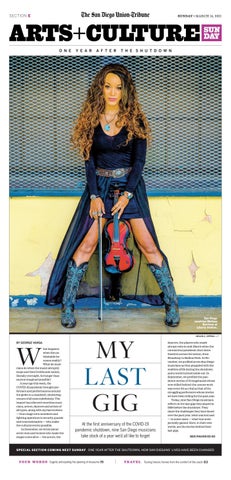
San Diego musician Melissa Barrison at Liberty Station.
BY GEORGE VARGA
W
hat happens when the unthinkable becomes reality? What do musicians do when the music abruptly stops and their livelihoods vanish, literally overnight, for longer than anyone imagined possible? A year ago this week, the COVID-19 pandemic brought performers and performances around the globe to a standstill, shuttering venues of all sizes indefinitely. The impact has silenced countless musicians, actors, dancers and artists of all types, along with myriad workers — from stage crew members and lighting operators to security guards and concessionaires — who make live cultural events possible. In December, we wrote about seven men and women who make the stages come alive — the actors, the
MY LAST GIG At the first anniversary of the COVID-19 pandemic shutdown, nine San Diego musicians take stock of a year we’d all like to forget
NELVIN C. CEPEDA U-T
dancers, the players who made abrupt exits in mid-March when the coronavirus pandemic shut down theaters across the nation, from Broadway to Balboa Park. In November, we profiled seven San Diego musicians as they grappled with the realities of life during the shutdown and a world turned inside out. In September, we profiled the pandemic stories of 10 stagehands whose now stilled behind-the-scenes work was every bit as vital as that of the struggling performers whose stories we have been telling for the past year. Today, nine San Diego musicians reflect on the last gigs they played in 2020 before the shutdown. They share the challenges they have faced over the past year, what was lost and — in some cases — what was unexpectedly gained. Here, in their own words, are the stories behind their last gigs. SEE PAGES E2-E5
S P EC I A L S ECT I O N CO M I N G N E XT S U N DAY ONE YEAR AFTER THE SHUTDOWN, HOW SAN DIEGANS' LIVES HAVE BEEN CHANGED
Y O U R W O R D S Eagerly anticipating the opening of museums E6
T R AV E L
Touring historic homes from the comfort of the couch E13
E2
THE SAN DIEGO UNION-TRIBUNE
O N E
Y E A R
A F T E R
T E R R Y
T H E
SUNDAY • MARCH 14, 2021
M Y L A S T
S H U T D O W N
‘ K O O L
T ’
S P E A R S
G I G
D J
‘Music means everything to me’ DJ Terry “Kool T” Spears, 64, has been a DJ in San Diego since 1979 at venues across the county and has mentored an array of younger DJs. Before the pandemic, he was the “Sunday Fun Day” house DJ at Breakfast Bitch in Hillcrest. facebook.com/terry.k.spears
EDUARDO CONTRERAS U-T
M
y last gig was March 15, 2020, at Breakfast Bitch, where I had performed every Sunday from 11 a.m. to 3 p.m. It was a great weekly gig — the most fun you can have while eating great food on a Sunday morning or afternoon. People would dance at the front counter, in the aisles and at their tables. I have at least 70,000 songs in my MacBook, and I always played my gigs by ear. At Breakfast Bitch, and at all my gigs, I’d do a diverse batch of music — hip-hip, funk, rock, pop, cha-cha, you name it. Some of my go-to artists at Breakfast Bitch were Megan Thee Stallion, Beyoncé, Bruno Mars, Frankie Beverly & Maze, Robin Thicke and Pharrell Williams. I’d also play some San Diego artists, like Mitchy Slick, some classic oldschool things, like Marvin Gaye’s “Got to Give It Up,” and some gospel stuff by Kirk Franklin, which people would sing along to.
And I’d always play (the 2008 V.I.C. hit) “Wobble,” which got everybody moving. The closer we would get to 3 p.m. at Breakfast Bitch, the saltier and spicier the music would get. The mood of the audience at my last gig there was normal. It was like a club where a lot of the same people came in each week, except it was during the day at a restaurant and there were little kids as well as adults. That last Sunday, some of the staff were saying, “This is the end of a good thing,” and asking what was going to happen. Then, bam! It was over, just like that. I thought, “It can’t be that serious, right?” Wrong. Everyone who worked at Breakfast Bitch was a team/family. The owners did their best with their takeout business. But no more parties there on Sunday. When they were briefly allowed to have limited indoor dining, we tried “Sunday Fun Day” one more time, but it was not the same. Having those plexiglass dividers, me being stuck in the corner by the Coca-Cola machine with my DJ rig, and the general vibe of knowing people were dying like crazy killed the party mood. And now Breakfast Bitch has closed (permanently) in Hillcrest.
S A C H A
That was not the only major gig of mine the pandemic knocked out. I was scheduled to DJ last April for the Robert Griffith Celebrity Charity Golf Tournament party at Sycuan Casino. And that was going to kick off “41 & Up,” a weekly club night for the grown-up crowd. I used to play birthday parties, quinceañeras, graduation events, baseball league banquets and a lot more, but those disappeared with the pandemic. I have two adult sons and two adult daughters, and — when they were growing up — I DJed at all their schools, from kindergarten to high
“I like to play as many songs as I can that make people feel good.”
B O U T R O S
school. One of my sons, Terry Spears Jr., is a San Diego barber and he DJs under the name DJ PBT. We’ve done some gigs together. I’ve been a carpenter since 1996, and I knew I could try to start doing a little more construction work to make up for the loss of my DJ income. But without those unemployment insurance checks coming in, I wouldn’t have made it. A few years before the pandemic, I would play up to four or five gigs per weekend, then I cut back to four or five a month. With the shutdown, I’m missing a big part of my life. I want to do more gigs so bad. There’s a big part of me that is missing — talking to people, rubbing shoulders and high-fiving them, talking on the microphone between songs. For me, being a DJ is really spiritual and a little bit financial. The biggest loss is an emotional one. Music means everything to me. It’s really like my religion. I like to play as many songs as I can that make people feel good. Now, the only way that I DJ is outdoors. People say: “Why outside? It’s cold. It’s hot.” I tell them: “No, it’s safe!”
S I N G E R
‘The megablows felt like the death of my soul’ Singer Sacha Boutros sings in English, French, Italian, German, Hebrew, Latin, Portuguese, Russian, Spanish and Yiddish. She was living in Paris when the pandemic began and returned to San Diego in October. Her latest recording, “Reviens-Moi,” was released in December.
T
he first week of January 2020, we sold out six shows in a rainy week in Paris, despite a citywide transportation strike, at the “Cathédrale de Jazz,” the Le Duc des Lombards club. It was a special week, billed as “The Great Ladies of Jazz,” which I organized. It featured nine-time Grammy Award winner Janis Siegel of Manhattan Transfer, bebop legend Michele Hendricks and Leslie Lewis to showcase the strength and talent of women in our field. These were friends I admire, respect and love. The show inspired young singers alongside the notable musicians who attended and honored us with their support. The subject of “Women in Jazz” is often shortchanged in a dominant male industry where ladies’ voices are (diminished) by the term “chick singer.”... When asked: “Who are your sidemen?” I listed women. A most memorable part of the evening was singing “Centerpiece” in three-part harmony with Michele and Janis. They taught me the bebop song in the dressing room before the show. I did not know this was the last jazz improv and hoopla of joyful music-making with my friends onstage. All my tours were canceled indefinitely, as well as the
quarterly shows I produced at Sacha’s Supper Club at the Fairmont Grand Del Mar. The economic blow was a serious and swift one for myself and my peers. I continued to volunteer and sing every Friday for the homeless lunch program at the American Cathedral in Paris, until COVID made it much too dangerous to continue. The moment the pandemic began in Europe, my musicians and I went “live” — or “en direct,” as we say in French — popping up in Paris for livestreamed shows at Le Cercle Suedois, Barloyds and in my living room. Creating supper club themes at home for viewers, we had a wonderful time and received ample views. Unfortunately, this was not reflected in our pocketbooks. Collecting online “tips” was like pulling teeth from an angry walrus. Simply put, we could not figure out how to monetize our online presence. Music aside, 2020 brought on a suffering of unmentionable cruelties that shattered my heart. On a personal level, the megablows felt like the death of my soul — and then there was COVID, erasing the face of music, coupled with the suffering of our world. I cried enough tears in 2020 to make me realize no man in this life is worth suffering for, even if he is your husband — my marriage
LAURA BRAVO MERTZ
“Thanks to ‘the great pause,’ I have learned that faith and optimism gets you through difficult situations.”
disintegrated, and it was the most painful year of my life. Living a life of service, God gave me a gift I share, and when I share it, I am joyful. These gifts manifested in other ways, including painting and cooking. ... I often went live online, from my kitchen in Paris, roasting a Poulet de Bresse, making buckwheat crepes and traveling to exotic destinations through food, while singing songs. In between the cuisine, my new compositions were born and old ones finalized. My song “How Was I to Know” was fine-tuned after 18 years and recorded in January at the University of Nevada at Las Vegas recording studio. I started writing a book, “Extraordinary Stories of Ordinary People.” Each day is welcomed by tennis, having not done so since playing collegiate tennis. I recorded a new French pop single, my version of George Michael’s “Last Christmas,” in French and English, at East West Studios in Los Angeles. It rose to No. 9 on the European Independent Charts. Where I worked the hardest on was transforming myself on my spiritual path. Thanks to “the great pause,” I have learned that faith and optimism gets you through difficult situations. Family and good friends are the wealth of one’s life, and whatever it may be, this too shall pass.
THE SAN DIEGO UNION-TRIBUNE
O N E
Y E A R
A F T E R
M E L I S S A
T H E
B A R R I S O N
E3
SUNDAY • MARCH 14, 2021
S H U T D O W N
V I O L I N I S T
M Y L A S T
A N D
G I G
S I N G E R
‘When things change, you can either adapt or fight it’ Violinist and singer Melissa Barrison, 31, is a Point Loma Nazarene University music graduate. She is a member of the country music band Young Guns and a solo artist who has opened concerts for CeeLo Green, P.O.D. and Pepper. melissabarrinson.com
I
t was March 10, 2020, when Young Guns and I played at the grand opening of the Ahern Hotel & Convention Center in Las Vegas. The gig felt like any other — masks weren’t a thing yet, and there were no hand sanitizers or plexiglass shields to be found.
We were all excited to be there and put our best foot forward to entertain and carry the night. Unfortunately, the crowd wasn’t as large as expected, but that just meant more room on the dance floor. My bandmate, Melody Ebner, and I led line dances from the stage and from the dance floor, using wireless microphones. We had several outfit changes throughout the night, but that’s Vegas, baby! After the hectic craziness of the night was over, we were able to just hang as a band and socialize. Because of COVID, the hotel never got the chance to open and still hasn’t. The next day, all flights back to San Diego, mysteriously, had been canceled, so we were forced to rent a van and drive home. I volunteered to drive the band, as I had made several trips to Vegas earlier that year by myself and felt comfortable with the drive and even enjoyed it. It made me realize how far I had come in my industry as a professional musician — to be able to say I play regularly, not just in San Diego, but Los Angeles, Las Vegas, Nashville and beyond. I wasn’t just a “local musician” anymore, and I had the miles to prove it. I didn’t know that more than 11 months would go by before I stepped foot on another stage. Pre-pandemic, I had performed almost every other other day, sometimes twice in one day. I had more gigs than there were days in a year. Just four months before the first lockdown, I left my office job to do music full time, traveling all over the country playing solo and with different artists and bands, doing what I love. Even my tax lady was impressed at my financial leaps of success with music, making 2019 the best year of my career — and 2020 was set to surpass that. To be honest, the first lockdown felt like my first retirement. Finally, I had a few weeks without heels, sequins or makeup. Then the weeks rolled into months and my rest grew into restlessness. Being a creative artist is more than just what we do; it’s who we are, and my colleagues and I began to lose sight of that. Like most people in the world, the pandemic proved devastating to not only my career and industry, but also to my mental and emotional health. I had spent over 20 years and invested hundreds of thousands of dollars into a career that basically became outlawed. When things change, you can either adapt or fight it. Since fighting an invisible enemy wasn’t an option, I decided to adapt and make the best of an unfortunate situation. My best friend, Cleo, and I came up with the idea to do “violin telegrams,” and we called it “VioGram.” She would drive her car and park in culde-sacs, out in front of private residences or businesses, and I would play violin through an amplifier on top of her car for birthdays and other special occasions. I also was able to ramp up my home studio and record tracks remotely as a source of residual income. In addition, the pandemic has stimulated my (online) songwriting collaborations with artists across the country. Although I still mourn the loss of my career and lifestyle before COVID, I can confidently say I celebrate the opportunity to reinvent myself, adapt and find my new purpose in this ever-changing world. I find comfort with my colleagues that I am not alone in this journey and that every day is a choice to either struggle in despair or go forward and be joyful in faith.
I R V I N G
F L O R E S
NELVIN C. CEPEDA U-T
“Being a creative artist is more than just what we do; it’s who we are, and my colleagues and I began to lose sight of that.”
P I A N I S T,
C O M P O S E R
A N D
B A N D
L E A D E R
‘Without music, I think I would not exist’
M
Pianist and band leader Irving Flores, 54, is a mainstay of the San Diego and Tijuana jazz and Latin music scenes. He is now producing and arranging an album of jazzy Christmas music for trombonist and singer Dave Scott. It is due out later this year. irvingflores.com
y last gig as a headliner was March 1, 2020, at Dizzy’s with the Irving Flores Afro-Cuban Quartet, which features Fernando Gomez on drums, Dean Hulett on bass and Amilkar Peña on congas. It was a beautiful concert, full of jazz, Latin flavor, great improvisations and the nice feedback of the audience. There were no face masks. People were still shaking hands, and friends gave us hugs. One of the highlights for me that night was when we played (John Coltrane’s) “Naima.” I had written a 6/8 Afro-Cuban arrangement, and it sounded very spiritual and emotional. The audience really loved it! We also played the classic “Chan Chan” by (famed Cuban composer) Compay Segundo. The last piece we did that night was a 13-minute version of my song “Armando Mi Conga.” We were all a little bit scared about the COVID-19 news at that time and didn’t know what was going to happen. There was a rumor that a global pandemic was spreading everywhere, very fast. And then it was a reality. My last gig as a sideman was March 11 in the Mississippi
Room at the Lafayette Hotel with a young singer named Ella Rossi at the Songs for Shelter benefit. We were performing in between two other acts and just did three songs. One of them was “Someone to Watch Over Me,” which seems more meaningful now. People weren’t shaking hands because the lockdown was about to become official. It was a scary feeling. We were afraid of the future. Earlier that same day, my first gig got canceled — a March 12 performance at Bread & Salt with the Binational Mambo Orchestra for the 2020 San Diego Latino Film Festival. Before the pandemic, I was playing almost every day, whether it was with my band or Gilbert Castellanos, Charlie Arbelaez, Cobby Brzeski, the Brad Steinwehe Jazz Orchestra, Sacha Boutros or Allison Adams Tucker. All my work disappeared. It was so difficult because we lost all the gigs for live music. I had been booked into July and everything was canceled. I was living in Bonita and received 60 days’ notice in July to leave the apartment I was renting. After that, it was difficult to find an affordable place. All the rents went up and it was impossible for me to pay $1,200 monthly
rent. I moved into a little cottage a musician friend of mine, Dave Scott, has behind his house in Escondido. That was in September, and he’s still letting me stay there (rentfree), in return for writing arrangements for his next three albums. Another friend, Hiroyuki Ikezi, trained me with (online) technology. He also supported me with a computer, microphones, and all the equipment to make it possible to present my livestream sessions, which I started doing in May from the Harbor Music Hall in Little Italy. The only way I was able to stay positive was by practicing every day, composing and doing livestream performances, but nothing was paying. It was illegal to perform live, and it was a big change. So, I practiced, wrote music and tried to survive. Music, to me, is my universe, my soul, my entire life. Without music, I think I would not exist. I understand the lockdown, because music brings together big crowds and the virus spreads among many people. But I feel there are other ways to continue doing live music for the people, safely, and avoid spreading the virus through preventive measures.
ROBERT SANCHEZ
“There was a rumor that a global pandemic was spreading everywhere, very fast. And then it was a reality.”
E4
THE SAN DIEGO UNION-TRIBUNE
O N E
Y E A R
A F T E R
T H E
SUNDAY • MARCH 14, 2021
S H U T D O W N
M Y L A S T
G I G
M O N E T T E M A R I N O P E R C U S S I O N I S T, B A N D L E A D E R A N D T E A C H E R
‘I miss it with all my heart’ Percussionist, band leader and teacher Monette Marino, 52, is the founder of San Diego’s 7-year-old Mo’Rhythm School of Percussion. Her most recent recording is the 2020 single “Sira.” monettemarino.com
M
y last gig before the lockdown was, eerily, on Friday, March 13, 2020. I was playing with guitarist Bruno Serrano and my 13year-old daughter, Nasira Keita — she’s a budding percussionist — at Hacienda de Vega, a Mexican restaurant in Encinitas. This was our third time playing there, and it was noticeably less full than usual. People who came in that night were not concerned about spreading germs. They danced, laughed, sang, hugged and did not seem worried for their health or safety. And the band was all about creating that party vibe for the audience. By the end of our gig, we had almost everyone in the restaurant dancing, singing and clapping their hands to the Gipsy Kings song “Bamboleo.” The best part of the gig was that I got to play music with my daughter and watch her immerse herself in music, playing the congas, cajon and bongos. She experienced how music brings joy to the world and brings people together. This was just the beginning of our family musical adventures, and we were looking forward to playing together more often. But that was not in the cards for 2020. We were all aware the coronavirus was present in the U.S., but it was still quite removed from our personal experiences, so it was more of a distant concern. I remember doing a shot of tequila at the end of the gig with the guitarist, and we jokingly said that at least the drink would kill any germs in our system. On average, I would usually play 12 to 16 gigs per month, pre-pandemic. All of those were lost due to the pandemic. The shutdown not only halted our musical momentum, it stifled our motivation, caused doubts about whether or not music was a viable career choice, and most of all caused me to lose a large portion of my income. I had to quickly figure out an alternative. I am only a percussionist, which is not really conducive for solo live performances online. I decided to focus on teaching instead of performing. My daughter and I did a series of YouTube videos that we called “Djembe & Dunun
Challenges,” and asked for donations, but that didn’t generate much income. So, I jumped onto the Zoom platform and revamped my classes to function virtually. As a result, I have extended my student base
beyond San Diego and gained students from across the U.S. and internationally. Pre-pandemic, I taught one in-person class weekly in Encinitas which had eight to 10 students on average. Online, I now teach two weekly classes with an average of 12 to 16 students, plus six to 10 private lessons with students all across the globe. Beyond that, the shutdown has helped me rebalance and reprioritize my life. It really made apparent was how much I ran around town filling up every second of my day hus-
tling to and from gigs, teaching, rehearsing, etc. Not having to do that has allowed me to focus on my personal health and happiness and spending family time with my daughter. For that I am grateful. There is no substitute for performing live, and I miss it with all my heart. I mostly miss the connections and the exchange of energy that takes place among the musicians, and between the musicians and the audience. I miss making people smile and feeling that warmth of sharing my joy when I’m playing.
“The shutdown has helped me rebalance and reprioritize my life.”
P A G E
‘It all seemed unreal’
H
S I N G E R - S O N G W R I T E R
‘My livelihood has been taken away’ Gregory Page, 57, is a singer-songwriter whose 18th and most recent album, “One Hell of a Memory,” was released in November on Jason Mraz’s label, Interrabang Records. Page’s most recent poetry book, “Growing Smaller,” was published in April. gregorypage.com
M
y last show before the world went to hell in a handbag was at the Ramona Library on March 10, 2020. It was a free midday concert in the library’s community room, and people knew you could get cookies and coffee, so some showed up for the free snacks and some for the concert. I opened with my song “Green Lights and Blues Skies.” It has a very hopeful and positive feel that takes on more meaning now than when I wrote it in 2018. That song, which Jason Mraz recorded with me, has had 250,000 streams on Spotify. At that Ramona show, the librarian told the audience that all future shows at the library had been canceled due to the “new flu bug.” I had just gotten a “new” 1971 Martin guitar, and that was my first show I did with it, and — for now — my last. Somebody in the audience coughed, and I was a little worried. That same day, I got a call that all my upcoming concerts at assisted-living homes and memory-care facilities in San Diego had been canceled. Later that same week, the real blow came when my spring tour of Europe was suddenly canceled. Then, my fall tour of Europe was canceled. It seems like the news during the pandemic has focused mostly on restaurants and gyms having a hard time, with little about the music and cultural communities that are also struggling to survive. When I am not on tour, I usually perform three
R O B S H I N N O G U I TA R I S T, B A N D L E A D E R
Guitarist Rob Shinno, 62, is the leader of the San Diego alternative-rock band Hemisphere, which he founded in 1996. Hemisphere’s newest album, “American Dreams,” was released in October. hemisphereband.com
COURTESY PHOTO
G R E G O R Y
RICHARD CRUZ JR.
JEFF WIANT
“Since the live-events lockdown, it’s been more than 11 months of canceled shows and tours.”
to five times a week in San Diego and around the county. Since the live-events lockdown, it’s been more than 11 months of canceled shows and tours. What kept me going has been the idea that my 2021 spring tour of Europe will be happening, and now that looks like it’s on the chopping block. I haven’t bought a plane ticket yet, but there’s a 50-50 chance I’ll be going in April to do seven club shows, all with limited capacity. I won’t make any money from them, but I am so eager to get back out there. I’m desperately afraid of catching COVID, but I’m equally afraid of catching “cancel-itis.” My livelihood has been taken away. If it wasn’t already a blow to independent musicians that their recorded music is available for free to stream online, the fact that — as a performing songwriter — all my live engagements have been taken away is about as scary as it comes. I live month to month with government assistance. I have the emergency rental assistance helping me out with rent and EDD benefits as a gig worker. I am grateful for all this, but it’s not at all where I ever thought I would find myself. This is the first time in my life I have had a steady income, so I guess that is something good that has come out of the pandemic. Thanks for listening to me. I know my position seems so petty while others are fighting for their lives on ventilators.
emisphere’s last gig, with a trimmed-down lineup, was a fundraiser for Pete Buttigieg, America’s first LGBTQ+ presidential candidate, on Feb. 20, 2020. I was very excited about the event, having had the pleasure to meet Pete in person at his only campaign stop in San Diego earlier in the year. Pete’s local committee folks, led by longtime San Diego political advocate George Biagi, helped to officially set up the event I hosted, and we proceeded to invite folks to attend. Because the fundraiser was held in my home in Hillcrest, attendance was limited to around 50 people, and I was pleased to hear, prior to the event, that it was in fact “sold out.” Since we had some space limitations, Hemisphere lead singer/saxophonist/keyboardist Don Bowman and I played live as a duo. ... The fundraiser included a personal video from Pete to the attendees, and then we performed several songs from our new album, including “Transmission,” which is a YouTube hit with around 60,000 views so far. … We all felt wonderful. In the back of our minds, we thought COVID-19 might disrupt things for a bit, but I personally thought: “Oh, well, maybe we need to push back a few dates and things will certainly be better by June 2020 at the latest.” We even met with our recording engineer and producer, Peter Sprague, on March 15, thinking we would all be in the studio. Then the lockdown happened. It all seemed unreal. Studio recording session dates and planned performances, including a huge float for San Diego Pride 2020, were all canceled. We were able to book an Oct. 15 album-release show, but Lockdown No. 2 hit and our sold-out show at The Lot in La Jolla was canceled two days before it was to be held. To make matters worse, our ticketing service, Brown Bag Tickets, never refunded our money, so we paid ticket-holders back (ourselves). We did put our “American Dreams” album out on Oct. 1 and received radio airplay on over 55 stations. Our singles “Transmission,” “These Are the Days” and “America” garnered over 200,000 streams and views, so we have been fortunate on that front. I am lucky to be able to work at home from a day job in software technology to provide my income. But isolation is hard on me as well as everyone else, and it’s been over a year since I’ve seen a co-worker in person. Three of my bandmates are fulltime musicians — Don Bowman, (keyboardist) Matt Zappe and (bassist) Nathan Brown — and have been heavily impacted. They have basically been unemployed because of COVID and not being able to perform. They’re trying to be as optimistic as possible that we can hopefully get back to normal this year. I was watching a large recorded “live” concert the other night, and I felt sad, wondering when I could be in a big audience again, let alone perform safely with my own band. Meanwhile, I am adding new skills to be productive ... and learning new social platform skills (TikTok here I come ...). Still, venues are shuttered — including Martinis Above Fourth in my own hood of Hillcrest — and musicians are hurting, and we all hope the public will come out in droves to support live music when this is all over. I just want to perform again and have folks come to our show and have a good time.
“I was watching a large recorded ‘live’ concert the other night, and I felt sad, wondering when I could be in a big audience again.”
THE SAN DIEGO UNION-TRIBUNE
O N E
Y E A R
L A U R A
A F T E R
J A N E
T H E
W I L L C O C K
E5
SUNDAY • MARCH 14, 2021
S H U T D O W N
M Y L A S T
S I N G E R
B A N D
A N D
G I G
L E A D E R
‘An artistic death’
BILL WECHTER
Singer and band leader Laura Jane Willcock, 58, is the leader of the seven-piece San Diego soul, funk and rock revue The Tighten Ups, which she co-founded in 2007. Their latest release is the 2019 concert video “Live at the Belly Up.” thetightenups.com
T
he Tighten Ups played our last show at Old Town Blues Club in Temecula on March 12, 2020. The band sounded fantastic for three sets of rock and soul, with Joey Harris on guitar, Meri Claire on trombone, Rene Woolley on drums and Neil McKenzie on trumpet, with valued subs Jonny Viau sitting in on sax for Topher Williams, and Jef Kmak on bass for Gerry Wasson. Starting at the (pre-show) load-in, I knew that this would be one of those days you never forget: “The Last Show Before ...” We were advised not to hug anyone, but I did. I wondered if it was worth it. Our band didn’t hang together on breaks. We spread out — fear of infection was already creeping in. The crowd was lively for a Thursday in Temecula on the brink of a total disaster. Happy patrons danced, drank and tipped the band. I made some kind of knee-jerk “Corona” beer joke that was timely but creepy. We had been hired to play the Te-
A L A N
L I L I
mecula Blues Festival on April 18, 2020, but the owner of Old Town Blues Club whispered in my ear the city had canceled the event and that it wasn’t public knowledge yet, so: “Keep it to yourself for now.” We all went home, and that was that. My life as an unemployed entertainer has been a hearty mix of life’s gifts, submission and finding my sea legs. My work’s focus has been to entertain in live, in-person formats. Boom! Gone! There is a lot of pain involved with having every single job canceled indefinitely. An artistic death. “Non-essential” (still). The first three months were the worst. I missed audiences, DJ-ing on Hornblower cruises, family weddings, emceeing, The Tighten Ups and my Michigan band’s annual reunion tour. Fact: I do not have an easy relationship with virtual video performance. Through the AIDS epidemic, 9/11, Katrina, beloved cats’ medical crises, etc., we’ve all entertained at fundraisers, helping people come together to laugh, give and heal. It’s a role I feel called to. This pandemic was fought without me helping people so much, but with many coming to my aid. Fans, family and friends are the best!
Lori Lower made super cool masks and donated proceeds, Jane and Gary St. John chucked a multi-pack of toilet paper over the fence, and I received so many thoughtful notes, calls and little presents. All truly
“My life as an unemployed entertainer has been a hearty mix of life’s gifts, submission and finding my sea legs.”
needed, especially before they figured out unemployment money for the self-employed. I am forever grateful! My wonderful boyfriend, Thomas Yearsley, pushed my audio engineering and mixing talents into distracting, beautiful, creative spaces at his Thunderbird Analog Recording Studio in Oceanside and for his label. Lux Records, which released albums in 2020 by Thunderlux and The Charles Burton Blues Band. We also have two releases slated in 2021 by Reagan “Guitar” Williams and Chimpos. I’m interning like a champ! More icing on my COVID cake: I am a guest singer on Reagan Williams’ roving trailer stage, which makes North County’s beaches and parks feel like The Casbah for a few songs here and there. I got hella crafty, too, doing various screen-printing and button-making projects. Songwriting sessions are going well. Last week, I got my first vaccine! Our granddaughter will be born in late May, and The Tighten Ups are booked for the Temecula Blues Festival on Oct 16. Things are looking up! But I really really, really miss my band. They are the best. We are magic together. I don’t feel legit without them, or you.
G U I TA R I S T
‘Live music was my temple’
I
Guitarist and songwriter Alan Lili, 31, is a musician, storyteller and psychedelic therapist who is a member of the band tulengua and host of the KPBS podcast “Port of Entry.” His band’s debut album, “Baja Funk,” was released last year, and all proceeds were donated to an immigrant rights organization. tulengua.mx
f I would have known my last show before the pandemic would be my last show for — well, who knows how long? — I might have cried onstage. Live music is a profound experience for any musical soul. It’s an incomparable adventure: playing songs that were birthed in the privacy of your inner world in front of an audience, feeding off their energy, giving them yours. It’s almost, dare I say, sexual. It’s the closest thing to a communal spiritual experience I’ve found — what I imagine religious folks feel when singing within the warmth of their temples. Live music was my temple. Or so I thought. This pandemic has recalibrated my entire relationship to music. My band tulengua — a bilingual hip-hop trio with members from both sides of the border — released our debut album in February 2020. We played our albumrelease show on March 10, 2020, at The Casbah. We knew of the coronavirus but thought it was an overblown media scare. People at the show shared joints and joked about the virus. We even did
a “corona chant” onstage. We taunted the virus, and I don’t think the virus appreciated it. Within three days, we were in quarantine. And with it, a huge part of my identity was gone. I thought playing live was essential to my love of music. I’ve come to realize how far off I was. Being a musician who seeks to make a living from sharing their emotions in song form is a strange thing. It’s easy to get caught thinking of other people’s opinions constantly: “How will people react to this song?” It’s easy to care about impressing people. Releasing music, trying to grow our audience, and playing shows constantly made me lose touch with the therapeutic, medicinal core of my love for music. I still have a deep desire to share music. But all this time alone has allowed me to reconnect with a pure love of music I hadn’t felt in years. No sharing or performing, just time to feel and enjoy. The reason I play music is to connect with and process the depths of my being, and to then share that with others. But without first falling into my depths, I can’t
bring anything of true value to the surface. A teacher once told me that humans live on two planes, the horizontal and the vertical. We tend to spend most of our time in the horizontal — relationships, projects, “busyness.” The real gold, the fulfillment, is in the vertical — in the depths. This time in isolation, though challenging, has gifted me the practice of going deeper into the way music moves through my body, so that when I emerge, I can share from a more rooted place. My hours at KPBS have been reduced, but I also spend less, so it evens out somewhat. While live shows have temporarily stopped, this time has allowed me to cultivate and develop my songwriting, production and engineering. I feel more skilled at releasing higherquality music, which will in turn translate to greater opportunities. As challenging as this past year has been, I am quite optimistic about the disguised blessings this has also brought. Everything always balances out.
COURTESY PHOTO
“We knew of the coronavirus but thought it was an overblown media scare.”
E6
POEMS
THE SAN DIEGO UNION-TRIBUNE
SUNDAY • MARCH 14, 2021
A YEAR WITHOUT MUSEUMS DERRICK R. CARTWRIGHT: COVID-19 MAY HAVE INADVERTENTLY BROUGHT SOME ASPECTS OF THE ARTS WORLD CLOSER TO AUDIENCES, AND THAT NEEDS TO CONTINUE
PANDEMIC BLUES By Janet Montgomery I’m stuck in the house and I can’t go out. The pandemic is what it’s all about. Thousands of people have died from this Without hands held or a goodbye kiss. Their breathing machines are the last thing they hear. Loved ones are not allowed to come near. We’ve been told we should wear a mask. But some say that’s too much to ask. So they will yell and scream and cry. And because of this many more will die. Our lives have changed and are in disarray. We want this disease to go away. This has been a very bad year. We need to get our lives back into gear. But Hooray! A new vaccine has come our way. We’ll soon be seeing a better day. Montgomery, a retired mathematician who enjoys playing mahjong, is from Poway.
AMANDA GORMAN By Andy Palasciano Mary Wollstonecraft was in the same writing circle as Thomas Paine. They wrote, at the foundation of our nation, about rights, dreaming of what the world could be. Mary Wollstonecraft wrote A Vindication of the Rights of Woman. And Thomas Paine would write The Rights of Man. Mary Wollstonecraft dreamed that women would be equal to men if they were given the chance to be educated. Niceties at the time said it was impolite for women to get educated. Mary Wollstonecraft died from complications from giving birth to Mary Shelley. Mary Shelley would later write Frankenstein, indirectly, because she felt like a monster for her mother dying to give birth to her. But this monster, a woman educated and bright in a dim world, was not a tragedy. When Amanda Gorman read her poem at the inauguration of a President, she was a descendant of slaves, whose rights were those of man. She was a woman governed by love and not a monster. The
M
useums have had a rough year. The practical inability to share collections, exhibitions and in-person programs has taken a toll on these institutions, to say nothing of the patrons that depend on them. It is hard to escape a sense that the overall cultural ecology has suffered as a result of the pandemic. If we sometimes feel unfulfilled, or creatively depleted, be reassured that the condition is not unique to San Diego, or even broadly localized within the United States. What’s scarier than this perceived global lack is the more real threat that it could become an enduring phenomenon. It’s one thing to view December Nights through the windshield or to content ourselves with scrolling through imagery that’s designed for optimal viewing on a cellphone. Those substitutes don’t come close to what a sustained, direct encounter with a compelling work of art delivers. Still, these simulacra have to do for now. A missed biennial, the cancellation of blockbuster displays or the postponement of yet another franchised art fair is, like a deferred Olympics, bound to disappoint a privileged few, but those events will return soon enough. What is more concerning to me are the sustained losses of support — the missing communities and a feared recalibration of lasting philanthropic instincts. Will things ever return to “normal” in the museum world? Let’s hope not. The challenges faced by art museums after a full year of COVID-19-induced setbacks are ones that have shaped them for a while. The current crises serve to sharpen focus on these institutions’ weakest spots of economics and equity.
Welcome opportunity
It used to be that a financially troubled institution reluctantly selling off its collections in order to keep the doors open was deemed a pariah. The few, desperate museums that chanced such a maneuver were ritually excoriated by their constituents, the media and professional associations alike. But deaccessioning under a pandemic-sanctioned “timeout” is not only possible today, it’s being enthusiastically pursued for reasons both good and bad. It’s doubtful that the best of those freshly monetized assets will return to the public trust anytime soon, but the underlying, “unprecedented” conditions of fiscal instability remain largely intact. Inequities of representation and access, while not new or unique to museums, have been similarly highlighted during this prolonged closure. This provides a welcome opportunity for self-examination. Following their awakening to systemic injustice throughout our society, some art institutions rose quickly to assert their solidarity with Black Lives Matter and other valid protests. Yet, it remains unclear how transformed their underlying structures are as a result, beyond the usual, performative moves. The resignation of a few directors and chief curators from major museums in cities and on college campuses under clouds of having fostered toxic work environments can be viewed as only partial proofs of the widespread prevalence of these conditions. Hiring more diverse, empathic and visionary leadership is what’s needed to correct the status quo and ensure lasting change. Working toward equity and greater inclusion in museums, when matched with increased commitments to the contributions of BIPOC artists, has been thrilling to witness. It must continue to be encouraged once we return to build-
ings and a routine workweek. Pursued over the long term, such efforts will both sustain pipelines of impactful projects and encourage future professionals to enter the field. In smaller collections, like the one I help steward at the University of San Diego, it is possible to move the ball in measurable ways. For example, with generous support from the Legler Benbough Foundation, we’ve pursued initiatives aimed at increasing the collection’s overall breadth, while equipping undergraduates with the experience of leading acquisition decisions. For the last six years, students have proposed objects — prints primarily — that have multiple curricular uses and, equally importantly, that most excite them. These works are purchased after a transparent process that resembles what typically takes place in the closed committee rooms of larger museums. We are still working with a small sample, but preliminary results suggest that these acquisitions are destined to include more artists of color, will fearlessly tackle challenging subject matter, and promise to be used more immediately in courses than more conventionally acquired objects. We’ve applied a related strategy to include students in decisions about our exhibition programs and, again, I am impressed by the advocacy for topical and relevant thematic displays. While distance learning has posed obstacles for the academy as a whole, these student-centered experiments function surprisingly well during a pandemic and appear ready to be scaled up in larger institutions.
Public square redefined
In other good news, San Diego’s community of museum professionals has delivered an impressive array of
Working toward equity and greater inclusion in museums ... has been thrilling to witness. It must continue to be encouraged once we return to buildings and a routine workweek.
lectures, panel discussions, virtual visits, art lessons, blogs and other online offerings that attest to their successful “pivot” from brick-and-mortar spaces onto digital platforms. I spent a part of the last 12 months drafting 52 “Work of the Week” postings for the Timken Museum of Art’s website and linked social media platforms. In what amounts to a kind of “Journal of the Plague Year” (seen not through the eyes of Daniel Defoe’s skeptical narrator of human suffering, but through the lens of our contemporary predicament), I’m fascinated by the capacity of familiar works to touch us anew. Those interpretations may not always demonstrate new knowledge, but if they’ve enabled us to remain connected to art, and collapsed even a little of the distance between us, then I am satisfied. The sheer variety of free and relevant offerings being promoted by museums, galleries, humanities centers and other institutions has been a heartening side effect of the pandemic’s otherwise formidable constraints. The leadership displayed by national organizations has been profound, too. Philanthropic entities such as the Getty Trust, Henry Luce and Andrew Mellon Foundations have provided financial backstops for organizations in need, but have also led conversations on timely matters, from the place of monuments and memorials in American cities to the role of the museum/archive in preserving the visual evidence of our convulsive times. At a moment when access to scholarly content might reasonably be expected to tail off, we have had first-row seats to urgent debates. We’ve also seen the public square redefined as a grid — a series of boxed faces in front of more or less carefully curated bookshelves — on our screens. That’s not been a bad thing, necessarily, but I am unconvinced that this format will sustain us over the long haul. When museums reopen in Southern California — with broad vaccinations this will be, hopefully, soon — the imperative to fight the virus ought to allow room for us to experience art in person again. Visiting new and old favorites will then be as safe, as unmediated, and as inclusive as possible, but only with continued effort on the part of our museum leaders. I am inspired by the Fine Arts Museums of San Francisco’s recent decision to address the currently reduced opportunities for local artists by launching a juried exhibition, called the de Young Open. Its commitment to make this a triennial, and thus a repeated event, is promising. There is room for that kind of inclusive action here. Think of all the spaces now nearing completion: new facilities for the Museum of Contemporary Art’s flagship in La Jolla and the Mingei International Museum in Balboa Park, and substantial renovations taking place at the Timken. The expanded social possibility suggested by future visits to these muchanticipated spaces is something to look forward to and an opportunity that the whole community should embrace. The promise of enjoying diverse objects together, slowly and satisfyingly close, is how museums will once again reflect the best things in our common culture. I can’t wait.
Cartwright is director of University Galleries and an associate professor in the Department of Art, Architecture + Art History at the University of San Diego. He is also director of curatorial affairs at the Timken Museum of Art. Cartwright formerly served as executive director at the Seattle Art Museum, the San Diego Museum of Art, the Hood Museum of Art (Dartmouth College) and the Musée d’Art Américain Giverny. He was a member of the city of San Diego’s Public Art Committee from 2015 to 2019.
Monster of Frankenstein found what this young poet found, that love is kind and stronger than monsters. Palasciano is a local poet who co-hosts a local poetry reading, “Broken Anchor Poetry,” and is a job coach, one who works with disabled adults at their place of work. He is from Old Town.
GETTY IMAGES
THE SAN DIEGO UNION-TRIBUNE
BY GEORGE VARGA
C
onnecting with his fans has never been a challenge for Todd Rundgren, who recently became a Rock & Roll Hall of Fame nominee for the third time in his storied career. But connecting with fans for 25 concerts in 25 U.S. cities across four time zones, while performing all those concerts live from a single city with his nine-piece band, during a global pandemic? And gearing each of the 25 concerts to a different city, replete with backstage food catering featuring food specialties from a different city each night?
That presents a challenge — make that a lot of challenges — even for a veteran maverick like Rundgren, who has been equally acclaimed as a solo artist, band leader, producer and all-around rock and pop visionary. “When I do a tour, it’s a big deal for me, everybody involved and, I hope, the audience,” said Rundgren, whose “Clearly Human Virtual Tour” doesn’t so much set the bar higher as create a new bar altogether. The tour began Feb. 12 in “Buffalo” and concludes March 22 in “Seattle.” It includes a Tuesday show in “San Diego.” The quotation marks are used to denote the fact that each of these virtual tour dates actually features Rundgren and his band performing livestreamed concerts from the Chicago Theatre in Illinois. The historic, 100-year-old venue has a capacity of 3,600. Because of COVID-19-related restrictions in Chicago, the actual in-person attendance is limited to 30 fans at each performance. That’s up from 19 when the virtual tour began a month ago today. Rundgren, who scored such Top 40 solo hits as “Can We Still Be Friends?” and “Hello It’s Me,” estimates he is investing about $1 million in the tour. He is producing it entirely himself, and it is being livestreamed by NoCap. Ticket prices range from $35 for one show to $700 for all 25, with a variety of other options, including online meet-and-greets with Rundgren,. Each concert will be localized with photos and videos from the city the virtual performances is targeted to each night. For an extra $20 each, 150 fans per show can appear as a “virtual audience” on video panels set up in in front of the band — a move designed to foster real-time interaction. For staunch devotees, a handful of in-person tickets are available for each show, priced at $287.50 each, from clearlyhumantickets.com. Attendees will need to provide proof of a negative COVID-19 test taken no more than 72 hours before the concert they attend. All of this represents a major gamble for Rundgren, who has produced landmark albums by Meat Loaf, Grand Funk Railroad, Patti Smith, Hall & Oates, XTC, New York Dolls, The Tubes and others. But creative gambles are nothing new for this seasoned risktaker. He performed the first live interactive TV concert back in 1978, created the first graphics tablet for Apple in 1979, and launched the first online direct artist subscription service, “PatroNet,” in 1998.
‘No assurances’
“Well, I am a gambling person — I just don’t play in Las Vegas,” Rundgren said, speaking in a
E7
SUNDAY • MARCH 14, 2021
Live from Chicago, it’s Todd Rundgren Three-time Rock & Roll Hall of Fame nominee goes on ‘tour,’ with 25 livestreamed concerts aimed at 25 U.S. cities
livestreamed concerts with “The Want of a Nail,” which is “Nearly Human’s” opening number. “We’re not playing anything in any particular order. The ‘Nearly Human’ album is about an hour long, and our shows each night for this virtual tour are two hours,” said Rundgren, who modifies his set list nightly. “I had dabbled in R&B before, but with ‘Nearly Human,’ I did make a conscious decision that I wanted to take being an R&B singer more seriously. There were so many influences on my singing, most notably Stevie Wonder and The O’Jays’ Eddie Levert, and innumerable other great R&B singers. So, in a certain way, I bit the bullet by writing material a White guy could sing, without attempting to go out of my legitimate (life) experiences. “I also had to build my vocal stamina. It’s not simply a matter of hitting the notes and having the stamina to get through a show, but of being able to abandon yourself to the material so that it doesn’t come out the same way every time you perform. That’s part of R&B. You don’t ever sing it exactly the same way each time, because — if you do — that’s when it starts to lose its meaning for you. You’re just doing the work, but not feeling it.”
A real bubble
JIM SNYDER SHOREFIRE MEDIA PHOTOS
“One of the upsides of doing this virtual tour is that I won’t have any shows canceled.” Todd Rundgren pre-virtual-tour interview from his home in Kauai. “I’m doing these shows and hope they will succeed artistically, first of all. And, secondly, that they won’t break me, and that, in the end, I won’t lose money. “It’s often a crapshoot, even in non-pandemic times, because touring is a business that operates on the margins. In other words, all your profit usually ends up coming from just a couple of key shows. You can play 30 shows on a tour, and most of that income goes to paying the bills. Only a couple of the shows pay your profits. And if you have two shows that fall through, there goes all your profit. If three shows get canceled, you are in the red.” He chuckled. “One of the upsides of doing this virtual tour is that I won’t have any shows canceled, because I’ll be there for every show with my band in Chicago,” Rundgren continued. “That was part of the basis for this virtual tour concept — the fact
Todd Rundgren’s ‘Clearly Human Virtual Tour’ When: 8 p.m. Monday, Tuesday, Thursday, Friday and next Sunday Where: Livestreamed online from the Chicago Theatre in Illinois Tickets: $35 (other options are available at different prices) from nocapshows.com it’s getting more and more difficult to travel because of disruptions and other climate-related things, like almost the entire state of California being on fire last summer or half of Texas being underwater. “But there is no assurance the audience will come out and that I don’t take a bath on this tour. So, it is a gamble from my standpoint. And we don’t have any track records of other virtual tours to look at as reference points. Other people have done one-off livestreamed performances. But doing 25 shows
and narrowcasting them to specific cities and regions is not something anyone’s done before.” Rundgren’s band largely features musicians who have worked with him for years. They include bassist Kasim Sulton, drummer Prairie Prince, guitarist Bruce McDaniel, saxophonist Bobby Strickland and trombonist Steven Stanley. Also on board is the threepiece Global Girls, which features Grace Yoo, Ashle Worrick and Rundgren’s wife, Michele. The “Clearly Human Virtual Tour” takes its name from his 1989 album “Nearly Human,” which took a deep dive into classic soul music with soaring vocals and meticulous arrangements. The 10-song album provides a bit less than half of the material for Rundgren’s virtual tour. Ever the nonconformist, he is not performing the songs from the album in the same order as on the record and is interspersing other material from his six-decade career. For good measure, he has been concluding some of his recent
Rundgren has clearly done the work for his virtual tour. He hired a director and four camera operators. Everyone in his band and production crew is regularly tested for COVID-19 by an on-site staff nurse. They are all living in a real, not virtual, bubble. “We’ve more or less taken over two Residence Inns, one for the band and another for the crew,” Rundgren, 72, noted. “Essentially, everyone has an apartment with a full kitchen and a washer and dryer, so they can eliminate a lot of interactions and contact with other people. Everyone goes from their room to the van, to the venue, and then back again. ... “We don’t have any expectations, but maybe vaccines will become available to us at some time during our virtual tour and we’ll get vaccinated, which will set our minds at ease so we won’t have to be so paranoid. Until that happens, we have a stringent medical regimen in place.” That regimen includes a provision to replace band members should any of them contract COVID-19 while in Chicago with Rundgren. “We are fully aware of that potentiality,” he said. “There are a couple of situations we’ve prepared for. If someone tests positive but are asymptomatic, which means they could still perform, we would isolate them, put a camera on them and have them stand behind a 6-foottall video panel, so that they would actually still be onstage. If someone tests positive, is symptomatic and can’t perform, we have backup musicians ready for all the key positions in the band. “The advantage is we don’t have to tear the stage set down every night and travel to 25 cities. Most times on tour, you perform for two hours and spend six to eight hours traveling to each show. We’ve eliminated the traveling, although, on balance, this is more difficult. “We’re putting up local memorabilia and the local newspaper for each show, and eating the food you would get there. For us, each night is like self-hypnosis: ‘We’re not in Chicago, we’re in whatever locality the virtual tour is playing that night!’ ” george.varga@sduniontribune.com
E8
THE SAN DIEGO UNION-TRIBUNE
SUNDAY • MARCH 14, 2021
NEW YORK TIMES BESTSELLERS
Fiction 1. “The Four Winds” by Kristin Hannah (St. Martin’s) 2. “A Court of Silver Flames” by Sarah J. Maas (Bloomsbury) 3. “The Midnight Library” by Matt Haig (Viking) 4. “The Sanatorium” by Sarah Pearse (Pamela Dorman) 5. “The Vanishing Half” by Brit Bennett (Riverhead) 6. “The Invisible Life of Addie LaRue” by V.E. Schwab (Tor/Forge) 7. “Where the Crawdads Sing” by Delia Owens (Putnam) 8. “The Kaiser’s Web” by Steve Berry (Minotaur) 9. “Faithless in Death” by J.D. Robb (St. Martin’s) 10. “The Russian” by James Patterson and James O. Born (Little, Brown)
THE NATIONAL ARCHIVES OF THE UNITED KINGDOM
A Colossus Mark 2 computer being operated by Dorothy Du Boisson (left) and Elsie Booker in 1943.
Breaking the code
Nonfiction 1. “How to Avoid a Climate Disaster” by Bill Gates (Knopf) 2. “Just as I Am” by Cicely Tyson with Michelle Burford (HarperCollins)
San Diego author’s new book explores female codebreakers during World War II
3. “Think Again” by Adam Grant (Viking) 4. “Greenlights” by Matthew McConaughey (Crown) 5. “Walk in My Combat Boots” by James Patterson and Matt Eversmann with Chris Mooney (Little, Brown) 6. “Caste” by Isabel Wilkerson (Random House) 7. “A Promised Land” by Barack Obama (Crown) 8. “The Sum of Us” by Heather McGhee (One World)
B
9. “Untamed” by Glennon Doyle (Dial) 10. “Four Hundred Souls” edited by Ibram X. Kendi and Keisha N. Blain (One World)
WARWICK’S TOP SELLERS 1. “Band of Sisters” by Lauren Willig 2. “Klara and the Sun” by Kazuo Ishiguro 3. “How to Avoid a Climate Disaster” by Bill Gates 4. “The Gift” by Edith Eva Eger 5. “The Four Winds” by Kristin Hannah 6. “The Committed” by Viet Thanh Nguyen 7. “The Soul of a Woman” by Isabel Allende 8. “Long Bright River” by Liz Moore 9. “The Body” by Bill Bryson 10. “The Boy, the Mole, the Fox and the Horse” by Charlie Mackesy
CALENDAR ADVENTURES BY THE BOOK, (619) 300-2532 Online: adventuresbythebook.com Inside the Author’s Studio with Susie Ghahremani: a Virtual Behind the Scenes Adventure: 4 p.m. Thursday. MYSTERIOUS GALAXY, (619) 539-7137 Online: mystgalaxy.com Virtual event with Joe Ide, “Smoke,” 7 p.m. Monday. Virtual event with Kim Neville (“The Memory Collectors”) with guest Bryan Camp, 7 p.m. Tuesday. Virtual event with Grant Farley (“Bone of a Saint”) in conversation with Timothy Hallinan, 7 p.m. Wednesday. Virtual event with Allison Saft (“Down Comes the Night”) in conversation with Christine Lynn Herman (“The Deck of Omens”), 7 p.m. Thursday. WARWICK’S, (858) 454-0347 Online: warwicks.com Virtual event with Gregory Brown (“The Lowering Days”) in conversation with Jeniffer Thompson, 6 p.m. Monday. Virtual event with Kim McCoy (“Waves and Beaches”) in conversation with Serge Dedina, 4 p.m. Tuesday. Virtual event with Laura Maylene Walter (“Body of Stars”) in conversation with Huda Al-Marashi, 4 p.m. Thursday.
RECOMMENDED READS
Q:
BY DENISE DAVIDSON estselling author Kate Quinn probes archives for inspirational people to write about. “I look for untold women’s stories in history — women of the past who wow me with their courage and unsung achievements, whose lives yearn for a spotlight,” the San Diego novelist said. “I don’t look deliberately in world wars for those kinds of stories, but there’s no doubt that war offered opportunity to women of the past — whether a job or career they wouldn’t otherwise land, or a fight they couldn’t fight in peacetime. So, the history of a war is also often a stretch of time where you’ll find women doing extraordinary things. I’m not surprised I’ve found more than one novel’s inspiration in World War II! Who knows how many more I’ll find?” Quinn’s newest novel, “The Rose Code,” explores the dynamics during World War II at Bletchley Park in England. There, codebreakers must solve complex military codes, survive the pressures of secrecy and outwit a Soviet spy who tries to tear apart friendships. Quinn — whose previous novels include “The Alice Network,” “The Huntress” and the “Empress of Rome Saga” series — lives in San Diego with her husband and three rescue dogs.
Q: A:
What is Bletchley Park? Bletchley Park is the isolated English country house that, during World War II, became the intelligence hub of Great Britain. The best and brightest minds in England — many of them women — were sent to work there in secrecy to break the supposedly unbreakable Axis military codes, and they succeeded brilliantly.
Q: A:
Do you have a favorite protagonist? I love all three of my heroines! They’re all based closely on real women or composites of real women, and they represent the range of roles women could play in the Bletchley Park codebreaking process. Mab is an ambitious,
Who is your favorite historical person you incorporated as a cameo? Prince Philip of Greece, in the days when he was just a dashing young officer in the British Navy rather than royal consort to Queen Elizabeth II. In the course of my research, I found out that Prince Philip’s long-term wartime girlfriend just happened to be a beautiful, vivacious ex-debutante named Osla who had been recruited to Bletchley Park as a translator! From that moment, I knew I had to include the two, and it was a lot of fun to explore the complex young man Philip was before he ever knew he’d be the Duke of Edinburgh.
A:
“The Rose Code”
by Kate Quinn (William Morrow, 2021; 656 pages) sharp-witted East Ender recruited from a secretarial pool to operate and maintain the famous decoding machines. Osla is a beautiful, vivacious ex-debutante whose finishing school German is put to use translating decoded intelligence from German to English. And Beth is the shy village wallflower whose skill at crossword puzzles and patterns makes her a brilliant cryptanalyst, turning encrypted code traffic into readable military communications.
Q: A:
What makes writing about broken friendships intriguing? Friendship between women can be a complicated thing. Even without the reductive stereotype that women can’t be friends without catfights, women are expected to put family ties before friends. But for these three women, their friends are their family because they can’t tell anyone outside Bletchley Park about the top-secret war work they do. Yet even as they become closer than family, they are still bound above those ties by their oath of secrecy, and ultimately, it’s that oath — not romance or jealousy or any of the usual clichés — that strains their friendship to the breaking point.
Q:
Why did you want to have a book club within your plot?
Adventures by the Book presents Kate Quinn When: 11 a.m. March 27
Q: A:
Online: warwicks.com
What was the bombe machine? The British bombe was a decoding machine developed by the great Alan Turing who, before he became one of the great computer science minds of the 20th century, broke German naval codes in Hut 8 at Bletchley Park. He also appears in “The Rose Code” as a minor character, and I had great fun writing him. Turing was one of the early recruits, and he designed his machine using the Polish “bomba” — designed earlier by brilliant cryptologist Marian Rejewski — as a basis. The first British bombe machines were operating in Bletchley Park by 1940, helping to shorten the codebreaking process by discovering some of the daily settings on the Enigma machines that were used to encrypt Axis military traffic.
A:
Q: A:
Where: Virtually hosted by Adventures by the Book: “The Fab Four of Historical Fiction: Patti Callahan, Sadeqa Johnson, Martha Hall Kelly, Kate Quinn” Tickets: Prices vary Phone: (619) 300-2532 Online: adventuresby thebook.com
Warwick’s presents Kate Quinn When: 11 a.m. April 24 Where: Virtually hosted by Warwick’s: Kate Quinn in Conversation with Kristin McMorris Tickets: Free on Facebook; Prices vary for autographed book “The Rose Code” Phone: (858) 454-0347
Mab, Osla and Beth come from completely different walks of life. They have almost nothing in common when they first meet, so I had to give them a way to connect outside of their work — which they can’t talk about anyway, because it’s too secret. I made these three very different women avid readers, and books are the way in which they initially bond. They rope a series of brilliant, eccentric codebreaker colleagues into it along with them.
What’s next?
My next book is tentatively titled “The Diamond Eye,” about the most famous female sniper in history: a Russian history student and single mother named Lyudmila Pavlichenko, who left graduate school to defend the Soviet Union when the Germans invaded during World War II, and whose tally of 309 earned her the nickname “Lady Death.” I can’t wait to see it in print! Davidson is a freelance writer.
Welcome to our literary circle, in which San Diegans pass the (printed) word on books
Kris Nelson
Laurel Berns
Marianne Reiner
Job: Owner at Bluestocking Books
Job: Library Assistant III, Rancho Bernardo Library, San Diego Public Library
Job: Owner, Run for Cover Books
She recommends: “Frankenstein, a Modern Prometheus” by Mary Shelley. Illustrated by Bernie Wrightson with an introduction by Stephen King (Gallery 13, August 2020; $29.99) Why? Said to be originally conceived in 1818 during a ghost-story challenge with Lord Byron, John William Polidori and husband Percy Bysshe Shelley, this story has been adapted into countless versions over two centuries. During Mary Shelley’s time, Prometheus represented human striving, new scientific frontiers and possibly unintended consequences of trying to improve human existence. A daughter of two philosophers — one a published proponent for women’s rights and the other for utilitarianism and anarchy — she is able to illustrate with heartbreaking clarity how a manmade man is not accepted as a person even though he is an articulate individual. Her themes run through so much of our canon of entertainment today: Who are we on the inside vs. the outside? How do we judge? What responsibility do creators have for their work, and does that ever end? Who deserves our respect, and why? Full of hopes, fears and a little bit of science-magic to make the impossible possible, it is a short novel in crisp, 1800s writing style; very readable. We know who won that storytelling challenge.
She recommends: “History of Wolves” by Emily Fridlund (Atlantic Monthly Press, 2017; 279 pages) Why? “History of Wolves” is a fascinating and unsettling story about a teenage girl and the events that ultimately lead to a life-impacting choice she makes one summer. There is death, there is a trial, there is suspense — but story is about so much more than that. “History of Wolves” is about the consequences of action versus inaction. It is about accountability and guilt, how trauma shapes who we become, and the power of loneliness. Written with beauty and elegance, the characters have an honesty to them. There is teenage Linda, a loner and desperately friendless; Mr. Grierson, a teacher accused of an inappropriate relationship; and, finally, the young family that lives across the lake. Phrases and descriptions are lush, rich and worth savoring. The plot skillfully builds with gentle tension, creating uneasiness right up to the point of crisis, and lives are forever changed.
She recommends: “How to Order the Universe” by Maria José Ferrada, translated by Elizabeth Bryer (Tin House Books, 2021; 180 pages) Why? The charm and quirkiness immediately worked on me as I started reading the first few lines of “How to Order the Universe” by Maria José Ferrada. In it, the characters are only introduced by a first initial. M, the narrator, is a witty 7-year old girl from Chile who is more interested in accompanying her traveling salesman father to work than attending school. Selling hardware equipment in Chilean towns allows not only for the description of a father-daughter bond but also for a painting of the growing tension that country is facing as it descends into the brutal dictatorship of Pinochet. M, her father D, the enigmatic photographer E and M’s mother are all going to pay a high price as opponents of that regime. Yet, everything in this book is suggested tenderly and quietly, allowing the reader’s imagination to complete this puzzle of a book. I loved the originality, the style (short chapters) and the perceived innocence of this story. Nothing is ever what it seems, and “How to Order the Universe” is a book I recommend you read and experience.
THE SAN DIEGO UNION-TRIBUNE
E9
SUNDAY • MARCH 14, 2021
WHAT’S NEW “The Hospital: Life, Death, and Dollars in a Small American Town” by Brian
“The Soul of a Woman” by Isabel Allende (Ballantine Books): “When I say I
Alexander (St. Martin's Publishing Group): San Diego author Brian Alexander investigates Bryan, Ohio’s small-town, small-budget hospital. Bryan’s population of 8,500 might be tiny by corporate standards, but its main health care facility nevertheless requires many kinds of skill sets and technology. “The Hospital” shows how fragile our country’s health care was even before the pandemic, and how that fragility affects staff and administration as well as patients.
was a feminist in kindergarten, I am not exaggerating,” declares the acclaimed Chilean journalist, novelist and activist in this memoir that reflects on her upbringing — she was raised with her two sisters by a single mother — while pondering women’s nature and women’s needs.
San Diego-based Kazim Ali is the author of “Northern Light: Power, Land, and the Memory of Water.”
TANYA ROSEN-JONES
Author’s holy land
In ‘Northern Light,’ Kazim Ali moves past nostalgia to tell the real story of his hometown BY SETH COMBS
F
or writer Kazim Ali, writing has always been personal. As the author of over a dozen books — including seven books of poetry, five novels and five essay collections — he’s often had to mine the deepest depths of his psyche for a profound sentence or a heartfelt stanza. Not to mention his day job is as a literature and writing professor at the University of California San Diego. But when asked where “Northern Light: Power, Land, and the Memory of Water” ranks in comparison to his other projects, he doesn’t hesitate to remark that the recently published book was his most ambitious project and one that left him feeling deeply changed. “This was a story that I never thought I was going to write, and even as I was writing it, I never really felt prepared to do it justice,” Ali says. “I had to learn, I had to train myself on the ground what it meant to be a journalist and tell the story of a community.” Where that story of “Northern Light” truly begins is, in fact, up to the reader. One could argue it begins as early as the 18th century when French and British colonizers began taking over land that would eventually become part of northern Manitoba, Canada. The story could begin in the late ‘70s when the Canadian government, along with the utilities company Manitoba Hydro, signed a treaty with five Indigenous bands to build a hydroelectric dam at the nearby Nelson River. Or does the story really begin in 2014 when the Pimicikamak Cree Nation began to occupy that dam, citing that their “homeland has been ruined” and that “the promises of fair treatment
have been ignored”? For Ali, however, the story begins around the mid-‘70s when his family moved to Jenpeg, Manitoba. “Northern Light” immediately recounts Ali’s family history, that of Muslim parents driven from their ancestral home in India to Pakistan, then moving to London and eventually emigrating to Winnipeg. There, Ali’s father began working for as an electrical engineer for Manitoba Hydro, specifically helping to design hydroelectric dams to generate electricity to nearby towns. It’s in Jenpeg where Ali spent a good chunk of his formative years and recalls with a poet’s grace in the book. He later adds, despite his mother telling him later in life that the family only lived there a few years, that it was Jenpeg, with its bristling winters, abundant wildlife and celestial lightshows, where the poet in him was born. “Really, it was the sky because it’s so far north and out in the middle of the forest,” Ali
says. “Every night that was clear, you could see everything. It’s where I first learned the stories of the myths, because I would see the constellations in the sky and my dad would tell me the story.” Ali often refers to his time in Jenpeg as a “fleeting phantom of my past.” One day, however, he began googling around only to find that the dam, the one his father had a hand in designing, was at the center of a controversy between the local indigenous community of Cross Lake and Manitoba Hydro. He also found details on a more recent history of mental health crises and suicides in Cross Lake. He reached out to the chief of the Pimicikamak nation via email, explaining that he’d grown up in neighboring Jenpeg, hoping she would send more information. She responded with a simple message: “Come visit.” “That was for sure a challenge,” Ali recalls. “It was a challenge and an invitation. A challenge with generosity. I was just looking for her to send me some links and she was just like, ‘Get up here.’” Still, Ali had a job teaching literature at Oberlin College in Ohio (he moved to San Diego in 2019) and was unsure what he could bring to the story of the community. “I felt some ambiguity with that role,” Ali says. “Should I be of service to them? Will I be able to be objective as a writer? I was still at the outset of this journey caught up in those kinds of questions. As I got there in 2017 and learned and met people, those questions of objectivity became less important, because I realized I am part of this story.”
“Northern Light: Power, Land, and the Memory of Water” by Kazim Ali (Milkweed Editions, 2021; 200 pages)
The Book Catapult presents Kazim Ali When: 5 p.m. Wednesday Tickets: Free Online: thebookcatapult.com
In fact, one of “Northern Light’s” greatest strengths is Ali’s ability to weave between his personal connection to the land and the history of the people who call it home. In one particularly moving passage, he tells a Cross Lake elder, “I don’t think I can understand my childhood until I know what happened in your community.” He dove headfirst into the proverbial waters of researching the history of the people that make up the land, something he was hardly used to. “I became a researcher and I did have to dig up a lot of stuff,” Ali says. “I’m not a journalist or a scholar by profession, so it was an adventure and new for me.” The book was recently included on a list of must-read books about climate change. Ali says he initially found that to be odd, but now understands that these focused stories about Black, Indigenous and people of color (BIPOC) communities, whose lives are disproportionately affected by industry, do go a long way to speak to broader issues of inequality. Ali’s gift as a writer is the way he is able to present his story in a way that brings attention to the myriad issues facing Indigenous communities, from oil pipelines in the Dakotas to border walls running through Kumeyaay land. “Don’t we all have an acknowledgment to be part of whatever the organizing for social change and political change that the indigenous communities are doing,” Ali asks. “It’s something that non-indigenous people all over the United States and Canada should be asking ourselves.” Combs is a freelance writer.
E10
UCTV University of California Television (UCTV) is making a host of videos available on its website — uctv.tv/life-ofthe-mind/ — during this period of social distancing. Among them, with descriptions courtesy of UCTV (text written by the UCTV staff): “Giving the Brain a Voice”: The human brain is composed of billions of cells that communicate through chemical and electrical signals. Chemical signaling underlies every function of the nervous system, from those of which we are unaware to higher cognitive functions. Neurotransmitters and neuromodulators mediate communication between neurons and between neurons and non-neural cells. Until recently, the means for studying these signaling agents directly has been limited in its ability to measure and record data about signaling dynamics in the brain. Now microelectrode biosensors are available that give unprecedented spatial and temporal resolution, enabling direct measurement of chemical conversations between cells in the nervous system.
THE SAN DIEGO UNION-TRIBUNE
SUNDAY • MARCH 14, 2021
What’s new in arts Creative drive keeps Ziggy Marley busy during pandemic
BY DAVID L. CODDON
I
TIM CADIENTE
“Paving the Way for the Future — UC San Diego Geisel Library”: It’s been called many things: a spaceship, a large mushroom, an enormous concrete and glass jewel held aloft by concrete fingers — the list goes on. UC San Diego’s flagship building, Geisel Library, fascinates and captures the imaginations of all who encounter it, as witnessed by the numerous movies and TV programs in which it has appeared. In this virtual event, a panel of experts peel back the layers of the building’s history and explore the basic architectural principles that make this icon an architectural masterpiece. The library’s director of Special Collections & Archives, Lynda Corey Claassen, moderates the discussion. “Labor and Delivery During COVID-19: What to Expect”: Preparing for childbirth is a unique time, where the expectant mother faces unknowns and potential challenges. Giving birth during a pandemic elevates these uncertainties to a new level; knowing what to expect and how to prepare for it are key to a successful outcome. By way of example, Dr. Julia Cormano explains what it’s like to give birth, detailing precautions such as screening of patients for infection, double masking, routine COVID testing of health care providers and staff, universal COVID testing of all patients, and more. Protocols in place for labor and delivery are also rigorously applied. Coddon writes the Union-Tribune’s Arts+Culture Newsletter, published every Thursday. Portions are published in this column. To get the newsletter in its entirety, sign up for it at sandiegouniontribune.com.
CAKEWATCH
V I RT UA L LY S P E A K I N G
“Being creative is something that I do. It doesn’t stop because of a pandemic. It comes when it comes,” said Ziggy Marley.
t’s appropriate that Ziggy Marley’s first show of 2021 performing with his entire band behind him was at the Belly Up Tavern in Solana Beach. “I grew up there,” Marley said before the concert. “As a teenager and as an adult, for me it’s a special place.” The concert was livestreamed Thursday and had only a few showings. The son of reggae legend Bob Marley has been busy, even with live performances in front of audiences on the shelf for now. He collaborated with Colombian reggaeton singer Maluma on a single called “Tonika” for Maluma’s album “7 Dias en Jamaica,” and Paramount Pictures has announced that Marley, along with his mother Rita and sister Cedella, will be co-producers of a new Bob Marley biopic. “Being creative is something that I do,” Marley said. “It doesn’t stop because of a pandemic. It comes when it comes. We don’t control it. It controls us.” Those watching were encouraged to donate to Marley’s charitable organization, URGE (Unlimited Resources Giving Entertainment), which in part supports young children in elementary education in Jamaica. Supporting social causes is “who I am,” Marley said. “I was born to a father and mother who came from poor neighborhoods. We were always taught to give back to those neighborhoods. “It’s not something we decided to do. It’s part of who we are.”
THEATER Originally scheduled to stream for four days around Valentine’s Day, San Diego Musical Theatre’s “Date Night” debuted Thursday and runs through today. Not so much theater as it is a musical cabaret, the hourlong show features local theatrical couples well known to SDMT audiences singing and celebrating l’amour toujours l’amour. The setup, recorded in front of a reduced, distanced audience, finds actress Carolyn Hennesy (remember her from “Dawson’s Creek”?) playing a woman anxiously waiting in a wine bar, Manhattans, for the arrival of a blind date. Keeping her company is a sympathetic bartender (Robert Townsend). Into the bar, one couple at a time, traipse Kelly Derouin and David Humphrey, Luke Monday and JD Dumas, Evie and Stephen Jack, and finally Katie Sapper and Charlie Gange. In between their renderings of love songs, Hennesy cracks self-deprecating one-liners — SAN DIEGO MUSICAL THEATRE really the best part of “Date Night.” What I viewed wasn’t the final cut of the show, but I took in all of the musical numbers. The most touching was the Stephens’ duetting on “Sun and Moon” from “Miss Saigon” (my favorite underappreciated Broadway musical). The most eclectic segment was Sapper’s and Gange’s trio of Maroon 5’s “Sunday Morning,” the Proclaimers’ “500 Miles” (eclectic and a little bizarre) and Ariana Grande’s “Somewhere That’s Green.” Tickets for “Date Night” streamings are $15. sdmt.org
DANCE Classical music and jazz have never been integrated as brilliantly as they were in George Gershwin’s timeless “Rhapsody in Blue.” It’s always thrilling to hear it, and now City Ballet of San Diego’s Geoff Gonzalez has choreographed a dance work worthy of its musical sophistication and intricacy. The 15-minute-long performance opens “Rhapsody in Blue,” City Ballet’s third installment in its digital season. The choreography matches Gershwin’s composition in nuance, not only reflecting the vagaries of two musical genres, but flitting rhythmically from subtlety to fanfare. The blue-clad dancers are expressive and laser-focused. ANNA SCIPIONE Also on the 67-minute program: “Black Swan Pas de Deux” with music by Tchaikovsky (choreographed after Marius Petipa); “four PAIR” with music by Debussy, choreographed by Gonzalez; “Cinderella Pas de Deux” with music by Prokofiev (choreographed after Rostislav Zakharov); and the narrative-rich “Tallis” with music by Ralph Vaughn Williams, choreography by Elizabeth Wistrich. Most memorable besides “Rhapsody” is the “Barber Adagio,” with music by Samuel Barber and Wistrich’s choreography. The pairing of Erin Burt and Brian Heil is both passionate and emotive. “Rhapsody in Blue” streams through next Sunday. Tickets begin at $29. cityballet.org
STREAMING PICK
‘DREW BARRYMORE SHOW’ A CURE FOR PANDEMIC BLUES With much of the arts moving to online and streaming platforms, here’s a look at a weekly standout. My pick: “The Drew Barrymore Show” Why: Not since the days of “The Oprah Winfrey Show” have I faithfully watched a daytime talk show. For all of the 1990s, “Oprah” was there for me when I got home from school — comforting me with inspiration when I had a bad day, indulging my pop culture obsessions with celebrity and author interviews, and introducing me to perspectives from communities outside my own. The show was canceled in 2011, and I never found a replacement ... until one morning I happened to catch an episode of “The Drew Barrymore Show.” Now, Barrymore’s show is nothing
BEN WATTS
Drew Barrymore’s show focuses on positivity, friendship and fun.
like Winfrey’s — Barrymore follows a format more like “The Ellen DeGeneres Show” or other celebritydriven programs. But something about it fills me with the same sort of comfort as my “Oprah” days. Maybe it’s because the actress is over-the-top friendly, and after a year like 2020, spending time with someone so seemingly nice is a salve we can all use. Maybe it’s that she’s a lifelong familiar presence thanks to movies like “E.T. the ExtraTerrestrial,” “Irreconcilable Differences,” “Never Been Kissed” and “The Wedding Singer.” (Also, I ran into her twice in real life — at a PJ Harvey concert in L.A. and at Game 4 of the 2004 Red Sox-Cardinals World Series in St. Louis — so in my head it’s like she’s my friend, hanging out with me via the television.)
“The Drew Barrymore Show” is a mix of celebrity interviews (mostly done via Zoom), cooking trends, style tips and celebrity gossip. She also spotlights small-business owners, many from the BIPOC community. Because of her, I have tried pasta made from chickpeas (deceptively delicious); bought a lip balm infused with hydrocortisone (very healing); and tried eye yoga (kinda weird). Since finding her show, I now force myself to take a lunch break to catch up on recorded episodes — something that I know is good for my mental and physical health, thanks to her interview with Dr. Oz (like “Oprah!”). Find it: “The Drew Barrymore Show” airs weekdays at 11 a.m. on KSWB.
NINA GARIN
Today: Actor Michael Caine is 88. Composer-conductor Quincy Jones is 88. Country singer Michael Martin Murphey is 76. Former Chicago sax player Walt Parazaider is 76. Actor Steve Kanaly (“Dallas”) is 75. Comedian Billy Crystal is 73. TV and radio personality Rick Dees is 70. Country singer Jann Browne is 67. Actor Tamara Tunie (“Law and Order: SVU”) is 62. Actor Penny Johnson Jerald (“Castle,” “24“) is 61. Actor Elise Neal (“All of Us”) is 55. Actor Gary Anthony Williams (“Boston Legal,” “Malcolm in the Middle”) is 55. Actor Megan Follows (“Reign”) is 53. Actor Betsy Brandt (“Breaking Bad”) is 48. Actor Grace Park (“Hawaii Five-0,” “Battlestar Galactica”) is 47. Actor Daniel Gillies (“The Originals,” “Vampire Diaries”) is 45. Actor Corey Stoll (“House of Cards” “The Bourne Legacy”) is 45. Actor Chris Klein is 44. Actor Ryan Cartwright (“Kevin Can Wait”) is 40. Actor Kate Maberly (“Finding Neverland”) is 39. Actor Jamie Bell (“Billy Elliot”) is 35. Bassist Este Haim of Haim is 35. Monday: Actor Judd Hirsch is 86. Jazz saxophonist Charles Lloyd is 83. Bassist Phil Lesh of the Grateful Dead is 81. Singer Mike Love of the Beach Boys is 80. Singerkeyboardist Sly Stone of Sly and the Family Stone is 78. Actor Frances Conroy (“American Horror Story,” “Six Feet Under”) is 68. Actor Craig Wasson (“Body Double”) is 67. Singer Dee Snider of Twisted Sister is 66. Actor Joaquim de Almeida (film’s “Clear and Present Danger,” TV’s “24”) is 64. Actor Park Overall (“Empty Nest”) is 64. Model Fabio is 60. Singer Bret Michaels of Poison is 58. Actor Chris Bruno (“The Fosters”) is 55. Actor Kim Raver (“Grey’s Anatomy”) is 54. Singer Mark McGrath of Sugar Ray is 53. Bassist Mark Hoppus of Blink 182 and of Plus-44 is 49. Actor Eva Longoria (“Desperate Housewives”) is 46. Musician will.i.am of Black Eyed Peas is 46. Rapper Young Buck is 40. Actor Kellan Lutz (“The Legend of Hercules,” The “Twilight” films) is 36. Actor Caitlin Wachs (“Profiler”) is 32. Tuesday: Game show host Chuck Woolery is 80. Actor Erik Estrada is 72. Actor Victor Garber (“DC’s Legends of Tomorrow,” “Alias”) is 72. Guitarist Nancy Wilson of Heart is 67. Actor Clifton Powell (“Ray,” “Norbit”) is 65. Rapper Flavor Flav of Public Enemy is 62. Actor Jerome Flynn (“Game of Thrones”) is 58. Folk singer Patty Griffin is 57. Singer Tracy Bonham is 54. Actor Lauren Graham (“Parenthood,” “Gilmore Girls”) is 54. Actor Judah Friedlander (“30 Rock”) is 52. Alan Tudyk (“Suburgatory”) is 50. Actor Tim Kang (“The Mentalist”) is 48. Singer Blu Cantrell is 45. Actor Brooke Burns (“Baywatch”) is 43. Actor Kimrie Lewis (“Single Parents,” “Scandal”) is 39. Actor Brett Davern (“Awkward”) is 38. Actor Alexandria Daddario (“True Detective”) is 35. Singer Jhene Aiko is 33. Wednesday: Singer-songwriter John Sebastian of the Lovin’ Spoonful is 77. Actor Patrick Duffy is 72. Actor Kurt Russell is 70. Country singer Susie Allanson is 69. Actor Lesley-Anne Down is 67. Actor Mark Boone Jr. (“Sons of Anarchy”) is 66. Country singer Paul Overstreet is 66. Actor Gary Sinise is 66. Actor Christian Clemenson (“CSI: Miami”) is 63. Actor Arye Gross (“Castle”) is 61. Actor Vicki Lewis (“NewsRadio”) is 61. Actor Rob Lowe is 57. Singer Billy Corgan of Smashing Pumpkins is 54. Actor Yanic Truesdale (“Gilmore Girls”) is 52. Actor Amelia Heinle (“The Young and the Restless,” “All My Children”) is 48. Singer Keifer Thompson of Thompson Square is 48. “The NFL on CBS” reporter Tracy Wolfson is 46. Actor Natalie Zea (“Justified,” “Dirty Sexy Money”) is 46. Actor Brittany Daniel (“It’s Always Sunny in Philadelphia”) is 45. Singer-TV personality Tamar Braxton (“Braxton Family Values”) is 44. TV personality Rob Kardashian (“Keeping Up With The Kardashians”) is 34. Singer Hozier is 31. Actor Eliza Hope Bennett (“Nanny McPhee”) is 29. Actor John Boyega (“Star Wars: The Force Awakens”) is 29. Actor Flynn Morrison (“Last Man Standing”) is 16. Thursday: Composer John Kander (“Chicago”) is 94. Actor Brad Dourif (“Deadwood,” “Lord of the Rings”) is 71. Singer Irene Cara is 62. Actor Geoffrey Owens (“The Cosby Show”) is 60. TV personality Mike Rowe (“Dirty Jobs”) is 59. Singeractor Vanessa Williams (“Desperate Housewives,” “Ugly Betty”) is 58. Actor David Cubitt (“Medium”) is 56. Actor Michael Bergin (“Baywatch”) is 52. Rapperactor Queen Latifah is 51. Comedian Dane Cook (“Employee of the Month”) is 49. Singer Philip Sweet of Little Big Town is 47. Singers Evan and Jaron Lowenstein of Evan and Jaron are 47. Actor Sutton Foster (“Bunheads”) is 46. Singer Adam Levine of Maroon 5 is 42. Actor Adam Pally (“The Mindy Project”) is 39. Actor Cornelius Smith Jr. (“Scandal”) is 39. Actor Duane Henry (“NCIS”) is 36. Actor Lily Collins is 32. Actor Julia Goldani Telles (“Bunheads”) is 26. Actor Ciara Bravo (“Big Time Rush”) is 24. Actor Blake Garrett Rosenthal (“Mom”) is 17. Friday: Actor Renee Taylor (“The Nanny”) is 88. Actor Ursula Andress (“Dr. No,” “Casino Royale”) is 85. Singer Clarence “Frogman” Henry is 84. Singer Ruth Pointer of the Pointer Sisters is 75. Actor Glenn Close is 74. Actor Bruce Willis is 66. Actor Mary Scheer (“iCarly,” “MadTV”) is 58. Actor Connor Trinneer (“Star Trek: Enterprise”) is 52. Actor Virginia Williams (“Fuller House”) is 43. Actor Abby Brammell (“The Unit”) is 42. Actor Craig Lamar Traylor (“Malcolm in the Middle”) is 32. Actor Philip Bolden (“Are We There Yet”) is 26. Saturday: Actor Hal Linden is 90. Country singer Don Edwards is 82. Country singerguitarist Ranger Doug of Riders in the Sky is 75. Blues musician Marcia Ball is 72. Actor William Hurt is 71. Drummer Carl Palmer (Asia; Emerson, Lake and Palmer) is 71. Guitarist Jimmie Vaughan (Fabulous Thunderbirds) is 70. Actor Amy Aquino (“Bosch,” “Brooklyn Bridge”) is 64. Actor Vanessa Bell Calloway is 64. Director Spike Lee is 64. Actor Theresa Russell is 64. Actor Holly Hunter is 63. Drummer Slim Jim Phantom (Stray Cats) is 60. Model Kathy Ireland is 58. Actor David Thewlis (“Harry Potter and the Prisoner of Azkaban”) is 58. Actor Jessica Lundy (“Party of Five,” “Hope and Gloria”) is 55. Actor Liza Snyder (“Yes, Dear”) is 53. Actor Michael Rapaport (“Boston Public”) is 51. Actor Alexander Chaplin (“Spin City”) is 50. Actor Cedric Yarbrough (“Speechless,” “Reno 911!”) is 48. Actor Paula Garces (“Harold and Kumar” films) is 47. Michael Genadry (“Ed”) is 43. Actor Bianca Lawson (“Pretty Little Liars”) is 42. Comedian Mikey Day (“Saturday Night Live”) is 41. Actor Nick Blood (“Marvel’s Agents of S.H.I.E.L.D.”) is 39. Guitarist Nick Wheeler of All-American Rejects is 39. Actor Michael Cassidy (“People of Earth,” “The O.C.”) is 38. Actor Christy Carlson Romano (“Even Stevens,” “Kim Possible”) is 37. Actor Ruby Rose (“Orange is the New Black”) is 35. Actor Barrett Doss (“Station 19“) is 32. ASSOCIATED PRESS
THE SAN DIEGO UNION-TRIBUNE
E11
SUNDAY • MARCH 14, 2021
Desiree Cuizon will present her film “I Miss Your Face” as part of Disco Riot’s “A Year of DisDANCE.”
Making connections
JESSICA OROPESA
In ‘A Year of DisDANCE,’ Disco Riot uses art to build spiritual and emotional bridges BY MARCIA MANNA
D
espite the challenges of social distancing, San Diego’s dance community is working to sustain its organizations while using film to inspire everyone from the grieving to the hopeful. “Dancers and artists aren’t necessarily first responders,” explains Zaquia Mahler Salinas, artistic director of Disco Riot, the nonprofit that “exists to elevate a collaborative art culture.” “But maybe they come in as second responders in terms of how different kinds of art can support people in finding lightness or ways of processing their experiences.” Disco Riot is producing “A Year of DisDANCE,” a collection of six dance films by local choreographers that will be screened today at Cinema Under the Stars and Tuesday online. In many ways, the effects of social distancing are amplified in the lives of dancers, whose instruction and creativity often requires touching and being in close proximity to others. With that in mind, the six local artists who have choreographed works for “A Year of “DisDANCE” offer a glimpse into their world and most likely, a peek into yours, too. “I was reflecting on the impact
of the pandemic on our artistic practices, on our physical and mental health and on the community as a whole,” Salinas says. “We are communal and interconnected creatures. I feel like the dance community across the world has floated people energetically, spiritually and emotionally.” San Diego performance artist Alyssa Rose explores joy as a survival tool in “Finding Light,” and those who have found themselves spending more time in the kitchen can relate to Marcos Duran’s “Minced,” a solo project that parallels the sense of being cut up into fallen pieces with the thera-
peutic task of combining ingredients to nourish the body. Marlene Garcia combines different movement modalities in “Sleep Walking,” a work that portrays the sensation of feeling out of control during the pandemic’s social isolation. And award-winning choreographer Tanya Lewis, a dancer with Visionary Dance Theatre in La Mesa, offers “6,” a film that compares isolation and being denied touch with the opposite of those conditions. The project titled “San Ko Fa /Kalayaan,” by Alyssa Junious, intends to answer the question, “Where do we find freedom in a world where we are tethered?” Junious, founder of Continuum Arts & Pilates in North County, says the dance is inspired by the resilience of her African and Filipino ancestors and translates to “Go Back and Fetch/Freedom.” In addition to her role as artistic director of Disco Riot, Salinas is a dancer, choreographer and filmmaker. The latter skill has been especially helpful to artists who must film choreography instead of performing it live at a show. She began learning film editing as an undergraduate and her immersive film project “the
Disco Riot presents “A Year of DisDANCE” When: Live screening 2:30, 4 and 5:30 p.m. today at Cinema Under the Stars, 4040 Goldfinch St., San Diego. Tickets must be purchased 24 hours in advance; no on-site ticket sales. Online screening Tuesday. Tickets: $20 for Cinema Under the Stars screening, $10 online Online: tickettailor.com/events/ discoriot/ or discoriot.org loneliest part of here is now” toured internationally and was shown locally at the 40 North Film Festival and at the White Box Live Arts performance space. Salinas is editing the film “I Miss Your Face” by choreographer Desiree Cuizon, a work included in “A Year of DisDANCE” that’s accompanied by Cuizon’s original piano composition and includes dancer Chelsea Zeffiro. “I think this year has become a catalyst for more dance on film and being creative with that,” Cuizon says. “But it’s very different than seeing a live performance, seeing a body move in front of you. A lot of dancers I have talked to
THEATER NOTBOOK San Diego Rep’s ‘Hershey Felder: Puccini’ to star international opera cast San Diego Repertory Theatre today will present the world premiere of “Hershey Felder: Puccini,” the Canadian-born playwright/pianist/actor’s latest composer-based play with music, streaming live from his home in Florence, Italy. The production will feature an international cast of leading opera singers that includes American baritone Nathan Gunn, American tenor Charles Castronovo, Russian soprano Ekaterina Siurina and Canadian soprano Gianna Corbisiero. Felder wrote the script and will co-star in the production as its title subject, Italian opera composer Giacomo Puccini. The production will feature on-location film shoots in Lucca, the Tuscan city where Puccini was born and raised, and Felder playing the piano on which Puccini composed “Turandot.” The production will feature sung scenes from “La bohème,” “Tosca,” “Madama Butterfly” and “Turandot.” Felder said in an email that he fell in love with Puccini’s music at age 17, when he heard the tenor aria “E lucevan le stelle” from “Tosca.” In the 35 years since, Felder said he’s been an opera devotee, and it was one of the reasons he moved to Florence, where the first opera ever written premiered. Felder said he was inspired to write about Puccini after visiting Lucca last summer.
COURTESY PHOTO
Cast members of “Hershey Felder: Puccini,” being presented by San Diego Repertory Theatre today. From left: tenor Charles Castronovo, Russian soprano Ekaterina Siurina, playwright Hershey Felder, Canadian soprano Gianna Corbisiero and American baritone Nathan Gunn. Officials with the city and Giacomo Puccini Foundation granted the film crew access to the buildings, instruments, personal items and theater where Puccini lived, composed and saw his first opera. The play, Felder said, is about a young music student who gets to meet his musical hero, and from that relationship, the audience gets to see and hear some of Puccini’s most famous opera arias and duets, which were filmed on location in full costume and, in some cases, with a live orchestra. The film will be streamed at 5 p.m. today. Tickets are $55 per household. To register, visit sdrep.org.
Storytelling Festival moves online The Storytellers of San Diego is going virtual for its 10th annual San Diego Storytelling Festival:
Voices at the Water’s Edge. The festival will be presented as a series of free Zoom presentations March 18 through 24. More than two dozen storytellers, both professionals and amateurs, will participate in this year’s fest. “Celtic Stories” will open the festival at 6:30 p.m. Thursday. On Friday, there will be three Zoom programs: A “What’s Your Story? Introduction to Personal Narrative Storytelling” workshop at 2 p.m.; the youth storytelling event “Kids Tell” at 4 p.m.; and food historian/storyteller Arlyn Hackett will present “Pandemic in the Kitchen: Cooking With Stories” at 6 p.m. On Saturday, three more events are planned: “Aunt LiAnne” will host “Stories Make Stories” at 10 a.m.; followed by the Black Storytellers of San Diego: “Lifted Voices” at 1 p.m.; and a
storytelling concert to conclude the day. The festival will close March 24 with an open mic story swap sessions. For details, visit storytellersofsandiego.org.
Breath Project finalists chosen The Breath Project, a new initiative co-sponsored by several American theaters that includes San Diego Rep, has announced the five finalists who will each receive $17,000 commissions to develop full-length plays. They are Giovanny Camarena’s “Don’t Be Afraid”; Gamal Chasten in collaboration with Palo Alto Children’s Theatre’s “Say Hello, Stewart”; Tyharra Cozier’s “Outside of Space and Time”; El Colectivo de Dramaturgos de Puerto Rico’s “Inhala Exhala”; and Derek J. Snow’s “The Ballad of the Dying Body.”
have gone out of their comfort zone, including myself, when sharing other parts of our artistry beyond the movement.” There are masks to reckon with, for one, and along with seeing faces, Cuizon has longed for the days when dancers could depend on lighting and costumes and live musicians. “The title ‘I Miss Your Face’ is kind of ironic because we miss half of everyone’s face,” Cuizon says. “We can only see their eyes. There may be smiling under there, you don’t know. So, we must push the boundaries and think about how we are moving so we can clearly express a feeling our faces can’t express.” Cuizon has an optimistic outlook and considers the challenges of the pandemic to be “a huge growth opportunity for all performance artists.” “I think, as a community, we have learned how to present our work creatively in any space,” Cuizon says. “Anything can happen anywhere. When people go out in public, dance will not be confined to just screens or a stage. It will be everywhere.” Manna is a freelance writer.
The five winners were chosen from among 24 filmed theater works presented at The Breath Project festival last fall. Each of the works is 8 minutes, 46 seconds long, which was the time that George Floyd was pinned by the neck by a Minneapolis police officer before he died last May. Herbert Siguenza, San Diego Rep’s artist in residence, was one of the festival’s curators. Danielle Ward, San Diego Rep’s associate artistic director and literary manager, said the Rep is now working with the Oregon Shakespeare Festival and Cornerstone Theatre in Los Angeles to provide support to Camarena to further develop his play “Don’t Be Afraid.” For details, visit thebreathproject2020.com.
Old Globe hosts directing fellowship Yolanda Marie Franklin, executive artistic director of San Diego’s Common Ground Theatre, was one of four fellows participating last week in the Old Globe’s 2021 Classical Directing Fellowship. Led by Old Globe artistic director Barry Edelstein, the weeklong fellowship focused on Shakespeare’s text, how it is put together, and how it works in the imagination and voices of American actors. The other three directors participating in the program this week were Meg DeBoard, Awoye Timpo and Edward Torres. Canceled last year due to the pandemic, the directing fellowship was presented March 8-12 in a virtual format. pam.kragen@sduniontribune.com
E12
THE SAN DIEGO UNION-TRIBUNE
SUNDAY • MARCH 14, 2021
ring in the new episode “Watchdog.”
BEST B ETS
“The Flash”: The CW, 8 p.m. As Eva (guest star Efrat Dor) becomes more powerful, Barry (Grant Gustin) and team must find a way to stop her. They are shocked when an old friend, Sue Dearbon (guest star Natalie Dreyfuss), risks her life to help.
Sunday “Bless the Harts”: Fox, 7:30 p.m. Jenny and Wayne (voices of Kristen Wiig and Ike Barinholtz) persuade Betty (voice of Maya Rudolph) to get a job in the new episode “Trollin’ With the Homies.” “American Idol”: ABC, 8 p.m. In this new episode, the search for the next superstar across Los Angeles, San Diego and Ojai, California, comes to an end as the auditions wrap. Saving some of the best for last, this week features the final auditions in front of the celebrity judges before heading to Hollywood Week, where contestants get one step closer to being crowned the next “American Idol.” “The 63rd Annual Grammy Awards”: CBS, 8 p.m. Live. Trevor Noah hosts the 63rd Grammy Awards on CBS, honoring the year’s best in the recording industry. Top nominees include Beyoncé, Dua Lipa, Roddy Ricch, Taylor Swift, Brittany Howard, John Beasley, Justin Bieber, Phoebe Bridgers, DaBaby, Billie Eilish, David Frost and Megan Thee Stallion. “The Great North”: Fox, 8:30 p.m. In the new episode “Pride & Prejudance Adventure,” Judy (voice of Jenny Slate) asks her crush to the most romantic dance of the school year, not realizing he’s got eyes for someone else. “The Walking Dead”: AMC, 9 p.m. With Maggie’s (Lauren Cohan) map, Gabriel (Seth Gilliam) and Aaron (Ross Marquand) go on a search for food and supplies to bring back to Alexandria. Checking out one more location, they chance upon a stash. Faith is broken and optimism is fragmented when they are put to the ultimate test.
Monday “Baywatch”: H&I, 6 p.m. The series joins retro channel
SU
ABC CBS NBC FOX CW MYTV KPBS KUSI UCSD AZTC
7:00
7:30
“Kenan”: NBC, 8:30 p.m. With Gary’s (Chris Redd) encouragement, Kenan (Kenan Thompson) agrees to get back into the dating world slowly through flirting. Rick (Don Johnson) takes Aubrey (Dani Lane) and Birdie (Dannah Lane) for a spa day and can’t help but join in.
“Bulletproof”: The CW, 8 p.m. Monday Season premiere. In Season 3, the three-episode special finds the British NCA detectives and best friends Aaron Bishop (Noel Clarke) and Ronnie Pike Jr. (Ashley Walters) heading to South Africa in search of a much-needed vacation from their London day job. Unfortunately for them, rest and relaxation will have to wait as they get swept up in the kidnapping of a young girl and they soon find themselves delving into the criminal underbelly of Cape Town. This tense, action-packed journey will take them from the lavish world of Cape Town’s elite through the poverty-stricken townships, with danger around every corner. Bishop and Pike will learn that not everyone with a badge can be trusted.
Heroes & Icons’ lineup today. “Baywatch” is soapy fun, following newly promoted lieutenant Mitch Buchannon (David Hasselhoff) and his beautiful but earnest colleagues as they go the extra mile to protect the people on their beach. From the start, personal issues are tackled on and off the sand. Mitch, his ex-wife, Gayle (Wendie Malick.), and their 13-year-old son, Hobie (Brandon Call), realistically navigate the rough waters of divorce and a looming custody battle. The episode’s villain, however, is straight out of a dated Lifetime movie: A young woman named Laurie (Mädchen Amick), with an unspecified mental disorder that causes her to have delusions and become violent, forms a dangerous attachment to married, moonlighting lawyer Craig Pomeroy (Parker Stevenson).
8:00
8:30
“The Bachelor”: ABC, 8 p.m. Season finale. Singleton Matt James finally makes his decision. Based on the show’s less-than-happily-ever-after track record, though, it doesn’t need to be set in stone — not even one provided by jeweler Neil Lane. “The Voice”: NBC, 8 p.m. Coaches Kelly Clarkson, Nick Jonas, John Legend and Blake Shelton vie to discover and coach the next singing phenomenon on the fifth night of Blind Auditions. “Bob (Hearts) Abishola”: CBS, 8:30 p.m. Bob (Billy Gardell) wants to impress the Nigerian mother of his fiancée, Abishola (Folake Olowofoyeku), on their first video chat. But he should probably think twice before taking advice from her uncle Tunde (Barry Shabaka Henley). “Intervention”: A&E,
9:00
9:30
10:00
9 p.m. Season premiere. Susan grew up in a devoutly Mormon household. As an adult, she suffered a back injury and was prescribed OxyContin. Not only did the medication ease her back pain, it also numbed the memories of her turbulent family upbringing and a recent breakup. She became addicted, and when her doctor stopped prescribing them, she turned to heroin. After losing custody of her young son, Susan’s addiction escalated. Fired from her job, penniless and living out of her car, Susan had no choice but to return home to the same family she had worked so hard to leave behind. And since she’s been back, her usage has only gotten worse.
Tuesday “NCIS”: CBS, 8 p.m. One of the team members makes an unexpected move after NCIS uncovers a secret dogfighting
10:30
11:00
11:30
America’s Funniest Home American Idol “405 (Auditions)” The final auditions in Who Wants to Be a Million- 10News at Sports XTRA Videos (CC) California. (N) (CC) aire (N) (CC) 11pm (N) The 63rd Annual Grammy Awards (5:00) The 63rd Annual Grammy Awards Excellence in the recording industry. (CC) Excellence in the recording industry. (N) (CC) The Voice “The Blind Auditions, Part 3” The coaches seek Ellen’s Game of Games (N) Good Girls A huge client NBC 7 News NBC 7 America’s best voice. (CC) (CC) approaches Dean. (N) at 11 (N) Sportswrap Cherries Wild Bless the The Simpsons The Great Bob’s Burgers Family Guy FOX 5 News FOX 5 Sports FOX 5 News The Issue Is (N) Harts (N) (N) North (N) (N) (N) at 10:00pm Final (N) at 11:00pm Friends (CC) Schitt’s Batwoman Ryan’s condition Charmed Maggie deals with Seinfeld “The News 8 at Schitt’s Schitt’s Creek worsens. (N) (CC) academic sabotage. (N) (CC) Virgin” (CC) 11pm (N) Creek Creek “Ghost” The Immor- The Big Bang The Big Bang The Big Bang The Big Bang Seinfeld “The Seinfeld “The Schitt’s Schitt’s (5:00) ››› tals Theory (CC) Theory (CC) Theory (CC) Theory (CC) Maestro” Wink” (CC) Creek Creek Masterpiece Rick Steves’ Sense and Sensibility (Part The Miniaturist on Master- A Very British Murder “The Survival Guide for Pain-Free 50 Fabulous Europe (CC) 3 of 3) (CC) piece (Part 3 of 3) (CC) Golden Age” (CC) Living With Peggy Cappy The Big Bang The Big Bang Last Man Last Man Storm of Suspicion “Snowy KUSI News at Ten (N) KUSI News at Pawn Stars Theory (CC) Theory (CC) Standing Standing Suspicions” 11:00PM (N) (CC) Boost Your Bone Health The Art and Science of China and Latin American Subversives “The Great Blood-Forming Stem Cells Atmospheric Rivers Energy Dictator” Weissman Lucha Azteca Lo que callamos las mujeres Lo que callamos las mujeres Lo que callamos las mujeres La Resolana
Exatlón Estados Unidos (N) Noticias Tele(Part 2 of 2) (SS) mundo FDS Aquí y ahora (N) ¿Quién es la máscara? (N) Vecinos (N) María de Noticiero: Fin UNIV Todos de Semana Storage Wars Storage Wars Storage Wars Storage Wars Storage Wars Storage Wars Storage Wars Storage Wars Storage Wars Storage Wars A&E (CC) (CC) (CC) (CC) (CC) (CC) (10:01) (CC) (10:32) (CC) (11:04) (CC) (11:34) (CC) The Walking Dead (6:56) The Walking Dead (7:57) The Walking Dead “One Talking Dead (10:08) Guests The Walking Dead (11:08) AMC “Home Sweet Home” (CC) “Find Me” (CC) More” (N) (CC) discuss episode 1019. (N) “One More” (CC) Lone Star Law Anglers are Lone Star Law: Bigger and Lone Star Law Stray bullets Lone Star Law (10:01) Poach- Lone Star Law A visit to the ANIM out all over Texas. Better (N) hit elderly couple’s home. (N) ing investigation. home of a known poacher. Tyler Perry’s Madea’s Farewell Play Madea and her family gather for a party. (CC) Tyler Perry’s The Oval “The BET Fencer” (CC) The Real Housewives of The Real Housewives of Married to Medicine “Gradu- Watch What Bravo’s Chat The Real Housewives of BRAVO Atlanta (N) (CC) Atlanta (N) (CC) ation Snub” (N) (CC) Happens Live Room (N) Atlanta (CC) Movie: “Clueless” (6:00) ››› (1995, Movie: “Easy A” ››› (2010) Emma Stone. A high-school To Be Announced CMT Comedy) Alicia Silverstone. (PG-13) (CC) student uses the rumor mill to her advantage. (PG-13) (CC) Movie: “Step Brothers” (6:00) ›› (2008, Movie: “Dodgeball: A True Underdog Story” ››› (2004, South Park Animated. Citi- South Park COM Comedy) Will Ferrell, John C. Reilly. (R) (CC) Comedy) Vince Vaughn, Christine Taylor. (PG-13) (CC) zens clamor for the vaccine. (CC) County San Diego County Connection Board of Supervisors CTN Connection County Re Naked and Afraid: Uncen- Naked and Afraid “The Devil’s Woods” The frigid Montana Naked and Afraid: Uncen- Naked and Afraid (11:01) A DISC sored (N) (CC) wilderness. (N) (CC) sored (10:01) (N) (CC) deserted Dominica beach. E! Live From the Red Carpet Keeping Up With the Kardashians The Keeping Up With the Kar- Keeping Up With the Kar- E! After ParE! (6:00) “Grammys 2021” (N) Kardashians reflect on their lives. (CC) dashians (CC) dashians “Milfs Gone Wild” ty (N) (CC) NBA Basketball (6:00) Los Angeles Clippers SportsCenter With Scott Van Pelt (N) SportsCenter With Scott Van Pelt SportsCenter ESPN at New Orleans Pelicans. (N) W/Van Pelt Tournament of Champions Tournament of Champions “East Wild Card Play-In” Four The Great Food Truck Race Beat Bobby Beat Bobby FOOD (6:30) (CC) chefs from the East compete. (N) (CC) “Fire and Ice” (N) (CC) Flay (CC) Flay (CC) Movie: “Jumanji” (5:30) ›› Movie: “Jumanji: Welcome to the Jungle” ››› (2017) Dwayne Johnson. Movie: “Jumanji: Welcome to the Jungle” FX (1995) Robin Williams. (PG) Four teens find adventure as adults inside a video game. (PG-13) (CC) ››› (2017) Dwayne Johnson. (PG-13) Home Town “Woodland Home Town A photographer Home Town “Memory Lane: Home Town An owner wants Home Town Ben and Erin help HGTV Wonderland” (CC) looks for a classic home. The Littlest House” (N) an artist’s retreat. a couple of newlyweds. The Food That Built America The Food That Built America The Food That Built America Modern Marvels (10:03) The Food That Built America HIST The cheese-making tradition. “Cola Wars” (CC) “Chip Dynasties” (N) (CC) “Food: Chocolate” (N) (CC) (11:05) (CC) Blue Bloods A journalist goes Blue Bloods Anthony is shot Blue Bloods Henry meddles Blue Bloods A student is shot Blue Bloods “Legacy” Danny ION missing. (CC) during an interview. in Danny and Baez’s case. by a gang member. investigates a man’s death. Academic League Arts in Every Classroom: Bridging Destinos: GED Connec- Arts 21 DW Newshour: Late Night ITV Workshop World History Introduction tion (CC) Edition Two and a Two and a Two and a Two and a Half Men (8:45) Two and a Two and a Two and a Two and a Two and a LAND Half Men Half Men Half Men “A Possum on Chemo” (CC) Half Men Half Men Half Men Half Men Half Men Movie: “Stalked by My Hus- Movie: “Deadly Dating Game” (2021) Skye Coyne. A radio Movie: “Girl in the Basement” (10:03) Stefanie Scott. The LIFE horrific story of Sara, who is a vibrant teenage girl. band’s Ex” (6:00) (2020) (NR) host suspects her ex-boyfriend of murder. (NR) (CC) Wicked Tuna “Back in the Wicked Tuna “Extra Reel: Wicked Tuna The captains Wicked Tuna (10:15) “Record Wicked Tuna (11:15) The capNATG Game” (CC) Bank On It” (N) (CC) must land a bluefin. (N) (CC) Breakers” (N) (CC) tains must land a bluefin. 20/20 on OWN Presents: 20/20 on OWN “Sweetie 20/20 on OWN “Switched at 20/20 on OWN “Switched at 20/20 on OWN Fires in a OWN Homicide Swindle” Ralph Raines Jr. Birth, or Stolen? - Part One” Birth, or Stolen? - Part Two” small town. In Ice Cold Blood “Dungeons, Dragons, and Death; Beauty Snapped A father is found Killer Motive A preacher’s Dateline: Secrets Uncovered OXY Queen Murder” A warlock and rumored Wiccan lover. (N) dead in his bedroom. (CC) wife is found murdered. (CC) “Against All Odds” (CC) Bar Rescue Two pals face Bar Rescue A Texas bar own- Bar Rescue “Dalia’s Inferno” Bar Rescue In historic Old Bar Rescue An owner twerks PARMT losing their bar. (CC) er crosses the line. (CC) An owner parties too hard. Town Sacramento. (CC) her way to tears. (CC) “Jewel Rob- Movie: “Mandalay” (7:45) ›› (1934, Movie: “Berlin: Symphony “À Propos de Movie: “Man- Movie: “Diary of a Country TCM bery” (6:30) Drama) Kay Francis. (NR) (CC) of a Great City” ›› (1927) Nice” (10:15) hatta” (10:45) Priest” ››› (1950) (NR) Movie: “Suicide Squad” (6:15) ›› (2016, Movie: “Aquaman” (8:45) ›› (2018, Action) Jason Momoa, Amber Heard. Aquaman must “Batman v TNT Action) Will Smith. (PG-13) (CC) save Atlantis from his power-hungry brother. (PG-13) (CC) Superman” A Haunting A couple worries A Haunting Haitian masks A Haunting “Desperate for Answers” A couple bring an A Haunting A teenager must TRAVEL about their daughter. (CC) with a voodoo spirit. (CC) antique cabinet home. (N) (CC) deal with a demon. (CC) Law & Order: Special Vic- Law & Order: Special Vic- Law & Order: Special Vic- Law & Order: Special Vic- Law & Order: Special VicUSA tims Unit (CC) tims Unit (CC) tims Unit (CC) tims Unit “Service” tims Unit “Flight Risk”
TELE
Fútbol Mexicano Primera División (6:30) (N) (SS)
Exatlón Estados Unidos (N) (Part 1 of 2) (SS)
“Superman & Lois”: The CW, 9 p.m. While sitting in the stands at the high school football game, Lois (Elizabeth Tulloch) and Chrissy (guest star Sofia Hasmik) spot fish out of water Morgan Edge (Adam Rayner) conversing with Mayor Dean (Eric Keenleyside) and Kyle Kushing (Erik Valdez), and the two see right through this insincere move to try to win over the town. Meanwhile, Clark (Tyler Hoechlin) agrees to help Lois out at a town hall meeting, but things get tense when he finds himself pulled in two different directions. Lastly, Jonathan (Jordan Elsass) is having mixed emotions about Jordan’s (Alex Garfin) newfound status. “Home Again With the Fords”: HGTV, 9 p.m. Season finale. Leanne Ford’s sister-in-law, Ali, followed Leanne, her brother Erik and niece Ever to Pittsburgh. Leanne wants to make sure Ali has the best Pittsburgh experience, especially since Ali is also Ever’s nanny. Leanne begins with a plan to give Ali a sweet old cottage with an English garden, but she becomes creatively confused the deeper down the reno rabbit hole she goes. Luckily for Ali, in the end Leanne and her brother Steve pull off the perfect nest for Leanne’s beloved sister-in-law.
Wednesday “Riverdale”: The CW, 8 p.m. A big announcement forces everyone to take stock of their current lives. Cheryl (Madelaine Petsch) sets a risky plan in motion after learning some surprising news about Toni (Vanessa Morgan). Jughead (Cole Sprouse) tries to make sense of a strange encounter he had. Kevin (Casey Cott) and Fangs (Drew Ray Tanner) make a big decision about their future together. “The Masked Singer”: Fox, 8 p.m. Group B performers take to the stage for the first time, and one will be unmasked at the end of the new episode “Group B Premiere — Shamrock and Roll.” “Farmhouse Fixer”: HGTV, 9 p.m. A historical house from 1873 is transformed into a vibrant, modern home for a young family. Jonathan Knight and designer Kristina Crestin give this family of five a home with fun colors, shiny brass, whimsical bird wallpaper and even a beehive. “Chicago Fire”: NBC, 9 p.m. Mouch (Christian Stolte), Gallo (Alberto Rosende), Ritter (Daniel Kyri) and Mackey (Adriyan Rae) report for training. Meanwhile, a nasty blow to the head brings Casey (Jesse Spencer) unimaginable pain. “I Survived a Crime”: A&E, 10 p.m. Two episodes of vehicular lunacy: A woman climbs atop the hood to escape a carjacking, a bus driver is attacked in a case of road rage, and a 2-ton truck nearly kills someone on an impound lot.
Thursday “Station 19”: ABC, 8 p.m. The Station 19 crew is called to a cult gathering, where they find the leader, Brother John, dancing on the roof and claiming he can fly. Meanwhile, Travis gets a surprise visit from his father, and Dean makes a difficult decision that could affect his career trajectory. “Walker”: The CW, 8 p.m. Captain James (Coby Bell) and Liam (Keegan Allen) follow up on a tip regarding Emily’s (guest star Genevieve Padalecki) murder. The duo head to Mexico for more answers but decide to keep their trip a secret from Walker (Jared Padalecki). Meanwhile, Trey (Jeff Pierre) escorts Stella (Violet Brinson), August (Kale
Culley) and the girls soccer team to an away game, but when things take a dangerous turn, Trey, Walker and Micki (Lindsey Morgan) have to team up to save the kids. Micki learns some shocking news. “Grey’s Anatomy”: ABC, 9 p.m. As traumas and pressure mount, Grey Sloan doctors try to find a path forward, and Richard questions his faith. Meanwhile, Maggie gives Winston hospital privileges and they work together to treat an uneasy patient. Jo, Link and Jackson play an unconventional drinking game. “The Unicorn”: CBS, 9:30 p.m. Season finale. Wade (Walton Goggins) puts his most recent relationship in the past and starts dating again. Guest stars Rob Riggle and Betsy Brandt return in the Season 2 finale “Put Your Mask on First.”
Friday “Country Comfort”: Netflix. New series. Katharine McPhee leads this comedy as an aspiring country singer who becomes a nanny for a widower and his five children. “Double Cross With Blake Griffin”: truTV, 5:30 p.m. New series. NBA star Blake Griffin conspires with people who are tired of being the victim of pranks to help them get some sweet revenge on their unsuspecting prankster in an ultimate double cross. “These pranks aren’t cruel in nature, and they’re not malicious ... they’re just fun,” Griffin tells us. “Given everything that’s going on, people need a distraction and entertainment and to be able to have fun and see these elaborate pranks and have a laugh.” “Deadly Excursion: Kidnapped From the Beach”: LMN, 8 p.m. Original film. The sequel to 2019’s “Deadly Excursion,” this film finds mother-daughter duo Samantha (Samaire Armstrong) and Ellie (Alexandria DeBerry) embarking on another family vacation in Florida cautiously believing their kidnapping saga is behind them. Unbeknownst to them, the men behind their original kidnapping have been keeping tabs on them and are ready to complete the job that was previously foiled. Also stars Corin Nemec, Matt Cedeño, David Meza and Jonathan Bouvier. “Everything but the House”: HGTV, 9 p.m. New series. I’m not sure if my dad’s taxidermied cobra vs. mongoose is worth much, but I could easily find out if I sold it via the online marketplace “Everything but the House.” In this new show, EBTH pros come to you to sniff out treasures and auction them off. “[These experts] don’t mind taking the time to do research on even the most obscure items,” says host Lara Spencer. Of a $5 yard-sale mushroom chair, Spencer says, “Midcentury furniture collectors got into a bidding war for this purple thing.” Final sale: $600.
Saturday “V.C. Andrews’ Ruby”: Lifetime, 8 p.m. Original film. Based on the bestselling V.C. Andrews Landry book series, Rubykicks off the first of four films that follow Ruby Landry (Raechelle Banno), who was born in the Louisiana bayou and watched over by her Grandmère Catherine (Naomi Judd). Ruby is filled with hope as love blooms with her high school sweetheart, but lingering thoughts of her mysterious father and her mother’s death often creep into Ruby’s life. “Chasing Waterfalls”: Hallmark Channel, 9 p.m. Original movie. Aspiring photographer Amy Atwater (Cindy Busby) gets the break of her career when high profile magazine Explorer Worldwide puts her on an assignment to shoot one of North America’s most fabled waterfalls — if she can prove it really exists. As Amy spends her days hiking to remote areas to photograph the spectacular waterfalls, she is surprised to find herself falling for her rugged guide, Mark North (Christopher Russell), and bonding with his young daughter Kyra (Cassidy Nugent). Their blossoming romance is threatened when Amy’s work brings her close to revealing one of the area’s, and Mark’s, most treasured secrets.
SUNDAY • MARCH 14, 2021
E13
TRAVEL
GAVIN ASHWORTH PRESERVATION SOCIETY OF NEWPORT COUNTY
The Gold Room, decorated in gold leaf with images of Greek and Roman gods, is part of Marble House (below), one of the historic mansions in Newport, R.I.
Virtually grand
Historic homes bereft of visitors due to pandemic restrictions have resorted to a rich array of online tours
H
BY ALEXIS SOLOSKI
ave you ever had the dream where you take a test that you haven’t studied for? Or the one where you’re caught in a public place in your underwear? Here’s another common one: You open a door in your home and discover a room you have never seen before. To make this one a reality, just charge your laptop. Since the pandemic began, tours of historic American homes, once strictly in-person events, have proliferated online. There are houses with architectural significance, while others had famous former owners or are merely — and wildly — opulent. Encountering these domestic spaces through your screen means sacrificing vestibular sensation and any hope of surreptitiously stroking tablecloth or tapestry. But if you are looking for ways to increase your square footage — no contractor required — here are a handful of options.
GAVIN ASHWORTH PRESERVATION SOCIETY OF NEWPORT COUNTY
Newport Mansions
The Gilded Age rarely gleamed as brightly as in late 19th century Newport, R.I., which hosted summer cottages for the nation’s wealthy, assuming your definition of “cottages” extends to 70room masterpieces of marble, alabaster and platinum leaf. With most homes currently closed, the Preservation Society of Newport County has made video and 3-D tours available of some of the more fabu-
BROOKE PIERCE GETTY IMAGES
Winchester Mystery House
Purchased in 1886 by Sarah Winchester, who inherited a fortune from her gun magnate husband (the second president of Winchester Repeating Arms), this mansion in San Jose underwent almost constant expansion until her death in 1922. (Why? A popular if unsubstantiated rumor holds that the design was meant to confuse the spirits of those shot by Winchester rifles.) Live tours of its 160 rooms are currently suspended, but the corporation that owns the house has prepared a 41-minute video, available on Vimeo ($5.99 to rent, $13.99 to buy), with an interactive 3-D tour ($8.99) that includes areas not usually shown. Both allow access to the creepy stained glass, the numerology-influenced light fixtures, the stairways to nowhere and the insane number of doors (2,000!) that Winchester bankrolled. Paranormal enthusiasts might particularly enjoy the séance room, with its single entrance and three exits. Neither viewing includes glimpses of the ghosts visitors have reported seeing. For details, visit winchestermysteryhouse.com.
lous ones: The Elms; Chateau-sur-Mer; Chepstow; Kingscote; Hunter House; Isaac Bell House; and Marble House, which reopened March 1 for live visits. Scroll and click through Italianate fantasia, Louis XIV pastiche, Gothic extravagance and high-end Victorian clutter. There’s also a tour of the Elms’ servants’ quarters, for a better understanding of the labor and austerity behind all of that splendor. Visit newportmansions.org/plan-a-visit/virtual-tours.
GETTY IMAGES
MARC DUFRESNE GETTY IMAGES
Mark Twain House
In 1874, Samuel Clemens (pen name Mark Twain) and his family moved into this Hartford, Conn., mansion designed by Edward Tuckerman Potter. The lavish interior, designed by Tiffany’s Associated Artists, came seven years later. Asked about the style of his house, Clemens said, “I guess we’ll call it ‘eclectic.’ ” Highlights of the free virtual tour include the library, the conservatory and the billiard room, which doubled as a writing room. It was a source of great sorrow to the writer when financial problems forced the family to abandon the house in 1891. “To us, our house was not unsentient matter,” Clemens wrote, “it had a heart, and a soul, and eyes to see us with.” To learn where and how other writers and artists lived, also consider a 3-D tour of Alice Austen’s house (aliceausten.org), a video tour of one of Georgia O’Keeffe’s homes (okeeffemuseum.org), a live feed from Winslow Homer’s studio (portlandmuseum.org/homer#) and a remote tour of Edgar Allan Poe’s Baltimore house (poeinbaltimore.org). For details, visit marktwainhouse.org.
The Frick Collection
Before it rebranded as a sumptuous museum, this Manhattan mansion, designed by Thomas Hastings, housed the wealthy industrialist Henry Clay Frick. A new renovation will close the building for at least two years, with its art collection moving to the Frick Madison (the former home of the Whitney and the Met Breuer). In the meantime, a detailed 3-D guide with a helpful audio component moves viewers through the ground floor rooms of the Garden Court, the Fragonard Room (once a drawing room), the music room and the Boucher Room (once a boudoir), to name a few. The free tour includes close-ups of the art and baroque furnishings that surround it, as well as archival photographs. The second and third floors? Those remain largely out of sight, even online. For details, visit frick.org. Soloski writes for The New York Times.
See more photos at sandiegouniontribune.com/lifestyle/travel
E14
THE SAN DIEGO UNION-TRIBUNE
SUNDAY • MARCH 14, 2021
TRAVEL
VIKING CRUISES PHOTOS
The Viking Star, near the Grand Canal of Venice, Italy, is one of the cruise line’s two 930-passenger ships with sold-out world tours set to sail in December.
Coming back in a big way Cruise lines plot out long trips, depending on the world to tame COVID-19 by the time they set sail
A
The safety of shore visits, however, remains a looming question mark, particularly in countries where vaccinations have not yet begun to roll out in any substantial way. While cruise companies are generally working on plans to ensure safety at these ports of call, the fast-changing nature of travel recommendations and long lead times before itineraries can resume mean that those details have not yet been broadly released.
BY FRAN GOLDEN
fter a year of isolation and lockdowns, four months on a ship is looking pretty good to cruise superfans. The COVID-19 pandemic was raging in July when Viking Ocean Cruises opened reservation books for a 136-day world cruise itinerary. The Christmas 2021 departure sold out in weeks. In December, in the midst of a second pandemic wave, the company opened a second cruise for the same period. It, too, quickly sold out. The company had no trouble filling two of its nearly identical 930-passenger ships, Viking Star and Viking Neptune, even though the borders of many of the two dozen countries they plan to visit remain largely closed to international visitors. The only cabins that went unsold, in fact, were those blocked off for potential quarantine needs. Now the line is scrambling to put together an additional around-the-world itinerary starting in 2023. “We are looking to open the next opportunity as quickly as we can,” says Richard Marnell, executive vice president of marketing for Viking. “Watch this space!” In spite of the dire straits of the cruise industry over the past year — or possibly, because of them — the hottest tickets on many cruise lines are pricey, multimonth world tours planned to take place a year or more out. These bookings, which can cost from about $50,000 per couple in standard rooms to hundreds of thousands of dollars in top-tier suites, represent a rare glimmer of hope for an industry that’s taken more than $30 billion in losses and continues to be saddled with uncertainty. The U.S. Centers for Disease Control and Prevention currently considers cruises a “very high level” of COVID-19 risk and recommends that travelers avoid them worldwide; to date, most lines have canceled sailings until June, and even that timeline seems optimistic.
Viking isn’t the only line with big plans for the fairly distant future. On Jan. 27, Oceania Cruises opened sales to the public for its 2023 “Around the World in 180 Days” cruise, which will hit five continents, including Antarctica. The upscale line sold out a 684passenger ship in one day. Ultraluxury line Seabourn, for its part, has sold out all top-level suites on two world sailings on the 450-passenger Seabourn Sojourn, with couples paying up to $500,000 for five-month cruises starting in 2022 and 2023. There’s so much demand, the company recently opened waitlists.
Suppressed demand
Many factors are driving this trend, from cabin fever to favorable deals and the promise of vaccinations for cruising’s famously older core demographic. Despite what they’re called, world cruises don’t necessarily circle the globe. But cruisers who have been stuck at home since March 2020 are apparently bullish on seeing as much of the world as possible in one fell swoop — including such hard-to-reach destinations as Easter Island, Bora Bora or the Seychelles. Take Silversea’s latest itinerary: When it sets sail in 2022, the first-ever “expedition world cruise” will spend 167 days journeying from Ushuaia, Argentina, to Tromso, Norway — nearly pole to pole. Pent-up demand and “reprioritization of life goals” are at play here, says Matthew D. Upchurch,
Bookings’ big gamble
The Explorers’ Lounge of the Viking Star, with plans to set sail in December on a 136-day world cruise. chairman and chief executive officer of Virtuoso, a luxury travel adviser network. In addition to world cruises, which typically take place over the winter into the spring, he says longer sailings of several weeks or months are attracting more interest than before the pandemic. “There’s a longing for the missed opportunities over the past year, and a strong desire to take advantage of seeing the world while they can,” Upchurch says. “By taking something away, you highlight the true value and appreciation for it.” For cruisers who had to cancel one or several voyages in 2020, these once-in-a-lifetime itineraries are also emerging as a good way to cash in on credits. Through the last 12 months, cruise lines have encouraged travelers not to seek refunds by offering 10 percent to 25 percent added value in the form of “bonus credits,” which on some lines need to be redeemed by April 2022. Cruise lines are also ramping up the VIP freebies they offer long-term guests, such as free dry cleaning, Wi-Fi and visa services. To help lock in ship occupancies for an extended period and guarantee income, they are adding lavish pre-departure parties, business class airfare and thou-
sands of dollars in onboard spending credits.
Keeping sickness at bay
Among folks raring to get back to sea are Linda Weissman and her husband, Marty, a retired orthopedic surgeon. The pair has escaped the cold temperatures in Michigan and “wintered” on Cunard world cruises 14 times — always staying in a top Queen’s Grill suite and spending millions of dollars in the process. They plan to do a further four-month world outing on Queen Mary 2 in 2022. “I miss the people, the service, being waited on and taken care of like royalty 24/7,” Linda says. “It’s like, ‘Do you want escargot tonight?’ ” After the pandemic, passengers will have to grapple with some serious concerns, including the frequency of outbreaks on ships that had promised buttoned-up COVID protocols last summer and fall. Despite those headlines, Viking’s Marnell says world cruisers will benefit from a safe, “constant environment” in which travelers can feel comfortable hanging out for a long period of time. Like other lines, his company’s ships have been outfitted with labs for frequent PCR testing and new air purification systems, among other measures.
For cruise companies to carry off these plans, many things will need to break their way. The Viking cruise in December 2021 is set to sail to 56 ports in 27 countries, including spots in Central America, Hawaii, Australia and New Zealand, Asia, the Middle East and the Mediterranean — with fares from $53,000 to $166,000 per person. The company, like others offering world cruises, will have to navigate the complexity of constantly changing entry requirements and quarantine rules in a world that may not reach herd immunity for years. The unknowns surrounding government regulations will make it difficult for cruise lines to plan itineraries, says Virtuoso’s Upchurch. “Having to change course once a voyage is under way is not practical. It’s costly, and it does nothing for restoring consumer confidence,” he says. Cruise lines are hoping that by the time these distant itineraries set sail, COVID won’t be an issue; should border closures persist for longer than expected, these itineraries may need to be postponed, just like the rest of the cruise calendar. What nobody wants is a repeat of last winter. As COVID-19 spread, world cruises had to be scrapped midway through, with passengers sent home on hastily arranged flights or stranded on ships. One result, though, is that travelers have come to understand that “nothing is guaranteed,” Upchurch says. Golden wrote this for Bloomberg.
ORBITING HOTEL ENVISIONED TO LAUNCH WITHIN THE DECADE
Construction start on Voyager Station expected by 2026 BY NATALIE B. COMPTON
While the concept of space tourism may sound ludicrous, plans to launch people into space as a vacation vs. a vocation are well under way. Orbital Assembly, a large-scale space construction company, announced earlier this year in a virtual event on its YouTube channel that it was on track to begin construction on the world’s (er, galaxy’s) first space hotel by 2026, Interesting Engineering reported. John Blincow, chief executive of Orbital Assembly, told The Washington Post
that the pandemic may ultimately delay the construction start date from its original 2025 projection. However, he believes it could take just a year or two to assemble Voyager Station, the commercial space station that will house the hotel. “It’s going to happen fast when it starts,” Blincow said. “And we believe it’s going to happen a lot, too, even before we finish the first one. We have buyers for other stations because they’re very, very lucrative.” Tourists will need to undergo some training (both safety and physical) before boarding their SpaceX Starship shuttle to Voyager Station, which is designed to accommodate 280 guests and 112 crew members. That will include people there for space tour-
ism alone, scientists conducting low-gravity research and service industry professionals doing what they do best — but in space. These included worldrenowned chefs Blincow plans to work with who will have the chance to build out (electric and fire-free) kitchens for the space station. “It’s a historic moment,” Blincow said. “You’re going to have the top chefs making really, really good food. And when you pay $5 million to go someplace, it’s not going to be burgers and fries.” Blincow isn’t speaking in hyperbole about the price. A trip to the first space hotel should cost $5 million for about 31⁄2 days orbiting the Earth. That sum may sound extreme, but it’s exponentially cheaper than other
up-and-coming opportunities for private citizens — for example, the first would-be spaceflight crew made up of private citizens each paid $55 million a ticket for Axiom Space’s trip up to the International Space Station for eight days. Voyager Station’s mission is to accommodate those people expressing interest to go, and provide an experience more comfortable than what the International Space has to offer. The rotating structure will have artificial gravity, according to Blincow, so tourists won’t float through the place like goo in a lava lamp or experience “moonface” — the head pressureinducing, sinus-clogging effect caused by microgravity’s impact on the body’s fluid distribution. With their
fluids where they’re supposed to be, hotel guests will be able to sleep, eat, shower and use the restroom normally, he said. That doesn’t mean staying at the space hotel will feel completely normal. Because you’re in lunar gravity, “when you jump in the air, you jump five times higher,” Blincow said. That jumping can be done in Voyager Station’s gymnasium, an area where space tourists can work out or play games. Blincow said the gymnasium will also be an entertainment venue for rock stars and talk-show hosts. “There’ll be two shows every night ... that’s part of the entertainment package,” he said. But the actual star of the show will be the opportunity for hotel guests to leave
Voyager Station and do a spacewalk. Blincow said astronauts have told him over the years that the experience is so incredible that they don’t want to come back inside. Blincow said the chance of the everyman staying in a space hotel shouldn’t seem like a reality far, far away. The hope is to eventually get the price down to be more attainable to the middle class. Even at the current earth-shattering price tag, travelers are eager for space tourism. More than 600 people have placed deposits, topping $80 million in total, for Virgin Galactic’s upcoming space opportunities, and thousands more are on a waitlist. Compton writes for The Washington Post.