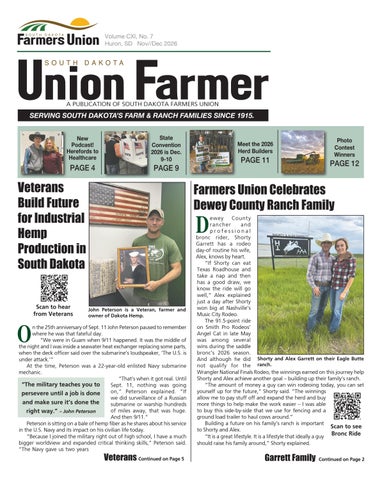
Volume CXI, No. 7 Huron, SD Nov//Dec 2026
A PUBLICATION OF SOUTH DAKOTA FARMERS UNION
SERVING SOUTH DAKOTA’S FARM & RANCH FAMILIES SINCE 1915. New Podcast! Herefords to Healthcare
PAGE 4
State Convention 2026 is Dec. 9-10
O
PAGE 11
PAGE 9
Veterans Build Future for Industrial Hemp Production in South Dakota Scan to hear from Veterans
Meet the 2026 Herd Builders
Photo Contest Winners
PAGE 12
Farmers Union Celebrates Dewey County Ranch Family
D
John Peterson is a Veteran, farmer and owner of Dakota Hemp.
n the 25th anniversary of Sept. 11 John Peterson paused to remember where he was that fateful day. “We were in Guam when 9/11 happened. It was the middle of the night and I was inside a seawater heat exchanger replacing some parts, when the deck officer said over the submarine’s loudspeaker, ‘The U.S. is under attack.’” At the time, Peterson was a 22-year-old enlisted Navy submarine mechanic. “That’s when it got real. Until “The military teaches you to Sept. 11, nothing was going on,” Peterson explained. “If persevere until a job is done we did surveillance of a Russian and make sure it’s done the submarine or warship hundreds of miles away, that was huge. right way.” – John Peterson And then 9/11.” Peterson is sitting on a bale of hemp fiber as he shares about his service in the U.S. Navy and its impact on his civilian life today. “Because I joined the military right out of high school, I have a much bigger worldview and expanded critical thinking skills,” Peterson said. “The Navy gave us two years
Veterans Continued on Page 5
ewey County rancher and professional bronc rider, Shorty Garrett has a rodeo day-of routine his wife, Alex, knows by heart. “If Shorty can eat Texas Roadhouse and take a nap and then has a good draw, we know the ride will go well,” Alex explained just a day after Shorty won big at Nashville’s Music City Rodeo. The 91.5-point ride on Smith Pro Rodeos’ Angel Cat in late May was among several wins during the saddle bronc’s 2026 season. And although he did Shorty and Alex Garrett on their Eagle Butte not qualify for the ranch. Wrangler National Finals Rodeo, the winnings earned on this journey help Shorty and Alex achieve another goal – building up their family’s ranch. “The amount of money a guy can win rodeoing today, you can set yourself up for the future,” Shorty said. “The winnings allow me to pay stuff off and expand the herd and buy more things to help make the work easier – I was able to buy this side-by-side that we use for fencing and a ground load trailer to haul cows around.” Building a future on his family’s ranch is important Scan to see to Shorty and Alex. Bronc Ride “It is a great lifestyle. It is a lifestyle that ideally a guy should raise his family around,” Shorty explained.
Garrett Family Continued on Page 2
Union Farmer
“It is a great lifestyle. It is a lifestyle that ideally a guy should raise his family around.” – Shorty Garrett Scan to enjoy a video of the Garrett family
Garrett Family Continued from Page 1
The ranch routine Days on the Garrett Ranch often begin at sunrise when Shorty and Alex saddle up full brothers, Chance and Champ, and ride out to check cattle. Unlike the rodeo routine, the ranch day routine is not predictable. It is constantly
Shorty with his grandpa, Jonny Holloway.
2
Nov/Dec 2026
changing depending on the season, their herd’s needs and whether or not there are emergencies that need to be dealt with. They may find themselves fixing fence, rounding up stray cattle, checking dams and water tanks, putting out mineral. The days often end long after sunset. Even though the work is taxing, transitioning from the excitement of a win and the crowds and the bustle of the city to the quiet isolation of their Eagle Butte ranch is rejuvenating. “I often feel like I need some time to process,” Alex said. “It’s nice coming home and being able to look out from our porch and not see a bazillion people.” Instead, she and Shorty’s ranch view is that of rolling hills, native grassland and Red Angus cattle. “Nothing looks better on green grass than red cows,” said Shorty, 33, of the Red Angus herd he has been building since 2014 when he returned to his grandparents’ ranch with 20-head he purchased from rancher Sean Deal. Living in the moment and working for the future The couple has learned to live in the moment because they do not have downtime to process the realities of the dual lives they lead. “I will be gone weeks at a time to rodeos, so when I am home for a couple days it is 100-miles-per-hour,” Shorty explained. Fortunately, the couple has a solid support
team. “There’s lot of people in this community who care and want us to succeed,” Alex said. “This is part of the reason we like living here.” There are neighbors like Oren Lesmeister and Kenny Gesinger; friends like Frank Chapmen, Kritter Lamb; and Shorty’s cousin, Keaton Peterson, and dad, Juan. Lifelong supporters, these men, and many others, drop what they are doing and help out anytime Shorty or Alex call. And then there’s Grandpa Johnny. “My granddad is 83 and he likes to help me fence,” Shorty explained. “If it was not for Grandpa Johnny, I would not be where I am at.” Shorty grew up helping Grandpa Holloway, a rodeo stock contractor, gather and haul
D D
For the Cowboy In All of Us Double D
Western Wear & Tack 800 21st St., Huron, SD 605.352.5792
www.ddwesternhuron.com
Farmers Union Members get
20% OFF* one item only!
Present this coupon with your purchase *Excludes all boots, shoes, men’s jeans and tack
www.sdfu.org
Union Farmer
bucking horses and other livestock to rodeos across the region. “I started out breaking colts in grade school,” Shorty said. “It could be hectic at times – gathering bucking horses, putting brood mares out with different studs, sorting – lots of sorting – to select which stock we’d take to which rodeo.” When Alex is not traveling to rodeos with Shorty, she works part-time as a dental hygienist and keeps things running on the ranch. Like Shorty, Alex is working to support the ranch and the lifestyle it provides. “This is our happy place. I can’t picture either of us any place else,” Alex said. Building up the ranch one rodeo at a time Although he is known for saddle bronc riding, Shorty got his start in rodeo team roping and riding bulls. “I was a late bloomer, so I never got to ride broncs until my junior year of high school because the rule my grandpa had was you had to weigh 100 pounds to ride broncs,” Shorty explained. “I was checking my weight all the time. Every time I would practice, I would weigh and try to put rocks in my pockets. It kind of sucked being a little guy. Growing up all my friends were riding broncs. I never quit craving it.” He made a name for himself riding bulls on the Casper College Rodeo Team, but bronc riding was his focus because his uncle had been a bronc rider. “My uncle, T.C. Holloway, was my inspiration. He always stood out to me as a human. As a little kid he always caught my eye. I focused on what he was doing. In my mind he was the most stylish bronc rider there was and I wanted to be just like him,” said Shorty of his uncle who tragically died in a car accident in 2000. “T.C. had fast feet, when he teed off, he would class one up and style out. Anyone who
www.sdfu.org
knows bronc riding, knows what I’m talking about.” Shorty gave up bull riding in 2016, purchased his pro-rodeo permit and put all his energy into bronc riding. He went pro just two years after bringing his first Red Angus cattle home to his family’s Eagle Butte ranch. “I like the ranching lifestyle. I had been helping neighbors with their cattle, but I wanted my own deal,” Shorty said. “This place was getting neglected and needed someone to care for it, so my grandpa said I might as well put up here, so I did.” Four years later, he qualified for the 2020 National Finals Rodeo (NFR). The NFR winnings contributed to his ranch goal, but they also increased his circle of support. “I tell you what, rodeo brings a guy to a whole new level when it comes to support from friends and family,” Shorty explained. “Everyone who is watching wants to help you.” Rodeo benefits his ranch budget, and ranch work benefits his rodeo outcomes. “Being able to be on a horse as much as I can when I’m on the ranch keeps me in shape for bronc riding,” Shorty said. “When you are riding horses every day, nothing is new. … Lot’s of ‘horse sense’ helps in both industries.” To compete at the NFR, rodeo athletes must rank in the top 15 in the world based on dollars earned from rodeo wins. From March 2026 until the end of August, Shorty ranked in the top 15. And then he had some bad draws. He ended the 2026 season 19th overall. Although disappointed, Shorty is not
“This is our happy place. I can’t picture either of us any place else.” – Alex Garrett discouraged. He is eager for the 2027 season to begin. “The love of bucking horses is the reason I do it. I just have a craving for bucking horses and rodeo. It’s the whole atmosphere of friends – rodeo is what brings us together. Rodeo is a great big family,” Shorty said. He added that as he waits, he’s enjoying the time working hard on his ranch. “There are a lot of bronc riders out there who just ride broncs. This is not my deal. I would not be able to come back home from bronc riding to an 8-to-5 job … or do nothing,” Shorty said. “I call this ranch my retirement. It is what I enjoy doing and it is something I want to do until I die.” n by Lura Roti for SDFU
Nov/Dec 2026
3
Union Farmer
Our Way of Life Episode 16: Herefords to Healthcare & The Miles in Between with Shannon Stuwe
I
n rural America, healthcare doesn’t always take place in the doctor’s office. Instead, it may be a familiar face showing up at your front door. For these communities, the most important part of healthcare isn’t just the treatment, but also who’s willing to make the drive to help a neighbor in need. For Shannon Stuwe, a Hoven, South Dakota, cattle producer, that is her livelihood. As a South Dakota State University nursing alum, for more than two decades Stuwe has seen and treated patients from all over Central South Dakota – whether that be in a hospital bed or in someone’s living room. Starting as a floor nurse in Mobridge and working her way up to Director of Nursing in Faulkton, Stuwe currently works as an Avera in-home health and hospice nurse serving individuals in her surrounding communities. When she isn’t on call, Stuwe and her husband, Eric, run a registered Hereford operation while chasing their three children: Chance, Sierra and Lane. From watching them compete on wrestling mats and rodeo to supporting them in fields and kindergarten classrooms, Shannon’s family means everything to her. And that same compassion shines bright when treating her patients. Working in a rural hospital, Stuwe has learned to help wherever needed, no matter the type of care. “As a nurse, you always prepare
1. Publication Title
Statement of Ownership, Management, and Circulation (All Periodicals Publications Except Requester Publications) 2. Publication Number
7
4
5 _ 8
3. Filing Date
Union Farmer
0
4. Issue Frequency
5. Number of Issues Published Annually
7
9
Monthly/Bi-Monthly
8-10
7
10/07/2026
South Dakota Farmers Union 1410 Dakota Ave. S., Huron SD 57350
13. Publication Title
(605) 554-3028
15. Extent and Nature of Circulation
(1) Mailed Outside-County Paid Subscriptions Stated on PS Form 3541 (Include paid distribution above nominal rate, advertiser’s proof copies, and exchange copies)
9. Full Names and Complete Mailing Addresses of Publisher, Editor, and Managing Editor (Do not leave blank) Publisher (Name and complete mailing address)
Karla Hofhenke - South Dakota Farmers Union 1410 Dakota Ave. S., Huron SD 57350 Editor (Name and complete mailing address)
Doug Sombke - South Dakota Farmers Union 1410 Dakota Ave. S., Huron SD 57350 Managing Editor (Name and complete mailing address)
Lura Roti, 840 West 9th, Sioux Falls, SD 57104
10. Owner (Do not leave blank. If the publication is owned by a corporation, give the name and address of the corporation immediately followed by the names and addresses of all stockholders owning or holding 1 percent or more of the total amount of stock. If not owned by a corporation, give the names and addresses of the individual owners. If owned by a partnership or other unincorporated firm, give its name and address as well as those of each individual owner. If the publication is published by a nonprofit organization, give its name and address.) Full Name Complete Mailing Address
1410 Dakota Ave S. Huron SD 57350
11. Known Bondholders, Mortgagees, and Other Security Holders Owning or Holding 1 Percent or More of Total Amount of Bonds, Mortgages, or Other Securities. If none, check box ✔ None
b. Paid Circulation (By Mail and Outside the Mail)
Statement of Ownership, Management, and Circulation (All Periodicals Publications Except Requester Publications)
10/07/2026 Average No. Copies No. Copies of Single Each Issue During Issue Published Preceding 12 Months Nearest to Filing Date
16. Electronic Copy Circulation
Average No. Copies Each Issue During Preceding 12 Months
No. Copies of Single Issue Published Nearest to Filing Date
a. Paid Electronic Copies
a. Total Number of Copies (Net press run)
Telephone (Include area code)
Episode 16 and hear how different agriculture seasons affect ER numbers, stereotypes that may or may not be true and the difference inhome healthcare makes in small communities. As Stuwe proudly says, “It’s an honor. I’m glad we have it in our communities. It makes a difference and that is what I feel like we are here to do – to do God’s work and that’s what I’ve always felt like nursing is.” n by Lydia Hill
14. Issue Date for Circulation Data Below
Union Farmer
Contact Person
South Dakota Farmers Union 1410 Dakota Ave. S., Huron SD 57350
Full Name
and plan for the worst, but you always hope and pray for the best,” she said. Many people may not realize the physical, emotional and mental load nurses carry on their shoulders every day, especially when the person they are caring for is someone they have known their whole life, which happens often in rural South Dakota. “You might punch out, but you never fully punch out.” To learn more, listen to Our Way of Life,
Karla Hofhenke
8. Complete Mailing Address of Headquarters or General Business Office of Publisher (Not printer)
South Dakota Farmers Union
Avera in-home health and hospice nurse Shannon Stuwe with her family: Chance, Shannon, Eric, Sierra and Lane.
6. Annual Subscription Price
$5.00
7. Complete Mailing Address of Known Office of Publication (Not printer) (Street, city, county, state, and ZIP+4 ®)
Scan to listen
2625
2700
(2)
Mailed In-County Paid Subscriptions Stated on PS Form 3541 (Include paid distribution above nominal rate, advertiser’s proof copies, and exchange copies)
108
108
(3)
Paid Distribution Outside the Mails Including Sales Through Dealers and Carriers, Street Vendors, Counter Sales, and Other Paid Distribution Outside USPS®
0
0
b. Total Paid Print Copies (Line 15c) + Paid Electronic Copies (Line 16a)
2733
0
c. Total Print Distribution (Line 15f) + Paid Electronic Copies (Line 16a)
3528
3627
d. Percent Paid (Both Print & Electronic Copies) (16b divided by 16c Í 100)
77.4
77.4
✔ I certify that 50% of all my distributed copies (electronic and print) are paid above a nominal price.
(4)
Paid Distribution by Other Classes of Mail Through the USPS (e.g., First-Class Mail®)
0
0
c. Total Paid Distribution [Sum of 15b (1), (2), (3), and (4)]
2733
2808
d. Free or (1) Free or Nominal Rate Outside-County Copies included on PS Form 3541 Nominal Rate Distribution (2) Free or Nominal Rate In-County Copies Included on PS Form 3541 (By Mail and Free or Nominal Rate Copies Mailed at Other Classes Through the USPS Outside (3) (e.g., First-Class Mail) the Mail)
795
819
(4)
Free or Nominal Rate Distribution Outside the Mail (Carriers or other means)
0
0
0
0
0
0
e. Total Free or Nominal Rate Distribution (Sum of 15d (1), (2), (3) and (4))
795
819
f. Total Distribution (Sum of 15c and 15e)
3528
3627
g. Copies not Distributed (See Instructions to Publishers #4 (page #3))
100
100
h. Total (Sum of 15f and g)
3628
3727
i. Percent Paid (15c divided by 15f times 100)
77.4
77.4
17. Publication of Statement of Ownership ✔ If the publication is a general publication, publication of this statement is required. Will be printed
Publication not required.
11/16/26 in the ________________________ issue of this publication. 18. Signature and Title of Editor, Publisher, Business Manager, or Owner
Karla Hofhenke, Executive Director
Date
10/07/2026
I certify that all information furnished on this form is true and complete. I understand that anyone who furnishes false or misleading information on this form or who omits material or information requested on the form may be subject to criminal sanctions (including fines and imprisonment) and/or civil sanctions (including civil penalties).
* If you are claiming electronic copies, go to line 16 on page 3. If you are not claiming electronic copies, skip to line 17 on page 3.
Complete Mailing Address
12. Tax Status (For completion by nonprofit organizations authorized to mail at nonprofit rates) (Check one) The purpose, function, and nonprofit status of this organization and the exempt status for federal income tax purposes: ✔ Has Not Changed During Preceding 12 Months
Has Changed During Preceding 12 Months (Publisher must submit explanation of change with this statement) PS Form 3526, July 2014 [Page 1 of 4 (see instructions page 4)] PSN: 7530-01-000-9931
4
Nov/Dec 2026
PRIVACY NOTICE: See our privacy policy on www.usps.com.
PS Form 3526, July 2014 (Page 2 of 4)
PS Form 3526, July 2014 (Page 3 of 4)
PRIVACY NOTICE: See our privacy policy on www.usps.com.
www.sdfu.org
Union Farmer Veterans
Continued from Page 1
of school, and from there we had to keep a submarine operational. When something goes wrong, you have to be able to think on your feet.” After taking the Armed Services Vocational Aptitude Battery (ASVAB), Peterson was recruited right out of high school to train as a Navy submarine nuclear mechanic. “I’m sure growing up on the farm gave me a leg up on the ASVAB because we were always breaking and fixing things,” said Peterson, a 1997 graduate of Wakonda High School. Today, the veteran and fifth-generation Wakonda farmer owns one of only two hemp processing facilities in South Dakota. Since 2021, Peterson has worked tirelessly to educate and encourage South Dakota farmers to grow industrial hemp – all the while he has invested in building a processing plant as well as markets for the fibrous plant. “There’s tens of thousands of uses for just the hemp stalk,” said Peterson of the plant species that contains less than 0.3 percent THC. “This plant is grown for its stalk while hemp is grown for marijuana contains 30 percent THC and is grown for its flower buds.” Peterson is now walking by a field of industrial hemp on his family’s farm. This field is within eyesight of Dakota Hemp processing facility. The 10-foot hemp stalks tower over him.
“It’s pretty neat to know that what we are growing here on a farm in South Dakota is eventually going to end up in some Department of Defense products.” – John Peterson “You need to use a special type of equipment to harvest the tall hemp stalks,” Peterson explained. He uses a multi-level cycle bar cutter. “The arms swing out so as you drive through the field it cuts tall hemp stalks into 3-foot sections.” Currently, Dakota Hemp processing plant is processing and marketing hemp stalks for bedding for horses and other livestock, building materials, like OSB and hempcrete, and fiber for U.S. military uniforms. “It’s pretty neat to know that what
www.sdfu.org
Karll Lecher with his dad, Mark.
we are growing here on a farm in South Dakota is eventually going to end up in some Department of Defense products,” Peterson said. A goal of Peterson’s is to see homes built and jobs created from hemp in his rural community of Wakonda, and across the U.S. “Think of the savings. We could build a whole neighborhood of homes from the materials grown right here – built right here – processed right here.” Summer 2026 the facility processed hemp grown by Peterson’s family and other South Dakota, Nebraska and Iowa farmers. Military taught us pride in our work and excellence in all we do After he was honorably discharged from the Navy in 2003, Peterson spent a few years working in Boston for a hydrogen fuel cell company. Then in 2006, there was an opportunity for him to return to his family’s farm when some farmland came up for sale. “Until then, our farm was too small to support two families. I always knew I wanted to return home, so I moved back and began farming with my dad and built a 2,400-head wean-to-finish hog barn.” In 2021, when South Dakota became the 50th state to legalize growing of industrial hemp, Peterson was eager to convert some acres to the drought-tolerant, hardy crop. “I was instantly bitten by the hemp bug,” Peterson said. “You know, I’d been farming corn and soybeans over and over and over again for nearly 20 years. I was ready for a change. It was the excitement I needed.” When he decided to fill the need he saw for in-state processing and build a processing plant, he asked his golfing buddy Karll Lecher if he would join him in this business venture. “John invited me to take a look at 5 acres of hemp he was growing for the CBD market. It was the most beautiful thing I’d ever seen. I put in my two weeks notice,” Lecher said. Like John, Lecher enlisted in the military right after high school.
Dakota Hemp business partners Karll Lecher and John Peterson. “I lacked direction. I had taken the ASVAB and was recruited. In the Air Force I did not need direction. The Air Force fed me, gave me a place to live and gave me training,” explained Lecher of the two years the Air Force gave him to grow up a bit before he needed to make adult decisions. In addition to maturity, through his years serving in Air Force Security Forces, Lecher gained a deep Scan to learn about sense of pride in a Dakota Hemp job well done. “In the Air Force, I felt like I had a sense of pride and a desire to do my best in everything that I do. Excellence in everything,” Lecher said. He explained that this mindset carries over to Dakota Hemp. Peterson agreed. Reflecting on the five-year journey – from a 5-acre field of hemp to contracting 1,500 acres and shipping product. “The military teaches you to persevere until a job is done and make sure it’s done the right way.” To view more photos and videos of Peterson and Lecher, visit www.sdfu.org. To learn more about Dakota Hemp visit dakotahemp.com. Dakota Hemp products can be purchased from their website or on Amazon. n by Lura Roti for SDFU
Nov/Dec 2026
5
Union Farmer
Farmers Union Industries Awards Bobbi Eide $1,500 Scholarship
F
armers Union Industries awarded South Dakota State University agriculture communications and agriculture education major Bobbi Eide the $1,500 Stanley Moore Scholarship. Bobbi is a 2026 graduate of Gettysburg High School where she was actively involved in FFA, serving as Chapter President. In her award-winning scholarship essay, Eide shared about the impact that involvement in Farmers Union youth programming and working alongside her grandpa on her family’s farm has had on her life, education and career goals. Below are excerpts from Eide’s essay. Enjoy!
SDSU ag communications & ag education major Bobbi Eide
When I think about the person I am becoming, so much of that growth traces back to agriculture, agricultural organizations, community and the people who took the time to invest in me. Growing up in rural South Dakota has shaped my values, work ethic and perspective on the world. It has also shaped my goals. I want to spend my life teaching, advocating and helping young people understand the importance of agriculture. My involvement in Farmers Union has played a major role in that direction. Through years of day, district and state camps, I found a place where I felt encouraged, challenged and trusted. Those experiences helped me forge friendships, discover what I want to do with my future and the kind of leader I hope to be. A big part of that foundation came from my grandpa. Some of my earliest memories are of trailing behind him on the farm, trying to match his long stride and listening to the stories he told while he worked. He never sat me down and listed out the values I needed in life. Instead, he showed them to me in the way he lived every day. He taught me that work is something you take pride in, not something you rush through. He showed me that you treat others with respect, whether they are neighbors, strangers or the cattle you are sorting. He taught me that community matters.
6
Nov/Dec 2026
Professionally, my goal is to become a high school agricultural education teacher and an agricultural communicator. I want to teach students the skills they need to succeed in agriculture, while also helping them grow as leaders and people. I want to coach FFA teams, guide SAE projects and create a classroom environment where students feel supported and challenged. At the same time, I want to use communication to bridge the gap between agriculture and the public. Agriculture needs strong, clear voices who can explain what we do and why it matters. I want to be one of those voices. Farmers Union helped me realize that education and advocacy go hand in hand, and that both are needed to strengthen rural communities. My involvement with Farmers Union began with day camps, and those early experiences were more meaningful than I realized at the time. As a young camper, I loved the activities, the games, and the chance to learn something new. I watched leaders guide activities, answer questions and make sure everyone felt included. Even then, I remember thinking, “I want to do that someday.” Those camps planted the first seeds of my interest in teaching and working with younger students.
“Growing up in rural South Dakota has shaped my values, work ethic and perspective on the world. It has also shaped my goals.” – Bobbi Eide District camp at Lake Byron took that interest and pushed it further. It was the first time I experienced a deeper level of leadership development. The district camp helped me understand that leadership is not about being the loudest person in the room. It is about being dependable, respectful and willing to help others succeed. That realization has stayed with me and continues to guide how I lead in 4-H, FFA and my community. State camp had the biggest impact on me. I attended twice, as the only attendee from my county, and each year helped me grow in ways I did not expect. State camp challenged me to think critically, speak confidently and take on responsibilities that pushed me outside my comfort zone. It also gave me opportunities to mentor younger campers, which helped me discover how much I enjoy teaching and guiding others. At state camp, I learned that leadership is not about perfection. It is about showing up, trying your best and being someone others can
rely on. Those lessons shaped my confidence and helped me see that agricultural education is not just something I want to do; it is something I feel called to do. Farmers Union also taught me the importance of advocacy. Through camp discussions and activities, as well as attending Farmers Union Day at the State Fair, I learned how policy affects agriculture and how important it is for young people to understand the issues facing their communities. I realized that advocacy does not always look like giving a speech or writing a letter. Sometimes it looks like teaching a younger student where their food comes from, clearing up a misconception overheard or helping someone understand why agriculture matters. Those small moments add up. They shape how people think about agriculture and the people who work in it. That understanding is a big part of why I want to become both an educator and a communicator. Looking ahead, I plan to attend South Dakota State University and major in agricultural education and agricultural communications. I want to gain the knowledge and experience I need to become an effective teacher and advocate. I hope to return to a rural community, teach high school agriculture and help students discover their own strengths and passions. I want to create a classroom where students feel supported, challenged and inspired. I also want to continue advocating for agriculture through writing, speaking and community involvement. My long term goal is to help strengthen rural communities by investing in the next generation of agricultural leaders. Who knows, maybe I will even get to finally lead a Farmers Union Day camp, a seed planted long ago. Farmers Union has been a meaningful part of my journey. Through day camps, district camp and state camps, I learned the value of leadership, education and community. Those experiences helped shape my goals, but the values behind them had been forming long before camp reinformed them. They started with my grandpa; with the lessons he taught me simply by the way he lived. As I move forward, I hope to carry those lessons with me and pass them on to the students I will someday teach. In many ways, everything I want to do comes back to the same simple idea he showed me: show up, work hard and help others grow. n Courtesy of Bobbi Eide
www.sdfu.org
Cattle Farmer Works to Grow Dung Beetle Populations for Grassland Health
Union Farmer Scan to learn more
G
roups of dark-colored insects are neatly arranged beside a microscope on entomologist Patrick Wagner’s desk. “What I have here are three different guilds represented at Scott’s ranch – these are the rollers, these are the tunnelers and the dweller is under the microscope because it is much, much smaller,” explained the SDSU Extension Entomology Field Specialist. Wagner trapped the dung beetles this August in a cattle pasture on Scott Kolousek’s Wessington Springs farm. Kolousek reached out to Wagner because he wanted to understand more about the health of dung beetle populations on his ranch. The reason? For more than 15 years, the fifth-generation cattle producer has been making intentional changes in hopes that their numbers would increase. “We quit deworming our cows,” said Kolousek of the decision he and his family made after learning parasiticides used in dewormer get into the cow’s excrement and kill dung beetles. “And we started getting really serious about rotational grazing.” Similar to the way bison grazed the prairie more than a century ago, each growing season Kolousek rotates the family’s Hereford cattle through 6,000 acres of native prairie and restored grasslands. He uses grassland health as the gauge to let him know when it’s time to move the herd to another pasture.
“Really, we are grass farmers selling our grass through cattle. You got to use the cattle as a tool to harvest the grass.” – Scott Kolousek “The longest any of our pastures support a cow herd is two-and-a-half to three weeks. The average is seven to 10 days,” Kolousek said. “Then they’re not in there for another 365 days. We change it up every year.” Instead of insecticide to control flies, the Kolouseks opt for a natural, garlic-based fly control. “We don’t spray any insecticides on the farm, and we haven’t for 20 years,” Kolousek explained. Insecticide is not only deadly to dung beetles, but it kills bees and other beneficial insects as well. All these efforts stem from Kolousek’s strong desire to work with nature and its systems to maximize grassland production. “I’ve always been intrigued about soil health
www.sdfu.org
SDSU Extension Entomology Field Specialist Patrick Wagner
and grassland health and all. There are so many species and living organisms below the surface of the ground that make this whole ecosystem above ground work,” Kolousek said. “Really, we are grass farmers selling our grass through cattle. You got to use the cattle as a tool to harvest the grass.” He learned about dung beetles’ role in the prairie grassland ecosystem from another cattle producer during a 2011 Grassland Coalition workshop. “I heard a guy named Pat Guptill speak … He talked about how you can use dung beetles to turn nature’s fertilizer into more grass,” Kolousek said. “Sunshine and water and cow manure is what makes the grass grow.” Nature’s garbage disposal Like their name suggests, dung beetles eat dung. They not only feed on cow patties, but they lay their eggs in cow poop too. When dung beetle larvae hatch, they feed on the manure brood ball crafted by their parents and buried deep into the soil profile. “I consider them the garbage disposals of the insect world,” Wagner said. “They have the lovely job of feeding on dung and breaking it down. …and they not only remove it from the soil surface, but then they’re burying it. It’s fertilizer – boom – straight into the ground.” Wagner explained that as Coprophagous insects, all dung beetles feed on dung and lay their eggs in dung. But depending on their guild, they dispose of dung in unique ways.
“Dwellers are called such because they dwell in the dung… it’s kind of like a race against the clock because they need to lay eggs, and the larvae need to completely develop into adults before the dung dries out and is not edible. “Tunnelers will also burrow through dung piles, but they’re going to be digging chambers down (into the soil) directly underneath the dung pile… and they form what we call brood balls and lay eggs inside those balls. They will have multiple brood balls and they’ll stick those in underground chambers. “Rollers will fly in, carve out a chunk of dung, roll it into a ball, and then roll that on the soil surface out away from the dung pile. Then they will dig a tunnel and bury it several feet deep. They will go quite a ways’ down.” Once the brood balls are in place, Wagner said the female dung beetle remains below to ward off any predator insects, while the male remains on the soil surface guarding the tunnel entrance. Rollers couple up and often only have one brood per season. Dung piles disappear overnight The reason intensive, rotational grazing boosts dung beetle populations is because this practice mimics the way buffalo once grazed the prairie. Native to North Dakota, South Dakota, Minnesota, Montana and other states where buffalo once roamed, for centuries dung beetles
Dung Beetles Continued on Page 8 Nov/Dec 2026
7
Union Farmer Team Buche Cares, South Dakota Farmers Union and Farmers Union Industries Unite to Fight Hunger Across South Dakota More than 35,000 pounds of pork spare ribs donated for distribution to rural and tribal communities, including all nine reservations
A
cross South Dakota, more than 130,000 people – including 1 in 5 children – struggle with food insecurity. These aren’t just statistics. These are real people whom organizations across the state work with daily as they fight food insecurity and support those who need help the most in our rural, tribal and urban communities. This fall Team Buche Cares received a generous donation of more than 35,000 pounds of pork spare ribs from South Dakota Farmers Union and Farmers Union Industries to distribute to partners in the communities we serve, including across all nine South Dakota reservations. “At South Dakota Farmers Union, we know the strength of our rural communities depends on neighbors helping neighbors. That’s why we’ve made a substantial commitment to partner with Team Buche Cares in the fight against food insecurity. Their work reflects the same values we hold dear, and we encourage other agriculture organizations to join us in supporting this important mission. We are
Dung Beetles Continued from Page 7
followed bison herds efficiently depositing their excrement into the soil profile. Today, on cattle farms and ranches where dung beetle populations are healthy, cow patties don’t remain on the soil surface long. “If there’s enough of them, especially rollers carving off pieces and taking it away, they can get rid of that dung pile faster than flies can even develop,” Wagner said. “In some cases, it can be within an hour the dung pile is gone.” Depositing the manure into the soil profile not only adds fertility to the soil, but Wagner explained that the tunnels and chambers carved out by dung beetles also increases water infiltration. Kolousek said before his focus on dung beetles, he didn’t really notice cow patties. But now? “I started looking at the ground a lot more,” Kolousek said. “And if I do see a halfway dry cow patty, I will kick it over and see if there’s anything scurrying around underneath.”
8
Nov/Dec 2026
proud to do our part and support families in South Dakota,” said Doug Sombke, President of South Dakota Farmers Union. “Team Buche Cares is committed to serving families in rural and tribal communities across South Dakota,” said RF Buche, Founder of Team Buche Cares and President & CEO of GF Buche Company. “We are incredibly grateful for this donation from South Dakota Farmers Union and Farmers Union Industries. This donation will allow us to support so many families in rural and tribal communities statewide.”
Dung beetle count is in After evaluating the dung beetle count from the pitfall traps, Wagner said based on the fact he found dung beetles from all guilds as well as predatory insects, populations on Kolousek’s ranch are healthy. “Typically, when we are first starting conservation practices – cutting back on insecticide use and rotational grazing – you will see dwellers show up first and maybe some tunnelers,” Wagner said. “The fact that we have rollers present is a very good sign because those take longer to develop and to build back up in the system.” Kolousek’s grasslands have responded to the extra efforts as well. Since 2011, the grassland carrying capacity increased by nearly 25 percent. Being able to graze more cattle on the same acres matters because the next generation will soon return home to become the sixth generation to raise cattle on the farm. “Our son, Isaac, is moving back in January,
About Team Buche Cares Team Buche Cares strengthens rural and tribal communities by fighting hunger, providing direct help to families in crisis and supporting educational opportunities that create longterm stability and hope. Since 2024, we have served more than 600,000 meals throughout the state, and provided access to emergency SNAP gift cards to 2,900 households during the 2025 government shutdown. Learn more at: teambuchecares.org n Courtesy of Team Buche Cares
and he just had a son, the first of my grandkids, so the seventh generation is on the ground already,” Kolousek said. “We just want to keep passing this (farm) on and improving it and expanding it and passing it down. It’s been 120 years we’ve been going on the same place. I hope 240 years from now we are still going.” To learn more about dung beetles, visit www.sdfu.org to watch a video. n by Lura Roti for SDFU
www.sdfu.org
Union Farmer
Data Centers’ Impact on Rural Communities a Focus During South Dakota Farmers Union State Convention
A
panel of experts will discuss data centers’ impact on rural communities, a nationallyrecognized meteorologist and economist will share the outlook for 2027, and family farmers and ranchers will set policy for the state’s largest agriculture organization during South Dakota Farmers Union 111th State Convention held Dec. 9 and 10 in Huron. “Farming and ranching today is challenging work because there are so many factors impacting family’s lives and livelihoods. So, we work to host a convention that provides timely information and connects producers with experts and thought leaders,” explained Karla Hofhenke, Executive Director of South Dakota
Farmers Union. Throughout the year, Hofhenke listens to members’ concerns and interests as she organizes programming, attends local meetings, livestock shows, county fairs and meets with members on their farms and ranches. “Before we book our speaker line-up, I want to know what the hot topics are that our members are interested in learning more about,” Hofhenke said. “The weather right now is unpredictable – so it will be helpful to learn about what we should prepare for this winter and looking ahead to the 2027 growing season. And then AI and data centers seem to be part of nearly every conversation. We all need to
understand their potential impacts on our ag operations, rural communities and resources.” Cattle producers who attend convention will also have the opportunity to learn about digestible bale wrap from Stephen Gent a South Dakota State University mechanical engineering Professor and Director of the North Central Regional Sun Grant Center. Grassroots policy Established more than a century ago as a
Register online or turn to page 14.
Convention Continued on Page 14
111th Annual Convention Crossroads Hotel and Huron Event Center Huron, South Dakota
Join us on Wednesday evening for
December 9-10, 2026 Featuring Speakers:
Doors Open at
5:30pm
Rob Larew
Shaun Haney
Matt Reardon
National Farmers Union President
Founder of RealAgriculture
Senior Atmospheric Scientist for Nutrien Ag Solutions
• Silent Auction • Banquet Dinner • Entertainment
Panel - From Cornfields to Cloud Storage: Data Centers in Rural America
Room reservations can be made by calling the Crossroads Hotel at (605) 352-3204.
Go online at www.sdfu.org for more details.
Grand Prize Giveaways!
featuring
The Six Appeals
• $4000 CASH • Honda Generator • M18 Milwaukee 5-Tool Combo Kit
No ticket purchase necessary. You must be a member, registered at convention, 18 years or older, and present to win.
www.sdfu.org
Nov/Dec 2026
9
Union Farmer Around the State with Farmers Union
South Dakota Farmers Union members and staff are making a difference in rural communities across South Dakota.
HARVEST MEALS Agtegra – Andover
FARM SAFETY TRAILER – Lemmon
Agtegra – Wolsey DSU
CAREER FAIRS Southeast Farmers Co-op – Beresford SDSU
NSU
10
Nov/Dec 2026
Howard Farmers Co-op
www.sdfu.org
Union Farmer
Farmers Union Awards Youth Breeding Heifers & Ewes
I
nvesting in the future of South Dakota’s livestock industry, South Dakota Farmers Union awarded five rural youth breeding stock during the 2026 Western Jr. Livestock Show as part of the organization’s Herd Builder Award. “Youth learn by doing. So, the younger they get Scan to watch a start taking over responsibility and making decisions video of for their own livestock the better,” explained Karla winners Hofhenke, Executive Director of South Dakota Farmers Union. “We all know quality breeding stock are expensive, so herd expansion may be out of reach for many youth and their families. This Herd Builder Award is one way Farmers Union works to invest “Youth learn by doing. So, in the future of South Dakota’s the younger they get a start family farmers and ranchers.” Youth were selected to receive taking over responsibility and a breeding heifer or ewe through making decisions for their an application process. All own livestock the better.” qualifying youth show livestock during the Western Jr. Livestock – Karla Hofhenke Show held in Rapid City each fall. The youth selected are: Ottilie Lau, from Parkston received a ewe; Oakleigh Reis-Elwood of Reliance received a ewe; Rett Blume of Pierre received a heifer; Avery Antelope of Ideal received a heifer; and Teagan Scheel of Alpena received a heifer.
Avery Antelope, Ideal; Teagan Scheel, Alpena; and Rett Blume won breeding heifers, pictured here with David Reis, Reliance rancher and SDFU State Board Member, Karla Hofhenke, Executive Director, SDFU, and Rocky Forman, Members Services Coordinator, SDFU.
Get to know the 2026 Herd Builders Ottilie Lau, Parkston Fourth-grader Ottilie Lau enjoys the chores she does on her family’s Parkston farm. “I feed the sheep and give them water and I help in the garden – planting, weeding and watering – I really like helping out,” Lau explained. Through the Herd Builder Award she was able to increase her sheep flock from two to three ewes. “I wanted to improve my flock genetics, and this ewe will do that.” In addition to caring for her ewe’s needs, Ottilie also trains them so she can show them in 4-H shows. She is a member of the Douglas County 4-H Club. “4-H is fun. I really like showing sheep and cattle.”
www.sdfu.org
Ottilie Lau, Parkston; and Oakleigh Reis-Elwood, Reliance; won breeding ewes, pictured here with Rocky Forman, Members Services Coordinator, SDFU (far left) David Reis, Reliance rancher and SDFU State Board Member, and Karla Hofhenke, Executive Director, SDFU.
Oakleigh Reis-Elwood, Reliance Chamberlain High School junior Oakleigh Reis-Elwood enjoys caring for her small flock of sheep. “They are one of the easiest animals to raise, but yet they are challenging to show. I like the challenge they present – it makes me want to succeed,” explained Reis-Elwood, who received grand champion in sheep showmanship for the last five years during the Lyman County Fair. “Also, caring for my sheep has taught me a lot about responsibility because you can’t just pick and choose when you want to feed or work with your animals. It is something you need to do every day,” added the president of the Lyman Longhorns 4-H Club. In addition to sheep, Reis-Elwood also raises cattle and meat goats. She is saving the money she earns from their offspring for college. After high school, she plans to pursue business and esthetician degrees. Her plan is to build a career in her hometown and continue to raise livestock. Rett Blume, Pierre Thirteen-year-old Rett Blume was eager to win the Herd Builder heifer because the middle schooler is focused on expanding his herd of eight, and its genetics. “Right now, all I have is Herefords, so I want to add new genetics,” explained the sixth-generation cattle producer. Rett enjoys helping his parents, Michael and Becky select genetics for the family’s cow/calf herd. “We have a catalogue that has bulls and we see if there is a bull we like and then we pick out the cow we think will go good with that bull.” An active member of the Prairie Wranglers 4-H Club, Rett said after high school and college, he plans to stay involved in the cattle business. “The markets are good and I love working with cattle.” Avery Antelope, Ideal Winner FFA member Avery Antelope said he was excited to win the Herd Builder heifer because, “I have been raised around cattle, and I show them, so I want to increase my herd and stick around them my entire life.” With the Herd Builder heifer, Antelope now has a herd of three breeding animals that he raises and cares for on the DeJong Ranch. Because he also shows cattle, in addition to typical livestock chores, Antelope said he also spends a lot of time working with his show animals. “To do well in the showring, you need to spend a lot of time in the
Herd Builder Continued on Page 15 Nov/Dec 2026
11
Union Farmer 2026 Farm & Ranch Photo Contest Winners Announced Riata Bultje
Scan to see more photos
Samantha Swanson
Leanne Mallon
S
tanding in an end row at sunset, Riata Bultje took a moment to capture the last night of corn harvest 2025. “It’s a pretty special photo to me because of the meaning behind it,” Bultje said. “On our farm, it’s just me and my sisters and my dad doing all the work. And when we are in school, it’s just him doing it all on his own. So, there are a lot of nights when he’s working long after sunset. This photo represents all the hard work and time that he puts into our farm.” A third-generation Lake Andes farmer and agriculture education major at South Dakota State University, Bultje’s photo also captured the eyes of judges. It placed first in the Farm and Ranch Scenery division of the South Dakota Farmers Union 2026 Capturing Life on South Dakota’s Farms and Ranches photo contest. Other division winners are: Farmer at Work Division – Ree Heights farmer and cattle producer Leanne Mallon; and Livestock Division – Redfield cattle producer and registered nurse Samantha Swanson. All winners received a prize. “There is a lot that happens day-in and dayout on farms and ranches across South Dakota. Farmers Union hosts this annual photo contest to capture, share and celebrate these moments,” explained Karla Hofhenke, Executive Director of South Dakota Farmers Union. “As an organization, we see this as one of many ways to honor the people who do the work of our state’s largest industry.” Learn more about the people behind the photos Growing up on her family’s crop and livestock farm influenced Riata Bultje’s decision to make a career of teaching others about agriculture. “No one can get away from agriculture. You eat it. You wear it. It is really a big part of every-
12
Nov/Dec 2026
one’s lives and I am passionate about showing students the role agriculture plays in their everyday lives, whether they grow up on a farm or not.” In her third year at South Dakota State University, Bultje drives home on the weekends to help her dad, Brice, and sisters on her family’s farm where she and her younger sisters, Emery and Marin, run a flock of registered Rambouillet sheep together. While Brice taught Bultje how to care for crops and livestock, her mom, Darci, taught her all about photography. “One of my favorite 4-H projects was photography. My mom did a lot of photography on our farm when I was younger,” Bultje said. Fifth-generation Ree Height’s farmer/rancher Leanne Mallon spends a lot of time working cattle. “I love working cattle. It’s pretty much all I’ve ever done since I was a little kid,” explained Mallon, who not only works her own and her family’s cattle, but also has an off-farm job working cattle for other ranchers. “Working cattle takes patience. I learned a lot when I worked for a veterinarian in high school and over time, I’ve learned a lot from other cattle producers as I help them out. I have picked up tips and tricks.” Although Mallon takes a lot of photos of cattle and others working cattle, her winning photo is taken from the seat of a Case IH Quadtrac during harvest 2025. “I enjoy capturing all aspects of life on our farm and I like seeing what other farmers photograph. It’s nice to see other farmers’ cow herds
or their farm fields,” Mallon said. Being part of a community of farm and ranch photographers is the reason Redfield nurse and cattle producer Samantha Swanson has participated in the South Dakota Farmers Union photo contest since 2022. “I like to see the perspectives of other people through their photos, like what’s beautiful in their eyes and what their operations look like and what do they do,” explained Swanson, who has placed first in a division each year she has competed. “Honestly, I love sharing my photos. And it’s nice to compete in a community of other farmers and ranchers because I feel like we all share the same values and goals.” Connecting with other family farmers and ranchers is also the reason Swanson attended a Farmers Union young producer event, winter 2026. “It was nice to be with a group of young producers because we have a lot in common and because we are all motivated to continue our family’s farms or ranches,” said Swanson who farms with her fiancé, Alan Masat, on his family’s Redfield farm. Swanson also works as a registered nurse at Community Memorial Hospital in Redfield. Enjoy more photos from farms and ranches across South Dakota In its sixth year, nearly 40 photographers from across the state competed in the 2026 photo contest. Visit www.sdfu.org to view their photos from farms and ranches across South Dakota. If you are interested in competing in the 2027 photo contest, send an email to sdfu@sdfu.org and you will receive notification when the Capturing Life on South Dakota’s Farms and Ranches photo contest opens. n by Lura Roti for SDFU
www.sdfu.org
Union Farmer Board Candidates Share Why They Want to Continue to Serve
T
hree familiar names will be on the South Dakota Farmers Union (SDFU) ballot during the 2026 State Convention held in Huron Dec. 9 and 10 as three South Dakota farmers ask to serve another term on the SDFU Board of Directors: Beresford farmer Larry Birgen, District 1; Clark farmer Gail Temple, District 3; and Groton farmer Chad Johnson, District 7. Read on to learn why these leaders want to continue serving.
Larry Birgen
Gail Temple
Chad Johnson
District 1: Larry Birgen, Beresford
District 3: Gail Temple, Clark
District 7: Chad Johnson, Groton
Question: Why do you want to continue to serve Farmers Union? Answer: Growing up, my parents, Matthew and Maureen, were actively involved in Farmers Union. So, I was active in Farmers Union – earning my Torchbearer Award in 1983 when I was a senior in high school. Throughout my farming career, I have valued Farmers Union support for the issues I care about. I see my role as a board member as being a voice for family farmers not only in District 1, but across the state. Farmers need a voice, we need to speak for ourselves, otherwise nothing will improve. I know many farmers are too busy to go to Pierre, or D.C. or participate in quarterly meetings. This is my job as a board member – to ensure their voice is heard when I am in Pierre or D.C. or sitting in the Farmers Union board room. Question: How will you work to grow membership and member engagement? Answer: It is interesting how membership in Farmers Union spikes when times are tough and family farmers and ranchers struggle more than usual. I will make time to listen to what the issues are that family farmers and ranchers care about and let them know that Farmers Union is here to serve as their voice, and through policy we can work to overcome challenges.
Question: Why do you want to continue to serve Farmers Union? Answer: Farmers Union is an organization that’s always been important to me. I grew up actively involved because my parents, Dee and Lloyd Battest, were involved. I received my Torchbearer in 1983. Serving in this leadership role on the board, I am always learning and gaining new experiences to help continue the mission of the organization I care about – to support family farmers and ranchers. The needs of family farmers and ranchers are different depending on where you are located in South Dakota. So, I work to ensure that I understand the needs of producers in District 3 – and across the state. Question: How will you work to grow membership and member engagement? Answer: Education for all ages has always been important to Farmers Union. And this is important because if we are going to survive as an organization, it is important to get younger producers involved. In my role as a board member, I work to ensure that family farmers and ranchers know about the educational opportunities – camps for youth, young producer events, leadership training and advocacy opportunities. Through educational opportunities, farmers and ranchers and their families not only expand their knowledge, but they develop friendships with other producers.
Question: Why do you want to continue to serve Farmers Union? Answer: I truly believe what we do as a leadership team makes a difference for family farmers and ranchers. Farmers Union board is a strong board because it is a diverse board. Each of us is a farmer or rancher and all our family operations are unique. Because we each represent a different area of South Dakota, we are able to understand the needs of the communities we serve. And we are able to draw on each other’s experiences to help solve problems. Question: How will you work to grow membership and member engagement? Answer: By being involved in my community and connecting with farmers throughout my district. When I connect and visit, it opens up opportunities for social interactions. It does not take too long before conversation gets to topics like commodity prices or grocery store prices. When this happens, I share what Farmers Union does and how it works to support South Dakota’s family farmers and ranchers. We are always looking for ways to engage with our community. My wife, Michelle, and our son, Porter, and I are all very active in our local bowling league. And I work to be involved in other community events, like a recent golf tournament where we gave away Farmers Union merch. n
www.sdfu.org
Nov/Dec 2026
13
Union Farmer Convention Continued from Page 9
costs, but also property rights and healthcare costs,” Sombke said. “Policy is where members have their voice heard. You can sit at home and scream at the news on the TV all you want, but if you want to have your voice heard, come to convention and put policy in place that can make actual change.” For a complete agenda and to register, visit www.sdfu.org. n by Lura Roti for SDFU
grassroots policy organization, South Dakota Farmers Union advocates for policies that support family farmers and ranchers. And State Convention is where members establish the policy to guide the organization’s advocacy efforts, explained Doug Sombke, President of South Dakota Farmers Union and fourth-generation Brown County farmer. “We are in extremely stressful times right now in agriculture – not just the markets, not just the weather, not just fuel costs, not just fertilizer
South Dakota Farmers Union 109th Annual State Convenon December 11-12, 2024 Crossroads Hotel and Convenon Center, Huron—100 4th St. SW, Huron, SD
NOTE: The registraon costs do not include Hotel Call CROSSROADS HOTEL & CONVENTION CENTER AT (605) 352.3204 Tothe Register for South Dakota Farmers Union State Convention: Rate is $96.00 plus tax, per night. Our block will be held unl November 20, 2024 Visit www.sdfu.org or return this form to: SDFU, PO Box 1388, Huron, SD 57350 Register using the form below or go online to www.sdfu.org (click on the slider)
——————————————————————————————————————————————————————————— First Name ___________________________ Delegate: Yes ___ No ___
Last Name __________________________________
Spouse Name ________________________ Delegate: Yes ___ No ___ City ______________________________ County ______________________________ Phone ____________________________ Convenon package - $50 PER PERSON ______ (Aer (AfterDec. Dec.9) 8) - $75 PER PERSON _______
TOTAL PAYMENT _____________________
Night on the Prairie Foundaon Fundraiser—$50 PER PERSON ______ (After (AerDec. Dec.5) 6) —$75 PER PERSON _______
Check Enclosed _____ Credit Card _____
Credit Card # ____________________________________________ Expiraon __________________ CVV _________ Signature ________________________________________________
14
Nov/Dec 2026
Return this form to: SDFU, PO Box 1388, Huron, SD 57350 www.sdfu.org
Union Farmer Western Jr. 2026
South Dakota Farmers Union hosts a meal for Western Jr. showmen and women and their families.
Herd Builder Continued from Page 11 barn with them, I probably spend an hour or two each day.” A sophomore in high school, Antelope plans to pursue a degree in veterinary medicine after high school and hopes income from his herd will help pay for college. “I have watched a lot of veterinarians and I have helped vets do their work before and I am really interested in doing this.” Teagan Scheel, Alpena Teagan Scheel got his first cow when he was 8. “My parents gave her to me,” explained
www.sdfu.org
the Wessington Springs High School senior. “I actually have a few of her daughters and granddaughters today.” Eager to continue to expand his herd of four, Scheel was excited to win the Herd Builder heifer. “I’ve been wanting to apply for the Herd Builder for a few years now and it just worked out this year, and I feel fortunate to get one because heifers are expensive animals,” Scheel said. “If you have a big herd, maybe one heifer doesn’t make a huge difference, but since I only have a herd of four, one more really helps.” After high school, Scheel plans to pursue an agriculture business degree and return to
his home community to work and continue to expand his cattle herd. “I’ve grown up raising livestock and it’s a great industry,” Scheel said. “By showing cattle, I have met a lot of people and made a lot of friends. I can tell you people that I met when I was 8 or 9 years old in the show ring who are my friends today and will probably be lifelong friends.” To learn more about how South Dakota Farmers Union supports farm and ranch youth and families, visit www.sdfu.org. n by Lura Roti for SDFU
Nov/Dec 2026
15
Union Farmer After the Blue Wave – What’s Next for Agriculture and Ethanol?
T
Doug Durante, Executive Director, Clean Fuels Development Coalition
he smoke hasn’t entirely cleared from the election, and it may be a long time before it does. In what is unquestionably one of the biggest shakeups in recent memory, agriculture, energy and environmental policies all will be subject to change – maybe for the better, maybe not. Now we enter the dreaded lame duck session where decisions are being made by people who won’t have to live with the consequences of those decisions. That makes for a dangerous, unpredictable situation. For farmers everywhere, the Farm Bill and ag appropriations impact you directly, yet remain unresolved. Are the same people that cut food assistance programs, refuse to clear the way for E15 and couldn’t get their work done on time now suddenly going to come to agreement on these contentious issues? For those who did not lose their seats or retire and must work with a Democratic majority next year, perhaps they will, if for no other reason than self-survival. Both the House and Senate Ag committees will be under new leadership. House Ag Committee under Democratic control would have been chaired by Rep. Angie Craig as the top Democrat but her failed bid for the Senate bid creates an opportunity for others and we hear there is some horse trading going on as members scramble to reorganize and for some, change their committee assignments. Without question, some experience and institutional knowledge will be lost. For the Senate Ag Committee, there was significant turnover on the Republican side with Sens. McConnell, Ernst, Tuberville, Marshall and possibly
16
Nov/Dec 2026
Hyde-Smith leaving and on the Democrat side ethanol, lost a champion in Amy Klobuchar, who would have likely chaired the committee. In addition, Illinois’ Dick Durbin and Minnesota’s Tina Smith are leaving. As we are all painfully aware, the E15 issue was one of the sticking points in the bill and the changes in leadership do not necessarily mean a better outlook. While the House included E15 in their version, there are no guarantees it would survive a conference committee markup with so many new members in both chambers. The other critical committee impacting ethanol and the environment in the House is Energy and Commerce. This behemoth of a committee has 50 members and numerous subcommittees, often with overlapping jurisdictions. It is the subcommittee on Environment that would be the first line of defense against efforts to repeal or significantly change the RFS and is not exactly a stronghold of support for ethanol. In fact, the likely chair of that subcommittee will be Rep. Paul Tonko of New York – a state that tried to ban E15 several years ago. And the likely chair of the full committee would be Rep. Frank Palone of New Jersey – another northeast state with little interest in ethanol. On the other hand, they could certainly revive climate change programs and would not be as oil-friendly as previous committees. However, the oil refiners are going all in opposing EPA’s proposal to reallocate renewable volumes under the RFS and this fight shows no sign of resolve. In addition to the environment subcommittee, there are subcommittees on Energy, Health and Oversight – all of
which can claim jurisdiction over issues of interest to us. Even with friendly subcommittees, getting something through the full committee and its 50 members is a gauntlet. So, it is to be determined as to how the Democrat majority in the House will impact agriculture, energy and environmental programs. One could argue it could not be much worse than the previous majority so I am somewhat optimistic. One positive thing that could be argued that came out of the recent run up in oil prices is the wake-up call it provided. Clearly the public was reminded how dependent we are on oil and how it impacts not just the cost of filling up our gas tanks but our food and other goods. Of all the agencies that will be subject to intense scrutiny beginning in January, none will be making the trip to capitol hill more than EPA. They have completely lost their way and ignored their core mission of protecting public health. Many members of Congress have made it clear that will change as emission standards, power plant pollution, clean water programs and climate change will all be revisited. Ditto for the administration’s war on renewable energy of all types. This should provide great opportunities to educate these new members that American agriculture can be part of the solution and educate this new Congress that we can provide food, feed and fuel while protecting public health and the environment. n www.sdfu.org
Union Farmer
From the President...
Get to Know Those Who Represent You
I
f you were among the more than 300,000 South Dakotans to vote on Nov. 3, thank you for making your voice heard! Ensuring the voices of South Dakota family farmers and ranchers are heard is something the leadership and staff of South Dakota Farmers Union work hard to do year-round. But advocacy efforts are definitely amplified when our state’s leaders gather in Pierre during Legislative Session. Now that we know who is representing us in Pierre, we encourage our members to make time ahead of Legislative Session 2027 to visit with their local representative. Reach out for a coffee, attend their next cracker barrel or better yet, invite them to tour your farm or ranch so you can show them what you do and concerns or opportunities you see. And while you are visiting with your representative, be sure to ask them their thoughts on issues that matter to you. What stance do they have on data centers? How about property rights? How about funding education? Whether you agree or disagree, it is helpful to know where they stand. Don’t know who your local representatives are? No worries! Scan the QR code below to find out. New leaders. New agendas. Going into the 2027 Legislative Session, the South Dakota House and Senate have new minority and majority leaders. These leaders set the agenda for the upcoming session. It is important to understand if their priorities align with the needs of family farmers and ranchers. Whether they do or not, it’s always a good idea to visit with them for clarification on issues affecting your family’s farm or ranch. Grassroots policy matters What matters to you as a South Dakota farmer or rancher? Your answer to this question is the reason we debate policy each year during the South Dakota Farmers Union State Convention. State Convention Policy Meeting is when members bring forward their concerns or their ideas for positive change and weigh in on what other members bring to the floor.
A PUBLICATION OF SOUTH DAKOTA FARMERS UNION
South Dakota Union Farmer, ISSN 0745-8797, publishes eight times per calendar year, with issues printed in January, February, March/April, May, June/July, August, September/ October and November/December. Periodical postage paid at Sioux Falls, S.D.
Doug Sombke, SDFU President Decisions made during policy guide SDFU staff, me and your board of directors. During past legislative sessions policy established by members guided SDFU to take a stand for property rights. And our policy guides our efforts for Mandatory Country-of-Origin Labeling (MCOOL) in D.C. (These are just a two of many examples I could list. You can read our Policy Book to learn more. It’s easy to find at www.sdfu.org) The policy members set addressing data centers during the 2025 State Convention says that if data centers are going to be welcome in South Dakota, they must do no harm. Farmers and ranchers do not want data centers to use state’s resources. We do not want data centers to increase the cost for electricity. We do not want data centers to get tax cuts. I was recently on a phone call with East River Electric Cooperative leaders emphasizing the points of our policy. Educate yourself Along with policy, education remains a strong focus of SDFU. Education is power. And as members of South Dakota Farmers Union we want to empower you through access to education. During State Convention we will have a panel of experts who will be discussing data centers and their potential impact on rural communities in South Dakota. There will also be plenty of time for you to ask questions. In addition to information on data centers, we are bringing in a experts to discuss the weather and economic outlooks for 2027. FUE has been working with SDSU developing digestible net wrap to address concerns of cattle dying from blockage to their digestive system. SDSU’s team will share the latest update of our new product. I look forward to discussing policy and learning alongside you during State Convention 2026. Register today!
Doug Sombke, President South Dakota Farmers Union
Congressional Leaders Contact information: Rep. Dusty Johnson Mason Ohnstad, Legislative Assistant 202-225-2801 mason.ohnstad@mail.house.gov
www.sdfu.org
Sen. Mike Rounds Lucas Heitkamp, Legislative Assistant 202-224-5842 Lucas_Heitkamp@rounds.senate.gov
Sen. John Thune Ashlynne Beninga, Legislative Assistant 202-224-2321 Ashlynne_Beninga@thune.senate.gov
Karla Hofhenke, Publisher Lura Roti, Editor Wendy Sweeter, Copy Editor Diane Martinson, Layout & Design
All information for publication must be submitted by the 15th of the month. You may submit items to address below or email items to: sdfu@sdfu.org POSTMASTER: Address changes to: SDFU, PO Box 1388, Huron, S.D. 57350-1388
Contact SDFU • 605-554-3028 1410 Dakota Avenue South, PO Box 1388, Huron, SD 57350 www.sdfu.org
sdfu@sdfu.org
SDFU State Office Staff Doug Sombke.............ext. 1240 President Groton Direct Line 605-554-3027
Karla Hofhenke..........ext. 1140 Executive Director Huron Direct Line 605-554-3028
Megan Babcock.........ext. 1180 Controller Huron Direct Line 605-554-3026
Lydia Hill.....................ext. 1220 Digital Media Interm Huron Direct Line 605-554-3024
Rocky Forman............ext. 1170 Member Services Coordinator Cavour Direct Line 605-554-3025
David Smith Legislative/Farm Specialist Pierre Direct Line 605-350-8857
Ashley Stegeman Education Specialist Wessington Springs Direct Line 605-554-3022
Lacey Bich Executive Assistant Cavour Direct line: 605-554-3023
Cally Faulhaber Web & Program Operations Intern Plankinton Direct line 605-554-3024
SDFU Board of Directors Doug Sombke.........President Groton Jeff Kippley..... Vice President Aberdeen Larry Birgen............... District I Beresford Scott Kolousek......... District II Wessington Springs Gail Temple............. District III Clark
David Reis................District IV Oacoma Chad Johnson........District VII Groton Oren Lesmeister....District VIII Parade
Contact NFU National Farmers Union 20 F Street NW Suite 300 Washington, DC 20001 Rob Larew, President ~ Jeff Kippley, Vice President Darin Von Ruden, Secretary ~ Doug Sombke, Treasurer 202.554.1600 www.nfu.org
Nov/Dec 2026
17
Union Farmer Farm/Ranch Transition Planning – Your Questions Answered
W
hat happens to your family’s farm or ranch when you are ready to retire or you pass away? If you don’t know the answer to these questions, Lance Boyer, Director of Financial Products for Farmers Union Insurance, is here to help by answering some of the most commonly asked Lance Boyer questions pertaining to farm and ranch succession planning. The questions he answers below were gathered from family farmers and ranchers from across South Dakota. Question: When it comes time to talk about transitioning the farm or ranch to the next generation, is it important to have everyone at the table… including the non-farm or ranch members of the family? Answer: It’s not only important to have all stakeholders at the table, it is a nonstarter. If we can’t get everyone to the table, we can’t put together a successful plan. I’m not saying when it comes to the final vote we need to have everyone at the table, because this would probably cause chaos. But I do believe it is very, very important that everyone is heard and understood. No family can execute a family plan, unless all the family members are included. As we all know, family farms and ranches are very personal to everyone. If family members are excluded and find out after the fact that they were not included, it creates deep divisions. If everyone is included from the start, everyone is happier with the final outcome. One of the most important things to remember about succession planning is that it helps keep the family a family. Question: How do you get everyone to understand that fair isn’t always equal, and equal isn’t always fair? Answer: I would say that this is probably the basis of transition planning. What is right
18
Nov/Dec 2026
is not always fair and what is fair isn’t always right. In an instance where there are two siblings and one stays with mom and dad and takes over the farm and does all the work and runs the farm, while the other sibling goes off and builds a life and career for themselves off the farm – would it be fair to split things 50-50? Even if the off-farm sibling returns to the farm to enjoy the privileges of hunting and bringing their family back to enjoy the farm, but they earn their income off the farm and they don’t invest time or money or labor in the farm, when it comes time for Mom and Dad to pass the farm on, would splitting everything 50-50 be the right thing to do? At the end of the day, it comes down to money. And if you want to see the farm continue to the next generation, it is important to talk about options that set the next generation up for success on the farm, while also providing an inheritance to the off-farm child or children. In this instance, we often talk about life insurance. This way one child gets assets and one child gets cash.
“To have the outcome you are looking for, you need to start transition planning sooner than later.” – Lance Boyer
Question: When is the right time to transition plan? Answer: The sooner the better. For example, if life insurance is part of the plan, you need to apply for it when you are healthy. If you wait until you are 65 or older, you may not be healthy enough to qualify. If the process is started too late, there are not as many options – especially when you take life insurance off the table. Question: How can I transition my farm or ranch to the next generation without giving them a load of debt, and I will still be able to retire and live and pay my bills without putting the burden on the next generation?
Answer: When I reflect on this question, my answer needs to begin with – to have the outcome you are looking for, you need to start transition planning sooner than later. I say this because there are numerous products that have what are called “living benefits.” The products provide cash and retirement to the generation transitioning out of farming while they are alive. But those need to be funded. So, this option leads to more questions: 1. Who funds the retirement payouts? 2. How do we transition plan so that one generation can retire and the generation now doing the farm or ranch work can do more than survive, they can thrive? And another part of the answer to this question is yet another question – one no one likes to discuss – long-term care. What happens if you need long-term care? We need to protect living benefits so if one, or both, of the older generation need long-term care, they don’t have to sell assets to pay the long-term care cost or use all the income. Question: So there’s a plan in place. But it is not followed. What are the options? Answer: The simple answer is to avoid this issue in the first place. When putting together a proper succession plan, the children should not be the ones responsible for making sure it is followed. It is a good idea to set up a trust with a non-family member serving as the trustee. This way the money flows into the trust and the money is dispersed to the wishes of the person who set up the trust. Question: I have more questions. Who do I contact? Answer: You can reach out to me anytime. I work with a team of experts, so if I cannot answer your questions, I can find someone who can. Reach out to me at Lance. Boyer@fumic.com. n
www.sdfu.org
Union Farmer Thank You Karla & SDFU, Thank you for sponsoring my blue FFA jacket! I really appreciate your doing this for me, this will make me feel like a real FFA member! Sincerely, Kaylee and Jerimiah
ORDER YOUR OWN COPY OF THE FARMERS UNION CENTENNIAL COOKBOOK
Cookbooks are $10 plus tax and shipping. Call 605-352-6761 or email sdfu@sdfu.org to place your order today!
*** Thank you for supporting and helping my career with the awarding of the Herd Builder, it was greatly appreciated! Avery Antelope
FARMERS UNION SIGNS
Show your Farmers Union spirit with a special Farmers Union sign. The cost per sign is $10 or free with a five-year or greater membership to Farmers Union. To get yours today, call 605-3526761 or email sdfu@sdfu.org.
Subscribe to Producer Connection Today!
SDFU CLIP AND SAVE CALENDAR
Keeping up on governmental policy and programming vital to your farm or ranch doesn’t need to be a chore.
SUBJECT TO CHANGE
Subscribe to Farmers Union Producer Connection weekly email today and stay connected to the news you need.
Producer Connection includes weekly: • Summaries of Congressional activity • South Dakota Ag News • Farmers Union Updates To subscribe, visit www.sdfu.org and add your email address to the “Join Our Mailing List” located at the bottom of the homepage.
COOK’S CORNER
Oreo Truffles
Kathy Wahle – Lifetime Member Salem, S.D.
1 pkg. (1 lb. 2 oz.) Oreos 1 (8 oz.) cream cheese 2 pkg. (8 oz.) Baker’s Semi Sweet Baking Chocolate
Crush 36 cookies fine with food processor. Mix with the cream cheese in the food processor. Don’t over process. Roll into balls and refrigerate. Dip in melted chocolate. Store in refrigerator. NOTE: Also good dipped in white almond bark. www.sdfu.org
November 17
Brule County Annual Meeting
17
Hand County Annual Meeting
17
District 4 Annual Meeting
18
District 7 Annual Meeting
18
Brown County Annual Meeting
19
Minnehaha County Meeting
19
Dewey/Ziebach Annual Meeting
19
Spink County Meeting
23
Deuel/Grant Annual Meeting
23
Hutchinson County Annual Meeting
24
Edmunds County Annual Meeting
26-27 Office Closed – Thanksgiving December 9-10 SDFU Convention 24-25 Office Closed – Christmas Nov/Dec 2026
19
Coverages for What’s IMPORTANT in Life. Cameron Lux Aberdeen, SD 605-229-3945
Collin Palmer Bison, SD 605-244-7431
Tom Farber Britton, SD 605-448-5150
Matt Field Brookings, SD 605-691-1492
Heidi Fields Brookings, SD 605-692-2078
Gary Ray Brookings, SD 605-692-6735
Harley Mollman Buffalo, SD 605-375-3311
Jenn Wickstrom Buffalo, SD 605-375-3311
Lon Reidburn Clark, SD 605-532-3299
Bill Noethlich Doland, SD 605-635-6511
Mark Rozell Doland, SD 605-635-6511
Dawn Melius Faulkton, SD 605-598-6570
J.R. Johnson Groton, SD 605-397-8155
Blaine Anderson Huron, SD 605-352-2130
Brendon Hansen Irene/Menno, SD 605-661-0086
Brian Hansen Irene, SD 605-263-3342
Donna Enders Kadoka, SD 605-837-2144
Kevin Albrecht Chris Goldsmith Kevin Marion, SD Albrecht Lemmon, SD Marion, SD 605-374-3462 605-941-0650
Zach Horstman Mitchell, SD 605-292-3333
David Schelske Mitchell, SD 605-292-3333
Ce Faulkner Piedmont, SD 605-737-0463
Andrew Mefferd Pierre, SD 605-222-7979
Kasey Keller Rapid City, SD 605-343-4213
Dan Lewis Rapid City, SD 605-342-3585
Jake Lewis Rapid City, SD 605-342-3585
Doug Koch Salem, SD 605-777-0571
Kay Koch Salem, SD 605-777-0571
Trevor Dietrich Sioux Falls, SD 605-705-4475
Michael Mongar Sioux Falls, SD 605-705-4475
Stacy Mongar Sioux Falls, SD 605-705-4475
Erica Steiner Scott Sabers Todd Nichols Sisseton, SD Spearfish/Sturgis, SD Watertown, SD 605-698-7316 605-490-0765 605-886-9683
Debbie Baumgarn Webster, SD 605-345-2640
Jeremy Clay Winner, SD 605-842-1556
Brendon Hansen Yankton, SD 605-975-6596
Tricia Quade Rapid City, SD 605-431-3986
Brandon Teichroew Yankton, SD 605-975-6596
AUTO • HOME • FARM & RANCH • CROP BUSINESS/COMMERCIAL • LIFE • HEALTH *not all products are underwritten by Farmers Union Insurance