SDSU FA L L 2 0 2 6
MAGAZINE
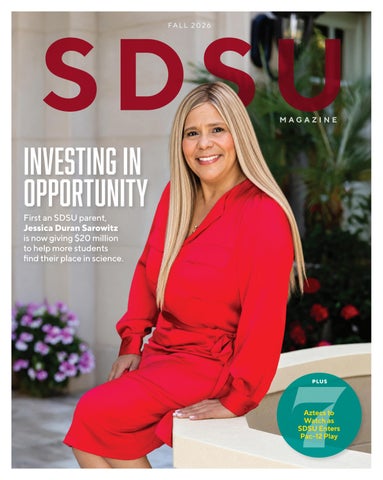
INVESTING IN OPPORTUNITY
First an SDSU parent, Jessica Duran Sarowitz is now giving $20 million to help more students find their place in science.
7 PLUS
Aztecs to Watch as SDSU Enters Pac-12 Play
M A G A Z I N E
10 ASK A RESEARCHER
FEATURES
Taharka Adé, associate professor of Africana Studies
18 7 PLAYERS TO WATCH
Attending SDSU is a tradition for the Day family. To date, they’re 12 alumni strong.
24 13 GAME-DAY SUPERSTITIONS
31 AZTEC FAMILY TREE
Linda Pouder, Merryall Studio Art Director Contributing Writers Aaron Burgin, Zoe Glotzer, Tim Grenda (’94), Taylor Harris (’23), Kylie Hastings (’26), Michael Klitzing (’05), Lizbeth Persons, Leslie L.J. Reilly, Rebecca Williamson
32 WHY WE GIVE Dennis (’75) and Elaine Szeto
What rituals get the Aztec football team focused?
Meet David Judson (’92), fifth-generation owner of the nation’s oldest stained-glass business.
p.12 p. 12
IN THIS ISSUE
ON THE COVER
26 AZTEC OWNED: JUDSON STUDIOS
Jellyfish and bees? That isn’t enough to stop Ironman Megan Imbres, chief marketing officer of Peloton.
Once a shooter for The Daily Aztec at SDSU, Derrick Tuskan (’06) photographed former Aztec parent and donor Jessica Duran Sarowitz at her Los Angeles home.
09 GUIDE TO GIVING
PHOTOGRAPH BY DERRICK TUSKAN
04 ZOOM The work of alumni artists from “Becoming Heirlooms”
06 TELL ME A STORY
How to give directly to students in need
FROM THE PRESIDENT
Contributing Photographers Jeff Lancaster (’90), Jeff Lewis (’11), Caitlyn Smiley (’19), Derrick Tuskan (’06) Multimedia Production Specialist Scott Hargrove
SAN DIEGO STATE UNIVERSITY HAS NEVER STOOD STILL. FOR NEARLY 130 YEARS, GENERATIONS OF AZTECS HAVE BUILT UPON THE WORK OF THOSE WHO CAME BEFORE THEM, CONTINUALLY EXPANDING WHAT IS POSSIBLE. Today, that spirit of ambition is stronger than ever. SDSU is building on extraordinary momentum as an R1 research university and an Opportunity University, demonstrating that academic and research excellence can go hand in hand with access, student success and social mobility. Our faculty are making groundbreaking discoveries. Our students are gaining experiences that prepare them to lead in a rapidly changing world. And our growing national and global reputation strengthens the value of an SDSU degree for every Aztec, past, present and future. These achievements give us much to celebrate, and they also invite us to think boldly about what comes next. What does SDSU look like in a decade, or in its next 130 years? As we shape SDSU’s future, we are focused on building upon the distinctive strengths that set our university apart. We will continue to accelerate research and innovation, elevate academic experiences, prepare graduates to lead lives of purpose and consequence, and deepen partnerships that extend SDSU’s impact throughout our region, across the border and around the world. At the center of those ambitions are people. Every discovery, every new pathway and every measure of progress ultimately matters because of the lives they touch—the students whose futures are transformed, the faculty and staff who make this possible, and the families and communities that benefit in turn. The mentorship, advocacy and generosity of our SDSU community have helped shape the university we know today. Belief in this university opens doors for students, fuels discovery, expands our capacity for impact and gives us the confidence to pursue possibilities once beyond our reach. As you explore the stories in this issue of SDSU Magazine, I hope you share my tremendous pride in how far SDSU has come and my optimism about where we are going. Our university’s story is still being written. This is an opportunity to imagine what SDSU can become, to build upon the legacy we have and to shape what comes next together. Go Aztecs!
Communications and Digital Services Specialist Jillian Anderson (’19)
SDSU Alumni photographer Caitlyn Smiley (’19) shot these stained glass samples at Judson Studios in Los Angeles.
VISIT US ONLINE
SDSU.EDU/MAGAZINE
Communications Specialist Bryana Quintana Photography Student Assistant Andre Young Editorial Operations Christian Rogers Senior Copy Editor Kathryn Sherer Brunetto OFFICE OF THE PRESIDENT
Adela de la Torre President Brittany Santos-Derieg Chief of Staff La Monica Everett-Haynes Associate Vice President of Strategic Communications and Public Affairs and Chief Communications Officer UNIVERSITY RELATIONS AND DEVELOPMENT
Adrienne Vargas Vice President
CELEBRATE STATE
Show your Aztec pride! Join SDSU Alumni to celebrate Homecoming Week Oct. 11–17, and cheer on your Aztecs as they face Fresno State!
Gema Deleon (’11) Director of Marketing and Communications CONTACT INFORMATION
Scan this QR code for game tickets, tailgate passes and more information.
SDSU Magazine Strategic Communications and Public Affairs 5500 Campanile Dr. San Diego, CA 92182-8080 magazine@sdsu.edu sdsu.edu/magazine ADDRESS CHANGES
San Diego State University 5500 Campanile Dr. San Diego, CA 92182-8045 alumdata@sdsu.edu Periodical postage paid at San Diego, CA Volume 33, No. 2, copyright 2026 San Diego State University Circulation: 20,000 Opinions expressed in SDSU Magazine are those of the individual authors and do not necessarily represent the views of the university administration nor those of The California State University Board of Trustees.
PHOTOGRAPH BY SCOTT HARGROVE
These Aztecs are leading the way in the opening months of Pac-12 Conference play.
Rebecca Nordquist Editor in Chief
ADELA DE LA TORRE, PH.D.
FAMILY TIES What do you do with inherited items from family members? Artist Christine Lee (’04, MFA) had her own interpretation. She took her mother’s handbag apart and
HOPE CHEST, 2026 Phil Rowland (’16, MFA) explores what families pass from one generation to the next. Repairs and knots worked into alder and lacewood represent inherited wounds, strengths, habits, beliefs and unspoken expectations. Photographs courtesy of Rob Hanson
then stitched its worn leather, hardware and history into tools for daily life. That transformation is at the heart of “Becoming Heirlooms,” an art exhibition that examines what families, societies and systems leave behind and what each generation chooses to keep, alter or release. It runs through Nov. 7 at San Diego Central Library’s Judith Harris Art Gallery. The exhibition draws on SDSU’s community of artists. Faculty co-curators Kerianne Quick and Adam John Manley, School of Art and Design director Matt Hebert and alumni Lee, India Thompson (’21), Phil Rowland (’16, MFA), Georgina Treviño (’07) and Kaiya
SOMETHING WE WOULD BOTH HAVE, 2026 Christine Lee (’04, MFA) deconstructed an inherited handbag and reshaped its leather and hardware with canvas, graphite and thread, turning something passed down into objects that can become part of daily life. Photographs courtesy of Christine Lee
STORAGE, 2026 What happens to the things we inherit when they no longer fit into our lives? India Thompson (’21) uses reed to explore a familiar dilemma. Photographs courtesy of Ron Kerner
Rainbolt (’13), among others, explore memory through varied materials. “There is something particularly meaningful about bringing together multiple generations of artists connected to SDSU,” says Quick, associate professor in the School of Art and Design. “The exhibition makes visible the lineages created through teaching, mentorship, making and the exchange of knowledge.” Together the artists suggest heirlooms are not simply passed down. They are continually made through use, memory and choice. —Lizbeth Persons sdsu.edu/magazine 5
/Tell Me a Story up, but I only swelled a little. This race was a comedy of errors: It sounds like some Judd Apatow movie. Stings aside, the biggest lesson from this race wasn’t about perfect execution. It was about choosing where to focus when everything is coming at you at once. It was 80 degrees and 80% humidity—similar to Kona. There was a lot working against me, but for everyone else as well. When I trained for that Maryland heat, I turned the heat up to 81 degrees in my Los Angeles home and wore a sweatshirt during my Peloton classes for about 10 days straight. It was brutal. We often hear about the mythical “perfect balance”—the idea that you can flawlessly crush a demanding executive career, be fully present as a parent, maintain a social life and train at an elite level. The biggest way I balance everything is by setting expectations across the board. It has served me well. My kids, who are ages 11 and 13, and I have conversations about how, for a month, I will be in a heavy training period, and that means I might have to order Shake Shack or use DoorDash more often than usual. And they actually don’t mind it. As for work, I’ve been developing a new Peloton campaign with long days on set at video shoot locations around LA, planning Peloton events and traveling to New York headquarters—all while training and participating in races. It’s been a really rewarding and exciting journey. In business, I think it’s extremely important to find laser focus. Similar to endurance sports, you have to stay focused with time and effort in order to reach the finish line.
THE NE W D EF INI T I O N O F EN D U R ANCE BY MEGAN IMBRES AS TOLD TO LESLIE L.J. REILLY
With marketing roles at Apple, Netflix, Amazon and now as chief marketing officer of Peloton, Megan Imbres (’04, international business) is focused on telling powerful stories through her work. At Peloton, she’s found a home where her competitive spirit is aligned with the brand. According to Imbres, that alignment is illustrated by Peloton’s “rock-solid” race support at her recent Ironman events. At the 2025 Ironman World Championship in Kailua-Kona, Hawaii, she completed a 2.4-mile swim, 112-mile bike ride and 26.2-mile marathon. In June, she took on the Ironman 70.3 Eagleman in Cambridge, Maryland, which covers half the distance, and finished third in her age group. This qualified her for the Ironman 70.3 World Championship in Nice, France, in September. In her own words, Imbres describes challenging moments— think sea creatures and insects—during the Maryland competition and how commitment and resilience in her professional life translate to her competitive life.
6 SDSU Magazine
THE IRONMAN 70.3 EAGLEMAN RACE IN MARYLAND WAS A MASTER CLASS IN TWO THINGS: RUTHLESS PRIORITIZATION AND MANAGING ABSOLUTE CHAOS.
Case in point: During the swim, I was stung by jellyfish. They were tiny jellyfish—nothing like the jellies in California—and I literally swam through a tangle of them. I was wearing a spring suit, and one stung me on my arm pretty badly the day before the race. I had to neutralize the venom with a soak in vinegar and take an antihistamine. On race day, I could feel more stings throughout the race. Some were worse than others, but I powered through—none were as bad as the day before. I heard that one woman actually swallowed a jellyfish during the race. She had to get airlifted to a hospital. Then, during the 13.1-mile run, a bee flew directly into my mouth and stung me. I’ve been stung before while riding a bike, but a sting in my mouth was new. I was worried that I might swell
COURTESY PHOTOGRAPH BY STACY TORRES (TOP) AND PHOTOGRAPHS COURTESY OF MEGAN IMBRES
During the Ironman 70.3 Eagleman in Maryland, Imbres encountered jellyfish on the 1.2-mile swim and bees on the 13.1-mile run. She remained unscathed on the 56-mile bike ride.
BEYOND THE STACKS Sometimes the request is for a novel. Sometimes it’s a dictionary, a legal resource or a book that can teach a new skill. The SDSU Prison Book Project puts those books into the hands of incarcerated readers who have asked for them. A collaboration between the University Library and the College of Professional Studies and Fine Arts, the project expands access to educational resources in prisons. Students and librarians read request letters, then search donated materials for titles that match readers’ interests and needs. Many volunteers are criminal justice students. Led by social sciences and data librarian Rayyon Robinson, who started the project in 2025, the Prison Book Project has sent more than 250 books to facilities across 10 states in the past year. “Readers have shared that receiving books gives them hope, helps to advance their knowledge and allows for connection to the outside world,” Robinson says. After visiting Donovan State Prison in Otay Mesa, California, recent graduate Luke Shellen (’26) was inspired to participate and help provide incarcerated readers with books they might not otherwise have access to. The project relies on books donated in excellent condition. Needed materials include recent paperback fiction and nonfiction, dictionaries, craft and how-to books, mysteries, graphic novels, manga, self-help books and legal resources. —Rebecca Williamson
To arrange a donation, email Robinson at jrobinson@sdsu.edu.
sdsu.edu/magazine 7
A GU I DE TO GI VI NG TO STU D EN T S
THE S KI L L S PL AYBOOK
THREE WAYS TO HELP STUDENTS MEET ESSENTIAL NEEDS, FROM FOOD AND HOUSING TO EVERYDAY NECESSITIES.
TODAY’S PROFESSIONALS ARE RETHINKING HOW THEY BUILD CAREERS. THE SDSU CAREER SKILLS INSTITUTE HELPS THEM STAY AHEAD OF CHANGE. BY TIM GRENDA
As technology continues to reshape the workplace, the skills employers value are evolving as well. Advances such as artificial intelligence are creating new opportunities for professionals who embrace continuous learning, adaptability and the development of skills that meet tomorrow’s needs. Professional certificates are also becoming increasingly valuable: 72% of employers say they are more likely to hire candidates who have earned one. For professionals looking to learn new skills or change career paths, the SDSU Career Skills Institute offers flexible online certificate programs that address current workforce needs. Developed in collaboration with local employers, programs in project management, grant writing, finance and other in-demand fields equip learners with practical skills they can apply immediately. Self-paced online courses can be completed from anywhere.
PAVING THE WAY
The format of the Meeting and Event Planning certificate allowed me to work full time and get my certificate after work hours, while not being overwhelmed. After completion of this certificate, I transitioned into the role of outreach events coordinator. This certificate helped pave the way to where my career is now! —Kirsten Sterling, Outreach Events Coordinator, SDSU Global Campus
Here’s a closer look at the trends reshaping today’s workforce. WORK SKILLS SHELF LIFE Average lifespan of a learned job skill. For specialized technology and AI skills, it can be even shorter.
2.5–5 YEARS
8 SDSU Magazine
SAN DIEGO’S TOP 5 MOST IN-DEMAND JOB SKILLS Project management Data analysis Software development Communication Accounting
EARNING POWER Range of annual boost in salary one can expect from earning a professional certificate.
13%
THE SKILLS GAP
25%
90% Percentage of executives and managers who report their organizations either currently face skill gaps or anticipate them within the next five years.
WORK IN PROGRESS Four out of every 10 core job skills are expected to fundamentally change or become obsolete within the next few years.
Explore the SDSU Career Skills Institute.
SOURCES: MCKINSEY GLOBAL INSTITUTE, FORBES, SAN DIEGO REGIONAL EDC, 2025
1. THE BASIC NEEDS CENTER Jorden Garcia, a fourthyear electrical engineering major, found himself in deep financial trouble during his second year at San Diego State University. His parents couldn’t support him because of his mother’s mounting hospital bills. He burned through his savings and maxed out credit cards, and at the lowest point lived out of his car. Garcia finally reached out to the Office of Financial Aid and Scholarships, where a staff member asked him a question that changed everything: “Have you heard of the Basic Needs Center or ECRT?” Located on the third floor of Calpulli Center, the Basic Needs Center supports students’ immediate needs. It offers toiletries, gift cards for food and gas, one-onone financial counseling, and events ranging from financial and housing support sessions to cook-along recipe demonstrations. And in cases of economic hardship or emergencies, the center houses the Economic Crisis Response Team, whose mission is to bridge the gap of resources for students in immediate food, housing or other financial crises that impact student success. “We provide a safety net away from home,” says Evie Baez, director of the Basic Needs Center. “Parents can
PHOTOGRAPHS BY SCOTT HARGROVE
By Aaron Burgin and Gema Deleon
and those from low-income backgrounds. In partnership with Educational Opportunity Programs, Outreach and Success, the Office of Financial Aid and Scholarships and the Economic Crisis Response Team, the Office of Housing Administration identifies students who need support. By helping students remain housed, enrolled and focused on their education, the fund provides stability. With a secure place to live, students can devote more time and energy to academics, participate in campus life, build relationships and develop a sense of belonging at SDSU. To learn more, contact Ashley McNulty, associate director of development for Housing Administration, at armcnulty@ sdsu.edu or 619-594-5190.
Now in its third year, the Basic Needs Center helps students access food, housing and financial resources when they need them most.
know that we are there to help their students navigate any type of financial crises, any impact to their basic needs, and they are going to get one-on-one support to connect them to resources.” Students themselves have credited the center for helping them stay in college. “I seriously considered dropping out of college,” Garcia says. “I can say with complete certainty that the ECRT saved me from giving
up on college. I’m incredibly grateful to be part of this team, doing meaningful work to support SDSU students when they need it most.” Support the Basic Needs Center by clicking on Donate: basicneeds.sdsu.edu.
2. RESIDENTIAL HOUSING FUND The Residential Housing Fund expands access to on-campus housing for first-generation students
3. A.S. FOOD PANTRY The A.S. Food Pantry helps students stretch their food budgets by providing groceries at no cost, regardless of financial need. Students can choose from fresh produce and pantry staples, along with a rotating selection of eggs, snacks, and refrigerated and frozen foods. Located in the Conrad Prebys Aztec Student Union, the pantry has served students facing food insecurity since 2016. Those interested in supporting the pantry can contribute financially through Aztecs Rock Hunger: as.sdsu.edu/rockhunger.
sdsu.edu/magazine 9
Ask a Researcher also a founding board member of the center.
TA H A RK A ADÉ Associate professor of Africana Studies and founding director of SDSU’s new Africana Research & Cultural Re naissance Ce nte r BY LESLIE L.J. REILLY
TAHARKA ADÉ’S RESEARCH HAS LONG EXPLORED HOW AFRICAN CULTURAL knowledge moves, endures and takes new forms across the African diaspora—the global community of people descended from Africa. Through his scholarly work on W. E. B. Du Bois’ conception of the African World, Afrocentricity and the development of his own African World Antecedent Methodology—a framework tool that brings together the African cultural-historical matrix—Adé came to recognize that this body of work needed more than a series of individual, though interconnected, projects. It needed a permanent institutional home where research could lead to restoration, public engagement and cultural justice. The Africana Research & Cultural Renaissance Center, which opened on Sept. 28 in the College of Arts and Letters, grew from that conviction.
Q: What is the new center’s mission? A: The center researches, preserves and restores African diasporic cultural knowledge while advancing cultural justice and cultural property
10 SDSU Magazine
rights. We organize the work around three pillars: cultural restoration, cultural rectification and cultural property. At the center, we envision a rotating display of African and African diasporic materials, including books, maps, artwork, textiles, reproductions and objects connected to the traditions. The goal is not decoration; each item should invite a story, question or deeper research. Why is the center’s debut so important now? For the first time at SDSU, the center provides a vital institutional home where African peoples’ knowledge, experiences and cultural inheritance are centered rather than treated as peripheral and are recognized
as deserving sustained research, protection and public investment. Our shared commitment, captured in our motto, “Center the People, Build the Path,” extends beyond fulfilling current legislation. We want this work to serve Black people directly, with their histories, families and experiences guiding every stage of the process. How will the mapping project use visualization to reveal patterns in the movement of people from West Africa to the Americas? The ArcGIS Cultural Patterns project will use interactive maps, timelines and layered visualizations to trace how African cultural knowledge moved across the Atlantic,
took root in different regions of the Americas and developed into new forms. Researchers will bring together archival sources, oral histories, genealogical records and cultural evidence related to foodways, language, music, spirituality, naming, kinship and community life. Users will be able to follow migration routes, compare practices across locations and periods, and identify geographic clusters, continuities and transformations that may be difficult to recognize through written records alone. The public-facing digital atlas will show relationships among peoples, places and practices, making visible the enduring influence of West and Central African peoples throughout the Americas.
PHOTOGRAPHS BY ANDRE YOUNG
Taharka Adé’s book, “W. E. B. Du Bois’ Africa: Scrambling for a New Africa” (left), came out in 2023.
A NEW HUB FOR WATER RESEARCH
Tell us about the University Library partnership with the Africana Studies Collection that opened in 2023 under your leadership. The Africana Studies Collection created a dedicated home for materials central to the field. The center will help activate that collection. My co-lead on the Africana Studies Collection, Gloria Rhodes, who is the resource librarian for all things Africana Studies, is
SAN DIEGO STATE UNIVERSITY
celebrated the opening of the One Water Laboratory this fall, marking the completion of the first dedicated research facility at SDSU Mission Valley. Located alongside the San Diego River and the SDSU Mission Valley river park, the 480-square-foot modular living learning laboratory creates a unique setting where students, faculty, researchers and community partners can study one of the region’s most important resources: water. The laboratory will examine issues including water quality, stormwater treatment, water reuse and watershed resilience. “The One Water Lab brings together three things that are central to our mission: research on innovative water systems and technologies, education and lifelong learning, and hands-on training in emerging technologies,” says Natalie Mladenov, the William E.
How will the center work with communities in San Diego and beyond? Community members are central to the center’s three pillars. They help identify priorities, contribute knowledge and ensure that histories are represented with accuracy, dignity and care. This work is grounded in partnership rather than extraction, extending from San Diego to communities across California, the United States and throughout the African World. What are your hopes for this new research home? I hope the center becomes a trusted place where scholars, students and communities build lasting projects together, shaping how we approach scholarship on African and African diasporic cultural phenomena across the world. The three pillars are
not symbolic language or simple platitudes; they are a framework for producing research that contributes to real political, social and economic change in the communities whose histories and cultural knowledge we study. How will students engage with research projects? They will work alongside faculty and community partners on projects including archival research, cultural mapping, oral histories, genealogy and digital humanities. The center gives students opportunities to develop their own research interests, gain practical experience, publish and present their work, and see how Africana Studies can be applied beyond the classroom to communities and careers.
Learn more about the Africana Research & Cultural Renaissance Center.
Leonhard Jr. endowed professor in SDSU’s department of Civil, Construction, and Environmental Engineering and director of the Water Innovation and Reuse Lab. “This facility gives us a place to explore not only water itself but everything water touches.” Made possible through a $2.6 million grant from the San Diego River Conservancy, the laboratory also strengthens connections beyond campus by expanding opportunities for K–16 education, community outreach and collaboration with government agencies and regional partners. —Zoe Glotzer Natalie Mladenov, professor of Civil, Construction, and Environmental Engineering
sdsu.edu/magazine 11
‘WHO’S NOT IN THE ROOM?’ Jessica Duran Sarowitz has built her career around that question. She saw that same commitment at San Diego State University while her son was a student. Her $20 million gift for the new sciences building will expand research opportunities for students and help shape the next generation of scientific discovery.
BY GEMA DELEON PHOTOGRAPHY BY BRYANA QUINTANA
“I’m going to write it up here so it looks like I’m tall,” Jessica Duran Sarowitz said with a laugh during a recent tour of Duran Sciences.
12 SDSU Magazine
“
Jessica Duran Sarowitz’s generosity is about much more than steel and concrete. The life sciences are at the heart of some of the world’s most urgent challenges. Duran Sciences is a platform for discovery and innovation at SDSU, where breakthroughs will emerge and lives will be changed.” —ADELA DE LA TORRE, SAN DIEGO STATE UNIVERSITY PRESIDENT
J
JESSICA DURAN SAROWITZ’S CONNECTION TO San Diego State
University began with a college search—but not her own. Growing up in the Midwest, her son, David Sarowitz, had dreamed of attending college in California. “He has always loved the water,” Duran Sarowitz says of his affinity for the ocean. Together, they toured universities across the Golden State, looking for a place where David would feel supported and could thrive. At each stop, they talked with alumni and community members, and again and again, they heard the same things about SDSU. The university’s academic reputation was impressive, but what stayed with Duran Sarowitz was something less tangible: the enthusiasm former Aztecs expressed when talking about their alma mater. “From the other places, we didn’t get that sort of sense of joy,” she says. David was drawn to something different. He saw a diverse campus where many of the students looked like him—and where he could picture himself belonging. The moment was an epiphany. They had found a new home, one Duran Sarowitz would later help shape. As David, class of 2026, wrapped up his senior year studying management, Duran Sarowitz committed a transformational $20 million naming gift to SDSU’s new sciences building, the largest gift by a woman donor in the university’s history. Set to open in fall 2027, the nearly 80,000-square-foot Duran Sciences will bear her family’s name and support the university’s growing research enterprise. BY TKcomes at a pivotal moment for SDSU. The univerThe gift AUTHOR sity is entering its TK second year among the nation’s top tier of PHOTOGRAPH BY research universities after earning R1 status and an Opportunity TK College/University designation under Carnegie classifications—together representing a powerful trifecta of research excellence, accessibility and world-class career preparation. Visible from Interstate 8 at College Avenue, Duran Sciences will reflect that momentum and Duran Sarowitz’s belief in creating opportunity for others. LONG BEFORE SHE BECAME A PHILANTHROPIST, Duran
Sarowitz was a precocious child growing up on Chicago’s North Side. Her teachers often told her she talked too much, but looking back, Duran Sarowitz sees it differently. “I had a curious mind,” she says. Duran Sarowitz loved to learn and often got lost in books. One afternoon, when she didn’t come home from school, her worried parents searched for her, eventually finding her locked inside the library, happily reading. That curiosity was nurtured at home. Her father, Enrique Duran, a union carpenter, and her mother, Ellie Duran, who
14 SDSU Magazine
BY THE NUMBERS Projected to open in fall 2027, Duran Sciences will support the growing population of SDSU students preparing for careers in science.
318 60,000
Number of SDSU biology graduates in 2026, making it one of the university’s 10 most popular majors
had a remarkable ability to connect with people regardless of language, encouraged education but also taught their daughter that learning came with a responsibility to serve others. Service wasn’t something they simply talked about. The Duran family, who immigrated from Tela, Honduras, when Duran Sarowitz was 2 years old, collected cans and clothing for those in need and volunteered around Chicago. They believed that creating opportunity began with giving back to communities, especially those that have historically been overlooked. “There was this sense of being aware that there is always a need around you and that you have to be part of contributing, to be of service,” Duran Sarowitz says. Today, those childhood lessons guide her work. As managing partner of 4S Bay Partners, an impact investment firm focused on equity and long-term community development, and founder of Miraflores Films, a documentary production company that amplifies historically underrepresented voices, she has built a career centered on expanding access. An Afro-Latina, Duran Sarowitz often approaches her work by asking, “Who’s not in the room? Is there a place for everyone to have a voice?”
Approximate number of life sciences jobs in the San Diego region, one of the nation’s largest biotech clusters
5,346
Square footage of Duran Sciences’ garden, incorporating outdoor spaces and design elements
AS HER SON, DAVID, settled into college
life, Duran Sarowitz’s curiosity about SDSU grew. She became interested not only in her son’s experience but also in the role the university played in its community. The more she learned about SDSU and its resources for students, the more invested she became. Duran Sarowitz began giving to programs such as Guardian Scholars, which serves students who have experienced foster care, that reflected the university’s commitment to expanding access for students from historically underserved backgrounds—a value that closely aligned with her own. She also saw that commitment in the Inclusive Excellence Fund, which
provides financial assistance to students with demonstrated need who champion inclusive excellence, and the Sí Se Puede Legacy Scholarship, created for students who are farm, domestic or service workers or come from families employed in those fields. Duran Sarowitz also became a member of The Campanile Foundation board—volunteer leaders who help guide philanthropy at SDSU—deepening a relationship with SDSU that had begun through her son.
As her involvement grew, a larger question emerged: What can a public university make possible for the students and communities it serves? Duran Sarowitz became increasingly interested in how public universities could bring together students from different backgrounds, create opportunities through research and use that work to address challenges beyond campus. One answer came through research.
sdsu.edu/magazine 15
David Sarowitz graduated in May with a degree in management. His whole family turned out to celebrate, including grandparents Enrique and Ellie Duran and mother Jessica Duran Sarowitz.
When SDSU achieved R1 status in February 2025—the highest research distinction in higher education, held by fewer than 5% of institutions—Duran Sarowitz understood the significance of the milestone. “Do you know how difficult it is to achieve R1 status?” says Duran Sarowitz, who studied economics at DePaul University in Chicago. “That means a lot of academic faculty and staff worked so hard to open up these new lines of research. You don’t just do that in a snap. It takes years.” The milestone also represented possibility to Duran Sarowitz. When she learned about plans for a new sciences building, she saw an opportunity to invest in the students, faculty and research that would shape the future of the university and the communities it serves. “You need the right kind of resources, and one of them is a facility that can take you into that future,” Duran Sarowitz says. WHEN PRESIDENT ADELA DE LA TORRE JOINED SDSU
in 2018, she brought with her a vision for the College of Sciences, particularly the life sciences. Sustaining the university’s research momentum—and building on it—called for a new facility. Within five years, design work began on what is now Duran Sciences. The five-story building was designed
around the increasingly collaborative nature of science. Rather than researchers working independently on narrowly focused problems, Jeffrey T. Roberts, dean of SDSU’s College of Sciences, says scientific discovery relies more on interdisciplinary teams working together. The building’s laboratories and collaborative spaces will support faculty members, students and postdoctoral researchers. Research conducted there will include studies that could help enhance healing in the brains of stroke patients, improve gut health and enable new immune-boosting therapeutics. SDSU instructional support technician John Mokili says the new laboratories were built with “student learning at the center” and will give students hands-on experience with the same technologies used in today’s clinical and research laboratories. The facility will also provide reliable spaces for long-term projects and help researchers compete for funding critical to SDSU’s R1 enterprise. Equally important to Roberts is student access. SDSU serves many first-generation, low-income, underrepresented and
AZTECS IN PHOTOGRAPHY
Derrick Tuskan (’06) While at SDSU, photographer Derrick Tuskan (’06, art) got his start by chasing surfers for surf magazines. For nearly 10 years, he has shot for SDSU Athletics and has photographed two covers for SDSU Magazine: Jessica Duran Sarowitz for this issue and MLB pitcher Stephen Strasburg in 2025. Other clients include UC San Diego, the Padres and San Diego FC. WHAT PHOTOGRAPHY EXPERIENCE DID YOU GET AT SDSU?
I took photography classes and worked in the photo lab mixing chemicals, but The Daily Aztec was where things really took off. I’d grab the paper, look at the photos and think, “I could do this.” I started as a volunteer, kept showing up and asking for assignments, and eventually became photo editor my senior year.
16 SDSU Magazine
WHAT’S YOUR ROLE WITH SDSU ATHLETICS TODAY? I’m the
team photographer for all the sports. I cover games, media days, special events and big press conferences. In short, I’m a visual historian—capturing today’s athletes and documenting the changes in our athletic department and venues. YOU SHOT THE 2023 FINAL FOUR RUN. WHAT WAS MOST MEMORABLE ABOUT THAT? The travel! Starting in Florida, the
back and forth, being home for 24 to 36 hours and then back on another flight. It was an adrenaline-filled month, and I wouldn’t change anything. And then there was being blocked by a referee on “The Shot” by Lamont Butler. The amount of times I had to tell people I got “zebra butt” was a pain in the you-know-what. In the moment, the blinders were on and it was work, but after the dust settled, it truly was special to be a part of that run with them. —Rebecca Nordquist
PHOTOGRAPHS COURTESY OF DERRICK TUSKAN
3 QUESTIONS WITH…
transborder students, some of whom may never have imagined themselves conducting research at a major research university. “We owe it to those students to give them research opportunities of a quality and scope that other students get,” Roberts says. “Our students deserve the kinds of opportunities that come from learning from faculty who operate at the leading edges of their field.” That mission resonated with Duran Sarowitz, whose career has centered on asking who has a seat at the table. She believes bringing different backgrounds and lived experiences into science not only opens doors for future scientists but can also lead to new approaches to some of society’s most difficult problems. “We have so many needs in our society right now and in the future,” she says. “We need highly qualified, educated professionals and students doing the research to really tackle these issues.” Her investment provided critical momentum for Duran Sciences, while continued philanthropic support of the various research spaces, instructional laboratories and other areas throughout the building will help extend its impact across research, teaching and student success. “She helped make something happen that we’ve been hoping for for a long time,” Roberts says of Duran Sarowitz’s gift. MORE THAN 50 YEARS AGO, Duran Sarowitz and her parents
immigrated to the United States with just $45 among them. Leaving a small town in Honduras for Chicago meant stepping into the unknown, but Enrique saw the possibility of greater opportunity and a better life. “I feel like sometimes that’s the leap of faith that researchers
or scientists have to have,” Duran Sarowitz says. When the opportunity arose to name the new sciences building, she chose Duran Sciences in honor of her father and mother. And if there is one quality she hopes the building nurtures in generations of students, it’s the same one she brought to a Chicago library as a child: curiosity. She wants students to ask bigger questions, challenge assumptions and pursue discoveries that improve lives. She also hopes they recognize the investment being made in them—and what they can do with it. “It’s for the students to take it to their next level of whatever it is that they’re interested in,” Duran Sarowitz says. —Additional reporting by Bryana Quintana To learn more about supporting Duran Sciences and philanthropic opportunities within the College of Sciences, contact Stacy Carota, executive director of development, at scarota@sdsu.edu.
sdsu.edu/magazine 17
THE WAIT IS OVER After much anticipation, SDSU’s first season in the Pac-12 Conference is underway. Depending on the sport, the Aztecs will compete against Boise State, Colorado State, Fresno State, Gonzaga, Oregon State, Texas State, Utah State and Washington State, along with Pac-12 affiliate members. Meet seven Aztecs leading the way in the opening months of competition.
MEN’S BASKETBALL
Elzie Harrington GUARD, SOPHOMORE HOMETOWN: LONG BEACH, CALIFORNIA
BY REBECCA NORDQUIST
PHOTOGRAPHS BY JEFF LEWIS (’11) AND JEFF LANCASTER (’90)
COACH BRIAN DUTCHER ON HARRINGTON Elzie
is everything you want in a player. He’s a good person, a good student and a good player, and he represents us well on all three levels.
MOMENT The last time my
OUTSIDE OF BASKETBALL
I especially love playing cards and dominoes. At a family gathering, that’s what I’m doing most of the time—and I’m winning a lot. GAME TO WATCH: GONZAGA (DATE TBD)
18 SDSU Magazine
GUARD, JUNIOR HOMETOWN: SAN LEANDRO, CALIFORNIA COACH STACIE TERRYHUTSON ON MARTINEZ
Natalia is wise beyond her years, coachable and a great ambassador of our program. She is someone that her teammates admire and look up to.
FUL CAREER MOMENT
A MEANINGFUL CAREER
COMPETITIVE STREAK
Natalia Martinez
MARTINEZ ON A MEANING-
ELZIE HARRINGTON ON
dad watched me play was during a playoff game on Feb. 14, 2025. He had been sick for some time, so it had become harder for him to be there. If you asked anyone, they would tell you that his favorite thing was talking about me playing basketball.
WOMEN’S BASKETBALL
“
Elzie has NBA size and athleticism, and as he regains full health, he will be an outstanding Pac-12 player.” —COACH BRIAN DUTCHER
“
Natalia’s preparation is unmatched, and she holds herself to a high standard. No one outworks her.” —COACH STACIE TERRY-HUTSON
When we do field trip games at SDSU, children come up to us afterward and say, “You were awesome out there. I want to be like you when I grow up.” Those are the moments you play basketball for. You play your sport to inspire young people. COMPETITIVE STREAK OUTSIDE OF BASKETBALL
Our team goes to the beach and holds Spikeball tournaments. If you watched us without knowing what was happening, you would think we were playing for a championship. GAME TO WATCH: GONZAGA (DATE TBD)
sdsu.edu/magazine 19
FOOTBALL
Max Garrison
VOLLEYBALL
SAFETY, SENIOR
Zara Stewart
HOMETOWN: PASADENA, CALIFORNIA
LIBERO & DEFENSIVE SPECIALIST, SOPHOMORE HOMETOWN: BONITA SPRINGS, FLORIDA
COACH BRENT HILLIARD ON STEWART Zara is extremely
prepared for Pac-12 level competition as her skill set is second to none at her position. She’s an elite passer who can run an offense out of the libero spot, which is extremely unique.
“
Elliana strives to put her best effort forward and carries herself with the mentality needed to thrive as a distance runner.”
STEWART ON PLAYING IN THE PAC-12 It’s special knowing
that we’re helping create a new chapter with the Pac-12, and I’m excited to see what we can accomplish together.
COACH SEAN LEWIS ON GARRISON If we had 105 Max
Garrisons, we’d be a pretty good team. We’d fight for each other, bleed for each other and win for each other.
fighting for his life and still supporting me in everything I do is truly special. We have an incredible bond, and he’s my superhero. COMPETITIVE STREAK OUT-
COMPETITIVE STREAK OUTSIDE OF VOLLEYBALL I can
be having fun and not taking something seriously, but the second there’s a winner and a loser, I want to win.
GAME TO WATCH: OCT. 15 VS. UTAH STATE
GARRISON ON A CHALLENGE HE’S OVERCOME My dad has
heart and kidney failure, so that’s something our family is still working through. To have him in my corner while he’s
SIDE OF FOOTBALL The new
college football video game [EA Sports College Football 27]. It’s fun to be [featured] in the game, and a lot of my friends are in it as well.
GAME TO WATCH: HOMECOMING, OCT. 17 VS. FRESNO STATE
—COACH ROBERT LUSITANA
CROSS-COUNTRY
Elliana Lomeli 6K RUNNER, SOPHOMORE HOMETOWN: CLOVIS, CALIFORNIA COACH ROBERT LUSITANA ON LOMELI Elliana has taken
it upon herself to help lead the team through words and actions and has made it clear that she wants to be a key contributor as our program enters this new era with the Pac-12.
work I had put in throughout high school had led me there. COMPETITIVE STREAK OUTSIDE OF CROSS-COUNTRY
LOMELI ON A MEANINGFUL CAREER MOMENT Commit-
ting to SDSU my junior year was my “I made it” moment. I felt as though all the hard
20 SDSU Magazine
Board games with my siblings. If someone isn’t paying attention when it’s their turn, I’ll say, “Hey, this is serious. We need to focus.”
“
Zara is relentless in her pursuit of greatness, both individually and as part of the team.” —COACH BRENT HILLIARD
“
Max epitomizes what it is to be an Aztec. He’s selfless and does whatever is needed to help this team succeed.” —COACH SEAN LEWIS
WOMEN’S SOCCER
Kailey Carlen GOALKEEPER, SOPHOMORE HOMETOWN: CHULA VISTA, CALIFORNIA
“
Kailey’s an outstanding person who is a phenomenal teammate and cares about other people. She wants to be her absolute best, and I think that’s infectious for the whole team.” —COACH MIKE FRIESEN
COACH MIKE FRIESEN
CARLEN ON PLAYING IN
ON CARLEN Having Kailey as
THE PAC-12 Of course there
an anchor in goal as we head into Pac-12 play is going to be great. We’ll concede a goal or two, but I hope her story is that she can deal with the adversity and bounce right back and be the phenomenal asset that she’s been the whole time.
are nerves. Of course there’s a lot of pressure coming into a new conference and having to prove yourself. But for this team, as soon as we step on the field, we sort of forget everything. We just enjoy playing with one another. That’s
“
Jonah’s positioning, ball recoveries and ability to link the defense and offense is invaluable.” —COACH RYAN HOPKINS
MEN’S SOCCER
Jonah Kawamura MIDFIELDER, FIFTH YEAR HOMETOWN: HONOLULU, HAWAII COACH RYAN HOPKINS ON KAWAMURA I always try to
pick my captains for their obvious care for their teammates and leaving the program in a better place than they found it. Jonah has both qualities in large abundance.
channels I could watch. I always wanted to play in the Pac-12, so it means the world to me. SDSU has given me so much, and I can’t wait to help make a big impact in the first year. COMPETITIVE STREAK OUTSIDE OF SOCCER Golf. I
KAWAMURA ON PLAYING IN THE PAC-12 Growing up as a
West Coast kid, the Pac-12 Network was one of the only
definitely feel the competitive juices flowing when the little comments are made about my shanked shot into the bushes.
GAME TO WATCH: OCT. 31 VS. UCSD
AZTECS IN PHOTOGRAPHY
something our coaches have instilled in us: being grateful that it’s a gift to play alongside our teammates. COMPETITIVE STREAK OUTSIDE OF SOCCER Uno. When
my friends and I play, it gets even more competitive, ’cause they hit you with a +4. That’s when it starts to get heated. GAME TO WATCH: OCT. 30 VS. GONZAGA
Jeff Lewis (’11) and Jeff Lancaster (’90)
Lancaster, left, and Lewis back on the SDSU campus.
Nearly 15 years ago, Jeff Lewis (’11) was fresh out of college when he assisted Jeff Lancaster (’90), owner of Lancaster Photographics, on a Road Runner Sports shoot. Both were once behind the camera at The Daily Aztec, but Lewis learned a different side of photography from Lancaster, an established commercial photographer. Since then, they’ve collaborated on several projects. Lewis’ clients now include Toyota, Better Buzz Coffee, San Diego FC and SDSU Athletics. For this issue, the friends reunited to photograph Aztecs to watch in the Pac-12. —Rebecca Nordquist
PHOTOGRAPH COURTESY OF JEFF LEWIS
Michael Levelle Watkins OFFENSIVE LINE SOPHOMORE
I always eat two bags of candy. No matter what, I eat some Trollis or Gushers or something. And then I got to drink pickle juice before a game.
Jamison Starks CORNERBACK SOPHOMORE
I have to go for a drive. I feel like every time I went for a drive before a game, I had one of the best games of my life. So definitely gotta drive.
Justius Lowe WIDE RECEIVER JUNIOR
Max Garrison
I have to call my mom. That’s No. 1. And I gotta say a prayer. Always.
SAFETY / SLOT RUNNING BACK SENIOR
My coach in high school who passed away was a really big part of my life. Before the kickoff prayer, I write his initials into the turf, then I say a little quick prayer to him and ask him to watch over all of us. No matter where I’m at or no matter what stadium it is, I have to do that.
WHAT’S YOUR GAME-DAY
SUPERSTITION?
Nathan Acevedo WIDE RECEIVER SENIOR
If I don’t listen to the song “Oceans” and go to the 13-yard line and pray, I feel like my games are usually bad.
Josiah “Jojo” Cox Aldrich Doe WIDE RECEIVER JUNIOR
I usually like to juggle before games. I do that a lot. Either tennis balls or lacrosse balls.
SAFETY
SENIOR Every game day I for sure get in that Jacuzzi before I go out there. Then I gotta run around the field before the game with no socks on for the grass.
BEFORE THE FIRST PAC-12 WHISTLE BLEW, SDSU Magazine wanted to know what gets the Aztec football team locked in before kickoff. While many players shared similar rituals, including specific playlists, pregame baths and naps, and even putting on their shoes in the same order, here are 13 superstitions and routines that stood out. INTERVIEWS BY KYLIE HASTINGS AND PHOTOGRAPHS COURTESY OF SDSU ATHLETICS
Jayden Denegal QUARTERBACK SENIOR
I touch every pylon before the game.
Kai Wallin
Sione Hala
CORNERBACK SENIOR
EDGE SENIOR
See my mom before every game and give her a hug. If she’s not at the game, then sending her a picture or calling her, something like that. I also have a pre-practice and pregame routine: walking two laps at the field. It has to be twice.
Jason Oliver
Lucan Amituanai EDGE REDSHIRT FRESHMAN
I have two braids, right? My dad used to braid my hair for every game, right before I went to school. I’ve probably been doing that for like three years now. Whenever he comes to my games this year, 100% we’re doing that. Whenever that happens, I know I’m ready.
I don’t step on the white lines before the game. And I always have to listen to some country music before I play. Morgan Wallen has been my go-to.
Solomon Davis SAFETY JUNIOR
In the mornings of game days, I always eat rice and eggs, a banana and grapes. I always keep my breakfast and my meals the same.
LINEBACKER SENIOR
I’ve got to have my playlist—the same four or five songs, and then some smelling salts right before I get in the game just to wake up my body.
sdsu.edu/magazine 25
aztec owned
THE HOUSE THAT JUDSON BUILT Twenty-five years ago, David Judson (’92) inherited the family business. It just happened to be America’s oldest family-run stained-glass studio. With more than a century of tradition behind him, how would he shape what came next? BY TAYLOR HARRIS PHOTOGRAPHS BY CAITLYN SMILEY
Pictured in front of the historic Judson Studios building, David Judson (top) has focused on bringing in a new generation of craftspeople, including glass cutter Silvia Martinez de Castaneda, who joined the company three years ago.
wall: William Lees Judson first, followed by three generations of Judsons who carried the studio forward. Beside them, a space awaits the fifth: San Diego State University alumnus and current Judson Studios president David Judson (’92).
JUST OFF SOUTH AVENUE 66 IN LOS ANGELES’ Garvanza neighborhood, a long dirt driveway winds through California pepper trees. More than a century ago, painter William Lees Judson and his art students gathered for lessons here beneath the same kind of trees. Today, dust curls behind tires as visitors drive toward Los Angeles Historic-Cultural Monument No. 62, once home to Southern California’s first art school. In the late 1800s, artists and craftspeople gravitated to the
26 SDSU Magazine
Arroyo Seco, or dry stream, the corridor stretching from the San Gabriel Mountains through Pasadena and Northeast Los Angeles. Judson was one of them. Originally from England, the painter helped establish the art school on this site that eventually became USC’s College of Fine Arts and served as its first dean. Through the trees, the building begins to emerge: two stories of wood shingles rising above a base of Arroyo stone gathered from the nearby wash. Built in 1911, the architecture
is a glimpse into the Arts and Crafts era, which emphasized natural materials and craftsmanship. When USC moved its fine arts program to its main campus in 1920, the Judson family’s stained-glass business moved into the building. Founded by Judson and his three sons in 1897, Judson Studios has remained here ever since. Walk through the studio doors and nearly 130 years of family history come into view. Four photographs hang together on a
DAVID JUDSON has never known a time without Judson Studios. By the time he was born, the nation’s oldest family-run stained-glass studio already had decades of history. Charlie Chaplin’s name appears in its old records as a client, and Judson windows could be found in famed architect Frank Lloyd Wright’s Hollyhock and Ennis houses and other landmarks across Los Angeles and beyond. Working alongside his father, Walter Judson, David spent his summers as a boy packing envelopes, learning how to cut glass and listening to stories about his grandfathers. “My grandfather used to talk a lot about his grandfather, who started the business, and how he would practice his Shakespeare with him,” David says. “My grandfather [Horace] was a lawyer before the company and was super meticulous about keeping records.”
sdsu.edu/magazine 27
“
Each generation was very different … they feel so distant. But I realize how much we have in common when I look back.
As David reached high school, he began Part of the answer came from looking in the thinking about life outside of the studio and past. As David researched the four generations what path he wanted to take. The prospect of that came before him, he began to see them moving away to college offered an opportuless as distant figures in the family history and nity to explore possibilities beyond the family more as people who had wrestled with many of business. the same questions he faced. For David, SDSU offered that chance. It was “Each generation was very different in their just far enough from home to offer a new experiways and the ways they corresponded, the –DAVID JUDSON ence, while keeping family and friends close. He records they kept, the projects they did, and, you studied Spanish in the College of Letters and know, they feel so distant,” he says. “But I realize Arts and minored in political science. He put his how much we have in common when I look back.” Spanish to practice and moved to Madrid, an experience that The research became almost therapeutic. David discovered eventually led him to a master’s degree in international relations that each generation had found its own way to effect change in from USC. the studio. Preserving the family legacy, he realized, didn’t have The path David explored beyond Judson Studios eventually to mean keeping everything the same. led him back. In 1996, he returned to Los Angeles and began That exploration eventually became the 2020 book, “Judson: working alongside his father again. He had seven years to learn Innovation in Stained Glass,” which traces all five generations from him—and a lifetime of hands-on experience—before of the family business. In their stories, David recognized familiar everything changed. struggles: perseverance, maintaining the integrity of the work In 2003, Walter died suddenly of a heart attack at 61. David’s and finding ways to innovate without losing what made the siblings weren’t working at the studio, and his mother wasn’t business successful. in a position to take over. The family business that had always “It was a way for me to connect with my forefathers, because been part of his life was suddenly his to carry forward. I was trying to do things in a way that I felt was the first time “I was just the last man standing,” David says. being done for our company,” David says. “This was a way to AS DAVID’S relationship with the family business came full circle, he found himself asking a different question for the first time: What could he do with it?
Judson Studios created stained-glass windows for The Lodge at Torrey Pines, which opened in 2002.
SEE FOR YOURSELF:
THE LODGE AT TORREY PINES Aztecs don’t have to travel to Los Angeles to see Judson Studios’ work. In San Diego, the family’s stained glass welcomes guests to The Lodge at Torrey Pines. THE LODGE AT TORREY PINES’ DESIGN DRAWS ON ARTS AND Crafts architects Charles and Henry Greene. Judson Studios incorporated that influence at the luxury resort with stained-glass entry doors depicting Torrey pine trees. It was a distinctly local choice: the Torrey pine grows naturally only in coastal San Diego County and on Santa Rosa Island. “David and his incredibly talented artisans brought institutional knowledge of Greene and Greene’s work to the craft and creation of The Lodge at Torrey Pines,” says Bill Evans, owner of Evans Hotels.
28 SDSU Magazine
“Judson Studios’ multigenerational eye for beauty was instrumental in ways I still cannot fully comprehend to this day.” The Judson connection continues beyond the front doors. The Lodge named its poolside bar Judson’s in honor of the studio, and its work can also be found there. —Taylor Harris
PHOTOGRAPHS COURTESY OF JUDSON STUDIOS
recognize the past and recognize them so I could move on and do what I want moving forward.” IN 2014, Judson Studios designed a window it didn’t yet know how to make. The company was beginning to explore fused glass, a process that uses kiln heat to melt layers of glass together rather than joining individual pieces with lead. Within two years, David opened Judson Studios’ second location down the street in South Pasadena, complete with kilns and an art gallery. He was moving the family business forward in his own way. “This was a huge redirect for us and the studio,” David says. “I kept thinking, what would my forefathers think of this?” That first project was the Resurrection Window for the Church of the Resurrection in Leawood, Kansas. Measuring at 3,404 square feet, about three-quarters the size of a basketball court, it is now recognized as the world’s largest single fused glass window. Dan Entwistle, managing executive director at Church of the Resurrection, says the church approached more than a dozen stained-glass studios with the challenge. The window’s design needed to capture the biblical story of creation, humanity and eternity and, at the same time, make it feel personal and approachable. When it came time to pick one, Judson stood out. The studio installed the 161 5-by-4-foot panels in three sessions from the
David Judson’s fascination with contemporary European glass led to a new fused glass studio— and the Resurrection Window.
fall of 2016 to the spring of 2017. “David’s team brought a breathtaking design,” Entwistle says, “and he intuitively understood how the window would draw people into the garden story before a word was spoken or a hymn was sung.” The window’s scale is impressive, but Entwistle says its impact is deeply personal. People who see it for the first time tend to react with a gasp, followed by a moment of silence. “The window quite literally takes your breath away,” he says. The new studio in South Pasadena and the Resurrection Window, among other innovations, helped David put his own mark on the family business. But changes like these also come with another responsibility: making sure he wasn’t the last to do it. “It is a double-edged sword; inheriting a legacy business is such a great gift, but you don’t want to be the last to pass it on,” David says. “This is a very long line that you want to be able to pass off at some point.” VISITORS TOURING Judson Studios just might have a sixth-generation Judson as their guide. Ben Judson, David’s son, leads some of those tours, which are sold out through 2026, while attending USC and working at the studio. He grew up here much as his father did, surrounded
sdsu.edu/magazine 29
classnotes class notes
/Alumni Spotlight on the Day Family AZTECS IN PHOTOGRAPHY 3 QUESTIONS WITH…
Caitlyn Smiley (’19) Alumna Caitlyn Smiley didn’t have to travel far to put her Television, Film and New Media Production degree to work. Two years after graduating, she returned to SDSU to join SDSU Alumni and now creates photo and video content across campus, with Scripps Cottage ranking as her favorite backdrop. WHAT WAS IT LIKE TO TRANSITION FROM BEING AN SDSU STUDENT TO TELLING THE UNIVERSITY’S STORIES AS A STAFF PHOTOGRAPHER AND VIDEOGRAPHER? It was initially bittersweet.
Being on campus brought back wonderful memories, but the friends who colored those memories were no longer there. In some ways, it felt like starting college all over again, except this time I knew where all the buildings were. But I was instantly welcomed into the staff side of the university and began building new relationships and memories. Capturing SDSU’s stories feels like giving back to the community that has stewarded my personal and professional journey for the last decade. WHAT HAS BEEN YOUR CAREER PATH AT SDSU?
I started as an event coordinator at the Parma Payne Goodall Alumni Center. I was hired for my film production background as the team added hybrid and livestreamed events coming out of the pandemic. I also occasionally created videos for SDSU Alumni eNews. After two years, I wanted to be more involved with alumni engagement and moved to that team. Over the years, my role has shifted and morphed into what I do now: event planning and content creation.
by artists at work and stories of the Judsons who came before him. Now he is learning the craft himself, with David nearby to answer questions. “One of the more challenging but also exciting aspects of working in the stained-glass industry is that the only way to learn the medium is to work directly with it,” Ben says. “My dad, being the amazing man and leader he is, is always open to teaching me about whatever I may be struggling with while I learn the business.” But what Ben is learning isn’t exactly what the generations before him practiced. That evolution is part of what interests him. Traditional leaded stained glass remains rooted in techniques that have endured for generations, while the fusedglass side of the business David helped develop continues to evolve. “While the leaded stained glass portion has maintained its traditional practices, our fused glass practice is making strides every day in development as we continue to learn more about the medium,” Ben says. “Being fortunate enough, as a studio, to create two completely different art forms in such a niche industry is a blessing.” David knows better than most that there is no guarantee where Ben’s interest will lead. He once left Los Angeles to find his own path before eventually returning to Judson Studios. For now, father and son have something generations of Judsons before them had: time to work side by side and, in the process, carry the business into the future.
•
Glazier Gerardo Hernandez, one of about 25 artists at Judson Studios, fits and joins individual pieces of glass to create finished stained-glass panels.
Clockwise from top left: Kevin Day (’88, ’94 MA),Luke Ratcliffe (’17, ’19 MBA), Mackenzie (Day) Ratcliffe (’17), Patrick Day, Samantha Berenter (’14 MBA), Monica (Day) Berenter (’80), Krista Day (’87), Timothy Day (’85, ’87 MS), Adam Day (’91, ’24 LHD) and Suzi Day Not pictured: Jonathan Day (’87) and Thomas Nathan Day
In the Day family, being an Aztec runs in the family. Twelve members have attended San Diego State University, a tradition that began nearly five decades ago. It started in 1978, when Thomas B. Day became SDSU president and his daughter, Monica Berenter (’80), transferred to the university as a junior. She was the first in the family to attend. Five of her siblings followed. For Berenter, SDSU memories are woven into family life. She remembers seeing her father dressed in academic regalia during commencement ceremonies in Aztec Bowl. She also remembers stopping by his office between classes and attending basketball games together. President Day was an avid sports fan who rarely missed a home game, even after retiring in 1996. He passed away in 2021 at the age of 89. President Day’s enthusiasm for SDSU inspired more than a family tradition. Over the years, members of the Day family have served on university boards and committees, supported the Thomas B. Day Awards for Excellence in Physics, made philanthropic gifts, and remained devoted Aztec sports fans. And the family’s Aztec spirit shows no sign of fading. Today, two of Berenter’s grandchildren enjoy attending basketball games, continuing a family tradition that has long extended beyond the classroom. For the Day family, it seems, being an Aztec is part of the family tree. —Gema Deleon
Monica (Day) Berenter and her father, Thomas B. Day, arrived at SDSU in 1978—she as a student, he as its sixth president. The Koester Memorial Sundial remains outside Hepner Hall today.
IF SOMEONE HANDED YOU A CAMERA AND ONE FREE DAY, WHAT WOULD YOU PHOTOGRAPH?
I would photograph my toddler son adventuring around the city. It’s not every day you get to see someone experience the world for the first time—so it is always a special thing for me to capture. —Rebecca Nordquist
30 SDSU Magazine
Does your family tree include even more Aztecs? Has your family’s SDSU tradition spanned generations? Did you meet your spouse at SDSU? Share your story with us on Aztec Network, SDSU’s digital community.
PHOTOGRAPH BY CAITLYN SMILEY
PHOTOGRAPH BY CAITLYN SMILEY AND PHOTOGRAPH COURTESY OF SDSU SPECIAL COLLECTIONS & UNIVERSITY ARCHIVE
sdsu.edu/magazine 31
An SDSU education opened Dennis’ eyes to the possibilities of the stock market. A finance class sparked his passion for investing. Decades later, after a long career in banking and corporate America, he took a leap of faith and made the lucrative decision to test his mettle on the markets. “I’m very grateful that the school gave me the opportunity, especially in the THE GIFT investment field,” he says. A $250,000 matching challenge supporting endowments for current After graduating from the University and future educators studying in SDSU programs. of California, Berkeley and University of Chicago, Elaine worked in New York City’s Lower East Side. She eventually AS A YOUNG BOY, DENNIS SZETO Elaine G. Szeto Endowed Scholarship in returned to the Bay Area and worked for MOVED FROM HONG KONG WITH Education, which supports SDSU many years in medical communications. his mother and siblings to reunite with students pursuing an elementary After meeting at church, Dennis and their father, who had followed opportuteaching credential, two years ago. Now, Elaine married and raised a daughter. nity to Silver City, New Mexico. Located they’re looking to get the community The couple were deeply involved in her in the rugged southwestern part of the involved in supporting student scholareducation, serving as members of the state, the town of about 7,000 residents ships for future and current educators in PTA and raising money for computers, was known for its legacy of mining and a credential and master’s programs computer furniture for classrooms and colorful history of Wild West gunfights. through a $250,000 matching teachers’ lounge furniture. Placed in a fifth-grade classroom, challenge. If fully Now, they hope Dennis began his schooling in the U.S. subscribed, the matching their gift—combined “I ALWAYS ENJOY SEEING hoping to stay invisible—but his teacher challenge could generate with the collective THE SZETOS BECAUSE wouldn’t let him hide. One day, she approximately $20,000 generosity of the OF OUR SHARED CITY OF assigned the students to stand in front in annual scholarship SDSU community— ORIGIN IN HONG KONG. of the class to give a presentation. support for future will help students “I just barely could speak English, and I teachers. looking to enter or I AM INSPIRED BY didn’t want to go up to the front of the “Our credential advance in the THEIR GENEROSITY classroom, but she made me do it,” he teachers are unable to teaching profession. AND APPRECIATE THEIR says. “Now, I appreciate that.” work during their “I would say there’s KIND SUPPORT FOR Looking back on his life after a credential program, so no better investment THE COLLEGE OF successful career in auditing and financial support for them than to support a EDUCATION, OUR investing, Dennis remembers the is of critical importance,” teacher,” Elaine says. moment as pivotal, one that helped his says Patricia “Who else has more STUDENTS AND SDSU.” confidence take root. That’s a big part of Lozada-Santone, influence over your —Y. BARRY CHUNG why he and his wife, Elaine—herself a assistant dean for children—body, mind Dean, College of Education staunch proponent of public education— Student Affairs in the and spirit? And they are making an impact on current and College of Education. will influence thoufuture educators through philanthropy. “Scholarship support from generous sands of students in their lifetime if In 2021, the Szetos responded to a donors like Dennis and Elaine Szeto they stay in the field, helping to bring match challenge from donor Ron allows them to focus on becoming the about the fulfillment of their potential. Fowler (’05, LHD) with a $500,000 gift best teachers possible.” What greater reward can there be?” to create an endowed professorship to Today, the Szetos live in Fremont, —Michael Klitzing help the Fowler College of Business California, just down the Nimitz Freeway recruit and retain top faculty. The from where they grew up. After a brief To support the Szeto Family Match experience inspired them to issue a stay in Silver City, Dennis’ family moved Endowment or to make a donation to SDSU, contact Mary Darling at challenge of their own to support this to Oakland to open a grocery store. mdarling@sdsu.edu. area of need. Elaine, whose parents are from China, The Szetos created the Dennis and was born and raised in the Bay Area city.
THE DONORS
Dennis (’75) and Elaine Szeto maintain strong ties to San Diego State University because of the university’s lasting, life-changing impact. A first-generation Chinese American immigrant, Dennis overcame a language barrier and a hearing disability to earn a business degree, an experience that planted the seeds for success as a stock market investor.
Dennis (’75), left, and Elaine Szeto with Y. Barry Chung, dean of the College of Education
PHOTOGRAPH BY CAITLYN SMILEY
sdsu.edu/magazine 33
SDSU ALUMNI 2026–2027 Alumni Board of Advisers EXECUTIVE COMMITTEE
1970s
2000s
President: Yolanda Apalategui Lugo (’05, ’15)
Danielle Austin (’76, B.A., Spanish) spent 36 years as a bilingual educator, teaching in elementary classrooms, bilingual special education and districtwide bilingual support. She now enjoys spending time as a grandmother.
Broc Glendinning (’03, B.A., Spanish; ’10, M.A., linguistics) owns and operates a Spanish immersion school for adults in Nosara, Costa Rica, welcoming travelers and language learners from around the world.
George Harrison (’74, B.S., marketing) credits his SDSU education with preparing him for a successful career in marketing and graphic arts with Kodak and Xerox. He remains active with the Porsche Club of America, coordinating charitable events, and continues pursuing his passion for oil painting.
Crista Hermance (’04, B.S., management) renamed her law firm The Heritance Lawyers. The all-female practice serves Ventura and Los Angeles counties and focuses on estate planning, trusts, probate and guardianship.
President-Elect Mark Emch (‘84) The Campanile Foundation Alumni Representative Risa Baron (’91) Liaison to Past Presidents Brianna Peters (’10) Vice President of Recent Grad Engagement Krystin West (’06) Vice President of Strategic Partnerships Scott Summerfield (’80) Vice President of Diversity, Equity, Inclusion and Belonging: Corey Polant (’15, ’20) Vice President of Finance David Baron (‘87) Administrator Marian Lim (’15) OTHER ELECTED ADVISERS Julius Alejandro (‘09), Chiloh Baty (’08), Martin Bridges (’87), Kevin Decker (’00, ’13), Carey Fernandes (’99), Christian Holt (’21), Maria V. Kachadoorian (’87, ’97), Tom Karlo (’75), Mark Krasner (’74), Martin Lang (’97, ’09), Paul Miller (’80), Brian Moffitt (’10), Gabriella Penaloza (’04), Humberto Peraza (’97, ’17), Justin Quis Quis (’97), Marlene Ruiz (’75), JR Tolver (’02), Alberto Velasquez (’07), Gerry Widmer (’90)
John Maffei (’70, B.A., journalism) received the 2026 Edmund Strelow Media Award from the California High School Coaches Association. A sportswriter for more than 55 years, he’s now with the San Diego Union-Tribune. Maffei previously served as sports information director at SDSU from 1972 to 1978. Pat Pfiffner (’76, B.M., music; ’77, M.A., music) donated a rare collection of vintage percussion instruments to SDSU’s School of Music and Dance, including symphony timpani and two Honduras rosewood xylophones. Over a fourdecade career, he performed with the San Diego Symphony, more than 140 Broadway-style productions and legendary artists including Andrea Bocelli, Bob Hope and Tony Bennett.
Visit sdsualumni.org/pastpresidents for a full list.
Phyllis Schwartz (’76, B.A., journalism), former general manager of NBC 7 San Diego, released her fourth children’s book, “Laggie and Grillo: The Sea Glass Mystery,” inspired by Encinitas, Swami’s Beach and her love of sea glass.
NONELECTED ADVISERS
1980s
PAST PRESIDENTS First President 1931 Vesta Muehleisen (1907)
President Adela de la Torre Vice President, University Relations and Development Adrienne Vargas Senate Chair Stephen Schellenberg Associated Students President Milan Rawls SDSU ALUMNI STAFF Executive Director Stephanie Dathe (’95) Director, Alumni and Community Engagement Malerie McNeill (’03, ’07) Senior Marketing and Communications Strategist Alyssa Villasenor (‘18) Associate Director, Parma Payne Goodall Alumni Center Marian Lim (‘15) Assistant Director, Membership & Alumni Success Blaire Chapman Assistant Director, Alumni Engagement Dustin Adkins (’20, ’25) Alumni Relations Specialist Jen Ranallo Alumni Events and Content Specialist Caitlyn Smiley (’19) Communications Specialist Taylor Harris (’23) Data Control Technician Lily Huey Parma Payne Goodall Alumni Center Events Coordinator Angie Perez
34 SDSU Magazine
Martin F. McCarthy (’89, B.S., accountancy) retired after more than 35 years as a certified public accountant. An Aztec for Life, he credits SDSU with helping him build a rewarding career and looks forward to new adventures with family and friends.
1990s William Ashbaugh (’92, M.A., history), professor of history at SUNY Oneonta, co-edited “Exploring Isekai: Mapping Worlds Through Anime, Manga, and Light Novels” and contributed the essay, “The First Anime Isekai: Aura Battler Dunbine’s Origins and Cold War Fears.” Yvette Durazo (’96, B.A., international business), founder of Unitive Consulting, continues her work as an author, educator and leadership consultant. She is the author of Conflict Intelligence Quotient–Conflict-IQ, In the High Heels of a Smart Negotiator and Leading with Care Under Pressure. Eric Longabardi (’90, B.S., telecommunications and film) produced the investigative documentary “Autumn Gold,” which premiered at the Dances With Films festival in Los Angeles. The film examines a decades-long government cover-up first uncovered through his investigative reporting.
Mario Holten (’05, B.A., economics) serves as vice president of philanthropy and community impact at Wells Fargo. He credits his time at SDSU with shaping his career in community leadership and philanthropy. Laura Tahmasebi (’00, B.A., liberal studies) recently earned National Board Certification and continues teaching at the elementary school level after 25 years in education.
2010s Carolyn Bystrom (’13, B.A., economics) received the U.S. Pacific Fleet’s Surface Warfare Officer of the Year Award while serving in the U.S. Navy. Laura Robles (’12, B.A., psychology) founded an environmental consulting company serving California, Washington and Oregon. She was recently recognized as a Sacramento Business Journal 40 Under 40 honoree. Ephraim Scott Sommers (’11, M.F.A., English and literature) will release the poetry collection “Diabetic Gumdrops,” written following his diagnosis with Type 1 diabetes. Angelyn Serrano-Barron (’19, B.S., marketing) published her first children’s book, “Jett’s Magical Jeepney Ride: Exploring the Philippines,” celebrating Filipino culture through the story of a family adventure. Staci Reidinger (’14, communication) co-founded Cause San Diego, a nonprofit that advances social impact through cross-sector partnerships. She also serves as director of the Cause Conference, which celebrates its 28th year in 2026. Destin Daniel Cretton (’11, M.A., television, film and new media production) directed “Spider-Man: Brand New Day,” which set the record for the biggest domestic opening weekend in box office history. The film continues his run of blockbuster success following “Shang-Chi and the Legend of the Ten Rings.”
Submit Class Notes through SDSU Alumni’s online form at sdsu.edu/ classnotes or scan the code.
Your IRA can do more than you think. If you are 70 ½ or older, a Qualified Charitable Distribution (QCD) allows you to make a gift directly from your IRA to San Diego State University. Your gift can support the SDSU programs and priorities you care about while potentially reducing your taxable income. Your QCD may also count toward your required minimum distribution.
Scan to learn more.
Questions? Contact Amy Walling at awalling@sdsu.edu or 619-594-0286.
sdsu.edu/magazine 35
Address Corrections: SDSU Magazine 5500 Campanile Drive San Diego,CA 92182-8045
alumdata@sdsu.edu
What will your legacy inspire? A gift to San Diego State University through your estate plan can create opportunities for generations of Aztecs to come. It can also welcome you into SDSU’s Heritage Society, a special, exclusive community of alumni and friends whose generosity helps shape the university’s future. Is SDSU already included in your estate plans? We‘d be honored to recognize you as a member of the Heritage Society.
Scan to let us know about your gift.
Questions? Contact Amy Walling at awalling@sdsu.edu or 619-594-0286.