
The year has been full of accolades for students and faculty alike.
Here are a few highlights:
I’m delighted to announce that we are making strides as we focus on world and career readiness for students. With our new program CAL Advance, students are learning from the very first semester how to best make an impact in their communities and workplace.
Starting with our new AI degree, we’re also reimagining our curricula, finding new ways to reassert the continuing value of the humanities and social sciences in a world that surely needs the deep knowledge, integrative insights, and continuing passion that characterizes the best of our fields.
We’ve also begun renewed efforts to make our work visible for and connected to the many communities we serve.
● Community Engagement | Faculty and students work to serve our communities
● Impact-Focused Scholarship | Students engage in impactful research that contributes to a more connected city
● Faculty Contributions | Emerita faculty secures a legacy through philanthropic efforts; new faculty brings new Spirituality and Sustainability course to CAL
You’ll find ample evidence of engagement and community connection in these newsletter stories about students, faculty and alumni. And, don’t miss learning about how our faculty experts contribute to local, national, and international news reports in the CAL in the NEWS section. You can learn more about CAL community impact at cal.sdsu.edu.
Thank you for another extraordinary year!
Warm Regards,

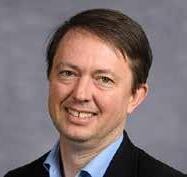
Todd Butler Dean, College of Arts and Letters



3 | Students ‘break bread’ with homeless communities in grant project
5 | Access to Justice scholarship recipients share insights about Indonesia FACULTY
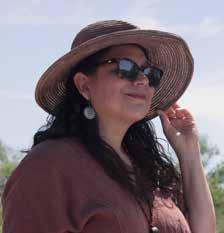
7 | Irene Lara named Alumni of Distinction Award Winner for CAL
9 | Research ignites conversation in religion courses taught by new faculty
11 | Bridging big data science and human connection to improve the health and welfare of the unhoused
ALUMNI
13 | International business alumna is Peloton CMO Megan Imbres
PHILANTHROPY
15 | Emerita professors generous gift bolsters the Korean studies program
CAL IN THE NEWS
17 | CAL faculty, alumni, and students featured in news media

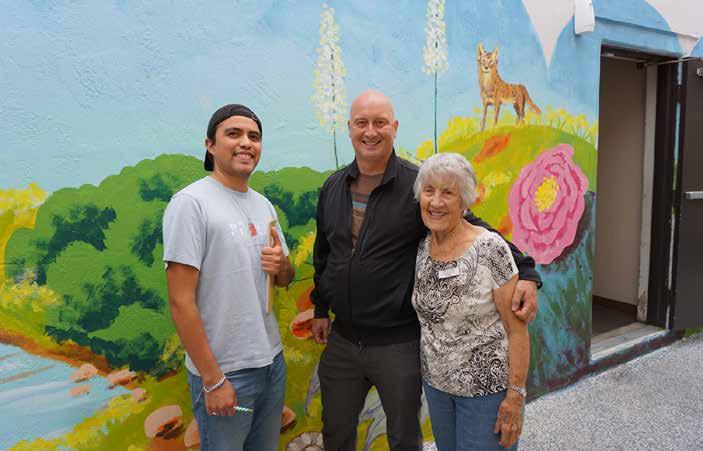
(L to R): Student Jacob Gallardo, Lecturer Adam Pine and volunteer Patty Bender pose on the outdoor patio of the Uptown Community Service Center.
At the Uptown Community Service Center, students gain insights into challenges faced by unhoused individuals while exploring broader public policy reform.
Geography Lecturer Adam Pine’s goal is clear: make an impact in San Diego unhoused communities through service-learning experiences and classroom assignments.
In his San Diego State University “Breaking Bread Project,” students participate in hands-on learning to explore the instability of food access and housing — all with the aim of driving positive and lasting change.
With the College of Arts and Letters
Community Engagement Grant and Weber Honors College course enrichment funds, Pine partnered with the Uptown Community Service Center and affiliated organizations
to help students learn how the unhoused are served and find ways to improve and implement assistance.
The CAL program promotes collaborations addressing needs and issues in local communities, research into new areas, and learning opportunities outside the classroom.
“This grant has allowed me to institutionalize community engagement in my courses, and provided a way to link my research with my teaching in very concrete ways,” said Pine.
His courses, Food, Place and Culture (GEO 342) and The Global Housing Crisis (HON
413), teach students about the intersections between food access and housing.
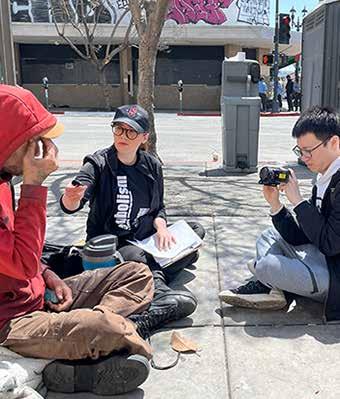
During four barbecues with the Uptown center last spring, Pine’s students cooked, organized clothes for the free clothing store, helped with registration and mail distribution, and made food and hygiene bags for distribution. Students took field notes, asked questions, and later synthesized their experiences into a class paper.
“A key insight from many of the papers was that experiences of homelessness were very individual and unique: some people were living in cars while others were living in shelters, and some people were working while others had health issues that kept them out of the labor force,” Pine said.
Pine and his research partner, Rebecca de Souza, professor and associate director of the SDSU School of Communication, conducted interviews with Uptown staff, volunteers and members. The interviews will be used to document the work of Uptown and guide future decisions of the organization.
“Adam’s work helps bridge quantitative and qualitative research but also puts a face to, and ideally better policy behind, a challenge that in San Diego and elsewhere is too often neglected or stereotyped,” College of Arts and Letters Dean Todd Butler said. “This sort of work matters, and it helps our college live up to its commitments and responsibilities to work for more than just ourselves.”
Experiential learning
Jacob Gallardo, a psychology major, picked Pine’s Housing Crisis course because he was curious about ongoing housing issues in San Diego. “The conversation only goes so far, and I really wanted to understand it.”
With the service portion of the class, Gallardo found connection.“It’s just one of those things where you kind of have an inkling or a small passion for something to begin with, and then when there’s just a great professor and great classmates, and you feel a taste of that work — it actually makes you feel connected to something.
“It’s pretty common for a lot of us to be in jobs, in majors, in workplaces, or with friends, and not really know why we’re doing it,” Gallardo added. “I feel like this class was a stepping stone toward all these things that I’ve been wanting to do.
Gallardo interviewed Patty Bender, 90, a longtime advocate and 15-year volunteer at Uptown who helps others navigate housing challenges. “I am a big believer that there is wisdom that needs to be passed down, and I learned a lot through her,” Gallardo said.
For Gallardo, the purpose of the class and service-learning is all about taking action. “Homeless people are people, and I think that it’s a multilayered, complex thing, but I think that we need to care more. Sometimes that is just looking at your closet and seeing what you really don’t need and giving it to them. ”
Another student, Meleana Love Suarez, a political science major, said, “Uptown to me is more than just a place to give meals, but a place to recognize someone else’s struggles. To say, ‘I see you, I see the struggles you go through, I understand you,’ and even in your struggles, ‘I am here to serve you.’”
While working at Uptown, students bonded about how important it is to understand and learn from these communities. Love Suarez, Gallardo and classmate Hana Adan created HUMANKIND at SDSU to serve this community and engage other students in making a difference in it.
“We believe that change starts at our back door and that creating action stems from just a small group of people trying to spread awareness,” Love Suarez said. “Our club is more than just a club, but a call to action.”
For Love Suarez, the people at Uptown represented someone’s child that needed support. “I love this work not only because it makes me feel whole, but because I understand the pain of feeling like you have no one in life. Kindness can be a chain of reaction that creates sparks of love and understanding,” she said. n
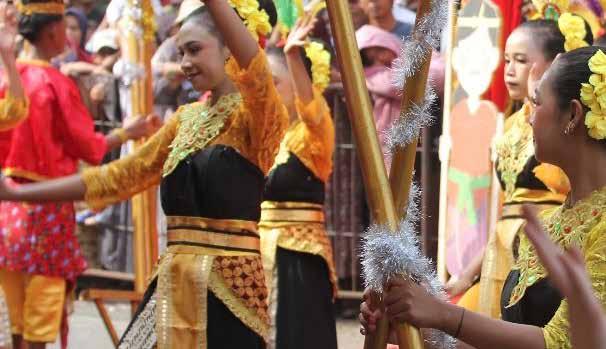
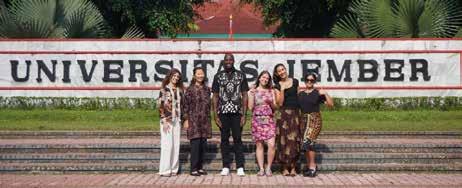
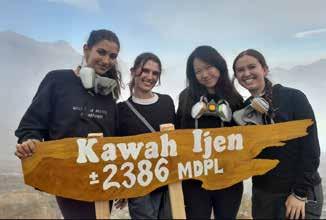
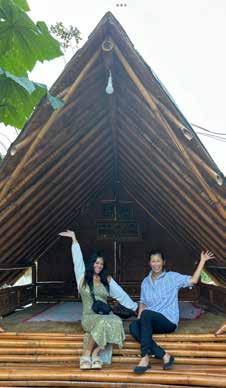
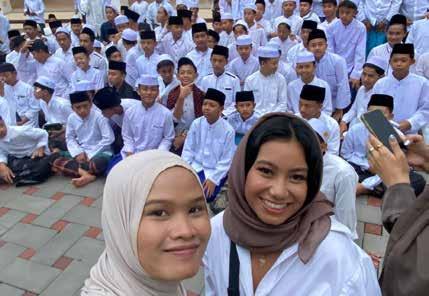
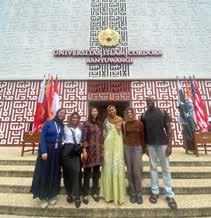
Four students spent four weeks in Indonesia to study human rights issues.
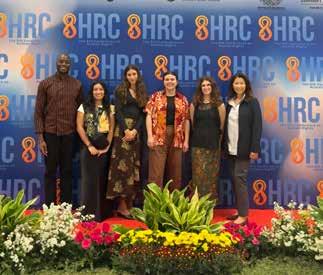
Forfour weeks this past summer four students from San Diego State University had an opportunity to study at the Faculty of Law at the University of Jember (UNEJ) in Indonesia through an SDSU Center for Human Rights scholarship. Students attended daily lectures, engaged in experiential field excursions, and attended a three-day Human Rights Conference organized annually by the UNEJ (and partners), hosted at the University of Airlangga in Surabaya.
The cohort from SDSU included ISCOR and political science students Jasmin Zeis-Khalil, Meleana Love Suarez, Lorena Ford, and Kinen Christopher, along with CAL alumni Skaidra Pulley and Sarah Davisson (fellows with the UNEJ Centre for Human Rights, Multiculturalism and Migration).
Scholars from various disciplines across the country shared research on a wide range of issues like land rights, religious politics, and gender rights and how law plays a role in access to justice. Students gained exposure to challenges that many groups face through field visits to Indigenous communities and
NGOs who support LGBTQ+ and migrant worker rights.
Grace Cheng, director of the SDSU Center for Human Rights, gave lectures on “Indigenous Rights in International Frameworks” and “Extractivism and Environmental Rights” during the course. She also gave a plenary presentation on “Human Rights Challenges in the Political Economy of Extractivism” at the Human Rights Conference.
“Indonesia is the fourth largest country in the world and a critical source of many of the materials used in a wide range of products that we use daily, so the course offers an excellent opportunity to learn about the human rights impact of that economy as well as about other aspects of this fascinating and diverse country,” Cheng said.
At the end of the program at UNEJ, students gave presentations on the human rights issues addressed during the experience.
“I realized from all the ceremonies and religions I visited and saw, that at the end of the day we are all people,” Love Suarez said.
“People who need love, people who need to be told they are enough. That’s why I say this program not only taught me, but showed me how I want to continue that love and spark to one day go back to Asia.”
The next program takes place in August 2026 at UNEJ and includes participation at the 2026 Human Rights Conference. Students in any major are invited to apply — details are forthcoming. Reach out to Grace Cheng at gcheng@sdsu.edu for details. n

WATCH VIDEO FEATURE ABOUT IRENE LARA
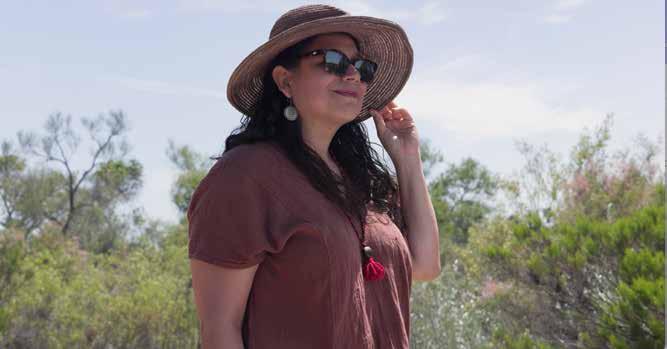
Lara is a Chicana scholar, writer, teacher, femtor (feminist mentor), and spiritual activist who recently celebrated her 20-year anniversary as a professor.
Irene Lara is associate professor in the Department of Women’s, Gender, and Sexuality Studies
San Diego State University President Adela de la Torre opened the 2025-26 academic year by praising SDSU’s leadership in California higher education, highlighting recent accomplishments in research and community engagement, and a promise to pursue the truth and amplify diverse voices in challenging times.
The annual Alumni Distinguished Faculty Awards were presented by William Tong, provost and senior vice president of Academic Affairs, and Brianna Bennett, president of the SDSU Alumni Board of Advisors at the Convocation at the beginning of the fall semester.
“SDSU is an extraordinary university, in large part because of our extraordinary faculty,” Tong said. “Among them are masterful, inspirational teachers; phenomenal researchers; committed and engaged citizens of our university community; passionate leaders of their scholarly disciplines both nationally and internationally; compassionate servants of our SDSU communities and many who actually excel in all of these areas of professional endeavor.” n
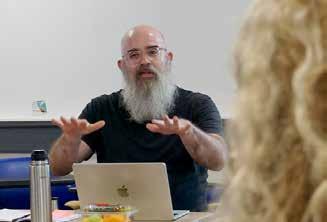
Ishai Mishory, new assistant professor in the Department for the Study of Religion asks students to meditate on Judaism, sustainability and spirituality.
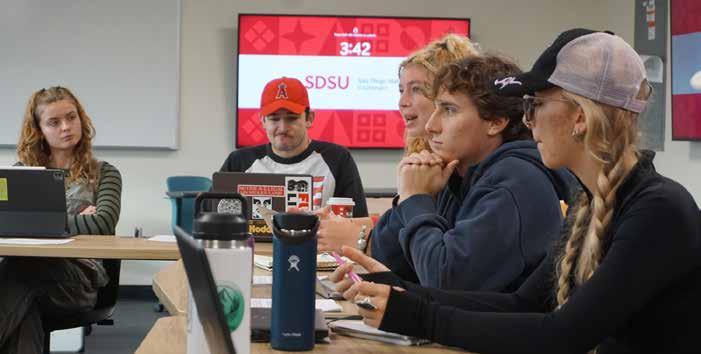
Whenstudents in San Diego State University’s study of religion courses gather in Assistant Professor Ishai Mishory’s classes, they don’t simply discuss religion — they unravel centuriesold treasures linking art, identity, and spirituality.
From the printing presses of Renaissance Italy to the sustainability challenges of the modern world, Mishory’s research sparks lively conversation about what it means to live thoughtfully in
relation to religion, history, and society.
Mishory not only holds a bachelor’s degree in graphic design, but obtained his master of arts, master of philosophy, and doctorate in religious studies at Columbia University in New York — and spent time in Italy on a Fulbright Fellowship. Now, he brings his creative energy and scholarship to the College of Arts and Letters.
Story continued on next page >>

Q: Tell us about your research?
A: I mostly write about two subjects. The first is the problematics, or possibility really, of a Jewish secularity: the way we understand “secularism,” certainly in the United States, is predicated on a Christian separation of “church” and “state,” of something called “religion” and something called “the world,” which doesn’t really exist in Judaism. So why do we read that Jews only “became secular” in the 19th century (by the way, we also read that that’s when they first became “religious”)? Investigating Jewish culture and history – in my case, Renaissance Italy – has helped me ask better questions about this set of problems. The questions animating my research – is Judaism a religion, a culture, or perhaps a shared history? – also feature prominently in the courses I teach on Judaism.
My second passion is book history, and specifically the making of “Jewish books”
broadly defined. The early modern press floor was an exciting meeting place where Jews and non-Jews worked together, trying to make sense of their similarities and differences, and I have written about books that an Italian-born, 16th-century

Jewish printer produced in central Italy and in Constantinople. Mainly known for his religious tomes, I have focused on ‘secular’ books he edited and printed, including a hilarious, beautiful compendium of animal fables (the first-ever illustrated book in Hebrew), Italian-language titles of action-packed chivalric poetry, and a primer on arithmetic. My questions about the different texts,
The idea is that we sit for 75 minutes talking to each other about texts that we’ve read. Whatever activity we do is meant to ignite their discussion.
—Ishai Mishory
about the books’ physical makeup and about their Jewish and non-Jewish readerships combine history, art history, theory and comparative religious studies to better make sense of those questions regarding Jewish religion and identity I mentioned above.
Q: What are fascinating facts you have discovered in your research after visiting more than 40 archives and libraries during your Fulbright Fellowship in Italy?
A: In Italy, I actually discovered some material that hadn’t been analyzed by bibliographers. My new discoveries allowed me to rethink, to reconceptualize, Jewish identity in Renaissance Italy using this new material.
The animating question, as I have mentioned, is on the possibility of an “early modern Jewish secularity.” I happen to believe that much of the history written about Jewish communities in places like Italy in the Renaissance has been influenced by contemporary and modern
historiography in Germany and in the United States.
So where the United States, a later Protestant culture, is very much a culture with a supposed separation of church and state, that is not the case regarding the people that I write about, who lived in the beginning of modernity, at a time when Protestantism was just beginning to take shape really. An anecdote on this related to my research has to do with the fact that when Martin Luther translated the Bible from Hebrew to German, he did so using an edition of the Bible printed by the printer I follow, Gershom (Hieronymus) Soncino.
I write about the time these modern ideas we use today, “religion” versus “irreligion” or “secularism,” were invented. And my somewhat controversial contention is that we should read the lives, the culture, of these early modern Jews in Italy as already “secular.” I reject this separation of a world of belief versus a world of secular politics, because it was irrelevant to these Jewish people, and indeed, to the people surrounding them at that time.
Q: How do you engage students in your two courses: Judaism and Spirituality and Sustainability?
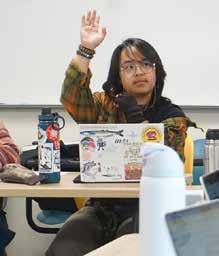
A: In the Judaism (RELS 320) course, I encourage students to talk, watch a movie, discuss in small groups, do a puzzle – any activity to strike up and allow conversation. The idea is that we sit for 75 minutes talking to each
other about texts that we’ve read. Whatever activity we do is meant to ignite their discussion. The question of this course is, what is Judaism? So we spend some time on different propositions: is it a religion, a culture, an ethnicity, or perhaps a shared history?
The Spirituality and Sustainability (RELS 376) course focuses on comparative religion – it asks, how have the great traditions conceptualized humans’ relation to nature? We read texts from and about Islam, Christianity, Judaism, Buddhism, Hinduism, Kumeyaay cosmography and other sources. Since many readings in this course feature an anthropological focus, we investigate writing on the self and on ‘the other’ in a religious context.
Q: Your work blends history, philosophy, and religion. How do you hope students will be inspired to continue their own research on these subjects?
A: The interdisciplinary nature of my research and teaching hopefully means I can meet different students where they are – honestly, what interests me above all else is to get students thinking, reading, to get them excited about participating in discussion of the class text and connect them to their own lives. The idea is not to tell students what the “truth” of any religion or culture is but rather to help them formulate better questions about (in the case of Judaism)
I have found my students at SDSU thus far to be wonderfully curious. “ ”
—Ishai Mishory
Jewish history and identity, or (in a general sense) about their own lives, the environment and the traditions we inherit.
I have found my students at SDSU thus far to be wonderfully curious. They bring very diverse viewpoints to the class, and are eager to discuss and have those viewpoints heard and challenged. And I think that on the whole they’ve found the readings I have presented to be interesting — I hope my classes are a gateway for them to do more rigorous reading. n

Co-PI Gabriela Fernandez interviews an unhoused community member downtown while student Jiachen Wang records the interaction. (Photo courtesy of Xinyu Du)
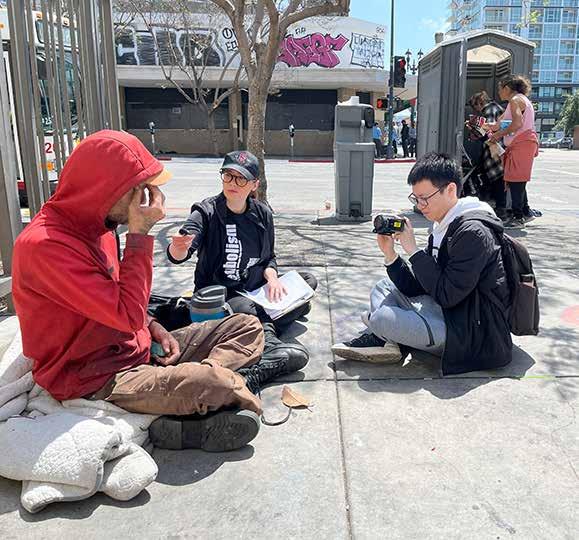
NSF grant guides new research promoting collaborative solutions in the U.S.-Mexico border region.
On the streets of San Diego — under bridges, in encampments, or in shelters — more than 10,000 people are experiencing homelessness as reported in the 2024 Point-in-Time study by the Regional Task Force on Homelessness.
Now, San Diego State University researchers are bringing collaborative solutions to these unhoused communities through the use of big data science, geospatial artificial intelligence (GeoAI), and social science mechanisms with the support of a $450,000 three-year National Science Foundation grant.
Ming-Hsiang Tsou, professor of geography and director of the Center for Human Dynamics in the Mobile Age (HDMA), is the principal investigator (PI) on the project along with a team of co-PIs. Together, they are developing actionable solutions and
collaborations with local agencies to study the dynamic changes of the homeless population in the County of San Diego.
Co-PIs include Atsushi Nara, associate professor of geography; Xiaobai Liu, associate professor of computer science; Audrey Beck, associate professor of sociology; and Gabriela Fernandez, lecturer in geography and graduate advisor for Big Data Analytics (Master of Science Program).
In development is an innovative framework combined with scientific tools that visualize and study dynamic changes in homeless populations through integration of multiple data sources like GeoAI, remote sensing imagery, street views, and GIS databases.
Researchers are analyzing migration patterns, learning about the socioeconomic impacts of homelessness on local neighborhoods, and
building a consortium to promote collaboration among researchers, stakeholders, and the community — all in order to inform policy decisions and interventions that can improve the health and welfare of the homeless population.
Regional workshops and webinars continue through 2027. And, the Nov. 8-15 SDSU Big Data Hackathon, hosted by SDSU and Tsou’s team, included an overarching theme “homeless solutions” — a direct result of the grant project. Students and the public were invited to participate on teams that compete to develop apps, platforms, or other technology that bring new solutions for homelessness to the San Diego community.
“Our long-term goal is to provide this information to government agencies to help them make better decisions,” Tsou said. “We must put empathy and humanity at the center of our research focus when we analyze these data. We need to understand the needs of those people and their stories behind the data we collected, because it’s not just a dataset — they are real persons behind these numbers.”
The San Diego Homeless and Health EquAlity Research Team known as the SDHEART Consortium, developed by the researchers, is a way to connect with regional groups advocating for unhoused individuals. Two SDHEART events in June brought together NGOs, city and county agencies, students, and academic researchers.
“The work is essential. It brings to light the daily struggles many face, like lack of access to housing, healthcare, safety and support,” said Fernandez.
Fernandez trained and supervised undergraduate and graduate student researchers in ethical fieldwork practices, spatial data collection using ArcGIS Survey123, and participant engagement strategies.
Nearly 100 interviews of unhoused individuals have been completed, and 200 more are planned. Students from geography, sociology, public health and urban studies have engaged in research and are continuing to interview the homeless community members alongside the Downtown San Diego Partnership.
“This experience has deepened my understanding of data analysis beyond the classroom and given me the opportunity to contribute to meaningful work that aims to improve outcomes for the unhoused community in San Diego,” said master’s in public health student Olivia Pugsley, who joined the team in late 2024.
When decision-makers, students and residents hear the stories and see the data, it may challenge them to think differently about homelessness — to see it not as a statistic, but a shared responsibility.
“This project is not just about research, it’s about relationships,” Fernandez said. “It’s about transforming the way we engage with the most marginalized members of our society and using every tool we have, from GIS to storytelling, to advocate for dignity and equity. Through storytelling, we are giving a voice to homeless people. We want to share their stories and understand how the city’s resources are being used.”
In order to solve complex issues like homelessness, listening is essential, said Fernandez.
“This project is about listening, learning, and acting together. I’m proud to be part of a team that believes community voices shape community solutions,” said Fernandez. n
The National Science Foundation (NSF) awarded the grant to San Diego State University on September 1, 2024, through its Division of Social and Economic Sciences (SES). This division aims to deepen understanding of human behavior, cooperation, and societal structures to enhance quality of life and economic prosperity. The broader Directorate for Social, Behavioral and Economic Sciences (SBE) supports foundational research on how social, economic, political, and environmental factors interact with human lives. It also funds vital research infrastructure and data collection, driving discoveries that strengthen industries, communities, and U.S. economic leadership.

Peloton
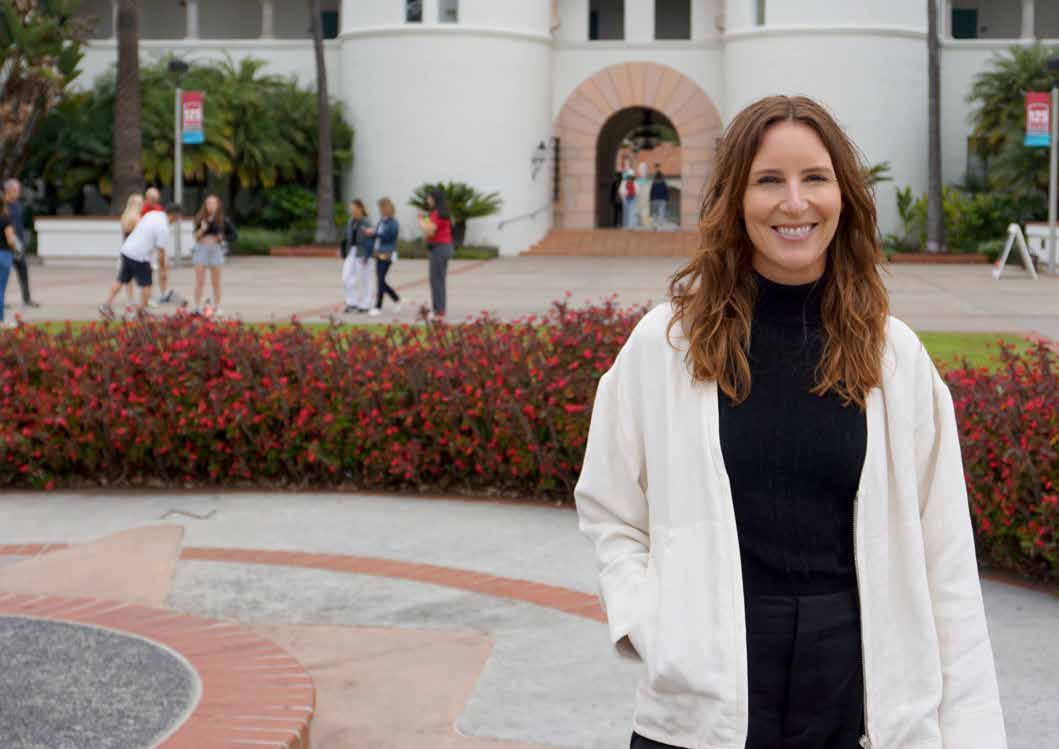
Megan Imbres, finds her creative calling in a global marketplace
International business alumna remained open to opportunity and stepped out of her comfort zone — to build a meaningful career.
Megan Imbres (‘04, international business) is a creative-at-heart. Just watch the Apple Music Super Bowl Halftime Show with Rihanna or Peloton’s latest ad campaign.
Imbres was managing director of Apple Marcom LA for three years and her team helped bring the Apple Music Halftime show to life. On any given day, she worked with creative directors, copywriters, filmmakers, and a superb creative team. Now Imbres is the chief marketing officer for Peloton where she oversees global brand and product marketing.
Despite her original plan to work in corporate finance, it was Imbres’ required study abroad experience at San Diego State University that set the tone for a creative career trajectory.
As an international business major with an emphasis in finance at SDSU, she chose to study abroad in France after taking only one French language course. It was a crucial step in her growth as a student.
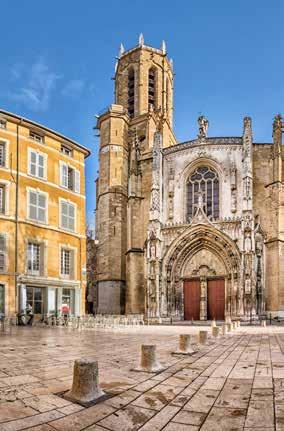
She dreamed of studying in Paris, but found that the academic opportunity was based in Aix-en-Provence. She was concerned that because it was not in Paris it would limit her experience, however, Imbres quickly discovered Aix-en-Provence “is one of the most magical places on earth.” It forced her out of her comfort zone.
After a year of language and cultural immersion, she was presented with an internship opportunity in France to work in marketing. She thought marketing was
“mumbo jumbo” and that it was not “real life.” However, she found out that marketing is actually focused on people, relationships, and connections. “It’s something that I eat up,” Imbres said. “It is the core of who I am.” After the internship, she could never imagine herself in a finance role again.
Career trajectories are not always linear
Her first job out of college was at a small ad agency in New York, where she had an opportunity to learn the account management process. It was a great place to hone her skills and be seen. She was working on pharmaceutical accounts which she calls “uninspiring” for a young 20-something. “I wasn’t going to talk to my friends and family about diabetic peripheral neuropathy drugs,” she said.
Agency work (despite being in the pharmaceutical sector) helped her move to other companies that were more interesting, like Netflix, where she had a role in launching the first season of “House of Cards.” During those formative years, she enjoyed exciting and challenging work full of growth opportunities. Knowledge acquired during her studies in international business at SDSU helped her gain valuable insights on how to market to a wide variety of international audiences. She managed marketing teams in Singapore, Japan, the UK, Amsterdam, and Brazil.
As a marketing executive at Apple for the past three years, Imbres found the focus on craft to be exhilarating. She calls herself a galvanizing leader who loves a good challenge. In any given business role, she always seeks core alignment with the business vision. At Peloton, she’s found a home. With the support of her team at Peloton, she finished the 2025 Ironman World Championships in Kona (official time 11:48:42) while balancing the role of motherhood and new CMO.
Advice for students: ride the wave and find your superpowers
In 2023 she joined the SDSU international business advisory board, where she gives back to students of her alma mater. In the future, she hopes to create a scholarship for students so that they can explore a life-changing study
abroad experience like hers.
You won’t find Imbres reading business books, instead she is reading books like “Unreasonable Hospitality” or “Careless People” to gain insights on business. In “Unreasonable Hospitality,” Imbres likes the storyline about one of the world’s best restaurants — it captured her attention because she is, after all, a foodie. But, it also features serious themes that can translate to business. “It is an example of how you can overdeliver, and push, push, push in a way that isn’t alienating,” Imbres said. “You can be the best in the world and have mutual respect. It is really critical for a leader to understand.”
Despite her original plan to work in corporate finance, it was Imbres’ required study abroad experience at San Diego State University that set the tone for a creative career trajectory.
When she thinks about her career journey, Imbres sees the wave as a metaphor. “You have to learn how to ride it, and to not swim against the current,” Imbres said. About the waves, “some will be great, and some not so great.” Her advice to students is “to be open to different opportunities — determine your unique skills set and find your superpowers.”
Being open to opportunity is a theme running throughout Imbres’ life. She appreciates the fact that even with her IB degree and finance emphasis she was able to tap into her creative side and find a rewarding career with engaging businesses focused on craft and creativity. “That’s in my soul, it is what I identify with.” n

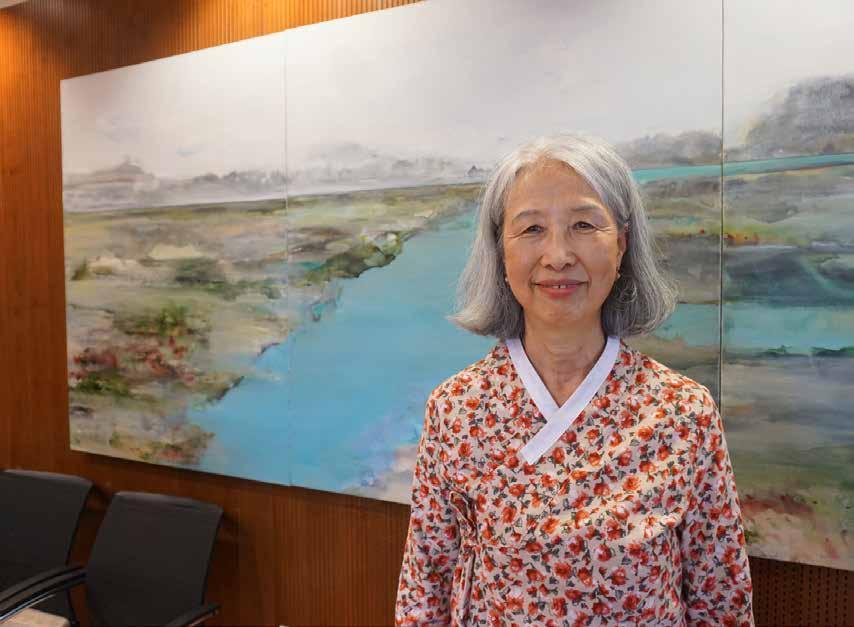
The longtime linguistics professor seals her legacy and ensures the continuance of the popular program with an endowment and scholarships
When she arrived at San Diego State University from the East Coast in 1987, Soonja Choi was one of only four Korean professors across the entire campus.
She remembers feeling lucky to teach on a campus in a city full of sunshine, beautiful trees and a temperate climate. “The sky was blue, the palm trees were there and SDSU really embraced me from the very beginning.” She was hired to teach language acquisition and the psychology of language. “I was an immigrant, and I was happy that I had a place that welcomed me as a professor, as a profession, as a professional.”
As she settled in she noticed that the College of Arts and Letters only offered Japanese and Chinese language programs. She wondered, “Is there a Korean program?” Choi often thought that she should find a way to promote or start a Korean language program. “As a Korean, I felt like I had a mission.”
“I’d like our Korean Studies program to be not only the San Diego community’s pride, but also nationwide.” — Soonja Choi
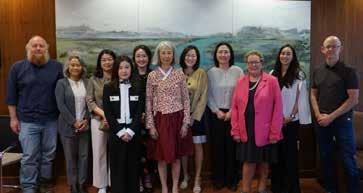
With CAL Dean Paul Wong, she found a supporter. He amassed grant funding to help build the program and with only a few months before the semester start in 2008, she gathered faculty and assembled a program. The first Korean 101 class was filled with about 30 students.
Studying a language like Korean, “not only fulfills a language requirement, but it enriches you, your philosophy, your point of view,” she said. Through the study of language, students learn cultures and respect. “What we need, as a country, is to learn about other people to understand the whole world,” Choi added.
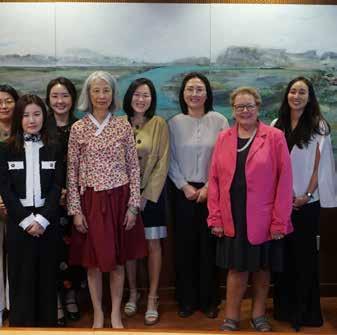
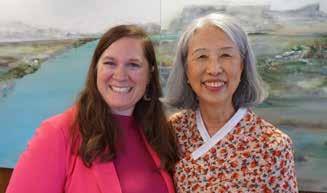
Now, 38 years later, Choi is giving back to the program she established with the Soonja Choi Director of Korean Language Studies Endowment and the Soonja Choi Korean Language Scholarship. Both will strengthen new initiatives, scholarships, and leadership. She hopes with her support, the program will expand with a directorship and appear on a “bigger platform.”
“I’d like our Korean Studies program to be not only the San Diego community’s pride, but also nationwide,” Choi said. n



Highlights of faculty and alumni
Anthropology // Professor Erin Riley was interviewed for the news story, “Western lowland gorilla breaks glass panel at San Diego Zoo.” CBS8
English and Comparative Literature // Y Howard received an Andy Warhol Foundation Arts Writers Grant for “Erratic Erotics: Analog - Sexualities - Mortalities.” Book awardees receive $50,000 in support of their work. Arts Writers, More on the 31 grant recipients: Hyper Allergic
Economics // Alumnus Chris Lynch was featured in an alumni news story and video. SDSU Alumni
Geography // Professor Trent Biggs, Sagar Parjuli, Fernando de Sales, Haley Ciborowski are co-PIs on a study cited in an AP article: “In a California farming region, researchers are mapping rural heat to protect farmworkers.” AP News
History // Professor Pierre Asselin was featured in a long-form interview about his research on Vietnam. Talk Vietnam
ISCOR // Uechi ISCOR Lecture with Sherri Goodman. Watch the entire lecture here.
Center for Skateboarding, Action Sports, and Social Change // Professor Neftalie Williams was interviewed in feature stories about The Stoke Sessions 2.0 conference. NBC7 | KPBS Midday Edition
Political Science // Professor Mikhail Alexseev appeared in a live interview on Deutsche Welle German World Service TV in a discussion about talks to end Russia’s war against Ukraine. Deutsche Welle
Political Science // Alumnus John Fiske and his family, along with two postdoctoral research scholars from CAL — Brooke Rose and Clarissa Rodriguez are featured in the award-winning documentary film, “The Most Biodiverse Place in America.” The film premiered at SDSU to a sold-out crowd in November at the Conrad Prebys Aztec Student Union Theatre.
Also, the April 2025 Fiske Legal Series event with guest speaker California Attorney General Rob Bonta can be seen its entirety, here.