A2
SDSUCollegian.com
INFO
October 7, 2026
ONLINE ONLY
MORE AT SDSUCOLLEGIAN.COM Here’s a look at stories that we’ve published online only.
ON DEMAND
THE COLLEGIAN REPORT On last week’s Collegian Report, we show the finalists for SDSU’s Vice President of Research and Economic Development, McCrory Gardens threw one last party before summer ended, and we highlight a new exhibit at the SD Art Museum.
NEW DIVISIVE SATIRE ‘DIGGER’ RATED 4/4
“Digger” is a film that on the surface seems to be focused on the issue of climate change, and while it definitely is, it also asks the audience what value the role art offers during crisis.
COMING THIS WEEK
To read the full review, visit SDSUCollegian.com
COLLEGIAN COOKS Ryann Davis and Willem Lim try a recipe for ramen noodles in the newest segment of Collegian Cooks.
ON DEMAND
SPOT OF THE FOUL Cordell Vitense and Nathan Thompson go over SDSU volleyball, soccer and football. Along with multiple college football, NFL and MLB games. Willem Lim also joins the episode to discuss UFC 331.
DEALING WITH MIDTERM STRESS
As the school year progresses, schedules get busier for students trying to balance classes, exams, work, social life, and everyday responsibilities. For some tips, look for this story later this week.
SMALL GROUP MINISTRY
Oasis, a college and young adult ministry at GracePoint Church in Brookings, offers small group mettings from Monday through Thursday. For some tips, look for this story later this week.
October 7, 2026
SDSUCollegian.com
OPINION
A3
REMEMBERING OUR ROOTS: Collegian Media and other news outlets serve a vital purpose in communities
RYANN DAVIS Editor-in-Chief
The Collegian existed prior to SDSU becoming a university. Our newspaper was established in 1885 when the school was called “Dakota Agricultural College,” and to me that says a lot about the importance of local journalism. Oct. 4 - 10 marks the 86th celebration of National Newspaper Week. This year’s theme is “rooted in community, committed to truth.” I think this theme speaks especially to our newspaper. The Collegian has increasingly become a voice for not only SDSU and its students, but a news source for the Brookings community at-large. A common phrase we think about when deciding what stories to cover is “by students, for students.” Fulfilling that phrase means covering stories beyond SDSU. Students RYANN DAVIS deserve to stay informed on the things happening in their town, not just their campus. It’s not a secret that less and less people are reading physical newspapers, especially our generation of students. A fact sheet from the Pew Research Center said newspapers’ financial fortunes and subscriber bases have been on the decline since the mid 2000’s. While that is true, I would argue our student media organization is the strongest it’s ever been. Beyond the newspaper, Collegian Media consists of The Collegian Report, Collegian Radio on KSDJ 90.7, our newsletter called The Jump and online at sdsucollegian.com. This week is a chance to honor how journalism got its start, and to remember that while we might not read physical papers often, everyone consumes the news in some way. Ultimately, the importance of local journalism hasn’t changed. Throughout last academic year and some of this year, our student media team covered more than just the routine stories like Students’ Association meetings.
Last fall the former University Police Department chief was arrested and fired, a racist video surfaced and the former equestrian coach was indicted on grand theft. Those charges on the equestrian coach were later dropped and now the coach is suing SDSU and the South Dakota Board of Regents. These are stories that don’t always reflect well on our university but we’re responsible for telling the truth about them, and we worked hard to do that. We also got to tell the truth about the Brookings Marketplace’s progression, the SDSU Metro Center’s
construction and grand opening and the Jackrabbit women’s basketball team’s Summit League championship win last season. To say I’m proud of the work my predecessors did would be an understatement. Emily DeCock and Brayden Byers, who I am so very grateful for, have set an example for Collegian Media that motivates me to become a better storyteller every day. There’s never been a better time to ensure student media has the space they need to continue quality, trustworthy storytelling.
COLLEGIAN NEWSPAPER ARCHIVES Above is a scan of The Collegian issue from the 100th anniversary of our newspaper in 1985.
A4
SDSUCollegian.com
NEWS
October 7, 2026
STUDENTS’ ASSOCIATION
Student speaks out against interim fleet vehicle policy
SARA SCHOENFELDER / COLLEGIAN MEDIA Ian Brueggeman addresses the SA at Monday night’s meeting in the upper level of the Student Union on Oct. 5.
SARA SCHOENFELDER Assistant News Director During the open forum at Monday night’s Students’ Association (SA) meeting, the Bethel Student Organization had its constitution approved. Collin Nickels from the Mike Huether Public Service Academy addressed the SA about trees being ripped out in downtown Brookings. There is a sapling planting event in partnership with the Sustainability and Geography club on Sunday, Oct. 18 at one p.m. at the Brookings Nursery. The saplings will then be planted around the city to make up for the lost trees. Ian Brueggeman, the president of the robotics club, addressed the senate on the changing motor pool policy. The motor pool policy currently states that school-sponsored events are the only events the motor pool can be used for. Brueggeman said that the robotics club travels to multiple competitions across the United States that formerly they were able to use the motor pool for. “It’s going to be difficult for us to travel to any of our competitions,” Brueggeman said, because none of the competitions are sponsored by the school.
UNFINISHED BUSINESS There were several legislation pieces that were discussed at Monday’s meeting. An amendment to the finance committee bylaws that was proposed was discussed by senators for an hour. After two additional amendments were passed, the Senate agreed to table it until their next meeting. A resolution was passed to request that the South Dakota Board of Regents revise the interim fleet vehicle policy regarding students’ ability to drive and utilize university motor vehicles. The Official Budgeting Policy for this year was passed. This lists the priorities and guidelines that the Finance Committee will use while allocating funds. The International Dance Committee had a new venture request for $600 that was approved and added the committee to the funding budget. The International Relations Council had a special allocation request for $15000 to host International Night. The finance committee recommended $3500 for the event, which was passed. This funding came from the allocation budget. A new ordinance regarding an optional prayer or invocation was introduced and will be voted on at the next meeting on Oct. 19.
COURTESY SOUTH DAKOTA STUDENT FEDERATION A resolution was passed to request that the South Dakota Board of Regents revise the interim fleet vehicle policy regarding students’ ability to drive and utilize unviersity motor vehicles.
October 7, 2026
SDSUCollegian.com
NEWS
A5
Keeping the conversation alive Students’ Association to read land acknowledgement prior to every meeting
meaning of why we’re doing this rather than just how it was written,” Spier said. “Future assemblies will have to continue this unless they want to change it,” Hall said. He explained that if future Students’ Associations want to modify the acknowledgment, they will have to read it first. “Knowing that it’ll simply exist beyond my time is important,” Spier said. She went on to say that future Students’ Associations will likely not remember her, but they will continue to state the land acknowledgment. “The intent behind it is to recognize and be acknowledgeable of the history and some of [those] tough conversations, yet we still stand together united today at the table,” Spier said.
SARA SCHOENFELDER Assistant News Director On September 21, the Students’ Association (SA) passed a formal land acknowledgment with Ordinance 261-O. A land acknowledgment is a statement that recognizes the Indigenous people who originally inhabited the land. In this ordinance, the Students’ Association enacts the use of a formal land acknowledgment on all SA agendas. This ordinance was sponsored by Sophie Spier, SA President, Megan Christoffels, SA Vice President, Brenda Khatthanam, SA Diversity Liaison and Michael Hall, American Indian Student Association Vice President (AISA) “A good land acknowledgment is specific about who you’re acknowledging,” AISA President Bryant Bigeagle said. The land acknowledgment passed by the SA states that “prior to South Dakota State University’s founding in 1881, the land the university now rests on belonged to the Očhéthi Šakówiŋ (oh-CHEH-tee shaw-KOH-we), meaning the Seven Council Fire;” “It starts from just acknowledging and accepting, like this land was indigenous, this belonged to people before it was South Dakota State University,” Hall said. “It’s just important to recognize that the lands that schools and different universities use were not obtained in a very ethical way,” Bigeagle said. “You gotta remember that colonization is still an ongoing thing,” Bigeagle explained. On September 30, AISA had their Every Child Matters event, which raises awareness to the challenges faced by Indigenous children.
SARA SCHOENFELDER / COLLEGIAN MEDIA A tree outside Crothers Engineering Hall on Oct. 6, 2026. This land, as well as all of the land SDSU was founded on, belonged to the Indigenous tribe Očhéthi Šakówiŋ.
According to Bigeagle, residential and boarding schools were still being federally funded in North America until the late 1990’s. He emphasizes that colonization is not “way back in the past” and is still prevalent today. Bigeagle added that the land acknowledgment “is very much a conversation starter.”
Spier said she worked closely with Hall to take the university’s approved land acknowledgment and worked simultaneously to ensure the wording was precise. Hall said that they wanted to look at the wording of how the university’s land acknowledgment was written. “We wanted it to resemble the true
“It’s just important to recognize that the lands that schools and different universities use were not obtained in a very ethical way.” Bryant Bigeagle President of the American Indian Student Association
A6
SDSUCollegian.com
NEWS
October 7, 2026
FARM BILL ADVANCES
COLLEGIAN MEDIA PHOTO
This photo is from last fall’s harvest season at the Davis family farm east of Brookings in Elkton on Oct 15, 2025.
‘Food security is national security’ BOBBI EIDE Multimedia Ag Reporter The Senate Agriculture Committee’s advancement of a new farm bill could give more certainty for South Dakota farmers, ranchers and rural communities after years of operating under an outdated law. The committee approved the legislation Sept. 16 in a 12-11 vote, marking the bill’s farthest progress since Congress last approved a farm bill in 2018. The legislation still must clear the full Senate before lawmakers can arrange differences with the House version. The current farm bill was brought in 2018 and has been extended several
times as lawmakers have worked to develop updated legislation. Agricultural groups say a new bill is needed to address changing economic circumstances and provide producers and rural communities with greater certainty. If the full Senate approves the legislation, lawmakers would have to confirm differences between the House and Senate versions before sending a final version to the president. The farm bill is one of the most significant pieces of federal legislation affecting agriculture. Typically renewed every five years, it charges funding for programs ranging from crop insurance and conservation to agricultural research, nutrition assistance and rural
development. Because agriculture is a major part of South Dakota’s economy, the bill’s influence increases beyond individual farms and ranches. For Joseph Cassady, dean of the College of Agriculture, Food and Environmental Sciences, the committee’s vote marks long-awaited progress. “I’m excited that it passed. It’s very encouraging, but there is still work to be done,” Cassady said. Cassady said the legislation could grow conservation programs that help producers improve environmental control while maintaining productive operations. Programs such as the Environmental Quality Incentives Program
(EQIP) and the Conservation Reserve Program (CRP) give resources to help farmers and ranchers protect natural resources and maintain productive land. The bill also would support rural communities through investments in broadband access, health care and child care services, problems that continue to challenge communities across the state. While farm programs often receive the most public attention, Cassady said many people misunderstand the legislation’s broader purpose. “A common misconception is that the vast majority of the Farm Bill funding goes to farmers, and that’s not
October 7, 2026
SDSUCollegian.com
entirely true,” Cassady said. “The Farm Bill is about is ensuring food security for the entire population of the United States.” Agricultural groups across South Dakota welcomed the bill’s recent advancement but emphasized that the work is far from over. Scott VanderWal, president of the South Dakota Farm Bureau, said he was pleased to see movement on a bill that producers have been waiting years for. The Farm Bureau supports the legislation but would still like to see additional changes made as it moves forward. Crop insurance remains a key provision for producers because it helps farmers manage risks beyond their control, including weather conditions and market instability, VanderWal said. “When you talk to producers, the most important thing about the Farm Bill really is the crop insurance program,” VanderWal said. He said updating the farm bill could give producers and agricultural lenders greater certainty when making longterm financial decisions. “The purpose of the Farm Bill is to make sure that we protect the financial viability of the American ag industry,” VanderWal said. “Food security is national security.” The South Dakota Farmers Unions (SDFU) also welcomed the legislation’s advancement. SDFU Executive Director Karla Hofhenke said the Senate proposal includes several priorities important to family farmers and ranchers. “I was really happy to hear it passed because several of the priorities we’ve been advocating for on behalf of family farmers and ranchers are included in the bill,” Hofhenke said. Those priorities include year-round E15 sales and mandatory country-of-origin labeling initiatives. Hofhenke said enlarged E15 access could create additional demand for corn, while country-of-origin labeling could give consumers more information about where their food comes from. She also highlighted provisions intended to address rising input costs, including seed, diesel, and fertilizer, which continue to challenge producers across South Dakota.
Despite differences in policy priorities, agricultural leaders agree that the bill’s effects reach beyond individual farms and ranches. “Rural communities depend on family farmers and ranchers,” Hofhenke said. “They’re what keep those communities thriving, so anything that helps agriculture ultimately helps rural South Dakota.” Beyond its immediate effects on producers, the legislation could influence agricultural research, education and workforce development. Cassady said that as South Dakota’s land-grant university, SDSU benefits from farm bill programs that support agricultural research, Extension programming and training opportunities for future agricultural professionals.. Those investments help universities and producers develop solutions to emerging challenges while preparing the next generation of agricultural leaders, Cassady said. “The Farm Bill shapes policy, which influences the future direction of production agriculture,” Cassady said. “It can affect what crops are grown, how land is used and the opportunities available to producers.” Despite the momentum generated by the committee vote, agricultural leaders caution that significant hurdles remain. The legislation must still pass the Senate before lawmakers can negotiate a compromise with the House version. “There’s still a lot of work left to do,” Hofhenke said. “Getting it through committee was important, but there are several more steps before this becomes a law.” VanderWal said he hopes lawmakers can move the legislation forward without letting politics stall progress. “The Farm Bill should not be a partisan issue because it affects everyone who eats food, puts fuel in their vehicle or wears clothing,” Hofhenke said. “When it gets caught up in politics and delayed, that’s very discouraging.” If approved by the Senate, lawmakers from the House and Senate Agriculture committees would negotiate a final version of the legislation before sending it to Congress for consideration.
NEWS
A7
A8
SDSUCollegian.com
NEWS
October 7, 2026
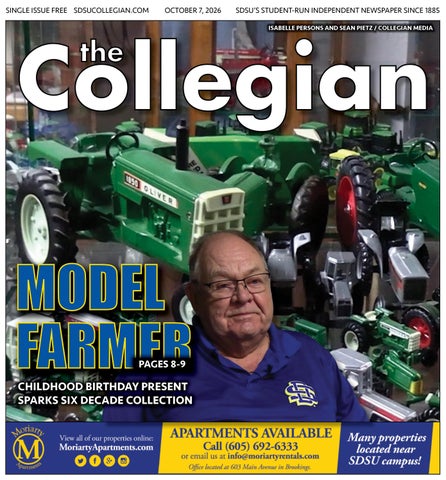
Toy tractors, bale makers, and other equipment on display at Clark Hanson’s house in Brookings, South Dakota. He has built his collection for almost six decades.
LEGACY ON THE MOVE
SD Tractor Museum to display local collection of 1,200 BOBBI EIDE Multimedia Ag Reporter What began as an 8-year-old’s birthday present has grown into a distinctive display of agricultural history. Clark Hanson, a longtime Brookings resident and former SDSU supervisor of agriculture education, has spent nearly six decades building a collection of more than 1,200 toy tractors, each one tied to a memory, a lesson, or a moment in the evolution of farm machinery.
Soon, Hanson will be displaying his collection at the South Dakota Tractor Museum in Kimball, with plans to have it on display by early 2027. “This collection helps us tell the story of agriculture in a way visitors of all ages can enjoy,” museum official Maynard Konechne said. “It will help preserve agricultural history and educate future generations about farming’s evolution.” Hanson said he’s glad the collection will be somewhere the public can enjoy it.
“It’s a little bittersweet after spending so many years building it, but I’m happy it will give younger generations a chance to connect with agricultural history,” he said. Hanson’s passion began with a single toy tractor, an Allis-Chalmers model he received in 1948. The gift came with a comment from his father that stayed with him for life. “My dad said he wanted toy farm machinery for his future grandkids to play with,” Hanson said. That simple idea sparked a fascina-
tion that would eventually help shape his career, family traditions and home. By fourth grade, Hanson was already drawn to miniature farm equipment. In 1967, while preparing for graduate school at Iowa State, he began collecting seriously and it turned into a lifelong pursuit. “I wanted to collect this part of agriculture’s history because at the time no one else was,” Hanson explained. As the toy tractor industry expanded in the 1970s and 1980s, Hanson’s collection grew with the trend. He searched
October 7, 2026
SDSUCollegian.com
for models with precise detail, preferring authentic 1/64 scale replicas over generic toys. Over the years, he collected tractors representing major agricultural brands including John Deere, International Harvester, Ford, Massey Ferguson, Allis-Chalmers and several others, creating a diverse and historically rich lineup. Many tractors were bought at auctions or garage sales, but a surprising number were gifts. Family, friends, colleagues and former students often added to his shelves, knowing how much the hobby meant to him. Hanson has never kept an inventory list. Instead, he memorized every model and, for the most part, recognized whether he already owned a particular tractor. His collection eventually filled his home wall to wall, transforming it into a sort of personal museum. Students in his agricultural education courses often visited, walking through rows of miniature machinery that reflected decades of farming history. Former student and current Webster agricultural instructor Fred Zenk said Hanson’s extensive knowledge of agriculture and machinery made him easy to relate to. “He knew the equipment we grew up with at home, and even sometimes how they were made,” Zenk said, noting how the tractors helped bridge classroom lessons with students’ real experiences. Hanson’s wife, Lyla, was part of the journey from early on. The couple traveled to auctions together, often searching for rare but affordable models. Lyla encouraged her husband to expand the International Harvester portion of the collection, a brand she grew up playing with. Their children and extended family joined in too, adding pieces and sharing in the excitement of each new find. For Lyla, the collection became as much a family tradition as a hobby. She said she is grateful the tractors will be displayed publicly, allowing others to appreciate the collection just as her family has. The toy tractors vary widely in size and style. The smallest is a red English utility tractor less than half an inch long. The largest is a 1/8 scale John Deere B. But Hanson’s favorite
NEWS
remains the one that started it all, the Allis-Chalmers. Though he has never estimated the collection’s value, he acknowledges that several pieces are rare and potentially worth significant amounts. As Hanson prepares to move the entire collection to the South Dakota Tractor Museum, he sees the transition as an opportunity to share his passion with a wider audience. He hopes the exhibit will inspire visitors, especially young agriculturalists, and that local FFA members will help maintain and present the display. Lon Moeller, who worked with Hanson at SDSU, said Hanson’s tractors were more than collectibles. They were teaching tools. The models helped students connect classroom concepts to real agricultural history, making Hanson’s lessons memorable and meaningful. For Hanson, sharing the collection honors the past while encouraging future generations. He spent years presenting his tractors at events, inviting SDSU students to tour his home and using the models to spark conversations about agricultural heritage. Before the collection moves, he hopes SDSU President Barry Dunn will visit for one last chance to see the display where it grew. What began as a simple gift of a toy for a child’s birthday has become a legacy built through passion, persistence and a deep love for agricultural history.
SD TRACTOR MUSEUM TOY TRACTOR EXHIBIT Museum Address
117 Cemetery Road, Kimball
Total Tractors 1,200
Brands Featured
John Deere, International Harvester, Ford, Massey Ferguson, Allis-Chalmers, others
Expected Arrival Early 2027
A9
COLLEGIAN MEDIA PHOTOS BY BELLE PERSONS AND SEAN PIETZ Tractor signs and memorabilia line the walls of local collector and former SDSU faculty member Clark Hanson’s house. His collection of more than 1,200 will move to the SD Tractor Museum in Kimball, South Dakota in early 2027.
A10
SDSUCollegian.com
SPORTS
October 7, 2026
Missing the Marker
How the absence of the Dakota Marker affects SDSU trophy is with the Bison has left a bad feeling with former SDSU head coach John Stigelmeier “It leaves a bitter taste in my mouth,” Stigelmeier said. “It’s kind of like it was our joint trophy and now it’s housed up there.” Stigelmeier served as head coach from 1997 to 2022. He has witnessed a lot of history with NDSU and said he has nothing but respect for the organization as a whole. “The importance of football and what they have done up there is unbelievable,” said Stiegelmeier, who himself had built quite the reputation against NDSU. In his last game as head coach, he dethroned the Bison and ended their perfect record of 9-0 in the FCS National Championship Game, leading the Jackrabbits to their first championship. “The rivalry is major,” Stiegelmeier said. “Everybody’s investment is in it: fans, writers, players, and coaches are all invested.”
MALACHI WEBER Multimedia Sports Reporter North Dakota State University’s move to the FBS earlier this year ended one of the most anticipated games on the Jackrabbit football schedule: the annual battle for the Dakota Marker. NDSU paid about $17.5 million to move from the FCS to the FBS and the Mountain West Conference, according to reports. This move came after years of success at the lower level, including 10 national championships and a record of 181-35 from 2004 to 2025. From an SDSU player standpoint, this move didn’t sit quite right. Senior tackle Quinten Christiansen grew up watching the Dakota Marker games and all four years in a Jackrabbit jersey included that game. Until this year. “When it happened, it was just a bummer, because that’s the game I look forward to,” Christiansen said of the Bison’s move up. It was the game of the year for Christiansen because it was a level of competition that other schools just couldn’t fill. With that intense competition also came a lot of admiration. While the games may have had some trash talk and a lot of aggression, there was also a level of respect that the players on both sides had for each other. Christiansen referred to it not as hatred but simply a rivalry. Meanwhile, games with USD can be much more bitter. The Bison have continued to succeed after the move to the Mountain West. They currently sit at the top of their conference with a 2-0 mark after beating Air Force and Wyoming. “To succeed at the FBS level is really a testament to the coaching and group of guys that NDSU has,” Christiansen said. “You’re not going to find tougher, more high-effort guys than you will in North Dakota and South Dakota.”
SDSU ATHLETICS Jack the Jackrabbit stands with the Dakota Marker in 2023. The Jacks are 17-46 against the Bison with the team’s last victory in 2023.
The Dakota-Marker rivalry started in 2004 after both teams became FCS contenders. The trophy was created as the game’s award, with the winner getting to keep the trophy on its campus until the next year. The trophy is a replica of the pink-and-red quartzite border monuments placed by surveyors in 1891 and 1892 along the Seventh Standard Parallel to mark the
boundary between North Dakota and South Dakota. It weighs in at almost 80 pounds. The trophy was a symbol of hard work for the players, and it was something every person on each team wanted to bring home. The trophy is currently in Fargo, where it will ultimately stay unless the teams face off again. The fact that the
October 7, 2026
SDSUCollegian.com
SPORTS
A11
JACKS PUSH TO 1-0-2 SDSU gets second draw in conference over weekend
their three games after a 1-1 draw, a 1-0 win and a 1-0 loss. Fifth-year midfielder Olivia Platt leads the way for the Roos with five of the team’s 15 points. Platt leads the team with two goals, one of which came in conference play. Senior Kaitlyn Edwards leads the team with two assists, both of which came in conference play. The Jacks have a 9-2-2 record historically against the Roos and a perfect 6-0 record at home when facing Kansas City. The last loss to the Roos came in 2017, but two of the last three matchups have ended in draws.
CORDELL VITENSE Sports Director The Jacks took their second tie in conference play on Saturday, Oct. 3, in Fargo. The Jacks couldn’t get their offense going against the Bison in a 0-0 tie. Even with a 0-0 tie, both teams got plenty of shots, with SDSU recording 13 and NDSU recording 12. Six of the 13 shots for the Jacks were on goal, all saved by Bison goalkeeper Payton Mulberry. For NDSU, three of their shots were on goal, with Mallorie Benhart saving all three. The Jacks are now 1-0-2 in conference play and 6-2-3 overall. “To NDSU’s credit, they were very good defensively to limit quality attacking opportunities for us,” Head Coach Brock Thompson said. “They got a lot of numbers behind the ball and they created some really dangerous moments too.”
UP NEXT
After the Jackrabbits’ two-game homestand, they hit the road to face St. Thomas on Thursday, Oct. 15.
ORAL ROBERTS
SDSU’s next test is at home against Oral Roberts on Thursday, Oct. 8 at six p.m. The Golden Eagles have got off to a good start in conference play, starting with a 1-1 draw against Kansas City and then shutting out Omaha and St. Thomas in 3-0 and 2-0 wins, respectively. Fifth-year senior Brianna Castleberry is the Golden Eagles’ headliner, as she has 25 points on the year, doubling second place. Castleberry has 11 goals this season, eight more than anyone else, while also having three assists. Conference play is where Castleberry has really shined. Scoring eight points in three games on three goals and two assists. Senior Cameron Silva is second on the team with 12 points, with eight
OWEN BOYD / COLLEGIAN MEDIA Senior midfielder Hannah Langstaff fights with UND freshman Rylee Lawrence for a ball on Sunday, Sept. 27 at Fishback Soccer Park in Brookings. The Jacks ended the game with a 2-1 win over the Fighting Hawks.
assists, which leads the team and two goals, which is tied for third on the team. Historically, SDSU has had no problem with ORU, with a 19-1-3 record. In the last 16 matchups, SDSU has zero losses and a record of 13-0-3.
KANSAS CITY
SDSU will get to stay home when Kansas City comes to town on Sunday, Oct. 11. Kansas City’s conference play has been full of ones. They are 1-1-1 in
A12
SDSUCollegian.com
SPORTS
October 7, 2026
Jackrabbits second at Briar Cliff Men and women fall to Creighton in Nebraska
NATHAN THOMPSON Assistant Sports Director As the city of Brookings was momentarily overtaken by runners on Oct. third for the Brookings Marathon, 11 of SDSU’s runners travelled to South Sioux City, Nebraska to compete in the Briar Cliff XC Invite.
The Context:
SDSU cancelled Oct. second’s “SDSU Classic,” due to course conditions caused by the rain that hit Brookings over the past week. For the second time, the team found a makeup meet to keep in competitive shape. “Our student athletes have maintained a great attitude despite the schedule changes, and they are looking forward to getting after it on Saturday,” said Head Coach Rod DeHaven.
Men’s Race
And get after it they did. The Jackrabbit’s 48 points were second only to Creighton’s 36. The five man team was composed of three freshmen, a sophomore, and a junior. The three freshmen; Tate Grabow, Caleb Morris and Griffin Smith led the team, getting fourth, fifth and sixth overall. Grabow ran 26:04, Morris 26:09 and Smith recorded a new personal best, beating his previous time by 25 seconds as he ran 26:14. The sophomore, Keaton Olson, was fourth on the team, and eighth in the race, as he ran 26:29. Behind Olson in 27th was Junior Will Harder. Harder rounded out the Jackrabbit’s squad with a time of 27:39. The Jacks ran well, with a formidable team spread of 1:35. However, Creighton’s sweeping of the top three spots proved to be too much of a lead for the Rabbits to overcome.
Women’s Race
The Jackrabbits scored 71, falling second yet again to the Bluejays, who scored 47. Their six woman roster was composed of two freshmen, two sophomores, a junior and a senior. The team was led by freshman Ellie Robinson, who ran 23:28, putting her in fifth place. Behind her was Anna Sheriff, running 23:50 for an eighth place finish. Junior Lindsey Rotz ran 24:03 for 12th place. Sophomore Halle Bauer claimed 21st place with a time of 24:42. Freshman Izzy Kraemer would round out the Rabbits with a time of 25:39. The women’s spread was actually tighter than the boys, with only 1:31 separating first through fifth. However, Creighton scoring five before SDSU could even score four led the Jacks to have to settle for second.
Oct. 3-South Sioux City, NE Distances: • Men: 8k • Women: 6k
Weekend Numbers
25
How many seconds Griffin Smith PR’d by at the Briar Cliff meet.
1:35
Distance in time from first men’s runner to fifth men’s runner.
11
Number of teams that competed at the Briar Cliff invite.
Oct. 16
Date of next meet for SDSU.
COURSE MAP
October 7, 2026
SDSUCollegian.com
SPORTS
Jackrabbits roll Toms
A13
SDSU splits weekend matches
Eric Heggseth Reporter The Jackrabbits continued Summit League play following a 3-0 sweep of USD in the conference opener last Friday by splitting a pair over the weekend on the road in Omaha and St. Paul, both contests going five sets. OMAHA The Jacks came out hot like they did against the Coyotes, but it was not enough as Omaha stormed back from a 2-1 deficit giving the Jacks their first road loss in the Summit League since the 2023 season which also came in Omaha. The two squads remained pretty even throughout set one, but the Mavericks were able to use separate runs of 3-0 and 5-0 to propel themselves to a 25-20 opening set victory. The Jacks tailed 10 kills with four coming from Sylvie Zgonc. The Jacks tied up the match with a thrilling 27-25 victory where they used two separate 3-0 runs after the 20th point to slam the door on the second set. In the third set SDSU used two 3-0 runs to keep ahead of the Mavericks before using an 8-0 rally to take the set 25-14. Trailing 2-1 Omaha was able to take the final two sets by scores of 25-20 and 15-13 to close the door on the Jackrabbits. Zgonc put up a double-double, leading the Jackrabbits in kills with 21 to go along with 17 digs. Rylee Martin also had a double-double with 25 assists and 14 digs, Taylor Byl racked up nine blocks to go along with 8 kills of her own. The Mavericks remained unbeaten moving to 3-0 in conference play and 9-4 overall before Omaha lost 3-0 to USD.
SDSU ATHLETICS The SDSU Jackrabbits celebrate scoring a point over the University of St.Thomas Tommies in their 3-2 win on Saturday. The Jackrabbits are currently 6-8 on the season.
ST. THOMAS Despite a 25-18 loss in set one SDSU was able to regroup and take the Saturday matinee in five sets. St. Thomas utilized a 4-0 run early in the first set to keep distance from the Jacks who led 1-0 but would not see an advantage after that. The Tommies trailed 10-5 early in the second set but were able to work to a 23-21 lead before The Jackrabbits closed the door with a 4-0 run taking the set 25-23. UST was able to take a 25-23 win of their own to follow in the third set. The Tommies trailed 6-3 before going on a 6-0 run to take the lead early in the set. SDSU used a 4-0 run of their own to take a 17-15 lead later on, but the Tommies did not go away scraping to the set victory. SDSU rallied in set four leading themselves to a 28-26 victory to force
a fifth set. SDSU again led early in the set before a Tommie scoring run. Zgonc put up a kill to put the Jacks up 27-26 before a UST attack error ended the set. The Jacks were able to take the fifth set 18-16 coming back from a 9-7 deficit. SDSU improved to 2-1 in Summit League play and 6-8 overall while the Tommies fell to 3-10 and 1-3 in the Summit League. The Tommies had the better hitting percentage in the match at .188 to the Jacks .151 despite the loss. Martin had 31 assists in the match to lead the Jackrabbits, Brooke Larsen also had 12 of her own. Zgonc racked up another double-double with 18 kills and 12 digs while Larsen tailed 11 assists to go along with 13 digs.
UP NEXT SDSU will open up home conference play with Kansas City on Thursday night. The Roos are unbeaten in conference play at 3-0 with wins over Oral Roberts and the two North Dakota schools with all three of those matchups being at home. Junior outside hitter, Ryanne Wattree led the Roos with 209 kills in 2025 and has returned in 2026 and has already eclipsed that total with 215 in the first 15 games for Kansas City, SDSU will then take on Oral Roberts on Saturday. ORU is winless in Summit League play at 0-3 and 6-8 on the season. Summit League losses have come to Kansas City, NDSU, and UND. The Golden Eagles are hitting .154 on the season and have yet to win a set in conference play.
A14
SDSUCollegian.com
SPORTS
October 7, 2026
BYE BYE BIRDIES OWEN BOYD / COLLEGIAN MEDIA
Junior wide receiver Lofton O’Groske celebrates a first down against Youngstown State on Saturday, Sept. 19. O’Groske ended the game with seven receptions for 94 yards to help the Jackrabbits get a 27-20 win.
NATHAN THOMPSON Assistant Sports Director The Jacks took on Illinois State on Saturday night and came away with a 31-14 win. In the first quarter, an Illinois commentator boldly predicted the game would be “an excellent matchup all game long.” The Redbirds received the ball to start the first quarter. After a touchback, they managed to pick up a first down before turning the ball over after failing to convert on fourth and nine on their own 37-yard line. While SDSU added to that distance with a five-yard penalty, they managed
to find the end zone after just three plays, as Chase Mason understudy Josh Holst threw a 33-yard touchdown to Lofton O’Groske, putting the Jacks on the board first 7-0. “I just saw there was no one around me. I was just like ‘I’m gonna go score this thing,” O’Groske said. The Redbird’s next drive was for 47 yards, but ended as Illinois kicker Drew Drzonek missed a 45-yard field goal wide left. SDSU failed to capitalize, as they punted to end the quarter. The Jackrabbits opened the second quarter strong, however. The Redbirds committed a penalty, which head coach Dan Jackson elected to decline
to bring up third and five. While the holding penalty would have pushed the Birds back, it would’ve been second down. It appeared as though Jackson had made the correct choice, as on the next play, quarterback Gage Roy threw an interception to SDSU cornerback Noah St-Juste, who pulled in the pass with just 29 yards between him and the end zone. The Jackrabbit’s celebration was short-lived however, as Holst was sacked for a loss of seven the very next play and lost control of the football. Illinois linebacker Dexter Niekamp not only sacked Holst but recovered the fumble to give the Redbirds the ball
back. The Redbirds managed to find the end zone on this possession, with a 15-yard pass interference penalty on St-Juste and a 21-yard pass to wide receiver Ian Willis being the two longest plays on a drive where running back Chase Kwiatkowski scored a one-yard touchdown. The extra point tied the score 7-7. The two teams traded punts before SDSU ended the half with an 80-yard drive that featured a 56-yard Josiah Johnson rush. The drive ultimately resulted in a field goal that put them up 10-7 as the teams headed to the locker rooms.
October 7, 2026
SDSUCollegian.com
SDSU relied on the run game in the first two games with Holst at quarterback. SDSU had just 94 total yards on the ground in the first half. Almost 60% of their rush yards came from Johnson’s 56-yarder before the half. SDSU continued their season-long streak of scoring on their first possession of the game. So far, this was certainly the “excellent matchup we were promised. SDSU got the ball to start the second half as they resumed their matchup against Illinois State. The two teams amassed a combined 16 plays and 57 yards as they traded punts before an 80-yard drive that included an 18-yard run by Holst resulted in the quarterback finding tight end Greyton Gannon for a seven-yard touchdown reception. Tristan Alvano’s PAT put the Jacks up 17-7 heading into the final 15 minutes of gameplay. Illinois ran three plays before the quarter switched. If the Redbirds were Cinderella, and their fairy godmother was the one keeping them in the game, then the start of the fourth quarter was midnight. Their first play in the fourth quarter was a forced fumble by SDSU safety Noah Thompson, recovered by SDSU’s Myles Green. The Jacks only achieved a first down on the drive, as they punted on fourth and 14. The SDSU offense spent more time than anticipated off the field, as the next 46 seconds of game play went as such: 12-yard run. Incompletion. Incompletion. Myles Green pick-six. Green’s defensive score put SDSU on top 24-7. The Redbirds held onto the ball for all of 36 seconds on their next drive before they were forced to punt. Josiah Johnson started the Jackrabbit drive strong with two rushes for a total of 17 yards, but James Basinger ended it on the third play with a 66-yard touchdown run to put the Jacks on top 31-7. Illinois State managed a score on their next drive, as they mustered a 69-yard drive, featuring 28 yards of penalties committed by SDSU. Chase Kwiatkowski finished off the drive with his fourth carry for a one-yard touchdown. Kwiatkowski managed two touchdowns on only 7 total yards. SDSU ran the clock out, as they went on to win 31-14 in their first road victory and second conference victory. They sit
SPORTS
A15
UP NEXT
OWEN BOYD / COLLEGIAN MEDIA Jackrabbit receiver Jack Smith goes to lineup for a play against Youngstown State Saturday, Sept. 19 at Dana J. Dykhouse Stadium. The Jacks ended the game with a 27-20 win.
at 5-1, being 2-0 in the Mountain Valley Football Conference. Illinois is 4-2 and 0-2 in the MVFC. SDSU ended the game with 239 yards rushing, with 145 in the second half. The Jacks’ leading rusher was Johnson with 134 yards. “The first level is the offensive line,” said head coach Dan Jackson. “Those guys are moving holes, they’re creating lanes for the backs to run.” “The backs are making the right
reads,...” Jackson continued “They’re making guys at the second level miss, which is what you see when young backs start to develop some confidence.” Holst threw for 153 yards, going 18of-23. SDSU’s defense really came in clutch, forcing three turnovers while holding Illinois State to only 92 yards on the ground.
The Jacks are headed into their bye next week. The team will use the bye to ensure that they’re prepared to face the Fighting Hawks of UND the following week. “This bye week will definitely help us all with our health, and just going into this bye week off a win is amazing,” Said O’Groske. Dan Jackson says this bye week marks the first part of the season ending. “Season one is complete for us,” Jackson said. “We’ve had our first six games and it was a lot of fun to have so many of those at home… I was really proud of the team. I think we had an opportunity to go 6-0 in this first season. We didn’t quite get that done but I was proud of the fight, resiliency and our team really embracing the identity that we want to play with. Now we get a chance to relax a little bit. We’re going to find ways to improve this week, focus on us, get healthy and get a little time this weekend to spend time with our families and relax before we head into a tough game.” The Hawks are also 5-1, and 2-0 in the MVFC. Their only loss came in the form of a 34-7 defeat on the road to the Nebraska Cornhuskers in week 4. They average 43 points per game, while holding other offenses to just 28. SDSU averages over 40 points in a game as well, so the two teams look to be evenly matched on the offensive side of the ball. However, the defense has held opponents to an average of 16 points, and held opponents to an average of 303 yards in a game, while the offense averages over 500. UND does not have a bye this week as they play Northern Iowa. The Hawks are tied with SDSU for first in the MVFC, and UNI is ranked third.
By the numbers
40.83
Jackrabbits points per game
8
Passing touchdowns
21
Rushing touchdowns